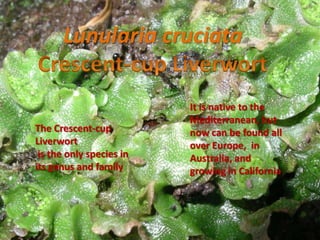
Lunularia cruciata

                          It is native to the
                          Mediterranean, but
The Crescent-cup          now can be found all
Liverwort                 over Europe, in
 is the only species in   Australia, and
its genus and family      growing in California
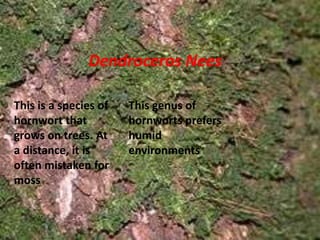
Dendroceros Nees

This is a species of   This genus of
hornwort that          hornworts prefers
grows on trees. At     humid
a distance, it is      environments
often mistaken for
moss
Sphagnum moss (peat moss)

 Sphagnum cristatum

Spagnum is probably the most
useful genus in the moss
phylum. When dried, as above,
it has been used all over the
world as fuel for millennia, and
is still used today.
                               This particular species is antiseptic,
                               and was used as absorbent in
                               Native American diapers, and also
                               to dress soldier’s wounds in world
                               war II.
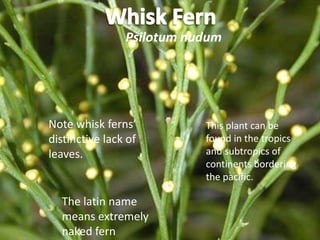
Psilotum nudum


Note whisk ferns’          This plant can be
distinctive lack of        found in the tropics
leaves.                    and subtropics of
                           continents bordering
                           the pacific.

  The latin name
  means extremely
  naked fern
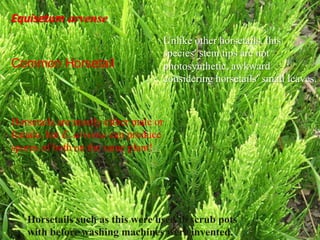
Equisetum arvense
                                   Unlike other horsetails, this
                                   species’ stem tips are not
Common Horsetail                   photosynthetic, awkward
                                   considering horsetails’ small leaves.


Horsetails are mostly either male or
female, but E. arvense can produce
spores of both on the same plant!


   Horsetails such as this were used to scrub pots
   with before washing machines were invented.
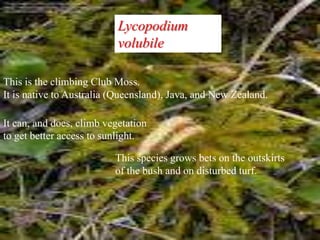
Lycopodium
                           volubile

This is the climbing Club Moss.
It is native to Australia (Queensland), Java, and New Zealand.

It can, and does, climb vegetation
to get better access to sunlight.

                          This species grows bets on the outskirts
                          of the bush and on disturbed turf.
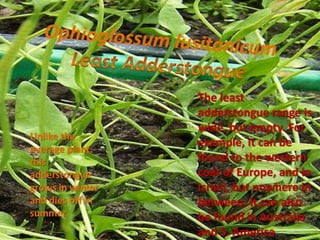
The least
                  adderstongue range is
                  wide, but empty. For
Unlike the
                  example, it can be
average plant,
this              found to the western
adderstongue      coat of Europe, and in
grows in winter   Israel, but nowhere in
and dies off in   between. It can also
summer            be found in Australia
                  and S. America
Azolla caroliniana

                       Wild mosquito fern

  The wild mosquito fern looks more like a
  moss than a fern, but it is an excellent
  example of ferns’ adaptability and niche-
  finding.


                                              Pond ferns such as this
     The reason that it looks like a          sometimes become
     moss is simply that the surface to       pests. This species can
     mass ratio of the plant had to be        double its mass in three
     greatly increased in order to            days under good
     allow it to float on ponds.              conditions.
Cycas rumphii
Sago paste, the
staple of some           Its native range is
cultures in the          the islands
tropical eastern         between Siam
pacific, is obtained     and Australia
from the pulp of this
                          Although it is called a
cycad. This makes it      palm, it is not even in
one of the very few       the same phylum.
conifers to have an       The visual
important role in         resemblance is
sustaining human          superficial
populations.
Their seeds look and taste like nuts,
 although they are not truly, and are
 thought to have many health benefits in
 East Asian society. The traditional
 remedies are not supported conclusively
 by science.

                                                        The last of its
                          Ginkgo biloba                 phylum, the
                                                        gingko is
                                                        considered a
                                                        living fossil

These trees have been cultivated by Chinese monks for hundreds of
years, (maybe thousands). These monks record that there are ginkgoes
3000 years old.
sequoiadendron giganteum      Giant sequoia


                           These impressive
                           trees are slow
                           giants, some
                           reaching an age of
                           3,500 years. Their
                           cones can take 20
                           years just to open!


                             The largest conifer,
                             it reaches heights
                             of 90+ft, diameters
                             of 17ft, and
                             volumes of over
                             42,500 cubic feet.
Welwitschia mirabilis
This plant is the only known member of the order Welwitschiales,.
It is only found in the Namibian dessert, and as the last of its
order, it is considered a living fossil.
                                    Although it doesn’t look like it, this
                                    plant only has two leaves, which
                                    grow for as long as the plant is
                                    alive and split into long straps due
                                    to weight and damage.
The plant gets a significant portion of its
water from dew, as its leaves are able to
open like pores and absorb condensation
during the night.

    It is the only gymnosperm to use CAM carbon-fixation
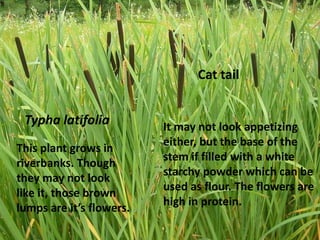
Cat tail


 Typha latifolia          It may not look appetizing
                          either, but the base of the
This plant grows in
                          stem if filled with a white
riverbanks. Though
                          starchy powder which can be
they may not look
                          used as flour. The flowers are
like it, those brown
                          high in protein.
lumps are it’s flowers.
Rubus fruticosus
                                               Common Blackberry


This plant is itself perennial,
but each of it’s vines are
biannual, leading to a
gradual buildup of old,
dead vines if pruning is not
done.

 Alternating generations:
                                  However, these
 The vines grow their first
                                  dead vines still
 year, then produce fruit         serve the plant
 the second, before dying.        by protecting it
                                  from grazing
                                  animals.
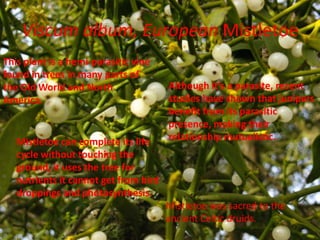
Viscum album, European Mistletoe
This plant is a hemi-parasitic vine
found in trees in many parts of
the Old World and North                Although it’s a parasite, recent
America.                               studies have shown that junipers
                                       benefit from its parasitic
                                       presence, making their
   Mistletoe can complete its life     relationship mutualistic.
   cycle without touching the
   ground, it uses the tree for
   nutrients it cannot get from bird
   droppings and photosynthesis.
                                       Mistletoe was sacred to the
                                       ancient Celtic druids.
Speaking of which…
• Merry Christmas, readers!