Welcome
To Our
Presentation
Effluent
Treatment
Plant
Presented to:
Md. Sajib Al Reza
Lecturer
Dept. of Food Technology and Nutritional Science
MBSTU
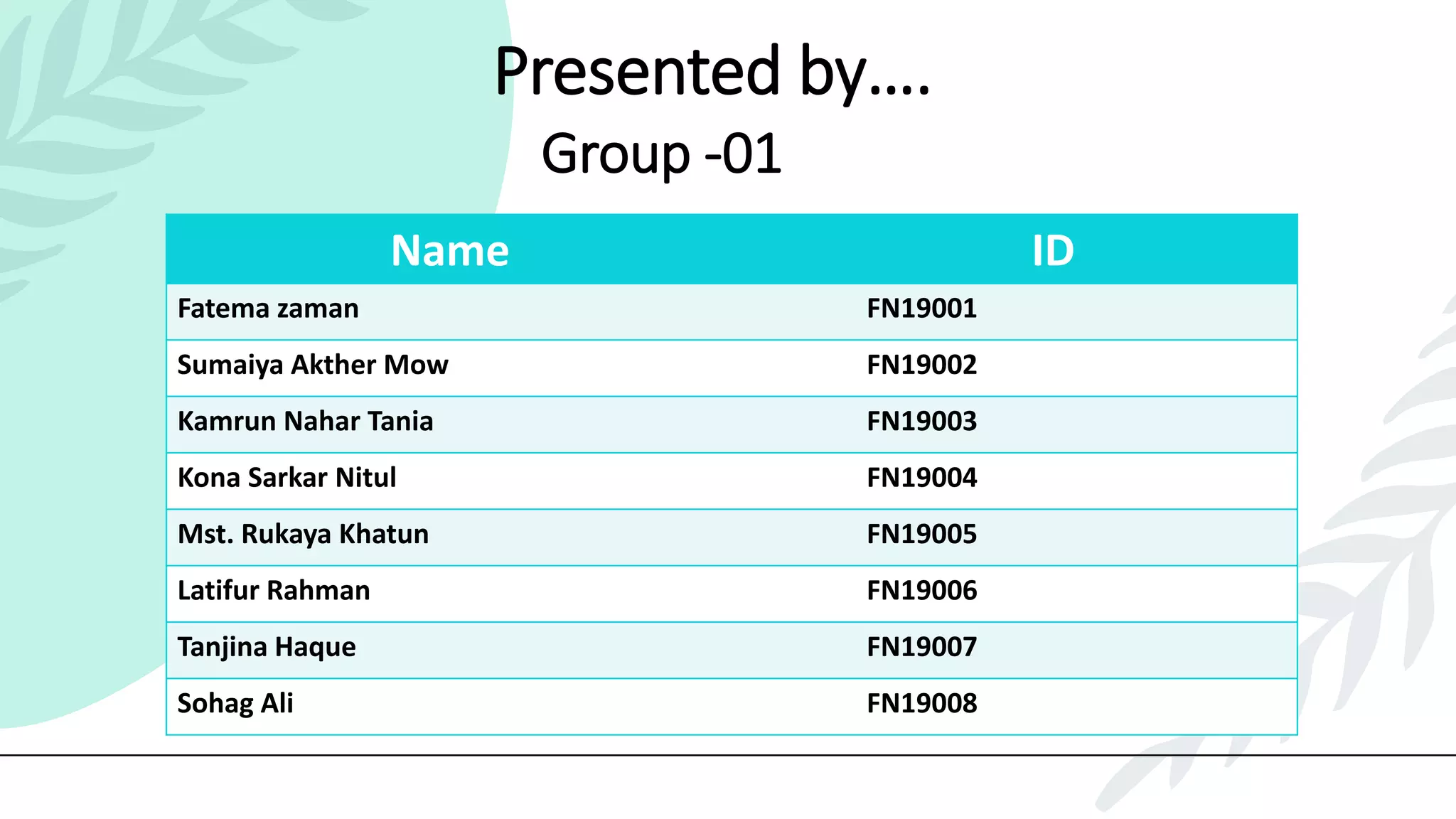
Presented by….
Group -01
Name ID
Fatema zaman FN19001
Sumaiya Akther Mow FN19002
Kamrun Nahar Tania FN19003
Kona Sarkar Nitul FN19004
Mst. Rukaya Khatun FN19005
Latifur Rahman FN19006
Tanjina Haque FN19007
Sohag Ali FN19008
Name ID
Israt Siddika Lima FN19009
Ratan Sarkar FN19010
Md. Riaz Hossen FN19011
Amiton Nesa FN19012
Md. Abu Hanif FN19014
Md. Liton FN19015
Tahmina Akter FN19016
Trisna Rani Saha FN19017
Jahidul Islam FN19018
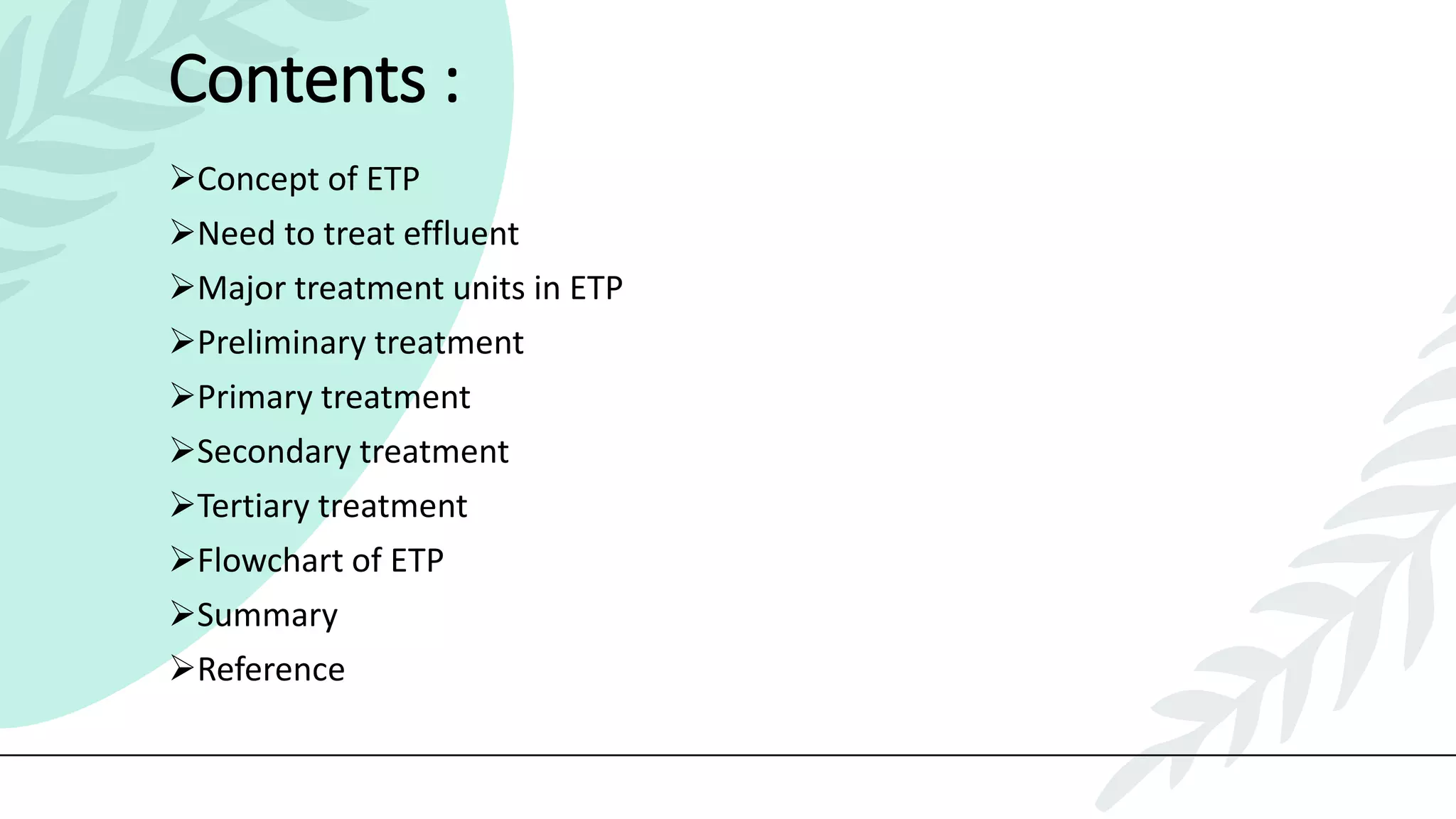
Contents :
Concept of ETP
Need to treat effluent
Major treatment units in ETP
Preliminary treatment
Primary treatment
Secondary treatment
Tertiary treatment
Flowchart of ETP
Summary
Reference
Reference:
Book :
A Text Book Of Environmental Chemistry
V. Subramanian
Google:
www.biotecharticles.com
www.sciencedirect.com
www.researchgatenet.com
www.lewa.ae/wastewater/treatment
www.neoakruthi.com › blog › effluent-treatment-plant-1
www.britannica.com/technology/wastewater-treatment
What is ETP?
ETP is a process design
for treating the
industrial wastewater for
its reuse or safe disposal
to the environment.
What is the purpose of ETP?
 Remove any toxic and non-toxic
material or chemicals.
 Water can be reused or released
in the environment .
 Used by most of the companies in
various industries to clean water.
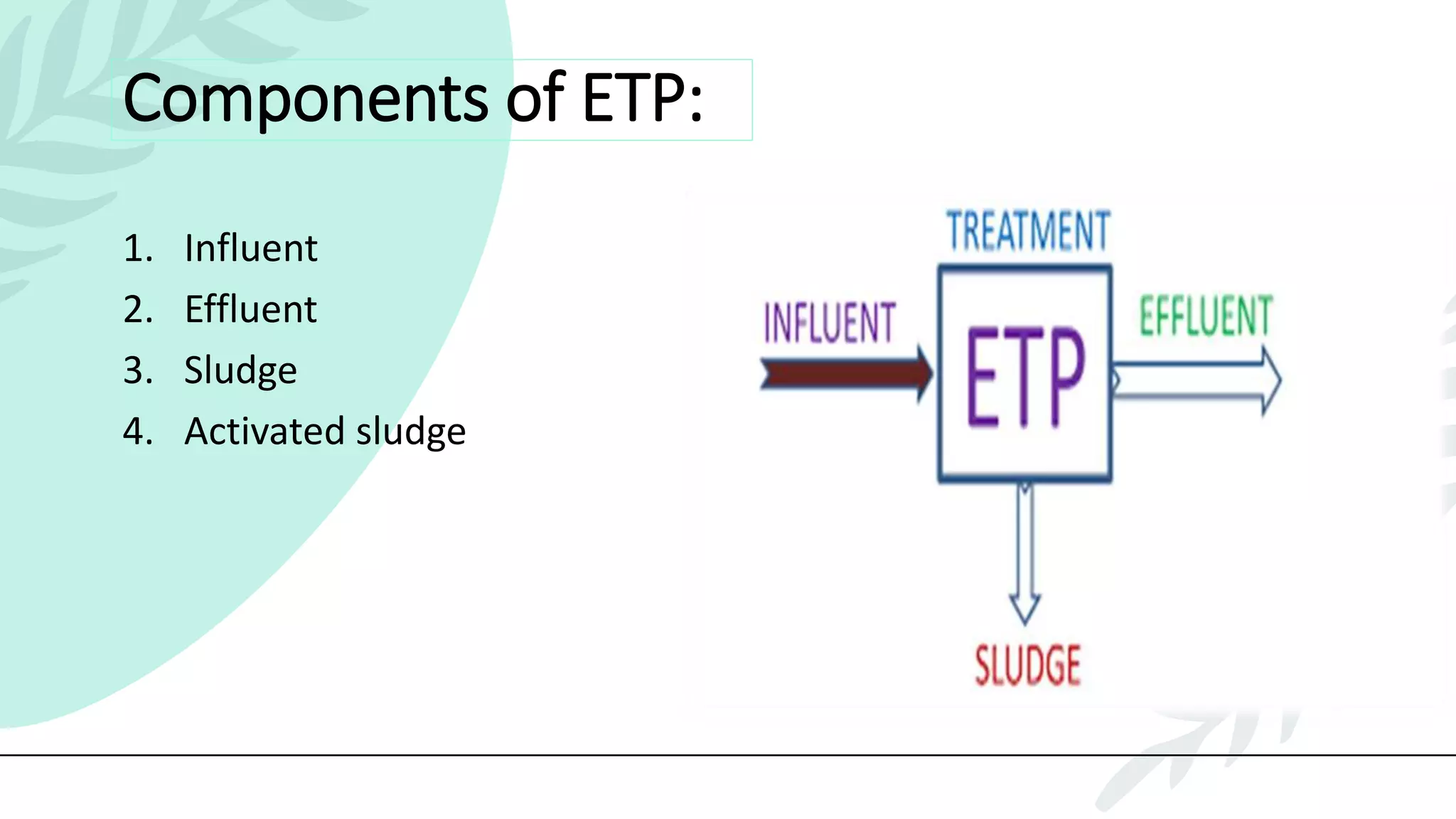
Components of ETP:
1. Influent
2. Effluent
3. Sludge
4. Activated sludge
Why Do We Need To Treat Effluent?
To prevent groundwater pollution
To prevent sea shore
To prevent soil pollution
To prevent marine life
Protection of public health
To reuse the treated effluent
For agriculture
For groundwater recharge
For industrial recycle
Key Parameters For Design Of An ETP
Design and size of
ETP depends
• Quantity & quality
of discharge
effluent
• Land availability
• Monetary
considerations
Area dimensions
depends
• Quality of waste
water
• Flow rate
• Type of biological
treatment
For less available
land
• CETP
• Preferred over ETP
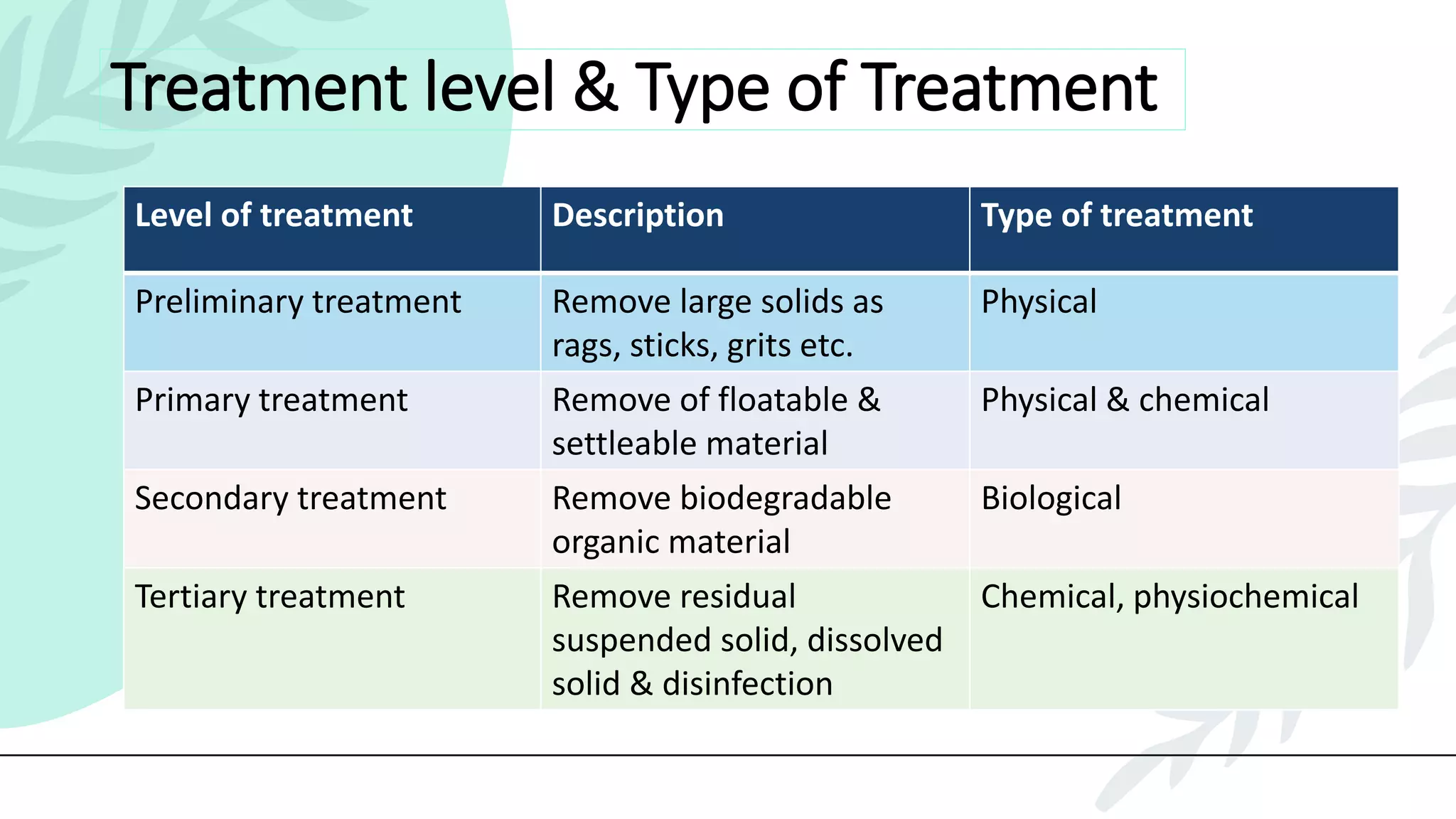
Treatment level & Type of Treatment
Level of treatment Description Type of treatment
Preliminary treatment Remove large solids as
rags, sticks, grits etc.
Physical
Primary treatment Remove of floatable &
settleable material
Physical & chemical
Secondary treatment Remove biodegradable
organic material
Biological
Tertiary treatment Remove residual
suspended solid, dissolved
solid & disinfection
Chemical, physiochemical
Benefits of ETP
To reduce expenditure on water
acquisition.
To reduce the usage of fresh water in
industries.
To clean industry effluent and recycle it for
further use.
To preserve natural environment against
pollution.
To meet the standards for emission of
pollutants set by the Government & avoid
heavy penalty.
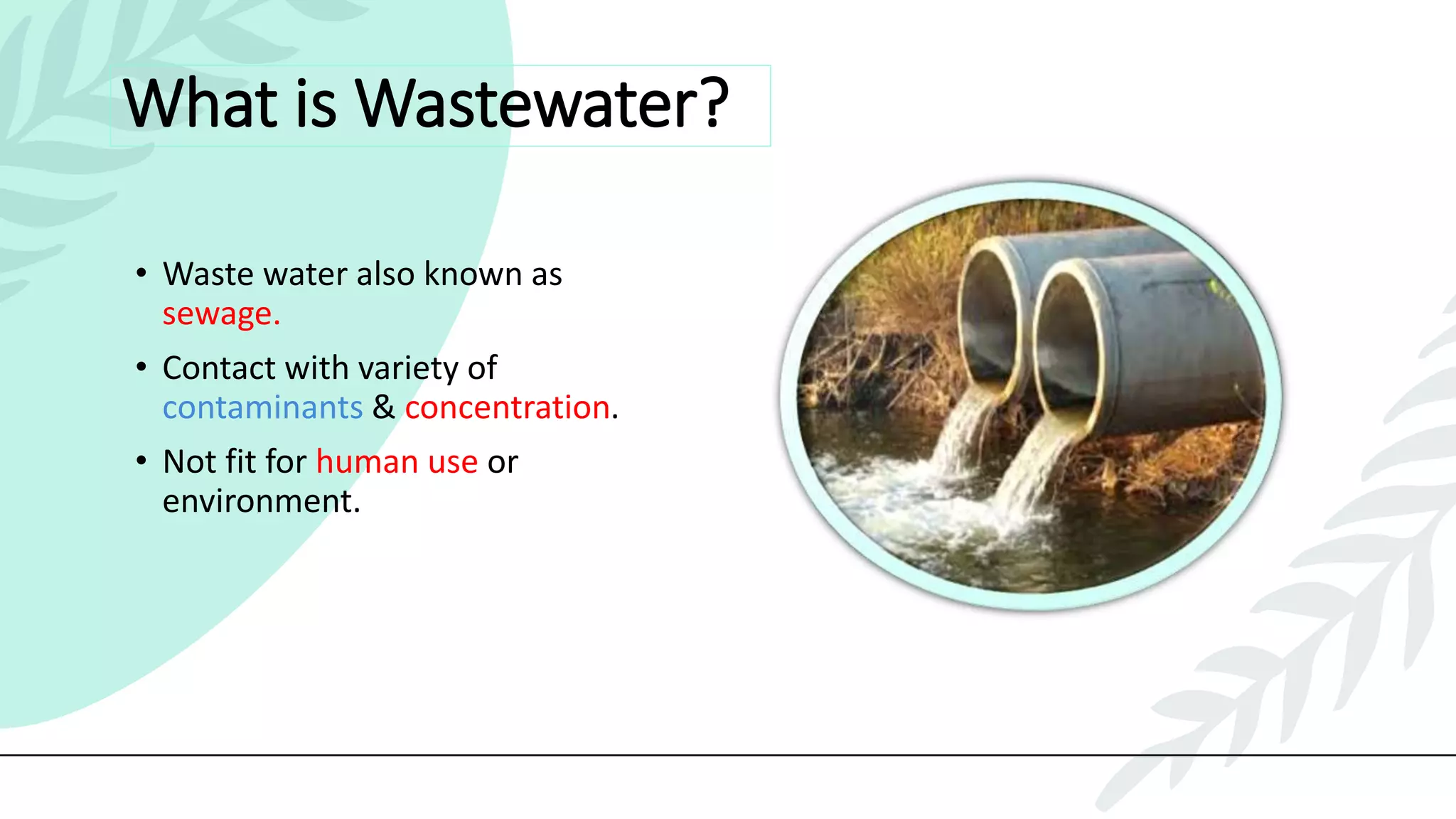
What is Wastewater?
• Waste water also known as
sewage.
• Contact with variety of
contaminants & concentration.
• Not fit for human use or
environment.
Where Does Wastewater Comes From?
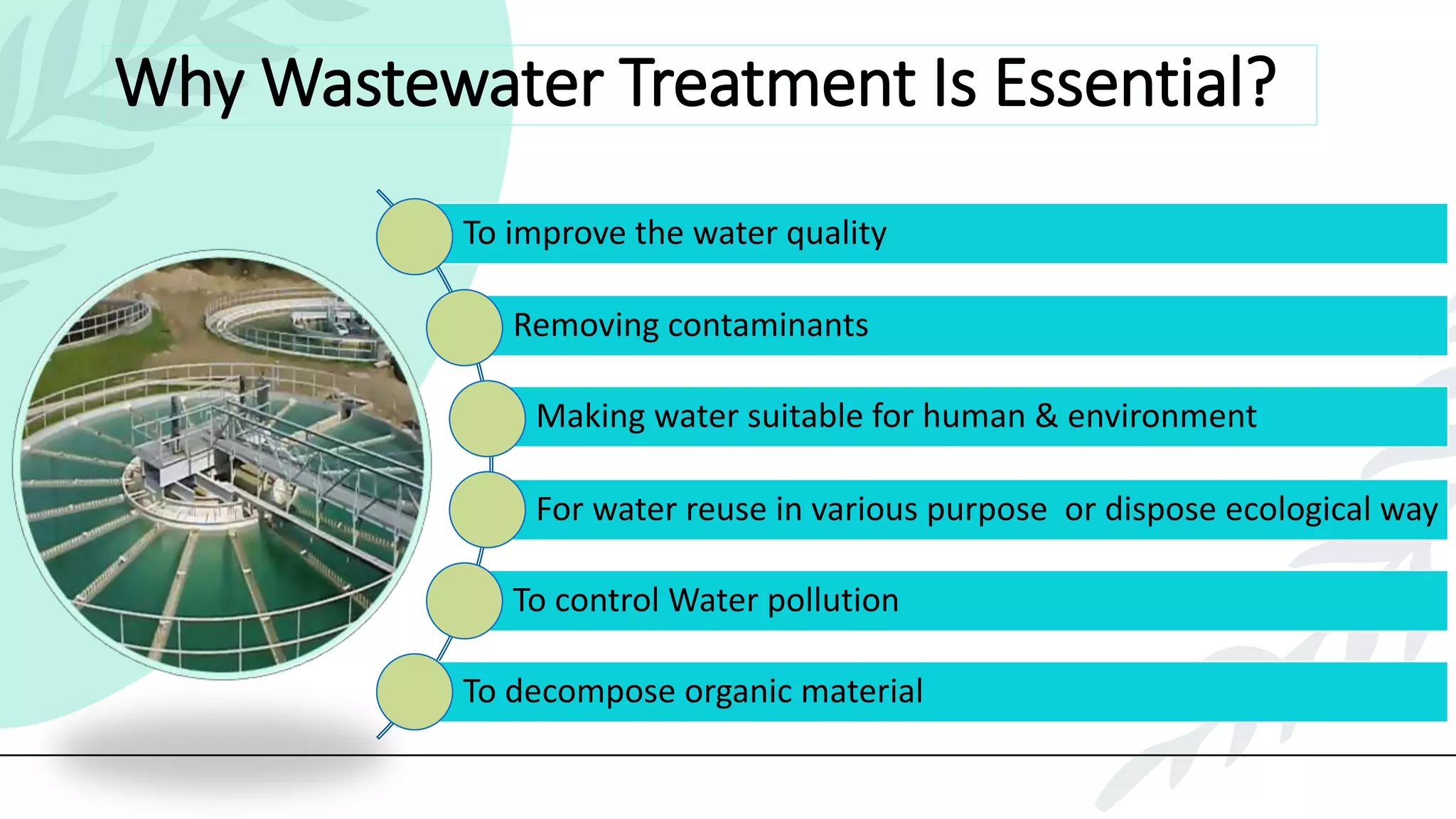
Why Wastewater Treatment Is Essential?
To improve the water quality
Removing contaminants
Making water suitable for human & environment
For water reuse in various purpose or dispose ecological way
To control Water pollution
To decompose organic material
What is wastewater treatment?
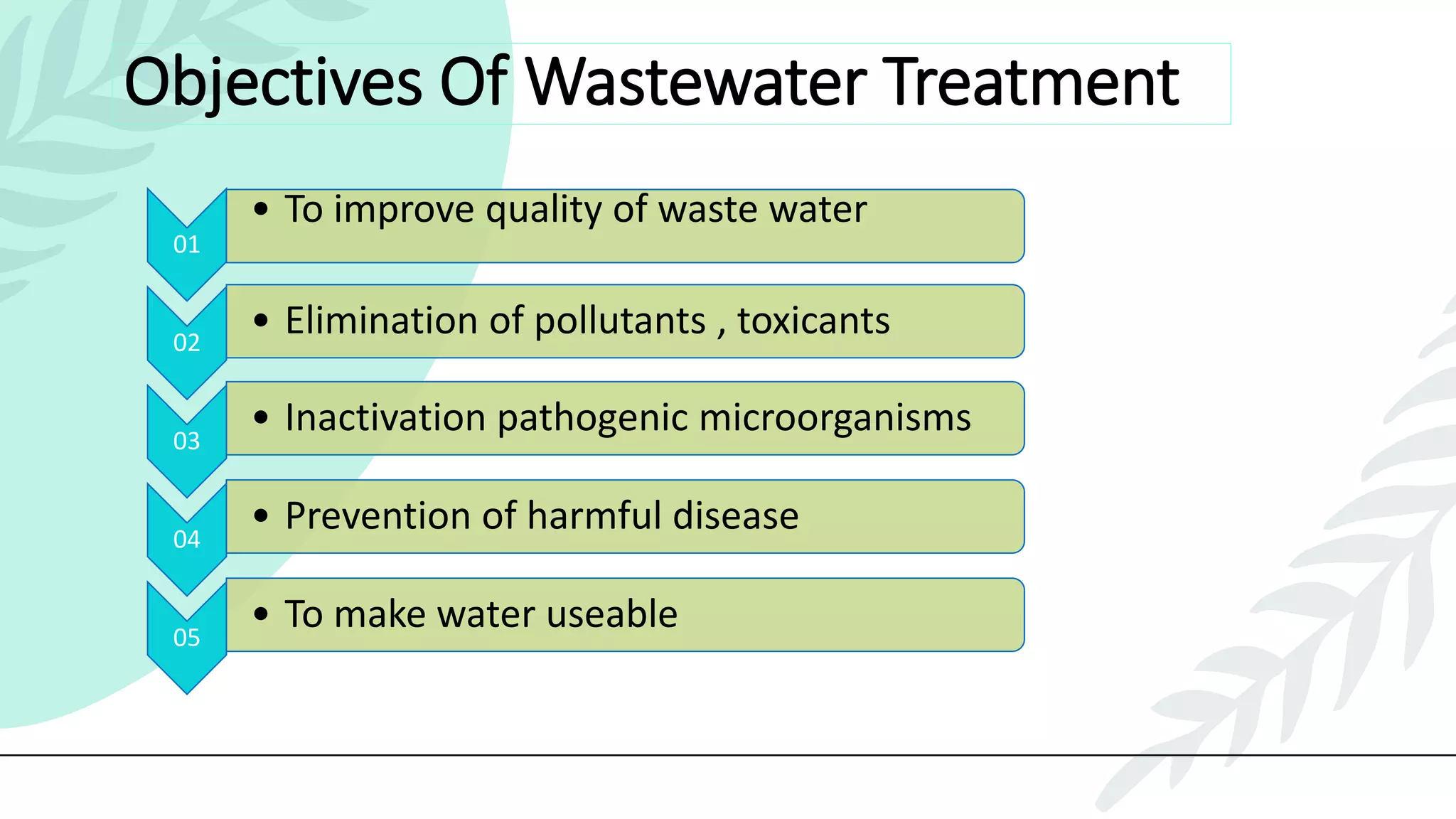
Objectives Of Wastewater Treatment
01
• To improve quality of waste water
02
• Elimination of pollutants , toxicants
03
• Inactivation pathogenic microorganisms
04
• Prevention of harmful disease
05
• To make water useable
Industrial Wastewater Treatment Process:
• There are four distinct steps of industrial waste water treatment process.
They are described below-
-Preliminary treatment
-Primary treatment
-Secondary treatment
-Tertiary/advanced treatment
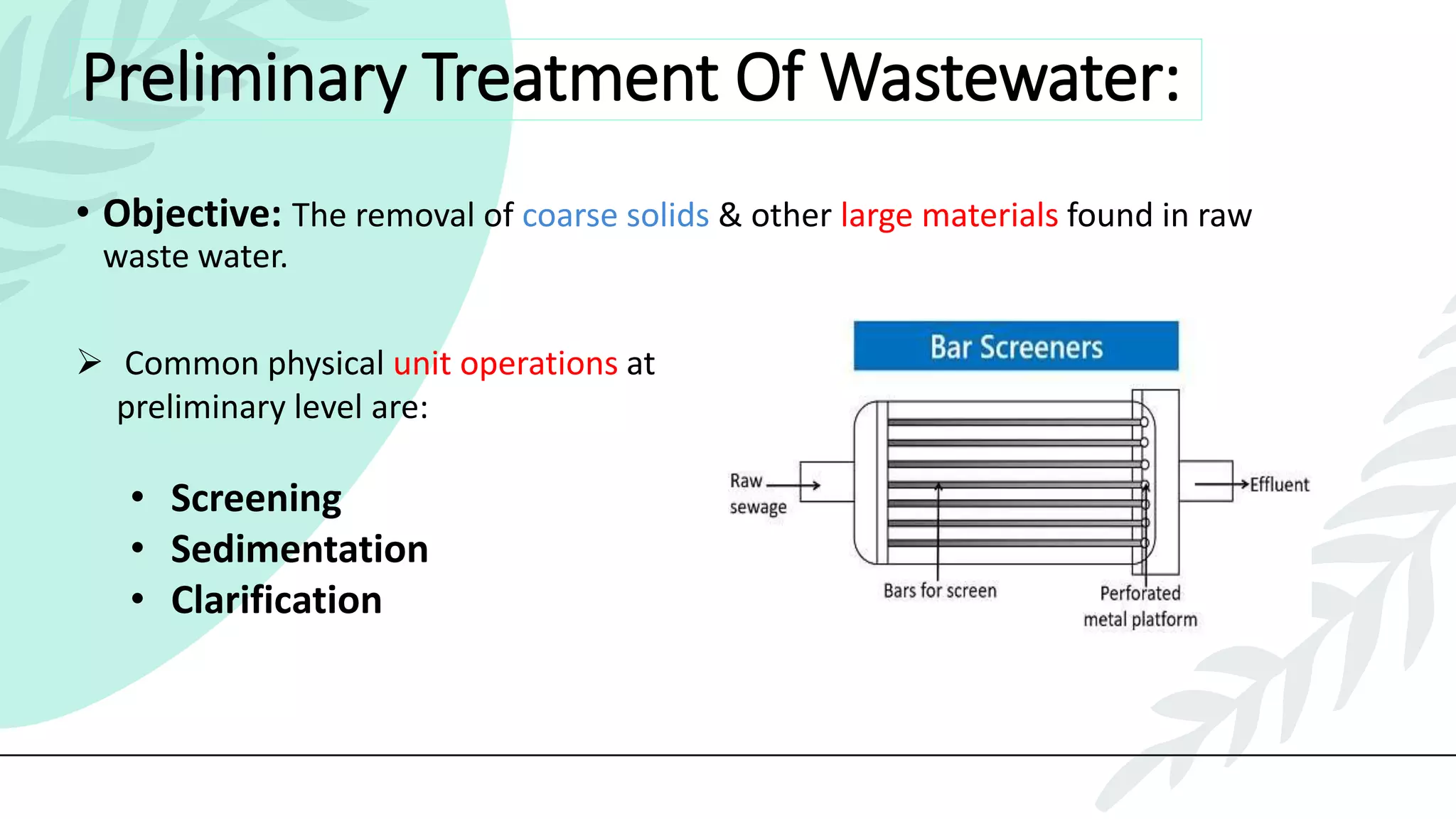
Preliminary Treatment Of Wastewater:
• Objective: The removal of coarse solids & other large materials found in raw
waste water.
 Common physical unit operations at
preliminary level are:
• Screening
• Sedimentation
• Clarification
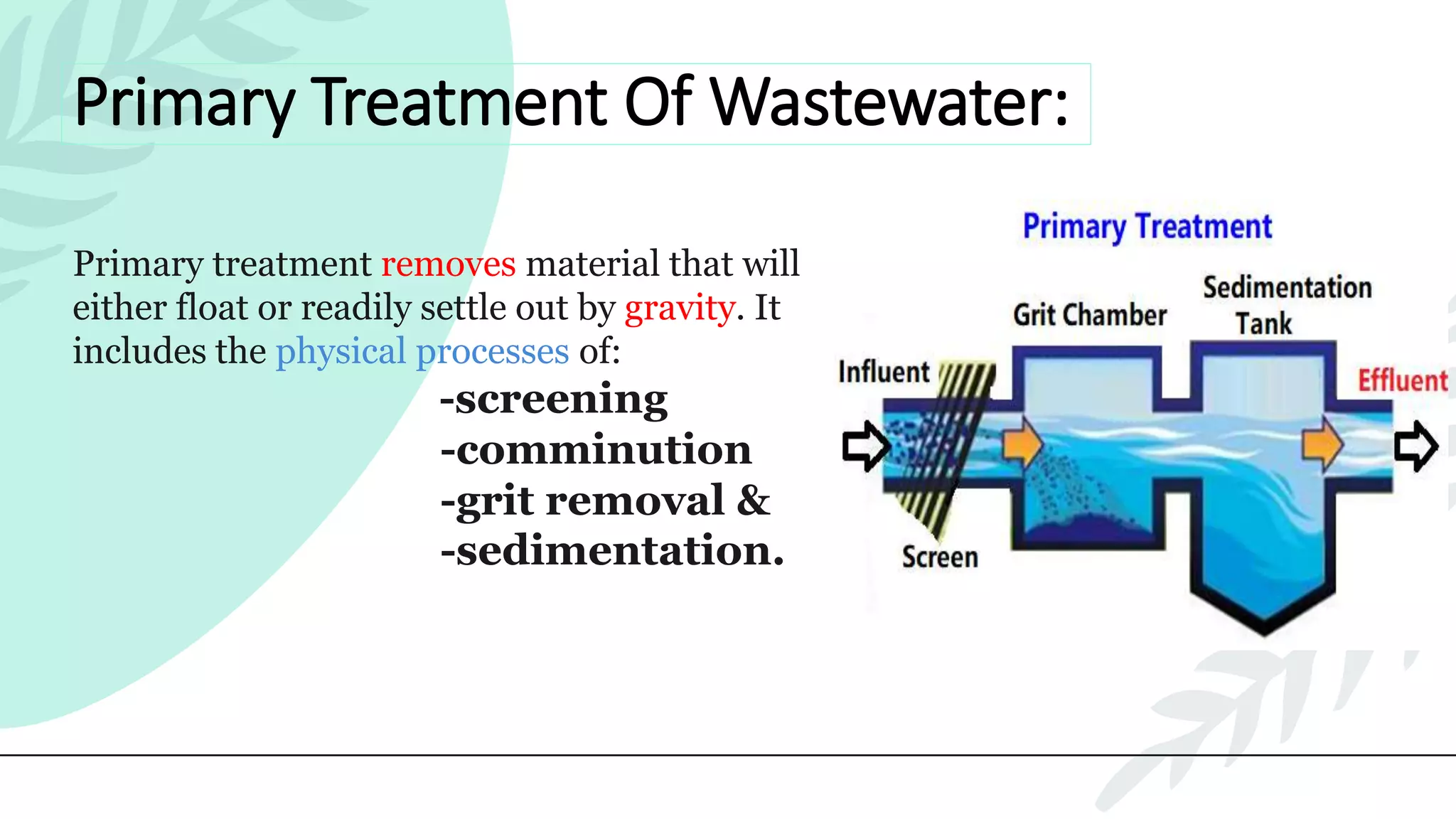
Primary Treatment Of Wastewater:
Primary treatment removes material that will
either float or readily settle out by gravity. It
includes the physical processes of:
-screening
-comminution
-grit removal &
-sedimentation.
Primary Treatment Of Wastewater:
• Remove floating, settleable materials
• Ex. Suspended solids, organic matters
Purpose
• Physical
• Chemical
Method
pH control/neutralization
Chemical unit process
Chemical coagulation
Chemical flocculation
• Adjust pH to make waste water neutral
• For acidic wastes : NaOH, Ca(OH)2 etc.
• It is used with physical operations
• Chemical add wastewater for changes its quality.
• Refers to collecting the minute solid particles
• Chemical coagulants improve fine particles & form
flocs
• Flocculent enhance flocculation process
• Flocculation is aided by gentle mixing
Secondary Treatment Of Wastewater:
-is a biological treatment process designed to reduce the amount of organic
materials in the wastewater before it is discharge to a disposal field for final
treatment & dispersal in the soil.
Objectives: to remove the
residual organics and
suspended solids.
Methods: chemical &
biological process.
Secondary Treatment Of Wastewater:
Can take many
forms
All are based on
microorganisms
Biological
process
Take place in the
presence of air
Utilize aerobes
microorganisms
Aerobic
process
Take place in the
absence of air
Utilize anaerobes
microorganisms
Anaerobic
process
Tertiary/Advanced Treatment Of Wastewater:
• Tertiary wastewater treatment involves a series of steps to further reduce
organic concentration, turbidity, N, P, metals & pathogens.
Advanced Treatment Of Wastewater:
Purpose
• Final cleaning process
• Improves waste water
quality
Mechanism
• Removes inorganic
compounds & substances
• Such as N,P, Bacteria,
Virus, Parasites.
Method
• Alum:
• To remove additional
phosphorus particles
• Chlorine:
• Disinfects tertiary
treated wastewater
• Removing
microorganisms
• Remove extra Cl.
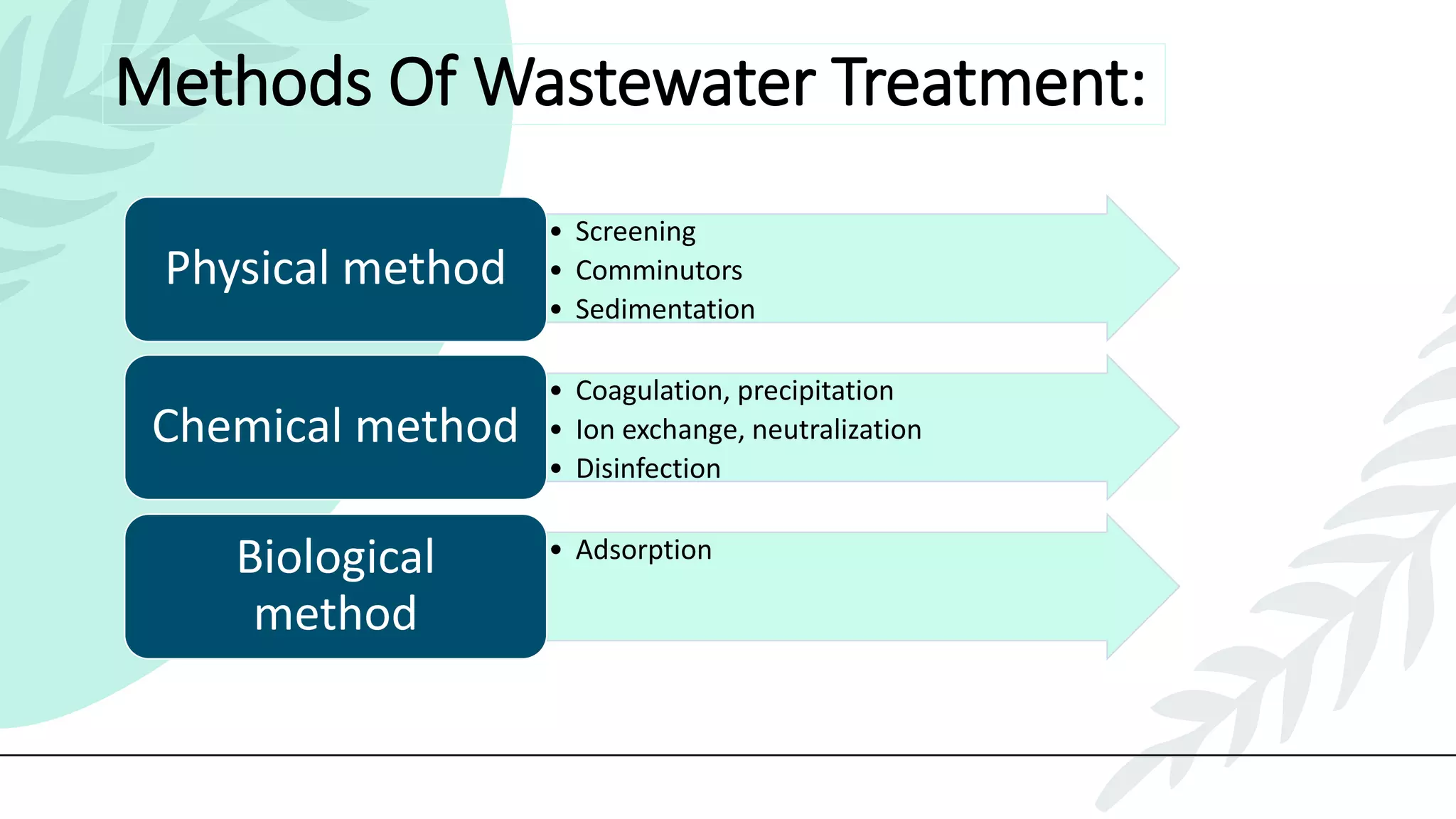
Methods Of Wastewater Treatment:
• Screening
• Comminutors
• Sedimentation
Physical method
• Coagulation, precipitation
• Ion exchange, neutralization
• Disinfection
Chemical method
• Adsorption
Biological
method
Biological Treatment Method
Aerated lagoon process
Trickling process
Activated sludge process
Anaerobic digestion
Oxidation pond
Aerated Lagoons Process
• An aerated lagoon (or aerated pond) is a simple wastewater treatment system
consisting of a pond with artificial aeration to promote the biological oxidation of
wastewaters.
Trickling Filters Process
• Trickling filters (TFs) are used to remove organic matter from wastewater. The TF
is an aerobic treatment system that utilizes microorganisms attached to a
medium to remove organic matter from wastewater.
Trickling Filters Process
Advantage
Good quality BOD removal
65 to 85%
Simple to operate
Manual attention not
needed
Disadvantage
High capital costs
Possible odor problems
Clogging of distributor
arms
Application Of Trickling Filters Process
Trickling filters are effectively used for treatment of industrial
wastes from:
-dairy, food processing
-distillery, pulp & paper mills
-brewery, pharmaceuticals
-slaughter house etc.
Activated Sludge Process:
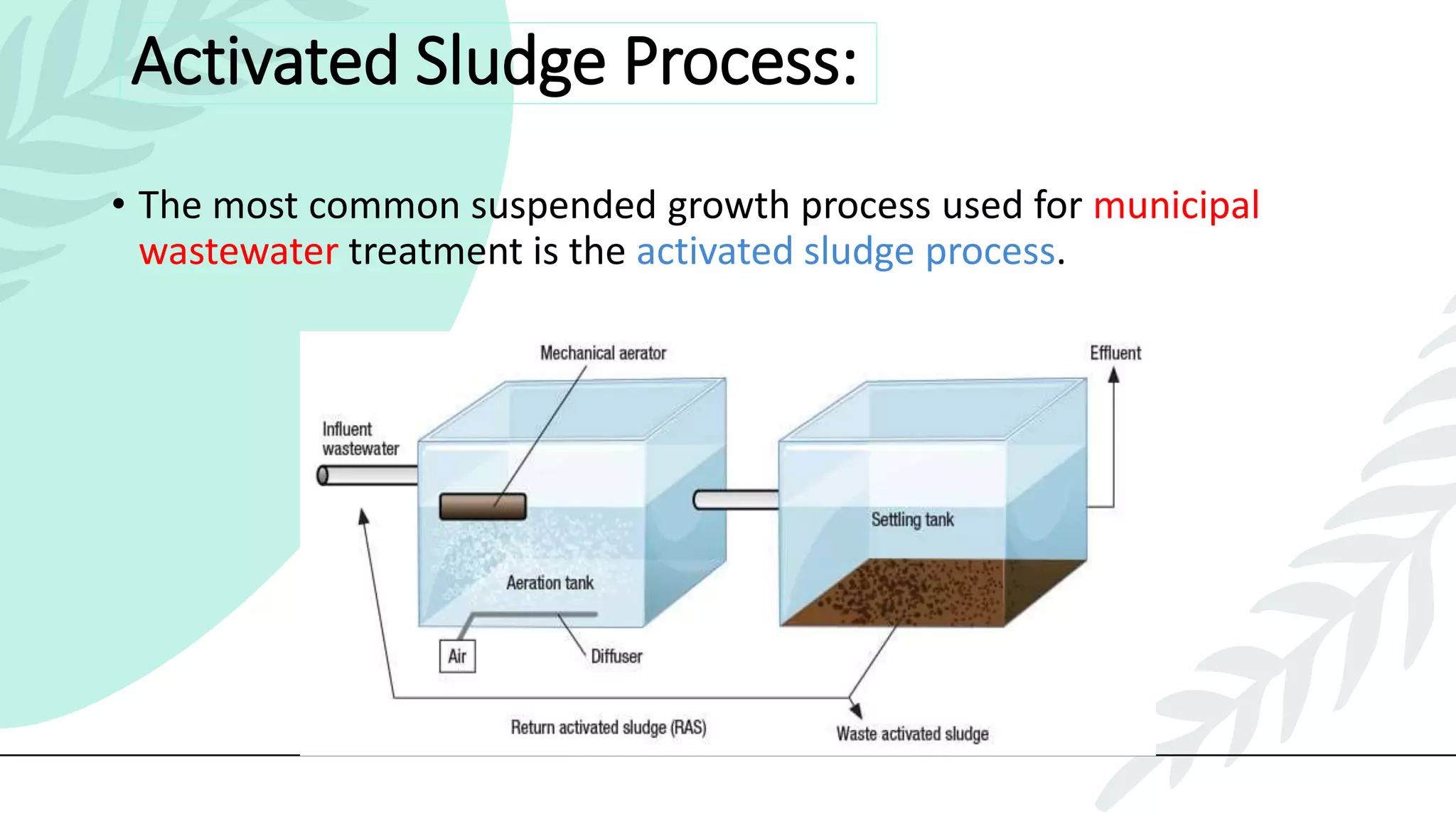
• The most common suspended growth process used for municipal
wastewater treatment is the activated sludge process.
Activated Sludge Process:
oWastewater is aerated in reaction tank in which some microbial
floc is suspended .
oAerobic bacterial flora grows & remains suspended in the from
of floc, that is called “activated sludge”.
oThe effluent from the reaction tank is separated from sludge by
settling & discharged.
oFrom here, BOD removal to the extent from 90-95% can be
achieved .
Activated Sludge Process:
Advantage
Produce high quality effluent
Almost 95% BOD can remove
Mostly used food, sugar, textile processing
Disadvantage
Needs careful attention
Maintenance & operation cost high
Have sensitivity toxic & organic substance
Anaerobic Digestion
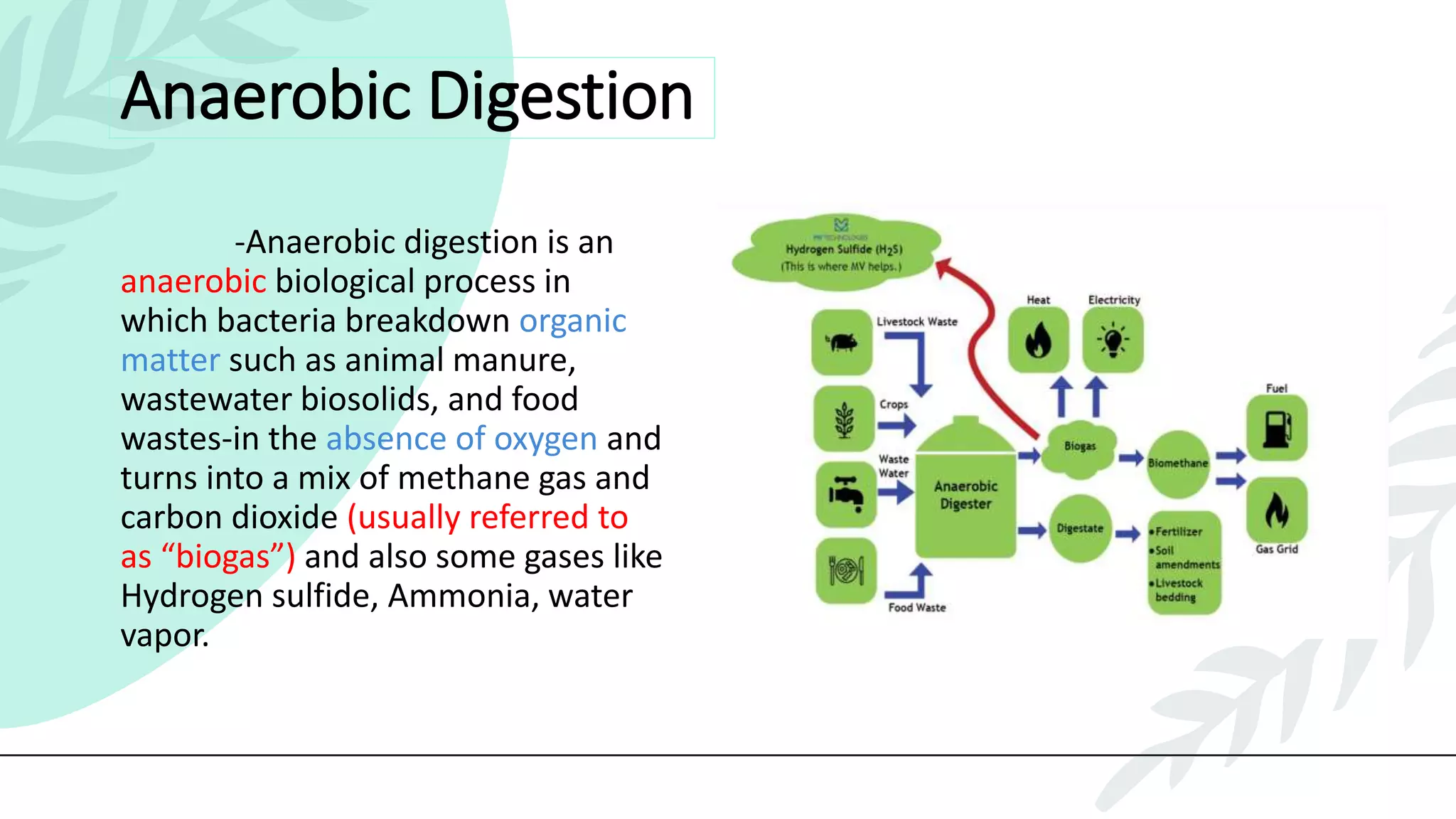
-Anaerobic digestion is an
anaerobic biological process in
which bacteria breakdown organic
matter such as animal manure,
wastewater biosolids, and food
wastes-in the absence of oxygen and
turns into a mix of methane gas and
carbon dioxide (usually referred to
as “biogas”) and also some gases like
Hydrogen sulfide, Ammonia, water
vapor.
Anaerobic Sludge Digestion Process:
 Mixture of farm waste is fed into
the biogas plant.
 Slurry is then fed into the digester.
 Anaerobic bacteria in digester
carry out decomposition of slurry.
 Biogas is sent out through an
outlet so that it can be suitably
used.
 Decomposed matter is taken out.
Anaerobic Digestion Process
Advantage
●Low operating
costs
Proven effectiveness
Burnable gas produced
Disadvantage
●Long start-up time
Affected by changes
in conditions.
Explosive gas produced
Application of Anaerobic Digestion Process
The process is used for industrial or domestic purposes to
manage waste or to produce fuels.
● Source of fuel, heat and electricity.
● Animal bedding production.
● Compost production.
● Solid fuel pellets production.
● Biochar production.
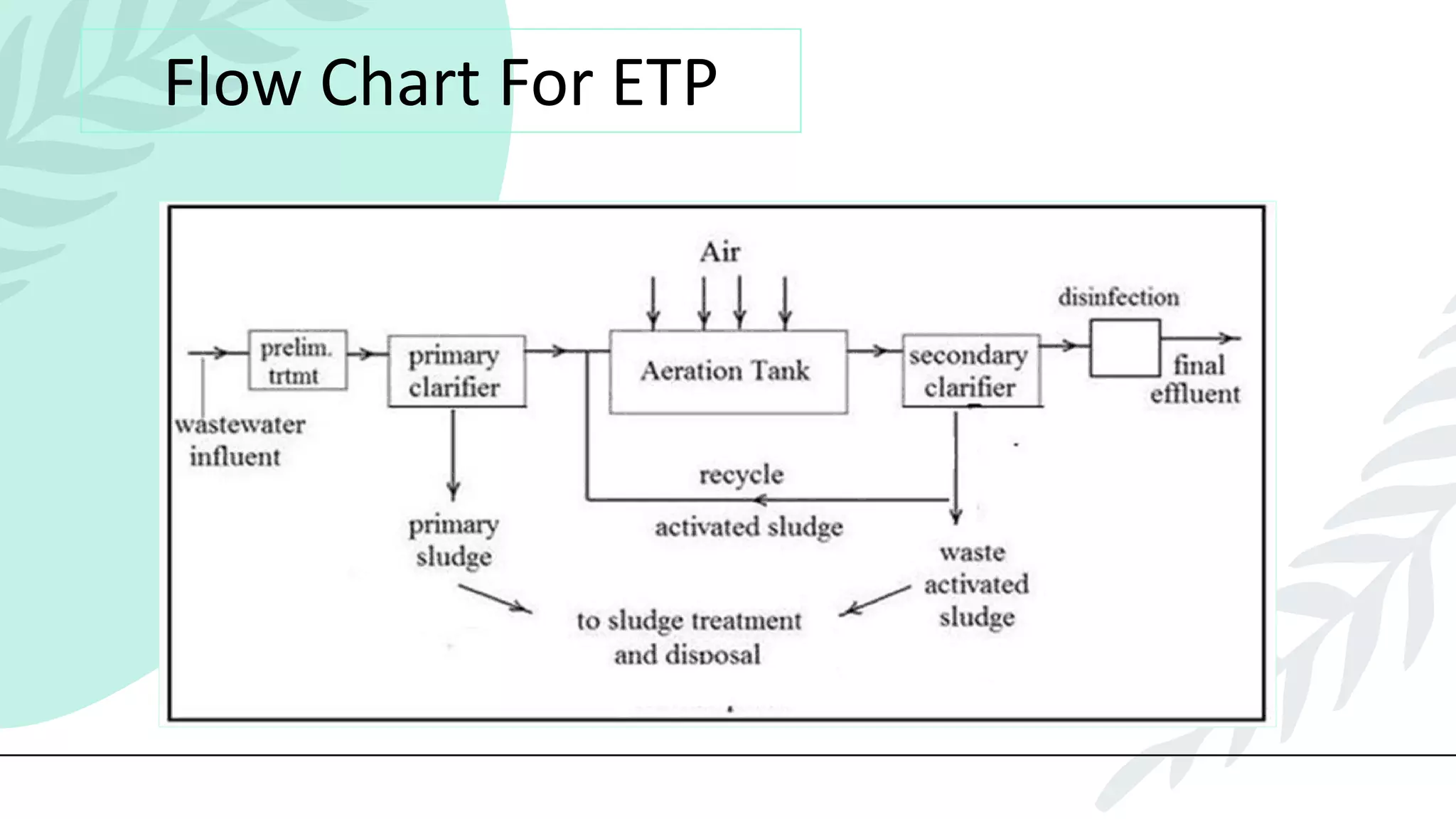
Flow Chart For ETP
Conclusion
o Different types of industrial waste water is treated by
ETP for environmental & public health safety .
o Major treatment procedures are preliminary , primary,
secondary & tertiary treatment which remove high
amount of organic, inorganic, toxic & non-toxic
compounds from wastewater.
o After the effluent treatment , wastewater should be
evaluated with different parameters of temperature,
PH, TDS, COD, BOD etc.
ETP.pptx
ETP.pptx

ETP.pptx

  • 1.
  • 2.
    Effluent Treatment Plant Presented to: Md. SajibAl Reza Lecturer Dept. of Food Technology and Nutritional Science MBSTU
  • 3.
    Presented by…. Group -01 NameID Fatema zaman FN19001 Sumaiya Akther Mow FN19002 Kamrun Nahar Tania FN19003 Kona Sarkar Nitul FN19004 Mst. Rukaya Khatun FN19005 Latifur Rahman FN19006 Tanjina Haque FN19007 Sohag Ali FN19008
  • 4.
    Name ID Israt SiddikaLima FN19009 Ratan Sarkar FN19010 Md. Riaz Hossen FN19011 Amiton Nesa FN19012 Md. Abu Hanif FN19014 Md. Liton FN19015 Tahmina Akter FN19016 Trisna Rani Saha FN19017 Jahidul Islam FN19018
  • 5.
    Contents : Concept ofETP Need to treat effluent Major treatment units in ETP Preliminary treatment Primary treatment Secondary treatment Tertiary treatment Flowchart of ETP Summary Reference
  • 6.
    Reference: Book : A TextBook Of Environmental Chemistry V. Subramanian Google: www.biotecharticles.com www.sciencedirect.com www.researchgatenet.com www.lewa.ae/wastewater/treatment www.neoakruthi.com › blog › effluent-treatment-plant-1 www.britannica.com/technology/wastewater-treatment
  • 7.
    What is ETP? ETPis a process design for treating the industrial wastewater for its reuse or safe disposal to the environment.
  • 8.
    What is thepurpose of ETP?  Remove any toxic and non-toxic material or chemicals.  Water can be reused or released in the environment .  Used by most of the companies in various industries to clean water.
  • 9.
    Components of ETP: 1.Influent 2. Effluent 3. Sludge 4. Activated sludge
  • 10.
    Why Do WeNeed To Treat Effluent? To prevent groundwater pollution To prevent sea shore To prevent soil pollution To prevent marine life Protection of public health To reuse the treated effluent For agriculture For groundwater recharge For industrial recycle
  • 11.
    Key Parameters ForDesign Of An ETP Design and size of ETP depends • Quantity & quality of discharge effluent • Land availability • Monetary considerations Area dimensions depends • Quality of waste water • Flow rate • Type of biological treatment For less available land • CETP • Preferred over ETP
  • 12.
    Treatment level &Type of Treatment Level of treatment Description Type of treatment Preliminary treatment Remove large solids as rags, sticks, grits etc. Physical Primary treatment Remove of floatable & settleable material Physical & chemical Secondary treatment Remove biodegradable organic material Biological Tertiary treatment Remove residual suspended solid, dissolved solid & disinfection Chemical, physiochemical
  • 13.
    Benefits of ETP Toreduce expenditure on water acquisition. To reduce the usage of fresh water in industries. To clean industry effluent and recycle it for further use. To preserve natural environment against pollution. To meet the standards for emission of pollutants set by the Government & avoid heavy penalty.
  • 14.
    What is Wastewater? •Waste water also known as sewage. • Contact with variety of contaminants & concentration. • Not fit for human use or environment.
  • 15.
  • 16.
    Why Wastewater TreatmentIs Essential? To improve the water quality Removing contaminants Making water suitable for human & environment For water reuse in various purpose or dispose ecological way To control Water pollution To decompose organic material
  • 17.
  • 18.
    Objectives Of WastewaterTreatment 01 • To improve quality of waste water 02 • Elimination of pollutants , toxicants 03 • Inactivation pathogenic microorganisms 04 • Prevention of harmful disease 05 • To make water useable
  • 19.
    Industrial Wastewater TreatmentProcess: • There are four distinct steps of industrial waste water treatment process. They are described below- -Preliminary treatment -Primary treatment -Secondary treatment -Tertiary/advanced treatment
  • 20.
    Preliminary Treatment OfWastewater: • Objective: The removal of coarse solids & other large materials found in raw waste water.  Common physical unit operations at preliminary level are: • Screening • Sedimentation • Clarification
  • 21.
    Primary Treatment OfWastewater: Primary treatment removes material that will either float or readily settle out by gravity. It includes the physical processes of: -screening -comminution -grit removal & -sedimentation.
  • 22.
    Primary Treatment OfWastewater: • Remove floating, settleable materials • Ex. Suspended solids, organic matters Purpose • Physical • Chemical Method pH control/neutralization Chemical unit process Chemical coagulation Chemical flocculation • Adjust pH to make waste water neutral • For acidic wastes : NaOH, Ca(OH)2 etc. • It is used with physical operations • Chemical add wastewater for changes its quality. • Refers to collecting the minute solid particles • Chemical coagulants improve fine particles & form flocs • Flocculent enhance flocculation process • Flocculation is aided by gentle mixing
  • 23.
    Secondary Treatment OfWastewater: -is a biological treatment process designed to reduce the amount of organic materials in the wastewater before it is discharge to a disposal field for final treatment & dispersal in the soil. Objectives: to remove the residual organics and suspended solids. Methods: chemical & biological process.
  • 24.
    Secondary Treatment OfWastewater: Can take many forms All are based on microorganisms Biological process Take place in the presence of air Utilize aerobes microorganisms Aerobic process Take place in the absence of air Utilize anaerobes microorganisms Anaerobic process
  • 25.
    Tertiary/Advanced Treatment OfWastewater: • Tertiary wastewater treatment involves a series of steps to further reduce organic concentration, turbidity, N, P, metals & pathogens.
  • 26.
    Advanced Treatment OfWastewater: Purpose • Final cleaning process • Improves waste water quality Mechanism • Removes inorganic compounds & substances • Such as N,P, Bacteria, Virus, Parasites. Method • Alum: • To remove additional phosphorus particles • Chlorine: • Disinfects tertiary treated wastewater • Removing microorganisms • Remove extra Cl.
  • 27.
    Methods Of WastewaterTreatment: • Screening • Comminutors • Sedimentation Physical method • Coagulation, precipitation • Ion exchange, neutralization • Disinfection Chemical method • Adsorption Biological method
  • 28.
    Biological Treatment Method Aeratedlagoon process Trickling process Activated sludge process Anaerobic digestion Oxidation pond
  • 29.
    Aerated Lagoons Process •An aerated lagoon (or aerated pond) is a simple wastewater treatment system consisting of a pond with artificial aeration to promote the biological oxidation of wastewaters.
  • 30.
    Trickling Filters Process •Trickling filters (TFs) are used to remove organic matter from wastewater. The TF is an aerobic treatment system that utilizes microorganisms attached to a medium to remove organic matter from wastewater.
  • 31.
    Trickling Filters Process Advantage Goodquality BOD removal 65 to 85% Simple to operate Manual attention not needed Disadvantage High capital costs Possible odor problems Clogging of distributor arms
  • 32.
    Application Of TricklingFilters Process Trickling filters are effectively used for treatment of industrial wastes from: -dairy, food processing -distillery, pulp & paper mills -brewery, pharmaceuticals -slaughter house etc.
  • 33.
    Activated Sludge Process: •The most common suspended growth process used for municipal wastewater treatment is the activated sludge process.
  • 34.
    Activated Sludge Process: oWastewateris aerated in reaction tank in which some microbial floc is suspended . oAerobic bacterial flora grows & remains suspended in the from of floc, that is called “activated sludge”. oThe effluent from the reaction tank is separated from sludge by settling & discharged. oFrom here, BOD removal to the extent from 90-95% can be achieved .
  • 35.
    Activated Sludge Process: Advantage Producehigh quality effluent Almost 95% BOD can remove Mostly used food, sugar, textile processing Disadvantage Needs careful attention Maintenance & operation cost high Have sensitivity toxic & organic substance
  • 36.
    Anaerobic Digestion -Anaerobic digestionis an anaerobic biological process in which bacteria breakdown organic matter such as animal manure, wastewater biosolids, and food wastes-in the absence of oxygen and turns into a mix of methane gas and carbon dioxide (usually referred to as “biogas”) and also some gases like Hydrogen sulfide, Ammonia, water vapor.
  • 37.
    Anaerobic Sludge DigestionProcess:  Mixture of farm waste is fed into the biogas plant.  Slurry is then fed into the digester.  Anaerobic bacteria in digester carry out decomposition of slurry.  Biogas is sent out through an outlet so that it can be suitably used.  Decomposed matter is taken out.
  • 38.
    Anaerobic Digestion Process Advantage ●Lowoperating costs Proven effectiveness Burnable gas produced Disadvantage ●Long start-up time Affected by changes in conditions. Explosive gas produced
  • 39.
    Application of AnaerobicDigestion Process The process is used for industrial or domestic purposes to manage waste or to produce fuels. ● Source of fuel, heat and electricity. ● Animal bedding production. ● Compost production. ● Solid fuel pellets production. ● Biochar production.
  • 40.
  • 41.
    Conclusion o Different typesof industrial waste water is treated by ETP for environmental & public health safety . o Major treatment procedures are preliminary , primary, secondary & tertiary treatment which remove high amount of organic, inorganic, toxic & non-toxic compounds from wastewater. o After the effluent treatment , wastewater should be evaluated with different parameters of temperature, PH, TDS, COD, BOD etc.