Melanie Booth Director, Center for Experiential Learning & Assessment / PLA Gretchen Potter Director of Admissions Gwen Hyatt Registrar MARYLHURST UNIVERSITY May 19, 2009 Harvesting Adult Learners’ Prior Knowledge:  Prior Learning Assessment  in Higher Education
Inventory of Knowledge Introduce yourself to the person next to you and identify what you know about Prior Learning Assessment. Please share out: What do you know? Why are you here?
History of   PLA PLA is a result of 3 significant social movements in the US: The adult education movement The non-traditional higher education movement The increasing sophistication of assessment  PLA has thus been …  part of a sweeping and multifaceted movement to rewrite the relationship between the university and the larger society. The implementation of PLA was largely congruent with such trends as ‘relevance’ in education, greater access for underserved populations, joint ventures between colleges and the private sector, and a more inclusive curriculum (Michelson, 1997, p. 42).
PLA Philosophy / Theory   Experience can be a source of significant learning and knowledge When [adult] learners come to college, they are not blank slates or empty pails.  PLA programs Honor learners’ prior experiences by providing a means for them to gain credit for the resulting college-level learning, Help learners reflect and then be able to  build upon  these experiences, and Help facilitate learners’ awareness of the great advantages of continual learning.
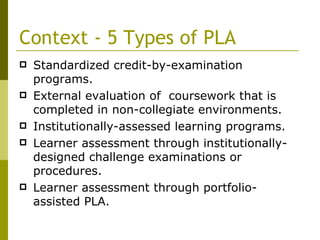
Context - 5 Types of PLA Standardized credit-by-examination programs. External evaluation of  coursework that is completed in non-collegiate environments. Institutionally-assessed learning programs. Learner assessment through institutionally-designed challenge examinations or procedures. Learner assessment through portfolio-assisted PLA.
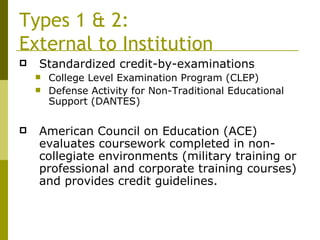
Types 1 & 2:  External to Institution Standardized credit-by-examinations College Level Examination Program (CLEP) Defense Activity for Non-Traditional Educational Support (DANTES) American Council on Education (ACE) evaluates coursework completed in non-collegiate environments (military training or professional and corporate training courses) and provides credit guidelines.
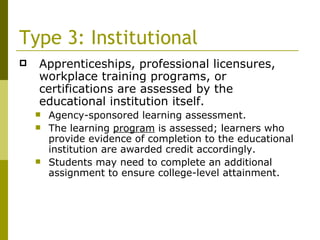
Type 3: Institutional Apprenticeships, professional licensures, workplace training programs, or certifications are assessed by the educational institution itself. Agency-sponsored learning assessment. The learning  program  is assessed; learners who provide evidence of completion to the educational institution are awarded credit accordingly. Students may need to complete an additional assignment to ensure college-level attainment.
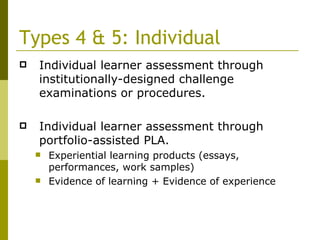
Types 4 & 5: Individual Individual learner assessment through institutionally-designed challenge examinations or procedures. Individual learner assessment through portfolio-assisted PLA. Experiential learning products (essays, performances, work samples) Evidence of learning + Evidence of experience
PLA Programs at  Marylhurst University
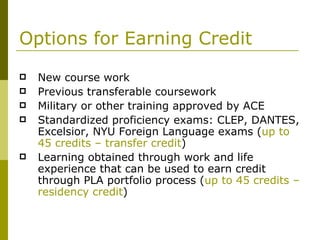
Options for Earning Credit New course work Previous transferable coursework Military or other training approved by ACE Standardized proficiency exams: CLEP, DANTES, Excelsior, NYU Foreign Language exams ( up to 45 credits – transfer credit ) Learning obtained through work and life experience that can be used to earn credit through PLA portfolio process ( up to 45 credits – residency credit )
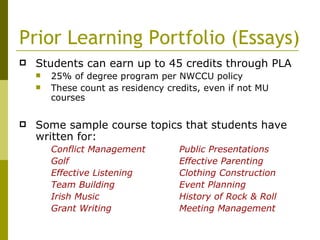
Prior Learning Portfolio (Essays) Students can earn up to 45 credits through PLA 25% of degree program per NWCCU policy These count as residency credits, even if not MU courses Some sample course topics that students have written for: Conflict Management   Public Presentations Golf    Effective Parenting Effective Listening Clothing Construction Team Building Event Planning Irish Music History of Rock & Roll Grant Writing Meeting Management
The Marylhurst PLA Process LRN 150 (1 credit): Learning Assessment Workshop LRN 305 (6 credits): PLA Seminar ~ From Experience to Learning LRN 311 (2 credits): PLA Portfolio Development LRN 312 (2 credits): PLA Portfolio Development LRN 003 (0 credits): PLA Portfolio Development Compile and submit final PLA Portfolio for transcription
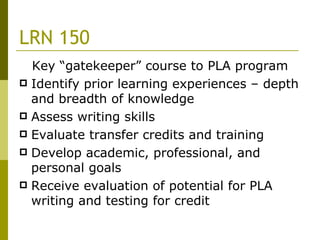
LRN 150 Key “gatekeeper” course to PLA program Identify prior learning experiences – depth and breadth of knowledge Assess writing skills Evaluate transfer credits and training Develop academic, professional, and personal goals Receive evaluation of potential for PLA writing and testing for credit
Evaluation & Transcription of Credit PLA submissions are evaluated by content experts with appropriate academic credentials Many of our evaluators are Marylhurst full-time or adjunct faculty members When final Portfolio is submitted, earned PLA credits are documented by CELA and given to Registrar to transcript PLA credits are identified on transcript “ Courses numbered 197/297/397/497 normally denote credits awarded for prior learning”
PLA & The Prospective Student Adult population is largest, most rapidly growing segment of US post-secondary education (Noel-Levitz, 2008 report) Non-traditional students are currently 50% of US college enrollment (Noel-Levitz, 2008 report) 80% of Marylhurst University undergrad students are 25+ years of age
PLA & The Prospective Student Marketing and recruiting tool Way to emphasize non-traditional student programs and Marylhurst’s student body Admissions advising process: initial evaluation/screening    Information Session    LRN 150 Is PLA Right for You? Training of new admissions counselors – typical student appointment
PLA & The Prospective Student Challenges Students with too many transfer credits Setting or resetting student expectations:  Can’t get credit for experience PLA credit can’t be identified in admissions advising session Traditional student who thinks they have the depth and breadth of experience Nature of degree programs may limit PLA possibilities
PLA & The Registrar After 35 years, it’s easy! Intentional Division of Labor Admissions – posts testing credits and ACE credits CELA – Academic work and most admin work; record and retain academic records Registration – Records and transcripts (SIS) NWCCU Policy 2.3  - Credit for Prior Experiential Learning
Q & A What else would you like to know about PLA programs?
Thank You For more information: Melanie Booth, Ed.D. Director, Center for Experiential Learning & Assessment Marylhurst University [email_address] 503-636-3941

PLA Presentation - OrACRAO

  • 1.
    Melanie Booth Director,Center for Experiential Learning & Assessment / PLA Gretchen Potter Director of Admissions Gwen Hyatt Registrar MARYLHURST UNIVERSITY May 19, 2009 Harvesting Adult Learners’ Prior Knowledge: Prior Learning Assessment in Higher Education
  • 2.
    Inventory of KnowledgeIntroduce yourself to the person next to you and identify what you know about Prior Learning Assessment. Please share out: What do you know? Why are you here?
  • 3.
    History of PLA PLA is a result of 3 significant social movements in the US: The adult education movement The non-traditional higher education movement The increasing sophistication of assessment PLA has thus been … part of a sweeping and multifaceted movement to rewrite the relationship between the university and the larger society. The implementation of PLA was largely congruent with such trends as ‘relevance’ in education, greater access for underserved populations, joint ventures between colleges and the private sector, and a more inclusive curriculum (Michelson, 1997, p. 42).
  • 4.
    PLA Philosophy /Theory Experience can be a source of significant learning and knowledge When [adult] learners come to college, they are not blank slates or empty pails. PLA programs Honor learners’ prior experiences by providing a means for them to gain credit for the resulting college-level learning, Help learners reflect and then be able to build upon these experiences, and Help facilitate learners’ awareness of the great advantages of continual learning.
  • 5.
    Context - 5Types of PLA Standardized credit-by-examination programs. External evaluation of coursework that is completed in non-collegiate environments. Institutionally-assessed learning programs. Learner assessment through institutionally-designed challenge examinations or procedures. Learner assessment through portfolio-assisted PLA.
  • 6.
    Types 1 &2: External to Institution Standardized credit-by-examinations College Level Examination Program (CLEP) Defense Activity for Non-Traditional Educational Support (DANTES) American Council on Education (ACE) evaluates coursework completed in non-collegiate environments (military training or professional and corporate training courses) and provides credit guidelines.
  • 7.
    Type 3: InstitutionalApprenticeships, professional licensures, workplace training programs, or certifications are assessed by the educational institution itself. Agency-sponsored learning assessment. The learning program is assessed; learners who provide evidence of completion to the educational institution are awarded credit accordingly. Students may need to complete an additional assignment to ensure college-level attainment.
  • 8.
    Types 4 &5: Individual Individual learner assessment through institutionally-designed challenge examinations or procedures. Individual learner assessment through portfolio-assisted PLA. Experiential learning products (essays, performances, work samples) Evidence of learning + Evidence of experience
  • 9.
    PLA Programs at Marylhurst University
  • 10.
    Options for EarningCredit New course work Previous transferable coursework Military or other training approved by ACE Standardized proficiency exams: CLEP, DANTES, Excelsior, NYU Foreign Language exams ( up to 45 credits – transfer credit ) Learning obtained through work and life experience that can be used to earn credit through PLA portfolio process ( up to 45 credits – residency credit )
  • 11.
    Prior Learning Portfolio(Essays) Students can earn up to 45 credits through PLA 25% of degree program per NWCCU policy These count as residency credits, even if not MU courses Some sample course topics that students have written for: Conflict Management Public Presentations Golf Effective Parenting Effective Listening Clothing Construction Team Building Event Planning Irish Music History of Rock & Roll Grant Writing Meeting Management
  • 12.
    The Marylhurst PLAProcess LRN 150 (1 credit): Learning Assessment Workshop LRN 305 (6 credits): PLA Seminar ~ From Experience to Learning LRN 311 (2 credits): PLA Portfolio Development LRN 312 (2 credits): PLA Portfolio Development LRN 003 (0 credits): PLA Portfolio Development Compile and submit final PLA Portfolio for transcription
  • 13.
    LRN 150 Key“gatekeeper” course to PLA program Identify prior learning experiences – depth and breadth of knowledge Assess writing skills Evaluate transfer credits and training Develop academic, professional, and personal goals Receive evaluation of potential for PLA writing and testing for credit
  • 14.
    Evaluation & Transcriptionof Credit PLA submissions are evaluated by content experts with appropriate academic credentials Many of our evaluators are Marylhurst full-time or adjunct faculty members When final Portfolio is submitted, earned PLA credits are documented by CELA and given to Registrar to transcript PLA credits are identified on transcript “ Courses numbered 197/297/397/497 normally denote credits awarded for prior learning”
  • 15.
    PLA & TheProspective Student Adult population is largest, most rapidly growing segment of US post-secondary education (Noel-Levitz, 2008 report) Non-traditional students are currently 50% of US college enrollment (Noel-Levitz, 2008 report) 80% of Marylhurst University undergrad students are 25+ years of age
  • 16.
    PLA & TheProspective Student Marketing and recruiting tool Way to emphasize non-traditional student programs and Marylhurst’s student body Admissions advising process: initial evaluation/screening  Information Session  LRN 150 Is PLA Right for You? Training of new admissions counselors – typical student appointment
  • 17.
    PLA & TheProspective Student Challenges Students with too many transfer credits Setting or resetting student expectations: Can’t get credit for experience PLA credit can’t be identified in admissions advising session Traditional student who thinks they have the depth and breadth of experience Nature of degree programs may limit PLA possibilities
  • 18.
    PLA & TheRegistrar After 35 years, it’s easy! Intentional Division of Labor Admissions – posts testing credits and ACE credits CELA – Academic work and most admin work; record and retain academic records Registration – Records and transcripts (SIS) NWCCU Policy 2.3 - Credit for Prior Experiential Learning
  • 19.
    Q & AWhat else would you like to know about PLA programs?
  • 20.
    Thank You Formore information: Melanie Booth, Ed.D. Director, Center for Experiential Learning & Assessment Marylhurst University [email_address] 503-636-3941