Community
Colleges
A Valuable Partner
in Student Success
Sherrie Knop Licón
Director of Student Retention
Central Arizona College
Overview
• Introduction and today’s news
• Benefits of community college
• (Sometimes unknown) Resources Available at the
Community College
• Reverse Transfer
Community College
Benefits of Community College
Easier transition for students
Small class sizes
Quality of instruction
Low tuition
Open door admission
Benefits of Community College
Benefits of Attending a Community
College
Easier transition for students
• Small class sizes
• Quality of instruction
• Low tuition
• Open door admission
Common Student Learning
Outcomes (CSLO)
• Cultural and Civic Engagement
Participate in diverse environments while demonstrating global
citizenship and social consciousness
• Integrative Knowledge
Identify, comprehend, apply and synthesize facts, concepts, theories
and practices across broad and specialized knowledge areas
• Personal and Professional Skills
Demonstrate skills which enhance personal and professional
development
• Reasoning Skills
Inquire and analyze to solve problems, draw logical conclusions, or
create innovative ideas
Tips for Student Success
(sometimes unknown) Resources
Transition Programs
TRIO Student Support Services:
www.centralaz.edu/trio
TRIO Summer Bridge:
www.centralaz.edu/summerbridge
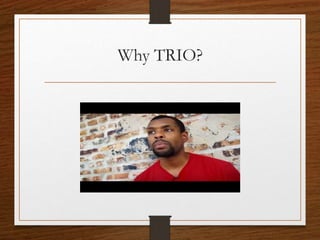
Why TRIO?
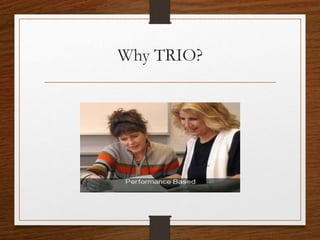
Why TRIO?
Transition Programs
STEM: www.centralaz.edu/stem
WIOA: www.centralaz.edu/wioa
Title V Step Up to Success: http://goo.gl/hgpaIZ
University Transfer Centers
Course Placement Boot Camp/Math Prep Programs
(sometimes unknown) Resources
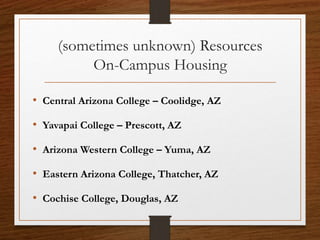
On-Campus Housing
• Central Arizona College – Coolidge, AZ
• Yavapai College – Prescott, AZ
• Arizona Western College – Yuma, AZ
• Eastern Arizona College, Thatcher, AZ
• Cochise College, Douglas, AZ
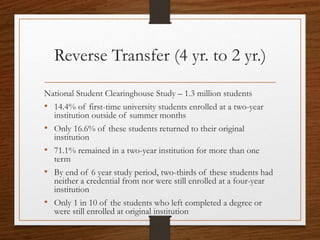
Reverse Transfer (4 yr. to 2 yr.)
National Student Clearinghouse Study – 1.3 million students
• 14.4% of first-time university students enrolled at a two-year
institution outside of summer months
• Only 16.6% of these students returned to their original
institution
• 71.1% remained in a two-year institution for more than one
term
• By end of 6 year study period, two-thirds of these students had
neither a credential from nor were still enrolled at a four-year
institution
• Only 1 in 10 of the students who left completed a degree or
were still enrolled at original institution
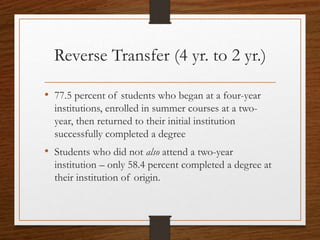
Reverse Transfer (4 yr. to 2 yr.)
• 77.5 percent of students who began at a four-year
institutions, enrolled in summer courses at a two-
year, then returned to their initial institution
successfully completed a degree
• Students who did not also attend a two-year
institution – only 58.4 percent completed a degree at
their institution of origin.
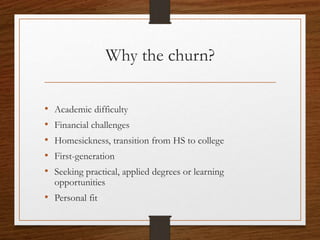
Why the churn?
• Academic difficulty
• Financial challenges
• Homesickness, transition from HS to college
• First-generation
• Seeking practical, applied degrees or learning
opportunities
• Personal fit
Challenges
• Unfamiliar structures
• Deal with bureaucracy of not one, but two or three
institutions *social/cultural capital formed during this time
• Internal vocabulary
• Perceptions of reverse transfer
• Self-talk is sometimes VERY LOUD – I couldn’t handle
university, will I be able to handle a new institution, new people,
etc.?
• * what was learned from the experience? How can we value this
knowledge
How can we help?
1. First, determine the end goal.
a) Bachelors, Associate’s, Certificate?
2. Create a plan.
3. Help the student to see daylight at the end of the tunnel.
4. Engage and Empower
Partner Discussion
What are your experiences with reverse transfer students?
How can we help?
Group Discussion
What are strategies we as professionals can employ to
ensure improve completion rates of reverse transfer
students?
Questions?
Sherrie Knop Licón
Director of Student Retention
Central Arizona College
sherrie.licon@centralaz.edu
480-677-7838

AZ Transfer Summit

  • 1.
    Community Colleges A Valuable Partner inStudent Success Sherrie Knop Licón Director of Student Retention Central Arizona College
  • 2.
    Overview • Introduction andtoday’s news • Benefits of community college • (Sometimes unknown) Resources Available at the Community College • Reverse Transfer
  • 3.
  • 4.
    Benefits of CommunityCollege Easier transition for students Small class sizes Quality of instruction Low tuition Open door admission
  • 5.
  • 6.
    Benefits of Attendinga Community College Easier transition for students • Small class sizes • Quality of instruction • Low tuition • Open door admission
  • 7.
    Common Student Learning Outcomes(CSLO) • Cultural and Civic Engagement Participate in diverse environments while demonstrating global citizenship and social consciousness • Integrative Knowledge Identify, comprehend, apply and synthesize facts, concepts, theories and practices across broad and specialized knowledge areas • Personal and Professional Skills Demonstrate skills which enhance personal and professional development • Reasoning Skills Inquire and analyze to solve problems, draw logical conclusions, or create innovative ideas
  • 8.
  • 9.
    (sometimes unknown) Resources TransitionPrograms TRIO Student Support Services: www.centralaz.edu/trio TRIO Summer Bridge: www.centralaz.edu/summerbridge
  • 10.
  • 11.
  • 12.
    Transition Programs STEM: www.centralaz.edu/stem WIOA:www.centralaz.edu/wioa Title V Step Up to Success: http://goo.gl/hgpaIZ University Transfer Centers Course Placement Boot Camp/Math Prep Programs
  • 13.
    (sometimes unknown) Resources On-CampusHousing • Central Arizona College – Coolidge, AZ • Yavapai College – Prescott, AZ • Arizona Western College – Yuma, AZ • Eastern Arizona College, Thatcher, AZ • Cochise College, Douglas, AZ
  • 14.
    Reverse Transfer (4yr. to 2 yr.) National Student Clearinghouse Study – 1.3 million students • 14.4% of first-time university students enrolled at a two-year institution outside of summer months • Only 16.6% of these students returned to their original institution • 71.1% remained in a two-year institution for more than one term • By end of 6 year study period, two-thirds of these students had neither a credential from nor were still enrolled at a four-year institution • Only 1 in 10 of the students who left completed a degree or were still enrolled at original institution
  • 15.
    Reverse Transfer (4yr. to 2 yr.) • 77.5 percent of students who began at a four-year institutions, enrolled in summer courses at a two- year, then returned to their initial institution successfully completed a degree • Students who did not also attend a two-year institution – only 58.4 percent completed a degree at their institution of origin.
  • 16.
    Why the churn? •Academic difficulty • Financial challenges • Homesickness, transition from HS to college • First-generation • Seeking practical, applied degrees or learning opportunities • Personal fit
  • 17.
    Challenges • Unfamiliar structures •Deal with bureaucracy of not one, but two or three institutions *social/cultural capital formed during this time • Internal vocabulary • Perceptions of reverse transfer • Self-talk is sometimes VERY LOUD – I couldn’t handle university, will I be able to handle a new institution, new people, etc.? • * what was learned from the experience? How can we value this knowledge
  • 18.
    How can wehelp? 1. First, determine the end goal. a) Bachelors, Associate’s, Certificate? 2. Create a plan. 3. Help the student to see daylight at the end of the tunnel. 4. Engage and Empower Partner Discussion What are your experiences with reverse transfer students?
  • 19.
    How can wehelp? Group Discussion What are strategies we as professionals can employ to ensure improve completion rates of reverse transfer students?
  • 20.
    Questions? Sherrie Knop Licón Directorof Student Retention Central Arizona College sherrie.licon@centralaz.edu 480-677-7838

Editor's Notes

  • #2 Greetings everyone we developed this session to provide you with the tools and resources to assist your students with their transition to community college. There are a myriad of resources available for students who choose to attend a university and we want to bring to you strategies and ideas that we feel will best facilitate your students success at the community college.
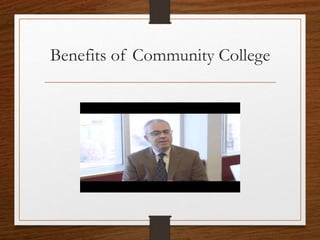
  • #4 You are the key to this success… we would like to share a video with you. Isa Adney is a community college champion and in this video shares her story of her first experience with a community college. VIDEO This video demonstrate the impact that community college can have on a student’s life. Your role is critical in helping students to see the benefit of attending a community college. While each student’s needs are unique, CC can be a positive stepping stone to launch a student into a successful university experience or vocation. Discussion: The pivotal role that counselors play in transitioning students from HS to the community college Connecting students to advising and services on campus Providing guidance on goal setting and career exploration Encouraging students to make connections on campus – make the experience “theirs”
  • #5 Easier transition for students: For many students who are first gen and low income the community college offers: Small class size: Average class size at CAC is 16, has been 16 for three years. Quality of instruction: Professors focus on different teaching modalities, meeting students where they are and developing the WHOLE student. Learning occurs in and out of classroom… in more than just academic areas. Go to next slide for CSLOs Low tuition- To reduce debt and the reliance on fin aid early. Time to complete vs. cost Open Door admission- CC can help students to reach whatever goals they have set for themselves whether it be to transfer, gain additional skills for their current job or complete a certificate program.
  • #7 Easier transition for students: For many students who are first gen and low income the community college offers: Small class size: Average class size at CAC is 16, has been 16 for three years. Quality of instruction: Professors focus on different teaching modalities, meeting students where they are and developing the WHOLE student. Learning occurs in and out of classroom… in more than just academic areas. Go to next slide for CSLOs Low tuition- To reduce debt and the reliance on fin aid early. Time to complete vs. cost Open Door admission- CC can help students to reach whatever goals they have set for themselves whether it be to transfer, gain additional skills for their current job or complete a certificate program.
  • #8 CAC as well as many community colleges are developing student learning outcomes for the non academic as well as academic areas. For example:
  • #14 For students interested in an experience closer to university life several AZ CCs offer on-campus housing.
  • #15 National Student Clearinghouse – Nation-wide educational data verification service. 96% or 20.1 million of currently enrolled postsecondary students (98% of all public and private institutions) Over 90% of all degrees awarded in the u.S. 237 million historical student records