Why Consider PLA
for your Institution?
Presented by
Nan Travers, Ph.D.
SUNY Empire State College
Prior Learning Assessment Professional Development Series
Why PLA? Why Now?
Degree Completion Agenda
• President Obama
• Challenged every American to commit to at least one year of
higher education or post-secondary training.
• Set goal that by 2020, the United States would once again have
the highest proportion of college graduates in the world.
• Lumina Foundation
• Increase the proportion of Americans with high-quality degrees,
certificates and other credentials to 60 percent by the year 2025.
• TAACCCT Grants
Lumina Foundation Gallop Poll
(2013)
• 87% of Americans think students should be able to receive
college credit for knowledge and skills acquired outside the
classroom
• 75% indicated that they would be more likely to enroll in a
higher education program if they could be evaluated and
receive credit for what they already know
PLA Provides Students
Opportunities
•Earn college credit for learning
outside of the classroom.
•Recognizes students for what they
know.
•Complete degrees sooner at a
lower cost.
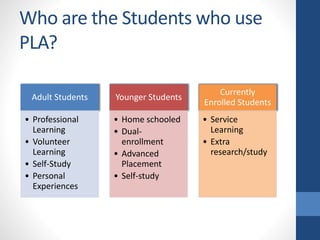
Who are the Students who use
PLA?
Adult Students
• Professional
Learning
• Volunteer
Learning
• Self-Study
• Personal
Experiences
Younger Students
• Home schooled
• Dual-
enrollment
• Advanced
Placement
• Self-study
Currently
Enrolled Students
• Service
Learning
• Extra
research/study
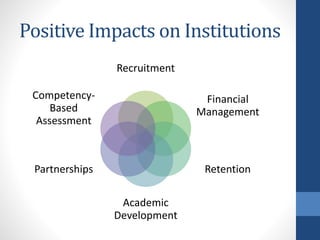
Positive Impacts on Institutions
Recruitment
Financial
Management
Retention
Academic
Development
Partnerships
Competency-
Based
Assessment
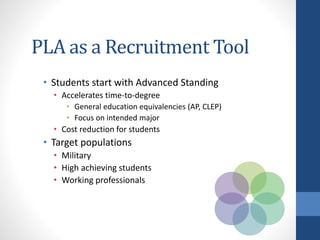
PLA as a Recruitment Tool
• Students start with Advanced Standing
• Accelerates time-to-degree
• General education equivalencies (AP, CLEP)
• Focus on intended major
• Cost reduction for students
• Target populations
• Military
• High achieving students
• Working professionals
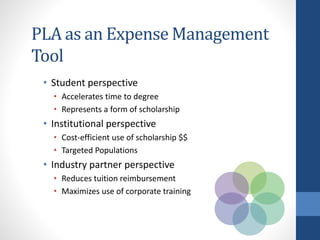
PLA as an Expense Management
Tool
• Student perspective
• Accelerates time to degree
• Represents a form of scholarship
• Institutional perspective
• Cost-efficient use of scholarship $$
• Targeted Populations
• Industry partner perspective
• Reduces tuition reimbursement
• Maximizes use of corporate training
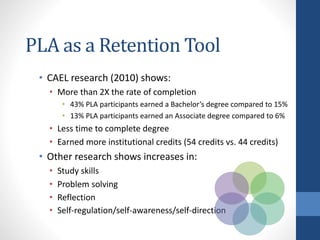
PLA as a Retention Tool
• CAEL research (2010) shows:
• More than 2X the rate of completion
• 43% PLA participants earned a Bachelor’s degree compared to 15%
• 13% PLA participants earned an Associate degree compared to 6%
• Less time to complete degree
• Earned more institutional credits (54 credits vs. 44 credits)
• Other research shows increases in:
• Study skills
• Problem solving
• Reflection
• Self-regulation/self-awareness/self-direction
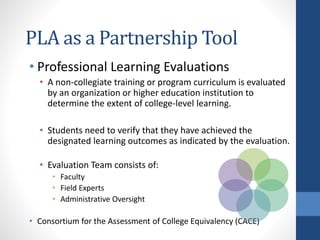
PLA as a Partnership Tool
• Professional Learning Evaluations
• A non-collegiate training or program curriculum is evaluated
by an organization or higher education institution to
determine the extent of college-level learning.
• Students need to verify that they have achieved the
designated learning outcomes as indicated by the evaluation.
• Evaluation Team consists of:
• Faculty
• Field Experts
• Administrative Oversight
• Consortium for the Assessment of College Equivalency (CACE)
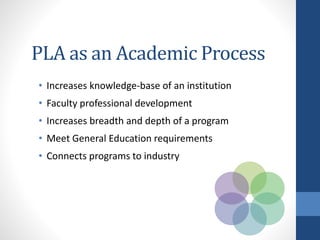
PLA as an Academic Process
• Increases knowledge-base of an institution
• Faculty professional development
• Increases breadth and depth of a program
• Meet General Education requirements
• Connects programs to industry
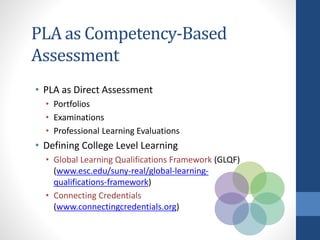
PLA as Competency-Based
Assessment
• PLA as Direct Assessment
• Portfolios
• Examinations
• Professional Learning Evaluations
• Defining College Level Learning
• Global Learning Qualifications Framework (GLQF)
(www.esc.edu/suny-real/global-learning-
qualifications-framework)
• Connecting Credentials
(www.connectingcredentials.org)
Thank You!
For more information on Prior Learning Assessment
• View additional videos
• Contact SUNY.REAL@esc.edu
Prior Learning Assessment Professional Development Series

Why should your institution consider a Prior Learning Assessment program?

  • 1.
    Why Consider PLA foryour Institution? Presented by Nan Travers, Ph.D. SUNY Empire State College Prior Learning Assessment Professional Development Series
  • 2.
    Why PLA? WhyNow? Degree Completion Agenda • President Obama • Challenged every American to commit to at least one year of higher education or post-secondary training. • Set goal that by 2020, the United States would once again have the highest proportion of college graduates in the world. • Lumina Foundation • Increase the proportion of Americans with high-quality degrees, certificates and other credentials to 60 percent by the year 2025. • TAACCCT Grants
  • 3.
    Lumina Foundation GallopPoll (2013) • 87% of Americans think students should be able to receive college credit for knowledge and skills acquired outside the classroom • 75% indicated that they would be more likely to enroll in a higher education program if they could be evaluated and receive credit for what they already know
  • 4.
    PLA Provides Students Opportunities •Earncollege credit for learning outside of the classroom. •Recognizes students for what they know. •Complete degrees sooner at a lower cost.
  • 5.
    Who are theStudents who use PLA? Adult Students • Professional Learning • Volunteer Learning • Self-Study • Personal Experiences Younger Students • Home schooled • Dual- enrollment • Advanced Placement • Self-study Currently Enrolled Students • Service Learning • Extra research/study
  • 6.
    Positive Impacts onInstitutions Recruitment Financial Management Retention Academic Development Partnerships Competency- Based Assessment
  • 7.
    PLA as aRecruitment Tool • Students start with Advanced Standing • Accelerates time-to-degree • General education equivalencies (AP, CLEP) • Focus on intended major • Cost reduction for students • Target populations • Military • High achieving students • Working professionals
  • 8.
    PLA as anExpense Management Tool • Student perspective • Accelerates time to degree • Represents a form of scholarship • Institutional perspective • Cost-efficient use of scholarship $$ • Targeted Populations • Industry partner perspective • Reduces tuition reimbursement • Maximizes use of corporate training
  • 9.
    PLA as aRetention Tool • CAEL research (2010) shows: • More than 2X the rate of completion • 43% PLA participants earned a Bachelor’s degree compared to 15% • 13% PLA participants earned an Associate degree compared to 6% • Less time to complete degree • Earned more institutional credits (54 credits vs. 44 credits) • Other research shows increases in: • Study skills • Problem solving • Reflection • Self-regulation/self-awareness/self-direction
  • 10.
    PLA as aPartnership Tool • Professional Learning Evaluations • A non-collegiate training or program curriculum is evaluated by an organization or higher education institution to determine the extent of college-level learning. • Students need to verify that they have achieved the designated learning outcomes as indicated by the evaluation. • Evaluation Team consists of: • Faculty • Field Experts • Administrative Oversight • Consortium for the Assessment of College Equivalency (CACE)
  • 11.
    PLA as anAcademic Process • Increases knowledge-base of an institution • Faculty professional development • Increases breadth and depth of a program • Meet General Education requirements • Connects programs to industry
  • 12.
    PLA as Competency-Based Assessment •PLA as Direct Assessment • Portfolios • Examinations • Professional Learning Evaluations • Defining College Level Learning • Global Learning Qualifications Framework (GLQF) (www.esc.edu/suny-real/global-learning- qualifications-framework) • Connecting Credentials (www.connectingcredentials.org)
  • 13.
    Thank You! For moreinformation on Prior Learning Assessment • View additional videos • Contact SUNY.REAL@esc.edu Prior Learning Assessment Professional Development Series