Prior Learning
Assessment (PLA)
Overview
Presented by
Nan Travers, Ph.D.
SUNY Empire State College
Prior Learning Assessment Professional Development Series
WHAT IS IT?
Prior Learning Assessment
Definition
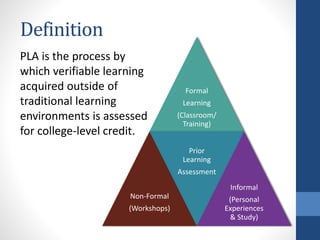
PLA is the process by
which verifiable learning
acquired outside of
traditional learning
environments is assessed
for college-level credit.
Formal
Learning
(Classroom/
Training)
Non-Formal
(Workshops)
Prior
Learning
Assessment
Informal
(Personal
Experiences
& Study)
PLA has many different
names…
• Prior Learning Assessment (PLA)
• Credit for Prior Learning (CPL)
• Assessment of Prior Learning (APL)
• Prior Learning Assessment & Recognition (PLAR)
• Recognition of Prior Learning (RPL)
• Assessment of Prior Experiential Learning (APEL)
• Recognition & Validation of Non-formal & Informal
Learning (RVNIL)
Why PLA? Why Now?
Degree Completion Agenda
• President Obama
• Challenged every American to commit to at least one year of
higher education or post-secondary training.
• Set goal that by 2020, the United States would once again have
the highest proportion of college graduates in the world.
• Lumina Foundation
• Increase the proportion of Americans with high-quality degrees,
certificates and other credentials to 60 percent by the year 2025.
• TAACCCT Grants
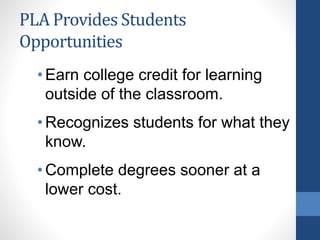
PLA Provides Students
Opportunities
•Earn college credit for learning
outside of the classroom.
•Recognizes students for what they
know.
•Complete degrees sooner at a
lower cost.
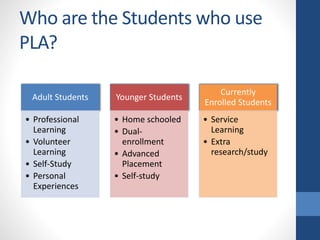
Who are the Students who use
PLA?
Adult Students
• Professional
Learning
• Volunteer
Learning
• Self-Study
• Personal
Experiences
Younger Students
• Home schooled
• Dual-
enrollment
• Advanced
Placement
• Self-study
Currently
Enrolled Students
• Service
Learning
• Extra
research/study
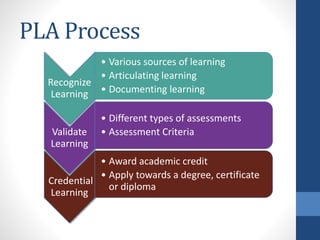
PLA Process
Recognize
Learning
• Various sources of learning
• Articulating learning
• Documenting learning
Validate
Learning
• Different types of assessments
• Assessment Criteria
Credential
Learning
• Award academic credit
• Apply towards a degree, certificate
or diploma
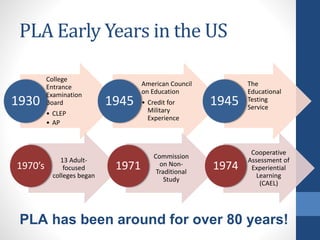
College
Entrance
Examination
Board
• CLEP
• AP
1930
American Council
on Education
• Credit for
Military
Experience
1945
The
Educational
Testing
Service
1945
PLA Early Years in the US
13 Adult-
focused
colleges began
1970’s
Commission
on Non-
Traditional
Study
1971
Cooperative
Assessment of
Experiential
Learning
(CAEL)
1974
PLA has been around for over 80 years!
CAEL Project (1974-1977) from Research
to Ten Standards for Assessing Learning
http://www.cael.org/whom-we-
serve/colleges-and-universities/prior-
learning-assessment-services
Consult your regional accreditation
organization’s standards regarding PLA
considerations.
Standards for Assessing Learning
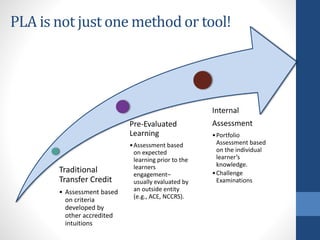
PLA is not just one method or tool!
Traditional
Transfer Credit
• Assessment based
on criteria
developed by
other accredited
intuitions
Pre-Evaluated
Learning
•Assessment based
on expected
learning prior to the
learners
engagement–
usually evaluated by
an outside entity
(e.g., ACE, NCCRS).
Internal
Assessment
•Portfolio
Assessment based
on the individual
learner’s
knowledge.
•Challenge
Examinations
Thank You!
For more information on Prior Learning Assessment
• View additional videos
• Contact SUNY.REAL@esc.edu
Prior Learning Assessment Professional Development Series

PLA: An Overview

  • 1.
    Prior Learning Assessment (PLA) Overview Presentedby Nan Travers, Ph.D. SUNY Empire State College Prior Learning Assessment Professional Development Series
  • 2.
    WHAT IS IT? PriorLearning Assessment
  • 3.
    Definition PLA is theprocess by which verifiable learning acquired outside of traditional learning environments is assessed for college-level credit. Formal Learning (Classroom/ Training) Non-Formal (Workshops) Prior Learning Assessment Informal (Personal Experiences & Study)
  • 4.
    PLA has manydifferent names… • Prior Learning Assessment (PLA) • Credit for Prior Learning (CPL) • Assessment of Prior Learning (APL) • Prior Learning Assessment & Recognition (PLAR) • Recognition of Prior Learning (RPL) • Assessment of Prior Experiential Learning (APEL) • Recognition & Validation of Non-formal & Informal Learning (RVNIL)
  • 5.
    Why PLA? WhyNow? Degree Completion Agenda • President Obama • Challenged every American to commit to at least one year of higher education or post-secondary training. • Set goal that by 2020, the United States would once again have the highest proportion of college graduates in the world. • Lumina Foundation • Increase the proportion of Americans with high-quality degrees, certificates and other credentials to 60 percent by the year 2025. • TAACCCT Grants
  • 6.
    PLA Provides Students Opportunities •Earncollege credit for learning outside of the classroom. •Recognizes students for what they know. •Complete degrees sooner at a lower cost.
  • 7.
    Who are theStudents who use PLA? Adult Students • Professional Learning • Volunteer Learning • Self-Study • Personal Experiences Younger Students • Home schooled • Dual- enrollment • Advanced Placement • Self-study Currently Enrolled Students • Service Learning • Extra research/study
  • 8.
    PLA Process Recognize Learning • Varioussources of learning • Articulating learning • Documenting learning Validate Learning • Different types of assessments • Assessment Criteria Credential Learning • Award academic credit • Apply towards a degree, certificate or diploma
  • 9.
    College Entrance Examination Board • CLEP • AP 1930 AmericanCouncil on Education • Credit for Military Experience 1945 The Educational Testing Service 1945 PLA Early Years in the US 13 Adult- focused colleges began 1970’s Commission on Non- Traditional Study 1971 Cooperative Assessment of Experiential Learning (CAEL) 1974 PLA has been around for over 80 years!
  • 10.
    CAEL Project (1974-1977)from Research to Ten Standards for Assessing Learning http://www.cael.org/whom-we- serve/colleges-and-universities/prior- learning-assessment-services Consult your regional accreditation organization’s standards regarding PLA considerations. Standards for Assessing Learning
  • 11.
    PLA is notjust one method or tool! Traditional Transfer Credit • Assessment based on criteria developed by other accredited intuitions Pre-Evaluated Learning •Assessment based on expected learning prior to the learners engagement– usually evaluated by an outside entity (e.g., ACE, NCCRS). Internal Assessment •Portfolio Assessment based on the individual learner’s knowledge. •Challenge Examinations
  • 12.
    Thank You! For moreinformation on Prior Learning Assessment • View additional videos • Contact SUNY.REAL@esc.edu Prior Learning Assessment Professional Development Series