Issues in the Philosophy of 
Language 
Dr. Samina Nadeem 
Week-2
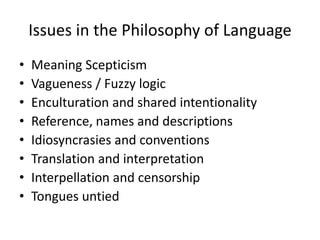
Issues in the Philosophy of Language 
• Meaning Scepticism 
• Vagueness / Fuzzy logic 
• Enculturation and shared intentionality 
• Reference, names and descriptions 
• Idiosyncrasies and conventions 
• Translation and interpretation 
• Interpellation and censorship 
• Tongues untied
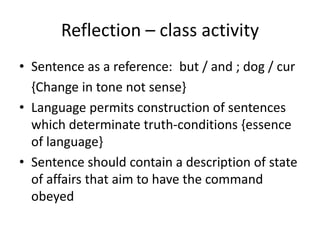
Reflection – class activity 
• Sentence as a reference: but / and ; dog / cur 
{Change in tone not sense} 
• Language permits construction of sentences 
which determinate truth-conditions {essence 
of language} 
• Sentence should contain a description of state 
of affairs that aim to have the command 
obeyed
Reflection …… cont. 
• Gottlob Frege (1848 – 1925): 
-The unit of significance is not the word but the 
sentence (eg: mean / lean) 
- Words are for power of expressing ideas 
- Combination of words – complex ideas 
- For explanation is needed sense of sentence 
- Recognition of sense – words are primary 
- Linguistic acts, to know the conditions, is based 
on sentence. 
- It is only in a context of a sentence that there is a 
meaning
Meaning Skepticism 
• Disbelief in contemporary philosophic 
solutions, rejecting the reality 
• Agnosticism – truth values of claims (God, 
metaphysics) are unknown or unknowable. 
“ Contextual determinacy is achieved when the 
participants in communication narrow down 
the set of admissible semantic interpretation 
through a process of negotiation in which 
different interpretations are tacitly or 
explicitly rejected.”
Vagueness / Fuzzy logic 
• Vagueness: Borderline cases …..inquiry 
resistant (eg; tall – a relative term) 
• Peirce (1902, 748) 
“By intrinsically uncertain we mean not 
uncertain in consequence of any ignorance of 
the interpreter, but because the speaker’s 
habits of language were indeterminate.” 
• Fuzzy Logic: One proposition may be more 
true than the other. (Lotfi Zadeh, 1965)
Enculturation and shared intentionality 
• A process – acquiring culture, internalization (not 
an innovative process?) 
• Herskovits – process of novel change and inquiry 
– 2 phases; unconscious stage of early years, the 
conscious stage of later years (innovation may be 
included) 
• Shared Intentionality (early years): a. gaze 
following into joint attention, b. social 
manipulation into cooperative communication, c. 
group activity into collaboration, d. social 
learning into instructed learning
Reference, names and descriptions 
• Donnellan, K. (1931 at UCLA) 
- Rejected the claim that Proper names hold reference 
relationship (Socrates etc) called descriptivism by 
Bertrand Russell (1910) 
- Definite descriptions – reference use & attributive use 
(closer to Russell’s theory) 
- Most influential developments of the Causal-Historical 
view of Reference 
- Eg; Santa Claus does not exist but there is a Santa 
Claus. 
• Kripke S. (1970) published Naming and Necessity – a 
series of three lectures {every name has a cluster of 
properties…}
Idiosyncrasies and conventions 
• The notion is inextricable from the history of 
culture production – 20th century obsession 
with deconstructions of the self, from the 
fragmented self of modern self to the empty 
self of existentialism ………. This level does not 
co-relate with anything common or inter-subjectively 
shared
Translation and interpretation 
• Interpretative negotiations: to understand how 
reference, sense and truth become entangled / 
how to navigate their complex relationship. Two 
philosophical models: a. neo- empiricist account 
(analytic tradition); b. hermeneutic approach 
• Quine (1951): Analytic statements – true or false 
by virtue of their meaning; synthetic statements – 
knowledge of language and knowledge of world; 
methodology of interpretation by examining the 
practice of translation – different language of the 
interpreter – stimulus meaning (sensory 
stimulation associated with words and sentences.
Interpellation and censorship 
• Althusser, A. (2001): identity through the 
address of the other. E.g. “Hey, you there!” 
the hailed individual will turn around and 
become a subject. 
• Butler (1998): Censorship establishes “ what 
must remain unspeakable for contemporary 
regimes of discourse to continue to exercise 
their power”
Tongues untied 
• Gloria Anzaldua: 
Communities and cultures always speak in many 
voices - polyphonic
References 
• Dummett, M. 1973 Philosophy of language, 
Harper & Row, Publishers, New York 
• Stanford Encyclopedia of Philosophy 
• Oxford Scholarship online

Pl week 2

  • 1.
    Issues in thePhilosophy of Language Dr. Samina Nadeem Week-2
  • 2.
    Issues in thePhilosophy of Language • Meaning Scepticism • Vagueness / Fuzzy logic • Enculturation and shared intentionality • Reference, names and descriptions • Idiosyncrasies and conventions • Translation and interpretation • Interpellation and censorship • Tongues untied
  • 3.
    Reflection – classactivity • Sentence as a reference: but / and ; dog / cur {Change in tone not sense} • Language permits construction of sentences which determinate truth-conditions {essence of language} • Sentence should contain a description of state of affairs that aim to have the command obeyed
  • 4.
    Reflection …… cont. • Gottlob Frege (1848 – 1925): -The unit of significance is not the word but the sentence (eg: mean / lean) - Words are for power of expressing ideas - Combination of words – complex ideas - For explanation is needed sense of sentence - Recognition of sense – words are primary - Linguistic acts, to know the conditions, is based on sentence. - It is only in a context of a sentence that there is a meaning
  • 5.
    Meaning Skepticism •Disbelief in contemporary philosophic solutions, rejecting the reality • Agnosticism – truth values of claims (God, metaphysics) are unknown or unknowable. “ Contextual determinacy is achieved when the participants in communication narrow down the set of admissible semantic interpretation through a process of negotiation in which different interpretations are tacitly or explicitly rejected.”
  • 6.
    Vagueness / Fuzzylogic • Vagueness: Borderline cases …..inquiry resistant (eg; tall – a relative term) • Peirce (1902, 748) “By intrinsically uncertain we mean not uncertain in consequence of any ignorance of the interpreter, but because the speaker’s habits of language were indeterminate.” • Fuzzy Logic: One proposition may be more true than the other. (Lotfi Zadeh, 1965)
  • 7.
    Enculturation and sharedintentionality • A process – acquiring culture, internalization (not an innovative process?) • Herskovits – process of novel change and inquiry – 2 phases; unconscious stage of early years, the conscious stage of later years (innovation may be included) • Shared Intentionality (early years): a. gaze following into joint attention, b. social manipulation into cooperative communication, c. group activity into collaboration, d. social learning into instructed learning
  • 8.
    Reference, names anddescriptions • Donnellan, K. (1931 at UCLA) - Rejected the claim that Proper names hold reference relationship (Socrates etc) called descriptivism by Bertrand Russell (1910) - Definite descriptions – reference use & attributive use (closer to Russell’s theory) - Most influential developments of the Causal-Historical view of Reference - Eg; Santa Claus does not exist but there is a Santa Claus. • Kripke S. (1970) published Naming and Necessity – a series of three lectures {every name has a cluster of properties…}
  • 9.
    Idiosyncrasies and conventions • The notion is inextricable from the history of culture production – 20th century obsession with deconstructions of the self, from the fragmented self of modern self to the empty self of existentialism ………. This level does not co-relate with anything common or inter-subjectively shared
  • 10.
    Translation and interpretation • Interpretative negotiations: to understand how reference, sense and truth become entangled / how to navigate their complex relationship. Two philosophical models: a. neo- empiricist account (analytic tradition); b. hermeneutic approach • Quine (1951): Analytic statements – true or false by virtue of their meaning; synthetic statements – knowledge of language and knowledge of world; methodology of interpretation by examining the practice of translation – different language of the interpreter – stimulus meaning (sensory stimulation associated with words and sentences.
  • 11.
    Interpellation and censorship • Althusser, A. (2001): identity through the address of the other. E.g. “Hey, you there!” the hailed individual will turn around and become a subject. • Butler (1998): Censorship establishes “ what must remain unspeakable for contemporary regimes of discourse to continue to exercise their power”
  • 12.
    Tongues untied •Gloria Anzaldua: Communities and cultures always speak in many voices - polyphonic
  • 13.
    References • Dummett,M. 1973 Philosophy of language, Harper & Row, Publishers, New York • Stanford Encyclopedia of Philosophy • Oxford Scholarship online