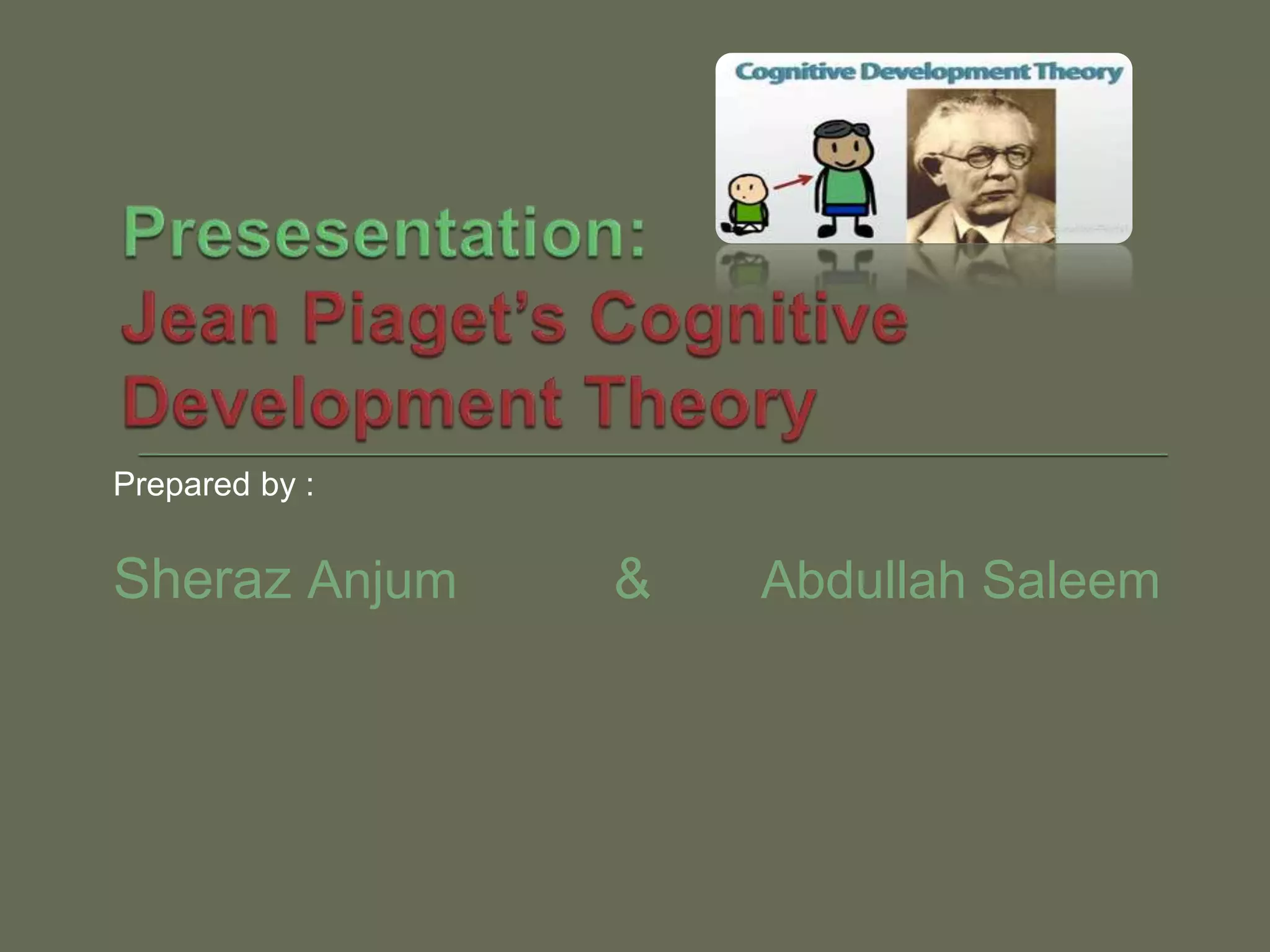

Prepared by :
Sheraz Anjum & Abdullah Saleem
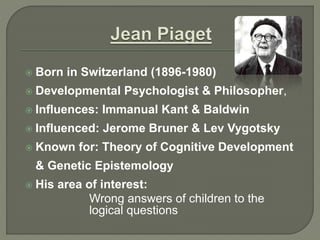
 Born in Switzerland (1896-1980)
 Developmental Psychologist & Philosopher,
 Influences: Immanual Kant & Baldwin
 Influenced: Jerome Bruner & Lev Vygotsky
 Known for: Theory of Cognitive Development
& Genetic Epistemology
 His area of interest:
Wrong answers of children to the
logical questions
 Available assumption :
Children as less competent thinkers
 His disagreement:
Children cannot be called less
competent thinkers
Incorrect answers show children’s
different ways of thinking
Started working on Child’s cognitive
development
Detailed observational studies
Series of simple and intelligence
based tests
 Different way of thinking, basic mental structure,
subsequent learning and knowledge is based on it, focus
on development rather than learning, cognitive
development is progressive and result of biological
maturation and environmental experience
03 Basic Components
1. Schema: Building blocks of knowledge, each related to one
aspect
2. Adaptation:
i. Assimilation: Existing schema to deal
with new situations.
ii. Accommodation: Modification of
existing schema
iii. Equilibrium: When existing schemas
can work
3. Stages of Development: 04 stages, same order is followed.
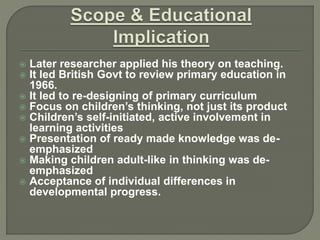
 Later researcher applied his theory on teaching.
 It led British Govt to review primary education in
1966.
 It led to re-designing of primary curriculum
 Focus on children’s thinking, not just its product
 Children’s self-initiated, active involvement in
learning activities
 Presentation of ready made knowledge was de-
emphasized
 Making children adult-like in thinking was de-
emphasized
 Acceptance of individual differences in
developmental progress.
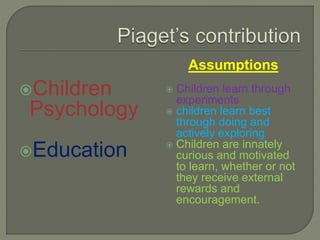
Children
Psychology
Education
Assumptions
 Children learn through
experiments
 children learn best
through doing and
actively exploring
 Children are innately
curious and motivated
to learn, whether or not
they receive external
rewards and
encouragement.
Jean Piaget
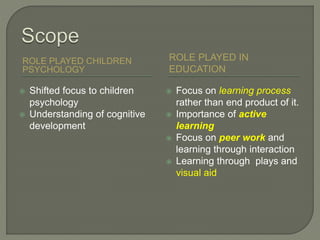
ROLE PLAYED CHILDREN
PSYCHOLOGY
ROLE PLAYED IN
EDUCATION
 Shifted focus to children
psychology
 Understanding of cognitive
development
 Focus on learning process
rather than end product of it.
 Importance of active
learning
 Focus on peer work and
learning through interaction
 Learning through plays and
visual aid
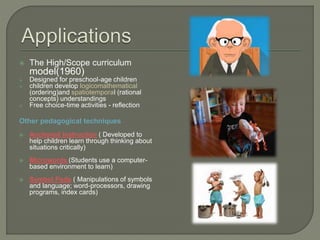
 The High/Scope curriculum
model(1960)
 Designed for preschool-age children
 children develop logicomathematical
(ordering)and spatiotemporal (rational
concepts) understandings
 Free choice-time activities - reflection
Other pedagogical techniques
 Anchored Instruction ( Developed to
help children learn through thinking about
situations critically)
 Microwords (Students use a computer-
based environment to learn)
 Symbol Pads ( Manipulations of symbols
and language; word-processors, drawing
programs, index cards)
For Teachers
Understanding Piaget Theory can make
you more effective teacher . Simple
objects like pencils and shoes can open
new horizons of learning for a child.
Teachers can use a variety of visual aid
and imagery to accelerate the little
scientist’s process of ASSIMILATION
ACCOMODATION & EQUILIBRIUM
Easy questions are more than welcome 

Presentation on Jean Piaget by Abdullah Saleem and Sheraz Anjum

  • 1.
    Prepared by : SherazAnjum & Abdullah Saleem
  • 2.
     Born inSwitzerland (1896-1980)  Developmental Psychologist & Philosopher,  Influences: Immanual Kant & Baldwin  Influenced: Jerome Bruner & Lev Vygotsky  Known for: Theory of Cognitive Development & Genetic Epistemology  His area of interest: Wrong answers of children to the logical questions
  • 3.
     Available assumption: Children as less competent thinkers  His disagreement: Children cannot be called less competent thinkers Incorrect answers show children’s different ways of thinking Started working on Child’s cognitive development Detailed observational studies Series of simple and intelligence based tests
  • 4.
     Different wayof thinking, basic mental structure, subsequent learning and knowledge is based on it, focus on development rather than learning, cognitive development is progressive and result of biological maturation and environmental experience 03 Basic Components 1. Schema: Building blocks of knowledge, each related to one aspect 2. Adaptation: i. Assimilation: Existing schema to deal with new situations. ii. Accommodation: Modification of existing schema iii. Equilibrium: When existing schemas can work 3. Stages of Development: 04 stages, same order is followed.
  • 5.
     Later researcherapplied his theory on teaching.  It led British Govt to review primary education in 1966.  It led to re-designing of primary curriculum  Focus on children’s thinking, not just its product  Children’s self-initiated, active involvement in learning activities  Presentation of ready made knowledge was de- emphasized  Making children adult-like in thinking was de- emphasized  Acceptance of individual differences in developmental progress.
  • 6.
    Children Psychology Education Assumptions  Children learnthrough experiments  children learn best through doing and actively exploring  Children are innately curious and motivated to learn, whether or not they receive external rewards and encouragement.
  • 7.
  • 8.
    ROLE PLAYED CHILDREN PSYCHOLOGY ROLEPLAYED IN EDUCATION  Shifted focus to children psychology  Understanding of cognitive development  Focus on learning process rather than end product of it.  Importance of active learning  Focus on peer work and learning through interaction  Learning through plays and visual aid
  • 9.
     The High/Scopecurriculum model(1960)  Designed for preschool-age children  children develop logicomathematical (ordering)and spatiotemporal (rational concepts) understandings  Free choice-time activities - reflection Other pedagogical techniques  Anchored Instruction ( Developed to help children learn through thinking about situations critically)  Microwords (Students use a computer- based environment to learn)  Symbol Pads ( Manipulations of symbols and language; word-processors, drawing programs, index cards)
  • 10.
  • 11.
    Understanding Piaget Theorycan make you more effective teacher . Simple objects like pencils and shoes can open new horizons of learning for a child. Teachers can use a variety of visual aid and imagery to accelerate the little scientist’s process of ASSIMILATION ACCOMODATION & EQUILIBRIUM
  • 12.
    Easy questions aremore than welcome 