Focused on three specific milestones for healthcare sector analysis:
1. Graduate from high school ready for college and careers in health science.
2. Completion of a high-quality or post-secondary credential prepared for transition
into a health science field.
3. Entry and retention into health science careers at a living wage
Focused on key indicators:
Education Outcomes:
1. Pathway participation/concentration
2. Talent indicators -Test Scores – Graduation - Credentials/Certifications
3. WIOA: In-program skills gained
Employment Outcomes:
1. Entered employment: First-second year earnings after transitioning to
employment
2. Retention: First-second year employment after transitioning to employment
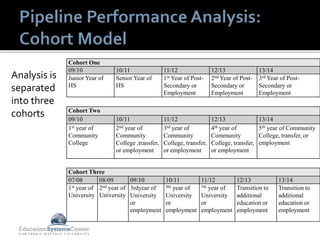
Cohort One
09/10 10/11 11/12 12/13 13/14
Junior Year of
HS
Senior Year of
HS
1st Year of Post-
Secondary or
Employment
2nd Year of Post-
Secondary or
Employment
3rd Year of Post-
Secondary or
Employment
Cohort Two
09/10 10/11 11/12 12/13 13/14
1st year of
Community
College
2nd year of
Community
College ,transfer,
or employment
3rd year of
Community
College, transfer,
or employment
4th year of
Community
College, transfer,
or employment
5th year of Community
College, transfer, or
employment
Cohort Three
07/08 08/09 09/10 10/11 11/12 12/13 13/14
1st year of
University
2nd year of
University
3rdyear of
University
or
employment
4th year of
University
or
employment
5th year of
University
or
employment
Transition to
additional
education or
employment
Transition to
additional
education or
employment
Analysis is
separated
into three
cohorts
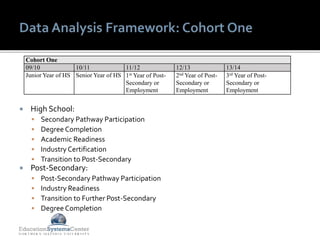
 High School:
 Secondary Pathway Participation
 Degree Completion
 Academic Readiness
 IndustryCertification
 Transition to Post-Secondary
 Post-Secondary:
 Post-Secondary Pathway Participation
 Industry Readiness
 Transition to Further Post-Secondary
 Degree Completion
Cohort One
09/10 10/11 11/12 12/13 13/14
Junior Year of HS Senior Year of HS 1st Year of Post-
Secondary or
Employment
2nd Year of Post-
Secondary or
Employment
3rd Year of Post-
Secondary or
Employment
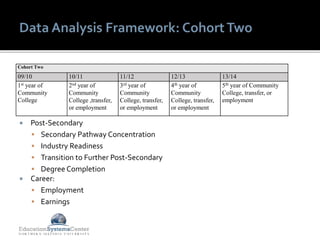
 Post-Secondary
 Secondary Pathway Concentration
 Industry Readiness
 Transition to Further Post-Secondary
 Degree Completion
 Career:
 Employment
 Earnings
Cohort Two
09/10 10/11 11/12 12/13 13/14
1st year of
Community
College
2nd year of
Community
College ,transfer,
or employment
3rd year of
Community
College, transfer,
or employment
4th year of
Community
College, transfer,
or employment
5th year of Community
College, transfer, or
employment
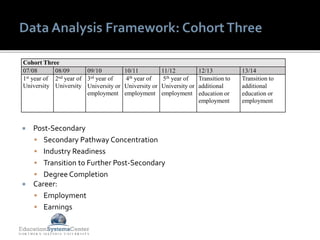
 Post-Secondary
 Secondary Pathway Concentration
 Industry Readiness
 Transition to Further Post-Secondary
 Degree Completion
 Career:
 Employment
 Earnings
Cohort Three
07/08 08/09 09/10 10/11 11/12 12/13 13/14
1st year of
University
2nd year of
University
3rd year of
University or
employment
4th year of
University or
employment
5th year of
University or
employment
Transition to
additional
education or
employment
Transition to
additional
education or
employment
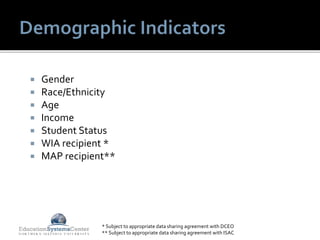
 Gender
 Race/Ethnicity
 Age
 Income
 Student Status
 WIA recipient *
 MAP recipient**
* Subject to appropriate data sharing agreement with DCEO
** Subject to appropriate data sharing agreement with ISAC

Pipeline Performance Analysis: Cohort Model

  • 1.
    Focused on threespecific milestones for healthcare sector analysis: 1. Graduate from high school ready for college and careers in health science. 2. Completion of a high-quality or post-secondary credential prepared for transition into a health science field. 3. Entry and retention into health science careers at a living wage Focused on key indicators: Education Outcomes: 1. Pathway participation/concentration 2. Talent indicators -Test Scores – Graduation - Credentials/Certifications 3. WIOA: In-program skills gained Employment Outcomes: 1. Entered employment: First-second year earnings after transitioning to employment 2. Retention: First-second year employment after transitioning to employment
  • 2.
    Cohort One 09/10 10/1111/12 12/13 13/14 Junior Year of HS Senior Year of HS 1st Year of Post- Secondary or Employment 2nd Year of Post- Secondary or Employment 3rd Year of Post- Secondary or Employment Cohort Two 09/10 10/11 11/12 12/13 13/14 1st year of Community College 2nd year of Community College ,transfer, or employment 3rd year of Community College, transfer, or employment 4th year of Community College, transfer, or employment 5th year of Community College, transfer, or employment Cohort Three 07/08 08/09 09/10 10/11 11/12 12/13 13/14 1st year of University 2nd year of University 3rdyear of University or employment 4th year of University or employment 5th year of University or employment Transition to additional education or employment Transition to additional education or employment Analysis is separated into three cohorts
  • 3.
     High School: Secondary Pathway Participation  Degree Completion  Academic Readiness  IndustryCertification  Transition to Post-Secondary  Post-Secondary:  Post-Secondary Pathway Participation  Industry Readiness  Transition to Further Post-Secondary  Degree Completion Cohort One 09/10 10/11 11/12 12/13 13/14 Junior Year of HS Senior Year of HS 1st Year of Post- Secondary or Employment 2nd Year of Post- Secondary or Employment 3rd Year of Post- Secondary or Employment
  • 4.
     Post-Secondary  SecondaryPathway Concentration  Industry Readiness  Transition to Further Post-Secondary  Degree Completion  Career:  Employment  Earnings Cohort Two 09/10 10/11 11/12 12/13 13/14 1st year of Community College 2nd year of Community College ,transfer, or employment 3rd year of Community College, transfer, or employment 4th year of Community College, transfer, or employment 5th year of Community College, transfer, or employment
  • 5.
     Post-Secondary  SecondaryPathway Concentration  Industry Readiness  Transition to Further Post-Secondary  Degree Completion  Career:  Employment  Earnings Cohort Three 07/08 08/09 09/10 10/11 11/12 12/13 13/14 1st year of University 2nd year of University 3rd year of University or employment 4th year of University or employment 5th year of University or employment Transition to additional education or employment Transition to additional education or employment
  • 6.
     Gender  Race/Ethnicity Age  Income  Student Status  WIA recipient *  MAP recipient** * Subject to appropriate data sharing agreement with DCEO ** Subject to appropriate data sharing agreement with ISAC

Editor's Notes

  • #2 Given the nature of data collection at the various agencies involved, this research will utilize a cohort approach, and will separate the workplan into three specific cohorts.
  • #3 Given the nature of data collection at the various agencies involved, this research will utilize a cohort approach, and will separate the workplan into three specific cohorts.