Illinois Longitudinal Data System
Annual Report & Plan
Approved by the Illinois Longitudinal Data System Governing Board Agencies
September 2018
2018
I. Introduction & Background  . . . . . . . . . . . . . . . . . . . . . . . . . . . . . . . . . . . . . . . . . . . . . . . . . . . . . . . . . . 1
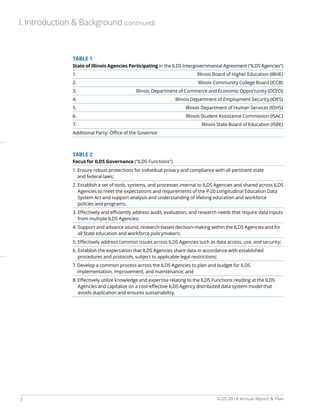
Table 1: State of Illinois Agencies Participating in the ILDS Intergovernmental Agreement  .  . 2
Table 2: Focus for ILDS Governance (“ILDS Functions”)  .  .  .  .  .  .  .  .  .  .  .  .  .  .  .  .  .  .  .  .  .  .  .  .  .  .  .  .  .  .  .  .  .  . 2
II. ILDS Governance Activities . . . . . . . . . . . . . . . . . . . . . . . . . . . . . . . . . . . . . . . . . . . . . . . . . . . . . . . . . . 3
Figure 1: ILDS Conceptual Technical Architecture Diagram .  .  .  .  .  .  .  .  .  .  .  .  .  .  .  .  .  .  .  .  .  .  .  .  .  .  .  .  .  .  . 3
A. Centralized Demographic Dataset Administrator and Master Client Index .  .  .  .  .  .  .  .  .  .  .  .  .  .  .  .  .  . 4
Table 3: CDDA Data Source Summary, Release 6, August 2018  .  .  .  .  .  .  .  .  .  .  .  .  .  .  .  .  .  .  .  .  .  .  .  .  .  .  . 4
B. Intra-Agency Enhancements .  .  .  .  .  .  .  .  .  .  .  .  .  .  .  .  .  .  .  .  .  .  .  .  .  .  .  .  .  .  .  .  .  .  .  .  .  .  .  .  .  .  .  .  .  .  .  .  .  .  .  .  .  .  .  .  .  .  . 5
Table 4: Intra-Agency Enhancements Over Prior 18 Months .  .  .  .  .  .  .  .  .  .  .  .  .  .  .  .  .  .  .  .  .  .  .  .  .  .  .  .  .  . 5
C. Progress on End-User Priorities  .  .  .  .  .  .  .  .  .  .  .  .  .  .  .  .  .  .  .  .  .  .  .  .  .  .  .  .  .  .  .  .  .  .  .  .  .  .  .  .  .  .  .  .  .  .  .  .  .  .  .  .  .  .  .  . 7
Table 5: Degree Attainment Status for those with a Level 4 ECE Credential  .  .  .  .  .  .  .  .  .  .  .  .  .  .  .  . 7
Table 6: Degree Attainment Status for those with a Level 3 ECE Credential  .  .  .  .  .  .  .  .  .  .  .  .  .  .  .  . 7
Figure 2: Percentage and number of 3-5 year olds in PFA and/or CCAP .  .  .  .  .  .  .  .  .  .  .  .  .  .  .  .  .  .  .  . 8
Figure 3: Remediation Rates in Community College – Class of 2015, Lake View High School
(9-12), City of Chicago SD 29 .  .  .  .  .  .  .  .  .  .  .  .  .  .  .  .  .  .  .  .  .  .  .  .  .  .  .  .  .  .  .  .  .  .  .  .  .  .  .  .  .  .  .  .  .  .  .  .  .  .  .  .  .  .  .  . 9
Figure 4: Selection Screen, IL College2Career tool .  .  .  .  .  .  .  .  .  .  .  .  .  .  .  .  .  .  .  .  .  .  .  .  .  .  .  .  .  .  .  .  .  .  .  .  .  . 10
III. ILDS Plan and Budget through FY 2019  . . . . . . . . . . . . . . . . . . . . . . . . . . . . . . . . . . . . . . . . . . . . . . 11
A. Aligning ILDS with Children’s Cabinet Data Projects  .  .  .  .  .  .  .  .  .  .  .  .  .  .  .  .  .  .  .  .  .  .  .  .  .  .  .  .  .  .  .  .  .  .  .  .  . 11
B. FY 2019 Priorities  .  .  .  .  .  .  .  .  .  .  .  .  .  .  .  .  .  .  .  .  .  .  .  .  .  .  .  .  .  .  .  .  .  .  .  .  .  .  .  .  .  .  .  .  .  .  .  .  .  .  .  .  .  .  .  .  .  .  .  .  .  .  .  .  .  .  .  . 11
Table 7: FY 2019 Priorities  .  .  .  .  .  .  .  .  .  .  .  .  .  .  .  .  .  .  .  .  .  .  .  .  .  .  .  .  .  .  .  .  .  .  .  .  .  .  .  .  .  .  .  .  .  .  .  .  .  .  .  .  .  .  .  .  .  .  . 12
C. Promoting Access and Use by External Researchers .  .  .  .  .  .  .  .  .  .  .  .  .  .  .  .  .  .  .  .  .  .  .  .  .  .  .  .  .  .  .  .  .  .  .  .  . 16
D. Enhancing the CDD Administrator’s Services  .  .  .  .  .  .  .  .  .  .  .  .  .  .  .  .  .  .  .  .  .  .  .  .  .  .  .  .  .  .  .  .  .  .  .  .  .  .  .  .  .  .  . 16
E. Supporting the P-20 Council’s Education and Data Workforce Task Force .  .  .  .  .  .  .  .  .  .  .  .  .  .  .  .  .  . 16
F. FY 2019 Budget .  .  .  .  .  .  .  .  .  .  .  .  .  .  .  .  .  .  .  .  .  .  .  .  .  .  .  .  .  .  .  .  .  .  .  .  .  .  .  .  .  .  .  .  .  .  .  .  .  .  .  .  .  .  .  .  .  .  .  .  .  .  .  .  .  .  .  .  .  .  . 17
Table 8: FY 2019 Budget: CDD Administrator and Governing Board/Committee Staffing .  .  . 17
IV. Conclusion . . . . . . . . . . . . . . . . . . . . . . . . . . . . . . . . . . . . . . . . . . . . . . . . . . . . . . . . . . . . . . . . . . . . . . . . 17
Appendix: Benchmarking Against the P-20 ILDS Act  . . . . . . . . . . . . . . . . . . . . . . . . . . . . . . . . . . . 18
Table of Contents
ILDS 2018 Annual Report  Plan
1ILDS 2018 Annual Report  Plan
THIS ILLINOIS LONGITUDINAL DATA SYSTEM
(“ILDS”) ANNUAL REPORT  PLAN is the fifth
such plan adopted by the ILDS Governing
Board. On June 30, 2013, seven State of Illinois
agencies and the Office of the Governor
entered into an intergovernmental agreement
for the governance of the Illinois Longitudinal
Data System (see Table 1, on page 2 of this
report, for participating agencies).
As shown in Table 2, (page 2), this agreement
identified eight separate requirements,
functions, and expectations for the focus of the
ILDS governance system (the “ILDS Functions”).
In addition, the agreement created:
• a Governing Board with senior leadership
from each of the ILDS Agencies and chaired
by an appointee of the Governor, and
• five separate committees, as shown in
Figure 1 (page 3).
Under Section IV.A of the Agreement, the
Governing Board must adopt, on an annual
basis, a report to the Governor, the P-20
Council, and the chief executive of each of the
ILDS Agencies that includes, without limitation:
a. A report on the activities of the Governing
Board and its committees for the prior
12-month period;
b. A plan and budget for the performance of
the ILDS Functions through the upcoming
State fiscal year; and
c. A benchmarking of the performance of the
ILDS Functions against the requirements and
expectations of the P-20 Longitudinal Educa-
tion Data System Act (105 ILCS 13/1 et seq.).
This Annual Report  Plan constitutes the
report required by Section IV.A of the ILDS
Intergovernmental Agreement. It draws from
meetings of the Governing Board and its
Committees, interviews with ILDS Agency staff,
and information from related state agency
initiatives such as the Governor’s Cabinet on
Children and Families. ILDS Agency staff have
reviewed and commented upon its contents,
and the Governing Board has adopted it.
This document describes the primary ILDS
governance activities during the 17-18 state
fiscal year (FY 2018). Then, it describes the
priorities for ILDS governance activities
through FY 2019 that have been adopted by
the Governing Board. Finally, it includes a
benchmarking of ILDS efforts against the
requirements of the P-20 Longitudinal
Education Data System Act.
While the Governing Board intends for this
document to provide a roadmap for ILDS
activities through FY 2019, it also recognizes
the need for flexibility and adaptability as the
ILDS Agencies move into implementation
activities. Certain priorities may need
adjustment, and others may not be attainable
in light of staffing and funding limitations.
The Governing Board will periodically review
its progress and this Report  Plan as
implementation activities move forward.
ILDS and Individual Privacy
The ILDS protects individual privacy and confi-
dentiality consistent with all privacy protection
laws and leading technical practices. The ILDS
and operations of the Governing Board do not
limit nor waive any of the state or federal
privacy protection laws that apply to an individ-
ual agency’s data. On the contrary, all sharing
of data must be specifically authorized by these
laws, and is subject to all applicable legal
limitations. Reports and analyses supported by
the ILDS will include only aggregate data—an
individual’s personal information will never be
disclosed. In addition, the systems for receiving
and matching agency data through the
Centralized Demographic Dataset—as described
in Section II.B of this Report—utilize the highest
technological standards:
• ensuring that data are maintained and
merged only on hardware that is not
connected to a network,
• not duplicating the data,
• only conducting data sharing that has been
explicitly authorized by the agencies, and
• access to data is limited only to employees
required to have access.
Ensuring robust protections for individual
privacy and compliance with all state and
federal laws are the highest priorities for the
ILDS Agencies and the Governing Board.
I. Introduction  Background
This document
describes the
primary ILDS
governance
activities during
the 2017-18 state
fiscal year. Then,
it describes the
priorities for ILDS
governance
activities through
2018-2019 that
have been
adopted by the
Governing Board.
2 ILDS 2018 Annual Report  Plan
TABLE 1
State of Illinois Agencies Participating in the ILDS Intergovernmental Agreement (“ILDS Agencies”)
1. 	 Illinois Board of Higher Education (IBHE)
2. 	 Illinois Community College Board (ICCB)
3. 	 Illinois Department of Commerce and Economic Opportunity (DCEO)
4. 	 Illinois Department of Employment Security (IDES)
5. 	 Illinois Department of Human Services (IDHS)
6. 	 Illinois Student Assistance Commission (ISAC)
7. 	 Illinois State Board of Education (ISBE)
Additional Party: Office of the Governor
TABLE 2
Focus for ILDS Governance (“ILDS Functions”)
1. Ensure robust protections for individual privacy and compliance with all pertinent state
and federal laws;
2. Establish a set of tools, systems, and processes internal to ILDS Agencies and shared across ILDS
Agencies to meet the expectations and requirements of the P-20 Longitudinal Education Data
System Act and support analysis and understanding of lifelong education and workforce
policies and programs;
3. Effectively and efficiently address audit, evaluation, and research needs that require data inputs
from multiple ILDS Agencies;
4. Support and advance sound, research-based decision-making within the ILDS Agencies and for
all State education and workforce policymakers;
5. Effectively address common issues across ILDS Agencies such as data access, use, and security;
6. Establish the expectation that ILDS Agencies share data in accordance with established
procedures and protocols, subject to applicable legal restrictions;
7. Develop a common process across the ILDS Agencies to plan and budget for ILDS
implementation, improvement, and maintenance; and
8. Effectively utilize knowledge and expertise relating to the ILDS Functions residing at the ILDS
Agencies and capitalize on a cost-effective ILDS Agency distributed data system model that
avoids duplication and ensures sustainability.
I. Introduction  Background (continued)
3ILDS 2018 Annual Report  Plan
The ILDS Agencies and the Governing Board
made substantial progress on activities
relating to the ILDS Functions in FY 2018.
Progress includes a number of intra-agency
enhancements that support the broader ILDS
effort; the continued expansion of the
Centralized Demographic Dataset Administra-
tor (CDDA) and Master Client Index (MCI); and
significant work and accomplishments in the
end-user service priorities established by
the Governing Board.
The first Annual Report  Plan adopted by the
Governing Board included a proposed ILDS
technical architecture and set of end-user
priorities that has guided ILDS-related activities
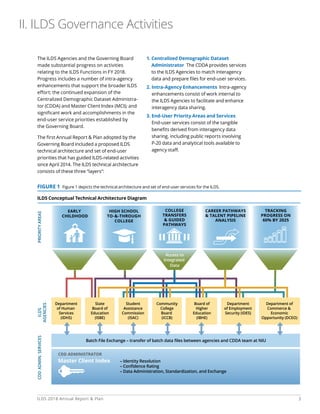
since April 2014. The ILDS technical architecture
consists of these three “layers”:
1. Centralized Demographic Dataset
Administrator The CDDA provides services
to the ILDS Agencies to match interagency
data and prepare files for end-user services.
2. Intra-Agency Enhancements Intra-agency
enhancements consist of work internal to
the ILDS Agencies to facilitate and enhance
interagency data sharing.
3. End-User Priority Areas and Services
End-user services consist of the tangible
benefits derived from interagency data
sharing, including public reports involving
P-20 data and analytical tools available to
agency staff.
FIGURE 1 Figure 1 depicts the technical architecture and set of end-user services for the ILDS.
ILDS Conceptual Technical Architecture Diagram
II. ILDS Governance Activities 
PRIORITYAREASILDS
AGENCIES
CDDADMIN.SERVICES
EARLY
CHILDHOOD
HIGH SCHOOL
TO--THROUGH
COLLEGE
COLLEGE
TRANSFERS
 GUIDED
PATHWAYS
CAREER PATHWAYS
 TALENT PIPELINE
ANALYSIS
TRACKING
PROGRESS ON
60% BY 2025
Board of
Higher
Education
(IBHE)
Community
College
Board
(ICCB)
Department of
Commerce 
Economic
Opportunity (DCEO)
Department
of Employment
Security (IDES)
Department
of Human
Services
(IDHS)
Student
Assistance
Commission
(ISAC)
State
Board of
Education
(ISBE)
Batch File Exchange – transfer of batch data files between agencies and CDDA team at NIU
CDD ADMINISTRATOR
Master Client Index – Identity Resolution
– Confidence Rating
– Data Administration, Standardization, and Exchange
Access to
Integrated
Data
4 ILDS 2018 Annual Report  Plan
The plan also established five priority areas for
end-user services:
1. Early Childhood Merging early childhood
data maintained by IDHS, ISBE, and other
agencies to understand the characteristics and
outcomes of children receiving early childhood
services and the members of the early
childhood workforce who serve them.
2. High School to  through College
Reporting and analyzing college enrollment
and performance information for Illinois public
high school graduates.
3. College Transfers  Guided Pathways
Providing information on the outcomes of
community college graduates who transfer to
Illinois public universities and of participation
in postsecondary guided pathways.
4. Career Pathways  Talent Pipeline
Analysis Analyzing the education and employ-
ment outcomes of students participating in
career pathway programs in high school and in
post-secondary education.
5. 60% by 2025 Enhancing the methods for
tracking progress against the State goal of 60%
of Illinois residents obtaining a high quality
post-secondary degree or credential by the
year 2025.
II. ILDS Governance Activities (continued)
The signature technical achievement of the
ILDS Governing Board is the establishment of
the CDDA and the related MCI. The CDDA
provides an identity resolution system to
address the challenge of different state
agencies using different identifiers for the
same individual. Susie Student may have one
identifier in an IDHS early childhood system,
which is different from the identifier for Susan
Student in the ISBE K-12 system, and different
still for Suzie Student in the employment
records systems maintained by IDES, even
though all of the information is for the same
person. The CDDA provides technical review
procedures and software to create, securely
and confidentially, an ID tied to the same indivi-
dual’s records across different agency systems.
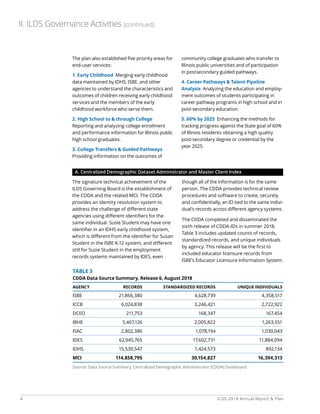
The CDDA completed and disseminated the
sixth release of CDDA-IDs in summer 2018;
Table 3 includes updated counts of records,
standardized records, and unique individuals
by agency. This release will be the first to
included educator licensure records from
ISBE’s Educator Licensure Information System.
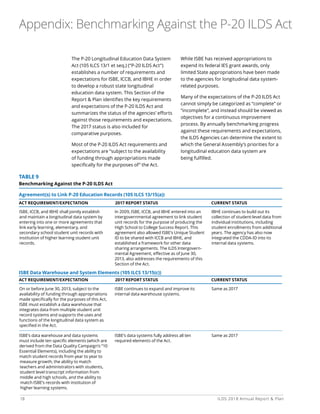
TABLE 3
CDDA Data Source Summary, Release 6, August 2018
AGENCY	 RECORDS	 STANDARDIZED RECORDS	 UNIQUE INDIVIDUALS
ISBE	21,866,380	 4,628,739	 4,358,517
ICCB	6,024,838	 3,246,421	 2,722,922
DCEO	211,753	 168,347	 167,454
IBHE	5,467,126	 2,005,822	 1,263,551
ISAC	2,802,386	 1,078,194	 1,030,043
IDES	62,945,765	 17,602,731	 11,884,094
IDHS	15,530,547	 1,424,573	 892,134
MCI	114,858,795	 30,154,827	 16,394,313
Source: Data Source Summary, Centralized Demographic Administrator (CDDA) Dashboard
A. Centralized Demographic Dataset Administrator and Master Client Index
5ILDS 2018 Annual Report  Plan
B. Intra-Agency Enhancements
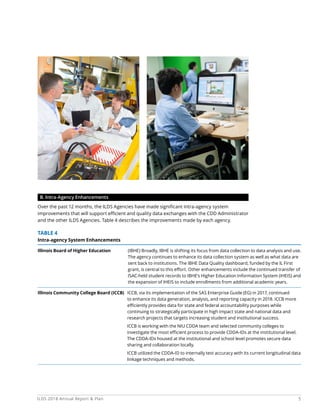
Over the past 12 months, the ILDS Agencies have made significant intra-agency system
improvements that will support efficient and quality data exchanges with the CDD Administrator
and the other ILDS Agencies. Table 4 describes the improvements made by each agency.
TABLE 4
Intra-agency System Enhancements
Illinois Board of Higher Education (IBHE) 	Broadly, IBHE is shifting its focus from data collection to data analysis and use.
The agency continues to enhance its data collection system as well as what data are
sent back to institutions. The IBHE Data Quality dashboard, funded by the IL First
grant, is central to this effort. Other enhancements include the continued transfer of
ISAC-held student records to IBHE’s Higher Education Information System (IHEIS) and
the expansion of IHEIS to include enrollments from additional academic years.
Illinois Community College Board (ICCB) 	ICCB, via its implementation of the SAS Enterprise Guide (EG) in 2017, continued
to enhance its data generation, analysis, and reporting capacity in 2018. ICCB more
efficiently provides data for state and federal accountability purposes while
continuing to strategically participate in high impact state and national data and
research projects that targets increasing student and institutional success.
				 ICCB is working with the NIU CDDA team and selected community colleges to
investigate the most efficient process to provide CDDA-IDs at the institutional level.
The CDDA-IDs housed at the institutional and school level promotes secure data
sharing and collaboration locally.
				 ICCB utilized the CDDA-ID to internally test accuracy with its current longitudinal data
linkage techniques and methods.
6 ILDS 2018 Annual Report  Plan
TABLE 4 (continued)
Intra-agency System Enhancements by the ILDS Agencies
Illinois Department of Commerce and Economic Opportunity (DCEO) DCEO is responsible for reporting Workforce 			
	 	 		 Innovation Opportunity Act (WIOA) Title I and ETP training provider and student
data to the U.S. Department of Labor. It is helping lead a collaborative project, the
WIOA Workforce Training Data Trust, with other ILDS agencies that seeks to
accomplish the following objectives:
			 	 • Create a virtual universal statewide workforce training provider and pro-
gram platform that contains and displays training provider establishments and
program information based on the WIOA education and workforce integration
initiative.
			 	 • Align training programs by sector-based career pathways and demand occupations.
			 	 • Enhance availability of program and training provider information linked
to career information services that educates on job readiness skills assessments,
occupation industry overviews and suitability, employment potential, career
advancement opportunities, financial assistance options, and state assistance
programs and eligibility.
			 	 • Model training information technology and framework in such a way to connect
program completion attainment to credentials and competencies such as degrees,
certificates, licenses, apprenticeships, badges, and micro-credentials.
			 	 • Integrate and connect individual training completion outcomes to wage data that
can be utilized for further curriculum planning and forecasting, WIOA eligible
training provider performance reporting, and publicly transparent aggregate data
scorecards and dashboards.
Illinois Department of Employment Security (IDES) 	 IDES is building its internal analytic and research capacity. This
			 	 capacity will support interagency projects, including the Career Outcomes Tool and an
employment analysis for selected cohorts of ISBE HS graduates, and better position
the agency to meet increased demand for analyses of employment outcomes.
Illinois Department of Human Services (IDHS) IDHS is drawing upon Family Case Management and Better Birth
			 	 Outcomes records to investigate the impact of physiological challenges at birth on a
child’s development and later education. The agency also provided data to support the
early childhood matching process described in Section III.B.1 of this document.
Illinois State Board of Education (ISBE) ISBE rolled out its integrated data system, called Ed360, statewide for
			 	 school year 2017-18. The agency is also enhancing its tracking of teacher supply 
demand data by contributing Educator Licensure Information System (ELIS) records
to the CDDA and through the Partnership for Educator Preparation, or PEP. PEP is a
committee of diverse stakeholders that, among other things, will support the
strengthening of data collection, sharing, and reporting for educator preparation
programs across Illinois.
Illinois Student Assistance Commission (ISAC) ISAC continues to build out the Gift Assistance Program (GAP Access)
			 	 system, which now encompasses multiple smaller, formerly distinct data systems.
The agency also intends to draw on ILDS infrastructure to enhance its research
capacity and better engage researchers seeking ISAC records.
II. ILDS Governance Activities (continued)
7ILDS 2018 Annual Report  Plan
C. Progress on End-User Priorities
The ILDS Agencies performed significant work
and achieved a number of accomplishments
in the end-user service priorities established
by the Governing Board for FY 2018. The 2017
Annual Report  Plan identified priority
projects and research topics for each of the
end-user service priority areas, with a goal of
making significant progress on each one by
the end of the fiscal year. Below are descrip-
tions and highlights from selected FY17 ILDS
priorities and related projects.
College Enrollment and Completion
Patterns of Gateways Credential Holders
(Early Childhood)
Gateways Credentials serve as professional
symbols of the knowledge, skills, and
experience held by members of the early
childhood workforce. IDHS awards the
credentials, which are administered by the
Illinois Network of Child Care Resource and
Referral Agencies (INCCRRA). Utilizing the
CDDA-ID to link Gateways records with
postsecondary data from ICCB and IBHE, this
study describes Gateways credential holders
and their enrollment and completion patterns
through 2- and 4-year postsecondary
institutions in Illinois.
Key findings include that:
• Gateways credential holders are more
racially/ethnically diverse than the overall
early childhood workforce in Illinois;
• many Gateways credential holders have
earned some college credit but no degree,
suggesting that Gateways credentials could
be used to inform progress towards 60%
by 2025; and
• early childhood enrollments and degree
completions in Illinois are declining
irrespective of sector or level.
Recommendations for future study include:
• investigating credential and degree stacking
across Gateways and higher education,
• determining the value-add of employer-
recognized credentials,
• making the case for social utility in helping
define credential quality, and
• expanding the analysis to include all
Gateways credential types.
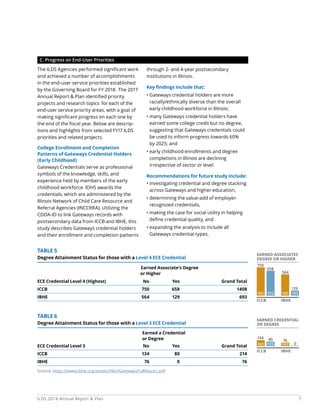
TABLE 5
Degree Attainment Status for those with a Level 4 ECE Credential
		Earned Associate’s Degree
	 or Higher	
ECE Credential Level 4 (Highest)	 No	 Yes	 Grand Total
ICCB	 750	658	 1408
IBHE	 564	129	 693
TABLE 6
Degree Attainment Status for those with a Level 3 ECE Credential
					 Earned a Credential
or Degree	
ECE Credential Level 3	 No	 Yes	 Grand Total
ICCB	 134	80	 214
IBHE	 76	0	 76
Source: https://www.ibhe.org/assets/files/GatewaysFullReport.pdf
EARNED ASSOCIATES
DEGREE OR HIGHER
EARNED CREDENTIAL
OR DEGREE
ICCB IBHE
ICCB IBHE
NO
NO
NO
NO
YES
YES
YES
YES
750
658
564
129
134 80 76
0
8 ILDS 2018 Annual Report  Plan
Early Childhood Matching Project, Phase II
(Early Childhood)
Undertaken by NIU, the Early Childhood
Matching Project serves two primary
purposes. First, it identifies data quality
issues and other barriers that ISBE and IDHS
can address. Second, it produces descriptive
statistics based on distinct counts of children
ages birth to 5 years receiving publicly funded
early childhood services in Illinois. The Project
relies upon the CDDA-ID linkage and place
Illinois among a small group of states having
established such denominators.
The NIU team completed the Phase II analysis,
which focuses on 2015 and 2016, in spring
2018. Key findings from Phase II are below.
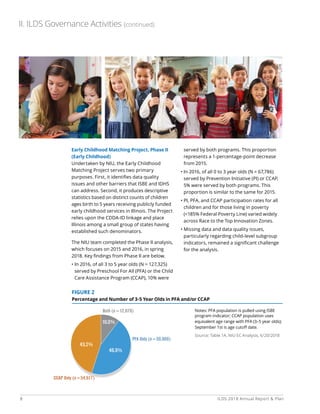
• In 2016, of all 3 to 5 year olds (N = 127,325)
served by Preschool For All (PFA) or the Child
Care Assistance Program (CCAP), 10% were
served by both programs. This proportion
represents a 1-percentage-point decrease
from 2015.
• In 2016, of all 0 to 3 year olds (N = 67,786)
served by Prevention Initiative (PI) or CCAP,
5% were served by both programs. This
proportion is similar to the same for 2015.
• PI, PFA, and CCAP participation rates for all
children and for those living in poverty
(185% Federal Poverty Line) varied widely
across Race to the Top Innovation Zones.
• Missing data and data quality issues,
particularly regarding child-level subgroup
indicators, remained a significant challenge
for the analysis.
FIGURE 2
Percentage and Number of 3-5 Year Olds in PFA and/or CCAP
Notes: PFA population is pulled using ISBE
program indicator; CCAP population uses
equivalent age range with PFA (3–5 year olds);
September 1st is age cutoff date.
Source: Table 1A, NIU EC Analysis, 6/20/2018
Both (n = 12,679)
10.0%
43.2%
CCAP Only (n = 54,977)
PFA Only (n = 59,669)
46.9%
II. ILDS Governance Activities (continued)
9ILDS 2018 Annual Report  Plan
ToThrough Statewide Pilot (High School to
 through College)
Analysis for the ToThrough statewide pilot
will commence in summer 2018. With the data
sharing agreement for the pilot now executed,
ISBE and ICCB have linked their respective
secondary and community college records via
the CDDA-ID. Urban Education Institute at the
University of Chicago has received those linked
records and plans to begin its analysis shortly.
The pilot carries exciting prospects for the use
of ILDS data and the CDDA-ID in future
ToThrough reporting. Stated goals include:
• to determine the feasibility of using ILDS data
for future ToThrough indices and reports;
• to establish appropriate ToThrough indices
and reports for 2-year and 4-year institutions;
• to determine the feasibility of state production
of reports both within and outside of
Chicago; and
• to explore utilization of cohort data for reports.
Community College Remediation on
State-Level Public Data Resources
(High School to  through College)
ISBE and ICCB linked student record data via
the CDDA-ID to measure the number of high
school graduates who attend an Illinois
community college and enroll in developmental
education coursework. Additionally, an analysis
of high school students that simultaneously
earn credits that count toward a high school
diploma and a college degree occurred. The
matched ISBE and ICCB data is utilized on the
Illinois Report Card and Ed360 platform in
aggregate form. The data are provided at the
high school and school district level leading to
many policy discussions and high-impact
strategies around college readiness.
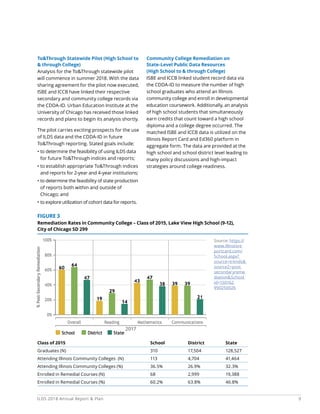
FIGURE 3
Remediation Rates in Community College – Class of 2015, Lake View High School (9-12),
City of Chicago SD 299
Source: https://
www.illinoisre
portcard.com/
School.aspx?
source=trends
source2=post
secondaryreme
diationSchool
id=150162
990250026
Class of 2015 					School		District		State
Graduates (N) 					310		17,504		128,527
Attending Illinois Community Colleges (N) 		 113		 4,704		 41,464
Attending Illinois Community Colleges (%)		 36.5%		 26.9%		 32.3%
Enrolled in Remedial Courses (N) 			 68		 2,999		 19,388
Enrolled in Remedial Courses (%)			 60.2%		 63.8%		 46.8%
2017
10 ILDS 2018 Annual Report  Plan
Career Outcomes Partnership (Career
Pathways  Talent Pipeline Management)
A data sharing partnership between IDES,
ISAC, IBHE, ICCB, and Illinois State University
has developed two tools built on a linkage of
postsecondary and career outcomes: the
IL College2Career tool mobile app and an
institutional microdata research portal.
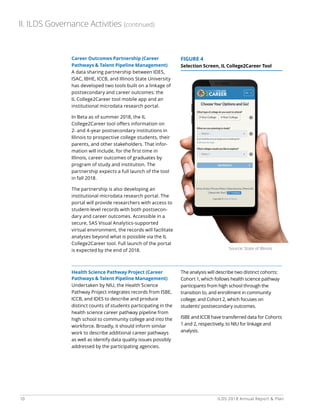
In Beta as of summer 2018, the IL
College2Career tool offers information on
2- and 4-year postsecondary institutions in
Illinois to prospective college students, their
parents, and other stakeholders. That infor-
mation will include, for the first time in
Illinois, career outcomes of graduates by
program of study and institution. The
partnership expects a full launch of the tool
in fall 2018.
The partnership is also developing an
institutional microdata research portal. The
portal will provide researchers with access to
student-level records with both postsecon-
dary and career outcomes. Accessible in a
secure, SAS Visual Analytics-supported
virtual environment, the records will facilitate
analyses beyond what is possible via the IL
College2Career tool. Full launch of the portal
is expected by the end of 2018.
Health Science Pathway Project (Career
Pathways  Talent Pipeline Management)
Undertaken by NIU, the Health Science
Pathway Project integrates records from ISBE,
ICCB, and IDES to describe and produce
distinct counts of students participating in the
health science career pathway pipeline from
high school to community college and into the
workforce. Broadly, it should inform similar
work to describe additional career pathways
as well as identify data quality issues possibly
addressed by the participating agencies.
The analysis will describe two distinct cohorts:
Cohort 1, which follows health science pathway
participants from high school through the
transition to, and enrollment in community
college; and Cohort 2, which focuses on
students’ postsecondary outcomes.
ISBE and ICCB have transferred data for Cohorts
1 and 2, respectively, to NIU for linkage and
analysis.
II. ILDS Governance Activities (continued)
FIGURE 4
Selection Screen, IL College2Career Tool
Source: State of Illinois
11ILDS 2018 Annual Report  Plan
Through state FY 2018 (ending on June 30,
2018), the ILDS Governing Board will prioritize
the following categories of activities for the ILDS:
A. Aligning ILDS Governing Board activities
with interagency data projects undertaken
through the Governor’s Cabinet on Children
and Youth (“The Children’s Cabinet”)
B. Continuing progress on the five end-user
priorities, with the identification of critical
research topics within each priority area
C. Promoting access and use by external
researchers
D. Continued enhancement of the CDD
Administrator’s services
E. Supporting the P-20 Council’s Education and
Workforce Data Task Force
F. FY 2019 Budget
A. Aligning ILDS with Children’s Cabinet
Data Projects
The Governor’s Cabinet on Children and Youth
(“Children’s Cabinet”) was established by
Governor Rauner in February 2016 to create a
cohesive statewide strategy to improve
outcomes for children and youth. Chaired by
the Governor, the Cabinet convenes the
executive leadership of the 15 state agencies
that oversee initiatives for children and youth,
as well as four members of the Governor’s
senior team and the Department of
Innovation and Technology (DoIT).
The Children’s Cabinet has adopted a new set
of projects. One of the projects—Transitional
Math and Alternative High School Equivalency
(HSE) Credentials – aligns closely with the
priority areas of the ILDS. The project seeks to
collaborate and develop transitional programs
to facilitate postsecondary degrees and creden-
tials. Where applicable, Table 5 shows areas
of alignment between Children’s Cabinet and
ILDS data projects.
B. FY 2019 Priorities
Through FY 2019, the ILDS Agencies will
continue to focus on the following five end-user
priority areas:
1. Early Childhood
2. High School to  through College
3. College Transfers  Guided Pathways
4. Career Pathways  Talent Pipeline Analysis
5. 60% by 2025
For each of these areas, Table 7 summarizes:
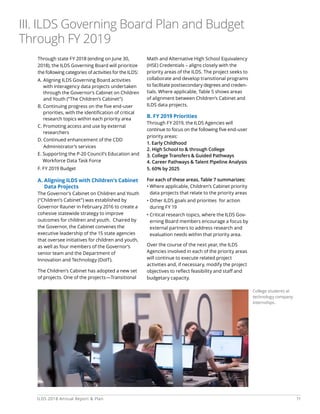
• Where applicable, Children’s Cabinet priority
data projects that relate to the priority areas
• Other ILDS goals and priorities for action
during FY 19
• Critical research topics, where the ILDS Gov-
erning Board members encourage a focus by
external partners to address research and
evaluation needs within that priority area.
Over the course of the next year, the ILDS
Agencies involved in each of the priority areas
will continue to execute related project
activities and, if necessary, modify the project
objectives to reflect feasibility and staff and
budgetary capacity.
College students at
technology company
internships.
III. ILDS Governing Board Plan and Budget
Through FY 2019
12 ILDS 2018 Annual Report  Plan
III. ILDS Governing Board Plan and Budget Through FY 2019 (continued)
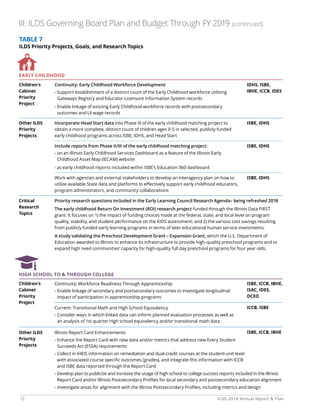
TABLE 7
ILDS Priority Projects, Goals, and Research Topics
IDHS, ISBE,
IBHE, ICCB, IDES
ISBE, ICCB, IBHE,
ISAC, IDES,
DCEO
ICCB, ISBE
ISBE, ICCB, IBHE
ISBE, IDHS
ISBE, IDHS
ISBE, IDHS
Children’s
Cabinet
Priority
Project 
Children’s
Cabinet
Priority
Project 
Other ILDS
Priority
Projects
EARLY CHILDHOOD
HIGH SCHOOL TO  THROUGH COLLEGE
Critical
Research
Topics 
Other ILDS
Priority
Projects 
Continuity: Early Childhood Workforce Development
- Support establishment of a distinct count of the Early Childhood workforce utilizing
Gateways Registry and Educator Licensure Information System records
- Enable linkage of existing Early Childhood workforce records with postsecondary
outcomes and UI wage records
Continuity: Workforce Readiness Through Apprenticeship
- Enable linkage of secondary and postsecondary outcomes to investigate longitudinal
impact of participation in apprenticeship programs
Current: Transitional Math and High School Equivalency
- Consider ways in which linked data can inform planned evaluation processes as well as
an analysis of 1st quarter high school equivalency and/or transitional math data
Illinois Report Card Enhancements:
- Enhance the Report Card with new data and/or metrics that address new Every Student
Succeeds Act (ESSA) requirements
- Collect in IHEIS information on remediation and dual-credit courses at the student-unit level
with associated course specific outcomes (grades), and integrate this information with ICCB
and ISBE data reported through the Report Card
- Develop plan to publicize and increase the usage of high school to college success reports included in the Illinois
Report Card and/or Illinois Postsecondary Profiles for local secondary and postsecondary education alignment
- Investigate areas for alignment with the Illinois Postsecondary Profiles, including metrics and design
Priority research questions included in the Early Learning Council Research Agenda– being refreshed 2018
The early childhood Return On Investment (ROI) research project funded through the Illinois Data FIRST
grant. It focuses on 1) the impact of funding choices made at the federal, state, and local level on program
quality, stability, and student performance on the KIDS assessment; and 2) the various cost savings resulting
from publicly funded early learning programs in terms of later educational human service investments.
A study validating the Preschool Development Grant – Expansion Grant, which the U.S. Department of
Education awarded to Illinois to enhance its infrastructure to provide high-quality preschool programs and to
expand high need communities’ capacity for high-quality full day preschool programs for four year olds.
Incorporate Head Start data into Phase III of the early childhood matching project to
obtain a more complete, distinct count of children ages 0-5 in selected, publicly funded
early childhood programs across ISBE, IDHS, and Head Start
Include reports from Phase II/III of the early childhood matching project:
- on an Illinois Early Childhood Services Dashboard as a feature of the Illinois Early
Childhood Asset Map (IECAM) website
- as early childhood reports included within ISBE’s Education 360 dashboard
Work with agencies and external stakeholders to develop an interagency plan on how to
utilize available State data and platforms to effectively support early childhood educators,
program administrators, and community collaborations
13ILDS 2018 Annual Report  Plan
IBHE, ICCB, IDES
ICCB, IBHE
IBHE, ICCB
Other ILDS
Priority
Projects
(continued)
ILDS Priority
Projects
Critical
Research
Topics
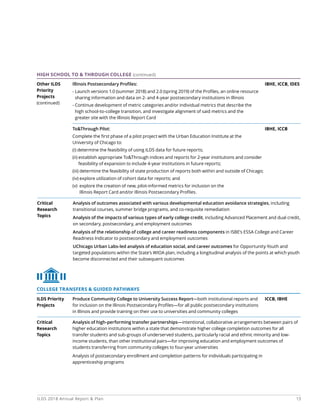
Illinois Postsecondary Profiles:
- Launch versions 1.0 (summer 2018) and 2.0 (spring 2019) of the Profiles, an online resource
sharing information and data on 2- and 4-year postsecondary institutions in Illinois
- Continue development of metric categories and/or individual metrics that describe the
high school-to-college transition, and investigate alignment of said metrics and the
greater site with the Illinois Report Card
Produce Community College to University Success Report—both institutional reports and
for inclusion on the Illinois Postsecondary Profiles—for all public postsecondary institutions
in Illinois and provide training on their use to universities and community colleges
Analysis of high-performing transfer partnerships—intentional, collaborative arrangements between pairs of
higher education institutions within a state that demonstrate higher college completion outcomes for all
transfer students and sub-groups of underserved students, particularly racial and ethnic minority and low-
income students, than other institutional pairs—for improving education and employment outcomes of
students transferring from community colleges to four-year universities
Analysis of postsecondary enrollment and completion patterns for individuals participating in
apprenticeship programs
ToThrough Pilot:
Complete the first phase of a pilot project with the Urban Education Institute at the
University of Chicago to:
(i) determine the feasibility of using ILDS data for future reports;
(ii) establish appropriate ToThrough indices and reports for 2-year institutions and consider
feasibility of expansion to include 4-year institutions in future reports;
(iii) determine the feasibility of state production of reports both within and outside of Chicago;
(iv) explore utilization of cohort data for reports; and
(v) explore the creation of new, pilot-informed metrics for inclusion on the
Illinois Report Card and/or Illinois Postsecondary Profiles.
HIGH SCHOOL TO  THROUGH COLLEGE (continued)
COLLEGE TRANSFERS  GUIDED PATHWAYS
Critical
Research
Topics 
Analysis of outcomes associated with various developmental education avoidance strategies, including
transitional courses, summer bridge programs, and co-requisite remediation
Analysis of the impacts of various types of early college credit, including Advanced Placement and dual credit,
on secondary, postsecondary, and employment outcomes
Analysis of the relationship of college and career readiness components in ISBE’s ESSA College and Career
Readiness Indicator to postsecondary and employment outcomes
UChicago Urban Labs-led analysis of education social, and career outcomes for Opportunity Youth and
targeted populations within the State’s WIOA plan, including a longitudinal analysis of the points at which youth
become disconnected and their subsequent outcomes
14 ILDS 2018 Annual Report  Plan
ISBE, ICCB, IBHE,
ISAC, IDES,
DCEO
IDES, ICCB,
IBHE, ISAC,
DCEO
ICCB, IBHE, IDES
IDES
ICCB, IBHE, IDES,
DCEO
ISBE, ICCB, IDES,
DCEO
IBHE, ICCB, IDHS,
ISBE, IDES
Children’s
Cabinet
Priority
Projects
Other ILDS
Priority
Projects
Critical
Research
Topics
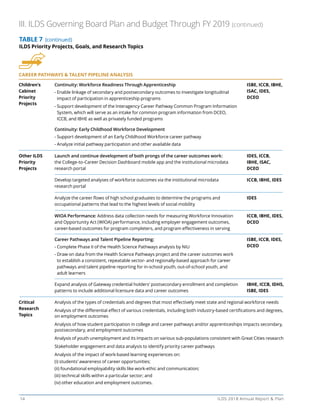
Continuity: Workforce Readiness Through Apprenticeship
- Enable linkage of secondary and postsecondary outcomes to investigate longitudinal
impact of participation in apprenticeship programs
- Support development of the Interagency Career Pathway Common Program Information
System, which will serve as an intake for common program information from DCEO,
ICCB, and IBHE as well as privately funded programs
Launch and continue development of both prongs of the career outcomes work:
the College-to-Career Decision Dashboard mobile app and the institutional microdata
research portal
Develop targeted analyses of workforce outcomes via the institutional microdata
research portal
Analyze the career flows of high school graduates to determine the programs and
occupational patterns that lead to the highest levels of social mobility
WIOA Performance: Address data collection needs for measuring Workforce Innovation
and Opportunity Act (WIOA) performance, including employer engagement outcomes,
career-based outcomes for program completers, and program effectiveness in serving
Career Pathways and Talent Pipeline Reporting:
- Complete Phase II of the Health Science Pathways analysis by NIU
- Draw on data from the Health Science Pathways project and the career outcomes work
to establish a consistent, repeatable sector- and regionally-based approach for career
pathways and talent pipeline reporting for in-school youth, out-of-school youth, and
adult learners
Expand analysis of Gateway credential holders’ postsecondary enrollment and completion
patterns to include additional licensure data and career outcomes
Analysis of the types of credentials and degrees that most effectively meet state and regional workforce needs
Analysis of the differential effect of various credentials, including both industry-based certifications and degrees,
on employment outcomes
Analysis of how student participation in college and career pathways and/or apprenticeships impacts secondary,
postsecondary, and employment outcomes
Analysis of youth unemployment and its impacts on various sub-populations consistent with Great Cities research
Stakeholder engagement and data analysis to identify priority career pathways
Analysis of the impact of work-based learning experiences on:
(i) students’ awareness of career opportunities;
(ii) foundational employability skills like work-ethic and communication;
(iii) technical skills within a particular sector; and
(iv) other education and employment outcomes.
Continuity: Early Childhood Workforce Development
- Support development of an Early Childhood Workforce career pathway
- Analyze initial pathway participation and other available data
CAREER PATHWAYS  TALENT PIPELINE ANALYSIS
III. ILDS Governing Board Plan and Budget Through FY 2019 (continued)
TABLE 7 (continued)
ILDS Priority Projects, Goals, and Research Topics
15ILDS 2018 Annual Report  Plan
ICCB, IBHE,
DCEO
ICCB, IBHE,
IDES, IDHS
ICCB, IBHE,
IDES, IDHS
ICCB, IBHE
All data is being
drawn from other
projects for this
dashboard
ILDS Priority
Projects
Critical
Research
Topic
Continue to integrate data on attainment of industry credentials with data on
postsecondary credential completion
Continue to enhance community dashboards with key education and workforce metrics
to support local progress monitoring toward the 60% by 2025 goal
Define a social utility component of the credential definition and consider the inclusion
of Gateways credentials in the 60% by 2025 calculation
Operationalize high quality credential definition, including a possible social utility
component, and develop mechanisms for collection of this data
Include on the Illinois Postsecondary Profiles indicators of statewide and institution-specific
progress towards 60% by 2025, and disaggregate the indicators by student demography
and/or subgroup
Analysis of level of degree and credential attainment needed in various regions to meet workforce
needs in 2025 and beyond
60% BY 2025
16 ILDS 2018 Annual Report  Plan
C. Promoting Access and Use by
External Partners
In FY 2019, the ILDS Governing Board will
undertake the following activities to promote
data access and use by external research and
evaluation organizations:
• Create an ILDS User Guide providing
background information on the ILDS and
outlining the processes and protocols—both
interagency and agency-specific—for
requesting those data
• Publish agency-specific data dictionaries or
similar documents describing the specific data
sources and elements available for linkage via
the ILDS
• Explore the establishment of de-identified
datasets that can be accessed through a
streamlined process, though one still involving
a data sharing agreement and security and
process controls questionnaire
Access to specific ILDS agency[s] data will still
require consent from the ILDS agency[s] via its
separate processes and protocols, although the
goal will be to align and coordinate these to the
extent feasible.
D. Enhancing the CDD
Administrator’s Services
The CDDA’s services through FY 2019 will focus
on regular updates, ongoing maintenance, and
system enhancements. Each of the ILDS
Agencies will continue to provide data to the
CDDA in accordance with the agreed-upon
annual or biannual schedule. The CDDA will then
de-duplicate and standardize the data, link it to
data from other agencies, and assign the
CDDA-ID. System maintenance and administra-
tive activities will include monitoring data
transactions, reporting through the CDDA
Dashboard, and hardware and software
evaluation and upgrades as needed. In addition,
the CDDA will continue to provide support to the
ILDS Agencies to use the CDDA-ID for interagency
data merges, including training and user guides
for agency staff. Utilization of the IDs allows the
agencies to limit matching based on either
sensitive personally identifiable information or
confidential employer-level information, thereby
enhancing the protection of these sensitive data.
During FY 2018, the CDDA added Educator
Licensure Information System (ELIS) demographic
data from ISBE. Linkage of these data will
support description and analysis of the early
childhood workforce and teacher preparation
systems—a continuation of the Early Childhood
Workforce Development project of the
Children’s Cabinet.
During FY 2019, the CDDA expects to add the
following datasets to the MCI system, contingent
upon the availability of budgetary resources for
the additions:
• From ICCB, Adult Education and non-credit
datasets. The inclusion of these data will support
analysis of a broader array of education and
training programs than is currently feasible
with ICCB’s for-credit data sets. Of particular
research interest are the capture of non-diploma
holders engaging the ICCB system and the
enhanced tracking of these individuals
throughout the lifelong-learning process.
• From the Illinois Head Start Association and
the University of Illinois Urbana-Champaign,
through IDHS, Early Head Start and Head Start
child demographic data. The inclusion of
these data will support establishment of a
comprehensive distinct count of children
served by publicly funded early childhood
services as well as facilitate the continued
pursuit of research questions included in the
Early Learning Council Research Agenda.
E. Supporting the P-20 Council’s
Education and Workforce Data
Task Force
Launching in fall 2018, the P-20 Council’s
Education and Workforce Data Task Force will
study the overall ecosystem of education data
use in Illinois. ILDS leadership will participate
actively in this effort, with goals of supporting
improved data use on Illinois education policy
and helping the ILDS’ continuous improvement
processes reflect the needs of its key
stakeholders.
III. ILDS Governing Board Plan and Budget Through FY 2019 (continued)
17ILDS 2018 Annual Report  Plan
F. FY 2019 Budget
The expenses of ILDS implementation include
shared costs for the overall ILDS effort that are
not specific to any one agency, and the expenses
of intra-agency enhancements and the
development of end-user reports that, in the
past, have typically either been:
• undertaken by agency staff,
• funded through agency operating budgets, or
• funded through federal grant sources (such as
the SLDS, WDQI, and Race to the Top Early
Learning Challenge grants).
Table 8 shows the FY 2019 budget for the shared
costs of the ILDS, which include administration
and maintenance of the CDDA. The Governing
Board is currently discussing the adoption and
implementation of a cost-sharing model wherein
the participating agencies would be responsible
TABLE 8
FY 2019 Budget CDD Administrator
Budget from July 1, 2018 through June 30, 2019
• Staffing support, equipment, software renewal and updates, upgrades,
maintenance, data exchange  record linkage, and training  .  .  .  .  .  .  .  .  .  .  .  .  .  .  .  .  .  .  .  . $ 250,000
Philanthropic resources support the staffing of the Governing Board
The ILDS Agencies have made substantial
progress to establish the ILDS governance
system, strengthen the CDDA, and proceed
on priorities for end-user services. To achieve
the State’s objectives for a useful and robust
longitudinal data system that supports analysis
and understanding of lifelong education and
workforce policies and programs, the agencies
will remain aggressive with our collective
work and continue to track progress against
the objectives described in this document.
Ultimately, ILDS governance is a continuous
process of improvement. The ILDS Agencies
have established an aggressive set of FY 2019
priorities, which they hope will receive broad
support and establish a clear direction for
future activities.
IV. Conclusion
18 ILDS 2018 Annual Report  Plan
TABLE 9
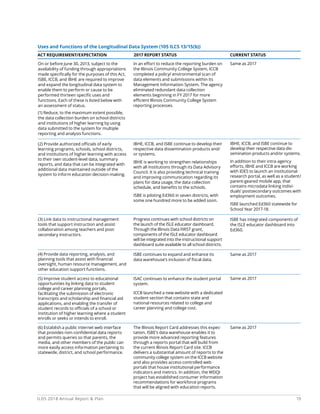
Benchmarking Against the P-20 ILDS Act
Agreement(s) to Link P-20 Education Records (105 ILCS 13/15(a))
ACT REQUIREMENT/EXPECTATION 	 2017 REPORT STATUS 	 CURRENT STATUS
ISBE Data Warehouse and System Elements (105 ILCS 13/15(c))
ACT REQUIREMENT/EXPECTATION 	 2017 REPORT STATUS 	 CURRENT STATUS
The P-20 Longitudinal Education Data System
Act (105 ILCS 13/1 et seq.) (“P-20 ILDS Act”)
establishes a number of requirements and
expectations for ISBE, ICCB, and IBHE in order
to develop a robust state longitudinal
education data system. This Section of the
Report  Plan identifies the key requirements
and expectations of the P-20 ILDS Act and
summarizes the status of the agencies’ efforts
against those requirements and expectations.
The 2017 status is also included for
comparative purposes.
Most of the P-20 ILDS Act requirements and
expectations are “subject to the availability
of funding through appropriations made
specifically for the purposes of” the Act.
While ISBE has received appropriations to
expend its federal IES grant awards, only
limited State appropriations have been made
to the agencies for longitudinal data system-
related purposes.
Many of the expectations of the P-20 ILDS Act
cannot simply be categorized as “complete” or
“incomplete”, and instead should be viewed as
objectives for a continuous improvement
process. By annually benchmarking progress
against these requirements and expectations,
the ILDS Agencies can determine the extent to
which the General Assembly’s priorities for a
longitudinal education data system are
being fulfilled.
Appendix: Benchmarking Against the P-20 ILDS Act
ISBE, ICCB, and IBHE shall jointly establish
and maintain a longitudinal data system by
entering into one or more agreements that
link early learning, elementary, and
secondary school student unit records with
institution of higher learning student unit
records.
On or before June 30, 2013, subject to the
availability of funding through appropriations
made specifically for the purposes of this Act,
ISBE must establish a data warehouse that
integrates data from multiple student unit
record systems and supports the uses and
functions of the longitudinal data system as
specified in the Act.
ISBE’s data warehouse and data systems
must include ten specific elements (which are
derived from the Data Quality Campaign’s “10
Essential Elements), including the ability to
match student records from year to year to
measure growth, the ability to match
teachers and administrators with students,
student level transcript information from
middle and high schools, and the ability to
match ISBE’s records with institution of
higher learning systems.
In 2009, ISBE, ICCB, and IBHE entered into an
intergovernmental agreement to link student
unit records for the purpose of producing the
High School to College Success Report. This
agreement also allowed ISBE’s Unique Student
ID to be shared with ICCB and IBHE, and
established a framework for other data
sharing arrangements. The ILDS Intergovern-
mental Agreement, effective as of June 30,
2013, also addresses the requirements of this
Section of the Act.
ISBE continues to expand and improve its
internal data warehouse systems.
ISBE’s data systems fully address all ten
required elements of the Act.
IBHE continues to build out its
collection of student-level data from
individual institutions, including
student enrollments from additional
years. The agency has also now
integrated the CDDA-ID into its
internal data systems.
Same as 2017
Same as 2017
19ILDS 2018 Annual Report  Plan
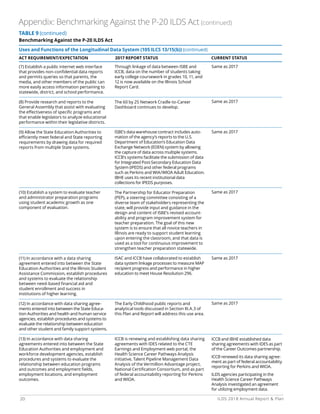
Uses and Functions of the Longitudinal Data System (105 ILCS 13/15(b))
ACT REQUIREMENT/EXPECTATION 	 2017 REPORT STATUS 	 CURRENT STATUS
On or before June 30, 2013, subject to the
availability of funding through appropriations
made specifically for the purposes of this Act,
ISBE, ICCB, and IBHE are required to improve
and expand the longitudinal data system to
enable them to perform or cause to be
performed thirteen specific uses and
functions. Each of these is listed below with
an assessment of status.
(1) Reduce, to the maximum extent possible,
the data collection burden on school districts
and institutions of higher learning by using
data submitted to the system for multiple
reporting and analysis functions.
(2) Provide authorized officials of early
learning programs, schools, school districts,
and institutions of higher learning with access
to their own student-level data, summary
reports, and data that can be integrated with
additional data maintained outside of the
system to inform education decision-making.
(3) Link data to instructional management
tools that support instruction and assist
collaboration among teachers and post-
secondary instructors.
(4) Provide data reporting, analysis, and
planning tools that assist with financial
oversight, human resource management, and
other education support functions.
(5) Improve student access to educational
opportunities by linking data to student
college and career planning portals,
facilitating the submission of electronic
transcripts and scholarship and financial aid
applications, and enabling the transfer of
student records to officials of a school or
institution of higher learning where a student
enrolls or seeks or intends to enroll.
(6) Establish a public internet web interface
that provides non-confidential data reports
and permits queries so that parents, the
media, and other members of the public can
more easily access information pertaining to
statewide, district, and school performance.
In an effort to reduce the reporting burden on
the Illinois Community College System, ICCB
completed a policy/ environmental scan of
data elements and submissions within its
Management Information System. The agency
eliminated redundant data collection
elements beginning in FY 2017 for more
efficient Illinois Community College System
reporting processes.
IBHE, ICCB, and ISBE continue to develop their
respective data dissemination products and/
or systems.
IBHE is working to strengthen relationships
with all institutions through its Data Advisory
Council. It is also providing technical training
and improving communication regarding its
plans for data usage, the data collection
schedule, and benefits to the schools.
ISBE is piloting Ed360 in seven districts, with
some one hundred more to be added soon.
Progress continues with school districts on
the launch of the ISLE educator dashboard.
Through the Illinois Data FIRST grant,
components of the ISLE educator dashboard
will be integrated into the instructional support
dashboard suite available to all school districts.
ISBE continues to expand and enhance its
data warehouse’s inclusion of fiscal data.
ISAC continues to enhance the student portal
system.
ICCB launched a new website with a dedicated
student section that contains state and
national resources related to college and
career planning and college cost.
The Illinois Report Card addresses this expec-
tation. ISBE’s data warehouse enables it to
provide more advanced reporting features
through a reports portal that will build from
the current Illinois Report Card site. ICCB
delivers a substantial amount of reports to the
community college system on the ICCB website
and also provides access-controlled web
portals that house institutional performance
indicators and metrics. In addition, the WDQI
project has established consumer information
recommendations for workforce programs
that will be aligned with education reports.
Same as 2017
IBHE, ICCB, and ISBE continue to
develop their respective data dis-
semination products and/or systems.
In addition to their intra-agency
efforts, IBHE and ICCB are working
with IDES to launch an institutional
research portal, as well as a student/
parent-geared mobile app, that
contains microdata linking indivi-
duals’ postsecondary outcomes with
employment outcomes.
ISBE launched Ed360 statewide for
School Year 2017-18.
ISBE has integrated components of
the ISLE educator dashboard into
Ed360.
Same as 2017
Same as 2017
Same as 2017
20 ILDS 2018 Annual Report  Plan
Uses and Functions of the Longitudinal Data System (105 ILCS 13/15(b)) (continued)
ACT REQUIREMENT/EXPECTATION 	 2017 REPORT STATUS 	 CURRENT STATUS
(7) Establish a public internet web interface
that provides non-confidential data reports
and permits queries so that parents, the
media, and other members of the public can
more easily access information pertaining to
statewide, district, and school performance.
(8) Provide research and reports to the
General Assembly that assist with evaluating
the effectiveness of specific programs and
that enable legislators to analyze educational
performance within their legislative districts.
(9) Allow the State Education Authorities to
efficiently meet federal and State reporting
requirements by drawing data for required
reports from multiple State systems.
(10) Establish a system to evaluate teacher
and administrator preparation programs
using student academic growth as one
component of evaluation.
(11) In accordance with a data sharing
agreement entered into between the State
Education Authorities and the Illinois Student
Assistance Commission, establish procedures
and systems to evaluate the relationship
between need-based financial aid and
student enrollment and success in
institutions of higher learning.
(12) In accordance with data sharing agree-
ments entered into between the State Educa-
tion Authorities and health and human service
agencies, establish procedures and systems to
evaluate the relationship between education
and other student and family support systems.
(13) In accordance with data sharing
agreements entered into between the State
Education Authorities and employment and
workforce development agencies, establish
procedures and systems to evaluate the
relationship between education programs
and outcomes and employment fields,
employment locations, and employment
outcomes.
Through linkage of data between ISBE and
ICCB, data on the number of students taking
early college coursework in grades 10, 11, and
12 is now available on the Illinois School
Report Card.
The 60 by 25 Network Cradle-to-Career
Dashboard continues to develop.
ISBE’s data warehouse contract includes auto-
mation of the agency’s reports to the U.S.
Department of Education’s Education Data
Exchange Network (EDEN) system by allowing
the capture of data across multiple systems.
ICCB’s systems facilitate the submission of data
for Integrated Post-Secondary Education Data
System (IPEDS) and other federal programs
such as Perkins and WIA/WIOA Adult Education.
IBHE uses its recent institutional data
collections for IPEDS purposes.
The Partnership for Educator Preparation
(PEP), a steering committee consisting of a
diverse team of stakeholders representing the
state, will provide input and guidance in the
design and content of ISBE’s revised account-
ability and program improvement system for
teacher preparation. The goal of this new
system is to ensure that all novice teachers in
Illinois are ready to support student learning
upon entering the classroom, and that data is
used as a tool for continuous improvement to
strengthen teacher preparation statewide.
ISAC and ICCB have collaborated to establish
data system linkage processes to measure MAP
recipient progress and performance in higher
education to meet House Resolution 296.
The Early Childhood public reports and
analytical tools discussed in Section III.A.3 of
this Plan and Report will address this use area.
ICCB is renewing and establishing data sharing
agreements with IDES related to the CTE
Earnings and Employment web portal, the
Health Science Career Pathways Analysis
initiative, Talent Pipeline Management Data
Analysis of the Vermillion Advantage project,
National Certification Consortium, and as part
of federal accountability reporting for Perkins
and WIOA.
Same as 2017
Same as 2017
Same as 2017
Same as 2017
Same as 2017
Same as 2017
ICCB and IBHE established data
sharing agreements with IDES as part
of the Career Outcomes partnership.
ICCB renewed its data sharing agree-
ment as part of federal accountability
reporting for Perkins and WIOA.
ILDS agencies participating in the
Health Science Career Pathways
Analysis investigated an agreement
for utilizing employment data.
TABLE 9 (continued)
Benchmarking Against the P-20 ILDS Act
Appendix: Benchmarking Against the P-20 ILDS Act (continued)
21ILDS 2018 Annual Report  Plan
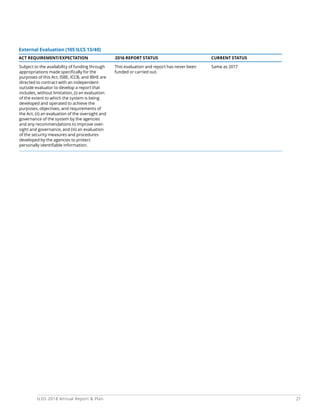
External Evaluation (105 ILCS 13/40)
ACT REQUIREMENT/EXPECTATION 	 2016 REPORT STATUS 	 CURRENT STATUS
Subject to the availability of funding through
appropriations made specifically for the
purposes of this Act, ISBE, ICCB, and IBHE are
directed to contract with an independent
outside evaluator to develop a report that
includes, without limitation, (i) an evaluation
of the extent to which the system is being
developed and operated to achieve the
purposes, objectives, and requirements of
the Act, (ii) an evaluation of the oversight and
governance of the system by the agencies
and any recommendations to improve over-
sight and governance, and (iii) an evaluation
of the security measures and procedures
developed by the agencies to protect
personally identifiable information.
This evaluation and report has never been
funded or carried out.
Same as 2017
Ilds annual report & plan 2018

Ilds annual report & plan 2018

  • 1.
    Illinois Longitudinal DataSystem Annual Report & Plan Approved by the Illinois Longitudinal Data System Governing Board Agencies September 2018 2018
  • 2.
    I. Introduction &Background . . . . . . . . . . . . . . . . . . . . . . . . . . . . . . . . . . . . . . . . . . . . . . . . . . . . . . . . . . 1 Table 1: State of Illinois Agencies Participating in the ILDS Intergovernmental Agreement . . 2 Table 2: Focus for ILDS Governance (“ILDS Functions”) . . . . . . . . . . . . . . . . . . . . . . . . . . . . . . . . . . 2 II. ILDS Governance Activities . . . . . . . . . . . . . . . . . . . . . . . . . . . . . . . . . . . . . . . . . . . . . . . . . . . . . . . . . . 3 Figure 1: ILDS Conceptual Technical Architecture Diagram . . . . . . . . . . . . . . . . . . . . . . . . . . . . . . . 3 A. Centralized Demographic Dataset Administrator and Master Client Index . . . . . . . . . . . . . . . . . . 4 Table 3: CDDA Data Source Summary, Release 6, August 2018 . . . . . . . . . . . . . . . . . . . . . . . . . . . 4 B. Intra-Agency Enhancements . . . . . . . . . . . . . . . . . . . . . . . . . . . . . . . . . . . . . . . . . . . . . . . . . . . . . . . . . . . 5 Table 4: Intra-Agency Enhancements Over Prior 18 Months . . . . . . . . . . . . . . . . . . . . . . . . . . . . . . 5 C. Progress on End-User Priorities . . . . . . . . . . . . . . . . . . . . . . . . . . . . . . . . . . . . . . . . . . . . . . . . . . . . . . . . 7 Table 5: Degree Attainment Status for those with a Level 4 ECE Credential . . . . . . . . . . . . . . . . 7 Table 6: Degree Attainment Status for those with a Level 3 ECE Credential . . . . . . . . . . . . . . . . 7 Figure 2: Percentage and number of 3-5 year olds in PFA and/or CCAP . . . . . . . . . . . . . . . . . . . . 8 Figure 3: Remediation Rates in Community College – Class of 2015, Lake View High School (9-12), City of Chicago SD 29 . . . . . . . . . . . . . . . . . . . . . . . . . . . . . . . . . . . . . . . . . . . . . . . . . . . . . . . . 9 Figure 4: Selection Screen, IL College2Career tool . . . . . . . . . . . . . . . . . . . . . . . . . . . . . . . . . . . . . . 10 III. ILDS Plan and Budget through FY 2019 . . . . . . . . . . . . . . . . . . . . . . . . . . . . . . . . . . . . . . . . . . . . . . 11 A. Aligning ILDS with Children’s Cabinet Data Projects . . . . . . . . . . . . . . . . . . . . . . . . . . . . . . . . . . . . . 11 B. FY 2019 Priorities . . . . . . . . . . . . . . . . . . . . . . . . . . . . . . . . . . . . . . . . . . . . . . . . . . . . . . . . . . . . . . . . . . . . 11 Table 7: FY 2019 Priorities . . . . . . . . . . . . . . . . . . . . . . . . . . . . . . . . . . . . . . . . . . . . . . . . . . . . . . . . . . . 12 C. Promoting Access and Use by External Researchers . . . . . . . . . . . . . . . . . . . . . . . . . . . . . . . . . . . . . 16 D. Enhancing the CDD Administrator’s Services . . . . . . . . . . . . . . . . . . . . . . . . . . . . . . . . . . . . . . . . . . . 16 E. Supporting the P-20 Council’s Education and Data Workforce Task Force . . . . . . . . . . . . . . . . . . 16 F. FY 2019 Budget . . . . . . . . . . . . . . . . . . . . . . . . . . . . . . . . . . . . . . . . . . . . . . . . . . . . . . . . . . . . . . . . . . . . . . . 17 Table 8: FY 2019 Budget: CDD Administrator and Governing Board/Committee Staffing . . . 17 IV. Conclusion . . . . . . . . . . . . . . . . . . . . . . . . . . . . . . . . . . . . . . . . . . . . . . . . . . . . . . . . . . . . . . . . . . . . . . . . 17 Appendix: Benchmarking Against the P-20 ILDS Act . . . . . . . . . . . . . . . . . . . . . . . . . . . . . . . . . . . 18 Table of Contents ILDS 2018 Annual Report Plan
  • 3.
    1ILDS 2018 AnnualReport Plan THIS ILLINOIS LONGITUDINAL DATA SYSTEM (“ILDS”) ANNUAL REPORT PLAN is the fifth such plan adopted by the ILDS Governing Board. On June 30, 2013, seven State of Illinois agencies and the Office of the Governor entered into an intergovernmental agreement for the governance of the Illinois Longitudinal Data System (see Table 1, on page 2 of this report, for participating agencies). As shown in Table 2, (page 2), this agreement identified eight separate requirements, functions, and expectations for the focus of the ILDS governance system (the “ILDS Functions”). In addition, the agreement created: • a Governing Board with senior leadership from each of the ILDS Agencies and chaired by an appointee of the Governor, and • five separate committees, as shown in Figure 1 (page 3). Under Section IV.A of the Agreement, the Governing Board must adopt, on an annual basis, a report to the Governor, the P-20 Council, and the chief executive of each of the ILDS Agencies that includes, without limitation: a. A report on the activities of the Governing Board and its committees for the prior 12-month period; b. A plan and budget for the performance of the ILDS Functions through the upcoming State fiscal year; and c. A benchmarking of the performance of the ILDS Functions against the requirements and expectations of the P-20 Longitudinal Educa- tion Data System Act (105 ILCS 13/1 et seq.). This Annual Report Plan constitutes the report required by Section IV.A of the ILDS Intergovernmental Agreement. It draws from meetings of the Governing Board and its Committees, interviews with ILDS Agency staff, and information from related state agency initiatives such as the Governor’s Cabinet on Children and Families. ILDS Agency staff have reviewed and commented upon its contents, and the Governing Board has adopted it. This document describes the primary ILDS governance activities during the 17-18 state fiscal year (FY 2018). Then, it describes the priorities for ILDS governance activities through FY 2019 that have been adopted by the Governing Board. Finally, it includes a benchmarking of ILDS efforts against the requirements of the P-20 Longitudinal Education Data System Act. While the Governing Board intends for this document to provide a roadmap for ILDS activities through FY 2019, it also recognizes the need for flexibility and adaptability as the ILDS Agencies move into implementation activities. Certain priorities may need adjustment, and others may not be attainable in light of staffing and funding limitations. The Governing Board will periodically review its progress and this Report Plan as implementation activities move forward. ILDS and Individual Privacy The ILDS protects individual privacy and confi- dentiality consistent with all privacy protection laws and leading technical practices. The ILDS and operations of the Governing Board do not limit nor waive any of the state or federal privacy protection laws that apply to an individ- ual agency’s data. On the contrary, all sharing of data must be specifically authorized by these laws, and is subject to all applicable legal limitations. Reports and analyses supported by the ILDS will include only aggregate data—an individual’s personal information will never be disclosed. In addition, the systems for receiving and matching agency data through the Centralized Demographic Dataset—as described in Section II.B of this Report—utilize the highest technological standards: • ensuring that data are maintained and merged only on hardware that is not connected to a network, • not duplicating the data, • only conducting data sharing that has been explicitly authorized by the agencies, and • access to data is limited only to employees required to have access. Ensuring robust protections for individual privacy and compliance with all state and federal laws are the highest priorities for the ILDS Agencies and the Governing Board. I. Introduction Background This document describes the primary ILDS governance activities during the 2017-18 state fiscal year. Then, it describes the priorities for ILDS governance activities through 2018-2019 that have been adopted by the Governing Board.
  • 4.
    2 ILDS 2018Annual Report Plan TABLE 1 State of Illinois Agencies Participating in the ILDS Intergovernmental Agreement (“ILDS Agencies”) 1. Illinois Board of Higher Education (IBHE) 2. Illinois Community College Board (ICCB) 3. Illinois Department of Commerce and Economic Opportunity (DCEO) 4. Illinois Department of Employment Security (IDES) 5. Illinois Department of Human Services (IDHS) 6. Illinois Student Assistance Commission (ISAC) 7. Illinois State Board of Education (ISBE) Additional Party: Office of the Governor TABLE 2 Focus for ILDS Governance (“ILDS Functions”) 1. Ensure robust protections for individual privacy and compliance with all pertinent state and federal laws; 2. Establish a set of tools, systems, and processes internal to ILDS Agencies and shared across ILDS Agencies to meet the expectations and requirements of the P-20 Longitudinal Education Data System Act and support analysis and understanding of lifelong education and workforce policies and programs; 3. Effectively and efficiently address audit, evaluation, and research needs that require data inputs from multiple ILDS Agencies; 4. Support and advance sound, research-based decision-making within the ILDS Agencies and for all State education and workforce policymakers; 5. Effectively address common issues across ILDS Agencies such as data access, use, and security; 6. Establish the expectation that ILDS Agencies share data in accordance with established procedures and protocols, subject to applicable legal restrictions; 7. Develop a common process across the ILDS Agencies to plan and budget for ILDS implementation, improvement, and maintenance; and 8. Effectively utilize knowledge and expertise relating to the ILDS Functions residing at the ILDS Agencies and capitalize on a cost-effective ILDS Agency distributed data system model that avoids duplication and ensures sustainability. I. Introduction Background (continued)
  • 5.
    3ILDS 2018 AnnualReport Plan The ILDS Agencies and the Governing Board made substantial progress on activities relating to the ILDS Functions in FY 2018. Progress includes a number of intra-agency enhancements that support the broader ILDS effort; the continued expansion of the Centralized Demographic Dataset Administra- tor (CDDA) and Master Client Index (MCI); and significant work and accomplishments in the end-user service priorities established by the Governing Board. The first Annual Report Plan adopted by the Governing Board included a proposed ILDS technical architecture and set of end-user priorities that has guided ILDS-related activities since April 2014. The ILDS technical architecture consists of these three “layers”: 1. Centralized Demographic Dataset Administrator The CDDA provides services to the ILDS Agencies to match interagency data and prepare files for end-user services. 2. Intra-Agency Enhancements Intra-agency enhancements consist of work internal to the ILDS Agencies to facilitate and enhance interagency data sharing. 3. End-User Priority Areas and Services End-user services consist of the tangible benefits derived from interagency data sharing, including public reports involving P-20 data and analytical tools available to agency staff. FIGURE 1 Figure 1 depicts the technical architecture and set of end-user services for the ILDS. ILDS Conceptual Technical Architecture Diagram II. ILDS Governance Activities  PRIORITYAREASILDS AGENCIES CDDADMIN.SERVICES EARLY CHILDHOOD HIGH SCHOOL TO--THROUGH COLLEGE COLLEGE TRANSFERS GUIDED PATHWAYS CAREER PATHWAYS TALENT PIPELINE ANALYSIS TRACKING PROGRESS ON 60% BY 2025 Board of Higher Education (IBHE) Community College Board (ICCB) Department of Commerce Economic Opportunity (DCEO) Department of Employment Security (IDES) Department of Human Services (IDHS) Student Assistance Commission (ISAC) State Board of Education (ISBE) Batch File Exchange – transfer of batch data files between agencies and CDDA team at NIU CDD ADMINISTRATOR Master Client Index – Identity Resolution – Confidence Rating – Data Administration, Standardization, and Exchange Access to Integrated Data
  • 6.
    4 ILDS 2018Annual Report Plan The plan also established five priority areas for end-user services: 1. Early Childhood Merging early childhood data maintained by IDHS, ISBE, and other agencies to understand the characteristics and outcomes of children receiving early childhood services and the members of the early childhood workforce who serve them. 2. High School to through College Reporting and analyzing college enrollment and performance information for Illinois public high school graduates. 3. College Transfers Guided Pathways Providing information on the outcomes of community college graduates who transfer to Illinois public universities and of participation in postsecondary guided pathways. 4. Career Pathways Talent Pipeline Analysis Analyzing the education and employ- ment outcomes of students participating in career pathway programs in high school and in post-secondary education. 5. 60% by 2025 Enhancing the methods for tracking progress against the State goal of 60% of Illinois residents obtaining a high quality post-secondary degree or credential by the year 2025. II. ILDS Governance Activities (continued) The signature technical achievement of the ILDS Governing Board is the establishment of the CDDA and the related MCI. The CDDA provides an identity resolution system to address the challenge of different state agencies using different identifiers for the same individual. Susie Student may have one identifier in an IDHS early childhood system, which is different from the identifier for Susan Student in the ISBE K-12 system, and different still for Suzie Student in the employment records systems maintained by IDES, even though all of the information is for the same person. The CDDA provides technical review procedures and software to create, securely and confidentially, an ID tied to the same indivi- dual’s records across different agency systems. The CDDA completed and disseminated the sixth release of CDDA-IDs in summer 2018; Table 3 includes updated counts of records, standardized records, and unique individuals by agency. This release will be the first to included educator licensure records from ISBE’s Educator Licensure Information System. TABLE 3 CDDA Data Source Summary, Release 6, August 2018 AGENCY RECORDS STANDARDIZED RECORDS UNIQUE INDIVIDUALS ISBE 21,866,380 4,628,739 4,358,517 ICCB 6,024,838 3,246,421 2,722,922 DCEO 211,753 168,347 167,454 IBHE 5,467,126 2,005,822 1,263,551 ISAC 2,802,386 1,078,194 1,030,043 IDES 62,945,765 17,602,731 11,884,094 IDHS 15,530,547 1,424,573 892,134 MCI 114,858,795 30,154,827 16,394,313 Source: Data Source Summary, Centralized Demographic Administrator (CDDA) Dashboard A. Centralized Demographic Dataset Administrator and Master Client Index
  • 7.
    5ILDS 2018 AnnualReport Plan B. Intra-Agency Enhancements Over the past 12 months, the ILDS Agencies have made significant intra-agency system improvements that will support efficient and quality data exchanges with the CDD Administrator and the other ILDS Agencies. Table 4 describes the improvements made by each agency. TABLE 4 Intra-agency System Enhancements Illinois Board of Higher Education (IBHE) Broadly, IBHE is shifting its focus from data collection to data analysis and use. The agency continues to enhance its data collection system as well as what data are sent back to institutions. The IBHE Data Quality dashboard, funded by the IL First grant, is central to this effort. Other enhancements include the continued transfer of ISAC-held student records to IBHE’s Higher Education Information System (IHEIS) and the expansion of IHEIS to include enrollments from additional academic years. Illinois Community College Board (ICCB) ICCB, via its implementation of the SAS Enterprise Guide (EG) in 2017, continued to enhance its data generation, analysis, and reporting capacity in 2018. ICCB more efficiently provides data for state and federal accountability purposes while continuing to strategically participate in high impact state and national data and research projects that targets increasing student and institutional success. ICCB is working with the NIU CDDA team and selected community colleges to investigate the most efficient process to provide CDDA-IDs at the institutional level. The CDDA-IDs housed at the institutional and school level promotes secure data sharing and collaboration locally. ICCB utilized the CDDA-ID to internally test accuracy with its current longitudinal data linkage techniques and methods.
  • 8.
    6 ILDS 2018Annual Report Plan TABLE 4 (continued) Intra-agency System Enhancements by the ILDS Agencies Illinois Department of Commerce and Economic Opportunity (DCEO) DCEO is responsible for reporting Workforce Innovation Opportunity Act (WIOA) Title I and ETP training provider and student data to the U.S. Department of Labor. It is helping lead a collaborative project, the WIOA Workforce Training Data Trust, with other ILDS agencies that seeks to accomplish the following objectives: • Create a virtual universal statewide workforce training provider and pro- gram platform that contains and displays training provider establishments and program information based on the WIOA education and workforce integration initiative. • Align training programs by sector-based career pathways and demand occupations. • Enhance availability of program and training provider information linked to career information services that educates on job readiness skills assessments, occupation industry overviews and suitability, employment potential, career advancement opportunities, financial assistance options, and state assistance programs and eligibility. • Model training information technology and framework in such a way to connect program completion attainment to credentials and competencies such as degrees, certificates, licenses, apprenticeships, badges, and micro-credentials. • Integrate and connect individual training completion outcomes to wage data that can be utilized for further curriculum planning and forecasting, WIOA eligible training provider performance reporting, and publicly transparent aggregate data scorecards and dashboards. Illinois Department of Employment Security (IDES) IDES is building its internal analytic and research capacity. This capacity will support interagency projects, including the Career Outcomes Tool and an employment analysis for selected cohorts of ISBE HS graduates, and better position the agency to meet increased demand for analyses of employment outcomes. Illinois Department of Human Services (IDHS) IDHS is drawing upon Family Case Management and Better Birth Outcomes records to investigate the impact of physiological challenges at birth on a child’s development and later education. The agency also provided data to support the early childhood matching process described in Section III.B.1 of this document. Illinois State Board of Education (ISBE) ISBE rolled out its integrated data system, called Ed360, statewide for school year 2017-18. The agency is also enhancing its tracking of teacher supply demand data by contributing Educator Licensure Information System (ELIS) records to the CDDA and through the Partnership for Educator Preparation, or PEP. PEP is a committee of diverse stakeholders that, among other things, will support the strengthening of data collection, sharing, and reporting for educator preparation programs across Illinois. Illinois Student Assistance Commission (ISAC) ISAC continues to build out the Gift Assistance Program (GAP Access) system, which now encompasses multiple smaller, formerly distinct data systems. The agency also intends to draw on ILDS infrastructure to enhance its research capacity and better engage researchers seeking ISAC records. II. ILDS Governance Activities (continued)
  • 9.
    7ILDS 2018 AnnualReport Plan C. Progress on End-User Priorities The ILDS Agencies performed significant work and achieved a number of accomplishments in the end-user service priorities established by the Governing Board for FY 2018. The 2017 Annual Report Plan identified priority projects and research topics for each of the end-user service priority areas, with a goal of making significant progress on each one by the end of the fiscal year. Below are descrip- tions and highlights from selected FY17 ILDS priorities and related projects. College Enrollment and Completion Patterns of Gateways Credential Holders (Early Childhood) Gateways Credentials serve as professional symbols of the knowledge, skills, and experience held by members of the early childhood workforce. IDHS awards the credentials, which are administered by the Illinois Network of Child Care Resource and Referral Agencies (INCCRRA). Utilizing the CDDA-ID to link Gateways records with postsecondary data from ICCB and IBHE, this study describes Gateways credential holders and their enrollment and completion patterns through 2- and 4-year postsecondary institutions in Illinois. Key findings include that: • Gateways credential holders are more racially/ethnically diverse than the overall early childhood workforce in Illinois; • many Gateways credential holders have earned some college credit but no degree, suggesting that Gateways credentials could be used to inform progress towards 60% by 2025; and • early childhood enrollments and degree completions in Illinois are declining irrespective of sector or level. Recommendations for future study include: • investigating credential and degree stacking across Gateways and higher education, • determining the value-add of employer- recognized credentials, • making the case for social utility in helping define credential quality, and • expanding the analysis to include all Gateways credential types. TABLE 5 Degree Attainment Status for those with a Level 4 ECE Credential Earned Associate’s Degree or Higher ECE Credential Level 4 (Highest) No Yes Grand Total ICCB 750 658 1408 IBHE 564 129 693 TABLE 6 Degree Attainment Status for those with a Level 3 ECE Credential Earned a Credential or Degree ECE Credential Level 3 No Yes Grand Total ICCB 134 80 214 IBHE 76 0 76 Source: https://www.ibhe.org/assets/files/GatewaysFullReport.pdf EARNED ASSOCIATES DEGREE OR HIGHER EARNED CREDENTIAL OR DEGREE ICCB IBHE ICCB IBHE NO NO NO NO YES YES YES YES 750 658 564 129 134 80 76 0
  • 10.
    8 ILDS 2018Annual Report Plan Early Childhood Matching Project, Phase II (Early Childhood) Undertaken by NIU, the Early Childhood Matching Project serves two primary purposes. First, it identifies data quality issues and other barriers that ISBE and IDHS can address. Second, it produces descriptive statistics based on distinct counts of children ages birth to 5 years receiving publicly funded early childhood services in Illinois. The Project relies upon the CDDA-ID linkage and place Illinois among a small group of states having established such denominators. The NIU team completed the Phase II analysis, which focuses on 2015 and 2016, in spring 2018. Key findings from Phase II are below. • In 2016, of all 3 to 5 year olds (N = 127,325) served by Preschool For All (PFA) or the Child Care Assistance Program (CCAP), 10% were served by both programs. This proportion represents a 1-percentage-point decrease from 2015. • In 2016, of all 0 to 3 year olds (N = 67,786) served by Prevention Initiative (PI) or CCAP, 5% were served by both programs. This proportion is similar to the same for 2015. • PI, PFA, and CCAP participation rates for all children and for those living in poverty (185% Federal Poverty Line) varied widely across Race to the Top Innovation Zones. • Missing data and data quality issues, particularly regarding child-level subgroup indicators, remained a significant challenge for the analysis. FIGURE 2 Percentage and Number of 3-5 Year Olds in PFA and/or CCAP Notes: PFA population is pulled using ISBE program indicator; CCAP population uses equivalent age range with PFA (3–5 year olds); September 1st is age cutoff date. Source: Table 1A, NIU EC Analysis, 6/20/2018 Both (n = 12,679) 10.0% 43.2% CCAP Only (n = 54,977) PFA Only (n = 59,669) 46.9% II. ILDS Governance Activities (continued)
  • 11.
    9ILDS 2018 AnnualReport Plan ToThrough Statewide Pilot (High School to through College) Analysis for the ToThrough statewide pilot will commence in summer 2018. With the data sharing agreement for the pilot now executed, ISBE and ICCB have linked their respective secondary and community college records via the CDDA-ID. Urban Education Institute at the University of Chicago has received those linked records and plans to begin its analysis shortly. The pilot carries exciting prospects for the use of ILDS data and the CDDA-ID in future ToThrough reporting. Stated goals include: • to determine the feasibility of using ILDS data for future ToThrough indices and reports; • to establish appropriate ToThrough indices and reports for 2-year and 4-year institutions; • to determine the feasibility of state production of reports both within and outside of Chicago; and • to explore utilization of cohort data for reports. Community College Remediation on State-Level Public Data Resources (High School to through College) ISBE and ICCB linked student record data via the CDDA-ID to measure the number of high school graduates who attend an Illinois community college and enroll in developmental education coursework. Additionally, an analysis of high school students that simultaneously earn credits that count toward a high school diploma and a college degree occurred. The matched ISBE and ICCB data is utilized on the Illinois Report Card and Ed360 platform in aggregate form. The data are provided at the high school and school district level leading to many policy discussions and high-impact strategies around college readiness. FIGURE 3 Remediation Rates in Community College – Class of 2015, Lake View High School (9-12), City of Chicago SD 299 Source: https:// www.illinoisre portcard.com/ School.aspx? source=trends source2=post secondaryreme diationSchool id=150162 990250026 Class of 2015 School District State Graduates (N) 310 17,504 128,527 Attending Illinois Community Colleges (N) 113 4,704 41,464 Attending Illinois Community Colleges (%) 36.5% 26.9% 32.3% Enrolled in Remedial Courses (N) 68 2,999 19,388 Enrolled in Remedial Courses (%) 60.2% 63.8% 46.8% 2017
  • 12.
    10 ILDS 2018Annual Report Plan Career Outcomes Partnership (Career Pathways Talent Pipeline Management) A data sharing partnership between IDES, ISAC, IBHE, ICCB, and Illinois State University has developed two tools built on a linkage of postsecondary and career outcomes: the IL College2Career tool mobile app and an institutional microdata research portal. In Beta as of summer 2018, the IL College2Career tool offers information on 2- and 4-year postsecondary institutions in Illinois to prospective college students, their parents, and other stakeholders. That infor- mation will include, for the first time in Illinois, career outcomes of graduates by program of study and institution. The partnership expects a full launch of the tool in fall 2018. The partnership is also developing an institutional microdata research portal. The portal will provide researchers with access to student-level records with both postsecon- dary and career outcomes. Accessible in a secure, SAS Visual Analytics-supported virtual environment, the records will facilitate analyses beyond what is possible via the IL College2Career tool. Full launch of the portal is expected by the end of 2018. Health Science Pathway Project (Career Pathways Talent Pipeline Management) Undertaken by NIU, the Health Science Pathway Project integrates records from ISBE, ICCB, and IDES to describe and produce distinct counts of students participating in the health science career pathway pipeline from high school to community college and into the workforce. Broadly, it should inform similar work to describe additional career pathways as well as identify data quality issues possibly addressed by the participating agencies. The analysis will describe two distinct cohorts: Cohort 1, which follows health science pathway participants from high school through the transition to, and enrollment in community college; and Cohort 2, which focuses on students’ postsecondary outcomes. ISBE and ICCB have transferred data for Cohorts 1 and 2, respectively, to NIU for linkage and analysis. II. ILDS Governance Activities (continued) FIGURE 4 Selection Screen, IL College2Career Tool Source: State of Illinois
  • 13.
    11ILDS 2018 AnnualReport Plan Through state FY 2018 (ending on June 30, 2018), the ILDS Governing Board will prioritize the following categories of activities for the ILDS: A. Aligning ILDS Governing Board activities with interagency data projects undertaken through the Governor’s Cabinet on Children and Youth (“The Children’s Cabinet”) B. Continuing progress on the five end-user priorities, with the identification of critical research topics within each priority area C. Promoting access and use by external researchers D. Continued enhancement of the CDD Administrator’s services E. Supporting the P-20 Council’s Education and Workforce Data Task Force F. FY 2019 Budget A. Aligning ILDS with Children’s Cabinet Data Projects The Governor’s Cabinet on Children and Youth (“Children’s Cabinet”) was established by Governor Rauner in February 2016 to create a cohesive statewide strategy to improve outcomes for children and youth. Chaired by the Governor, the Cabinet convenes the executive leadership of the 15 state agencies that oversee initiatives for children and youth, as well as four members of the Governor’s senior team and the Department of Innovation and Technology (DoIT). The Children’s Cabinet has adopted a new set of projects. One of the projects—Transitional Math and Alternative High School Equivalency (HSE) Credentials – aligns closely with the priority areas of the ILDS. The project seeks to collaborate and develop transitional programs to facilitate postsecondary degrees and creden- tials. Where applicable, Table 5 shows areas of alignment between Children’s Cabinet and ILDS data projects. B. FY 2019 Priorities Through FY 2019, the ILDS Agencies will continue to focus on the following five end-user priority areas: 1. Early Childhood 2. High School to through College 3. College Transfers Guided Pathways 4. Career Pathways Talent Pipeline Analysis 5. 60% by 2025 For each of these areas, Table 7 summarizes: • Where applicable, Children’s Cabinet priority data projects that relate to the priority areas • Other ILDS goals and priorities for action during FY 19 • Critical research topics, where the ILDS Gov- erning Board members encourage a focus by external partners to address research and evaluation needs within that priority area. Over the course of the next year, the ILDS Agencies involved in each of the priority areas will continue to execute related project activities and, if necessary, modify the project objectives to reflect feasibility and staff and budgetary capacity. College students at technology company internships. III. ILDS Governing Board Plan and Budget Through FY 2019
  • 14.
    12 ILDS 2018Annual Report Plan III. ILDS Governing Board Plan and Budget Through FY 2019 (continued) TABLE 7 ILDS Priority Projects, Goals, and Research Topics IDHS, ISBE, IBHE, ICCB, IDES ISBE, ICCB, IBHE, ISAC, IDES, DCEO ICCB, ISBE ISBE, ICCB, IBHE ISBE, IDHS ISBE, IDHS ISBE, IDHS Children’s Cabinet Priority Project Children’s Cabinet Priority Project Other ILDS Priority Projects EARLY CHILDHOOD HIGH SCHOOL TO THROUGH COLLEGE Critical Research Topics Other ILDS Priority Projects Continuity: Early Childhood Workforce Development - Support establishment of a distinct count of the Early Childhood workforce utilizing Gateways Registry and Educator Licensure Information System records - Enable linkage of existing Early Childhood workforce records with postsecondary outcomes and UI wage records Continuity: Workforce Readiness Through Apprenticeship - Enable linkage of secondary and postsecondary outcomes to investigate longitudinal impact of participation in apprenticeship programs Current: Transitional Math and High School Equivalency - Consider ways in which linked data can inform planned evaluation processes as well as an analysis of 1st quarter high school equivalency and/or transitional math data Illinois Report Card Enhancements: - Enhance the Report Card with new data and/or metrics that address new Every Student Succeeds Act (ESSA) requirements - Collect in IHEIS information on remediation and dual-credit courses at the student-unit level with associated course specific outcomes (grades), and integrate this information with ICCB and ISBE data reported through the Report Card - Develop plan to publicize and increase the usage of high school to college success reports included in the Illinois Report Card and/or Illinois Postsecondary Profiles for local secondary and postsecondary education alignment - Investigate areas for alignment with the Illinois Postsecondary Profiles, including metrics and design Priority research questions included in the Early Learning Council Research Agenda– being refreshed 2018 The early childhood Return On Investment (ROI) research project funded through the Illinois Data FIRST grant. It focuses on 1) the impact of funding choices made at the federal, state, and local level on program quality, stability, and student performance on the KIDS assessment; and 2) the various cost savings resulting from publicly funded early learning programs in terms of later educational human service investments. A study validating the Preschool Development Grant – Expansion Grant, which the U.S. Department of Education awarded to Illinois to enhance its infrastructure to provide high-quality preschool programs and to expand high need communities’ capacity for high-quality full day preschool programs for four year olds. Incorporate Head Start data into Phase III of the early childhood matching project to obtain a more complete, distinct count of children ages 0-5 in selected, publicly funded early childhood programs across ISBE, IDHS, and Head Start Include reports from Phase II/III of the early childhood matching project: - on an Illinois Early Childhood Services Dashboard as a feature of the Illinois Early Childhood Asset Map (IECAM) website - as early childhood reports included within ISBE’s Education 360 dashboard Work with agencies and external stakeholders to develop an interagency plan on how to utilize available State data and platforms to effectively support early childhood educators, program administrators, and community collaborations
  • 15.
    13ILDS 2018 AnnualReport Plan IBHE, ICCB, IDES ICCB, IBHE IBHE, ICCB Other ILDS Priority Projects (continued) ILDS Priority Projects Critical Research Topics Illinois Postsecondary Profiles: - Launch versions 1.0 (summer 2018) and 2.0 (spring 2019) of the Profiles, an online resource sharing information and data on 2- and 4-year postsecondary institutions in Illinois - Continue development of metric categories and/or individual metrics that describe the high school-to-college transition, and investigate alignment of said metrics and the greater site with the Illinois Report Card Produce Community College to University Success Report—both institutional reports and for inclusion on the Illinois Postsecondary Profiles—for all public postsecondary institutions in Illinois and provide training on their use to universities and community colleges Analysis of high-performing transfer partnerships—intentional, collaborative arrangements between pairs of higher education institutions within a state that demonstrate higher college completion outcomes for all transfer students and sub-groups of underserved students, particularly racial and ethnic minority and low- income students, than other institutional pairs—for improving education and employment outcomes of students transferring from community colleges to four-year universities Analysis of postsecondary enrollment and completion patterns for individuals participating in apprenticeship programs ToThrough Pilot: Complete the first phase of a pilot project with the Urban Education Institute at the University of Chicago to: (i) determine the feasibility of using ILDS data for future reports; (ii) establish appropriate ToThrough indices and reports for 2-year institutions and consider feasibility of expansion to include 4-year institutions in future reports; (iii) determine the feasibility of state production of reports both within and outside of Chicago; (iv) explore utilization of cohort data for reports; and (v) explore the creation of new, pilot-informed metrics for inclusion on the Illinois Report Card and/or Illinois Postsecondary Profiles. HIGH SCHOOL TO THROUGH COLLEGE (continued) COLLEGE TRANSFERS GUIDED PATHWAYS Critical Research Topics Analysis of outcomes associated with various developmental education avoidance strategies, including transitional courses, summer bridge programs, and co-requisite remediation Analysis of the impacts of various types of early college credit, including Advanced Placement and dual credit, on secondary, postsecondary, and employment outcomes Analysis of the relationship of college and career readiness components in ISBE’s ESSA College and Career Readiness Indicator to postsecondary and employment outcomes UChicago Urban Labs-led analysis of education social, and career outcomes for Opportunity Youth and targeted populations within the State’s WIOA plan, including a longitudinal analysis of the points at which youth become disconnected and their subsequent outcomes
  • 16.
    14 ILDS 2018Annual Report Plan ISBE, ICCB, IBHE, ISAC, IDES, DCEO IDES, ICCB, IBHE, ISAC, DCEO ICCB, IBHE, IDES IDES ICCB, IBHE, IDES, DCEO ISBE, ICCB, IDES, DCEO IBHE, ICCB, IDHS, ISBE, IDES Children’s Cabinet Priority Projects Other ILDS Priority Projects Critical Research Topics Continuity: Workforce Readiness Through Apprenticeship - Enable linkage of secondary and postsecondary outcomes to investigate longitudinal impact of participation in apprenticeship programs - Support development of the Interagency Career Pathway Common Program Information System, which will serve as an intake for common program information from DCEO, ICCB, and IBHE as well as privately funded programs Launch and continue development of both prongs of the career outcomes work: the College-to-Career Decision Dashboard mobile app and the institutional microdata research portal Develop targeted analyses of workforce outcomes via the institutional microdata research portal Analyze the career flows of high school graduates to determine the programs and occupational patterns that lead to the highest levels of social mobility WIOA Performance: Address data collection needs for measuring Workforce Innovation and Opportunity Act (WIOA) performance, including employer engagement outcomes, career-based outcomes for program completers, and program effectiveness in serving Career Pathways and Talent Pipeline Reporting: - Complete Phase II of the Health Science Pathways analysis by NIU - Draw on data from the Health Science Pathways project and the career outcomes work to establish a consistent, repeatable sector- and regionally-based approach for career pathways and talent pipeline reporting for in-school youth, out-of-school youth, and adult learners Expand analysis of Gateway credential holders’ postsecondary enrollment and completion patterns to include additional licensure data and career outcomes Analysis of the types of credentials and degrees that most effectively meet state and regional workforce needs Analysis of the differential effect of various credentials, including both industry-based certifications and degrees, on employment outcomes Analysis of how student participation in college and career pathways and/or apprenticeships impacts secondary, postsecondary, and employment outcomes Analysis of youth unemployment and its impacts on various sub-populations consistent with Great Cities research Stakeholder engagement and data analysis to identify priority career pathways Analysis of the impact of work-based learning experiences on: (i) students’ awareness of career opportunities; (ii) foundational employability skills like work-ethic and communication; (iii) technical skills within a particular sector; and (iv) other education and employment outcomes. Continuity: Early Childhood Workforce Development - Support development of an Early Childhood Workforce career pathway - Analyze initial pathway participation and other available data CAREER PATHWAYS TALENT PIPELINE ANALYSIS III. ILDS Governing Board Plan and Budget Through FY 2019 (continued) TABLE 7 (continued) ILDS Priority Projects, Goals, and Research Topics
  • 17.
    15ILDS 2018 AnnualReport Plan ICCB, IBHE, DCEO ICCB, IBHE, IDES, IDHS ICCB, IBHE, IDES, IDHS ICCB, IBHE All data is being drawn from other projects for this dashboard ILDS Priority Projects Critical Research Topic Continue to integrate data on attainment of industry credentials with data on postsecondary credential completion Continue to enhance community dashboards with key education and workforce metrics to support local progress monitoring toward the 60% by 2025 goal Define a social utility component of the credential definition and consider the inclusion of Gateways credentials in the 60% by 2025 calculation Operationalize high quality credential definition, including a possible social utility component, and develop mechanisms for collection of this data Include on the Illinois Postsecondary Profiles indicators of statewide and institution-specific progress towards 60% by 2025, and disaggregate the indicators by student demography and/or subgroup Analysis of level of degree and credential attainment needed in various regions to meet workforce needs in 2025 and beyond 60% BY 2025
  • 18.
    16 ILDS 2018Annual Report Plan C. Promoting Access and Use by External Partners In FY 2019, the ILDS Governing Board will undertake the following activities to promote data access and use by external research and evaluation organizations: • Create an ILDS User Guide providing background information on the ILDS and outlining the processes and protocols—both interagency and agency-specific—for requesting those data • Publish agency-specific data dictionaries or similar documents describing the specific data sources and elements available for linkage via the ILDS • Explore the establishment of de-identified datasets that can be accessed through a streamlined process, though one still involving a data sharing agreement and security and process controls questionnaire Access to specific ILDS agency[s] data will still require consent from the ILDS agency[s] via its separate processes and protocols, although the goal will be to align and coordinate these to the extent feasible. D. Enhancing the CDD Administrator’s Services The CDDA’s services through FY 2019 will focus on regular updates, ongoing maintenance, and system enhancements. Each of the ILDS Agencies will continue to provide data to the CDDA in accordance with the agreed-upon annual or biannual schedule. The CDDA will then de-duplicate and standardize the data, link it to data from other agencies, and assign the CDDA-ID. System maintenance and administra- tive activities will include monitoring data transactions, reporting through the CDDA Dashboard, and hardware and software evaluation and upgrades as needed. In addition, the CDDA will continue to provide support to the ILDS Agencies to use the CDDA-ID for interagency data merges, including training and user guides for agency staff. Utilization of the IDs allows the agencies to limit matching based on either sensitive personally identifiable information or confidential employer-level information, thereby enhancing the protection of these sensitive data. During FY 2018, the CDDA added Educator Licensure Information System (ELIS) demographic data from ISBE. Linkage of these data will support description and analysis of the early childhood workforce and teacher preparation systems—a continuation of the Early Childhood Workforce Development project of the Children’s Cabinet. During FY 2019, the CDDA expects to add the following datasets to the MCI system, contingent upon the availability of budgetary resources for the additions: • From ICCB, Adult Education and non-credit datasets. The inclusion of these data will support analysis of a broader array of education and training programs than is currently feasible with ICCB’s for-credit data sets. Of particular research interest are the capture of non-diploma holders engaging the ICCB system and the enhanced tracking of these individuals throughout the lifelong-learning process. • From the Illinois Head Start Association and the University of Illinois Urbana-Champaign, through IDHS, Early Head Start and Head Start child demographic data. The inclusion of these data will support establishment of a comprehensive distinct count of children served by publicly funded early childhood services as well as facilitate the continued pursuit of research questions included in the Early Learning Council Research Agenda. E. Supporting the P-20 Council’s Education and Workforce Data Task Force Launching in fall 2018, the P-20 Council’s Education and Workforce Data Task Force will study the overall ecosystem of education data use in Illinois. ILDS leadership will participate actively in this effort, with goals of supporting improved data use on Illinois education policy and helping the ILDS’ continuous improvement processes reflect the needs of its key stakeholders. III. ILDS Governing Board Plan and Budget Through FY 2019 (continued)
  • 19.
    17ILDS 2018 AnnualReport Plan F. FY 2019 Budget The expenses of ILDS implementation include shared costs for the overall ILDS effort that are not specific to any one agency, and the expenses of intra-agency enhancements and the development of end-user reports that, in the past, have typically either been: • undertaken by agency staff, • funded through agency operating budgets, or • funded through federal grant sources (such as the SLDS, WDQI, and Race to the Top Early Learning Challenge grants). Table 8 shows the FY 2019 budget for the shared costs of the ILDS, which include administration and maintenance of the CDDA. The Governing Board is currently discussing the adoption and implementation of a cost-sharing model wherein the participating agencies would be responsible TABLE 8 FY 2019 Budget CDD Administrator Budget from July 1, 2018 through June 30, 2019 • Staffing support, equipment, software renewal and updates, upgrades, maintenance, data exchange record linkage, and training . . . . . . . . . . . . . . . . . . . . $ 250,000 Philanthropic resources support the staffing of the Governing Board The ILDS Agencies have made substantial progress to establish the ILDS governance system, strengthen the CDDA, and proceed on priorities for end-user services. To achieve the State’s objectives for a useful and robust longitudinal data system that supports analysis and understanding of lifelong education and workforce policies and programs, the agencies will remain aggressive with our collective work and continue to track progress against the objectives described in this document. Ultimately, ILDS governance is a continuous process of improvement. The ILDS Agencies have established an aggressive set of FY 2019 priorities, which they hope will receive broad support and establish a clear direction for future activities. IV. Conclusion
  • 20.
    18 ILDS 2018Annual Report Plan TABLE 9 Benchmarking Against the P-20 ILDS Act Agreement(s) to Link P-20 Education Records (105 ILCS 13/15(a)) ACT REQUIREMENT/EXPECTATION 2017 REPORT STATUS CURRENT STATUS ISBE Data Warehouse and System Elements (105 ILCS 13/15(c)) ACT REQUIREMENT/EXPECTATION 2017 REPORT STATUS CURRENT STATUS The P-20 Longitudinal Education Data System Act (105 ILCS 13/1 et seq.) (“P-20 ILDS Act”) establishes a number of requirements and expectations for ISBE, ICCB, and IBHE in order to develop a robust state longitudinal education data system. This Section of the Report Plan identifies the key requirements and expectations of the P-20 ILDS Act and summarizes the status of the agencies’ efforts against those requirements and expectations. The 2017 status is also included for comparative purposes. Most of the P-20 ILDS Act requirements and expectations are “subject to the availability of funding through appropriations made specifically for the purposes of” the Act. While ISBE has received appropriations to expend its federal IES grant awards, only limited State appropriations have been made to the agencies for longitudinal data system- related purposes. Many of the expectations of the P-20 ILDS Act cannot simply be categorized as “complete” or “incomplete”, and instead should be viewed as objectives for a continuous improvement process. By annually benchmarking progress against these requirements and expectations, the ILDS Agencies can determine the extent to which the General Assembly’s priorities for a longitudinal education data system are being fulfilled. Appendix: Benchmarking Against the P-20 ILDS Act ISBE, ICCB, and IBHE shall jointly establish and maintain a longitudinal data system by entering into one or more agreements that link early learning, elementary, and secondary school student unit records with institution of higher learning student unit records. On or before June 30, 2013, subject to the availability of funding through appropriations made specifically for the purposes of this Act, ISBE must establish a data warehouse that integrates data from multiple student unit record systems and supports the uses and functions of the longitudinal data system as specified in the Act. ISBE’s data warehouse and data systems must include ten specific elements (which are derived from the Data Quality Campaign’s “10 Essential Elements), including the ability to match student records from year to year to measure growth, the ability to match teachers and administrators with students, student level transcript information from middle and high schools, and the ability to match ISBE’s records with institution of higher learning systems. In 2009, ISBE, ICCB, and IBHE entered into an intergovernmental agreement to link student unit records for the purpose of producing the High School to College Success Report. This agreement also allowed ISBE’s Unique Student ID to be shared with ICCB and IBHE, and established a framework for other data sharing arrangements. The ILDS Intergovern- mental Agreement, effective as of June 30, 2013, also addresses the requirements of this Section of the Act. ISBE continues to expand and improve its internal data warehouse systems. ISBE’s data systems fully address all ten required elements of the Act. IBHE continues to build out its collection of student-level data from individual institutions, including student enrollments from additional years. The agency has also now integrated the CDDA-ID into its internal data systems. Same as 2017 Same as 2017
  • 21.
    19ILDS 2018 AnnualReport Plan Uses and Functions of the Longitudinal Data System (105 ILCS 13/15(b)) ACT REQUIREMENT/EXPECTATION 2017 REPORT STATUS CURRENT STATUS On or before June 30, 2013, subject to the availability of funding through appropriations made specifically for the purposes of this Act, ISBE, ICCB, and IBHE are required to improve and expand the longitudinal data system to enable them to perform or cause to be performed thirteen specific uses and functions. Each of these is listed below with an assessment of status. (1) Reduce, to the maximum extent possible, the data collection burden on school districts and institutions of higher learning by using data submitted to the system for multiple reporting and analysis functions. (2) Provide authorized officials of early learning programs, schools, school districts, and institutions of higher learning with access to their own student-level data, summary reports, and data that can be integrated with additional data maintained outside of the system to inform education decision-making. (3) Link data to instructional management tools that support instruction and assist collaboration among teachers and post- secondary instructors. (4) Provide data reporting, analysis, and planning tools that assist with financial oversight, human resource management, and other education support functions. (5) Improve student access to educational opportunities by linking data to student college and career planning portals, facilitating the submission of electronic transcripts and scholarship and financial aid applications, and enabling the transfer of student records to officials of a school or institution of higher learning where a student enrolls or seeks or intends to enroll. (6) Establish a public internet web interface that provides non-confidential data reports and permits queries so that parents, the media, and other members of the public can more easily access information pertaining to statewide, district, and school performance. In an effort to reduce the reporting burden on the Illinois Community College System, ICCB completed a policy/ environmental scan of data elements and submissions within its Management Information System. The agency eliminated redundant data collection elements beginning in FY 2017 for more efficient Illinois Community College System reporting processes. IBHE, ICCB, and ISBE continue to develop their respective data dissemination products and/ or systems. IBHE is working to strengthen relationships with all institutions through its Data Advisory Council. It is also providing technical training and improving communication regarding its plans for data usage, the data collection schedule, and benefits to the schools. ISBE is piloting Ed360 in seven districts, with some one hundred more to be added soon. Progress continues with school districts on the launch of the ISLE educator dashboard. Through the Illinois Data FIRST grant, components of the ISLE educator dashboard will be integrated into the instructional support dashboard suite available to all school districts. ISBE continues to expand and enhance its data warehouse’s inclusion of fiscal data. ISAC continues to enhance the student portal system. ICCB launched a new website with a dedicated student section that contains state and national resources related to college and career planning and college cost. The Illinois Report Card addresses this expec- tation. ISBE’s data warehouse enables it to provide more advanced reporting features through a reports portal that will build from the current Illinois Report Card site. ICCB delivers a substantial amount of reports to the community college system on the ICCB website and also provides access-controlled web portals that house institutional performance indicators and metrics. In addition, the WDQI project has established consumer information recommendations for workforce programs that will be aligned with education reports. Same as 2017 IBHE, ICCB, and ISBE continue to develop their respective data dis- semination products and/or systems. In addition to their intra-agency efforts, IBHE and ICCB are working with IDES to launch an institutional research portal, as well as a student/ parent-geared mobile app, that contains microdata linking indivi- duals’ postsecondary outcomes with employment outcomes. ISBE launched Ed360 statewide for School Year 2017-18. ISBE has integrated components of the ISLE educator dashboard into Ed360. Same as 2017 Same as 2017 Same as 2017
  • 22.
    20 ILDS 2018Annual Report Plan Uses and Functions of the Longitudinal Data System (105 ILCS 13/15(b)) (continued) ACT REQUIREMENT/EXPECTATION 2017 REPORT STATUS CURRENT STATUS (7) Establish a public internet web interface that provides non-confidential data reports and permits queries so that parents, the media, and other members of the public can more easily access information pertaining to statewide, district, and school performance. (8) Provide research and reports to the General Assembly that assist with evaluating the effectiveness of specific programs and that enable legislators to analyze educational performance within their legislative districts. (9) Allow the State Education Authorities to efficiently meet federal and State reporting requirements by drawing data for required reports from multiple State systems. (10) Establish a system to evaluate teacher and administrator preparation programs using student academic growth as one component of evaluation. (11) In accordance with a data sharing agreement entered into between the State Education Authorities and the Illinois Student Assistance Commission, establish procedures and systems to evaluate the relationship between need-based financial aid and student enrollment and success in institutions of higher learning. (12) In accordance with data sharing agree- ments entered into between the State Educa- tion Authorities and health and human service agencies, establish procedures and systems to evaluate the relationship between education and other student and family support systems. (13) In accordance with data sharing agreements entered into between the State Education Authorities and employment and workforce development agencies, establish procedures and systems to evaluate the relationship between education programs and outcomes and employment fields, employment locations, and employment outcomes. Through linkage of data between ISBE and ICCB, data on the number of students taking early college coursework in grades 10, 11, and 12 is now available on the Illinois School Report Card. The 60 by 25 Network Cradle-to-Career Dashboard continues to develop. ISBE’s data warehouse contract includes auto- mation of the agency’s reports to the U.S. Department of Education’s Education Data Exchange Network (EDEN) system by allowing the capture of data across multiple systems. ICCB’s systems facilitate the submission of data for Integrated Post-Secondary Education Data System (IPEDS) and other federal programs such as Perkins and WIA/WIOA Adult Education. IBHE uses its recent institutional data collections for IPEDS purposes. The Partnership for Educator Preparation (PEP), a steering committee consisting of a diverse team of stakeholders representing the state, will provide input and guidance in the design and content of ISBE’s revised account- ability and program improvement system for teacher preparation. The goal of this new system is to ensure that all novice teachers in Illinois are ready to support student learning upon entering the classroom, and that data is used as a tool for continuous improvement to strengthen teacher preparation statewide. ISAC and ICCB have collaborated to establish data system linkage processes to measure MAP recipient progress and performance in higher education to meet House Resolution 296. The Early Childhood public reports and analytical tools discussed in Section III.A.3 of this Plan and Report will address this use area. ICCB is renewing and establishing data sharing agreements with IDES related to the CTE Earnings and Employment web portal, the Health Science Career Pathways Analysis initiative, Talent Pipeline Management Data Analysis of the Vermillion Advantage project, National Certification Consortium, and as part of federal accountability reporting for Perkins and WIOA. Same as 2017 Same as 2017 Same as 2017 Same as 2017 Same as 2017 Same as 2017 ICCB and IBHE established data sharing agreements with IDES as part of the Career Outcomes partnership. ICCB renewed its data sharing agree- ment as part of federal accountability reporting for Perkins and WIOA. ILDS agencies participating in the Health Science Career Pathways Analysis investigated an agreement for utilizing employment data. TABLE 9 (continued) Benchmarking Against the P-20 ILDS Act Appendix: Benchmarking Against the P-20 ILDS Act (continued)
  • 23.
    21ILDS 2018 AnnualReport Plan External Evaluation (105 ILCS 13/40) ACT REQUIREMENT/EXPECTATION 2016 REPORT STATUS CURRENT STATUS Subject to the availability of funding through appropriations made specifically for the purposes of this Act, ISBE, ICCB, and IBHE are directed to contract with an independent outside evaluator to develop a report that includes, without limitation, (i) an evaluation of the extent to which the system is being developed and operated to achieve the purposes, objectives, and requirements of the Act, (ii) an evaluation of the oversight and governance of the system by the agencies and any recommendations to improve over- sight and governance, and (iii) an evaluation of the security measures and procedures developed by the agencies to protect personally identifiable information. This evaluation and report has never been funded or carried out. Same as 2017