Demand Occupations
Find the jobs, most in demand, based on Illinois job data!
Illinois workNet® is sponsored by the Department of Commerce and Economic Opportunity. – September 2021
Illinois workNet® is sponsored by the Department of Commerce
and Economic Opportunity.
WHAT ARE DEMAND OCCUPATIONS?
These are the occupations that:
• Are projected to grow,
• Have many job openings,
• Provide regionally set wage standards, and
• Require an education level above a high school diploma or require
on-the-job-training.
By meeting these criteria, these occupations are available and ready
for you to start your career.
When looking for a career it is important to enter a field that will allow for growth and
sustainability and one in which you will be able to find a job. The research has been done so you
can find the most in-demand careers in your area!
Illinois workNet® is sponsored by the Department of Commerce
and Economic Opportunity.
WHY USE DEMAND OCCUPATIONS?
Demand Occupations are helpful because they provide opportunities that will help
you reach short and long-term career goals.
If you are receiving Workforce Innovation and Opportunity Act
(WIOA) funds, you are required to choose a training program
that will help you get into a demand occupation.
This is required because these occupations will help you get into a
job with opportunity for growth and long-term stability.
Demand occupations are
determined by looking at Labor
Market Information (LMI) in the
Economic Development Regions
(EDRs) in Illinois. There are 10
EDRs in Illinois.
You can hover over any of the
region names to find the counties
in that region on the Demand
Occupations Search.
Use this map or list to find your
EDR and regions near you so you
can find the demand occupations
in your area!
Demand
Occupation
Regions
Central: Cass, Christian, Greene, Logan, Macon, Macoupin,
Menard, Montgomery, Morgan, Sangamon, Scott, and
Shelby
East Central: Champaign, Douglas, Ford, Iroquois, Piatt, and
Vermillion
North Central: DeWitt, Fulton, Livingston, Marshall, Mason,
McLean, Peoria, Stark, Tazewell, and Woodford
Northeast: Cook, DeKalb, DuPage, Grundy, Kane, Kankakee,
Kendall, Lake, McHenry, and Will
Northern Stateline: Boone, Ogle, Stephenson, and
Winnebago
Northwest: Bureau, Carrol, Henry, Jo Daviess, LaSalle, Lee,
Mercer, Putnam, Rock Island, and Whiteside
Southeast: Clark, Clay, Coles, Crawford, Cumberland, Edgar,
Effingham, Fayette, Jasper, Lawrence, Marion, Moultrie,
and Richland
Southern: Alexander, Edwards, Franklin, Gallatin, Hamilton,
Hardin, Jackson, Jefferson, Johnson, Massac, Perry, Pope,
Pulaski, Saline, Union, Wabash, Wayne, White, and
Williamson
Southwest: Bond, Calhoun, Clinton, Jersey, Madison,
Monroe, Randolph, St. Clair, and Washington
West Central: Adams, Brown, Hancock, Henderson, Knox,
McDonough, Pike, Schuyler, and Warren
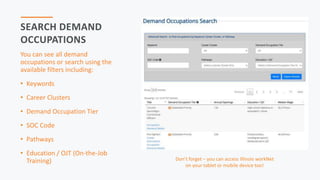
SEARCH DEMAND
OCCUPATIONS
You can see all demand
occupations or search using the
available filters including:
• Keywords
• Career Clusters
• Demand Occupation Tier
• SOC Code
• Pathways
• Education / OJT (On-the-Job
Training) Don’t forget – you can access Illinois workNet
on your tablet or mobile device too!
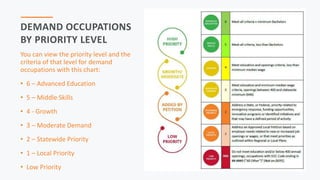
DEMAND OCCUPATIONS
BY PRIORITY LEVEL
You can view the priority level and the
criteria of that level for demand
occupations with this chart:
• 6 – Advanced Education
• 5 – Middle Skills
• 4 - Growth
• 3 – Moderate Demand
• 2 – Statewide Priority
• 1 – Local Priority
• Low Priority
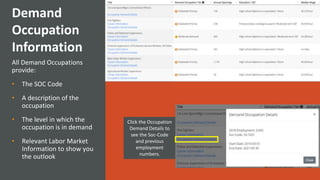
All Demand Occupations
provide:
• The SOC Code
• A description of the
occupation
• The level in which the
occupation is in demand
• Relevant Labor Market
Information to show you
the outlook
Demand
Occupation
Information
Click the Occupation
Demand Details to
see the Soc-Code
and previous
employment
numbers.
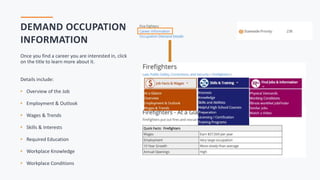
DEMAND OCCUPATION
INFORMATION
Once you find a career you are interested in, click
on the title to learn more about it.
Details include:
• Overview of the Job
• Employment & Outlook
• Wages & Trends
• Skills & Interests
• Required Education
• Workplace Knowledge
• Workplace Conditions
Illinois workNet® is sponsored by the Department of Commerce
and Economic Opportunity.
FOLLOW US!
Subscribe to our Newsfeed or check us out on Social Media:
FACEBOOK TWITTER YOUTUBE LINKEDIN LINKEDIN GROUP PINTEREST
HOME: https://www.illinoisworknet.com/
EMAIL: info@illinoisworknet.com
MORE INFO: https://www.illinoisworknet.com/explore/Pages/DemandOccs.aspx
The Illinois workNet Center System, an American Job Center, is an equal opportunity employer/program. Auxiliary aids and services are available upon request to individuals with disabilities. All voice telephone numbers may be reached
by persons using TTY/TDD equipment by calling TTY (800) 526-0844 or 711. This workforce product was funded by a grant awarded by the U.S. Department of Labor’s Employment and Training Administration. For more information
please refer to the footer at the bottom of www.illinoisworknet.com.
THANKS FOR VIEWING!

Demand Occupations

  • 1.
    Demand Occupations Find thejobs, most in demand, based on Illinois job data! Illinois workNet® is sponsored by the Department of Commerce and Economic Opportunity. – September 2021
  • 2.
    Illinois workNet® issponsored by the Department of Commerce and Economic Opportunity. WHAT ARE DEMAND OCCUPATIONS? These are the occupations that: • Are projected to grow, • Have many job openings, • Provide regionally set wage standards, and • Require an education level above a high school diploma or require on-the-job-training. By meeting these criteria, these occupations are available and ready for you to start your career. When looking for a career it is important to enter a field that will allow for growth and sustainability and one in which you will be able to find a job. The research has been done so you can find the most in-demand careers in your area!
  • 3.
    Illinois workNet® issponsored by the Department of Commerce and Economic Opportunity. WHY USE DEMAND OCCUPATIONS? Demand Occupations are helpful because they provide opportunities that will help you reach short and long-term career goals. If you are receiving Workforce Innovation and Opportunity Act (WIOA) funds, you are required to choose a training program that will help you get into a demand occupation. This is required because these occupations will help you get into a job with opportunity for growth and long-term stability.
  • 4.
    Demand occupations are determinedby looking at Labor Market Information (LMI) in the Economic Development Regions (EDRs) in Illinois. There are 10 EDRs in Illinois. You can hover over any of the region names to find the counties in that region on the Demand Occupations Search. Use this map or list to find your EDR and regions near you so you can find the demand occupations in your area! Demand Occupation Regions Central: Cass, Christian, Greene, Logan, Macon, Macoupin, Menard, Montgomery, Morgan, Sangamon, Scott, and Shelby East Central: Champaign, Douglas, Ford, Iroquois, Piatt, and Vermillion North Central: DeWitt, Fulton, Livingston, Marshall, Mason, McLean, Peoria, Stark, Tazewell, and Woodford Northeast: Cook, DeKalb, DuPage, Grundy, Kane, Kankakee, Kendall, Lake, McHenry, and Will Northern Stateline: Boone, Ogle, Stephenson, and Winnebago Northwest: Bureau, Carrol, Henry, Jo Daviess, LaSalle, Lee, Mercer, Putnam, Rock Island, and Whiteside Southeast: Clark, Clay, Coles, Crawford, Cumberland, Edgar, Effingham, Fayette, Jasper, Lawrence, Marion, Moultrie, and Richland Southern: Alexander, Edwards, Franklin, Gallatin, Hamilton, Hardin, Jackson, Jefferson, Johnson, Massac, Perry, Pope, Pulaski, Saline, Union, Wabash, Wayne, White, and Williamson Southwest: Bond, Calhoun, Clinton, Jersey, Madison, Monroe, Randolph, St. Clair, and Washington West Central: Adams, Brown, Hancock, Henderson, Knox, McDonough, Pike, Schuyler, and Warren
  • 5.
    SEARCH DEMAND OCCUPATIONS You cansee all demand occupations or search using the available filters including: • Keywords • Career Clusters • Demand Occupation Tier • SOC Code • Pathways • Education / OJT (On-the-Job Training) Don’t forget – you can access Illinois workNet on your tablet or mobile device too!
  • 6.
    DEMAND OCCUPATIONS BY PRIORITYLEVEL You can view the priority level and the criteria of that level for demand occupations with this chart: • 6 – Advanced Education • 5 – Middle Skills • 4 - Growth • 3 – Moderate Demand • 2 – Statewide Priority • 1 – Local Priority • Low Priority
  • 7.
    All Demand Occupations provide: •The SOC Code • A description of the occupation • The level in which the occupation is in demand • Relevant Labor Market Information to show you the outlook Demand Occupation Information Click the Occupation Demand Details to see the Soc-Code and previous employment numbers.
  • 8.
    DEMAND OCCUPATION INFORMATION Once youfind a career you are interested in, click on the title to learn more about it. Details include: • Overview of the Job • Employment & Outlook • Wages & Trends • Skills & Interests • Required Education • Workplace Knowledge • Workplace Conditions
  • 9.
    Illinois workNet® issponsored by the Department of Commerce and Economic Opportunity. FOLLOW US! Subscribe to our Newsfeed or check us out on Social Media: FACEBOOK TWITTER YOUTUBE LINKEDIN LINKEDIN GROUP PINTEREST HOME: https://www.illinoisworknet.com/ EMAIL: info@illinoisworknet.com MORE INFO: https://www.illinoisworknet.com/explore/Pages/DemandOccs.aspx The Illinois workNet Center System, an American Job Center, is an equal opportunity employer/program. Auxiliary aids and services are available upon request to individuals with disabilities. All voice telephone numbers may be reached by persons using TTY/TDD equipment by calling TTY (800) 526-0844 or 711. This workforce product was funded by a grant awarded by the U.S. Department of Labor’s Employment and Training Administration. For more information please refer to the footer at the bottom of www.illinoisworknet.com. THANKS FOR VIEWING!