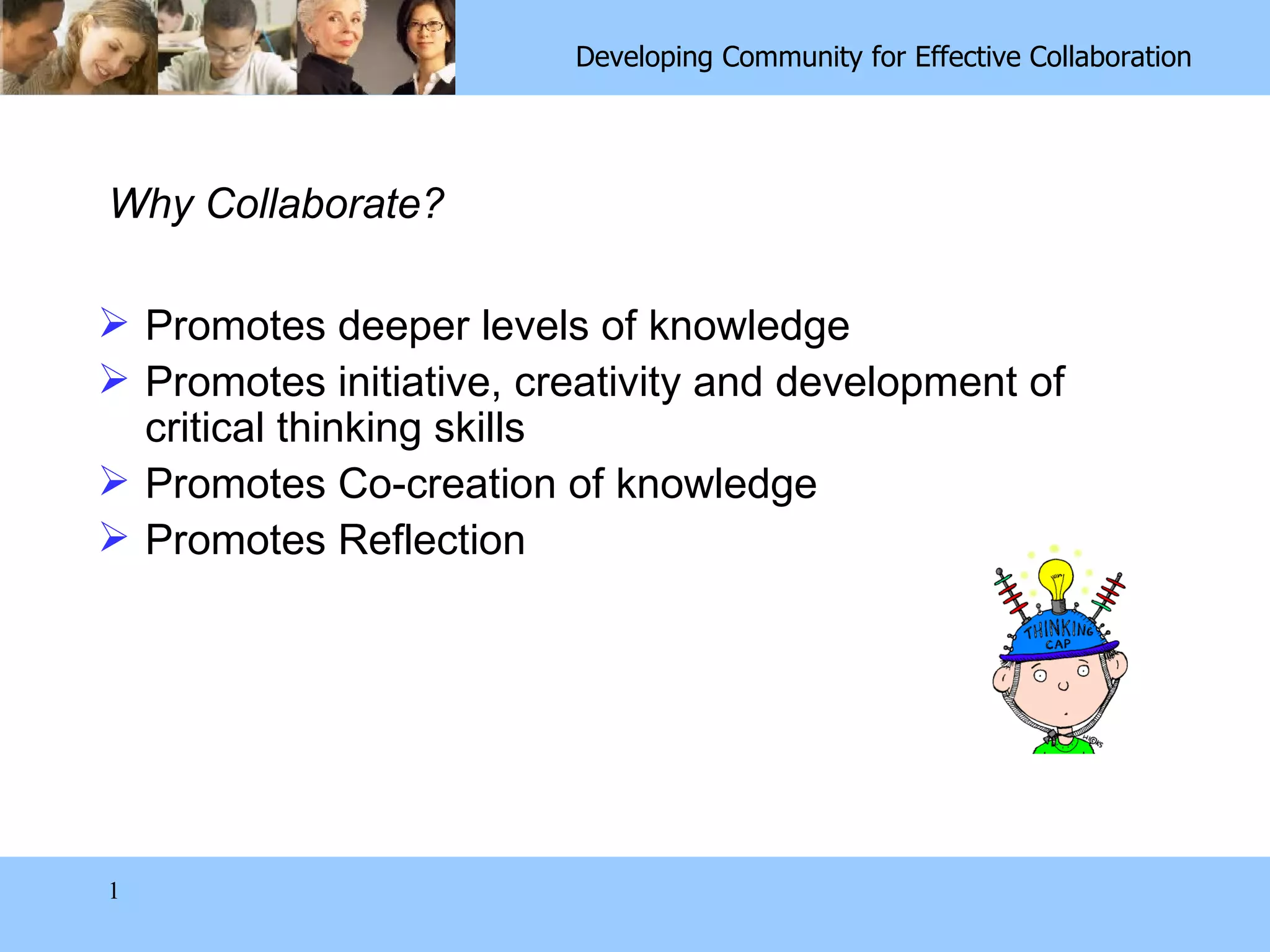
Why Collaborate? Promotes deeper levels of knowledge Promotes initiative, creativity and development of critical thinking skills Promotes Co-creation of knowledge Promotes Reflection
Building Community A sense of community must exist for collaboration to occur Community deters feelings of isolation in distance learning Students need to interact with content, teachers and each other Builds relationships through interaction and common goals Leads to enhanced collaboration and learning
Elements of Community All the people involved Shared purpose Sharing information, experiences, interests, resources Guidelines Structure of the course, groundrules for participation and interaction Technology or Meeting Places Collaborative Learning Student-to-student interaction Reflection To reinforce and transform the learning
Why Do People Need to Learn to Work Together? Collaborative teamwork fosters the following benefits if utilized effectively.  These benefits when employed will lead to better productivity In the workplace. Creativity – By utilizing different skills, knowledge, and personal attributes, more ideas can be generated. Efficiency – Team members are able to complete projects more rapidly because of the different minds and hands being able to problem solve together.
Why Do People Need to Learn to Work Together? Cont. Overcomes Monotony – Interaction with others generates enthusiasm which leads to better productivity. Morale – Team members who work well together tend to be happier, which boosts confidence and self-esteem. Support – A sense of camaraderie is created through effective teamwork which leads to a sense of unity.
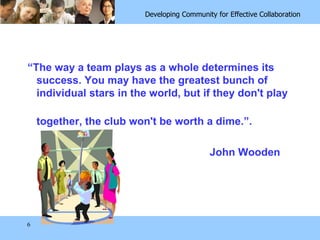
“ The way a team plays as a whole determines its success. You may have the greatest bunch of individual stars in the world, but if they don't play  together, the club won't be worth a dime.”.  John Wooden
When Groups Work and Don’t Work External Factors (determined by instructor) Well established communication process Clear goals and expectations Individual accountability Available source of information Effective monitoring learning contract, periodic feedback, group evaluation
When Groups Work and Don’t Work Internal Characteristics-groups that work Open minded Willing to participate Committed to quality result Respectful to team members
When Groups Work and Don’t Work Internal Characteristics-groups that don’t work Resistant to change Procrastination Refusal to participate Refusal to communicate
Stages of Group Development Forming: when groups get to know one another Norming: when groups figure out how to work together Storming: Problem-solving where there will be disagreement and/or conflict. Benefits Include: Promoting engagement with the group and topics. Offering of different view points. Stronger team unity when a decision is reached. Performing: when groups work to complete the task Adjourning: when groups end the work and disband or regroup for other tasks
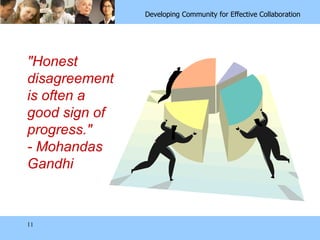
"Honest disagreement is often a good sign of progress."  - Mohandas Gandhi
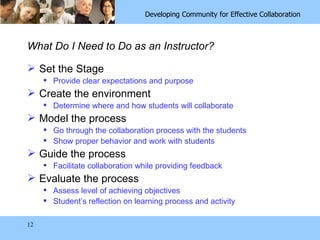
What Do I Need to Do as an Instructor? Set the Stage Provide clear expectations and purpose Create the environment Determine where and how students will collaborate Model the process Go through the collaboration process with the students Show proper behavior and work with students Guide the process Facilitate collaboration while providing feedback Evaluate the process Assess level of achieving objectives Student’s reflection on learning process and activity
Successful Collaboration

Pine Project

  • 1.
    Why Collaborate? Promotesdeeper levels of knowledge Promotes initiative, creativity and development of critical thinking skills Promotes Co-creation of knowledge Promotes Reflection
  • 2.
    Building Community Asense of community must exist for collaboration to occur Community deters feelings of isolation in distance learning Students need to interact with content, teachers and each other Builds relationships through interaction and common goals Leads to enhanced collaboration and learning
  • 3.
    Elements of CommunityAll the people involved Shared purpose Sharing information, experiences, interests, resources Guidelines Structure of the course, groundrules for participation and interaction Technology or Meeting Places Collaborative Learning Student-to-student interaction Reflection To reinforce and transform the learning
  • 4.
    Why Do PeopleNeed to Learn to Work Together? Collaborative teamwork fosters the following benefits if utilized effectively. These benefits when employed will lead to better productivity In the workplace. Creativity – By utilizing different skills, knowledge, and personal attributes, more ideas can be generated. Efficiency – Team members are able to complete projects more rapidly because of the different minds and hands being able to problem solve together.
  • 5.
    Why Do PeopleNeed to Learn to Work Together? Cont. Overcomes Monotony – Interaction with others generates enthusiasm which leads to better productivity. Morale – Team members who work well together tend to be happier, which boosts confidence and self-esteem. Support – A sense of camaraderie is created through effective teamwork which leads to a sense of unity.
  • 6.
    “ The waya team plays as a whole determines its success. You may have the greatest bunch of individual stars in the world, but if they don't play together, the club won't be worth a dime.”. John Wooden
  • 7.
    When Groups Workand Don’t Work External Factors (determined by instructor) Well established communication process Clear goals and expectations Individual accountability Available source of information Effective monitoring learning contract, periodic feedback, group evaluation
  • 8.
    When Groups Workand Don’t Work Internal Characteristics-groups that work Open minded Willing to participate Committed to quality result Respectful to team members
  • 9.
    When Groups Workand Don’t Work Internal Characteristics-groups that don’t work Resistant to change Procrastination Refusal to participate Refusal to communicate
  • 10.
    Stages of GroupDevelopment Forming: when groups get to know one another Norming: when groups figure out how to work together Storming: Problem-solving where there will be disagreement and/or conflict. Benefits Include: Promoting engagement with the group and topics. Offering of different view points. Stronger team unity when a decision is reached. Performing: when groups work to complete the task Adjourning: when groups end the work and disband or regroup for other tasks
  • 11.
    "Honest disagreement isoften a good sign of progress." - Mohandas Gandhi
  • 12.
    What Do INeed to Do as an Instructor? Set the Stage Provide clear expectations and purpose Create the environment Determine where and how students will collaborate Model the process Go through the collaboration process with the students Show proper behavior and work with students Guide the process Facilitate collaboration while providing feedback Evaluate the process Assess level of achieving objectives Student’s reflection on learning process and activity
  • 13.

Editor's Notes

  • #3 Avoid isolation: social presence, communication, interaction – more satisfaction. New ideas generated.
  • #5 Page 11
  • #6 Page 11
  • #7 Page 11