Team Clark Developing Community for Effective Collaboration
Why Collaborate? Promotes deeper levels of knowledge Promotes initiative, creativity and  development of critical thinking skills Promotes Co-creation of knowledge Promotes Reflection Developing Community for Effective Collaboration
Building Community Developing Community for Effective Collaboration A sense of community must exist for collaboration to occur When students sense they belong to a  supportive group they feel safe to  answer, extent their learning experiences, test out new ideas and receive  critical and constructive feedback without getting offended or alienated.  Working collaboratively on-line may lead to higher motivation and when  students are motivated is less likely that they ‘drop out’ of class.  http ://www.youtube.com/watch?v=MwIASjSD37M&feature=related
Developing Community for Effective Collaboration All the people involved Shared purpose Sharing information, experiences, interests, resources Guidelines Structure of the course, groundrules for participation and interaction Technology or Meeting Places Collaborative Learning Student-to-student interaction Reflection To reinforce and transform the learning Elements of Community
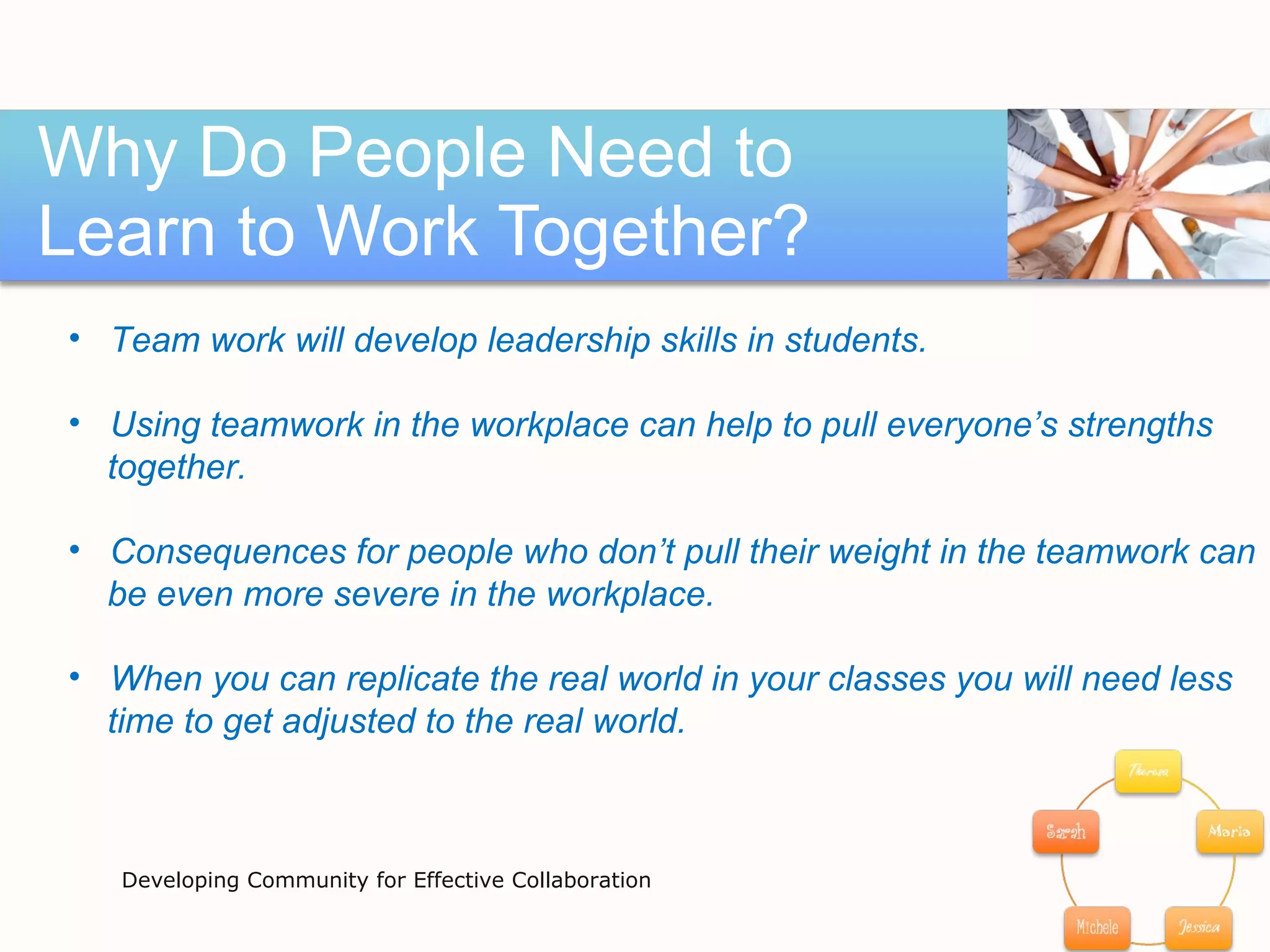
Why Do People Need to Learn to Work Together? Developing Community for Effective Collaboration Team work will develop leadership skills in students.  Using teamwork in the workplace can help to pull everyone’s strengths  together.  Consequences for people who don’t pull their weight in the teamwork can  be even more severe in the workplace. When you can replicate the real world in your classes you will need less  time to get adjusted to the real world.
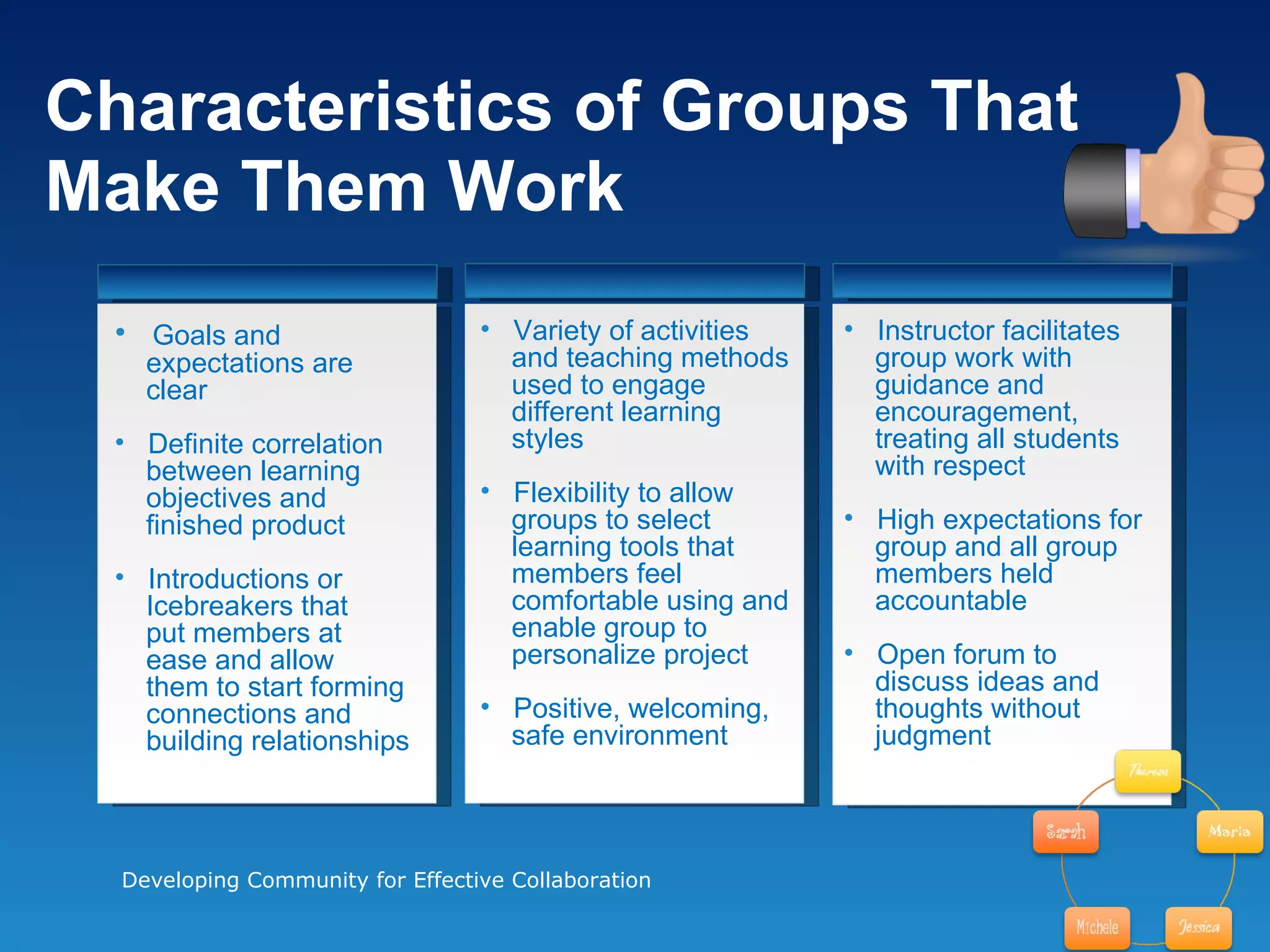
Characteristics of Groups That Make Them Work Goals and  expectations are  clear Definite correlation  between learning  objectives and  finished product Introductions or  Icebreakers that  put members at  ease and allow  them to start forming  connections and  building relationships Developing Community for Effective Collaboration Variety of activities  and teaching methods  used to engage  different learning  styles Flexibility to allow  groups to select  learning tools that  members feel  comfortable using and  enable group to  personalize project Positive, welcoming,  safe environment Instructor facilitates  group work with  guidance and  encouragement,  treating all students  with respect High expectations for  group and all group  members held  accountable Open forum to  discuss ideas and  thoughts without  judgment
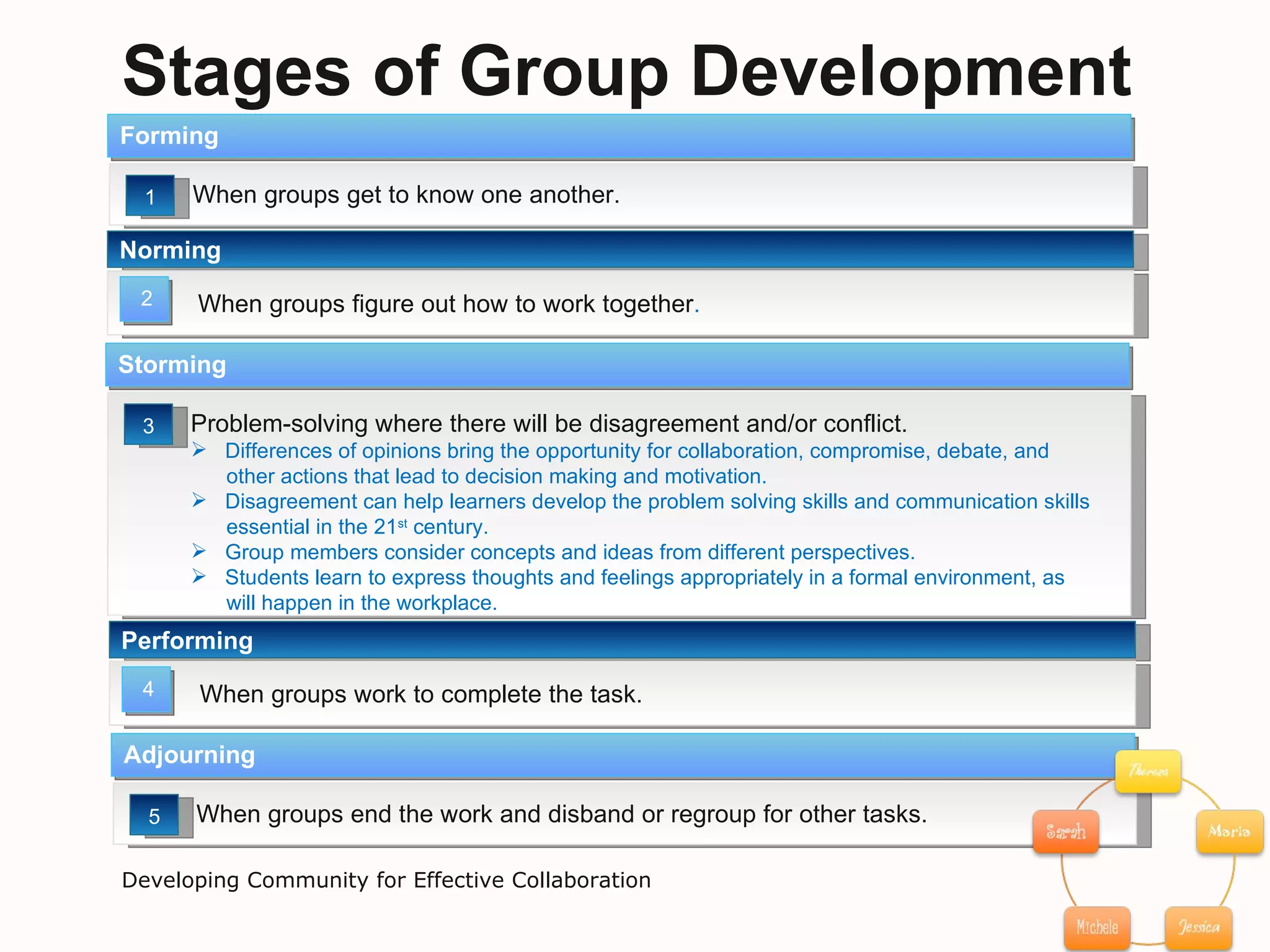
When groups work to complete the task. Performing 4 When groups end the work and disband or regroup for other tasks. Adjourning 5 Stages of Group Development When groups get to know one another. Forming When groups figure out how to work together . Norming 1 2 Developing Community for Effective Collaboration Problem-solving where there will be disagreement and/or conflict. Differences of opinions bring the opportunity for collaboration, compromise, debate, and  other actions that lead to decision making and motivation. Disagreement can help learners develop the problem solving skills and communication skills  essential in the 21 st  century.  Group members consider concepts and ideas from different perspectives. Students learn to express thoughts and feelings appropriately in a formal environment, as  will happen in the workplace. Storming 3
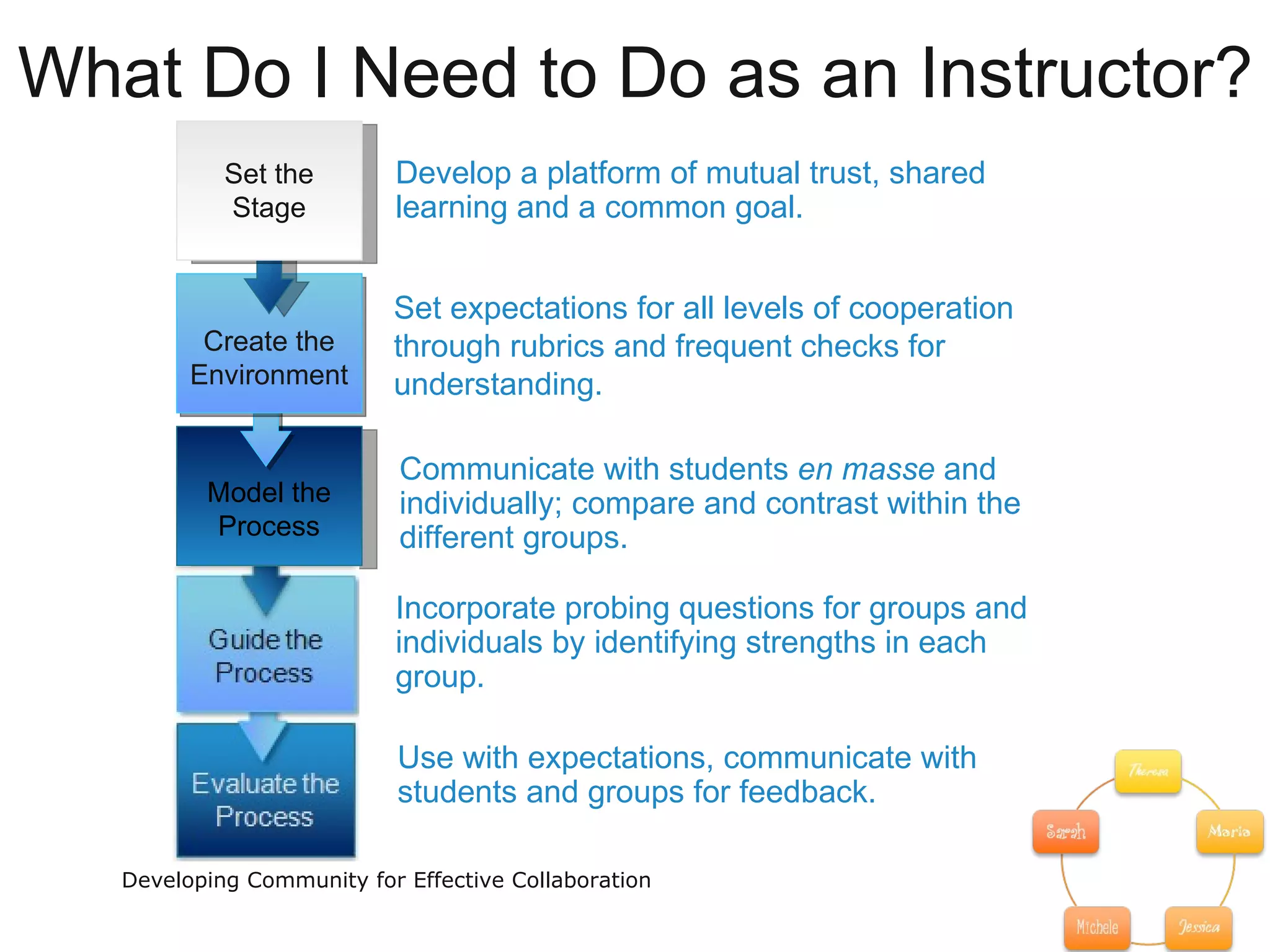
What Do I Need to Do as an Instructor? Developing Community for Effective Collaboration Set expectations for all levels of cooperation through rubrics and frequent checks for understanding. Incorporate probing questions for groups and individuals by identifying strengths in each group.  Use with expectations, communicate with students and groups for feedback. Develop a platform of mutual trust, shared learning and a common goal. Communicate with students  en masse  and individually; compare and contrast within the different groups.  Set the Stage Model the Process Create the Environment
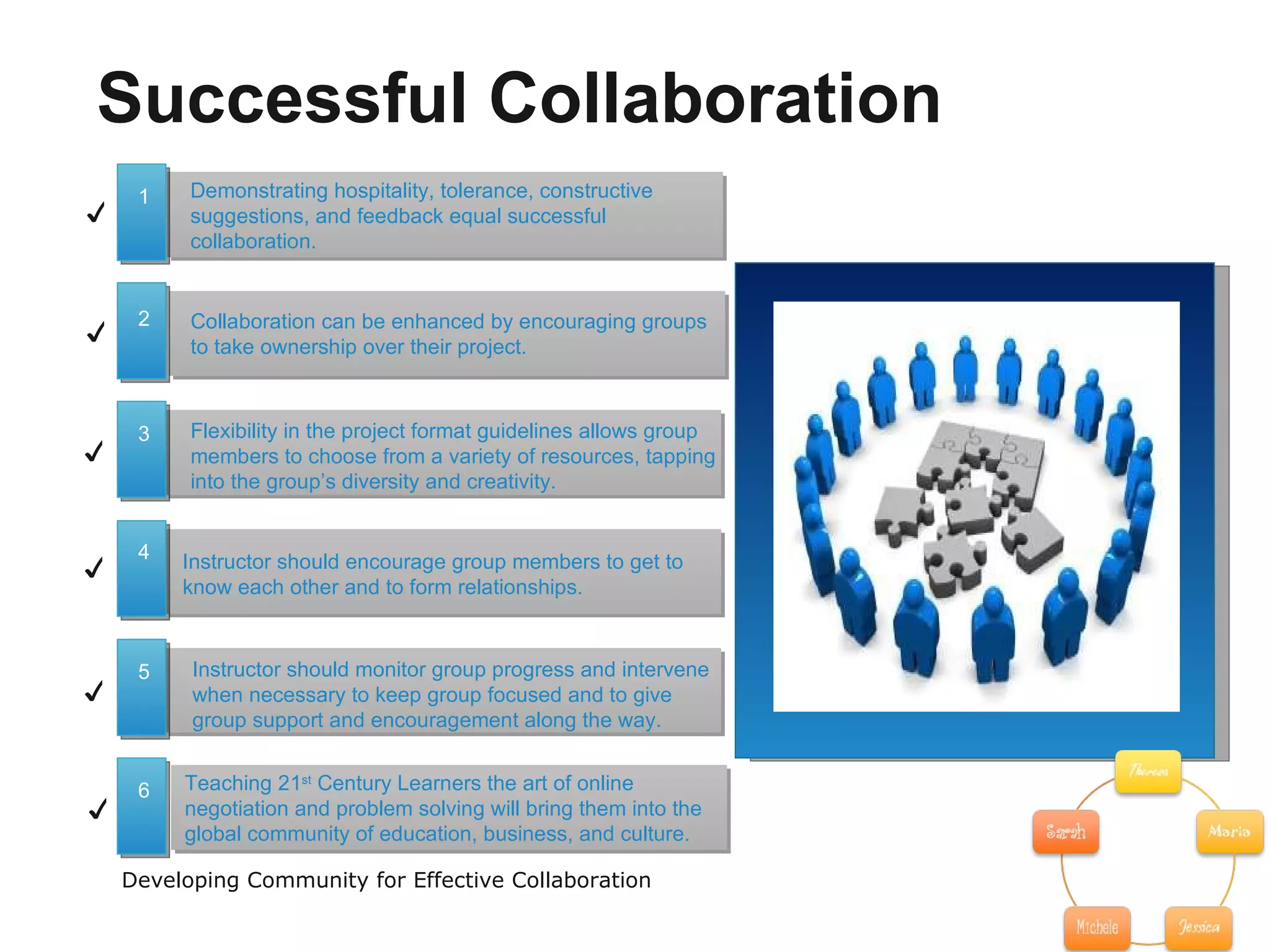
Successful Collaboration Demonstrating hospitality, tolerance, constructive suggestions, and feedback equal successful collaboration. Teaching 21 st  Century Learners the art of online negotiation and problem solving will bring them into the global community of education, business, and culture. Instructor should encourage group members to get to know each other and to form relationships. Collaboration can be enhanced by encouraging groups to take ownership over their project.  Flexibility in the project format guidelines allows group members to choose from a variety of resources, tapping into the group’s diversity and creativity. Instructor should monitor group progress and intervene when necessary to keep group focused and to give group support and encouragement along the way.  ✓ ✓ ✓ ✓ ✓ ✓ Developing Community for Effective Collaboration 1 2 3 4 5 6
THANK  YOU!

Team Clark Draft

  • 1.
    Team Clark DevelopingCommunity for Effective Collaboration
  • 2.
    Why Collaborate? Promotesdeeper levels of knowledge Promotes initiative, creativity and development of critical thinking skills Promotes Co-creation of knowledge Promotes Reflection Developing Community for Effective Collaboration
  • 3.
    Building Community DevelopingCommunity for Effective Collaboration A sense of community must exist for collaboration to occur When students sense they belong to a supportive group they feel safe to answer, extent their learning experiences, test out new ideas and receive critical and constructive feedback without getting offended or alienated. Working collaboratively on-line may lead to higher motivation and when students are motivated is less likely that they ‘drop out’ of class. http ://www.youtube.com/watch?v=MwIASjSD37M&feature=related
  • 4.
    Developing Community forEffective Collaboration All the people involved Shared purpose Sharing information, experiences, interests, resources Guidelines Structure of the course, groundrules for participation and interaction Technology or Meeting Places Collaborative Learning Student-to-student interaction Reflection To reinforce and transform the learning Elements of Community
  • 5.
    Why Do PeopleNeed to Learn to Work Together? Developing Community for Effective Collaboration Team work will develop leadership skills in students. Using teamwork in the workplace can help to pull everyone’s strengths together. Consequences for people who don’t pull their weight in the teamwork can be even more severe in the workplace. When you can replicate the real world in your classes you will need less time to get adjusted to the real world.
  • 6.
    Characteristics of GroupsThat Make Them Work Goals and expectations are clear Definite correlation between learning objectives and finished product Introductions or Icebreakers that put members at ease and allow them to start forming connections and building relationships Developing Community for Effective Collaboration Variety of activities and teaching methods used to engage different learning styles Flexibility to allow groups to select learning tools that members feel comfortable using and enable group to personalize project Positive, welcoming, safe environment Instructor facilitates group work with guidance and encouragement, treating all students with respect High expectations for group and all group members held accountable Open forum to discuss ideas and thoughts without judgment
  • 7.
    When groups workto complete the task. Performing 4 When groups end the work and disband or regroup for other tasks. Adjourning 5 Stages of Group Development When groups get to know one another. Forming When groups figure out how to work together . Norming 1 2 Developing Community for Effective Collaboration Problem-solving where there will be disagreement and/or conflict. Differences of opinions bring the opportunity for collaboration, compromise, debate, and other actions that lead to decision making and motivation. Disagreement can help learners develop the problem solving skills and communication skills essential in the 21 st century.  Group members consider concepts and ideas from different perspectives. Students learn to express thoughts and feelings appropriately in a formal environment, as will happen in the workplace. Storming 3
  • 8.
    What Do INeed to Do as an Instructor? Developing Community for Effective Collaboration Set expectations for all levels of cooperation through rubrics and frequent checks for understanding. Incorporate probing questions for groups and individuals by identifying strengths in each group. Use with expectations, communicate with students and groups for feedback. Develop a platform of mutual trust, shared learning and a common goal. Communicate with students en masse and individually; compare and contrast within the different groups. Set the Stage Model the Process Create the Environment
  • 9.
    Successful Collaboration Demonstratinghospitality, tolerance, constructive suggestions, and feedback equal successful collaboration. Teaching 21 st Century Learners the art of online negotiation and problem solving will bring them into the global community of education, business, and culture. Instructor should encourage group members to get to know each other and to form relationships. Collaboration can be enhanced by encouraging groups to take ownership over their project.  Flexibility in the project format guidelines allows group members to choose from a variety of resources, tapping into the group’s diversity and creativity. Instructor should monitor group progress and intervene when necessary to keep group focused and to give group support and encouragement along the way.  ✓ ✓ ✓ ✓ ✓ ✓ Developing Community for Effective Collaboration 1 2 3 4 5 6
  • 10.