COLLABORATION IN THE ONLINE CLASSROOM Robin Ward-Dassler Lindsay Holland Janet Smith Benjamin Schosek
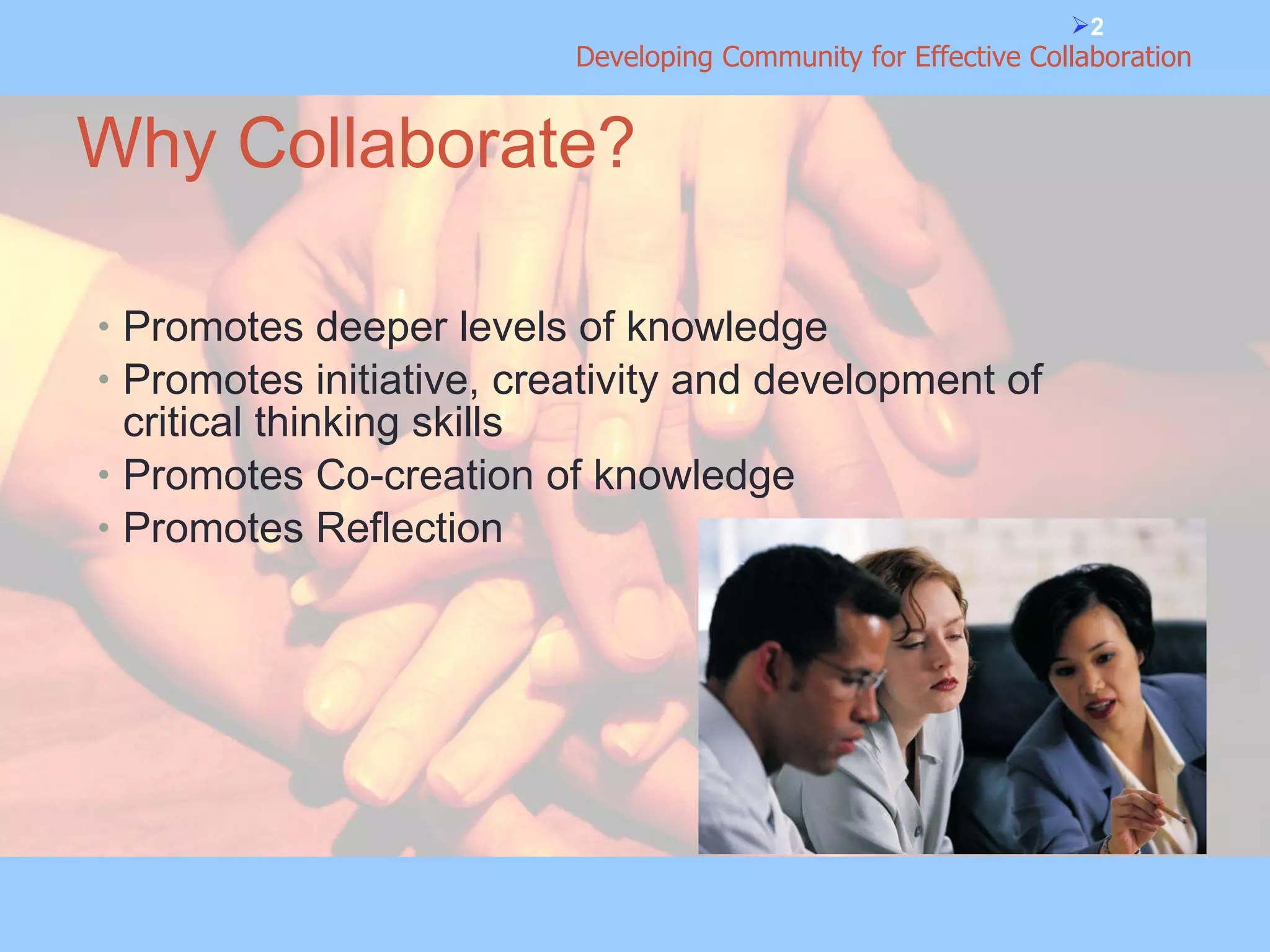
Why Collaborate? Promotes deeper levels of knowledge Promotes initiative, creativity and development of critical thinking skills Promotes Co-creation of knowledge Promotes Reflection
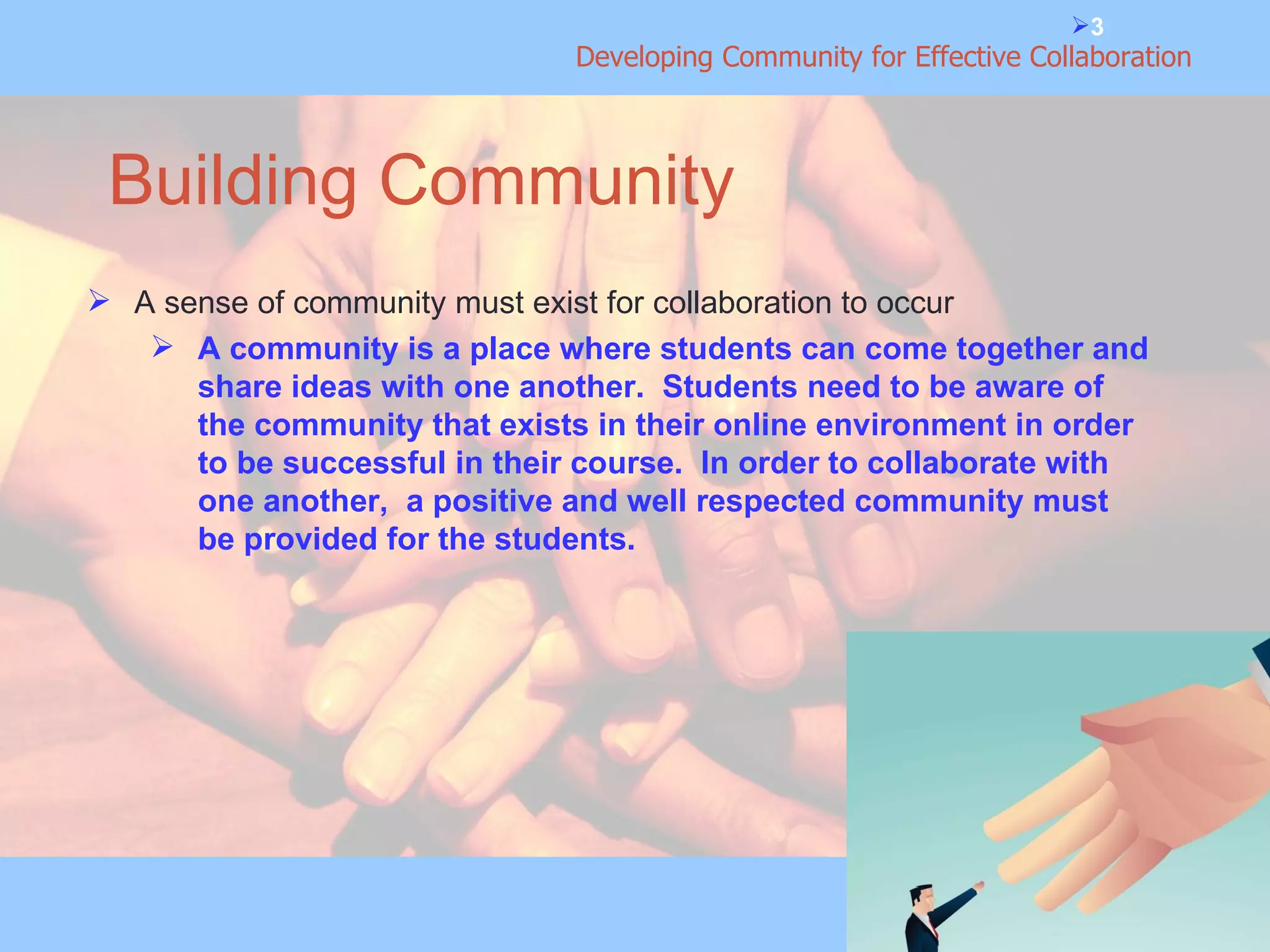
Building Community A sense of community must exist for collaboration to occur A community is a place where students can come together and share ideas with one another.  Students need to be aware of the community that exists in their online environment in order to be successful in their course.  In order to collaborate with one another,  a positive and well respected community must be provided for the students.
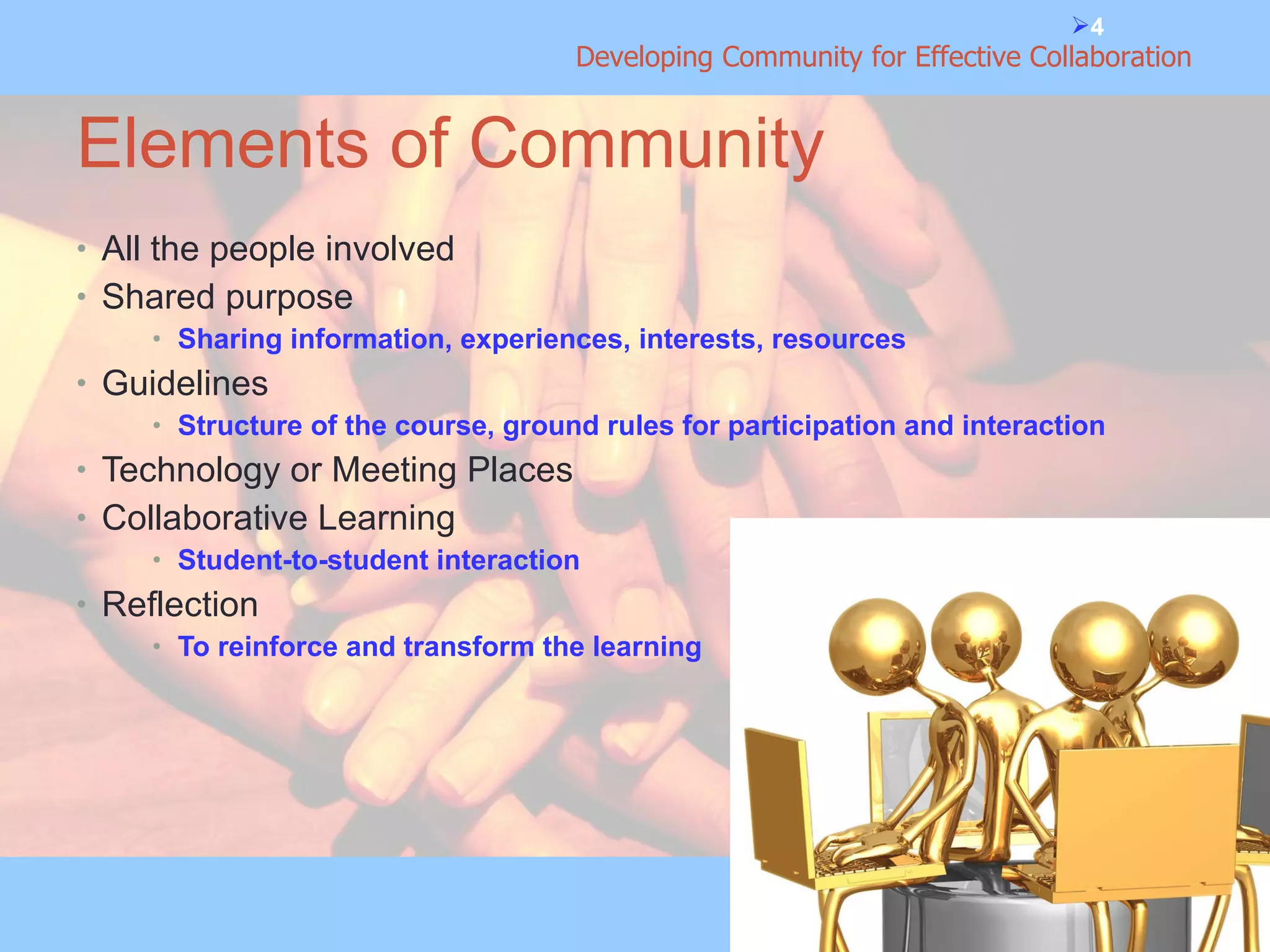
Elements of Community All the people involved Shared purpose Sharing information, experiences, interests, resources Guidelines Structure of the course, ground rules for participation and interaction Technology or Meeting Places Collaborative Learning Student-to-student interaction Reflection To reinforce and transform the learning
Why Do People Need to Learn to Work Together? Learning to work together gives learners the opportunity to share knowledge with others.  It also gives learners the chance to learn things in a different way from other people. Collaboration with others prepares learners in the workplace by providing them with the social skills they need in a work environment.  They will be able to be more successful in their work place if they are able to work together with others and respect different ideas and opinions from their colleagues.
When Groups Work and Don’t Work A group work project that was the most successful for me was when everyone in the group had  the same experience.  The project dealt with algebraic thinking in students and since my group members all possessed algebra teaching experience it made the project go very well. Since everyone in my group had algebra teaching experience, it made the project go very smooth and everyone was able to agree on several components of the project.
When Groups Work and Don’t Work A group work project that was not as successful for me was when the members all had different levels of thinking.  I remember working with two members in my group who were pursuing their PHD s in mathematics so their level of thinking was a lot higher than mine. When it came time to put all our findings together in one paper, we had several issues because of everyone's level of thinking. It was a very challenging project for everyone.
Stages of Group Development Forming: when groups get to know one another Norming: when groups figure out how to work together Storming: Problem-solving where there will be disagreement and/or conflict Students in groups bring to the table a variety of knowledge in the subject, their own experiences and opinions. As groups begin to share, different ideas emerge and negotiations begin.  This process can be frustrating and uncomfortable, but through the process learning increases and the team goals are reached. Performing: when groups work to complete the task Adjourning: when groups end the work and disband or regroup for other tasks
What Do I Need to Do as an Instructor? Set the Stage The instructor sets the stage by using a learning contract.  Create the environment The instructor creates the environment dividing students into groups and clearly defining the assignment. Model the process The instructor models the process by communicating clearly and focusing on the goals and objectives. Guide the process The instructor guides the process by reminding students of deadlines and making constructive comments. Evaluate the process The instructor evaluates the process by observing the work of the group and evaluating the outcome.
Successful Collaboration The instructor can enhance successful collaboration by: Hold discussions in a forum that the instructor can monitor.
Building Online Communities

Collaboration

  • 1.
    COLLABORATION IN THEONLINE CLASSROOM Robin Ward-Dassler Lindsay Holland Janet Smith Benjamin Schosek
  • 2.
    Why Collaborate? Promotesdeeper levels of knowledge Promotes initiative, creativity and development of critical thinking skills Promotes Co-creation of knowledge Promotes Reflection
  • 3.
    Building Community Asense of community must exist for collaboration to occur A community is a place where students can come together and share ideas with one another. Students need to be aware of the community that exists in their online environment in order to be successful in their course. In order to collaborate with one another, a positive and well respected community must be provided for the students.
  • 4.
    Elements of CommunityAll the people involved Shared purpose Sharing information, experiences, interests, resources Guidelines Structure of the course, ground rules for participation and interaction Technology or Meeting Places Collaborative Learning Student-to-student interaction Reflection To reinforce and transform the learning
  • 5.
    Why Do PeopleNeed to Learn to Work Together? Learning to work together gives learners the opportunity to share knowledge with others. It also gives learners the chance to learn things in a different way from other people. Collaboration with others prepares learners in the workplace by providing them with the social skills they need in a work environment. They will be able to be more successful in their work place if they are able to work together with others and respect different ideas and opinions from their colleagues.
  • 6.
    When Groups Workand Don’t Work A group work project that was the most successful for me was when everyone in the group had the same experience. The project dealt with algebraic thinking in students and since my group members all possessed algebra teaching experience it made the project go very well. Since everyone in my group had algebra teaching experience, it made the project go very smooth and everyone was able to agree on several components of the project.
  • 7.
    When Groups Workand Don’t Work A group work project that was not as successful for me was when the members all had different levels of thinking. I remember working with two members in my group who were pursuing their PHD s in mathematics so their level of thinking was a lot higher than mine. When it came time to put all our findings together in one paper, we had several issues because of everyone's level of thinking. It was a very challenging project for everyone.
  • 8.
    Stages of GroupDevelopment Forming: when groups get to know one another Norming: when groups figure out how to work together Storming: Problem-solving where there will be disagreement and/or conflict Students in groups bring to the table a variety of knowledge in the subject, their own experiences and opinions. As groups begin to share, different ideas emerge and negotiations begin. This process can be frustrating and uncomfortable, but through the process learning increases and the team goals are reached. Performing: when groups work to complete the task Adjourning: when groups end the work and disband or regroup for other tasks
  • 9.
    What Do INeed to Do as an Instructor? Set the Stage The instructor sets the stage by using a learning contract. Create the environment The instructor creates the environment dividing students into groups and clearly defining the assignment. Model the process The instructor models the process by communicating clearly and focusing on the goals and objectives. Guide the process The instructor guides the process by reminding students of deadlines and making constructive comments. Evaluate the process The instructor evaluates the process by observing the work of the group and evaluating the outcome.
  • 10.
    Successful Collaboration Theinstructor can enhance successful collaboration by: Hold discussions in a forum that the instructor can monitor.
  • 11.

Editor's Notes

  • #4 Avoid isolation: social presence, communication, interaction – more satisfaction. New ideas generated.
  • #6 Page 11