WELCOME
Redgram
Introduction
• The pigeon pea (Cajanus cajan) is a perennial legume
from the family Fabaceae. Since its domestication in India
at least 3,500 years ago, its seeds have become a
common food grain in Asia, Africa, and Latin America. It is
consumed on a large scale mainly in south Asia and is a
major source of protein for the population of that
subcontinent.
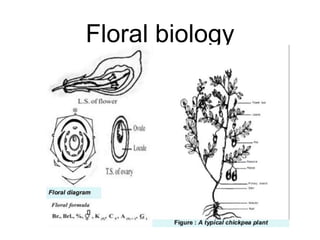
Floral biology
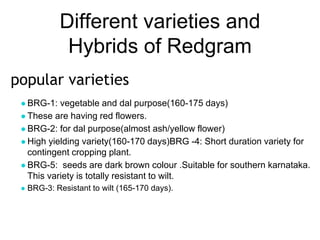
Different varieties and
Hybrids of Redgram
popular varieties
● BRG-1: vegetable and dal purpose(160-175 days)
● These are having red flowers.
● BRG-2: for dal purpose(almost ash/yellow flower)
● High yielding variety(160-170 days)BRG -4: Short duration variety for
contingent cropping plant.
● BRG-5: seeds are dark brown colour .Suitable for southern karnataka.
This variety is totally resistant to wilt.
● BRG-3: Resistant to wilt (165-170 days).
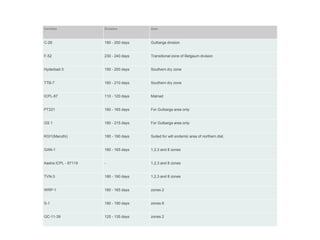
Varieties Duration Area
C-28 180 - 200 days Gulbarga division
F-52 230 - 240 days Transitional zone of Belgaum division
Hyderbad-3 150 - 200 days Southern dry zone
TTB-7 160 - 210 days Southern dry zone
ICPL-87 110 - 120 days Malnad
PT221 160 - 165 days For Gulbarga area only
GS 1 180 - 215 days For Gulbarga area only
KGI1(Maruthi) 180 - 190 days Suited for wilt endemic area of northern dist.
GAN-1 160 - 165 days 1,2,3 and 8 zones
Aasha ICPL - 87119 - 1,2,3 and 8 zones
TVN-3 180 - 190 days 1,2,3 and 8 zones
WRP-1 160 - 165 days zones 2
S-1 180 - 190 days zones 8
GC-11-39 125 - 135 days zones 2
Hybrids
• Hybrid AKPH-2080 - UAS, Dharwad.
• Hybrid KBPH-4 released by UAS, Bangalore suitable for
May and July sowing. RA-4 Vegetable pigeonpea from UAS,
Bangalore
Maintainance of field standards in pigeon pea
Varities
Seed Production
Red gram is known as pigeonpea. In Karnataka, redgram is being growth
in an area of about 4 lakh ha. The crop can be grown in almost all types of
soils. However, it does best on well drained, light to medium soils, and
deep enough to permit a free development of roots. Bright sunny weather
is needed during flowering and pod ripening stages.
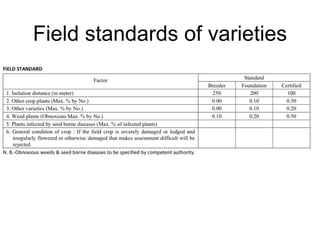
Field standards
The minimum standards which are fixed by Indian seed certification agency in
Order to maintain genetic and physical purity
Seed production techniques
Land requirement
Select fields on which the same kind of crop was not grown in
the previous season unless the previous crop was same
variety and approved by the certification agency for varietal
purity. In addition, the soils should be light, well drained with a
natural pH.
Isolation requirements
Redgram is often cross-pollinated by bees and other insects.
Therefore, for maintaining varietal purity an isolation of 200
meters for foundation seed class and 100 meters for certified
seed class is necessary.
Brief cultural practices
• Preparation of land by repeated ploughings and harrowings to obtain a fairly
pulverised seed bed free from weeds.
• Time of sowing: Sowing of seed crop may be taken up from May to July.
However, early sowing is advantageous for better yields.
• Source of seed: Obtain nucleus/breeder/foundation seed from approved source.
About 15-20 kg seed is required per ha depending upon seed size.
• Method of sowing: After land is ready for sowing, apply the entire dose of
fertilizers and sow the seeds with seed drill or by plough sole in 90 cam rows at 20
cm apart (for May sowing) and provide 60 cm between rows for July sowing. The
depth of seeding should not be more than 5 cm.
• Manures and fertilizers: Incorporate about 7.5 tonnes of FYM or compost per ha
at the time of land preparation. Apply 25 kg N and 50 kg P2O5 and 25 kg K2O per ha
as basal dose at the time of sowing.
• Irrigation and interculture: Light irrigation is required after sowing to ensure good
germination. One irrigation at flowering and subsequent irrigations after flowering is
necessary depending upon the soil and weather conditions.
• Intercultivate the crop 2-3 times and earthup the crop before flowering to keep
the seed plots free of weeds.
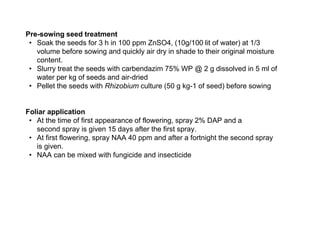
Pre-sowing seed treatment
• Soak the seeds for 3 h in 100 ppm ZnSO4, (10g/100 lit of water) at 1/3
volume before sowing and quickly air dry in shade to their original moisture
content.
• Slurry treat the seeds with carbendazim 75% WP @ 2 g dissolved in 5 ml of
water per kg of seeds and air-dried
• Pellet the seeds with Rhizobium culture (50 g kg-1 of seed) before sowing
Foliar application
• At the time of first appearance of flowering, spray 2% DAP and a
second spray is given 15 days after the first spray.
• At first flowering, spray NAA 40 ppm and after a fortnight the second spray
is given.
• NAA can be mixed with fungicide and insecticide
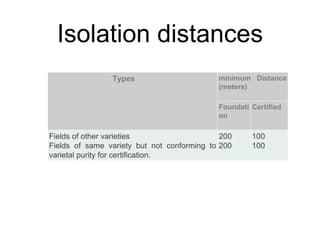
Isolation distances
Types minimum Distance
(meters)
Foundati
on
Certified
Fields of other varieties
Fields of same variety but not conforming to
varietal purity for certification.
200
200
100
100
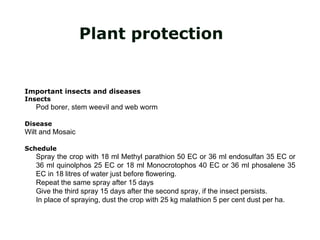
Plant protection
Important insects and diseases
Insects
Pod borer, stem weevil and web worm
Disease
Wilt and Mosaic
Schedule
Spray the crop with 18 ml Methyl parathion 50 EC or 36 ml endosulfan 35 EC or
36 ml quinolphos 25 EC or 18 ml Monocrotophos 40 EC or 36 ml phosalene 35
EC in 18 litres of water just before flowering.
Repeat the same spray after 15 days
Give the third spray 15 days after the second spray, if the insect persists.
In place of spraying, dust the crop with 25 kg malathion 5 per cent dust per ha.
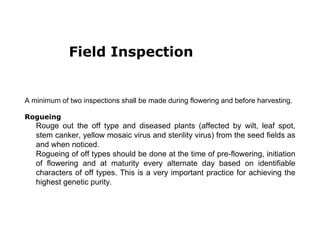
Field Inspection
A minimum of two inspections shall be made during flowering and before harvesting.
Rogueing
Rouge out the off type and diseased plants (affected by wilt, leaf spot,
stem canker, yellow mosaic virus and sterility virus) from the seed fields as
and when noticed.
Rogueing of off types should be done at the time of pre-flowering, initiation
of flowering and at maturity every alternate day based on identifiable
characters of off types. This is a very important practice for achieving the
highest genetic purity.
Harvesting and Threshing
• Harvesting
The crop is harvested soon after the seed is mature. The harvesting is normally done
with sickle and the crop is left in the field to dry for about a week. Threshing is done
by beating the plants with sticks. It is better to harvest the pods as and when they
reach physiological maturity without being delayed or exposed to wetting and drying
to maintain high germination with the least deterioration in storage.
• Drying, grading, treating and bagging
• Threshed seed produce should be dried properly on a tarpaulin in sun and
graded by using 9.52 mmR x 3.97 mmR or 3.18 mm oblong sieve with the help
of seed cleaner-cum-grader. Even after grading, it is better to hand pick
discoloured and broken seeds, if found to improve seed quality. Seeds having
a moisture content of not more than 9 per cent should be packed preferably in
polythene lined gunny bags or cloth bag and kept on wooden pallets in a cool
and dry ventilated seed store.
• Treat the seed with Thiram 75 per cent WP at 2 gm per kg and also dust the
seed bags with 5 per cent malathion dust before storage
Field standards of varieties
Maintenance of field
standards of Hybrids
Major components of hybrid technology
The hybrid technology is based on three major components
namely, male sterility and its genetic maintenance system, stable
fertility restoration, and cost effective mass pollination mechanism.
In this technology the seed of hybrids and their female parents is
produced on the male- sterile plants; and to achieve this, pollen
from the fertile plants is transferred on to male sterile flowers by
insects
Isolation distance
Tunwar and Singh (1988) advised to use an isolation distance of 100 meters;
while Ariyanayagam (1976) recommended 180-360 m isolation at different
places in Trinidad.
Agarwal (1980) and Faris (1985) respectively, recommended 200 and 300 m
isolation distances.
For hybrids the information generated by different research stations was used
by ICRISAT to recommend a safe isolation distance. Considering various
ecologies where seed production was carried out, an isolation distance of 500
m was found very safe for the production of both certified as well as breeder
seed
Crop management
Field preparation
It is an important activity to assure good crop. Being a rainy season crop, it is essential to make appropriate
arrangements to drain excess water and for this, ridges at the spacing of 100 cm should be made along the
slope.
Fertiliser application
A basal dose of 100 kg/ha of di-ammonium phosphates is recommended to provide 18 kg/ha N and 20 kg/ha
P.
Seed selection
Since genetic purity of the seed is of prime importance, the Breeder seed of highest quality should be obtained
from a reliable source.
Seed rate and sowing
The sowings should be undertaken at the time when the soil moisture is adequate for germination. The female
parental seed @ 4-5 kg/ha and that of male parent @ 1-2 kg/ha should be used.
Weed management
To manage the weeds a pre-emergence herbicide such as Promytrine or Basaline be sprayed.
Pest and disease control
For controlling pod borers (Helicoverpa armigera) 2-3 spraying of Dimethoate (30% EC @ 1.0 L /ha) during
reproductive stage gives good results. The most important consideration in spraying is that the insecticide
should not kill the pollinating insects; and for this the spraying should be organized either before 9 AM or after
5 PM.
Rouging
Generally three rounds of rouging are recommended to remove off-type plants. Harvesting should be organized
with utmost care. All the male rows should be harvested first, removed from field, and kept aside. This should
follow the easy harvesting of female rows. Threshing, cleaning, drying, seed treatment, and storage should be
done as per the local practices. At every stage enough care should be taken to maintain the purity of seed.
Harvest
• The pods attained physiological maturation at 40 days after 50%
flowering.
• Harvest the pods as one or two pickings for harvesting the
quality seeds.
Drying
• Dry the pods immediately to about 12 to 13 per cent moisture
content.
• Dry the seeds to 10 % moisture content
Seed grading
• Size grade the seeds using wire mesh sieve BSS 5 x 5 (width of
square aperture 3.35 mm) for large seeded varieties and BSS 6
x 6 (2.8 mm) for small seeded varieties.
• Do not select the discoloured and broken seeds for seed
purpose
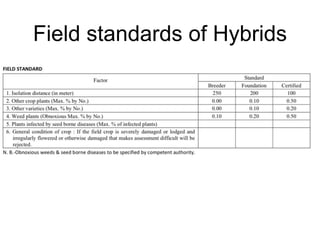
Field standards of Hybrids
Research articles

Pigeon_pea_seed production

  • 1.
  • 2.
    Redgram Introduction • The pigeonpea (Cajanus cajan) is a perennial legume from the family Fabaceae. Since its domestication in India at least 3,500 years ago, its seeds have become a common food grain in Asia, Africa, and Latin America. It is consumed on a large scale mainly in south Asia and is a major source of protein for the population of that subcontinent.
  • 3.
  • 4.
    Different varieties and Hybridsof Redgram popular varieties ● BRG-1: vegetable and dal purpose(160-175 days) ● These are having red flowers. ● BRG-2: for dal purpose(almost ash/yellow flower) ● High yielding variety(160-170 days)BRG -4: Short duration variety for contingent cropping plant. ● BRG-5: seeds are dark brown colour .Suitable for southern karnataka. This variety is totally resistant to wilt. ● BRG-3: Resistant to wilt (165-170 days).
  • 5.
    Varieties Duration Area C-28180 - 200 days Gulbarga division F-52 230 - 240 days Transitional zone of Belgaum division Hyderbad-3 150 - 200 days Southern dry zone TTB-7 160 - 210 days Southern dry zone ICPL-87 110 - 120 days Malnad PT221 160 - 165 days For Gulbarga area only GS 1 180 - 215 days For Gulbarga area only KGI1(Maruthi) 180 - 190 days Suited for wilt endemic area of northern dist. GAN-1 160 - 165 days 1,2,3 and 8 zones Aasha ICPL - 87119 - 1,2,3 and 8 zones TVN-3 180 - 190 days 1,2,3 and 8 zones WRP-1 160 - 165 days zones 2 S-1 180 - 190 days zones 8 GC-11-39 125 - 135 days zones 2
  • 6.
    Hybrids • Hybrid AKPH-2080- UAS, Dharwad. • Hybrid KBPH-4 released by UAS, Bangalore suitable for May and July sowing. RA-4 Vegetable pigeonpea from UAS, Bangalore
  • 7.
    Maintainance of fieldstandards in pigeon pea Varities Seed Production Red gram is known as pigeonpea. In Karnataka, redgram is being growth in an area of about 4 lakh ha. The crop can be grown in almost all types of soils. However, it does best on well drained, light to medium soils, and deep enough to permit a free development of roots. Bright sunny weather is needed during flowering and pod ripening stages. Field standards The minimum standards which are fixed by Indian seed certification agency in Order to maintain genetic and physical purity
  • 8.
    Seed production techniques Landrequirement Select fields on which the same kind of crop was not grown in the previous season unless the previous crop was same variety and approved by the certification agency for varietal purity. In addition, the soils should be light, well drained with a natural pH. Isolation requirements Redgram is often cross-pollinated by bees and other insects. Therefore, for maintaining varietal purity an isolation of 200 meters for foundation seed class and 100 meters for certified seed class is necessary.
  • 9.
    Brief cultural practices •Preparation of land by repeated ploughings and harrowings to obtain a fairly pulverised seed bed free from weeds. • Time of sowing: Sowing of seed crop may be taken up from May to July. However, early sowing is advantageous for better yields. • Source of seed: Obtain nucleus/breeder/foundation seed from approved source. About 15-20 kg seed is required per ha depending upon seed size. • Method of sowing: After land is ready for sowing, apply the entire dose of fertilizers and sow the seeds with seed drill or by plough sole in 90 cam rows at 20 cm apart (for May sowing) and provide 60 cm between rows for July sowing. The depth of seeding should not be more than 5 cm. • Manures and fertilizers: Incorporate about 7.5 tonnes of FYM or compost per ha at the time of land preparation. Apply 25 kg N and 50 kg P2O5 and 25 kg K2O per ha as basal dose at the time of sowing. • Irrigation and interculture: Light irrigation is required after sowing to ensure good germination. One irrigation at flowering and subsequent irrigations after flowering is necessary depending upon the soil and weather conditions. • Intercultivate the crop 2-3 times and earthup the crop before flowering to keep the seed plots free of weeds.
  • 10.
    Pre-sowing seed treatment •Soak the seeds for 3 h in 100 ppm ZnSO4, (10g/100 lit of water) at 1/3 volume before sowing and quickly air dry in shade to their original moisture content. • Slurry treat the seeds with carbendazim 75% WP @ 2 g dissolved in 5 ml of water per kg of seeds and air-dried • Pellet the seeds with Rhizobium culture (50 g kg-1 of seed) before sowing Foliar application • At the time of first appearance of flowering, spray 2% DAP and a second spray is given 15 days after the first spray. • At first flowering, spray NAA 40 ppm and after a fortnight the second spray is given. • NAA can be mixed with fungicide and insecticide
  • 11.
    Isolation distances Types minimumDistance (meters) Foundati on Certified Fields of other varieties Fields of same variety but not conforming to varietal purity for certification. 200 200 100 100
  • 12.
    Plant protection Important insectsand diseases Insects Pod borer, stem weevil and web worm Disease Wilt and Mosaic Schedule Spray the crop with 18 ml Methyl parathion 50 EC or 36 ml endosulfan 35 EC or 36 ml quinolphos 25 EC or 18 ml Monocrotophos 40 EC or 36 ml phosalene 35 EC in 18 litres of water just before flowering. Repeat the same spray after 15 days Give the third spray 15 days after the second spray, if the insect persists. In place of spraying, dust the crop with 25 kg malathion 5 per cent dust per ha.
  • 13.
    Field Inspection A minimumof two inspections shall be made during flowering and before harvesting. Rogueing Rouge out the off type and diseased plants (affected by wilt, leaf spot, stem canker, yellow mosaic virus and sterility virus) from the seed fields as and when noticed. Rogueing of off types should be done at the time of pre-flowering, initiation of flowering and at maturity every alternate day based on identifiable characters of off types. This is a very important practice for achieving the highest genetic purity.
  • 14.
    Harvesting and Threshing •Harvesting The crop is harvested soon after the seed is mature. The harvesting is normally done with sickle and the crop is left in the field to dry for about a week. Threshing is done by beating the plants with sticks. It is better to harvest the pods as and when they reach physiological maturity without being delayed or exposed to wetting and drying to maintain high germination with the least deterioration in storage. • Drying, grading, treating and bagging • Threshed seed produce should be dried properly on a tarpaulin in sun and graded by using 9.52 mmR x 3.97 mmR or 3.18 mm oblong sieve with the help of seed cleaner-cum-grader. Even after grading, it is better to hand pick discoloured and broken seeds, if found to improve seed quality. Seeds having a moisture content of not more than 9 per cent should be packed preferably in polythene lined gunny bags or cloth bag and kept on wooden pallets in a cool and dry ventilated seed store. • Treat the seed with Thiram 75 per cent WP at 2 gm per kg and also dust the seed bags with 5 per cent malathion dust before storage
  • 15.
  • 16.
    Maintenance of field standardsof Hybrids Major components of hybrid technology The hybrid technology is based on three major components namely, male sterility and its genetic maintenance system, stable fertility restoration, and cost effective mass pollination mechanism. In this technology the seed of hybrids and their female parents is produced on the male- sterile plants; and to achieve this, pollen from the fertile plants is transferred on to male sterile flowers by insects
  • 17.
    Isolation distance Tunwar andSingh (1988) advised to use an isolation distance of 100 meters; while Ariyanayagam (1976) recommended 180-360 m isolation at different places in Trinidad. Agarwal (1980) and Faris (1985) respectively, recommended 200 and 300 m isolation distances. For hybrids the information generated by different research stations was used by ICRISAT to recommend a safe isolation distance. Considering various ecologies where seed production was carried out, an isolation distance of 500 m was found very safe for the production of both certified as well as breeder seed
  • 18.
    Crop management Field preparation Itis an important activity to assure good crop. Being a rainy season crop, it is essential to make appropriate arrangements to drain excess water and for this, ridges at the spacing of 100 cm should be made along the slope. Fertiliser application A basal dose of 100 kg/ha of di-ammonium phosphates is recommended to provide 18 kg/ha N and 20 kg/ha P. Seed selection Since genetic purity of the seed is of prime importance, the Breeder seed of highest quality should be obtained from a reliable source. Seed rate and sowing The sowings should be undertaken at the time when the soil moisture is adequate for germination. The female parental seed @ 4-5 kg/ha and that of male parent @ 1-2 kg/ha should be used.
  • 19.
    Weed management To managethe weeds a pre-emergence herbicide such as Promytrine or Basaline be sprayed. Pest and disease control For controlling pod borers (Helicoverpa armigera) 2-3 spraying of Dimethoate (30% EC @ 1.0 L /ha) during reproductive stage gives good results. The most important consideration in spraying is that the insecticide should not kill the pollinating insects; and for this the spraying should be organized either before 9 AM or after 5 PM. Rouging Generally three rounds of rouging are recommended to remove off-type plants. Harvesting should be organized with utmost care. All the male rows should be harvested first, removed from field, and kept aside. This should follow the easy harvesting of female rows. Threshing, cleaning, drying, seed treatment, and storage should be done as per the local practices. At every stage enough care should be taken to maintain the purity of seed.
  • 20.
    Harvest • The podsattained physiological maturation at 40 days after 50% flowering. • Harvest the pods as one or two pickings for harvesting the quality seeds. Drying • Dry the pods immediately to about 12 to 13 per cent moisture content. • Dry the seeds to 10 % moisture content Seed grading • Size grade the seeds using wire mesh sieve BSS 5 x 5 (width of square aperture 3.35 mm) for large seeded varieties and BSS 6 x 6 (2.8 mm) for small seeded varieties. • Do not select the discoloured and broken seeds for seed purpose
  • 21.
  • 22.