Global Landscape Forum
Warsaw, 16-17 November 2013

WATER MANAGEMENT IN RURAL AREAS
IN CHANGING CLIMATE
prof. Edward Pierzgalski
Warsaw University of Life Sciences
STRUCTURE OF PRESENTATION
1. Main issues of water management in rural areas
2. Climate change versus water resources
3. Water management in agriculture versus climate
change
4. What should we do?
5. Conclusions
MAIN ISSUES OF WATER MANAGEMENT
IN RURAL AREAS
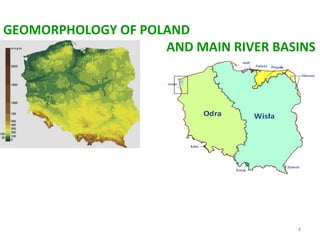
GEOMORPHOLOGY OF POLAND
AND MAIN RIVER BASINS

4
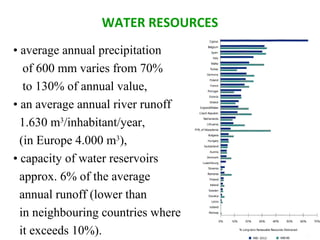
WATER RESOURCES
• average annual precipitation
of 600 mm varies from 70%
to 130% of annual value,
• an average annual river runoff
1.630 m3/inhabitant/year,
(in Europe 4.000 m3),
• capacity of water reservoirs
approx. 6% of the average
annual runoff (lower than
in neighbouring countries where
it exceeds 10%).
WATER EXPLOITATION INDEX [%]
(EEA, 2012)
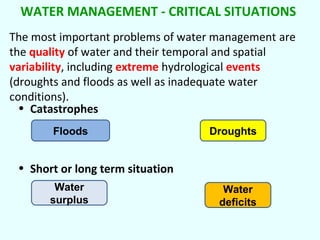
WATER MANAGEMENT - CRITICAL SITUATIONS
The most important problems of water management are
the quality of water and their temporal and spatial
variability, including extreme hydrological events
(droughts and floods as well as inadequate water
conditions).
• Catastrophes
Floods

Droughts

• Short or long term situation
Water
surplus

Water
deficits
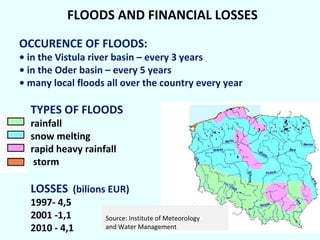
FLOODS AND FINANCIAL LOSSES
OCCURENCE OF FLOODS:

• in the Vistula river basin – every 3 years
• in the Oder basin – every 5 years
• many local floods all over the country every year

TYPES OF FLOODS
rainfall
snow melting
rapid heavy rainfall
storm

LOSSES (bilions EUR)
1997- 4,5
2001 -1,1
2010 - 4,1

Source: Institute of Meteorology
and Water Management
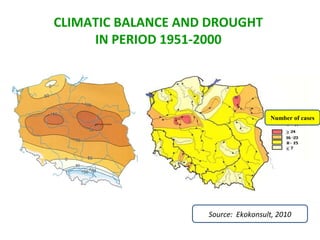
CLIMATIC BALANCE AND DROUGHT
IN PERIOD 1951-2000

Number of cases

Source: Ekokonsult, 2010
CLIMATE CHANGE VERSUS WATER RESOURCES
IMPACT OF AIR TEMPERATURE RISE
ON WATER RESOURCES
Decrease of water resources due to:
- decline of snow cover duration,
- increase of ewapotranspiration.
Direct effects:
- drying of streams, lakes and water reservoirs,
- lowering of groundwater level,
- drying of soil.
Other effects:
- negative impact on agricultural production,
- deterioration of ecosystem’s health,
- decline of forests,
- degradation of wetlands,
- increase of greenhouse gases emissions.
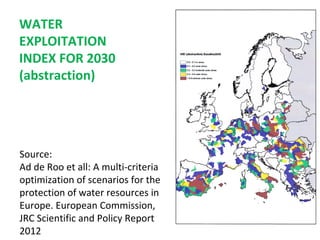
WATER
EXPLOITATION
INDEX FOR 2030
(abstraction)

Source:
Ad de Roo et all: A multi-criteria
optimization of scenarios for the
protection of water resources in
Europe. European Commission,
JRC Scientific and Policy Report
2012
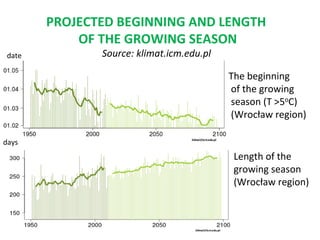
PROJECTED BEGINNING AND LENGTH
OF THE GROWING SEASON
date

Source: klimat.icm.edu.pl

The beginning
of the growing
season (T >5oC)
(Wrocław region)
days

Length of the
growing season
(Wrocław region)
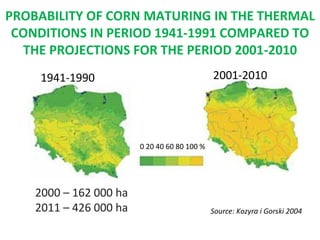
PROBABILITY OF CORN MATURING IN THE THERMAL
CONDITIONS IN PERIOD 1941-1991 COMPARED TO
THE PROJECTIONS FOR THE PERIOD 2001-2010
2001-2010

1941-1990

0 20 40 60 80 100 %

2000 – 162 000 ha
2011 – 426 000 ha

Source: Kozyra i Gorski 2004
WATER MANAGEMENT IN AGRICULTURE
VERSUS CLIMATE CHANGE
Emission of greenhouses gases could be mitigate by
proper regulation of soil moisture, specially in organic
soils.
Scale of problem:
Peatlands and organic soils cover 3-4 % of Earth’s area
but contain 30 percent of the world’s soil carbon.
It was estimated that in Poland from 0,8 mln ha of
wetlands (without forest fens) annual emission CO2
amounts to 14 mln tons (10 place in Europe).
Emission of CO2 depends on fens type, ground water
level, temperature, land use, vegetation state and
varies from 9 to 90 t ha-1 year-1.
It has been found that is a direct relation between
amount of emissions CO2 and the ground water level.
Emission of N20 varies from 9 to 60 kg ha-1 year-1
and also depends on drainage depth, soil moisture,
fertilizers, temperature.
Adjusting the ground water table it is possible to
reduce emissions of CO2 and N20 significantly.
Methane emission
Ground
water
CH4 emission
depth [cm] [mg m-2 h-1]
0
25
50
75

Source:
J. Turbiak,2012

10,1
7,9
4,0
2,9

Total CH4 emission
in growing season
kg ha-1
502
361
198
141
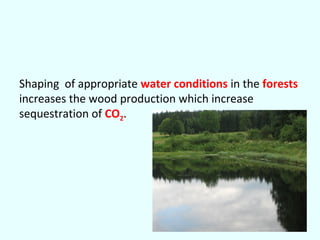
Shaping of appropriate water conditions in the forests
increases the wood production which increase
sequestration of CO2.
WHAT SHOULD WE DO?
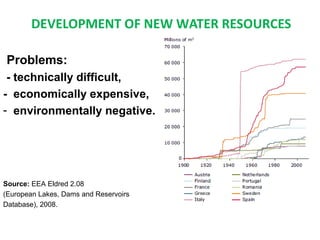
DEVELOPMENT OF NEW WATER RESOURCES
Problems:
- technically difficult,
- economically expensive,
- environmentally negative.

Source: EEA Eldred 2.08
(European Lakes, Dams and Reservoirs
Database), 2008.
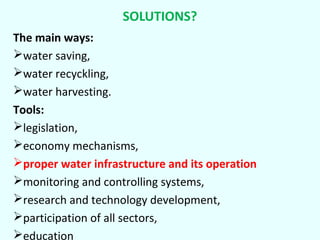
SOLUTIONS?
The main ways:
water saving,
water recyckling,
water harvesting.
Tools:
legislation,
economy mechanisms,
proper water infrastructure and its operation
monitoring and controlling systems,
research and technology development,
participation of all sectors,
education
DRAINAGE AND IRRIGATION AREA
Area [mln ha]
Land use

Arable
land

total
area

in this
ameliora- drained area irrigated
tive area
area

12,11

4,63
[38,2 %]

3,98
[86 % ]

0,05
[1,08 %]

Meadows
and
pasture

3,18

1,79
[56,3 %]

0,40
[22,3 %]

0,36
[20,1 %]

Forests

9,27

0,95
[10,3 %]

23
PROBLEMS
OF IRRIGATION AND DRAINAGE SYSTEMS

1. Age of drainage and irrigation systems.
2. The legislation.
3. Operation and management.
4. The economic condition of the agricultural sector.
5. Others.
1400

agricultural lands
forest areas

Reclaimed area
[thousands hectares]

1200
1000
800
600

Number of
Change
YEAR
water
compared
companies to 2000 year

2000

200
0
19511955

19561960

19611965

19661970

19711975

19761980

19811985

19861990

19911995

2748

2005

400

2450

- 298

2010

2290

- 458

2011

2292

- 456
24
ENVIRONMENTAL THREATS
OF AMELIORATIVE MEASURES
• acceleration of the water cycle in the catchment
area,
• reduction of water resources,
• transfer of pollutions from the surface of the fields
by ditches to surface water bodies,
• increased leaching of chemicals in drainage areas,
• destruction of wetland habitats and organic soils,
• impact on emission of greenhouses gases.
25
MITIGATION OF NEGATIVE RESULTS
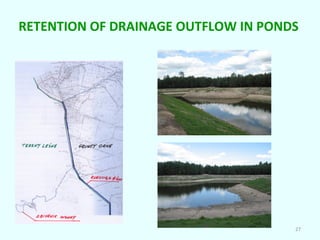
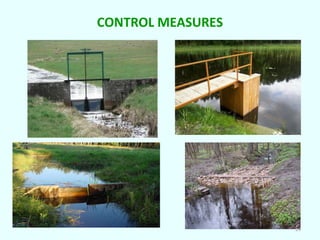
• conversion drainage systems into controllable (equiped
existing drainage systems with control devices),
• retention drainage outflow in ponds,
• mitigation of organic soils degradation by precise
regulation of ground water level,
• recirculation of water on ameliorative objects,
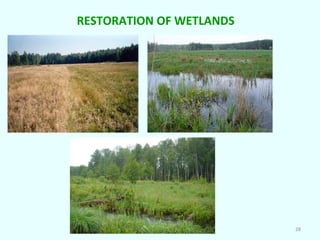
• restoration of wetlands,
• operation of ameliorative systems on protected areas
according to the requirements of protection tasks on these
areas.
26
RETENTION OF DRAINAGE OUTFLOW IN PONDS

27
RESTORATION OF WETLANDS

28
CONTROL MEASURES

29
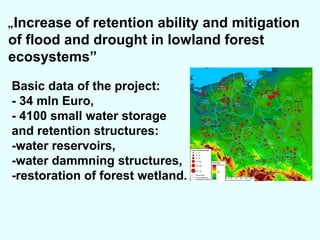
„Increase

of retention ability and mitigation
of flood and drought in lowland forest
ecosystems”
Basic data of the project:
- 34 mln Euro,
- 4100 small water storage
and retention structures:
-water reservoirs,
-water dammning structures,
-restoration of forest wetland.
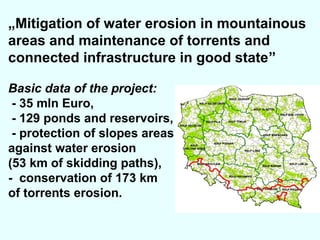
„Mitigation of water erosion in mountainous
areas and maintenance of torrents and
connected infrastructure in good state”
Basic data of the project:
- 35 mln Euro,
- 129 ponds and reservoirs,
- protection of slopes areas
against water erosion
(53 km of skidding paths),
- conservation of 173 km
of torrents erosion.
CONCLUSIONS
1. Water management in rural areas play important roles in:
adaptation of land for agricultural and forestry production,
control of water balance in scale of watershed, protection
against floods and droughts, shaping proper water conditions
in natural environment, development of non-productivity
functions of rural areas (recreation, tourism, ecotourism).
2. Water is a key factor in aspect of climate change.

Water management may help in adaptation to projected
climate change as well may be important tool in
mitigation of climate changes.
The basic condition for the fulfillment of those roles is
appropriate infrastructure and its operation. In Poland,
there is an urgent need for technological modernization
of existing irrigation and drainage systems and for
improvement their operation and maintenance.

34
3. All strategies, programmes and plans of water
management should not be based on historical
observations only, but should consider the likely
scenarios of climate change.
Thank you for your attention

Water Management in Rural Areas in a Changing Climate

  • 1.
    Global Landscape Forum Warsaw,16-17 November 2013 WATER MANAGEMENT IN RURAL AREAS IN CHANGING CLIMATE prof. Edward Pierzgalski Warsaw University of Life Sciences
  • 2.
    STRUCTURE OF PRESENTATION 1.Main issues of water management in rural areas 2. Climate change versus water resources 3. Water management in agriculture versus climate change 4. What should we do? 5. Conclusions
  • 3.
    MAIN ISSUES OFWATER MANAGEMENT IN RURAL AREAS
  • 4.
    GEOMORPHOLOGY OF POLAND ANDMAIN RIVER BASINS 4
  • 5.
    WATER RESOURCES • averageannual precipitation of 600 mm varies from 70% to 130% of annual value, • an average annual river runoff 1.630 m3/inhabitant/year, (in Europe 4.000 m3), • capacity of water reservoirs approx. 6% of the average annual runoff (lower than in neighbouring countries where it exceeds 10%).
  • 6.
    WATER EXPLOITATION INDEX[%] (EEA, 2012)
  • 7.
    WATER MANAGEMENT -CRITICAL SITUATIONS The most important problems of water management are the quality of water and their temporal and spatial variability, including extreme hydrological events (droughts and floods as well as inadequate water conditions). • Catastrophes Floods Droughts • Short or long term situation Water surplus Water deficits
  • 8.
    FLOODS AND FINANCIALLOSSES OCCURENCE OF FLOODS: • in the Vistula river basin – every 3 years • in the Oder basin – every 5 years • many local floods all over the country every year TYPES OF FLOODS rainfall snow melting rapid heavy rainfall storm LOSSES (bilions EUR) 1997- 4,5 2001 -1,1 2010 - 4,1 Source: Institute of Meteorology and Water Management
  • 9.
    CLIMATIC BALANCE ANDDROUGHT IN PERIOD 1951-2000 Number of cases Source: Ekokonsult, 2010
  • 10.
    CLIMATE CHANGE VERSUSWATER RESOURCES
  • 11.
    IMPACT OF AIRTEMPERATURE RISE ON WATER RESOURCES Decrease of water resources due to: - decline of snow cover duration, - increase of ewapotranspiration. Direct effects: - drying of streams, lakes and water reservoirs, - lowering of groundwater level, - drying of soil. Other effects: - negative impact on agricultural production, - deterioration of ecosystem’s health, - decline of forests, - degradation of wetlands, - increase of greenhouse gases emissions.
  • 12.
    WATER EXPLOITATION INDEX FOR 2030 (abstraction) Source: Adde Roo et all: A multi-criteria optimization of scenarios for the protection of water resources in Europe. European Commission, JRC Scientific and Policy Report 2012
  • 13.
    PROJECTED BEGINNING ANDLENGTH OF THE GROWING SEASON date Source: klimat.icm.edu.pl The beginning of the growing season (T >5oC) (Wrocław region) days Length of the growing season (Wrocław region)
  • 14.
    PROBABILITY OF CORNMATURING IN THE THERMAL CONDITIONS IN PERIOD 1941-1991 COMPARED TO THE PROJECTIONS FOR THE PERIOD 2001-2010 2001-2010 1941-1990 0 20 40 60 80 100 % 2000 – 162 000 ha 2011 – 426 000 ha Source: Kozyra i Gorski 2004
  • 15.
    WATER MANAGEMENT INAGRICULTURE VERSUS CLIMATE CHANGE
  • 16.
    Emission of greenhousesgases could be mitigate by proper regulation of soil moisture, specially in organic soils. Scale of problem: Peatlands and organic soils cover 3-4 % of Earth’s area but contain 30 percent of the world’s soil carbon. It was estimated that in Poland from 0,8 mln ha of wetlands (without forest fens) annual emission CO2 amounts to 14 mln tons (10 place in Europe).
  • 17.
    Emission of CO2depends on fens type, ground water level, temperature, land use, vegetation state and varies from 9 to 90 t ha-1 year-1. It has been found that is a direct relation between amount of emissions CO2 and the ground water level. Emission of N20 varies from 9 to 60 kg ha-1 year-1 and also depends on drainage depth, soil moisture, fertilizers, temperature. Adjusting the ground water table it is possible to reduce emissions of CO2 and N20 significantly.
  • 18.
    Methane emission Ground water CH4 emission depth[cm] [mg m-2 h-1] 0 25 50 75 Source: J. Turbiak,2012 10,1 7,9 4,0 2,9 Total CH4 emission in growing season kg ha-1 502 361 198 141
  • 19.
    Shaping of appropriatewater conditions in the forests increases the wood production which increase sequestration of CO2.
  • 20.
  • 21.
    DEVELOPMENT OF NEWWATER RESOURCES Problems: - technically difficult, - economically expensive, - environmentally negative. Source: EEA Eldred 2.08 (European Lakes, Dams and Reservoirs Database), 2008.
  • 22.
    SOLUTIONS? The main ways: watersaving, water recyckling, water harvesting. Tools: legislation, economy mechanisms, proper water infrastructure and its operation monitoring and controlling systems, research and technology development, participation of all sectors, education
  • 23.
    DRAINAGE AND IRRIGATIONAREA Area [mln ha] Land use Arable land total area in this ameliora- drained area irrigated tive area area 12,11 4,63 [38,2 %] 3,98 [86 % ] 0,05 [1,08 %] Meadows and pasture 3,18 1,79 [56,3 %] 0,40 [22,3 %] 0,36 [20,1 %] Forests 9,27 0,95 [10,3 %] 23
  • 24.
    PROBLEMS OF IRRIGATION ANDDRAINAGE SYSTEMS 1. Age of drainage and irrigation systems. 2. The legislation. 3. Operation and management. 4. The economic condition of the agricultural sector. 5. Others. 1400 agricultural lands forest areas Reclaimed area [thousands hectares] 1200 1000 800 600 Number of Change YEAR water compared companies to 2000 year 2000 200 0 19511955 19561960 19611965 19661970 19711975 19761980 19811985 19861990 19911995 2748 2005 400 2450 - 298 2010 2290 - 458 2011 2292 - 456 24
  • 25.
    ENVIRONMENTAL THREATS OF AMELIORATIVEMEASURES • acceleration of the water cycle in the catchment area, • reduction of water resources, • transfer of pollutions from the surface of the fields by ditches to surface water bodies, • increased leaching of chemicals in drainage areas, • destruction of wetland habitats and organic soils, • impact on emission of greenhouses gases. 25
  • 26.
    MITIGATION OF NEGATIVERESULTS • conversion drainage systems into controllable (equiped existing drainage systems with control devices), • retention drainage outflow in ponds, • mitigation of organic soils degradation by precise regulation of ground water level, • recirculation of water on ameliorative objects, • restoration of wetlands, • operation of ameliorative systems on protected areas according to the requirements of protection tasks on these areas. 26
  • 27.
    RETENTION OF DRAINAGEOUTFLOW IN PONDS 27
  • 28.
  • 29.
  • 30.
    „Increase of retention abilityand mitigation of flood and drought in lowland forest ecosystems” Basic data of the project: - 34 mln Euro, - 4100 small water storage and retention structures: -water reservoirs, -water dammning structures, -restoration of forest wetland.
  • 31.
    „Mitigation of watererosion in mountainous areas and maintenance of torrents and connected infrastructure in good state” Basic data of the project: - 35 mln Euro, - 129 ponds and reservoirs, - protection of slopes areas against water erosion (53 km of skidding paths), - conservation of 173 km of torrents erosion.
  • 32.
  • 33.
    1. Water managementin rural areas play important roles in: adaptation of land for agricultural and forestry production, control of water balance in scale of watershed, protection against floods and droughts, shaping proper water conditions in natural environment, development of non-productivity functions of rural areas (recreation, tourism, ecotourism).
  • 34.
    2. Water isa key factor in aspect of climate change. Water management may help in adaptation to projected climate change as well may be important tool in mitigation of climate changes. The basic condition for the fulfillment of those roles is appropriate infrastructure and its operation. In Poland, there is an urgent need for technological modernization of existing irrigation and drainage systems and for improvement their operation and maintenance. 34
  • 35.
    3. All strategies,programmes and plans of water management should not be based on historical observations only, but should consider the likely scenarios of climate change.
  • 36.
    Thank you foryour attention