Frontrunners in Forest Rights Devolution at the Crossroads: Path Dependencies and Their Implications for the Future of Community Forestry in Guatemala and Nepal
Presented by Dietmar Stoian & Anukram Adhikary at FLARE 2024 Annual Meeting
University of Notre Dame, Rome
3-7 October 2024
Similar to Frontrunners in Forest Rights Devolution at the Crossroads: Path Dependencies and Their Implications for the Future of Community Forestry in Guatemala and Nepal
PPT
Investment in the sustainable commons conditions for commons based enterprises
Frontrunners in Forest Rights Devolution at the Crossroads: Path Dependencies and Their Implications for the Future of Community Forestry in Guatemala and Nepal
1.
Frontrunners in ForestRights Devolution at the Crossroads:
Path Dependencies and Their Implications for the Future of Community
Forestry in Guatemala and Nepal
Dietmar Stoian & Anukram Adhikary
FLARE 2024 Annual Meeting
University of Notre Dame, Rome
3-7 October 2024
2.
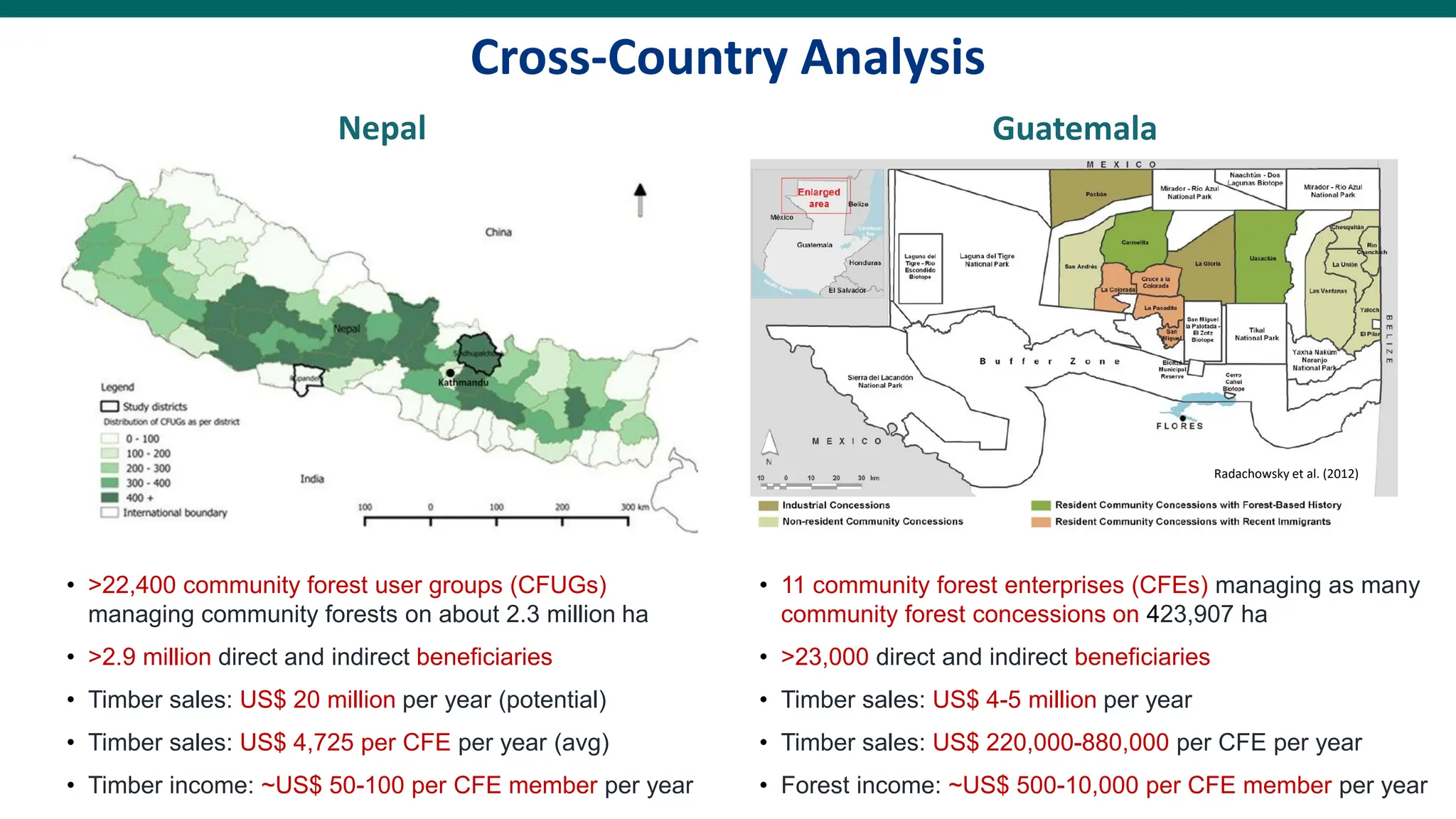
Radachowsky et al.(2012)
Cross-Country Analysis
Guatemala
• 11 community forest enterprises (CFEs) managing as many
community forest concessions on 423,907 ha
• >23,000 direct and indirect beneficiaries
• Timber sales: US$ 4-5 million per year
• Timber sales: US$ 220,000-880,000 per CFE per year
• Forest income: ~US$ 500-10,000 per CFE member per year
• >22,400 community forest user groups (CFUGs)
managing community forests on about 2.3 million ha
• >2.9 million direct and indirect beneficiaries
• Timber sales: US$ 20 million per year (potential)
• Timber sales: US$ 4,725 per CFE per year (avg)
• Timber income: ~US$ 50-100 per CFE member per year
Nepal
3.
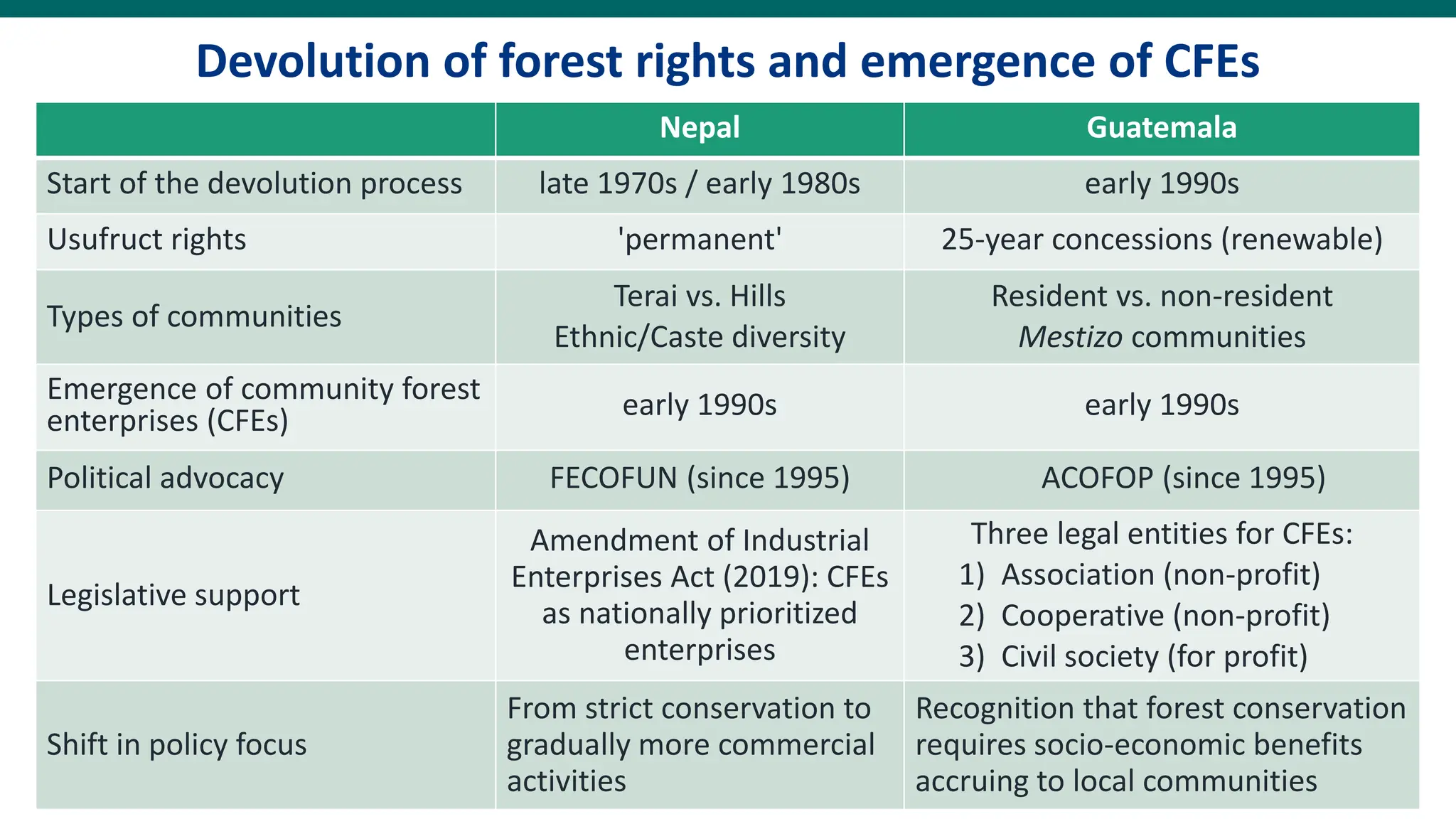
Devolution of forestrights and emergence of CFEs
Nepal Guatemala
Start of the devolution process late 1970s / early 1980s early 1990s
Usufruct rights 'permanent' 25-year concessions (renewable)
Types of communities
Terai vs. Hills
Ethnic/Caste diversity
Resident vs. non-resident
Mestizo communities
Emergence of community forest
enterprises (CFEs) early 1990s early 1990s
Political advocacy FECOFUN (since 1995) ACOFOP (since 1995)
Legislative support
Amendment of Industrial
Enterprises Act (2019): CFEs
as nationally prioritized
enterprises
Three legal entities for CFEs:
1) Association (non-profit)
2) Cooperative (non-profit)
3) Civil society (for profit)
Shift in policy focus
From strict conservation to
gradually more commercial
activities
Recognition that forest conservation
requires socio-economic benefits
accruing to local communities
4.
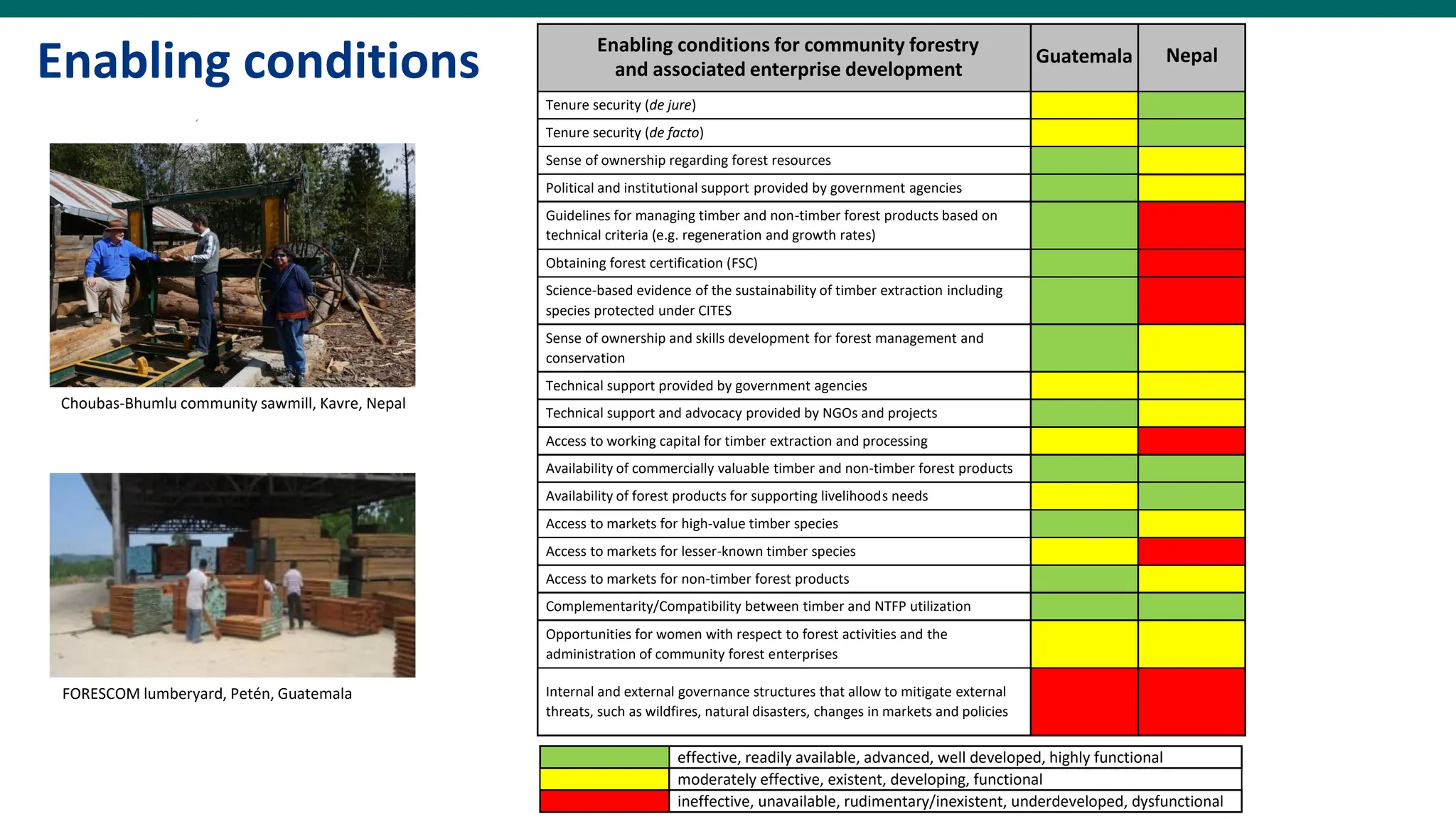
effective, readily available,advanced, well developed, highly functional
moderately effective, existent, developing, functional
ineffective, unavailable, rudimentary/inexistent, underdeveloped, dysfunctional
Enabling conditions for community forestry
and associated enterprise development
Guatemala Nepal
Tenure security (de jure)
Tenure security (de facto)
Sense of ownership regarding forest resources
Political and institutional support provided by government agencies
Guidelines for managing timber and non-timber forest products based on
technical criteria (e.g. regeneration and growth rates)
Obtaining forest certification (FSC)
Science-based evidence of the sustainability of timber extraction including
species protected under CITES
Sense of ownership and skills development for forest management and
conservation
Technical support provided by government agencies
Technical support and advocacy provided by NGOs and projects
Access to working capital for timber extraction and processing
Availability of commercially valuable timber and non-timber forest products
Availability of forest products for supporting livelihoods needs
Access to markets for high-value timber species
Access to markets for lesser-known timber species
Access to markets for non-timber forest products
Complementarity/Compatibility between timber and NTFP utilization
Opportunities for women with respect to forest activities and the
administration of community forest enterprises
Internal and external governance structures that allow to mitigate external
threats, such as wildfires, natural disasters, changes in markets and policies
Enabling conditions
Choubas-Bhumlu community sawmill, Kavre, Nepal
FORESCOM lumberyard, Petén, Guatemala
5.
Evolution of communityforest enterprises in Nepal
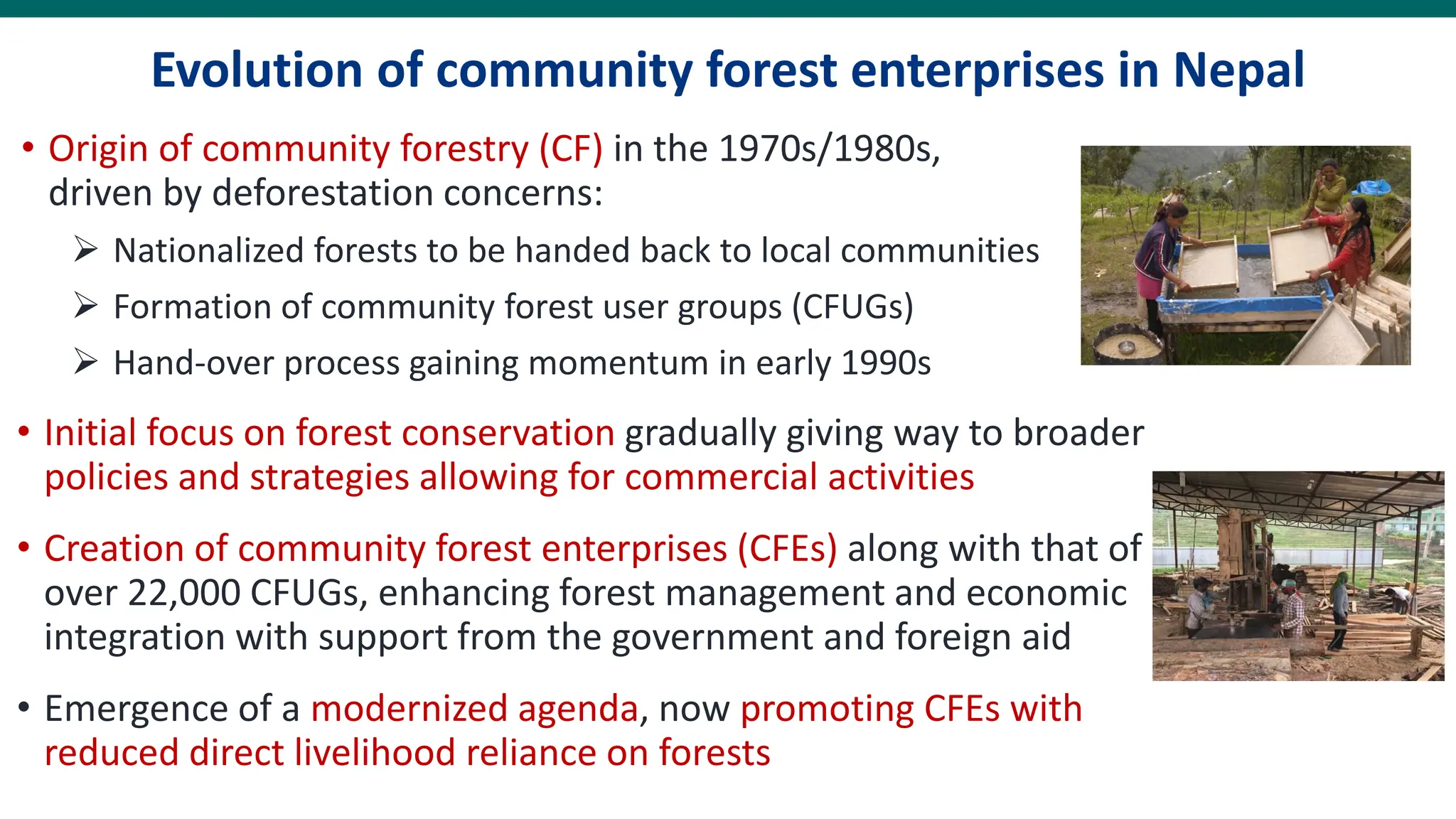
• Origin of community forestry (CF) in the 1970s/1980s,
driven by deforestation concerns:
➢ Nationalized forests to be handed back to local communities
➢ Formation of community forest user groups (CFUGs)
➢ Hand-over process gaining momentum in early 1990s
• Initial focus on forest conservation gradually giving way to broader
policies and strategies allowing for commercial activities
• Creation of community forest enterprises (CFEs) along with that of
over 22,000 CFUGs, enhancing forest management and economic
integration with support from the government and foreign aid
• Emergence of a modernized agenda, now promoting CFEs with
reduced direct livelihood reliance on forests
6.
Evolution of communityforest enterprises in Guatemala
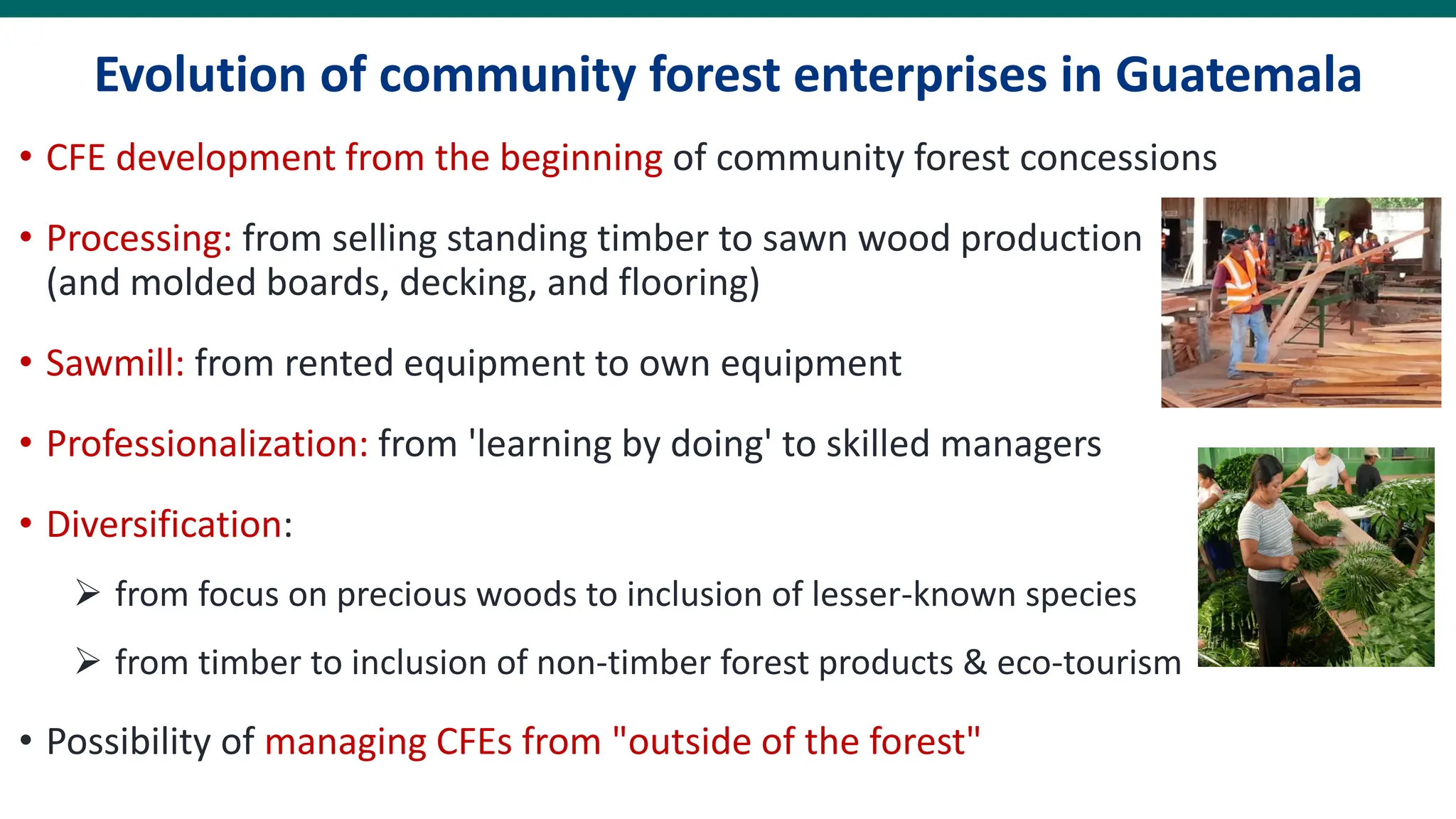
• CFE development from the beginning of community forest concessions
• Processing: from selling standing timber to sawn wood production
(and molded boards, decking, and flooring)
• Sawmill: from rented equipment to own equipment
• Professionalization: from 'learning by doing' to skilled managers
• Diversification:
➢ from focus on precious woods to inclusion of lesser-known species
➢ from timber to inclusion of non-timber forest products & eco-tourism
• Possibility of managing CFEs from "outside of the forest"
7.
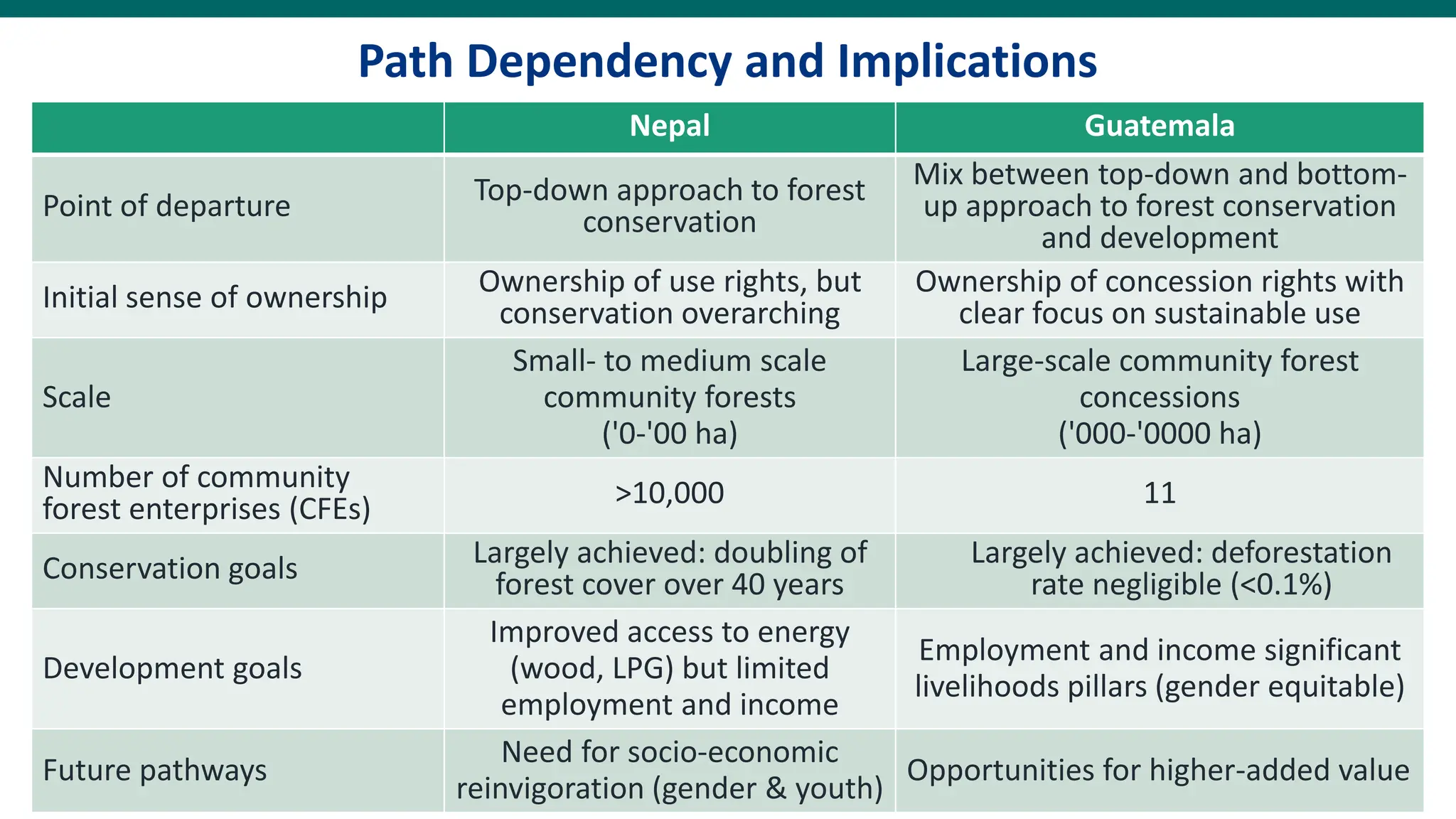
Path Dependency andImplications
Nepal Guatemala
Point of departure Top-down approach to forest
conservation
Mix between top-down and bottom-
up approach to forest conservation
and development
Initial sense of ownership Ownership of use rights, but
conservation overarching
Ownership of concession rights with
clear focus on sustainable use
Scale
Small- to medium scale
community forests
('0-'00 ha)
Large-scale community forest
concessions
('000-'0000 ha)
Number of community
forest enterprises (CFEs) >10,000 11
Conservation goals Largely achieved: doubling of
forest cover over 40 years
Largely achieved: deforestation
rate negligible (<0.1%)
Development goals
Improved access to energy
(wood, LPG) but limited
employment and income
Employment and income significant
livelihoods pillars (gender equitable)
Future pathways
Need for socio-economic
reinvigoration (gender & youth)
Opportunities for higher-added value
8.
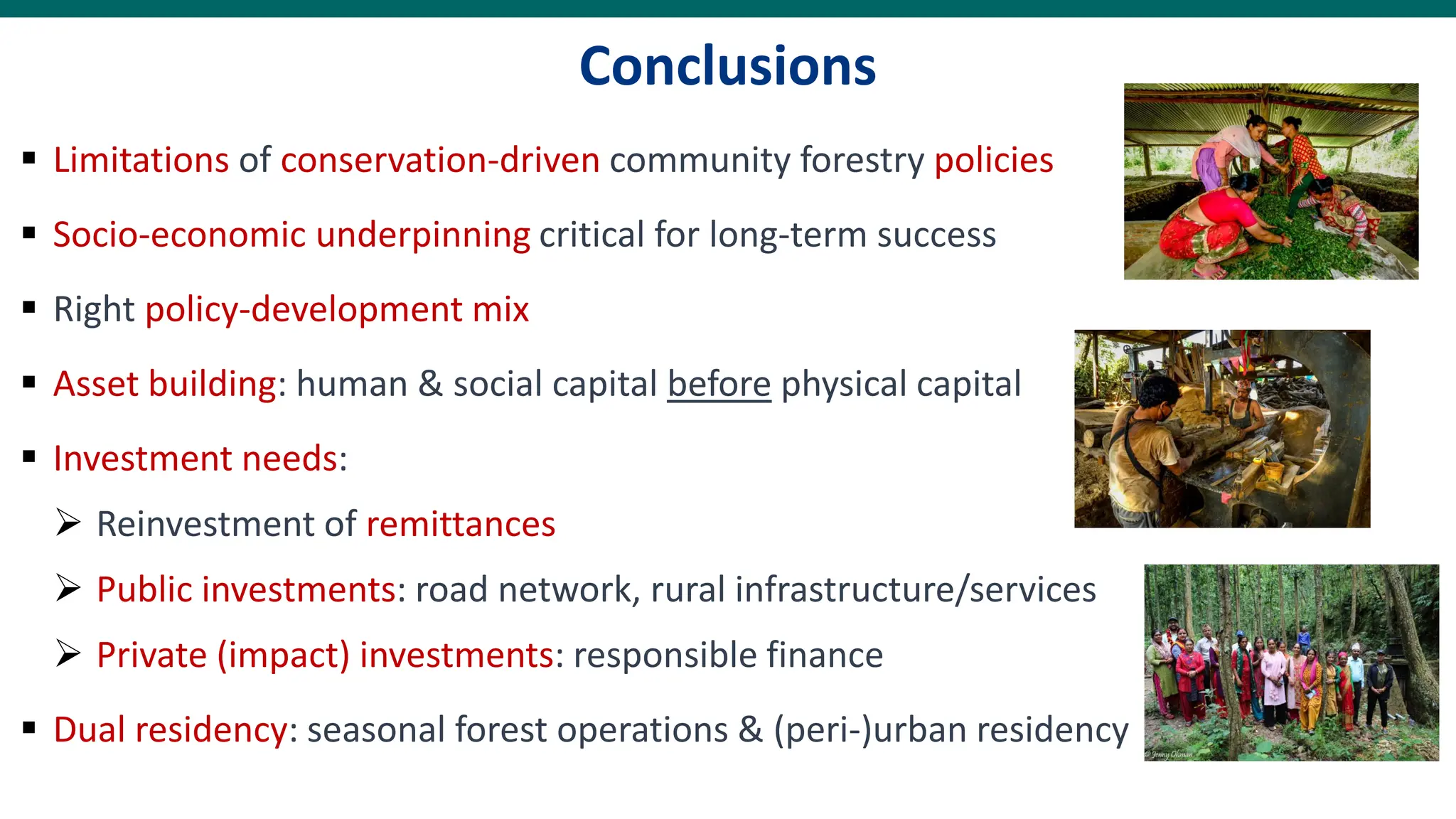
Conclusions
▪ Limitations ofconservation-driven community forestry policies
▪ Socio-economic underpinning critical for long-term success
▪ Right policy-development mix
▪ Asset building: human & social capital before physical capital
▪ Investment needs:
➢ Reinvestment of remittances
➢ Public investments: road network, rural infrastructure/services
➢ Private (impact) investments: responsible finance
▪ Dual residency: seasonal forest operations & (peri-)urban residency
9.
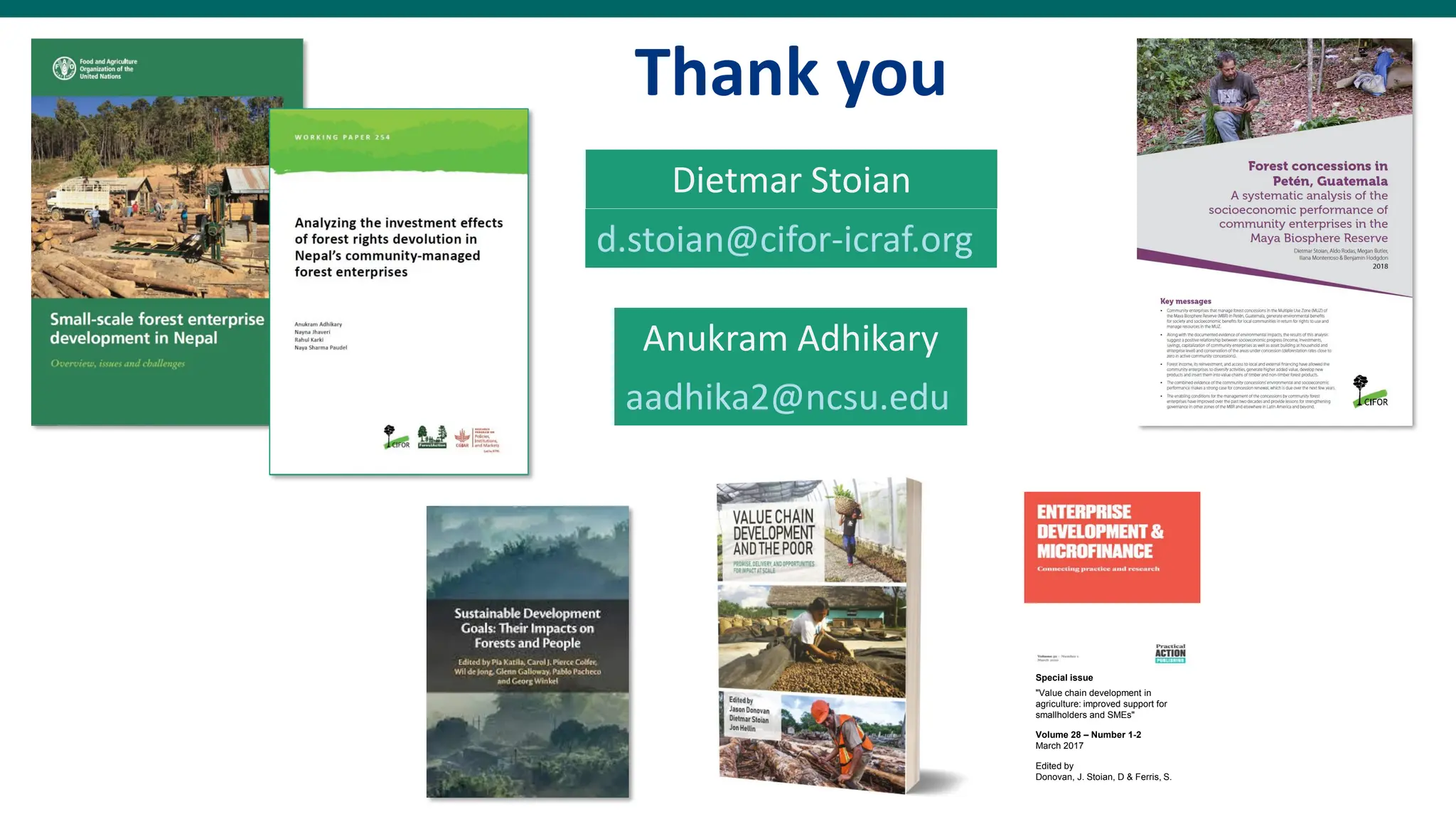
Thank you
Special issue
"Valuechain development in
agriculture: improved support for
smallholders and SMEs"
Volume 28 – Number 1-2
March 2017
Edited by
Donovan, J. Stoian, D & Ferris, S.
aadhika2@ncsu.edu
Anukram Adhikary
d.stoian@cifor-icraf.org
Dietmar Stoian