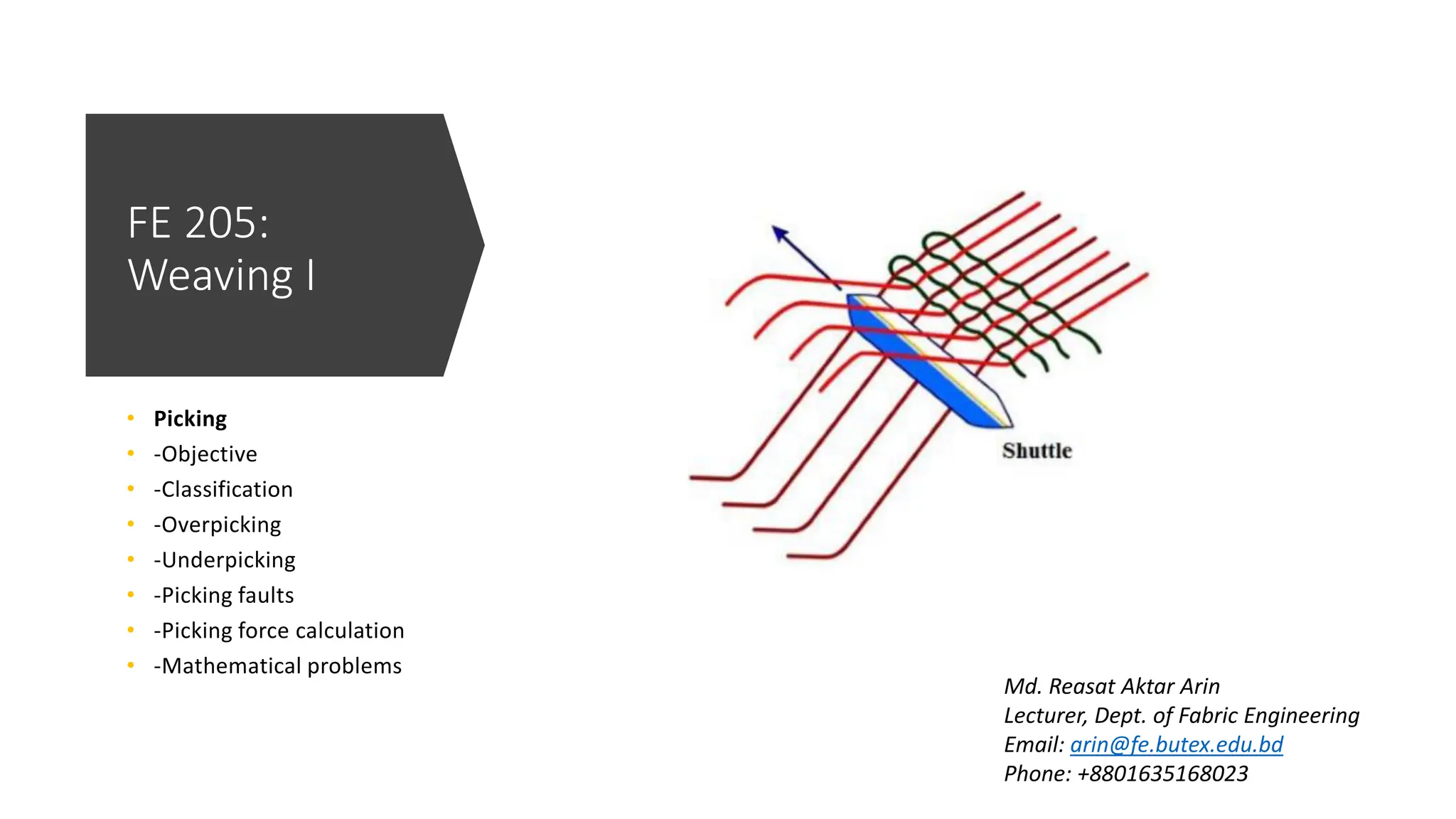
FE 205:
Weaving I
• Picking
• -Objective
• -Classification
• -Overpicking
• -Underpicking
• -Picking faults
• -Picking force calculation
• -Mathematical problems
Md. Reasat Aktar Arin
Lecturer, Dept. of Fabric Engineering
Email: arin@fe.butex.edu.bd
Phone: +8801635168023
Reference Books,
• Principles of Weaving
---A.T.C. Robinson
• Weaving Machines, Mechanisms, Management
--- Dr. M.K. Talukdar
• Weaving: Conversion of yarn to fabric
--- P.R. Lord and M.H. Mohamed
• HandBook of Weaving
---Sabit Adanur
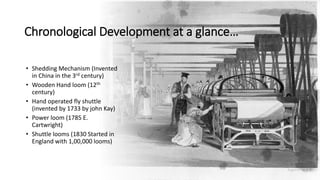
Chronological Development at a glance…
• Shedding Mechanism (Invented
in China in the 3rd century)
• Wooden Hand loom (12th
century)
• Hand operated fly shuttle
(invented by 1733 by john Kay)
• Power loom (1785 E.
Cartwright)
• Shuttle looms (1830 Started in
England with 1,00,000 looms)
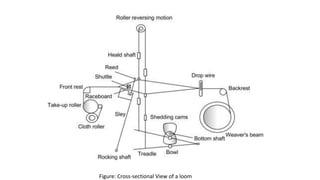
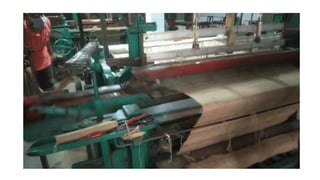
Figure: Cross-sectional View of a loom
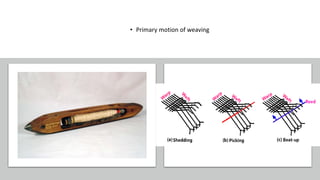
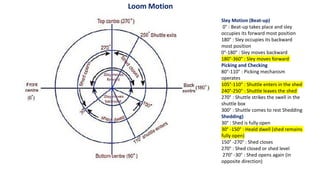
• Primary motion of weaving
Sley Motion (Beat-up)
0° : Beat-up takes place and sley
occupies its forward most position
180° : Sley occupies its backward
most position
0°-180° : Sley moves backward
180°-360° : Sley moves forward
Picking and Checking
80°-110° : Picking mechanism
operates
105°-110° : Shuttle enters in the shed
240°-250° : Shuttle leaves the shed
270° : Shuttle strikes the swell in the
shuttle box
300° : Shuttle comes to rest Shedding
Shedding)
30° : Shed is fully open
30° -150° : Heald dwell (shed remains
fully open)
150° -270° : Shed closes
270° : Shed closed or shed level
270° -30° : Shed opens again (in
opposite direction)
Loom Motion
Picking
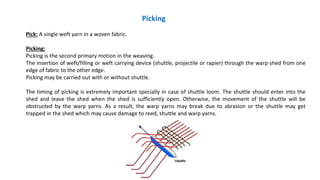
Pick: A single weft yarn in a woven fabric.
Picking:
Picking is the second primary motion in the weaving.
The insertion of weft/filling or weft carrying device (shuttle, projectile or rapier) through the warp shed from one
edge of fabric to the other edge.
Picking may be carried out with or without shuttle.
The timing of picking is extremely important specially in case of shuttle loom. The shuttle should enter into the
shed and leave the shed when the shed is sufficiently open. Otherwise, the movement of the shuttle will be
obstructed by the warp yarns. As a result, the warp yarns may break due to abrasion or the shuttle may get
trapped in the shed which may cause damage to reed, shuttle and warp yarns.
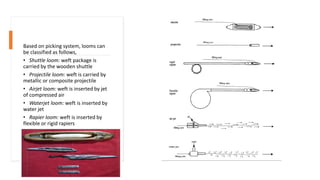
Based on picking system, looms can
be classified as follows,
• Shuttle loom: weft package is
carried by the wooden shuttle
• Projectile loom: weft is carried by
metallic or composite projectile
• Airjet loom: weft is inserted by jet
of compressed air
• Waterjet loom: weft is inserted by
water jet
• Rapier loom: weft is inserted by
flexible or rigid rapiers
• To insert the weft of a predetermined velocity through the shed
• To project the shuttle at a predetermined velocity
• To deliver the shuttle across the current flight path
In brief, the objective of picking is to propel the weft carrying element (shuttle, projectile or
rapier) or the weft yarn along the correct trajectory maintaining requisite velocity through the
shed in order to provide lateral sets of yarns in the fabric.
Function/Purpose/Objective of picking
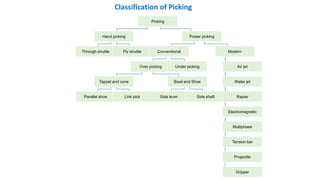
Picking
Hand picking
Through shuttle Fly shuttle
Power picking
Conventional
Over picking
Tappet and cone
Parallel shoe Link pick
Bowl and Shoe
Side lever Side shaft
Under picking
Modern
Air jet
Water jet
Rapier
Electromagnetic
Multiphase
Tension bar
Projectile
Gripper
Classification of Picking
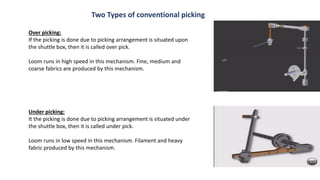
Two Types of conventional picking
Over picking:
If the picking is done due to picking arrangement is situated upon
the shuttle box, then it is called over pick.
Loom runs in high speed in this mechanism. Fine, medium and
coarse fabrics are produced by this mechanism.
Under picking:
It the picking is done due to picking arrangement is situated under
the shuttle box, then it is called under pick.
Loom runs in low speed in this mechanism. Filament and heavy
fabric produced by this mechanism.
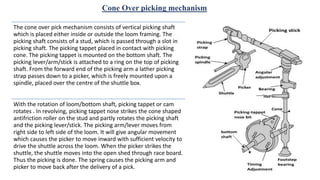
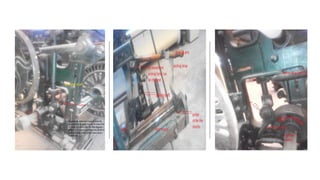
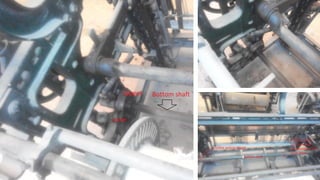
Cone Over picking mechanism
The cone over pick mechanism consists of vertical picking shaft
which is placed either inside or outside the loom framing. The
picking shaft consists of a stud, which is passed through a slot in
picking shaft. The picking tappet placed in contact with picking
cone. The picking tappet is mounted on the bottom shaft. The
picking lever/arm/stick is attached to a ring on the top of picking
shaft. From the forward end of the picking arm a lather picking
strap passes down to a picker, which is freely mounted upon a
spindle, placed over the centre of the shuttle box.
With the rotation of loom/bottom shaft, picking tappet or cam
rotates . In revolving, picking tappet nose strikes the cone shaped
antifriction roller on the stud and partly rotates the picking shaft
and the picking lever/stick. The picking arm/lever moves from
right side to left side of the loom. It will give angular movement
which causes the picker to move inward with sufficient velocity to
drive the shuttle across the loom. When the picker strikes the
shuttle, the shuttle moves into the open shed through race board.
Thus the picking is done. The spring causes the picking arm and
picker to move back after the delivery of a pick.
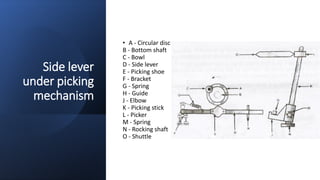
Side lever
under picking
mechanism
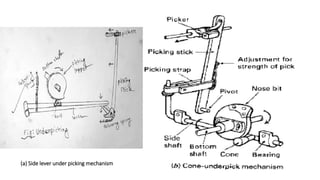
• A - Circular disc
B - Bottom shaft
C - Bowl
D - Side lever
E - Picking shoe
F - Bracket
G - Spring
H - Guide
J - Elbow
K - Picking stick
L - Picker
M - Spring
N - Rocking shaft
O - Shuttle
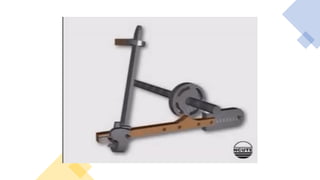
(a) Side lever under picking mechanism
Construction
• A side-lever under pick mechanism is shown in the figure. Circular disc A is fixed to the bottom shaft B.
The disc contains slots. A bowl C is fixed in one of the slots. A side lever D, which is below the disc, carries
a picking shoe E at the centre and is connected to a bracket F and spring G at the back end. The bracket
acts as a fulcrum for the side lever. A guide H is used to guide the side lever during its motion. The lower
front end of side lever touches an elbow J, which carries the picking stick K. A picker L is loosely mounted
on the picking stick. The elbow is connected to a coiled spring M, which is in a housing bracket. The elbow
is connected at the bottom to a rocking shaft N. A buffer is fixed to the side frame of the loom and a check
strap is fixed in the slot of a bracket provided below the shuttle box. The picker is kept in contact with the
tip of the shuttle O, when it is in the shuttle box.
• A similar arrangement is provided on the other side of the loom. But the position of the bowl on the
circular disc is shifted by 180 degrees. So, for the first 180 degrees of the rotation of the bottom shaft, the
shuttle is delivered from one side and for the next 180 degrees, it is delivered from the other side. Thus
one revolution of the bottom shaft introduces two picks.
21
Working
Principle
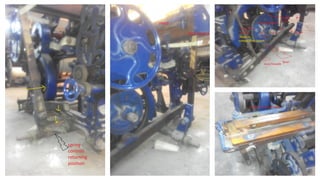
• When the bottom shaft rotates in the direction shown
in the figure, the bowl also rotates with the circular disc.
As the bowl comes against the shoe, it strikes the shoe
and thus lowers the forward end of the side lever. This
in turn hits the elbow down and the picking stick moves
towards the centre of the loom. The picker, loosely
mounted on the stick, moves and pushes the shuttle
into the shed. At the end of the motion, the stick and
the side lever are returned to their original positions by
their springs respectively.
• A similar arrangement of parts is provided on the
opposite side of the loom to enable the return of the
shuttle for the next pick. When the picking parts on one
side of the loom are in action, those on the other side
are out of action. The check strap is used to reduce the
speed of the shuttle and prevent it from rebounding.
The guide-bracket guides the lever while it is moving.
There is also a buffer to absorb the shock created during
the motion of the picking stick.
22
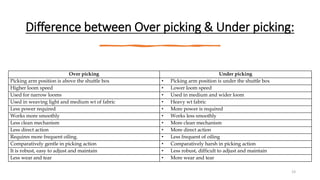
Difference between Over picking & Under picking:
23
Over picking Under picking
Picking arm position is above the shuttle box • Picking arm position is under the shuttle box
Higher loom speed • Lower loom speed
Used for narrow looms • Used in medium and wider loom
Used in weaving light and medium wt of fabric • Heavy wt fabric
Less power required • More power is required
Works more smoothly • Works less smoothly
Less clean mechanism • More clean mechanism
Less direct action • More direct action
Requires more frequent oiling. • Less frequent of oiling
Comparatively gentle in picking action • Comparatively harsh in picking action
It is robust, easy to adjust and maintain • Less robust, difficult to adjust and maintain
Less wear and tear • More wear and tear
Picking
Faults
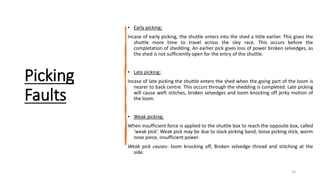
• Early picking:
Incase of early picking, the shuttle enters into the shed a little earlier. This gives the
shuttle more time to travel across the sley race. This occurs before the
completation of shedding. An earlier pick gives loss of power broken selvedges, as
the shed is not sufficiently open for the entry of the shuttle.
• Late picking:
Incase of late picking the shuttle enters the shed when the going part of the loom is
nearer to back centre. This occurs through the shedding is completed. Late picking
will cause weft stitches, broken selvedges and loom knocking off jerky motion of
the loom.
• Weak picking:
When insufficient force is applied to the shuttle box to reach the opposite box, called
‘weak pick’. Weak pick may be due to slack picking band, loose picking stick, worm
nose piece, insufficient power.
Weak pick causes- loom knocking off, Broken selvedge thread and stitching at the
side.
24
Picking
Faults
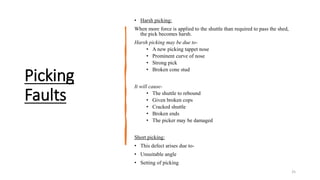
• Harsh picking:
When more force is applied to the shuttle than required to pass the shed,
the pick becomes harsh.
Harsh picking may be due to-
• A new picking tappet nose
• Prominent curve of nose
• Strong pick
• Broken cone stud
It will cause-
• The shuttle to rebound
• Given broken cops
• Cracked shuttle
• Broken ends
• The picker may be damaged
Short picking:
• This defect arises due to-
• Unsuitable angle
• Setting of picking
25
Picking
Faults
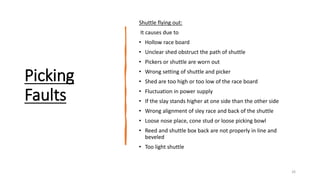
Shuttle flying out:
It causes due to
• Hollow race board
• Unclear shed obstruct the path of shuttle
• Pickers or shuttle are worn out
• Wrong setting of shuttle and picker
• Shed are too high or too low of the race board
• Fluctuation in power supply
• If the slay stands higher at one side than the other side
• Wrong alignment of sley race and back of the shuttle
• Loose nose place, cone stud or loose picking bowl
• Reed and shuttle box back are not properly in line and
beveled
• Too light shuttle
26
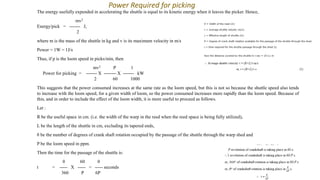
The energy usefully expended in accelerating the shuttle is equal to its kinetic energy when it leaves the picker. Hence,
mv2
Energy/pick = ------- J,
2
where m is the mass of the shuttle in kg and v is its maximum velocity in m/s
Power = 1W = 1J/s
Thus, if p is the loom speed in picks/min, then
mv2 P 1
Power for picking = ------- X -------- X ------- kW
2 60 1000
This suggests that the power consumed increases at the same rate as the loom speed, but this is not so because the shuttle speed also tends
to increase with the loom speed, for a given width of loom, so the power consumed increases more rapidly than the loom speed. Because of
this, and in order to include the effect of the loom width, it is more useful to proceed as follows.
Let :
R be the useful space in cm. (i.e. the width of the warp in the reed when the reed space is being fully utilized),
L be the length of the shuttle in cm, excluding its tapered ends,
θ be the number of degrees of crank shaft rotation occupied by the passage of the shuttle through the warp shed and
P be the loom speed in ppm.
Then the time for the passage of the shuttle is:
θ 60 θ
t = ----- X ----- = ----- seconds
360 P 6P
Power Required for picking
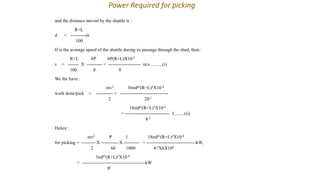
and the distance moved by the shuttle is :
R+L
d = ----------m
100
If is the average speed of the shuttle during its passage through the shed, then :
R+L 6P 6P(R+L)X10-2
v = ------- X ---------- = --------------------- m/s ..........(i)
100 θ θ
We the have :
mv2 36mP2(R+L)2X10⁻⁴
work done/pick = ----------- = -------------------------------
2 2θ 2
18mP2(R+L)2X10-4
= ----------------------------- J.........(ii)
θ 2
Hence :
mv2 P 1 18mP3(R+L)2X10⁻⁴
for picking = --------- X ----------- X ---------- = --------------------------------kW,
2 60 1000 θ 2X6X104
3mP3(R+L)2X10-8
= -----------------------------------------kW
θ2
Power Required for picking
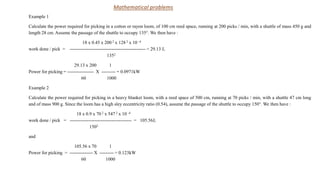
Example 1
Calculate the power required for picking in a cotton or rayon loom, of 100 cm reed space, running at 200 picks / min, with a shuttle of mass 450 g and
length 28 cm. Assume the passage of the shuttle to occupy 135°. We then have :
18 x 0.45 x 200 2 x 128 2 x 10 -4
work done / pick = ------------------------------------------------- = 29.13 J,
1352
29.13 x 200 1
Power for picking = ----------------- X --------- = 0.0971kW
60 1000
Example 2
Calculate the power required for picking in a heavy blanket loom, with a reed space of 500 cm, running at 70 picks / min, with a shuttle 47 cm long
and of mass 900 g. Since the loom has a high sley eccentricity ratio (0.54), assume the passage of the shuttle to occupy 150°. We then have :
18 x 0.9 x 70 2 x 547 2 x 10 -4
work done / pick = ---------------------------------------- = 105.56J,
1502
and
105.56 x 70 1
Power for picking = --------------- X --------- = 0.123kW
60 1000
Mathematical problems
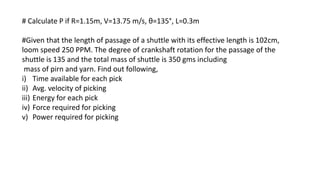
# Calculate P if R=1.15m, V=13.75 m/s, θ=135°, L=0.3m
#Given that the length of passage of a shuttle with its effective length is 102cm,
loom speed 250 PPM. The degree of crankshaft rotation for the passage of the
shuttle is 135 and the total mass of shuttle is 350 gms including
mass of pirn and yarn. Find out following,
i) Time available for each pick
ii) Avg. velocity of picking
iii) Energy for each pick
iv) Force required for picking
v) Power required for picking
Thanks

PICKING for textile engineering students major in Fabric

  • 1.
    FE 205: Weaving I •Picking • -Objective • -Classification • -Overpicking • -Underpicking • -Picking faults • -Picking force calculation • -Mathematical problems Md. Reasat Aktar Arin Lecturer, Dept. of Fabric Engineering Email: arin@fe.butex.edu.bd Phone: +8801635168023
  • 2.
    Reference Books, • Principlesof Weaving ---A.T.C. Robinson • Weaving Machines, Mechanisms, Management --- Dr. M.K. Talukdar • Weaving: Conversion of yarn to fabric --- P.R. Lord and M.H. Mohamed • HandBook of Weaving ---Sabit Adanur
  • 3.
    Chronological Development ata glance… • Shedding Mechanism (Invented in China in the 3rd century) • Wooden Hand loom (12th century) • Hand operated fly shuttle (invented by 1733 by john Kay) • Power loom (1785 E. Cartwright) • Shuttle looms (1830 Started in England with 1,00,000 looms)
  • 4.
  • 5.
  • 8.
    Sley Motion (Beat-up) 0°: Beat-up takes place and sley occupies its forward most position 180° : Sley occupies its backward most position 0°-180° : Sley moves backward 180°-360° : Sley moves forward Picking and Checking 80°-110° : Picking mechanism operates 105°-110° : Shuttle enters in the shed 240°-250° : Shuttle leaves the shed 270° : Shuttle strikes the swell in the shuttle box 300° : Shuttle comes to rest Shedding Shedding) 30° : Shed is fully open 30° -150° : Heald dwell (shed remains fully open) 150° -270° : Shed closes 270° : Shed closed or shed level 270° -30° : Shed opens again (in opposite direction) Loom Motion
  • 9.
    Picking Pick: A singleweft yarn in a woven fabric. Picking: Picking is the second primary motion in the weaving. The insertion of weft/filling or weft carrying device (shuttle, projectile or rapier) through the warp shed from one edge of fabric to the other edge. Picking may be carried out with or without shuttle. The timing of picking is extremely important specially in case of shuttle loom. The shuttle should enter into the shed and leave the shed when the shed is sufficiently open. Otherwise, the movement of the shuttle will be obstructed by the warp yarns. As a result, the warp yarns may break due to abrasion or the shuttle may get trapped in the shed which may cause damage to reed, shuttle and warp yarns.
  • 10.
    Based on pickingsystem, looms can be classified as follows, • Shuttle loom: weft package is carried by the wooden shuttle • Projectile loom: weft is carried by metallic or composite projectile • Airjet loom: weft is inserted by jet of compressed air • Waterjet loom: weft is inserted by water jet • Rapier loom: weft is inserted by flexible or rigid rapiers
  • 11.
    • To insertthe weft of a predetermined velocity through the shed • To project the shuttle at a predetermined velocity • To deliver the shuttle across the current flight path In brief, the objective of picking is to propel the weft carrying element (shuttle, projectile or rapier) or the weft yarn along the correct trajectory maintaining requisite velocity through the shed in order to provide lateral sets of yarns in the fabric. Function/Purpose/Objective of picking
  • 12.
    Picking Hand picking Through shuttleFly shuttle Power picking Conventional Over picking Tappet and cone Parallel shoe Link pick Bowl and Shoe Side lever Side shaft Under picking Modern Air jet Water jet Rapier Electromagnetic Multiphase Tension bar Projectile Gripper Classification of Picking
  • 13.
    Two Types ofconventional picking Over picking: If the picking is done due to picking arrangement is situated upon the shuttle box, then it is called over pick. Loom runs in high speed in this mechanism. Fine, medium and coarse fabrics are produced by this mechanism. Under picking: It the picking is done due to picking arrangement is situated under the shuttle box, then it is called under pick. Loom runs in low speed in this mechanism. Filament and heavy fabric produced by this mechanism.
  • 14.
    Cone Over pickingmechanism The cone over pick mechanism consists of vertical picking shaft which is placed either inside or outside the loom framing. The picking shaft consists of a stud, which is passed through a slot in picking shaft. The picking tappet placed in contact with picking cone. The picking tappet is mounted on the bottom shaft. The picking lever/arm/stick is attached to a ring on the top of picking shaft. From the forward end of the picking arm a lather picking strap passes down to a picker, which is freely mounted upon a spindle, placed over the centre of the shuttle box. With the rotation of loom/bottom shaft, picking tappet or cam rotates . In revolving, picking tappet nose strikes the cone shaped antifriction roller on the stud and partly rotates the picking shaft and the picking lever/stick. The picking arm/lever moves from right side to left side of the loom. It will give angular movement which causes the picker to move inward with sufficient velocity to drive the shuttle across the loom. When the picker strikes the shuttle, the shuttle moves into the open shed through race board. Thus the picking is done. The spring causes the picking arm and picker to move back after the delivery of a pick.
  • 17.
    Side lever under picking mechanism •A - Circular disc B - Bottom shaft C - Bowl D - Side lever E - Picking shoe F - Bracket G - Spring H - Guide J - Elbow K - Picking stick L - Picker M - Spring N - Rocking shaft O - Shuttle
  • 19.
    (a) Side leverunder picking mechanism
  • 21.
    Construction • A side-leverunder pick mechanism is shown in the figure. Circular disc A is fixed to the bottom shaft B. The disc contains slots. A bowl C is fixed in one of the slots. A side lever D, which is below the disc, carries a picking shoe E at the centre and is connected to a bracket F and spring G at the back end. The bracket acts as a fulcrum for the side lever. A guide H is used to guide the side lever during its motion. The lower front end of side lever touches an elbow J, which carries the picking stick K. A picker L is loosely mounted on the picking stick. The elbow is connected to a coiled spring M, which is in a housing bracket. The elbow is connected at the bottom to a rocking shaft N. A buffer is fixed to the side frame of the loom and a check strap is fixed in the slot of a bracket provided below the shuttle box. The picker is kept in contact with the tip of the shuttle O, when it is in the shuttle box. • A similar arrangement is provided on the other side of the loom. But the position of the bowl on the circular disc is shifted by 180 degrees. So, for the first 180 degrees of the rotation of the bottom shaft, the shuttle is delivered from one side and for the next 180 degrees, it is delivered from the other side. Thus one revolution of the bottom shaft introduces two picks. 21
  • 22.
    Working Principle • When thebottom shaft rotates in the direction shown in the figure, the bowl also rotates with the circular disc. As the bowl comes against the shoe, it strikes the shoe and thus lowers the forward end of the side lever. This in turn hits the elbow down and the picking stick moves towards the centre of the loom. The picker, loosely mounted on the stick, moves and pushes the shuttle into the shed. At the end of the motion, the stick and the side lever are returned to their original positions by their springs respectively. • A similar arrangement of parts is provided on the opposite side of the loom to enable the return of the shuttle for the next pick. When the picking parts on one side of the loom are in action, those on the other side are out of action. The check strap is used to reduce the speed of the shuttle and prevent it from rebounding. The guide-bracket guides the lever while it is moving. There is also a buffer to absorb the shock created during the motion of the picking stick. 22
  • 23.
    Difference between Overpicking & Under picking: 23 Over picking Under picking Picking arm position is above the shuttle box • Picking arm position is under the shuttle box Higher loom speed • Lower loom speed Used for narrow looms • Used in medium and wider loom Used in weaving light and medium wt of fabric • Heavy wt fabric Less power required • More power is required Works more smoothly • Works less smoothly Less clean mechanism • More clean mechanism Less direct action • More direct action Requires more frequent oiling. • Less frequent of oiling Comparatively gentle in picking action • Comparatively harsh in picking action It is robust, easy to adjust and maintain • Less robust, difficult to adjust and maintain Less wear and tear • More wear and tear
  • 24.
    Picking Faults • Early picking: Incaseof early picking, the shuttle enters into the shed a little earlier. This gives the shuttle more time to travel across the sley race. This occurs before the completation of shedding. An earlier pick gives loss of power broken selvedges, as the shed is not sufficiently open for the entry of the shuttle. • Late picking: Incase of late picking the shuttle enters the shed when the going part of the loom is nearer to back centre. This occurs through the shedding is completed. Late picking will cause weft stitches, broken selvedges and loom knocking off jerky motion of the loom. • Weak picking: When insufficient force is applied to the shuttle box to reach the opposite box, called ‘weak pick’. Weak pick may be due to slack picking band, loose picking stick, worm nose piece, insufficient power. Weak pick causes- loom knocking off, Broken selvedge thread and stitching at the side. 24
  • 25.
    Picking Faults • Harsh picking: Whenmore force is applied to the shuttle than required to pass the shed, the pick becomes harsh. Harsh picking may be due to- • A new picking tappet nose • Prominent curve of nose • Strong pick • Broken cone stud It will cause- • The shuttle to rebound • Given broken cops • Cracked shuttle • Broken ends • The picker may be damaged Short picking: • This defect arises due to- • Unsuitable angle • Setting of picking 25
  • 26.
    Picking Faults Shuttle flying out: Itcauses due to • Hollow race board • Unclear shed obstruct the path of shuttle • Pickers or shuttle are worn out • Wrong setting of shuttle and picker • Shed are too high or too low of the race board • Fluctuation in power supply • If the slay stands higher at one side than the other side • Wrong alignment of sley race and back of the shuttle • Loose nose place, cone stud or loose picking bowl • Reed and shuttle box back are not properly in line and beveled • Too light shuttle 26
  • 27.
    The energy usefullyexpended in accelerating the shuttle is equal to its kinetic energy when it leaves the picker. Hence, mv2 Energy/pick = ------- J, 2 where m is the mass of the shuttle in kg and v is its maximum velocity in m/s Power = 1W = 1J/s Thus, if p is the loom speed in picks/min, then mv2 P 1 Power for picking = ------- X -------- X ------- kW 2 60 1000 This suggests that the power consumed increases at the same rate as the loom speed, but this is not so because the shuttle speed also tends to increase with the loom speed, for a given width of loom, so the power consumed increases more rapidly than the loom speed. Because of this, and in order to include the effect of the loom width, it is more useful to proceed as follows. Let : R be the useful space in cm. (i.e. the width of the warp in the reed when the reed space is being fully utilized), L be the length of the shuttle in cm, excluding its tapered ends, θ be the number of degrees of crank shaft rotation occupied by the passage of the shuttle through the warp shed and P be the loom speed in ppm. Then the time for the passage of the shuttle is: θ 60 θ t = ----- X ----- = ----- seconds 360 P 6P Power Required for picking
  • 28.
    and the distancemoved by the shuttle is : R+L d = ----------m 100 If is the average speed of the shuttle during its passage through the shed, then : R+L 6P 6P(R+L)X10-2 v = ------- X ---------- = --------------------- m/s ..........(i) 100 θ θ We the have : mv2 36mP2(R+L)2X10⁻⁴ work done/pick = ----------- = ------------------------------- 2 2θ 2 18mP2(R+L)2X10-4 = ----------------------------- J.........(ii) θ 2 Hence : mv2 P 1 18mP3(R+L)2X10⁻⁴ for picking = --------- X ----------- X ---------- = --------------------------------kW, 2 60 1000 θ 2X6X104 3mP3(R+L)2X10-8 = -----------------------------------------kW θ2 Power Required for picking
  • 29.
    Example 1 Calculate thepower required for picking in a cotton or rayon loom, of 100 cm reed space, running at 200 picks / min, with a shuttle of mass 450 g and length 28 cm. Assume the passage of the shuttle to occupy 135°. We then have : 18 x 0.45 x 200 2 x 128 2 x 10 -4 work done / pick = ------------------------------------------------- = 29.13 J, 1352 29.13 x 200 1 Power for picking = ----------------- X --------- = 0.0971kW 60 1000 Example 2 Calculate the power required for picking in a heavy blanket loom, with a reed space of 500 cm, running at 70 picks / min, with a shuttle 47 cm long and of mass 900 g. Since the loom has a high sley eccentricity ratio (0.54), assume the passage of the shuttle to occupy 150°. We then have : 18 x 0.9 x 70 2 x 547 2 x 10 -4 work done / pick = ---------------------------------------- = 105.56J, 1502 and 105.56 x 70 1 Power for picking = --------------- X --------- = 0.123kW 60 1000 Mathematical problems
  • 30.
    # Calculate Pif R=1.15m, V=13.75 m/s, θ=135°, L=0.3m #Given that the length of passage of a shuttle with its effective length is 102cm, loom speed 250 PPM. The degree of crankshaft rotation for the passage of the shuttle is 135 and the total mass of shuttle is 350 gms including mass of pirn and yarn. Find out following, i) Time available for each pick ii) Avg. velocity of picking iii) Energy for each pick iv) Force required for picking v) Power required for picking
  • 31.