Precision Irrigation using IoT and Machine
Learning for Drip Irrigation
Muhammad Aleem Siddiqui
What is Precision Irrigation
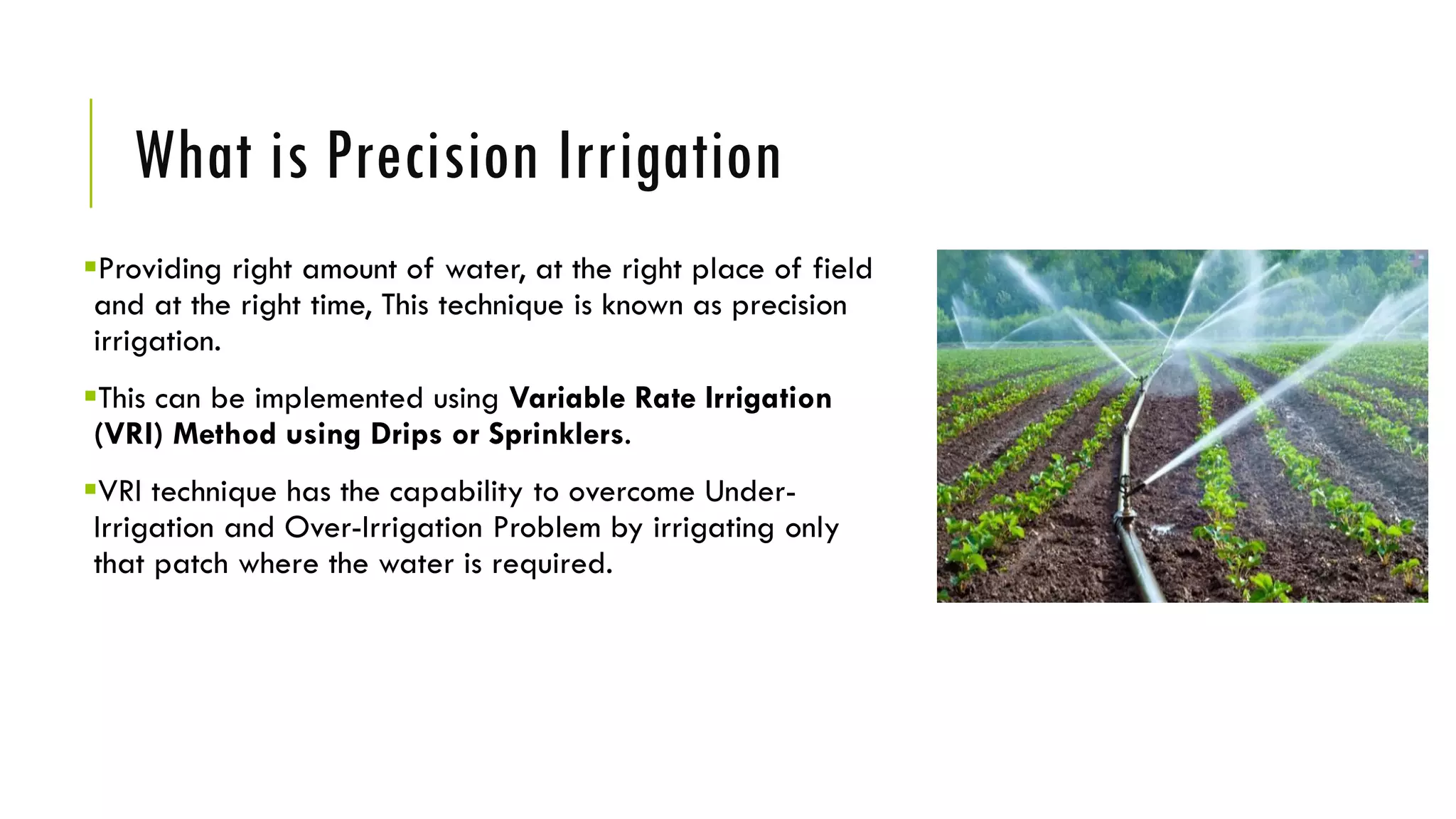
Providing right amount of water, at the right place of field
and at the right time, This technique is known as precision
irrigation.
This can be implemented using Variable Rate Irrigation
(VRI) Method using Drips or Sprinklers.
VRI technique has the capability to overcome Under-
Irrigation and Over-Irrigation Problem by irrigating only
that patch where the water is required.
What is Drip Irrigation?
Drip Irrigation is the localized application of
irrigating water to the crop. Drip irrigation systems
save a lot of water.
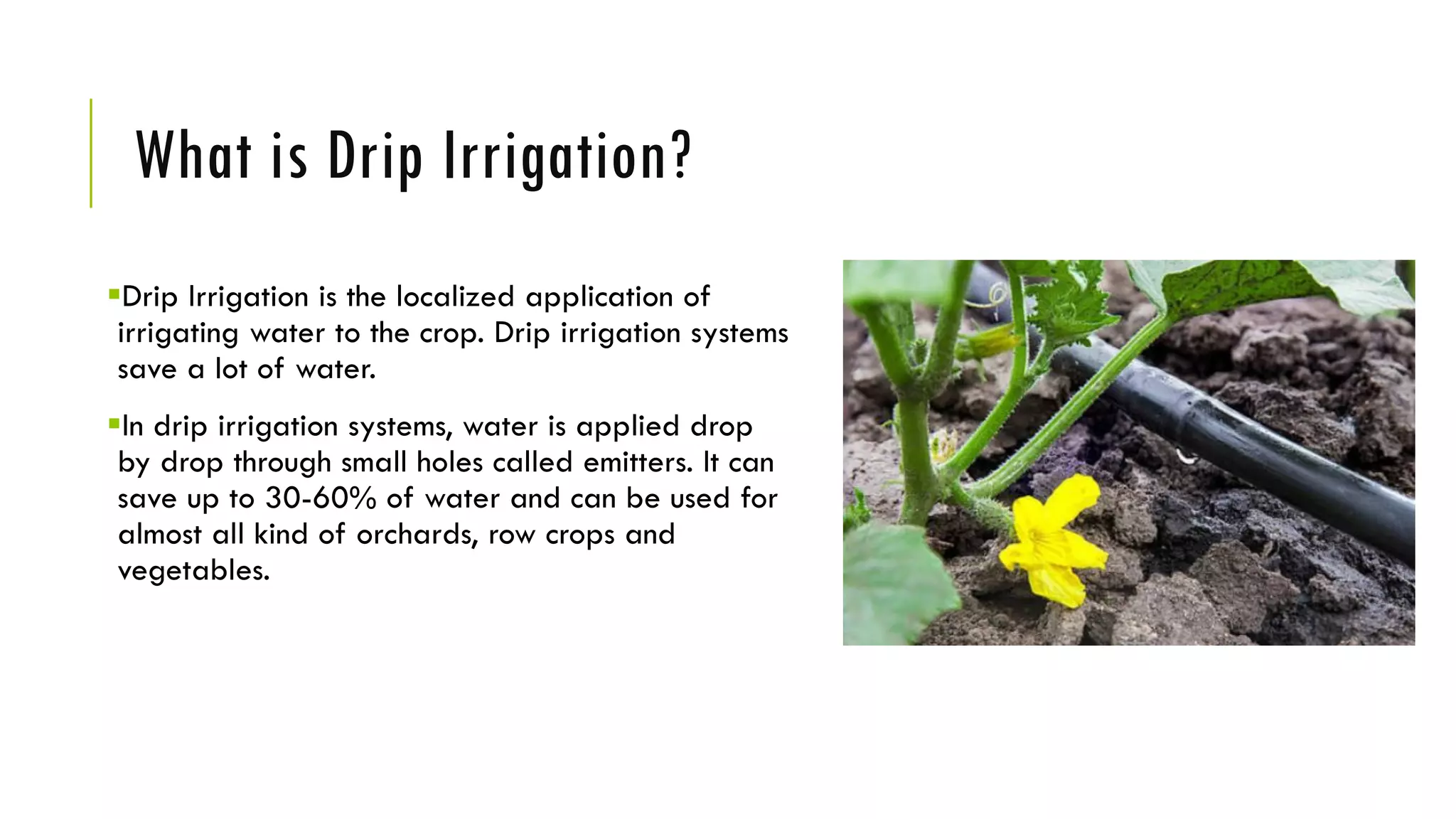
In drip irrigation systems, water is applied drop
by drop through small holes called emitters. It can
save up to 30-60% of water and can be used for
almost all kind of orchards, row crops and
vegetables.
Advantages of Drip Irrigation
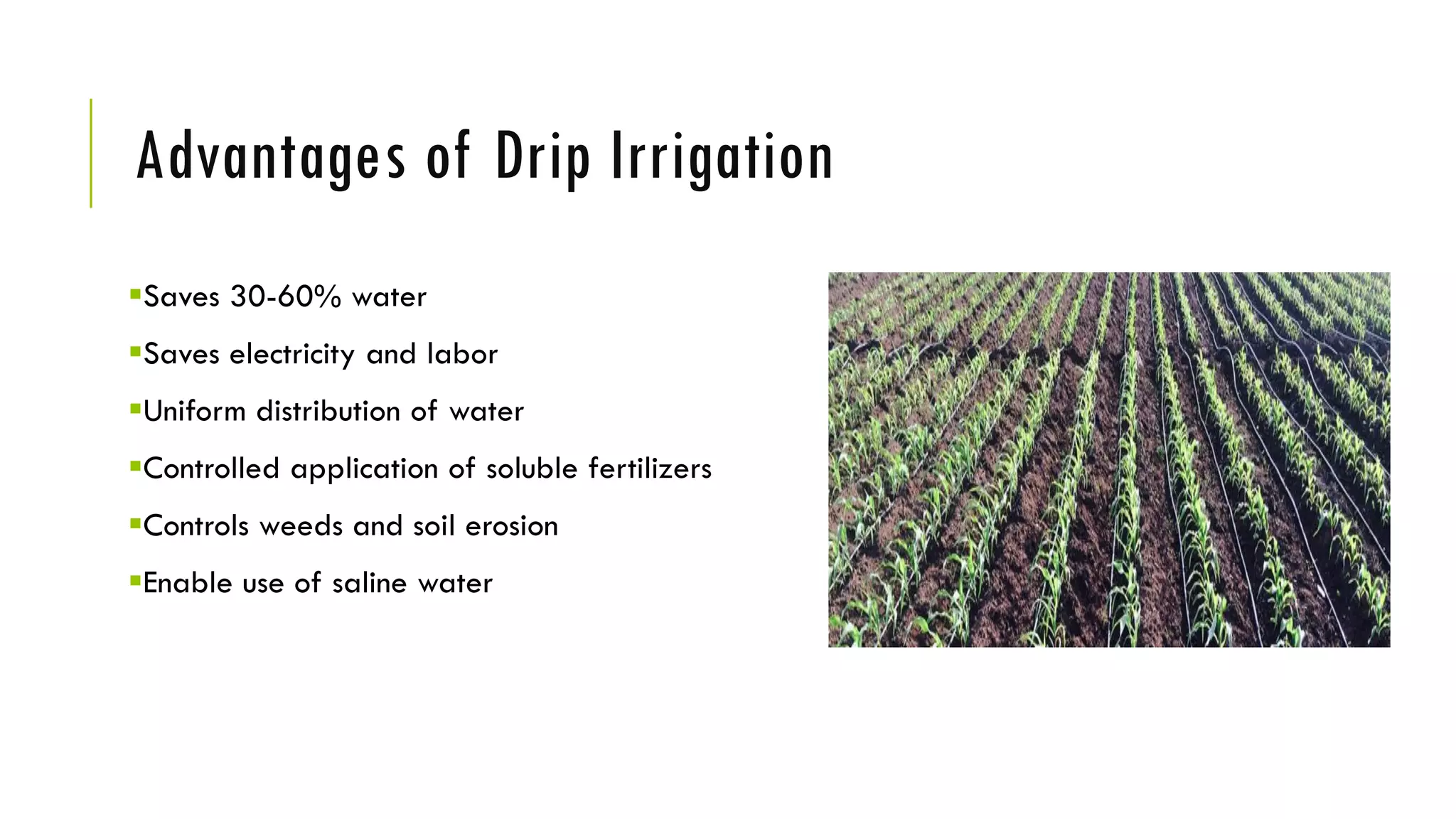
Saves 30-60% water
Saves electricity and labor
Uniform distribution of water
Controlled application of soluble fertilizers
Controls weeds and soil erosion
Enable use of saline water
Parameters of Using Drip Irrigation
Suitable crops
Drip irrigation is most suitable for row crops (vegetables, soft fruit), tree and vine
crops where one or more emitters can be provided for each plant. Generally, only
high value crops are considered for drip irrigation because of the high capital costs
of installing a drip system
Suitable slopes
Drip irrigation is adaptable to any farmable slope. Normally the crop is planted
along contour lines and the water supply pipes are laid along the contour also. This is
done to minimize changes in emitter discharge as a result of land elevation changes.
Parameters of Using Drip Irrigation
Suitable soils
Drip irrigation is suitable for most soils. On clay soils water must be applied slowly to
avoid surface water ponding and runoff. On sandy soils higher emitter discharge
rates will be needed to ensure adequate lateral wetting of the soil.
Suitable irrigation water
One of the main problems with drip irrigation is blockage of the emitters. All emitters
have very small waterways ranging from 0.2-2.0mm in diameter and these can
become blocked if the water is not clean. Thus it is essential for irrigation water to be
free of sediments.
Drip System Layout
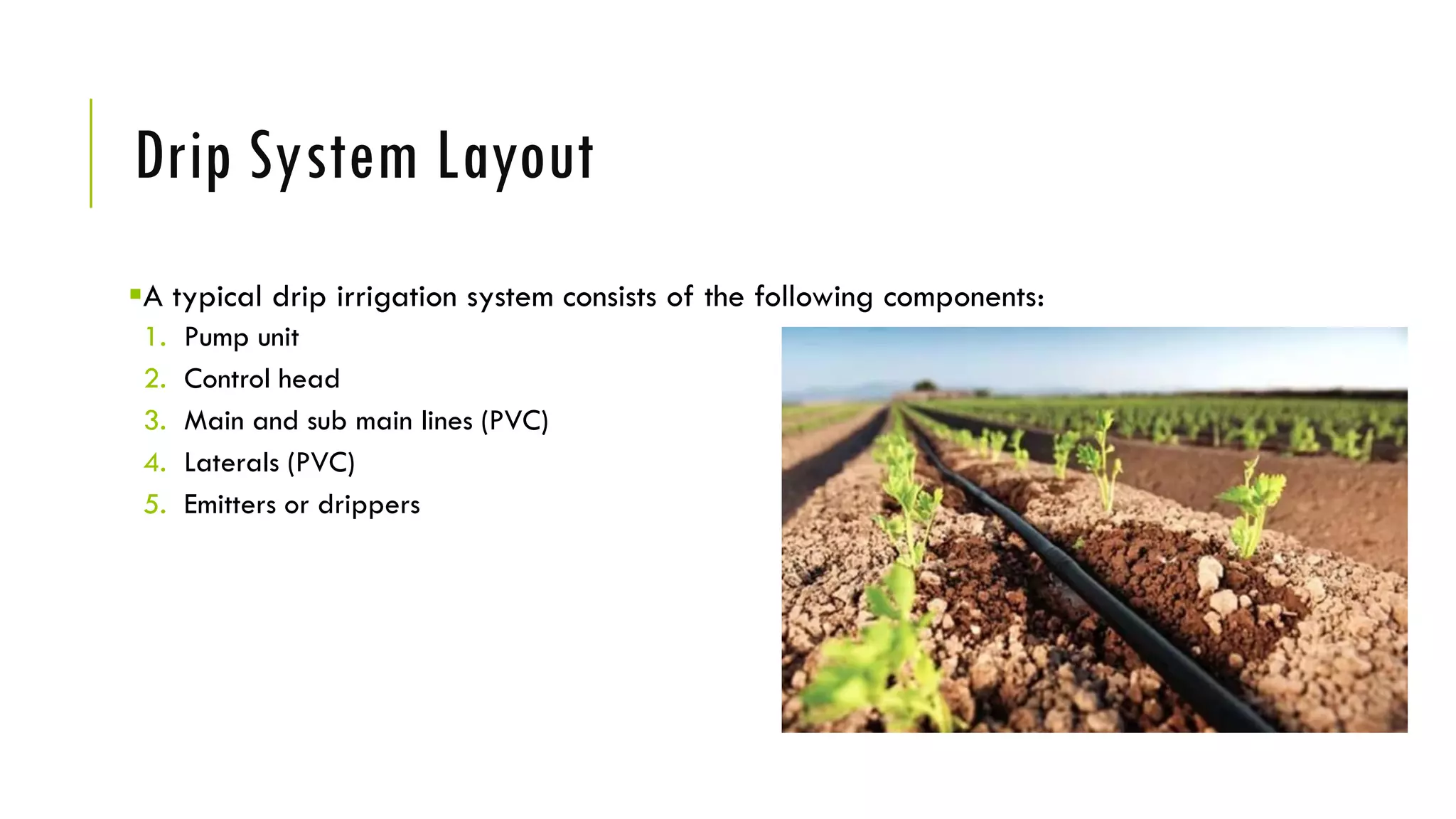
A typical drip irrigation system consists of the following components:
1. Pump unit
2. Control head
3. Main and sub main lines (PVC)
4. Laterals (PVC)
5. Emitters or drippers
Using Machine Learning Precision Irrigation
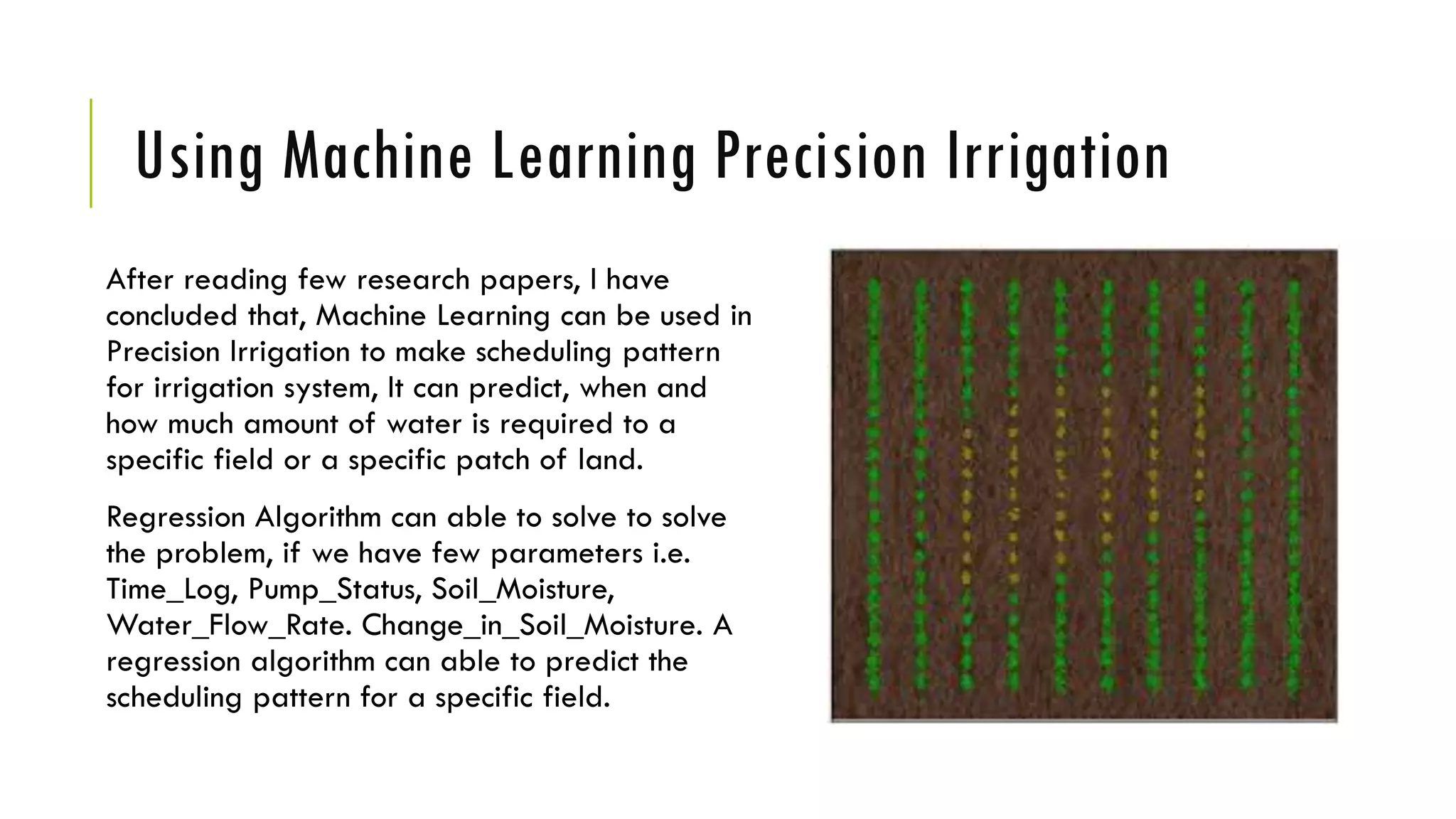
After reading few research papers, I have
concluded that, Machine Learning can be used in
Precision Irrigation to make scheduling pattern
for irrigation system, It can predict, when and
how much amount of water is required to a
specific field or a specific patch of land.
Regression Algorithm can able to solve to solve
the problem, if we have few parameters i.e.
Time_Log, Pump_Status, Soil_Moisture,
Water_Flow_Rate. Change_in_Soil_Moisture. A
regression algorithm can able to predict the
scheduling pattern for a specific field.
Using Convolutional Neural Network for
Precision Irrigation
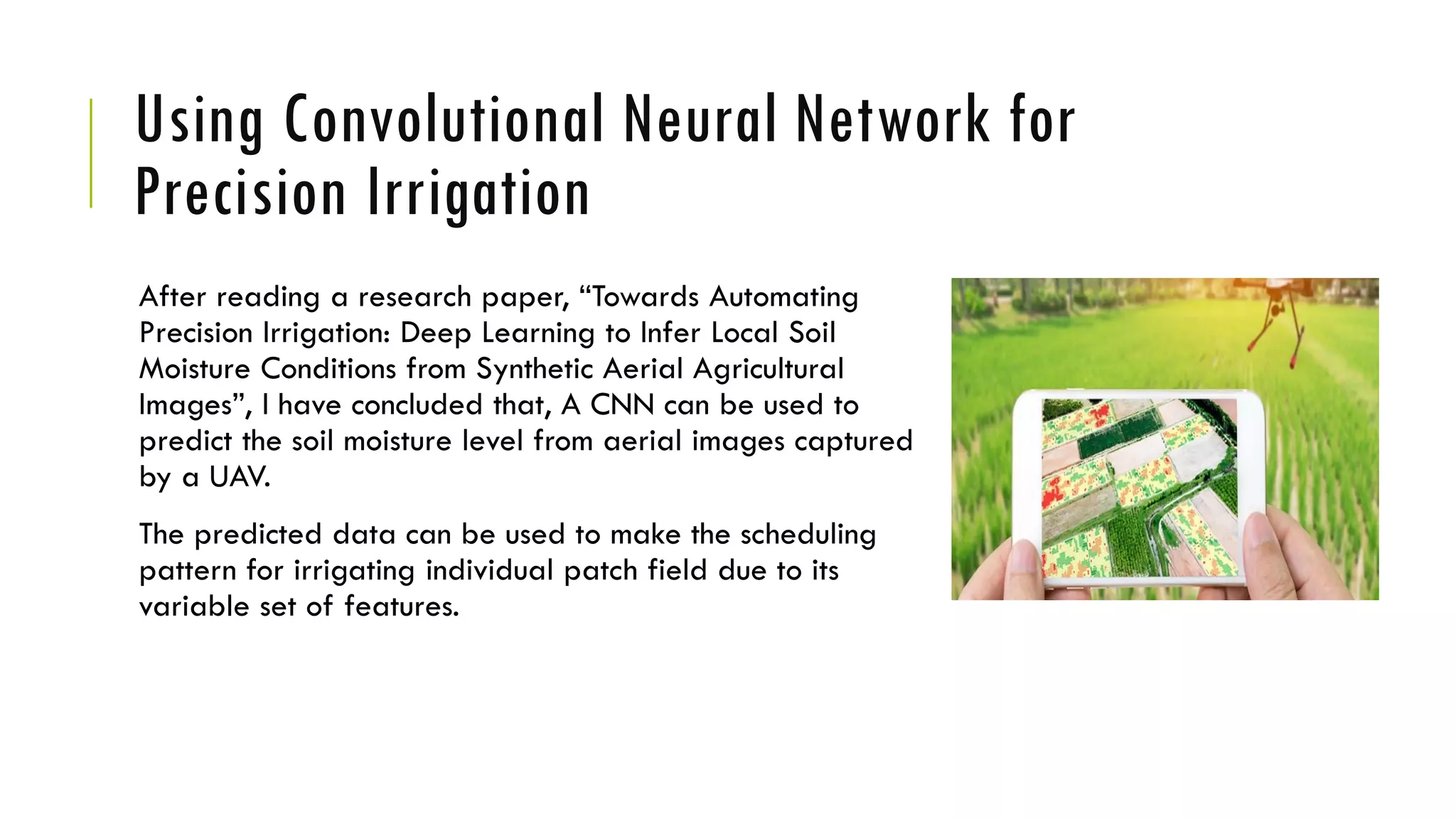
After reading a research paper, “Towards Automating
Precision Irrigation: Deep Learning to Infer Local Soil
Moisture Conditions from Synthetic Aerial Agricultural
Images”, I have concluded that, A CNN can be used to
predict the soil moisture level from aerial images captured
by a UAV.
The predicted data can be used to make the scheduling
pattern for irrigating individual patch field due to its
variable set of features.
Using Internet of Things in Precision Irrigation
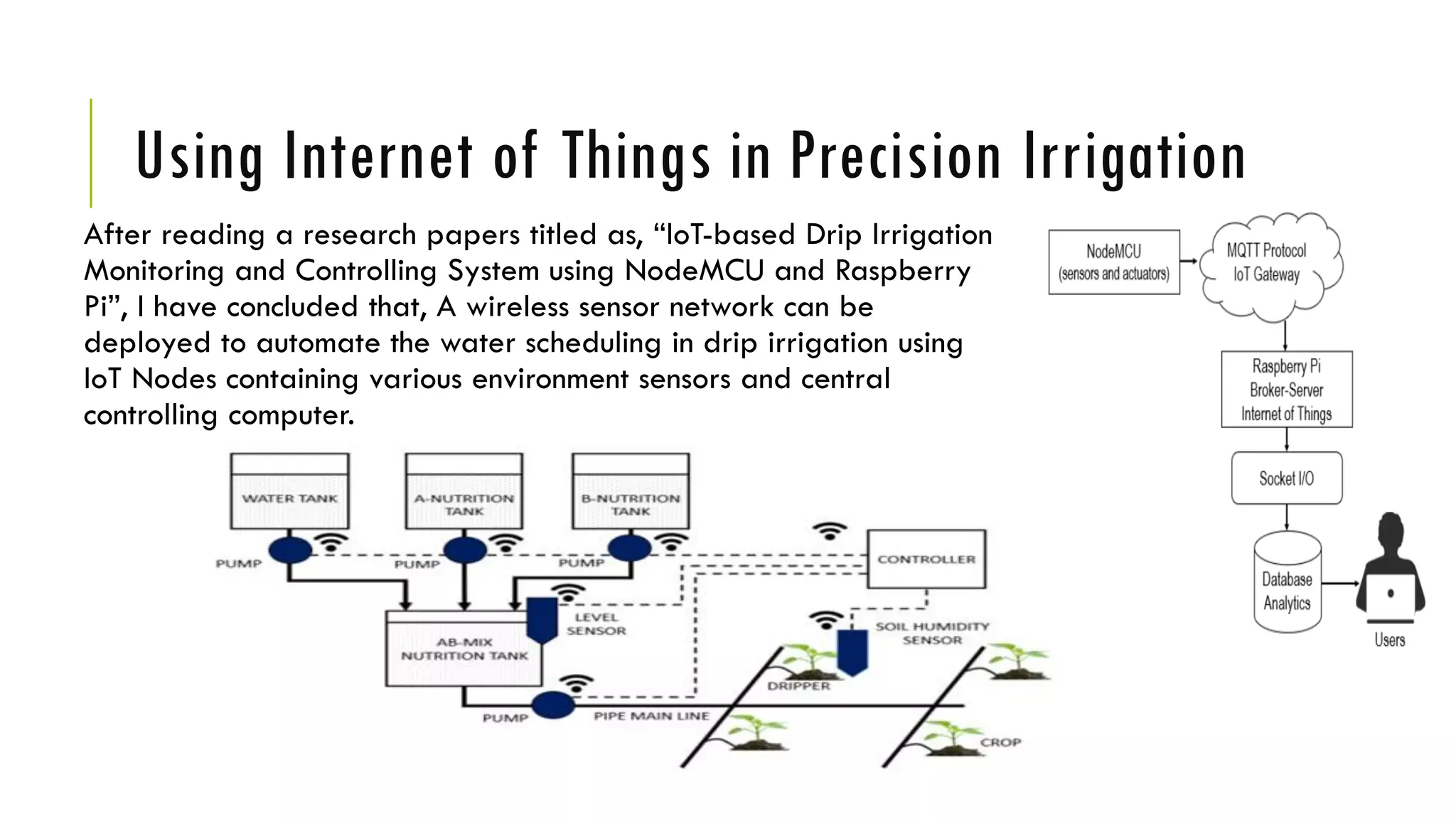
After reading a research papers titled as, “IoT-based Drip Irrigation
Monitoring and Controlling System using NodeMCU and Raspberry
Pi”, I have concluded that, A wireless sensor network can be
deployed to automate the water scheduling in drip irrigation using
IoT Nodes containing various environment sensors and central
controlling computer.
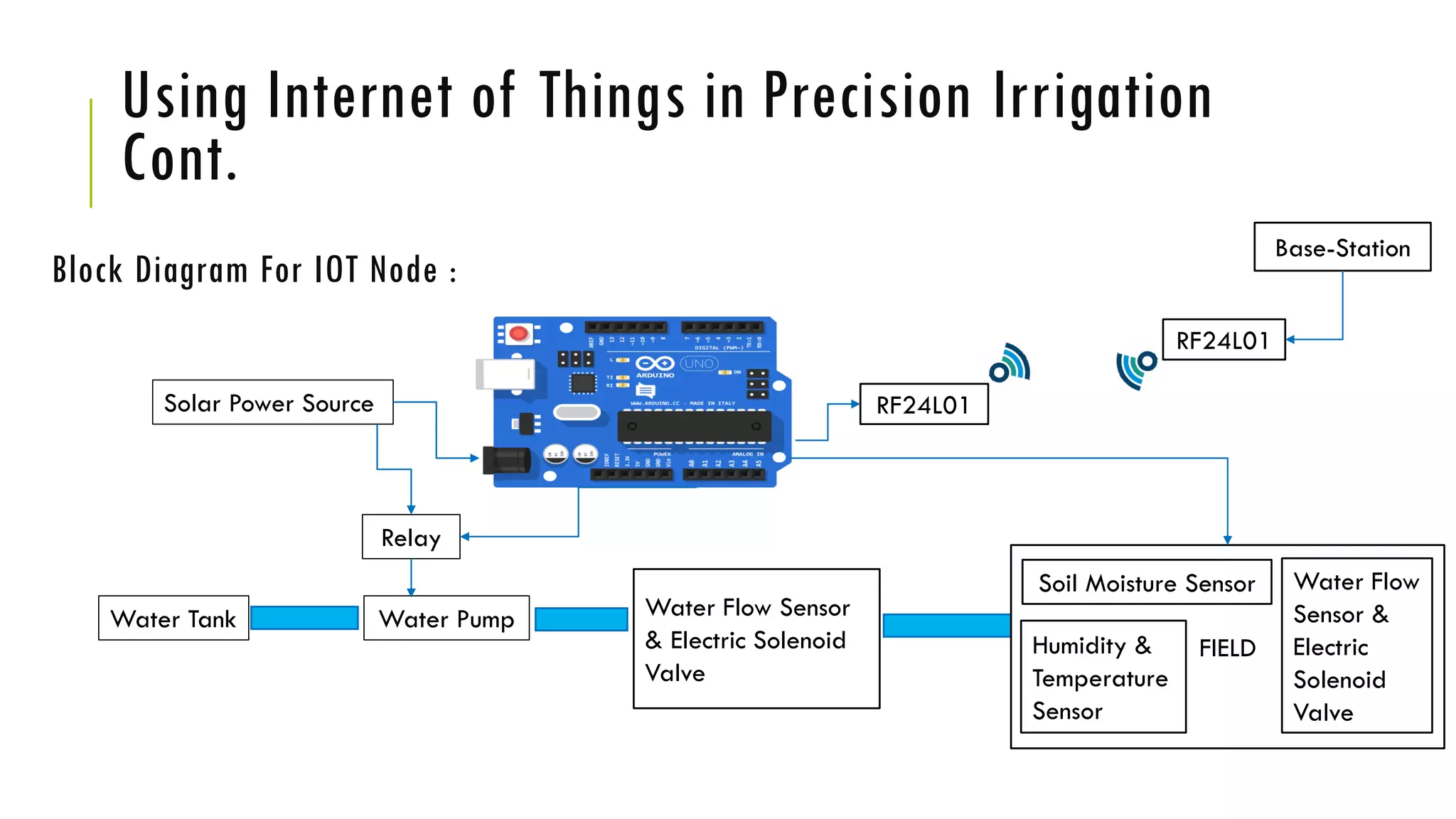
Block Diagram For IOT Node :
Solar Power Source
Relay
Water PumpWater Tank
FIELD
Soil Moisture Sensor Water Flow
Sensor &
Electric
Solenoid
Valve
Humidity &
Temperature
Sensor
RF24L01
Base-Station
RF24L01
Water Flow Sensor
& Electric Solenoid
Valve
Using Internet of Things in Precision Irrigation
Cont.
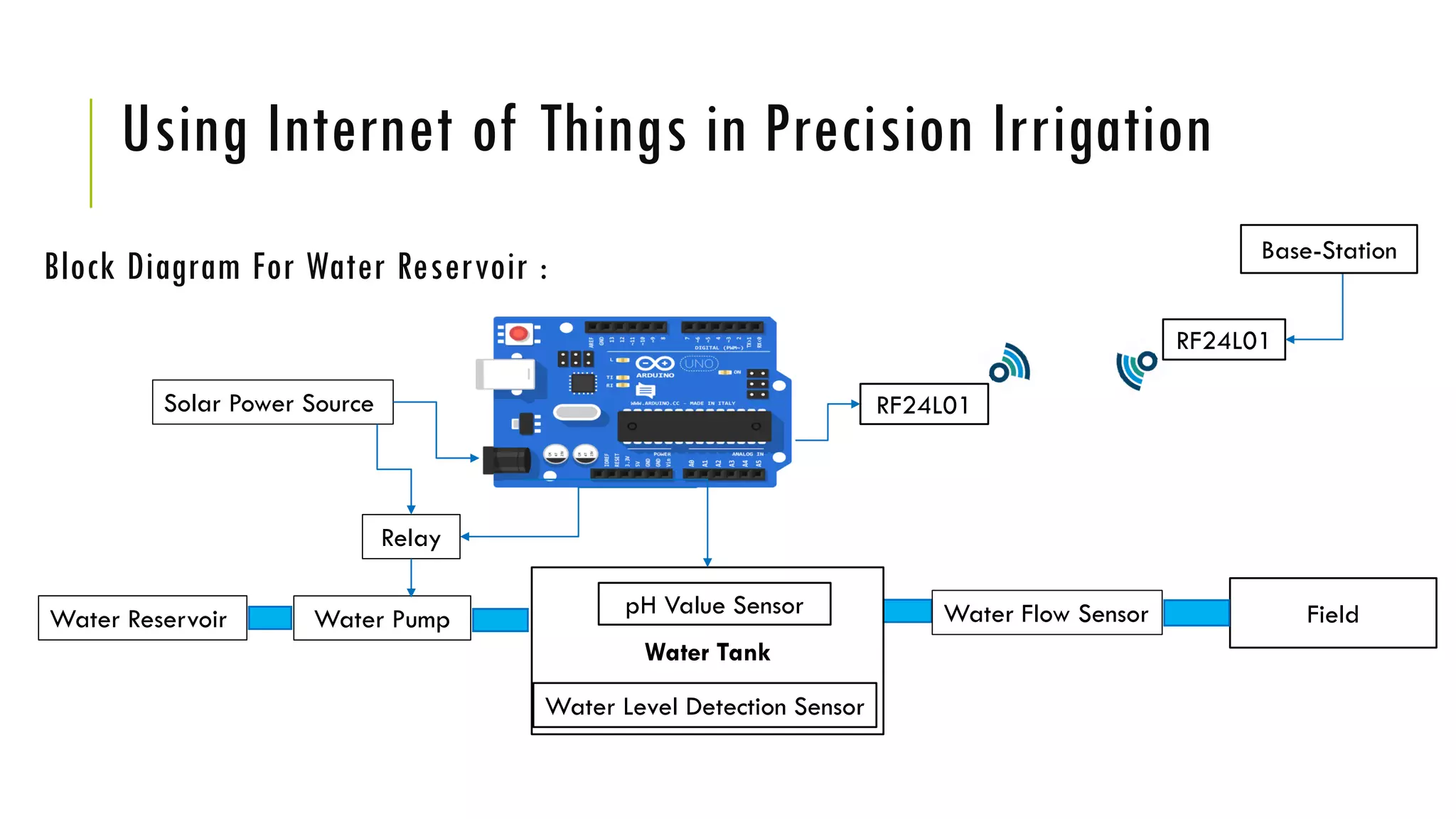
Block Diagram For Water Reservoir :
Solar Power Source
Relay
Water PumpWater Reservoir
Water Tank
Water Level Detection Sensor
Water Flow SensorpH Value Sensor Field
RF24L01
RF24L01
Base-Station
Using Internet of Things in Precision Irrigation
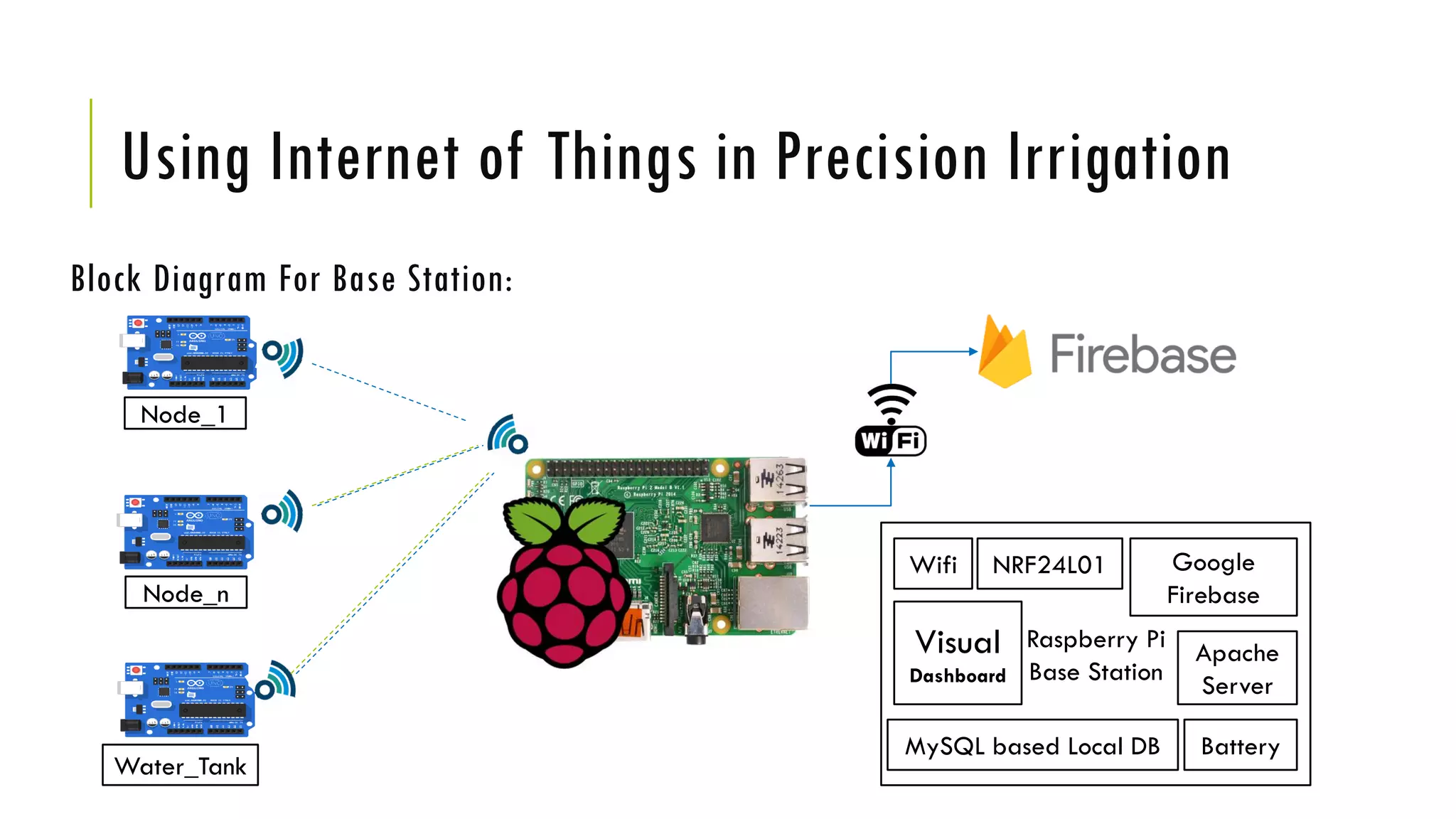
Block Diagram For Base Station:
Raspberry Pi
Base Station
MySQL based Local DB Battery
Wifi NRF24L01 Google
Firebase
Apache
Server
Visual
Dashboard
Node_1
Node_n
Water_Tank
RESEARCH PAPERS
1. Olutobi Adeyemi, Ivan Grove and Sven Peets, “Dynamic Neural Network
Modelling of Soil Moisture Content for Predictive Irrigation Scheduling”, in
Sensors, 2018
2. D. Tseng, D. Wang and C. Chen, “Towards Automating Precision Irrigation: Deep
Learning to Infer Local Soil Moisture Conditions from Synthetic Aerial Agricultural
Images”, in 14th International Conference on Automation Science and Engineering
(CASE), IEEE, 2018
3. R. Berenstein, R. Fox, S. McKinley, S. Carpin, and K. Goldberg, “Robustly adjusting
indoor drip irrigation emitters with the toyota hsr robot”, in ICRA, IEEE, 2018
4. Nyoman K. Wardana, Padma Nyoman Crisnapati and Komang Agus Ady Aryanto,
“IoT-based Drip Irrigation Monitoring and Controlling System using NodeMCU and
Raspberry Pi”, in ICST, 2018

Precision Irrigation using IoT and Machine Learning for Drip Irrigation

  • 1.
    Precision Irrigation usingIoT and Machine Learning for Drip Irrigation Muhammad Aleem Siddiqui
  • 2.
    What is PrecisionIrrigation Providing right amount of water, at the right place of field and at the right time, This technique is known as precision irrigation. This can be implemented using Variable Rate Irrigation (VRI) Method using Drips or Sprinklers. VRI technique has the capability to overcome Under- Irrigation and Over-Irrigation Problem by irrigating only that patch where the water is required.
  • 3.
    What is DripIrrigation? Drip Irrigation is the localized application of irrigating water to the crop. Drip irrigation systems save a lot of water. In drip irrigation systems, water is applied drop by drop through small holes called emitters. It can save up to 30-60% of water and can be used for almost all kind of orchards, row crops and vegetables.
  • 4.
    Advantages of DripIrrigation Saves 30-60% water Saves electricity and labor Uniform distribution of water Controlled application of soluble fertilizers Controls weeds and soil erosion Enable use of saline water
  • 5.
    Parameters of UsingDrip Irrigation Suitable crops Drip irrigation is most suitable for row crops (vegetables, soft fruit), tree and vine crops where one or more emitters can be provided for each plant. Generally, only high value crops are considered for drip irrigation because of the high capital costs of installing a drip system Suitable slopes Drip irrigation is adaptable to any farmable slope. Normally the crop is planted along contour lines and the water supply pipes are laid along the contour also. This is done to minimize changes in emitter discharge as a result of land elevation changes.
  • 6.
    Parameters of UsingDrip Irrigation Suitable soils Drip irrigation is suitable for most soils. On clay soils water must be applied slowly to avoid surface water ponding and runoff. On sandy soils higher emitter discharge rates will be needed to ensure adequate lateral wetting of the soil. Suitable irrigation water One of the main problems with drip irrigation is blockage of the emitters. All emitters have very small waterways ranging from 0.2-2.0mm in diameter and these can become blocked if the water is not clean. Thus it is essential for irrigation water to be free of sediments.
  • 7.
    Drip System Layout Atypical drip irrigation system consists of the following components: 1. Pump unit 2. Control head 3. Main and sub main lines (PVC) 4. Laterals (PVC) 5. Emitters or drippers
  • 8.
    Using Machine LearningPrecision Irrigation After reading few research papers, I have concluded that, Machine Learning can be used in Precision Irrigation to make scheduling pattern for irrigation system, It can predict, when and how much amount of water is required to a specific field or a specific patch of land. Regression Algorithm can able to solve to solve the problem, if we have few parameters i.e. Time_Log, Pump_Status, Soil_Moisture, Water_Flow_Rate. Change_in_Soil_Moisture. A regression algorithm can able to predict the scheduling pattern for a specific field.
  • 9.
    Using Convolutional NeuralNetwork for Precision Irrigation After reading a research paper, “Towards Automating Precision Irrigation: Deep Learning to Infer Local Soil Moisture Conditions from Synthetic Aerial Agricultural Images”, I have concluded that, A CNN can be used to predict the soil moisture level from aerial images captured by a UAV. The predicted data can be used to make the scheduling pattern for irrigating individual patch field due to its variable set of features.
  • 10.
    Using Internet ofThings in Precision Irrigation After reading a research papers titled as, “IoT-based Drip Irrigation Monitoring and Controlling System using NodeMCU and Raspberry Pi”, I have concluded that, A wireless sensor network can be deployed to automate the water scheduling in drip irrigation using IoT Nodes containing various environment sensors and central controlling computer.
  • 11.
    Block Diagram ForIOT Node : Solar Power Source Relay Water PumpWater Tank FIELD Soil Moisture Sensor Water Flow Sensor & Electric Solenoid Valve Humidity & Temperature Sensor RF24L01 Base-Station RF24L01 Water Flow Sensor & Electric Solenoid Valve Using Internet of Things in Precision Irrigation Cont.
  • 12.
    Block Diagram ForWater Reservoir : Solar Power Source Relay Water PumpWater Reservoir Water Tank Water Level Detection Sensor Water Flow SensorpH Value Sensor Field RF24L01 RF24L01 Base-Station Using Internet of Things in Precision Irrigation
  • 13.
    Using Internet ofThings in Precision Irrigation Block Diagram For Base Station: Raspberry Pi Base Station MySQL based Local DB Battery Wifi NRF24L01 Google Firebase Apache Server Visual Dashboard Node_1 Node_n Water_Tank
  • 14.
    RESEARCH PAPERS 1. OlutobiAdeyemi, Ivan Grove and Sven Peets, “Dynamic Neural Network Modelling of Soil Moisture Content for Predictive Irrigation Scheduling”, in Sensors, 2018 2. D. Tseng, D. Wang and C. Chen, “Towards Automating Precision Irrigation: Deep Learning to Infer Local Soil Moisture Conditions from Synthetic Aerial Agricultural Images”, in 14th International Conference on Automation Science and Engineering (CASE), IEEE, 2018 3. R. Berenstein, R. Fox, S. McKinley, S. Carpin, and K. Goldberg, “Robustly adjusting indoor drip irrigation emitters with the toyota hsr robot”, in ICRA, IEEE, 2018 4. Nyoman K. Wardana, Padma Nyoman Crisnapati and Komang Agus Ady Aryanto, “IoT-based Drip Irrigation Monitoring and Controlling System using NodeMCU and Raspberry Pi”, in ICST, 2018