
Applying Petroleum Biomarkers as a Tool for
Confirmation of Petroleum Hydrocarbons in
High Organic Content Soils
Presented at
INEF Conference
Calgary, AB
August 31, 2009
© 2015
Presentation
• This presentation was given as part of the
INEF 2009 meeting in Calgary, AB.
• Find link to book here regarding this work.
© 2015
Chemistry Matters Inc.
Problem
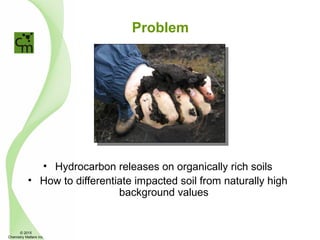
• Hydrocarbon releases on organically rich soils
• How to differentiate impacted soil from naturally high
background values
© 2015
Chemistry Matters Inc.
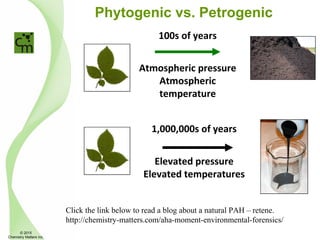
Phytogenic vs. Petrogenic
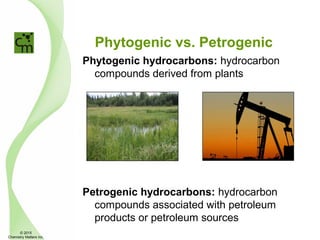
Phytogenic hydrocarbons: hydrocarbon
compounds derived from plants
Petrogenic hydrocarbons: hydrocarbon
compounds associated with petroleum
products or petroleum sources
© 2015
Chemistry Matters Inc.
1,000,000s of years
Elevated pressure
Elevated temperatures
Phytogenic vs. Petrogenic
100s of years
Atmospheric pressure
Atmospheric
temperature
Click the link below to read a blog about a natural PAH – retene.
http://chemistry-matters.com/aha-moment-environmental-forensics/
© 2015
Chemistry Matters Inc.
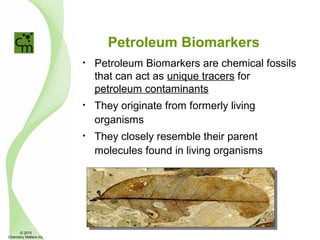
Petroleum Biomarkers
• Petroleum Biomarkers are chemical fossils
that can act as unique tracers for
petroleum contaminants
• They originate from formerly living
organisms
• They closely resemble their parent
molecules found in living organisms
© 2015
Chemistry Matters Inc.
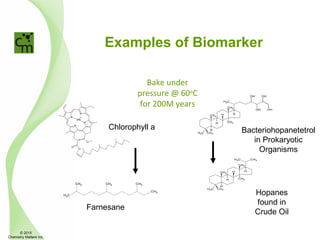
Examples of Biomarker
OH
CH3
CH3
H
CH3
HCH3
CH3 CH3
H
H
OH OH
OH
CH3CH3
CH3
H
CH3
HCH3
CH3 CH3
H
H
Bacteriohopanetetrol
in Prokaryotic
Organisms
Hopanes
found in
Crude Oil
The Biomarker Guide, Volume 1, Peters, Walters & Moldowan
Bake under
pressure @ 60o
C
for 200M years
N
N
N
N
Mg
2+
O
O
O
O
Chlorophyll a
CH3
CH3
CH3 CH3 CH3
Farnesane
© 2015
Chemistry Matters Inc.
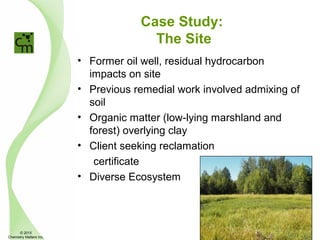
Case Study:
The Site
• Former oil well, residual hydrocarbon
impacts on site
• Previous remedial work involved admixing of
soil
• Organic matter (low-lying marshland and
forest) overlying clay
• Client seeking reclamation
certificate
• Diverse Ecosystem
© 2015
Chemistry Matters Inc.
Case Study:
Initial Assessment
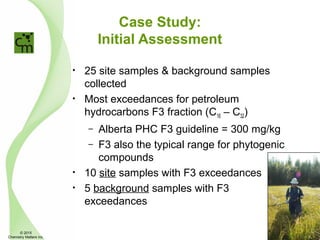
• 25 site samples & background samples
collected
• Most exceedances for petroleum
hydrocarbons F3 fraction (C16 – C32)
– Alberta PHC F3 guideline = 300 mg/kg
– F3 also the typical range for phytogenic
compounds
• 10 site samples with F3 exceedances
• 5 background samples with F3
exceedances
© 2015
Chemistry Matters Inc.
Analytical Approach
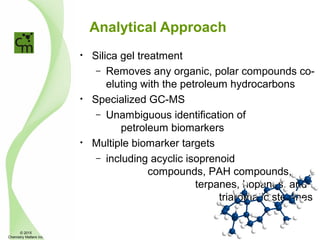
• Silica gel treatment
– Removes any organic, polar compounds co-
eluting with the petroleum hydrocarbons
• Specialized GC-MS
– Unambiguous identification of
petroleum biomarkers
• Multiple biomarker targets
– including acyclic isoprenoid
compounds, PAH compounds,
terpanes, hopanes, and
triaromatic steranes
© 2015
Chemistry Matters Inc.
Silica Gel Treatment
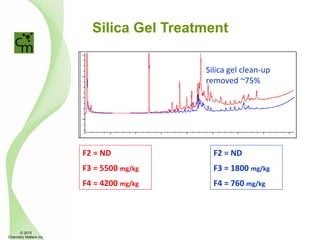
F2 = ND
F3 = 5500 mg/kg
F4 = 4200 mg/kg
F2 = ND
F3 = 1800 mg/kg
F4 = 760 mg/kg
Silica gel clean-up
removed ~75%
© 2015
Chemistry Matters Inc.
Biomarkers
in site samples
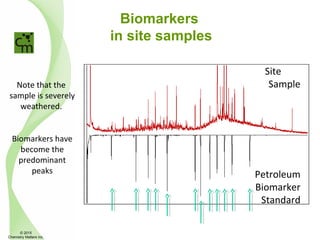
Note that the
sample is severely
weathered.
Biomarkers have
become the
predominant
peaks Petroleum
Biomarker
Standard
Site
Sample
© 2015
Chemistry Matters Inc.
Biomarker Peak
Identification
Library spectra are
available for a number
of petroleum biomarker
compounds.
In this case, the sample
showed a perfect
match!
Pristane
(2,6,10,14 – tetramethylpentadecane)
© 2015
Chemistry Matters Inc.
Results Showing F3 exceedances
Concentration(mg/kg)
Site Samples
10,000
8,000
6,000
4,000
2,000
0
Petrogenic Phytogenic
© 2015
Chemistry Matters Inc.
© 2015
Chemistry Matters Inc.
Conclusions
• Natural hydrocarbons can be present in
concentrations above guidelines
• Site specific conditions must be taken into account
when evaluating remedial targets
• Biomarker analysis can differentiate
phytogenic and petrogenic materials
• Conclusive assessment and
remediation tool
• Definitive Closure
• Cost/Time Efficient
• Everyone Wins
• Lab - “Good” science
• Consultant - sound decisions
• Client - closure and assurance
• Site - minimal disturbance in a
diverse ecosystem
© 2015
Chemistry Matters Inc.
Questions?
Contact Info:
Chemistry Matters Inc.
Court Sandau
Email: csandau@chemistry-matters.com
Twitter: @Chem_Matters
Slideshare: www.slideshare.net/csandau
Please visit our website for related information, case
studies and blogs. www.chemistry-matters.com
Got a question, post it to our website, HERE.
© 2015
Chemistry Matters Inc.

Phytogenic or Petrogenic Hydrocarbons - Using Biomarkers for Delineation

  • 1.
    Applying Petroleum Biomarkersas a Tool for Confirmation of Petroleum Hydrocarbons in High Organic Content Soils Presented at INEF Conference Calgary, AB August 31, 2009 © 2015
  • 2.
    Presentation • This presentationwas given as part of the INEF 2009 meeting in Calgary, AB. • Find link to book here regarding this work. © 2015 Chemistry Matters Inc.
  • 3.
    Problem • Hydrocarbon releaseson organically rich soils • How to differentiate impacted soil from naturally high background values © 2015 Chemistry Matters Inc.
  • 4.
    Phytogenic vs. Petrogenic Phytogenichydrocarbons: hydrocarbon compounds derived from plants Petrogenic hydrocarbons: hydrocarbon compounds associated with petroleum products or petroleum sources © 2015 Chemistry Matters Inc.
  • 5.
    1,000,000s of years Elevatedpressure Elevated temperatures Phytogenic vs. Petrogenic 100s of years Atmospheric pressure Atmospheric temperature Click the link below to read a blog about a natural PAH – retene. http://chemistry-matters.com/aha-moment-environmental-forensics/ © 2015 Chemistry Matters Inc.
  • 6.
    Petroleum Biomarkers • PetroleumBiomarkers are chemical fossils that can act as unique tracers for petroleum contaminants • They originate from formerly living organisms • They closely resemble their parent molecules found in living organisms © 2015 Chemistry Matters Inc.
  • 7.
    Examples of Biomarker OH CH3 CH3 H CH3 HCH3 CH3CH3 H H OH OH OH CH3CH3 CH3 H CH3 HCH3 CH3 CH3 H H Bacteriohopanetetrol in Prokaryotic Organisms Hopanes found in Crude Oil The Biomarker Guide, Volume 1, Peters, Walters & Moldowan Bake under pressure @ 60o C for 200M years N N N N Mg 2+ O O O O Chlorophyll a CH3 CH3 CH3 CH3 CH3 Farnesane © 2015 Chemistry Matters Inc.
  • 8.
    Case Study: The Site •Former oil well, residual hydrocarbon impacts on site • Previous remedial work involved admixing of soil • Organic matter (low-lying marshland and forest) overlying clay • Client seeking reclamation certificate • Diverse Ecosystem © 2015 Chemistry Matters Inc.
  • 9.
    Case Study: Initial Assessment •25 site samples & background samples collected • Most exceedances for petroleum hydrocarbons F3 fraction (C16 – C32) – Alberta PHC F3 guideline = 300 mg/kg – F3 also the typical range for phytogenic compounds • 10 site samples with F3 exceedances • 5 background samples with F3 exceedances © 2015 Chemistry Matters Inc.
  • 10.
    Analytical Approach • Silicagel treatment – Removes any organic, polar compounds co- eluting with the petroleum hydrocarbons • Specialized GC-MS – Unambiguous identification of petroleum biomarkers • Multiple biomarker targets – including acyclic isoprenoid compounds, PAH compounds, terpanes, hopanes, and triaromatic steranes © 2015 Chemistry Matters Inc.
  • 11.
    Silica Gel Treatment F2= ND F3 = 5500 mg/kg F4 = 4200 mg/kg F2 = ND F3 = 1800 mg/kg F4 = 760 mg/kg Silica gel clean-up removed ~75% © 2015 Chemistry Matters Inc.
  • 12.
    Biomarkers in site samples Notethat the sample is severely weathered. Biomarkers have become the predominant peaks Petroleum Biomarker Standard Site Sample © 2015 Chemistry Matters Inc.
  • 13.
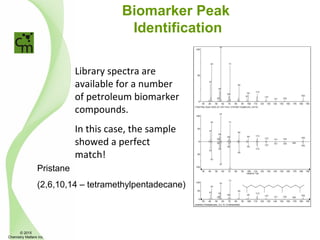
    Biomarker Peak Identification Library spectraare available for a number of petroleum biomarker compounds. In this case, the sample showed a perfect match! Pristane (2,6,10,14 – tetramethylpentadecane) © 2015 Chemistry Matters Inc.
  • 14.
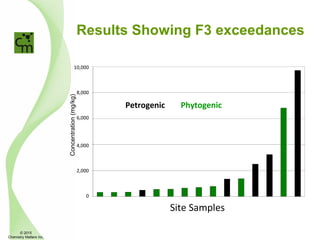
    Results Showing F3exceedances Concentration(mg/kg) Site Samples 10,000 8,000 6,000 4,000 2,000 0 Petrogenic Phytogenic © 2015 Chemistry Matters Inc.
  • 15.
  • 16.
    Conclusions • Natural hydrocarbonscan be present in concentrations above guidelines • Site specific conditions must be taken into account when evaluating remedial targets • Biomarker analysis can differentiate phytogenic and petrogenic materials • Conclusive assessment and remediation tool • Definitive Closure • Cost/Time Efficient • Everyone Wins • Lab - “Good” science • Consultant - sound decisions • Client - closure and assurance • Site - minimal disturbance in a diverse ecosystem © 2015 Chemistry Matters Inc.
  • 17.
    Questions? Contact Info: Chemistry MattersInc. Court Sandau Email: csandau@chemistry-matters.com Twitter: @Chem_Matters Slideshare: www.slideshare.net/csandau Please visit our website for related information, case studies and blogs. www.chemistry-matters.com Got a question, post it to our website, HERE. © 2015 Chemistry Matters Inc.

Editor's Notes

  • #2 Presented as part of the INEF conference held in Calgary, Alberta in 2009.
  • #4 A typical problem faced by environmental consultants is petroleum hydrocarbon releases in soil as the result of oil and gas activities. Normally these are easy to identify and characterize with routine laboratory analysis, but some organically rich soil soils pose additional challenges. These types of soils often contain high concentrations of naturally occurring phytogenic compounds that may be reported as petroleum hydrocarbons by routine analytical methods.
  • #6 Though both types of materials may have originated from organic matter, it is the conditions of their formation that determine the end product. Phytogenic – milder conditions, shorter time period Petrogenic – harsher conditions such as diagenesis & catagenesis
  • #8 Biomarkers are very resistant to weathering and degradation. Over time, the basic structures remain intact giving scientists an indication of the source material. Bacteriohopanetetrol – distinctive ring structure remains.
  • #9 Organically rich soil have the potential to interfere with the delineation of petroleum hydrocarbon impacts. Diverse ecosystem – all parties involved wanted to ensure that minimal disturbance was created and that the least possible amount of natural vegetation and habitat was removed.
  • #10 Most of our background samples were above guidelines, indicating the need for a different approach.
  • #11 Each sample showing hydrocarbon exceedances underwent additional cleanup to remove extraneous, polar compounds eluting and being included in the petroleum hydrocarbons concentrations. Polar compounds tend to obscure the petroleum hydrocarbons in chromatograms, making identification difficult and giving elevated concentrations.
  • #12 As we can see, the baseline seems to be running away and the chromatogram is very busy, showing large interferences from the numerous compounds in the sample. Difference is very apparent – shows a large contribution of polar compounds (organic matter) to the petroleum hydrocarbons chromatograms. This is an approved clean-up technique, as the treatment only removes polar components. The petroleum hydrocarbon guidelines do not apply to these polar components.
  • #13 Lab standard, shown in black, contains about twelve biomarkers (hopanes) found in crude oil. Weathered sample, shown in red, most compounds have been degraded to low levels but several persistent biomarkers remain, identifying this sample as containing petrogenic sources of hydrocarbons.
  • #14 For additional assurance, the mass-spectra from suspected biomarker peaks were compared to library spectra. Spectral match confirmed the presence of the petroleum biomarkers providing a secondary identification in addition to retention time match.
  • #15 Figure shows all 15 samples that exceeded the petroleum hydrocarbon F3 fraction guideline (300 mg/kg) Figure shows black bars (containing petroleum biomarkers) and green bars (identified as natural hydrocarbons since no petroleum biomarkers were present). The15 samples showing F3 exceedances would result in a very large excavation would be required. The area removed would extend beyond the north and south boundaries of the site, including large, naturally forested areas. Positive petroleum biomarker identification was made in these 5 samples, confirming impacted soils. The remaining 10 samples did not contain the petroleum biomarkers and were therefore considered unimpacted, thus representing natural hydrocarbons.
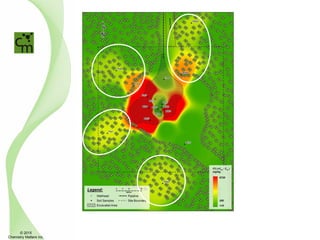
  • #16 A map of the site shows all 15 of the sample locations having the initial F3 exceedances – anything in yellow, orange or red was over guidelines. Hatched areas shows the area that was excavated. As can be expected, the five samples that showed the presence of petroleum biomarkers were all located within close proximity of the former well head. The lack of petroleum biomarkers helped the client save these circled areas (and possibly more) from being excavated.