Physiotherapy for COVID 19
Dr. Satyen Bhattacharyya (PT)
MPT,COMT,CMT, CDNP,DOMTP (Pursuing), PhD Scholar
Associate Professor: BIMLS, Bardhaman
Chief Physio: Fit O Fine
www.fitofine.in
Dr. Aurodeep Dasgupta (PT)
MPT(Cardio-thoracic Disorders), FIMT, C/DN, C/PFT
Senior Physiotherapist,
Bengal FAITH Hospital
Physiotherapy
in
COVID-19
Where it works?
• ICU
• Generalward
• Post hospitalization
• Even for nonCovid patients
to increasetheir lungcapacity
When Physiotherapist
is required
in ICU?
If ventilated patientdevelop
secretions
If patient unable toclear
airway secretion byhimself,
mainly post-extubation in
the ICU
If exudative consolidation
develops and difficulty in
clearingsecretions
If comorbidity like COPD,
cystic fibrosis, chronic
bronchitis, emphysema, ALS,
DMD present
For preventing complications
like DVT, pressure sores,
CRIMYNE
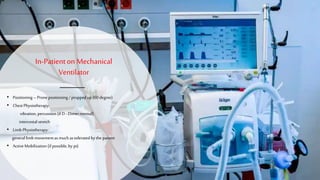
In-Patienton Mechanical
Ventilator
• Positioning – Pronepositioning / propped up (60 degree)
• ChestPhysiotherapy:
vibration, percussion(if D -Dimernormal)
intercostalstretch
• Limb Physiotherapy:
generallimb movementas muchas tolerated by the patient
• Active Mobilization (if possible, by pt)
Post Extubation in ICU
• Diaphragmatic breathing
• Pursed-Lip Breathing
• Alternate Nostril breathing
• Coughing Mechanism
• Suctioning
• Slow Deep breathing Exercise
• Postural drainage
If required
Patient not in ventilator
• Positioning prone(12 to16 hours) proppedup
• ChestPhysiotherapy
vibrationwithproperassessment
percussionwithproperassessment
slowdeepbreathing
ACBTas tolerated
Incentivespirometryas tolerated
• LimbPhysiotherapy
AROM
Bedsidesitting
Dynamicquad
Sittingonbed/chair
Bedsideambulationiftolerated
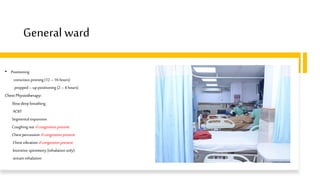
General ward
• Positioning
conscious proning(12 –16 hours)
propped – up positioning (2 – 4 hours)
ChestPhysiotherapy:
Slow deep breathing
ACBT
Segmental expansion
Coughing out ifcongestion present
Chest percussion ifcongestion present
Chest vibration ifcongestion present
Incentive spirometry (inhalation only)
stream inhalation
General ward Contd.
• Limb Physiotherapy:
AROM exercises
Isometric exercise as tolerated
Graded functional exercise
Ambulated as tolerated
For stable patient (General ward)
Diaphragmaticbreathing
Lungexpansiontechnique
Manualmobilizationtothe ribcage
Respiratorymuscle training
Incentive spirometry
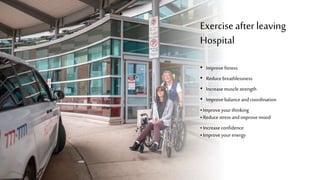
Exercise after leaving
Hospital
• Improvefitness
• Reducebreathlessness
• Increasemusclestrength
• Improvebalanceandcoordination
• Improveyourthinking
• Reducestressandimprove mood
• Increaseconfidence
• Improveyourenergy
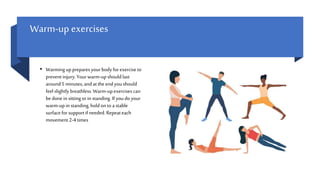
Warm-up exercises
• Warminguppreparesyourbodyforexerciseto
prevent injury.Yourwarm-upshouldlast
around5 minutes,andatthe endyoushould
feel slightly breathless.Warm-upexercisescan
bedonein sitting orin standing.If youdoyour
warm-upin standing,holdontoa stable
surfaceforsupportif needed. Repeateach
movement 2-4times
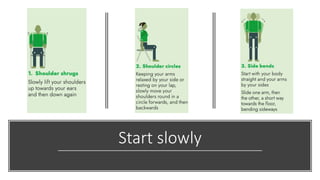
Start slowly
Follow the steps
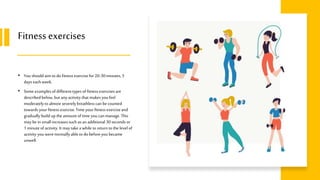
Fitness exercises
• You should aimto do fitness exercisefor 20-30minutes, 5
days eachweek.
• Some examplesof differenttypes of fitness exercisesare
describedbelow,but any activity that makesyou feel
moderatelyto almost severelybreathlesscan be counted
towards your fitness exercise.Time your fitness exerciseand
gradually build up the amount of time you canmanage.This
may be insmallincreasessuch asan additional 30seconds or
1 minute of activity. It may takea while to returnto the levelof
activity you werenormally able to do beforeyou became
unwell.
• 9. Walking
— Use a walking frame, crutches, or stick if needed — Choose a
route that is relatively flat
• Progressing this exercise:
— Increasing the speed or distance you walk, or if accessible
- include walkinguphill in your route
When you might choose this exercise: — If you can get outdoors to
exercise
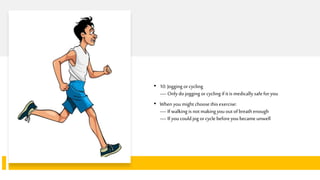
• 10.Jogging orcycling
—Onlydojogging or cycling if itis medicallysafeforyou
• Whenyoumight choosethisexercise:
—Ifwalking is notmakingyououtofbreathenough
—Ifyoucould jog orcycle beforeyoubecame unwell
Strengtheningexercises
• Strengtheningexerciseswillhelpimprovemusclesthathavebecomeweakeras a resultofyour
illness.Youshouldaim todothreesessionsofstrengtheningexerciseeachweek.Strengthening
exerciseswillnotmakeyoufeelbreathlessinthesamewayas fitnessexercises.Instead,your
muscleswillfeelliketheyhaveworkedhard.
• Youshouldaim tocompleteupto3 setsof10repetitionsofeachexercise,takinga shortrestin
betweeneachset.Donotworryifyoufindtheseexerciseshard.Ifyoudo,start witha smaller
numberofrepetitionsineachsetandbuilduptoachievingsetsof10. Asyougetbetterwiththe
exercises,useheavierweightstomakeyourmusclesworkharder.Youcanusetinsoffoodor
bottlesofwateras weights.
• Somestrengtheningexercisesforyourarmsandlegsaredescribedbelow,whichcanbedonein
sittingorstanding.Thesecan bedoneinanyorder.Keepa goodposture,withyourbackstraight
andyourtummytuckedin,andcompletetheexercisesslowly.
• Remembertobreatheinas youpreparetodothehardestpartoftheexerciseandbreatheoutas
youmake theeffort.
Examples of
strengthening
exercises for your
ARMS
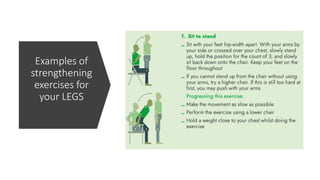
Examples of
strengthening
exercises for
your LEGS
Endurance exercises (when tolerated)
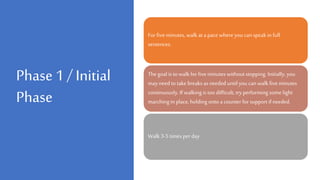
Phase 1 / Initial
Phase
For fiveminutes, walk at a pace where you can speak in full
sentences.
The goal is to walk for fiveminutes without stopping. Initially, you
may need to take breaks as needed until you can walk five minutes
continuously. If walkingis too difficult, try performing some light
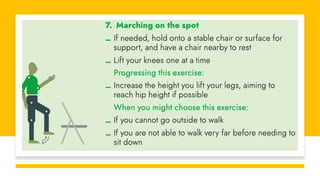
marching in place, holding onto a counter for support if needed.
Walk 3-5 times per day
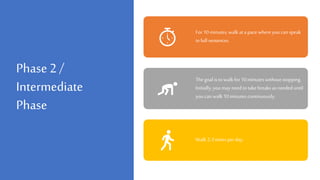
Phase 2 /
Intermediate
Phase
For10 minutes,walkat a pacewhereyoucan speak
infull sentences.
Thegoal isto walkfor 10minuteswithoutstopping.
Initially,youmayneed totakebreaks as needed until
youcan walk10minutescontinuously.
Walk2-3timesper day.
Phase 3 / Final
Phase
Endurance Activities
For 30-45 minutes, walkat a pace where you can speak in full sentences.
The goal is to walkat least 30 minutes without stopping. Initially, you may need to
take breaks as needed until you can walkat least 30 minutes continuously.
Start by walking on flat surfaces. As you progress and gainendurance, try
challenging yourself by walking on hills and inclines.
Walk five times per week.
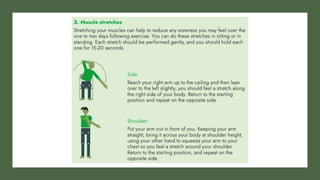
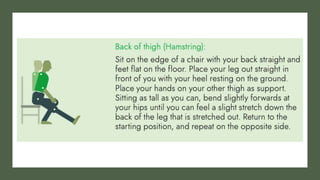
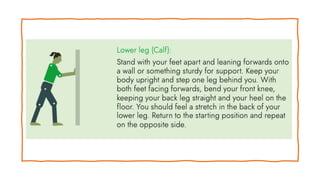
Cool down
exercises
• Cool down exercises allow yourbody to return to normal beforestopping exercise. Yourcool
down should last approximately 5 minutes,and your breathing should be back to normalby
the end. Tryworkingthroughall these suggestions, but if youcannotmanage all the
exercises orstretches, do the ones that youcan.
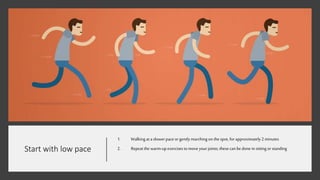
Start with low pace
1. Walkingat a slowerpace or gently marchingon thespot, for approximately2minutes
2. Repeatthe warm-upexercisesto move your joints; thesecan be done insitting or standing
References
• https://www.youtube.com/watch?v=QmrZkV4AOMM
• PostCovid-19physiotherapyadviceandexercise programmebyNHS
• SupportforRehabilitationSelf-ManagementafterCOVID-19-RelatedIllness byWHO
• PHYSIOTHERAPYMANAGEMENTFOR COVID-19IN THE PRIMARY,COMMUNITY ANDACUTE (HOSPITAL) SETTINGS
GPA PreliminaryGuideline forCOVID-19.Version 1.0April 23, 2020.
• COVID-19ProningforSelfcarebyMinistryofHealth & Family WelfareGovernment ofIndia

Physiotherapy for COVID 19

  • 1.
    Physiotherapy for COVID19 Dr. Satyen Bhattacharyya (PT) MPT,COMT,CMT, CDNP,DOMTP (Pursuing), PhD Scholar Associate Professor: BIMLS, Bardhaman Chief Physio: Fit O Fine www.fitofine.in Dr. Aurodeep Dasgupta (PT) MPT(Cardio-thoracic Disorders), FIMT, C/DN, C/PFT Senior Physiotherapist, Bengal FAITH Hospital
  • 2.
    Physiotherapy in COVID-19 Where it works? •ICU • Generalward • Post hospitalization • Even for nonCovid patients to increasetheir lungcapacity
  • 3.
    When Physiotherapist is required inICU? If ventilated patientdevelop secretions If patient unable toclear airway secretion byhimself, mainly post-extubation in the ICU If exudative consolidation develops and difficulty in clearingsecretions If comorbidity like COPD, cystic fibrosis, chronic bronchitis, emphysema, ALS, DMD present For preventing complications like DVT, pressure sores, CRIMYNE
  • 4.
    In-Patienton Mechanical Ventilator • Positioning– Pronepositioning / propped up (60 degree) • ChestPhysiotherapy: vibration, percussion(if D -Dimernormal) intercostalstretch • Limb Physiotherapy: generallimb movementas muchas tolerated by the patient • Active Mobilization (if possible, by pt)
  • 5.
    Post Extubation inICU • Diaphragmatic breathing • Pursed-Lip Breathing • Alternate Nostril breathing • Coughing Mechanism • Suctioning • Slow Deep breathing Exercise • Postural drainage If required
  • 6.
    Patient not inventilator • Positioning prone(12 to16 hours) proppedup • ChestPhysiotherapy vibrationwithproperassessment percussionwithproperassessment slowdeepbreathing ACBTas tolerated Incentivespirometryas tolerated • LimbPhysiotherapy AROM Bedsidesitting Dynamicquad Sittingonbed/chair Bedsideambulationiftolerated
  • 7.
    General ward • Positioning consciousproning(12 –16 hours) propped – up positioning (2 – 4 hours) ChestPhysiotherapy: Slow deep breathing ACBT Segmental expansion Coughing out ifcongestion present Chest percussion ifcongestion present Chest vibration ifcongestion present Incentive spirometry (inhalation only) stream inhalation
  • 8.
    General ward Contd. •Limb Physiotherapy: AROM exercises Isometric exercise as tolerated Graded functional exercise Ambulated as tolerated
  • 9.
    For stable patient(General ward) Diaphragmaticbreathing Lungexpansiontechnique Manualmobilizationtothe ribcage Respiratorymuscle training Incentive spirometry
  • 10.
    Exercise after leaving Hospital •Improvefitness • Reducebreathlessness • Increasemusclestrength • Improvebalanceandcoordination • Improveyourthinking • Reducestressandimprove mood • Increaseconfidence • Improveyourenergy
  • 11.
    Warm-up exercises • Warminguppreparesyourbodyforexerciseto preventinjury.Yourwarm-upshouldlast around5 minutes,andatthe endyoushould feel slightly breathless.Warm-upexercisescan bedonein sitting orin standing.If youdoyour warm-upin standing,holdontoa stable surfaceforsupportif needed. Repeateach movement 2-4times
  • 12.
  • 13.
  • 14.
    Fitness exercises • Youshould aimto do fitness exercisefor 20-30minutes, 5 days eachweek. • Some examplesof differenttypes of fitness exercisesare describedbelow,but any activity that makesyou feel moderatelyto almost severelybreathlesscan be counted towards your fitness exercise.Time your fitness exerciseand gradually build up the amount of time you canmanage.This may be insmallincreasessuch asan additional 30seconds or 1 minute of activity. It may takea while to returnto the levelof activity you werenormally able to do beforeyou became unwell.
  • 17.
    • 9. Walking —Use a walking frame, crutches, or stick if needed — Choose a route that is relatively flat • Progressing this exercise: — Increasing the speed or distance you walk, or if accessible - include walkinguphill in your route When you might choose this exercise: — If you can get outdoors to exercise
  • 18.
    • 10.Jogging orcycling —Onlydojoggingor cycling if itis medicallysafeforyou • Whenyoumight choosethisexercise: —Ifwalking is notmakingyououtofbreathenough —Ifyoucould jog orcycle beforeyoubecame unwell
  • 19.
    Strengtheningexercises • Strengtheningexerciseswillhelpimprovemusclesthathavebecomeweakeras aresultofyour illness.Youshouldaim todothreesessionsofstrengtheningexerciseeachweek.Strengthening exerciseswillnotmakeyoufeelbreathlessinthesamewayas fitnessexercises.Instead,your muscleswillfeelliketheyhaveworkedhard. • Youshouldaim tocompleteupto3 setsof10repetitionsofeachexercise,takinga shortrestin betweeneachset.Donotworryifyoufindtheseexerciseshard.Ifyoudo,start witha smaller numberofrepetitionsineachsetandbuilduptoachievingsetsof10. Asyougetbetterwiththe exercises,useheavierweightstomakeyourmusclesworkharder.Youcanusetinsoffoodor bottlesofwateras weights. • Somestrengtheningexercisesforyourarmsandlegsaredescribedbelow,whichcanbedonein sittingorstanding.Thesecan bedoneinanyorder.Keepa goodposture,withyourbackstraight andyourtummytuckedin,andcompletetheexercisesslowly. • Remembertobreatheinas youpreparetodothehardestpartoftheexerciseandbreatheoutas youmake theeffort.
  • 20.
  • 23.
  • 27.
  • 28.
    Phase 1 /Initial Phase For fiveminutes, walk at a pace where you can speak in full sentences. The goal is to walk for fiveminutes without stopping. Initially, you may need to take breaks as needed until you can walk five minutes continuously. If walkingis too difficult, try performing some light marching in place, holding onto a counter for support if needed. Walk 3-5 times per day
  • 29.
    Phase 2 / Intermediate Phase For10minutes,walkat a pacewhereyoucan speak infull sentences. Thegoal isto walkfor 10minuteswithoutstopping. Initially,youmayneed totakebreaks as needed until youcan walk10minutescontinuously. Walk2-3timesper day.
  • 30.
    Phase 3 /Final Phase Endurance Activities For 30-45 minutes, walkat a pace where you can speak in full sentences. The goal is to walkat least 30 minutes without stopping. Initially, you may need to take breaks as needed until you can walkat least 30 minutes continuously. Start by walking on flat surfaces. As you progress and gainendurance, try challenging yourself by walking on hills and inclines. Walk five times per week.
  • 31.
    Cool down exercises • Cooldown exercises allow yourbody to return to normal beforestopping exercise. Yourcool down should last approximately 5 minutes,and your breathing should be back to normalby the end. Tryworkingthroughall these suggestions, but if youcannotmanage all the exercises orstretches, do the ones that youcan.
  • 32.
    Start with lowpace 1. Walkingat a slowerpace or gently marchingon thespot, for approximately2minutes 2. Repeatthe warm-upexercisesto move your joints; thesecan be done insitting or standing
  • 37.
    References • https://www.youtube.com/watch?v=QmrZkV4AOMM • PostCovid-19physiotherapyadviceandexerciseprogrammebyNHS • SupportforRehabilitationSelf-ManagementafterCOVID-19-RelatedIllness byWHO • PHYSIOTHERAPYMANAGEMENTFOR COVID-19IN THE PRIMARY,COMMUNITY ANDACUTE (HOSPITAL) SETTINGS GPA PreliminaryGuideline forCOVID-19.Version 1.0April 23, 2020. • COVID-19ProningforSelfcarebyMinistryofHealth & Family WelfareGovernment ofIndia