TYPES OF
MOTIVATION
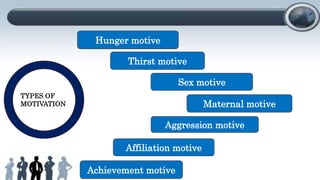
TYPES OF
MOTIVATION
Hunger motive
Thirst motive
Sex motive
Maternal motive
Aggression motive
Affiliation motive
Achievement motive
Hunger motivation in psychology is the motivation or
drive that causes the feeling of hunger, whether it is
an internal physiological or external process(hunger
hormone_Ghrelin).
Opposite of hunger-Satiety
Basic biological drive necessary for survival
Influenced by cultural and psychological factors
Nature VS nuture interacting with motivation
Hunger motive
The thirst drive and motivation to seek/consume water
are vital aspects of the homeostatic regulation of total
body water volume and tonicity, in response to
intracellular dehydration, increased plasma osmolality,
decreased plasma volume, decreased blood pressure, and
extracellular hypovolemia.
Thirst motive
Thirst is the motivation to find and consume water
Moniter the level of fluids inside the cells
When levels drop thirst drive is activated
Sex motive
Sexual motivation is the human desire to partake in sexual
activities and the interest in sexual objects
The two sex hormones are estrogen and testosterone.
Human sexual motivation dependent on experience and
learning than on biology.
There are many reasons why people have sex,
External stimuli
Imagined stimuli
Maternal motive
Maternal drive or maternal instinct refers to the
motivation of animals and humans to take care of
their offspring and sometimes, even others' as well.
This is manifested as nesting, feeding, and defending
babies.
Maternal sensitivity is a very specific include the
elements of appropriateness, timeliness, and the quality
of resposes.
Aggression motive
The goal of aggression is to harm someone who doesn't want
to be harmed. The motivation behind this varies from
person to person. Someone may act aggressively as a
response to pain or fear, while someone else may use
aggression to achieve another goal, like taking another
person's money or property.
It is not a motive e.g. revenge.
It is not a negative attitude e.g. ethnic or social prejudice.
It is intended not an accident.
It is not an emotion e.g. anger.
Affiliation motive
Affiliative motivation is defined as a concern over
establishing, maintaining, or restoring a positive
affective relationship with another person or group of
persons (Heyns, Veroff, & Atkinson, 1958).
For example, consider a situation in which your
employer tasks your team with improving your
company's social media presence.
Affiliation motive _ The need to be with others
(friends, family ,spouse, etc.)
This motive is aroused when people feel threatened,
anxious, celebratory.
Achievement motive
An achievement motive is an impulse to master challenges
and reach a high standard of excellence. Both personality
and situational factors influence achievement motivation.
Researchers often use the Thematic Apperception Test(TAT)
to measure people's need for achievement.
Example _ entrepreneur.
They avoid the task with moderate difficulty because they
are afraid that they might fail at something in which
someone else completed successfully.
THANK YOU ALL
THANK YOU ALL

Physiological and psychological motivation

  • 1.
  • 2.
    TYPES OF MOTIVATION Hunger motive Thirstmotive Sex motive Maternal motive Aggression motive Affiliation motive Achievement motive
  • 3.
    Hunger motivation inpsychology is the motivation or drive that causes the feeling of hunger, whether it is an internal physiological or external process(hunger hormone_Ghrelin). Opposite of hunger-Satiety Basic biological drive necessary for survival Influenced by cultural and psychological factors Nature VS nuture interacting with motivation Hunger motive
  • 4.
    The thirst driveand motivation to seek/consume water are vital aspects of the homeostatic regulation of total body water volume and tonicity, in response to intracellular dehydration, increased plasma osmolality, decreased plasma volume, decreased blood pressure, and extracellular hypovolemia. Thirst motive Thirst is the motivation to find and consume water Moniter the level of fluids inside the cells When levels drop thirst drive is activated
  • 5.
    Sex motive Sexual motivationis the human desire to partake in sexual activities and the interest in sexual objects The two sex hormones are estrogen and testosterone. Human sexual motivation dependent on experience and learning than on biology. There are many reasons why people have sex, External stimuli Imagined stimuli
  • 6.
    Maternal motive Maternal driveor maternal instinct refers to the motivation of animals and humans to take care of their offspring and sometimes, even others' as well. This is manifested as nesting, feeding, and defending babies. Maternal sensitivity is a very specific include the elements of appropriateness, timeliness, and the quality of resposes.
  • 7.
    Aggression motive The goalof aggression is to harm someone who doesn't want to be harmed. The motivation behind this varies from person to person. Someone may act aggressively as a response to pain or fear, while someone else may use aggression to achieve another goal, like taking another person's money or property. It is not a motive e.g. revenge. It is not a negative attitude e.g. ethnic or social prejudice. It is intended not an accident. It is not an emotion e.g. anger.
  • 8.
    Affiliation motive Affiliative motivationis defined as a concern over establishing, maintaining, or restoring a positive affective relationship with another person or group of persons (Heyns, Veroff, & Atkinson, 1958). For example, consider a situation in which your employer tasks your team with improving your company's social media presence. Affiliation motive _ The need to be with others (friends, family ,spouse, etc.) This motive is aroused when people feel threatened, anxious, celebratory.
  • 9.
    Achievement motive An achievementmotive is an impulse to master challenges and reach a high standard of excellence. Both personality and situational factors influence achievement motivation. Researchers often use the Thematic Apperception Test(TAT) to measure people's need for achievement. Example _ entrepreneur. They avoid the task with moderate difficulty because they are afraid that they might fail at something in which someone else completed successfully.
  • 10.