1
ALL INDIA SENIOR SCHOOL CERTIFICATE EXAMINATION
(A.I.S.S.C.E)
P.M.S PUBLIC SCHOOL
MORADABAD
SESSION- 2021-22
PHYSICS
PROJECT ON
FIRE ALARM
SUBMITTED TO C.B.S.E
SUPERVISED BY: SUMITTED BY:
MR. SPARSHVERMA KARTIK KHANNA
H.O.D PHYSICS XII-A
2
CERTIFICATE
It is certify that Kartik Khanna of class XII-A (Science) of P.M.S
Public School, M.B.D has completed this project work under my
guideline in the given time as per the norms of CBSE. This report is
genuine and correct as per my knowledge.
Mr. Sparsh Verma Mr. Mathew Paul Alancheril
H.O.D Physics (Principal)
3
ACKNOWLEDGEMENT
It gives me immense pleasure to express my gratitude to my physics
teacher MR. SPARSH VERMA for his guidance, support and
encouragement throughout the duration of the project.
Without the motivation and help, the successful completion of this
project would not have been possible.
Kartik Khanna
XII-A
4
INDEX
 Certificate
 Acknowledgement
 Introduction
 Aim of project
 Introduction
 Theory
 Apparatus required
 Working
 Observation
 Conclusion
 Precautions
 Bibliography
5
INTRODUCTION
An automatic fire alarm system is designed to detect the unwanted
presence of fire by monitoring environmental changes associated with
combustion. In general, a fire alarm system is either classified as
automatic, manually activated, or both. Automatic fire alarm systems
can be used to notify people to evacuate in the event of a fire or other
emergency, to summon emergency services, and to prepare the
structure and associated systems to control the spread of fire and
smoke. Fire alarm systems have become increasingly sophisticated
and functionally more capable and reliable in recent years. They are
designed to fulfill two general requirements: protection of property
and assets and protection of life. As a result of state and local codes,
the life-safety aspect of fire protection has become a major factor in
the last two decades. There are a number of reasons for the substantial
increases in the life-safety form of fire protection during recent years,
foremost of which are:
1. The proliferation of high-rise construction and the concern for life
safety within these buildings.
6
2. A growing awareness of the life-safety hazard in residential,
institutional, and educational occupancies.
3. Increased hazards caused by new building materials and
furnishings that create large amounts of toxic combustion products
(i.e., plastics, synthetic fabrics, etc.).
4. Vast improvements in smoke detection and related technology
made possible through quantum advances in electronic technology.
5. The passing of the Americans with Disabilities Act (ADA), signed
into law on July 26, 1990, providing comprehensive civil rights
protection for individuals with disabilities. With an effective date of
January 26, 1992, these requirements included detailed accessibility
standards for both new construction and Renovation towards the goal
of equal usability of buildings for everyone, regardless of limitations
of sight, hearing, and mobility. This had a significant impact on fire
alarm system signaling devices, power requirements, and device
locations.
7
THEORY
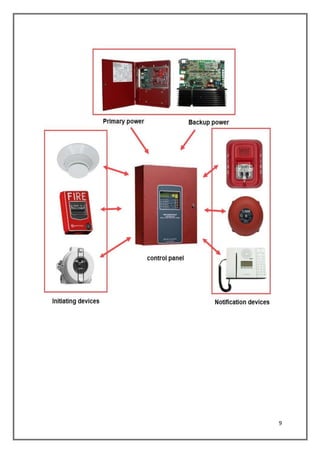
A fire alarm system has a number of devices working together to
detect and warn people through visual and audio appliances when
smoke, fire, carbon monoxide or other emergencies are present. These
alarms may be activated automatically from smoke detectors and heat
detectors or may also be activated via manual fire alarm activation
devices such as manual call points or pull stations. Alarms can be
either motorized bells or wall mountable sounders or horns. They can
also be speaker strobes which sound an alarm, followed by a voice
evacuation message which warns people inside the building not to use
the elevators. Fire alarm sounders can be set to certain frequencies
and different tones including low, medium and high, depending on the
country and manufacturer of the device.
WE WILL BE STUDYING A THERMISTOR BASED FIRE
ALARM WHERE WE WILL USE FIRE SWITCH TO CONTROL
THE CIRCUIT.
8
COMPONENTS OF FIRE ALARM CIRCUIT
 Battery
 PCB Board
 Fire switch
 Resistance330K
 Resistance01K
 PNP Transistor369
 NPN Transistor548
 Capacitor 0.04µF
 Buzzer
 Connecting wires
 Solder
9
10
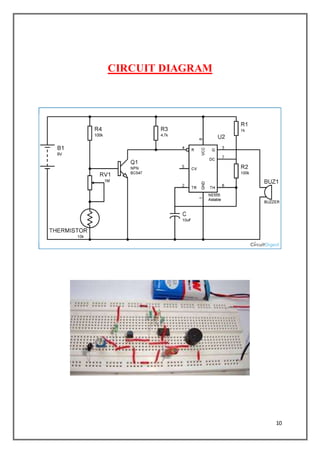
CIRCUIT DIAGRAM
11
CIRCUIT WORKING
All the components are soldered using soldering wire and are fixed on
PCB board.
Resistors of 330k and 0.1k are used to bias transistors so that they
work according to our requirement in the circuit and control the flow
of current I the desired way.
We have npn and pnp transistors to control the flow of current.
Capacitors store the energy and let the alarm sound for some time
after the fire switch turns off.
We have a buzzer that will sound as soon as a fire is detected by the
fire switch.
The main component of the whole circuit is the fire switch that is
responsible for its working.
12
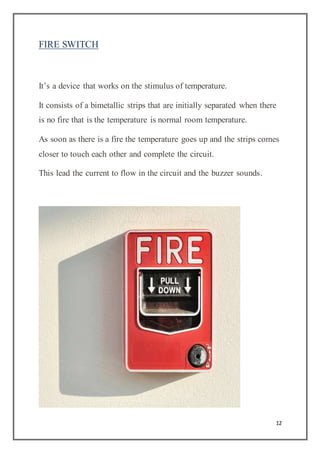
FIRE SWITCH
It’s a device that works on the stimulus of temperature.
It consists of a bimetallic strips that are initially separated when there
is no fire that is the temperature is normal room temperature.
As soon as there is a fire the temperature goes up and the strips comes
closer to touch each other and complete the circuit.
This lead the current to flow in the circuit and the buzzer sounds.
13
OBSERVATIONS
We have seen that initially there was no buzzer sound as none of the
fire was detected.
When we bring a match stick near the fire switch with a time lag of 5-
10 seconds the buzzer starts giving sound as the fire is detected and
the circuit is completed by the action of bimetallic strip.
When we remove the burning match stick away from switch, the
buzzer continues to give the sound for some time due to action of
capacitor and time is required by switch to return to room
temperature.
14
CONCLUSION
A fire alarm is a device that detects the presence of fire and
atmospheric changes relating to smoke. In some cases, a firm alarm is
a part of a complete security system, in addition to a burglary
protection system. The fire alarm operates to alert people to evacuate
a location in which a fire or smoke accumulation is present. When
functioning properly, a fire alarm will sound to notify people of an
immediate fire emergency. Fire alarms can be found in homes,
schools, churches and businesses, and function as the catalyst to
saving lives. For most fire alarms, when sounded, a beep, bell or horn
noise is made. This distinct sound exists to allow the notification to be
heard. The fire alarm constructed by this project work is reliable at
low cost.
15
PRECAUTIONS
1. Components of the circuit should be handled carefully.
2. Care should be taken while soldering as it may burn the skin.
3. Connecting wires should be insulated to prevent disturbance.
4. Connections should be tight as it may break easily.
5. Soldering must be done carefully as it may burn the PCB board.
16
BIBLIOGRAPHY
1) NCERT textbook class 12
2) NCERT physics lab Manuel
3) INTERNET
4) www.yahoo.com
5) www.scribd.com
6) www.google.com

PHYSICS.docx

  • 1.
    1 ALL INDIA SENIORSCHOOL CERTIFICATE EXAMINATION (A.I.S.S.C.E) P.M.S PUBLIC SCHOOL MORADABAD SESSION- 2021-22 PHYSICS PROJECT ON FIRE ALARM SUBMITTED TO C.B.S.E SUPERVISED BY: SUMITTED BY: MR. SPARSHVERMA KARTIK KHANNA H.O.D PHYSICS XII-A
  • 2.
    2 CERTIFICATE It is certifythat Kartik Khanna of class XII-A (Science) of P.M.S Public School, M.B.D has completed this project work under my guideline in the given time as per the norms of CBSE. This report is genuine and correct as per my knowledge. Mr. Sparsh Verma Mr. Mathew Paul Alancheril H.O.D Physics (Principal)
  • 3.
    3 ACKNOWLEDGEMENT It gives meimmense pleasure to express my gratitude to my physics teacher MR. SPARSH VERMA for his guidance, support and encouragement throughout the duration of the project. Without the motivation and help, the successful completion of this project would not have been possible. Kartik Khanna XII-A
  • 4.
    4 INDEX  Certificate  Acknowledgement Introduction  Aim of project  Introduction  Theory  Apparatus required  Working  Observation  Conclusion  Precautions  Bibliography
  • 5.
    5 INTRODUCTION An automatic firealarm system is designed to detect the unwanted presence of fire by monitoring environmental changes associated with combustion. In general, a fire alarm system is either classified as automatic, manually activated, or both. Automatic fire alarm systems can be used to notify people to evacuate in the event of a fire or other emergency, to summon emergency services, and to prepare the structure and associated systems to control the spread of fire and smoke. Fire alarm systems have become increasingly sophisticated and functionally more capable and reliable in recent years. They are designed to fulfill two general requirements: protection of property and assets and protection of life. As a result of state and local codes, the life-safety aspect of fire protection has become a major factor in the last two decades. There are a number of reasons for the substantial increases in the life-safety form of fire protection during recent years, foremost of which are: 1. The proliferation of high-rise construction and the concern for life safety within these buildings.
  • 6.
    6 2. A growingawareness of the life-safety hazard in residential, institutional, and educational occupancies. 3. Increased hazards caused by new building materials and furnishings that create large amounts of toxic combustion products (i.e., plastics, synthetic fabrics, etc.). 4. Vast improvements in smoke detection and related technology made possible through quantum advances in electronic technology. 5. The passing of the Americans with Disabilities Act (ADA), signed into law on July 26, 1990, providing comprehensive civil rights protection for individuals with disabilities. With an effective date of January 26, 1992, these requirements included detailed accessibility standards for both new construction and Renovation towards the goal of equal usability of buildings for everyone, regardless of limitations of sight, hearing, and mobility. This had a significant impact on fire alarm system signaling devices, power requirements, and device locations.
  • 7.
    7 THEORY A fire alarmsystem has a number of devices working together to detect and warn people through visual and audio appliances when smoke, fire, carbon monoxide or other emergencies are present. These alarms may be activated automatically from smoke detectors and heat detectors or may also be activated via manual fire alarm activation devices such as manual call points or pull stations. Alarms can be either motorized bells or wall mountable sounders or horns. They can also be speaker strobes which sound an alarm, followed by a voice evacuation message which warns people inside the building not to use the elevators. Fire alarm sounders can be set to certain frequencies and different tones including low, medium and high, depending on the country and manufacturer of the device. WE WILL BE STUDYING A THERMISTOR BASED FIRE ALARM WHERE WE WILL USE FIRE SWITCH TO CONTROL THE CIRCUIT.
  • 8.
    8 COMPONENTS OF FIREALARM CIRCUIT  Battery  PCB Board  Fire switch  Resistance330K  Resistance01K  PNP Transistor369  NPN Transistor548  Capacitor 0.04µF  Buzzer  Connecting wires  Solder
  • 9.
  • 10.
  • 11.
    11 CIRCUIT WORKING All thecomponents are soldered using soldering wire and are fixed on PCB board. Resistors of 330k and 0.1k are used to bias transistors so that they work according to our requirement in the circuit and control the flow of current I the desired way. We have npn and pnp transistors to control the flow of current. Capacitors store the energy and let the alarm sound for some time after the fire switch turns off. We have a buzzer that will sound as soon as a fire is detected by the fire switch. The main component of the whole circuit is the fire switch that is responsible for its working.
  • 12.
    12 FIRE SWITCH It’s adevice that works on the stimulus of temperature. It consists of a bimetallic strips that are initially separated when there is no fire that is the temperature is normal room temperature. As soon as there is a fire the temperature goes up and the strips comes closer to touch each other and complete the circuit. This lead the current to flow in the circuit and the buzzer sounds.
  • 13.
    13 OBSERVATIONS We have seenthat initially there was no buzzer sound as none of the fire was detected. When we bring a match stick near the fire switch with a time lag of 5- 10 seconds the buzzer starts giving sound as the fire is detected and the circuit is completed by the action of bimetallic strip. When we remove the burning match stick away from switch, the buzzer continues to give the sound for some time due to action of capacitor and time is required by switch to return to room temperature.
  • 14.
    14 CONCLUSION A fire alarmis a device that detects the presence of fire and atmospheric changes relating to smoke. In some cases, a firm alarm is a part of a complete security system, in addition to a burglary protection system. The fire alarm operates to alert people to evacuate a location in which a fire or smoke accumulation is present. When functioning properly, a fire alarm will sound to notify people of an immediate fire emergency. Fire alarms can be found in homes, schools, churches and businesses, and function as the catalyst to saving lives. For most fire alarms, when sounded, a beep, bell or horn noise is made. This distinct sound exists to allow the notification to be heard. The fire alarm constructed by this project work is reliable at low cost.
  • 15.
    15 PRECAUTIONS 1. Components ofthe circuit should be handled carefully. 2. Care should be taken while soldering as it may burn the skin. 3. Connecting wires should be insulated to prevent disturbance. 4. Connections should be tight as it may break easily. 5. Soldering must be done carefully as it may burn the PCB board.
  • 16.
    16 BIBLIOGRAPHY 1) NCERT textbookclass 12 2) NCERT physics lab Manuel 3) INTERNET 4) www.yahoo.com 5) www.scribd.com 6) www.google.com