A fire alarm circuit is very useful for security reasons. Equipment specifically
manufactured for these purposes are selected and standardized installation
methods are anticipated during the design. Various circuits can be designed for
this purpose. An ideal, nearly perfect fire alarm should be able to quickly
perceive or predict the danger and make effective feedback very quickly. In
order to ensure the two requirements of "fast" and "sensitive", a very fast
information transmission circuit is needed, which is the reason that the author
chooses the combinatorial logic circuit as my first choice [2]. The characteristic
of combinatorial logic circuits is that the output at any time depends only on the
input at that time, independent of the original state of the circuit. This feature
makes it have an efficient timeliness, which can be in a variety of emergency
occasions (especially in the case of sudden disaster) in the early warning, reduce
the loss of society. At present, the design structures of combinatorial logic
circuits are still needed to be improved. Most combinatorial logic circuits used
in reality are very complex, and a large part of them need to be simplified. In
addition, "crisis" sensors, for example, smoke sensors and temperature sensors
in a fire, need a lot of technological progress to ensure that they do not fail or
"lie". This may require advances in fields other than electricity, such as
chemistry, heat science and materials science.
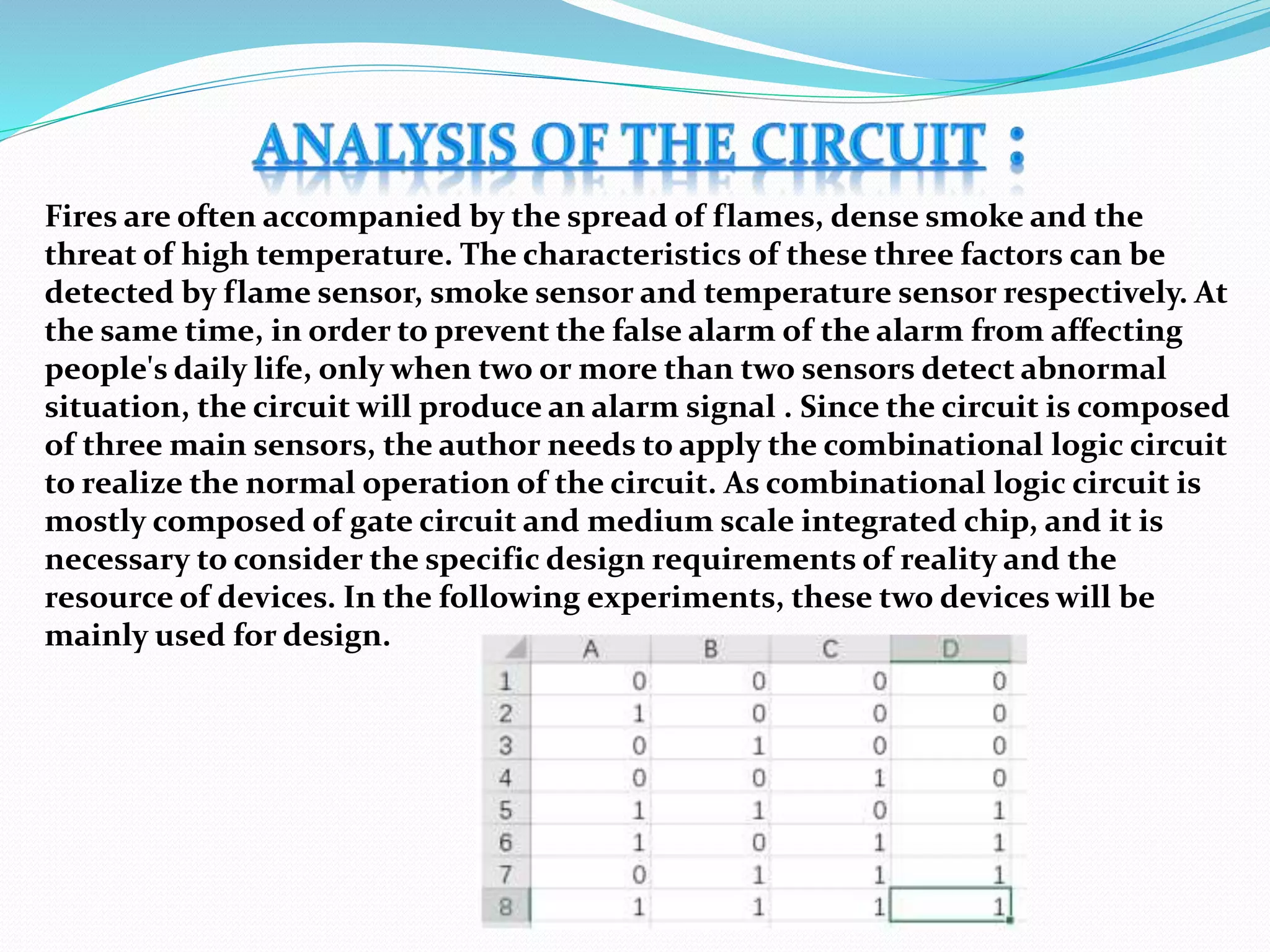
Fires are often accompanied by the spread of flames, dense smoke and the
threat of high temperature. The characteristics of these three factors can be
detected by flame sensor, smoke sensor and temperature sensor respectively. At
the same time, in order to prevent the false alarm of the alarm from affecting
people's daily life, only when two or more than two sensors detect abnormal
situation, the circuit will produce an alarm signal . Since the circuit is composed
of three main sensors, the author needs to apply the combinational logic circuit
to realize the normal operation of the circuit. As combinational logic circuit is
mostly composed of gate circuit and medium scale integrated chip, and it is
necessary to consider the specific design requirements of reality and the
resource of devices. In the following experiments, these two devices will be
mainly used for design.
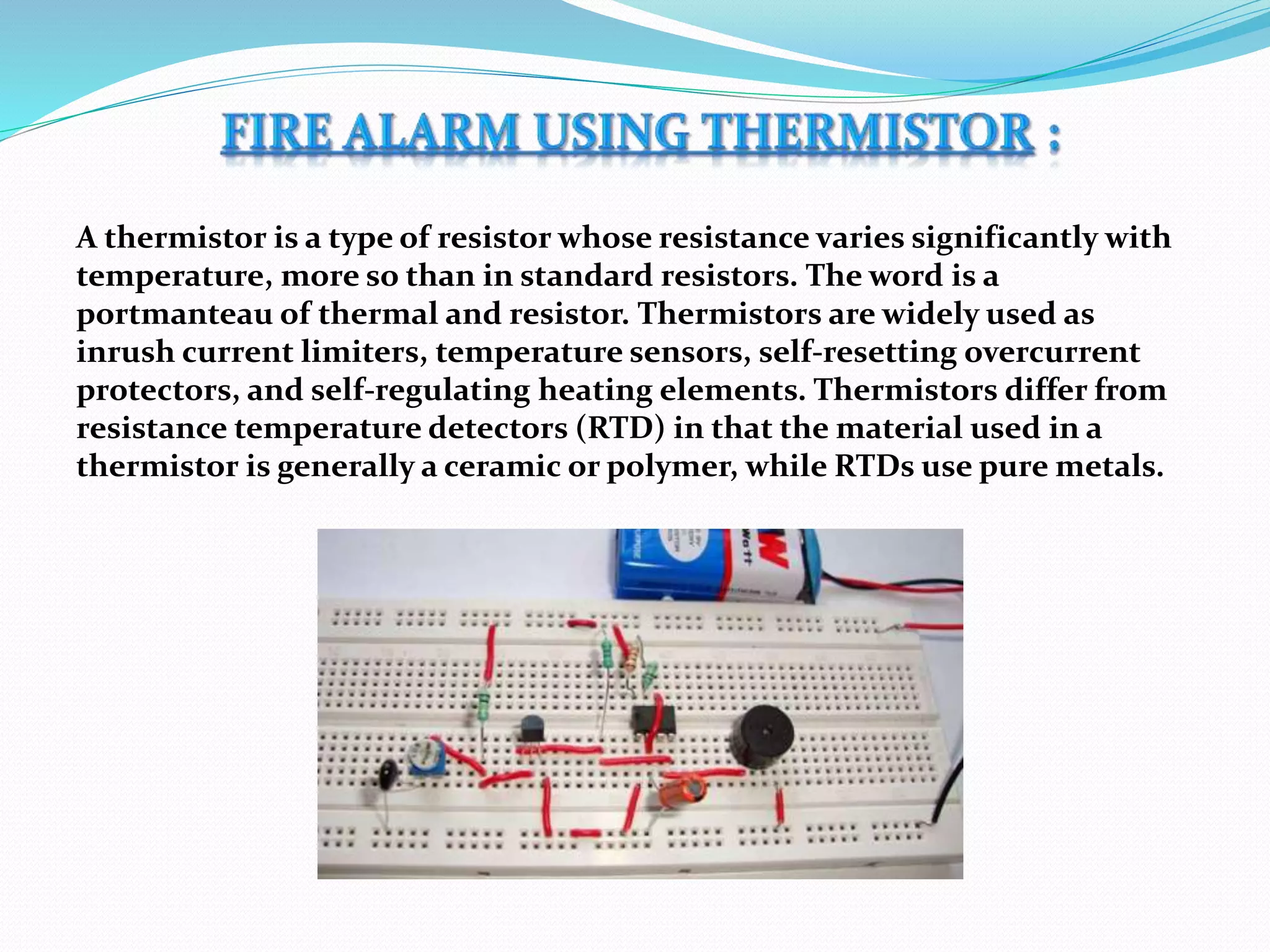
A thermistor is a type of resistor whose resistance varies significantly with
temperature, more so than in standard resistors. The word is a
portmanteau of thermal and resistor. Thermistors are widely used as
inrush current limiters, temperature sensors, self-resetting overcurrent
protectors, and self-regulating heating elements. Thermistors differ from
resistance temperature detectors (RTD) in that the material used in a
thermistor is generally a ceramic or polymer, while RTDs use pure metals.
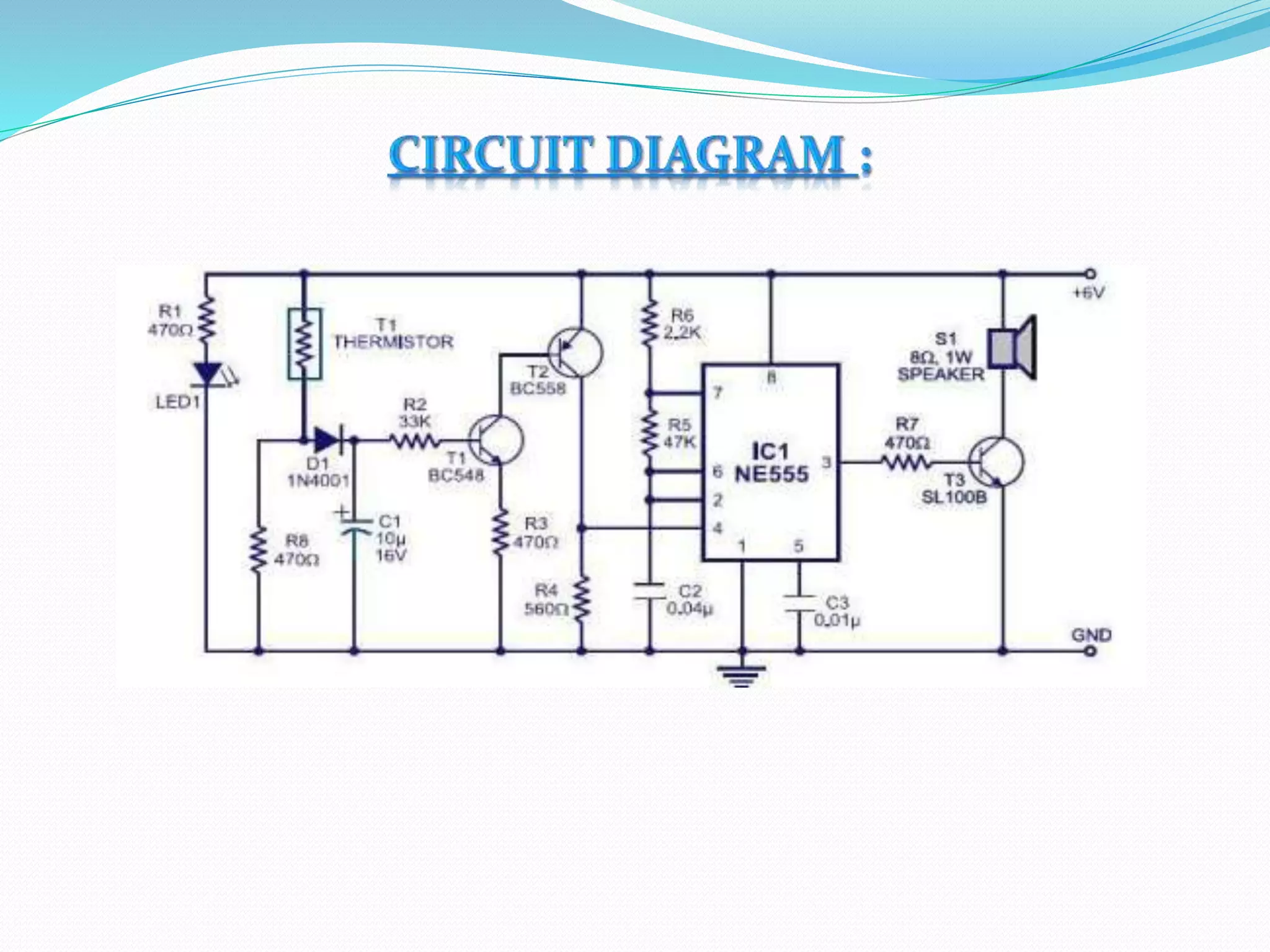
When there is a fire breakout in the room the temperature increases. This ultra
compact and low cost fire alarm senses fire breakout based on this fact.
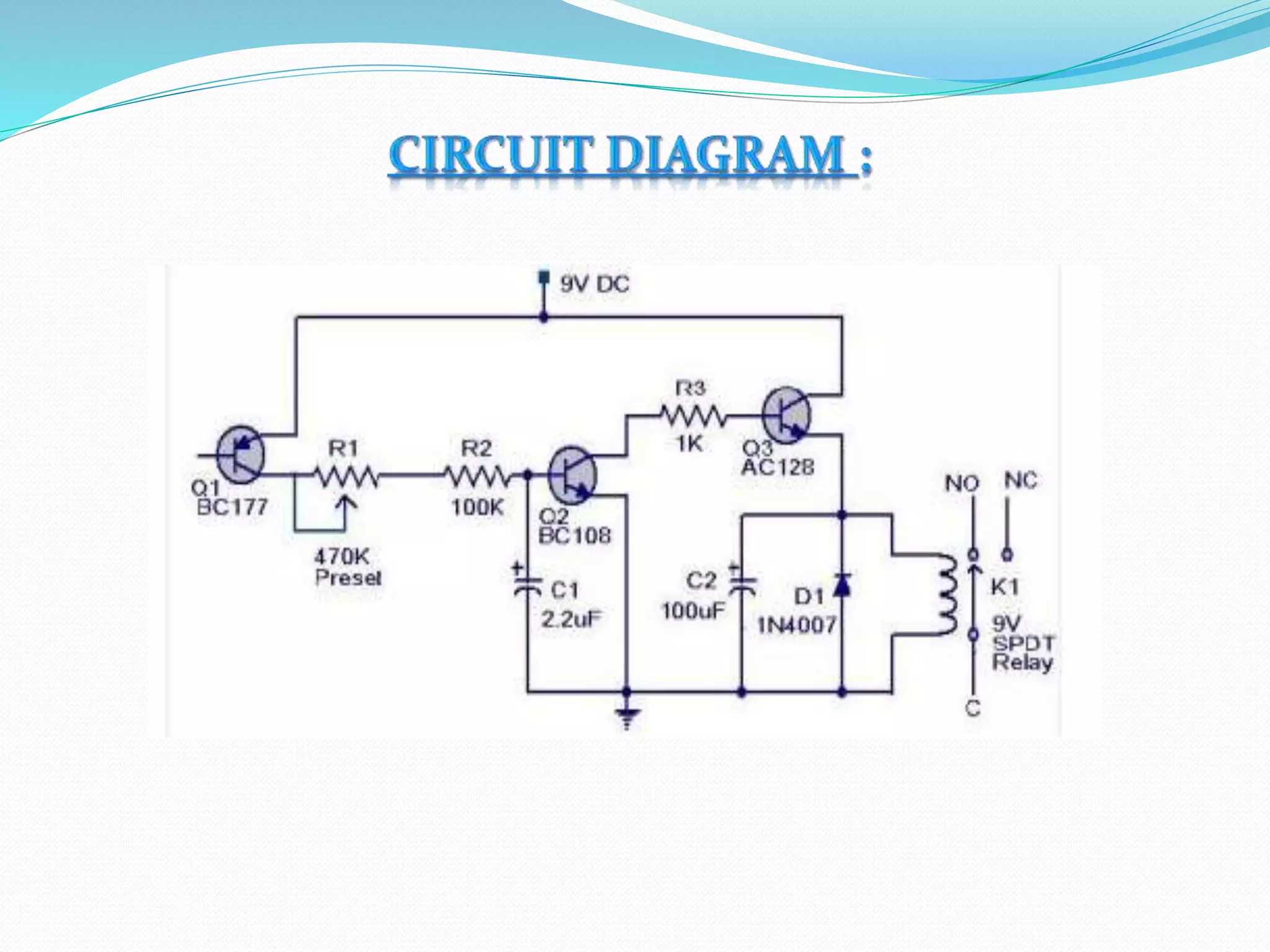
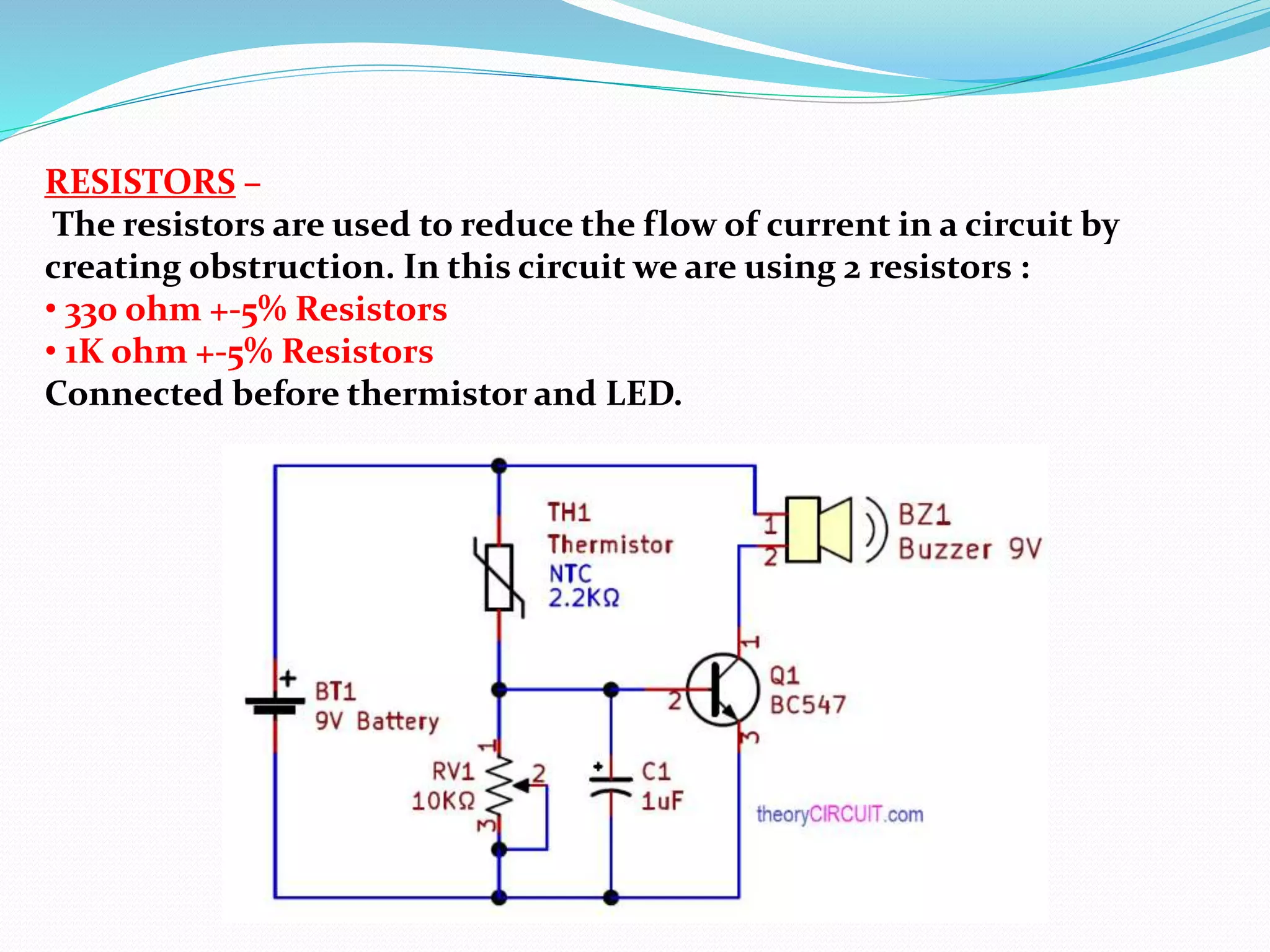
Transistor BC177 (Q1) is used as the fire sensor here. When the temperature
increases the leakage current of this transistor also increases. The circuit is
designed so that when there is an increase in the leakage current of Q1,
transistor Q2 will get biased. As a result when there is a fire breakout the
transistor Q2 will be on. The emitter of Q2 (BC 108) is connected to the base of
Q3(AC 128). So when Q2 is ON Q3 will be also ON. The transistor Q3 drives the
relay which is used to drive the load (i.e.) light, bell, horn etc as an indication of
the fire. The diode D1 is used as a free wheeling diode to protect it from back
EMF generated when relay is switched. The Preset R1 can be used to desired
temperature level for setting the alarm ON. This is not a latching alarm, that is;
when the temperature in the vicinity of the sensor decreases below the set
point the alarm stops. The circuit can be powered using a 9V battery or a 9V
battery eliminator. All capacitors are electrolytic and must be rated at least 10V.
The load can be connected through the C, NC, NO points of the relay according
to your need.
• Copper PCB
• 9V Battery
• Potentiometer
• 10K Thermistor
• Resistor
• Transistor
• Buzzer
• LED Light
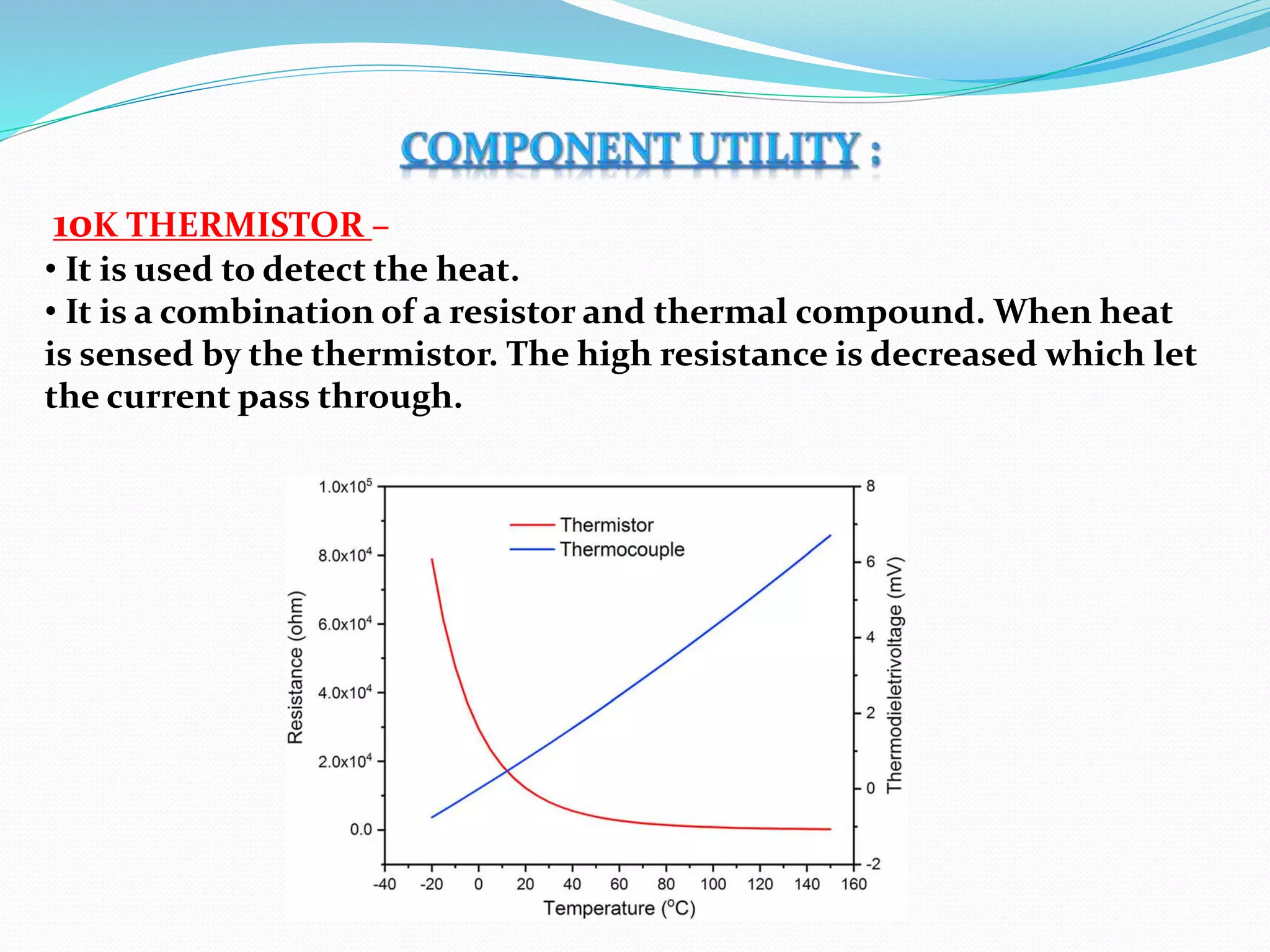
10K THERMISTOR –
• It is used to detect the heat.
• It is a combination of a resistor and thermal compound. When heat
is sensed by the thermistor. The high resistance is decreased which let
the current pass through.
POTENTIOMETER –
A potential meter is an electric instrument used to measure the EMF
of a given cell. The internal resistance of a cell and also it is used to
compare the EMF of different cells. It can be used as a variable
register. We are using it as a variable register in our circuit do not let
the damage to any component.
TRANSISTOR –
It acts as a switch or gate for the electronics signals. Opening and
closing an electronic gate many times per second in our circuit it is
connected to the Bazaar so when the current comes to the emitter the
LED glows and complete the acts to make the buzzer buzz. It has it's
base connected to the transmitter which when allows current to flow
it completes the circuit and working.
LEDLIGHT –
LED runs on low voltage. It is used to eluminate and show that there is
a possible danger of fire.
BUZZER –
Used in alarm devices, timers, etc. Here we use it in our circuit to
alarm of heat. It is connected with the thermostat and connector of
the transistor converts electric energy to sound energy.
COPPER PCB –
Copper is an internal part of any PCB design as it has exceptional
electrical and thermal characteristics necessary for signal
transmission and heat dissipation. Copper used as traces transfer heat
along with signal across the board.
9V BATTERY –
Most commonly used in smoke alarm, walkie talkies, transistor radio,
LCD display, and other small portable appliances. In this we are using
a 9V battery for the circuit supply. It sends supply to thermistor in the
circuit.
RESISTORS –
The resistors are used to reduce the flow of current in a circuit by
creating obstruction. In this circuit we are using 2 resistors :
• 330 ohm +-5% Resistors
• 1K ohm +-5% Resistors
Connected before thermistor and LED.
Hence electronic circuits can be designed for the fire based
alarms and they provide very high efficiency and can be
used for the security reasons. Early fire detection is best
achieved by the installation and maintenance of fire
detection equipment in all rooms and areas of the house or
building. The various circuits described in the paper can be
used.

Fire Alarm circuit.pptx

  • 2.
    A fire alarmcircuit is very useful for security reasons. Equipment specifically manufactured for these purposes are selected and standardized installation methods are anticipated during the design. Various circuits can be designed for this purpose. An ideal, nearly perfect fire alarm should be able to quickly perceive or predict the danger and make effective feedback very quickly. In order to ensure the two requirements of "fast" and "sensitive", a very fast information transmission circuit is needed, which is the reason that the author chooses the combinatorial logic circuit as my first choice [2]. The characteristic of combinatorial logic circuits is that the output at any time depends only on the input at that time, independent of the original state of the circuit. This feature makes it have an efficient timeliness, which can be in a variety of emergency occasions (especially in the case of sudden disaster) in the early warning, reduce the loss of society. At present, the design structures of combinatorial logic circuits are still needed to be improved. Most combinatorial logic circuits used in reality are very complex, and a large part of them need to be simplified. In addition, "crisis" sensors, for example, smoke sensors and temperature sensors in a fire, need a lot of technological progress to ensure that they do not fail or "lie". This may require advances in fields other than electricity, such as chemistry, heat science and materials science.
  • 3.
    Fires are oftenaccompanied by the spread of flames, dense smoke and the threat of high temperature. The characteristics of these three factors can be detected by flame sensor, smoke sensor and temperature sensor respectively. At the same time, in order to prevent the false alarm of the alarm from affecting people's daily life, only when two or more than two sensors detect abnormal situation, the circuit will produce an alarm signal . Since the circuit is composed of three main sensors, the author needs to apply the combinational logic circuit to realize the normal operation of the circuit. As combinational logic circuit is mostly composed of gate circuit and medium scale integrated chip, and it is necessary to consider the specific design requirements of reality and the resource of devices. In the following experiments, these two devices will be mainly used for design.
  • 4.
    A thermistor isa type of resistor whose resistance varies significantly with temperature, more so than in standard resistors. The word is a portmanteau of thermal and resistor. Thermistors are widely used as inrush current limiters, temperature sensors, self-resetting overcurrent protectors, and self-regulating heating elements. Thermistors differ from resistance temperature detectors (RTD) in that the material used in a thermistor is generally a ceramic or polymer, while RTDs use pure metals.
  • 6.
    When there isa fire breakout in the room the temperature increases. This ultra compact and low cost fire alarm senses fire breakout based on this fact. Transistor BC177 (Q1) is used as the fire sensor here. When the temperature increases the leakage current of this transistor also increases. The circuit is designed so that when there is an increase in the leakage current of Q1, transistor Q2 will get biased. As a result when there is a fire breakout the transistor Q2 will be on. The emitter of Q2 (BC 108) is connected to the base of Q3(AC 128). So when Q2 is ON Q3 will be also ON. The transistor Q3 drives the relay which is used to drive the load (i.e.) light, bell, horn etc as an indication of the fire. The diode D1 is used as a free wheeling diode to protect it from back EMF generated when relay is switched. The Preset R1 can be used to desired temperature level for setting the alarm ON. This is not a latching alarm, that is; when the temperature in the vicinity of the sensor decreases below the set point the alarm stops. The circuit can be powered using a 9V battery or a 9V battery eliminator. All capacitors are electrolytic and must be rated at least 10V. The load can be connected through the C, NC, NO points of the relay according to your need.
  • 8.
    • Copper PCB •9V Battery • Potentiometer • 10K Thermistor • Resistor • Transistor • Buzzer • LED Light
  • 9.
    10K THERMISTOR – •It is used to detect the heat. • It is a combination of a resistor and thermal compound. When heat is sensed by the thermistor. The high resistance is decreased which let the current pass through.
  • 10.
    POTENTIOMETER – A potentialmeter is an electric instrument used to measure the EMF of a given cell. The internal resistance of a cell and also it is used to compare the EMF of different cells. It can be used as a variable register. We are using it as a variable register in our circuit do not let the damage to any component. TRANSISTOR – It acts as a switch or gate for the electronics signals. Opening and closing an electronic gate many times per second in our circuit it is connected to the Bazaar so when the current comes to the emitter the LED glows and complete the acts to make the buzzer buzz. It has it's base connected to the transmitter which when allows current to flow it completes the circuit and working.
  • 11.
    LEDLIGHT – LED runson low voltage. It is used to eluminate and show that there is a possible danger of fire. BUZZER – Used in alarm devices, timers, etc. Here we use it in our circuit to alarm of heat. It is connected with the thermostat and connector of the transistor converts electric energy to sound energy.
  • 12.
    COPPER PCB – Copperis an internal part of any PCB design as it has exceptional electrical and thermal characteristics necessary for signal transmission and heat dissipation. Copper used as traces transfer heat along with signal across the board. 9V BATTERY – Most commonly used in smoke alarm, walkie talkies, transistor radio, LCD display, and other small portable appliances. In this we are using a 9V battery for the circuit supply. It sends supply to thermistor in the circuit.
  • 13.
    RESISTORS – The resistorsare used to reduce the flow of current in a circuit by creating obstruction. In this circuit we are using 2 resistors : • 330 ohm +-5% Resistors • 1K ohm +-5% Resistors Connected before thermistor and LED.
  • 14.
    Hence electronic circuitscan be designed for the fire based alarms and they provide very high efficiency and can be used for the security reasons. Early fire detection is best achieved by the installation and maintenance of fire detection equipment in all rooms and areas of the house or building. The various circuits described in the paper can be used.