M.Sc. in
Science Education
(Biology)
SE 519
Research Project
R.D.N.P. Chandrasena
PGIS/SE/MSc/SED/BE/10/04
Students’ Conceptual Understanding
and Misconceptions on Force and Motion
through different instruments combined
with Certainty Response Index (CRI)
CONTENT
1. Introduction
2. Literature Review
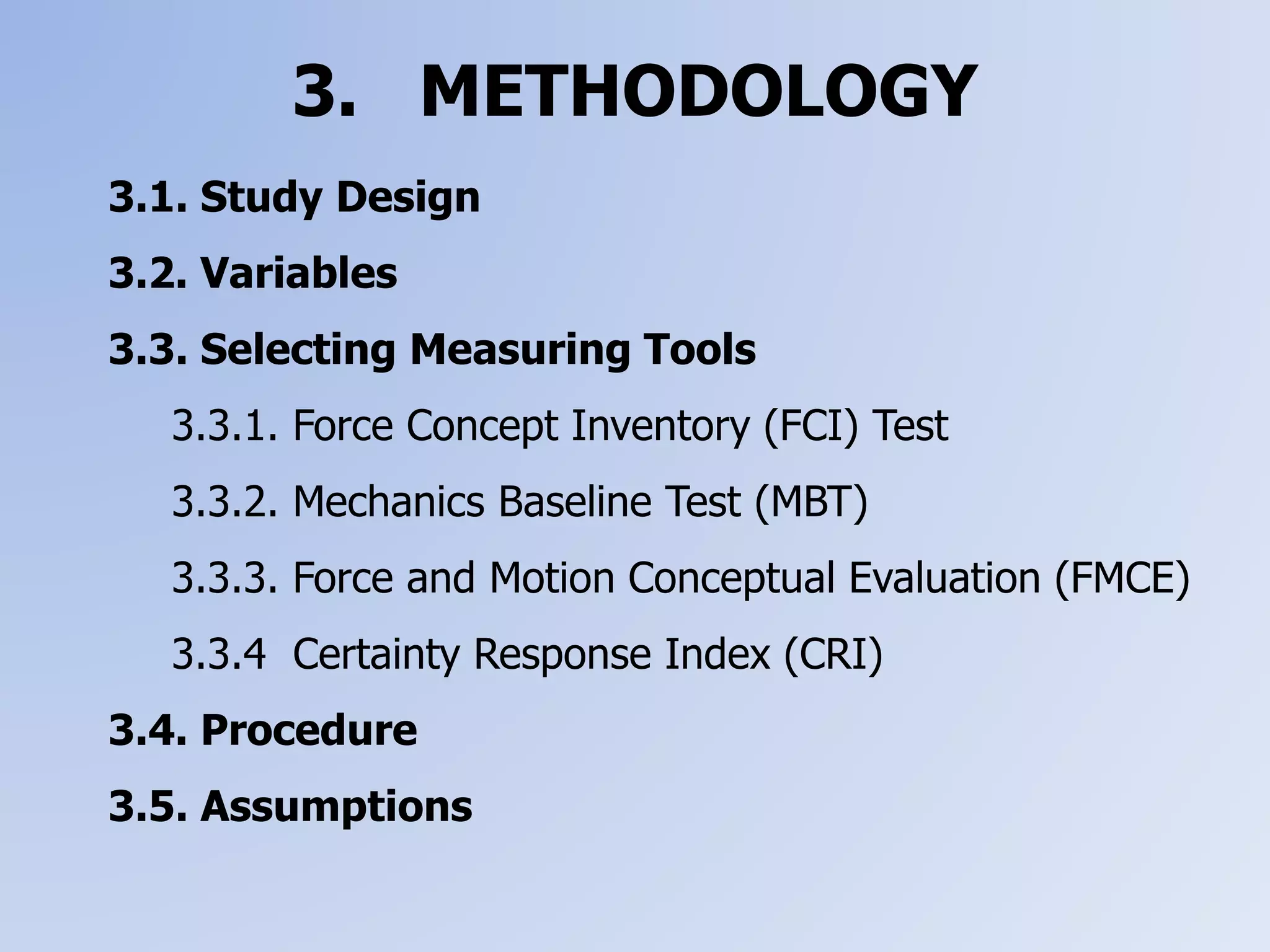
3. Methodology
4. Analysis of Results
5. Conclusion
6. References
7. Appendices
1. INTRODUCTION
• To develop competencies in science,
– deep foundation of factual knowledge
– understand facts and ideas to build up conceptual
knowledge
– organize knowledge in ways that facilitate
retrieval and application
Background
• Performance in Science (G.C.E. (O/L))
• Entrance for G.C.E. (A/L) Science stream
• Scientifically literate workforce
Poor ??? or High ???
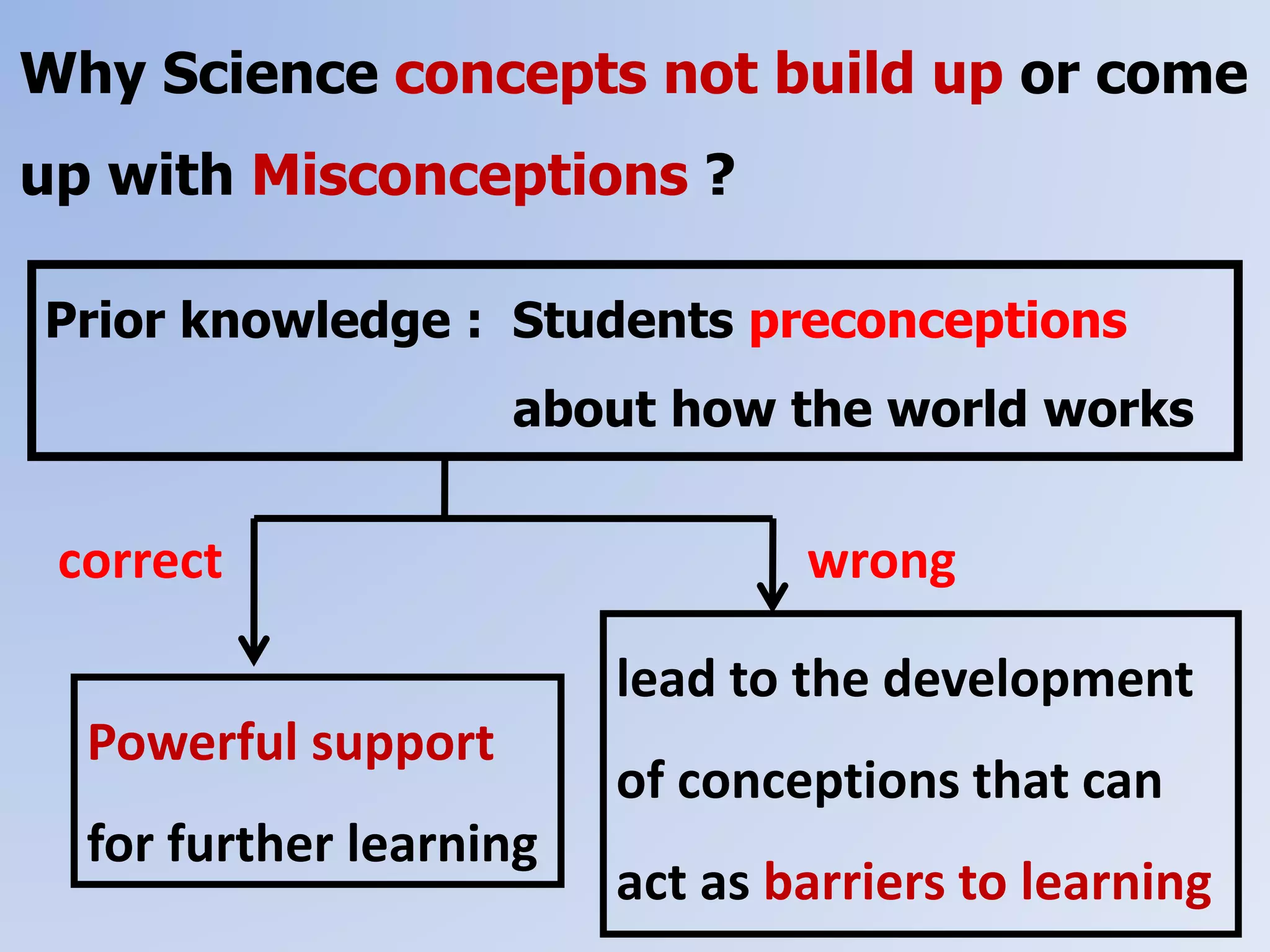
Why Science concepts not build up or come
up with Misconceptions ?
correct wrong
Powerful support
for further learning
lead to the development
of conceptions that can
act as barriers to learning
Prior knowledge : Students preconceptions
about how the world works
A FISH STORY : Children’s story
Leo Lionni’s Fish Is Fish © 1970. Copyright renewed 1998 by Leo Lionni
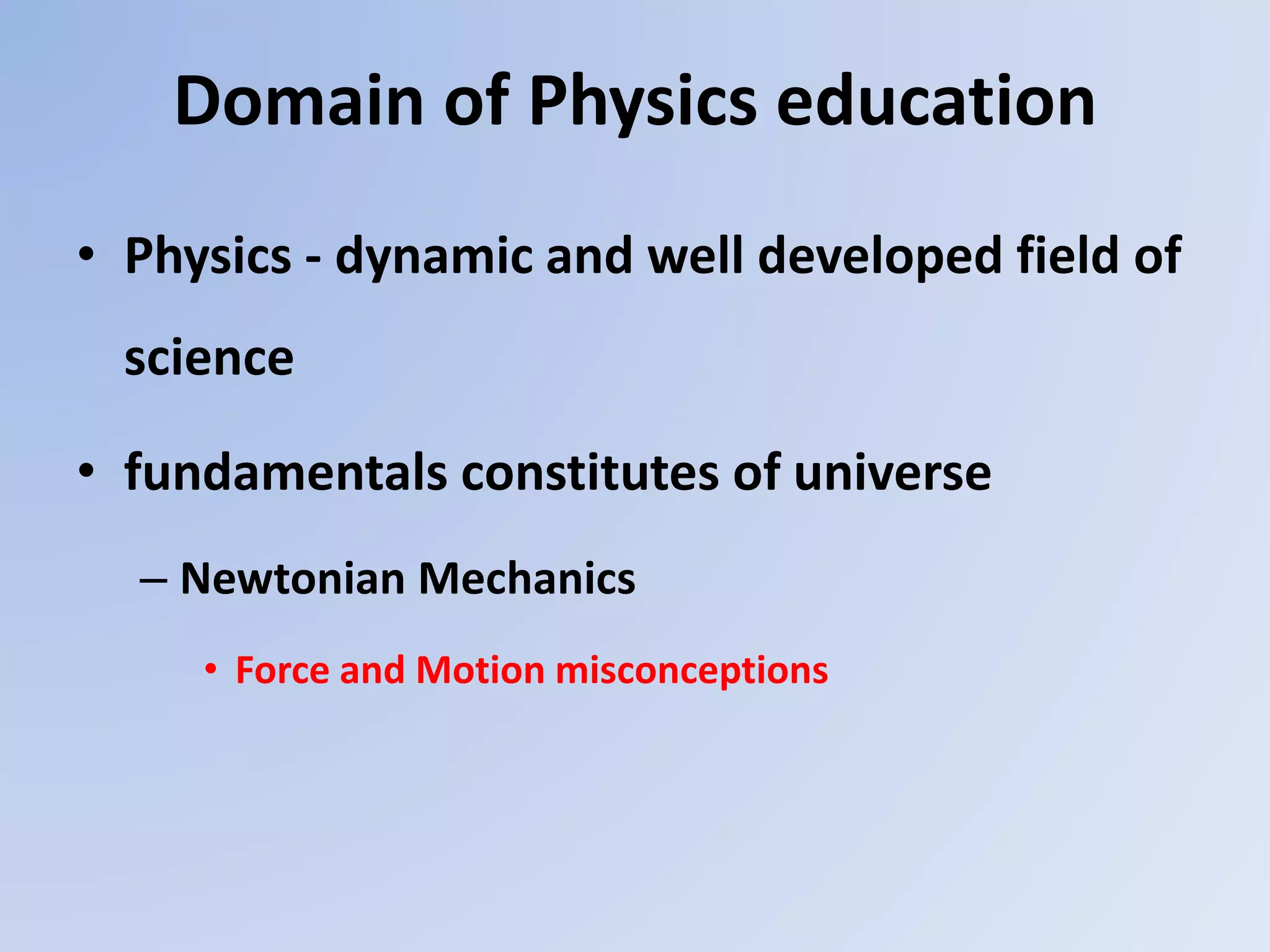
Domain of Physics education
• Physics - dynamic and well developed field of
science
• fundamentals constitutes of universe
– Newtonian Mechanics
• Force and Motion misconceptions
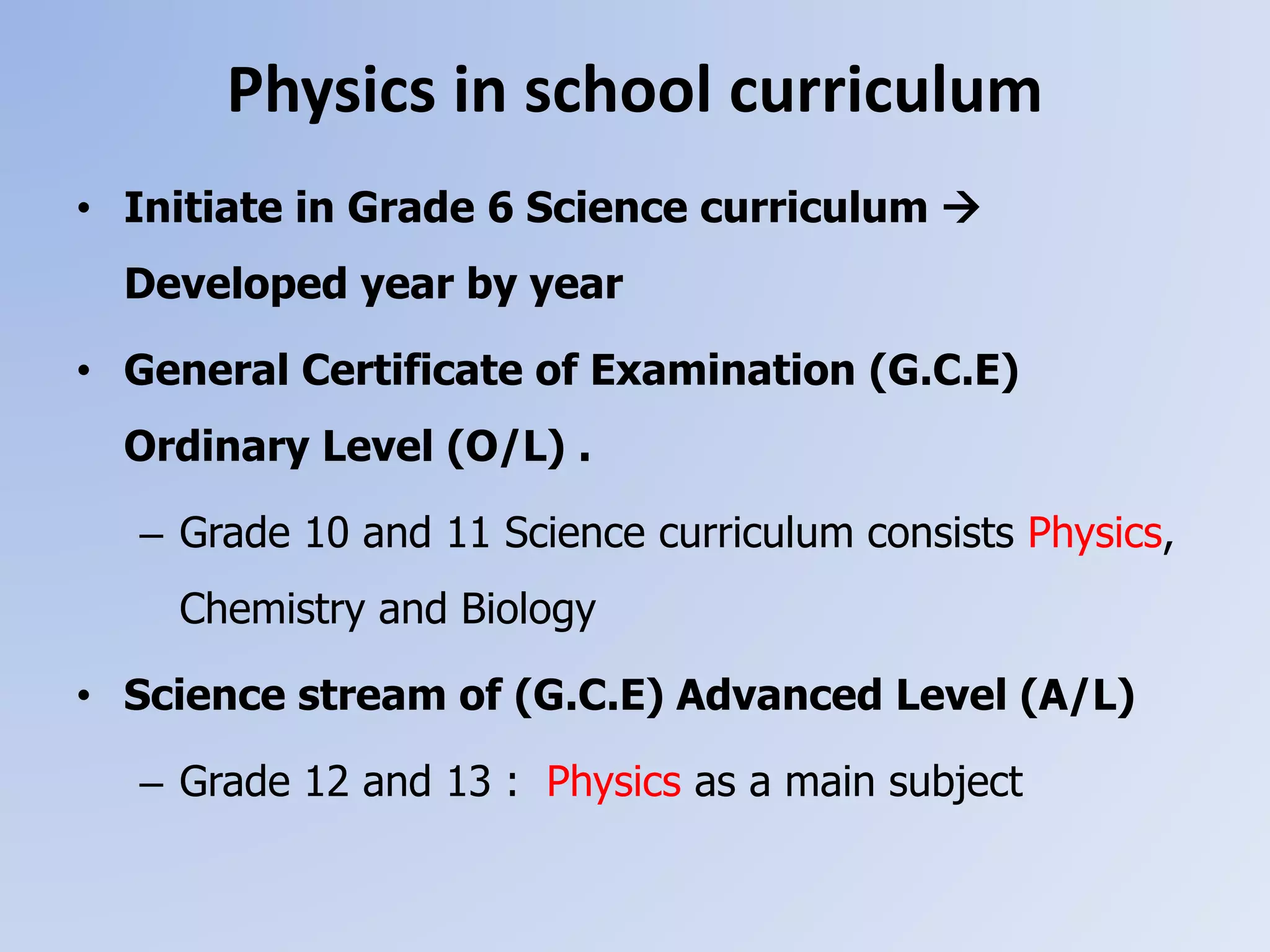
Physics in school curriculum
• Initiate in Grade 6 Science curriculum 
Developed year by year
• General Certificate of Examination (G.C.E)
Ordinary Level (O/L) .
– Grade 10 and 11 Science curriculum consists Physics,
Chemistry and Biology
• Science stream of (G.C.E) Advanced Level (A/L)
– Grade 12 and 13 : Physics as a main subject
Goal
To improve the quality of teaching and
maximize learning of Physics in science
classrooms through addressing problems in
force and motion concepts in domain of
Physics education.
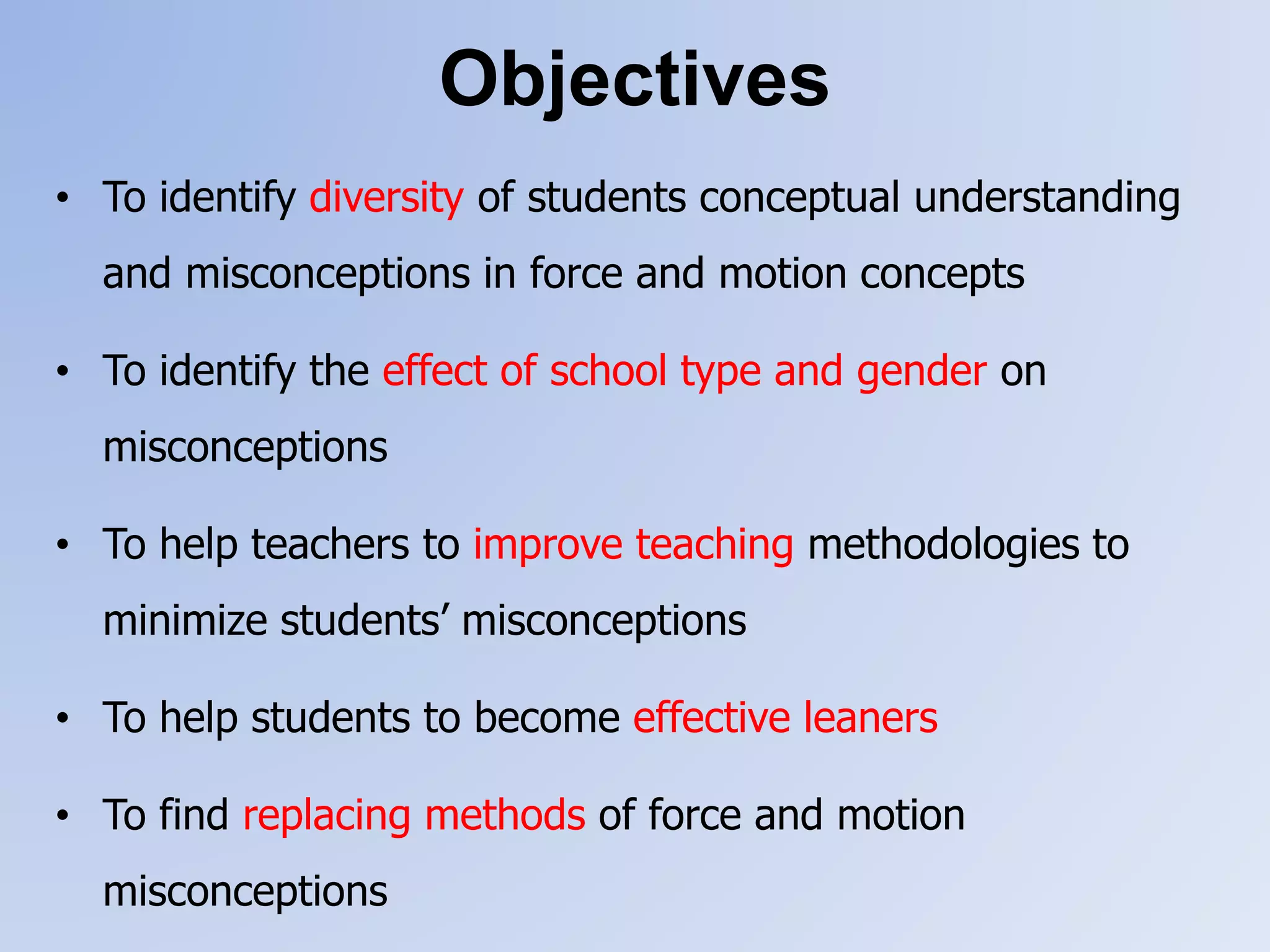
Objectives
• To identify diversity of students conceptual understanding
and misconceptions in force and motion concepts
• To identify the effect of school type and gender on
misconceptions
• To help teachers to improve teaching methodologies to
minimize students’ misconceptions
• To help students to become effective leaners
• To find replacing methods of force and motion
misconceptions
2. LITERATURE REVIEW
• Misconceptions Concerning Force and Motion
• Factors that affect on misconceptions
• The Instruments
– Force Concept Inventory (FCI) Test
– Mechanics Baseline Test (MBT)
– Force and Motion Conceptual Evaluation (FMCE) Test
– Certainty Response Index (CRI)
Misconceptions ….
• The learner’s initial personal knowledge,
i.e., his or her conceptions, beliefs, and views, is the most
important factor influencing learning.
constructivist views
• an idea which is wrong or untrue, but which people
believe because they do not understand the subject
properly.
Longman English Dictionary
Concepts and Misconceptions in Force & Motion
i. Impetus: "force“
ii. Active Force:
iii. Velocity is proportional to Force:
iv. Motion implies force:
v. Passive forces:
vi. Gravity:
vii. Action-Reaction Pairs:
viii. Ideal versus real systems:
ix. Position, Velocity and Acceleration Confusion:
x. Confused the velocity and the acceleration of an object.
Factors that may affect on misconceptions
• initial knowledge, Hestenes et al. (1992)
• conventional instruction
• teaching practices (Glasersfeld, 1992).
• Gender
• Age
• Life experiences
• School type
• Family background
• contextual change, learning style, quality of teacher,
experiences, attitudes, text context, mathematics
background, learning styles and instruction
The Instruments
• Multiple-choice tests
– Force Concept Inventory (FCI)
– Mechanics baseline Test (MBT)
– Force and Motion Conceptual Evaluation (FMCE)
answers combined with,
• Certainty of Response Index (CRI) - Hasany,
Bagayokoz and Kelley, 1999
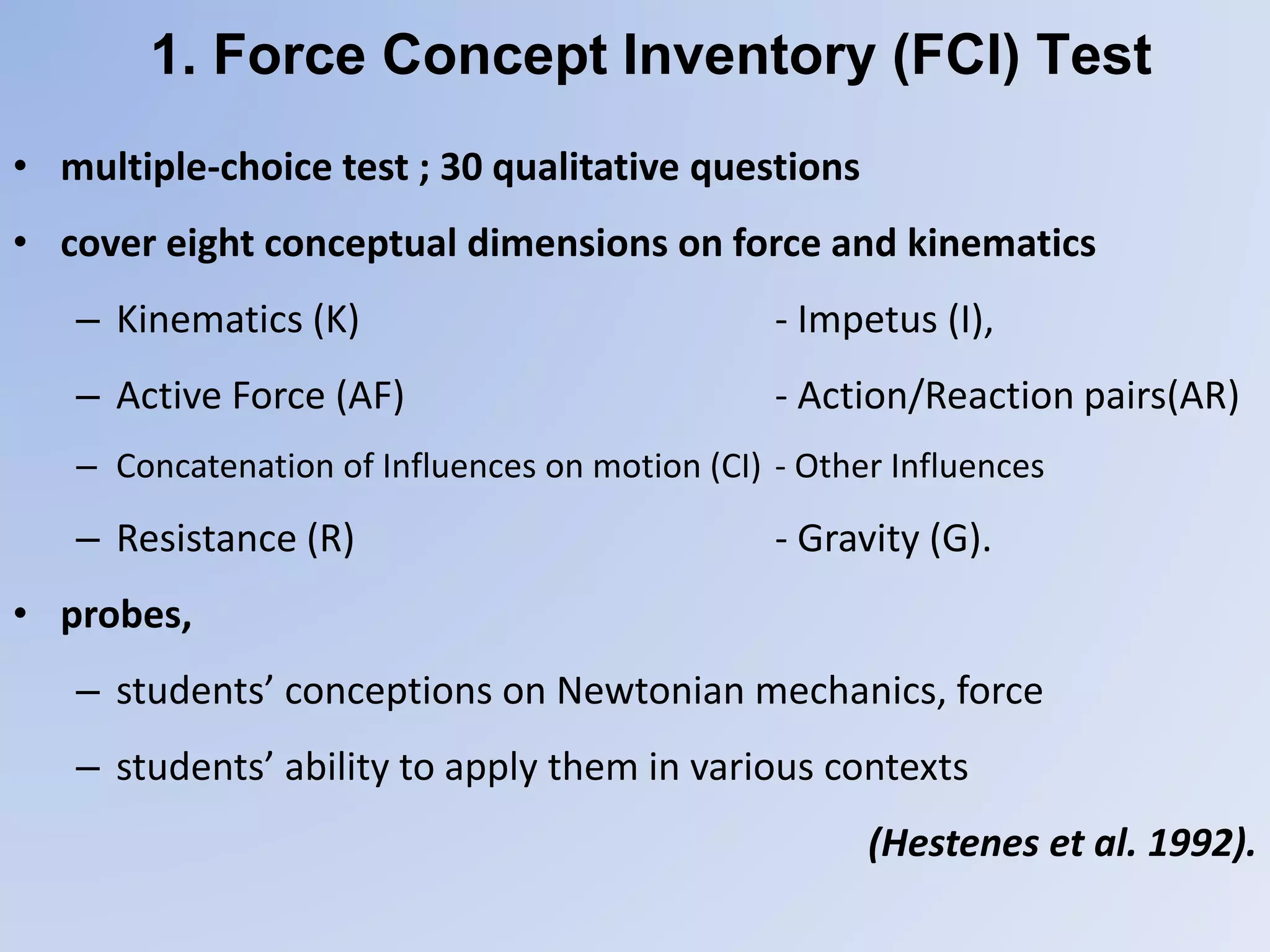
1. Force Concept Inventory (FCI) Test
• multiple-choice test ; 30 qualitative questions
• cover eight conceptual dimensions on force and kinematics
– Kinematics (K) - Impetus (I),
– Active Force (AF) - Action/Reaction pairs(AR)
– Concatenation of Influences on motion (CI) - Other Influences
– Resistance (R) - Gravity (G).
• probes,
– students’ conceptions on Newtonian mechanics, force
– students’ ability to apply them in various contexts
(Hestenes et al. 1992).
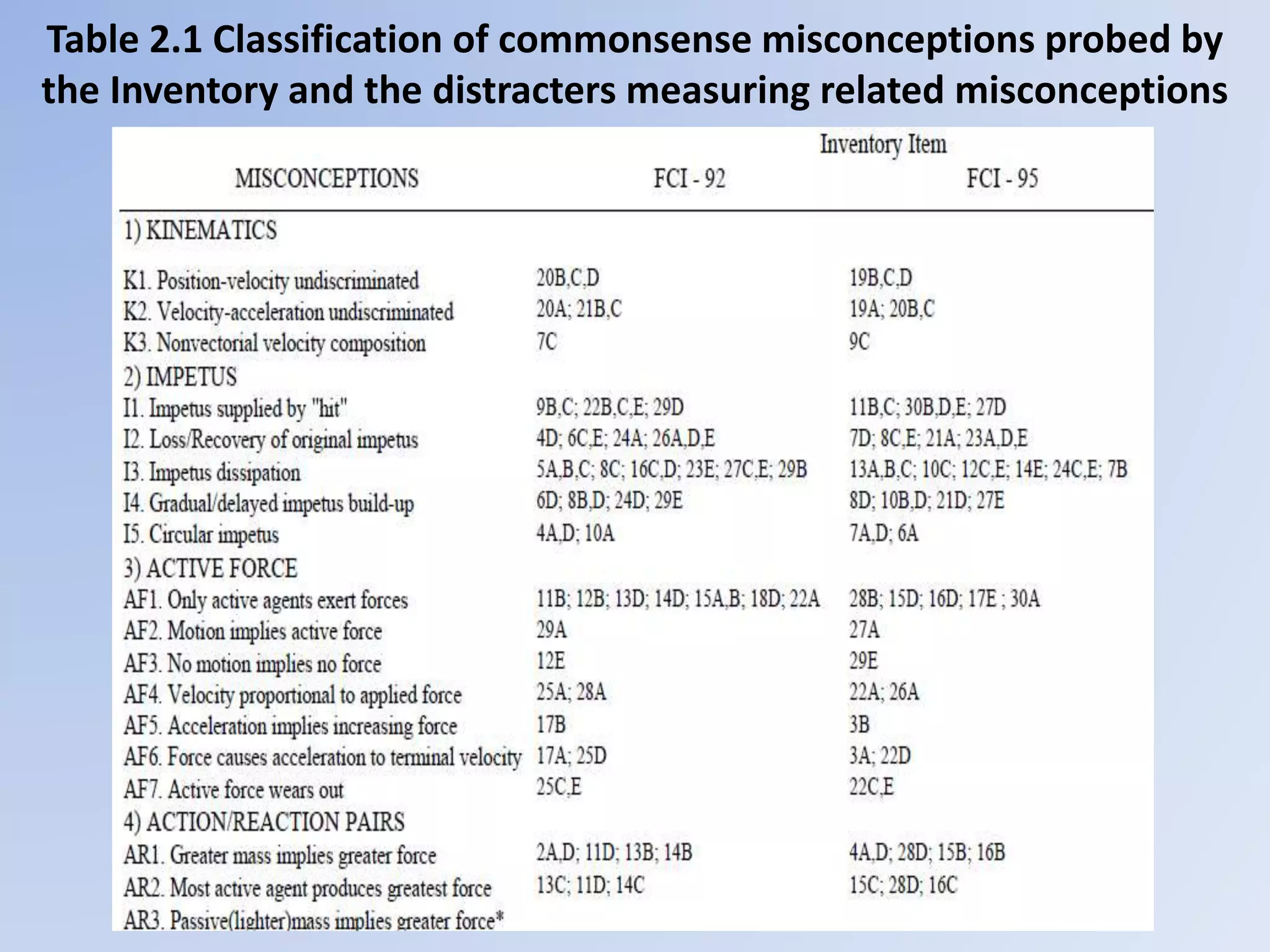
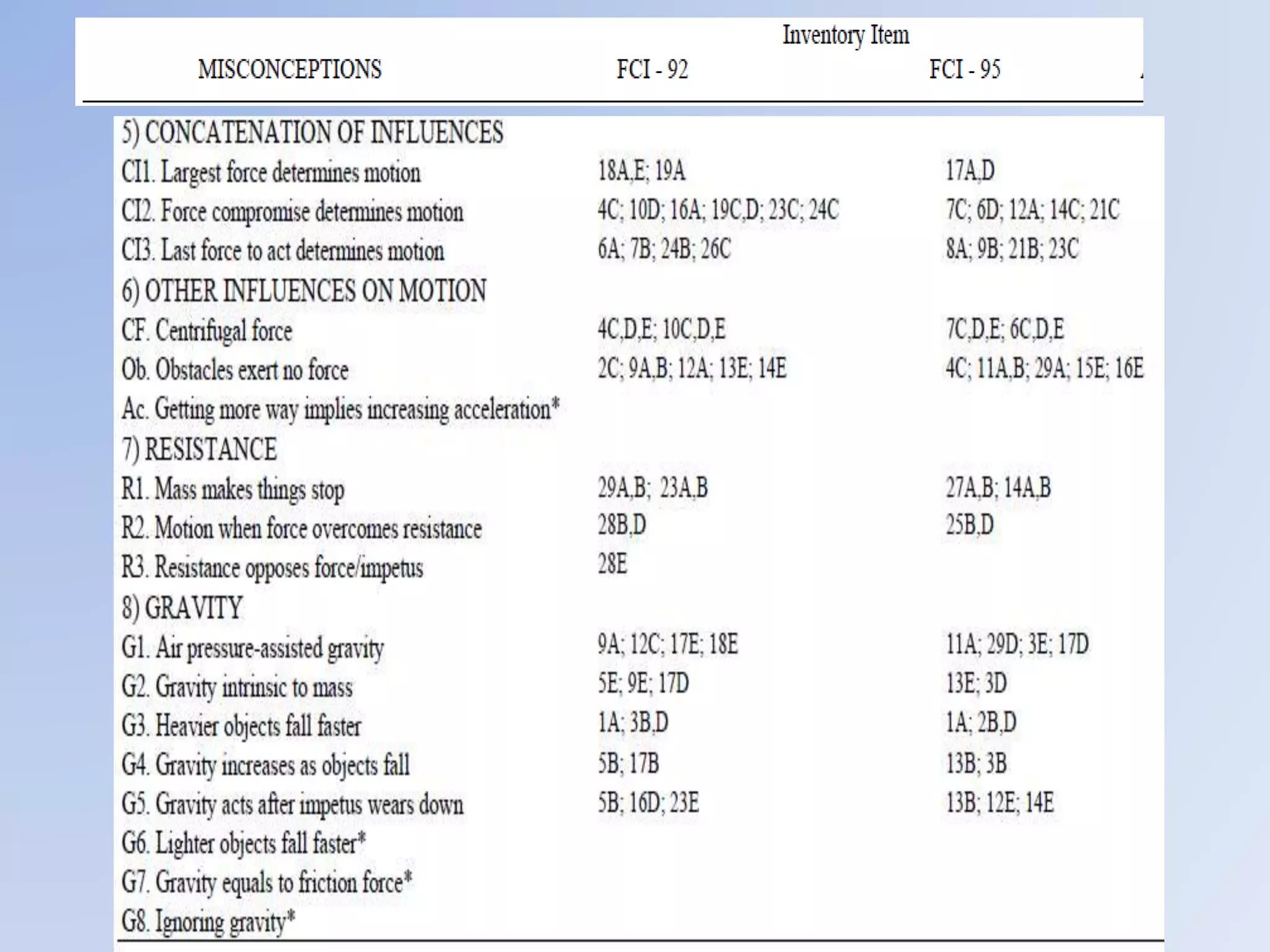
Table 2.1 Classification of commonsense misconceptions probed by
the Inventory and the distracters measuring related misconceptions
2. Mechanics Baseline Test (MBT)
• 26 multiple-choice questions
• emphasizes concepts that cannot be grasped without formal
knowledge about mechanics
• assess quantitative understanding
• multiple-choice distracters typical student mistakes, due to
deficient understanding than to carelessness.
• real deficiencies in understanding the basic concepts
Hestenes & Wells, 1992
3. Force and Motion Conceptual Evaluation
(FMCE) Test
• probe conceptual understanding of Newtonian
mechanics.
• achievement measure
• emphasis on students’ understanding of graphical
representations of velocity, acceleration, and force.
• higher scores indicate greater achievement
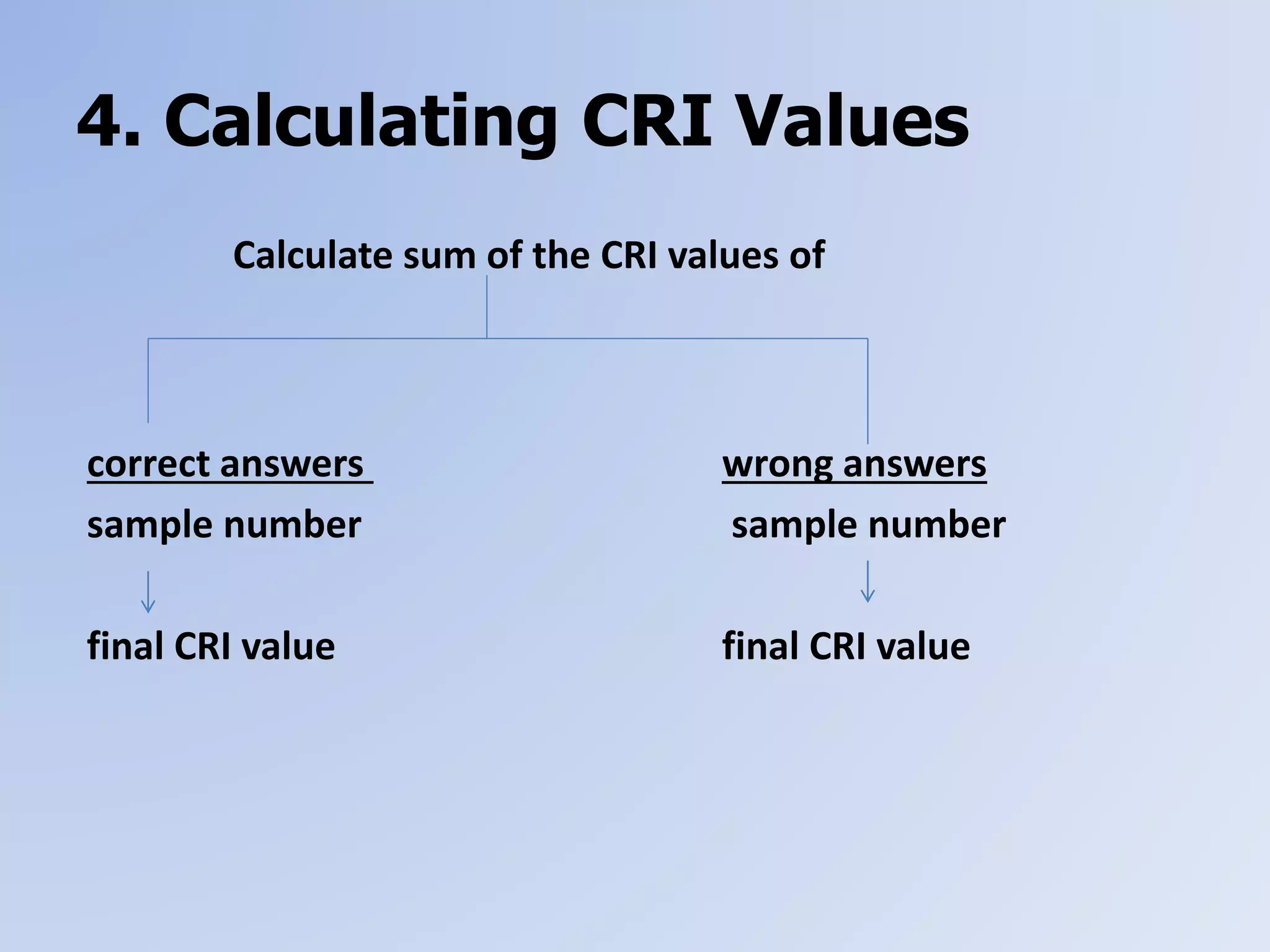
4. Calculating CRI Values
Calculate sum of the CRI values of
correct answers wrong answers
sample number sample number
final CRI value final CRI value
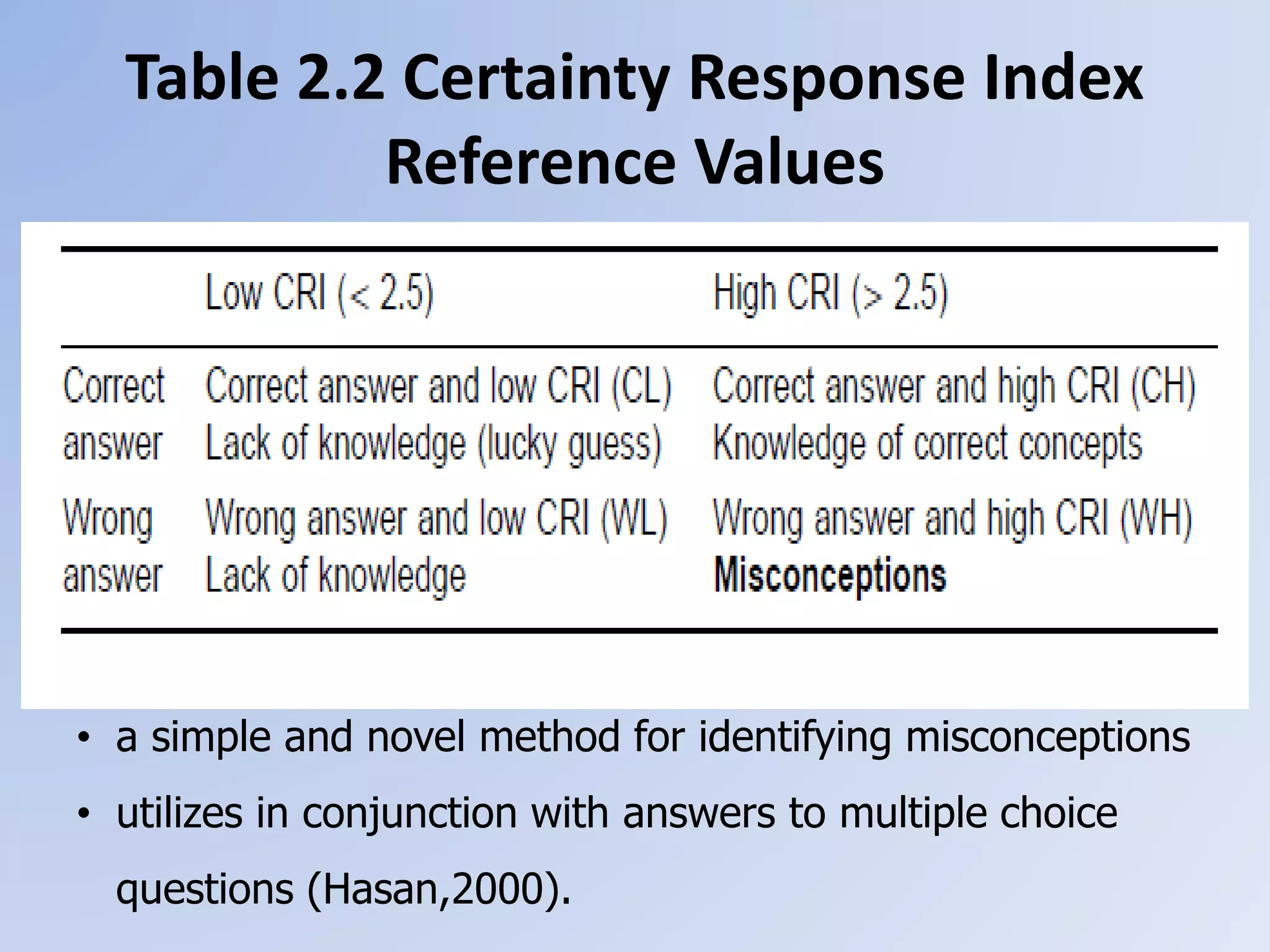
Table 2.2 Certainty Response Index
Reference Values
• a simple and novel method for identifying misconceptions
• utilizes in conjunction with answers to multiple choice
questions (Hasan,2000).
3. METHODOLOGY
3.1. Study Design
3.2. Variables
3.3. Selecting Measuring Tools
3.3.1. Force Concept Inventory (FCI) Test
3.3.2. Mechanics Baseline Test (MBT)
3.3.3. Force and Motion Conceptual Evaluation (FMCE)
3.3.4 Certainty Response Index (CRI)
3.4. Procedure
3.5. Assumptions
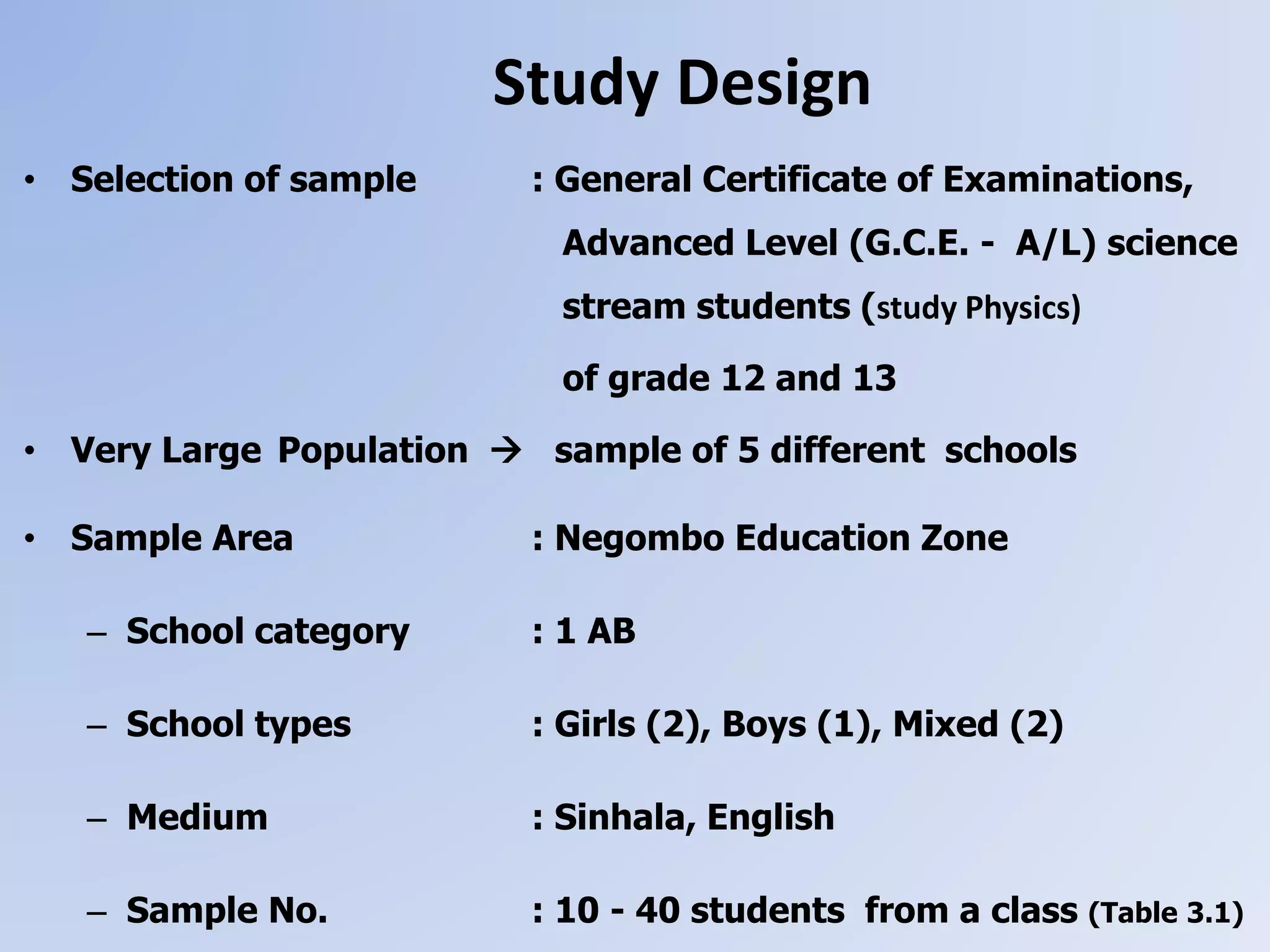
• Selection of sample : General Certificate of Examinations,
Advanced Level (G.C.E. - A/L) science
stream students (study Physics)
of grade 12 and 13
• Very Large Population  sample of 5 different schools
• Sample Area : Negombo Education Zone
– School category : 1 AB
– School types : Girls (2), Boys (1), Mixed (2)
– Medium : Sinhala, English
– Sample No. : 10 - 40 students from a class (Table 3.1)
Study Design
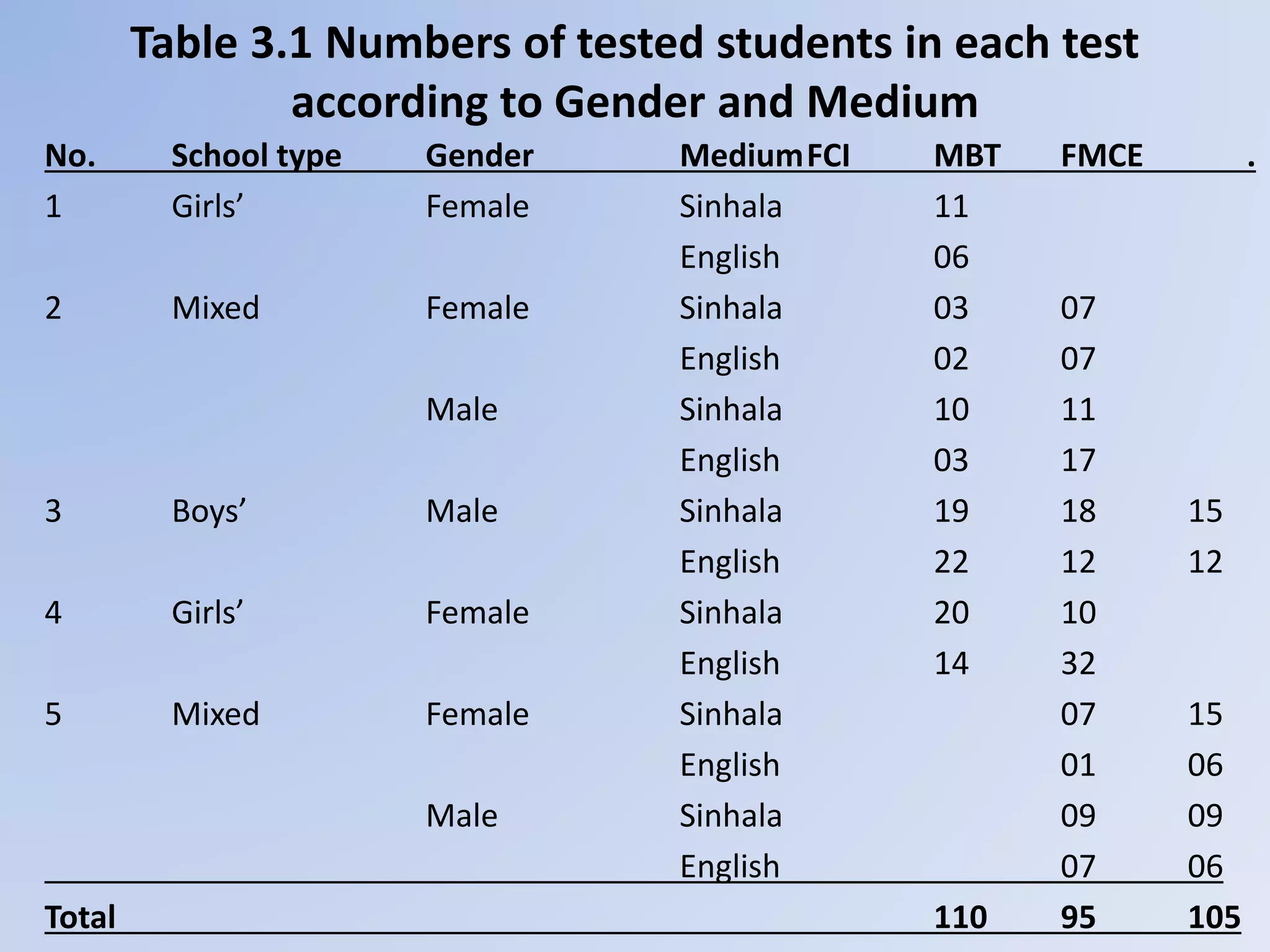
Table 3.1 Numbers of tested students in each test
according to Gender and Medium
No. School type Gender MediumFCI MBT FMCE .
1 Girls’ Female Sinhala 11
English 06
2 Mixed Female Sinhala 03 07
English 02 07
Male Sinhala 10 11
English 03 17
3 Boys’ Male Sinhala 19 18 15
English 22 12 12
4 Girls’ Female Sinhala 20 10
English 14 32
5 Mixed Female Sinhala 07 15
English 01 06
Male Sinhala 09 09
English 07 06
Total 110 95 105
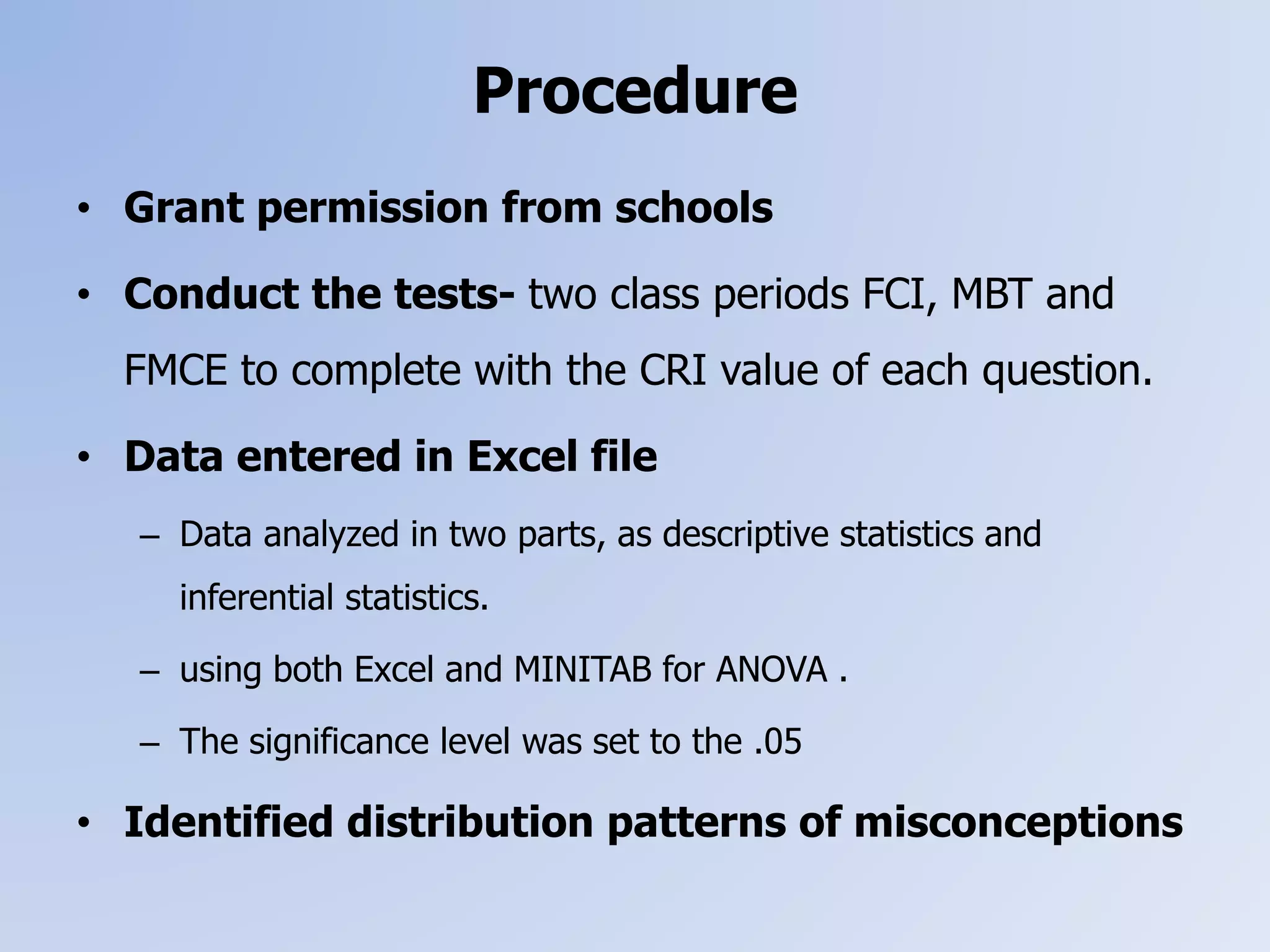
Procedure
• Grant permission from schools
• Conduct the tests- two class periods FCI, MBT and
FMCE to complete with the CRI value of each question.
• Data entered in Excel file
– Data analyzed in two parts, as descriptive statistics and
inferential statistics.
– using both Excel and MINITAB for ANOVA .
– The significance level was set to the .05
• Identified distribution patterns of misconceptions
Application of Measuring Tools
• translated tests into Sinhala
• test items checked and corrected.
• Finalized with the supervisor
• calculating the achievement scores,
– 1 point for each correct answer
– higher scores indicate lower number of
misconceptions.
Assumptions
1. The administrations of the FCI, MBT and FMCE together
with CRI were under standard conditions.
2. The subjects of the study answered the items
of the FCI, MBT and FMCE sincerely.
4. RESULTS & DISCUSSIONS
1. comparison of male and female students' misconceptions
2. Achievement scores and misconception scores through CRI
values of FCI,MBT and FMCE tests
3. Effect of Gender on misconceptions according to FCI,MBT
and FMCE tests
4. Effect of School type on misconceptions according to
FCI,MBT and FMCE tests
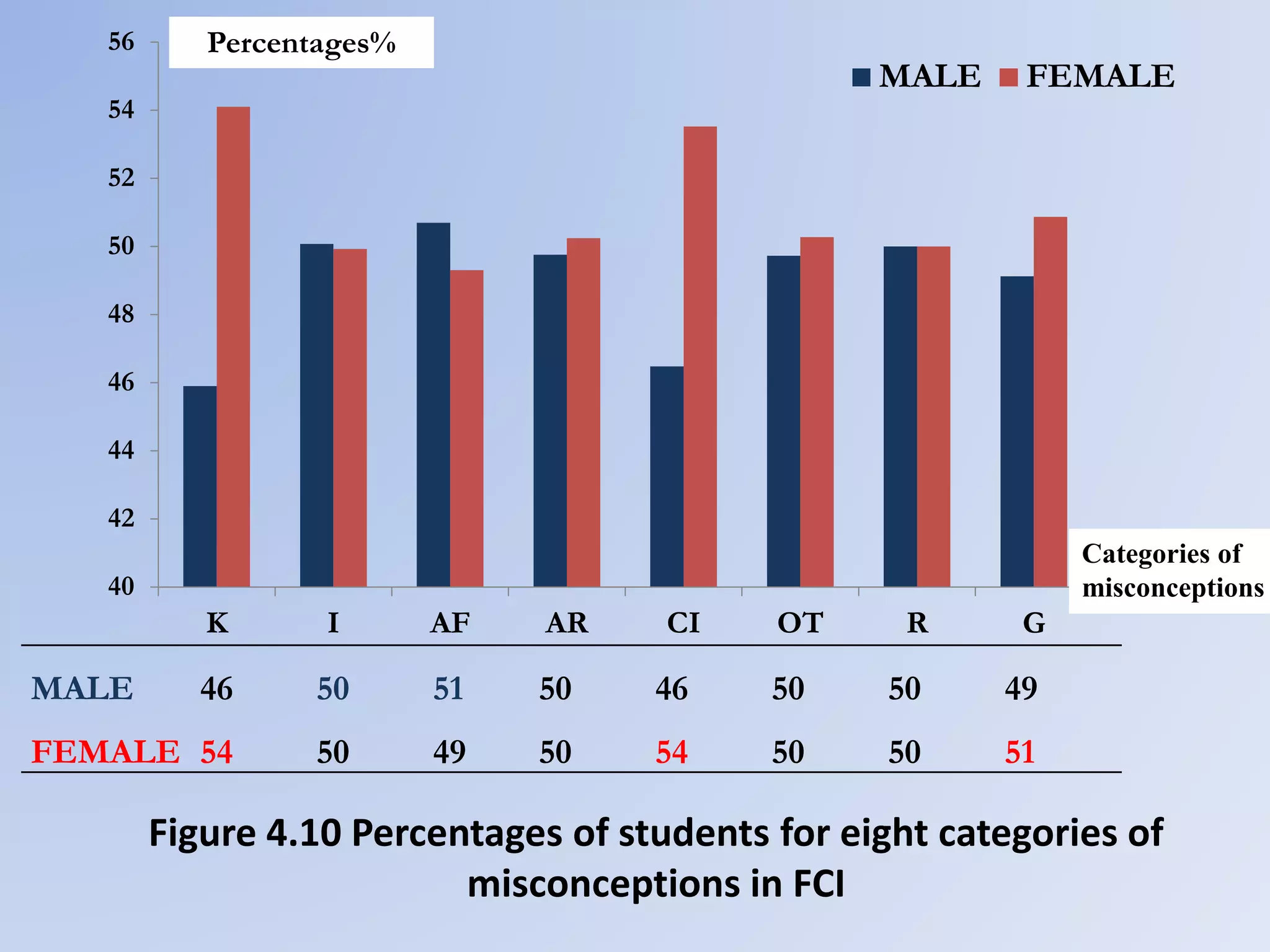
Figure 4.10 Percentages of students for eight categories of
misconceptions in FCI
40
42
44
46
48
50
52
54
56
K I AF AR CI OT R G
MALE FEMALE
MALE 46 50 51 50 46 50 50 49
FEMALE 54 50 49 50 54 50 50 51
Categories of
misconceptions
Percentages%
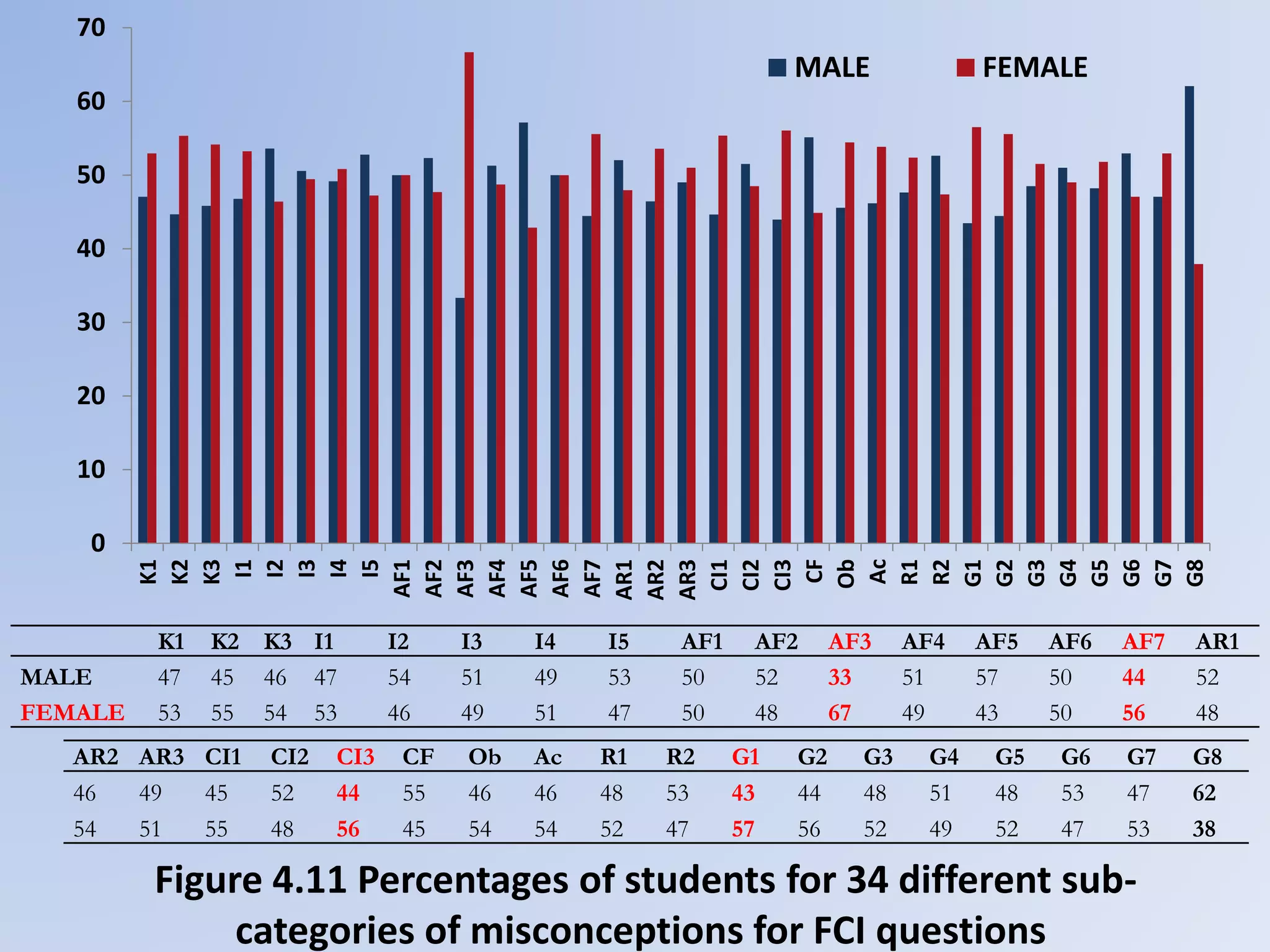
Figure 4.11 Percentages of students for 34 different sub-
categories of misconceptions for FCI questions
K1 K2 K3 I1 I2 I3 I4 I5 AF1 AF2 AF3 AF4 AF5 AF6 AF7 AR1
MALE 47 45 46 47 54 51 49 53 50 52 33 51 57 50 44 52
FEMALE 53 55 54 53 46 49 51 47 50 48 67 49 43 50 56 48
AR2 AR3 CI1 CI2 CI3 CF Ob Ac R1 R2 G1 G2 G3 G4 G5 G6 G7 G8
46 49 45 52 44 55 46 46 48 53 43 44 48 51 48 53 47 62
54 51 55 48 56 45 54 54 52 47 57 56 52 49 52 47 53 38
0
10
20
30
40
50
60
70
K1
K2
K3
I1
I2
I3
I4
I5
AF1
AF2
AF3
AF4
AF5
AF6
AF7
AR1
AR2
AR3
CI1
CI2
CI3
CF
Ob
Ac
R1
R2
G1
G2
G3
G4
G5
G6
G7
G8
MALE FEMALE
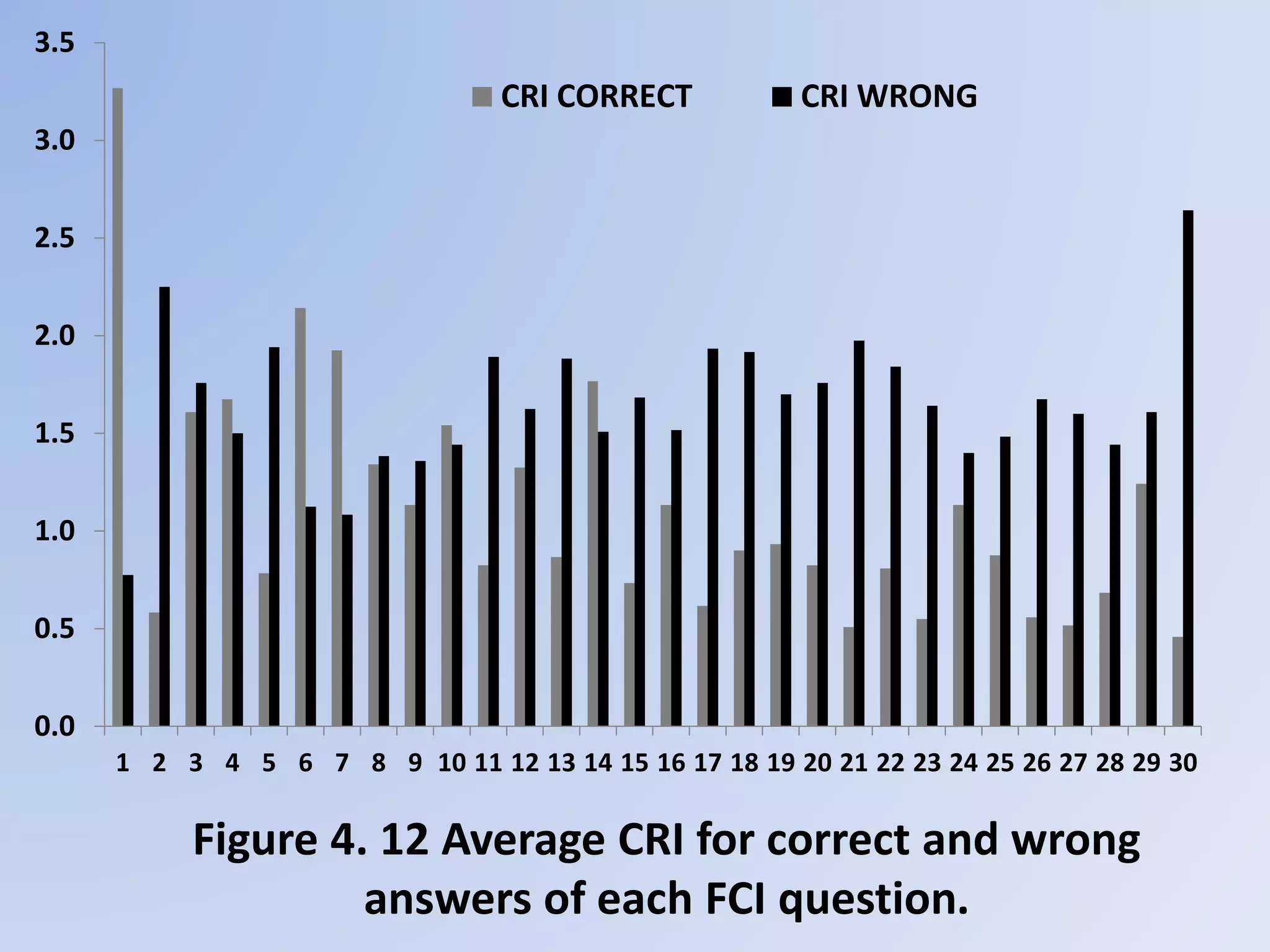
Figure 4. 12 Average CRI for correct and wrong
answers of each FCI question.
0.0
0.5
1.0
1.5
2.0
2.5
3.0
3.5
1 2 3 4 5 6 7 8 9 10 11 12 13 14 15 16 17 18 19 20 21 22 23 24 25 26 27 28 29 30
CRI CORRECT CRI WRONG
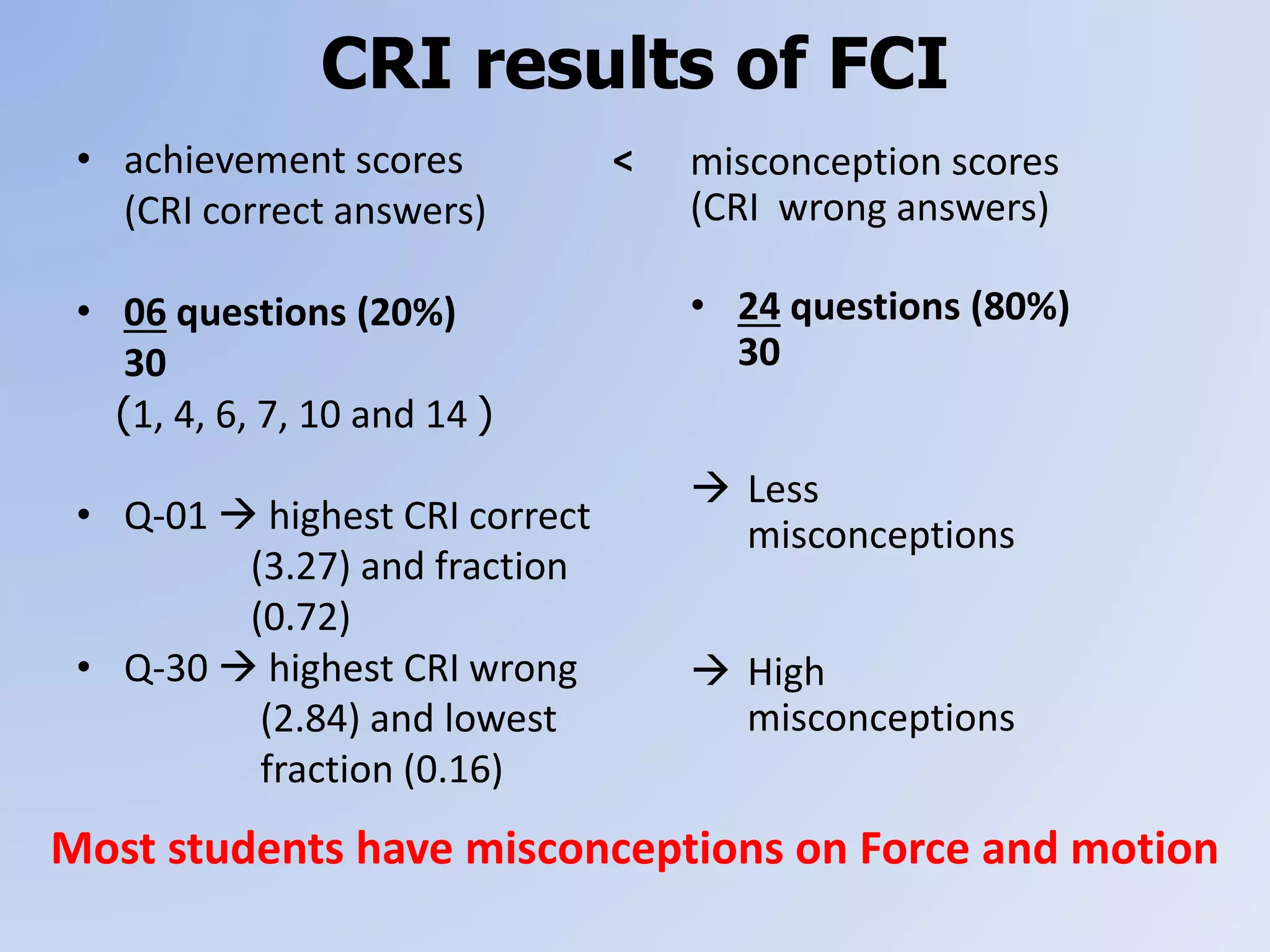
CRI results of FCI
• achievement scores <
(CRI correct answers)
• 06 questions (20%)
30
(1, 4, 6, 7, 10 and 14 )
• Q-01  highest CRI correct
(3.27) and fraction
(0.72)
• Q-30  highest CRI wrong
(2.84) and lowest
fraction (0.16)
misconception scores
(CRI wrong answers)
• 24 questions (80%)
30
 Less
misconceptions
 High
misconceptions
Most students have misconceptions on Force and motion
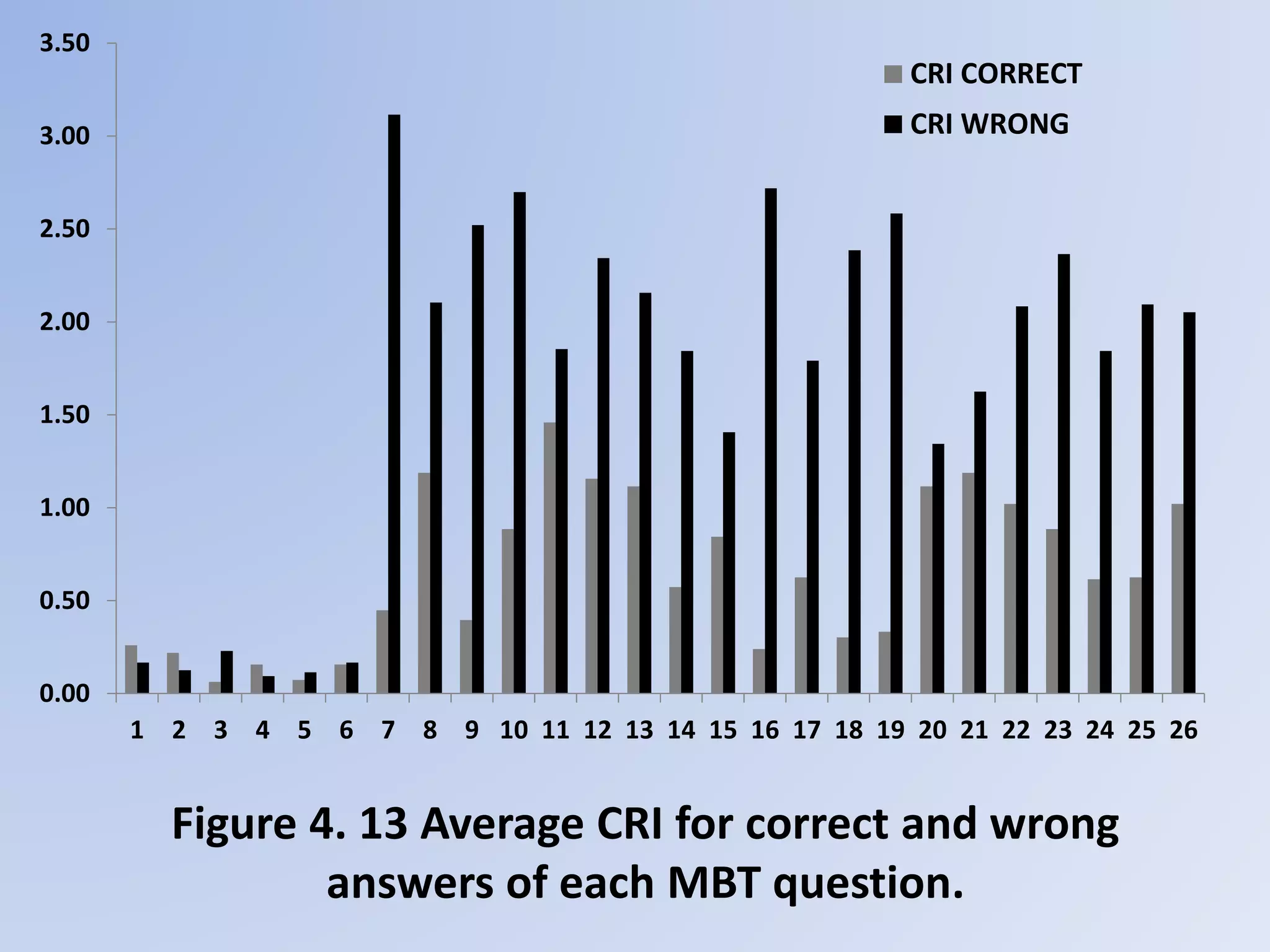
Figure 4. 13 Average CRI for correct and wrong
answers of each MBT question.
0.00
0.50
1.00
1.50
2.00
2.50
3.00
3.50
1 2 3 4 5 6 7 8 9 10 11 12 13 14 15 16 17 18 19 20 21 22 23 24 25 26
CRI CORRECT
CRI WRONG
CRI results of MBT
• achievement scores <
(CRI correct answers)
• 03 questions (10%)
26
(questions 1, 2 and 4)
• Q-07  highest CRI wrong 
(3.11) and lowest
fraction (0.04)
misconception scores
(CRI wrong answers)
• 23 questions (90%)
26
High misconceptions
Most students have misconceptions on Force and motion
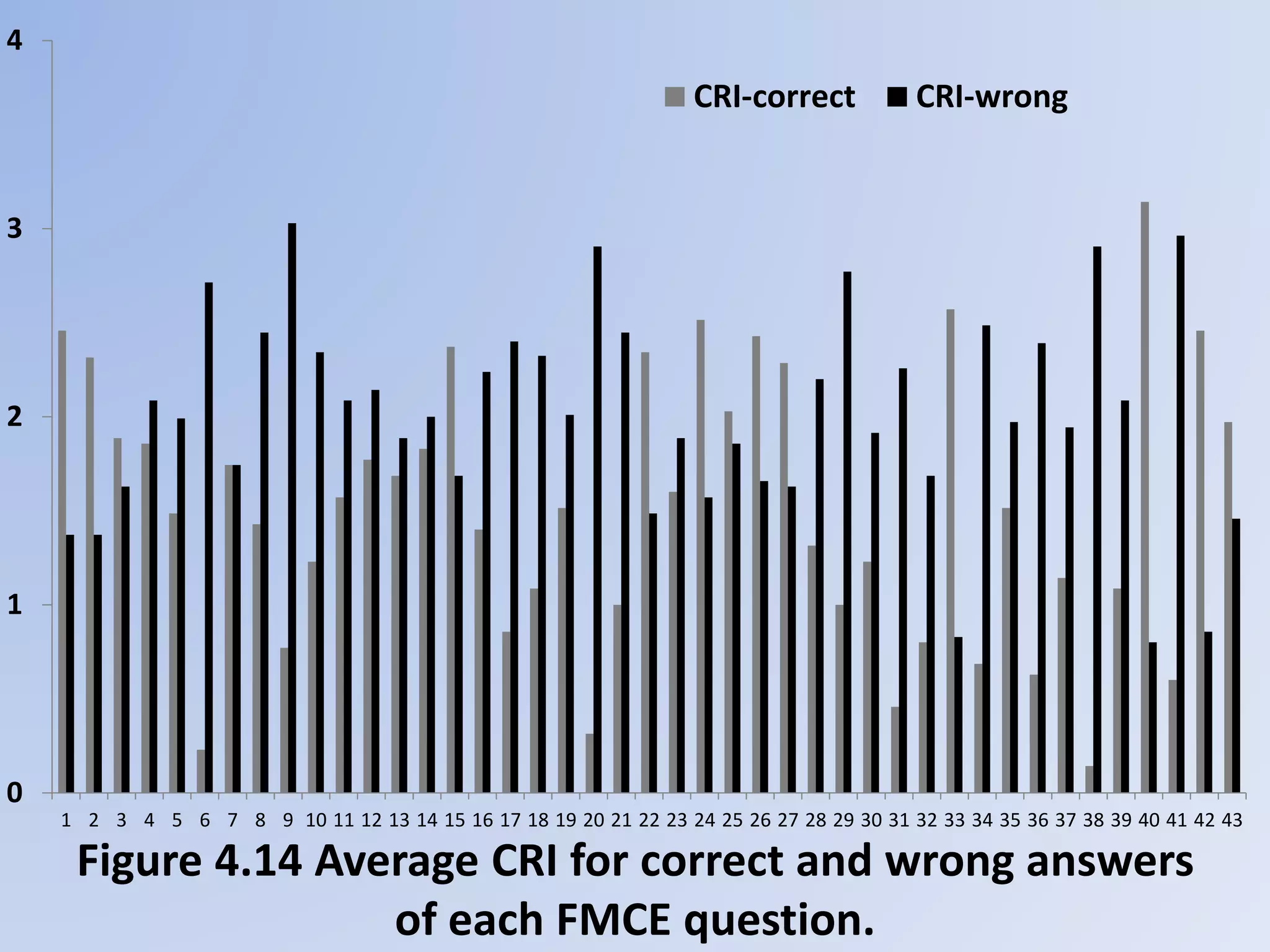
Figure 4.14 Average CRI for correct and wrong answers
of each FMCE question.
0
1
2
3
4
1 2 3 4 5 6 7 8 9 10 11 12 13 14 15 16 17 18 19 20 21 22 23 24 25 26 27 28 29 30 31 32 33 34 35 36 37 38 39 40 41 42 43
CRI-correct CRI-wrong
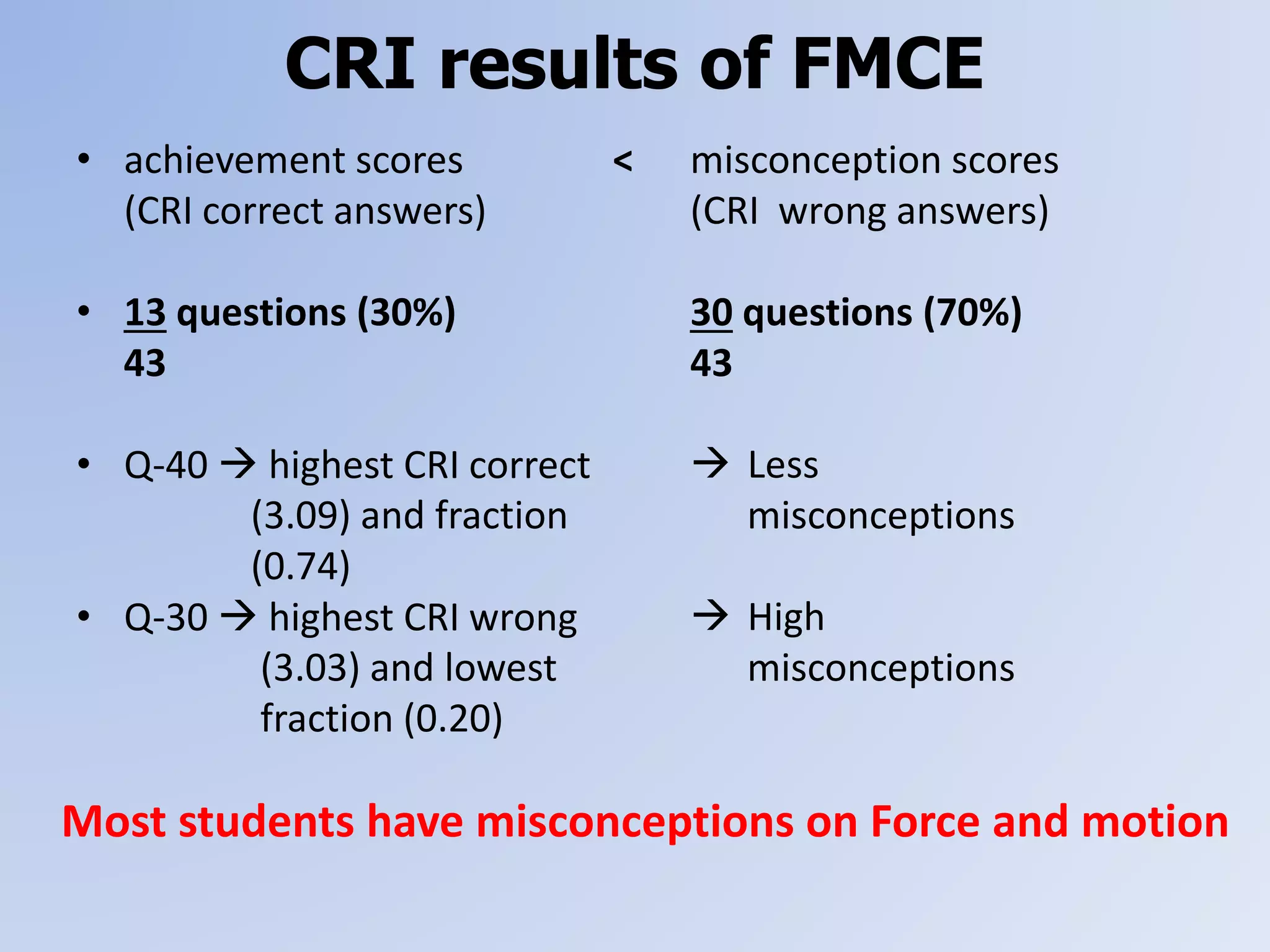
CRI results of FMCE
• achievement scores <
(CRI correct answers)
• 13 questions (30%)
43
• Q-40  highest CRI correct
(3.09) and fraction
(0.74)
• Q-30  highest CRI wrong
(3.03) and lowest
fraction (0.20)
misconception scores
(CRI wrong answers)
30 questions (70%)
43
 Less
misconceptions
 High
misconceptions
Most students have misconceptions on Force and motion
One-way ANOVA using MINITAB
• Gender was generally not effective on the students' total
conceptual understanding of force and motion through
FCI, MBT and FMCE test scores
• School type was generally not effective on the students'
total conceptual understanding of force and motion
through FCI , MBT and FMCE test scores
Effect of Gender and School type on Misconceptions
Students’ conceptual understanding and
Multiple Choice Concept Tests
• percentages of students' misconceptions are relatively
similar to the results of previous studies (Hestenes et al.,
1992; Eryılmaz, 1992; 2002).
• All findings of this research is not in agreement with
that of Eryılmaz's (1992 ; 2002) studies, that male
students have fewer misconceptions than female
students in mechanics.
• The gender difference was observed on the total FCI
scores and misconception categories of Kinetics and CI.
• FCI test, MBT and FMCE tests combined with CRI were
used in this research enables detecting Force and Motion
misconceptions.
5. CONCLUSIONS AND SUGGESTIONS
CONCLUSIONS
• Three tests combined with CRI, studied A/L Students'
mechanics achievement scores are lower than their
misconception scores.
• Misconception scores are lower than that of
misconception scores of FCI, MBT and FMCE tests
combined with CRI.
• Studied population does not indicate a significant
difference in misconception scores with gender for MBT
and FMCE tests.
• Studied population does not indicate a significant
difference in misconception scores with school type for
MBT and FMCE tests.
Suggestions
• use a modern method of teaching Physics in secondary
education
• precautions to be taken to minimize misconceptions
• the academic staff should take note of
– the background
– daily life experiences
– differences in type of activities
– preconceptions of the knowledge of their students before
teaching them.
• need of a module to replace misconceptions with correct
scientific concepts
• Teachers should encourage to set meaningful learning goals
and understand their contributions
• The Physics lessons should enable students' conceptual
learning instead of rote learning
• use of laboratory materials should be improved by supplying
experiments and activities that student can perform and learn
concepts by doing themselves.
6. BIBLIOGRAPHY
7. APPENDICES
I. FORCE CONCEPT INVENTORY (FCI)
II. MECHANICS BASELINE TEST (MBT)
III. FORCE AND MORTION CONCEPTUAL EVELUATION
(FMCE)
IV - VI. ANSWER KEYS
VII-IX. RAW DATA
Thank You !

Physics: Force & motion misconceptions

  • 1.
    M.Sc. in Science Education (Biology) SE519 Research Project R.D.N.P. Chandrasena PGIS/SE/MSc/SED/BE/10/04
  • 2.
    Students’ Conceptual Understanding andMisconceptions on Force and Motion through different instruments combined with Certainty Response Index (CRI)
  • 3.
    CONTENT 1. Introduction 2. LiteratureReview 3. Methodology 4. Analysis of Results 5. Conclusion 6. References 7. Appendices
  • 4.
  • 5.
    • To developcompetencies in science, – deep foundation of factual knowledge – understand facts and ideas to build up conceptual knowledge – organize knowledge in ways that facilitate retrieval and application Background
  • 6.
    • Performance inScience (G.C.E. (O/L)) • Entrance for G.C.E. (A/L) Science stream • Scientifically literate workforce Poor ??? or High ???
  • 7.
    Why Science conceptsnot build up or come up with Misconceptions ? correct wrong Powerful support for further learning lead to the development of conceptions that can act as barriers to learning Prior knowledge : Students preconceptions about how the world works
  • 8.
    A FISH STORY: Children’s story Leo Lionni’s Fish Is Fish © 1970. Copyright renewed 1998 by Leo Lionni
  • 9.
    Domain of Physicseducation • Physics - dynamic and well developed field of science • fundamentals constitutes of universe – Newtonian Mechanics • Force and Motion misconceptions
  • 10.
    Physics in schoolcurriculum • Initiate in Grade 6 Science curriculum  Developed year by year • General Certificate of Examination (G.C.E) Ordinary Level (O/L) . – Grade 10 and 11 Science curriculum consists Physics, Chemistry and Biology • Science stream of (G.C.E) Advanced Level (A/L) – Grade 12 and 13 : Physics as a main subject
  • 11.
    Goal To improve thequality of teaching and maximize learning of Physics in science classrooms through addressing problems in force and motion concepts in domain of Physics education.
  • 12.
    Objectives • To identifydiversity of students conceptual understanding and misconceptions in force and motion concepts • To identify the effect of school type and gender on misconceptions • To help teachers to improve teaching methodologies to minimize students’ misconceptions • To help students to become effective leaners • To find replacing methods of force and motion misconceptions
  • 13.
    2. LITERATURE REVIEW •Misconceptions Concerning Force and Motion • Factors that affect on misconceptions • The Instruments – Force Concept Inventory (FCI) Test – Mechanics Baseline Test (MBT) – Force and Motion Conceptual Evaluation (FMCE) Test – Certainty Response Index (CRI)
  • 14.
    Misconceptions …. • Thelearner’s initial personal knowledge, i.e., his or her conceptions, beliefs, and views, is the most important factor influencing learning. constructivist views • an idea which is wrong or untrue, but which people believe because they do not understand the subject properly. Longman English Dictionary
  • 15.
    Concepts and Misconceptionsin Force & Motion i. Impetus: "force“ ii. Active Force: iii. Velocity is proportional to Force: iv. Motion implies force: v. Passive forces: vi. Gravity: vii. Action-Reaction Pairs: viii. Ideal versus real systems: ix. Position, Velocity and Acceleration Confusion: x. Confused the velocity and the acceleration of an object.
  • 16.
    Factors that mayaffect on misconceptions • initial knowledge, Hestenes et al. (1992) • conventional instruction • teaching practices (Glasersfeld, 1992). • Gender • Age • Life experiences • School type • Family background • contextual change, learning style, quality of teacher, experiences, attitudes, text context, mathematics background, learning styles and instruction
  • 17.
    The Instruments • Multiple-choicetests – Force Concept Inventory (FCI) – Mechanics baseline Test (MBT) – Force and Motion Conceptual Evaluation (FMCE) answers combined with, • Certainty of Response Index (CRI) - Hasany, Bagayokoz and Kelley, 1999
  • 18.
    1. Force ConceptInventory (FCI) Test • multiple-choice test ; 30 qualitative questions • cover eight conceptual dimensions on force and kinematics – Kinematics (K) - Impetus (I), – Active Force (AF) - Action/Reaction pairs(AR) – Concatenation of Influences on motion (CI) - Other Influences – Resistance (R) - Gravity (G). • probes, – students’ conceptions on Newtonian mechanics, force – students’ ability to apply them in various contexts (Hestenes et al. 1992).
  • 19.
    Table 2.1 Classificationof commonsense misconceptions probed by the Inventory and the distracters measuring related misconceptions
  • 21.
    2. Mechanics BaselineTest (MBT) • 26 multiple-choice questions • emphasizes concepts that cannot be grasped without formal knowledge about mechanics • assess quantitative understanding • multiple-choice distracters typical student mistakes, due to deficient understanding than to carelessness. • real deficiencies in understanding the basic concepts Hestenes & Wells, 1992
  • 22.
    3. Force andMotion Conceptual Evaluation (FMCE) Test • probe conceptual understanding of Newtonian mechanics. • achievement measure • emphasis on students’ understanding of graphical representations of velocity, acceleration, and force. • higher scores indicate greater achievement
  • 23.
    4. Calculating CRIValues Calculate sum of the CRI values of correct answers wrong answers sample number sample number final CRI value final CRI value
  • 24.
    Table 2.2 CertaintyResponse Index Reference Values • a simple and novel method for identifying misconceptions • utilizes in conjunction with answers to multiple choice questions (Hasan,2000).
  • 25.
    3. METHODOLOGY 3.1. StudyDesign 3.2. Variables 3.3. Selecting Measuring Tools 3.3.1. Force Concept Inventory (FCI) Test 3.3.2. Mechanics Baseline Test (MBT) 3.3.3. Force and Motion Conceptual Evaluation (FMCE) 3.3.4 Certainty Response Index (CRI) 3.4. Procedure 3.5. Assumptions
  • 26.
    • Selection ofsample : General Certificate of Examinations, Advanced Level (G.C.E. - A/L) science stream students (study Physics) of grade 12 and 13 • Very Large Population  sample of 5 different schools • Sample Area : Negombo Education Zone – School category : 1 AB – School types : Girls (2), Boys (1), Mixed (2) – Medium : Sinhala, English – Sample No. : 10 - 40 students from a class (Table 3.1) Study Design
  • 27.
    Table 3.1 Numbersof tested students in each test according to Gender and Medium No. School type Gender MediumFCI MBT FMCE . 1 Girls’ Female Sinhala 11 English 06 2 Mixed Female Sinhala 03 07 English 02 07 Male Sinhala 10 11 English 03 17 3 Boys’ Male Sinhala 19 18 15 English 22 12 12 4 Girls’ Female Sinhala 20 10 English 14 32 5 Mixed Female Sinhala 07 15 English 01 06 Male Sinhala 09 09 English 07 06 Total 110 95 105
  • 28.
    Procedure • Grant permissionfrom schools • Conduct the tests- two class periods FCI, MBT and FMCE to complete with the CRI value of each question. • Data entered in Excel file – Data analyzed in two parts, as descriptive statistics and inferential statistics. – using both Excel and MINITAB for ANOVA . – The significance level was set to the .05 • Identified distribution patterns of misconceptions
  • 29.
    Application of MeasuringTools • translated tests into Sinhala • test items checked and corrected. • Finalized with the supervisor • calculating the achievement scores, – 1 point for each correct answer – higher scores indicate lower number of misconceptions.
  • 30.
    Assumptions 1. The administrationsof the FCI, MBT and FMCE together with CRI were under standard conditions. 2. The subjects of the study answered the items of the FCI, MBT and FMCE sincerely.
  • 31.
    4. RESULTS &DISCUSSIONS 1. comparison of male and female students' misconceptions 2. Achievement scores and misconception scores through CRI values of FCI,MBT and FMCE tests 3. Effect of Gender on misconceptions according to FCI,MBT and FMCE tests 4. Effect of School type on misconceptions according to FCI,MBT and FMCE tests
  • 32.
    Figure 4.10 Percentagesof students for eight categories of misconceptions in FCI 40 42 44 46 48 50 52 54 56 K I AF AR CI OT R G MALE FEMALE MALE 46 50 51 50 46 50 50 49 FEMALE 54 50 49 50 54 50 50 51 Categories of misconceptions Percentages%
  • 33.
    Figure 4.11 Percentagesof students for 34 different sub- categories of misconceptions for FCI questions K1 K2 K3 I1 I2 I3 I4 I5 AF1 AF2 AF3 AF4 AF5 AF6 AF7 AR1 MALE 47 45 46 47 54 51 49 53 50 52 33 51 57 50 44 52 FEMALE 53 55 54 53 46 49 51 47 50 48 67 49 43 50 56 48 AR2 AR3 CI1 CI2 CI3 CF Ob Ac R1 R2 G1 G2 G3 G4 G5 G6 G7 G8 46 49 45 52 44 55 46 46 48 53 43 44 48 51 48 53 47 62 54 51 55 48 56 45 54 54 52 47 57 56 52 49 52 47 53 38 0 10 20 30 40 50 60 70 K1 K2 K3 I1 I2 I3 I4 I5 AF1 AF2 AF3 AF4 AF5 AF6 AF7 AR1 AR2 AR3 CI1 CI2 CI3 CF Ob Ac R1 R2 G1 G2 G3 G4 G5 G6 G7 G8 MALE FEMALE
  • 34.
    Figure 4. 12Average CRI for correct and wrong answers of each FCI question. 0.0 0.5 1.0 1.5 2.0 2.5 3.0 3.5 1 2 3 4 5 6 7 8 9 10 11 12 13 14 15 16 17 18 19 20 21 22 23 24 25 26 27 28 29 30 CRI CORRECT CRI WRONG
  • 35.
    CRI results ofFCI • achievement scores < (CRI correct answers) • 06 questions (20%) 30 (1, 4, 6, 7, 10 and 14 ) • Q-01  highest CRI correct (3.27) and fraction (0.72) • Q-30  highest CRI wrong (2.84) and lowest fraction (0.16) misconception scores (CRI wrong answers) • 24 questions (80%) 30  Less misconceptions  High misconceptions Most students have misconceptions on Force and motion
  • 36.
    Figure 4. 13Average CRI for correct and wrong answers of each MBT question. 0.00 0.50 1.00 1.50 2.00 2.50 3.00 3.50 1 2 3 4 5 6 7 8 9 10 11 12 13 14 15 16 17 18 19 20 21 22 23 24 25 26 CRI CORRECT CRI WRONG
  • 37.
    CRI results ofMBT • achievement scores < (CRI correct answers) • 03 questions (10%) 26 (questions 1, 2 and 4) • Q-07  highest CRI wrong  (3.11) and lowest fraction (0.04) misconception scores (CRI wrong answers) • 23 questions (90%) 26 High misconceptions Most students have misconceptions on Force and motion
  • 38.
    Figure 4.14 AverageCRI for correct and wrong answers of each FMCE question. 0 1 2 3 4 1 2 3 4 5 6 7 8 9 10 11 12 13 14 15 16 17 18 19 20 21 22 23 24 25 26 27 28 29 30 31 32 33 34 35 36 37 38 39 40 41 42 43 CRI-correct CRI-wrong
  • 39.
    CRI results ofFMCE • achievement scores < (CRI correct answers) • 13 questions (30%) 43 • Q-40  highest CRI correct (3.09) and fraction (0.74) • Q-30  highest CRI wrong (3.03) and lowest fraction (0.20) misconception scores (CRI wrong answers) 30 questions (70%) 43  Less misconceptions  High misconceptions Most students have misconceptions on Force and motion
  • 40.
    One-way ANOVA usingMINITAB • Gender was generally not effective on the students' total conceptual understanding of force and motion through FCI, MBT and FMCE test scores • School type was generally not effective on the students' total conceptual understanding of force and motion through FCI , MBT and FMCE test scores Effect of Gender and School type on Misconceptions
  • 41.
    Students’ conceptual understandingand Multiple Choice Concept Tests • percentages of students' misconceptions are relatively similar to the results of previous studies (Hestenes et al., 1992; Eryılmaz, 1992; 2002). • All findings of this research is not in agreement with that of Eryılmaz's (1992 ; 2002) studies, that male students have fewer misconceptions than female students in mechanics. • The gender difference was observed on the total FCI scores and misconception categories of Kinetics and CI. • FCI test, MBT and FMCE tests combined with CRI were used in this research enables detecting Force and Motion misconceptions.
  • 42.
    5. CONCLUSIONS ANDSUGGESTIONS
  • 43.
    CONCLUSIONS • Three testscombined with CRI, studied A/L Students' mechanics achievement scores are lower than their misconception scores. • Misconception scores are lower than that of misconception scores of FCI, MBT and FMCE tests combined with CRI. • Studied population does not indicate a significant difference in misconception scores with gender for MBT and FMCE tests. • Studied population does not indicate a significant difference in misconception scores with school type for MBT and FMCE tests.
  • 44.
    Suggestions • use amodern method of teaching Physics in secondary education • precautions to be taken to minimize misconceptions • the academic staff should take note of – the background – daily life experiences – differences in type of activities – preconceptions of the knowledge of their students before teaching them. • need of a module to replace misconceptions with correct scientific concepts
  • 45.
    • Teachers shouldencourage to set meaningful learning goals and understand their contributions • The Physics lessons should enable students' conceptual learning instead of rote learning • use of laboratory materials should be improved by supplying experiments and activities that student can perform and learn concepts by doing themselves.
  • 46.
  • 47.
    7. APPENDICES I. FORCECONCEPT INVENTORY (FCI) II. MECHANICS BASELINE TEST (MBT) III. FORCE AND MORTION CONCEPTUAL EVELUATION (FMCE) IV - VI. ANSWER KEYS VII-IX. RAW DATA
  • 48.