Electromagnetic Radiation
Insulators & Conductors
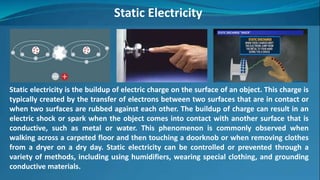
Static electricity is the buildup of electric charge on the surface of an object. This charge is
typically created by the transfer of electrons between two surfaces that are in contact or
when two surfaces are rubbed against each other. The buildup of charge can result in an
electric shock or spark when the object comes into contact with another surface that is
conductive, such as metal or water. This phenomenon is commonly observed when
walking across a carpeted floor and then touching a doorknob or when removing clothes
from a dryer on a dry day. Static electricity can be controlled or prevented through a
variety of methods, including using humidifiers, wearing special clothing, and grounding
conductive materials.
Static Electricity
Difference of Potential
• A difference of potential exists between similar bodies charged with
different quantities of electricity. If a conducting connection is made
between the two bodies, electrons will flow from the more negative
body to the less negative one. The force producing this movement is
called an electromotive force (EMF).
• Electron flow continues until both objects are at the same potential.
• The greater the potential difference, the greater the EMF.
Current Electricity
• An electric current occurs when there is a flow of charged particles
(generally electrons) in a conductor.
• The factors essential for the production of an electric current are a
difference of potential (PD), and a conducting pathway between the
points of potential difference.
• Electrons will flow only for as long as the potential difference & the
pathway exist.
Current Electricity
Magnitude of Current
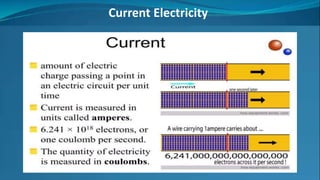
• The intensity, or magnitude, of current (I) is the rate of flow of electrons
through the conductor per second. Electric current is measured in
amperes, one ampere being a rate of flow of one coulomb (6.26 x 10¹⁸
electrons) per second.
• The greater the EMF applied, the greater is the flow of electrons. (Direct
Relationship)
• The greater the resistance, the more difficult it is for electrons to move
through the conductor (produce a low current: inverse relationship).
Resistance
Resistance
Resistance in Series
• Connected in Series. One possible way.
• Total Resistance is equal to sum of individual resistance
Resistance in Parallel
• Current is offered number of alternatives routes.
• Current divides in 3 parts at A & unites again at B.
• Larger the resistance, carries the smallest current.
Electrical Energy & Power
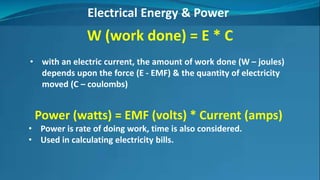
W (work done) = E * C
• with an electric current, the amount of work done (W – joules)
depends upon the force (E - EMF) & the quantity of electricity
moved (C – coulombs)
Power (watts) = EMF (volts) * Current (amps)
• Power is rate of doing work, time is also considered.
• Used in calculating electricity bills.
Electrical Watts
Magnetism
 Revolving electrons produce a North & South pole for each
molecule
 No matter how many times magnet is divided, it will represent
North & South pole.
 Arrangement of molecular magnets
Magnetism
 Properties:
• Setting in North South direction
• Unlike poles Attract, while like poles shall Repel
• Transmission of properties
 Magnetization by Contact
 Magnetic Induction
• Attraction of suitable materials
• A magnetic field
Magnetization by Contact
Electromagnetic Induction
Laws of Governing Radiation
• Reflection
• Refraction
• Absorption
Resistor
Transformer
Capacitor
Capacitor
Capacitor
Capacitor
Capacitor
Capacitor
Capacitor
Thermionic Valves
Thermionic Valves
Thermionic Valves
Thermionic Valves
Semi Conductors
Semi Conductors
Rheostat
Rheostat
Rheostat
Rheostat

Physics & Basic Electrical Equipments.pptx

  • 2.
  • 5.
  • 6.
    Static electricity isthe buildup of electric charge on the surface of an object. This charge is typically created by the transfer of electrons between two surfaces that are in contact or when two surfaces are rubbed against each other. The buildup of charge can result in an electric shock or spark when the object comes into contact with another surface that is conductive, such as metal or water. This phenomenon is commonly observed when walking across a carpeted floor and then touching a doorknob or when removing clothes from a dryer on a dry day. Static electricity can be controlled or prevented through a variety of methods, including using humidifiers, wearing special clothing, and grounding conductive materials. Static Electricity
  • 9.
    Difference of Potential •A difference of potential exists between similar bodies charged with different quantities of electricity. If a conducting connection is made between the two bodies, electrons will flow from the more negative body to the less negative one. The force producing this movement is called an electromotive force (EMF). • Electron flow continues until both objects are at the same potential. • The greater the potential difference, the greater the EMF.
  • 10.
    Current Electricity • Anelectric current occurs when there is a flow of charged particles (generally electrons) in a conductor. • The factors essential for the production of an electric current are a difference of potential (PD), and a conducting pathway between the points of potential difference. • Electrons will flow only for as long as the potential difference & the pathway exist.
  • 11.
  • 12.
    Magnitude of Current •The intensity, or magnitude, of current (I) is the rate of flow of electrons through the conductor per second. Electric current is measured in amperes, one ampere being a rate of flow of one coulomb (6.26 x 10¹⁸ electrons) per second. • The greater the EMF applied, the greater is the flow of electrons. (Direct Relationship) • The greater the resistance, the more difficult it is for electrons to move through the conductor (produce a low current: inverse relationship).
  • 13.
  • 14.
  • 15.
    Resistance in Series •Connected in Series. One possible way. • Total Resistance is equal to sum of individual resistance
  • 16.
    Resistance in Parallel •Current is offered number of alternatives routes. • Current divides in 3 parts at A & unites again at B. • Larger the resistance, carries the smallest current.
  • 17.
    Electrical Energy &Power W (work done) = E * C • with an electric current, the amount of work done (W – joules) depends upon the force (E - EMF) & the quantity of electricity moved (C – coulombs) Power (watts) = EMF (volts) * Current (amps) • Power is rate of doing work, time is also considered. • Used in calculating electricity bills.
  • 18.
  • 19.
    Magnetism  Revolving electronsproduce a North & South pole for each molecule  No matter how many times magnet is divided, it will represent North & South pole.  Arrangement of molecular magnets
  • 20.
    Magnetism  Properties: • Settingin North South direction • Unlike poles Attract, while like poles shall Repel • Transmission of properties  Magnetization by Contact  Magnetic Induction • Attraction of suitable materials • A magnetic field
  • 21.
  • 22.
  • 25.
    Laws of GoverningRadiation • Reflection • Refraction • Absorption
  • 27.
  • 28.
  • 29.
  • 30.
  • 31.
  • 32.
  • 33.
  • 34.
  • 35.
  • 36.
  • 37.
  • 38.
  • 39.
  • 40.
  • 41.
  • 42.
  • 43.
  • 44.
  • 45.