AI for Medicine
Lecture 1: Introduction
January 18, 2021
Mohammad Hammoud
Carnegie Mellon University in Qatar
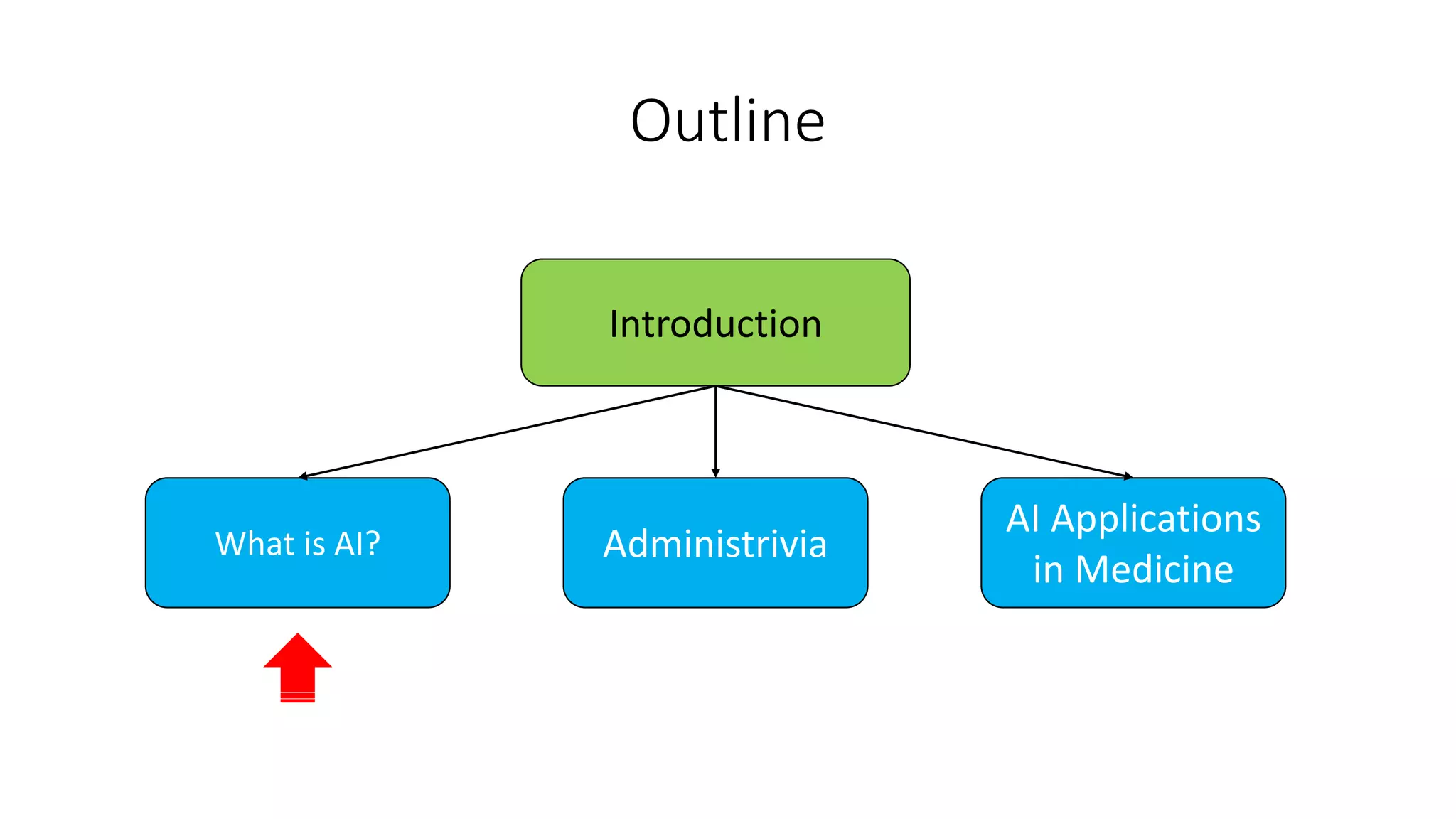
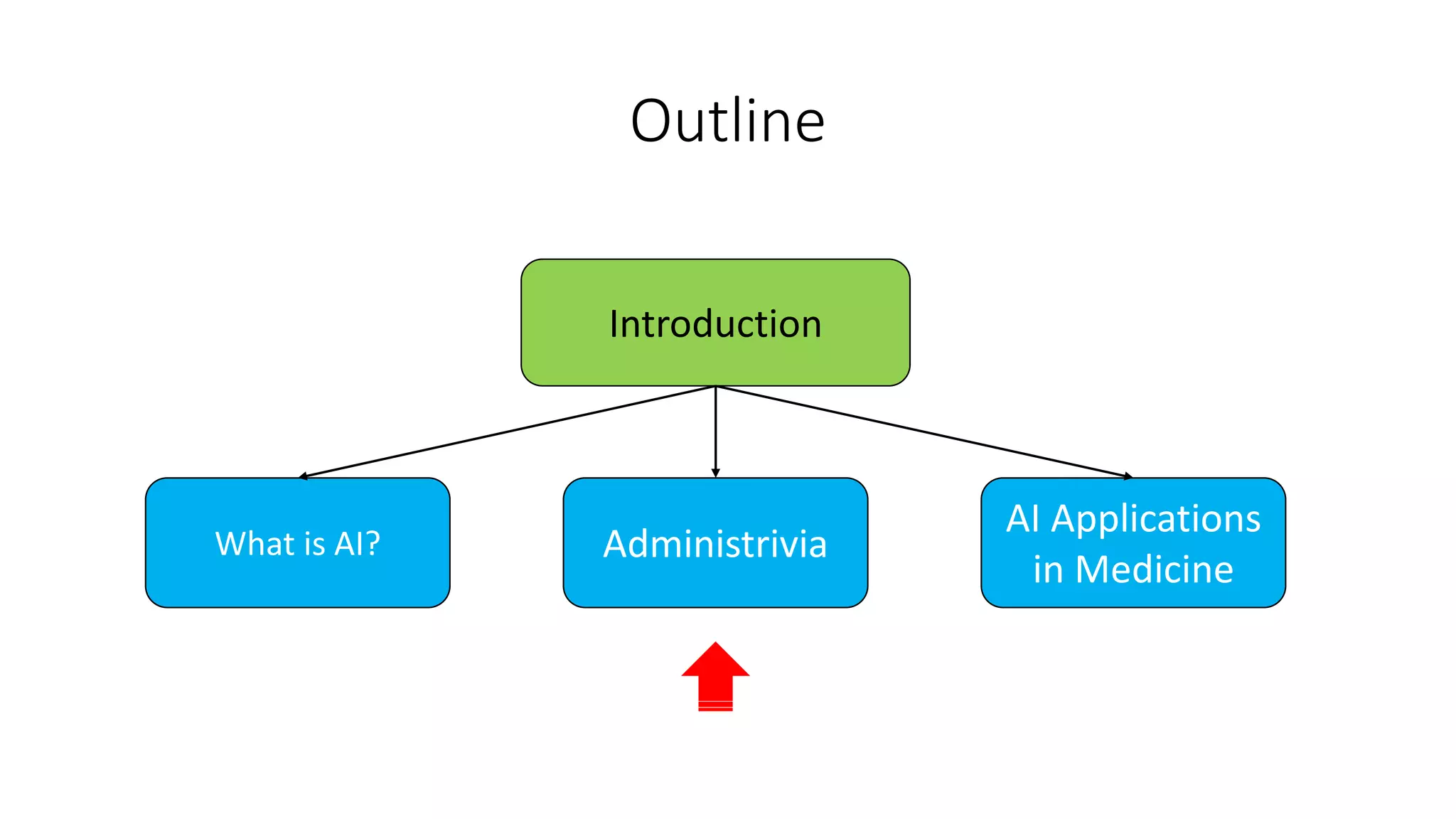
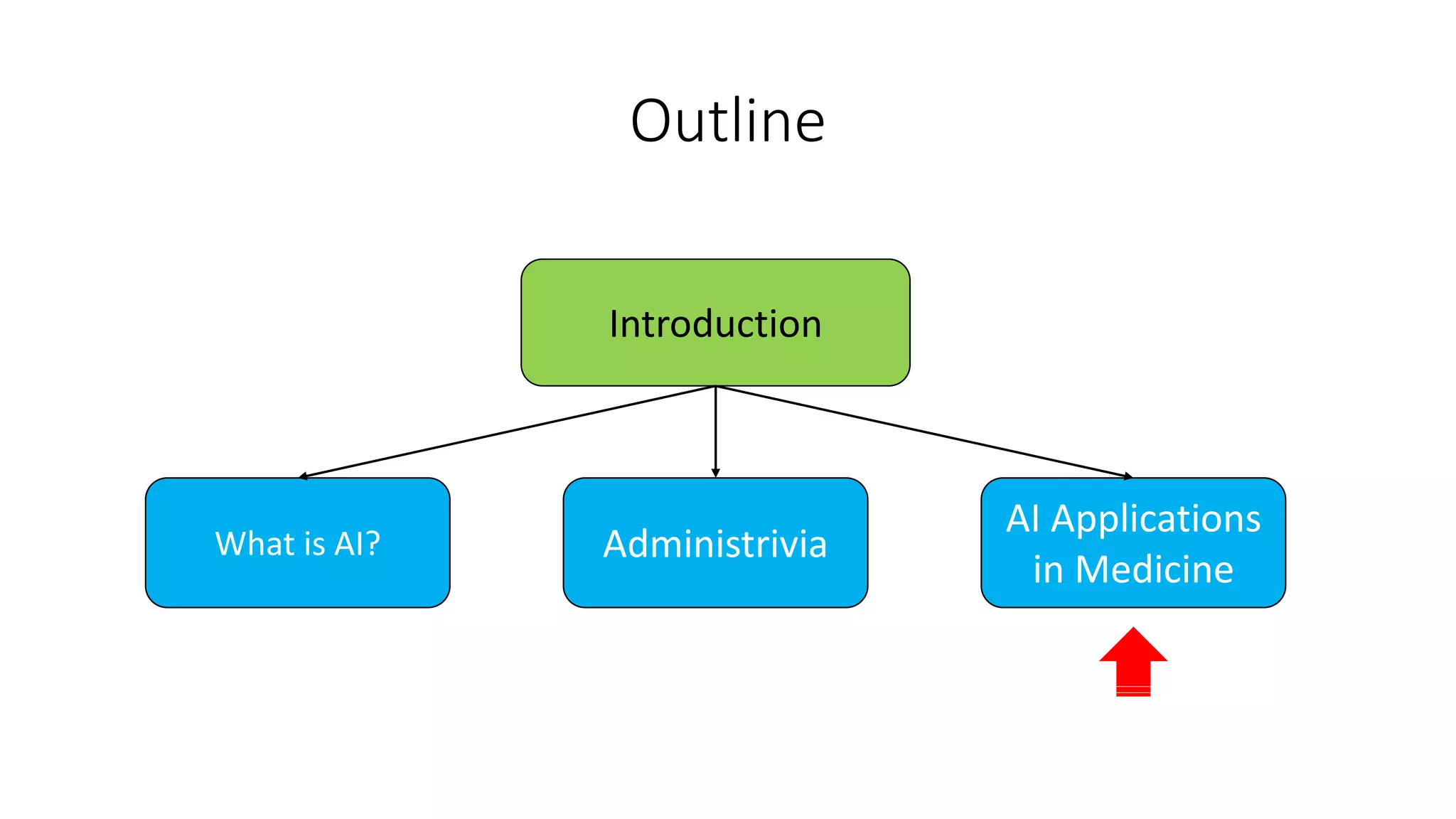
Outline
Introduction
What is AI? Administrivia
AI Applications
in Medicine
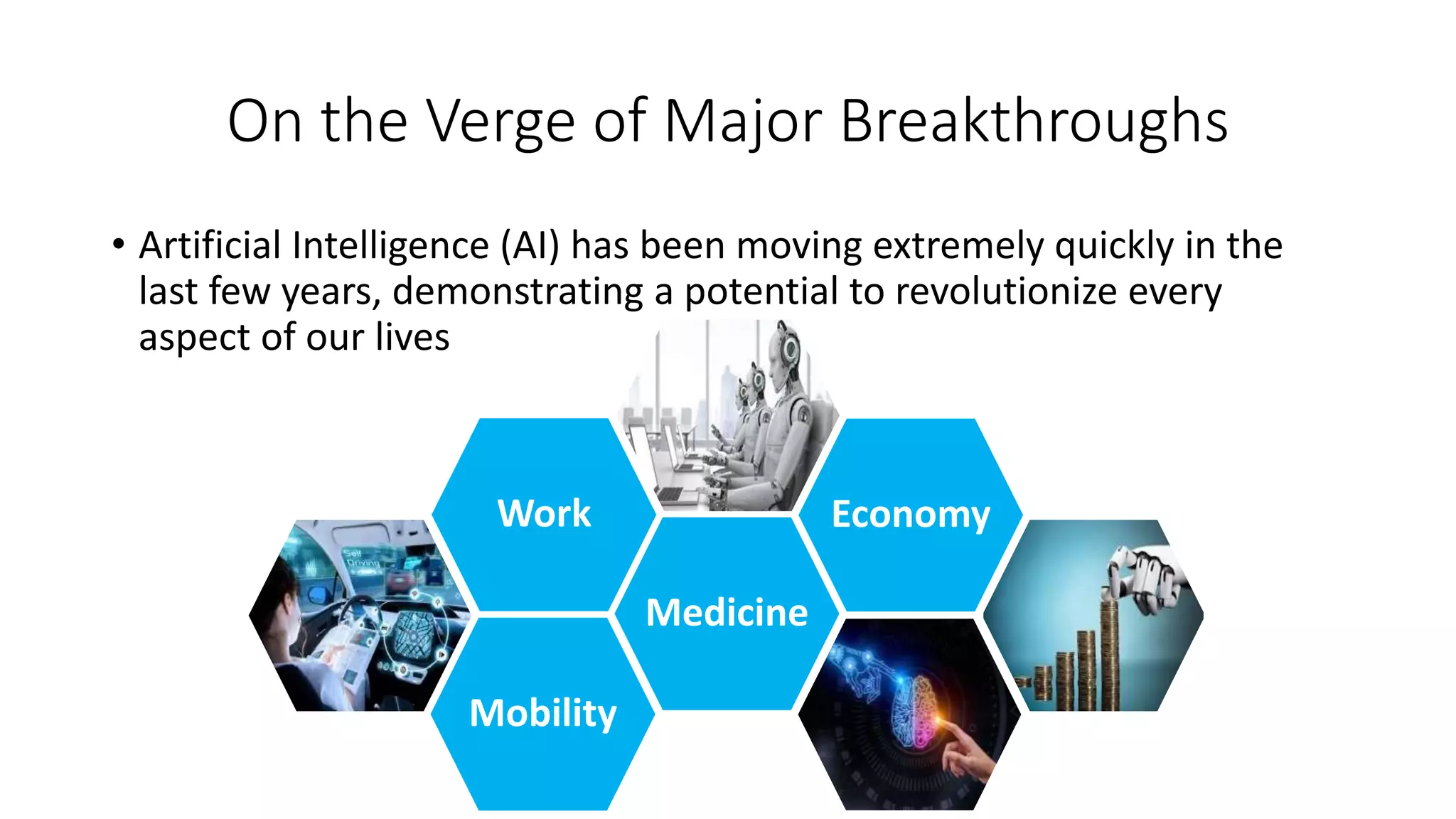
On the Verge of Major Breakthroughs
• Artificial Intelligence (AI) has been moving extremely quickly in the
last few years, demonstrating a potential to revolutionize every
aspect of our lives
Work
Mobility
Medicine
Economy
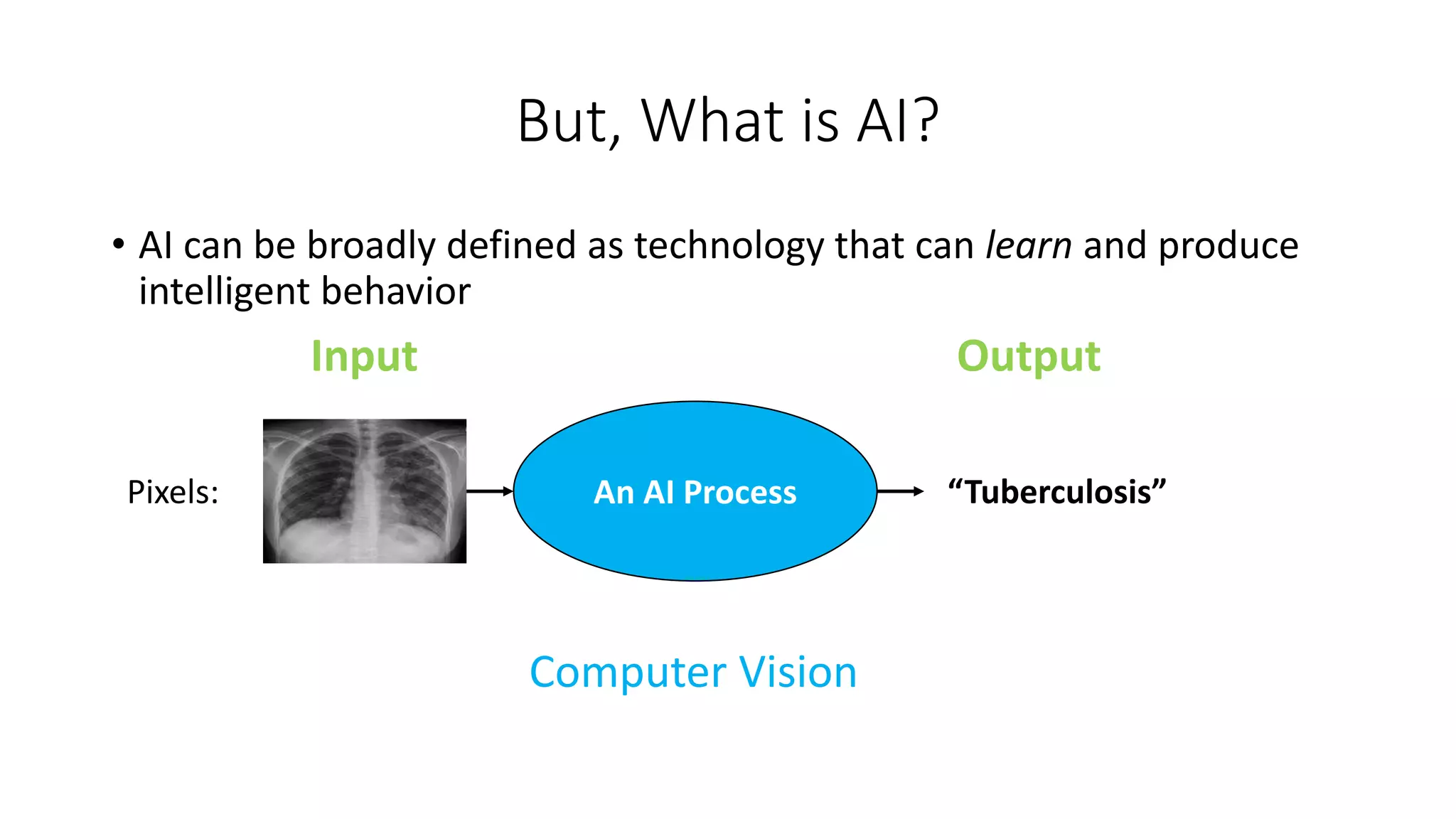
But, What is AI?
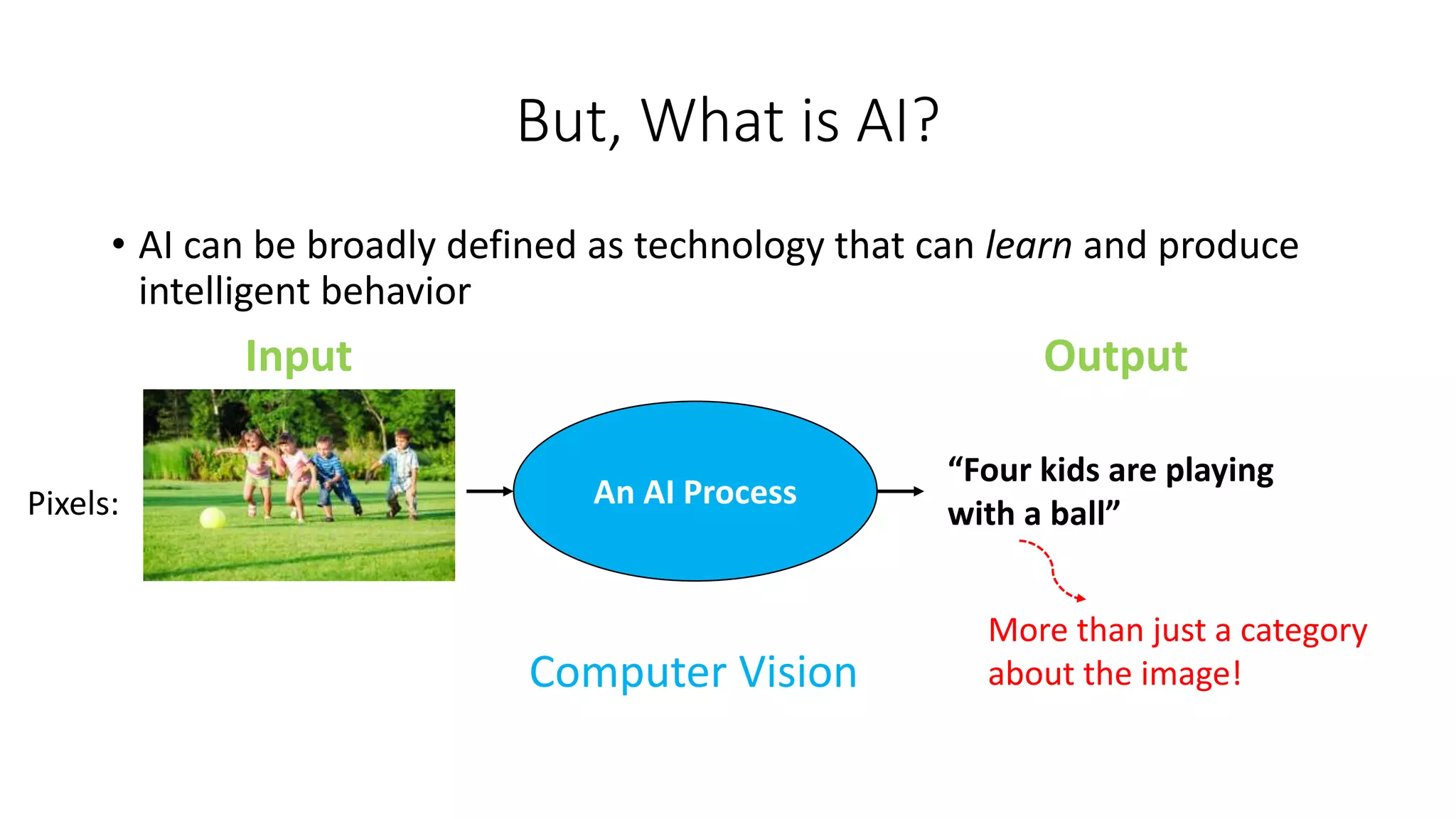
• AI can be broadly defined as technology that can learn and produce
intelligent behavior
Input Output
Pixels: “Tuberculosis”
An AI Process
Computer Vision
But, What is AI?
• AI can be broadly defined as technology that can learn and produce
intelligent behavior
Input Output
Pixels:
“Four kids are playing
with a ball”
An AI Process
Computer Vision
More than just a category
about the image!
But, What is AI?
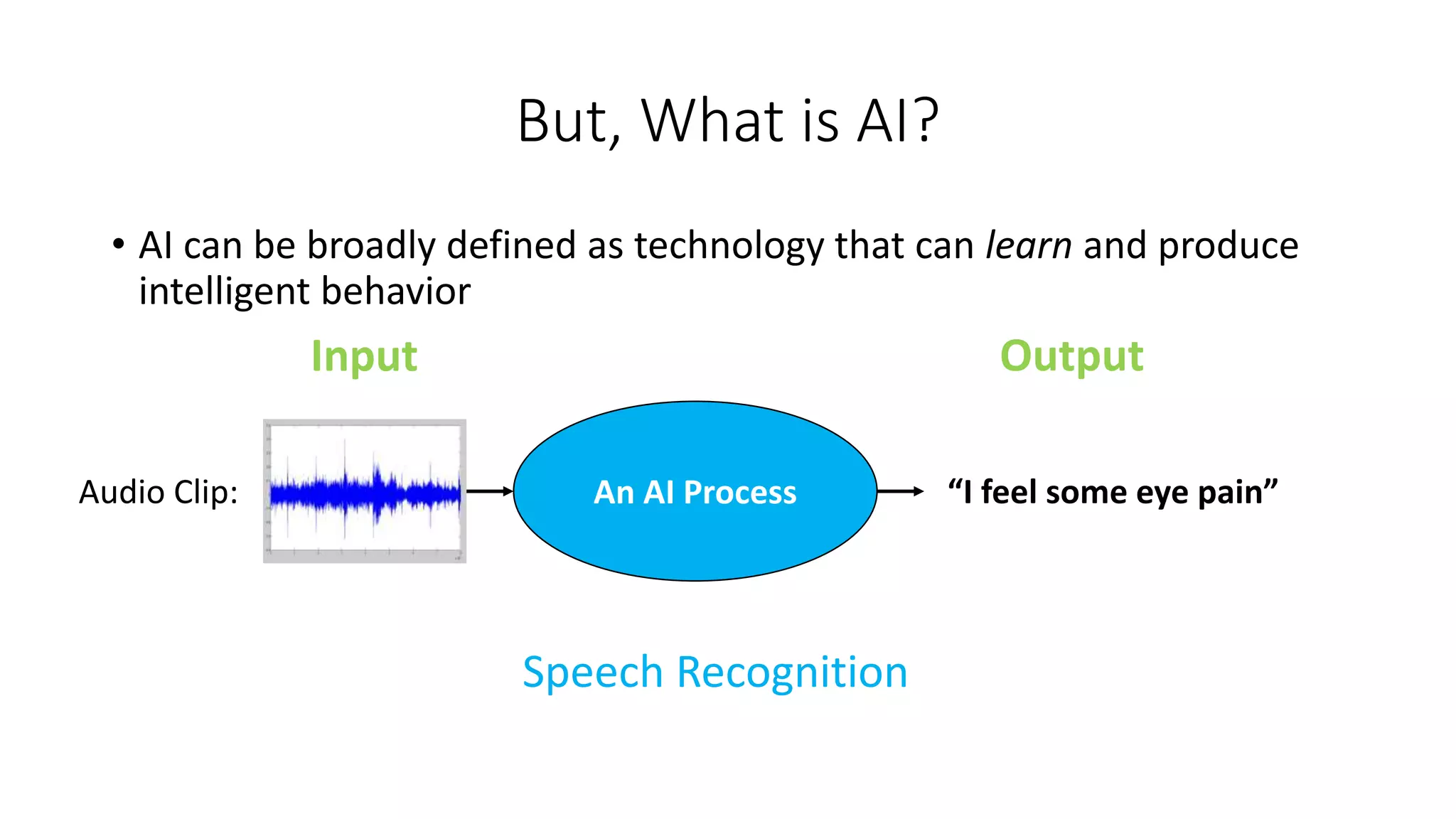
• AI can be broadly defined as technology that can learn and produce
intelligent behavior
Input Output
Audio Clip: “I feel some eye pain”
An AI Process
Speech Recognition
But, What is AI?
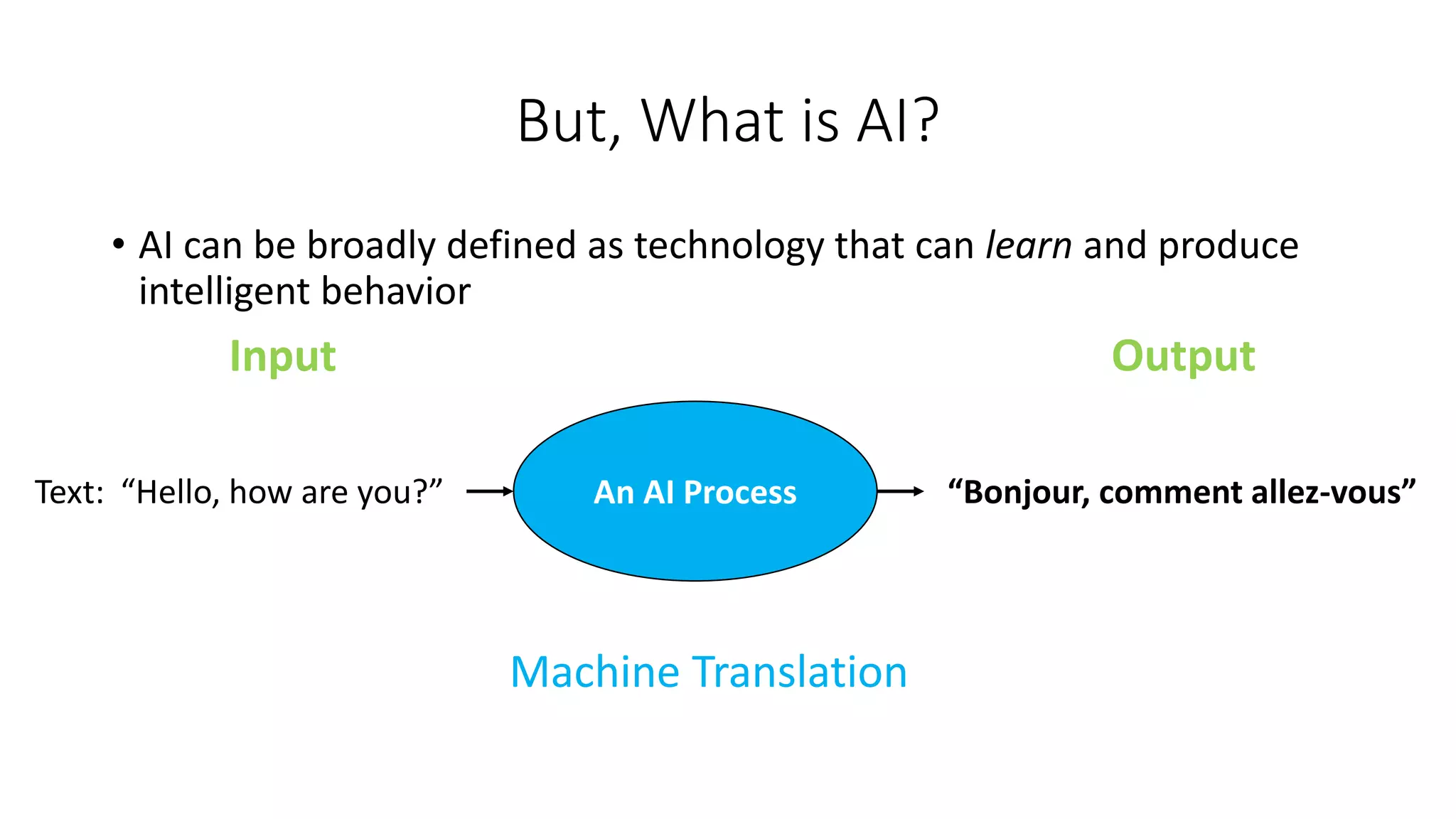
• AI can be broadly defined as technology that can learn and produce
intelligent behavior
Input Output
“Hello, how are you?” “Bonjour, comment allez-vous”
An AI Process
Machine Translation
Text:
But, What is AI?
Output
Input
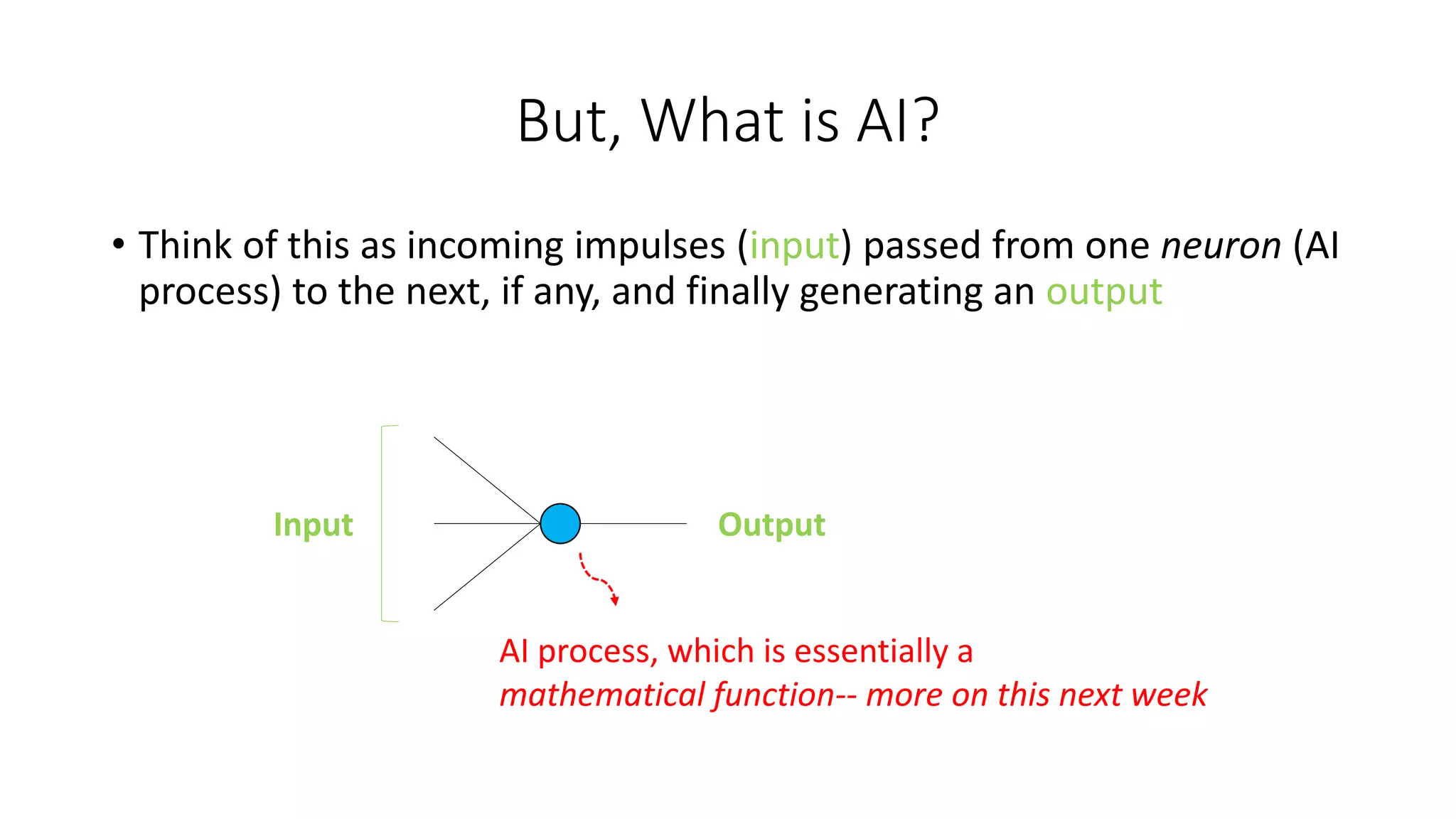
• Think of this as incoming impulses (input) passed from one neuron (AI
process) to the next, if any, and finally generating an output
AI process, which is essentially a
mathematical function-- more on this next week
But, What is AI?
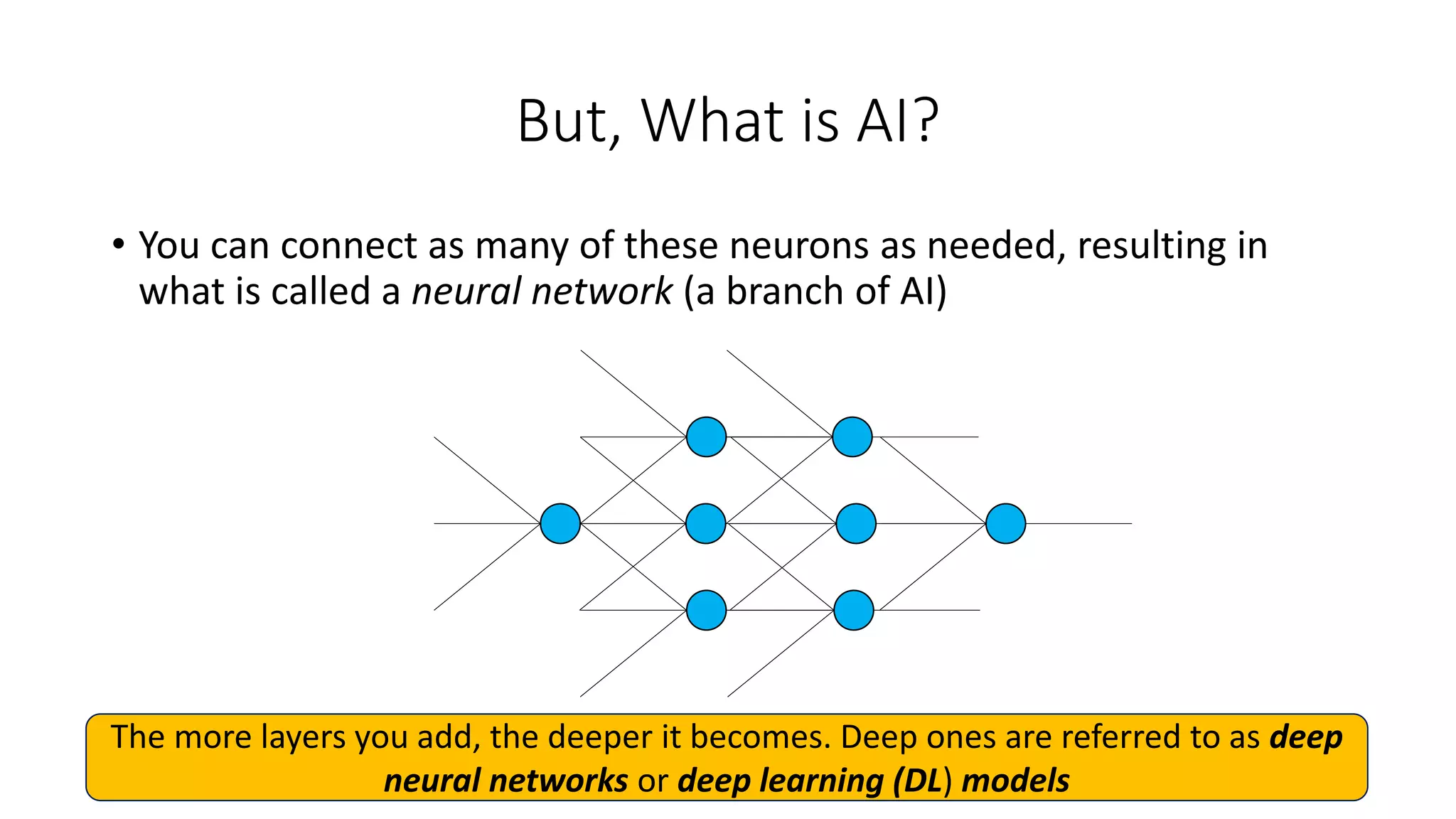
• You can connect as many of these neurons as needed, resulting in
what is called a neural network (a branch of AI)
The more layers you add, the deeper it becomes. Deep ones are referred to as deep
neural networks or deep learning (DL) models
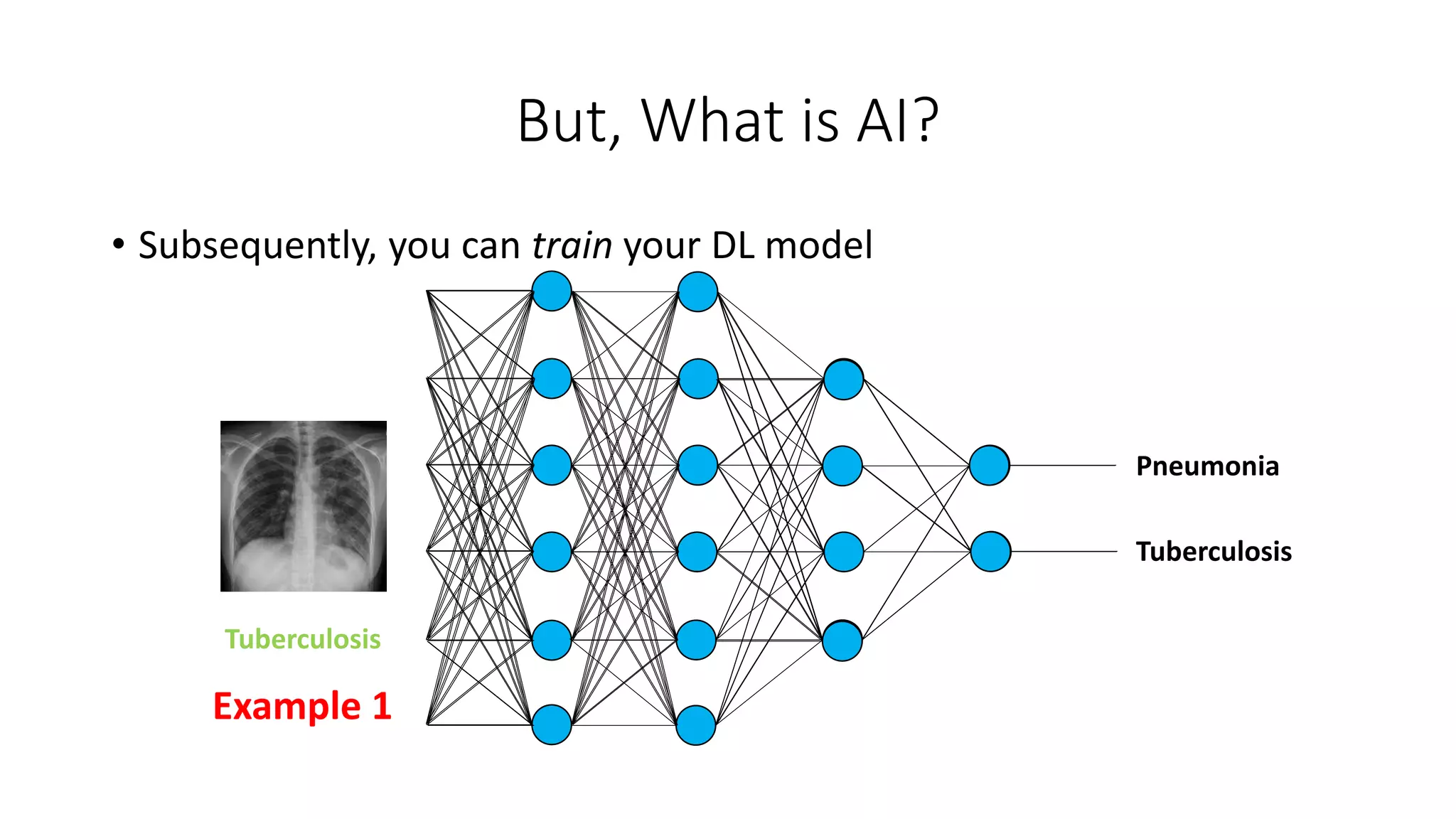
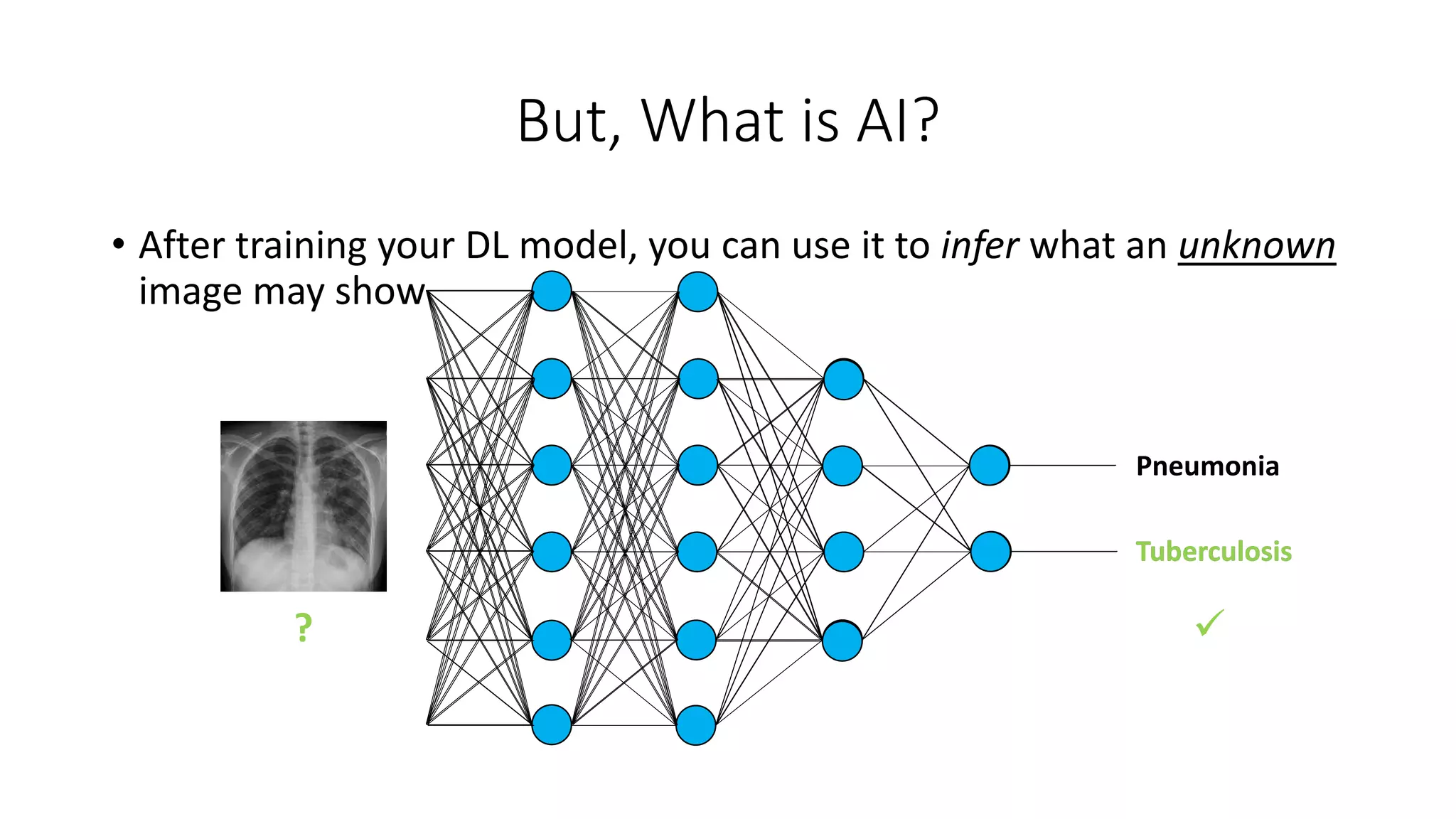
But, What is AI?
Tuberculosis
Pneumonia
Tuberculosis
Example 1
• Subsequently, you can train your DL model
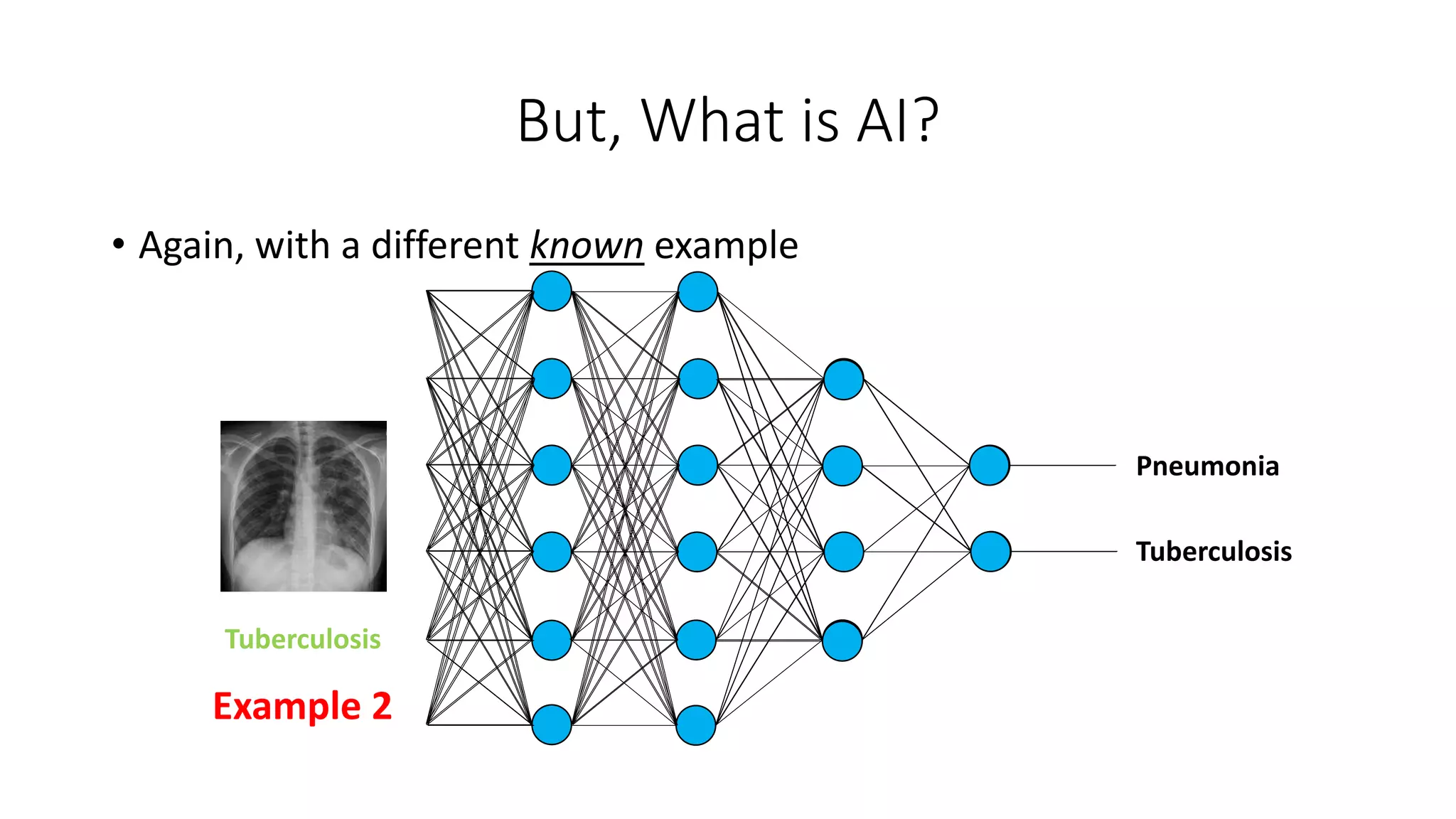
But, What is AI?
Tuberculosis
Pneumonia
Tuberculosis
Example 2
• Again, with a different known example
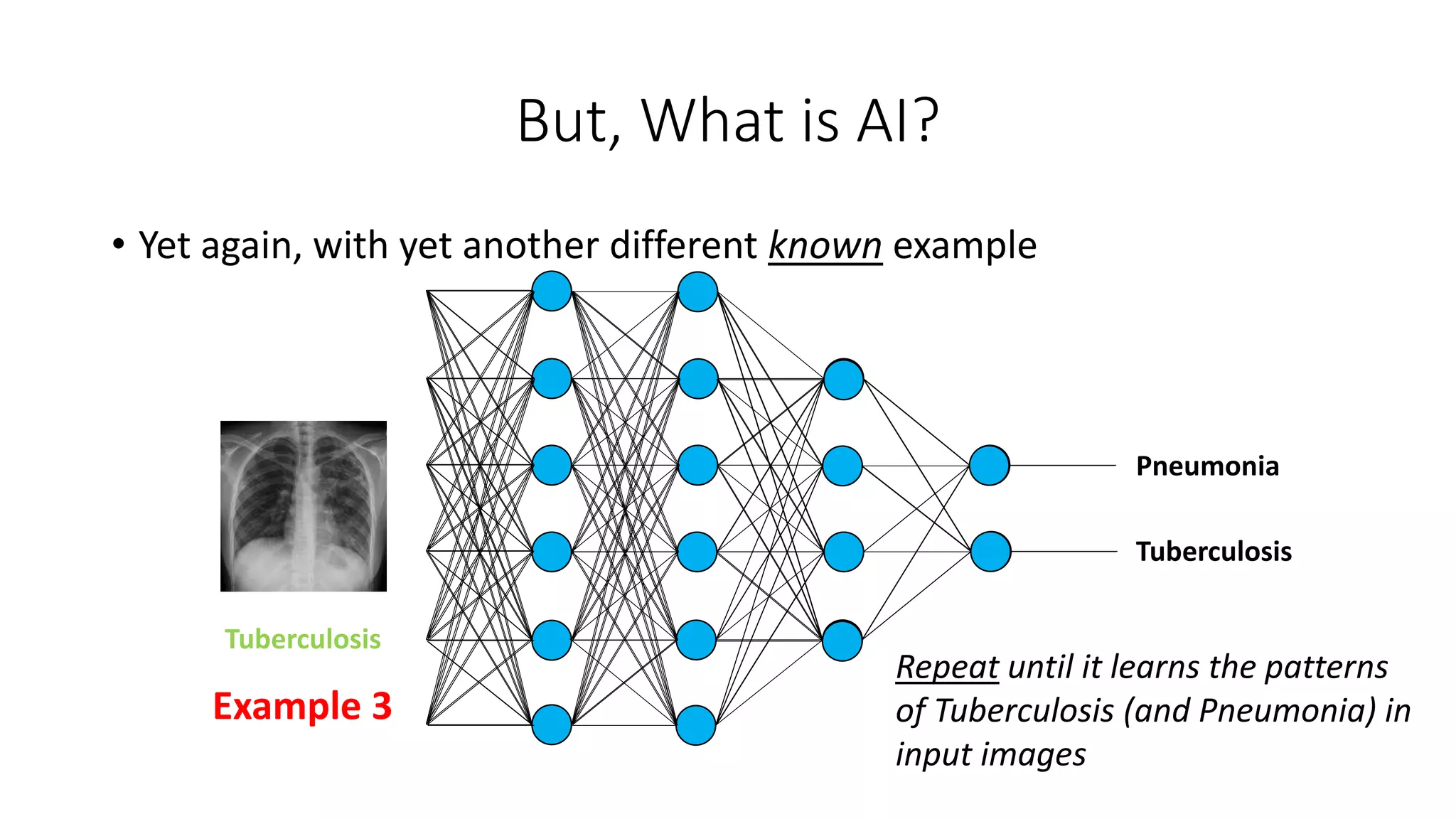
But, What is AI?
Tuberculosis
Pneumonia
Tuberculosis
Example 3
• Yet again, with yet another different known example
Repeat until it learns the patterns
of Tuberculosis (and Pneumonia) in
input images
But, What is AI?
Tuberculosis
Pneumonia
?
• After training your DL model, you can use it to infer what an unknown
image may show
Tuberculosis

But, What is AI?
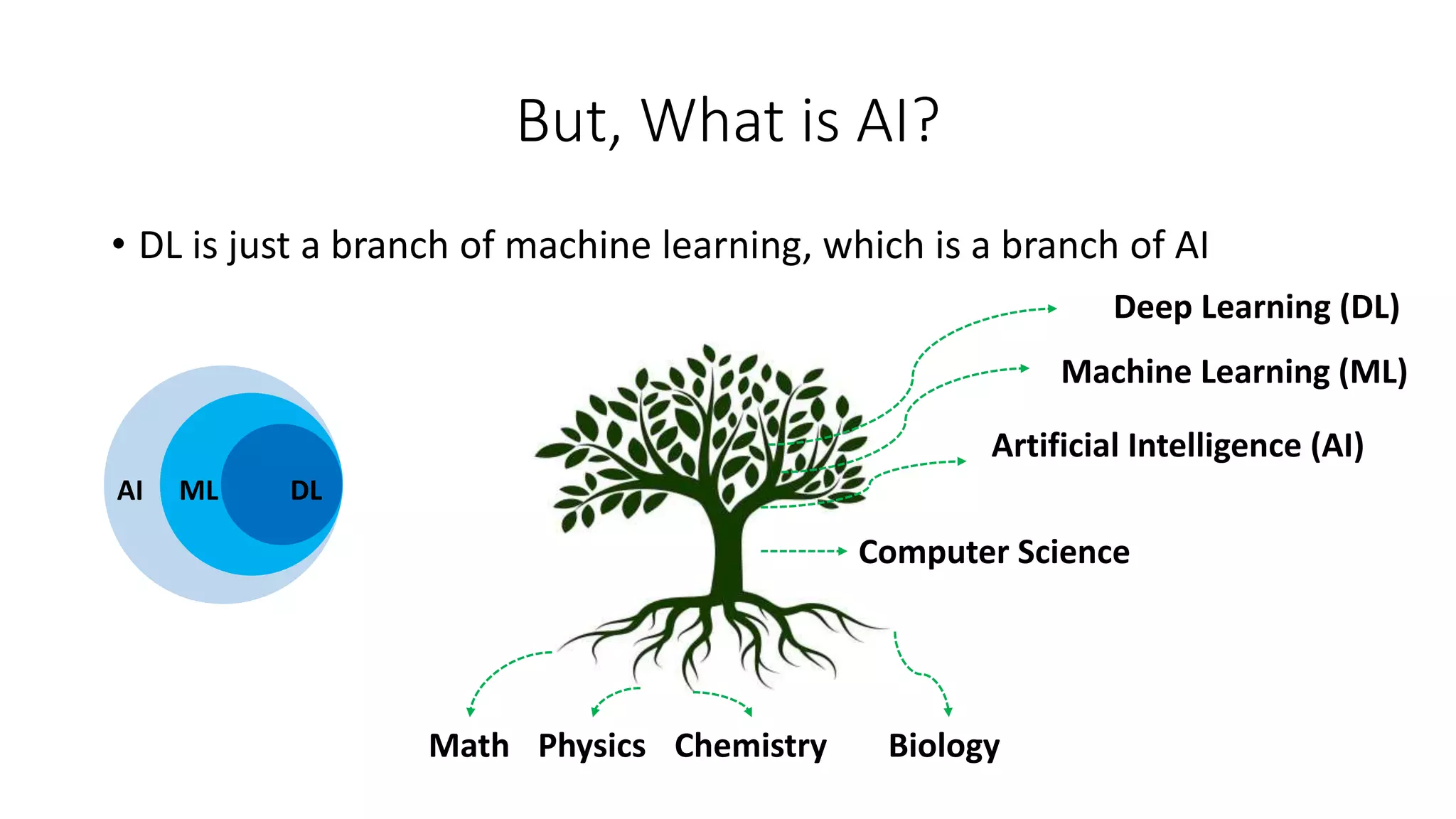
• DL is just a branch of machine learning, which is a branch of AI
Math
Computer Science
Artificial Intelligence (AI)
Machine Learning (ML)
Physics Chemistry Biology
Deep Learning (DL)
AI ML DL
Outline
Introduction
What is AI? Administrivia
AI Applications
in Medicine
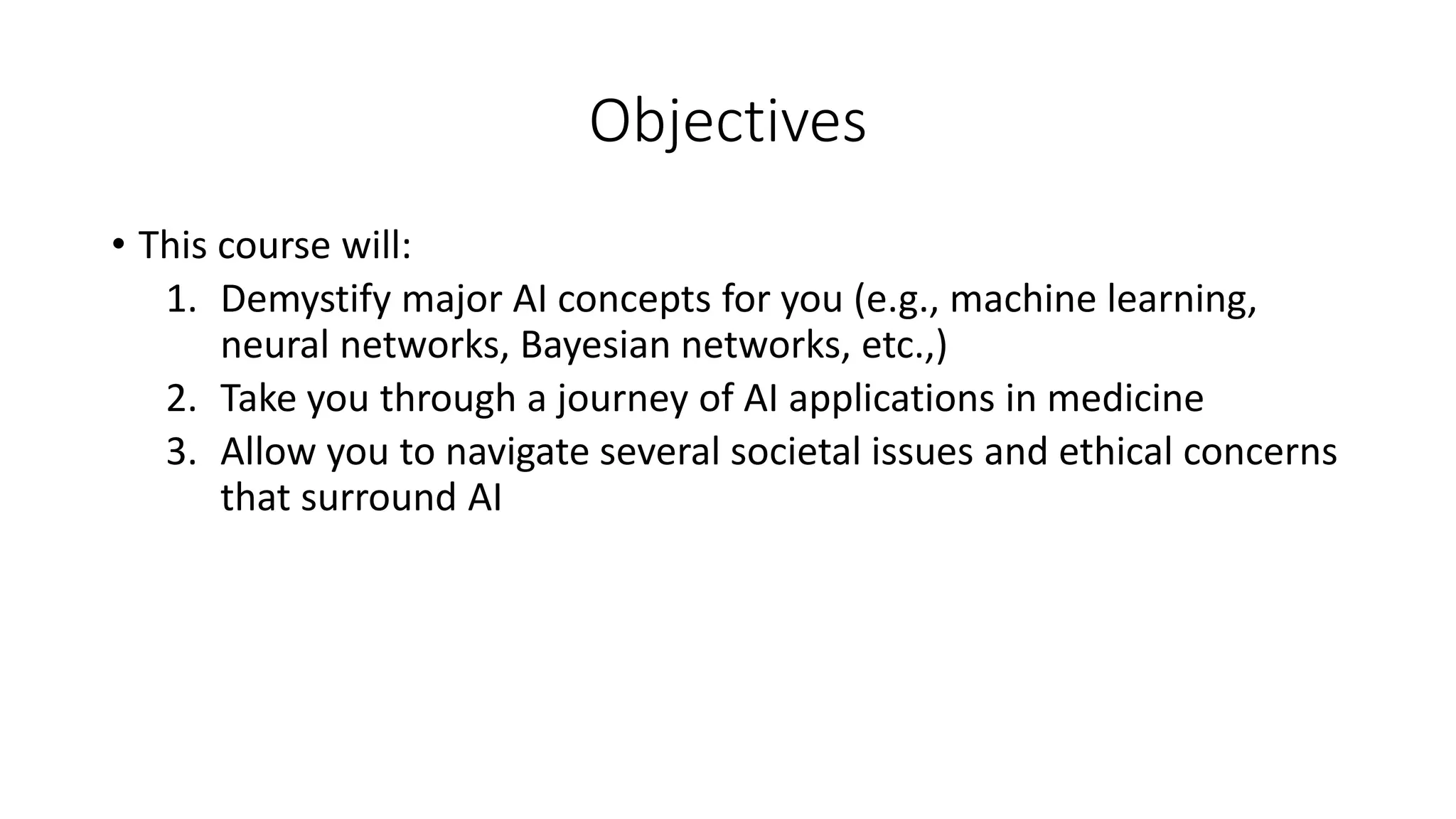
Objectives
• This course will:
1. Demystify major AI concepts for you (e.g., machine learning,
neural networks, Bayesian networks, etc.,)
2. Take you through a journey of AI applications in medicine
3. Allow you to navigate several societal issues and ethical concerns
that surround AI
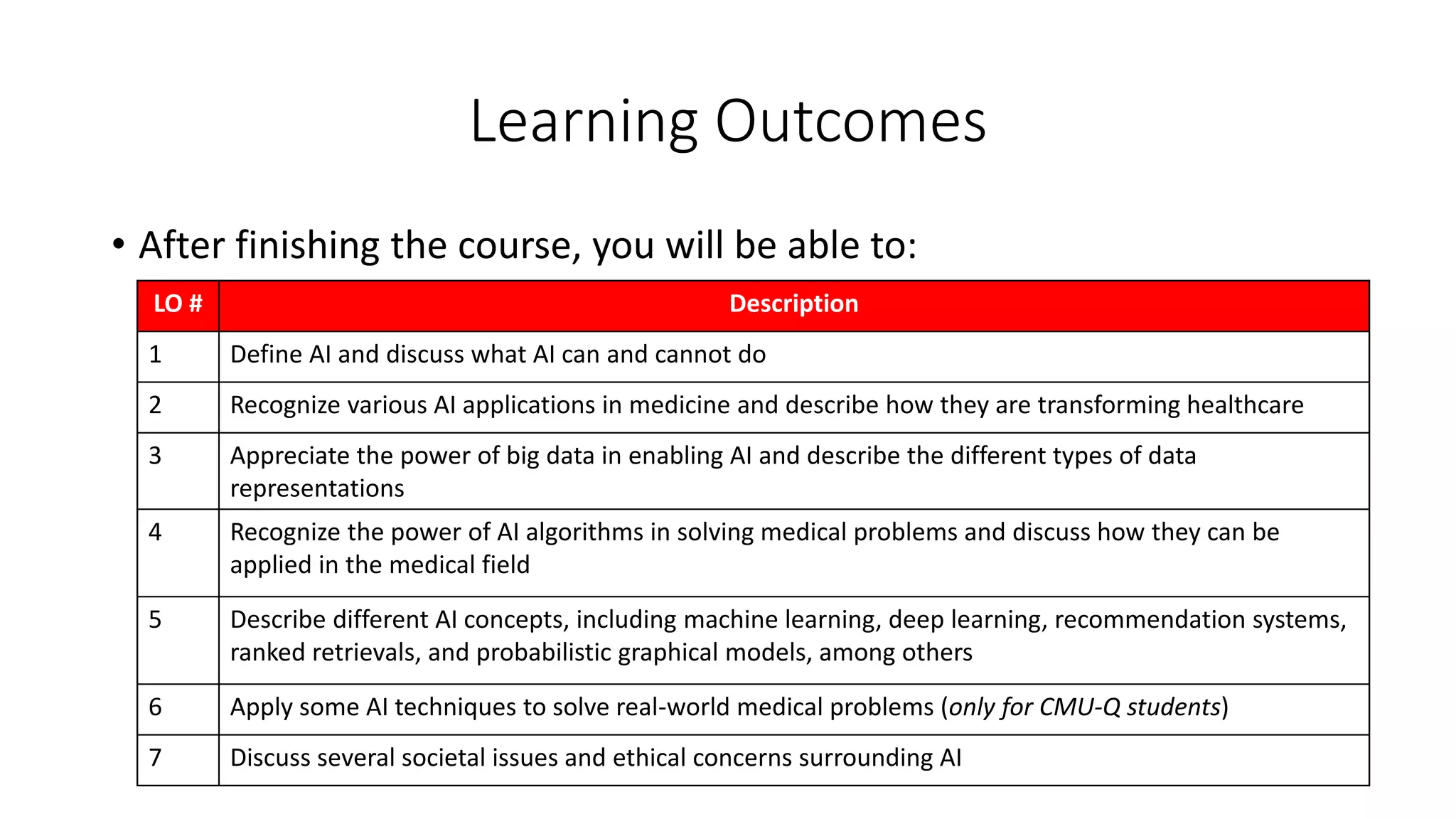
Learning Outcomes
• After finishing the course, you will be able to:
LO # Description
1 Define AI and discuss what AI can and cannot do
2 Recognize various AI applications in medicine and describe how they are transforming healthcare
3 Appreciate the power of big data in enabling AI and describe the different types of data
representations
4 Recognize the power of AI algorithms in solving medical problems and discuss how they can be
applied in the medical field
5 Describe different AI concepts, including machine learning, deep learning, recommendation systems,
ranked retrievals, and probabilistic graphical models, among others
6 Apply some AI techniques to solve real-world medical problems (only for CMU-Q students)
7 Discuss several societal issues and ethical concerns surrounding AI
LO # Description
1 Define AI and discuss what AI can and cannot do
2 Recognize various AI applications in medicine and describe how they are transforming healthcare
3 Appreciate the power of big data in enabling AI and describe the different types of data
representations
4 Recognize the power of AI algorithms in solving medical problems and discuss how they can be
applied in the medical field
5 Describe different AI concepts, including machine learning, deep learning, recommendation systems,
ranked retrievals, and probabilistic graphical models, among others
6 Apply some AI techniques to solve real-world medical problems (only for CMU-Q students)
7 Discuss several societal issues and ethical concerns surrounding AI
LO # Description
1 Define AI and discuss what AI can and cannot do
2 Recognize various AI applications in medicine and describe how they are transforming healthcare
3 Appreciate the power of big data in enabling AI and describe the different types of data
representations
4 Recognize the power of AI algorithms in solving medical problems and discuss how they can be
applied in the medical field
5 Describe different AI concepts, including machine learning, deep learning, recommendation systems,
ranked retrievals, and probabilistic graphical models, among others
6 Apply some AI techniques to solve real-world medical problems (only for CMU-Q students)
7 Discuss several societal issues and ethical concerns surrounding AI
LO # Description
1 Define AI and discuss what AI can and cannot do
2 Recognize various AI applications in medicine and describe how they are transforming healthcare
3 Appreciate the power of big data in enabling AI and describe the different types of data
representations
4 Recognize the power of AI algorithms in solving medical problems and discuss how they can be
applied in the medical field
5 Describe different AI concepts, including machine learning, deep learning, recommendation systems,
ranked retrievals, and probabilistic graphical models, among others
6 Apply some AI techniques to solve real-world medical problems (only for CMU-Q students)
7 Discuss several societal issues and ethical concerns surrounding AI
LO # Description
1 Define AI and discuss what AI can and cannot do
2 Recognize various AI applications in medicine and describe how they are transforming healthcare
3 Appreciate the power of big data in enabling AI and describe the different types of data
representations
4 Recognize the power of AI algorithms in solving medical problems and discuss how they can be
applied in the medical field
5 Describe different AI concepts, including machine learning, deep learning, recommendation systems,
ranked retrievals, and probabilistic graphical models, among others
6 Apply some AI techniques to solve real-world medical problems (only for CMU-Q students)
7 Discuss several societal issues and ethical concerns surrounding AI
LO # Description
1 Define AI and discuss what AI can and cannot do
2 Recognize various AI applications in medicine and describe how they are transforming healthcare
3 Appreciate the power of big data in enabling AI and describe the different types of data
representations
4 Recognize the power of AI algorithms in solving medical problems and discuss how they can be
applied in the medical field
5 Describe different AI concepts, including machine learning, deep learning, recommendation systems,
ranked retrievals, and probabilistic graphical models, among others
6 Apply some AI techniques to solve real-world medical problems (only for CMU-Q students)
7 Discuss several societal issues and ethical concerns surrounding AI
LO # Description
1 Define AI and discuss what AI can and cannot do
2 Recognize various AI applications in medicine and describe how they are transforming healthcare
3 Appreciate the power of big data in enabling AI and describe the different types of data
representations
4 Recognize the power of AI algorithms in solving medical problems and discuss how they can be
applied in the medical field
5 Describe different AI concepts, including machine learning, deep learning, recommendation systems,
ranked retrievals, and probabilistic graphical models, among others
6 Apply some AI techniques to solve real-world medical problems (only for CMU-Q students)
7 Discuss several societal issues and ethical concerns surrounding AI
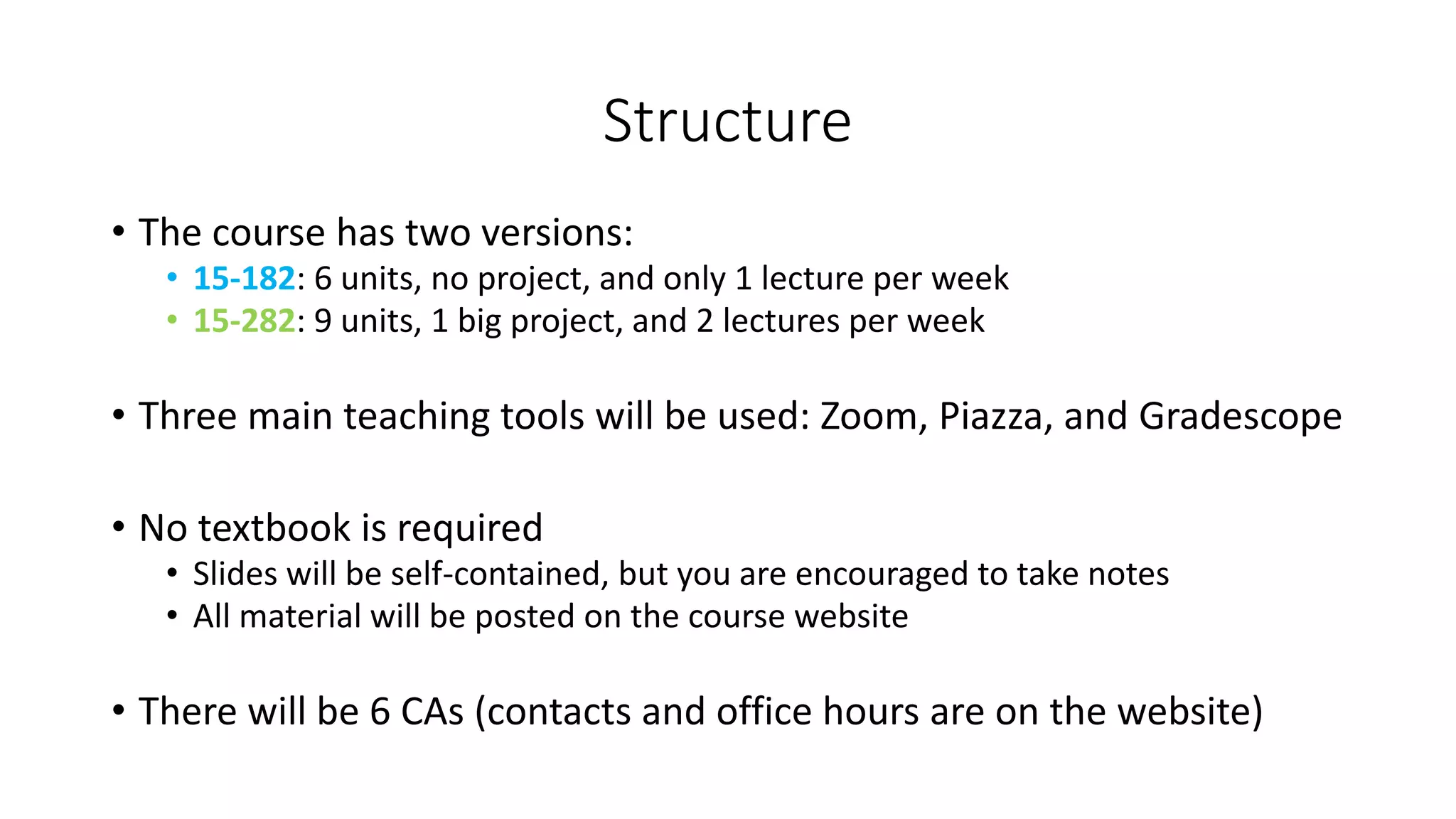
Structure
• The course has two versions:
• 15-182: 6 units, no project, and only 1 lecture per week
• 15-282: 9 units, 1 big project, and 2 lectures per week
• Three main teaching tools will be used: Zoom, Piazza, and Gradescope
• No textbook is required
• Slides will be self-contained, but you are encouraged to take notes
• All material will be posted on the course website
• There will be 6 CAs (contacts and office hours are on the website)
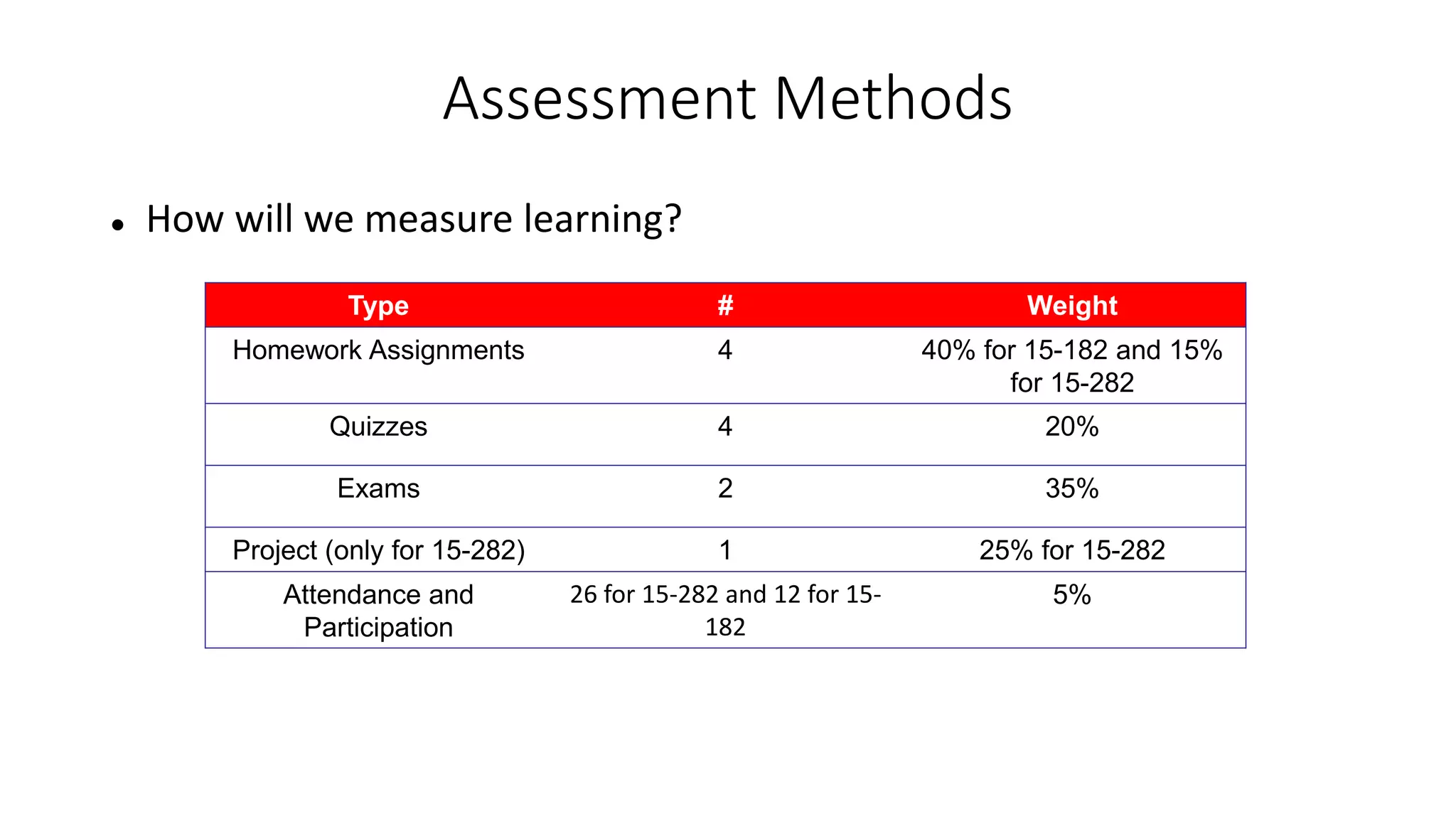
Assessment Methods
 How will we measure learning?
Type # Weight
Homework Assignments 4 40% for 15-182 and 15%
for 15-282
Quizzes 4 20%
Exams 2 35%
Project (only for 15-282) 1 25% for 15-282
Attendance and
Participation
26 for 15-282 and 12 for 15-
182
5%
Outline
Introduction
What is AI? Administrivia
AI Applications
in Medicine
Some Applications of AI in Medicine
1. Diagnosing diabetic eye disease using deep learning [1]
2. Detecting anemia from retinal fundus images using deep learning [2]
3. Predicting cardiovascular risk factors from retinal fundus photographs
using deep learning [3]
4. Performing differential diagnosis using probabilistic graphical models
[4]
5. Extracting symptoms and their status from clinical conversations using
recurrent neural networks [5]
6. Predicting osteoarthritis using machine learning [6]
Some Applications of AI in Medicine
1. Diagnosing diabetic eye disease using deep learning [1]
2. Detecting anemia from retinal fundus images using deep learning [2]
3. Predicting cardiovascular risk factors from retinal fundus photographs
using deep learning [3]
4. Performing differential diagnosis using probabilistic graphical models
[4]
5. Extracting symptoms and their status from clinical conversations using
recurrent neural networks [5]
6. Predicting osteoarthritis using machine learning [6]
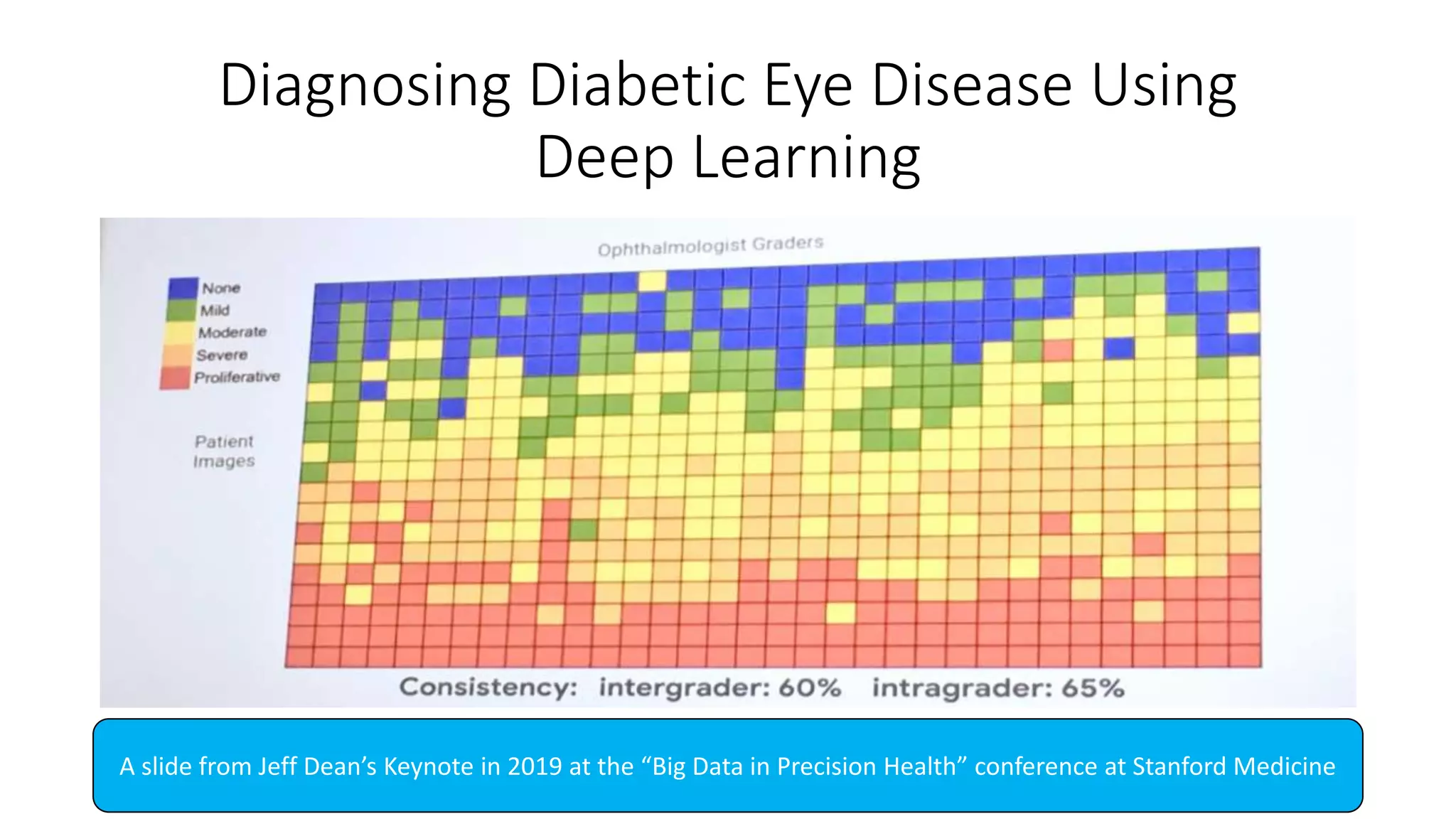
Diagnosing Diabetic Eye Disease Using
Deep Learning
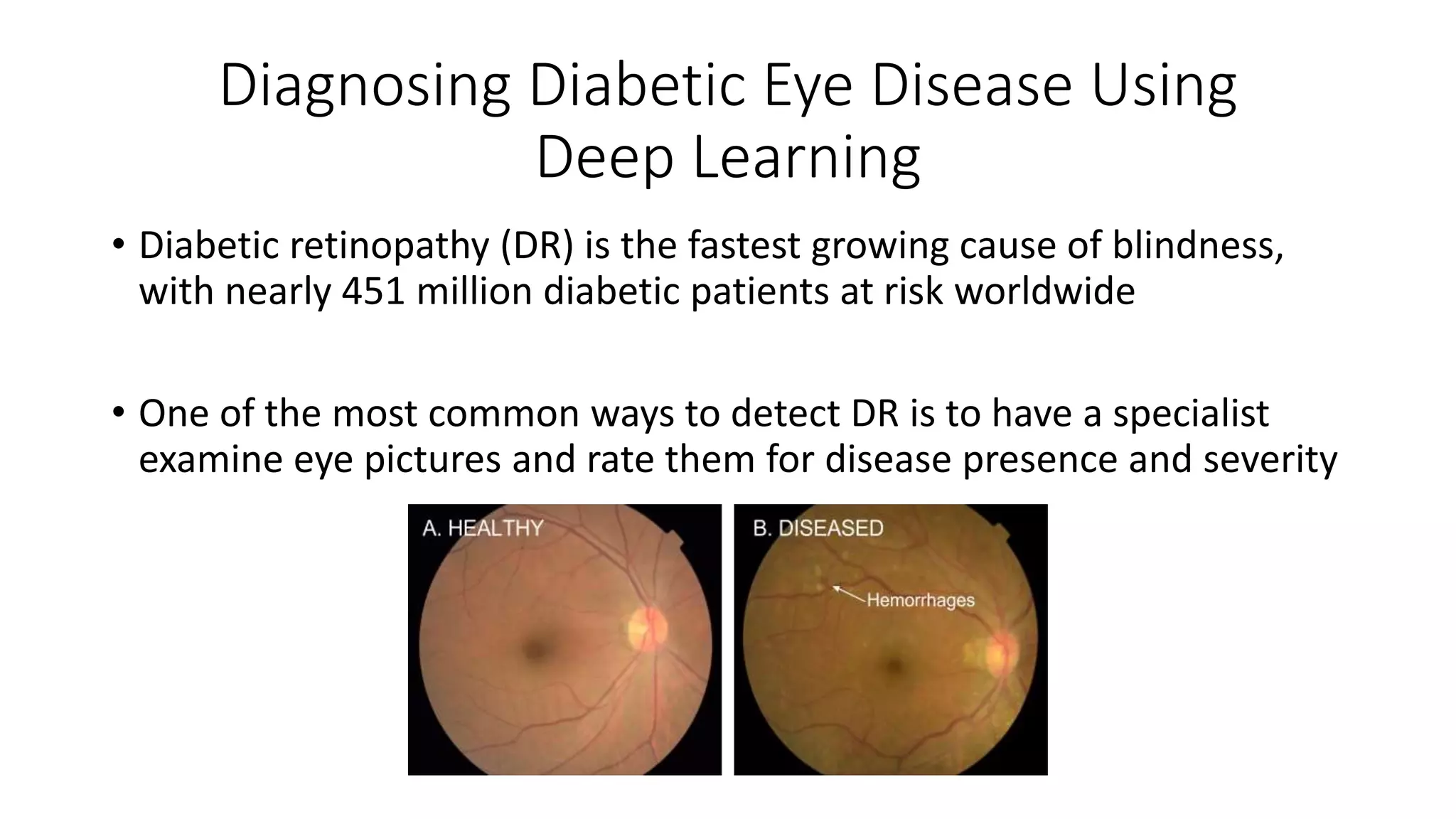
• Diabetic retinopathy (DR) is the fastest growing cause of blindness,
with nearly 451 million diabetic patients at risk worldwide
• One of the most common ways to detect DR is to have a specialist
examine eye pictures and rate them for disease presence and severity
Diagnosing Diabetic Eye Disease Using
Deep Learning
• If DR is caught early, the disease can be treated; if not, it can lead to
irreversible blindness
• As such, regular screening is essential for the early detection of DR
• Unfortunately, medical specialists capable of detecting DR are not
available in many parts of the world where diabetes is prevalent
• Google has developed a deep learning algorithm capable of
interpreting signs of DR in retinal photographs
Diagnosing Diabetic Eye Disease Using
Deep Learning
• They created a dataset of 128,000 images, each labeled by 3-7
ophthalmologists from a panel of 54 ophthalmologists
• DR severity (none, mild, moderate, severe, or proliferative) was graded
according to the International Clinical Diabetic Retinopathy scale
• They then used this dataset to train a deep learning algorithm to
detect referable diabetic retinopathy
• Afterwards, they tested the algorithm on two clinical validation sets
totaling ~12,000 images, with a panel of 7-8 U.S. board-certified
ophthalmologists serving as the reference standard
Diagnosing Diabetic Eye Disease Using
Deep Learning
• The F-score (combined sensitivity and specificity) of the algorithm
was 0.95, which is slightly better than the median F-score of the 8
board-certified ophthalmologists (measured at 0.91)
• What does that mean?
• AI can now offer an automated system for DR detection with
• Very high accuracy
• Near instantaneous reporting of results!
• Consistency of interpretation (the algorithm will make the same
prediction on a specific image every time)
Diagnosing Diabetic Eye Disease Using
Deep Learning
A slide from Jeff Dean’s Keynote in 2019 at the “Big Data in Precision Health” conference at Stanford Medicine
Some Applications of AI in Medicine
1. Diagnosing diabetic eye disease using deep learning [1]
2. Detecting anemia from retinal fundus images using deep learning [2]
3. Predicting cardiovascular risk factors from retinal fundus photographs
using deep learning [3]
4. Performing differential diagnosis using probabilistic graphical models
[4]
5. Extracting symptoms and their status from clinical conversations using
recurrent neural networks [5]
6. Predicting osteoarthritis using machine learning [6]

Next week on Monday …
Thank you!
References
1. Gulshan, Varun, et al. "Development and validation of a deep learning algorithm
for detection of diabetic retinopathy in retinal fundus photographs." Jama 316.22
(2016): 2402-2410.
2. Mitani, Akinori, et al. "Detection of anaemia from retinal fundus images via deep
learning." Nature Biomedical Engineering 4.1 (2020): 18-27.
3. Poplin, R., et al. "Predicting cardiovascular risk factors from retinal fundus
photographs using deep learning. arXiv 2017." arXiv preprint arXiv:1708.09843.
4. https://rimads.ai/avey/
5. Du, Nan, et al. "Extracting symptoms and their status from clinical
conversations." arXiv preprint arXiv:1906.02239 (2019).
6. Kundu, Shinjini, et al. "Discovery and visualization of structural biomarkers from
MRI using transport-based morphometry." NeuroImage 167 (2018): 256-275.

Lecture1-Introduction-Jan18-2021.pptx

  • 1.
    AI for Medicine Lecture1: Introduction January 18, 2021 Mohammad Hammoud Carnegie Mellon University in Qatar
  • 2.
    Outline Introduction What is AI?Administrivia AI Applications in Medicine
  • 3.
    On the Vergeof Major Breakthroughs • Artificial Intelligence (AI) has been moving extremely quickly in the last few years, demonstrating a potential to revolutionize every aspect of our lives Work Mobility Medicine Economy
  • 4.
    But, What isAI? • AI can be broadly defined as technology that can learn and produce intelligent behavior Input Output Pixels: “Tuberculosis” An AI Process Computer Vision
  • 5.
    But, What isAI? • AI can be broadly defined as technology that can learn and produce intelligent behavior Input Output Pixels: “Four kids are playing with a ball” An AI Process Computer Vision More than just a category about the image!
  • 6.
    But, What isAI? • AI can be broadly defined as technology that can learn and produce intelligent behavior Input Output Audio Clip: “I feel some eye pain” An AI Process Speech Recognition
  • 7.
    But, What isAI? • AI can be broadly defined as technology that can learn and produce intelligent behavior Input Output “Hello, how are you?” “Bonjour, comment allez-vous” An AI Process Machine Translation Text:
  • 8.
    But, What isAI? Output Input • Think of this as incoming impulses (input) passed from one neuron (AI process) to the next, if any, and finally generating an output AI process, which is essentially a mathematical function-- more on this next week
  • 9.
    But, What isAI? • You can connect as many of these neurons as needed, resulting in what is called a neural network (a branch of AI) The more layers you add, the deeper it becomes. Deep ones are referred to as deep neural networks or deep learning (DL) models
  • 10.
    But, What isAI? Tuberculosis Pneumonia Tuberculosis Example 1 • Subsequently, you can train your DL model
  • 11.
    But, What isAI? Tuberculosis Pneumonia Tuberculosis Example 2 • Again, with a different known example
  • 12.
    But, What isAI? Tuberculosis Pneumonia Tuberculosis Example 3 • Yet again, with yet another different known example Repeat until it learns the patterns of Tuberculosis (and Pneumonia) in input images
  • 13.
    But, What isAI? Tuberculosis Pneumonia ? • After training your DL model, you can use it to infer what an unknown image may show Tuberculosis 
  • 14.
    But, What isAI? • DL is just a branch of machine learning, which is a branch of AI Math Computer Science Artificial Intelligence (AI) Machine Learning (ML) Physics Chemistry Biology Deep Learning (DL) AI ML DL
  • 15.
    Outline Introduction What is AI?Administrivia AI Applications in Medicine
  • 16.
    Objectives • This coursewill: 1. Demystify major AI concepts for you (e.g., machine learning, neural networks, Bayesian networks, etc.,) 2. Take you through a journey of AI applications in medicine 3. Allow you to navigate several societal issues and ethical concerns that surround AI
  • 17.
    Learning Outcomes • Afterfinishing the course, you will be able to: LO # Description 1 Define AI and discuss what AI can and cannot do 2 Recognize various AI applications in medicine and describe how they are transforming healthcare 3 Appreciate the power of big data in enabling AI and describe the different types of data representations 4 Recognize the power of AI algorithms in solving medical problems and discuss how they can be applied in the medical field 5 Describe different AI concepts, including machine learning, deep learning, recommendation systems, ranked retrievals, and probabilistic graphical models, among others 6 Apply some AI techniques to solve real-world medical problems (only for CMU-Q students) 7 Discuss several societal issues and ethical concerns surrounding AI LO # Description 1 Define AI and discuss what AI can and cannot do 2 Recognize various AI applications in medicine and describe how they are transforming healthcare 3 Appreciate the power of big data in enabling AI and describe the different types of data representations 4 Recognize the power of AI algorithms in solving medical problems and discuss how they can be applied in the medical field 5 Describe different AI concepts, including machine learning, deep learning, recommendation systems, ranked retrievals, and probabilistic graphical models, among others 6 Apply some AI techniques to solve real-world medical problems (only for CMU-Q students) 7 Discuss several societal issues and ethical concerns surrounding AI LO # Description 1 Define AI and discuss what AI can and cannot do 2 Recognize various AI applications in medicine and describe how they are transforming healthcare 3 Appreciate the power of big data in enabling AI and describe the different types of data representations 4 Recognize the power of AI algorithms in solving medical problems and discuss how they can be applied in the medical field 5 Describe different AI concepts, including machine learning, deep learning, recommendation systems, ranked retrievals, and probabilistic graphical models, among others 6 Apply some AI techniques to solve real-world medical problems (only for CMU-Q students) 7 Discuss several societal issues and ethical concerns surrounding AI LO # Description 1 Define AI and discuss what AI can and cannot do 2 Recognize various AI applications in medicine and describe how they are transforming healthcare 3 Appreciate the power of big data in enabling AI and describe the different types of data representations 4 Recognize the power of AI algorithms in solving medical problems and discuss how they can be applied in the medical field 5 Describe different AI concepts, including machine learning, deep learning, recommendation systems, ranked retrievals, and probabilistic graphical models, among others 6 Apply some AI techniques to solve real-world medical problems (only for CMU-Q students) 7 Discuss several societal issues and ethical concerns surrounding AI LO # Description 1 Define AI and discuss what AI can and cannot do 2 Recognize various AI applications in medicine and describe how they are transforming healthcare 3 Appreciate the power of big data in enabling AI and describe the different types of data representations 4 Recognize the power of AI algorithms in solving medical problems and discuss how they can be applied in the medical field 5 Describe different AI concepts, including machine learning, deep learning, recommendation systems, ranked retrievals, and probabilistic graphical models, among others 6 Apply some AI techniques to solve real-world medical problems (only for CMU-Q students) 7 Discuss several societal issues and ethical concerns surrounding AI LO # Description 1 Define AI and discuss what AI can and cannot do 2 Recognize various AI applications in medicine and describe how they are transforming healthcare 3 Appreciate the power of big data in enabling AI and describe the different types of data representations 4 Recognize the power of AI algorithms in solving medical problems and discuss how they can be applied in the medical field 5 Describe different AI concepts, including machine learning, deep learning, recommendation systems, ranked retrievals, and probabilistic graphical models, among others 6 Apply some AI techniques to solve real-world medical problems (only for CMU-Q students) 7 Discuss several societal issues and ethical concerns surrounding AI LO # Description 1 Define AI and discuss what AI can and cannot do 2 Recognize various AI applications in medicine and describe how they are transforming healthcare 3 Appreciate the power of big data in enabling AI and describe the different types of data representations 4 Recognize the power of AI algorithms in solving medical problems and discuss how they can be applied in the medical field 5 Describe different AI concepts, including machine learning, deep learning, recommendation systems, ranked retrievals, and probabilistic graphical models, among others 6 Apply some AI techniques to solve real-world medical problems (only for CMU-Q students) 7 Discuss several societal issues and ethical concerns surrounding AI
  • 18.
    Structure • The coursehas two versions: • 15-182: 6 units, no project, and only 1 lecture per week • 15-282: 9 units, 1 big project, and 2 lectures per week • Three main teaching tools will be used: Zoom, Piazza, and Gradescope • No textbook is required • Slides will be self-contained, but you are encouraged to take notes • All material will be posted on the course website • There will be 6 CAs (contacts and office hours are on the website)
  • 19.
    Assessment Methods  Howwill we measure learning? Type # Weight Homework Assignments 4 40% for 15-182 and 15% for 15-282 Quizzes 4 20% Exams 2 35% Project (only for 15-282) 1 25% for 15-282 Attendance and Participation 26 for 15-282 and 12 for 15- 182 5%
  • 20.
    Outline Introduction What is AI?Administrivia AI Applications in Medicine
  • 21.
    Some Applications ofAI in Medicine 1. Diagnosing diabetic eye disease using deep learning [1] 2. Detecting anemia from retinal fundus images using deep learning [2] 3. Predicting cardiovascular risk factors from retinal fundus photographs using deep learning [3] 4. Performing differential diagnosis using probabilistic graphical models [4] 5. Extracting symptoms and their status from clinical conversations using recurrent neural networks [5] 6. Predicting osteoarthritis using machine learning [6]
  • 22.
    Some Applications ofAI in Medicine 1. Diagnosing diabetic eye disease using deep learning [1] 2. Detecting anemia from retinal fundus images using deep learning [2] 3. Predicting cardiovascular risk factors from retinal fundus photographs using deep learning [3] 4. Performing differential diagnosis using probabilistic graphical models [4] 5. Extracting symptoms and their status from clinical conversations using recurrent neural networks [5] 6. Predicting osteoarthritis using machine learning [6]
  • 23.
    Diagnosing Diabetic EyeDisease Using Deep Learning • Diabetic retinopathy (DR) is the fastest growing cause of blindness, with nearly 451 million diabetic patients at risk worldwide • One of the most common ways to detect DR is to have a specialist examine eye pictures and rate them for disease presence and severity
  • 24.
    Diagnosing Diabetic EyeDisease Using Deep Learning • If DR is caught early, the disease can be treated; if not, it can lead to irreversible blindness • As such, regular screening is essential for the early detection of DR • Unfortunately, medical specialists capable of detecting DR are not available in many parts of the world where diabetes is prevalent • Google has developed a deep learning algorithm capable of interpreting signs of DR in retinal photographs
  • 25.
    Diagnosing Diabetic EyeDisease Using Deep Learning • They created a dataset of 128,000 images, each labeled by 3-7 ophthalmologists from a panel of 54 ophthalmologists • DR severity (none, mild, moderate, severe, or proliferative) was graded according to the International Clinical Diabetic Retinopathy scale • They then used this dataset to train a deep learning algorithm to detect referable diabetic retinopathy • Afterwards, they tested the algorithm on two clinical validation sets totaling ~12,000 images, with a panel of 7-8 U.S. board-certified ophthalmologists serving as the reference standard
  • 26.
    Diagnosing Diabetic EyeDisease Using Deep Learning • The F-score (combined sensitivity and specificity) of the algorithm was 0.95, which is slightly better than the median F-score of the 8 board-certified ophthalmologists (measured at 0.91) • What does that mean? • AI can now offer an automated system for DR detection with • Very high accuracy • Near instantaneous reporting of results! • Consistency of interpretation (the algorithm will make the same prediction on a specific image every time)
  • 27.
    Diagnosing Diabetic EyeDisease Using Deep Learning A slide from Jeff Dean’s Keynote in 2019 at the “Big Data in Precision Health” conference at Stanford Medicine
  • 28.
    Some Applications ofAI in Medicine 1. Diagnosing diabetic eye disease using deep learning [1] 2. Detecting anemia from retinal fundus images using deep learning [2] 3. Predicting cardiovascular risk factors from retinal fundus photographs using deep learning [3] 4. Performing differential diagnosis using probabilistic graphical models [4] 5. Extracting symptoms and their status from clinical conversations using recurrent neural networks [5] 6. Predicting osteoarthritis using machine learning [6]  Next week on Monday …
  • 29.
  • 30.
    References 1. Gulshan, Varun,et al. "Development and validation of a deep learning algorithm for detection of diabetic retinopathy in retinal fundus photographs." Jama 316.22 (2016): 2402-2410. 2. Mitani, Akinori, et al. "Detection of anaemia from retinal fundus images via deep learning." Nature Biomedical Engineering 4.1 (2020): 18-27. 3. Poplin, R., et al. "Predicting cardiovascular risk factors from retinal fundus photographs using deep learning. arXiv 2017." arXiv preprint arXiv:1708.09843. 4. https://rimads.ai/avey/ 5. Du, Nan, et al. "Extracting symptoms and their status from clinical conversations." arXiv preprint arXiv:1906.02239 (2019). 6. Kundu, Shinjini, et al. "Discovery and visualization of structural biomarkers from MRI using transport-based morphometry." NeuroImage 167 (2018): 256-275.