To View the presentation as a slideshow with effects  select   “View”   on the menu bar and click on   “Slide Show.” To advance through the presentation, click the right-arrow key or the space bar . From the resources slide, click on any resource to see a presentation for that resource. From the Chapter menu screen click on any lesson to go directly to that lesson’s presentation. You may exit the slide show at any time by pressing  the   Esc  key . How to Use This Presentation
Resources Chapter Presentation Image Bank Math Focus Bellringers Standards Assessment Visual Concepts
Table of Contents Section 1  Measuring Motion Section 2  What Is a Force? Section 3  Friction: A Force That Opposes Motion Chapter 12 Matter in Motion
Bellringer Describe the location of a favorite place, using a reference point and reference directions. For example, “The library is at the corner of Madison Street and Monroe Street. It is two blocks west of the school and four blocks north of the bus stop.”  Write your response in your  Science Journal. Section 1  Measuring Motion Chapter 12
What You Will Learn Properties used to describe the motion of an object include a reference point, direction, speed, velocity, and acceleration. Average speed can be calculated by dividing total distance by total time. A change in velocity is due to a change in speed, direction, or both. Speed and acceleration can be represented on graphs. Section 1  Measuring Motion Chapter 12
Motion and Reference Points An object is in  motion  if it changes position over time in relation to a reference point.  A  reference point  is any object that appears to stay in place. Features on Earth’s surface are often used as standard reference points. Section 1  Measuring Motion Chapter 12
Motion and Reference Points , continued Reference directions—such as north, south, east, west, up, or down—can be used to describe the direction of an object’s motion. A grid can be used to describe motion in a two-dimensional system. Section 1  Measuring Motion Chapter 12
Average Speed The speed of an object is the rate at which the object moves.  The speed of an object is rarely constant. So, it is useful to find the average speed of an object. Section 1  Measuring Motion Chapter 12
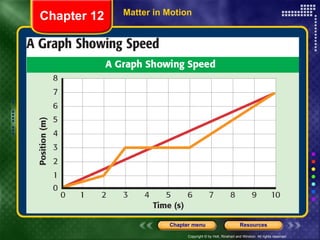
Average Speed , continued Average speed  is the total distance traveled divided by the total time taken. A graph of position versus time can show an object’s speed. On a graph of position versus time, the slope of the line is equal to the speed of the object. Section 1  Measuring Motion Chapter 12
Velocity: Direction Matters Velocity  is the speed of an object in a particular direction. Velocity and speed do not have the same meaning.  Velocity must include a direction. Section 1  Measuring Motion Chapter 12
Velocity: Direction Matters , continued The velocity of an object is constant only if the speed and direction of the object do not change. So, constant velocity is always motion along a straight line. The velocity of an object changes if the object’s speed, direction, or both change. Section 1  Measuring Motion Chapter 12
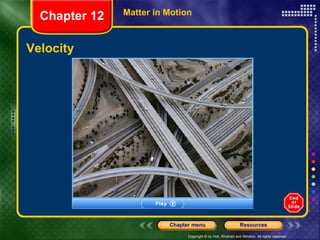
Velocity Matter in Motion Chapter 12
Acceleration Acceleration  is the rate at which velocity changes over time.  An object can accelerate by changing speed, direction, or both. The units for acceleration are the units for velocity divided by a unit for time, usually meters per second per second, or (m/s)/s, which is also written as m/s 2 . Section 1  Measuring Motion Chapter 12
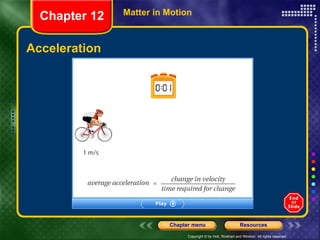
Acceleration Matter in Motion Chapter 12
Acceleration , continued Centripetal acceleration  occurs when an object moves at a constant speed in circular motion. A graph of speed versus time can show positive acceleration, no acceleration, and negative acceleration. Section 1  Measuring Motion Chapter 12
Matter in Motion Chapter 12
Bellringer A force is a push or a pull on an object. Imagine that you are trying to push a box up a ramp. Describe as many forces (pushes and pulls) as you can in that situation. Be sure to include the direction of each force (push or pull) in your description. Write your answers in your  Science Journal. Section 2  What Is a Force? Chapter 12
What You Will Learn A force is a push or a pull that acts on an object. Forces have magnitude and direction. Net force is the combined effect of two or more forces acting on an object. Balanced forces do not cause changes in motion. Unbalanced forces cause changes in an object’s velocity. Section 2  What Is a Force? Chapter 12
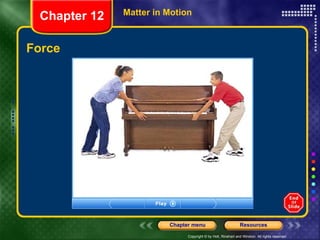
Forces Acting on Objects A  force  is a push or a pull exerted on an object in order to change the motion of the object. All forces have two properties: direction and magnitude, or size. Forces can cause acceleration. Section 2  What Is a Force? Chapter 12
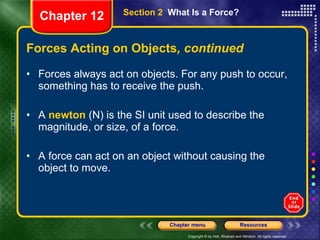
Forces Acting on Objects , continued Forces always act on objects. For any push to occur, something has to receive the push. A  newton  (N) is the SI unit used to describe the magnitude, or size, of a force. A force can act on an object without causing the object to move. Section 2  What Is a Force? Chapter 12
Force Matter in Motion Chapter 12
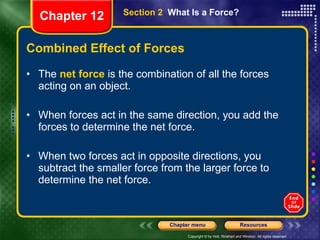
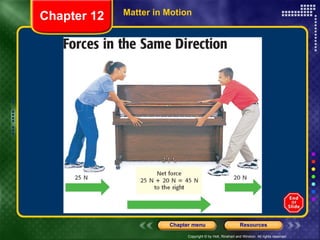
Combined Effect of Forces The  net force  is the combination of all the forces acting on an object. When forces act in the same direction, you add the forces to determine the net force. When two forces act in opposite directions, you subtract the smaller force from the larger force to determine the net force. Section 2  What Is a Force? Chapter 12
Matter in Motion Chapter 12
Balanced Forces: No Change in Motion When the forces on an object produce a net force of 0 N, the forces are  balanced.   Balanced forces do not cause a change in the motion of an object. Section 2  What Is a Force? Chapter 12
Balanced Forces: No Change in Motion , continued Objects that are not moving and have balanced forces acting on them are called  static  objects. Tension and compression are two forces that often act on static objects. Section 2  What Is a Force? Chapter 12
Balanced Forces: No Change in Motion , continued Tension  is a force that is exerted when matter is pulled or stretched. Compression  is a force that is exerted when matter is pushed or squeezed. Section 2  What Is a Force? Chapter 12
Unbalanced Forces: Velocity Changes When the net force on an object is not 0 N, the forces on the object are  unbalanced.   Unbalanced forces cause a change in the velocity of an object. Section 2  What Is a Force? Chapter 12
Unbalanced Forces: Velocity Changes , continued Unbalanced forces are needed to cause static objects to start moving. Objects do not always move in the direction of the unbalanced force. Section 2  What Is a Force? Chapter 12
Bellringer Imagine that you are trying to push a heavy desk across the floor. There are two opposing forces on the desk: the force you apply, and the force of friction between the desk and the floor. What will happen if the force of friction is the same magnitude as the force that you apply? What will happen if the force that you apply is greater than the force of friction? Write your answers in your  Science Journal. Section 3  Friction: A Force That Opposes Motion Chapter 12
What You Will Learn The magnitude of the force of friction can vary. Kinetic friction is a force that, when unbalanced, can change the velocity of a moving object. Static friction balances an applied force and can prevent motion. Friction can be both harmful and helpful. Section 3  Friction: A Force That Opposes Motion Chapter 12
The Source of Friction When the hills and valleys of one surface stick to the hills and valleys of another surface, friction is created. Friction  is a force that opposes motion between two surfaces that are touching. Section 3  Friction: A Force That Opposes Motion Chapter 12
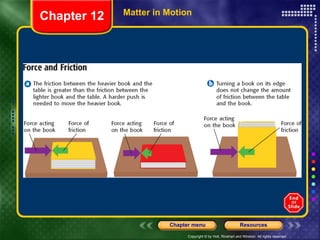
The Source of Friction , continued As the force pushing surfaces together increases, the friction between the surfaces increases. Friction is usually greater between materials that have rough surfaces than it is between materials that have smooth surfaces. Section 3  Friction: A Force That Opposes Motion Chapter 12
Matter in Motion Chapter 12
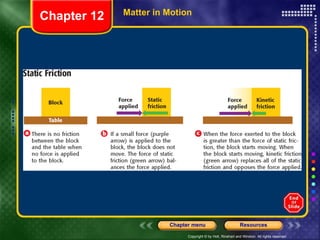
Types of Friction There are two types of friction:  kinetic friction  and  static friction. Kinetic friction is friction between moving surfaces.  The force of sliding kinetic friction is greater than the force of rolling kinetic friction. Section 3  Friction: A Force That Opposes Motion Chapter 12
Types of Friction , continued Static friction can balance an applied force and can prevent changes in motion. Some static objects do not move because the force of static friction balances the other forces acting on the object. Section 3  Friction: A Force That Opposes Motion Chapter 12
Matter in Motion Chapter 12
Friction: Harmful and Helpful Because friction can be both harmful and helpful, sometimes it should be decreased and sometimes it should be increased. Lubricants  are substances that are put on surfaces to decrease friction between the surfaces. Some examples of lubricants include motor oil, wax, and grease. Section 3  Friction: A Force That Opposes Motion Chapter 12
Friction: Harmful and Helpful , continued Harmful friction can be decreased by using lubricants or by smoothing the surfaces that rub against each other. Helpful friction can be increased by making the surfaces that rub against each other rougher or by increasing the force pushing surfaces together. Section 3  Friction: A Force That Opposes Motion Chapter 12
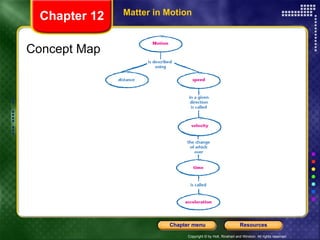
Concept Map Chapter 12 Matter in Motion Use the terms below to complete the concept map on the next slide. motion acceleration speed  time velocity
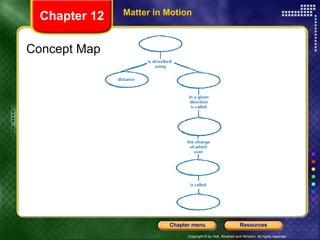
Matter in Motion Chapter 12 Concept Map
End of Chapter 12 Show Matter in Motion  Chapter 12
1. Which of the following words means “stress that happens when forces act to stretch an object”? A. drive B. tension C. torque D. energy Chapter 12 Standards Assessment
2. Which of the following words is the closest in meaning to the word  involve ? A. include B. ascertain C. believe D. accompany Chapter 12 Standards Assessment
3. In the sentence “By interpreting the data in the graph, the scientist learned that the speed of the car had been constant,” what does the word  interpreting  mean? A. figuring out the meaning of B. interacting with C. disposing of D. identifying the parts of Chapter 12 Standards Assessment
4. Which of the following sets of words best completes the following sentence: “Position _____ relation to a reference point and a set of references directions.” A. defines with B. was defined of C. is defined in D. definition by Chapter 12 Standards Assessment
5. Which of the following is the noun form of the verb specify? A. specific B. specifically C. specified D. specification Chapter 12 Standards Assessment
6. The rate at which an object moves is its speed. If a horse walked 50 m in 68 s, cantered 150 m in 35 s, and galloped 300 m in 22 s, what would its average speed be? A. 0.25 m/s B. 4 m/s C. 6.22 m/s D. 40 m/s Chapter 12 Standards Assessment
7. What is the difference between speed and velocity? A. Velocity is expressed in m/s. Speed is expressed  in m/s 2 . B. Speed involves a constant rate of acceleration,  and velocity does not. C. Speed is measured by time and distance, but  velocity also includes direction. D. Velocity involves moving in a direction in a straight  line, and speed does not. Chapter 12 Standards Assessment
8. A teenager pulls a rope to the left with a force of 12 N. A child pulls on the other end of the rope to the right with a force of 7 N. The child’s friend adds a force of 8 N, also pulling to the right. What will happen? A. The net force will be 3 N to the right. B. The net force will be 15 N to the left. C. The net force will be 12 N to the right. D. The net force will be 27 N to the left. Chapter 12 Standards Assessment
9. Which of the following are forces that act on a person leaning against a pole at a bus stop? A. gravity and newtons B. tension and weight C. tension and kinetic friction D. gravity and static friction Chapter 12 Standards Assessment
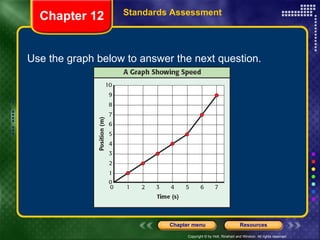
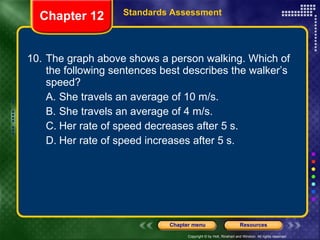
Use the graph below to answer the next question. Chapter 12 Standards Assessment
10. The graph above shows a person walking. Which of the following sentences best describes the walker’s speed? A. She travels an average of 10 m/s. B. She travels an average of 4 m/s. C. Her rate of speed decreases after 5 s. D. Her rate of speed increases after 5 s. Chapter 12 Standards Assessment
11. All forces are measured by their direction and their size. Another term for the size of a force is A. circumference. B. magnitude. C. cumulative force. D. velocity. Chapter 12 Standards Assessment
12. What is matter? A. solid things that you can see and touch B. anything contained in a gravitational field C. anything that has mass and volume D. things with a definite shape and volume Chapter 12 Standards Assessment
13. Which of the following holds the electrons of an atom around the atom’s nucleus? A. strong force B. electromagnetic force C. weak force D. gravitational force Chapter 12 Standards Assessment
14. What is the function of tendons in the human body? A. They coordinate muscle groups. B. They provide support for the body. C. They connect two muscles. D. They attach muscle to bone. Chapter 12 Standards Assessment
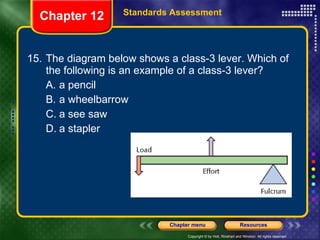
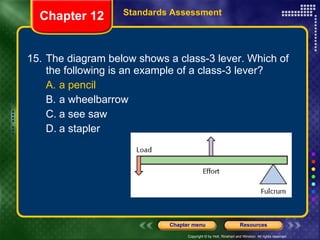
15. The diagram below shows a class-3 lever. Which of the following is an example of a class-3 lever? A. a pencil B. a wheelbarrow C. a see saw D. a stapler Chapter 12 Standards Assessment
Chapter 12

Chapter 12: Forces

  • 1.
    To View thepresentation as a slideshow with effects select “View” on the menu bar and click on “Slide Show.” To advance through the presentation, click the right-arrow key or the space bar . From the resources slide, click on any resource to see a presentation for that resource. From the Chapter menu screen click on any lesson to go directly to that lesson’s presentation. You may exit the slide show at any time by pressing the Esc key . How to Use This Presentation
  • 2.
    Resources Chapter PresentationImage Bank Math Focus Bellringers Standards Assessment Visual Concepts
  • 3.
    Table of ContentsSection 1 Measuring Motion Section 2 What Is a Force? Section 3 Friction: A Force That Opposes Motion Chapter 12 Matter in Motion
  • 4.
    Bellringer Describe thelocation of a favorite place, using a reference point and reference directions. For example, “The library is at the corner of Madison Street and Monroe Street. It is two blocks west of the school and four blocks north of the bus stop.” Write your response in your Science Journal. Section 1 Measuring Motion Chapter 12
  • 5.
    What You WillLearn Properties used to describe the motion of an object include a reference point, direction, speed, velocity, and acceleration. Average speed can be calculated by dividing total distance by total time. A change in velocity is due to a change in speed, direction, or both. Speed and acceleration can be represented on graphs. Section 1 Measuring Motion Chapter 12
  • 6.
    Motion and ReferencePoints An object is in motion if it changes position over time in relation to a reference point. A reference point is any object that appears to stay in place. Features on Earth’s surface are often used as standard reference points. Section 1 Measuring Motion Chapter 12
  • 7.
    Motion and ReferencePoints , continued Reference directions—such as north, south, east, west, up, or down—can be used to describe the direction of an object’s motion. A grid can be used to describe motion in a two-dimensional system. Section 1 Measuring Motion Chapter 12
  • 8.
    Average Speed Thespeed of an object is the rate at which the object moves. The speed of an object is rarely constant. So, it is useful to find the average speed of an object. Section 1 Measuring Motion Chapter 12
  • 9.
    Average Speed ,continued Average speed is the total distance traveled divided by the total time taken. A graph of position versus time can show an object’s speed. On a graph of position versus time, the slope of the line is equal to the speed of the object. Section 1 Measuring Motion Chapter 12
  • 10.
    Velocity: Direction MattersVelocity is the speed of an object in a particular direction. Velocity and speed do not have the same meaning. Velocity must include a direction. Section 1 Measuring Motion Chapter 12
  • 11.
    Velocity: Direction Matters, continued The velocity of an object is constant only if the speed and direction of the object do not change. So, constant velocity is always motion along a straight line. The velocity of an object changes if the object’s speed, direction, or both change. Section 1 Measuring Motion Chapter 12
  • 12.
    Velocity Matter inMotion Chapter 12
  • 13.
    Acceleration Acceleration is the rate at which velocity changes over time. An object can accelerate by changing speed, direction, or both. The units for acceleration are the units for velocity divided by a unit for time, usually meters per second per second, or (m/s)/s, which is also written as m/s 2 . Section 1 Measuring Motion Chapter 12
  • 14.
    Acceleration Matter inMotion Chapter 12
  • 15.
    Acceleration , continuedCentripetal acceleration occurs when an object moves at a constant speed in circular motion. A graph of speed versus time can show positive acceleration, no acceleration, and negative acceleration. Section 1 Measuring Motion Chapter 12
  • 16.
    Matter in MotionChapter 12
  • 17.
    Bellringer A forceis a push or a pull on an object. Imagine that you are trying to push a box up a ramp. Describe as many forces (pushes and pulls) as you can in that situation. Be sure to include the direction of each force (push or pull) in your description. Write your answers in your Science Journal. Section 2 What Is a Force? Chapter 12
  • 18.
    What You WillLearn A force is a push or a pull that acts on an object. Forces have magnitude and direction. Net force is the combined effect of two or more forces acting on an object. Balanced forces do not cause changes in motion. Unbalanced forces cause changes in an object’s velocity. Section 2 What Is a Force? Chapter 12
  • 19.
    Forces Acting onObjects A force is a push or a pull exerted on an object in order to change the motion of the object. All forces have two properties: direction and magnitude, or size. Forces can cause acceleration. Section 2 What Is a Force? Chapter 12
  • 20.
    Forces Acting onObjects , continued Forces always act on objects. For any push to occur, something has to receive the push. A newton (N) is the SI unit used to describe the magnitude, or size, of a force. A force can act on an object without causing the object to move. Section 2 What Is a Force? Chapter 12
  • 21.
    Force Matter inMotion Chapter 12
  • 22.
    Combined Effect ofForces The net force is the combination of all the forces acting on an object. When forces act in the same direction, you add the forces to determine the net force. When two forces act in opposite directions, you subtract the smaller force from the larger force to determine the net force. Section 2 What Is a Force? Chapter 12
  • 23.
    Matter in MotionChapter 12
  • 24.
    Balanced Forces: NoChange in Motion When the forces on an object produce a net force of 0 N, the forces are balanced. Balanced forces do not cause a change in the motion of an object. Section 2 What Is a Force? Chapter 12
  • 25.
    Balanced Forces: NoChange in Motion , continued Objects that are not moving and have balanced forces acting on them are called static objects. Tension and compression are two forces that often act on static objects. Section 2 What Is a Force? Chapter 12
  • 26.
    Balanced Forces: NoChange in Motion , continued Tension is a force that is exerted when matter is pulled or stretched. Compression is a force that is exerted when matter is pushed or squeezed. Section 2 What Is a Force? Chapter 12
  • 27.
    Unbalanced Forces: VelocityChanges When the net force on an object is not 0 N, the forces on the object are unbalanced. Unbalanced forces cause a change in the velocity of an object. Section 2 What Is a Force? Chapter 12
  • 28.
    Unbalanced Forces: VelocityChanges , continued Unbalanced forces are needed to cause static objects to start moving. Objects do not always move in the direction of the unbalanced force. Section 2 What Is a Force? Chapter 12
  • 29.
    Bellringer Imagine thatyou are trying to push a heavy desk across the floor. There are two opposing forces on the desk: the force you apply, and the force of friction between the desk and the floor. What will happen if the force of friction is the same magnitude as the force that you apply? What will happen if the force that you apply is greater than the force of friction? Write your answers in your Science Journal. Section 3 Friction: A Force That Opposes Motion Chapter 12
  • 30.
    What You WillLearn The magnitude of the force of friction can vary. Kinetic friction is a force that, when unbalanced, can change the velocity of a moving object. Static friction balances an applied force and can prevent motion. Friction can be both harmful and helpful. Section 3 Friction: A Force That Opposes Motion Chapter 12
  • 31.
    The Source ofFriction When the hills and valleys of one surface stick to the hills and valleys of another surface, friction is created. Friction is a force that opposes motion between two surfaces that are touching. Section 3 Friction: A Force That Opposes Motion Chapter 12
  • 32.
    The Source ofFriction , continued As the force pushing surfaces together increases, the friction between the surfaces increases. Friction is usually greater between materials that have rough surfaces than it is between materials that have smooth surfaces. Section 3 Friction: A Force That Opposes Motion Chapter 12
  • 33.
    Matter in MotionChapter 12
  • 34.
    Types of FrictionThere are two types of friction: kinetic friction and static friction. Kinetic friction is friction between moving surfaces. The force of sliding kinetic friction is greater than the force of rolling kinetic friction. Section 3 Friction: A Force That Opposes Motion Chapter 12
  • 35.
    Types of Friction, continued Static friction can balance an applied force and can prevent changes in motion. Some static objects do not move because the force of static friction balances the other forces acting on the object. Section 3 Friction: A Force That Opposes Motion Chapter 12
  • 36.
    Matter in MotionChapter 12
  • 37.
    Friction: Harmful andHelpful Because friction can be both harmful and helpful, sometimes it should be decreased and sometimes it should be increased. Lubricants are substances that are put on surfaces to decrease friction between the surfaces. Some examples of lubricants include motor oil, wax, and grease. Section 3 Friction: A Force That Opposes Motion Chapter 12
  • 38.
    Friction: Harmful andHelpful , continued Harmful friction can be decreased by using lubricants or by smoothing the surfaces that rub against each other. Helpful friction can be increased by making the surfaces that rub against each other rougher or by increasing the force pushing surfaces together. Section 3 Friction: A Force That Opposes Motion Chapter 12
  • 39.
    Concept Map Chapter12 Matter in Motion Use the terms below to complete the concept map on the next slide. motion acceleration speed time velocity
  • 40.
    Matter in MotionChapter 12 Concept Map
  • 41.
    Matter in MotionChapter 12 Concept Map
  • 42.
    End of Chapter12 Show Matter in Motion Chapter 12
  • 43.
    1. Which ofthe following words means “stress that happens when forces act to stretch an object”? A. drive B. tension C. torque D. energy Chapter 12 Standards Assessment
  • 44.
    1. Which ofthe following words means “stress that happens when forces act to stretch an object”? A. drive B. tension C. torque D. energy Chapter 12 Standards Assessment
  • 45.
    2. Which ofthe following words is the closest in meaning to the word involve ? A. include B. ascertain C. believe D. accompany Chapter 12 Standards Assessment
  • 46.
    2. Which ofthe following words is the closest in meaning to the word involve ? A. include B. ascertain C. believe D. accompany Chapter 12 Standards Assessment
  • 47.
    3. In thesentence “By interpreting the data in the graph, the scientist learned that the speed of the car had been constant,” what does the word interpreting mean? A. figuring out the meaning of B. interacting with C. disposing of D. identifying the parts of Chapter 12 Standards Assessment
  • 48.
    3. In thesentence “By interpreting the data in the graph, the scientist learned that the speed of the car had been constant,” what does the word interpreting mean? A. figuring out the meaning of B. interacting with C. disposing of D. identifying the parts of Chapter 12 Standards Assessment
  • 49.
    4. Which ofthe following sets of words best completes the following sentence: “Position _____ relation to a reference point and a set of references directions.” A. defines with B. was defined of C. is defined in D. definition by Chapter 12 Standards Assessment
  • 50.
    4. Which ofthe following sets of words best completes the following sentence: “Position _____ relation to a reference point and a set of references directions.” A. defines with B. was defined of C. is defined in D. definition by Chapter 12 Standards Assessment
  • 51.
    5. Which ofthe following is the noun form of the verb specify? A. specific B. specifically C. specified D. specification Chapter 12 Standards Assessment
  • 52.
    5. Which ofthe following is the noun form of the verb specify? A. specific B. specifically C. specified D. specification Chapter 12 Standards Assessment
  • 53.
    6. The rateat which an object moves is its speed. If a horse walked 50 m in 68 s, cantered 150 m in 35 s, and galloped 300 m in 22 s, what would its average speed be? A. 0.25 m/s B. 4 m/s C. 6.22 m/s D. 40 m/s Chapter 12 Standards Assessment
  • 54.
    6. The rateat which an object moves is its speed. If a horse walked 50 m in 68 s, cantered 150 m in 35 s, and galloped 300 m in 22 s, what would its average speed be? A. 0.25 m/s B. 4 m/s C. 6.22 m/s D. 40 m/s Chapter 12 Standards Assessment
  • 55.
    7. What isthe difference between speed and velocity? A. Velocity is expressed in m/s. Speed is expressed in m/s 2 . B. Speed involves a constant rate of acceleration, and velocity does not. C. Speed is measured by time and distance, but velocity also includes direction. D. Velocity involves moving in a direction in a straight line, and speed does not. Chapter 12 Standards Assessment
  • 56.
    7. What isthe difference between speed and velocity? A. Velocity is expressed in m/s. Speed is expressed in m/s 2 . B. Speed involves a constant rate of acceleration, and velocity does not. C. Speed is measured by time and distance, but velocity also includes direction. D. Velocity involves moving in a direction in a straight line, and speed does not. Chapter 12 Standards Assessment
  • 57.
    8. A teenagerpulls a rope to the left with a force of 12 N. A child pulls on the other end of the rope to the right with a force of 7 N. The child’s friend adds a force of 8 N, also pulling to the right. What will happen? A. The net force will be 3 N to the right. B. The net force will be 15 N to the left. C. The net force will be 12 N to the right. D. The net force will be 27 N to the left. Chapter 12 Standards Assessment
  • 58.
    8. A teenagerpulls a rope to the left with a force of 12 N. A child pulls on the other end of the rope to the right with a force of 7 N. The child’s friend adds a force of 8 N, also pulling to the right. What will happen? A. The net force will be 3 N to the right. B. The net force will be 15 N to the left. C. The net force will be 12 N to the right. D. The net force will be 27 N to the left. Chapter 12 Standards Assessment
  • 59.
    9. Which ofthe following are forces that act on a person leaning against a pole at a bus stop? A. gravity and newtons B. tension and weight C. tension and kinetic friction D. gravity and static friction Chapter 12 Standards Assessment
  • 60.
    9. Which ofthe following are forces that act on a person leaning against a pole at a bus stop? A. gravity and newtons B. tension and weight C. tension and kinetic friction D. gravity and static friction Chapter 12 Standards Assessment
  • 61.
    Use the graphbelow to answer the next question. Chapter 12 Standards Assessment
  • 62.
    10. The graphabove shows a person walking. Which of the following sentences best describes the walker’s speed? A. She travels an average of 10 m/s. B. She travels an average of 4 m/s. C. Her rate of speed decreases after 5 s. D. Her rate of speed increases after 5 s. Chapter 12 Standards Assessment
  • 63.
    10. The graphabove shows a person walking. Which of the following sentences best describes the walker’s speed? A. She travels an average of 10 m/s. B. She travels an average of 4 m/s. C. Her rate of speed decreases after 5 s. D. Her rate of speed increases after 5 s. Chapter 12 Standards Assessment
  • 64.
    11. All forcesare measured by their direction and their size. Another term for the size of a force is A. circumference. B. magnitude. C. cumulative force. D. velocity. Chapter 12 Standards Assessment
  • 65.
    11. All forcesare measured by their direction and their size. Another term for the size of a force is A. circumference. B. magnitude. C. cumulative force. D. velocity. Chapter 12 Standards Assessment
  • 66.
    12. What ismatter? A. solid things that you can see and touch B. anything contained in a gravitational field C. anything that has mass and volume D. things with a definite shape and volume Chapter 12 Standards Assessment
  • 67.
    12. What ismatter? A. solid things that you can see and touch B. anything contained in a gravitational field C. anything that has mass and volume D. things with a definite shape and volume Chapter 12 Standards Assessment
  • 68.
    13. Which ofthe following holds the electrons of an atom around the atom’s nucleus? A. strong force B. electromagnetic force C. weak force D. gravitational force Chapter 12 Standards Assessment
  • 69.
    13. Which ofthe following holds the electrons of an atom around the atom’s nucleus? A. strong force B. electromagnetic force C. weak force D. gravitational force Chapter 12 Standards Assessment
  • 70.
    14. What isthe function of tendons in the human body? A. They coordinate muscle groups. B. They provide support for the body. C. They connect two muscles. D. They attach muscle to bone. Chapter 12 Standards Assessment
  • 71.
    14. What isthe function of tendons in the human body? A. They coordinate muscle groups. B. They provide support for the body. C. They connect two muscles. D. They attach muscle to bone. Chapter 12 Standards Assessment
  • 72.
    15. The diagrambelow shows a class-3 lever. Which of the following is an example of a class-3 lever? A. a pencil B. a wheelbarrow C. a see saw D. a stapler Chapter 12 Standards Assessment
  • 73.
    15. The diagrambelow shows a class-3 lever. Which of the following is an example of a class-3 lever? A. a pencil B. a wheelbarrow C. a see saw D. a stapler Chapter 12 Standards Assessment
  • 74.