Fundamentals of Nursing
LEARNING OUTCOMES
After completing this chapter, you will be able to:
1. Identify the purposes of the physical examination
2. Explain the four techniques used in physical examination:
inspection, palpation, percussion, and auscultation
3. Verbalize the steps used in performing selected examination
procedures
4. Describe suggested sequencing to conduct a physical health
examination in an orderly fashion
5. Demonstrate appropriate documentation and reporting of health
assessment
Introduction
• Assessing a client’s health status:
1. Nursing health history
2. Physical examination
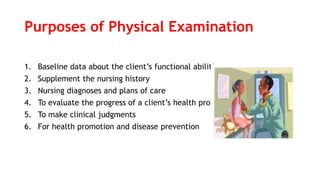
Purposes of Physical Examination
1. Baseline data about the client’s functional abilities
2. Supplement the nursing history
3. Nursing diagnoses and plans of care
4. To evaluate the progress of a client’s health problem
5. To make clinical judgments
6. For health promotion and disease prevention
Types of Physical Examination
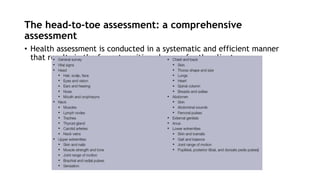
The head-to-toe assessment: a comprehensive
assessment
• Health assessment is conducted in a systematic and efficient manner
that results in the fewest position changes for the client.
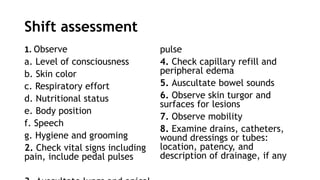
Shift assessment
1. Observe
a. Level of consciousness
b. Skin color
c. Respiratory effort
d. Nutritional status
e. Body position
f. Speech
g. Hygiene and grooming
2. Check vital signs including
pain, include pedal pulses
pulse
4. Check capillary refill and
peripheral edema
5. Auscultate bowel sounds
6. Observe skin turgor and
surfaces for lesions
7. Observe mobility
8. Examine drains, catheters,
wound dressings or tubes:
location, patency, and
description of drainage, if any
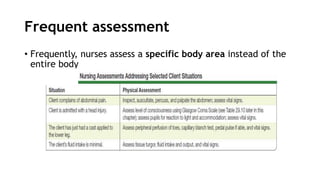
Frequent assessment
• Frequently, nurses assess a specific body area instead of the
entire body
Methods of Examining
• Four primary techniques are used in the physical examination:
1. Inspection
2. Palpation
3. Percussion
4. Auscultation
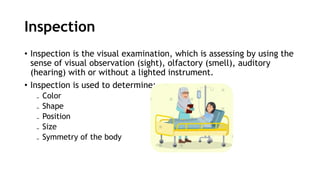
Inspection
• Inspection is the visual examination, which is assessing by using the
sense of visual observation (sight), olfactory (smell), auditory
(hearing) with or without a lighted instrument.
• Inspection is used to determine:
₋ Color
₋ Shape
₋ Position
₋ Size
₋ Symmetry of the body
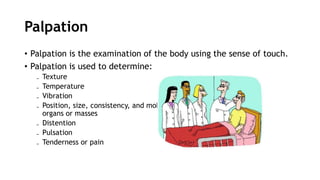
Palpation
• Palpation is the examination of the body using the sense of touch.
• Palpation is used to determine:
₋ Texture
₋ Temperature
₋ Vibration
₋ Position, size, consistency, and mobility of
organs or masses
₋ Distention
₋ Pulsation
₋ Tenderness or pain
General guidelines for palpation
• The pads of the fingers are used
• The nurse’s hands should be clean and warm, and the
fingernails short
• Areas of tenderness should be palpated last
• Deep palpation should be done after superficial palpation
• To test skin temperature, it is best to use the dorsum (back) of
the hand and fingers, where the examiner’s skin is thinnest
• To test for vibration, the nurse should use the palmar surface
of the hand
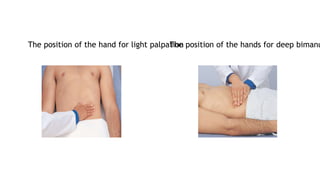
The position of the hand for light palpation
The position of the hands for deep bimanu
Percussion
• Percussion is the act of striking the body surface
• Percussion is used to determine:
₋ Size and shape of internal organs
₋ Borders of internal organs
₋ Indicates whether tissue is fluid filled, air filled, or solid
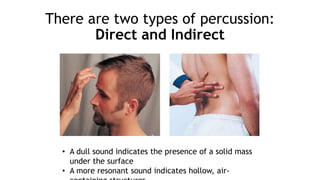
There are two types of percussion:
Direct and Indirect
• A dull sound indicates the presence of a solid mass
under the surface
• A more resonant sound indicates hollow, air-
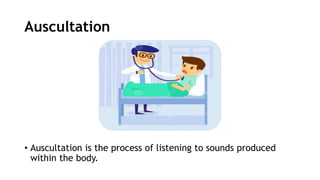
Auscultation
• Auscultation is the process of listening to sounds produced
within the body.
Auscultation
• Auscultated sounds are described according to their pitch,
intensity, duration, and quality.
₋ The pitch is the frequency of the vibrations (the number of
vibrations per second)
₋ The intensity (amplitude) refers to the loudness or softness of a
sound
₋ The duration
₋ The quality of sound is a subjective description of a sound
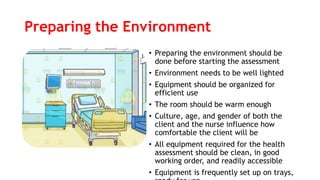
Preparing the Environment
• Preparing the environment should be
done before starting the assessment
• Environment needs to be well lighted
• Equipment should be organized for
efficient use
• The room should be warm enough
• Culture, age, and gender of both the
client and the nurse influence how
comfortable the client will be
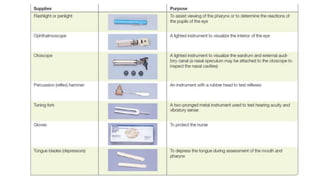
• All equipment required for the health
assessment should be clean, in good
working order, and readily accessible
• Equipment is frequently set up on trays,
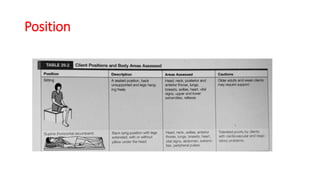
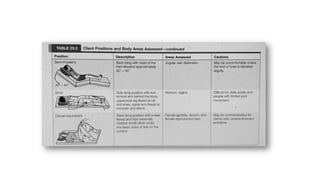
Position
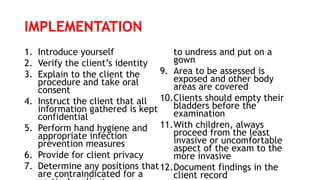
IMPLEMENTATION
1. Introduce yourself
2. Verify the client’s identity
3. Explain to the client the
procedure and take oral
consent
4. Instruct the client that all
information gathered is kept
confidential
5. Perform hand hygiene and
appropriate infection
prevention measures
6. Provide for client privacy
7. Determine any positions that
are contraindicated for a
to undress and put on a
gown
9. Area to be assessed is
exposed and other body
areas are covered
10.Clients should empty their
bladders before the
examination
11.With children, always
proceed from the least
invasive or uncomfortable
aspect of the exam to the
more invasive
12.Document findings in the
client record
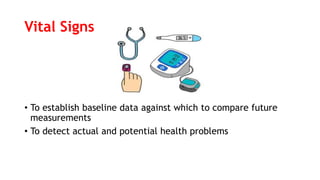
Vital Signs
• To establish baseline data against which to compare future
measurements
• To detect actual and potential health problems
Height and Weight
• Purpose:
₋ Provides a general measure of health
₋ Unintentional weight gain or loss
Appearance and Mental Status
• General appearance
• Client’s age, sex, and race
• Behavior of an individual
• Posture and gait
• Facial expressions
• Hygiene and grooming
• Mood
• Quantity of speech
• Organization of thoughts
Skin
• Assessment of the skin involves inspection and palpation
• The nurse may also use the olfactory sense to detect unusual
skin odors
• Inspect skin color and uniformity of its color
• Inspect, palpate, and describe skin lesions
• Observe and palpate skin moisture
• Palpate skin temperature
Skin
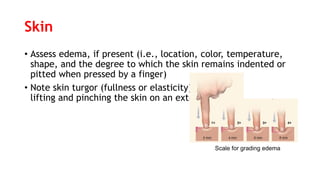
• Assess edema, if present (i.e., location, color, temperature,
shape, and the degree to which the skin remains indented or
pitted when pressed by a finger)
• Note skin turgor (fullness or elasticity) by
lifting and pinching the skin on an extremity or on the sternum
Scale for grading edema
Hair
• Assessing a client’s hair includes inspecting the hair
• Inspect the evenness of growth over the scalp
• Inspect hair thickness or thinness
• Inspect hair texture and oiliness
• Note presence of infections or infestations by parting the hair
in several areas, checking behind the ears and along the
hairline at the neck
• Inspect amount of body hair
Nails
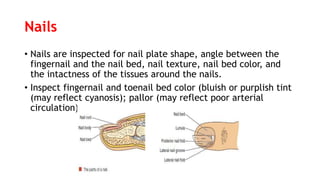
• Nails are inspected for nail plate shape, angle between the
fingernail and the nail bed, nail texture, nail bed color, and
the intactness of the tissues around the nails.
• Inspect fingernail and toenail bed color (bluish or purplish tint
(may reflect cyanosis); pallor (may reflect poor arterial
circulation)
Nails
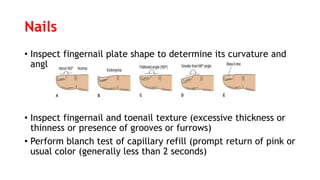
• Inspect fingernail plate shape to determine its curvature and
angle
• Inspect fingernail and toenail texture (excessive thickness or
thinness or presence of grooves or furrows)
• Perform blanch test of capillary refill (prompt return of pink or
usual color (generally less than 2 seconds)
Head
• Inspect the skull for size, shape, and symmetry (rounded
normocephalic and symmetric)
• Inspect the facial features (e.g., symmetry of structures and
of the distribution of hair)
• Inspect the eyes for edema or hollowness
• Note symmetry of facial movements
• Ask the client to elevate the eyebrows, frown, or lower the
eyebrows, close the eyes tightly, puff the cheeks, and smile
and show the teeth
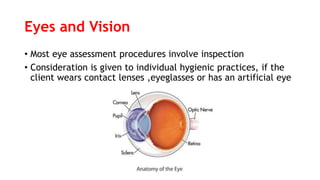
Eyes and Vision
• Most eye assessment procedures involve inspection
• Consideration is given to individual hygienic practices, if the
client wears contact lenses ,eyeglasses or has an artificial eye
Eyes and Vision
• Inspect for:
₋ Myopia (nearsightedness), Hyperopia (farsightedness), or
Presbyopia (loss of elasticity of the lens and thus loss of ability to
see close objects)
₋ Mydriasis (enlarged pupils)
₋ Miosis (constricted pupils)
₋ Anisocoria (unequal pupils)
₋ Cataract (opacity of the lens or its capsule, which blocks light rays,
is frequently removed and replaced by a lens implant)
₋ Glaucoma (a disturbance in the circulation of aqueous fluid, which
causes an increase in intraocular pressure)
Ears and Hearing
• Direct inspection and palpation of the external ear
• Inspection of the internal parts of the ear by an otoscope
• Inspect the auricles for color, symmetry of size, and position
• Palpate the auricles for texture, elasticity, and areas of
tenderness
• Inspect the external ear canal for cerumen, skin lesions, pus,
and blood
• Assess client’s response to normal voice tones
Nose and Sinuses
• Inspect for:
₋ Difficulty or abnormality in smell
₋ External nose for any deviations in shape, size, or color and
flaring or discharge from the nares
₋ Inspect and palpate the facial sinuses
₋ Lightly palpate the external nose to determine any areas of
tenderness, masses, and displacements of bone and cartilage
₋ Determine patency of both nasal cavities
Mouth and Oropharynx
• Inspect and palpate color, moisture, texture, and the presence of
lesions on lips
• Inspect the teeth and gums while examining the inner lips and
buccal mucosa
• Inspect dentures
• Inspect the surface of the tongue for position, color, and texture
• Inspect the hard and soft palate for color, shape, texture, and the
presence of bony prominences
• Inspect the uvula for position and mobility while examining the
palates
• Inspect the oropharynx for color and texture
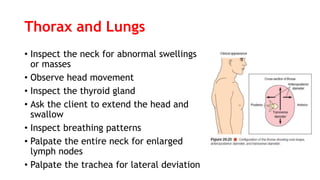
Thorax and Lungs
• Inspect the neck for abnormal swellings
or masses
• Observe head movement
• Inspect the thyroid gland
• Ask the client to extend the head and
swallow
• Inspect breathing patterns
• Palpate the entire neck for enlarged
lymph nodes
• Palpate the trachea for lateral deviation
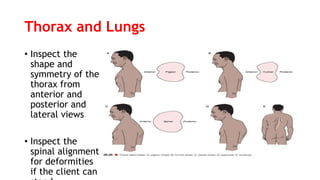
Thorax and Lungs
• Inspect the
shape and
symmetry of the
thorax from
anterior and
posterior and
lateral views
• Inspect the
spinal alignment
for deformities
if the client can
Thorax and Lungs
• Palpate the anterior and posterior thorax for skin lesions or
areas of hyperthermia or for fremitus
• Percuss the thorax
• Auscultate the thorax and trachea using stethoscope
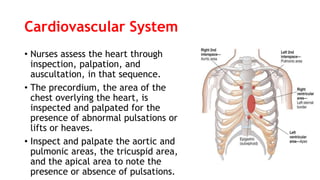
Cardiovascular System
• Nurses assess the heart through
inspection, palpation, and
auscultation, in that sequence.
• The precordium, the area of the
chest overlying the heart, is
inspected and palpated for the
presence of abnormal pulsations or
lifts or heaves.
• Inspect and palpate the aortic and
pulmonic areas, the tricuspid area,
and the apical area to note the
presence or absence of pulsations.
Cardiovascular System
• Inspect and palpate the epigastric area at the base of the
sternum for abdominal aortic pulsations
• Auscultate the heart in all four anatomic sites: aortic,
pulmonic, tricuspid, and apical (mitral)
• Palpate the carotid artery, using extreme caution
• Auscultate the carotid artery
• Inspect the jugular veins for distention while the client is
placed in the semi- Fowler’s position
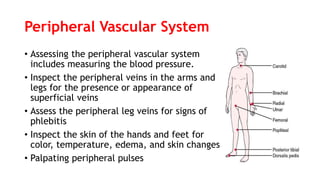
Peripheral Vascular System
• Assessing the peripheral vascular system
includes measuring the blood pressure.
• Inspect the peripheral veins in the arms and
legs for the presence or appearance of
superficial veins
• Assess the peripheral leg veins for signs of
phlebitis
• Inspect the skin of the hands and feet for
color, temperature, edema, and skin changes
• Palpating peripheral pulses
Peripheral Vascular System
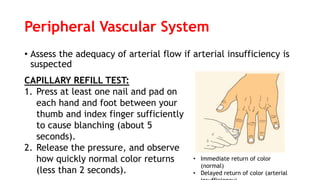
• Assess the adequacy of arterial flow if arterial insufficiency is
suspected
• Immediate return of color
(normal)
• Delayed return of color (arterial
CAPILLARY REFILL TEST:
1. Press at least one nail and pad on
each hand and foot between your
thumb and index finger sufficiently
to cause blanching (about 5
seconds).
2. Release the pressure, and observe
how quickly normal color returns
(less than 2 seconds).
Abdomen
• When assessing the abdomen, the nurse performs inspection
first, followed by auscultation, percussion, and/or palpation.
• Inspect the abdomen for skin integrity, for contour and
symmetry
• Observe abdominal movements associated with respiration,
peristalsis, or aortic pulsations
• Auscultate the abdomen for bowel sounds, vascular sounds,
and peritoneal friction rubs
• Perform light palpation to detect areas of tenderness and/or
muscle guarding
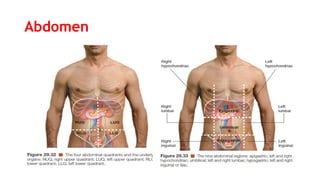
• Percuss several areas in each of the four quadrants to
determine presence of tympany (sound indicating gas in
Abdomen
Musculoskeletal System
• The nurse usually assesses the musculoskeletal system for muscle
strength, tone, size and symmetry of muscle development, and for
tremors.
• Inspect the muscles for size
• Inspect the muscles and tendons for contractures
• Inspect the muscles for tremors
• Inspect the skeleton for structure
• Inspect the joint for swelling
• Assess joint range of motion
• Test muscle strength
• Palpate the bones to locate any areas of edema or tenderness
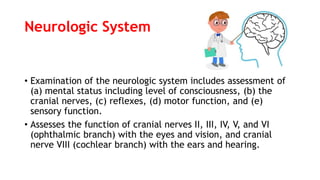
Neurologic System
• Examination of the neurologic system includes assessment of
(a) mental status including level of consciousness, (b) the
cranial nerves, (c) reflexes, (d) motor function, and (e)
sensory function.
• Assesses the function of cranial nerves II, III, IV, V, and VI
(ophthalmic branch) with the eyes and vision, and cranial
nerve VIII (cochlear branch) with the ears and hearing.
Neurologic System
• Language
• Orientation: to recognize other people (person), awareness of
when and where they presently are (time and place), and who
they, themselves, are (self).
• Memory: (immediate recall), (recent memory), (remote or
long-term memory).
• Level of Consciousness
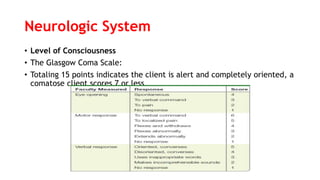
Neurologic System
• Level of Consciousness
• The Glasgow Coma Scale:
• Totaling 15 points indicates the client is alert and completely oriented, a
comatose client scores 7 or less
Neurologic System
• Reflexes
• The deep tendon reflex (DTR) is activated when a tendon is
stimulated (tapped) and its associated muscle contracts.
• Reflexes are tested using a percussion hammer
• Sensory Function
• Touch, pain, temperature, position, and tactile discrimination.
• Abnormal responses to touch stimuli include loss of sensation
(anesthesia); more than normal sensation (hyperesthesia); less
than normal sensation (hypoesthesia); or an abnormal
sensation such as burning, pain, or an electric shock
(paresthesia).
Neurologic System
• Motor Function
• Neurologic assessment of the motor system evaluates
proprioception and cerebellar function.
• The proprioception function
• The cerebellum (a) helps to control posture, (b) acts with the
cerebral cortex to make body movements smooth and
coordinated, and (c) controls skeletal muscles to maintain
equilibrium.
Health_assessment1-1.pptx

Health_assessment1-1.pptx

  • 1.
  • 2.
    LEARNING OUTCOMES After completingthis chapter, you will be able to: 1. Identify the purposes of the physical examination 2. Explain the four techniques used in physical examination: inspection, palpation, percussion, and auscultation 3. Verbalize the steps used in performing selected examination procedures 4. Describe suggested sequencing to conduct a physical health examination in an orderly fashion 5. Demonstrate appropriate documentation and reporting of health assessment
  • 3.
    Introduction • Assessing aclient’s health status: 1. Nursing health history 2. Physical examination
  • 4.
    Purposes of PhysicalExamination 1. Baseline data about the client’s functional abilities 2. Supplement the nursing history 3. Nursing diagnoses and plans of care 4. To evaluate the progress of a client’s health problem 5. To make clinical judgments 6. For health promotion and disease prevention
  • 5.
    Types of PhysicalExamination
  • 6.
    The head-to-toe assessment:a comprehensive assessment • Health assessment is conducted in a systematic and efficient manner that results in the fewest position changes for the client.
  • 7.
    Shift assessment 1. Observe a.Level of consciousness b. Skin color c. Respiratory effort d. Nutritional status e. Body position f. Speech g. Hygiene and grooming 2. Check vital signs including pain, include pedal pulses pulse 4. Check capillary refill and peripheral edema 5. Auscultate bowel sounds 6. Observe skin turgor and surfaces for lesions 7. Observe mobility 8. Examine drains, catheters, wound dressings or tubes: location, patency, and description of drainage, if any
  • 8.
    Frequent assessment • Frequently,nurses assess a specific body area instead of the entire body
  • 9.
    Methods of Examining •Four primary techniques are used in the physical examination: 1. Inspection 2. Palpation 3. Percussion 4. Auscultation
  • 10.
    Inspection • Inspection isthe visual examination, which is assessing by using the sense of visual observation (sight), olfactory (smell), auditory (hearing) with or without a lighted instrument. • Inspection is used to determine: ₋ Color ₋ Shape ₋ Position ₋ Size ₋ Symmetry of the body
  • 11.
    Palpation • Palpation isthe examination of the body using the sense of touch. • Palpation is used to determine: ₋ Texture ₋ Temperature ₋ Vibration ₋ Position, size, consistency, and mobility of organs or masses ₋ Distention ₋ Pulsation ₋ Tenderness or pain
  • 12.
    General guidelines forpalpation • The pads of the fingers are used • The nurse’s hands should be clean and warm, and the fingernails short • Areas of tenderness should be palpated last • Deep palpation should be done after superficial palpation • To test skin temperature, it is best to use the dorsum (back) of the hand and fingers, where the examiner’s skin is thinnest • To test for vibration, the nurse should use the palmar surface of the hand
  • 13.
    The position ofthe hand for light palpation The position of the hands for deep bimanu
  • 14.
    Percussion • Percussion isthe act of striking the body surface • Percussion is used to determine: ₋ Size and shape of internal organs ₋ Borders of internal organs ₋ Indicates whether tissue is fluid filled, air filled, or solid
  • 15.
    There are twotypes of percussion: Direct and Indirect • A dull sound indicates the presence of a solid mass under the surface • A more resonant sound indicates hollow, air-
  • 16.
    Auscultation • Auscultation isthe process of listening to sounds produced within the body.
  • 17.
    Auscultation • Auscultated soundsare described according to their pitch, intensity, duration, and quality. ₋ The pitch is the frequency of the vibrations (the number of vibrations per second) ₋ The intensity (amplitude) refers to the loudness or softness of a sound ₋ The duration ₋ The quality of sound is a subjective description of a sound
  • 18.
    Preparing the Environment •Preparing the environment should be done before starting the assessment • Environment needs to be well lighted • Equipment should be organized for efficient use • The room should be warm enough • Culture, age, and gender of both the client and the nurse influence how comfortable the client will be • All equipment required for the health assessment should be clean, in good working order, and readily accessible • Equipment is frequently set up on trays,
  • 19.
  • 22.
    IMPLEMENTATION 1. Introduce yourself 2.Verify the client’s identity 3. Explain to the client the procedure and take oral consent 4. Instruct the client that all information gathered is kept confidential 5. Perform hand hygiene and appropriate infection prevention measures 6. Provide for client privacy 7. Determine any positions that are contraindicated for a to undress and put on a gown 9. Area to be assessed is exposed and other body areas are covered 10.Clients should empty their bladders before the examination 11.With children, always proceed from the least invasive or uncomfortable aspect of the exam to the more invasive 12.Document findings in the client record
  • 23.
    Vital Signs • Toestablish baseline data against which to compare future measurements • To detect actual and potential health problems
  • 24.
    Height and Weight •Purpose: ₋ Provides a general measure of health ₋ Unintentional weight gain or loss
  • 25.
    Appearance and MentalStatus • General appearance • Client’s age, sex, and race • Behavior of an individual • Posture and gait • Facial expressions • Hygiene and grooming • Mood • Quantity of speech • Organization of thoughts
  • 26.
    Skin • Assessment ofthe skin involves inspection and palpation • The nurse may also use the olfactory sense to detect unusual skin odors • Inspect skin color and uniformity of its color • Inspect, palpate, and describe skin lesions • Observe and palpate skin moisture • Palpate skin temperature
  • 27.
    Skin • Assess edema,if present (i.e., location, color, temperature, shape, and the degree to which the skin remains indented or pitted when pressed by a finger) • Note skin turgor (fullness or elasticity) by lifting and pinching the skin on an extremity or on the sternum Scale for grading edema
  • 28.
    Hair • Assessing aclient’s hair includes inspecting the hair • Inspect the evenness of growth over the scalp • Inspect hair thickness or thinness • Inspect hair texture and oiliness • Note presence of infections or infestations by parting the hair in several areas, checking behind the ears and along the hairline at the neck • Inspect amount of body hair
  • 29.
    Nails • Nails areinspected for nail plate shape, angle between the fingernail and the nail bed, nail texture, nail bed color, and the intactness of the tissues around the nails. • Inspect fingernail and toenail bed color (bluish or purplish tint (may reflect cyanosis); pallor (may reflect poor arterial circulation)
  • 30.
    Nails • Inspect fingernailplate shape to determine its curvature and angle • Inspect fingernail and toenail texture (excessive thickness or thinness or presence of grooves or furrows) • Perform blanch test of capillary refill (prompt return of pink or usual color (generally less than 2 seconds)
  • 31.
    Head • Inspect theskull for size, shape, and symmetry (rounded normocephalic and symmetric) • Inspect the facial features (e.g., symmetry of structures and of the distribution of hair) • Inspect the eyes for edema or hollowness • Note symmetry of facial movements • Ask the client to elevate the eyebrows, frown, or lower the eyebrows, close the eyes tightly, puff the cheeks, and smile and show the teeth
  • 32.
    Eyes and Vision •Most eye assessment procedures involve inspection • Consideration is given to individual hygienic practices, if the client wears contact lenses ,eyeglasses or has an artificial eye
  • 33.
    Eyes and Vision •Inspect for: ₋ Myopia (nearsightedness), Hyperopia (farsightedness), or Presbyopia (loss of elasticity of the lens and thus loss of ability to see close objects) ₋ Mydriasis (enlarged pupils) ₋ Miosis (constricted pupils) ₋ Anisocoria (unequal pupils) ₋ Cataract (opacity of the lens or its capsule, which blocks light rays, is frequently removed and replaced by a lens implant) ₋ Glaucoma (a disturbance in the circulation of aqueous fluid, which causes an increase in intraocular pressure)
  • 34.
    Ears and Hearing •Direct inspection and palpation of the external ear • Inspection of the internal parts of the ear by an otoscope • Inspect the auricles for color, symmetry of size, and position • Palpate the auricles for texture, elasticity, and areas of tenderness • Inspect the external ear canal for cerumen, skin lesions, pus, and blood • Assess client’s response to normal voice tones
  • 35.
    Nose and Sinuses •Inspect for: ₋ Difficulty or abnormality in smell ₋ External nose for any deviations in shape, size, or color and flaring or discharge from the nares ₋ Inspect and palpate the facial sinuses ₋ Lightly palpate the external nose to determine any areas of tenderness, masses, and displacements of bone and cartilage ₋ Determine patency of both nasal cavities
  • 36.
    Mouth and Oropharynx •Inspect and palpate color, moisture, texture, and the presence of lesions on lips • Inspect the teeth and gums while examining the inner lips and buccal mucosa • Inspect dentures • Inspect the surface of the tongue for position, color, and texture • Inspect the hard and soft palate for color, shape, texture, and the presence of bony prominences • Inspect the uvula for position and mobility while examining the palates • Inspect the oropharynx for color and texture
  • 37.
    Thorax and Lungs •Inspect the neck for abnormal swellings or masses • Observe head movement • Inspect the thyroid gland • Ask the client to extend the head and swallow • Inspect breathing patterns • Palpate the entire neck for enlarged lymph nodes • Palpate the trachea for lateral deviation
  • 38.
    Thorax and Lungs •Inspect the shape and symmetry of the thorax from anterior and posterior and lateral views • Inspect the spinal alignment for deformities if the client can
  • 39.
    Thorax and Lungs •Palpate the anterior and posterior thorax for skin lesions or areas of hyperthermia or for fremitus • Percuss the thorax • Auscultate the thorax and trachea using stethoscope
  • 40.
    Cardiovascular System • Nursesassess the heart through inspection, palpation, and auscultation, in that sequence. • The precordium, the area of the chest overlying the heart, is inspected and palpated for the presence of abnormal pulsations or lifts or heaves. • Inspect and palpate the aortic and pulmonic areas, the tricuspid area, and the apical area to note the presence or absence of pulsations.
  • 41.
    Cardiovascular System • Inspectand palpate the epigastric area at the base of the sternum for abdominal aortic pulsations • Auscultate the heart in all four anatomic sites: aortic, pulmonic, tricuspid, and apical (mitral) • Palpate the carotid artery, using extreme caution • Auscultate the carotid artery • Inspect the jugular veins for distention while the client is placed in the semi- Fowler’s position
  • 42.
    Peripheral Vascular System •Assessing the peripheral vascular system includes measuring the blood pressure. • Inspect the peripheral veins in the arms and legs for the presence or appearance of superficial veins • Assess the peripheral leg veins for signs of phlebitis • Inspect the skin of the hands and feet for color, temperature, edema, and skin changes • Palpating peripheral pulses
  • 43.
    Peripheral Vascular System •Assess the adequacy of arterial flow if arterial insufficiency is suspected • Immediate return of color (normal) • Delayed return of color (arterial CAPILLARY REFILL TEST: 1. Press at least one nail and pad on each hand and foot between your thumb and index finger sufficiently to cause blanching (about 5 seconds). 2. Release the pressure, and observe how quickly normal color returns (less than 2 seconds).
  • 44.
    Abdomen • When assessingthe abdomen, the nurse performs inspection first, followed by auscultation, percussion, and/or palpation. • Inspect the abdomen for skin integrity, for contour and symmetry • Observe abdominal movements associated with respiration, peristalsis, or aortic pulsations • Auscultate the abdomen for bowel sounds, vascular sounds, and peritoneal friction rubs • Perform light palpation to detect areas of tenderness and/or muscle guarding • Percuss several areas in each of the four quadrants to determine presence of tympany (sound indicating gas in
  • 45.
  • 46.
    Musculoskeletal System • Thenurse usually assesses the musculoskeletal system for muscle strength, tone, size and symmetry of muscle development, and for tremors. • Inspect the muscles for size • Inspect the muscles and tendons for contractures • Inspect the muscles for tremors • Inspect the skeleton for structure • Inspect the joint for swelling • Assess joint range of motion • Test muscle strength • Palpate the bones to locate any areas of edema or tenderness
  • 47.
    Neurologic System • Examinationof the neurologic system includes assessment of (a) mental status including level of consciousness, (b) the cranial nerves, (c) reflexes, (d) motor function, and (e) sensory function. • Assesses the function of cranial nerves II, III, IV, V, and VI (ophthalmic branch) with the eyes and vision, and cranial nerve VIII (cochlear branch) with the ears and hearing.
  • 48.
    Neurologic System • Language •Orientation: to recognize other people (person), awareness of when and where they presently are (time and place), and who they, themselves, are (self). • Memory: (immediate recall), (recent memory), (remote or long-term memory). • Level of Consciousness
  • 49.
    Neurologic System • Levelof Consciousness • The Glasgow Coma Scale: • Totaling 15 points indicates the client is alert and completely oriented, a comatose client scores 7 or less
  • 50.
    Neurologic System • Reflexes •The deep tendon reflex (DTR) is activated when a tendon is stimulated (tapped) and its associated muscle contracts. • Reflexes are tested using a percussion hammer • Sensory Function • Touch, pain, temperature, position, and tactile discrimination. • Abnormal responses to touch stimuli include loss of sensation (anesthesia); more than normal sensation (hyperesthesia); less than normal sensation (hypoesthesia); or an abnormal sensation such as burning, pain, or an electric shock (paresthesia).
  • 51.
    Neurologic System • MotorFunction • Neurologic assessment of the motor system evaluates proprioception and cerebellar function. • The proprioception function • The cerebellum (a) helps to control posture, (b) acts with the cerebral cortex to make body movements smooth and coordinated, and (c) controls skeletal muscles to maintain equilibrium.

Editor's Notes

  • #4 Health history subjective Physical assessment object Some nurses consider assessment to be the broad term used in applying the nursing process to health data and examination to be the physical process used to gather the data. Performing the health history and physical examination include data collection, organization, validation, and documentation.
  • #9 These specific assessments are made in relation to client complaints, the nurse’s own observation of problems, the client’s presenting problem, nursing interventions provided, and medical therapies.
  • #16 Indirect percussion is often used to assess the lungs and the abdomen (e.g., bowels, bladder, liver). Direct percussion may be used instead of indirect percussion on an infant's chest. It is also used to assess for sinus tenderness.
  • #23 Drapes provide not only a degree of privacy but also warmth.
  • #25 By asking clients about their height and weight before actually measuring them, the nurse obtains some idea of the client’s self-image. Excessive discrepancies between the client’s responses and the measurements may provide clues to actual or potential problems in self-concept.
  • #40 Percussion of the thorax is performed to determine whether underlying lung tissue is filled with air, liquid, or solid material and to determine the positions and boundaries of certain organs fremitus, the faintly perceptible vibration felt through the chest wall when the client speaks (tactile fremitus)
  • #41 The point where the apex touches the anterior chest wall and heart movements are most easily observed and palpated is known as the point of maximal impulse (PMI).
  • #42 Pressure can occlude the artery, and carotid sinus massage can precipitate bradycardia
  • #43 Use index and middle finger to palpate pulse
  • #45 Auscultation is done before palpation and percussion because palpation and percussion cause movement or stimulation of the bowel, which can increase bowel motility and thus heighten bowel sounds, creating false results. Aortic pulsations in thin people at epigastric area Friction rubs may be caused by inflammation, infection, or abnormal growths. Normally Absence of friction rub
  • #47 A tremor is an involuntary trembling of a limb or body part. Compare the muscles on one side of the body