PHYSICAL
IMPAIRMENT
Prepared by C.G.E.
July23,2016
Definition – Physical Disability
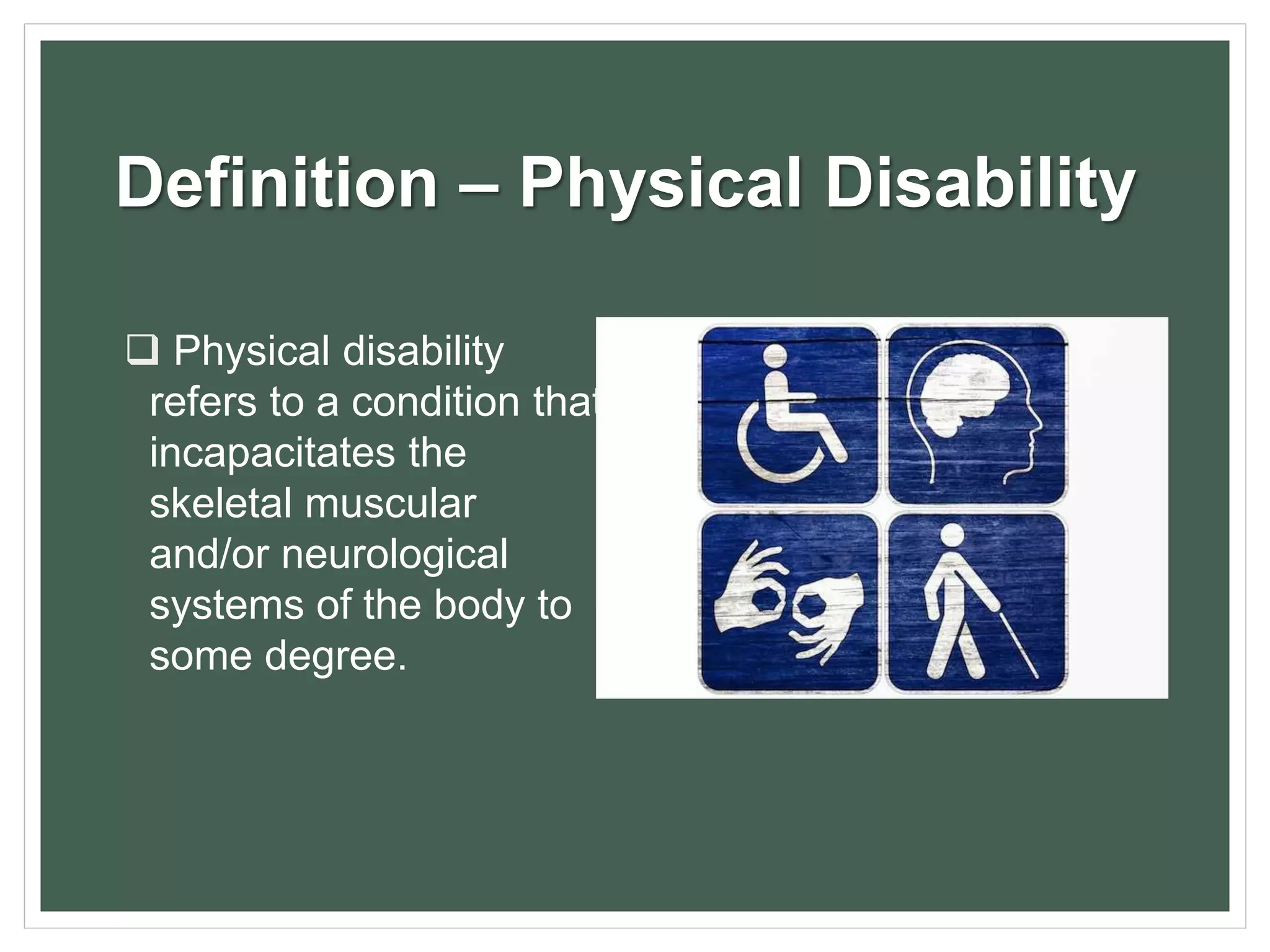
 Physical disability
refers to a condition that
incapacitates the
skeletal muscular
and/or neurological
systems of the body to
some degree.
Critical Considerations:
• limited vitality and energy
• need for physical
accommodations
• poor motor coordination
• poor attendance
• lack of concentration
• frequent falls
• inarticulate speech
Signs or
characteristics of
physical and health
Impairments (Smith,
1998)
ORTHOPEDIC
IMPAIRMENT
 Affects bones, joints, limbs and muscles of skeletal
system
IDEA Definition-
 It means a severe orthopedic impairment that adversely
affects a child’s educational performance. The term includes
impairments caused by congenital anomaly (e.g. clubfoot,
absence of some member, etc.), impairments caused by
disease (e.g. poliomyelitis, bone tuberculosis, etc.), and
impairments from other causes (e.g., cerebral palsy,
amputations, and fractures or burns that cause contractures).
Orthopedic Impairment
Causes
 inherited or genetic disorders such as muscular
dystrophy
 conditions present at birth such as spina bifida
 serious illness affecting the brain, nerves or muscles
such as meningitis
 accidents leading to spinal cord injury
 accidents leading to brain injury
Poliomyelitis or Infantile Paralysis
 Contagious
 Poliovirus – intestinal tract and mucus in nose and
throat
 Fecal-Oral transmission
 Oral-Oral Transmission
In a few people it damages nerve tissue in the spinal
cord, and results in a varying degree of paralysis of
individual muscle groups.
It can also affect the respiratory muscles.
Osteomyelitis
(TB of the bones and spine)
Bacteremia – bloodstream, spreads to the bone
 Infection in the body – pneumonia, abscessed
tooth or a urinary tract infection (blood to bone)
Muscular Dystrophy
 group of diseases that are, for the most part,
1. genetically determined and
2. cause gradual wasting of muscle with
accompanying weakness and deformity
Three Features in common:
1. Hereditary
2. Progressive
3. Each causes a characteristic, selective pattern of
weakness
Muscular Dystrophy
 Most common type is Duchenne’s muscular
dystrophy
 Respiratory disease – often cause of death of
individuals with MD, who frequently live only until
adolescence or early adulthood (Grove, Cusick &
Bigge, 1991)
Osteogenesis Imperfecta
 Brittle bones, easily fractured
 Skeletal system does not grow normally
Congenital Malformations
 it is an incomplete or improperly formed part of the
skeletal or muscular system that is present at birth
 Birth defects – associated with medications or drugs
taken during pregnancy, with illness, such as rubella
*Thalidomide
And with infections experienced by the mother during
pregnancy
Crippling Conditions
Clubfoot
• Born with one or both feet
deformed, turned inward or upward
Clubhands
• Hands and fingers are deformed
Crippling Conditions
Polydactylism
• Born with extra toes or fingers
Syndactylism
• Fingers or toes are webbed like
those of ducks
NEUROLOGICAL
IMPAIRMENT
 The Nervous systems are affecting the ability to
move, use, feel or control certain parts of the body
Cerebral Palsy
 Disturbance of
voluntary motor functions
 Includes
paralysis,
extreme weakness,
lack of coordination,
motor disorder,
convulsion
 Results from lesion to the brain, abnormal brain
growth
 Due to injury, accidents, illnesses during prenatal,
perinatal and postnatal
Types of Cerebral Palsy –
Kinds of Muscle Tone
Hypertonia
(tense, poor
coordination)
Hypotonia
(weak, floppy)
Athetosis
(oral language)
Ataxia
(balance and
equilibrium)
Rigidity
(resistance and
stiffness)
Tremor
(trembling body)
Types of Cerebral Palsy –
Parts of the Bodies
Quadriplegia
(four limbs)
Hemiplegia
(one side of the
body)
Diplegia
(just in legs)
Types of Cerebral Palsy –
Parts of the Bodies
A new machine developed by researchers at the
University of Oklahoma allows infants at risk of cerebral
palsy to better develop motor skills
Spina Bifida
 “open spine”
 is a birth defect which
occurs when the bones of
the spine do not form
properly around part of the
baby’s spinal cord.
 correlated with lack of
folic acid
Types: Mild to Severe
Spina Bifida
Occulta
• opening in 1 or
more of the bones
of the spinal cord
w/o apparent
damage to the
spinal cord
Meningocele
• meninges has
pushed out through
the opening in the
vertebrae in a sac
("meningocele")
• Spinal cord
remainds intact
Myelomeningocele
• most severe form
• a portion of spinal
cord itself protrudes
through the back
Traumatic Brain Injury
 Injuries to the head due to vehicular
accidents.
 May lead to cognitive and language deficits,
memory loss, seizures, perceptual disorders.
 May display extreme apathy or
aggressiveness
Spinal Cord Injuries
 Results from accidents, paralysis, loss of sensation
I am me first, and my health and mobility are secondary.
I want to be appreciated and respected for myself and what I
can do, not what I cannot do...
I have needs, and my ability to express those needs is critical
to being happy or feeling unfulfilled.
If I am feeling unfulfilled, I may behave in ways that express
how unfulfilled, thwarted and unhappy I am.
If I go for a long time feeling thwarted, and cannot gain
acceptance and ways to honor who I am and what I can do, I
may express my needs in ways that oppress others, I may not
be able to fully develop and reach my potential, and I will not
have the opportunity to share my strengths and gifts with
others.
Some Considerations…
 When talking to a wheelchair user, attempt to
converse at eye level
 Ask before giving assistance, and wait for a
response
 Be considerate of the extra time it might take a
student with disability to speak or act.
 A wheelchair should be viewed as personal
assistance device rather than something one is
“confined to.”
Educational Needs
SafetyAccessMobility
 Health Maintenance
 Physical Handling
 Positioning
Educational Needs
 Ensure physical access for students through the use
of ramps into buildings, appropriate adjustments to
toilets, etc.
 When considering seating needs foot-blocks, sloped
desks, seat adjustors and customized cushions may
have to be used for some students. Ensure that the
student is able to sit comfortably and is in a good
position to engage appropriately in curricular
activities.
Educational Needs
 Use assistive and augmentative technology
appropriately in implementing students’ learning and
teaching programmes.
 Students may require the use of mobility aids such
as wheelchairs, crutches, walking frames, rolators,
splints, adapted footwear or mobile standers.
Educational Needs
 If the student cannot write, provide other means of
recording work, such as tape or computer.
 Keep written activities short if completing these is
time consuming and exhausting.
 Adapt activities so that the student can participate in
Physical Education.
Educational Needs
f The student can experience difficulties in the areas
of personal and social development, so social skills
and coping strategies may need to be explicitly
taught.
 Study buddies may be used to help a student
organise materials.
Therapy
Physical Therapy ‘PT’
Speech and Language Therapy
Occupational Therapy ‘OT’
Recreational Therapy
References
http://jan.ucc.nau.edu/~jde7/ese504/class/advanced/
Physicaldisabilities.html
The State of Queensland (Department of
Communities, Child Safety and Disability Services),
2014. My child has a physical disability: Information
for Queensland families of young children.pdf
 Hunt, N. and Marshall K. (1999). Exceptional
Children and Youth 2nd Edition, pages 331-362

Physical and Neurological Impairment

  • 1.
  • 2.
    Definition – PhysicalDisability  Physical disability refers to a condition that incapacitates the skeletal muscular and/or neurological systems of the body to some degree.
  • 3.
    Critical Considerations: • limitedvitality and energy • need for physical accommodations • poor motor coordination • poor attendance • lack of concentration • frequent falls • inarticulate speech Signs or characteristics of physical and health Impairments (Smith, 1998)
  • 4.
    ORTHOPEDIC IMPAIRMENT  Affects bones,joints, limbs and muscles of skeletal system
  • 5.
    IDEA Definition-  Itmeans a severe orthopedic impairment that adversely affects a child’s educational performance. The term includes impairments caused by congenital anomaly (e.g. clubfoot, absence of some member, etc.), impairments caused by disease (e.g. poliomyelitis, bone tuberculosis, etc.), and impairments from other causes (e.g., cerebral palsy, amputations, and fractures or burns that cause contractures). Orthopedic Impairment
  • 6.
    Causes  inherited orgenetic disorders such as muscular dystrophy  conditions present at birth such as spina bifida  serious illness affecting the brain, nerves or muscles such as meningitis  accidents leading to spinal cord injury  accidents leading to brain injury
  • 7.
    Poliomyelitis or InfantileParalysis  Contagious  Poliovirus – intestinal tract and mucus in nose and throat  Fecal-Oral transmission  Oral-Oral Transmission In a few people it damages nerve tissue in the spinal cord, and results in a varying degree of paralysis of individual muscle groups. It can also affect the respiratory muscles.
  • 8.
    Osteomyelitis (TB of thebones and spine) Bacteremia – bloodstream, spreads to the bone  Infection in the body – pneumonia, abscessed tooth or a urinary tract infection (blood to bone)
  • 10.
    Muscular Dystrophy  groupof diseases that are, for the most part, 1. genetically determined and 2. cause gradual wasting of muscle with accompanying weakness and deformity Three Features in common: 1. Hereditary 2. Progressive 3. Each causes a characteristic, selective pattern of weakness
  • 13.
    Muscular Dystrophy  Mostcommon type is Duchenne’s muscular dystrophy  Respiratory disease – often cause of death of individuals with MD, who frequently live only until adolescence or early adulthood (Grove, Cusick & Bigge, 1991)
  • 14.
    Osteogenesis Imperfecta  Brittlebones, easily fractured  Skeletal system does not grow normally
  • 15.
    Congenital Malformations  itis an incomplete or improperly formed part of the skeletal or muscular system that is present at birth  Birth defects – associated with medications or drugs taken during pregnancy, with illness, such as rubella *Thalidomide And with infections experienced by the mother during pregnancy
  • 17.
    Crippling Conditions Clubfoot • Bornwith one or both feet deformed, turned inward or upward Clubhands • Hands and fingers are deformed
  • 18.
    Crippling Conditions Polydactylism • Bornwith extra toes or fingers Syndactylism • Fingers or toes are webbed like those of ducks
  • 19.
    NEUROLOGICAL IMPAIRMENT  The Nervoussystems are affecting the ability to move, use, feel or control certain parts of the body
  • 20.
    Cerebral Palsy  Disturbanceof voluntary motor functions  Includes paralysis, extreme weakness, lack of coordination, motor disorder, convulsion  Results from lesion to the brain, abnormal brain growth  Due to injury, accidents, illnesses during prenatal, perinatal and postnatal
  • 21.
    Types of CerebralPalsy – Kinds of Muscle Tone Hypertonia (tense, poor coordination) Hypotonia (weak, floppy) Athetosis (oral language) Ataxia (balance and equilibrium) Rigidity (resistance and stiffness) Tremor (trembling body)
  • 22.
    Types of CerebralPalsy – Parts of the Bodies Quadriplegia (four limbs) Hemiplegia (one side of the body) Diplegia (just in legs)
  • 23.
    Types of CerebralPalsy – Parts of the Bodies
  • 24.
    A new machinedeveloped by researchers at the University of Oklahoma allows infants at risk of cerebral palsy to better develop motor skills
  • 25.
    Spina Bifida  “openspine”  is a birth defect which occurs when the bones of the spine do not form properly around part of the baby’s spinal cord.  correlated with lack of folic acid
  • 26.
    Types: Mild toSevere Spina Bifida Occulta • opening in 1 or more of the bones of the spinal cord w/o apparent damage to the spinal cord Meningocele • meninges has pushed out through the opening in the vertebrae in a sac ("meningocele") • Spinal cord remainds intact Myelomeningocele • most severe form • a portion of spinal cord itself protrudes through the back
  • 27.
    Traumatic Brain Injury Injuries to the head due to vehicular accidents.  May lead to cognitive and language deficits, memory loss, seizures, perceptual disorders.  May display extreme apathy or aggressiveness Spinal Cord Injuries  Results from accidents, paralysis, loss of sensation
  • 28.
    I am mefirst, and my health and mobility are secondary. I want to be appreciated and respected for myself and what I can do, not what I cannot do... I have needs, and my ability to express those needs is critical to being happy or feeling unfulfilled. If I am feeling unfulfilled, I may behave in ways that express how unfulfilled, thwarted and unhappy I am. If I go for a long time feeling thwarted, and cannot gain acceptance and ways to honor who I am and what I can do, I may express my needs in ways that oppress others, I may not be able to fully develop and reach my potential, and I will not have the opportunity to share my strengths and gifts with others.
  • 29.
    Some Considerations…  Whentalking to a wheelchair user, attempt to converse at eye level  Ask before giving assistance, and wait for a response  Be considerate of the extra time it might take a student with disability to speak or act.  A wheelchair should be viewed as personal assistance device rather than something one is “confined to.”
  • 30.
    Educational Needs SafetyAccessMobility  HealthMaintenance  Physical Handling  Positioning
  • 31.
    Educational Needs  Ensurephysical access for students through the use of ramps into buildings, appropriate adjustments to toilets, etc.  When considering seating needs foot-blocks, sloped desks, seat adjustors and customized cushions may have to be used for some students. Ensure that the student is able to sit comfortably and is in a good position to engage appropriately in curricular activities.
  • 32.
    Educational Needs  Useassistive and augmentative technology appropriately in implementing students’ learning and teaching programmes.  Students may require the use of mobility aids such as wheelchairs, crutches, walking frames, rolators, splints, adapted footwear or mobile standers.
  • 33.
    Educational Needs  Ifthe student cannot write, provide other means of recording work, such as tape or computer.  Keep written activities short if completing these is time consuming and exhausting.  Adapt activities so that the student can participate in Physical Education.
  • 34.
    Educational Needs f Thestudent can experience difficulties in the areas of personal and social development, so social skills and coping strategies may need to be explicitly taught.  Study buddies may be used to help a student organise materials.
  • 35.
    Therapy Physical Therapy ‘PT’ Speechand Language Therapy Occupational Therapy ‘OT’ Recreational Therapy
  • 36.
    References http://jan.ucc.nau.edu/~jde7/ese504/class/advanced/ Physicaldisabilities.html The State ofQueensland (Department of Communities, Child Safety and Disability Services), 2014. My child has a physical disability: Information for Queensland families of young children.pdf  Hunt, N. and Marshall K. (1999). Exceptional Children and Youth 2nd Edition, pages 331-362

Editor's Notes

  • #21 Cerebral = head Palsy = anything wrong with control of muscles or joint in the body
  • #23 Plegia
  • #24 Plegia
  • #25 https://youtu.be/yI0F6LyGtGs
  • #26 Spina Bifida = cleft spine Meninges = protective covering around spinal cord
  • #31 Spina Bifida Catheterization - insertion of tube to permit passage of urine Successful bladder management program - can be incorporated into regular school day SB with history of hydrocephalus - early intervention Mainstreaming - difficulty paying attention, expressing or understanding language, grasping reading and math Modification in school equipment or curriculum least restrictive - as "normal" as possible Architectural factors, structural changes (elevators, ramps) Schedule or location changes (ground floor) Mobility Aids: walkers, modified vans, electronic direction-finding electric wheelchairs, canes, crutches, braces Promote personal growth and indpendence
  • #36 PT – ways to move and balance SLT – communication skills OT – right special equipment RT – develop hobbies and lifelong pasttimes