Children with
special needs:
Physical Disability
Prepared By: Erika R. Barrozo
Learning Objectives
a. identify what is Physical Disability
b. observe and share ideas of the
cause and effect of physical disability
of children with special needs; and
c. know the importance of general
etiquette on how to approach
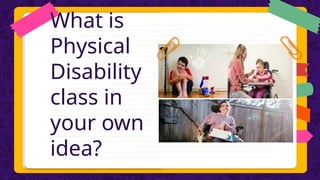
What is
Physical
Disability
class in
your own
idea?
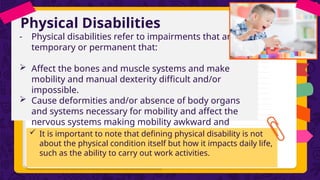
Physical Disabilities
- Physical disabilities refer to impairments that are
temporary or permanent that:
 Affect the bones and muscle systems and make
mobility and manual dexterity difficult and/or
impossible.
 Cause deformities and/or absence of body organs
and systems necessary for mobility and affect the
nervous systems making mobility awkward and
uncoordinated.
 It is important to note that defining physical disability is not
about the physical condition itself but how it impacts daily life,
such as the ability to carry out work activities.
Cause of
Physical
Disability
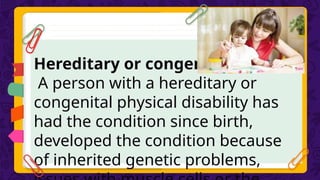
Hereditary or congenital
A person with a hereditary or
congenital physical disability has
had the condition since birth,
developed the condition because
of inherited genetic problems,
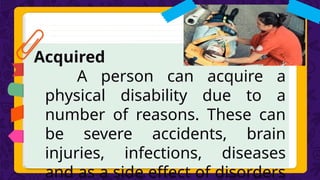
Acquired
A person can acquire a
physical disability due to a
number of reasons. These can
be severe accidents, brain
injuries, infections, diseases
and as a side effect of disorders
What are the types of physical
disabilities?
There is a vast number of physical
disabilities, each affecting people
differently. Types include:
 Mobility impairment
 Visual impairment
 Hearing loss
 Chronic fatigue or pain and
seizures
Physical disabilities
are categorized
into groups. The
main physical
disability groups
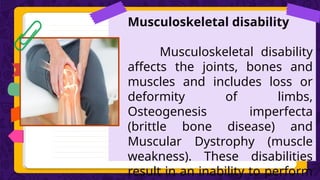
Musculoskeletal disability
affects the joints, bones and
muscles and includes loss or
deformity of limbs,
Osteogenesis imperfecta
(brittle bone disease) and
Muscular Dystrophy (muscle
weakness). These disabilities
result in an inability to perform
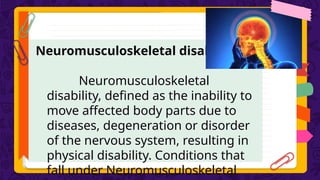
Neuromusculoskeletal disability
Neuromusculoskeletal
disability, defined as the inability to
move affected body parts due to
diseases, degeneration or disorder
of the nervous system, resulting in
physical disability. Conditions that
fall under Neuromusculoskeletal
Orthopedic and
Neurological
Impairments
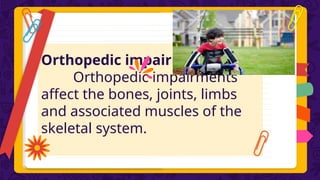
Orthopedic impairments
affect the bones, joints, limbs
and associated muscles of the
skeletal system.
1. Poliomyelitis – also known as infantile
paralysis
2. Osteomyelitis – tuberculosis of the bones
and spine
3. Bone fracture – breakage in the continuity of
the bone resulting from falls and accidents.
4. Muscular dystrophy – group of long-term
diseases that progressively weakens,
deteriorates and wastes away the muscle of the
body.
5. Osteogenesis imperfecta – is a rare
inherited condition marked by extremely brittle
bones. The skeletal system does not grow
Orthopedic impairments
6. Limb deficiency – refers to the absence or
partial loss of an arm or leg.
a. Quadriplegia – all four limbs, both arms
and legs, are affected.
b. Paraplegia – motor impairment of the legs
only.
c. Hemiplegia – only one side of the body is
affected.
d. Diplegia – major involvement of the legs,
with less severe involvement of the arms.
e. Monoplegia – only one limb is affected.
f. Triplegia – three limbs are affected.
g. Double hemiplegia – major involvement of
Orthopedic impairments
7. Crippling conditions – congenital or
present at birth.
a. Clubfoot – the child is born with one or
both feet deformed usually with the feet
and toes turned inward, outward or
upward often accompanied by webbed
toes.
b. Clubhand – same with clubfoot but the
hands and fingers are the ones deformed.
c. Polydactylism – the child is born with
extra toes or fingers.
d. Syndactylism – the fingers or toes or
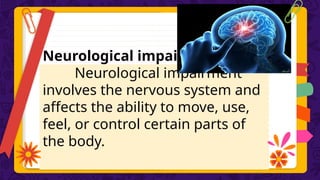
Neurological impairment
involves the nervous system and
affects the ability to move, use,
feel, or control certain parts of
the body.
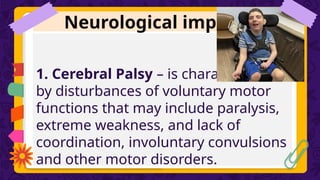
Neurological impairment
1. Cerebral Palsy – is characterized
by disturbances of voluntary motor
functions that may include paralysis,
extreme weakness, and lack of
coordination, involuntary convulsions
and other motor disorders.
characterized by tense, contracted muscles and the
movements may be jerky, exaggerated and poorly
coordinated.
b. Athetosis – characterized by slow, worm-like
involuntary, uncontrollable and purposeless
movements. A child with this condition may not be able
to control the muscles of the tongue, throat and may
drool so there is difficulty in expressive oral language.
c. Ataxia – it is a disturbance of balance and equilibrium
resulting in a gait like that of a drunken person when
walking and may fall easily if nor supported.
d. Rigidity – characterized by the marked resistance of
the muscles to passive motion and display extreme
stiffness in the affected limbs.
Neurological
impairment
in the vertebrae that encloses the
spinal cord. The condition ranges from
mild to severe.
3. Spinal Cord Injuries – are results of
accidents. In general, paralysis and loss
of sensation occur below the level of
injury.
4. Traumatic Brain Injury – is
commonly caused by injuries to the
head as a result from automobile,
motorcycle and bicycle accidents, falls,
Administration
of Special
Education
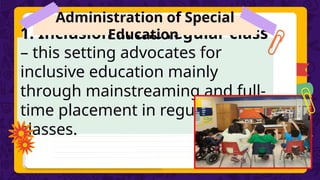
1. Inclusion in the regular class
– this setting advocates for
inclusive education mainly
through mainstreaming and full-
time placement in regular
classes.
Administration of Special
Education
Administration of Special
Education
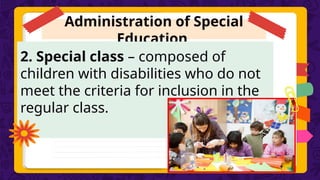
2. Special class – composed of
children with disabilities who do not
meet the criteria for inclusion in the
regular class.
Administration of Special
Education
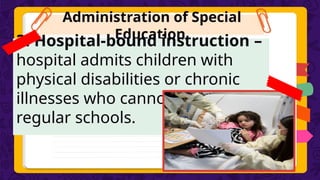
3. Hospital-bound instruction –
hospital admits children with
physical disabilities or chronic
illnesses who cannot study in
regular schools.
Administration of Special
Education
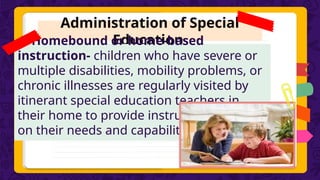
4. Homebound or home-based
instruction- children who have severe or
multiple disabilities, mobility problems, or
chronic illnesses are regularly visited by
itinerant special education teachers in
their home to provide instruction based
on their needs and capabilities.
Instructional
Models
Instructional models
1. Individualized Instruction Model (IEP)-
Identifies annual goals, short-term objectives
and weekly and daily instructional plans for
specific children. Self-management skills are
taught for self-regulation and competence in
the adaptive skills.
2. Resource Room Model - Children who are
mainstreamed in regular classes go to the
resource room for special instruction, tutorial
and mentoring activities.
3. Curriculum Modification Model - Changes
are introduced in the regular curriculum to
Instructional models
Model
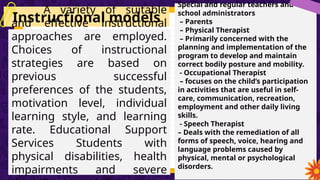
A variety of suitable
and effective instructional
approaches are employed.
Choices of instructional
strategies are based on
previous successful
preferences of the students,
motivation level, individual
learning style, and learning
rate. Educational Support
Services Students with
physical disabilities, health
impairments and severe
Special and regular teachers and
school administrators
– Parents
– Physical Therapist
– Primarily concerned with the
planning and implementation of the
program to develop and maintain
correct bodily posture and mobility.
- Occupational Therapist
– focuses on the child’s participation
in activities that are useful in self-
care, communication, recreation,
employment and other daily living
skills.
- Speech Therapist
– Deals with the remediation of all
forms of speech, voice, hearing and
language problems caused by
physical, mental or psychological
disorders.
Physicians, nurses
and specialists
Environmental
Modifications
Physicians, nurses and
specialists Environmental
Modifications
1. Modifying school
furniture
2. Providing need-based
assistance like taping
paper to the desk.
Assistive
Technology
Assistive Technology
1. Mobility aids – assistive technology
devices that help people perform
movements in a variety of environments.
Ex: wheelchair
2. Seating and positioning aids – used
to position the disabled person in the
best posture to participate in a particular
activity. Ex: seatbelts, braces, cushions
3. Aids for daily living – devices used to
increase independence. Ex: spoon and
fork with custom-made handles or straps
Assistive Technology
4. Communication aids – devices such
as speech synthesizers, text-to-speech
software, and telecommunication for
the deaf.
5. Sensory aids – assistive technology
devices for students who have primary
disabilities as hearing impairment and
visual impairment. Ex: hearing aids
6. Instructional aids – devices and
adaptations to materials that help
facilitate an individual’s learning. Ex:
Here are some General
Etiquette Tips that you
should know on how
to approach people
with Physical
Disability
1. Practice the Golden Rule Treat
everyone as you would like to be
treated. Think of the person
first, not their disability.
2. Always Ask Before Giving
Assistance
3. Think Before You Speak
4. Avoid Showing Pity or Being
Patronizing
Thankyouforyouractive
Participationtoday
ACTIVITY
Watch the movie “Me before you” then make a reflection paper about
the movie. The reflection paper should consist of your Introduction,
Body and conclusion. Here are some of your guide questions in doing
your reflection paper.
1. Who is Will Traynor and lousia Clark?
2. What is the cause of Will Traynor having a Physical disability?
3. What do you observe on how Louisa takes care Will Traynor?
4. What Lesson do you get on the movie especially on how to treat
people with special disability?
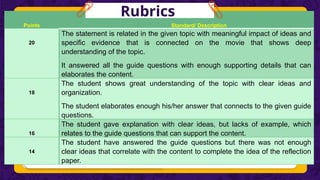
Points Standard/ Description
20
The statement is related in the given topic with meaningful impact of ideas and
specific evidence that is connected on the movie that shows deep
understanding of the topic.
It answered all the guide questions with enough supporting details that can
elaborates the content.
18
The student shows great understanding of the topic with clear ideas and
organization.
The student elaborates enough his/her answer that connects to the given guide
questions.
16
The student gave explanation with clear ideas, but lacks of example, which
relates to the guide questions that can support the content.
14
The student have answered the guide questions but there was not enough
clear ideas that correlate with the content to complete the idea of the reflection
paper.
Rubrics
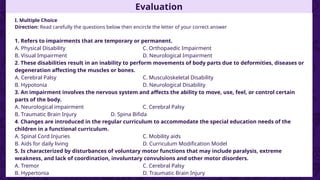
Evaluation
I. Multiple Choice
Direction: Read carefully the questions below then encircle the letter of your correct answer
1. Refers to impairments that are temporary or permanent.
A. Physical Disability C. Orthopaedic Impairment
B. Visual Impairment D. Neurological Impairment
2. These disabilities result in an inability to perform movements of body parts due to deformities, diseases or
degeneration affecting the muscles or bones.
A. Cerebral Palsy C. Musculoskeletal Disability
B. Hypotonia D. Neurological Disability
3. An impairment involves the nervous system and affects the ability to move, use, feel, or control certain
parts of the body.
A. Neurological impairment C. Cerebral Palsy
B. Traumatic Brain Injury D. Spina Bifida
4. Changes are introduced in the regular curriculum to accommodate the special education needs of the
children in a functional curriculum.
A. Spinal Cord Injuries C. Mobility aids
B. Aids for daily living D. Curriculum Modification Model
5. Is characterized by disturbances of voluntary motor functions that may include paralysis, extreme
weakness, and lack of coordination, involuntary convulsions and other motor disorders.
A. Tremor C. Cerebral Palsy
B. Hypertonia D. Traumatic Brain Injury
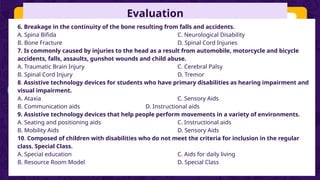
Evaluation
6. Breakage in the continuity of the bone resulting from falls and accidents.
A. Spina Bifida C. Neurological Disability
B. Bone Fracture D. Spinal Cord Injuries
7. Is commonly caused by injuries to the head as a result from automobile, motorcycle and bicycle
accidents, falls, assaults, gunshot wounds and child abuse.
A. Traumatic Brain Injury C. Cerebral Palsy
B. Spinal Cord Injury D. Tremor
8. Assistive technology devices for students who have primary disabilities as hearing impairment and
visual impairment.
A. Ataxia C. Sensory Aids
B. Communication aids D. Instructional aids
9. Assistive technology devices that help people perform movements in a variety of environments.
A. Seating and positioning aids C. Instructional aids
B. Mobility Aids D. Sensory Aids
10. Composed of children with disabilities who do not meet the criteria for inclusion in the regular
class. Special Class.
A. Special education C. Aids for daily living
B. Resource Room Model D. Special Class
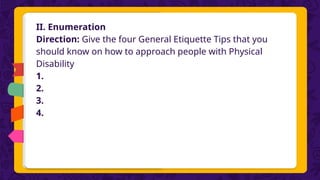
II. Enumeration
Direction: Give the four General Etiquette Tips that you
should know on how to approach people with Physical
Disability
1.
2.
3.
4.
Assignment
What are the ways on how you properly
approach children with special needs especially
with those who have physical disability?
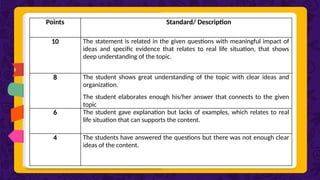
Points Standard/ Description
10 The statement is related in the given questions with meaningful impact of
ideas and specific evidence that relates to real life situation, that shows
deep understanding of the topic.
8 The student shows great understanding of the topic with clear ideas and
organization.
The student elaborates enough his/her answer that connects to the given
topic
6 The student gave explanation but lacks of examples, which relates to real
life situation that can supports the content.
4 The students have answered the questions but there was not enough clear
ideas of the content.

PPT in Different Physical Disability.pptx

  • 2.
    Children with special needs: PhysicalDisability Prepared By: Erika R. Barrozo
  • 3.
    Learning Objectives a. identifywhat is Physical Disability b. observe and share ideas of the cause and effect of physical disability of children with special needs; and c. know the importance of general etiquette on how to approach
  • 4.
  • 5.
    Physical Disabilities - Physicaldisabilities refer to impairments that are temporary or permanent that:  Affect the bones and muscle systems and make mobility and manual dexterity difficult and/or impossible.  Cause deformities and/or absence of body organs and systems necessary for mobility and affect the nervous systems making mobility awkward and uncoordinated.  It is important to note that defining physical disability is not about the physical condition itself but how it impacts daily life, such as the ability to carry out work activities.
  • 6.
  • 7.
    Hereditary or congenital Aperson with a hereditary or congenital physical disability has had the condition since birth, developed the condition because of inherited genetic problems,
  • 8.
    Acquired A person canacquire a physical disability due to a number of reasons. These can be severe accidents, brain injuries, infections, diseases and as a side effect of disorders
  • 9.
    What are thetypes of physical disabilities? There is a vast number of physical disabilities, each affecting people differently. Types include:  Mobility impairment  Visual impairment  Hearing loss  Chronic fatigue or pain and seizures
  • 10.
    Physical disabilities are categorized intogroups. The main physical disability groups
  • 11.
    Musculoskeletal disability Musculoskeletal disability affectsthe joints, bones and muscles and includes loss or deformity of limbs, Osteogenesis imperfecta (brittle bone disease) and Muscular Dystrophy (muscle weakness). These disabilities result in an inability to perform
  • 12.
    Neuromusculoskeletal disability Neuromusculoskeletal disability, definedas the inability to move affected body parts due to diseases, degeneration or disorder of the nervous system, resulting in physical disability. Conditions that fall under Neuromusculoskeletal
  • 13.
  • 14.
    Orthopedic impairments Orthopedic impairments affectthe bones, joints, limbs and associated muscles of the skeletal system.
  • 15.
    1. Poliomyelitis –also known as infantile paralysis 2. Osteomyelitis – tuberculosis of the bones and spine 3. Bone fracture – breakage in the continuity of the bone resulting from falls and accidents. 4. Muscular dystrophy – group of long-term diseases that progressively weakens, deteriorates and wastes away the muscle of the body. 5. Osteogenesis imperfecta – is a rare inherited condition marked by extremely brittle bones. The skeletal system does not grow Orthopedic impairments
  • 16.
    Orthopedic impairments 6. Limbdeficiency – refers to the absence or partial loss of an arm or leg. a. Quadriplegia – all four limbs, both arms and legs, are affected. b. Paraplegia – motor impairment of the legs only. c. Hemiplegia – only one side of the body is affected. d. Diplegia – major involvement of the legs, with less severe involvement of the arms. e. Monoplegia – only one limb is affected. f. Triplegia – three limbs are affected. g. Double hemiplegia – major involvement of
  • 17.
    Orthopedic impairments 7. Cripplingconditions – congenital or present at birth. a. Clubfoot – the child is born with one or both feet deformed usually with the feet and toes turned inward, outward or upward often accompanied by webbed toes. b. Clubhand – same with clubfoot but the hands and fingers are the ones deformed. c. Polydactylism – the child is born with extra toes or fingers. d. Syndactylism – the fingers or toes or
  • 18.
    Neurological impairment Neurological impairment involvesthe nervous system and affects the ability to move, use, feel, or control certain parts of the body.
  • 19.
    Neurological impairment 1. CerebralPalsy – is characterized by disturbances of voluntary motor functions that may include paralysis, extreme weakness, and lack of coordination, involuntary convulsions and other motor disorders.
  • 20.
    characterized by tense,contracted muscles and the movements may be jerky, exaggerated and poorly coordinated. b. Athetosis – characterized by slow, worm-like involuntary, uncontrollable and purposeless movements. A child with this condition may not be able to control the muscles of the tongue, throat and may drool so there is difficulty in expressive oral language. c. Ataxia – it is a disturbance of balance and equilibrium resulting in a gait like that of a drunken person when walking and may fall easily if nor supported. d. Rigidity – characterized by the marked resistance of the muscles to passive motion and display extreme stiffness in the affected limbs.
  • 21.
    Neurological impairment in the vertebraethat encloses the spinal cord. The condition ranges from mild to severe. 3. Spinal Cord Injuries – are results of accidents. In general, paralysis and loss of sensation occur below the level of injury. 4. Traumatic Brain Injury – is commonly caused by injuries to the head as a result from automobile, motorcycle and bicycle accidents, falls,
  • 22.
  • 23.
    1. Inclusion inthe regular class – this setting advocates for inclusive education mainly through mainstreaming and full- time placement in regular classes. Administration of Special Education
  • 24.
    Administration of Special Education 2.Special class – composed of children with disabilities who do not meet the criteria for inclusion in the regular class.
  • 25.
    Administration of Special Education 3.Hospital-bound instruction – hospital admits children with physical disabilities or chronic illnesses who cannot study in regular schools.
  • 26.
    Administration of Special Education 4.Homebound or home-based instruction- children who have severe or multiple disabilities, mobility problems, or chronic illnesses are regularly visited by itinerant special education teachers in their home to provide instruction based on their needs and capabilities.
  • 27.
  • 28.
    Instructional models 1. IndividualizedInstruction Model (IEP)- Identifies annual goals, short-term objectives and weekly and daily instructional plans for specific children. Self-management skills are taught for self-regulation and competence in the adaptive skills. 2. Resource Room Model - Children who are mainstreamed in regular classes go to the resource room for special instruction, tutorial and mentoring activities. 3. Curriculum Modification Model - Changes are introduced in the regular curriculum to
  • 29.
    Instructional models Model A varietyof suitable and effective instructional approaches are employed. Choices of instructional strategies are based on previous successful preferences of the students, motivation level, individual learning style, and learning rate. Educational Support Services Students with physical disabilities, health impairments and severe Special and regular teachers and school administrators – Parents – Physical Therapist – Primarily concerned with the planning and implementation of the program to develop and maintain correct bodily posture and mobility. - Occupational Therapist – focuses on the child’s participation in activities that are useful in self- care, communication, recreation, employment and other daily living skills. - Speech Therapist – Deals with the remediation of all forms of speech, voice, hearing and language problems caused by physical, mental or psychological disorders.
  • 30.
  • 31.
    Physicians, nurses and specialistsEnvironmental Modifications 1. Modifying school furniture 2. Providing need-based assistance like taping paper to the desk.
  • 32.
  • 33.
    Assistive Technology 1. Mobilityaids – assistive technology devices that help people perform movements in a variety of environments. Ex: wheelchair 2. Seating and positioning aids – used to position the disabled person in the best posture to participate in a particular activity. Ex: seatbelts, braces, cushions 3. Aids for daily living – devices used to increase independence. Ex: spoon and fork with custom-made handles or straps
  • 34.
    Assistive Technology 4. Communicationaids – devices such as speech synthesizers, text-to-speech software, and telecommunication for the deaf. 5. Sensory aids – assistive technology devices for students who have primary disabilities as hearing impairment and visual impairment. Ex: hearing aids 6. Instructional aids – devices and adaptations to materials that help facilitate an individual’s learning. Ex:
  • 35.
    Here are someGeneral Etiquette Tips that you should know on how to approach people with Physical Disability
  • 36.
    1. Practice theGolden Rule Treat everyone as you would like to be treated. Think of the person first, not their disability. 2. Always Ask Before Giving Assistance 3. Think Before You Speak 4. Avoid Showing Pity or Being Patronizing
  • 37.
  • 38.
    ACTIVITY Watch the movie“Me before you” then make a reflection paper about the movie. The reflection paper should consist of your Introduction, Body and conclusion. Here are some of your guide questions in doing your reflection paper. 1. Who is Will Traynor and lousia Clark? 2. What is the cause of Will Traynor having a Physical disability? 3. What do you observe on how Louisa takes care Will Traynor? 4. What Lesson do you get on the movie especially on how to treat people with special disability?
  • 39.
    Points Standard/ Description 20 Thestatement is related in the given topic with meaningful impact of ideas and specific evidence that is connected on the movie that shows deep understanding of the topic. It answered all the guide questions with enough supporting details that can elaborates the content. 18 The student shows great understanding of the topic with clear ideas and organization. The student elaborates enough his/her answer that connects to the given guide questions. 16 The student gave explanation with clear ideas, but lacks of example, which relates to the guide questions that can support the content. 14 The student have answered the guide questions but there was not enough clear ideas that correlate with the content to complete the idea of the reflection paper. Rubrics
  • 40.
    Evaluation I. Multiple Choice Direction:Read carefully the questions below then encircle the letter of your correct answer 1. Refers to impairments that are temporary or permanent. A. Physical Disability C. Orthopaedic Impairment B. Visual Impairment D. Neurological Impairment 2. These disabilities result in an inability to perform movements of body parts due to deformities, diseases or degeneration affecting the muscles or bones. A. Cerebral Palsy C. Musculoskeletal Disability B. Hypotonia D. Neurological Disability 3. An impairment involves the nervous system and affects the ability to move, use, feel, or control certain parts of the body. A. Neurological impairment C. Cerebral Palsy B. Traumatic Brain Injury D. Spina Bifida 4. Changes are introduced in the regular curriculum to accommodate the special education needs of the children in a functional curriculum. A. Spinal Cord Injuries C. Mobility aids B. Aids for daily living D. Curriculum Modification Model 5. Is characterized by disturbances of voluntary motor functions that may include paralysis, extreme weakness, and lack of coordination, involuntary convulsions and other motor disorders. A. Tremor C. Cerebral Palsy B. Hypertonia D. Traumatic Brain Injury
  • 41.
    Evaluation 6. Breakage inthe continuity of the bone resulting from falls and accidents. A. Spina Bifida C. Neurological Disability B. Bone Fracture D. Spinal Cord Injuries 7. Is commonly caused by injuries to the head as a result from automobile, motorcycle and bicycle accidents, falls, assaults, gunshot wounds and child abuse. A. Traumatic Brain Injury C. Cerebral Palsy B. Spinal Cord Injury D. Tremor 8. Assistive technology devices for students who have primary disabilities as hearing impairment and visual impairment. A. Ataxia C. Sensory Aids B. Communication aids D. Instructional aids 9. Assistive technology devices that help people perform movements in a variety of environments. A. Seating and positioning aids C. Instructional aids B. Mobility Aids D. Sensory Aids 10. Composed of children with disabilities who do not meet the criteria for inclusion in the regular class. Special Class. A. Special education C. Aids for daily living B. Resource Room Model D. Special Class
  • 42.
    II. Enumeration Direction: Givethe four General Etiquette Tips that you should know on how to approach people with Physical Disability 1. 2. 3. 4.
  • 43.
    Assignment What are theways on how you properly approach children with special needs especially with those who have physical disability?
  • 44.
    Points Standard/ Description 10The statement is related in the given questions with meaningful impact of ideas and specific evidence that relates to real life situation, that shows deep understanding of the topic. 8 The student shows great understanding of the topic with clear ideas and organization. The student elaborates enough his/her answer that connects to the given topic 6 The student gave explanation but lacks of examples, which relates to real life situation that can supports the content. 4 The students have answered the questions but there was not enough clear ideas of the content.