Photosynthesis (C2, C3, C4 and CAM Photosynthesis).pdf
The document provides an overview of plant photosynthesis, specifically focusing on the processes of C3, C4, and CAM (Crassulacean Acid Metabolism) photosynthesis. It details how these processes differ in their fixation of carbon dioxide and the advantages and disadvantages of each method, particularly in relation to environmental conditions. Additionally, it discusses the mechanisms of photorespiration, including its impact on plant metabolism and efficiency.
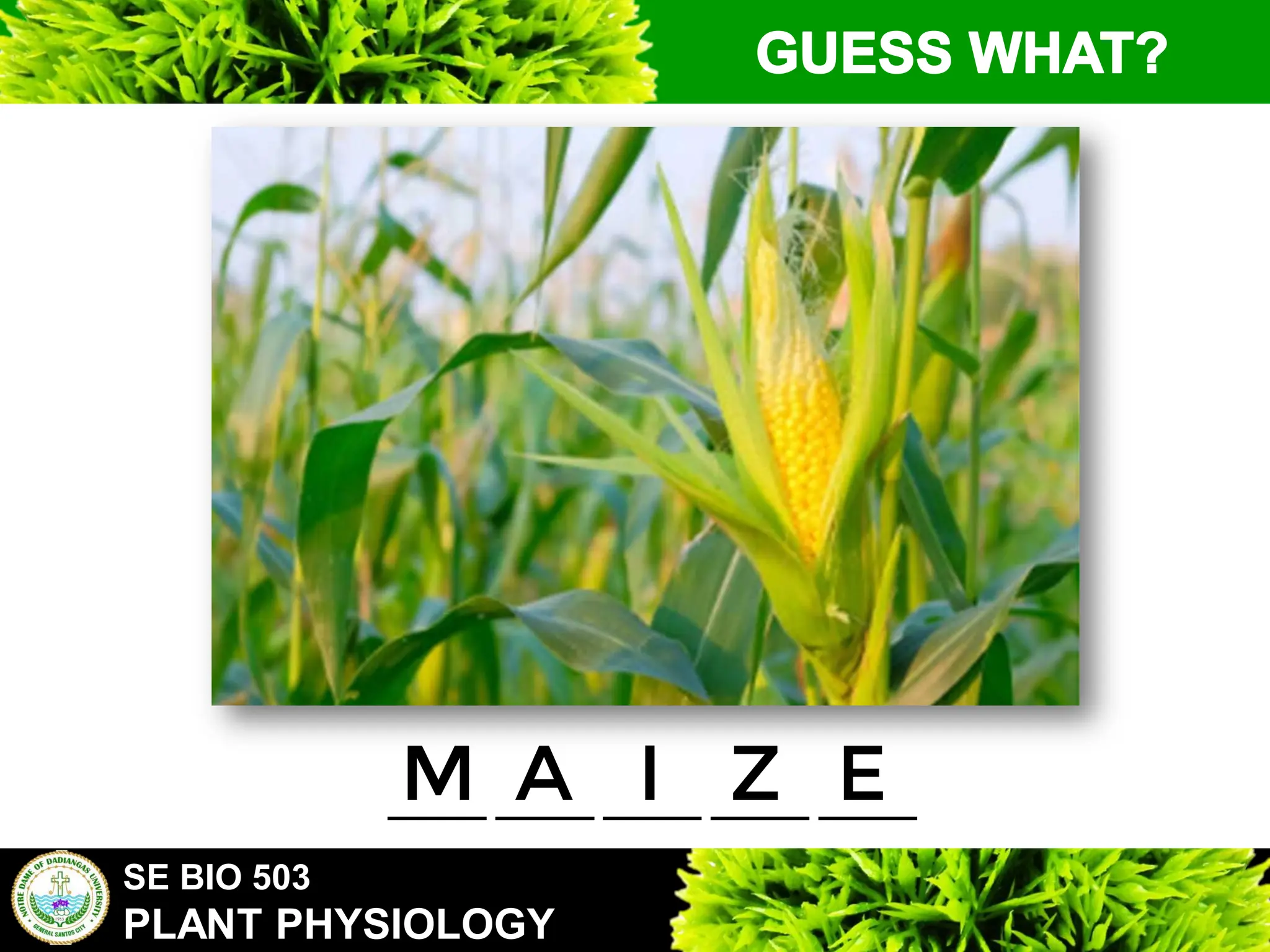
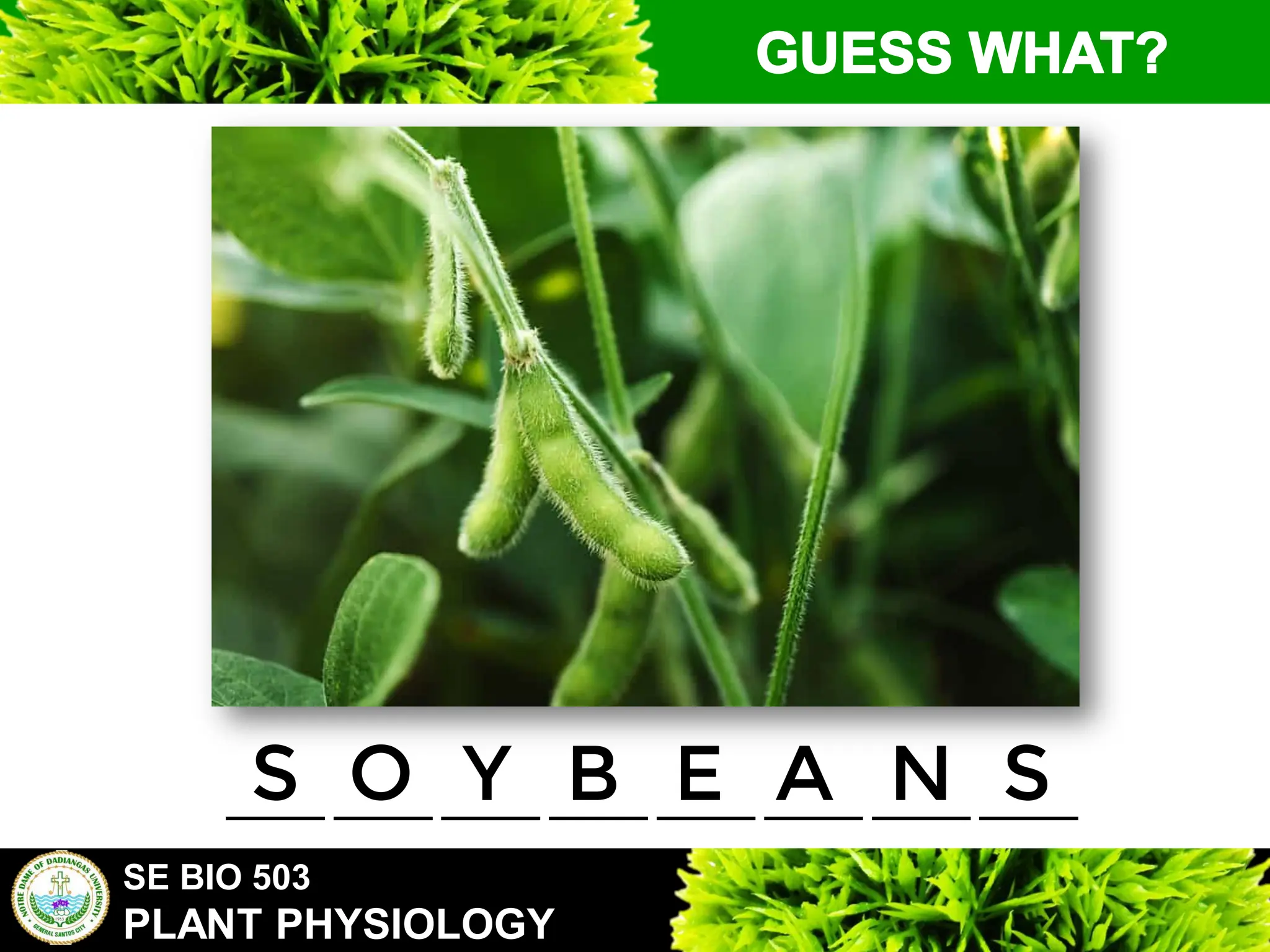
Introduction to the presentation on Plant Physiology, focusing on photosynthesis and common plants. Engagement activity identifying common plants (sunflower, tomatoes, maize, soybeans, wheat, sugarcane, pineapple) related to photosynthesis.
Introduction of the types of photosynthesis: C3, C4, and CAM types of plants.
Explains phot respiration, effects of low CO2 levels in leaves, RuBisCo enzyme, and production of toxic byproducts.
Summarizes disadvantages (loss of efficiency) and advantages (cell protection, biomolecule synthesis) of photo respiration.
Discussion on the historical context of Calvin cycle and the arising issue of photorespiration due to atmospheric changes.
Quiz questions assessing understanding of concepts linked to CO2 levels, toxic compounds, and disadvantages of photorespiration.
In-depth look at C3 photosynthesis, including the process, key components like RuBisCo, and leaf mesophyll role.
Outlines advantages such as efficiency under certain conditions and disadvantages like photorespiration.
Introduction to C4 photosynthesis, emphasizing its mechanism and Kranz anatomy for efficient CO2 fixation.
Comparison of mesophyll and bundle-sheath cells; C4 plants' efficiency in water use and CO2 fixation.
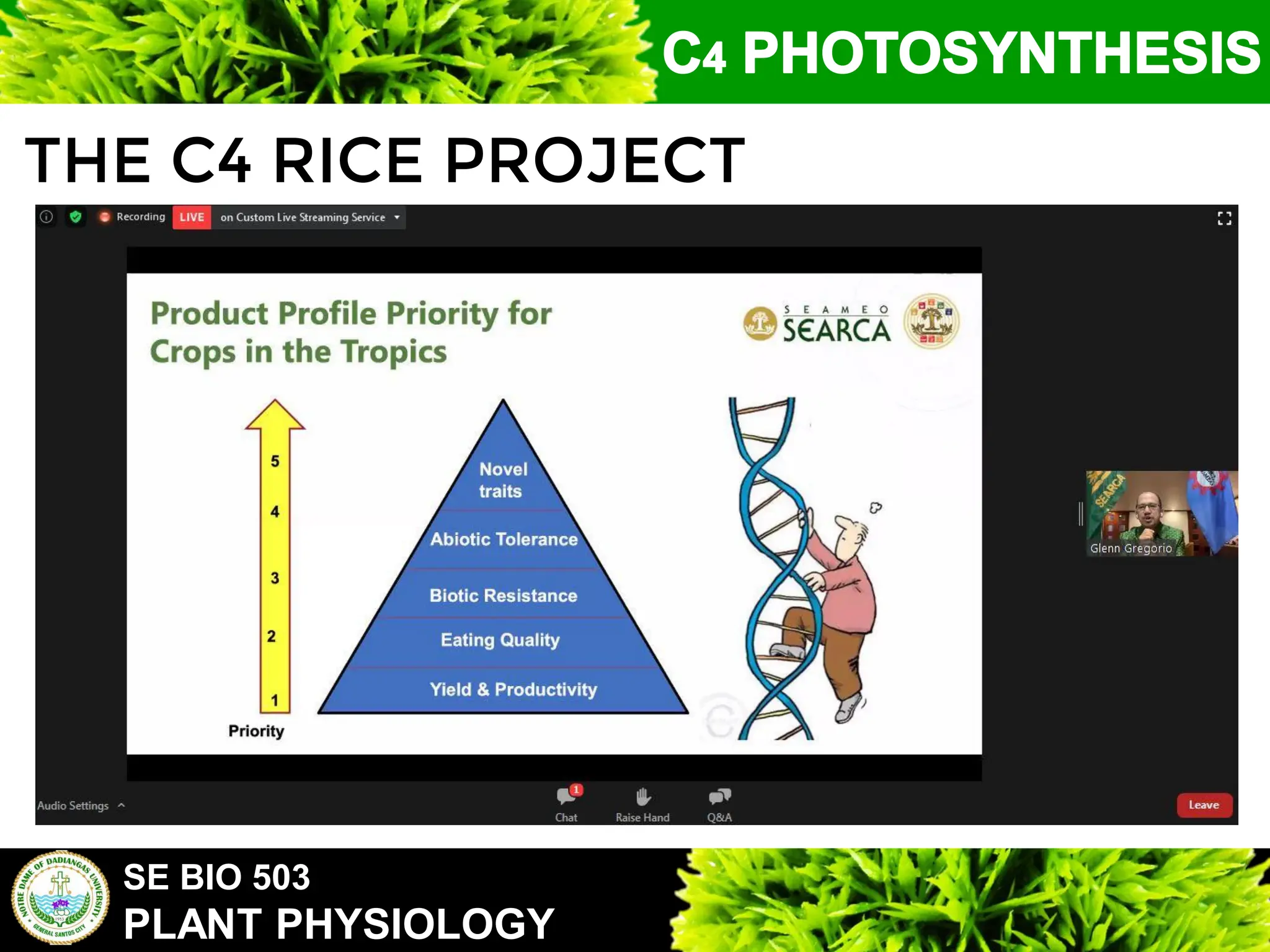
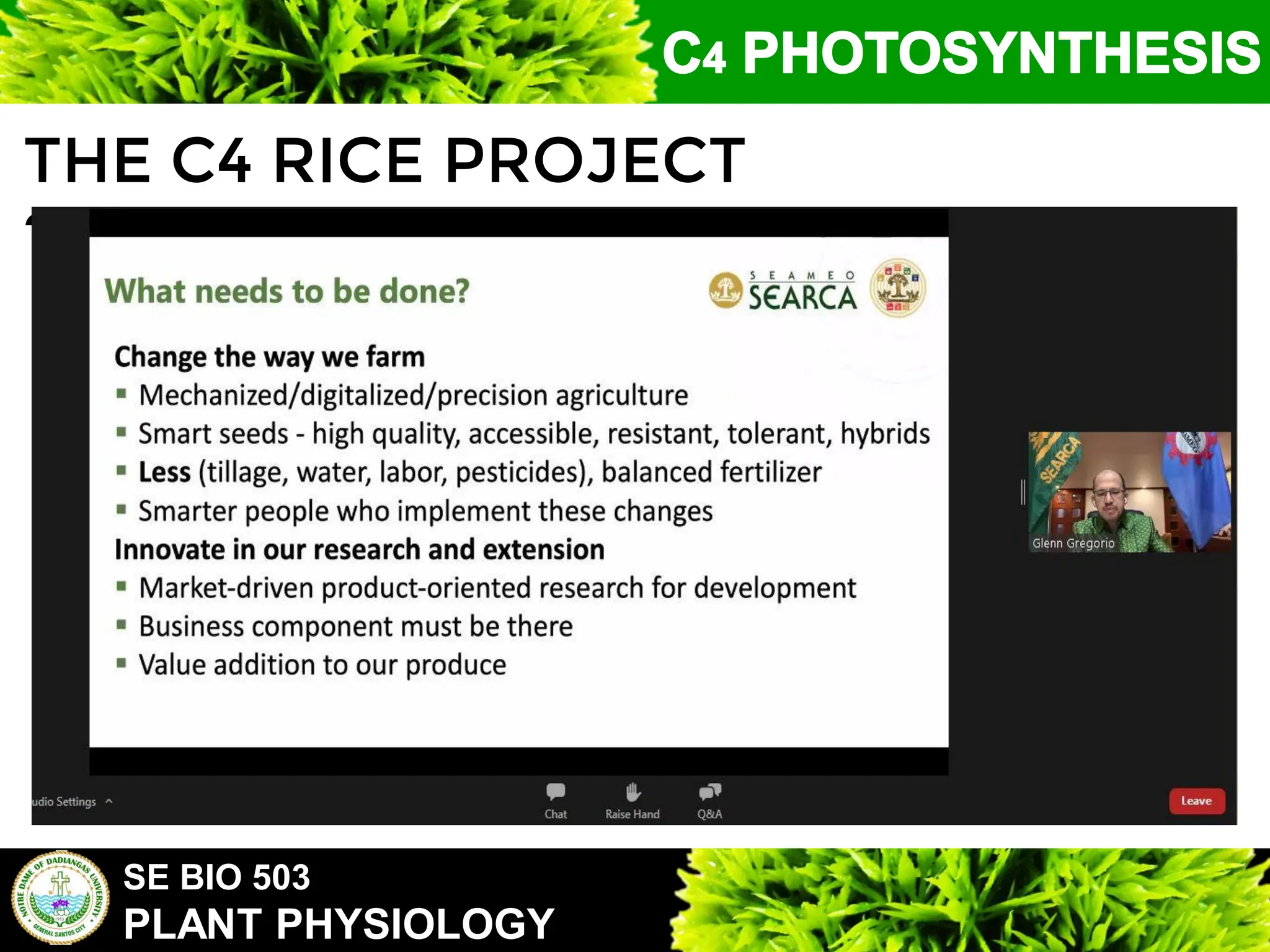
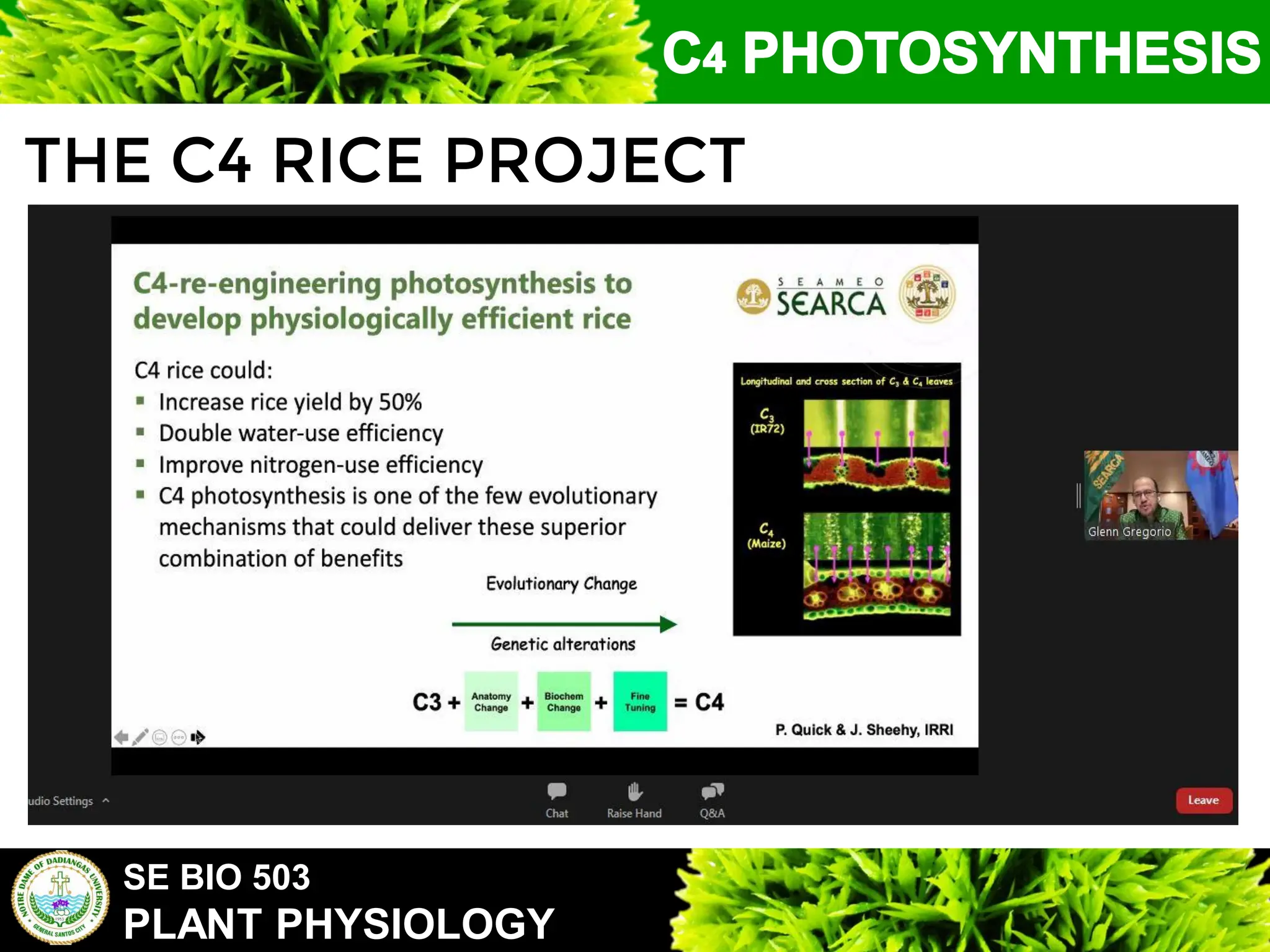
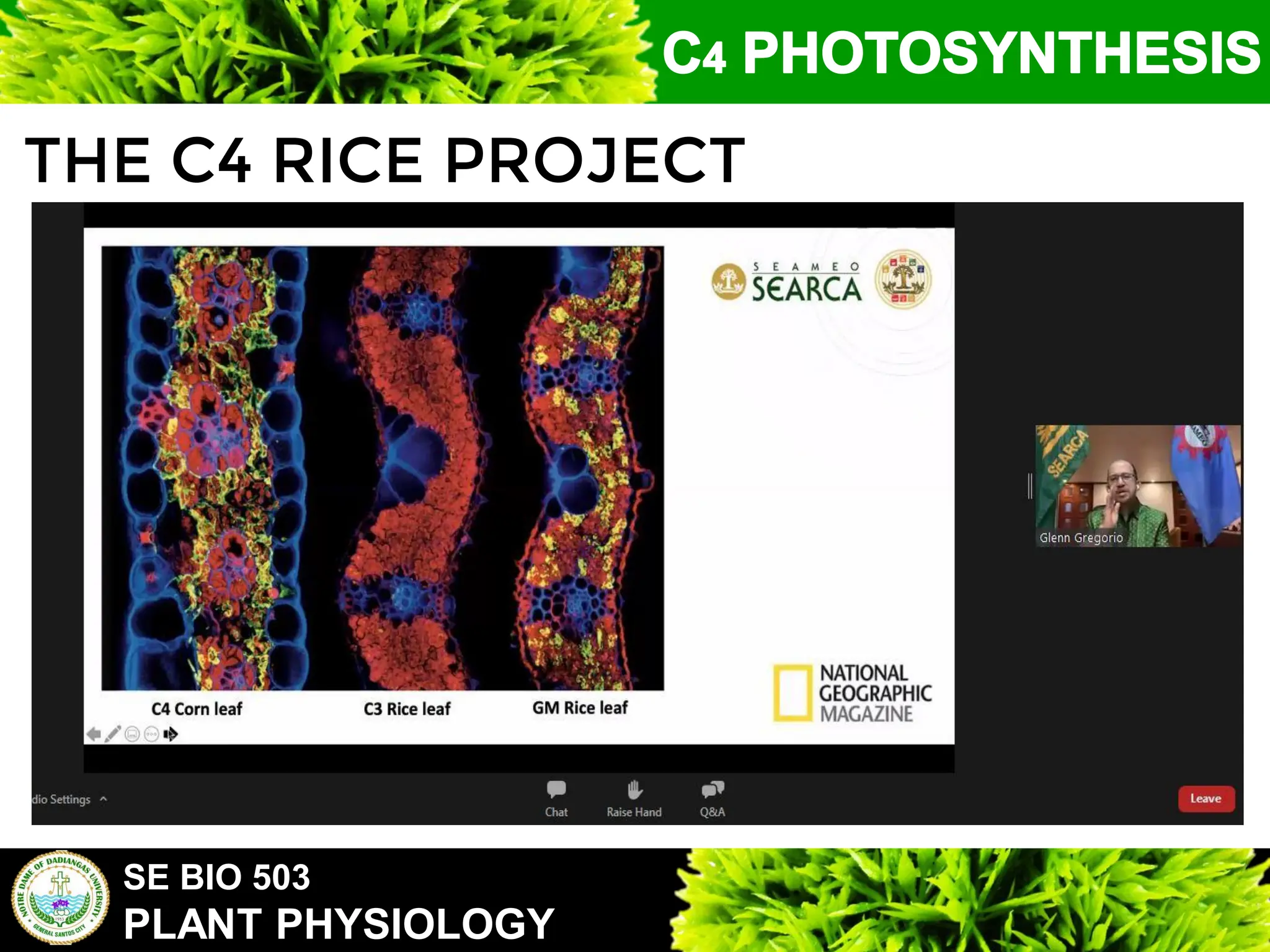
Discussion on the C4 rice project and its implications for improving rice productivity through enhanced photosynthesis.
Quiz assessing understanding of C4 photosynthesis, including initial product and Kranz anatomy.
Introduction to CAM (Crassulacean Acid Metabolism) photosynthesis as an adaptation to arid environments.
Details on how CAM plants fix CO2 at night and release it during the day for photosynthesis.
Discusses advantages like water conservation and disadvantages such as low photosynthetic activity.
Quizzes on CAM processes, including when CO2 is fixed and the types of acids formed.
Conclusion of the presentation, expressing gratitude for participation and attention.
Photosynthesis (C2, C3, C4 and CAM Photosynthesis).pdf
1.
JMJ
NOTRE DAME OFDADIANGAS UNIVERSITY
Marist Avenue, General Santos
By:
2.
SE BIO 503
PLANTPHYSIOLOGY
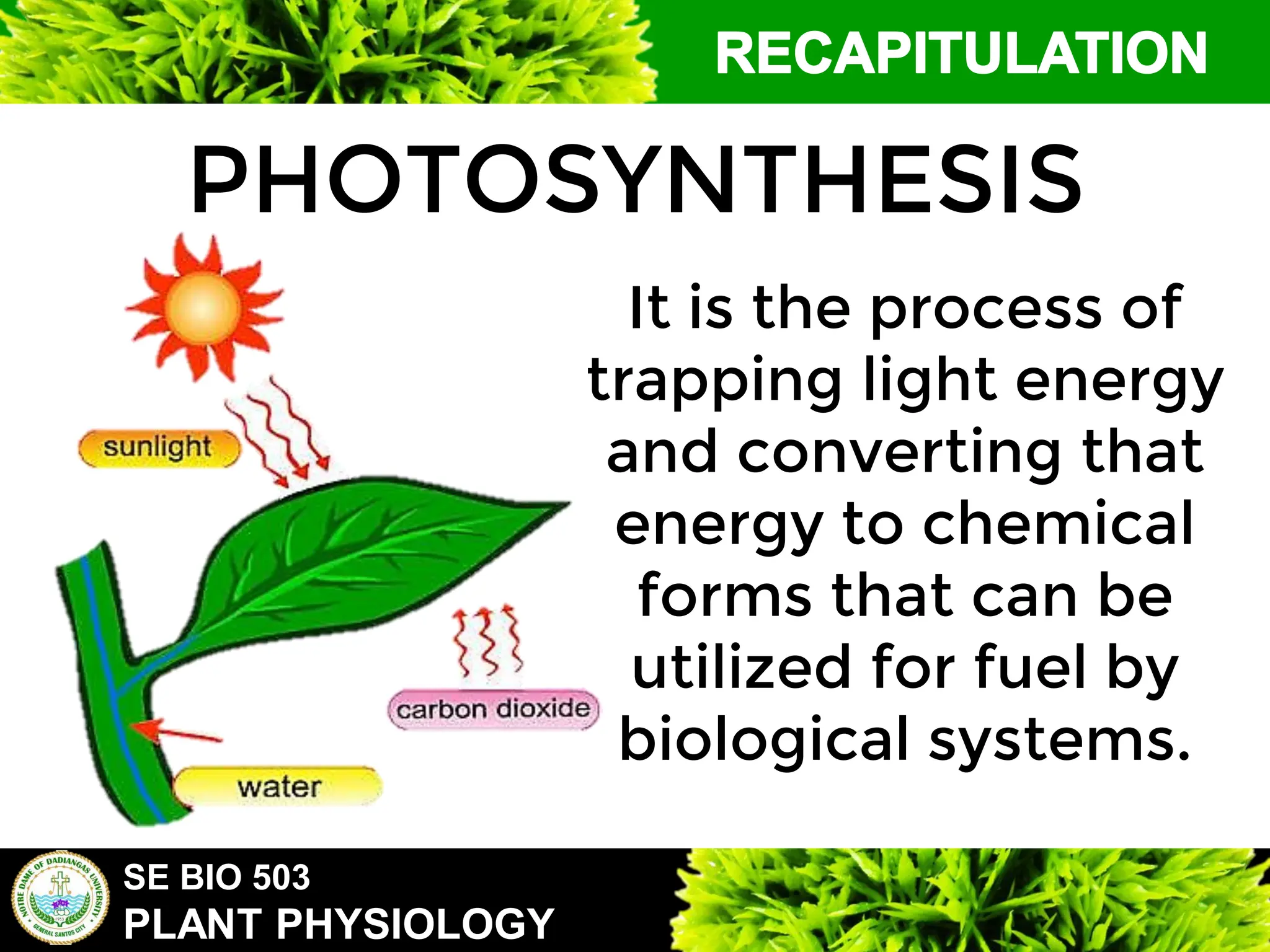
PHOTOSYNTHESIS
It is the process of
trapping light energy
and converting that
energy to chemical
forms that can be
utilized for fuel by
biological systems.
SE BIO 503
PLANTPHYSIOLOGY
PHOTORESPIRATION
It occurs when the CO2
levels inside a leaf
become low.
This happens on hot
dry days.
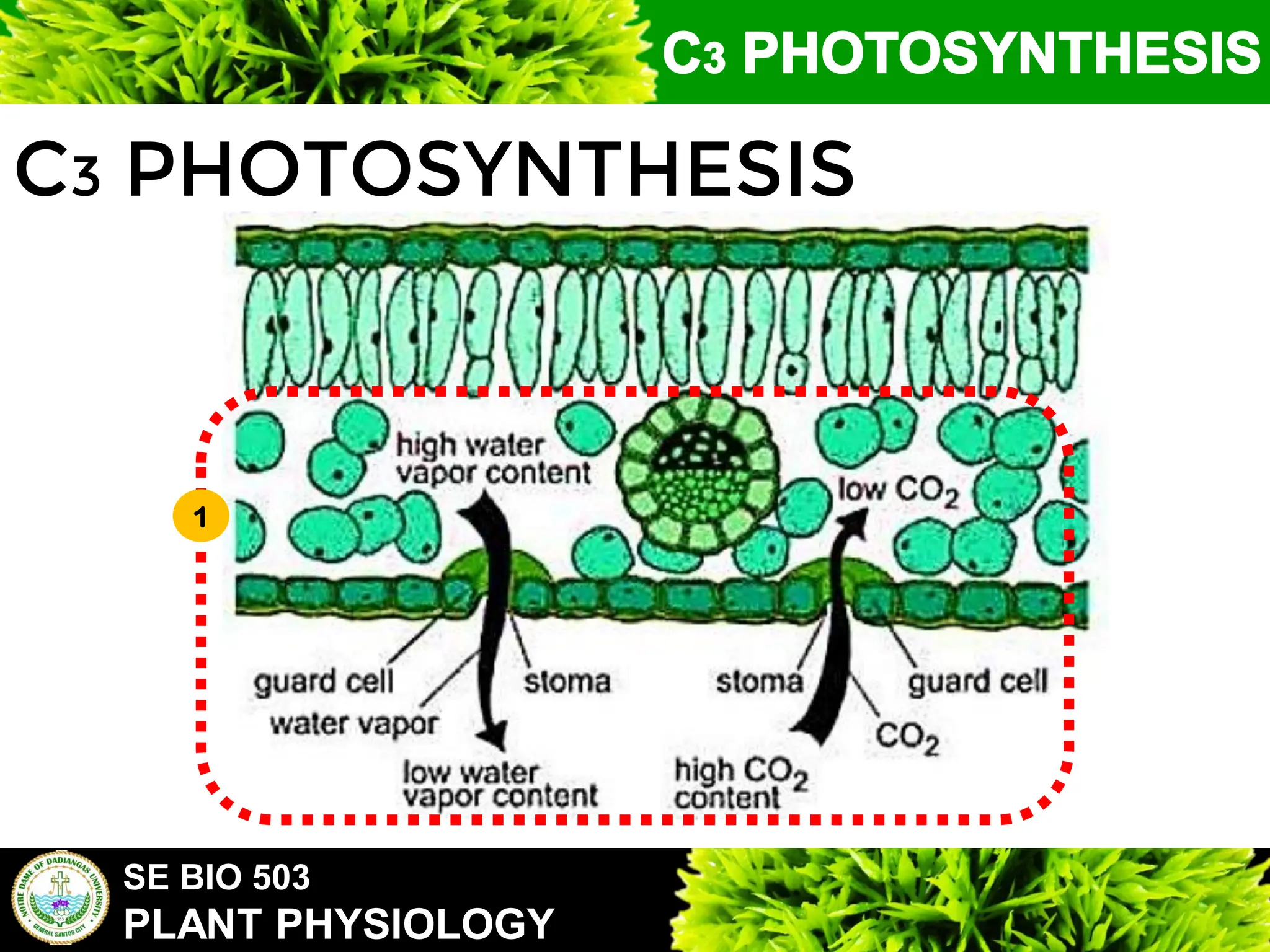
On hot dry days, the
plant is forced to close
its stomata to prevent
excess water loss. RuBisCo Enzyme
15.
SE BIO 503
PLANTPHYSIOLOGY
PHOTORESPIRATION
The plant continues fix CO2 when its stomata are
closed, the CO2 will get used up and the O2 ratio in
the leaf will increase relative to CO2 concentrations.
16.
SE BIO 503
PLANTPHYSIOLOGY
PHOTORESPIRATION
The plant continues fix CO2 when its stomata are
closed, the CO2 will get used up and the O2 ratio in
the leaf will increase relative to CO2 concentrations.
17.
SE BIO 503
PLANTPHYSIOLOGY
PHOTORESPIRATION
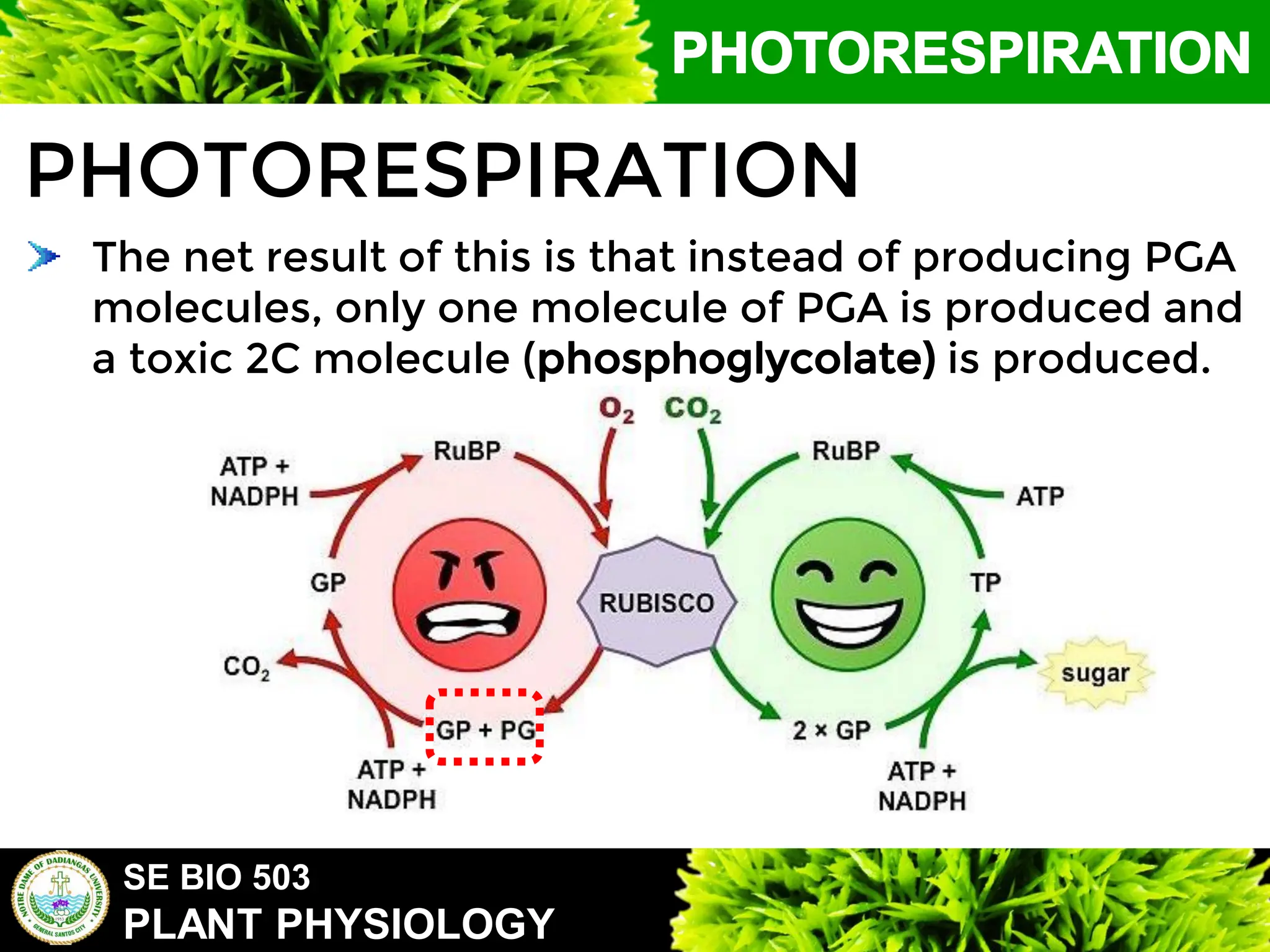
When the CO2 levels inside the leaf drop to around
50 ppm, RuBisCo starts to combine O2 with RuBP
instead of CO2.
18.
SE BIO 503
PLANTPHYSIOLOGY
PHOTORESPIRATION
The net result of this is that instead of producing PGA
molecules, only one molecule of PGA is produced and
a toxic 2C molecule (phosphoglycolate) is produced.
19.
SE BIO 503
PLANTPHYSIOLOGY
PHOSPOGLYCOLATE (PG)
This compound is toxic to
plant metabolism because it
inhibits distinct steps in the
carbon-fixing Calvin-Benson
Cycle.
It also inhibits other metabolic
pathways such as triose-
phosphate isomerase,
phosphofructokinase, or
sedoheptulose 1,7-
bisphosphate phosphatase.
So, degradation of 2-PG during
photorespiration is important
for cellular homeostasis.
SE BIO 503
PLANTPHYSIOLOGY
1. Decrease the
production of
phosphoglyceric acid
(PGA)
2. Consume ATP produced
in the light reaction
3. Lost a carbon atom in
the form of carbon
dioxide
4. Reduce the efficiency of
photosynthesis.
DISADVANTAGES
26.
SE BIO 503
PLANTPHYSIOLOGY
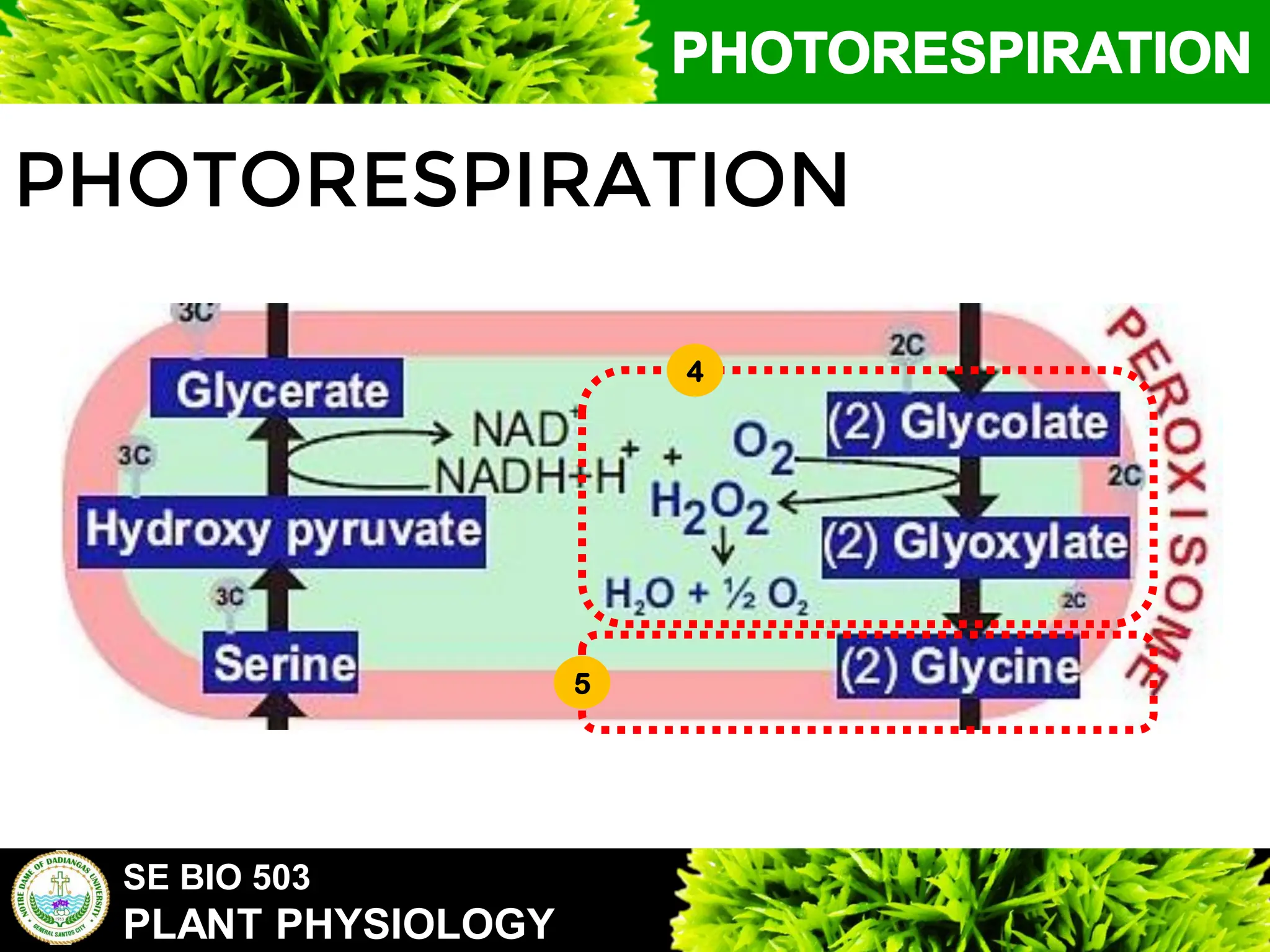
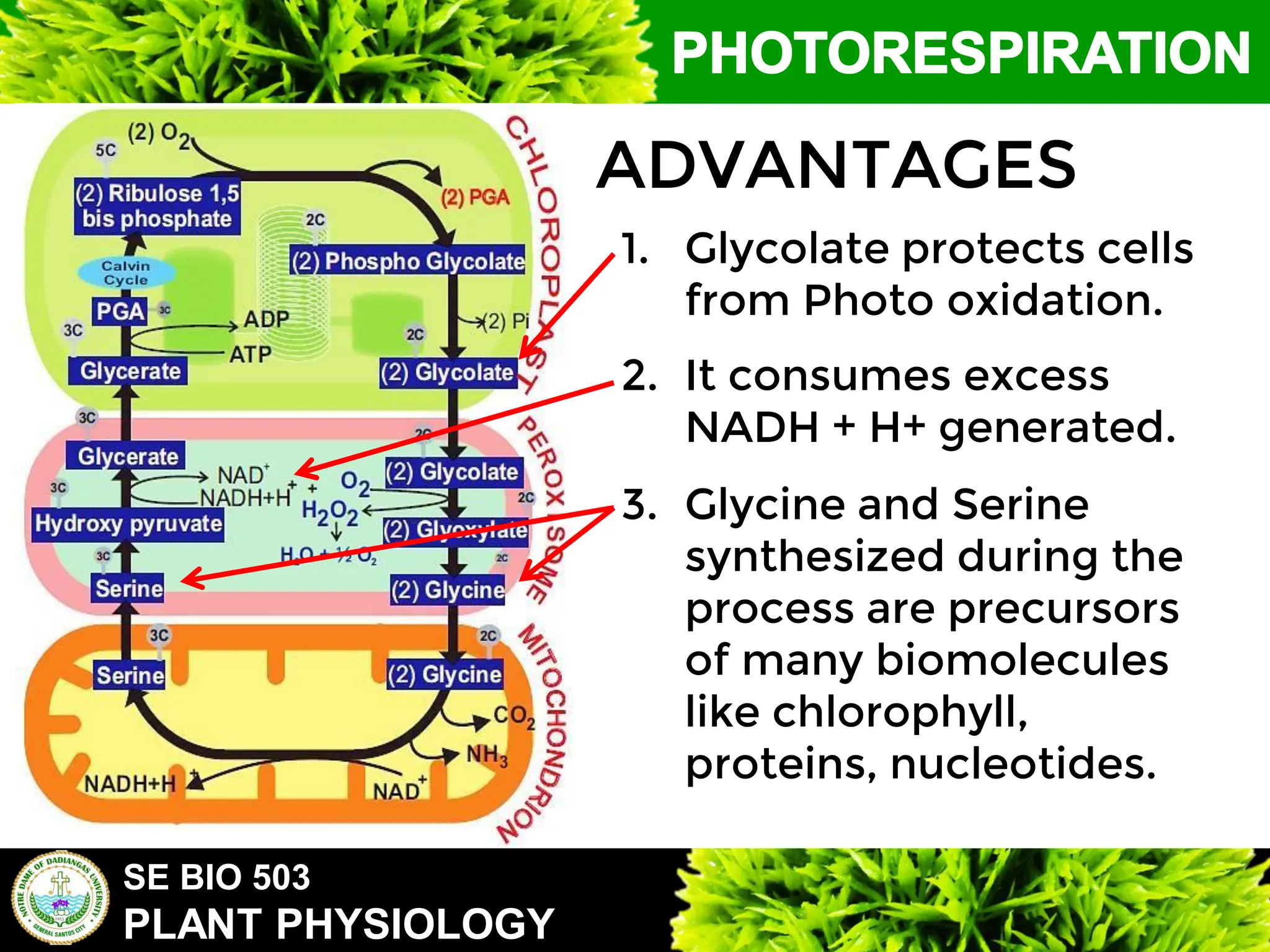
1. Glycolate protects cells
from Photo oxidation.
2. It consumes excess
NADH + H+ generated.
3. Glycine and Serine
synthesized during the
process are precursors
of many biomolecules
like chlorophyll,
proteins, nucleotides.
ADVANTAGES
27.
SE BIO 503
PLANTPHYSIOLOGY
1. When the Calvin cycle evolved, there was little O2
in the atmosphere. Binding of oxygen by RuBisCo
was not a problem.
2. After millions of years, photosynthesis caused the
build-up of oxygen levels in the atmosphere and
the binding oxygen by RuBisCo became the
photorespiration problem of today.
3. Perhaps it is mere evolutionary baggage, but its
cost may be high because of reduced plant
growth and reduced food production.
CALVIN CYCLE vs. PHOTORESPIRATION
(COMPARISON)
28.
Checking Knowledge:
When CO2in the leaf drops, what
compound is used by RuBisCo to
combined with RuBP?
Serine
A
Oxygen gas
B
Phosphoglycolate
C
Glycine
D
29.
Checking Knowledge:
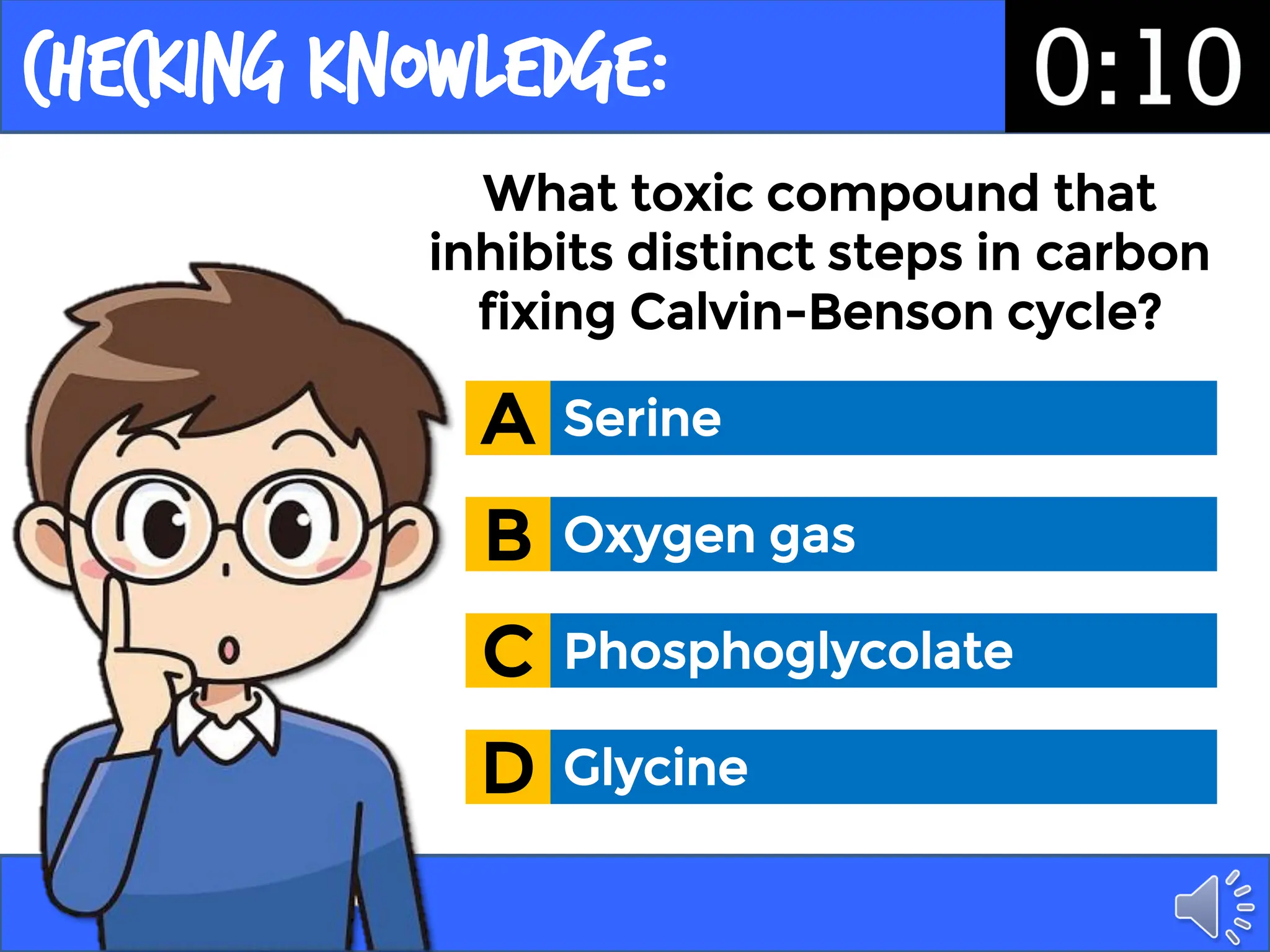
What toxiccompound that
inhibits distinct steps in carbon
fixing Calvin-Benson cycle?
Serine
A
Oxygen gas
B
Phosphoglycolate
C
Glycine
D
30.
Checking COMPREHENSION:
Which ofthe following is the
disadvantage of photorespiration?
It consumes excess NADH + H+
generated.
A
Glycolate protects cells from
Photo oxidation.
B
Glycine and Serine are
synthesized
C
Reduce the efficiency of
photosynthesis.
D
SE BIO 503
PLANTPHYSIOLOGY
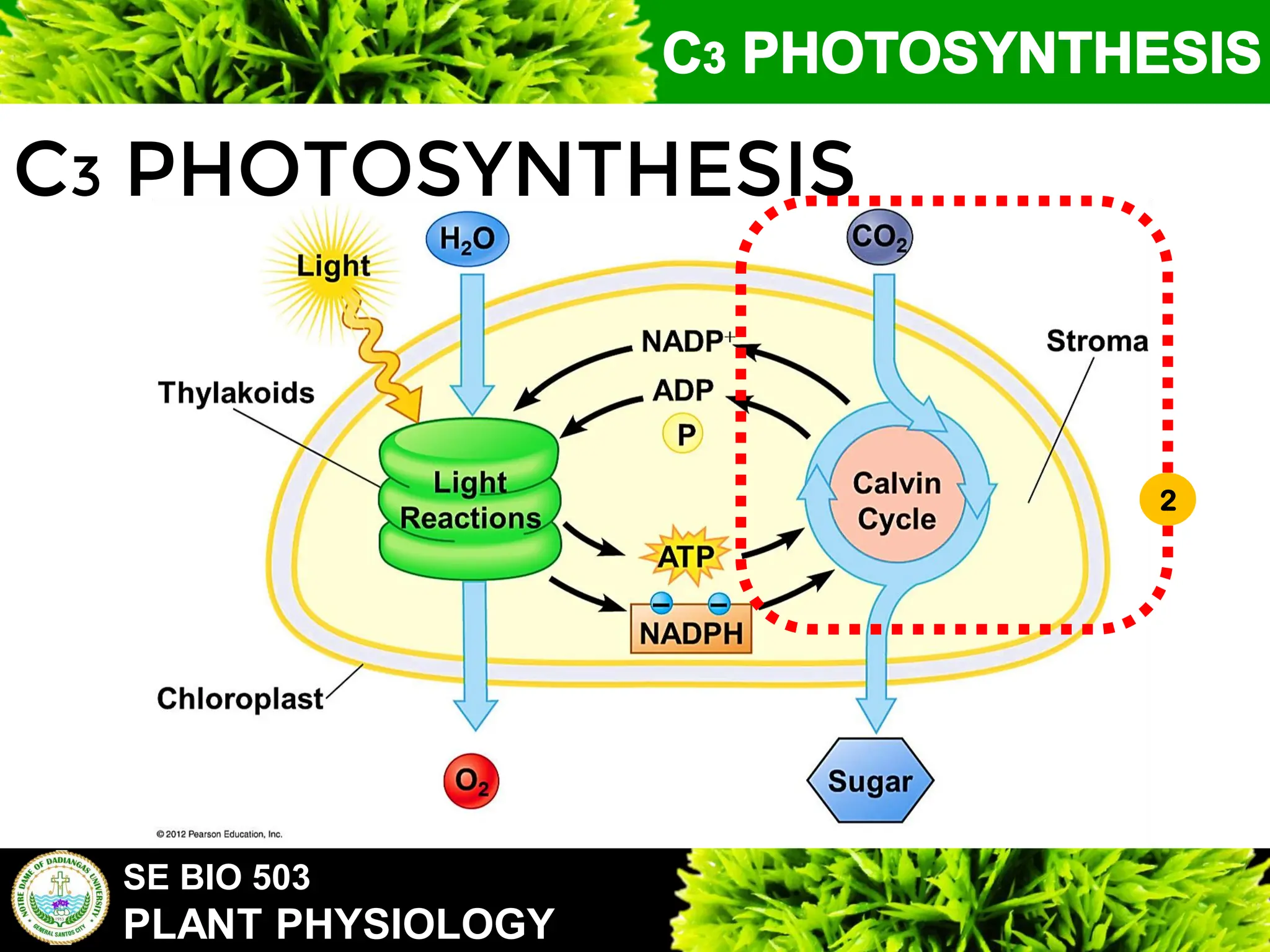
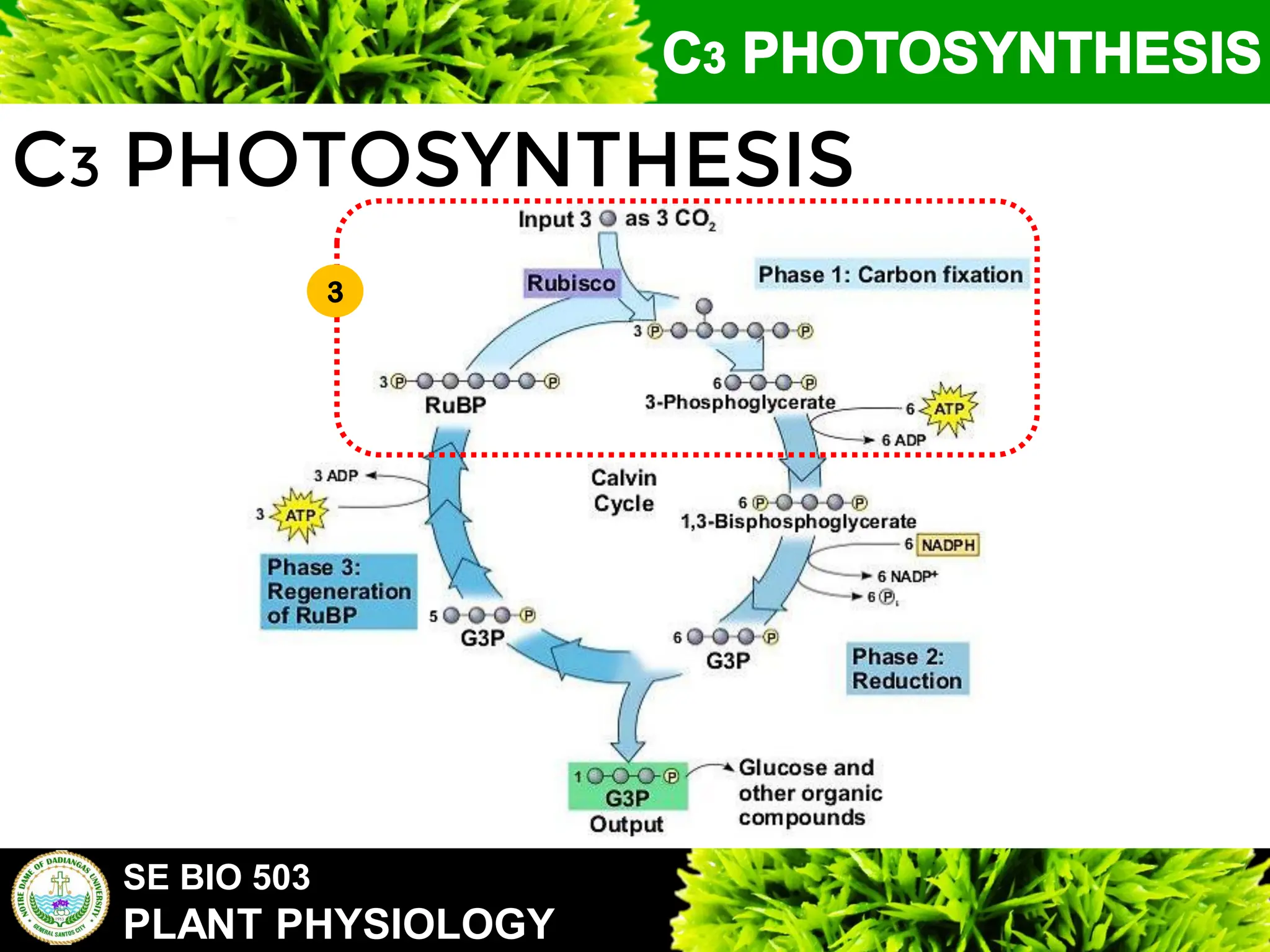
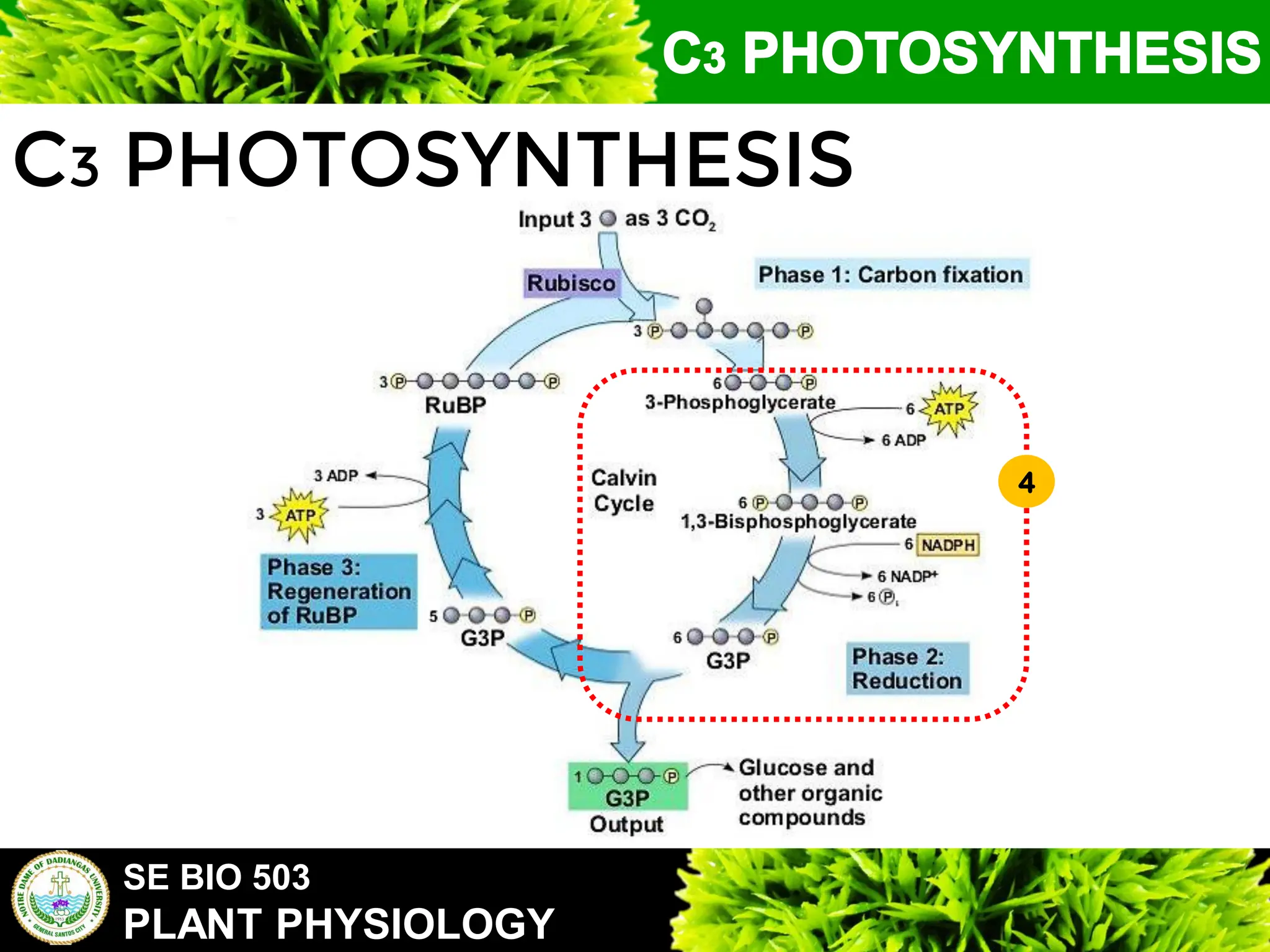
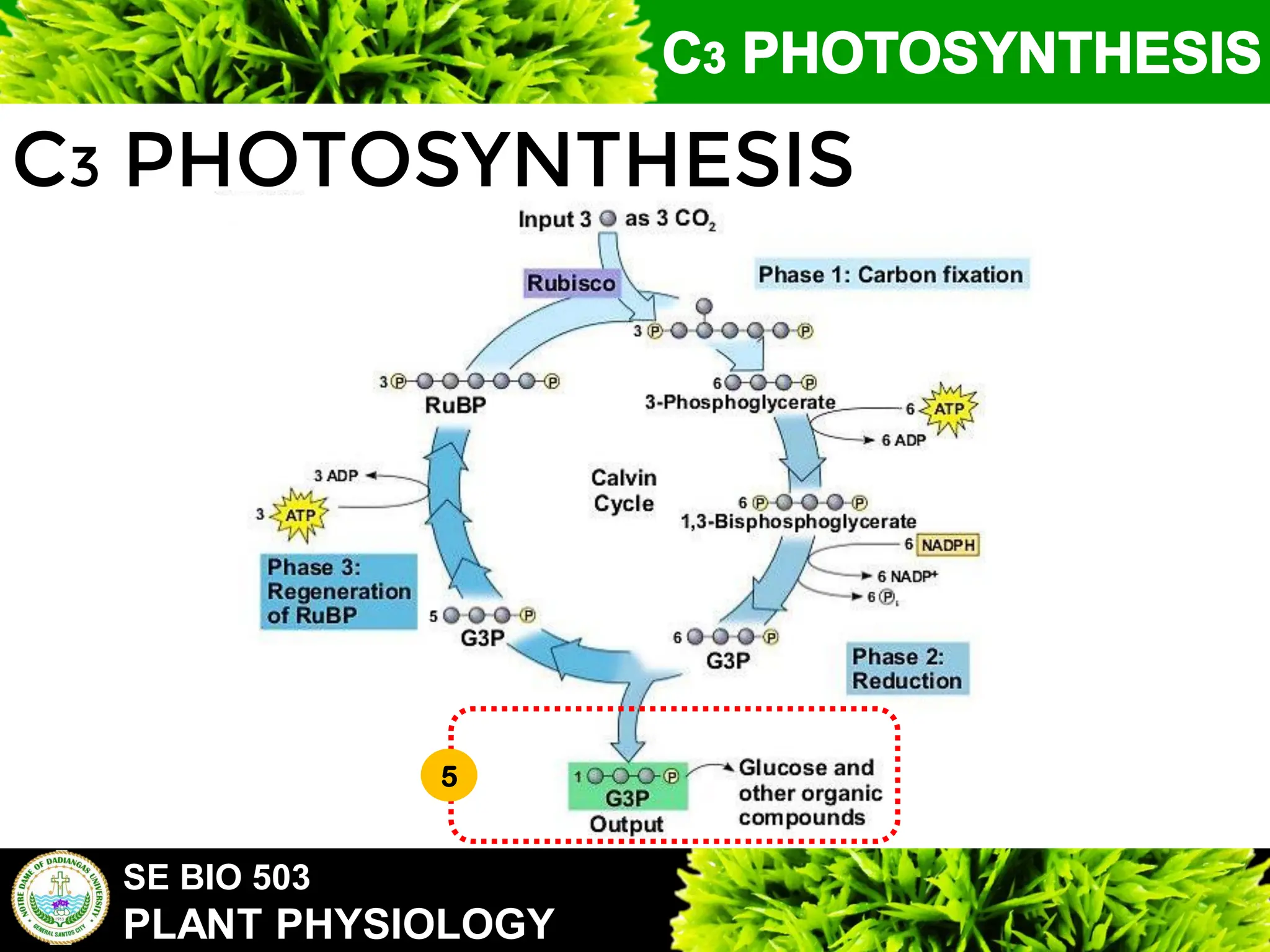
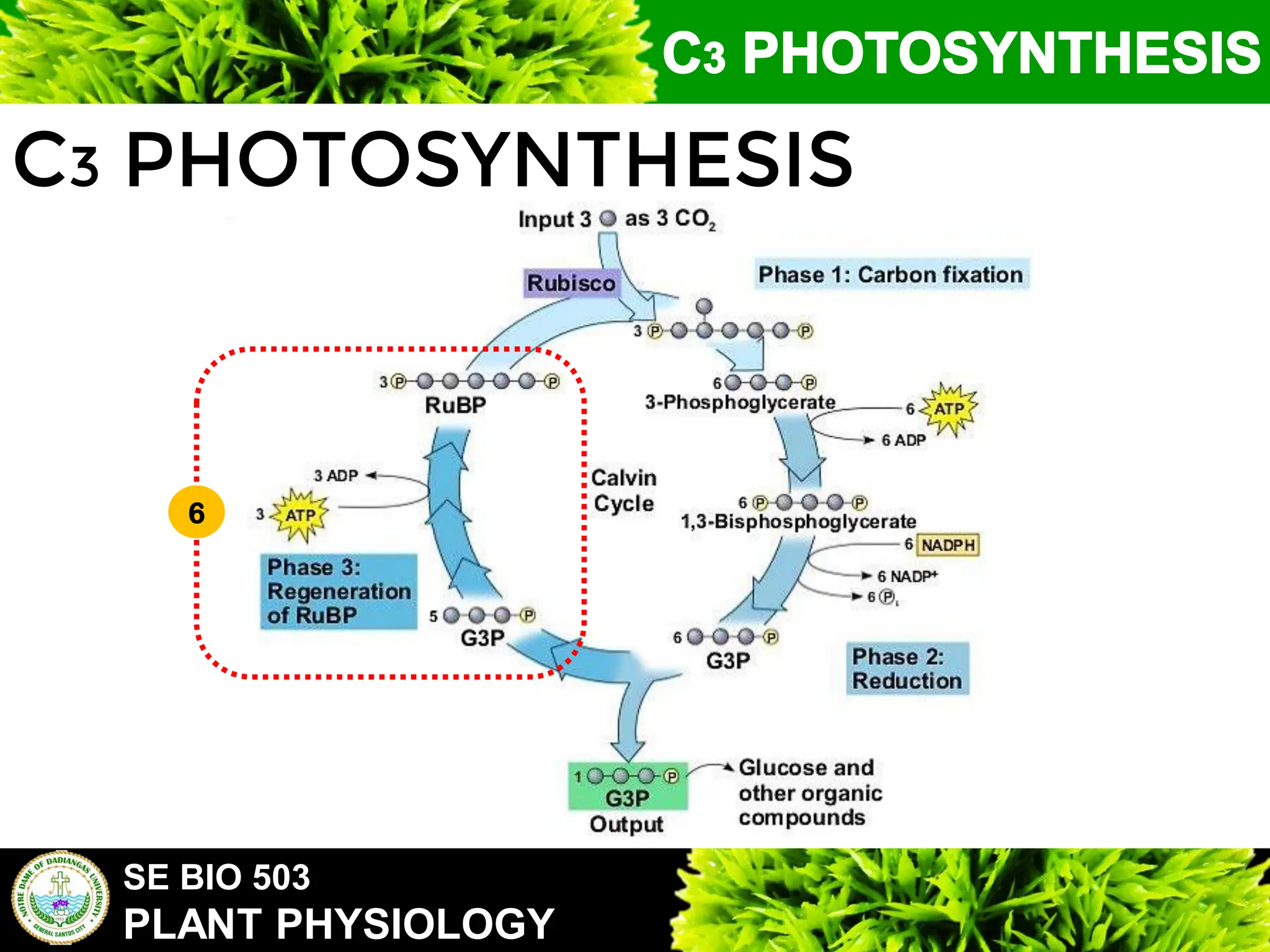
C3 PHOTOSYNTHESIS
It is called C3
because the first
product formed is a
3-carbon molecule
(3-Phosphoglycerate)
Most plants that are
C3, usually on dicot
plant.
33.
SE BIO 503
PLANTPHYSIOLOGY
C3 PHOTOSYNTHESIS
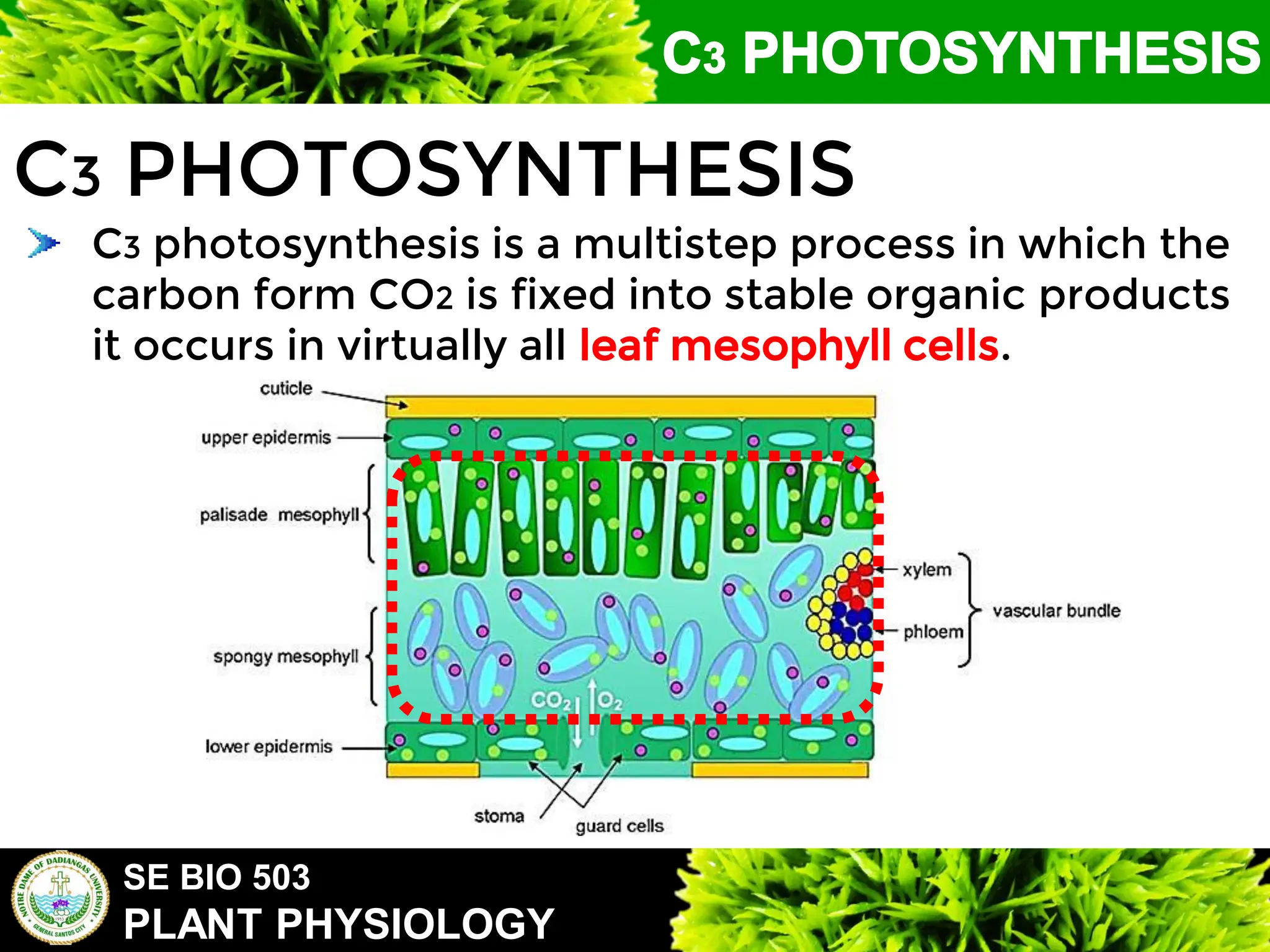
C3 photosynthesis is a multistep process in which the
carbon form CO2 is fixed into stable organic products
it occurs in virtually all leaf mesophyll cells.
34.
SE BIO 503
PLANTPHYSIOLOGY
LEAF MESOPHYLL CELLS
Palisade layer helps in photosynthesis, (in fact palisade cells are the
site of photosynthesis) while the air pockets in the spongy layer
allow exchange of gases like CO2 required for photosynthesis.
35.
SE BIO 503
PLANTPHYSIOLOGY
C3 PHOTOSYNTHESIS
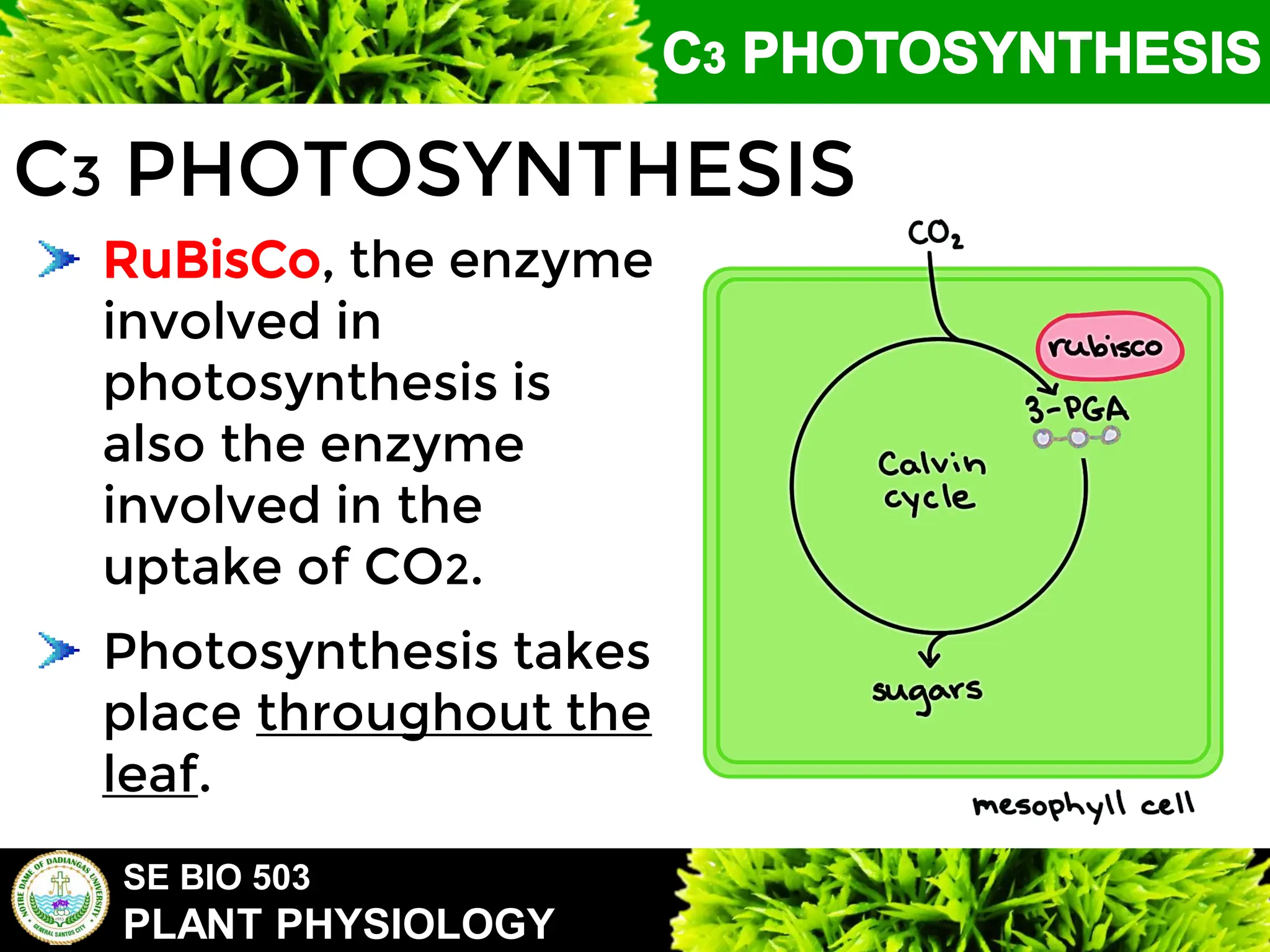
RuBisCo, the enzyme
involved in
photosynthesis is
also the enzyme
involved in the
uptake of CO2.
Photosynthesis takes
place throughout the
leaf.
SE BIO 503
PLANTPHYSIOLOGY
C3 PHOTOSYNTHESIS
Advantages:
More efficient than C4
plants under cool and
moist conditions and
under normal light
because fewer enzymes
and no specialized
anatomy.
Most plants are C3 such as
evergreen trees, deciduous
trees and weedy plants.
44.
SE BIO 503
PLANTPHYSIOLOGY
C3 PHOTOSYNTHESIS
Advantages:
Important sources of
calories all over the
world: cowpea, cassava,
soybean, and rice are C3
plants.
Many plants live in
tropics and subtropics,
where precipitation is
not sparse, are C3 plants.
45.
SE BIO 503
PLANTPHYSIOLOGY
C3 PHOTOSYNTHESIS
Disadvantages:
During hot or dry climates, RuBisCo uses up oxygen
which leads to photorespiration.
46.
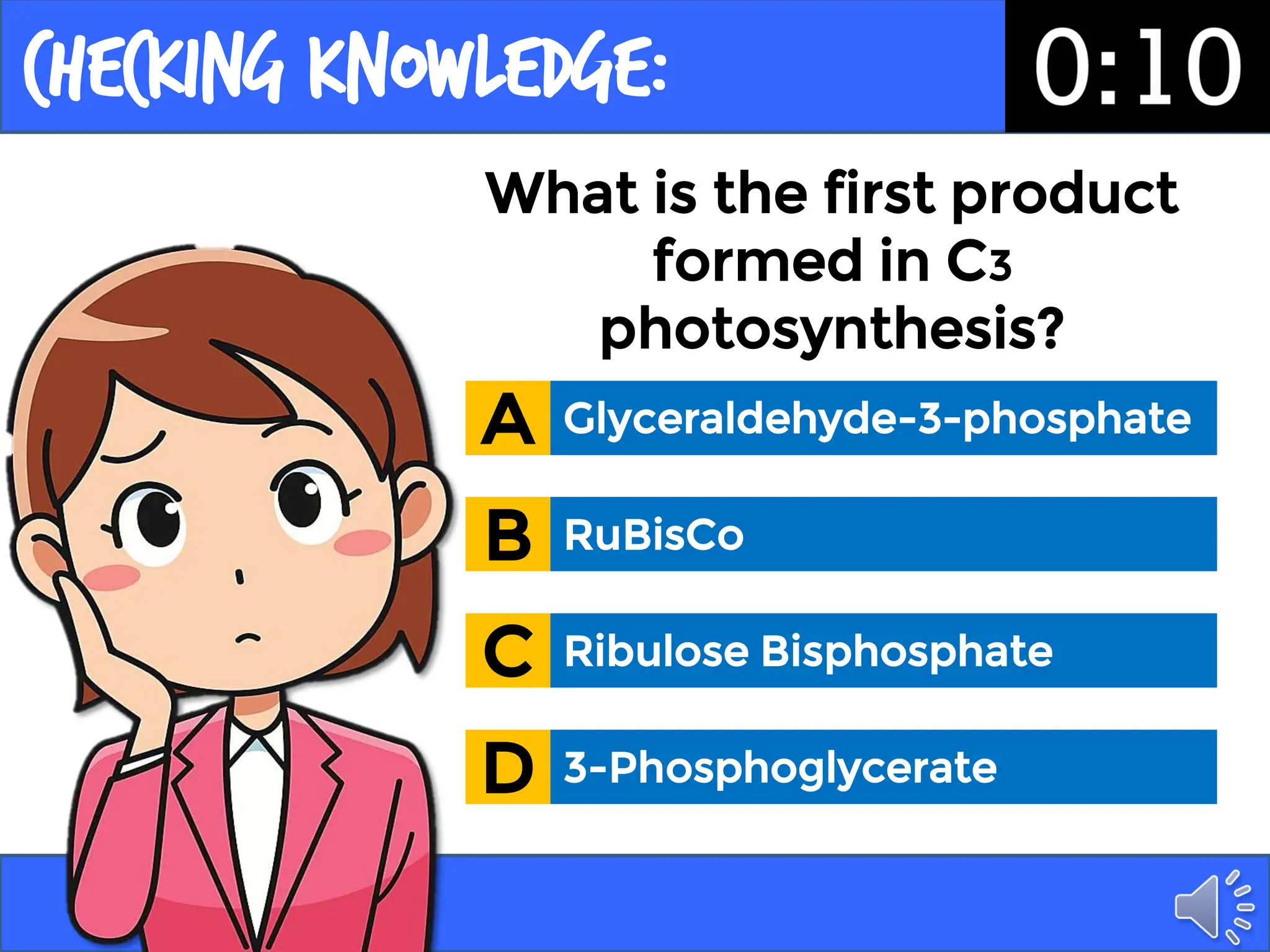
Checking Knowledge:
What isthe first product
formed in C3
photosynthesis?
Glyceraldehyde-3-phosphate
A
RuBisCo
B
Ribulose Bisphosphate
C
3-Phosphoglycerate
D
47.
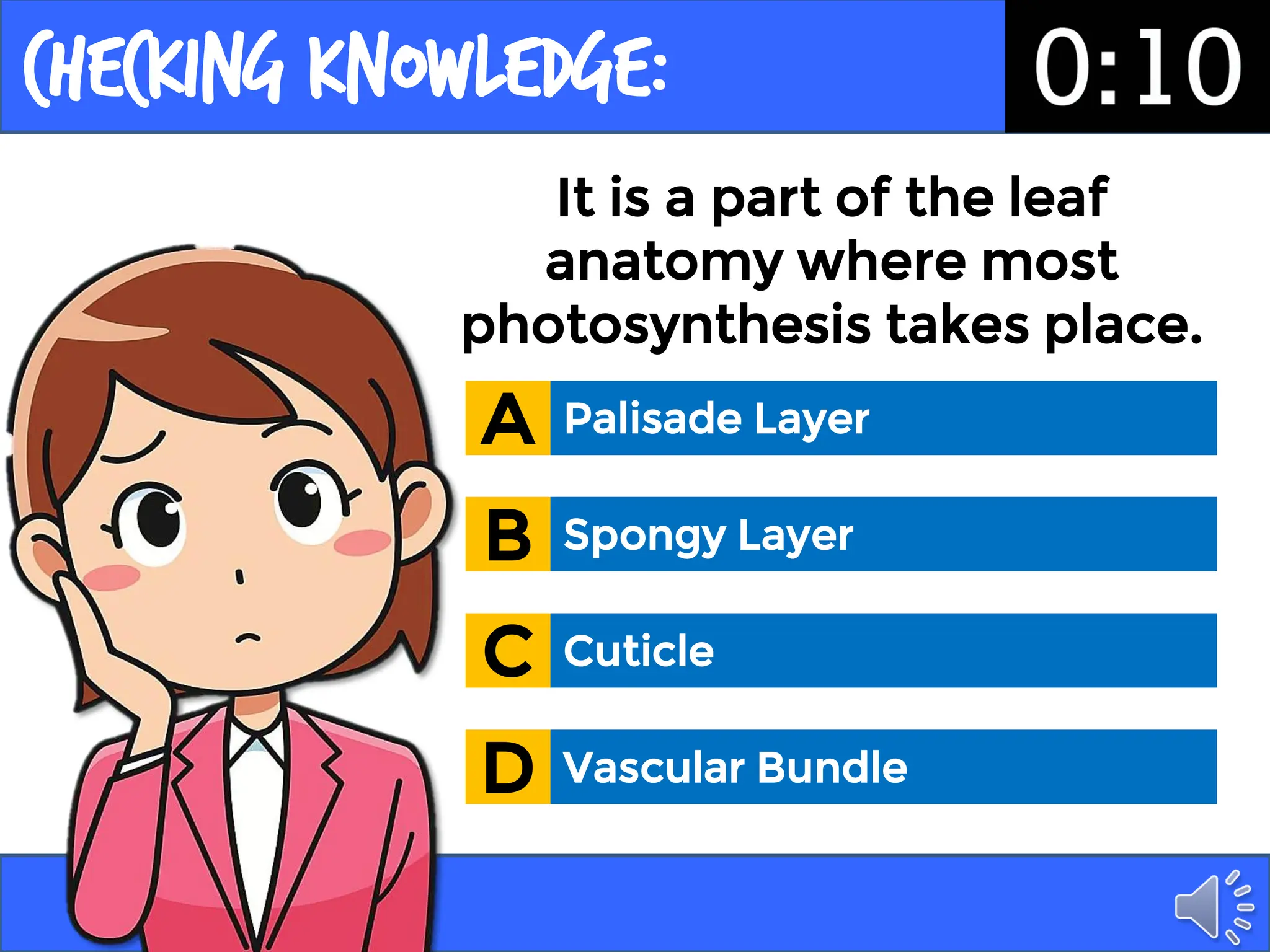
Checking Knowledge:
It isa part of the leaf
anatomy where most
photosynthesis takes place.
Palisade Layer
A
Spongy Layer
B
Cuticle
C
Vascular Bundle
D
48.
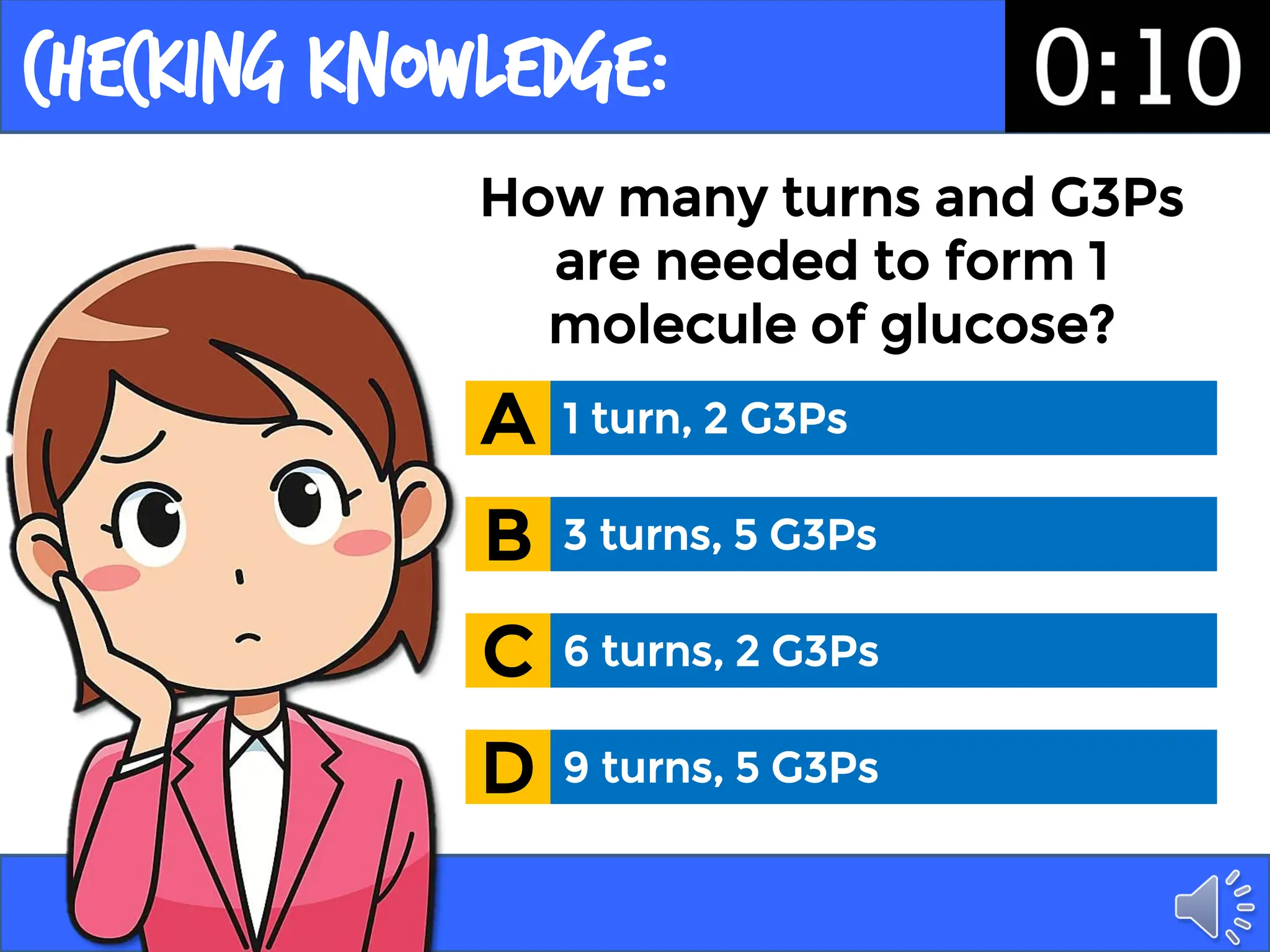
Checking KNOWLEDGE:
How manyturns and G3Ps
are needed to form 1
molecule of glucose?
1 turn, 2 G3Ps
A
3 turns, 5 G3Ps
B
6 turns, 2 G3Ps
C
9 turns, 5 G3Ps
D
49.
Checking COMPREHENSION:
Which ofthe following is the
disadvantage of C3 photosynthesis?
Important source of Calories all
over the world.
A
It is more efficient in moist and
cold environment.
B
It has fewer enzymes and no
specialized anatomy.
C
It undergoes photorespiration
during hot or dry climates.
D
SE BIO 503
PLANTPHYSIOLOGY
C4 PHOTOSYNTHESIS
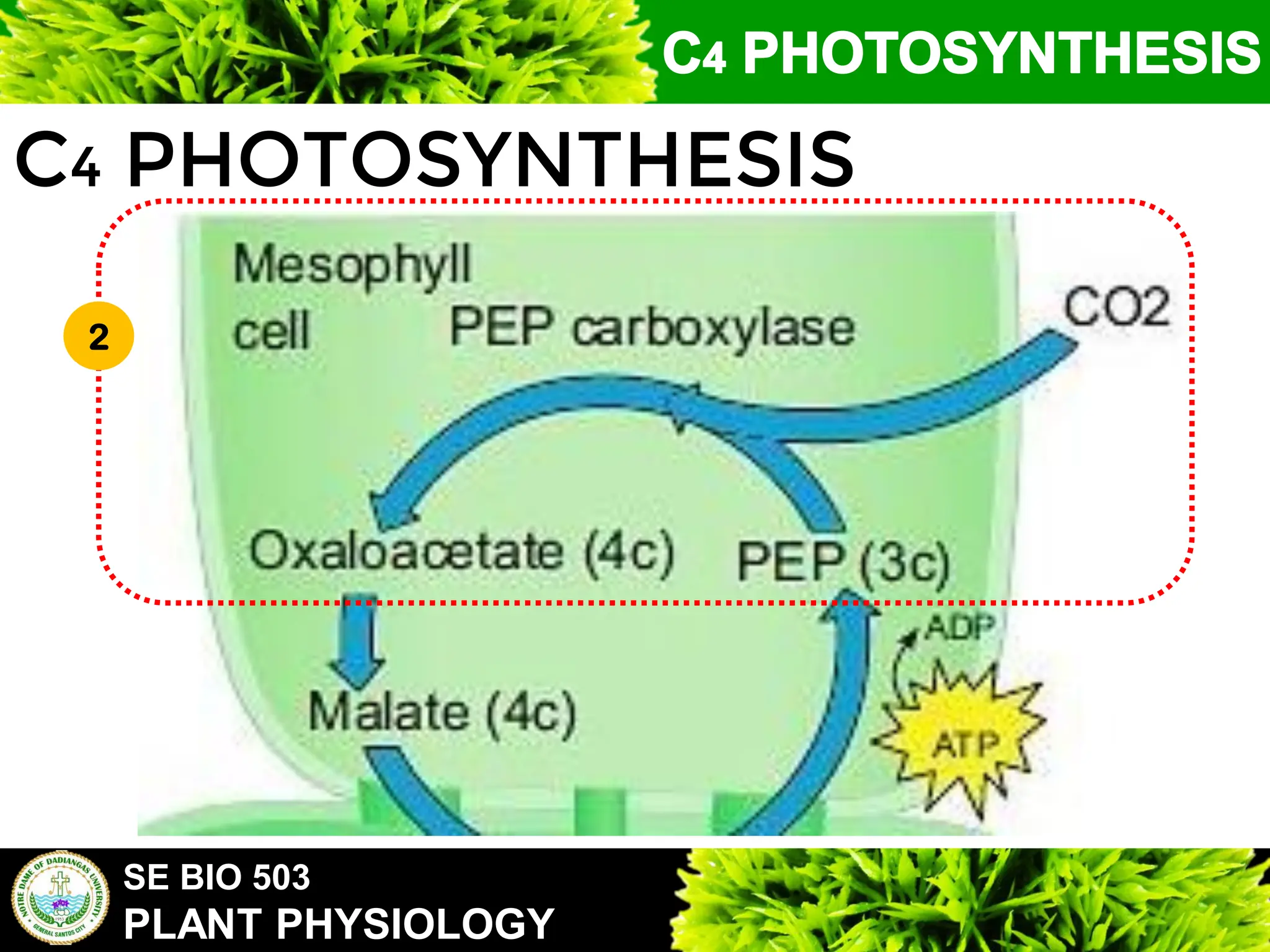
It is called C4 because
the first product formed
is a 4-carbon compound
called oxaloacetate.
Some plants which live
in drought, at high
temperature, nitrogen,
and CO2 limited
environment use C4
mechanism.
52.
SE BIO 503
PLANTPHYSIOLOGY
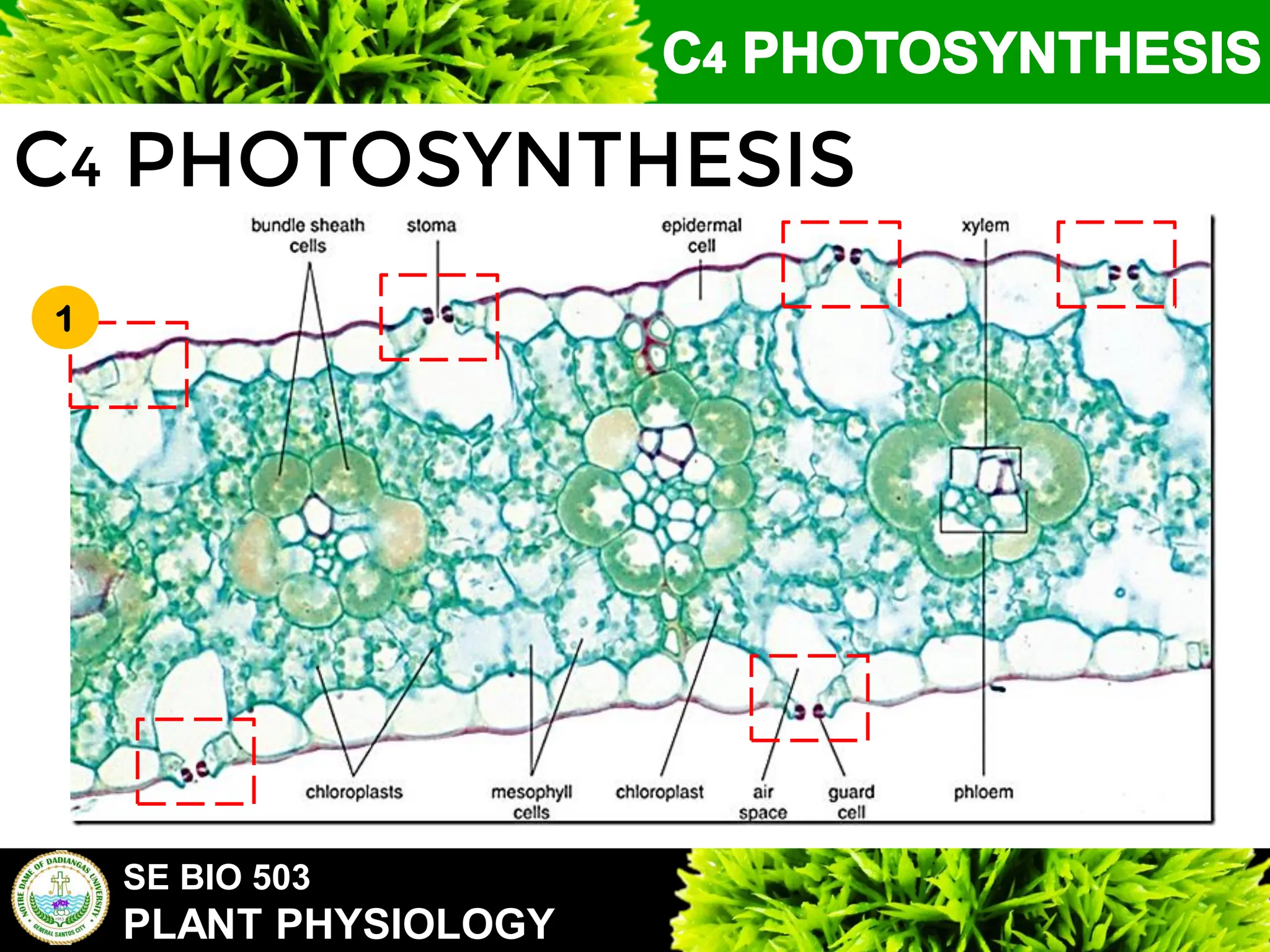
C4 PHOTOSYNTHESIS
C4 plant fix more CO2 as compared to the C3
plant due to having Kranz anatomy.
53.
SE BIO 503
PLANTPHYSIOLOGY
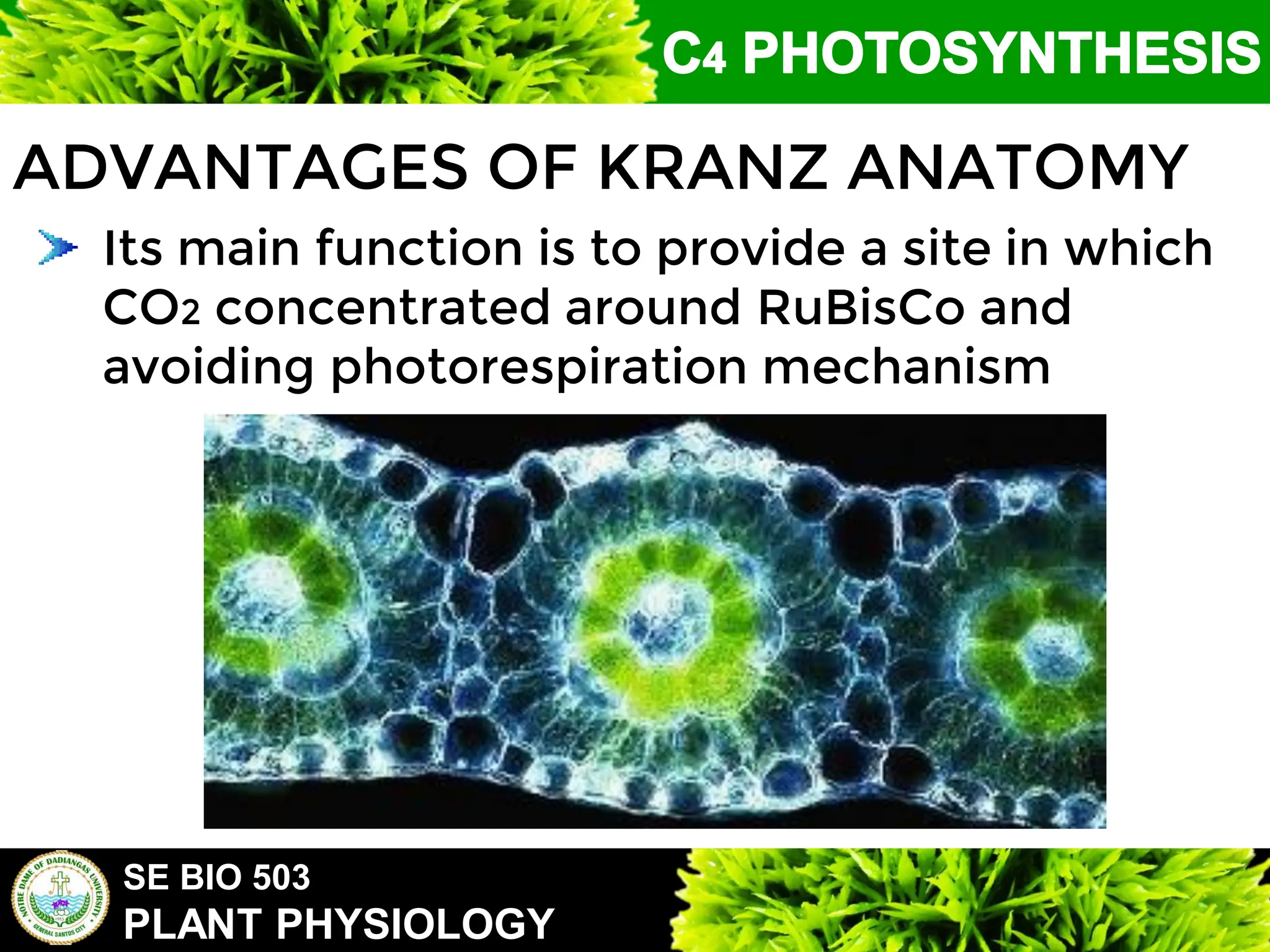
KRANZ ANATOMY
The word Kranz
means “wreath” or
“ring”.
Kranz anatomy is a
specialized structure
in C4 Plants where
the mesophyll cells
are clustered around
the bundle-sheath
cells in a ring-like
fashion.
54.
SE BIO 503
PLANTPHYSIOLOGY
ADVANTAGES OF KRANZ ANATOMY
Its main function is to provide a site in which
CO2 concentrated around RuBisCo and
avoiding photorespiration mechanism
55.
SE BIO 503
PLANTPHYSIOLOGY
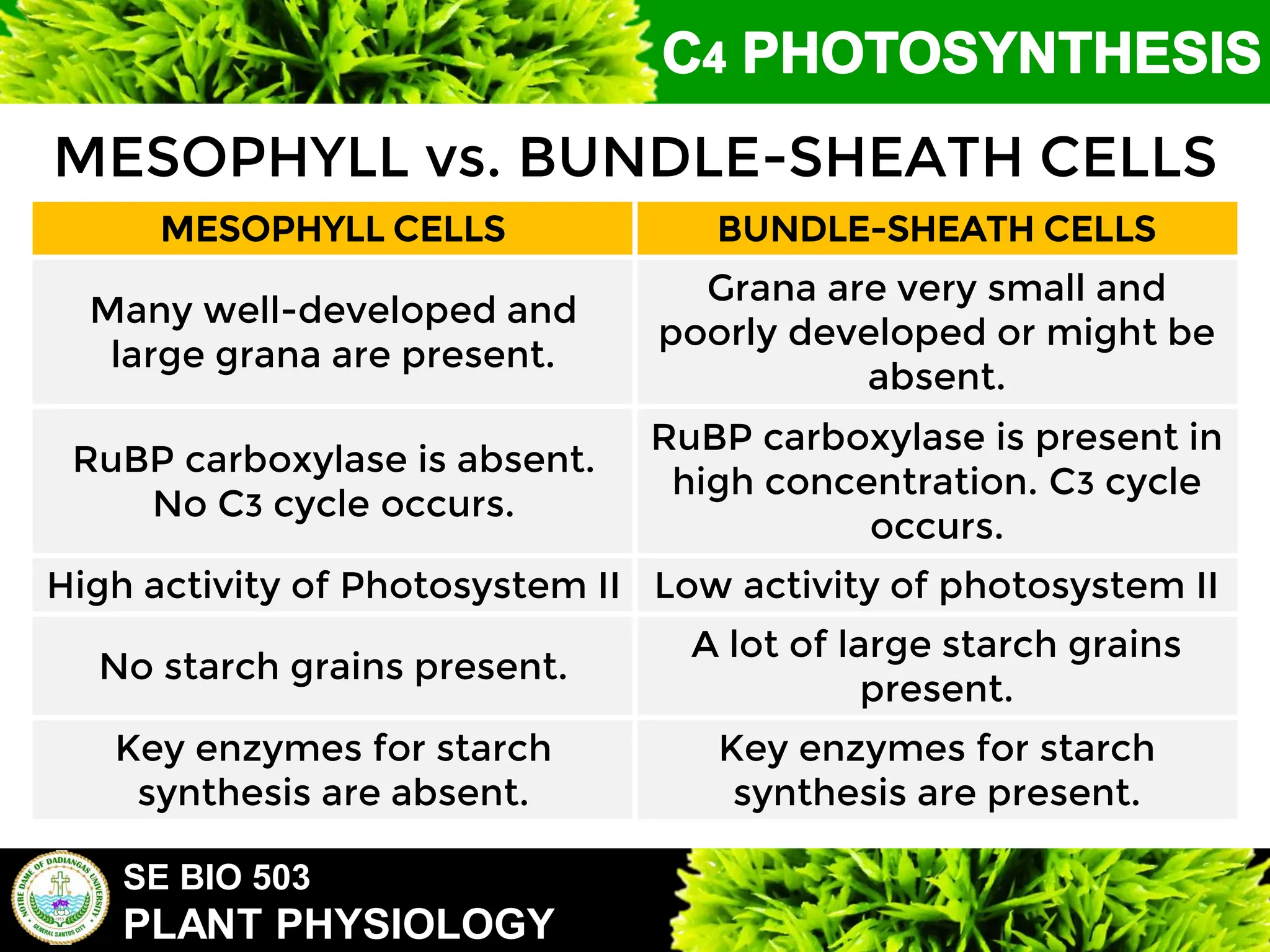
MESOPHYLL vs. BUNDLE-SHEATH CELLS
MESOPHYLL CELLS BUNDLE-SHEATH CELLS
Many well-developed and
large grana are present.
Grana are very small and
poorly developed or might be
absent.
RuBP carboxylase is absent.
No C3 cycle occurs.
RuBP carboxylase is present in
high concentration. C3 cycle
occurs.
High activity of Photosystem II Low activity of photosystem II
No starch grains present.
A lot of large starch grains
present.
Key enzymes for starch
synthesis are absent.
Key enzymes for starch
synthesis are present.
56.
SE BIO 503
PLANTPHYSIOLOGY
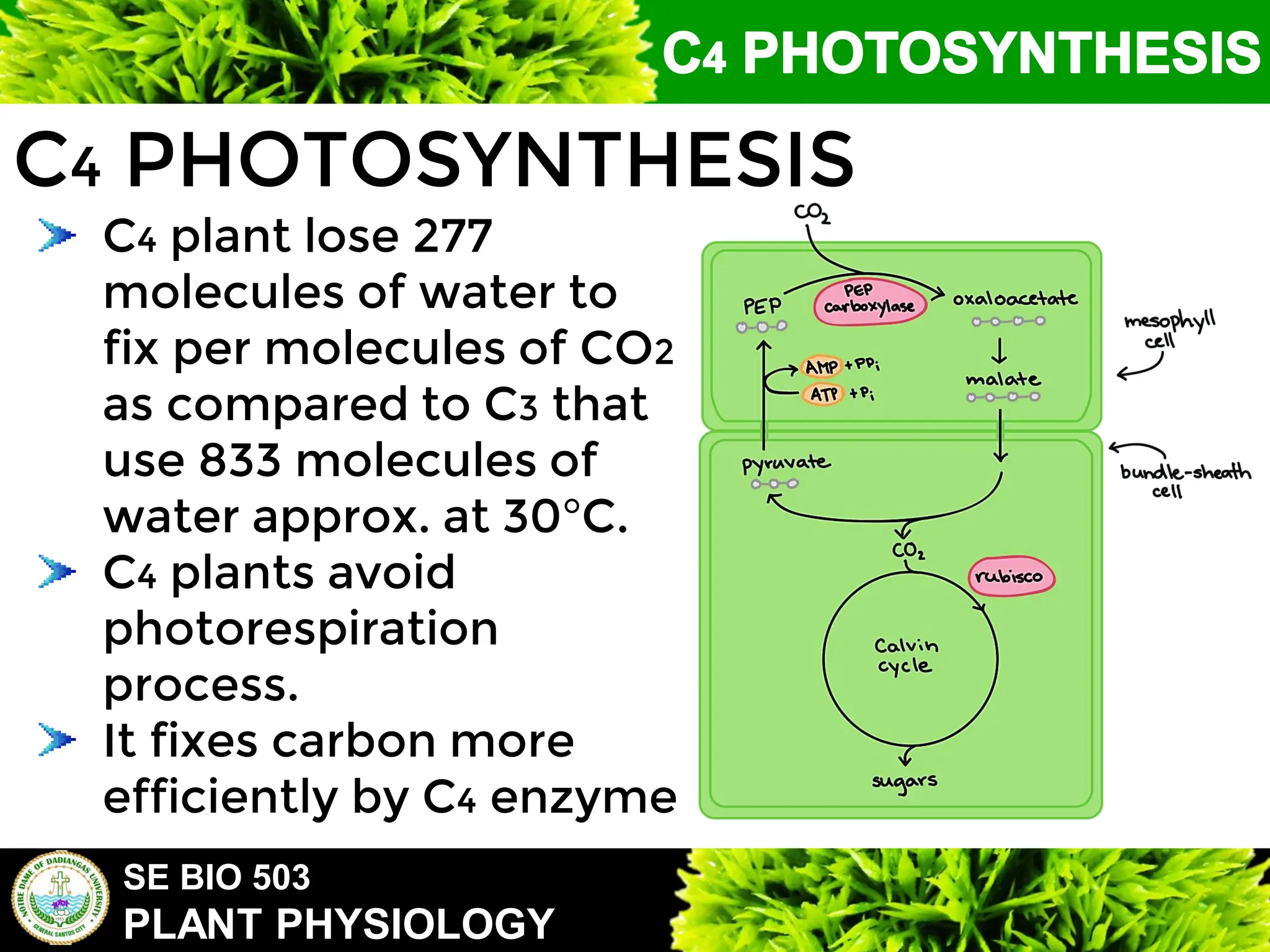
C4 PHOTOSYNTHESIS
C4 plant lose 277
molecules of water to
fix per molecules of CO2
as compared to C3 that
use 833 molecules of
water approx. at 30°C.
C4 plants avoid
photorespiration
process.
It fixes carbon more
efficiently by C4 enzyme
SE BIO 503
PLANTPHYSIOLOGY
C4 PHOTOSYNTHESIS
6
pyruvate
orthophosphate
dikinase
63.
SE BIO 503
PLANTPHYSIOLOGY
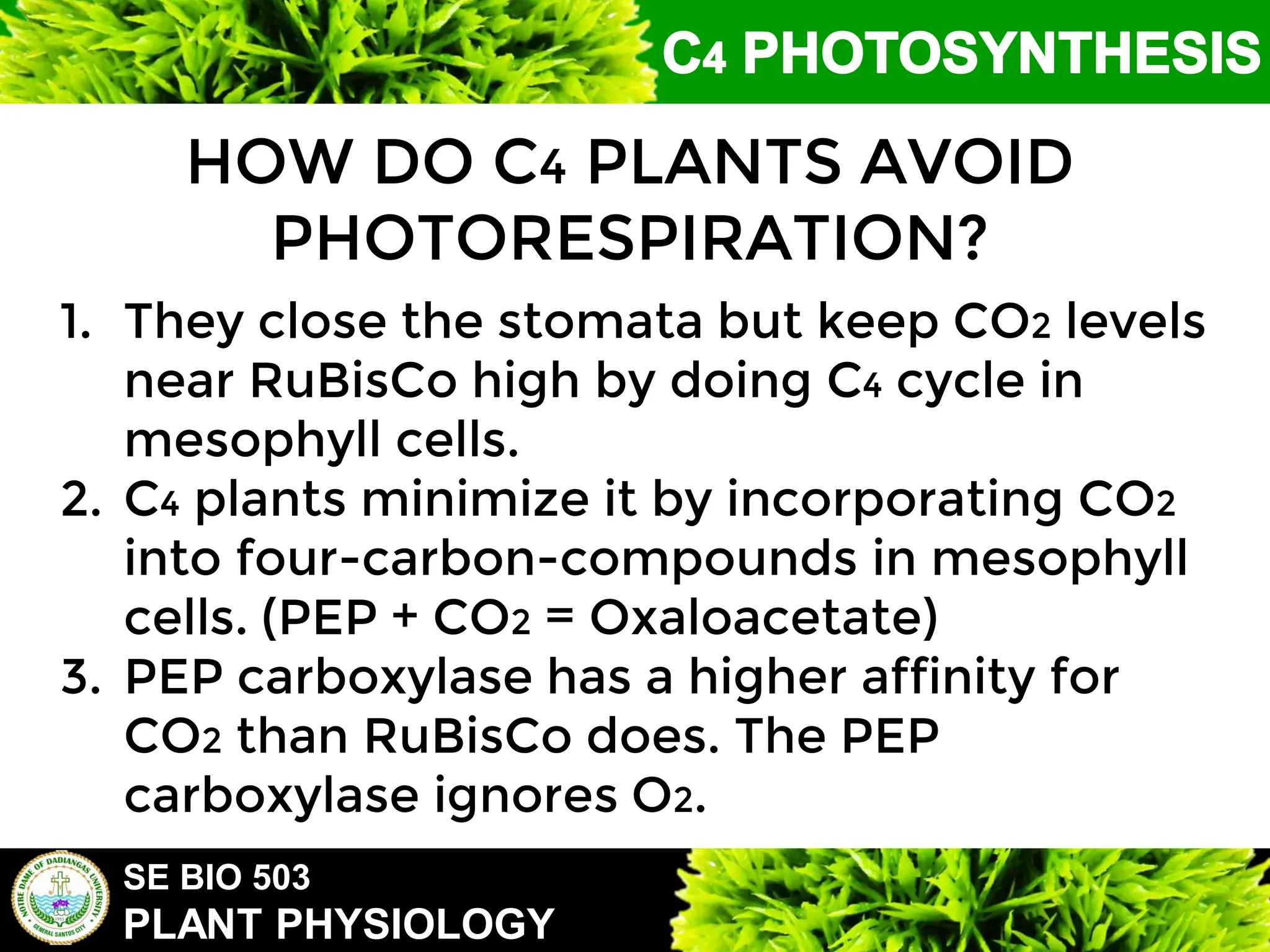
HOW DO C4 PLANTS AVOID
PHOTORESPIRATION?
1. They close the stomata but keep CO2 levels
near RuBisCo high by doing C4 cycle in
mesophyll cells.
2. C4 plants minimize it by incorporating CO2
into four-carbon-compounds in mesophyll
cells. (PEP + CO2 = Oxaloacetate)
3. PEP carboxylase has a higher affinity for
CO2 than RuBisCo does. The PEP
carboxylase ignores O2.
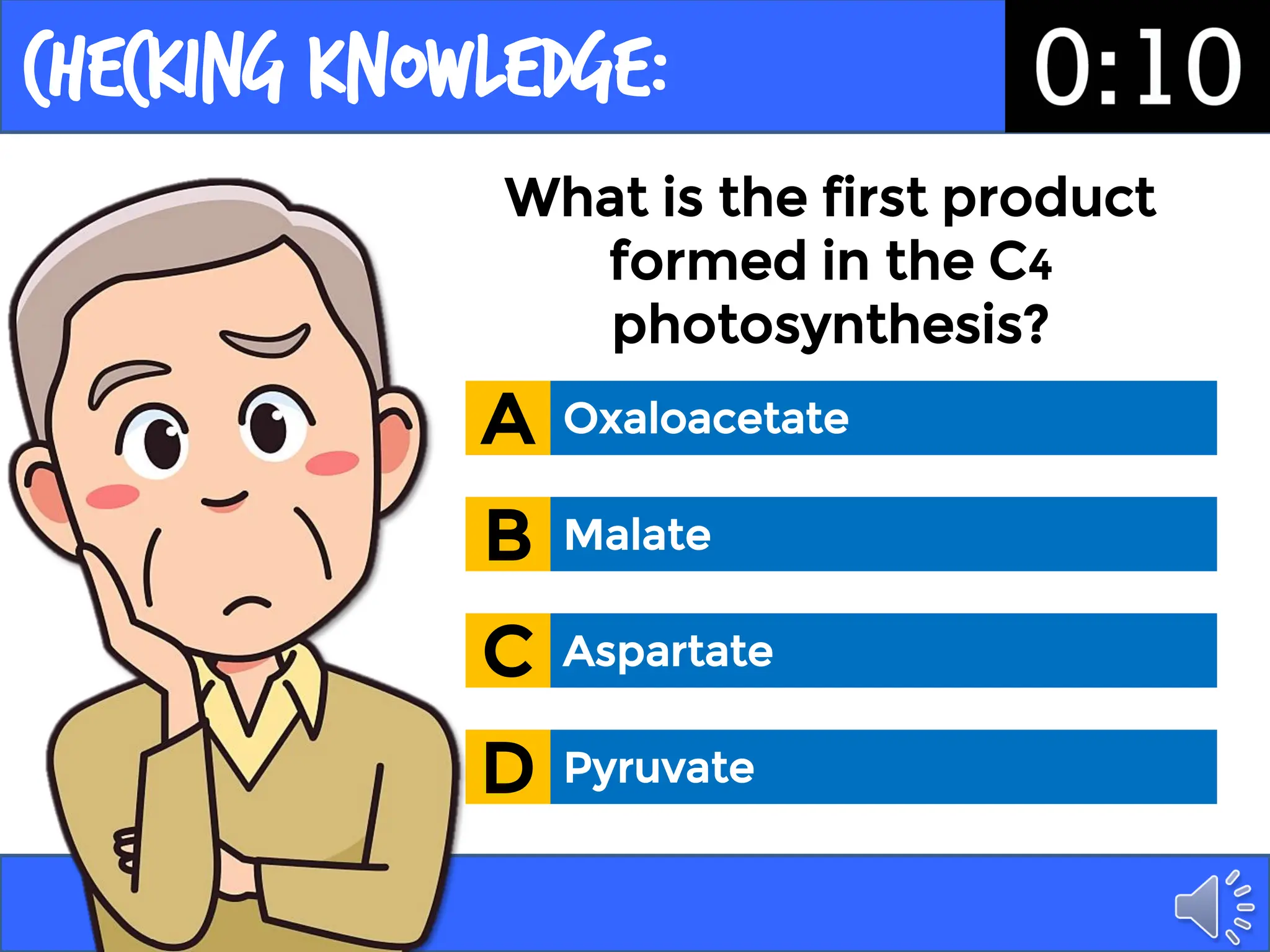
Checking KNOWLEDGE:
What isthe first product
formed in the C4
photosynthesis?
Oxaloacetate
A
Malate
B
Aspartate
C
Pyruvate
D
75.
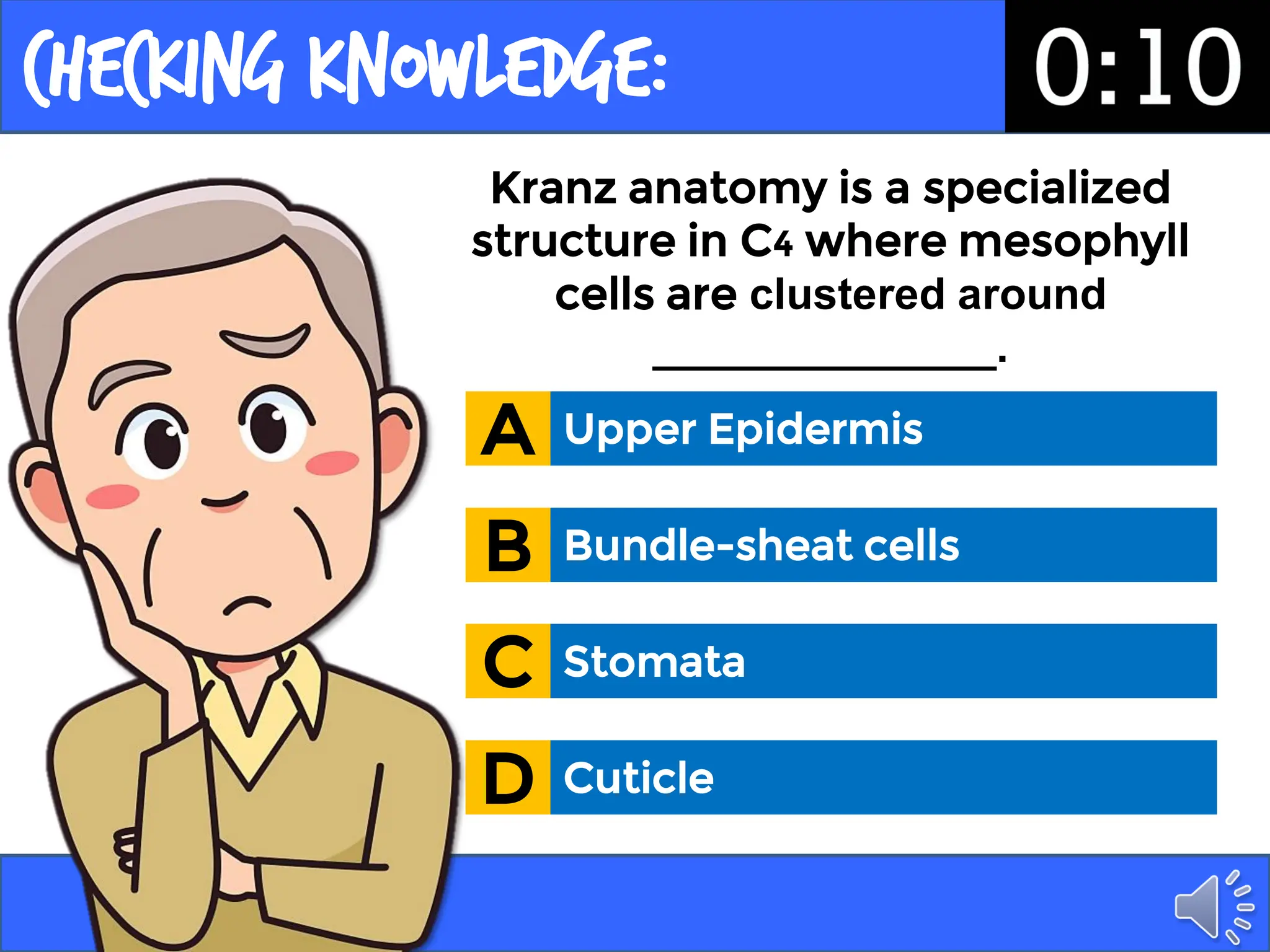
Checking KNOWLEDGE:
Kranz anatomyis a specialized
structure in C4 where mesophyll
cells are clustered around
______________.
Upper Epidermis
A
Bundle-sheat cells
B
Stomata
C
Cuticle
D
76.
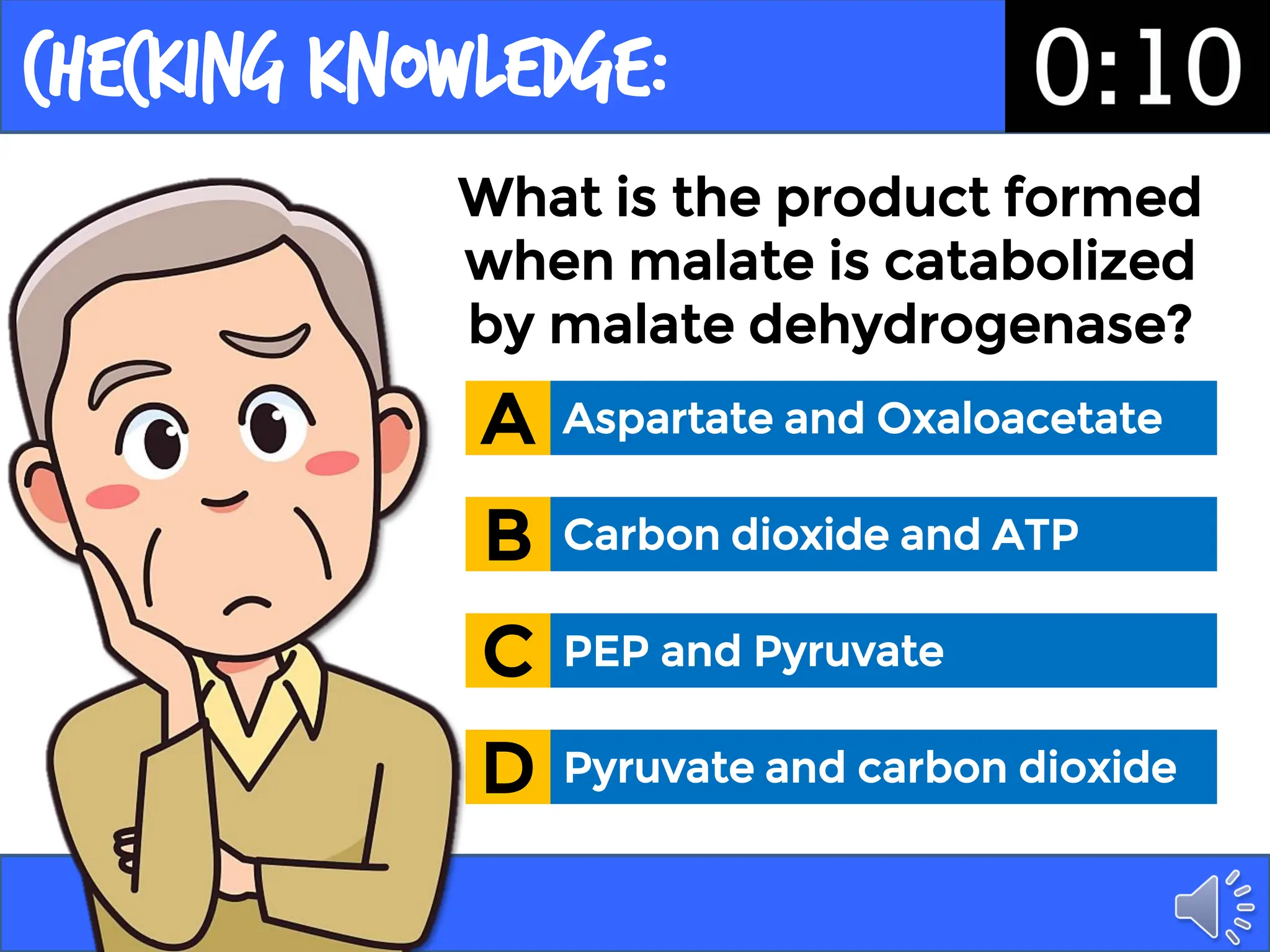
Checking KNOWLEDGE:
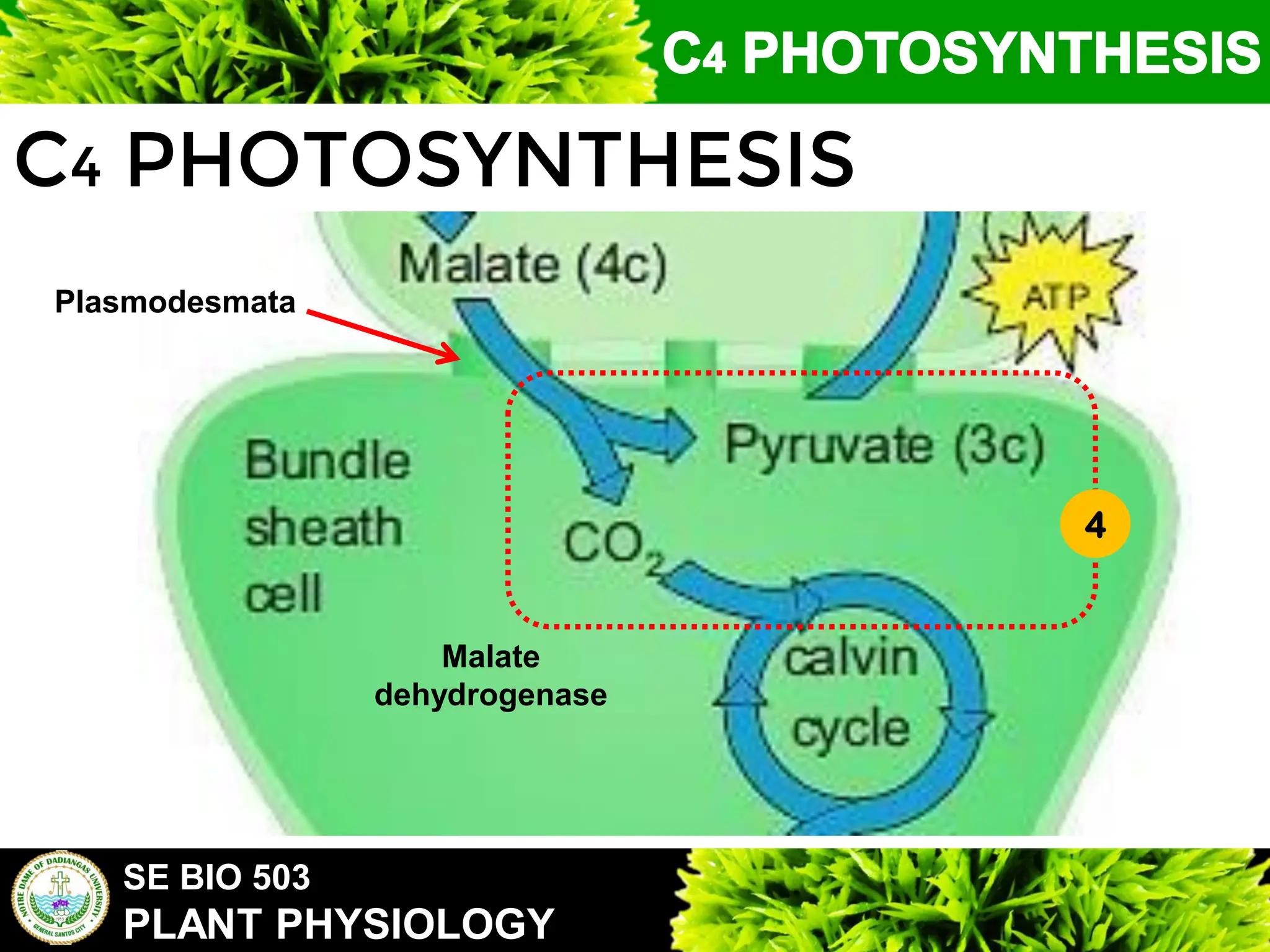
What isthe product formed
when malate is catabolized
by malate dehydrogenase?
Aspartate and Oxaloacetate
A
Carbon dioxide and ATP
B
PEP and Pyruvate
C
Pyruvate and carbon dioxide
D
77.
Checking COMPREHENSION:
How C4plants avoid
photorespiration?
PEP carboxylase ignores O2 due to
high affinity to CO2.
A
C4 plants minimize it by
incorporating CO2 into oxaloacetate.
B
They close the stomata but keep CO2
levels near RuBisCo high.
C
All of the Above
D
SE BIO 503
PLANTPHYSIOLOGY
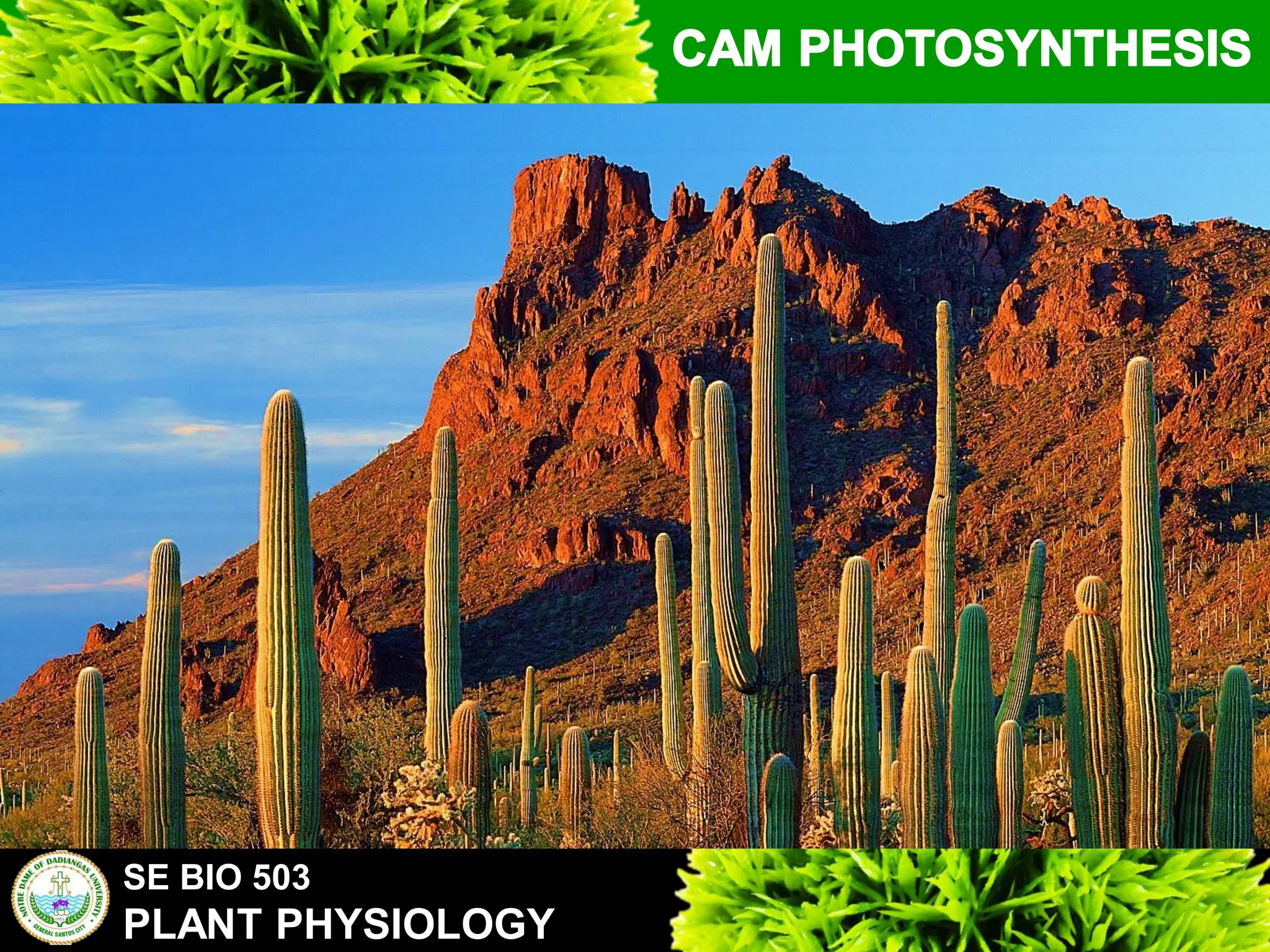
CAM PHOTOSYNTHESIS
CAM (Crassulacean Acid
Metabolism) occurs in
hundreds of species in 20
families of angiosperms.
Some of these families are
liliaceae, crassulaceae,
euphorbiaceae.
It has been reported that
CAM plants are sometimes
affected by changes in the
surrounding environment.
80.
SE BIO 503
PLANTPHYSIOLOGY
CAM PHOTOSYNTHESIS
CAM plants are
considered an adaptation
to arid conditions.
They often display other
xerophytic characters,
such as thick, reduced
leaves with a low surface-
to-volume ratio, thick
cuticle, and stomata
sunken into pits.
SE BIO 503
PLANTPHYSIOLOGY
CAM PHOTOSYNTHESIS
CAM plants fix CO2
during the night, storing
it as the four carbon acid
malate.
The CO2 is released
during the day, where it
is concentrated around
the enzyme RuBisCo,
increasing the efficiency
of photosynthesis.
SE BIO 503
PLANTPHYSIOLOGY
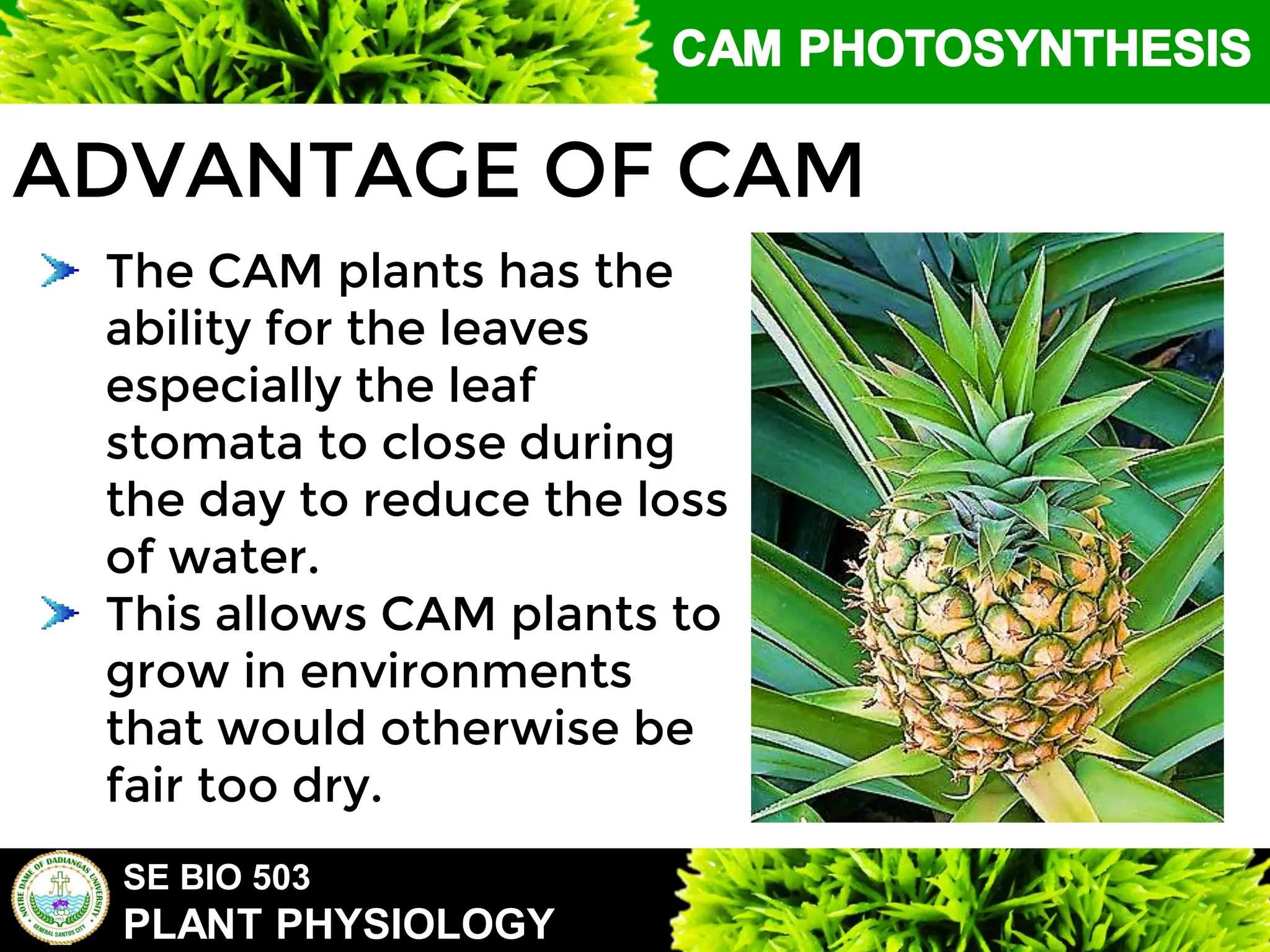
ADVANTAGE OF CAM
The CAM plants has the
ability for the leaves
especially the leaf
stomata to close during
the day to reduce the loss
of water.
This allows CAM plants to
grow in environments
that would otherwise be
fair too dry.
100.
SE BIO 503
PLANTPHYSIOLOGY
DISADVANTAGE OF CAM
The CAM plants often
have low photosynthetic
activity, slow growth,
and low competitive
abilities because
photosynthetic rates are
limited by vacuolar
storage capacity and by
greater ATP costs, similar
to C4 species.
101.
Checking KNOWLEDGE:
When doCAM plants fixed
carbon dioxide and stored it
as four carbon acid – malate?
During daytime
A
During night time
B
Both A and B
C
None of the Above
D
102.
Checking KNOWLEDGE:
What isformed when malate
gained two hydrogen ions in
the vacuole?
Oxalic acid
A
Citric acid
B
Malic acid
C
Ascorbic acid
D
103.
Checking KNOWLEDGE:
How Phosphoenolpyruvate
(PEP) are formed in CAM
plants from sugars?
Glycolysis
A
Acidification
B
Gluconeogenesis
C
Photolysis
D
104.
Checking COMPREHENSION:
TRUE orFALSE
CAM plants closed their stomata
during night time to reduce the
loss of water through
evapotranspiration.
TRUE
A
FALSE
B