SOIL ENZYMES
Presented by
BARATHKUMAR S
M.Sc. (Ag.) Soil science
TNAU, COIMBATORE
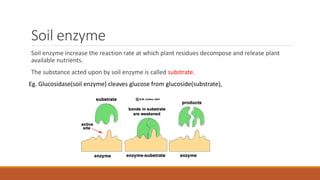
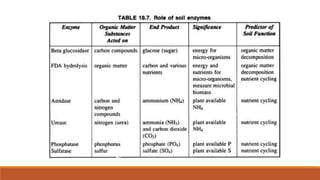
Soil enzyme
Soil enzyme increase the reaction rate at which plant residues decompose and release plant
available nutrients.
The substance acted upon by soil enzyme is called substrate.
Eg. Glucosidase(soil enzyme) cleaves glucose from glucoside(substrate),
Sources of Soil Enzymes
•Microorganisms
•Plants
•Animals
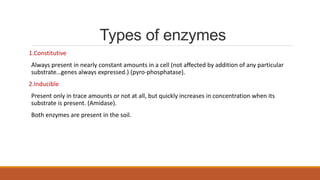
Types of enzymes
1.Constitutive
Always present in nearly constant amounts in a cell (not affected by addition of any particular
substrate…genes always expressed.) (pyro-phosphatase).
2.Inducible
Present only in trace amounts or not at all, but quickly increases in concentration when its
substrate is present. (Amidase).
Both enzymes are present in the soil.
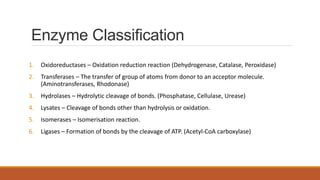
Enzyme Classification
1. Oxidoreductases – Oxidation reduction reaction (Dehydrogenase, Catalase, Peroxidase)
2. Transferases – The transfer of group of atoms from donor to an acceptor molecule.
(Aminotransferases, Rhodonase)
3. Hydrolases – Hydrolytic cleavage of bonds. (Phosphatase, Cellulase, Urease)
4. Lysates – Cleavage of bonds other than hydrolysis or oxidation.
5. Isomerases – Isomerisation reaction.
6. Ligases – Formation of bonds by the cleavage of ATP. (Acetyl-CoA carboxylase)
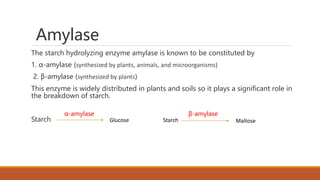
Amylase
The starch hydrolyzing enzyme amylase is known to be constituted by
1. α-amylase (synthesized by plants, animals, and microorganisms)
2. β-amylase (synthesized by plants)
This enzyme is widely distributed in plants and soils so it plays a significant role in
the breakdown of starch.
Starch
α-amylase
Glucose Starch
β-amylase
Maltose
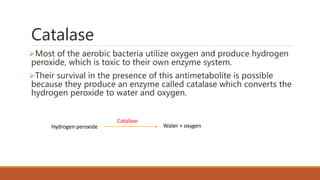
Catalase
Most of the aerobic bacteria utilize oxygen and produce hydrogen
peroxide, which is toxic to their own enzyme system.
Their survival in the presence of this antimetabolite is possible
because they produce an enzyme called catalase which converts the
hydrogen peroxide to water and oxygen.
Hydrogen peroxide
Catalase
Water + oxygen
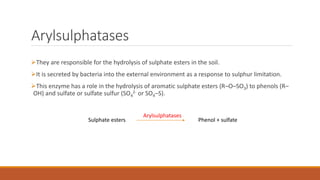
Arylsulphatases
They are responsible for the hydrolysis of sulphate esters in the soil.
It is secreted by bacteria into the external environment as a response to sulphur limitation.
This enzyme has a role in the hydrolysis of aromatic sulphate esters (R–O–SO3) to phenols (R–
OH) and sulfate or sulfate sulfur (SO4
2- or SO4–S).
Phenol + sulfate
Arylsulphatases
Sulphate esters
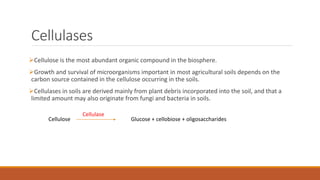
Cellulases
Cellulose is the most abundant organic compound in the biosphere.
Growth and survival of microorganisms important in most agricultural soils depends on the
carbon source contained in the cellulose occurring in the soils.
Cellulases in soils are derived mainly from plant debris incorporated into the soil, and that a
limited amount may also originate from fungi and bacteria in soils.
Glucose + cellobiose + oligosaccharides
Cellulase
Cellulose
Chitinase
It is responsible for the degradation and hydrolysis of chitin.
It is the major structural component of many fungal cell walls.
It use the hyperparasitism mechanisms against pests/pathogen attack.
These biological agents also reduce disease-producing agents by using other mechanisms such
as antibiosis or competition mechanisms.
It is produced or released by various organisms including plants and microorganisms.
Chitinase that cause the degradation of cell walls of pathogenic fungi.
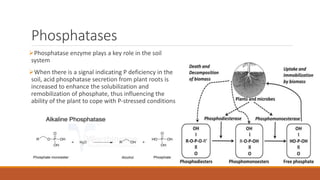
Phosphatases
Phosphatase enzyme plays a key role in the soil
system
When there is a signal indicating P deficiency in the
soil, acid phosphatase secretion from plant roots is
increased to enhance the solubilization and
remobilization of phosphate, thus influencing the
ability of the plant to cope with P-stressed conditions
Proteases
Proteases in the soil play a significant role in N mineralization.
This enzyme in the soil is generally associated with inorganic and organic
colloids.
There is a need to study the properties and factors affecting naturally occurring
enzyme complexes such as those involving protease enzymes in the soil
ecosystem as they may reveal some unknown role in maintaining soil health and
fertility.
Urease
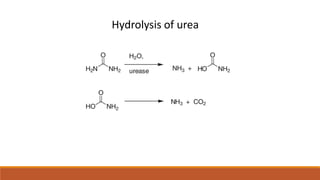
Urease enzyme is responsible for the hydrolysis of urea fertilizers applied to the
soil into NH3 and CO2 with the rise in soil pH .
 Soil urease originates mainly from plants and microorganisms found as both
intra- and extra-cellular enzymes .
On the other hand, urease extracted from plants or microorganisms is rapidly
degraded in soil by proteolytic (breakdown of proteins into smaller polypeptides
or amino acids) enzymes.
 Urease activity in soils is influenced by many factors. These include cropping
history, organic matter content of the soil, soil depth, heavy metals, and
environmental factors such as temperatures.
Hydrolysis of urea
Inorganic fertilization:
The effect of long-term application of inorganic fertilizers on soil biological properties.
Biological indicators are more sensitive to changes than chemical and physical indicators.
Microbial biomass and N:
Soil parameters Rice-wheat Rice-mustard-sesame
Control NPK Control NPK
Microbial biomass C
(µg C g )
417.3 637.4 395.2 478.5
Microbial biomass N
(µg NH N g )
55.7 58.5 44.2 51.9
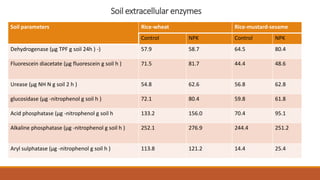
Soil extracellular enzymes
Soil parameters Rice-wheat Rice-mustard-sesame
Control NPK Control NPK
Dehydrogenase (µg TPF g soil 24h ) -) 57.9 58.7 64.5 80.4
Fluorescein diacetate (µg fluorescein g soil h ) 71.5 81.7 44.4 48.6
Urease (µg NH N g soil 2 h ) 54.8 62.6 56.8 62.8
glucosidase (µg -nitrophenol g soil h ) 72.1 80.4 59.8 61.8
Acid phosphatase (µg -nitrophenol g soil h 133.2 156.0 70.4 95.1
Alkaline phosphatase (µg -nitrophenol g soil h ) 252.1 276.9 244.4 251.2
Aryl sulphatase (µg -nitrophenol g soil h ) 113.8 121.2 14.4 25.4
Microbial population
Soil parameters Rice-wheat Rice-mustard-sesame
Control NPK Control NPK
Nitrogen fixing
bacteria (c.f.u × 10 g
soil)
26.7 34.2 18.7 34.2
Phosphate solubilizing
bacteria (c.f.u × 10 g
soil)
46.9 55.1 27.4 42.9
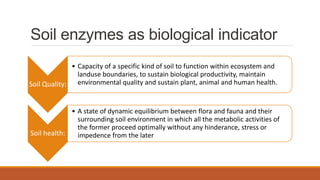
Soil enzymes as biological indicator
Soil Quality:
• Capacity of a specific kind of soil to function within ecosystem and
landuse boundaries, to sustain biological productivity, maintain
environmental quality and sustain plant, animal and human health.
Soil health:
• A state of dynamic equilibrium between flora and fauna and their
surrounding soil environment in which all the metabolic activities of
the former proceed optimally without any hinderance, stress or
impedence from the later
Biological indicators of soil quality:
Properties associated with biological activity on organic matter, such as
A. Microbial biomass carbon
B. Soil respiration
C. Abundance, diversity, food chains and stability of microbial communities
D. Mesofauna such as earthworms, nematodes and arthropods
E. Biological activities such as enzyme activity
F. Potentially mineralized nitrogen
G. CO2 production
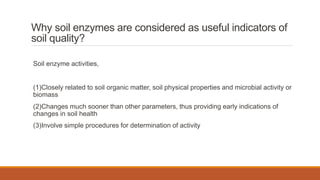
Why soil enzymes are considered as useful indicators of
soil quality?
Soil enzyme activities,
(1)Closely related to soil organic matter, soil physical properties and microbial activity or
biomass
(2)Changes much sooner than other parameters, thus providing early indications of
changes in soil health
(3)Involve simple procedures for determination of activity
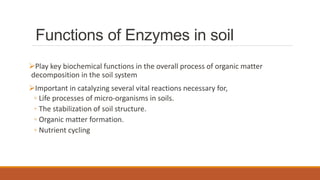
Functions of Enzymes in soil
Play key biochemical functions in the overall process of organic matter
decomposition in the soil system
Important in catalyzing several vital reactions necessary for,
◦ Life processes of micro-organisms in soils.
◦ The stabilization of soil structure.
◦ Organic matter formation.
◦ Nutrient cycling
THANK YOU

SOIL ENZYMES.pptx

  • 1.
    SOIL ENZYMES Presented by BARATHKUMARS M.Sc. (Ag.) Soil science TNAU, COIMBATORE
  • 2.
    Soil enzyme Soil enzymeincrease the reaction rate at which plant residues decompose and release plant available nutrients. The substance acted upon by soil enzyme is called substrate. Eg. Glucosidase(soil enzyme) cleaves glucose from glucoside(substrate),
  • 3.
    Sources of SoilEnzymes •Microorganisms •Plants •Animals
  • 4.
    Types of enzymes 1.Constitutive Alwayspresent in nearly constant amounts in a cell (not affected by addition of any particular substrate…genes always expressed.) (pyro-phosphatase). 2.Inducible Present only in trace amounts or not at all, but quickly increases in concentration when its substrate is present. (Amidase). Both enzymes are present in the soil.
  • 5.
    Enzyme Classification 1. Oxidoreductases– Oxidation reduction reaction (Dehydrogenase, Catalase, Peroxidase) 2. Transferases – The transfer of group of atoms from donor to an acceptor molecule. (Aminotransferases, Rhodonase) 3. Hydrolases – Hydrolytic cleavage of bonds. (Phosphatase, Cellulase, Urease) 4. Lysates – Cleavage of bonds other than hydrolysis or oxidation. 5. Isomerases – Isomerisation reaction. 6. Ligases – Formation of bonds by the cleavage of ATP. (Acetyl-CoA carboxylase)
  • 6.
    Amylase The starch hydrolyzingenzyme amylase is known to be constituted by 1. α-amylase (synthesized by plants, animals, and microorganisms) 2. β-amylase (synthesized by plants) This enzyme is widely distributed in plants and soils so it plays a significant role in the breakdown of starch. Starch α-amylase Glucose Starch β-amylase Maltose
  • 7.
    Catalase Most of theaerobic bacteria utilize oxygen and produce hydrogen peroxide, which is toxic to their own enzyme system. Their survival in the presence of this antimetabolite is possible because they produce an enzyme called catalase which converts the hydrogen peroxide to water and oxygen. Hydrogen peroxide Catalase Water + oxygen
  • 8.
    Arylsulphatases They are responsiblefor the hydrolysis of sulphate esters in the soil. It is secreted by bacteria into the external environment as a response to sulphur limitation. This enzyme has a role in the hydrolysis of aromatic sulphate esters (R–O–SO3) to phenols (R– OH) and sulfate or sulfate sulfur (SO4 2- or SO4–S). Phenol + sulfate Arylsulphatases Sulphate esters
  • 9.
    Cellulases Cellulose is themost abundant organic compound in the biosphere. Growth and survival of microorganisms important in most agricultural soils depends on the carbon source contained in the cellulose occurring in the soils. Cellulases in soils are derived mainly from plant debris incorporated into the soil, and that a limited amount may also originate from fungi and bacteria in soils. Glucose + cellobiose + oligosaccharides Cellulase Cellulose
  • 10.
    Chitinase It is responsiblefor the degradation and hydrolysis of chitin. It is the major structural component of many fungal cell walls. It use the hyperparasitism mechanisms against pests/pathogen attack. These biological agents also reduce disease-producing agents by using other mechanisms such as antibiosis or competition mechanisms. It is produced or released by various organisms including plants and microorganisms. Chitinase that cause the degradation of cell walls of pathogenic fungi.
  • 11.
    Phosphatases Phosphatase enzyme playsa key role in the soil system When there is a signal indicating P deficiency in the soil, acid phosphatase secretion from plant roots is increased to enhance the solubilization and remobilization of phosphate, thus influencing the ability of the plant to cope with P-stressed conditions
  • 12.
    Proteases Proteases in thesoil play a significant role in N mineralization. This enzyme in the soil is generally associated with inorganic and organic colloids. There is a need to study the properties and factors affecting naturally occurring enzyme complexes such as those involving protease enzymes in the soil ecosystem as they may reveal some unknown role in maintaining soil health and fertility.
  • 13.
    Urease Urease enzyme isresponsible for the hydrolysis of urea fertilizers applied to the soil into NH3 and CO2 with the rise in soil pH .  Soil urease originates mainly from plants and microorganisms found as both intra- and extra-cellular enzymes . On the other hand, urease extracted from plants or microorganisms is rapidly degraded in soil by proteolytic (breakdown of proteins into smaller polypeptides or amino acids) enzymes.  Urease activity in soils is influenced by many factors. These include cropping history, organic matter content of the soil, soil depth, heavy metals, and environmental factors such as temperatures.
  • 14.
  • 15.
    Inorganic fertilization: The effectof long-term application of inorganic fertilizers on soil biological properties. Biological indicators are more sensitive to changes than chemical and physical indicators. Microbial biomass and N: Soil parameters Rice-wheat Rice-mustard-sesame Control NPK Control NPK Microbial biomass C (µg C g ) 417.3 637.4 395.2 478.5 Microbial biomass N (µg NH N g ) 55.7 58.5 44.2 51.9
  • 16.
    Soil extracellular enzymes Soilparameters Rice-wheat Rice-mustard-sesame Control NPK Control NPK Dehydrogenase (µg TPF g soil 24h ) -) 57.9 58.7 64.5 80.4 Fluorescein diacetate (µg fluorescein g soil h ) 71.5 81.7 44.4 48.6 Urease (µg NH N g soil 2 h ) 54.8 62.6 56.8 62.8 glucosidase (µg -nitrophenol g soil h ) 72.1 80.4 59.8 61.8 Acid phosphatase (µg -nitrophenol g soil h 133.2 156.0 70.4 95.1 Alkaline phosphatase (µg -nitrophenol g soil h ) 252.1 276.9 244.4 251.2 Aryl sulphatase (µg -nitrophenol g soil h ) 113.8 121.2 14.4 25.4
  • 17.
    Microbial population Soil parametersRice-wheat Rice-mustard-sesame Control NPK Control NPK Nitrogen fixing bacteria (c.f.u × 10 g soil) 26.7 34.2 18.7 34.2 Phosphate solubilizing bacteria (c.f.u × 10 g soil) 46.9 55.1 27.4 42.9
  • 18.
    Soil enzymes asbiological indicator Soil Quality: • Capacity of a specific kind of soil to function within ecosystem and landuse boundaries, to sustain biological productivity, maintain environmental quality and sustain plant, animal and human health. Soil health: • A state of dynamic equilibrium between flora and fauna and their surrounding soil environment in which all the metabolic activities of the former proceed optimally without any hinderance, stress or impedence from the later
  • 19.
    Biological indicators ofsoil quality: Properties associated with biological activity on organic matter, such as A. Microbial biomass carbon B. Soil respiration C. Abundance, diversity, food chains and stability of microbial communities D. Mesofauna such as earthworms, nematodes and arthropods E. Biological activities such as enzyme activity F. Potentially mineralized nitrogen G. CO2 production
  • 20.
    Why soil enzymesare considered as useful indicators of soil quality? Soil enzyme activities, (1)Closely related to soil organic matter, soil physical properties and microbial activity or biomass (2)Changes much sooner than other parameters, thus providing early indications of changes in soil health (3)Involve simple procedures for determination of activity
  • 22.
    Functions of Enzymesin soil Play key biochemical functions in the overall process of organic matter decomposition in the soil system Important in catalyzing several vital reactions necessary for, ◦ Life processes of micro-organisms in soils. ◦ The stabilization of soil structure. ◦ Organic matter formation. ◦ Nutrient cycling
  • 23.