AN ASSIGNMENT ON BENEFICIAL NUTRIENTS AND ELEMENTS AND
THERE ROLE IN PLANT GROWTH AND
FORMS OF NUTRIENTS IN SOIL
BY: ASIF AHAD FIRDOUSI
NISHAT PERVEEN (DEPARTMENTOF GENETICSAND PLANT BREEDING)
MANISHA CHANDRAKAR
AN INTRODUCTIONTO PLANT
NUTRIENTS:
• The element is involved directly in the nutrition of the
plant quite apart from its possible effects in
correcting some unfavorable microbiological or chemical
condition of the soil or other culture medium.
A total of only 17 elements are essential for the growth
and full development of higher green plants according to
the criteria laid down by Arnon and Stout (1939). These
criteria are:
• A deficiency of an essential nutrient makes it
impossible for the plant to complete the vegetative or
reproductive stage of its life cycle.
• Such deficiency is specific to the element in question
and can be prevented or corrected only by supplying
this element.
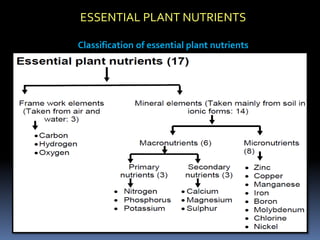
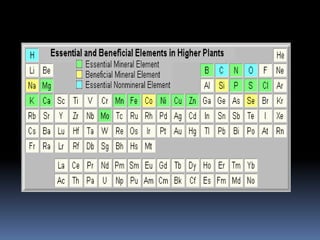
Classification of essential plant nutrients
ESSENTIAL PLANT NUTRIENTS
WHAT ARE BENEFICIAL ELEMENTS ?
Beneficial elements are those elements which may not be beneficial or useful to all the
existing plants but may be of prime importance to a specific plant.
They are also known as potential micronutrients.
These elements at very low concentrations and often under specific conditions have been
shown to stimulate the growth of certain plants or to have other beneficial effects.
Examples are : selenium
aluminum
nickel
Vanadium
Chromium
arsenic
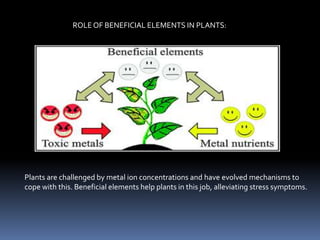
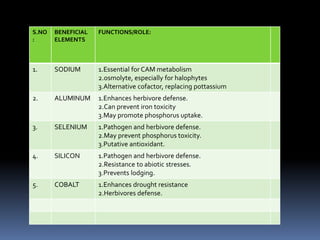
ROLE OF BENEFICIAL ELEMENTS IN PLANTS:
Plants are challenged by metal ion concentrations and have evolved mechanisms to
cope with this. Beneficial elements help plants in this job, alleviating stress symptoms.
S.NO
:
BENEFICIAL
ELEMENTS
FUNCTIONS/ROLE:
1. SODIUM 1.Essential for CAM metabolism
2.osmolyte, especially for halophytes
3.Alternative cofactor, replacing pottassium
2. ALUMINUM 1.Enhances herbivore defense.
2.Can prevent iron toxicity
3.May promote phosphorus uptake.
3. SELENIUM 1.Pathogen and herbivore defense.
2.May prevent phosphorus toxicity.
3.Putative antioxidant.
4. SILICON 1.Pathogen and herbivore defense.
2.Resistance to abiotic stresses.
3.Prevents lodging.
5. COBALT 1.Enhances drought resistance
2.Herbivores defense.
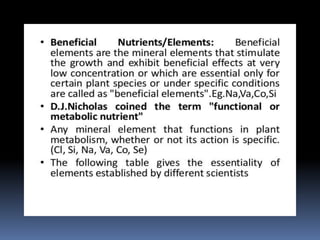
Note: Cobalt (Co), sodium (Na), vanadium (V) and
silicon (Si) are sometimes called as beneficial plant
nutrients. They are not required by all plants but
appear to benefit certain plants. Cobalt is required
for nitrogen fixation in legumes. Silicon is found in
plant cell walls and appears to produce tougher cells.
This increases the resistance of these plants to
piercing and sucking insects and decreases the spread
of fungal diseases.
Sources of Elements in the Soil
1.Organic matter:
Most soil nutrients are contained in the soil organic matter.To make these nutrients
available the organic matter must be decomposed..
2.Soil minerals (includes clay minerals)
These are the nutrients that are in the parent materials.These nutrients may
become available through weathering, however this is a very slow process.There are
also nutrients in the clay minerals.This includes Mg and K that are in the 2:1 clay
minerals.
3.Adsorbed nutrients
These are the nutrients that are held on the soil colloid.This is the major source of
nutrients for the plants, and is the source that is most easily controlled by man.
AN INTRODUCTIONTO FORMS OF NUTRIENTS IN SOIL:
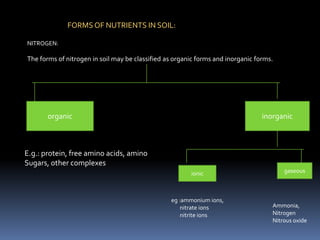
FORMS OF NUTRIENTS IN SOIL:
NITROGEN:
The forms of nitrogen in soil may be classified as organic forms and inorganic forms.
organic inorganic
E.g.: protein, free amino acids, amino
Sugars, other complexes
ionic gaseous
eg :ammonium ions,
nitrate ions
nitrite ions
Ammonia,
Nitrogen
Nitrous oxide
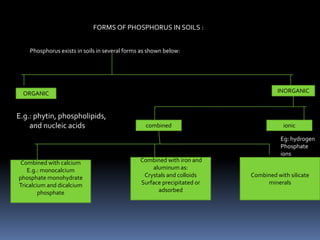
FORMS OF PHOSPHORUS IN SOILS :
Phosphorus exists in soils in several forms as shown below:
ORGANIC INORGANIC
E.g.: phytin, phospholipids,
and nucleic acids combined ionic
Eg: hydrogen
Phosphate
ions
Combined with calcium
E.g.: monocalcium
phosphate monohydrate
Tricalcium and dicalcium
phosphate
Combined with iron and
aluminum as:
Crystals and colloids
Surface precipitated or
adsorbed
Combined with silicate
minerals
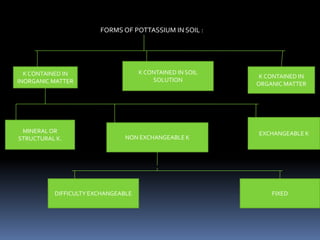
FORMS OF POTTASSIUM IN SOIL :
K CONTAINED IN
INORGANIC MATTER
K CONTAINED IN SOIL
SOLUTION
K CONTAINED IN
ORGANIC MATTER
MINERALOR
STRUCTURAL K. NON EXCHANGEABLE K
EXCHANGEABLE K
DIFFICULTY EXCHANGEABLE FIXED
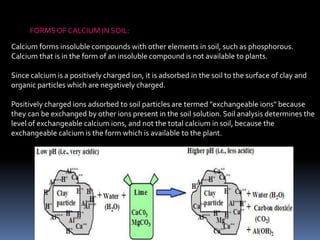
FORMS OF CALCIUM IN SOIL:
Calcium forms insoluble compounds with other elements in soil, such as phosphorous.
Calcium that is in the form of an insoluble compound is not available to plants.
Since calcium is a positively charged ion, it is adsorbed in the soil to the surface of clay and
organic particles which are negatively charged.
Positively charged ions adsorbed to soil particles are termed "exchangeable ions" because
they can be exchanged by other ions present in the soil solution. Soil analysis determines the
level of exchangeable calcium ions, and not the total calcium in soil, because the
exchangeable calcium is the form which is available to the plant.
FORMSOF MAGNESIUM IN SOIL:
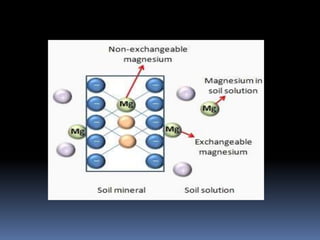
In soil, magnesium is present in three fractions:
Magnesium in soil solution – Magnesium in soil solution is in equilibrium with the
exchangeable magnesium and is readily available for plants.
Exchangeable magnesium –This is the most important fraction for determining
the magnesium that is available to plants.This fraction consists of the magnesium
held by clay particles and organic matter. It is in equilibrium with magnesium in soil
solution.
Non-exchangeable magnesium – Consists of the magnesium that is a constituent
of primary minerals in the soil.The break down process of minerals in soils is very
slow; therefore, this magnesium fraction is not available to plants.
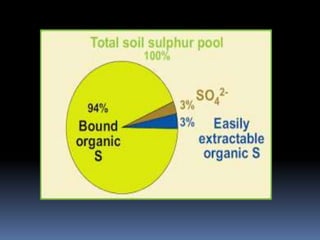
Most soil sources of S are in the organic matter and are therefore concentrated in
the topsoil or plow layer. Elemental S and other forms as found in soil organic
matter and some fertilizers, are not available to crops.They must be converted to
the sulfate (SO4
--) form to become available to the crop.This conversion is
performed by soil microbes and therefore requires soil conditions that are warm,
moist, and well drained to proceed rapidly.The sulfate form of S is an anion
(negative charge), and therefore is leachable. As a rough rule-of-thumb, it can be
considered to leach through the soil profile at about 50% as fast as nitrates (NO3
-).
In soils with a significant and restrictive clay layer in the sub-soil, it is common to
find that sulfate which has leached through the soil over time and become
"perched" on the clay layer.This SO4
-- is available to crops when the roots reach
this area of the soil.
FORMSOF SULPHUR IN SOIL:
IRON
Form: Iron is taken up by plants as either Fe2+ (ferrous cation) or Fe3+ (ferric
cation).
BORON
Form: Boron is taken up by plants primarily as H3BO3 (boric acid) and H2BO3
-
(borate).
MANGANESE
Form:The primary form of manganese uptake is Mn2+ (manganous ion).
ZINC
Form:The Zn2+ cation is the predominate form taken up by plants
MOLYBDENUM
Form: Molybdenum is primarily taken up as MoO4
2- (molybdate ion).
COPPER
Form: Copper is taken up as Cu2+ (cupric ion).
FORMSOF MICRONUTRIENTS IN SOIL:
REFERENCES:
 Brady, N.C. and Weil, R.R. 2002. Elements of the Nature and Properties of Soils. Prentice Hall, New
Jersey
 Silva, J. and Uchida, R.S. (eds). 2000. Plant Nutrient Management in Hawaii’s Soils: Approaches for
Tropical and Subtropical Agriculture. College ofTropical Agriculture and Human Resources, University
of Hawaii at Manoa, Honolulu.

Asif ppt

  • 1.
    AN ASSIGNMENT ONBENEFICIAL NUTRIENTS AND ELEMENTS AND THERE ROLE IN PLANT GROWTH AND FORMS OF NUTRIENTS IN SOIL BY: ASIF AHAD FIRDOUSI NISHAT PERVEEN (DEPARTMENTOF GENETICSAND PLANT BREEDING) MANISHA CHANDRAKAR
  • 2.
    AN INTRODUCTIONTO PLANT NUTRIENTS: •The element is involved directly in the nutrition of the plant quite apart from its possible effects in correcting some unfavorable microbiological or chemical condition of the soil or other culture medium. A total of only 17 elements are essential for the growth and full development of higher green plants according to the criteria laid down by Arnon and Stout (1939). These criteria are: • A deficiency of an essential nutrient makes it impossible for the plant to complete the vegetative or reproductive stage of its life cycle. • Such deficiency is specific to the element in question and can be prevented or corrected only by supplying this element.
  • 3.
    Classification of essentialplant nutrients ESSENTIAL PLANT NUTRIENTS
  • 4.
    WHAT ARE BENEFICIALELEMENTS ? Beneficial elements are those elements which may not be beneficial or useful to all the existing plants but may be of prime importance to a specific plant. They are also known as potential micronutrients. These elements at very low concentrations and often under specific conditions have been shown to stimulate the growth of certain plants or to have other beneficial effects. Examples are : selenium aluminum nickel Vanadium Chromium arsenic
  • 7.
    ROLE OF BENEFICIALELEMENTS IN PLANTS: Plants are challenged by metal ion concentrations and have evolved mechanisms to cope with this. Beneficial elements help plants in this job, alleviating stress symptoms.
  • 8.
    S.NO : BENEFICIAL ELEMENTS FUNCTIONS/ROLE: 1. SODIUM 1.Essentialfor CAM metabolism 2.osmolyte, especially for halophytes 3.Alternative cofactor, replacing pottassium 2. ALUMINUM 1.Enhances herbivore defense. 2.Can prevent iron toxicity 3.May promote phosphorus uptake. 3. SELENIUM 1.Pathogen and herbivore defense. 2.May prevent phosphorus toxicity. 3.Putative antioxidant. 4. SILICON 1.Pathogen and herbivore defense. 2.Resistance to abiotic stresses. 3.Prevents lodging. 5. COBALT 1.Enhances drought resistance 2.Herbivores defense.
  • 9.
    Note: Cobalt (Co),sodium (Na), vanadium (V) and silicon (Si) are sometimes called as beneficial plant nutrients. They are not required by all plants but appear to benefit certain plants. Cobalt is required for nitrogen fixation in legumes. Silicon is found in plant cell walls and appears to produce tougher cells. This increases the resistance of these plants to piercing and sucking insects and decreases the spread of fungal diseases.
  • 10.
    Sources of Elementsin the Soil 1.Organic matter: Most soil nutrients are contained in the soil organic matter.To make these nutrients available the organic matter must be decomposed.. 2.Soil minerals (includes clay minerals) These are the nutrients that are in the parent materials.These nutrients may become available through weathering, however this is a very slow process.There are also nutrients in the clay minerals.This includes Mg and K that are in the 2:1 clay minerals. 3.Adsorbed nutrients These are the nutrients that are held on the soil colloid.This is the major source of nutrients for the plants, and is the source that is most easily controlled by man. AN INTRODUCTIONTO FORMS OF NUTRIENTS IN SOIL:
  • 11.
    FORMS OF NUTRIENTSIN SOIL: NITROGEN: The forms of nitrogen in soil may be classified as organic forms and inorganic forms. organic inorganic E.g.: protein, free amino acids, amino Sugars, other complexes ionic gaseous eg :ammonium ions, nitrate ions nitrite ions Ammonia, Nitrogen Nitrous oxide
  • 12.
    FORMS OF PHOSPHORUSIN SOILS : Phosphorus exists in soils in several forms as shown below: ORGANIC INORGANIC E.g.: phytin, phospholipids, and nucleic acids combined ionic Eg: hydrogen Phosphate ions Combined with calcium E.g.: monocalcium phosphate monohydrate Tricalcium and dicalcium phosphate Combined with iron and aluminum as: Crystals and colloids Surface precipitated or adsorbed Combined with silicate minerals
  • 13.
    FORMS OF POTTASSIUMIN SOIL : K CONTAINED IN INORGANIC MATTER K CONTAINED IN SOIL SOLUTION K CONTAINED IN ORGANIC MATTER MINERALOR STRUCTURAL K. NON EXCHANGEABLE K EXCHANGEABLE K DIFFICULTY EXCHANGEABLE FIXED
  • 14.
    FORMS OF CALCIUMIN SOIL: Calcium forms insoluble compounds with other elements in soil, such as phosphorous. Calcium that is in the form of an insoluble compound is not available to plants. Since calcium is a positively charged ion, it is adsorbed in the soil to the surface of clay and organic particles which are negatively charged. Positively charged ions adsorbed to soil particles are termed "exchangeable ions" because they can be exchanged by other ions present in the soil solution. Soil analysis determines the level of exchangeable calcium ions, and not the total calcium in soil, because the exchangeable calcium is the form which is available to the plant.
  • 15.
    FORMSOF MAGNESIUM INSOIL: In soil, magnesium is present in three fractions: Magnesium in soil solution – Magnesium in soil solution is in equilibrium with the exchangeable magnesium and is readily available for plants. Exchangeable magnesium –This is the most important fraction for determining the magnesium that is available to plants.This fraction consists of the magnesium held by clay particles and organic matter. It is in equilibrium with magnesium in soil solution. Non-exchangeable magnesium – Consists of the magnesium that is a constituent of primary minerals in the soil.The break down process of minerals in soils is very slow; therefore, this magnesium fraction is not available to plants.
  • 17.
    Most soil sourcesof S are in the organic matter and are therefore concentrated in the topsoil or plow layer. Elemental S and other forms as found in soil organic matter and some fertilizers, are not available to crops.They must be converted to the sulfate (SO4 --) form to become available to the crop.This conversion is performed by soil microbes and therefore requires soil conditions that are warm, moist, and well drained to proceed rapidly.The sulfate form of S is an anion (negative charge), and therefore is leachable. As a rough rule-of-thumb, it can be considered to leach through the soil profile at about 50% as fast as nitrates (NO3 -). In soils with a significant and restrictive clay layer in the sub-soil, it is common to find that sulfate which has leached through the soil over time and become "perched" on the clay layer.This SO4 -- is available to crops when the roots reach this area of the soil. FORMSOF SULPHUR IN SOIL:
  • 19.
    IRON Form: Iron istaken up by plants as either Fe2+ (ferrous cation) or Fe3+ (ferric cation). BORON Form: Boron is taken up by plants primarily as H3BO3 (boric acid) and H2BO3 - (borate). MANGANESE Form:The primary form of manganese uptake is Mn2+ (manganous ion). ZINC Form:The Zn2+ cation is the predominate form taken up by plants MOLYBDENUM Form: Molybdenum is primarily taken up as MoO4 2- (molybdate ion). COPPER Form: Copper is taken up as Cu2+ (cupric ion). FORMSOF MICRONUTRIENTS IN SOIL:
  • 20.
    REFERENCES:  Brady, N.C.and Weil, R.R. 2002. Elements of the Nature and Properties of Soils. Prentice Hall, New Jersey  Silva, J. and Uchida, R.S. (eds). 2000. Plant Nutrient Management in Hawaii’s Soils: Approaches for Tropical and Subtropical Agriculture. College ofTropical Agriculture and Human Resources, University of Hawaii at Manoa, Honolulu.