Rationalist Epistemology - Plato Unit 2, Part 1
What is sufficient for knowledge? According to Plato, belief is a necessary part of knowledge But does true belief constitute knowledge? No!  Not according to Plato Plato claims that in order for one to claim that one “knows” something, the following must be true: The individual must believe X X must be true One has to be able to give the  logos  (give the theory, etc)  for X For Plato, knowledge is justified belief
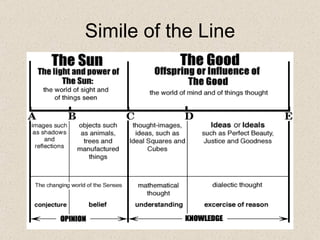
Simile of the Line
Simile of the Line, cont’d… What does Plato mean by images? Images are dependent on the sensible objects of which they are images Sensible in this case means experienced by the five senses If the object of one’s state of awareness is an image, than Plato would say you are in a state of imagination The person in the state confuses an image with the thing itself This is the lowest point on the line, an experience that Plato would not define as knowledge
Simile of the Line, cont’d… What does Plato mean by sensible objects? Sensible objects refer to things in the physical world (llamas, skateboards, and chicken patties) These are more real than images (obviously, a picture of a chicken patty is less real than the actual chicken patty leaking grease onto your cafeteria plate), but Plato says that they are not “absolutely real” – meaning that they are impermanent (that chicken patty will rot away to nothing eventually), and they are dependent on other things – such as the sun, and the Forms (which we will talk about later) If the object of one’s awareness is a sensible object, then one is in a state of belief…not knowledge
Simile of the Line, cont’d… What does Plato mean by concepts? For Plato, a concept is similar to a theory, or a science For example, gravity would be considered a concept, or Einstein’s theory of relativity At this point, when one is focusing on concepts, we have now entered the realm of knowledge But not the highest form of knowledge…
Simile of the Line, cont’d… We have arrived at…THE FORMS! According to Plato, all the concepts we have mentioned (gravity, chicken patties, Einstein’s theory of relativity…) are simply copies of higher truths, which he called the Forms. Forms are essentially archetypes of everything existing in the visible world For example, that chicken patty on your plate is only a shadow of the “real thing” – there exists the Form of a chicken patty…the ultimate, perfect chicken patty
Simile of the Line, cont’d… The Forms exist outside time and space, not merely as ideas in one’s mind However, they can only be grasped using the intellect, not the senses They are uncreated, indestructible, unchanging, and eternal However, they still depend upon something – what Plato calls, “the Good”, which serves as an absolute value and grounds all of reality  The Forms must be grasped “formally” – essentially, mathematically Just as gravity might have a formula, so would Love, Beauty, etc.
Innate Ideas It seems that to know the forms, one must know everything!  How could we ever know anything? Plato contends that we each possess  innate ideas , that are present in our souls at birth The Forms, being the highest form of knowledge, must therefore be present in the souls of each person – otherwise, how could we ever know anything? True knowledge then, is merely a recollection of the innate ideas of the Forms that we all already possess

Rationalist epistemology plato

  • 1.
    Rationalist Epistemology -Plato Unit 2, Part 1
  • 2.
    What is sufficientfor knowledge? According to Plato, belief is a necessary part of knowledge But does true belief constitute knowledge? No! Not according to Plato Plato claims that in order for one to claim that one “knows” something, the following must be true: The individual must believe X X must be true One has to be able to give the logos (give the theory, etc) for X For Plato, knowledge is justified belief
  • 3.
  • 4.
    Simile of theLine, cont’d… What does Plato mean by images? Images are dependent on the sensible objects of which they are images Sensible in this case means experienced by the five senses If the object of one’s state of awareness is an image, than Plato would say you are in a state of imagination The person in the state confuses an image with the thing itself This is the lowest point on the line, an experience that Plato would not define as knowledge
  • 5.
    Simile of theLine, cont’d… What does Plato mean by sensible objects? Sensible objects refer to things in the physical world (llamas, skateboards, and chicken patties) These are more real than images (obviously, a picture of a chicken patty is less real than the actual chicken patty leaking grease onto your cafeteria plate), but Plato says that they are not “absolutely real” – meaning that they are impermanent (that chicken patty will rot away to nothing eventually), and they are dependent on other things – such as the sun, and the Forms (which we will talk about later) If the object of one’s awareness is a sensible object, then one is in a state of belief…not knowledge
  • 6.
    Simile of theLine, cont’d… What does Plato mean by concepts? For Plato, a concept is similar to a theory, or a science For example, gravity would be considered a concept, or Einstein’s theory of relativity At this point, when one is focusing on concepts, we have now entered the realm of knowledge But not the highest form of knowledge…
  • 7.
    Simile of theLine, cont’d… We have arrived at…THE FORMS! According to Plato, all the concepts we have mentioned (gravity, chicken patties, Einstein’s theory of relativity…) are simply copies of higher truths, which he called the Forms. Forms are essentially archetypes of everything existing in the visible world For example, that chicken patty on your plate is only a shadow of the “real thing” – there exists the Form of a chicken patty…the ultimate, perfect chicken patty
  • 8.
    Simile of theLine, cont’d… The Forms exist outside time and space, not merely as ideas in one’s mind However, they can only be grasped using the intellect, not the senses They are uncreated, indestructible, unchanging, and eternal However, they still depend upon something – what Plato calls, “the Good”, which serves as an absolute value and grounds all of reality The Forms must be grasped “formally” – essentially, mathematically Just as gravity might have a formula, so would Love, Beauty, etc.
  • 9.
    Innate Ideas Itseems that to know the forms, one must know everything! How could we ever know anything? Plato contends that we each possess innate ideas , that are present in our souls at birth The Forms, being the highest form of knowledge, must therefore be present in the souls of each person – otherwise, how could we ever know anything? True knowledge then, is merely a recollection of the innate ideas of the Forms that we all already possess