
GANITO ANG
ANTROPOLOHIYA NOON,
PAANO KAYA NGAYON?
Notes on the Practice and Teaching of Philippine Anthropology
Jessie G. Varquez, Jr.
Department of Social Sciences, UPLB
DSS Friday School Extension Project
28 October 2016
Outline
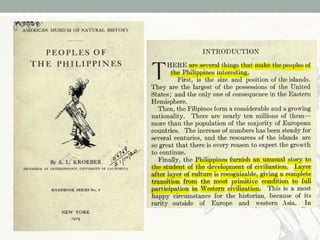
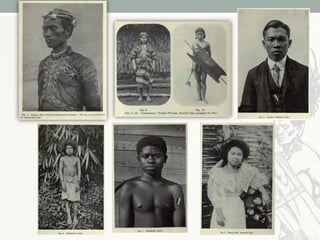
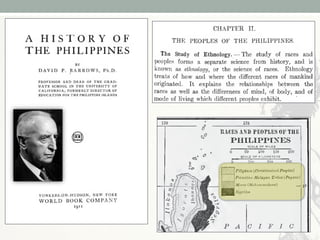
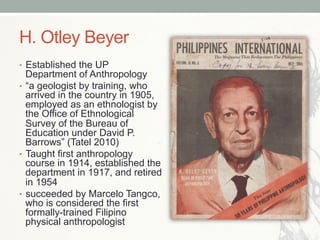
•  Antropolohiya / Aghamtao 101
•  19th century ethnological studies
•  20th century American anthropology
•  UP Anthropology
•  Ugnayang Pang-Aghamtao
•  Anthropology outside UP / Public Anthropology
•  Some monographs on Philippine anthropology
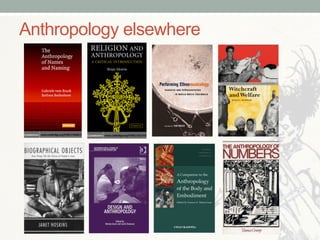
•  Anthropology elsewhere
Antropolohiya / Aghamtao 101
anthropos + logos
•  ... a discipline of infinite curiosity about human beings. (Ember)
•  ... the exploration of human diversity in time and space. (Kottak)
•  … the most liberating of all the sciences. (Haviland)
Fieldwork as key research method (participant observation)
‘holistic’ and comparative
Broader in scope, both geographically and historically
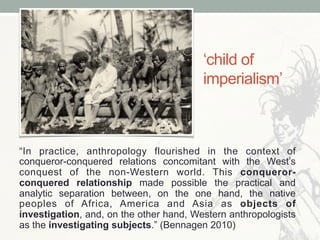
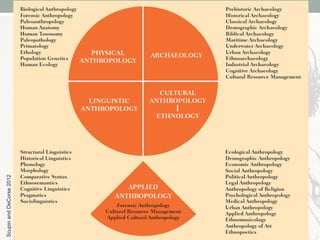
‘child of
imperialism’
“In practice, anthropology flourished in the context of
conqueror-conquered relations concomitant with the West’s
conquest of the non-Western world. This conqueror-
conquered relationship made possible the practical and
analytic separation between, on the one hand, the native
peoples of Africa, America and Asia as objects of
investigation, and, on the other hand, Western anthropologists
as the investigating subjects.” (Bennagen 2010)
ScupinandDeCorse2012
19th century ethnological studies
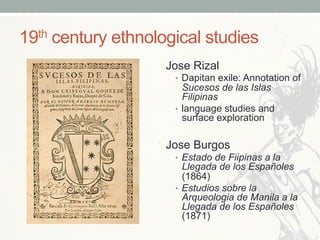
Jose Rizal
•  Dapitan exile: Annotation of
Sucesos de las Islas
Filipinas
•  language studies and
surface exploration
Jose Burgos
•  Estado de Fiipinas a la
Llegada de los Españoles
(1864)
•  Estudios sobre la
Arqueologia de Manila a la
Llegada de los Españoles
(1871)
19th century ethnological studies
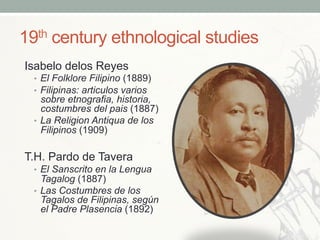
Isabelo delos Reyes
•  El Folklore Filipino (1889)
•  Filipinas: articulos varios
sobre etnografia, historia,
costumbres del pais (1887)
•  La Religion Antiqua de los
Filipinos (1909)
T.H. Pardo de Tavera
•  El Sanscrito en la Lengua
Tagalog (1887)
•  Las Costumbres de los
Tagalos de Filipinas, según
el Padre Plasencia (1892)
Ferdinand Blumentritt,
1890. Mapa Etnografico
del Archipielago Filipino
20th century American anthropology
•  Unilineal cultural evolutionism
•  Conducted ethnological survey focusing on “mountain dwelling”
and “non-Christian” indigenous groups
•  Bureau of Non-Christian Tribes (BNCT)
•  David P. Barrows (PhD anthropology) and Dean C. Worcester
(zoologist)
•  “a vital agency during the American colonial regime in the
Philippines having supplied much of the cultural and racial
justification for American presence in the country” (Tatel 2010)
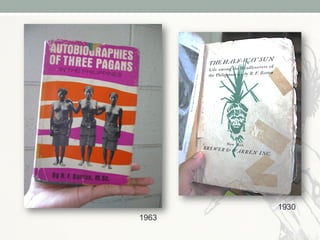
1930
1963
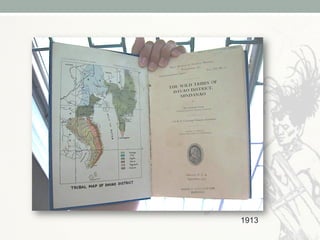
1913
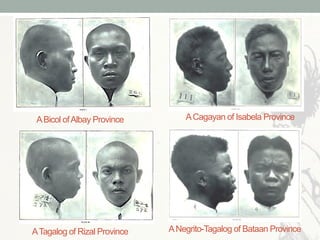
ABicol ofAlbay Province ACagayan of Isabela Province
ATagalog of Rizal Province ANegrito-Tagalog of Bataan Province
H. Otley Beyer
•  Established the UP
Department of Anthropology
•  “a geologist by training, who
arrived in the country in 1905,
employed as an ethnologist by
the Office of Ethnological
Survey of the Bureau of
Education under David P.
Barrows” (Tatel 2010)
•  Taught first anthropology
course in 1914, established the
department in 1917, and retired
in 1954
•  succeeded by Marcelo Tangco,
who is considered the first
formally-trained Filipino
physical anthropologist
Beyer’s studies
•  Outline Review of
Philippine Archaeology by
Islands and Provinces
(1949)
•  Philippine Tektites: A
Contribution to the Study
of Tektite Problem in
General, in the Light of
both Past and Recent
Discoveries (1961)
•  The Philippine Saga: A
Pictorial History of the
Archipelago since Time
Began (1947, with Jaime
C. De Veyra)
“Wave Migration Theory”
“First came the Java Man,
and then the “little people” –
Australoid Sakai, Negritos,
and Proto-Malays – followed
by two waves of Indonesian –
Type A and Type B – with a
smaller wave of Papuans,
who were succeeded in turn
by separate Northern and
Southern Malay waves, and
finally the Jar Burial People.”
PASSE. INCORRECT
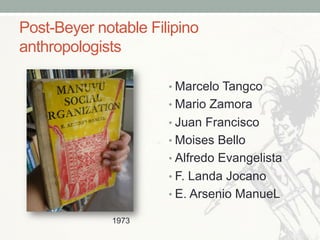
Post-Beyer notable Filipino
anthropologists
• Marcelo Tangco
• Mario Zamora
• Juan Francisco
• Moises Bello
• Alfredo Evangelista
• F. Landa Jocano
• E. Arsenio ManueL
1973
70s-80s: Indigenization
•  “Aghamtao”; linguistic turn
•  Sikolohiyang Pilipino ni Virgilio Enriquez
•  Pantayong Pananaw ni Zeus Salazar
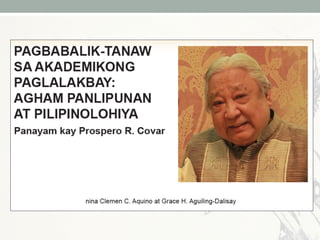
•  Pilipinolohiya ni Prospero Covar
•  “Asianization of Anthropology”
This perspective to Asianize anthropology and the
other sciences was the logical consequence of the
recognition of the inadequacy of Western models,
hypotheses and theories. (Bennagen 1980)
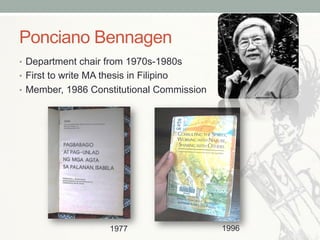
Ponciano Bennagen
•  Department chair from 1970s-1980s
•  First to write MA thesis in Filipino
•  Member, 1986 Constitutional Commission
1977 1996
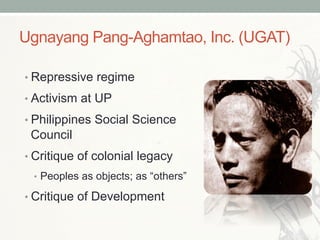
Ugnayang Pang-Aghamtao, Inc. (UGAT)
• Repressive regime
• Activism at UP
• Philippines Social Science
Council
• Critique of colonial legacy
•  Peoples as objects; as “others”
• Critique of Development
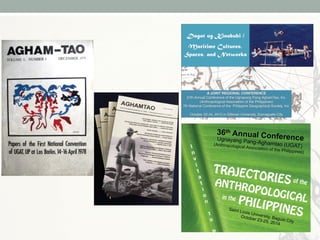
Ugnayang Pang-Aghamtao, Inc. (UGAT)
formal organization of anthropologists in a
conscious effort to create a more appropriate
anthropology, i.e., attuned to the conditions,
needs and visions of Philippine society
(Bennagen 1978 :1-2)
Forum on the Pantabangan and Chico Dam
Project (1978)
The International Conference on the Tasaday
and other Urgent Anthropological Issues (1986)
First Conference of the Ancestral Domain:
Human Rights and the Ancestral Domain (1983)
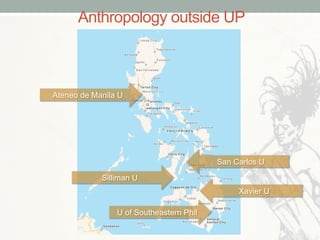
Anthropology outside UP
Ateneo de Manila U
Silliman U
San Carlos U
Xavier U
U of Southeastern Phil
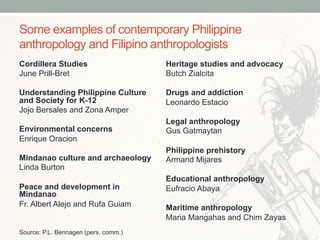
Some examples of contemporary Philippine
anthropology and Filipino anthropologists
Cordillera Studies
June Prill-Bret
Understanding Philippine Culture
and Society for K-12
Jojo Bersales and Zona Amper
Environmental concerns
Enrique Oracion
Mindanao culture and archaeology
Linda Burton
Peace and development in
Mindanao
Fr. Albert Alejo and Rufa Guiam
Heritage studies and advocacy
Butch Zialcita
Drugs and addiction
Leonardo Estacio
Legal anthropology
Gus Gatmaytan
Philippine prehistory
Armand Mijares
Educational anthropology
Eufracio Abaya
Maritime anthropology
Maria Mangahas and Chim Zayas
Source: P.L. Bennagen (pers. comm.)
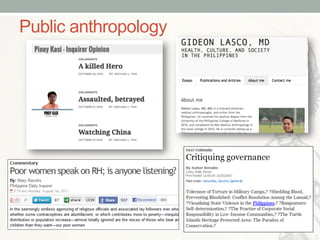
Public anthropology
“Public anthropology”
Source: Eufracio Abaya’s
presentation at the World
Council of Anthropological
Associations in New Delhi,
India. 2012.
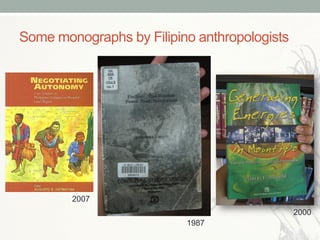
Some monographs by Filipino anthropologists
1987
2000
2007
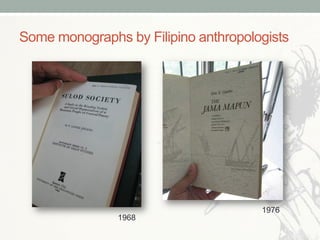
Some monographs by Filipino anthropologists
1968
1976
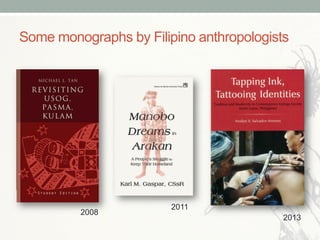
Some monographs by Filipino anthropologists
2013
2008
2011
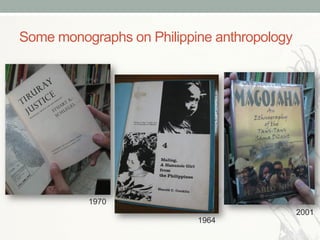
Some monographs on Philippine anthropology
2001
1970
1964
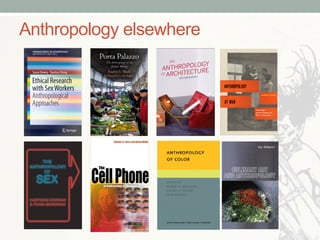
Anthropology elsewhere
GANITO ANG
ANTROPOLOHIYA NOON,
PAANO KAYA NGAYON?
Maraming salamat po sa pakikinig!
References
Abaya, Eufracio; Ma. Luisa Lucas-Fernan and Daisy Y. Noval-Morales. 1999. “Shifting Terms of
Engagement: A Review of the History of Anthropology,” in Virginia Miralao (ed.). The Philippine
Social Science in the Life of the Nation. Quezon City: Philippine Social Science Research
Council.
Alatas, Syed Farid. 2005. “Indigenization: Features and problems.” In van Bremen, Jan, Eyal
Ben-Ari and Syed Farid Alatas (eds) Asian Anthropology. London and New York: Routledge.
Bennagen, Poncianno L. 1980. “The Asianization of anthropology”. Asian Studies, 18: 1–26.
Tan, Michael L. 2010. “Philippine Anthropology in a Post-Anthropology Age”. In Tigno, Jorge V.
(ed.) Philippine Social Science Discourse. Quezon City: College of Social Sciences and
Philosophy.
Scupin, Raymond and Christopher R. DeCorse. 2012. Anthropology: A Global Perspective.
Seventh edition. Upper Saddle River, NJ: Pearson.
Tatel, Carlos P. Jr. 2010. “Anthropology at the University of the Philippines: Examining
Institutional History and Academic Dependency in a Southeast Asian University.” In Syed Farid
Alatas and Kathinka Sinha-Kerkhoff (eds.) Academic Dependency in the Social Sciences:
Structural Reality and Intellectual Challenges. New Delhi: Manohar Publishers.
Zamora, Mario D. “Cultural Anthropology in the Philippines - 1900-1983: Perspectives,
Problems, and Prospectsr..”

Philippine anthropology

  • 1.
    GANITO ANG ANTROPOLOHIYA NOON, PAANOKAYA NGAYON? Notes on the Practice and Teaching of Philippine Anthropology Jessie G. Varquez, Jr. Department of Social Sciences, UPLB DSS Friday School Extension Project 28 October 2016
  • 2.
    Outline •  Antropolohiya /Aghamtao 101 •  19th century ethnological studies •  20th century American anthropology •  UP Anthropology •  Ugnayang Pang-Aghamtao •  Anthropology outside UP / Public Anthropology •  Some monographs on Philippine anthropology •  Anthropology elsewhere
  • 3.
    Antropolohiya / Aghamtao101 anthropos + logos •  ... a discipline of infinite curiosity about human beings. (Ember) •  ... the exploration of human diversity in time and space. (Kottak) •  … the most liberating of all the sciences. (Haviland) Fieldwork as key research method (participant observation) ‘holistic’ and comparative Broader in scope, both geographically and historically
  • 4.
    ‘child of imperialism’ “In practice,anthropology flourished in the context of conqueror-conquered relations concomitant with the West’s conquest of the non-Western world. This conqueror- conquered relationship made possible the practical and analytic separation between, on the one hand, the native peoples of Africa, America and Asia as objects of investigation, and, on the other hand, Western anthropologists as the investigating subjects.” (Bennagen 2010)
  • 5.
  • 6.
    19th century ethnologicalstudies Jose Rizal •  Dapitan exile: Annotation of Sucesos de las Islas Filipinas •  language studies and surface exploration Jose Burgos •  Estado de Fiipinas a la Llegada de los Españoles (1864) •  Estudios sobre la Arqueologia de Manila a la Llegada de los Españoles (1871)
  • 7.
    19th century ethnologicalstudies Isabelo delos Reyes •  El Folklore Filipino (1889) •  Filipinas: articulos varios sobre etnografia, historia, costumbres del pais (1887) •  La Religion Antiqua de los Filipinos (1909) T.H. Pardo de Tavera •  El Sanscrito en la Lengua Tagalog (1887) •  Las Costumbres de los Tagalos de Filipinas, según el Padre Plasencia (1892)
  • 8.
    Ferdinand Blumentritt, 1890. MapaEtnografico del Archipielago Filipino
  • 9.
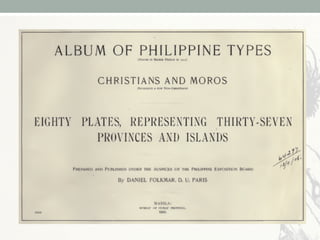
    20th century Americananthropology •  Unilineal cultural evolutionism •  Conducted ethnological survey focusing on “mountain dwelling” and “non-Christian” indigenous groups •  Bureau of Non-Christian Tribes (BNCT) •  David P. Barrows (PhD anthropology) and Dean C. Worcester (zoologist) •  “a vital agency during the American colonial regime in the Philippines having supplied much of the cultural and racial justification for American presence in the country” (Tatel 2010)
  • 10.
  • 11.
  • 13.
    ABicol ofAlbay ProvinceACagayan of Isabela Province ATagalog of Rizal Province ANegrito-Tagalog of Bataan Province
  • 17.
    H. Otley Beyer • Established the UP Department of Anthropology •  “a geologist by training, who arrived in the country in 1905, employed as an ethnologist by the Office of Ethnological Survey of the Bureau of Education under David P. Barrows” (Tatel 2010) •  Taught first anthropology course in 1914, established the department in 1917, and retired in 1954 •  succeeded by Marcelo Tangco, who is considered the first formally-trained Filipino physical anthropologist
  • 18.
    Beyer’s studies •  OutlineReview of Philippine Archaeology by Islands and Provinces (1949) •  Philippine Tektites: A Contribution to the Study of Tektite Problem in General, in the Light of both Past and Recent Discoveries (1961) •  The Philippine Saga: A Pictorial History of the Archipelago since Time Began (1947, with Jaime C. De Veyra) “Wave Migration Theory” “First came the Java Man, and then the “little people” – Australoid Sakai, Negritos, and Proto-Malays – followed by two waves of Indonesian – Type A and Type B – with a smaller wave of Papuans, who were succeeded in turn by separate Northern and Southern Malay waves, and finally the Jar Burial People.” PASSE. INCORRECT
  • 19.
    Post-Beyer notable Filipino anthropologists • MarceloTangco • Mario Zamora • Juan Francisco • Moises Bello • Alfredo Evangelista • F. Landa Jocano • E. Arsenio ManueL 1973
  • 20.
    70s-80s: Indigenization •  “Aghamtao”;linguistic turn •  Sikolohiyang Pilipino ni Virgilio Enriquez •  Pantayong Pananaw ni Zeus Salazar •  Pilipinolohiya ni Prospero Covar •  “Asianization of Anthropology” This perspective to Asianize anthropology and the other sciences was the logical consequence of the recognition of the inadequacy of Western models, hypotheses and theories. (Bennagen 1980)
  • 22.
    Ponciano Bennagen •  Departmentchair from 1970s-1980s •  First to write MA thesis in Filipino •  Member, 1986 Constitutional Commission 1977 1996
  • 23.
    Ugnayang Pang-Aghamtao, Inc.(UGAT) • Repressive regime • Activism at UP • Philippines Social Science Council • Critique of colonial legacy •  Peoples as objects; as “others” • Critique of Development
  • 24.
    Ugnayang Pang-Aghamtao, Inc.(UGAT) formal organization of anthropologists in a conscious effort to create a more appropriate anthropology, i.e., attuned to the conditions, needs and visions of Philippine society (Bennagen 1978 :1-2) Forum on the Pantabangan and Chico Dam Project (1978) The International Conference on the Tasaday and other Urgent Anthropological Issues (1986) First Conference of the Ancestral Domain: Human Rights and the Ancestral Domain (1983)
  • 26.
    Anthropology outside UP Ateneode Manila U Silliman U San Carlos U Xavier U U of Southeastern Phil
  • 27.
    Some examples ofcontemporary Philippine anthropology and Filipino anthropologists Cordillera Studies June Prill-Bret Understanding Philippine Culture and Society for K-12 Jojo Bersales and Zona Amper Environmental concerns Enrique Oracion Mindanao culture and archaeology Linda Burton Peace and development in Mindanao Fr. Albert Alejo and Rufa Guiam Heritage studies and advocacy Butch Zialcita Drugs and addiction Leonardo Estacio Legal anthropology Gus Gatmaytan Philippine prehistory Armand Mijares Educational anthropology Eufracio Abaya Maritime anthropology Maria Mangahas and Chim Zayas Source: P.L. Bennagen (pers. comm.)
  • 28.
  • 29.
    “Public anthropology” Source: EufracioAbaya’s presentation at the World Council of Anthropological Associations in New Delhi, India. 2012.
  • 30.
    Some monographs byFilipino anthropologists 1987 2000 2007
  • 31.
    Some monographs byFilipino anthropologists 1968 1976
  • 32.
    Some monographs byFilipino anthropologists 2013 2008 2011
  • 33.
    Some monographs onPhilippine anthropology 2001 1970 1964
  • 34.
  • 35.
  • 36.
    GANITO ANG ANTROPOLOHIYA NOON, PAANOKAYA NGAYON? Maraming salamat po sa pakikinig!
  • 37.
    References Abaya, Eufracio; Ma.Luisa Lucas-Fernan and Daisy Y. Noval-Morales. 1999. “Shifting Terms of Engagement: A Review of the History of Anthropology,” in Virginia Miralao (ed.). The Philippine Social Science in the Life of the Nation. Quezon City: Philippine Social Science Research Council. Alatas, Syed Farid. 2005. “Indigenization: Features and problems.” In van Bremen, Jan, Eyal Ben-Ari and Syed Farid Alatas (eds) Asian Anthropology. London and New York: Routledge. Bennagen, Poncianno L. 1980. “The Asianization of anthropology”. Asian Studies, 18: 1–26. Tan, Michael L. 2010. “Philippine Anthropology in a Post-Anthropology Age”. In Tigno, Jorge V. (ed.) Philippine Social Science Discourse. Quezon City: College of Social Sciences and Philosophy. Scupin, Raymond and Christopher R. DeCorse. 2012. Anthropology: A Global Perspective. Seventh edition. Upper Saddle River, NJ: Pearson. Tatel, Carlos P. Jr. 2010. “Anthropology at the University of the Philippines: Examining Institutional History and Academic Dependency in a Southeast Asian University.” In Syed Farid Alatas and Kathinka Sinha-Kerkhoff (eds.) Academic Dependency in the Social Sciences: Structural Reality and Intellectual Challenges. New Delhi: Manohar Publishers. Zamora, Mario D. “Cultural Anthropology in the Philippines - 1900-1983: Perspectives, Problems, and Prospectsr..”