THE VISUAL IN
ANTHROPOLOGY
Presented during the Meeting of Southern Luzon Association of
Museum
Jessie G. Varquez, Jr. / Department of Social Sciences, UPLB / 20 Feb
2018
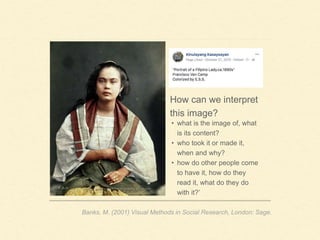
How can we interpret
this image?
Banks, M. (2001) Visual Methods in Social Research, London: Sage.
• what is the image of, what
is its content?
• who took it or made it,
when and why?
• how do other people come
to have it, how do they
read it, what do they do
with it?’
PREFATORY NOTES
anthropos + logos = the study of humans
fieldwork as key research method (participant
observation); holistic and comparative
colonial science; ‘child of imperialism’
anthropology was taught in U.P. as a formal
academic discipline in 1914 by H. Otley Beyer
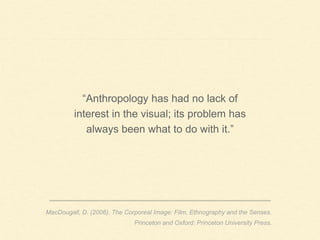
“Anthropology has had no lack of
interest in the visual; its problem has
always been what to do with it.”
MacDougall, D. (2006). The Corporeal Image: Film, Ethnography and the Senses.
Princeton and Oxford: Princeton University Press.
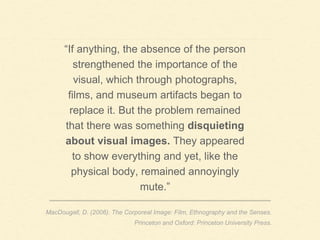
“If anything, the absence of the person
strengthened the importance of the
visual, which through photographs,
films, and museum artifacts began to
replace it. But the problem remained
that there was something disquieting
about visual images. They appeared
to show everything and yet, like the
physical body, remained annoyingly
mute.”
MacDougall, D. (2006). The Corporeal Image: Film, Ethnography and the Senses.
Princeton and Oxford: Princeton University Press.
PHOTOGRAPHS
IN AMERICAN COLONIAL
PERIOD
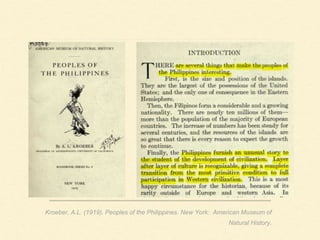
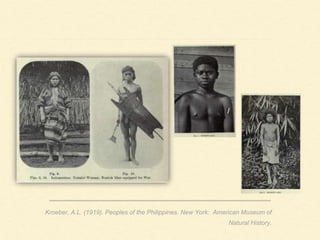
Kroeber, A.L. (1919). Peoples of the Philippines. New York: American Museum of
Natural History.
Kroeber, A.L. (1919). Peoples of the Philippines. New York: American Museum of
Natural History.
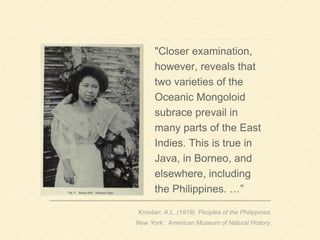
"Closer examination,
however, reveals that
two varieties of the
Oceanic Mongoloid
subrace prevail in
many parts of the East
Indies. This is true in
Java, in Borneo, and
elsewhere, including
the Philippines. …”
Kroeber, A.L. (1919). Peoples of the Philippines.
New York: American Museum of Natural History.
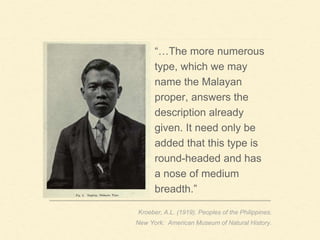
“…The more numerous
type, which we may
name the Malayan
proper, answers the
description already
given. It need only be
added that this type is
round-headed and has
a nose of medium
breadth.”
Kroeber, A.L. (1919). Peoples of the Philippines.
New York: American Museum of Natural History.
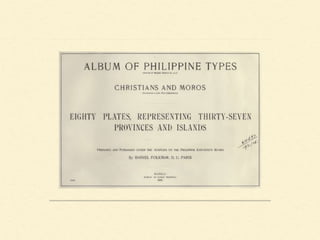
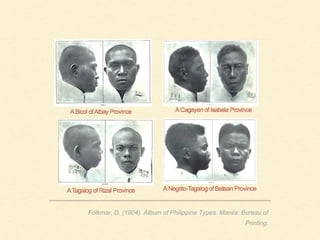
Folkmar, D. (1904). Album of Philippine Types. Manila: Bureau of
Printing.
“As anthropology developed in the
colonial context, the visual had further
primacy as a way of organizing
society by types. Like the collecting of
artifacts and botanical samples,
photography provided a new way of
creating human models, against which
further examples could be compared
and classified.”
MacDougall, D. (2006). The Corporeal Image: Film, Ethnography and the Senses.
Princeton and Oxford: Princeton University Press.
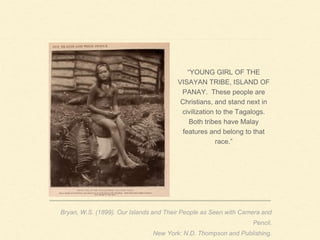
“YOUNG GIRL OF THE
VISAYAN TRIBE, ISLAND OF
PANAY. These people are
Christians, and stand next in
civilization to the Tagalogs.
Both tribes have Malay
features and belong to that
race.”
Bryan, W.S. (1899). Our Islands and Their People as Seen with Camera and
Pencil.
New York: N.D. Thompson and Publishing.
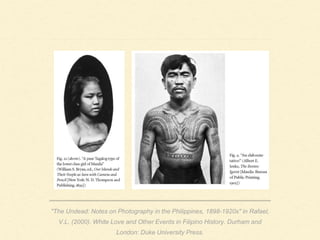
"The Undead: Notes on Photography in the Philippines, 1898-1920s" in Rafael,
V.L. (2000). White Love and Other Events in Filipino History. Durham and
London: Duke University Press.
"It is this capacity to convert the colonized into objects
of foreign interests and subjects of colonial accounts
that historically has lent to photography a predatory
and cannibalistic quality. And it is all the more
problematic, as critical studies have suggested, for its
ability to provide an alibi of objectivity so that a
photograph seems only to record what is in front of it
while masking intentions, concealing selections, and
rendering invisible the various frames that determine
what is seen, how it is seen, and by whom.
Photography has thus functioned as an apparatus of
disavowal.”
"The Undead: Notes on Photography in the Philippines, 1898-1920s" in Rafael,
V.L. (2000). White Love and Other Events in Filipino History. Durham and
London: Duke University Press.
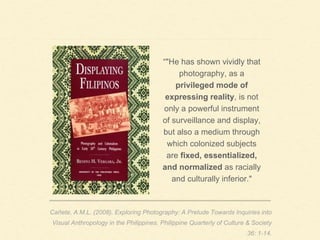
“"He has shown vividly that
photography, as a
privileged mode of
expressing reality, is not
only a powerful instrument
of surveillance and display,
but also a medium through
which colonized subjects
are fixed, essentialized,
and normalized as racially
and culturally inferior."
Cañete, A.M.L. (2008). Exploring Photography: A Prelude Towards Inquiries into
Visual Anthropology in the Philippines. Philippine Quarterly of Culture & Society
36: 1-14.
BEYOND THE
PHILIPPINES
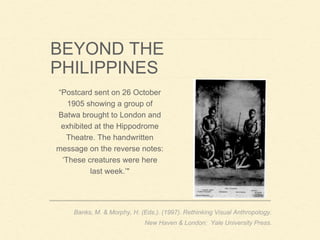
“Postcard sent on 26 October
1905 showing a group of
Batwa brought to London and
exhibited at the Hippodrome
Theatre. The handwritten
message on the reverse notes:
‘These creatures were here
last week.’"
Banks, M. & Morphy, H. (Eds.). (1997). Rethinking Visual Anthropology.
New Haven & London: Yale University Press.
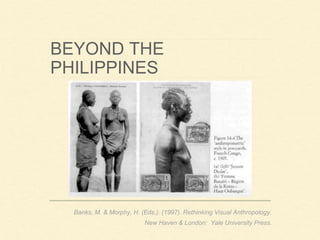
BEYOND THE
PHILIPPINES
Banks, M. & Morphy, H. (Eds.). (1997). Rethinking Visual Anthropology.
New Haven & London: Yale University Press.
INTERPRETING VISUAL
IMAGES
‘crisis of representation’
‘ethnographies of audiencing’
reflexivity; positionality
QUESTIONS TO CONSIDER
Are there instances in our museum work where the
colonial/evolutionist elements in displaying the
visual is at work?
How are our museum collections displayed? Are
they ‘fixed, essentialized, and normalized’?
Have we payed attention to how the museum
visitors gaze at the visual? How will this inform our
museum work?
VISUAL BEYOND
PHOTOGRAPHS
Films (e.g., ethnographic, documentary, feature)
Museums (‘cabinets of curiosities’)
Portraits (family, studio, etc.)
Billboards (gender issues, power relations)
Social media (e.g., memes, fake news)
– Susan Sontag
“To photograph people is to violate
them, by seeing them as they never see
themselves, by having knowledge of
them they can never have; it turns
people into objects that can be
symbolically possessed.”
THE VISUAL IN
ANTHROPOLOGY
Presented during the Meeting of Southern Luzon Association of
Museum
Jessie G. Varquez, Jr. / Department of Social Sciences, UPLB / 20 Feb
2018

The Visual in Anthropology

  • 1.
    THE VISUAL IN ANTHROPOLOGY Presentedduring the Meeting of Southern Luzon Association of Museum Jessie G. Varquez, Jr. / Department of Social Sciences, UPLB / 20 Feb 2018
  • 2.
    How can weinterpret this image? Banks, M. (2001) Visual Methods in Social Research, London: Sage. • what is the image of, what is its content? • who took it or made it, when and why? • how do other people come to have it, how do they read it, what do they do with it?’
  • 3.
    PREFATORY NOTES anthropos +logos = the study of humans fieldwork as key research method (participant observation); holistic and comparative colonial science; ‘child of imperialism’ anthropology was taught in U.P. as a formal academic discipline in 1914 by H. Otley Beyer
  • 4.
    “Anthropology has hadno lack of interest in the visual; its problem has always been what to do with it.” MacDougall, D. (2006). The Corporeal Image: Film, Ethnography and the Senses. Princeton and Oxford: Princeton University Press.
  • 5.
    “If anything, theabsence of the person strengthened the importance of the visual, which through photographs, films, and museum artifacts began to replace it. But the problem remained that there was something disquieting about visual images. They appeared to show everything and yet, like the physical body, remained annoyingly mute.” MacDougall, D. (2006). The Corporeal Image: Film, Ethnography and the Senses. Princeton and Oxford: Princeton University Press.
  • 6.
  • 7.
    Kroeber, A.L. (1919).Peoples of the Philippines. New York: American Museum of Natural History.
  • 8.
    Kroeber, A.L. (1919).Peoples of the Philippines. New York: American Museum of Natural History.
  • 9.
    "Closer examination, however, revealsthat two varieties of the Oceanic Mongoloid subrace prevail in many parts of the East Indies. This is true in Java, in Borneo, and elsewhere, including the Philippines. …” Kroeber, A.L. (1919). Peoples of the Philippines. New York: American Museum of Natural History.
  • 10.
    “…The more numerous type,which we may name the Malayan proper, answers the description already given. It need only be added that this type is round-headed and has a nose of medium breadth.” Kroeber, A.L. (1919). Peoples of the Philippines. New York: American Museum of Natural History.
  • 12.
    Folkmar, D. (1904).Album of Philippine Types. Manila: Bureau of Printing.
  • 13.
    “As anthropology developedin the colonial context, the visual had further primacy as a way of organizing society by types. Like the collecting of artifacts and botanical samples, photography provided a new way of creating human models, against which further examples could be compared and classified.” MacDougall, D. (2006). The Corporeal Image: Film, Ethnography and the Senses. Princeton and Oxford: Princeton University Press.
  • 14.
    “YOUNG GIRL OFTHE VISAYAN TRIBE, ISLAND OF PANAY. These people are Christians, and stand next in civilization to the Tagalogs. Both tribes have Malay features and belong to that race.” Bryan, W.S. (1899). Our Islands and Their People as Seen with Camera and Pencil. New York: N.D. Thompson and Publishing.
  • 15.
    "The Undead: Noteson Photography in the Philippines, 1898-1920s" in Rafael, V.L. (2000). White Love and Other Events in Filipino History. Durham and London: Duke University Press. "It is this capacity to convert the colonized into objects of foreign interests and subjects of colonial accounts that historically has lent to photography a predatory and cannibalistic quality. And it is all the more problematic, as critical studies have suggested, for its ability to provide an alibi of objectivity so that a photograph seems only to record what is in front of it while masking intentions, concealing selections, and rendering invisible the various frames that determine what is seen, how it is seen, and by whom. Photography has thus functioned as an apparatus of disavowal.”
  • 16.
    "The Undead: Noteson Photography in the Philippines, 1898-1920s" in Rafael, V.L. (2000). White Love and Other Events in Filipino History. Durham and London: Duke University Press.
  • 17.
    “"He has shownvividly that photography, as a privileged mode of expressing reality, is not only a powerful instrument of surveillance and display, but also a medium through which colonized subjects are fixed, essentialized, and normalized as racially and culturally inferior." Cañete, A.M.L. (2008). Exploring Photography: A Prelude Towards Inquiries into Visual Anthropology in the Philippines. Philippine Quarterly of Culture & Society 36: 1-14.
  • 18.
    BEYOND THE PHILIPPINES “Postcard senton 26 October 1905 showing a group of Batwa brought to London and exhibited at the Hippodrome Theatre. The handwritten message on the reverse notes: ‘These creatures were here last week.’" Banks, M. & Morphy, H. (Eds.). (1997). Rethinking Visual Anthropology. New Haven & London: Yale University Press.
  • 19.
    BEYOND THE PHILIPPINES Banks, M.& Morphy, H. (Eds.). (1997). Rethinking Visual Anthropology. New Haven & London: Yale University Press.
  • 20.
    INTERPRETING VISUAL IMAGES ‘crisis ofrepresentation’ ‘ethnographies of audiencing’ reflexivity; positionality
  • 21.
    QUESTIONS TO CONSIDER Arethere instances in our museum work where the colonial/evolutionist elements in displaying the visual is at work? How are our museum collections displayed? Are they ‘fixed, essentialized, and normalized’? Have we payed attention to how the museum visitors gaze at the visual? How will this inform our museum work?
  • 22.
    VISUAL BEYOND PHOTOGRAPHS Films (e.g.,ethnographic, documentary, feature) Museums (‘cabinets of curiosities’) Portraits (family, studio, etc.) Billboards (gender issues, power relations) Social media (e.g., memes, fake news)
  • 23.
    – Susan Sontag “Tophotograph people is to violate them, by seeing them as they never see themselves, by having knowledge of them they can never have; it turns people into objects that can be symbolically possessed.”
  • 24.
    THE VISUAL IN ANTHROPOLOGY Presentedduring the Meeting of Southern Luzon Association of Museum Jessie G. Varquez, Jr. / Department of Social Sciences, UPLB / 20 Feb 2018