READINGS IN
PHILIPPINE HISTORY
INSTR. MORELL B. CAÑA, RPm
PRE-HISTORIC PERIOD | PRE-COLONIAL
TRACING THE ORIGIN OF FILIPINO PEOPLE
EARLY DISCOVERIES:
 Paleolithic period
 Stone age
 Early settlers in the Philippines
PRE-HISTORIC ERA PRE-COLONIAL ERA
 Where information of the past was
recorded in materials other than
written documents which may not
be understood by historian.
 The pre-colonial period broadly
refers to the span of time prior to
the introduction of European
colonialism in areas across the
world.
READINGS IN PHILIPPINE
PRE-HISTORY
The Theory of Evolution
 The belief that man came from apelike
creatures who lived thousands of years ago
in caves and had crude tools.
ARCHEOLOGISTS - scientist who study about
the past
 they study old material relics like bones, jars,
pottery and antique jewelry
 these relics are found in the sites of old
burial plots, homes or villages of people who
lived long, long ago.
PRE-HISTORY
PALEOLITHIC PERIOD MESOLITHIC PERIOD NEOLITHIC PERIOD
 2.5 million years ago to
10,000 B.C.
 humans lived in caves or
simple huts or tepees and
were hunters.
 Used basic stone and bone
tools, as well as crude stone
axes, for hunting birds and
wild animals.
 They cooked their prey,
including woolly mammoths,
deer and bison, using
controlled fire.
 They also fished and
collected berries, fruit and
nuts.
 The end of this period
marked the end of the last
Ice Age, which resulted in the
extinction of many large
mammals and rising sea
levels and climate change
that eventually caused man
to migrate.
 10,000 B.C. to 8,000 B.C
 humans used small stone
tools, now also polished and
sometimes crafted with
points and attached to
antlers, bone or wood to
serve as spears and arrows.
 They often lived nomadically
in camps near rivers and
other bodies of water.
 Agriculture was introduced
during this time, which led to
more permanent settlements
settlements in villages.
 8,000 B.C. to 3,000 B.C.
 humans switched from
hunter/gatherer mode to
agriculture and food
production.
 They domesticated
animals and cultivated
cereal grains.
 They used polished hand
axes, adzes for ploughing
and tilling the land and
started to settle in the
plains.
 Advancements were made
not only in tools but also
in farming, home
construction and art,
including pottery, sewing
and
KALINGA ARTIFACTS AND FOSSIL FAUNA REMAINS
 A 2018 study led by Thomas Ingicco pushes back
the arrival of the first Homo species on the
Philippines between 631,000 and 777,000 years
ago.
 The authors found butchery marks on the bones of
the ribs, metacarpals and both humeri while no
bones from any hominin were reported from the
site, over 50 stone tools found in context with the
rhinoceros (Pleistocene-aged species of rhinoceros
endemic to the Philippine islands) provided direct
evidence for human activities at the site.
 75-percent complete fossil of the R. philippinensis
was unearthed in Rizal, Kalinga along with 57 stone
tools in 2014.
HOMININS
Hominin, Any member of the zoological “tribe” Hominini (family
(family Hominidae, order Primates), of which only one species
exists today—Homo sapiens, or human beings
CALLAO MAN (C. 67,000 YEARS AGO)
 Callao Man was shorter than four feet and was just as
comfortable climbing trees as it was walking on the
ground.
 The earliest known hominin remains in the Philippines is
the fossil discovered in 2007 in the rocky floor Callao
Caves in Cagayan.
 The 67,000-year-old find predates the 47,000-year-old
Tabon Man, which was until then the earliest known set of
human remains in the archipelago.
 The find consisted of a single 61 millimeter metatarsal
which was dated using uranium series ablation.
 It was initially thought to be possibly one of the oldest
Homo sapiens remains in the Asia-Pacific.
Noong taong 2007, isang grupo ng mga arkeologo
na pinangunahan ni Dr. Armand Mijares ng U.P.
Diliman ay nakadiskubre ng buto ng paa sa
Cave sa bayan ng Peñablanca, Cagayan.
Ang nasabing labi ng buto sa paa – ang
pangatlong metatarsal ng buto sa paa ay
sinasabing “ang pinaka-unang human fossil na
matatagpuan sa Asia-Pacific region.”
“Uranium-series dating”, napagalaman din na
butong ito ay halos 67,000 taon na at mas nauna
pa sa “Tabon Man” na sinasabing
pinakamatandang labi ng tao sa bansa na kung
saan ay 50,000 taon lamang.
Ayon sa mga eksperto, ang Callao Man ay
posibleng nakarating sa isla ng Luzon mula sa
Indonesia sa pamamagitan ng balsa.
Ang ibang eksperto naman ay naniniwalang ang
Callao Man ay isang specie lamang na malapit na
kamag-anak ng tao at isang produkto ng proseso
ng ebolusyon na kung tawagin ay “human
speciation”.
Stone Age (c. 50,000 – c. 500 BC)
The Stone Age was a broad prehistoric period during which stone
was widely used to make tools with an edge, a point, or a percussion
surface. The period lasted for roughly 3.4 million years, and ended
between 8700 BCE and 2000 BCE , with the advent of metalworking.
TABON CAVE, PALAWAN
Its remains discovered in the Tabon Caves in
Lipuun Point in Quezon, Palawan in the
Philippines.
Discovered by Robert B. Fox, an American
anthropologist of the National Museum of the
Philippines, on May 28, 1962.
The fossil is composed of the skull cap, or
the frontal skull bone, two fragments of jaw
bones and some teeth. The set of fossils
suggest that are at least three individuals.
The skull cap is that of a young individual,
probably female.
TOOLS DISCOVERED:
Lithic flake is a "portion of rock removed
from an objective piece by percussion or
pressure,"[1]:255 and may also be
referred to as a chip or flake, or
collectively as debitage.
Charcoal is the traditional fuel of a
blacksmith's forge and other
applications where an intense heat is
required.
READINGS IN PHILIPPINE
PRE-COLONIAL PERIOD
READINGS IN PHILIPPINE PRE-
COLONIAL PERIOD
EARLY SETTLERS
CULTURAL
SOCIETAL CLASS
POLITICS
RELIGION
ECONOMIC LIFE
EARLY SETTLERS IN THE
PHILIPPINES
A settler is a person who has migrated to an area
and established a permanent residence there, often
to colonize the area.
NEGRITOS INDONESIANS MALAYS
 first people to come to the
Philippines
 also called Atis or Aetas
 they came across land bridges from
mainland Asia about 25,000 years
ago.
 Philippines then, was connected to
Asia by land bridges which later
sank below the sea
THE NEGRITOS
Characteristics:
• very small people, less than 5 feet tall
• were called "Negritos" because they had black skin,
short kinky hair, thick lips, and flat noses.
• they wore little clothing
• had no government
• no writing
• no permanent homes
• they wandered in the forests and lived by hunting,
fishing, and gathering wild plants and fruits.
• used bow and arrow for hunting.
THE INDONESIANS
According to the migration theory,
Indonesians were the first
immigrants to come by sea to the
Philippines, about 5,000 years ago.
2 types of Indonesians:
1. tall, with light skin, large
forehead, high nose and
thin lips
2. shorter and darker, with
large nose, thick lips and
heavy jaw.
CHARACTERISTICS
• they were more advance than negritos.
• they lived in permanent homes
• Uses fires to cook their food
• lived by hunting, fishing, and small
farming.
• they painted their bodies with colorful
figures.
THE MALAYS
Malays, came after the Indonesians, about
2,000 years ago.
Characteristics:
• medium in height
• brown-skinned
• with dark eyes
• flat noses and straight black hair
They drove the Indonesians into the forest
and lived in the lowlands.
• they were more civilized that
Indonesians.
• they lived in larger villages
• had government, writing, music, arts
and sciences.
• they lived by agriculture, fishing,
mining and trading.
SOCIETY | CULTURAL
The societal and cultural setting of the
Philippine in Pre-colonial period is
both different and the same in the
present.
CLOTHING
MALE ATTIRE
TOP: Kanggan (Sleeveless Jacket)
Bottom: Bahag (Loincloth)
The color of the Kanggan indicates
rank:
• RED = Chief
• Black or Blue = Commoners
Head Dress: Putong (Turban) that tells
social status/achievement.
FEMALE ATTIRE
TOP: Baro / Camisa (Jacket with
Sleeves)
Bottom: Saya / Patadyong
(Long Skirt)
*Some women wore a piece of
red or white cloth on top of
their skirt called “TAPIS”
HOUSES
BAHAY KUBO or the NIPPA HOUSE
Built to suit the tropical Climate
Made of Wood, bamboo and Nipa Palm; that was built
on stilts and can be entered through ladders that can be
drawn up.
Filipinos Such as the Kalingas, Mandayas and Bagobos
built there houses on treetop.
While Badjaos, built their houses on boats or above the
the water.
SOCIAL CLASSES
The society was made up of three classes:
1. NOBLES (Datu and their Families)
 Upper Class
 Highly honored
2. MAHADLIKA/MAHARLIKA (Freemen)
 Middle Class - Doesn’t have to pay tribute to the noble
3. ALIPIN (Dependents) - lowest Social Status
 FULL DEPENDENTS (Both parents are Alipin)
 One-half Dependent (Only one parent is Alipin)
 SEMI DEPENDENT (One parent – one half dependent; other parent –
Free)
SOCIAL CLASSES
The Two types of Alipin:
 Aliping Namamahay was a servant that lived in their own little house on the
property of their master.
 Aliping Sagigilid was a servant that lived around the house of their master.
WOMEN POSITION IN SOCIETY
Women in pre-colonial Philippine Society has
the right to:
 Inherit Property
 Engage in Trade and Industry
 Succeed to the Chieftainship of the
barangay in the absence of a male heir.
 Name their children
 Men walk behind them as sign of respect
MARRIAGE CUSTOMS
 It was customary to marry a person who was in
the same social Class:
 Man had the right to marry as many women
as he could support.
 Before a man could marry a woman, he
should render household services to the
woman’s family. He need to show his patience
and dedication to both the lady and her
parents.
 Courtship or Panliligaw usually begins with
“Paninilbihan”.
MARRIAGE CUSTOMS
 If man wins the trust of the parents.
He does not directly marry the
woman:
 groom should give dowry (bigay-
kaya)
 Pay gift (Panghimuyat) to the
bride’s parents.
 Pay the Wet Nurse (Bigay-suso)
 Pay the parents himaraw
MARRIAGE CUSTOMS
 Wedding was usually officiated by the
priesties or the babaylan.
 Babaylan refers to the pre-colonial
Philippine tradition of female mystical
healers whose spiritual connectedness was
a source of political and social power.
Babaylan serve as intermediaries between
spiritual and material worlds in their
communities. Their leadership roles are
multi-fold: warrior, healer, priestess and
sage (wiseman).
MUSIC AND DANCES
 People danced to appease the gods, to curry favor from
powerful spirits, to celebrate a hunt or harvest, to mimic the
exotic life forms around them. They danced their stories and
their shamanic rituals, their rites of passage and their
remembered legends and history.
 Rural dances include such favorites as the high-stepping
Tinikling, which mimics a bird, and the Gaway-Gaway, which
features the movements of children pulling the stalks of the
gaway roots during a bountiful harvest.
The Negritos of Zambales and Bataan were
fond playing Kullibaw, which resembled the
Jew’s harp made of baboo; the bansic a sort
of flute made of bamboo. And the gangsa, a
string music instrument.
EDUCATION SYSTEM OF WRITING
 The pre-colonial alphabet is called Baybayin or
Alibata. In this system of writing, a particular letter is
pronounced as syllable.
 Baybayin or Alibata is composed of 17 symbols (3
vowels/patinig and 14 consonants/Katinig)
 The orientation of writing of the ancient alphabet is
still subject for debate.
 The ancient Filipinos wrote on large leaves. They also
used sticks with sharpened end as their main writing
instrument and colored tree saps ink.
RELIGIOUS BELIEFS
The nature of religion in the pre-colonial Philippines
is often unclear. Religions present include animism,
indigenous religious beliefs and mythologies such
as Anito and influences from Hinduism and
Buddhism.
Bathala (Supreme King)
The creator
“Immortality of the soul and in Life after Death”
They also believed in the existence of a number of gods
whom they worship and made offerings to according to
rank.
Siginarugan (God of Hell)
IDIYANALE (God of Agriculture) SIDAPA (God of Death)
Agni (God of Fire)
Balangaw (God of Rainbow)
Lalahon (Goddess of Harvest)
Mandarangan (God of War)
Ancient Filipinos also worshipped the sun, the moon, the
animals, and others. They strongly believed that each part
the environment had to be respected.
BURIAL
 Early Filipinos placed dead bodies in a wooden
coffin and buried under the house complete
with gold and other valuable things.
 The Manunggul Jar, a container for bones of
the dead, is also a manifestation of the early
Filipinos’ reverence towards their dead.
 MORORAL - mourning for a woman
 MAGLAHI - mourning for a man
 LARAW - mourning for the Chieftain/Datu
THE POLITICAL SET-UP
Barangay
 Came from the Malay/Austronesian
word “balangay”, which means
“Sailboat”.
 It is the basic unit of government
during the pre-colonial period.
 Usually composed of 30 to 100
families in one unit.
 The families within the tribes are
accumulated in a single political
unit (barangay)
CHIEFTAIN / DATU
 Protect and promote the interests of his subjects
 Possessed the executive, legislative, and the judiciary
powers in a barangay unit.
 Assisted by the council of elders who would give
advice to issues concerning his barangay.
 The chieftain of each barangay chose to forge alliance
with other barangays to preserve peace and harmony
and provide mutual protection from a common
enemy.
 The subjects served their chieftain during wars,
voyages, planting and harvest and when their houses
need to be built or repaired; they also paid tributes
called “Buwis”.
TRIAL BY ORDEAL
 It refers to the primitive method of determining a person’s
innocence or guilt through the use of treacherous tests.
 Laws were made through the Initiative of the Datu and with
the approval of the elders.
 Once approved, A public announcer called “Omalohokan”
goes around the barangay and announce the New Law.
TRIAL BY ORDEAL is a series of test used to determine the guilt
or innocents of accused criminals.
 A stone is placed in a vessel with boiling water. The suspects will dip
their hands, and the man with the most scald will be judged the guilty
one.
 Giving lighted candles to the suspects. The man whose candle died out
first will be considered guilty.
 Plunging into the river. He who came to the surface first will be the
guilty one. Many were drowned in this process since nobody of the
accused wanted to be pinpointed as the criminal
 Chewing of uncooked rice. He who had the thickest saliva spewed was
considered guilty.
ECONOMIC LIFE
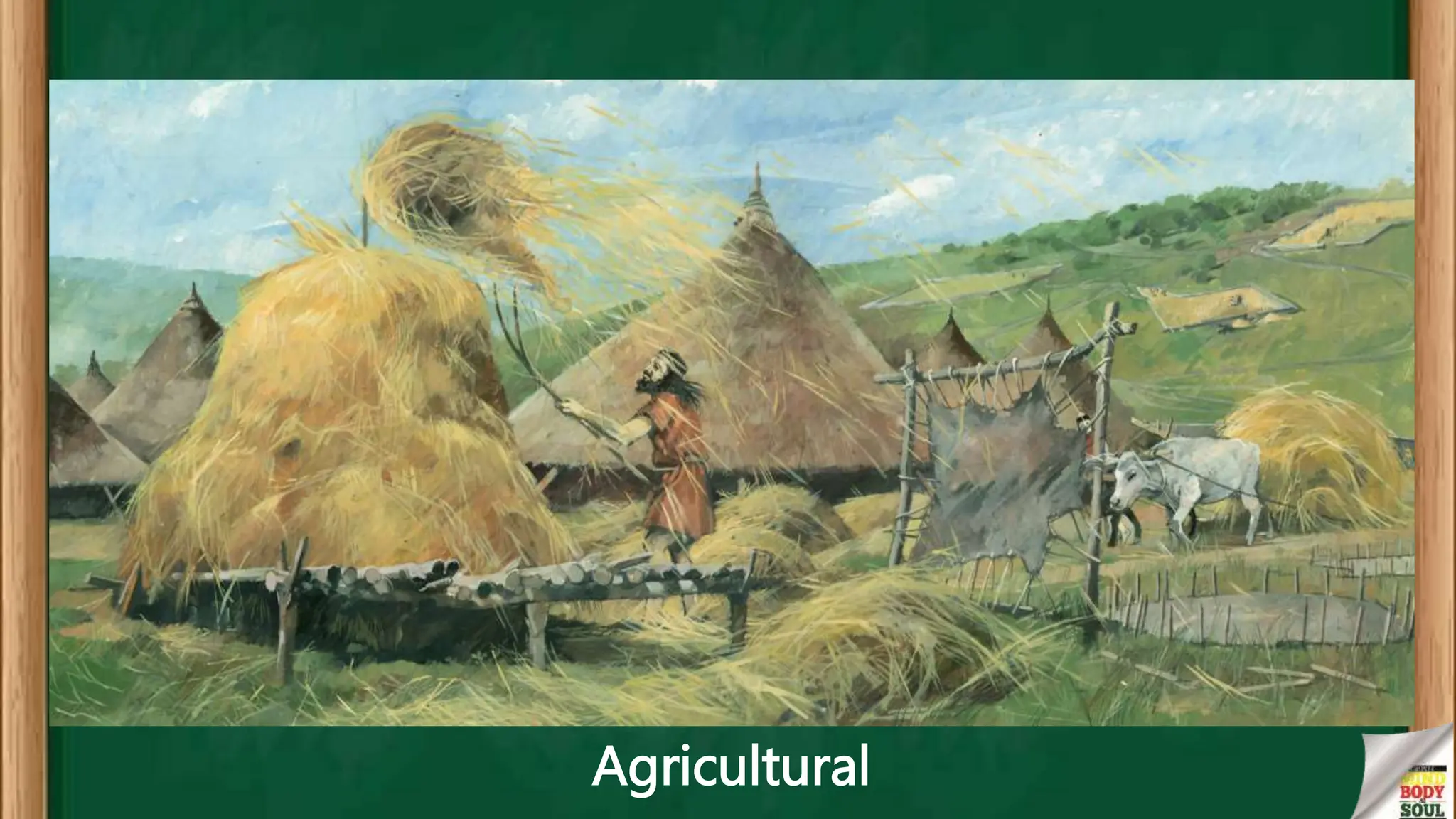
Agricultural Industrial
Agricultural
ECONOMIC LIFE: AGRICULTURE
 Various crops were raised such as banana,
sugar cane, cotton, coconut, rice,
vegetable, hemp (tough fiber from abaca)
and others. (kaingin)
 Land Cultivation has been popular in the
Philippines as early as the existence of the
ancient Filipinos.
 Antonio Pigefetta noted in his journal
some agricultural crops that he saw in
Sugbu (Cebu).
 Ancient Filipinos were engaged in
progressive irrigation system to ensure
that there is a continuous crop production.
The building of the rice terraces of the Cordilleras
started around 1650 and coincided with the arrival
of the Spaniards in northern Luzon.
 Anthropologist Stephen Acabado noted that
the adoption of wet-rice agriculture in the
Cordillera highlands and the subsequent
landscape modification for terraced wet-rice
cultivation were part of the strategy of
resistance of the highlanders from the
Spanish conquest, as the modified
landscape served as zones of refuge.
 William Henry Scott also noted that this
techniques employed by the pre-colonial
Visayans were not destructive, as
evidenced by the fact that most of the
Visayan settlements around that time were
permanent.
 Historian William Henry Scott also
noted that pre-colonial Visayan
farmers neither knew the plow nor the
carabao.
 PLOW - farm tool for loosening or
turning the soil before sowing seed or
planting.
Mangyan is the generic name for the
eight indigenous groups found on
the island of Mindoro, southwest of
the island of Luzon, the Philippines, each
with its own tribal name, language, and
customs. The total population may be around
280,000
Anthropologist Robert B. Fox described the
Mangyans of Mindoro as sedentary
agriculturalists who farm without the plow
and the carabao.
INDUSTRIES
 MINING
- Early Filipinos worked in various mines
of gold, copper, silver, etc.
 SHIPBUILDING and LOGGING
• Early Filipinos were also engaged
in shipbuilding and logging.
• Antonio de Morga stated that
natives were skillful in
constructing sea-based vessels.
• This skill may be attributed to the
rich presence of hardwood in the
Philippine Forests.
References:
filipinawomensnetwork.org/epahayagan/did-you-know-pre-colonial-
philippines-longstanding-tradition-of-women-leadership-and-mysticism
https://dance.lovetoknow.com/Philippine_Folk_Dance_History
Funtecha, H. (2006). The pre-colonial government of the Filipinos. [online] The
News Today. Available at: http://goo.gl/9Z5DFI [Accessed 10 Nov. 2014].
Families in a Global Context by Charles B. Hennon, Stephan M. Wilson
Philippine History Module-based Learning I 2002 Edition by Rebecca Ramilo
Ongsotto, Reena R. Ongsotto
Development in Asia: Interdisciplinary, Post-Neoliberal, and Transnational:
Interdisciplinary, Post-neoliberal, and Transnational Perspectives by Derrick M.
Nault
The Philippines: A Global Studies Handbook by Damon L. Woods
An Introduction to Philippine Social Science by Maximo M. Kalaw
Colonial Counterpoint: Music in Early Modern Manila by D. R. M. Irving
PRE-HISTORIC quick brown fox jumps over a lazy dog.pptx

PRE-HISTORIC quick brown fox jumps over a lazy dog.pptx

  • 1.
    READINGS IN PHILIPPINE HISTORY INSTR.MORELL B. CAÑA, RPm PRE-HISTORIC PERIOD | PRE-COLONIAL
  • 2.
    TRACING THE ORIGINOF FILIPINO PEOPLE EARLY DISCOVERIES:  Paleolithic period  Stone age  Early settlers in the Philippines PRE-HISTORIC ERA PRE-COLONIAL ERA  Where information of the past was recorded in materials other than written documents which may not be understood by historian.  The pre-colonial period broadly refers to the span of time prior to the introduction of European colonialism in areas across the world.
  • 3.
  • 4.
    The Theory ofEvolution  The belief that man came from apelike creatures who lived thousands of years ago in caves and had crude tools. ARCHEOLOGISTS - scientist who study about the past  they study old material relics like bones, jars, pottery and antique jewelry  these relics are found in the sites of old burial plots, homes or villages of people who lived long, long ago.
  • 5.
    PRE-HISTORY PALEOLITHIC PERIOD MESOLITHICPERIOD NEOLITHIC PERIOD  2.5 million years ago to 10,000 B.C.  humans lived in caves or simple huts or tepees and were hunters.  Used basic stone and bone tools, as well as crude stone axes, for hunting birds and wild animals.  They cooked their prey, including woolly mammoths, deer and bison, using controlled fire.  They also fished and collected berries, fruit and nuts.  The end of this period marked the end of the last Ice Age, which resulted in the extinction of many large mammals and rising sea levels and climate change that eventually caused man to migrate.  10,000 B.C. to 8,000 B.C  humans used small stone tools, now also polished and sometimes crafted with points and attached to antlers, bone or wood to serve as spears and arrows.  They often lived nomadically in camps near rivers and other bodies of water.  Agriculture was introduced during this time, which led to more permanent settlements settlements in villages.  8,000 B.C. to 3,000 B.C.  humans switched from hunter/gatherer mode to agriculture and food production.  They domesticated animals and cultivated cereal grains.  They used polished hand axes, adzes for ploughing and tilling the land and started to settle in the plains.  Advancements were made not only in tools but also in farming, home construction and art, including pottery, sewing and
  • 6.
    KALINGA ARTIFACTS ANDFOSSIL FAUNA REMAINS  A 2018 study led by Thomas Ingicco pushes back the arrival of the first Homo species on the Philippines between 631,000 and 777,000 years ago.  The authors found butchery marks on the bones of the ribs, metacarpals and both humeri while no bones from any hominin were reported from the site, over 50 stone tools found in context with the rhinoceros (Pleistocene-aged species of rhinoceros endemic to the Philippine islands) provided direct evidence for human activities at the site.  75-percent complete fossil of the R. philippinensis was unearthed in Rizal, Kalinga along with 57 stone tools in 2014.
  • 7.
    HOMININS Hominin, Any memberof the zoological “tribe” Hominini (family (family Hominidae, order Primates), of which only one species exists today—Homo sapiens, or human beings
  • 8.
    CALLAO MAN (C.67,000 YEARS AGO)  Callao Man was shorter than four feet and was just as comfortable climbing trees as it was walking on the ground.  The earliest known hominin remains in the Philippines is the fossil discovered in 2007 in the rocky floor Callao Caves in Cagayan.  The 67,000-year-old find predates the 47,000-year-old Tabon Man, which was until then the earliest known set of human remains in the archipelago.  The find consisted of a single 61 millimeter metatarsal which was dated using uranium series ablation.  It was initially thought to be possibly one of the oldest Homo sapiens remains in the Asia-Pacific.
  • 9.
    Noong taong 2007,isang grupo ng mga arkeologo na pinangunahan ni Dr. Armand Mijares ng U.P. Diliman ay nakadiskubre ng buto ng paa sa Cave sa bayan ng Peñablanca, Cagayan. Ang nasabing labi ng buto sa paa – ang pangatlong metatarsal ng buto sa paa ay sinasabing “ang pinaka-unang human fossil na matatagpuan sa Asia-Pacific region.” “Uranium-series dating”, napagalaman din na butong ito ay halos 67,000 taon na at mas nauna pa sa “Tabon Man” na sinasabing pinakamatandang labi ng tao sa bansa na kung saan ay 50,000 taon lamang. Ayon sa mga eksperto, ang Callao Man ay posibleng nakarating sa isla ng Luzon mula sa Indonesia sa pamamagitan ng balsa. Ang ibang eksperto naman ay naniniwalang ang Callao Man ay isang specie lamang na malapit na kamag-anak ng tao at isang produkto ng proseso ng ebolusyon na kung tawagin ay “human speciation”.
  • 10.
    Stone Age (c.50,000 – c. 500 BC) The Stone Age was a broad prehistoric period during which stone was widely used to make tools with an edge, a point, or a percussion surface. The period lasted for roughly 3.4 million years, and ended between 8700 BCE and 2000 BCE , with the advent of metalworking.
  • 11.
    TABON CAVE, PALAWAN Itsremains discovered in the Tabon Caves in Lipuun Point in Quezon, Palawan in the Philippines. Discovered by Robert B. Fox, an American anthropologist of the National Museum of the Philippines, on May 28, 1962. The fossil is composed of the skull cap, or the frontal skull bone, two fragments of jaw bones and some teeth. The set of fossils suggest that are at least three individuals. The skull cap is that of a young individual, probably female.
  • 12.
    TOOLS DISCOVERED: Lithic flakeis a "portion of rock removed from an objective piece by percussion or pressure,"[1]:255 and may also be referred to as a chip or flake, or collectively as debitage. Charcoal is the traditional fuel of a blacksmith's forge and other applications where an intense heat is required.
  • 13.
  • 14.
    READINGS IN PHILIPPINEPRE- COLONIAL PERIOD EARLY SETTLERS CULTURAL SOCIETAL CLASS POLITICS RELIGION ECONOMIC LIFE
  • 15.
    EARLY SETTLERS INTHE PHILIPPINES A settler is a person who has migrated to an area and established a permanent residence there, often to colonize the area. NEGRITOS INDONESIANS MALAYS
  • 16.
     first peopleto come to the Philippines  also called Atis or Aetas  they came across land bridges from mainland Asia about 25,000 years ago.  Philippines then, was connected to Asia by land bridges which later sank below the sea THE NEGRITOS Characteristics: • very small people, less than 5 feet tall • were called "Negritos" because they had black skin, short kinky hair, thick lips, and flat noses. • they wore little clothing • had no government • no writing • no permanent homes • they wandered in the forests and lived by hunting, fishing, and gathering wild plants and fruits. • used bow and arrow for hunting.
  • 17.
    THE INDONESIANS According tothe migration theory, Indonesians were the first immigrants to come by sea to the Philippines, about 5,000 years ago. 2 types of Indonesians: 1. tall, with light skin, large forehead, high nose and thin lips 2. shorter and darker, with large nose, thick lips and heavy jaw. CHARACTERISTICS • they were more advance than negritos. • they lived in permanent homes • Uses fires to cook their food • lived by hunting, fishing, and small farming. • they painted their bodies with colorful figures.
  • 18.
    THE MALAYS Malays, cameafter the Indonesians, about 2,000 years ago. Characteristics: • medium in height • brown-skinned • with dark eyes • flat noses and straight black hair They drove the Indonesians into the forest and lived in the lowlands. • they were more civilized that Indonesians. • they lived in larger villages • had government, writing, music, arts and sciences. • they lived by agriculture, fishing, mining and trading.
  • 19.
    SOCIETY | CULTURAL Thesocietal and cultural setting of the Philippine in Pre-colonial period is both different and the same in the present.
  • 21.
    CLOTHING MALE ATTIRE TOP: Kanggan(Sleeveless Jacket) Bottom: Bahag (Loincloth) The color of the Kanggan indicates rank: • RED = Chief • Black or Blue = Commoners Head Dress: Putong (Turban) that tells social status/achievement. FEMALE ATTIRE TOP: Baro / Camisa (Jacket with Sleeves) Bottom: Saya / Patadyong (Long Skirt) *Some women wore a piece of red or white cloth on top of their skirt called “TAPIS”
  • 22.
    HOUSES BAHAY KUBO orthe NIPPA HOUSE Built to suit the tropical Climate Made of Wood, bamboo and Nipa Palm; that was built on stilts and can be entered through ladders that can be drawn up. Filipinos Such as the Kalingas, Mandayas and Bagobos built there houses on treetop. While Badjaos, built their houses on boats or above the the water.
  • 23.
    SOCIAL CLASSES The societywas made up of three classes: 1. NOBLES (Datu and their Families)  Upper Class  Highly honored 2. MAHADLIKA/MAHARLIKA (Freemen)  Middle Class - Doesn’t have to pay tribute to the noble 3. ALIPIN (Dependents) - lowest Social Status  FULL DEPENDENTS (Both parents are Alipin)  One-half Dependent (Only one parent is Alipin)  SEMI DEPENDENT (One parent – one half dependent; other parent – Free)
  • 24.
    SOCIAL CLASSES The Twotypes of Alipin:  Aliping Namamahay was a servant that lived in their own little house on the property of their master.  Aliping Sagigilid was a servant that lived around the house of their master.
  • 26.
    WOMEN POSITION INSOCIETY Women in pre-colonial Philippine Society has the right to:  Inherit Property  Engage in Trade and Industry  Succeed to the Chieftainship of the barangay in the absence of a male heir.  Name their children  Men walk behind them as sign of respect
  • 27.
    MARRIAGE CUSTOMS  Itwas customary to marry a person who was in the same social Class:  Man had the right to marry as many women as he could support.  Before a man could marry a woman, he should render household services to the woman’s family. He need to show his patience and dedication to both the lady and her parents.  Courtship or Panliligaw usually begins with “Paninilbihan”.
  • 28.
    MARRIAGE CUSTOMS  Ifman wins the trust of the parents. He does not directly marry the woman:  groom should give dowry (bigay- kaya)  Pay gift (Panghimuyat) to the bride’s parents.  Pay the Wet Nurse (Bigay-suso)  Pay the parents himaraw
  • 29.
    MARRIAGE CUSTOMS  Weddingwas usually officiated by the priesties or the babaylan.  Babaylan refers to the pre-colonial Philippine tradition of female mystical healers whose spiritual connectedness was a source of political and social power. Babaylan serve as intermediaries between spiritual and material worlds in their communities. Their leadership roles are multi-fold: warrior, healer, priestess and sage (wiseman).
  • 30.
    MUSIC AND DANCES People danced to appease the gods, to curry favor from powerful spirits, to celebrate a hunt or harvest, to mimic the exotic life forms around them. They danced their stories and their shamanic rituals, their rites of passage and their remembered legends and history.  Rural dances include such favorites as the high-stepping Tinikling, which mimics a bird, and the Gaway-Gaway, which features the movements of children pulling the stalks of the gaway roots during a bountiful harvest. The Negritos of Zambales and Bataan were fond playing Kullibaw, which resembled the Jew’s harp made of baboo; the bansic a sort of flute made of bamboo. And the gangsa, a string music instrument.
  • 31.
    EDUCATION SYSTEM OFWRITING  The pre-colonial alphabet is called Baybayin or Alibata. In this system of writing, a particular letter is pronounced as syllable.  Baybayin or Alibata is composed of 17 symbols (3 vowels/patinig and 14 consonants/Katinig)  The orientation of writing of the ancient alphabet is still subject for debate.  The ancient Filipinos wrote on large leaves. They also used sticks with sharpened end as their main writing instrument and colored tree saps ink.
  • 32.
    RELIGIOUS BELIEFS The natureof religion in the pre-colonial Philippines is often unclear. Religions present include animism, indigenous religious beliefs and mythologies such as Anito and influences from Hinduism and Buddhism. Bathala (Supreme King) The creator “Immortality of the soul and in Life after Death”
  • 33.
    They also believedin the existence of a number of gods whom they worship and made offerings to according to rank. Siginarugan (God of Hell) IDIYANALE (God of Agriculture) SIDAPA (God of Death) Agni (God of Fire) Balangaw (God of Rainbow) Lalahon (Goddess of Harvest) Mandarangan (God of War)
  • 34.
    Ancient Filipinos alsoworshipped the sun, the moon, the animals, and others. They strongly believed that each part the environment had to be respected.
  • 35.
    BURIAL  Early Filipinosplaced dead bodies in a wooden coffin and buried under the house complete with gold and other valuable things.  The Manunggul Jar, a container for bones of the dead, is also a manifestation of the early Filipinos’ reverence towards their dead.  MORORAL - mourning for a woman  MAGLAHI - mourning for a man  LARAW - mourning for the Chieftain/Datu
  • 36.
  • 37.
    Barangay  Came fromthe Malay/Austronesian word “balangay”, which means “Sailboat”.  It is the basic unit of government during the pre-colonial period.  Usually composed of 30 to 100 families in one unit.  The families within the tribes are accumulated in a single political unit (barangay)
  • 38.
    CHIEFTAIN / DATU Protect and promote the interests of his subjects  Possessed the executive, legislative, and the judiciary powers in a barangay unit.  Assisted by the council of elders who would give advice to issues concerning his barangay.  The chieftain of each barangay chose to forge alliance with other barangays to preserve peace and harmony and provide mutual protection from a common enemy.  The subjects served their chieftain during wars, voyages, planting and harvest and when their houses need to be built or repaired; they also paid tributes called “Buwis”.
  • 39.
    TRIAL BY ORDEAL It refers to the primitive method of determining a person’s innocence or guilt through the use of treacherous tests.  Laws were made through the Initiative of the Datu and with the approval of the elders.  Once approved, A public announcer called “Omalohokan” goes around the barangay and announce the New Law.
  • 40.
    TRIAL BY ORDEALis a series of test used to determine the guilt or innocents of accused criminals.  A stone is placed in a vessel with boiling water. The suspects will dip their hands, and the man with the most scald will be judged the guilty one.  Giving lighted candles to the suspects. The man whose candle died out first will be considered guilty.  Plunging into the river. He who came to the surface first will be the guilty one. Many were drowned in this process since nobody of the accused wanted to be pinpointed as the criminal  Chewing of uncooked rice. He who had the thickest saliva spewed was considered guilty.
  • 41.
  • 42.
  • 43.
    ECONOMIC LIFE: AGRICULTURE Various crops were raised such as banana, sugar cane, cotton, coconut, rice, vegetable, hemp (tough fiber from abaca) and others. (kaingin)  Land Cultivation has been popular in the Philippines as early as the existence of the ancient Filipinos.  Antonio Pigefetta noted in his journal some agricultural crops that he saw in Sugbu (Cebu).  Ancient Filipinos were engaged in progressive irrigation system to ensure that there is a continuous crop production.
  • 44.
    The building ofthe rice terraces of the Cordilleras started around 1650 and coincided with the arrival of the Spaniards in northern Luzon.  Anthropologist Stephen Acabado noted that the adoption of wet-rice agriculture in the Cordillera highlands and the subsequent landscape modification for terraced wet-rice cultivation were part of the strategy of resistance of the highlanders from the Spanish conquest, as the modified landscape served as zones of refuge.  William Henry Scott also noted that this techniques employed by the pre-colonial Visayans were not destructive, as evidenced by the fact that most of the Visayan settlements around that time were permanent.
  • 45.
     Historian WilliamHenry Scott also noted that pre-colonial Visayan farmers neither knew the plow nor the carabao.  PLOW - farm tool for loosening or turning the soil before sowing seed or planting. Mangyan is the generic name for the eight indigenous groups found on the island of Mindoro, southwest of the island of Luzon, the Philippines, each with its own tribal name, language, and customs. The total population may be around 280,000 Anthropologist Robert B. Fox described the Mangyans of Mindoro as sedentary agriculturalists who farm without the plow and the carabao.
  • 46.
    INDUSTRIES  MINING - EarlyFilipinos worked in various mines of gold, copper, silver, etc.  SHIPBUILDING and LOGGING • Early Filipinos were also engaged in shipbuilding and logging. • Antonio de Morga stated that natives were skillful in constructing sea-based vessels. • This skill may be attributed to the rich presence of hardwood in the Philippine Forests.
  • 47.
    References: filipinawomensnetwork.org/epahayagan/did-you-know-pre-colonial- philippines-longstanding-tradition-of-women-leadership-and-mysticism https://dance.lovetoknow.com/Philippine_Folk_Dance_History Funtecha, H. (2006).The pre-colonial government of the Filipinos. [online] The News Today. Available at: http://goo.gl/9Z5DFI [Accessed 10 Nov. 2014]. Families in a Global Context by Charles B. Hennon, Stephan M. Wilson Philippine History Module-based Learning I 2002 Edition by Rebecca Ramilo Ongsotto, Reena R. Ongsotto Development in Asia: Interdisciplinary, Post-Neoliberal, and Transnational: Interdisciplinary, Post-neoliberal, and Transnational Perspectives by Derrick M. Nault The Philippines: A Global Studies Handbook by Damon L. Woods An Introduction to Philippine Social Science by Maximo M. Kalaw Colonial Counterpoint: Music in Early Modern Manila by D. R. M. Irving

Editor's Notes

  • #3 Early human ancestors painting a bison inside a cave during the Paleolithic Age. Prisma/Universal Images Group/Getty Images
  • #4 Early human ancestors painting a bison inside a cave during the Paleolithic Age. Prisma/Universal Images Group/Getty Images