Formulation and In-vitro Evaluation of Gastro retentive
Floating Tablets of Enalapril Maleate Using Natural and
Synthetic Polymers
September 2015
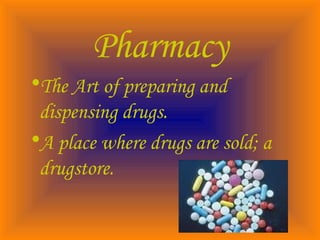
Pharmacy
•The Art of preparing and
dispensing drugs.
•A place where drugs are sold; a
drugstore.
• History of Career
• Expected Duties and
Physical Demands
• Training and
Education
• Personal Qualities
• Skill Measurement
• Code of Ethics
• Earnings/Benefi
ts
• Future outlook
• Bibliography
• Dates back to medieval times with
priests
• Origin of the word “pharmacy” come
from the Greek
• As much as 80,000 years ago people
of Paleolithic period were interested
in flora.
• It is hard to say when it started exactly
– It existed in a rudimentary form long before the word
existed.
• Combining different agents(compounding) was
considered an art form by priests and doctors.
• First known chemical process was carried out by
the artisans of Mesopotamia, Egypt, and China.
• Theories often involved magic, but developed
mathematical, astronomical, and cosmological
ideas.
• The first culture to consider ideas
scientifically was the Greeks.
– Made logical speculations rather than relying
on myth.
• Pharmacy began to develop as a profession
separate from medicine in the 18th
century.
– 1821 the first school of pharmacy was
established.
• Industrial Revolution
– Rapid change from hand methods to machine
methods of production that characterized
industrial revolution.
• Large scale drug manufacturing was big in
society;many machines and patents
• Declining art of Apothecary:
– Industrial Revolution had an impact of every
aspect of pharmacy.
• 1st
lead to creation of new drugs.
– Drugs many pharmacists couldn’t produce
• 2nd
many drugs could be produced more
economically & with better quality.
• 3rd
the industry assumed responsibilities for the
quality of medication instead of individuals.
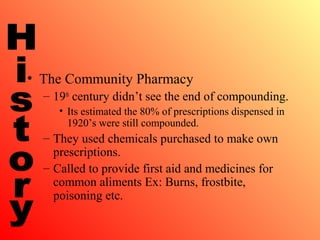
• The Community Pharmacy
– 19th
century didn’t see the end of compounding.
• Its estimated the 80% of prescriptions dispensed in
1920’s were still compounded.
– They used chemicals purchased to make own
prescriptions.
– Called to provide first aid and medicines for
common aliments Ex: Burns, frostbite,
poisoning etc.
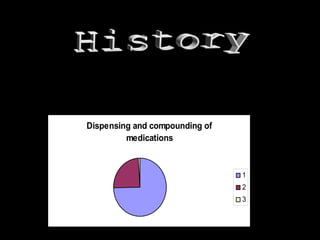
• Graph for 50 years
Between 1920-1971.
Dispensing and compounding of
medications
1
2
3
• Now they need to know things like shelf
life and effect of exposure to light,
– Judging reliability and reputation of
manufacturers.
• Compounding today is on the rise
– People are realizing the benefits
– Pharmacists are going back to it just for the
love science and interests.
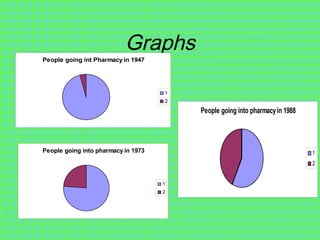
Graphs
People going int Pharmacy in 1947
1
2
People going into pharmacy in 1973
1
2
People going into pharmacyin 1988
1
2
• The Work
– Prepare and dispense drugs prescribed by
doctors.
– Advise doctors, patients, and other health
care professionals on proper dosage and
possible side effects.
• They must know what’s in the drug, how it
works, and how it affects people.
• Purchase medical supplies
• Answer customer questions
• Go with doctors and hospital
staff on rounds
• Advise patients on medical
equipment and over-the-
counter medication
• HELP PATIENTS GET WELL
• May work in a hospital, clinic, or drug
store
• Constantly learning and studying about
properties & side effects of new drugs.
• Communicate with doctors & patients
• Most work a standard work week
• Best job opportunities go to people with
best grades
– Lower grades will get you a job, however,
maybe part time
• Companies want people who graduate at
the top of the class.
• Fierce competition
Education
• Bachelor’s degree is being phased out
– Instead schools offer a doctor of
pharmacy (PharmD).
• Bachelor’s degrees will not be
awarded after 2005
Education-
Classes
• College Prep
– English
– Math
– Science
– Good written and verbal communication
skills
Education-
Classes
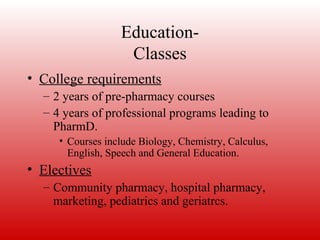
• College requirements
– 2 years of pre-pharmacy courses
– 4 years of professional programs leading to
PharmD.
• Courses include Biology, Chemistry, Calculus,
English, Speech and General Education.
• Electives
– Community pharmacy, hospital pharmacy,
marketing, pediatrics and geriatrcs.
Personal Qualities
• Have a good memory
• Enjoy learning about new medications &
treatments
• Be trustworthy & detail oriented
• Good communication skills
• Good problem solving abilities
• Enjoy people
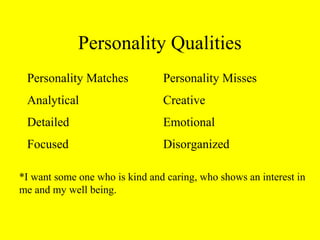
Personality Qualities
Personality Matches Personality Misses
Analytical Creative
Detailed Emotional
Focused Disorganized
*I want some one who is kind and caring, who shows an interest in
me and my well being.
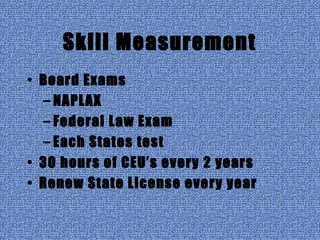
Skill Measurement
• Board Exams
– NAPLAX
– Federal Law Exam
– Each States test
• 30 hours of CEU’s every 2 years
• Renew State License every year
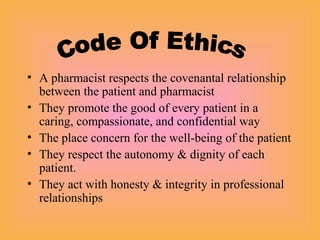
• A pharmacist respects the covenantal relationship
between the patient and pharmacist
• They promote the good of every patient in a
caring, compassionate, and confidential way
• The place concern for the well-being of the patient
• They respect the autonomy & dignity of each
patient.
• They act with honesty & integrity in professional
relationships
• They maintain professional competence
• They respect the values & abilities of colleagues
and other health care professionals
• They serve individual, community, and societal
needs
• They seek justice in the distribution of health
resources
– Very similar to many peoples morals.
Earnings/Benefits
Average
Earning
Average
Hourly Rate
$69,440 $33.39
California Pharmacist-
Staff average-$90,000-100,000 per
year
Manager- $100,000-150,000
Owner - $100,000-???
Pros Cons
Good Salaries Long Hours
Wide variety of
Careers
Potential Restlessness
Options
• INCREASING
NEED!!!!!
2000
workforce
2000-2010
Growth
Rate
217,000 24.3%
Other Places of Work
• Armed Services
• Community pharmacy
• Drug Research & Development
• Sales & Marketing
Armed Forces
• Air force
• Army
• Coast Guard
• Navy
*You need a 4
year college
degree in
pharmacy and
a state license
to practice
pharmacy.
• http://www.iit.edu/departments/csep/Public
WWW/codes/coe/American
%20Pharmaceutic…
• http://www.lindsaydrug.com/newhist.htm
• http://usa.cx.bridges.com/student/DisplayAr
ticle.do?
dt=Career+Information&dn=Pharmacist
• http://www.uspharmd.com/rxpharmacist.htm
• http://www.uspharmd.com/rxpharmacist2.htm
• http://www.uspharmd.com/rxpharmacist3.htm
• http://www.pharmacists-recruitment-
int.com/Pharmacits-
Recruitment/Professinal_Requirements.html
• Kevin House-interview
• http://www.op.nysed.gov/pharm.htm
• http://www.ask.com/-pictures

Pharmacists

  • 1.
    Formulation and In-vitroEvaluation of Gastro retentive Floating Tablets of Enalapril Maleate Using Natural and Synthetic Polymers September 2015
  • 2.
    Pharmacy •The Art ofpreparing and dispensing drugs. •A place where drugs are sold; a drugstore.
  • 3.
    • History ofCareer • Expected Duties and Physical Demands • Training and Education • Personal Qualities • Skill Measurement • Code of Ethics
  • 4.
    • Earnings/Benefi ts • Futureoutlook • Bibliography
  • 5.
    • Dates backto medieval times with priests • Origin of the word “pharmacy” come from the Greek • As much as 80,000 years ago people of Paleolithic period were interested in flora.
  • 6.
    • It ishard to say when it started exactly – It existed in a rudimentary form long before the word existed. • Combining different agents(compounding) was considered an art form by priests and doctors. • First known chemical process was carried out by the artisans of Mesopotamia, Egypt, and China. • Theories often involved magic, but developed mathematical, astronomical, and cosmological ideas.
  • 7.
    • The firstculture to consider ideas scientifically was the Greeks. – Made logical speculations rather than relying on myth. • Pharmacy began to develop as a profession separate from medicine in the 18th century. – 1821 the first school of pharmacy was established.
  • 8.
    • Industrial Revolution –Rapid change from hand methods to machine methods of production that characterized industrial revolution. • Large scale drug manufacturing was big in society;many machines and patents
  • 9.
    • Declining artof Apothecary: – Industrial Revolution had an impact of every aspect of pharmacy. • 1st lead to creation of new drugs. – Drugs many pharmacists couldn’t produce • 2nd many drugs could be produced more economically & with better quality. • 3rd the industry assumed responsibilities for the quality of medication instead of individuals.
  • 10.
    • The CommunityPharmacy – 19th century didn’t see the end of compounding. • Its estimated the 80% of prescriptions dispensed in 1920’s were still compounded. – They used chemicals purchased to make own prescriptions. – Called to provide first aid and medicines for common aliments Ex: Burns, frostbite, poisoning etc.
  • 11.
    • Graph for50 years Between 1920-1971. Dispensing and compounding of medications 1 2 3
  • 12.
    • Now theyneed to know things like shelf life and effect of exposure to light, – Judging reliability and reputation of manufacturers. • Compounding today is on the rise – People are realizing the benefits – Pharmacists are going back to it just for the love science and interests.
  • 13.
    Graphs People going intPharmacy in 1947 1 2 People going into pharmacy in 1973 1 2 People going into pharmacyin 1988 1 2
  • 14.
    • The Work –Prepare and dispense drugs prescribed by doctors. – Advise doctors, patients, and other health care professionals on proper dosage and possible side effects. • They must know what’s in the drug, how it works, and how it affects people.
  • 15.
    • Purchase medicalsupplies • Answer customer questions • Go with doctors and hospital staff on rounds • Advise patients on medical equipment and over-the- counter medication • HELP PATIENTS GET WELL
  • 16.
    • May workin a hospital, clinic, or drug store • Constantly learning and studying about properties & side effects of new drugs. • Communicate with doctors & patients • Most work a standard work week
  • 17.
    • Best jobopportunities go to people with best grades – Lower grades will get you a job, however, maybe part time • Companies want people who graduate at the top of the class. • Fierce competition
  • 18.
    Education • Bachelor’s degreeis being phased out – Instead schools offer a doctor of pharmacy (PharmD). • Bachelor’s degrees will not be awarded after 2005
  • 19.
    Education- Classes • College Prep –English – Math – Science – Good written and verbal communication skills
  • 20.
    Education- Classes • College requirements –2 years of pre-pharmacy courses – 4 years of professional programs leading to PharmD. • Courses include Biology, Chemistry, Calculus, English, Speech and General Education. • Electives – Community pharmacy, hospital pharmacy, marketing, pediatrics and geriatrcs.
  • 21.
    Personal Qualities • Havea good memory • Enjoy learning about new medications & treatments • Be trustworthy & detail oriented • Good communication skills • Good problem solving abilities • Enjoy people
  • 22.
    Personality Qualities Personality MatchesPersonality Misses Analytical Creative Detailed Emotional Focused Disorganized *I want some one who is kind and caring, who shows an interest in me and my well being.
  • 23.
    Skill Measurement • BoardExams – NAPLAX – Federal Law Exam – Each States test • 30 hours of CEU’s every 2 years • Renew State License every year
  • 24.
    • A pharmacistrespects the covenantal relationship between the patient and pharmacist • They promote the good of every patient in a caring, compassionate, and confidential way • The place concern for the well-being of the patient • They respect the autonomy & dignity of each patient. • They act with honesty & integrity in professional relationships
  • 25.
    • They maintainprofessional competence • They respect the values & abilities of colleagues and other health care professionals • They serve individual, community, and societal needs • They seek justice in the distribution of health resources – Very similar to many peoples morals.
  • 26.
    Earnings/Benefits Average Earning Average Hourly Rate $69,440 $33.39 CaliforniaPharmacist- Staff average-$90,000-100,000 per year Manager- $100,000-150,000 Owner - $100,000-???
  • 27.
    Pros Cons Good SalariesLong Hours Wide variety of Careers Potential Restlessness Options
  • 28.
  • 29.
    Other Places ofWork • Armed Services • Community pharmacy • Drug Research & Development • Sales & Marketing
  • 30.
    Armed Forces • Airforce • Army • Coast Guard • Navy *You need a 4 year college degree in pharmacy and a state license to practice pharmacy.
  • 31.
    • http://www.iit.edu/departments/csep/Public WWW/codes/coe/American %20Pharmaceutic… • http://www.lindsaydrug.com/newhist.htm •http://usa.cx.bridges.com/student/DisplayAr ticle.do? dt=Career+Information&dn=Pharmacist
  • 32.
    • http://www.uspharmd.com/rxpharmacist.htm • http://www.uspharmd.com/rxpharmacist2.htm •http://www.uspharmd.com/rxpharmacist3.htm • http://www.pharmacists-recruitment- int.com/Pharmacits- Recruitment/Professinal_Requirements.html • Kevin House-interview
  • 33.