PHARMACYPHARMACY
Prescription for a Rewarding CareerPrescription for a Rewarding Career©
American Association of Colleges of Pharmacy
1727 King Street
Alexandria, Virginia 22314
www.aacp.org
www.pharmcas.org
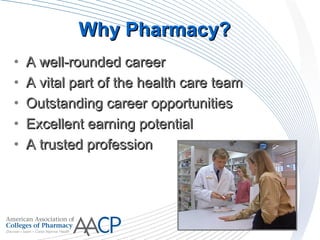
Why Pharmacy?Why Pharmacy?
• A well-rounded careerA well-rounded career
• A vital part of the health care teamA vital part of the health care team
• Outstanding career opportunitiesOutstanding career opportunities
• Excellent earning potentialExcellent earning potential
• A trusted professionA trusted profession
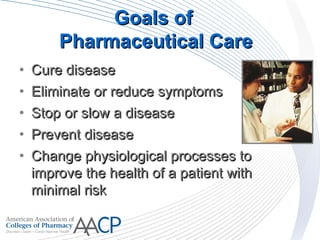
Goals ofGoals of
Pharmaceutical CarePharmaceutical Care
• Cure diseaseCure disease
• Eliminate or reduce symptomsEliminate or reduce symptoms
• Stop or slow a diseaseStop or slow a disease
• Prevent diseasePrevent disease
• Change physiological processes toChange physiological processes to
improve the health of a patient withimprove the health of a patient with
minimal riskminimal risk
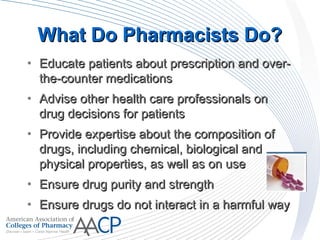
What Do Pharmacists Do?What Do Pharmacists Do?
• Educate patients about prescription and over-Educate patients about prescription and over-
the-counter medicationsthe-counter medications
• Advise other health care professionals onAdvise other health care professionals on
drug decisions for patientsdrug decisions for patients
• Provide expertise about the composition ofProvide expertise about the composition of
drugs, including chemical, biological anddrugs, including chemical, biological and
physical properties, as well as on usephysical properties, as well as on use
• Ensure drug purity and strengthEnsure drug purity and strength
• Ensure drugs do not interact in a harmful wayEnsure drugs do not interact in a harmful way
PHARMACISTSPHARMACISTS
areare
Drug Information ExpertsDrug Information Experts
No one knows more aboutNo one knows more about
medications thanmedications than
pharmacistspharmacists
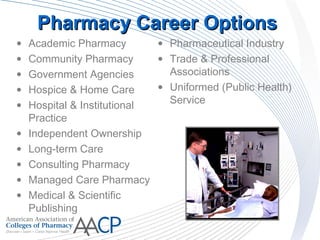
Pharmacy Career OptionsPharmacy Career Options
• Academic Pharmacy
• Community Pharmacy
• Government Agencies
• Hospice & Home Care
• Hospital & Institutional
Practice
• Independent Ownership
• Long-term Care
• Consulting Pharmacy
• Managed Care Pharmacy
• Medical & Scientific
Publishing
• Pharmaceutical Industry
• Trade & Professional
Associations
• Uniformed (Public Health)
Service
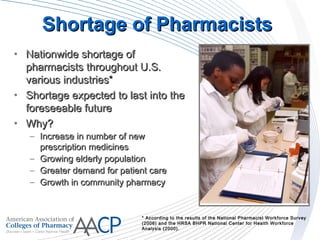
Shortage of PharmacistsShortage of Pharmacists
• Nationwide shortage ofNationwide shortage of
pharmacists throughout U.S.pharmacists throughout U.S.
various industriesvarious industries**
• Shortage expected to last into theShortage expected to last into the
foreseeable futureforeseeable future
• Why?Why?
– Increase in number of newIncrease in number of new
prescription medicinesprescription medicines
– Growing elderly populationGrowing elderly population
– Greater demand for patient careGreater demand for patient care
– Growth in community pharmacyGrowth in community pharmacy
* According to the results of the National Pharmacist Workforce Survey
(2006) and the HRSA BHPR National Center for Health Workforce
Analysis ((2000).).
• Nationwide Shortage = Increased DemandNationwide Shortage = Increased Demand
• Student pharmacists can expect multiple jobStudent pharmacists can expect multiple job
offers at graduationoffers at graduation
• Median salary in 2007 =Median salary in 2007 = $107,403$107,403
**According to DrugTopics.comAccording to DrugTopics.com
• Regional mobility - Demand for pharmacistsRegional mobility - Demand for pharmacists
is widespread in U.S.is widespread in U.S.
• Opportunities to work in wide variety of healthOpportunities to work in wide variety of health
care and industry settingscare and industry settings
Job OutlookJob Outlook
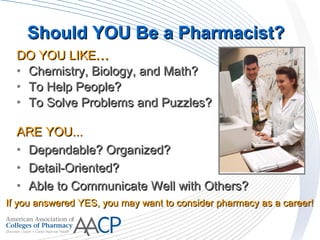
DO YOU LIKEDO YOU LIKE......
• Chemistry, Biology, and Math?Chemistry, Biology, and Math?
• To Help People?To Help People?
• To Solve Problems and Puzzles?To Solve Problems and Puzzles?
ARE YOU...ARE YOU...
• Dependable? Organized?Dependable? Organized?
• Detail-Oriented?Detail-Oriented?
• Able to Communicate Well with Others?Able to Communicate Well with Others?
If you answered YES, you may want to consider pharmacy as a career!If you answered YES, you may want to consider pharmacy as a career!
Should YOU Be a Pharmacist?Should YOU Be a Pharmacist?
Pharmacy EducationPharmacy Education
andand
Admission RequirementsAdmission Requirements
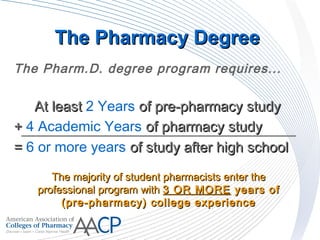
The Pharm.D. degree program requires...
At leastAt least 2 Years of pre-pharmacy studyof pre-pharmacy study
++ 4 Academic Years of pharmacy studyof pharmacy study
== 6 or more years of study after high schoolof study after high school
The Pharmacy DegreeThe Pharmacy Degree
The majority of student pharmacists enter theThe majority of student pharmacists enter the
professional program withprofessional program with 3 OR MORE3 OR MORE years ofyears of
(pre-pharmacy) college experience(pre-pharmacy) college experience
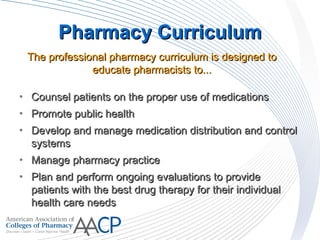
PharmacyPharmacy CurriculumCurriculum
• Counsel patients on the proper use of medicationsCounsel patients on the proper use of medications
• Promote public healthPromote public health
• Develop and manage medication distribution and controlDevelop and manage medication distribution and control
systemssystems
• Manage pharmacy practiceManage pharmacy practice
• Plan and perform ongoing evaluations to providePlan and perform ongoing evaluations to provide
patients with the best drug therapy for their individualpatients with the best drug therapy for their individual
health care needshealth care needs
The professional pharmacy curriculum is designed toThe professional pharmacy curriculum is designed to
educate pharmacists to...educate pharmacists to...
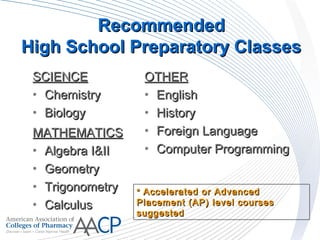
RecommendedRecommended
High School Preparatory ClassesHigh School Preparatory Classes
SCIENCESCIENCE
• ChemistryChemistry
• BiologyBiology
MATHEMATICSMATHEMATICS
• Algebra I&IIAlgebra I&II
• GeometryGeometry
• TrigonometryTrigonometry
• CalculusCalculus
OTHEROTHER
• EnglishEnglish
• HistoryHistory
• Foreign LanguageForeign Language
• Computer ProgrammingComputer Programming
** Accelerated or AdvancedAccelerated or Advanced
Placement (AP) level coursesPlacement (AP) level courses
suggestedsuggested
** Accelerated or AdvancedAccelerated or Advanced
Placement (AP) level coursesPlacement (AP) level courses
suggestedsuggested
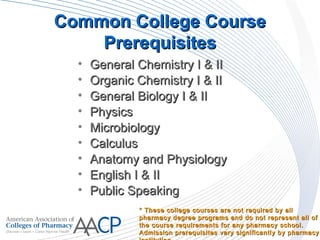
Common College CourseCommon College Course
PrerequisitesPrerequisites
• General Chemistry I & IIGeneral Chemistry I & II
• Organic Chemistry I & IIOrganic Chemistry I & II
• General Biology I & IIGeneral Biology I & II
• PhysicsPhysics
• MicrobiologyMicrobiology
• CalculusCalculus
• Anatomy and PhysiologyAnatomy and Physiology
• English I & IIEnglish I & II
• Public SpeakingPublic Speaking
* These college courses are not required by all* These college courses are not required by all
pharmacy degree programs and do not represent all ofpharmacy degree programs and do not represent all of
the course requirements for any pharmacy school.the course requirements for any pharmacy school.
Admission prerequisites vary significantly by pharmacyAdmission prerequisites vary significantly by pharmacy
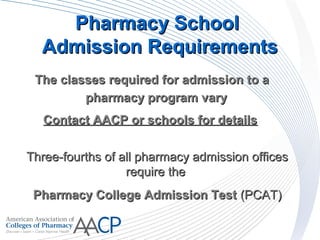
Pharmacy SchoolPharmacy School
Admission RequirementsAdmission Requirements
The classes required for admission to aThe classes required for admission to a
pharmacy program varypharmacy program vary
Contact AACP or schools for detailsContact AACP or schools for details
Three-fourths of all pharmacy admission officesThree-fourths of all pharmacy admission offices
require therequire the
Pharmacy College Admission TestPharmacy College Admission Test (PCAT)(PCAT)
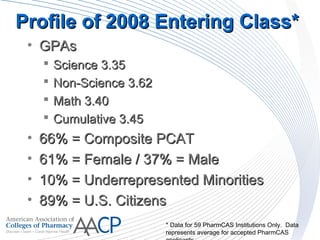
Profile of 2008 Entering Class*Profile of 2008 Entering Class*
• GPAsGPAs
 Science 3.35Science 3.35
 Non-Science 3.62Non-Science 3.62
 Math 3.40Math 3.40
 Cumulative 3.45Cumulative 3.45
• 66% = Composite PCAT66% = Composite PCAT
• 61% = Female / 37% = Male61% = Female / 37% = Male
• 10% = Underrepresented Minorities10% = Underrepresented Minorities
• 89% = U.S. Citizens89% = U.S. Citizens
* Data for 59 PharmCAS Institutions Only. Data
represents average for accepted PharmCAS
• 71 Participating PharmCAS Schools71 Participating PharmCAS Schools
• Allows an applicants to use oneAllows an applicants to use one
application and one set of materials toapplication and one set of materials to
apply to multiple Pharm.D. degreeapply to multiple Pharm.D. degree
programs.programs.
www.pharmcas.orgwww.pharmcas.org
DonDon’t Delay…’t Delay…
Find Out More Today!Find Out More Today!
American Association of Colleges of PharmacyAmerican Association of Colleges of Pharmacy
1727 King Street1727 King Street
Alexandria, Virginia 22314Alexandria, Virginia 22314
703/739-2330, x1024703/739-2330, x1024
JAthay@aacp.orgJAthay@aacp.org
www.aacp.orgwww.aacp.org

Pharmacy eac wordpress

  • 1.
    PHARMACYPHARMACY Prescription for aRewarding CareerPrescription for a Rewarding Career© American Association of Colleges of Pharmacy 1727 King Street Alexandria, Virginia 22314 www.aacp.org www.pharmcas.org
  • 2.
    Why Pharmacy?Why Pharmacy? •A well-rounded careerA well-rounded career • A vital part of the health care teamA vital part of the health care team • Outstanding career opportunitiesOutstanding career opportunities • Excellent earning potentialExcellent earning potential • A trusted professionA trusted profession
  • 3.
    Goals ofGoals of PharmaceuticalCarePharmaceutical Care • Cure diseaseCure disease • Eliminate or reduce symptomsEliminate or reduce symptoms • Stop or slow a diseaseStop or slow a disease • Prevent diseasePrevent disease • Change physiological processes toChange physiological processes to improve the health of a patient withimprove the health of a patient with minimal riskminimal risk
  • 4.
    What Do PharmacistsDo?What Do Pharmacists Do? • Educate patients about prescription and over-Educate patients about prescription and over- the-counter medicationsthe-counter medications • Advise other health care professionals onAdvise other health care professionals on drug decisions for patientsdrug decisions for patients • Provide expertise about the composition ofProvide expertise about the composition of drugs, including chemical, biological anddrugs, including chemical, biological and physical properties, as well as on usephysical properties, as well as on use • Ensure drug purity and strengthEnsure drug purity and strength • Ensure drugs do not interact in a harmful wayEnsure drugs do not interact in a harmful way
  • 5.
    PHARMACISTSPHARMACISTS areare Drug Information ExpertsDrugInformation Experts No one knows more aboutNo one knows more about medications thanmedications than pharmacistspharmacists
  • 6.
    Pharmacy Career OptionsPharmacyCareer Options • Academic Pharmacy • Community Pharmacy • Government Agencies • Hospice & Home Care • Hospital & Institutional Practice • Independent Ownership • Long-term Care • Consulting Pharmacy • Managed Care Pharmacy • Medical & Scientific Publishing • Pharmaceutical Industry • Trade & Professional Associations • Uniformed (Public Health) Service
  • 7.
    Shortage of PharmacistsShortageof Pharmacists • Nationwide shortage ofNationwide shortage of pharmacists throughout U.S.pharmacists throughout U.S. various industriesvarious industries** • Shortage expected to last into theShortage expected to last into the foreseeable futureforeseeable future • Why?Why? – Increase in number of newIncrease in number of new prescription medicinesprescription medicines – Growing elderly populationGrowing elderly population – Greater demand for patient careGreater demand for patient care – Growth in community pharmacyGrowth in community pharmacy * According to the results of the National Pharmacist Workforce Survey (2006) and the HRSA BHPR National Center for Health Workforce Analysis ((2000).).
  • 8.
    • Nationwide Shortage= Increased DemandNationwide Shortage = Increased Demand • Student pharmacists can expect multiple jobStudent pharmacists can expect multiple job offers at graduationoffers at graduation • Median salary in 2007 =Median salary in 2007 = $107,403$107,403 **According to DrugTopics.comAccording to DrugTopics.com • Regional mobility - Demand for pharmacistsRegional mobility - Demand for pharmacists is widespread in U.S.is widespread in U.S. • Opportunities to work in wide variety of healthOpportunities to work in wide variety of health care and industry settingscare and industry settings Job OutlookJob Outlook
  • 9.
    DO YOU LIKEDOYOU LIKE...... • Chemistry, Biology, and Math?Chemistry, Biology, and Math? • To Help People?To Help People? • To Solve Problems and Puzzles?To Solve Problems and Puzzles? ARE YOU...ARE YOU... • Dependable? Organized?Dependable? Organized? • Detail-Oriented?Detail-Oriented? • Able to Communicate Well with Others?Able to Communicate Well with Others? If you answered YES, you may want to consider pharmacy as a career!If you answered YES, you may want to consider pharmacy as a career! Should YOU Be a Pharmacist?Should YOU Be a Pharmacist?
  • 10.
  • 11.
    The Pharm.D. degreeprogram requires... At leastAt least 2 Years of pre-pharmacy studyof pre-pharmacy study ++ 4 Academic Years of pharmacy studyof pharmacy study == 6 or more years of study after high schoolof study after high school The Pharmacy DegreeThe Pharmacy Degree The majority of student pharmacists enter theThe majority of student pharmacists enter the professional program withprofessional program with 3 OR MORE3 OR MORE years ofyears of (pre-pharmacy) college experience(pre-pharmacy) college experience
  • 12.
    PharmacyPharmacy CurriculumCurriculum • Counselpatients on the proper use of medicationsCounsel patients on the proper use of medications • Promote public healthPromote public health • Develop and manage medication distribution and controlDevelop and manage medication distribution and control systemssystems • Manage pharmacy practiceManage pharmacy practice • Plan and perform ongoing evaluations to providePlan and perform ongoing evaluations to provide patients with the best drug therapy for their individualpatients with the best drug therapy for their individual health care needshealth care needs The professional pharmacy curriculum is designed toThe professional pharmacy curriculum is designed to educate pharmacists to...educate pharmacists to...
  • 13.
    RecommendedRecommended High School PreparatoryClassesHigh School Preparatory Classes SCIENCESCIENCE • ChemistryChemistry • BiologyBiology MATHEMATICSMATHEMATICS • Algebra I&IIAlgebra I&II • GeometryGeometry • TrigonometryTrigonometry • CalculusCalculus OTHEROTHER • EnglishEnglish • HistoryHistory • Foreign LanguageForeign Language • Computer ProgrammingComputer Programming ** Accelerated or AdvancedAccelerated or Advanced Placement (AP) level coursesPlacement (AP) level courses suggestedsuggested ** Accelerated or AdvancedAccelerated or Advanced Placement (AP) level coursesPlacement (AP) level courses suggestedsuggested
  • 14.
    Common College CourseCommonCollege Course PrerequisitesPrerequisites • General Chemistry I & IIGeneral Chemistry I & II • Organic Chemistry I & IIOrganic Chemistry I & II • General Biology I & IIGeneral Biology I & II • PhysicsPhysics • MicrobiologyMicrobiology • CalculusCalculus • Anatomy and PhysiologyAnatomy and Physiology • English I & IIEnglish I & II • Public SpeakingPublic Speaking * These college courses are not required by all* These college courses are not required by all pharmacy degree programs and do not represent all ofpharmacy degree programs and do not represent all of the course requirements for any pharmacy school.the course requirements for any pharmacy school. Admission prerequisites vary significantly by pharmacyAdmission prerequisites vary significantly by pharmacy
  • 15.
    Pharmacy SchoolPharmacy School AdmissionRequirementsAdmission Requirements The classes required for admission to aThe classes required for admission to a pharmacy program varypharmacy program vary Contact AACP or schools for detailsContact AACP or schools for details Three-fourths of all pharmacy admission officesThree-fourths of all pharmacy admission offices require therequire the Pharmacy College Admission TestPharmacy College Admission Test (PCAT)(PCAT)
  • 16.
    Profile of 2008Entering Class*Profile of 2008 Entering Class* • GPAsGPAs  Science 3.35Science 3.35  Non-Science 3.62Non-Science 3.62  Math 3.40Math 3.40  Cumulative 3.45Cumulative 3.45 • 66% = Composite PCAT66% = Composite PCAT • 61% = Female / 37% = Male61% = Female / 37% = Male • 10% = Underrepresented Minorities10% = Underrepresented Minorities • 89% = U.S. Citizens89% = U.S. Citizens * Data for 59 PharmCAS Institutions Only. Data represents average for accepted PharmCAS
  • 17.
    • 71 ParticipatingPharmCAS Schools71 Participating PharmCAS Schools • Allows an applicants to use oneAllows an applicants to use one application and one set of materials toapplication and one set of materials to apply to multiple Pharm.D. degreeapply to multiple Pharm.D. degree programs.programs. www.pharmcas.orgwww.pharmcas.org
  • 18.
    DonDon’t Delay…’t Delay… FindOut More Today!Find Out More Today! American Association of Colleges of PharmacyAmerican Association of Colleges of Pharmacy 1727 King Street1727 King Street Alexandria, Virginia 22314Alexandria, Virginia 22314 703/739-2330, x1024703/739-2330, x1024 JAthay@aacp.orgJAthay@aacp.org www.aacp.orgwww.aacp.org

Editor's Notes

  • #12 As of Fall 2008 80% of accepted students had 3 or more years of education prior to pharmacy school