Introduction to Pharmacy
Practice
&
Its Scopes
MN Islam, PhD
(Molecular Pharmacology)
1
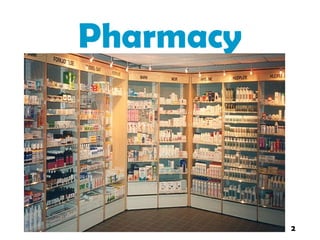
Pharmacy
2
Pharmacy Profession: …. Actual meaning?
. Pharmacy is the health profession that links the
health sciences with the chemical sciences and it is
charged with ensuring the safe and effective use of
pharmaceutical drugs. The word derives from the
Greek: (pharmakon), meaning "drug" or "medicine.
Pharmacy
Art and science of preparing and dispensing
medicine
Provision for sharing drug related information
to the public to ensure safe end effective uses
of medication
3
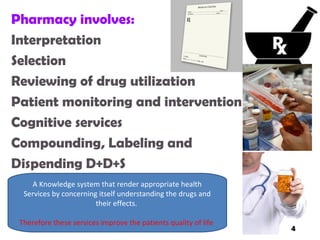
Pharmacy involves:
Interpretation
Selection
Reviewing of drug utilization
Patient monitoring and intervention
Cognitive services
Compounding, Labeling and
Dispending D+D+S
A Knowledge system that render appropriate health
Services by concerning itself understanding the drugs and
their effects.
Therefore these services improve the patients quality of life
4
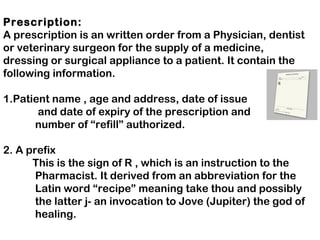
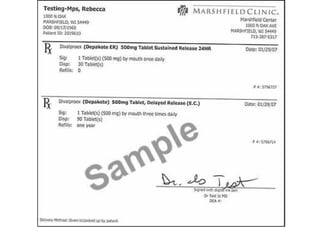
Prescription:
A prescription is an written order from a Physician, dentist
or veterinary surgeon for the supply of a medicine,
dressing or surgical appliance to a patient. It contain the
following information.
1.Patient name , age and address, date of issue
and date of expiry of the prescription and
number of “refill” authorized.
2. A prefix
This is the sign of R , which is an instruction to the
Pharmacist. It derived from an abbreviation for the
Latin word “recipe” meaning take thou and possibly
the latter j- an invocation to Jove (Jupiter) the god of
healing.
3. The name and quantity of medicine to be
supplied
The medicament may supplied as
a. An official name, preparation together with quantity
name
b. A proprietary product, together with quantity
required.
4. Instruction for the patient
These includes
a. The method of administration or application
b. The dose. If preparation is for internal use
c. The time of administration or application
d. The diluents if needed or means of application
e. The part of the body to which preparation to be
applied
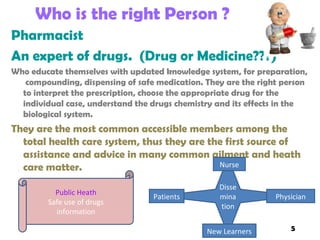
Pharmacist
An expert of drugs. (Drug or Medicine???)
Who educate themselves with updated knowledge system, for preparation,
compounding, dispensing of safe medication. They are the right person
to interpret the prescription, choose the appropriate drug for the
individual case, understand the drugs chemistry and its effects in the
biological system.
They are the most common accessible members among the
total health care system, thus they are the first source of
assistance and advice in many common ailment and heath
care matter.
Who is the right Person ?
Disse
mina
tion
Patients
New Learners
Nurse
Physician
Public Heath
Safe use of drugs
information
5
Pharmacists are members of pharmacy
profession dealing with all aspects of drugs.
Pharmacists arePharmacists are experts of drugsexperts of drugs..
• Preparation • Combination
• Identification • Analysis
• Selection • Standardization
• Action • Use
• Preservation • Counseling
• Sales • Information
6
Roles of Pharmacist:
Pharmacists play an important role in helping people to get the
best results from their medications. The pharmacist is an
accessible liaison whom patients can talk to face-to-face, without
an appointment.
He or she is someone who can answer health-related questions
— what foods, drinks, activities, or other drugs could have an
effect on medication or what to do about a missed dose.
Essentially, pharmacists help people with almost anything related
to the use of medicines, which means they help people to stay as
healthy as possible. If this sounds interesting to you, then
perhaps becoming a pharmacist— a trusted, caring, and
knowledgeable health care professional — might very well be
you.
7
Am I interested to help people?
 Am I be very good listener and critical thinker?
 Do I have strong interest in math's and science
subjects?
 Do I enjoy health related profession, working
directly with physicians, nurses and other health care
professionals?
 Do I wish to work in a exciting and dynamic
environment where lives are saved everyday?
 Am I seeking endless opportunity for career growth
?If you answer “Yes”
to any of those
question, pharmacy
would
be the very good
choice of profession
for you.
How can I understand that I am the
right person to be a Pharmacist?
8
Well come to Pharmacy Profession
An exciting career choice
 A trusted Profession
 Room to grow
 Excellent Earning potential and job security
Pharmacy combines science,
health care, computer technology,
business, math and counseling.
Often, jobs in the sciences involve
limited interaction with the
public, but pharmacy offers a rare
balance of independence and
interaction with customers, which
can be very appealing if you’re a
"people person." If you’re looking
for adventure, you might be
surprised to learn that pharmacy
can be very exciting; there’s a
place for pharmacists out on the
front lines, offering services
during natural disasters,
epidemics, and other crises.
9
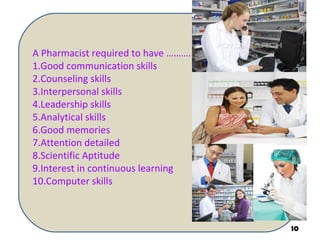
A Pharmacist required to have ………..
1.Good communication skills
2.Counseling skills
3.Interpersonal skills
4.Leadership skills
5.Analytical skills
6.Good memories
7.Attention detailed
8.Scientific Aptitude
9.Interest in continuous learning
10.Computer skills
10
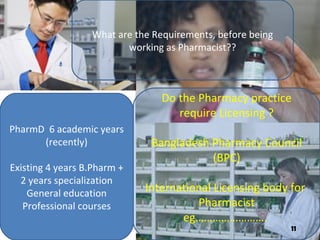
What are the Requirements, before being
working as Pharmacist??
PharmD 6 academic years
(recently)
Existing 4 years B.Pharm +
2 years specialization
General education
Professional courses
Do the Pharmacy practice
require Licensing ?
Bangladesh Pharmacy Council
(BPC)
International Licensing body for
Pharmacist
eg…………………….
11
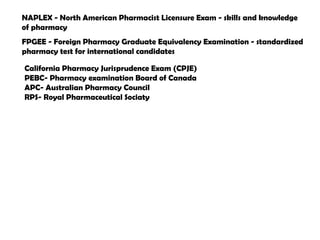
California Pharmacy Jurisprudence Exam (CPJE)
PEBC- Pharmacy examination Board of Canada
APC- Australian Pharmacy Council
RPS- Royal Pharmaceutical Sociaty
FPGEE - Foreign Pharmacy Graduate Equivalency Examination - standardized
pharmacy test for international candidates
NAPLEX - North American Pharmacist Licensure Exam - skills and knowledge
of pharmacy
12
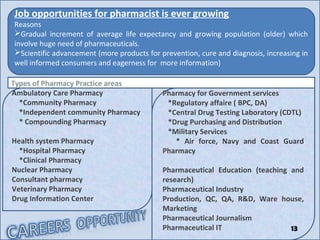
Job opportunities for pharmacist is ever growing
Reasons
Gradual increment of average life expectancy and growing population (older) which
involve huge need of pharmaceuticals.
Scientific advancement (more products for prevention, cure and diagnosis, increasing in
well informed consumers and eagerness for more information)
Ambulatory Care Pharmacy
*Community Pharmacy
*Independent community Pharmacy
* Compounding Pharmacy
Health system Pharmacy
*Hospital Pharmacy
*Clinical Pharmacy
Nuclear Pharmacy
Consultant pharmacy
Veterinary Pharmacy
Drug Information Center
Types of Pharmacy Practice areas
Pharmacy for Government services
*Regulatory affaire ( BPC, DA)
*Central Drug Testing Laboratory (CDTL)
*Drug Purchasing and Distribution
*Military Services
* Air force, Navy and Coast Guard
Pharmacy
Pharmaceutical Education (teaching and
research)
Pharmaceutical Industry
Production, QC, QA, R&D, Ware house,
Marketing
Pharmaceutical Journalism
Pharmaceutical IT 13
What is a drug?
a. “Pharmakon”
b. Articles recognized in the official USP, NF
c. Articles intended for use in the Dx, cure, mitigation, Tx,
prevention of disease in man and animals and enlisted their
name in the official books like Pharmacopoeia, Natinal
Formulary are regarded as drug.
d. Articles (other than food) intended to affect the structure or
any function of body of man/animals
e. Articles intended for use as a component of any article
specified in the first 3 but doesnt include devices, or their
components, parts or accessories
f. Active ingredient exerting therapeutic effect
14
What is a medicine?
• Drug as the active ingredient + excipients
formulated into a suitable dosage form with
complete packaging
15
Classification of drugs?
• Ethical / Prescription drugs
– Use for Mx / Tx of diseases
– Require prescription form
• Over the counter/ Non-Rx
– Use for the prevention of self-limiting or minor
ailments
– No Rx form needed
16
Sources of drug Information or Official books
BNF
BPC
BPJ
BVC
Extra Pharmacopoeia
I P
IP
EP
USP
NF
2. http://www.pharmacyforme.org/index.php/the-411-on-pharmacy/learn-
about-pharmacy/2-uncategorised/93
3. http://en.wikipedia.org/wiki/Pharmacy
1. The Science and practice of Pharmacy by Remington
17
Thank you

Introduction of pharmacy,

  • 1.
    Introduction to Pharmacy Practice & ItsScopes MN Islam, PhD (Molecular Pharmacology) 1
  • 2.
  • 3.
    Pharmacy Profession: ….Actual meaning? . Pharmacy is the health profession that links the health sciences with the chemical sciences and it is charged with ensuring the safe and effective use of pharmaceutical drugs. The word derives from the Greek: (pharmakon), meaning "drug" or "medicine. Pharmacy Art and science of preparing and dispensing medicine Provision for sharing drug related information to the public to ensure safe end effective uses of medication 3
  • 4.
    Pharmacy involves: Interpretation Selection Reviewing ofdrug utilization Patient monitoring and intervention Cognitive services Compounding, Labeling and Dispending D+D+S A Knowledge system that render appropriate health Services by concerning itself understanding the drugs and their effects. Therefore these services improve the patients quality of life 4
  • 5.
    Prescription: A prescription isan written order from a Physician, dentist or veterinary surgeon for the supply of a medicine, dressing or surgical appliance to a patient. It contain the following information. 1.Patient name , age and address, date of issue and date of expiry of the prescription and number of “refill” authorized. 2. A prefix This is the sign of R , which is an instruction to the Pharmacist. It derived from an abbreviation for the Latin word “recipe” meaning take thou and possibly the latter j- an invocation to Jove (Jupiter) the god of healing.
  • 7.
    3. The nameand quantity of medicine to be supplied The medicament may supplied as a. An official name, preparation together with quantity name b. A proprietary product, together with quantity required. 4. Instruction for the patient These includes a. The method of administration or application b. The dose. If preparation is for internal use c. The time of administration or application d. The diluents if needed or means of application e. The part of the body to which preparation to be applied
  • 8.
    Pharmacist An expert ofdrugs. (Drug or Medicine???) Who educate themselves with updated knowledge system, for preparation, compounding, dispensing of safe medication. They are the right person to interpret the prescription, choose the appropriate drug for the individual case, understand the drugs chemistry and its effects in the biological system. They are the most common accessible members among the total health care system, thus they are the first source of assistance and advice in many common ailment and heath care matter. Who is the right Person ? Disse mina tion Patients New Learners Nurse Physician Public Heath Safe use of drugs information 5
  • 9.
    Pharmacists are membersof pharmacy profession dealing with all aspects of drugs. Pharmacists arePharmacists are experts of drugsexperts of drugs.. • Preparation • Combination • Identification • Analysis • Selection • Standardization • Action • Use • Preservation • Counseling • Sales • Information 6
  • 10.
    Roles of Pharmacist: Pharmacistsplay an important role in helping people to get the best results from their medications. The pharmacist is an accessible liaison whom patients can talk to face-to-face, without an appointment. He or she is someone who can answer health-related questions — what foods, drinks, activities, or other drugs could have an effect on medication or what to do about a missed dose. Essentially, pharmacists help people with almost anything related to the use of medicines, which means they help people to stay as healthy as possible. If this sounds interesting to you, then perhaps becoming a pharmacist— a trusted, caring, and knowledgeable health care professional — might very well be you. 7
  • 11.
    Am I interestedto help people?  Am I be very good listener and critical thinker?  Do I have strong interest in math's and science subjects?  Do I enjoy health related profession, working directly with physicians, nurses and other health care professionals?  Do I wish to work in a exciting and dynamic environment where lives are saved everyday?  Am I seeking endless opportunity for career growth ?If you answer “Yes” to any of those question, pharmacy would be the very good choice of profession for you. How can I understand that I am the right person to be a Pharmacist? 8
  • 12.
    Well come toPharmacy Profession An exciting career choice  A trusted Profession  Room to grow  Excellent Earning potential and job security Pharmacy combines science, health care, computer technology, business, math and counseling. Often, jobs in the sciences involve limited interaction with the public, but pharmacy offers a rare balance of independence and interaction with customers, which can be very appealing if you’re a "people person." If you’re looking for adventure, you might be surprised to learn that pharmacy can be very exciting; there’s a place for pharmacists out on the front lines, offering services during natural disasters, epidemics, and other crises. 9
  • 13.
    A Pharmacist requiredto have ……….. 1.Good communication skills 2.Counseling skills 3.Interpersonal skills 4.Leadership skills 5.Analytical skills 6.Good memories 7.Attention detailed 8.Scientific Aptitude 9.Interest in continuous learning 10.Computer skills 10
  • 14.
    What are theRequirements, before being working as Pharmacist?? PharmD 6 academic years (recently) Existing 4 years B.Pharm + 2 years specialization General education Professional courses Do the Pharmacy practice require Licensing ? Bangladesh Pharmacy Council (BPC) International Licensing body for Pharmacist eg……………………. 11
  • 15.
    California Pharmacy JurisprudenceExam (CPJE) PEBC- Pharmacy examination Board of Canada APC- Australian Pharmacy Council RPS- Royal Pharmaceutical Sociaty FPGEE - Foreign Pharmacy Graduate Equivalency Examination - standardized pharmacy test for international candidates NAPLEX - North American Pharmacist Licensure Exam - skills and knowledge of pharmacy
  • 16.
  • 17.
    Job opportunities forpharmacist is ever growing Reasons Gradual increment of average life expectancy and growing population (older) which involve huge need of pharmaceuticals. Scientific advancement (more products for prevention, cure and diagnosis, increasing in well informed consumers and eagerness for more information) Ambulatory Care Pharmacy *Community Pharmacy *Independent community Pharmacy * Compounding Pharmacy Health system Pharmacy *Hospital Pharmacy *Clinical Pharmacy Nuclear Pharmacy Consultant pharmacy Veterinary Pharmacy Drug Information Center Types of Pharmacy Practice areas Pharmacy for Government services *Regulatory affaire ( BPC, DA) *Central Drug Testing Laboratory (CDTL) *Drug Purchasing and Distribution *Military Services * Air force, Navy and Coast Guard Pharmacy Pharmaceutical Education (teaching and research) Pharmaceutical Industry Production, QC, QA, R&D, Ware house, Marketing Pharmaceutical Journalism Pharmaceutical IT 13
  • 18.
    What is adrug? a. “Pharmakon” b. Articles recognized in the official USP, NF c. Articles intended for use in the Dx, cure, mitigation, Tx, prevention of disease in man and animals and enlisted their name in the official books like Pharmacopoeia, Natinal Formulary are regarded as drug. d. Articles (other than food) intended to affect the structure or any function of body of man/animals e. Articles intended for use as a component of any article specified in the first 3 but doesnt include devices, or their components, parts or accessories f. Active ingredient exerting therapeutic effect 14
  • 19.
    What is amedicine? • Drug as the active ingredient + excipients formulated into a suitable dosage form with complete packaging 15
  • 20.
    Classification of drugs? •Ethical / Prescription drugs – Use for Mx / Tx of diseases – Require prescription form • Over the counter/ Non-Rx – Use for the prevention of self-limiting or minor ailments – No Rx form needed 16
  • 21.
    Sources of drugInformation or Official books BNF BPC BPJ BVC Extra Pharmacopoeia I P IP EP USP NF
  • 22.
  • 23.