AVILEEN KAUR
ASSISTANT PROFESSOR
DEPT. OF PHARMACOLOGY
ISF COLLEGE OF PHARMACY
WEBSITE: - WWW.ISFCP.ORG
EMAIL: avileenkaurbrar@gmail.com
ISF College of Pharmacy, Moga
Ghal Kalan, nGT Road, Moga- 142001, Punjab, INDIA
2Contents
Introduction
Aim And Scope
Need of pharmacovigilance
Governing bodies
Other historic violations
Adverse drug reaction
Type of drug reaction
Steps of ADR monitoring
Withdrawal of drug from market
Recently banned drug in India
3Introduction
 It is the pharmacological science relating to the collection, detection,
assessment, monitoring, and prevention of adverse reaction with pharmaceutical
products.
"Pharmacovigilance”
( Pharmakon - drug + vigilare - to keep watch)
What is Pharmacovigilance ?
4Aim and Scope
 Patient care • to improve patient care & safety in relation to medicines & all
medical & para-medical interventions
 Public health • to improve public health & safety in relation to the use of
medicines in public health
 Risk benefit assessment • to contribute to the assessment of benefit, harm,
effectiveness and risk of medicines risk benefit assessment
 Communication • to promote understanding, clinical training & effective
communication to health professionals & the public
5Need of Pharmacovigilance
1.Humanitarian concern
-Animal toxicology is often not a good predictor for human effects .
-Evidence of safety from clinical trials is insufficient due to some limitations
Limitations (phase 1-3):
-Limited size
-Narrow population (age &sex specific),
-Narrow indications (only specific disease),
-Short duration
6Contd.....
2. Safe use of medicines- It Has Been Suggested That ADRs May
Cause 5700 Deaths Per Year In UK
3.Promoting Rational Use of Medicines
4.Ensuring Public Confidence
5.Ethical Concern
Not reporting a serious reaction is unethical
7Governing Bodies
 The pharmaceutical industry
 Regulatory authorities
 WHO Collaborating Centre for International Drug Monitoring
 CIOMS (Council for International Organisation of Medical Sciences)
8Why these Studies Started?
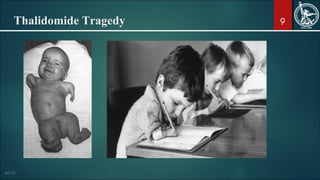
Thalidomide tragedy (1961-62): the greatest of all drug disasters.
Thalidomide had been introduced and welcomed as a safe and effective
hypnotic and antiemetic. It rapidly became popular for the treatment of nausea
and vomiting in early pregnancy.
Tragically the drug proved to be a potent human teratogen that caused major
birth defects in an estimated 10,000 children
Phocomelia was a characteristic feature
9Thalidomide Tragedy
10Other Historic Violations
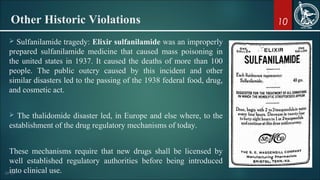
 Sulfanilamide tragedy: Elixir sulfanilamide was an improperly
prepared sulfanilamide medicine that caused mass poisoning in
the united states in 1937. It caused the deaths of more than 100
people. The public outcry caused by this incident and other
similar disasters led to the passing of the 1938 federal food, drug,
and cosmetic act.
 The thalidomide disaster led, in Europe and else where, to the
establishment of the drug regulatory mechanisms of today.
These mechanisms require that new drugs shall be licensed by
well established regulatory authorities before being introduced
into clinical use.
11
List of a few licenced medicines withdrawn after
marketing for drug safety reasons:
1. Practolol - blindness
2. Benoxaprofen - causes onycholysis, renal,
liver, bone marrow toxicity
3. Encainide - excessive mortality
4. Rofecoxib due to incresed cardiovascular
risks
5. Valdecoxib - due to Stevens-Johnson
syndrome
12Adverse Drug Reaction
Adverse event reporting- comprises 4 elements
1. An identifiable patient
2. An identifiable reporter
3. A suspect drug
4. A suspected adverse event
13Types of ADR
 Non immunological
a) TYPE A (or) predictable
b) TYPE B (or) unpredictable
 Immunological
a) Type -I (IGE mediated)
B) TYPE -II (cytotoxic)
C) TYPE -III (immune complex)
D) TYPE -IV (cell mediated)
 Miscellaneous
a) jarisch - herxheimer reaction
B) infectious mononucleosis
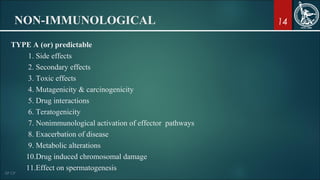
14NON-IMMUNOLOGICAL
TYPE A (or) predictable
1. Side effects
2. Secondary effects
3. Toxic effects
4. Mutagenicity & carcinogenicity
5. Drug interactions
6. Teratogenicity
7. Nonimmunological activation of effector pathways
8. Exacerbation of disease
9. Metabolic alterations
10.Drug induced chromosomal damage
11.Effect on spermatogenesis
15
TYPE B (or) unpredictable:
1. Intolerance
2. Idiosyncrasy
Contd.....
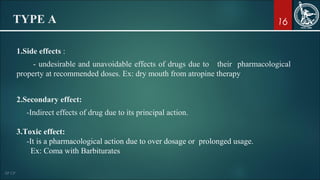
16TYPE A
1.Side effects :
- undesirable and unavoidable effects of drugs due to their pharmacological
property at recommended doses. Ex: dry mouth from atropine therapy
2.Secondary effect:
-Indirect effects of drug due to its principal action.
3.Toxic effect:
-It is a pharmacological action due to over dosage or prolonged usage.
Ex: Coma with Barbiturates
17
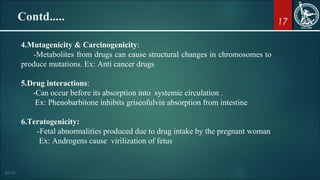
4.Mutagenicity & Carcinogenicity:
-Metabolites from drugs can cause structural changes in chromosomes to
produce mutations. Ex: Anti cancer drugs
5.Drug interactions:
-Can occur before its absorption into systemic circulation .
Ex: Phenobarbitone inhibits griseofulvin absorption from intestine
6.Teratogenicity:
-Fetal abnormalities produced due to drug intake by the pregnant woman
Ex: Androgens cause virilization of fetus
Contd.....
18
7.Non immunological activation of effector pathways:
-Some drugs cause release of mediators from mast cells resulting in urticaria.
Ex: Radio contrast media
8.Exacerbation of disease :
-Barbiturates precipitate symptoms of porphyria
9.Drug induced chromosomal damage:
-Also called clastogens
Ex: antibiotics, anticonvulsants
10.Effect on spermatogenesis:
-Cytotoxic drugs causes oligospermia.
Contd.....
19TYPE B
1. Intolerance:
-Appearance of toxic effects in a recipient to therapeutic doses of drug
Ex: trifluperazine single dose causing muscle dystonia in children
2. Idiosyncrasy:
-Uncertain reaction to a drug in a genetically defect patient
Ex:chloramphenicol causes bone marrow depression
20Miscellaneous
1. Jarisch-herxheimer reaction:
-This is seen when an infective disease is treated with antimicrobials , due
to release of active substances from dead micro organisms and injured tissue
resulting in focal exacerbation of the lesions.
2. Infectious mononucleosis:
-Ampicillin induced morbilliform rash in patients suffering from infectious
mononucleosis.
21Steps of ADR Monitoring
1.Identifying adverse drug reactions
2.Assessing causality
3.Documentation of ADR
4.Reporting serious ADRs to PV centres /ADR regulatory authorities
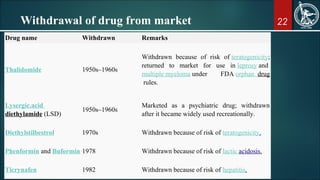
22Withdrawal of drug from market
Drug name Withdrawn Remarks
Thalidomide 1950s–1960s
Withdrawn because of risk of teratogenicity;
returned to market for use in leprosy and
multiple myeloma under FDA orphan drug
rules.
Lysergic.acid
diethylamide (LSD)
1950s–1960s
Marketed as a psychiatric drug; withdrawn
after it became widely used recreationally.
Diethylstilbestrol 1970s Withdrawn because of risk of teratogenicity.
Phenformin and Buformin 1978 Withdrawn because of risk of lactic acidosis.
Ticrynafen 1982 Withdrawn because of risk of hepatitis.
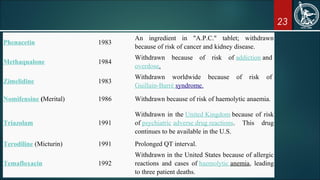
23
Phenacetin 1983
An ingredient in "A.P.C." tablet; withdrawn
because of risk of cancer and kidney disease.
Methaqualone 1984
Withdrawn because of risk of addiction and
overdose.
Zimelidine 1983
Withdrawn worldwide because of risk of
Guillain-Barré syndrome.
Nomifensine (Merital) 1986 Withdrawn because of risk of haemolytic anaemia.
Triazolam 1991
Withdrawn in the United Kingdom because of risk
of psychiatric adverse drug reactions. This drug
continues to be available in the U.S.
Terodiline (Micturin) 1991 Prolonged QT interval.
Temafloxacin 1992
Withdrawn in the United States because of allergic
reactions and cases of haemolytic anemia, leading
to three patient deaths.
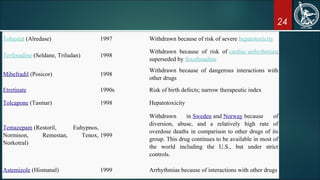
24
Tolrestat (Alredase) 1997 Withdrawn because of risk of severe hepatotoxicity
Terfenadine (Seldane, Triludan) 1998
Withdrawn because of risk of cardiac arrhythmias;
superseded by fexofenadine
Mibefradil (Posicor) 1998
Withdrawn because of dangerous interactions with
other drugs
Etretinate 1990s Risk of birth defects; narrow therapeutic index
Tolcapone (Tasmar) 1998 Hepatotoxicity
Temazepam (Restoril, Euhypnos,
Normison, Remestan, Tenox,
Norkotral)
1999
Withdrawn in Sweden and Norway because of
diversion, abuse, and a relatively high rate of
overdose deaths in comparison to other drugs of its
group. This drug continues to be available in most of
the world including the U.S., but under strict
controls.
Astemizole (Hismanal) 1999 Arrhythmias because of interactions with other drugs
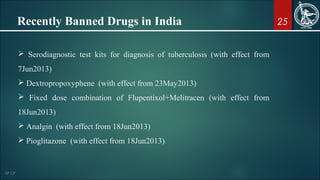
25
 Serodiagnostic test kits for diagnosis of tuberculosis (with effect from
7Jun2013)
 Dextropropoxyphene (with effect from 23May2013)
 Fixed dose combination of Flupentixol+Melitracen (with effect from
18Jun2013)
 Analgin (with effect from 18Jun2013)
 Pioglitazone (with effect from 18Jun2013)
Recently Banned Drugs in India
26Applications of Pharmacovigilance
1. In national drug policy
2.In the regulation of medicines
3.In clinical practice
4.In disease control public health programmes

Pharmacovigilance

  • 1.
    AVILEEN KAUR ASSISTANT PROFESSOR DEPT.OF PHARMACOLOGY ISF COLLEGE OF PHARMACY WEBSITE: - WWW.ISFCP.ORG EMAIL: avileenkaurbrar@gmail.com ISF College of Pharmacy, Moga Ghal Kalan, nGT Road, Moga- 142001, Punjab, INDIA
  • 2.
    2Contents Introduction Aim And Scope Needof pharmacovigilance Governing bodies Other historic violations Adverse drug reaction Type of drug reaction Steps of ADR monitoring Withdrawal of drug from market Recently banned drug in India
  • 3.
    3Introduction  It isthe pharmacological science relating to the collection, detection, assessment, monitoring, and prevention of adverse reaction with pharmaceutical products. "Pharmacovigilance” ( Pharmakon - drug + vigilare - to keep watch) What is Pharmacovigilance ?
  • 4.
    4Aim and Scope Patient care • to improve patient care & safety in relation to medicines & all medical & para-medical interventions  Public health • to improve public health & safety in relation to the use of medicines in public health  Risk benefit assessment • to contribute to the assessment of benefit, harm, effectiveness and risk of medicines risk benefit assessment  Communication • to promote understanding, clinical training & effective communication to health professionals & the public
  • 5.
    5Need of Pharmacovigilance 1.Humanitarianconcern -Animal toxicology is often not a good predictor for human effects . -Evidence of safety from clinical trials is insufficient due to some limitations Limitations (phase 1-3): -Limited size -Narrow population (age &sex specific), -Narrow indications (only specific disease), -Short duration
  • 6.
    6Contd..... 2. Safe useof medicines- It Has Been Suggested That ADRs May Cause 5700 Deaths Per Year In UK 3.Promoting Rational Use of Medicines 4.Ensuring Public Confidence 5.Ethical Concern Not reporting a serious reaction is unethical
  • 7.
    7Governing Bodies  Thepharmaceutical industry  Regulatory authorities  WHO Collaborating Centre for International Drug Monitoring  CIOMS (Council for International Organisation of Medical Sciences)
  • 8.
    8Why these StudiesStarted? Thalidomide tragedy (1961-62): the greatest of all drug disasters. Thalidomide had been introduced and welcomed as a safe and effective hypnotic and antiemetic. It rapidly became popular for the treatment of nausea and vomiting in early pregnancy. Tragically the drug proved to be a potent human teratogen that caused major birth defects in an estimated 10,000 children Phocomelia was a characteristic feature
  • 9.
  • 10.
    10Other Historic Violations Sulfanilamide tragedy: Elixir sulfanilamide was an improperly prepared sulfanilamide medicine that caused mass poisoning in the united states in 1937. It caused the deaths of more than 100 people. The public outcry caused by this incident and other similar disasters led to the passing of the 1938 federal food, drug, and cosmetic act.  The thalidomide disaster led, in Europe and else where, to the establishment of the drug regulatory mechanisms of today. These mechanisms require that new drugs shall be licensed by well established regulatory authorities before being introduced into clinical use.
  • 11.
    11 List of afew licenced medicines withdrawn after marketing for drug safety reasons: 1. Practolol - blindness 2. Benoxaprofen - causes onycholysis, renal, liver, bone marrow toxicity 3. Encainide - excessive mortality 4. Rofecoxib due to incresed cardiovascular risks 5. Valdecoxib - due to Stevens-Johnson syndrome
  • 12.
    12Adverse Drug Reaction Adverseevent reporting- comprises 4 elements 1. An identifiable patient 2. An identifiable reporter 3. A suspect drug 4. A suspected adverse event
  • 13.
    13Types of ADR Non immunological a) TYPE A (or) predictable b) TYPE B (or) unpredictable  Immunological a) Type -I (IGE mediated) B) TYPE -II (cytotoxic) C) TYPE -III (immune complex) D) TYPE -IV (cell mediated)  Miscellaneous a) jarisch - herxheimer reaction B) infectious mononucleosis
  • 14.
    14NON-IMMUNOLOGICAL TYPE A (or)predictable 1. Side effects 2. Secondary effects 3. Toxic effects 4. Mutagenicity & carcinogenicity 5. Drug interactions 6. Teratogenicity 7. Nonimmunological activation of effector pathways 8. Exacerbation of disease 9. Metabolic alterations 10.Drug induced chromosomal damage 11.Effect on spermatogenesis
  • 15.
    15 TYPE B (or)unpredictable: 1. Intolerance 2. Idiosyncrasy Contd.....
  • 16.
    16TYPE A 1.Side effects: - undesirable and unavoidable effects of drugs due to their pharmacological property at recommended doses. Ex: dry mouth from atropine therapy 2.Secondary effect: -Indirect effects of drug due to its principal action. 3.Toxic effect: -It is a pharmacological action due to over dosage or prolonged usage. Ex: Coma with Barbiturates
  • 17.
    17 4.Mutagenicity & Carcinogenicity: -Metabolitesfrom drugs can cause structural changes in chromosomes to produce mutations. Ex: Anti cancer drugs 5.Drug interactions: -Can occur before its absorption into systemic circulation . Ex: Phenobarbitone inhibits griseofulvin absorption from intestine 6.Teratogenicity: -Fetal abnormalities produced due to drug intake by the pregnant woman Ex: Androgens cause virilization of fetus Contd.....
  • 18.
    18 7.Non immunological activationof effector pathways: -Some drugs cause release of mediators from mast cells resulting in urticaria. Ex: Radio contrast media 8.Exacerbation of disease : -Barbiturates precipitate symptoms of porphyria 9.Drug induced chromosomal damage: -Also called clastogens Ex: antibiotics, anticonvulsants 10.Effect on spermatogenesis: -Cytotoxic drugs causes oligospermia. Contd.....
  • 19.
    19TYPE B 1. Intolerance: -Appearanceof toxic effects in a recipient to therapeutic doses of drug Ex: trifluperazine single dose causing muscle dystonia in children 2. Idiosyncrasy: -Uncertain reaction to a drug in a genetically defect patient Ex:chloramphenicol causes bone marrow depression
  • 20.
    20Miscellaneous 1. Jarisch-herxheimer reaction: -Thisis seen when an infective disease is treated with antimicrobials , due to release of active substances from dead micro organisms and injured tissue resulting in focal exacerbation of the lesions. 2. Infectious mononucleosis: -Ampicillin induced morbilliform rash in patients suffering from infectious mononucleosis.
  • 21.
    21Steps of ADRMonitoring 1.Identifying adverse drug reactions 2.Assessing causality 3.Documentation of ADR 4.Reporting serious ADRs to PV centres /ADR regulatory authorities
  • 22.
    22Withdrawal of drugfrom market Drug name Withdrawn Remarks Thalidomide 1950s–1960s Withdrawn because of risk of teratogenicity; returned to market for use in leprosy and multiple myeloma under FDA orphan drug rules. Lysergic.acid diethylamide (LSD) 1950s–1960s Marketed as a psychiatric drug; withdrawn after it became widely used recreationally. Diethylstilbestrol 1970s Withdrawn because of risk of teratogenicity. Phenformin and Buformin 1978 Withdrawn because of risk of lactic acidosis. Ticrynafen 1982 Withdrawn because of risk of hepatitis.
  • 23.
    23 Phenacetin 1983 An ingredientin "A.P.C." tablet; withdrawn because of risk of cancer and kidney disease. Methaqualone 1984 Withdrawn because of risk of addiction and overdose. Zimelidine 1983 Withdrawn worldwide because of risk of Guillain-Barré syndrome. Nomifensine (Merital) 1986 Withdrawn because of risk of haemolytic anaemia. Triazolam 1991 Withdrawn in the United Kingdom because of risk of psychiatric adverse drug reactions. This drug continues to be available in the U.S. Terodiline (Micturin) 1991 Prolonged QT interval. Temafloxacin 1992 Withdrawn in the United States because of allergic reactions and cases of haemolytic anemia, leading to three patient deaths.
  • 24.
    24 Tolrestat (Alredase) 1997Withdrawn because of risk of severe hepatotoxicity Terfenadine (Seldane, Triludan) 1998 Withdrawn because of risk of cardiac arrhythmias; superseded by fexofenadine Mibefradil (Posicor) 1998 Withdrawn because of dangerous interactions with other drugs Etretinate 1990s Risk of birth defects; narrow therapeutic index Tolcapone (Tasmar) 1998 Hepatotoxicity Temazepam (Restoril, Euhypnos, Normison, Remestan, Tenox, Norkotral) 1999 Withdrawn in Sweden and Norway because of diversion, abuse, and a relatively high rate of overdose deaths in comparison to other drugs of its group. This drug continues to be available in most of the world including the U.S., but under strict controls. Astemizole (Hismanal) 1999 Arrhythmias because of interactions with other drugs
  • 25.
    25  Serodiagnostic testkits for diagnosis of tuberculosis (with effect from 7Jun2013)  Dextropropoxyphene (with effect from 23May2013)  Fixed dose combination of Flupentixol+Melitracen (with effect from 18Jun2013)  Analgin (with effect from 18Jun2013)  Pioglitazone (with effect from 18Jun2013) Recently Banned Drugs in India
  • 26.
    26Applications of Pharmacovigilance 1.In national drug policy 2.In the regulation of medicines 3.In clinical practice 4.In disease control public health programmes