1. Definition – Pharmacogenetics
2. Variation in drug response
3. Pharmacogenetic importance
4. Elementary genetics
5. Single gene PK disorders
6. Therapeutic drugs & clinically available PG tests
7. Conclusion
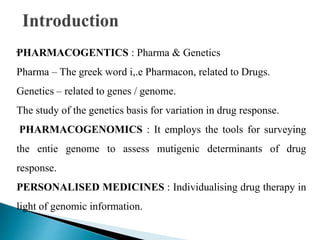
.PHARMACOGENTICS : Pharma & Genetics
Pharma – The greek word i,.e Pharmacon, related to Drugs.
Genetics – related to genes / genome.
The study of the genetics basis for variation in drug response.
PHARMACOGENOMICS : It employs the tools for surveying
the entie genome to assess mutigenic determinants of drug
response.
PERSONALISED MEDICINES : Individualising drug therapy in
light of genomic information.
 To use genetic information specific to an individual patient to
preselect a drug that will be effective and not cause toxicity.
 Better than relying on trials and error supported by physical
clues.
 USFDA : Addition of pharmacogenomics labelling
information to the package inserts of over 50 drugs.
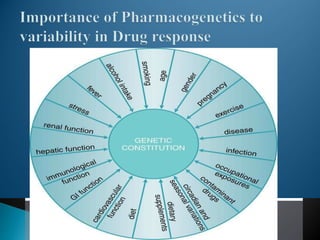
Inter individual variation in response to drugs – Serious
problem
Results in Lack of efficacy/Unexpected side effects
Variation:
Pharmacokinetic
Pharmacodynamic
Idiosyncratic
Too much/not enough drug at site of action.
 Metabolism
 Transporters
 Plasma protein binding
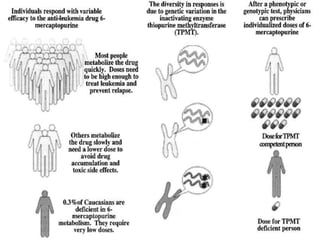
 Thiopurine drugs ( tioguanine, Mercaptopurine and its prodrug
Azathioprine) and TPMT(Thiopurine-S-methyltransferase)
activity : Bone marrow and liver toxicity.
 About 1 in 300 Caucasians and African-Americans are TPMT-
deficient .
 5-Fluorouracil (5-FU) and DPYD(dihydropyrimidine
dehydrogenase ) activity: Decreased metabolism
leukocytopenia, stomatitis, diarrhea, nausea and vomiting
PD->/<effect of a drug at a given concentration at site of action
Interindividual variation in
•Drug targets
G-proteins
•Immune Molecules
•Receptors
•Ion channel and enzymes
 Qualitatively abnormal reaction that occurs only in a
few exposed individuals
 Results from differences in enzymes or immune
mechanisms.
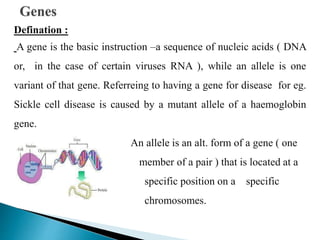
Defination :
A gene is the basic instruction –a sequence of nucleic acids ( DNA
or, in the case of certain viruses RNA ), while an allele is one
variant of that gene. Referreing to having a gene for disease for eg.
Sickle cell disease is caused by a mutant allele of a haemoglobin
gene.
An allele is an alt. form of a gene ( one
member of a pair ) that is located at a
specific position on a specific
chromosomes.
‘
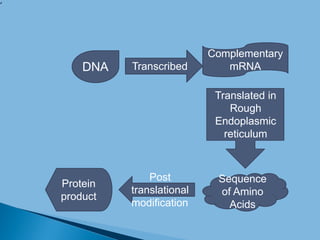
DNA Transcribed
Complementary
mRNA
Translated in
Rough
Endoplasmic
reticulum
Sequence
of Amino
Acids
Post
translational
modification
Protein
product
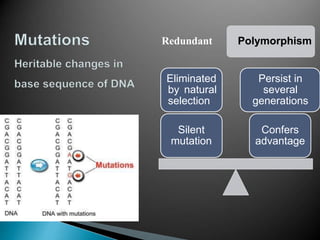
Redundant Polymorphism
Confers
advantage
Persist in
several
generations
Silent
mutation
Eliminated
by natural
selection
 Different alternative sequences at a locus within DNA
strand(alleles) that persist in a population through several
generations.
 A rise due to mutation.
 Increase in frequency over generations-selective advantage
SNPs are DNA sequence variations that occur
when a single nucleotide in the genome
sequence is altered.
May entail substitution of one nucleotide to
another(C for T).
Result in ‘frame shift’ in translation
 Result can be loss of protein synthesis, abnormal
protein synthesis or an abnormal rate of protein
synthesis.
 Individuals differ from each other approx. every 300-
1000 nucleotides with an estimated total of 30 million
SNP.
 Can occur in coding & non coding regions
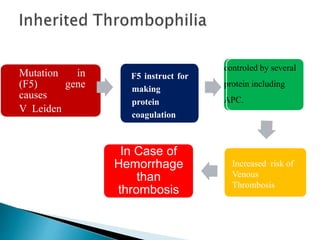
 Important determinant of disease-e.g. Inherited
Thrombophilia
Mutation in
(F5) gene
causes
V Leiden
F5 instruct for
making
protein
coagulation
controled by several
protein including
APC.
Increased risk of
Venous
Thrombosis
In Case of
Hemorrhage
than
thrombosis
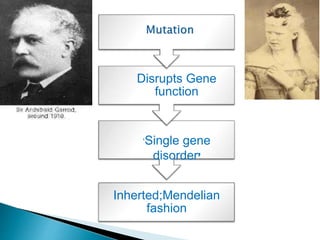
Inherted;Mendelian
fashion
Disrupts Gene
function
‘Single gene
disorder’
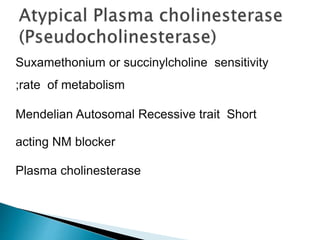
Suxamethonium or succinylcholine sensitivity
;rate of metabolism
Mendelian Autosomal Recessive trait Short
acting NM blocker
Plasma cholinesterase
 Genetic abnormality of calcium channels with skeleton
muscle.
 Autosomal dominant inherited.
 Idiosyncratic ADR due to SXM on Ryanodine receptor
 Also due to halogenated inhalational agents ( induced
anaesthesia by blocking CNS neurotransmission
teRapid rise of body
perature,
 muscle rigidity,
 Rapid heart beat
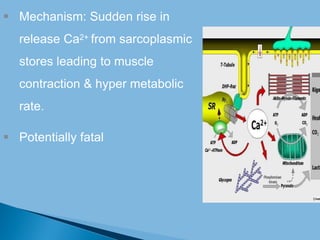
 Mechanism: Sudden rise in
release Ca2+ from sarcoplasmic
stores leading to muscle
contraction & hyper metabolic
rate.
 Potentially fatal
Treatment:
Dantrolene 1 mg/kg i.v repeated up to 10mg/kg.
(prevents release of Ca2+ from sarcoplasmic
reticulum)
Symptomatic Rx of Hyperthermia
Rx of Cardiac arrhythmias
• Inherited hepatic disorder, Autosomal
dominant
• Deficiency of HBMS (hydroxymethylbilane
synthase)
• Mutation in gene coding Porphobilinogen
deaminase(PBGD)
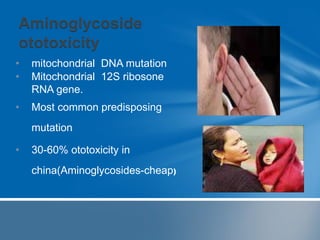
• mitochondrial DNA mutation
• Mitochondrial 12S ribosone
RNA gene.
• Most common predisposing
mutation
• 30-60% ototoxicity in
china(Aminoglycosides-cheap)
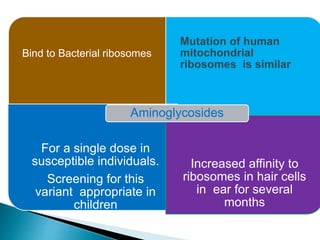
Bind to Bacterial ribosomes
For a single dose in
susceptible individuals.
Screening for this
variant appropriate in
children
Increased affinity to
ribosomes in hair cells
in ear for several
months
Aminoglycosides
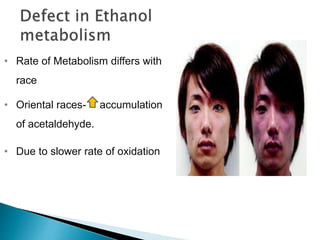
• Rate of Metabolism differs with
race
• Oriental races- accumulation
of acetaldehyde.
• Due to slower rate of oxidation
of acetaldehyde as a result of
genetic polymorphism
Especially in
Japanese
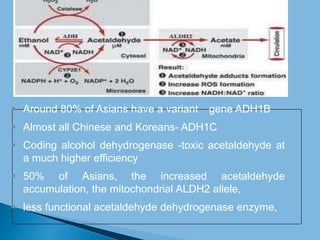
 Around 80% of Asians have a variant gene ADH1B
 Almost all Chinese and Koreans- ADH1C
 Coding alcohol dehydrogenase -toxic acetaldehyde at
a much higher efficiency
 50% of Asians, the increased acetaldehyde
accumulation, the mitochondrial ALDH2 allele,
 less functional acetaldehyde dehydrogenase enzyme,
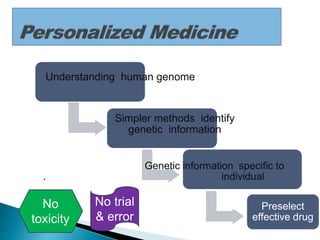
Understanding human genome
Simpler methods identify
genetic information
Genetic information specific to
. individual
Preselect
effective drug
No
toxicity
No trial
& error
 Anticipated to be one of the first applications of
human genome sequencing.
 Development slowed by various scientific ,
commercial, political and educational barriers.
 Cost effectiveness
 Evidence in support of atest is less convincing
than the ideal of an RCT of PG informed
prescribing strategy versus current best practice
1.Variants of different HLA strongly linked to
susceptibility to severe idiosyncratic
reactions
2.Genes controlling aspects of drug
metabolism
3.Genes encoding drug targets
 Abacavir-Reverse transcriptase inhibitor
 Highly effective - HIV Infection
 Severe Rashes
 Susceptibility linked to HLA variant
HLAB*5701
Carbamazepine
Severe life threatening rashes
Stevens Johnson Syndrome
Toxic epidermal Necrolysis
Almost only in Asians
FDA recommends Chinese patients to be screened for
this allele
Similar problem with Phenytoin for same allele
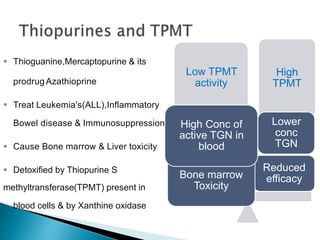
prodrug Azathioprine
 Treat Leukemia's(ALL),Inflammatory
Bowel disease & Immunosuppression
 Cause Bone marrow & Liver toxicity
 Detoxified by Thiopurine S
methyltransferase(TPMT) present in
blood cells & by Xanthine oxidase
 Thioguanine,Mercaptopurine & its
Low TPMT
activity
High
TPMT
Reduced
efficacy
Lower
conc
TGN
Bone marrow
Toxicity
High Conc of
active TGN in
blood
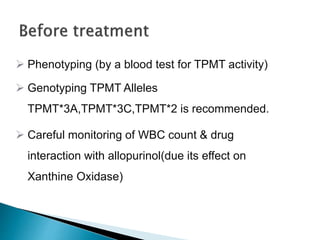
 Phenotyping (by a blood test for TPMT activity)
 Genotyping TPMT Alleles
TPMT*3A,TPMT*3C,TPMT*2 is recommended.
 Careful monitoring of WBC count & drug
interaction with allopurinol(due its effect on
Xanthine Oxidase)
 Effective antipsychotic drug
 Agranulocytosis 1% of patients
 Studies-small
 Specificity and sensitivity yet to be
established
Extensively used to treat solid Tumours.
Unpredictable mucocutaneous toxicity.
Detoxified by dihydropyrimidine
dehydrogenase(DPYD)-clinically identifiable
multiple genetic variants
FDA recommends no to be given to those with
DPYD deficiency
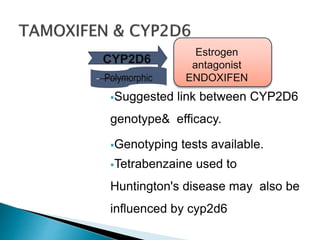
TAMOXIFEN variation
Suggested link between CYP2D6
genotype& efficacy.
Genotyping tests available.
Tetrabenzaine used to
Huntington's disease may also be
influenced by cyp2d6
Estrogen
antagonist
ENDOXIFEN
CYP2D6
Polymorphic
 Topoisomerase I inhibitor.
 Marked activity against colorectal & lung
cancers(minority)
 Toxicity(Diarrhoea & BM suppression very severe
 Active metabolite SN-38
Gilberts
 UDP glucuronyltransferase
 Reduced activity Hyberbilirubinemia
syndrome
• Herceptin is mAB that antagonizes
epidermal growth factor(EGF) by binding to
one of its receptors(human epidermal
growth factor receptor 2-HER2)
HER2 in tumour
• Somatic mutation
tissue
o DASATINIB –dual BCR/ABL & Src tyrosine
kinase inhibitor
o Used in hematological
malignancies(Philadelphia chromosome)
o CML ALL
o Mutation (T3151) in BCR/ABL confers
resistance to inhibitory effect of dasatinib.
o IMATINIB-TYROSINE kinase inhibitor
o CML & other myelodysplastic disorders.
 WARFARIN
 Dosing individualized by measuring
INR(International normalized ratio)
 Thrombotic effects(lack of efficacy)
 Adverse effects(bleeding) common
 PG testing proposed based on polymorphism in its
key target, vitamin K epoxide reductase(VKOR)
&CYP2C9 GENOTYPE involved in its metabolism
Ph proves that concept of susceptibility to ADR can
be genetically determined
Offers possibility of a more armacogenetics
Precise ‘Personalised ‘ Medicine for several drugs
& disorders.
Field of intense research, rapid progress.
Challenge remains about its feasibility in
Clinical setup
pharmacogenetics dds.ppt

pharmacogenetics dds.ppt

  • 2.
    1. Definition –Pharmacogenetics 2. Variation in drug response 3. Pharmacogenetic importance 4. Elementary genetics 5. Single gene PK disorders 6. Therapeutic drugs & clinically available PG tests 7. Conclusion
  • 3.
    .PHARMACOGENTICS : Pharma& Genetics Pharma – The greek word i,.e Pharmacon, related to Drugs. Genetics – related to genes / genome. The study of the genetics basis for variation in drug response. PHARMACOGENOMICS : It employs the tools for surveying the entie genome to assess mutigenic determinants of drug response. PERSONALISED MEDICINES : Individualising drug therapy in light of genomic information.
  • 4.
     To usegenetic information specific to an individual patient to preselect a drug that will be effective and not cause toxicity.  Better than relying on trials and error supported by physical clues.  USFDA : Addition of pharmacogenomics labelling information to the package inserts of over 50 drugs.
  • 5.
    Inter individual variationin response to drugs – Serious problem Results in Lack of efficacy/Unexpected side effects Variation: Pharmacokinetic Pharmacodynamic Idiosyncratic
  • 6.
    Too much/not enoughdrug at site of action.  Metabolism  Transporters  Plasma protein binding
  • 7.
     Thiopurine drugs( tioguanine, Mercaptopurine and its prodrug Azathioprine) and TPMT(Thiopurine-S-methyltransferase) activity : Bone marrow and liver toxicity.  About 1 in 300 Caucasians and African-Americans are TPMT- deficient .  5-Fluorouracil (5-FU) and DPYD(dihydropyrimidine dehydrogenase ) activity: Decreased metabolism leukocytopenia, stomatitis, diarrhea, nausea and vomiting
  • 9.
    PD->/<effect of adrug at a given concentration at site of action Interindividual variation in •Drug targets G-proteins •Immune Molecules •Receptors •Ion channel and enzymes
  • 10.
     Qualitatively abnormalreaction that occurs only in a few exposed individuals  Results from differences in enzymes or immune mechanisms.
  • 13.
    Defination : A geneis the basic instruction –a sequence of nucleic acids ( DNA or, in the case of certain viruses RNA ), while an allele is one variant of that gene. Referreing to having a gene for disease for eg. Sickle cell disease is caused by a mutant allele of a haemoglobin gene. An allele is an alt. form of a gene ( one member of a pair ) that is located at a specific position on a specific chromosomes.
  • 15.
  • 16.
  • 17.
     Different alternativesequences at a locus within DNA strand(alleles) that persist in a population through several generations.  A rise due to mutation.  Increase in frequency over generations-selective advantage
  • 18.
    SNPs are DNAsequence variations that occur when a single nucleotide in the genome sequence is altered. May entail substitution of one nucleotide to another(C for T). Result in ‘frame shift’ in translation
  • 19.
     Result canbe loss of protein synthesis, abnormal protein synthesis or an abnormal rate of protein synthesis.  Individuals differ from each other approx. every 300- 1000 nucleotides with an estimated total of 30 million SNP.  Can occur in coding & non coding regions  Important determinant of disease-e.g. Inherited Thrombophilia
  • 20.
    Mutation in (F5) gene causes VLeiden F5 instruct for making protein coagulation controled by several protein including APC. Increased risk of Venous Thrombosis In Case of Hemorrhage than thrombosis
  • 22.
  • 23.
    Suxamethonium or succinylcholinesensitivity ;rate of metabolism Mendelian Autosomal Recessive trait Short acting NM blocker Plasma cholinesterase
  • 24.
     Genetic abnormalityof calcium channels with skeleton muscle.  Autosomal dominant inherited.  Idiosyncratic ADR due to SXM on Ryanodine receptor  Also due to halogenated inhalational agents ( induced anaesthesia by blocking CNS neurotransmission teRapid rise of body perature,  muscle rigidity,  Rapid heart beat
  • 25.
     Mechanism: Suddenrise in release Ca2+ from sarcoplasmic stores leading to muscle contraction & hyper metabolic rate.  Potentially fatal
  • 26.
    Treatment: Dantrolene 1 mg/kgi.v repeated up to 10mg/kg. (prevents release of Ca2+ from sarcoplasmic reticulum) Symptomatic Rx of Hyperthermia Rx of Cardiac arrhythmias
  • 27.
    • Inherited hepaticdisorder, Autosomal dominant • Deficiency of HBMS (hydroxymethylbilane synthase) • Mutation in gene coding Porphobilinogen deaminase(PBGD)
  • 28.
    • mitochondrial DNAmutation • Mitochondrial 12S ribosone RNA gene. • Most common predisposing mutation • 30-60% ototoxicity in china(Aminoglycosides-cheap)
  • 29.
    Bind to Bacterialribosomes For a single dose in susceptible individuals. Screening for this variant appropriate in children Increased affinity to ribosomes in hair cells in ear for several months Aminoglycosides
  • 30.
    • Rate ofMetabolism differs with race • Oriental races- accumulation of acetaldehyde. • Due to slower rate of oxidation of acetaldehyde as a result of genetic polymorphism Especially in Japanese
  • 31.
     Around 80%of Asians have a variant gene ADH1B  Almost all Chinese and Koreans- ADH1C  Coding alcohol dehydrogenase -toxic acetaldehyde at a much higher efficiency  50% of Asians, the increased acetaldehyde accumulation, the mitochondrial ALDH2 allele,  less functional acetaldehyde dehydrogenase enzyme,
  • 33.
    Understanding human genome Simplermethods identify genetic information Genetic information specific to . individual Preselect effective drug No toxicity No trial & error
  • 34.
     Anticipated tobe one of the first applications of human genome sequencing.  Development slowed by various scientific , commercial, political and educational barriers.  Cost effectiveness  Evidence in support of atest is less convincing than the ideal of an RCT of PG informed prescribing strategy versus current best practice
  • 35.
    1.Variants of differentHLA strongly linked to susceptibility to severe idiosyncratic reactions 2.Genes controlling aspects of drug metabolism 3.Genes encoding drug targets
  • 37.
     Abacavir-Reverse transcriptaseinhibitor  Highly effective - HIV Infection  Severe Rashes  Susceptibility linked to HLA variant HLAB*5701
  • 38.
    Carbamazepine Severe life threateningrashes Stevens Johnson Syndrome Toxic epidermal Necrolysis Almost only in Asians FDA recommends Chinese patients to be screened for this allele Similar problem with Phenytoin for same allele
  • 40.
    prodrug Azathioprine  TreatLeukemia's(ALL),Inflammatory Bowel disease & Immunosuppression  Cause Bone marrow & Liver toxicity  Detoxified by Thiopurine S methyltransferase(TPMT) present in blood cells & by Xanthine oxidase  Thioguanine,Mercaptopurine & its Low TPMT activity High TPMT Reduced efficacy Lower conc TGN Bone marrow Toxicity High Conc of active TGN in blood
  • 41.
     Phenotyping (bya blood test for TPMT activity)  Genotyping TPMT Alleles TPMT*3A,TPMT*3C,TPMT*2 is recommended.  Careful monitoring of WBC count & drug interaction with allopurinol(due its effect on Xanthine Oxidase)
  • 42.
     Effective antipsychoticdrug  Agranulocytosis 1% of patients  Studies-small  Specificity and sensitivity yet to be established
  • 43.
    Extensively used totreat solid Tumours. Unpredictable mucocutaneous toxicity. Detoxified by dihydropyrimidine dehydrogenase(DPYD)-clinically identifiable multiple genetic variants FDA recommends no to be given to those with DPYD deficiency
  • 44.
    TAMOXIFEN variation Suggested linkbetween CYP2D6 genotype& efficacy. Genotyping tests available. Tetrabenzaine used to Huntington's disease may also be influenced by cyp2d6 Estrogen antagonist ENDOXIFEN CYP2D6 Polymorphic
  • 45.
     Topoisomerase Iinhibitor.  Marked activity against colorectal & lung cancers(minority)  Toxicity(Diarrhoea & BM suppression very severe  Active metabolite SN-38 Gilberts  UDP glucuronyltransferase  Reduced activity Hyberbilirubinemia syndrome
  • 47.
    • Herceptin ismAB that antagonizes epidermal growth factor(EGF) by binding to one of its receptors(human epidermal growth factor receptor 2-HER2) HER2 in tumour • Somatic mutation tissue
  • 48.
    o DASATINIB –dualBCR/ABL & Src tyrosine kinase inhibitor o Used in hematological malignancies(Philadelphia chromosome) o CML ALL o Mutation (T3151) in BCR/ABL confers resistance to inhibitory effect of dasatinib.
  • 49.
    o IMATINIB-TYROSINE kinaseinhibitor o CML & other myelodysplastic disorders.
  • 51.
     WARFARIN  Dosingindividualized by measuring INR(International normalized ratio)  Thrombotic effects(lack of efficacy)  Adverse effects(bleeding) common  PG testing proposed based on polymorphism in its key target, vitamin K epoxide reductase(VKOR) &CYP2C9 GENOTYPE involved in its metabolism
  • 52.
    Ph proves thatconcept of susceptibility to ADR can be genetically determined Offers possibility of a more armacogenetics Precise ‘Personalised ‘ Medicine for several drugs & disorders. Field of intense research, rapid progress. Challenge remains about its feasibility in Clinical setup