By,
Shabnam Relhan
M.Pharm(Biotech.)
      AIP
OVERVIEW
 Pharmacogenomics
 Single nucleotide polymorphism
 Importance of pharmacogenomics
 Examples of altered drug reponse
 Benefits of pharmacogenomics
 Pharmacogenomic drugs
 Ethical concerns
 Challenges to the growth and expansion
PHARMACOGENOMICS


 Pharmacology + Genomics = pharmacogenomics
PHARMACOGENOMICS
 IT IS THE BRANCH OF PHARMACOLOGY WHICH
  DEALS WITH THE INFLUENCE OF GENETIC
  VARIATION ON DRUG RESPONSE BY CO-
  RELATING GENE EXPRESSION OR SINGLE
  NUCLEOTIDE POLYMORPHISM WITH A DRUG’S
  EFFICACY OR TOXICITY.
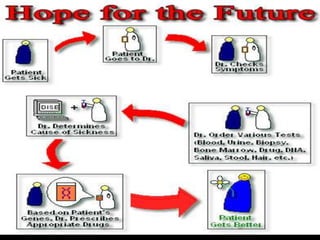
 It is an approach to PERSONALIZED MEDICINE.
SINGLE NUCLEOTIDE
POLYMORPHISMS (SNPs)
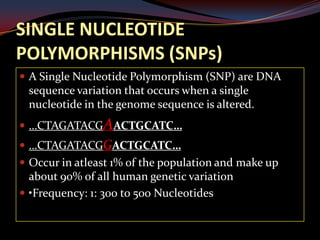
 A Single Nucleotide Polymorphism (SNP) are DNA
 sequence variation that occurs when a single
 nucleotide in the genome sequence is altered.
 …CTAGATACGAACTGCATC…
 …CTAGATACGGACTGCATC…
 Occur in atleast 1% of the population and make up
  about 90% of all human genetic variation
 •Frequency: 1: 300 to 500 Nucleotides
Personalized Medicine
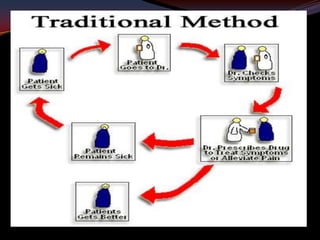
 It refers to an approach of clinical practice
 where a particular treatment is not chosen
 based on the ‘average pateint’ but on
 characteristic of an individual pateint.
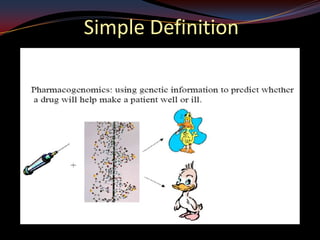
Simple Definition
Corelation
Pharmacogenetics:- The study of
inherited differences or variations in
drug metabolism and response.

Pharmacogenomics:- The study of the
role of inheritance in individual
variation in drug response.
IMPORTANCE OF
       PHARMACOGENOMICS
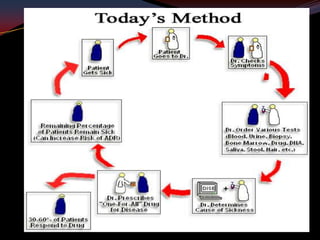
 “ONE SIZE FITS ALL” Only work for
 about60 percent of the population at the
 best. And the other 40 percent of the
 population increase their risks of adverse
 drug reaction because their genes do not do
 what is intended of them
ONE SIZE DOES NOT FIT ALL
    A 1998 study of hospitalized patients
    published in the Journal of the American
    Medical Association reported that in 1994,
    adverse drug reactions accounted for more
    than 2.2 million serious cases and over
    100,000 deaths, making adverse drug
    reactions (ADRs) one of the leading causes
    of hospitalization and death in the United
    States.
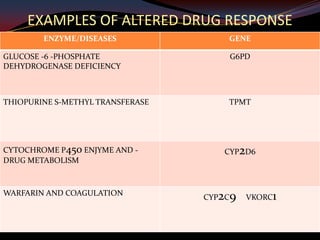
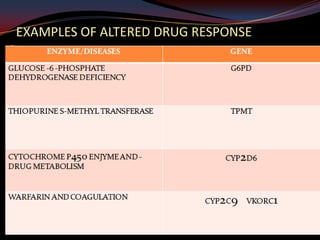
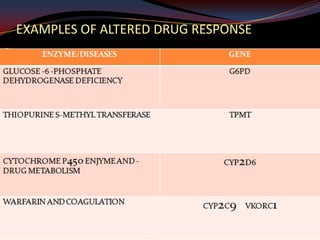
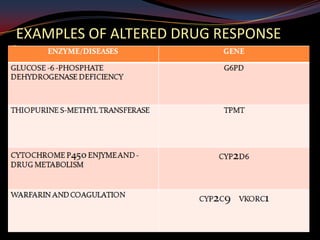
EXAMPLES OF ALTERED DRUG RESPONSE
        ENZYME/DISEASES               GENE

GLUCOSE -6 -PHOSPHATE                 G6PD
DEHYDROGENASE DEFICIENCY


THIOPURINE S-METHYL TRANSFERASE       TPMT


CYTOCHROME P450 ENJYME AND -         CYP2D6
DRUG METABOLISM


WARFARIN AND COAGULATION
                                  CYP2C9   VKORC1
GLUCOSE 6-PHOSPHATE
           DEHYDROGENASE
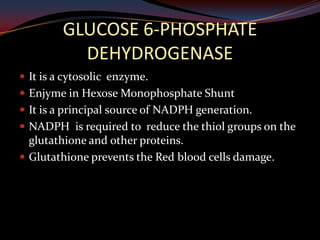
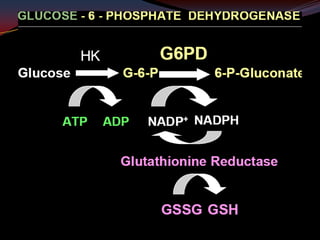
 It is a cytosolic enzyme.
 Enjyme in Hexose Monophosphate Shunt
 It is a principal source of NADPH generation.
 NADPH is required to reduce the thiol groups on the
  glutathione and other proteins.
 Glutathione prevents the Red blood cells damage.
GLUCOSE 6- PHOHPHATE
DEHYDROGENASE DEFICIENCY
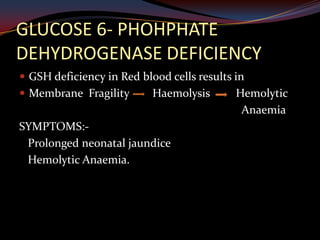
 GSH deficiency in Red blood cells results in
 Membrane Fragility       Haemolysis       Hemolytic
                                             Anaemia
SYMPTOMS:-
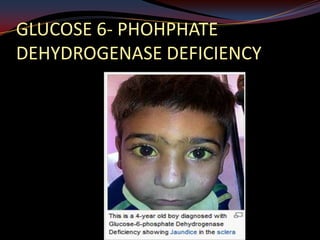
 Prolonged neonatal jaundice
 Hemolytic Anaemia.
GLUCOSE 6- PHOHPHATE
DEHYDROGENASE DEFICIENCY
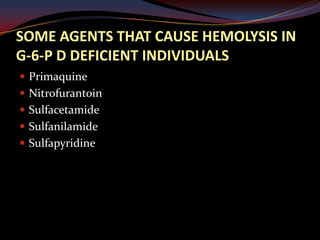
SOME AGENTS THAT CAUSE HEMOLYSIS IN
G-6-P D DEFICIENT INDIVIDUALS
 Primaquine
 Nitrofurantoin
 Sulfacetamide
 Sulfanilamide
 Sulfapyridine
EXAMPLES OF ALTERED DRUG RESPONSE
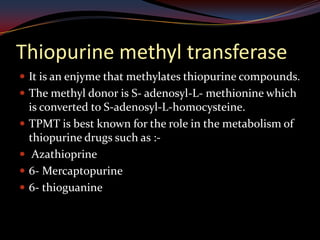
Thiopurine methyl transferase
 It is an enjyme that methylates thiopurine compounds.
 The methyl donor is S- adenosyl-L- methionine which
    is converted to S-adenosyl-L-homocysteine.
   TPMT is best known for the role in the metabolism of
    thiopurine drugs such as :-
    Azathioprine
   6- Mercaptopurine
   6- thioguanine
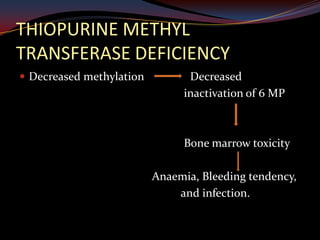
THIOPURINE METHYL
TRANSFERASE DEFICIENCY
 Decreased methylation         Decreased
                               inactivation of 6 MP


                               Bone marrow toxicity

                          Anaemia, Bleeding tendency,
                              and infection.
EXAMPLES OF ALTERED DRUG RESPONSE
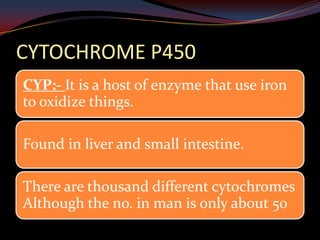
CYTOCHROME P450
CYP:- It is a host of enzyme that use iron
to oxidize things.

Found in liver and small intestine.

There are thousand different cytochromes
Although the no. in man is only about 50
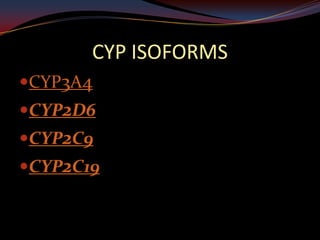
CYP ISOFORMS
CYP3A4
CYP2D6
CYP2C9
CYP2C19
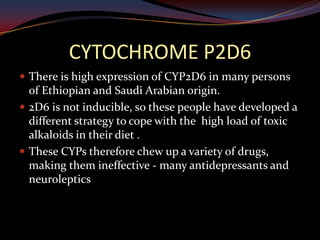
CYTOCHROME P2D6
 There is high expression of CYP2D6 in many persons
  of Ethiopian and Saudi Arabian origin.
 2D6 is not inducible, so these people have developed a
  different strategy to cope with the high load of toxic
  alkaloids in their diet .
 These CYPs therefore chew up a variety of drugs,
  making them ineffective - many antidepressants and
  neuroleptics
CYTOCHROME P2D6 Deficiency
 Many individuals lack functional 2D6.
 These subjects will be predisposed to drug toxicity
  caused by antidepressants or neuroleptics
 Other drugs include:
 Dexfenfluramine
 Perhexiline (withdrawn from the market due to
  neuropathy)
EXAMPLES OF ALTERED DRUG RESPONSE
WARFARIN
 •The Most Commonly Prescribed Anticoagulant
   •Patients Maybe: Resistant - Need Higher Dose to
    Prevent Strokes
   Sensitive - Need Lower Dose to Prevent CNS Bleeds


       • Warfarin Is Metabolised by the Cytochrome P450,
        Cyp2c9

           • Warfarin Metabolism Involves Vitamin K Epoxide Reductase
            (VKORC1).
BENEFITS OF
PHARMACOGENOMICS
 More Powerful Medicines
 Safer Drugs The First Time
 More Accurate Methods Of
  Determining The Dosages.
 Better Vaccines.
PHARMACOGENOMIC DRUGS

HERCEPTIN

GLEEVAC
ETHICAL CONCERNS
 Many fear the implications pharmacogenomics can bring to their
  lives:
  1. Through the development of individual pharmacogenomic
  profiles, an individual's privacy and confidentiality are at risk
  2. Certain individuals (such as Health Insurance Companies or
  Employers) can obtain the profiles of others and use the "weak
  points" in their genes to discriminate
  (The U.S. Senate and the U.S. House of Representatives are
  attempting to pass the Genetic Information Nondiscrimination
  Act of 2007 in hopes of protecting individuals from genetic
  discrimination in terms of health insurance and employment).
ETHICAL CONCERNS

    3. Since the drugs are more focused, the test
    groups become smaller, which can lead to rare
    and more fatal Adverse Drug Reactions
    4. Developing drugs beneficial to one group but
    dangerous to another


    5. Should physicians inform patients that due to
    their genetic makeup, they have a high chance of
    developing a disease that currently has no effective
    treatment?
ETHICAL CONCERNS



    6. How will the FDA regulate the development and
    distribution of genetic tests and associated
    medicines?
    7. It will become challenging to fully inform
    patients on possible risks.
    8. Will these "personalized medicines" be
    available only to those who can afford it?

Challenges to the growth and
Expansion
 Education of various healthcare providers regarding
    pharmacogenomics.
   Potentially smaller and more specialized drug markets.
   Resistance to genetic testing.
   Ethical & Legal issues.
   Expense.
REFERENCE
 One size does not fit all: The promise of
  pharmacogenomics A pharmacogenomics primer for
  the national centre for Biotecnology
  information(NCBI)
 Zdanowicz Martin M” Concept in
  Pharmacogenomics” page no-61-66
 Ingelman-Sundberg et al.
  Polymorphic cytochrome P450 enzymes: an
  opportunity for individualized drug treatment
  Trends in Pharm Sci Aug 1999 342-9
Reference
 Eichelbaum M, Ingelman-Sundberg M, Evans WE.
  “Pharmcogenomics and individualized drug
  therapy”. Annu Rev Med. 2006.57:119-137.
 Dr D.P katare “Basics in Biotechnology”page no. 267-
  269
THANK YOU

Pharmacogenomics

  • 1.
  • 2.
    OVERVIEW  Pharmacogenomics  Singlenucleotide polymorphism  Importance of pharmacogenomics  Examples of altered drug reponse  Benefits of pharmacogenomics  Pharmacogenomic drugs  Ethical concerns  Challenges to the growth and expansion
  • 3.
    PHARMACOGENOMICS  Pharmacology +Genomics = pharmacogenomics
  • 4.
    PHARMACOGENOMICS  IT ISTHE BRANCH OF PHARMACOLOGY WHICH DEALS WITH THE INFLUENCE OF GENETIC VARIATION ON DRUG RESPONSE BY CO- RELATING GENE EXPRESSION OR SINGLE NUCLEOTIDE POLYMORPHISM WITH A DRUG’S EFFICACY OR TOXICITY.  It is an approach to PERSONALIZED MEDICINE.
  • 5.
    SINGLE NUCLEOTIDE POLYMORPHISMS (SNPs) A Single Nucleotide Polymorphism (SNP) are DNA sequence variation that occurs when a single nucleotide in the genome sequence is altered.  …CTAGATACGAACTGCATC…  …CTAGATACGGACTGCATC…  Occur in atleast 1% of the population and make up about 90% of all human genetic variation  •Frequency: 1: 300 to 500 Nucleotides
  • 6.
    Personalized Medicine  Itrefers to an approach of clinical practice where a particular treatment is not chosen based on the ‘average pateint’ but on characteristic of an individual pateint.
  • 7.
  • 8.
    Corelation Pharmacogenetics:- The studyof inherited differences or variations in drug metabolism and response. Pharmacogenomics:- The study of the role of inheritance in individual variation in drug response.
  • 9.
    IMPORTANCE OF PHARMACOGENOMICS  “ONE SIZE FITS ALL” Only work for about60 percent of the population at the best. And the other 40 percent of the population increase their risks of adverse drug reaction because their genes do not do what is intended of them
  • 10.
    ONE SIZE DOESNOT FIT ALL  A 1998 study of hospitalized patients published in the Journal of the American Medical Association reported that in 1994, adverse drug reactions accounted for more than 2.2 million serious cases and over 100,000 deaths, making adverse drug reactions (ADRs) one of the leading causes of hospitalization and death in the United States.
  • 11.
    EXAMPLES OF ALTEREDDRUG RESPONSE ENZYME/DISEASES GENE GLUCOSE -6 -PHOSPHATE G6PD DEHYDROGENASE DEFICIENCY THIOPURINE S-METHYL TRANSFERASE TPMT CYTOCHROME P450 ENJYME AND - CYP2D6 DRUG METABOLISM WARFARIN AND COAGULATION CYP2C9 VKORC1
  • 12.
    GLUCOSE 6-PHOSPHATE DEHYDROGENASE  It is a cytosolic enzyme.  Enjyme in Hexose Monophosphate Shunt  It is a principal source of NADPH generation.  NADPH is required to reduce the thiol groups on the glutathione and other proteins.  Glutathione prevents the Red blood cells damage.
  • 14.
    GLUCOSE 6- PHOHPHATE DEHYDROGENASEDEFICIENCY  GSH deficiency in Red blood cells results in  Membrane Fragility Haemolysis Hemolytic Anaemia SYMPTOMS:- Prolonged neonatal jaundice Hemolytic Anaemia.
  • 15.
  • 16.
    SOME AGENTS THATCAUSE HEMOLYSIS IN G-6-P D DEFICIENT INDIVIDUALS  Primaquine  Nitrofurantoin  Sulfacetamide  Sulfanilamide  Sulfapyridine
  • 17.
    EXAMPLES OF ALTEREDDRUG RESPONSE
  • 18.
    Thiopurine methyl transferase It is an enjyme that methylates thiopurine compounds.  The methyl donor is S- adenosyl-L- methionine which is converted to S-adenosyl-L-homocysteine.  TPMT is best known for the role in the metabolism of thiopurine drugs such as :-  Azathioprine  6- Mercaptopurine  6- thioguanine
  • 19.
    THIOPURINE METHYL TRANSFERASE DEFICIENCY Decreased methylation Decreased inactivation of 6 MP Bone marrow toxicity Anaemia, Bleeding tendency, and infection.
  • 20.
    EXAMPLES OF ALTEREDDRUG RESPONSE
  • 21.
    CYTOCHROME P450 CYP:- Itis a host of enzyme that use iron to oxidize things. Found in liver and small intestine. There are thousand different cytochromes Although the no. in man is only about 50
  • 22.
  • 23.
    CYTOCHROME P2D6  Thereis high expression of CYP2D6 in many persons of Ethiopian and Saudi Arabian origin.  2D6 is not inducible, so these people have developed a different strategy to cope with the high load of toxic alkaloids in their diet .  These CYPs therefore chew up a variety of drugs, making them ineffective - many antidepressants and neuroleptics
  • 24.
    CYTOCHROME P2D6 Deficiency Many individuals lack functional 2D6.  These subjects will be predisposed to drug toxicity caused by antidepressants or neuroleptics  Other drugs include:  Dexfenfluramine  Perhexiline (withdrawn from the market due to neuropathy)
  • 25.
    EXAMPLES OF ALTEREDDRUG RESPONSE
  • 26.
    WARFARIN  •The MostCommonly Prescribed Anticoagulant  •Patients Maybe: Resistant - Need Higher Dose to Prevent Strokes  Sensitive - Need Lower Dose to Prevent CNS Bleeds  • Warfarin Is Metabolised by the Cytochrome P450, Cyp2c9  • Warfarin Metabolism Involves Vitamin K Epoxide Reductase (VKORC1).
  • 30.
    BENEFITS OF PHARMACOGENOMICS  MorePowerful Medicines  Safer Drugs The First Time  More Accurate Methods Of Determining The Dosages.  Better Vaccines.
  • 32.
  • 33.
    ETHICAL CONCERNS  Manyfear the implications pharmacogenomics can bring to their lives: 1. Through the development of individual pharmacogenomic profiles, an individual's privacy and confidentiality are at risk 2. Certain individuals (such as Health Insurance Companies or Employers) can obtain the profiles of others and use the "weak points" in their genes to discriminate (The U.S. Senate and the U.S. House of Representatives are attempting to pass the Genetic Information Nondiscrimination Act of 2007 in hopes of protecting individuals from genetic discrimination in terms of health insurance and employment).
  • 34.
    ETHICAL CONCERNS  3. Since the drugs are more focused, the test groups become smaller, which can lead to rare and more fatal Adverse Drug Reactions 4. Developing drugs beneficial to one group but dangerous to another  5. Should physicians inform patients that due to their genetic makeup, they have a high chance of developing a disease that currently has no effective treatment?
  • 35.
    ETHICAL CONCERNS  6. How will the FDA regulate the development and distribution of genetic tests and associated medicines? 7. It will become challenging to fully inform patients on possible risks. 8. Will these "personalized medicines" be available only to those who can afford it? 
  • 36.
    Challenges to thegrowth and Expansion  Education of various healthcare providers regarding pharmacogenomics.  Potentially smaller and more specialized drug markets.  Resistance to genetic testing.  Ethical & Legal issues.  Expense.
  • 37.
    REFERENCE  One sizedoes not fit all: The promise of pharmacogenomics A pharmacogenomics primer for the national centre for Biotecnology information(NCBI)  Zdanowicz Martin M” Concept in Pharmacogenomics” page no-61-66  Ingelman-Sundberg et al. Polymorphic cytochrome P450 enzymes: an opportunity for individualized drug treatment Trends in Pharm Sci Aug 1999 342-9
  • 38.
    Reference  Eichelbaum M,Ingelman-Sundberg M, Evans WE. “Pharmcogenomics and individualized drug therapy”. Annu Rev Med. 2006.57:119-137.  Dr D.P katare “Basics in Biotechnology”page no. 267- 269
  • 39.