PHARMACEUTICAL ORGANIC CHEMISTRY
           RESEARCH
     Combinatorial Chemistry
INTRODUCTION :


*Combinatorial chemistry is one of the important new methods
developed by academics and researchers in the pharmaceutical,
chemical, and biotechnology industries to reduce the time and
costs associated with producing effective, marketable, and
competitive new drugs.


 *Simply, scientists use combinatorial chemistry to create large
 populations of molecules, or libraries, that can be screened
 efficiently.


 * By producing larger, more diverse compound libraries,
 companies increase the probability that they will find novel
 compounds of significant therapeutic and commercial value.


 *The field represents: a convergence of chemistry and
 biology, made possible by fundamental advances in
 miniaturization, robotics, and receptor development.


                                2
* And not surprisingly, it has also captured the attention of
 every major player in the pharmaceutical, biotechnology, and
 agrochemical arena.


*Technique invented in the late 1980s and early 1990s to
enable tasks to be applied to many molecules simultaneously


                                 3
DEFINITION :


*Combinatorial chemistry is a technique by which large numbers
of structurally distinct molecules may be synthesized in a time
and submitted for pharmacological assay.


*The key of combinatorial chemistry is that a large range of
analogues is synthesized using the same reaction conditions, the
same reaction vessels.


*In this way, the chemist can synthesize many hundreds or
thousands of compounds in one time instead of preparing only a
few by simple methods .


                                 4
In the past


*chemists have traditionally made one compound at a time.

*For example compound A would have been reacted with
compound B to give product AB, which would have been isolated
after reaction work up and purification through crystallization,
distillation, or chromatography.


In contrast to this approach


*combinatorial chemistry offers the potential to make every
combination of compound A1 to An with compound B1 to Bn.


The range of combinatorial techniques is highly diverse, and
these products could be made individually in a parallel or in
mixtures, using either solution or solid phase techniques.
Whatever the technique used the common denominator is that
productivity has been amplified beyond the levels that have been
routine for the last hundred years.


                                   5
TOOLS:


       - Solid-phase synthesis

       – Resins

       – Reagents (Monomers)

       – Linkers

       – Screening methods


                         METHODS :

1-Use of solid supports for peptide synthesis led to wider
applications

2-Products from one reaction are divided and reacted with other
reagents in succession


            Benefits to material science :

1-Combinatorial approaches now being applied to solid-state and
materials applications

2-Also to search for new catalysts

                                 6
Application of Combinatorial Chemistry :


*Applications of combinatorial chemistry are very wide.

* For example in pharmaceutical companies for drug designs.
For illustrate this, one a practical example:


Transition-state analog HIV protease inhibitors.

-Extensive efforts toward the rational design of aspartyl
protease inhibitors such as renin and HIV have led to the
discovery of several transition-states analog mimics.

-These templates can serve as the central unit around which
molecular diversity can be generated by application of
appropriate chemistries.

- Recently, solid phase synthesis of hydroxyethylamine and
1,2-diol transition-state pharmacophore units and their utility
for synthesis of HIV protease inhibitors have been reported by
two different groups.

-The first instance, bifunctional linker are used by Wang to
serve the dual purpose of protecting the hydroxyl group of
these BBs and providing point for attachment on solid support.


                                7
-Thus, one linker possesses a vinyl ether group at one end and
a free carboxylate group at the other.

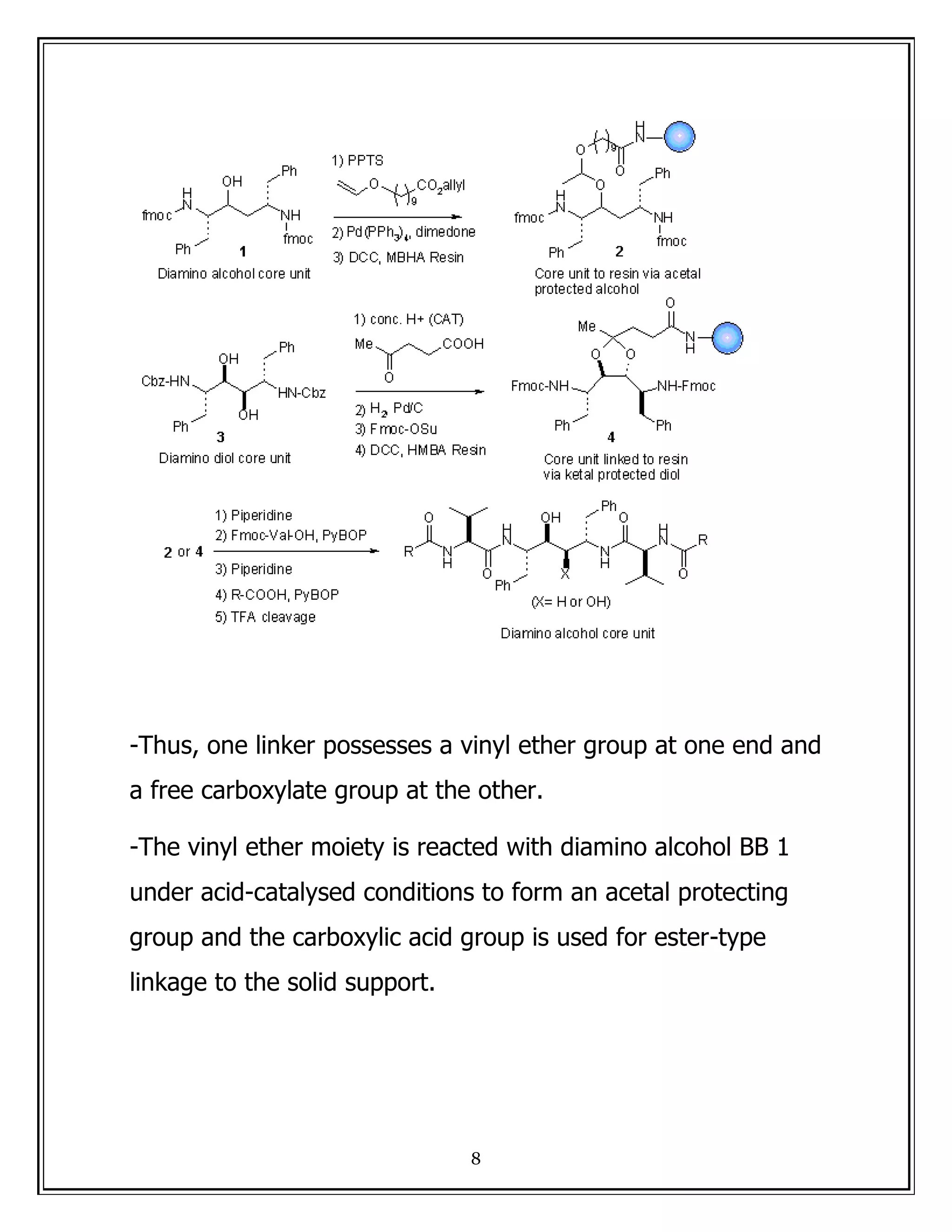
-The vinyl ether moiety is reacted with diamino alcohol BB 1
under acid-catalysed conditions to form an acetal protecting
group and the carboxylic acid group is used for ester-type
linkage to the solid support.


                                8
-The other linker possesses a methyl ketone and carboxylic
groups at the two ends, with the ketone group forming a ketal
with diol 3.

-Resulting intermediates 2 and 4 are now well suited for a bi-
directional solid phase synthesis strategy for preparing C2
symmetric HIV protease inhibitors.

- The two terminal amino groups of 2 and 4 are deprotected
and reacted with a variety of carboxylic acid, sulfonyl chlorides,
isocyanates, and chloroformates to extend the core unit in both
directions and generate a wide variety of aspartyl protease
inhibitors.


                                9
ADVANTAGES AND DISADVANTAGES :

                       1-ADVANTAGES:

1-save time

2-fast

3-produce unexpected new compounds

4-used in many biological & chemical applications

5-save money


                                10
2-DISADVANTAGES:

1-Can't used with Many compounds had undesirable properties
like

       – Size

       – Solubility

       – Inappropriate functional groups

2-Early libraries often based on a single skeleton (basic structure)

3-Limited number of skeletons accessible

4-Individual library members were structurally similar

5-Compounds tended to be achiral or racemic

6-Initial emphasis on creating mixtures of very large numbers of
compounds now out of favor


                                 11
REFRENCES :

1- http://www.combichemistry.com/combichem_applications.
  html
2- http://en.wikipedia.org/wiki/Combinatorial_chemistry
3- http://www.wiziq.com/tutorial/2967-Combinatorial-
  Chemistry-and-Library-Design
4- http://www.netsci.org/Science/Combichem/feature02.html
5- http://www.chem.msu.su/rus/books/patrick/part1.pdf


                MADE BY SECTION(2) :

1- JehanEssam Mahmoud (112) .
2- Aya Ahmed Saber Yosif (86).
3- Eman Mohammed MostafaSherra (83).
4- Eman Ahmed AlaaElshamy .
5- AyaSamir .


                            12
13

pharmaceutical organic chemistry

  • 1.
    PHARMACEUTICAL ORGANIC CHEMISTRY RESEARCH Combinatorial Chemistry
  • 2.
    INTRODUCTION : *Combinatorial chemistryis one of the important new methods developed by academics and researchers in the pharmaceutical, chemical, and biotechnology industries to reduce the time and costs associated with producing effective, marketable, and competitive new drugs. *Simply, scientists use combinatorial chemistry to create large populations of molecules, or libraries, that can be screened efficiently. * By producing larger, more diverse compound libraries, companies increase the probability that they will find novel compounds of significant therapeutic and commercial value. *The field represents: a convergence of chemistry and biology, made possible by fundamental advances in miniaturization, robotics, and receptor development. 2
  • 3.
    * And notsurprisingly, it has also captured the attention of every major player in the pharmaceutical, biotechnology, and agrochemical arena. *Technique invented in the late 1980s and early 1990s to enable tasks to be applied to many molecules simultaneously 3
  • 4.
    DEFINITION : *Combinatorial chemistryis a technique by which large numbers of structurally distinct molecules may be synthesized in a time and submitted for pharmacological assay. *The key of combinatorial chemistry is that a large range of analogues is synthesized using the same reaction conditions, the same reaction vessels. *In this way, the chemist can synthesize many hundreds or thousands of compounds in one time instead of preparing only a few by simple methods . 4
  • 5.
    In the past *chemistshave traditionally made one compound at a time. *For example compound A would have been reacted with compound B to give product AB, which would have been isolated after reaction work up and purification through crystallization, distillation, or chromatography. In contrast to this approach *combinatorial chemistry offers the potential to make every combination of compound A1 to An with compound B1 to Bn. The range of combinatorial techniques is highly diverse, and these products could be made individually in a parallel or in mixtures, using either solution or solid phase techniques. Whatever the technique used the common denominator is that productivity has been amplified beyond the levels that have been routine for the last hundred years. 5
  • 6.
    TOOLS: - Solid-phase synthesis – Resins – Reagents (Monomers) – Linkers – Screening methods METHODS : 1-Use of solid supports for peptide synthesis led to wider applications 2-Products from one reaction are divided and reacted with other reagents in succession Benefits to material science : 1-Combinatorial approaches now being applied to solid-state and materials applications 2-Also to search for new catalysts 6
  • 7.
    Application of CombinatorialChemistry : *Applications of combinatorial chemistry are very wide. * For example in pharmaceutical companies for drug designs. For illustrate this, one a practical example: Transition-state analog HIV protease inhibitors. -Extensive efforts toward the rational design of aspartyl protease inhibitors such as renin and HIV have led to the discovery of several transition-states analog mimics. -These templates can serve as the central unit around which molecular diversity can be generated by application of appropriate chemistries. - Recently, solid phase synthesis of hydroxyethylamine and 1,2-diol transition-state pharmacophore units and their utility for synthesis of HIV protease inhibitors have been reported by two different groups. -The first instance, bifunctional linker are used by Wang to serve the dual purpose of protecting the hydroxyl group of these BBs and providing point for attachment on solid support. 7
  • 8.
    -Thus, one linkerpossesses a vinyl ether group at one end and a free carboxylate group at the other. -The vinyl ether moiety is reacted with diamino alcohol BB 1 under acid-catalysed conditions to form an acetal protecting group and the carboxylic acid group is used for ester-type linkage to the solid support. 8
  • 9.
    -The other linkerpossesses a methyl ketone and carboxylic groups at the two ends, with the ketone group forming a ketal with diol 3. -Resulting intermediates 2 and 4 are now well suited for a bi- directional solid phase synthesis strategy for preparing C2 symmetric HIV protease inhibitors. - The two terminal amino groups of 2 and 4 are deprotected and reacted with a variety of carboxylic acid, sulfonyl chlorides, isocyanates, and chloroformates to extend the core unit in both directions and generate a wide variety of aspartyl protease inhibitors. 9
  • 10.
    ADVANTAGES AND DISADVANTAGES: 1-ADVANTAGES: 1-save time 2-fast 3-produce unexpected new compounds 4-used in many biological & chemical applications 5-save money 10
  • 11.
    2-DISADVANTAGES: 1-Can't used withMany compounds had undesirable properties like – Size – Solubility – Inappropriate functional groups 2-Early libraries often based on a single skeleton (basic structure) 3-Limited number of skeletons accessible 4-Individual library members were structurally similar 5-Compounds tended to be achiral or racemic 6-Initial emphasis on creating mixtures of very large numbers of compounds now out of favor 11
  • 12.
    REFRENCES : 1- http://www.combichemistry.com/combichem_applications. html 2- http://en.wikipedia.org/wiki/Combinatorial_chemistry 3- http://www.wiziq.com/tutorial/2967-Combinatorial- Chemistry-and-Library-Design 4- http://www.netsci.org/Science/Combichem/feature02.html 5- http://www.chem.msu.su/rus/books/patrick/part1.pdf MADE BY SECTION(2) : 1- JehanEssam Mahmoud (112) . 2- Aya Ahmed Saber Yosif (86). 3- Eman Mohammed MostafaSherra (83). 4- Eman Ahmed AlaaElshamy . 5- AyaSamir . 12
  • 13.