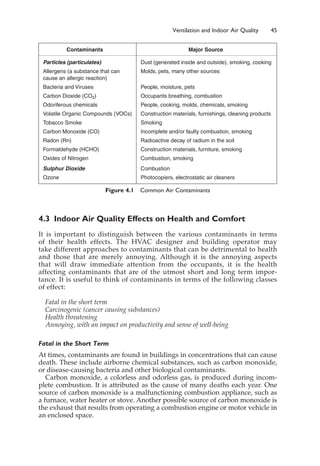
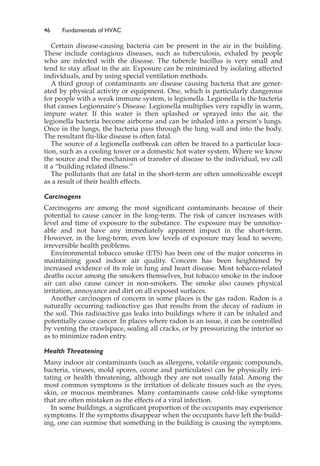
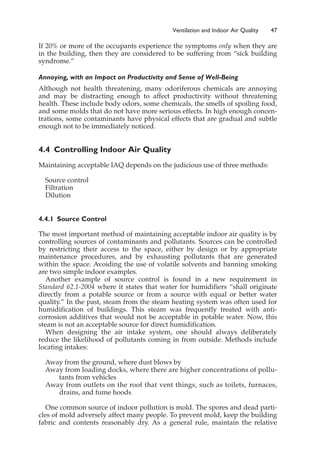
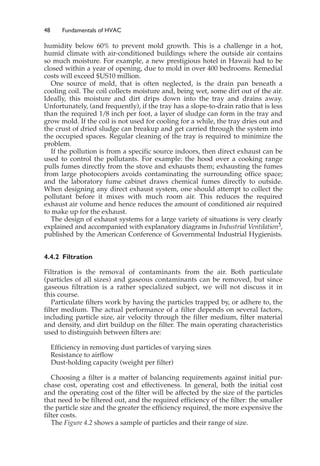
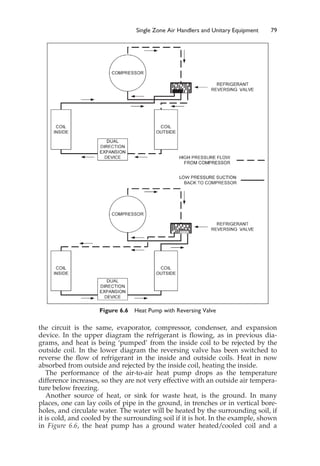
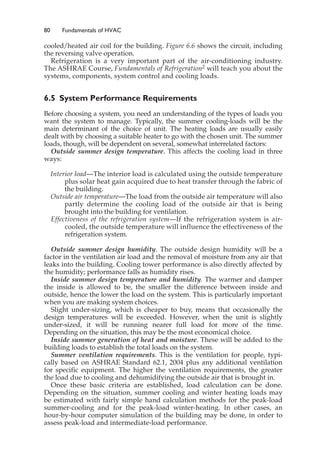
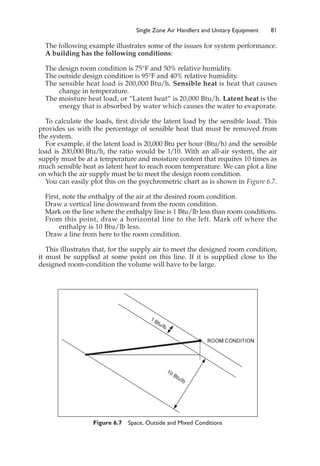
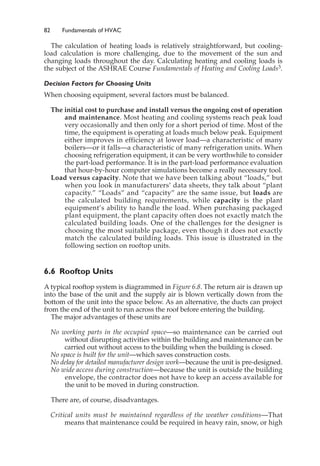
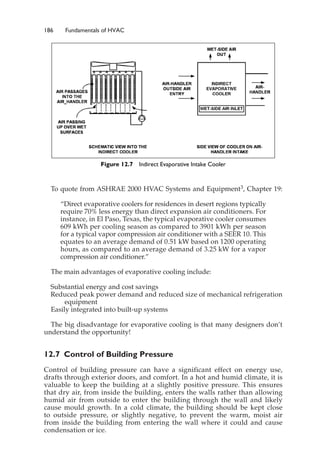
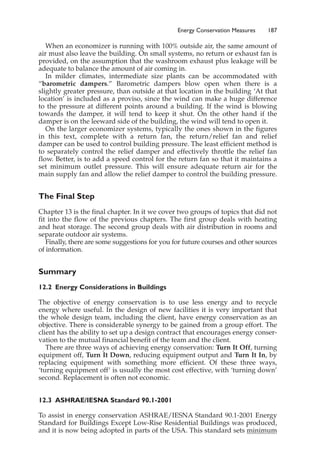
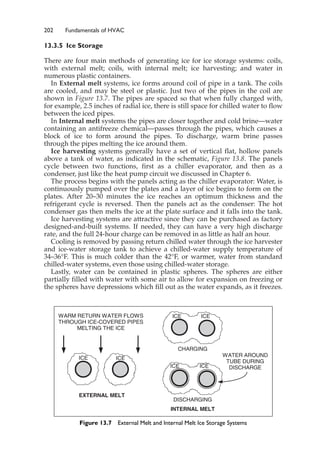
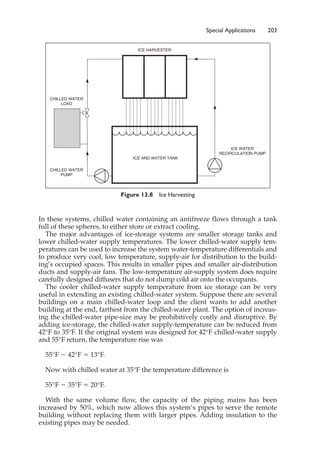
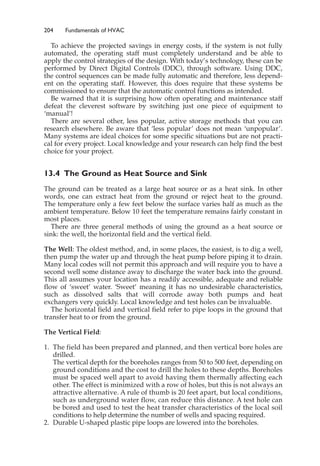
Fundamentals of HVAC Systems
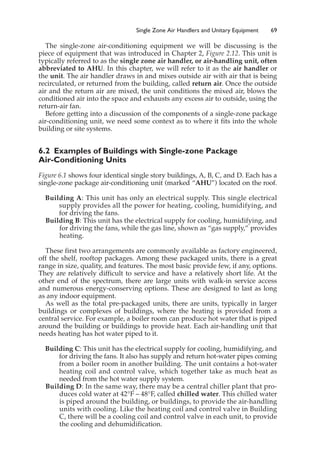
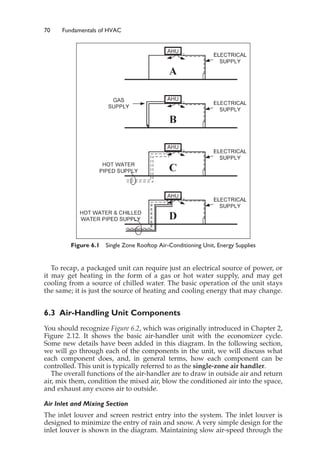
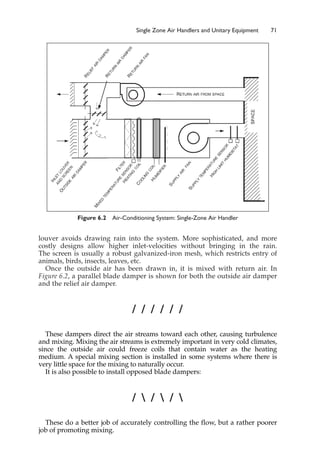
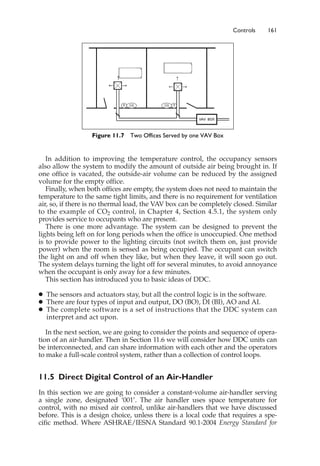
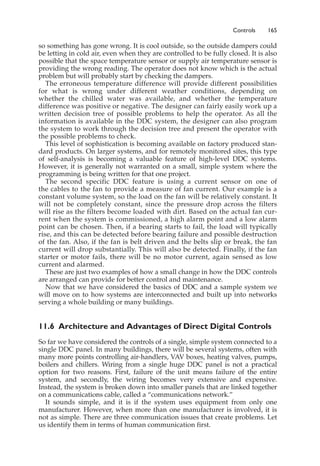
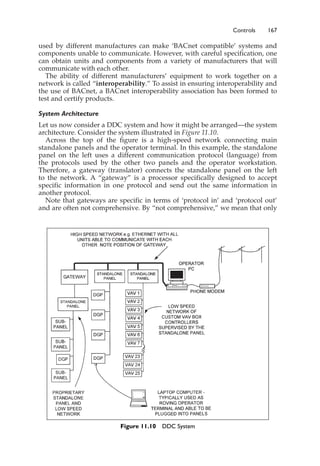
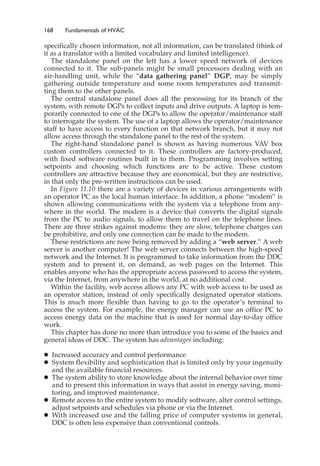
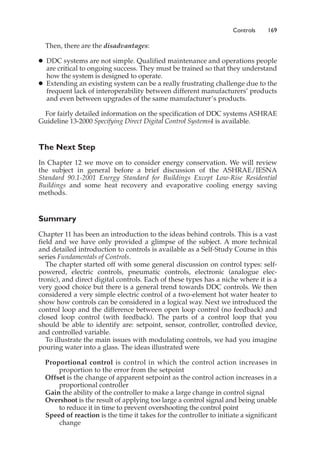
This Page is Intentionally Left Blank
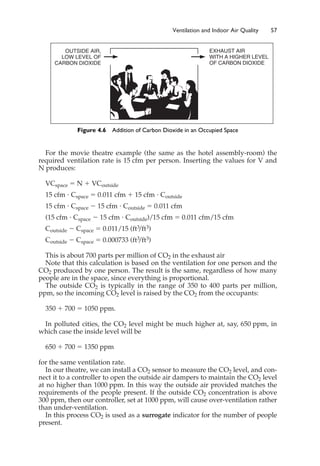
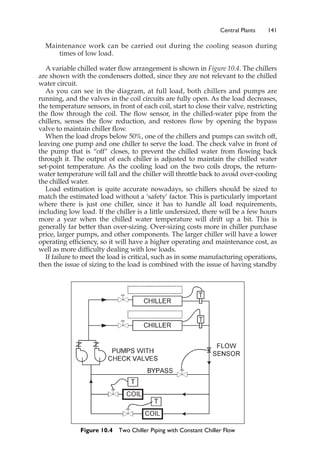
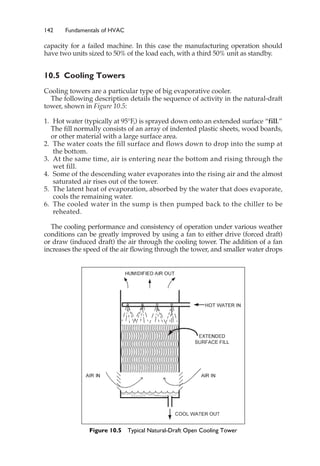
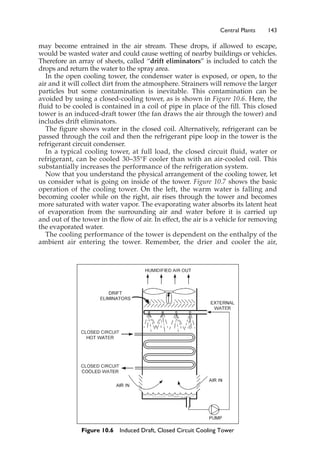
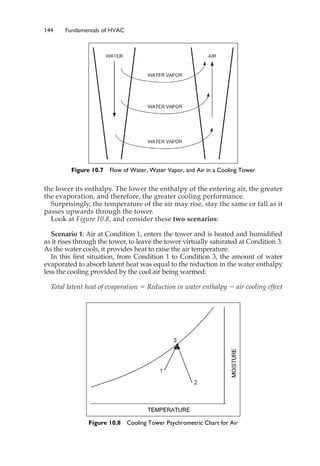
Fundamentals of HVAC Systems
Prepared by
Robert McDowall, P. Eng.
Engineering Change Inc.
American Society of Heating, Refrigerating and
Air-Conditioning Engineers Inc.
1791 Tullie Circle NE, Atlanta, GA 30329, USA
AMSTERDAM • BOSTON • HEIDELBERG • LONDON
NEW YORK • OXFORDPARIS • SAN DIEGO
SAN FRANCISCO • SINGAPORE • SYDNEY • TOKYO
Butterworth-Heinemann is an imprint of Elsevier
Linacre House, Jordan Hill, Oxford OX2 8DP, UK
The Boulevard, Langford Lane, Kidlington, Oxford OX5 1GB, UK
84 Theobald’s Road, London WC1X 8RR, UK
Radarweg 29, PO Box 211, 1000 AE Amsterdam, The Netherlands
30 Corporate Drive, Suite 400, Burlington, MA 01803, USA
525 B Street, Suite 1900, San Diego, CA 92101-4495, USA
First edition 2006
Copyright © 2006, American Society of Heating, Refrigerating and Air-Conditioning
Engineers, Inc. and Elsevier Inc Published by Elsevier 2006. All rights reserved
The right of American Society of Heating, Refrigerating and Air-Conditioning
Engineers, Inc. and Elsevier Inc to be identified as the author of this work has been
asserted in accordance with the Copyright, Designs and Patents Act 1988
No part of this publication may be reproduced, stored in a retrieval system
or transmitted in any form or by any means electronic, mechanical, photocopying,
recording or otherwise without the prior written permission of the publisher
Permissions may be sought directly from Elsevier’s Science & Technology Rights
Department in Oxford, UK: phone (⫹44) (0) 1865 843830; fax (⫹44) (0) 1865 853333;
email: permissions@elsevier.com. Alternatively you can submit your request online by
visiting the Elsevier web site at http://elsevier.com/locate/permissions, and selecting
Obtaining Permission to use Elsevier material
Notice
No responsibility is assumed by the publisher for any injury and/or damage to persons
or property as a matter of products liability, negligence or otherwise, or from any use
or operation of any methods, products, instructions or ideas contained in the material
herein. Because of rapid advances in the medical sciences, in particular, independent
verification of diagnoses and drug dosages should be made
British Library Cataloguing in Publication Data
A catalogue record for this book is available from the British Library
Library of Congress Cataloging-in-Publication Data
A catalog record for this book is available from the Library of Congress
ISBN–13: 978-0-12-372497-7
ISBN–10: 0-12-372497-X
Printed and bound in Great Briatin
06 07 08 09 10 10 9 8 7 6 5 4 3 2 1
Working together to grow
libraries in developing countries
www.elsevier.com | www.bookaid.org | www.sabre.org
For information on all Butterworth-Heinemann publications
visit our web site at books.elsevier.com
Contents
Foreword ix
1 Introduction to HVAC 1
Study Objectives of Chapter 1 1
1.1 Introduction 1
1.2 Brief History of HVAC 2
1.3 Scope of Modern HVAC 3
1.4 Introduction to Air-conditioning Processes 3
1.5 Objective: What is your system to achieve? 4
1.6 Environment For Human Comfort 6
The Next Step 8
Summary 8
Bibliography 9
2 Introduction to HVAC Systems 10
Study Objectives of Chapter 2 10
2.1 Introduction 10
2.2 Introducing the Psychrometric Chart 11
2.3 Basic Air-Conditioning System 20
2.4 Zoned Air-Conditioning Systems 23
2.5 Choosing an Air-Conditioning System 26
2.6 System Choice Matrix 28
The Next Step 30
Summary 30
Bibliography 31
3 Thermal Comfort 32
Study Objectives of Chapter 3 32
3.1 Introduction: What is Thermal Comfort? 32
3.2 Seven Factors Influencing Thermal Comfort 33
3.3 Conditions for Comfort 36
3.4 Managing Under Less Than Ideal Conditions 39
3.5 Requirements of Non-Standard Groups 40
The Next Step 41
Summary 41
Bibliography 42
vi Contents
4 Ventilation and Indoor Air Quality 43
Study Objectives of Chapter 4 43
4.1 Introduction 43
4.2 Air Pollutants and Contaminants 44
4.3 Indoor Air Quality Effects on Health and Comfort 45
4.4 Controlling Indoor Air Quality 47
4.5 ASHRAE Standard 62 Ventilation for Acceptable Indoor
Air Quality 52
The Next Step 58
Summary 58
Bibliography 59
5 Zones 60
Study Objectives of Chapter 5 60
5.1 Introduction 60
5.2 What is a Zone? 61
5.3 Zoning Design 62
5.4 Controlling the Zone 65
The Next Step 67
Summary 67
6 Single Zone Air Handlers and Unitary Equipment 68
Study Objectives of Chapter 6 68
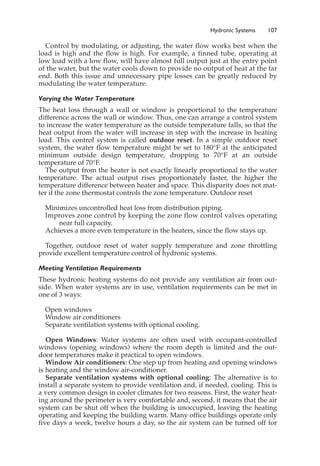
6.1 Introduction 68
6.2 Examples of Buildings with Single-zone Package
Air-Conditioning Units 69
6.3 Air-Handling Unit Components 70
6.4 Refrigeration Equipment 75
6.5 System Performance Requirements 80
6.6 Rooftop Units 82
6.7 Split Systems 85
The Next Step 86
Summary 86
Bibliography 87
7 Multiple Zone Air Systems 88
Study Objectives of Chapter 7 88
7.1 Introduction 88
7.2 Single-Duct, Zoned Reheat, Constant Volume Systems 90
7.3 Single-Duct, Variable Air Volume Systems 92
7.4 By-Pass Box Systems 94
7.5 Constant Volume Dual-Duct, All-Air Systems 95
7.6 Multizone Systems 98
7.7 Three-deck Multizone Systems 99
7.8 Dual-Duct, Variable Air Volume Systems 99
7.9 Dual Path Outside Air Systems 100
The Next Step 101
Summary 101
8 Hydronic Systems 103
Study Objectives of Chapter 8 103
8.1 Introduction 103
8.2 Natural Convection and Low Temperature Radiation
Heating Systems 104
8.3 Panel Heating and Cooling 108
8.4 Fan Coils 109
8.5 Two Pipe Induction Systems 112
8.6 Water Source Heat Pumps 113
The Next Step 115
Summary 115
Bibliography 116
9 Hydronic System Architecture 117
Study Objectives of Chapter 9 117
9.1 Introduction 117
9.2 Steam 118
9.3 Water Systems 120
9.4 Hot Water 124
9.5 Chilled Water 127
9.6 Condenser Water 129
The Next Step 131
Summary 131
Bibliography 132
10 Central Plants 133
Study Objectives of Chapter 10 133
10.1 Introduction 133
10.2 Central Plant Versus Local Plant in a Building 134
10.3 Boilers 136
10.4 Chillers 139
10.5 Cooling Towers 142
The Next Step 145
Summary 145
Bibliography 147
11 Controls 148
Study Objectives of Chapter 11 148
11.1 Introduction 148
11.2 Basic Control 150
11.3 Typical Control loops 155
11.4 Introduction to Direct Digital Control, DDC 157
11.5 Direct Digital Control of an Air-Handler 161
11.6 Architecture and Advantages of Direct Digital Controls 165
The Next Step 169
Summary 169
Bibliography 170
Contents vii
viii Contents
12 Energy Conservation Measures 171
Study Objectives of Chapter 12 171
12.1 Introduction 172
12.2 Energy Considerations for Buildings 172
12.3 ASHRAE/IESNA Standard 90.1 176
12.4 Heat Recovery 179
12.5 Air-Side and Water-Side Economizers 183
12.6 Evaporative Cooling 185
12.7 Control of Building Pressure 186
The Final Step 187
Summary 187
Bibliography 189
13 Special Applications 190
Study Objectives of Chapter 13 190
13.1 Introduction 190
13.2 Radiant Heating and Cooling Systems 191
13.3 Thermal Storage Systems 194
13.4 The Ground as Heat Source and Sink 204
13.5 Occupant Controlled Windows with HVAC 206
13.6 Room Air Distribution Systems 207
13.7 Decoupled or Dual Path, and Dedicated Outdoor
Air Systems 211
Summary 213
Your Next Step 215
Bibliography 216
Index 219
Foreword
Welcome to the ASHRAE Learning Institute’s Fundamentals of HVAC&R
eLearning System series.
This is the Course Reader to accompany the Fundamentals of HVAC
Systems online modules. To help you learn at your convenience, this Course
Reader is also available to you as an eBook included with the online Course
Modules.
The Course Reader will provide you with background information to help
you develop in-depth knowledge of the Fundamentals of HVAC Systems, to
improve your skills in HVAC&R and to earn the 35 PDHs/3.5 CEUs awarded
for successful completion of the Fundamentals of HVAC Systems Learning
course.
We look forward to working with you and helping you achieve maximum
results from the course.
This Page is Intentionally Left Blank
Chapter 1
Introduction to HVAC
Contents of Chapter 1
Study Objectives of Chapter 1
1.1 Introduction
1.2 History of HVAC
1.3 Scope of Modern HVAC
1.4 Introduction To Air-Conditioning Processes
1.5 Objective: what is your system to achieve?
1.6 Environment For Human Comfort
The Next Step
Summary
Bibliography
Study Objectives of Chapter 1
Chapter 1 introduces the history, uses and main processes of heating, ventilat-
ing and air conditioning. There are no calculations to be done. The ideas will
be addressed in detail in later chapters. After studying the chapter, you should
be able to:
Define heating, ventilating and air conditioning.
Describe the purposes of heating, ventilating and air conditioning.
Name and describe seven major air-conditioning processes.
Identify five main aspects of a space that influence an occupant’s comfort.
1.1 Introduction
Heating, Ventilating and Air Conditioning, HVAC, is a huge field. HVAC sys-
tems include a range from the simplest hand-stoked stove, used for comfort
heating, to the extremely reliable total air-conditioning systems found in sub-
marines and space shuttles. Cooling equipment varies from the small domestic
unit to refrigeration machines that are 10,000 times the size, which are used in
industrial processes.
Depending on the complexity of the requirements, the HVAC designer must
consider many more issues than simply keeping temperatures comfortable.
This chapter will introduce you to the fundamental concepts that are used by
designers to make decisions about system design, operation, and maintenance.
2 Fundamentals of HVAC
1.2 Brief History of HVAC
For millennia, people have used fire for heating. Initially, the air required to
keep the fire going ensured adequate ventilation for the occupants. However,
as central furnaces with piped steam or hot water became available for heat-
ing, the need for separate ventilation became apparent. By the late 1880s, rules
of thumb for ventilation design were developed and used in many countries.
In 1851 Dr. John Gorrie was granted U.S. patent 8080 for a refrigeration
machine. By the 1880s, refrigeration became available for industrial purposes.
Initially, the two main uses were freezing meat for transport and making ice.
However, in the early 1900s there was a new initiative to keep buildings cool
for comfort. Cooling the New York Stock Exchange, in 1902, was one of the
first comfort cooling systems. Comfort cooling was called “air conditioning.”
Our title, “HVAC,” thus captures the development of our industry. The term
“air conditioning” has gradually changed, from meaning just cooling, to the
total control of:
䊉 Temperature
䊉 Moisture in the air (humidity)
䊉 Supply of outside air for ventilation
䊉 Filtration of airborne particles
䊉 Air movement in the occupied space
Throughout the rest of this text we will use the term “air conditioning” to
include all of these issues and continue to use “HVAC” where only some of
the elements of full air conditioning are being controlled.
To study the historical record of HVAC is to take a fascinating trip through the
tremendous technical and scientific record of society. There are the pioneers such
as Robert Boyle, Sadi Carnot, John Dalton, James Watt, Benjamin Franklin, John
Gorrie, Lord Kelvin, Ferdinand Carré, Willis Carrier and Thomas Midgley, along
with many others, who have brought us to our current state. Air-conditioning
technology has developed since 1900 through the joint accomplishments of sci-
ence and engineering. Advances in thermodynamics, fluid mechanics, electricity,
electronics, construction, materials, medicine, controls and social behavior are the
building blocks to better engineered products of air conditioning.
Historical accounts are not required as part of this course but, for the
enjoyment and perspective it provides, it is worth reading an article such as
“Milestones in Air Conditioning,” by Walter A. Grant1 or the book about Willis
Carrier, The Father of Air Conditioning.2 The textbook Principles of Heating,
Ventilating, and Air Conditioning,3 starts with a concise and comprehensive his-
tory of the HVAC industry.
HVAC evolved based on:
䊉 Technological discoveries, such as refrigeration, that were quickly adopted
for food storage.
䊉 Economic pressures, such as the reduction in ventilation rates after the 1973
energy crisis.
䊉 Computerization and networking, used for sophisticated control of large
complex systems serving numerous buildings.
䊉 Medical discoveries, such as the effects of second hand smoke on people,
which influenced ventilation methods.
1.3 Scope of Modern HVAC
Modern air conditioning is critical to almost every facet of advancing human
activity. Although there have been great advances in HVAC, there are several
areas where active research and debate continue.
Indoor air quality is one that directly affects us. In many countries of
the world there is a rapid rise in asthmatics and increasing dissatisfaction
with indoor-air-quality in buildings and planes. The causes and effects are
extremely complex. A significant scientific and engineering field has devel-
oped to investigate and address these issues.
Greenhouse gas emissions and the destruction of the earth’s protective ozone
layer are concerns that are stimulating research. New legislation and guide-
lines are evolving that encourage: recycling; the use of new forms of energy;
less energy usage; and low polluting materials, particularly refrigerants. All
these issues have a significant impact on building design, including HVAC
systems and the design codes.
Energy conservation is an ongoing challenge to find novel ways to reduce
consumption in new and existing buildings without compromising comfort
and indoor air quality. Energy conservation requires significant cooperation
between disciplines.
For example, electric lighting produces heat. When a system is in a cooling
mode, this heat is an additional cooling load. Conversely, when the system is
in a heating mode, the lighting heat reduces the load on the building heating
system. This interaction between lighting and HVAC is the reason that
ASHRAE and the Illuminating Engineering Society of North America (IESNA)
joined forces to write the building energy conservation standard, Standard
90.1–2004, Energy Standard for Buildings Except Low-Rise Residential Buildings4.
1.4 Introduction to Air-conditioning Processes
As mentioned earlier, the term “air conditioning,” when properly used, now
means the total control of temperature, moisture in the air (humidity), supply
of outside air for ventilation, filtration of airborne particles, and air movement
in the occupied space. There are seven main processes required to achieve full
air conditioning and they are listed and explained below:
The processes are:
1. Heating—the process of adding thermal energy (heat) to the conditioned
space for the purposes of raising or maintaining the temperature of the space.
2. Cooling—the process of removing thermal energy (heat) from the condi-
tioned space for the purposes of lowering or maintaining the temperature
of the space.
3. Humidifying—the process of adding water vapor (moisture) to the air in the
conditioned space for the purposes of raising or maintaining the moisture
content of the air.
4. Dehumidifying—the process of removing water vapor (moisture) from the
air in the conditioned space for the purposes of lowering or maintaining the
moisture content of the air.
5. Cleaning—the process of removing particulates, (dust etc.,) and biological
contaminants, (insects, pollen etc.,) from the air delivered to the condi-
tioned space for the purposes of improving or maintaining the air quality.
Introduction to HVAC 3
4 Fundamentals of HVAC
6. Ventilating—the process of exchanging air between the outdoors and the
conditioned space for the purposes of diluting the gaseous contaminants in
the air and improving or maintaining air quality, composition and fresh-
ness. Ventilation can be achieved either through natural ventilation or
mechanical ventilation. Natural ventilation is driven by natural draft, like
when you open a window. Mechanical ventilation can be achieved by using
fans to draw air in from outside or by fans that exhaust air from the space
to outside.
7. Air Movement—the process of circulating and mixing air through conditioned
spaces in the building for the purposes of achieving the proper ventilation
and facilitating the thermal energy transfer.
The requirements and importance of the seven processes varies. In a climate
that stays warm all year, heating may not be required at all. Conversely, in a
cold climate the periods of heat in the summer may be so infrequent as to
make cooling unnecessary. In a dry desert climate, dehumidification may
be redundant, and in a hot, humid climate dehumidification may be the most
important design aspect of the air-conditioning system.
Defining Air conditioning
The actual use of the words “air conditioning” varies considerably, so it is
always advisable to check what is really meant. Consider, for example, “win-
dow air conditioners.” The vast majority provide cooling, some dehumidifica-
tion, some filtering, and some ventilation when the outside temperature is well
above freezing. They have no ability to heat or to humidify the conditioned
space and do not cool if it is cold outside.
In colder climates, heating is often provided by a separate, perimeter
heating system, that is located within the outside walls. The other functions:
cooling, humidification, dehumidification, cleaning, ventilating and air
movement, are all provided by a separate air system, often referred to as the
“air-conditioning system.” It is important to remember that both the heat-
ing and the air system together form the “air-conditioning” system for the
space.
1.5 Objective: What is your system to achieve?
Before starting to design a system, it is critical that you know what your
system is to achieve.
Often, the objective is to provide a comfortable environment for the human
occupants, but there are many other possible objectives: creating a suitable
environment for farm animals; regulating a hospital operating room; main-
taining cold temperatures for frozen food storage; or maintaining temperature
and humidity to preserve wood and fiber works of art. Whatever the situation,
it is important that the objective criteria for system success are clearly identi-
fied at the start of the project, because different requirements need different
design considerations.
Let us very briefly consider some specific design situations and the types of
performance requirements for HVAC systems.
Example 1: Farm animals. The design issues are economics, the health and well
being of both animals and workers, plus any regulations. Farm animal
spaces are always ventilated. Depending on the climate, cooling and/or
heating may be provided, controlled by a simple thermostat. The ventilation
rate may be varied to:
䊉 Maintain indoor air quality (removal of body and excrement fumes.)
䊉 Maintain inside design temperature (bring in cool air and exhaust hot air.)
䊉 Remove moisture (bring in drier air and exhaust moist air.)
䊉 Change the air movement over the animals (higher air speed provides
cooling.)
A complex control of ventilation to meet the four design requirements
may well be very cost effective. However, humidification and cleaning are
not required.
Example 2: Hospital operating room. This is a critical environment, often served
by a dedicated air-conditioning system. The design objectives include:
䊉 Heating, to avoid the patient from becoming too cold.
䊉 Cooling, to prevent the members of the operating team from becoming too
hot.
䊉 Control adjustment by the operating team for temperatures between 65°F
(Fahrenheit) and 80°F.
䊉 Humidifying, to avoid low humidity and the possibility of static electricity
sparks.
䊉 Dehumidifying, to minimize any possibility of mold and to minimize
operating team discomfort.
䊉 Cleaning the incoming air with very high efficiency filters, to remove any
airborne organisms that could infect the patient.
䊉 Ventilating, to remove airborne contaminants and to keep the theatre
fresh.
䊉 Providing steady air movement from ceiling supply air outlets down over
the patient for exhaust near the floor, to minimize contamination of the
operating site.
This situation requires a very comprehensive air-conditioning system.
Example 3: Frozen food storage. The ideal temperature for long storage varies: i.e.
ice cream requires temperatures below ⫺12°F and meat requires temperatures
below ⫺5°F. The design challenge is to ensure that the temperature is
accurately maintained and that the temperature is as even as possible through-
out the storage facility. Here, accurate cooling and good air movement are
the prime issues. Although cooling and air movement are required, we refer to
this system as a “freezer,” not as an air-conditioning system, because heating,
ventilation, humidification and dehumidification are not controlled.
Example 4: Preserving wood and fiber works of art. The objectives in this environ-
ment are to minimize any possibility of mold, by keeping the humidity low,
and to minimize drying out, by keeping the humidity up. In addition, it is
important to minimize the expansion and contraction of specimens that can
Introduction to HVAC 5
6 Fundamentals of HVAC
occur as the moisture content changes. As a result the design challenge is
to maintain a very steady humidity, reasonably steady temperature, and to
minimize required ventilation, from a system that runs continuously. For this
situation, the humidity control is the primary issue and temperature control is
secondary. Typically, this situation will require all seven of the air-conditioning
features and we will describe the space as fully “air-conditioned.”
Now let us go on to consider the more complex subject of human comfort in
a space.
1.6 Environment For Human Comfort
“Provide a comfortable environment for the occupants” sounds like a simple
objective, until you start to consider the variety of factors that influence the
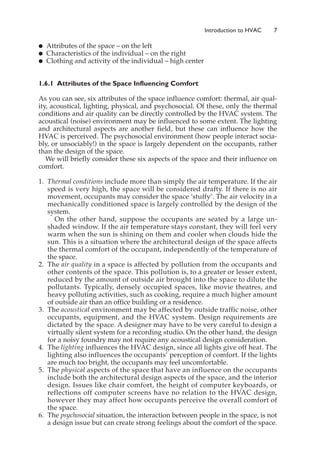
comfort of an individual. Figure 1.1 is a simplified diagram of the three main
groups of factors that affect comfort.
THERMAL
CONDITIONS
INCLUDING
HUMIDITY
AIR QUALITY
ACOUSTICAL
(NOISE)
LIGHTING
PHYSICAL –
ARCHITECTURAL,
FURNITURE
HEALTH
VULNERABILITY
EXPECTATIONS
ENVIRONMENTAL
CONDITIONS
INDIVIDUAL
CHARACTERISTICS
PRODUCTIVITY
RATING OF
THE SPACE
SYMPTOMS
CLOTHING
ACTIVITY LEVEL
PSYCHOSOCIAL
INDIVIDUAL
PERSON
Figure 1.1 Personal Environment Model (adapted with permission from “The construct
of comfort: a framework for research” by W.S. Cain5)
䊉 Attributes of the space – on the left
䊉 Characteristics of the individual – on the right
䊉 Clothing and activity of the individual – high center
1.6.1 Attributes of the Space Influencing Comfort
As you can see, six attributes of the space influence comfort: thermal, air qual-
ity, acoustical, lighting, physical, and psychosocial. Of these, only the thermal
conditions and air quality can be directly controlled by the HVAC system. The
acoustical (noise) environment may be influenced to some extent. The lighting
and architectural aspects are another field, but these can influence how the
HVAC is perceived. The psychosocial environment (how people interact socia-
bly, or unsociably!) in the space is largely dependent on the occupants, rather
than the design of the space.
We will briefly consider these six aspects of the space and their influence on
comfort.
1. Thermal conditions include more than simply the air temperature. If the air
speed is very high, the space will be considered drafty. If there is no air
movement, occupants may consider the space ‘stuffy’. The air velocity in a
mechanically conditioned space is largely controlled by the design of the
system.
On the other hand, suppose the occupants are seated by a large un-
shaded window. If the air temperature stays constant, they will feel very
warm when the sun is shining on them and cooler when clouds hide the
sun. This is a situation where the architectural design of the space affects
the thermal comfort of the occupant, independently of the temperature of
the space.
2. The air quality in a space is affected by pollution from the occupants and
other contents of the space. This pollution is, to a greater or lesser extent,
reduced by the amount of outside air brought into the space to dilute the
pollutants. Typically, densely occupied spaces, like movie theatres, and
heavy polluting activities, such as cooking, require a much higher amount
of outside air than an office building or a residence.
3. The acoustical environment may be affected by outside traffic noise, other
occupants, equipment, and the HVAC system. Design requirements are
dictated by the space. A designer may have to be very careful to design a
virtually silent system for a recording studio. On the other hand, the design
for a noisy foundry may not require any acoustical design consideration.
4. The lighting influences the HVAC design, since all lights give off heat. The
lighting also influences the occupants’ perception of comfort. If the lights
are much too bright, the occupants may feel uncomfortable.
5. The physical aspects of the space that have an influence on the occupants
include both the architectural design aspects of the space, and the interior
design. Issues like chair comfort, the height of computer keyboards, or
reflections off computer screens have no relation to the HVAC design,
however they may affect how occupants perceive the overall comfort of
the space.
6. The psychosocial situation, the interaction between people in the space, is not
a design issue but can create strong feelings about the comfort of the space.
Introduction to HVAC 7
8 Fundamentals of HVAC
1.6.2 Characteristics of the Individual that Influence Comfort
Now let us consider the characteristics of the occupants of the space. All
people bring with them health, vulnerabilities and expectations.
Their health may be excellent and they may not even notice the draft
from the air conditioning. On the other hand if the occupants are patients in a
doctor’s waiting room, they could perceive a cold draft as very uncomfortable
and distressing.
The occupants can also vary in vulnerability. For example, cool floors will
likely not affect an active adult who is wearing shoes. The same floor may be
uncomfortably cold for the baby who is crawling around on it.
Lastly the occupants bring their expectations. When we enter a prestigious
hotel, we expect it to be comfortable. When we enter an air-conditioned build-
ing in summer, we expect it to be cool. The expectations may be based on pre-
vious experience in the space or based on the visual perception of the space.
For example, when you enter the changing room in the gym, you expect it to
be smelly, and your expectations make you more tolerant of the reality.
1.6.3 Clothing and Activity as a function of Individual Comfort
The third group of factors influencing comfort is the amount of clothing and
the activity level of the individual. If we are wearing light clothing, the space
needs to be warmer for comfort than if we are heavily clothed. Similarly, when
we are involved in strenuous activity, we generate considerable body heat and
are comfortable with a lower space temperature.
In the summer, in many business offices, managers wear suits with shirts and
jackets while staff members may have bare arms, and light clothing. The same
space may be thermally comfortable to one group and uncomfortable to the other.
There is much more to comfort than most people realize. These various
aspects of comfort will be covered in more detail in later chapters.
The Next Step
Chapter 2 introduces the concept of an air-conditioning system. We will then
consider characteristics of systems and how various parameters influence
system choice. Chapter 2 is broad in scope and will introduce you the content
and value of the other ASHRAE Self-Study Courses.
Summary
This has been an introduction to heating, ventilating and air conditioning
and some of the terminology and main processes that are involved in air
conditioning.
1.2 Brief History of HVAC
The field of HVAC started in the mid 1800s. The term “air conditioning” has
gradually changed from meaning just cooling, to the total control of temperature,
moisture in the air (humidity), supply of outside air for ventilation, filtration of
airborne particles and air movement in the occupied space.
1.3 Scope of Modern HVAC
Some of the areas of research, regulation and responsibility include indoor air
quality, greenhouse gas emissions, and energy conservation.
1.4 Introduction to Air-conditioning Processes
There are seven main processes required to achieve full air conditioning: heat-
ing, cooling, humidifying, dehumidifying, cleaning, ventilating, air movement.
The requirements and importance of the seven processes vary with the climate.
1.5 System Objectives
Before starting to design a system, it is critical that you know what your
system is supposed to achieve. The objective will determine the type of system
to select, and the performance goals for it.
1.6 Environment For Human Comfort
The requirements for human comfort are affected by: the physical space; the
characteristics of the individual, including health, vulnerability and expecta-
tions; and the clothing and activities of the individual.
Six attributes of the physical space that influence comfort are thermal, air
quality, acoustical, lighting, physical, and the psychosocial environment. Of
these, only the thermal conditions and air quality can be directly controlled by
the HVAC system. The acoustical (noise) environment may be influenced to
some extent. The lighting and architectural aspects can influence how
the HVAC is perceived. The psychosocial environment in the space is largely
dependent on the occupants rather than the design of the space.
Bibliography
1. Grant, W. 1969. “Milestones in Air Conditioning.” ASHRAE Journal. Atlanta:
ASHRAE. Vol. 11, No. 9, pp. 45–51.
2. Ingels, M. 1991. The Father of Air Conditioning. Louisville, KY: Fetter Printing Co.
3. Sauer, Harry J. Jr., Ronald H. Howell, William J. Coad. 2001. Principles of Heating,
Ventilating, and Air Conditioning. Atlanta: ASHRAE.
4. Standard 90.1–2004 Energy Standard for Buildings Except Low-Rise Residential Buildings.
Atlanta: ASHRAE.
5. Cain, W.S. 2002. “The construct of comfort: a framework for research” Indoor Air
2002, Proceedings: Indoor Air 2002 Volume II, pp.12–20.
Introduction to HVAC 9
Chapter 2
Introduction to HVAC Systems
Contents of Chapter 2
Study Objectives of Chapter 2
2.1 Introduction
2.2 Introducing the Psychrometric Chart
2.3 Basic Air-Conditioning System
2.4 Zoned Air-Conditioning Systems
2.5 Choosing an Air-Conditioning System
2.6 System Choice Matrix
The Next Step
Summary
Bibliography
Study Objectives of Chapter 2
Chapter 2 begins with an introduction to a graphical representation of air-
conditioning processes called the psychrometric chart. Next, an air-conditioning
system is introduced followed by a discussion about how it can be adapted to
serve many spaces. The chapter ends with a brief introduction to the idea of
using a factor matrix to help choose an air-conditioning system.
Chapter 2 is broad in scope and will also introduce you to the content and
value of other, more in depth, ASHRAE Self-Study Courses. After studying
Chapter 2, you should be able to:
Understand and describe the major concepts of the psychrometric chart.
Define the main issues to be considered when designing a system.
Name the four major system types and explain their differences.
Describe the main factors to be considered in a matrix selection process.
2.1 Introduction
In Chapter 1 we introduced the seven main air-conditioning processes and the
task of establishing objectives for air-conditioning design. In this chapter we
will consider
How these processes are described graphically in the psychrometric chart.
How these processes are combined to form an air-conditioning system.
The range of heating, ventilating and air-conditioning systems.
How system choices are made.
2.2 Introducing the Psychrometric Chart
Many of the air-conditioning processes involve air that is experiencing
energy changes. These changes arise from changes in the air’s temperature
and its moisture content. The relationships between temperature, moisture
content, and energy are most easily understood using a visual aid called the
“psychrometric chart.”
The psychrometric chart is an industry-standard tool that is used to visualize
the interrelationships between dry air, moisture and energy. If you are responsible
for the design or maintenance of any aspect of air conditioning in buildings, a
clear and comfortable understanding of the chart will make your job easier.
Initially, the chart can be intimidating, but as you work with it you will
discover that the relationships that it illustrates are relatively easy to understand.
Once you are comfortable with it, you will discover that it is a tool that can make
it easier to troubleshoot air-conditioning problems in buildings. The ASHRAE
course, Fundamentals of Thermodynamics and Psychrometrics1 goes into great detail
about the use of the chart. That course also provides calculations and discussion
about how the chart can be used as a design and troubleshooting tool.
In this course, however, we will only introduce the psychrometric chart, and
provide a very brief overview of its structure.
The Design of the Psychrometric Chart
The psychrometric chart is built upon two simple concepts.
1. Indoor air is a mixture of dry air and water vapor.
2. There is a specific amount of energy in the mixture at a specific temperature
and pressure.
Psychrometric Chart Concept 1: Indoor Air is a Mixture of Dry Air and Water Vapor.
The air we live in is a mixture of both dry air and water vapor. Both are invisible
gases. The water vapor in air is also called moisture or humidity. The quantity of
water vapor in air is expressed as “pounds of water vapor per pound of air.”
This ratio is called the “humidity ratio,” abbreviation W and the units are pounds
of water/pound of dry air, lbw/lbda, often abbreviated to lb/lb.
The exact properties of moist air vary with pressure. Because pressure
reduces as altitude increases, the properties of moist air change with altitude.
Typically, psychrometric charts are printed based on standard pressure at sea
level. For the rest of this course we will consider pressure as constant.
To understand the relationship between water vapor, air and temperature,
we will consider two conditions:
First Condition: The temperature is constant, but the quantity of water vapor is
increasing.
If the temperature remains constant, then, as the quantity of water vapor in the
air increases, the humidity increases. However, at every temperature point, there
is a maximum amount of water vapor that can co-exist with the air. The point
Introduction to HVAC Systems 11
12 Fundamentals of HVAC
at which this maximum is reached is called the saturation point. If more water
vapor is added after the saturation point is reached, then an equal amount of
water vapor condenses, and takes the form of either water droplets or ice crystals.
Outdoors, we see water droplets in the air as fog, clouds or rain and we see
ice crystals in the air as snow or hail. The psychrometric chart only considers the
conditions up to the saturation point; therefore, it only considers the effects of
water in the vapor phase, and does not deal with water droplets or ice crystals.
Second Condition: The temperature is dropping, but the quantity of water
vapor is constant.
If the air is cooled sufficiently, it reaches the saturation line. If it is cooled
even more, moisture will condense out and dew forms.
For example, if a cold canned drink is taken out of the refrigerator and left for a
few minutes, the container gets damp. This is because the moist air is in contact
with the chilled container. The container cools the air that it contacts to a temper-
ature that is below saturation, and dew forms. This temperature, at which the air
starts to produce condensation, is called the dew point temperature.
Relative Humidity
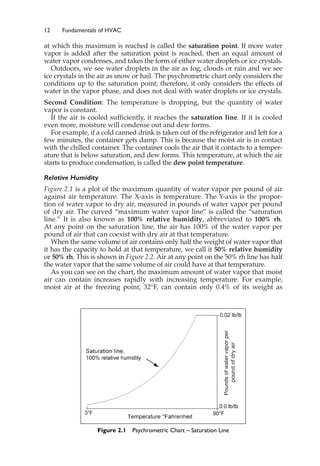
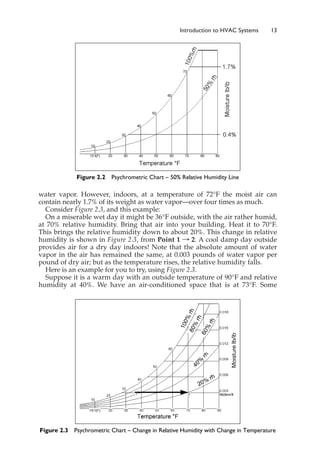
Figure 2.1 is a plot of the maximum quantity of water vapor per pound of air
against air temperature. The X-axis is temperature. The Y-axis is the propor-
tion of water vapor to dry air, measured in pounds of water vapor per pound
of dry air. The curved “maximum water vapor line” is called the “saturation
line.” It is also known as 100% relative humidity, abbreviated to 100% rh.
At any point on the saturation line, the air has 100% of the water vapor per
pound of air that can coexist with dry air at that temperature.
When the same volume of air contains only half the weight of water vapor that
it has the capacity to hold at that temperature, we call it 50% relative humidity
or 50% rh. This is shown in Figure 2.2. Air at any point on the 50% rh line has half
the water vapor that the same volume of air could have at that temperature.
As you can see on the chart, the maximum amount of water vapor that moist
air can contain increases rapidly with increasing temperature. For example,
moist air at the freezing point, 32°F, can contain only 0.4% of its weight as
Figure 2.1 Psychrometric Chart – Saturation Line
water vapor. However, indoors, at a temperature of 72°F the moist air can
contain nearly 1.7% of its weight as water vapor—over four times as much.
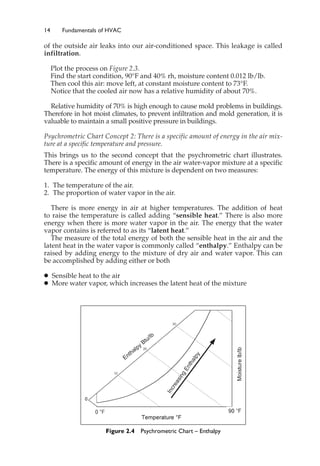
Consider Figure 2.3, and this example:
On a miserable wet day it might be 36°F outside, with the air rather humid,
at 70% relative humidity. Bring that air into your building. Heat it to 70°F.
This brings the relative humidity down to about 20%. This change in relative
humidity is shown in Figure 2.3, from Point 1 : 2. A cool damp day outside
provides air for a dry day indoors! Note that the absolute amount of water
vapor in the air has remained the same, at 0.003 pounds of water vapor per
pound of dry air; but as the temperature rises, the relative humidity falls.
Here is an example for you to try, using Figure 2.3.
Suppose it is a warm day with an outside temperature of 90°F and relative
humidity at 40%. We have an air-conditioned space that is at 73°F. Some
Introduction to HVAC Systems 13
Figure 2.2 Psychrometric Chart – 50% Relative Humidity Line
Figure 2.3 Psychrometric Chart – Change in Relative Humidity with Change in Temperature
14 Fundamentals of HVAC
of the outside air leaks into our air-conditioned space. This leakage is called
infiltration.
Plot the process on Figure 2.3.
Find the start condition, 90°F and 40% rh, moisture content 0.012 lb/lb.
Then cool this air: move left, at constant moisture content to 73°F.
Notice that the cooled air now has a relative humidity of about 70%.
Relative humidity of 70% is high enough to cause mold problems in buildings.
Therefore in hot moist climates, to prevent infiltration and mold generation, it is
valuable to maintain a small positive pressure in buildings.
Psychrometric Chart Concept 2: There is a specific amount of energy in the air mix-
ture at a specific temperature and pressure.
This brings us to the second concept that the psychrometric chart illustrates.
There is a specific amount of energy in the air water-vapor mixture at a specific
temperature. The energy of this mixture is dependent on two measures:
1. The temperature of the air.
2. The proportion of water vapor in the air.
There is more energy in air at higher temperatures. The addition of heat
to raise the temperature is called adding “sensible heat.” There is also more
energy when there is more water vapor in the air. The energy that the water
vapor contains is referred to as its “latent heat.”
The measure of the total energy of both the sensible heat in the air and the
latent heat in the water vapor is commonly called “enthalpy.” Enthalpy can be
raised by adding energy to the mixture of dry air and water vapor. This can
be accomplished by adding either or both
䊉 Sensible heat to the air
䊉 More water vapor, which increases the latent heat of the mixture
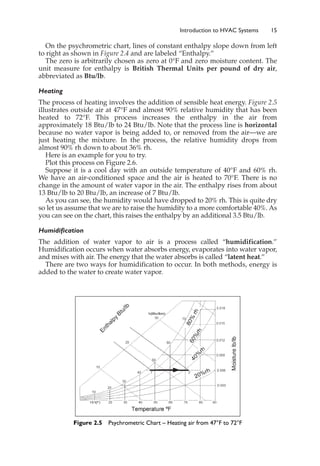
Figure 2.4 Psychrometric Chart – Enthalpy
On the psychrometric chart, lines of constant enthalpy slope down from left
to right as shown in Figure 2.4 and are labeled “Enthalpy.”
The zero is arbitrarily chosen as zero at 0°F and zero moisture content. The
unit measure for enthalpy is British Thermal Units per pound of dry air,
abbreviated as Btu/lb.
Heating
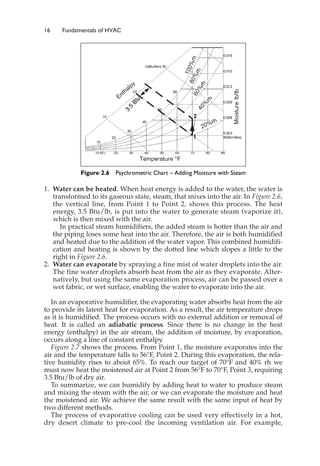
The process of heating involves the addition of sensible heat energy. Figure 2.5
illustrates outside air at 47°F and almost 90% relative humidity that has been
heated to 72°F. This process increases the enthalpy in the air from
approximately 18 Btu/lb to 24 Btu/lb. Note that the process line is horizontal
because no water vapor is being added to, or removed from the air—we are
just heating the mixture. In the process, the relative humidity drops from
almost 90% rh down to about 36% rh.
Here is an example for you to try.
Plot this process on Figure 2.6.
Suppose it is a cool day with an outside temperature of 40°F and 60% rh.
We have an air-conditioned space and the air is heated to 70°F. There is no
change in the amount of water vapor in the air. The enthalpy rises from about
13 Btu/lb to 20 Btu/lb, an increase of 7 Btu/lb.
As you can see, the humidity would have dropped to 20% rh. This is quite dry
so let us assume that we are to raise the humidity to a more comfortable 40%. As
you can see on the chart, this raises the enthalpy by an additional 3.5 Btu/lb.
Humidification
The addition of water vapor to air is a process called “humidification.”
Humidification occurs when water absorbs energy, evaporates into water vapor,
and mixes with air. The energy that the water absorbs is called “latent heat.”
There are two ways for humidification to occur. In both methods, energy is
added to the water to create water vapor.
Introduction to HVAC Systems 15
Figure 2.5 Psychrometric Chart – Heating air from 47°F to 72°F
16 Fundamentals of HVAC
1. Water can be heated. When heat energy is added to the water, the water is
transformed to its gaseous state, steam, that mixes into the air. In Figure 2.6,
the vertical line, from Point 1 to Point 2, shows this process. The heat
energy, 3.5 Btu/lb, is put into the water to generate steam (vaporize it),
which is then mixed with the air.
In practical steam humidifiers, the added steam is hotter than the air and
the piping loses some heat into the air. Therefore, the air is both humidified
and heated due to the addition of the water vapor. This combined humidifi-
cation and heating is shown by the dotted line which slopes a little to the
right in Figure 2.6.
2. Water can evaporate by spraying a fine mist of water droplets into the air.
The fine water droplets absorb heat from the air as they evaporate. Alter-
natively, but using the same evaporation process, air can be passed over a
wet fabric, or wet surface, enabling the water to evaporate into the air.
In an evaporative humidifier, the evaporating water absorbs heat from the air
to provide its latent heat for evaporation. As a result, the air temperature drops
as it is humidified. The process occurs with no external addition or removal of
heat. It is called an adiabatic process. Since there is no change in the heat
energy (enthalpy) in the air stream, the addition of moisture, by evaporation,
occurs along a line of constant enthalpy.
Figure 2.7 shows the process. From Point 1, the moisture evaporates into the
air and the temperature falls to 56°F, Point 2. During this evaporation, the rela-
tive humidity rises to about 65%. To reach our target of 70°F and 40% rh we
must now heat the moistened air at Point 2 from 56°F to 70°F, Point 3, requiring
3.5 Btu/lb of dry air.
To summarize, we can humidify by adding heat to water to produce steam
and mixing the steam with the air, or we can evaporate the moisture and heat
the moistened air. We achieve the same result with the same input of heat by
two different methods.
The process of evaporative cooling can be used very effectively in a hot,
dry desert climate to pre-cool the incoming ventilation air. For example,
Figure 2.6 Psychrometric Chart – Adding Moisture with Steam
outside air at 90°F and 15% relative humidity could be cooled to 82°F by
passing it through an evaporative cooler. The relative humidity will rise,
but only to about 27%. Even with no mechanical refrigeration, this results in
a pleasant reduction in air temperature without raising the relative
humidity excessively.
Cooling and Dehumidification
Cooling is most often achieved in an air-conditioning system by passing the
moist air over a cooling coil. As illustrated in Figure 2.8, a coil is constructed
of a long serpentine pipe through which a cold liquid or gas flows.
This cold fluid is either chilled water, typically between 40°F and 45°F, or
a refrigerant. The pipe is lined with fins to increase the heat transfer from
the air to the cold fluid in the pipe. Figure 2.8 shows the face of the coil, in
the direction of airflow. Depending on the coil design, required temperature
Introduction to HVAC Systems 17
Figure 2.7 Psychrometric Chart – Adding Moisture, Evaporative Humidifier
FACE VIEW OF FINNED COIL SHOWING COOLANT FLOW.
COOLANT
FLOW
Figure 2.8 Cooling Coil
18 Fundamentals of HVAC
drop, and moisture removal performance, the coil may have 2 to 8 rows of
piping. Generally the more rows, the higher the moisture removal ability of
the coil.
There are two results. First, the cooling coil cools the air as the air passes
over the coils. Second, because the cooling fluid in the coil is usually well
below the saturation temperature of the air, moisture condenses on the coil,
and drips off, to drain away. This process reduces the enthalpy, or heat, of the
air mixture and increases the enthalpy of the chilled water or refrigerant. In
another part of the system, this added heat must be removed from the chilled
water or refrigerant to recool it for reuse in the cooling coil.
The amount of moisture that is removed depends on several factors including:
䊉 The temperature of the cooling fluid
䊉 The depth of the coil
䊉 Whether the fins are flat or embossed
䊉 The air velocity across the coil.
An example of the typical process is shown in Figure 2.9.
The warm moist air comes into the building at 80°F and 50% rh, and passes
through a cooling coil. In this process, the air is being cooled to 57°F. As the
moisture condenses on the coil, it releases its latent heat and this heat has to
be removed by the cooling fluid. In Figure 2.9 the moisture removal enthalpy,
A : B, is about a third of the enthalpy required to cool the air, B : C.
This has been a very brief introduction to the concepts of the psychrometric
chart. A typical chart is shown in Figure 2.10. It looks complicated, but you
know the simple underlying ideas:
Indoor air is a mixture of dry air and water vapor.
There is a specific amount of total energy, called enthalpy, in the mixture at a
specific temperature, moisture content and pressure.
There is a maximum limit to the amount of water vapor in the mixture at
any particular temperature.
Figure 2.9 Psychrometric Chart – Cooling Across a Wet Cooling Coil
Figure 2.10 ASHRAE Psychrometric Chart
20 Fundamentals of HVAC
The actual use of the chart for design, including the calculations, is detailed
in the ASHRAE course Fundamentals of Thermodynamics and Psychrometrics1.
Now that we have an understanding of the relationships of dry air, moisture
and energy, at a particular pressure we will consider an air-conditioning plant
that will provide all seven basic functions of an air-conditioning system to a
single space. Remember, the processes required are: heating, cooling, dehu-
midifying, humidifying, ventilating, cleaning and air movement.
2.3 Basic Air-Conditioning System
Figure 2.11 shows the schematic diagram of an air-conditioning plant. The
majority of the air is drawn from the space, mixed with outside ventilation air
and then conditioned before being blown back into the space.
As you discovered in Chapter 1, air-conditioning systems are designed to
meet a variety of objectives. In many commercial and institutional systems, the
ratio of outside ventilation air to return air typically varies from 15 to 25% of
outside air. There are, however, systems which provide 100% outside air with
zero recirculation.
The components, from left to right, are:
Outside Air Damper, which closes off the outside air intake when the
system is switched off. The damper can be on a spring return with a
motor to drive it open; then it will automatically close on power failure.
On many systems there will be a metal mesh screen located upstream of
the filter, to prevent birds and small animals from entering, and to catch
larger items such as leaves and pieces of paper.
Mixing chamber, where return air from the space is mixed with the outside
ventilation air.
Filter, which cleans the air by removing solid airborne contaminants (dirt).
The filter is positioned so that it cleans the return air and the ventilation
air. The filter is also positioned upstream of any heating or cooling coils,
to keep the coils clean. This is particularly important for the cooling
coil, because the coil is wet with condensation when it is cooling.
Figure 2.11 Air-Conditioning Plant
Heating coil, which raises the air temperature to the required supply
temperature.
Cooling coil, which provides cooling and dehumidification. A thermostat
mounted in the space will normally control this coil. A single thermostat
and controller are often used to control both the heating and cooling coil.
This method reduces energy waste, because it ensures the two coils
cannot both be “on” at the same time.
Humidifier, which adds moisture, and which is usually controlled by a
humidistat in the space. In addition, a high humidity override humidi-
stat will often be mounted just downstream of the fan, to switch the
humidification “off” if it is too humid in the duct. This minimizes the
possibility of condensation forming in the duct.
Fan, to draw the air through the resistance of the system and blow it into the
space.
These components are controlled to achieve six of the seven air-conditioning
processes.
Heating: directly by the space thermostat controlling the amount of heat
supplied by the heating coil.
Cooling: directly by the space thermostat controlling the amount of cooling
supplied to the cooling coil.
Dehumidifying: by default when cooling is required, since, as the cooling coil
cools the air, some moisture condenses out.
Humidifying: directly, by releasing steam into the air, or by a very fine water
spray into the air causing both humidification and cooling.
Ventilating: provided by the outside air brought in to the system.
Cleaning: provided by the supply of filtered air.
Air movement within the space is not addressed by the air-conditioning
plant, but rather by the way the air is delivered into the space.
Economizer Cycle
In many climates there are substantial periods of time when cooling is
required and the return air from the space is warmer and moister than the
outside air. During these periods, you can reduce the cooling load on the cool-
ing coil by bringing in more outside air than that required for ventilation. This
can be accomplished by expanding the design of the basic air-conditioning
system to include an economizer.
The economizer consists of three (or four) additional components as shown
in Figure 2.12.
Expanded air intake and damper, sized for 100% system flow.
Relief air outlet with automatic damper, to exhaust excess air to outside.
Return air damper, to adjust the flow of return air into the mixing chamber.
(Optional) Return fan in the return air duct. The return fan is often added
on economizer systems, particularly on larger systems. If there is no
return fan, the main supply fan must provide enough positive pressure
in the space to force the return air out through any ducting and the relief
dampers. This can cause unacceptable pressures in the space, making
doors slam and difficult to open. When the return air fan is added it will
overcome the resistance of the return duct and relief damper, so the space
pressure stays near neutral to outside.
Introduction to HVAC Systems 21
22 Fundamentals of HVAC
Figure 2.12 Air-Conditioning Plant with Economizer Cycle
Example: Let us consider the operation of the economizer system in
Figure 2.13. The particular system operating requirements and settings are:
The system is required to provide supply air at 55°F
Return air from the space is at 75°F
Minimum outside air requirement is 20%,
Above 68°F, the system will revert to minimum outside air for ventilation.
In Figure 2.13, the outside temperature is shown along the x-axis from ⫺60°F
to ⫹100°F. We are going to consider the economizer operation from ⫺50°F up
to 100°F, working across Figure 2.13 from left to right.
At ⫺50°F, the minimum 20% outside air for ventilation is mixing with 80%
return air at 75°F and will produce a mixed temperature of only 50°F.
Therefore, in order to achieve the required supply air at 55°F, the heater will
have to increase the temperature by 5°F.
Figure 2.13 Economizer Performance
At ⫺25°F, the minimum outside air for ventilation, 20%, is mixing with 80%
return air at 75°F to produce a mixed temperature of 55°F, so the supply air
will no longer require any additional heating.
As the temperature rises above ⫺25°F the proportion of outside air will
steadily increase to maintain a mixed temperature of 55°F. When the outside
air temperature reaches 55°F the mixture will be 100% outside air (and 0%
return air). This represents full economizer operation.
Above 55°F the controls will maintain 100% outside air but the temperature
will rise as does the outside temperature. The cooling coil will come on to cool
the mixed air to the required 55°F.
In this example, at 68°F the controls will close the outside air dampers, and
allow only the required 20% ventilation air into the mixing chamber.
From 68°F to 100°F the system will be mixing 20% outside air and 80%
return air. This will produce a mixture with temperature rising from 73.6°F to
80°F as the outside air temperature rises from 68°F to 100°F.
The useful economizer operation is from ⫺25°F to 68°F. Below ⫺25°F the
economizer has no effect, since the system is operating with the minimum 20%
outside ventilation air intake. In this example, 68°F was a predetermined
change-over point. Above 68°F, the economizer turns off, and the system
reverts to the minimum outside air amount, 20%.
The economizer is a very valuable energy saver for climates with long
periods of cool weather. For climates with warm moist weather most of the
year, the additional cost is not recovered in savings. Also, for spaces where
the relative humidity must be maintained above ⬃45%, operation in very
cold weather is uneconomic. This is because cold outside air is very dry, and
considerable supplementary humidification energy is required to humidify
the additional outside air.
2.4 Zoned Air-Conditioning Systems
The air-conditioning system considered so far provides a single source of air
with uniform temperature to the entire space, controlled by one space thermo-
stat and one space humidistat. However, in many buildings there is a variety
of spaces with different users and varying thermal loads. These varying loads
may be due to different inside uses of the spaces, or due to changes in cooling
loads because the sun shines into some spaces and not others. Thus our simple
system, which supplies a single source of heating or cooling, must be modified
to provide independent, variable cooling or heating to each space.
When a system is designed to provide independent control in different
spaces, each space is called a “zone.” A zone may be a separate room. A zone
may also be part of a large space. For example, a theatre stage may be a zone,
while the audience seating area is a second zone in the same big space. Each
has a different requirement for heating and cooling.
This need for zoning leads us to the four broad categories of air-conditioning
systems, and consideration of how each can provide zoned cooling and heat-
ing. The four systems are
1. All-air systems
2. Air-and-water systems
3. All-water systems
4. Unitary, refrigeration-based systems
Introduction to HVAC Systems 23
24 Fundamentals of HVAC
System 1: All-air Systems
All-air systems provide air conditioning by using a tempered flow of air to
the spaces. These all-air systems need substantial space for ducting the air to
each zone.
The cooling or heating capacity, Q, is measured in British Thermal Units
(Btu) and is the product of airflow, measured in cubic feet per minute, (cfm),
times the difference in temperature between the supply air to the zone and the
return air from the zone.
Q (Btu) ⫽ Constant ⭈ mass flow ⭈ temperature difference
Q (Btu) ⫽ Constant ⭈ cfm ⭈ (°Fzone ⫺ °Fsupply air)
To change the heating or cooling capacity of the air supply to one zone, the
system must either alter the supply temperature, °F, or alter the flow, cfm, to
that zone.
Reheat system: The simplest, and least energy efficient system, is the constant
volume reheat system. Let us assume that the main air system provides air
that is cool enough to satisfy all possible cooling loads, and that there is a
heater in the duct to each zone.
A zone thermostat can then control the heater to maintain the desired
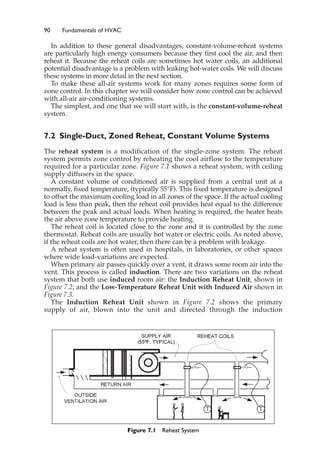
zone set-point-temperature. The system, shown in Figure 2.14, is called a
reheat system, since the cool air is reheated as necessary to maintain zone
temperature.
Figure 2.14 illustrates the basic air-conditioning system, plus ducting, to only
two of many zones. The air to each zone passes over a reheat coil before entering
the zone. A thermostat in the zone controls the reheat coil. If the zone requires
full cooling, the thermostat will shut off the reheat coil. Then, as the cooling load
drops, the thermostat will turn on the coil to maintain the zone temperature.
Variable Air Volume (VAV) System: Figure 2.15 illustrates another zoned
system, called a Variable Air Volume system, VAV system, because it varies the
volume of air supplied to each zone.
Variable Air Volume systems are more energy efficient than the reheat
systems. Again, assume that the basic system provides air that is cool enough
to satisfy all possible cooling loads. In zones that require only cooling, the duct
T T
REHEAT COILS
Figure 2.14 Reheat System
to each zone can be fitted with a control damper that can be throttled to reduce
the airflow to maintain the desired temperature.
In both types of systems, all the air-conditioning processes are achieved
through the flow of air from a central unit into each zone. Therefore they
are called “all-air systems.” We will discuss these systems in a bit more
detail in Chapter 7. However, to design and choose systems, you will need
the detailed information found in the ASHRAE course Fundamentals of Air
System Design2.
System 2: Air-and-water Systems
Another group of systems, air-and-water systems, provide all the primary ven-
tilation air from a central system, but local units provide additional condition-
ing. The primary ventilation system also provides most, or all, of the humidity
control by conditioning the ventilation air. The local units are usually supplied
with hot or chilled water. These systems are particularly effective in perimeter
spaces, where high heating and cooling loads occur. Although they may use
electric coils instead of water, they are grouped under the title “air-and-water
systems.” For example, in cold climates substantial heating is often required
at the perimeter walls. In this situation, a hot-water-heating system can be
installed around the perimeter of the building while a central air system pro-
vides cooling and ventilation.
System 3: All-water Systems
When the ventilation is provided through natural ventilation, by opening
windows, or other means, there is no need to duct ventilation air to the zones
from a central plant. This allows all processes other than ventilation to be pro-
vided by local equipment supplied with hot and chilled water from a central
plant. These systems are grouped under the name “all-water systems.”
The largest group of all-water systems are heating systems. We will introduce
these systems, pumps and piping in Chapters 8 and 9. The detailed design
of these heating systems is covered in the ASHRAE course Fundamentals of
Heating Systems3.
Both the air-and-water and all-water systems rely on a central supply of hot
water for heating and chilled water for cooling. The detailed designs and calcu-
lations for these systems can be found in the ASHRAE course Fundamentals of
Water System Design4.
Introduction to HVAC Systems 25
T T
VARIABLE VOLUME
DAMPERS
Figure 2.15 Variable Air Volume (VAV) System
26 Fundamentals of HVAC
System 4: Unitary, Refrigerant-based Systems
The final type of system uses local refrigeration equipment and heaters to
provide air conditioning. They are called “unitary refrigerant–based systems”
and we will discuss them in more detail in Chapter 6.
The window air-conditioner is the simplest example of this type of system.
In these systems, ventilation air may be brought in by the unit, by opening
windows, or from a central ventilation air system.
The unitary system has local refrigerant-based cooling. In comparison, the
other types of systems use a central refrigeration unit to either cool the air-
conditioning airflow or to chill water for circulation to local cooling units.
The design, operation and choice of refrigeration equipment is a huge field
of knowledge in itself. Refrigeration equipment choices, design, installation,
and operating issues are introduced in the ASHRAE course Fundamentals of
Refrigeration5.
System Control
We have not yet considered how any of these systems can be controlled. Controls
have become a vast area of knowledge with the use of solid-state sensors, com-
puters, radio and the Internet. Basic concepts will be introduced throughout this
text, with a focused discussion in Chapter 11. For an in-depth introduction to
controls, ASHRAE provides the course Fundamentals of HV
AC Control Systems6.
2.5 Choosing an Air-Conditioning System
Each of the four general types of air-conditioning systems has numerous
variations, so choosing a system is not a simple task. With experience, it becomes
easier. However, a new client, a new type of building or a very different climate
can be a challenge.
We are now going to briefly outline the range of factors that affect system
choice and finish by introducing a process that designers can use to help choose
a system.
The factors, or parameters that influence system choice can conveniently be
divided into the following groups:
䊉 Building design
䊉 Location issues
䊉 Utilities: availability and cost
䊉 Indoor requirements and loads
䊉 Client issues
Building Design
The design of the building has a major influence on system choice. For example,
if there is very little space for running ducts around the building, an all-air
system may not fit in the available space.
Location Issues
The building location determines the weather conditions that will affect the
building and its occupants. For the specific location we will need to consider
factors like:
site conditions
peak summer cooling conditions
summer humidity
peak winter heating conditions
wind speeds
sunshine hours
typical snow accumulation depths
The building location and, at times, the client, will determine what national,
local, and facility specific codes must be followed. Typically, the designer must
follow the local codes. These include:
Building code that includes a section on HVAC design including ventilation.
Fire code that specifies how the system must be designed to minimize the
start and spread of fire and smoke.
Energy code that mandates minimum energy efficiencies for the building and
components. We will be considering the ASHRAE Standard 90.1 2004
Energy Standard for Buildings Except Low-Rise Residential Buildings7 and
other energy conservation issues in Chapter 12.
In addition, some types of buildings, such as medical facilities, are designed
to consensus codes which may not be required by local authorities but which
may be mandated by the client. An example is The American Institute of
Architects Guidelines for Design and Construction of Hospital and Health Care
Facilities8, which has guidelines that are extremely onerous in some climates.
Utilities: Availability and Cost
The choice of system can be heavily influenced by available utilities and their
costs to supply and use. So, if chilled water is available from the adjacent
building, it would probably be cost advantageous to use it, rather than install
new unitary refrigerant-based units in the new building.
Then again, the cost of electricity may be very high at peak periods, encour-
aging the design of an electrically-efficient system with low peak-demand for
electricity. We will be introducing some of the ways to limit the cost of peak-
time electricity in our final chapter, Chapter 13.
The issues around electrical pricing and usage have become very well publi-
cized in North America over recent years. The ASHRAE course Fundamentals
of Electrical Systems and Building Electrical Energy Use10 introduces this topic.
Indoor Requirements and Loads
The location effects and indoor requirements provide all the necessary infor-
mation for load calculation for the systems.
The thermal and moisture loads – Occupants’ requirements and heat output
from lighting and equipment affect the demands on the air-conditioning
system.
Outside ventilation air – The occupants and other polluting sources, such
as cooking, will determine the requirements.
Zoning – The indoor arrangement of spaces and uses will determine if, and
how, the system is to be zoned.
Introduction to HVAC Systems 27
28 Fundamentals of HVAC
Other indoor restrictions may be very project, or even zone specific. For
example, a sound recording studio requires an extremely quiet system and
negligible vibration.
The methods of calculating the heating and cooling loads are fully explained,
with examples, in the ASHRAE course Fundamentals of Heating and Cooling Loads9.
Client Issues
Buildings cost money to construct and to use. Therefore, the designer has to
consider the clients’ requirements both for construction and for in-use costs. For
example, the available construction finances may dictate a very simple system.
Alternatively, the client may wish to finance a very sophisticated, and more
expensive system to achieve superior performance, or to reduce in-use costs.
In addition to cost structures, the availability of maintenance staff must be con-
sidered. A building at a very remote site should have simple, reliable systems,
unless very competent and well-supported maintenance staff will be available.
Clients’ approvals may be gained, or lost, based on their own previous
experience with other projects or systems. Therefore, it is important for the
designer to find out, in advance, if the client has existing preconceptions about
potential systems.
System Choice
While all the above factors are considered when choosing a system, the first
step in making a choice is to calculate the system loads and establish the
number and size of the zones. Understanding of the loads may eliminate some
systems from consideration. For example:
䊉 In warm climates where heating is not required only systems providing
cooling need be considered.
䊉 If there are significant variations in operating hours between zones, a
system which cannot be shut down on a zone-by-zone basis may not be
worth considering.
Typically, after some systems have been eliminated for specific reasons, one
needs to do a point-by-point comparison to make a final choice. This is where
the system-choice matrix is a very useful tool.
2.6 System Choice Matrix
The matrix method of system choice consists of a list of relevant factors that
affect system choice and a tabular method of comparing the systems under
consideration.
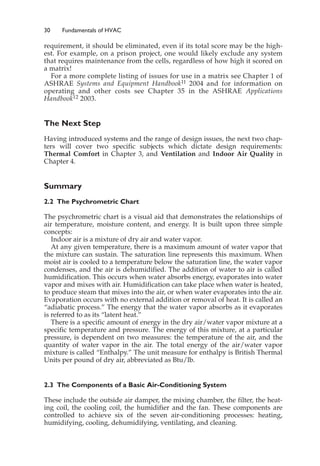
Figure 2.16 provides an illustration of the matrix method of choosing a system.
In the left column of the matrix are the relevant factors that will be used to eval-
uate the systems, and the top row shows the systems under consideration.
In our example, we have simplified the matrix in both dimensions. We have
strictly limited our relevant factors, and we have limited our choices down to
two systems, the reheat system and a VAV system. Note that in a real matrix
you would include all the relevant issues, as discussed in the preceding
section. You would also probably have several systems under consideration.
In this example, the relevant design issues for this building are as follows:
䊉 The building requires cooling but no heating.
䊉 Some areas of the building will be in use for 24 hours every day of the
week. Other areas will be used just during the day, Monday to Friday.
䊉 The client has indicated that operational expenses (ongoing) are more
important than construction costs (one time).
As you can see, the matrix has a list of relevant issues down the left hand
side. Each issue may have a greater or lesser importance. In the column
headed “Relative importance” one assigns a multiplier between 1 and 10,
with 10 meaning “extremely important” and 1 meaning “not important.”
So if, for our example, temperature control is very important it might be
rated “9” and the ability to Zone – which is critical to economic operation
in this particular building, requires a relative importance of 10. As you
can see in the matrix, it is possible for two factors to share the same relative
importance.
Once the relative importances have been assigned, it is time to assess the
systems under consideration. In our example, both systems have excellent
cooling capacity. They each score “10” under performance for this factor.
When we consider the requirement for zone occupancy-timing, however, we
note that the reheat system does not have any ability to shut off one part of
the system and leave another running. Therefore, it scores only “1” for this
requirement. The VAV system, on the other hand, has the capacity to shut off
any zone at any time though the main fan still has to run, even if only one
zone is on. Therefore the VAV system scores “9” for this factor.
The VAV system also gets a higher score for first cost (construction cost) and
for operating expense.
After each factor has been considered, the “relative performance” number is
multiplied by the “relative importance” multiplier, to obtain the relative score
for that item. The results for each system are totaled, and compared.
In this example, the VAV has a higher score and would be chosen.
The method is an excellent way of methodically assessing system alterna-
tives. However, it should be used intelligently. If a system fails on a critical
Introduction to HVAC Systems 29
System 1 System 2
Reheat Variable Air Volume
Relative Relative Relative Relative Relative
Importance Performance Score Performance Score
Cooling Capacity 8 10 80 10 80
Temperature Control 9 10 90 8 72
Zone Occupancy Timing 10 1 10 9 90
First Cost 5 7 35 5 25
Operating Cost 8 3 24 8 64
Totals 239 331
Figure 2.16 Matrix for Systems Choice
30 Fundamentals of HVAC
requirement, it should be eliminated, even if its total score may be the high-
est. For example, on a prison project, one would likely exclude any system
that requires maintenance from the cells, regardless of how high it scored on
a matrix!
For a more complete listing of issues for use in a matrix see Chapter 1 of
ASHRAE Systems and Equipment Handbook11 2004 and for information on
operating and other costs see Chapter 35 in the ASHRAE Applications
Handbook12 2003.
The Next Step
Having introduced systems and the range of design issues, the next two chap-
ters will cover two specific subjects which dictate design requirements:
Thermal Comfort in Chapter 3, and Ventilation and Indoor Air Quality in
Chapter 4.
Summary
2.2 The Psychrometric Chart
The psychrometric chart is a visual aid that demonstrates the relationships of
air temperature, moisture content, and energy. It is built upon three simple
concepts:
Indoor air is a mixture of dry air and water vapor.
At any given temperature, there is a maximum amount of water vapor that
the mixture can sustain. The saturation line represents this maximum. When
moist air is cooled to a temperature below the saturation line, the water vapor
condenses, and the air is dehumidified. The addition of water to air is called
humidification. This occurs when water absorbs energy, evaporates into water
vapor and mixes with air. Humidification can take place when water is heated,
to produce steam that mixes into the air, or when water evaporates into the air.
Evaporation occurs with no external addition or removal of heat. It is called an
“adiabatic process.” The energy that the water vapor absorbs as it evaporates
is referred to as its “latent heat.”
There is a specific amount of energy in the dry air/water vapor mixture at a
specific temperature and pressure. The energy of this mixture, at a particular
pressure, is dependent on two measures: the temperature of the air, and the
quantity of water vapor in the air. The total energy of the air/water vapor
mixture is called “Enthalpy.” The unit measure for enthalpy is British Thermal
Units per pound of dry air, abbreviated as Btu/lb.
2.3 The Components of a Basic Air-Conditioning System
These include the outside air damper, the mixing chamber, the filter, the heat-
ing coil, the cooling coil, the humidifier and the fan. These components are
controlled to achieve six of the seven air-conditioning processes: heating,
humidifying, cooling, dehumidifying, ventilating, and cleaning.
The economizer cycle is an energy saver for climates with long periods of
cool weather. The economizer consists of three, or four additional compo-
nents: expanded air intake and damper sized for 100% flow; relief outlet
with damper to exhaust excess air to outside; return air damper to adjust the
flow of return air into the mixing chamber; (optional) return fan in the return
air duct.
2.4 Zoned Air-Conditioning Systems
Zoning is used to provide variable heating or cooling in different spaces using:
all-air systems, like reheat and variable air volume systems; air-and-water
systems, all-water systems, and unitary, refrigeration-based systems.
2.5 Choosing an Air-Conditioning System
Design factors for choosing an air-conditioning system include: building
design, location issues, utilities – availability and cost, indoor requirements
and loads, and client issues.
2.6 System Choice Matrix
To determine the relative importance of the different design factors, you can use
a System Choice Matrix to compare the systems that are under consideration.
Bibliography
1. Fundamentals of Thermodynamics and Psychrometrics. ASHRAE Learning Institute
Publication.
2. Fundamentals of Air System Design. ASHRAE Learning Institute Publication.
3. Fundamentals of Heating Systems. ASHRAE Learning Institute Publication.
4. Fundamentals of Water System Design. ASHRAE Learning Institute Publication.
5. Fundamentals of Refrigeration. ASHRAE Learning Institute Publication.
6. Fundamentals of HV
AC Control Systems. ASHRAE Learning Institute Publication.
7. Standard 90.1-2004 Energy Standard for Buildings Except Low-Rise Residential
Buildings. ASHRAE
8. Guidelines for Design and Construction of Hospital and Health Care Facilities. 2001. The
American Institute of Architects Washington, DC
9. Fundamentals of Heating and Cooling Loads. ASHRAE Learning Institute Publication.
10. Fundamentals of Electrical Systems and Building Electrical Energy Use. ASHRAE
Learning Institute Publication.
11. ASHRAE Systems and Equipment Handbook, 2004
12. ASHRAE Applications Handbook, 2003
Introduction to HVAC Systems 31
Chapter 3
Thermal Comfort
Contents of Chapter 3
Study Objectives of Chapter 3
3.1 Introduction – What is Thermal Comfort?
3.2 Seven Factors Influencing Thermal Comfort
3.3 Conditions for Comfort
3.4 Managing Under Less Than Ideal Conditions
3.5 Requirements of Non-Standard Groups
The Next Step
Summary
Bibliography
Study Objectives of Chapter 3
Having studied this chapter you should be able to:
List seven factors influencing thermal comfort.
Explain why thermal comfort depends on the individual as well as the
thermal conditions.
Choose acceptable thermal design conditions.
3.1 Introduction: What is Thermal Comfort?
In Chapter 1, Sections 1.6.1 and 1.6.2, we introduced the Personal Environmental
Model that illustrated the main factors that affect human comfort in an envi-
ronment. In this chapter, we will focus only on those specific factors that affect
thermal comfort.
Thermal comfort is primarily controlled by a building’s heating, ventilating
and air-conditioning systems, though the architectural design of the building
may also have significant influences on thermal comfort.
This chapter is largely based on ASHRAE’s Standard 55-2004 Thermal
Environmental Conditions for Human Occupancy1. In this text, we will abbreviate
the title to “Standard 55.” For a much more in-depth discussion of thermal
comfort and the way experimental results are presented, see Chapter 8 of the
ASHRAE Handbook, 2005, Fundamentals2.
Standard 55 defines thermal comfort as “that condition of mind which
expresses satisfaction with the thermal environment and is assessed by
Thermal Comfort 33
subjective evaluation.” There is no way “state of mind” can be measured.
As a result, all comfort data are based on researchers asking questions about
particular situations, to build a numerical model of comfort conditions. The
model is based on answers to questions by many people under many differ-
ent experimental conditions.
In the next section, we will consider seven factors influencing comfort and
then define acceptable thermal comfort conditions.
3.2 Seven Factors Influencing Thermal Comfort
You are a person, so you already know a lot about thermal comfort. You have
a lifetime of experience. You know that physical exertion makes you “hot and
sweaty.” You know you can be more comfortable in a cooler space if you wear
more clothes, or warmer clothes. You know that the air temperature matters
and that the radiant heat from a fire can help keep you warm and comfortable.
You have likely experienced feeling hot in a very humid space and been aware
of a cold draft. You have anticipated that a space will be warm and comfort-
able or cool and comfortable when you get inside.
As a result, you have personal experience of the seven factors that affect
thermal comfort.
Personal
1. Activity level
2. Clothing
Individual Characteristics
3. Expectation
Environmental Conditions and Architectural Effects
4. Air temperature
5. Radiant temperature
6. Humidity
7. Air speed
1. Activity Level
The human body continuously produces heat through a process call
“metabolism.” This heat must be emitted from the body to maintain a fairly
constant core temperature, and ideally, a comfortable skin temperature. We
produce heat at a minimum rate when asleep. As activity increases, from sitting
to walking to running, so the metabolic heat produced increases.
The standard measure of activity level is the “met.” One met is the metabolic
rate (heat output per unit area of skin) for an individual who is seated and at rest.
Typical activity levels and the corresponding met values are shown in Figure 3.1.
2. Clothing
In occupied spaces, clothing acts as an insulator, slowing the heat loss from
the body. As you know from experience, if you are wearing clothing that is an
effective insulator, you can withstand, and feel comfortable in lower temperatures.
34 Fundamentals of HVAC
To predict thermal comfort we must have an idea of the clothing that will be worn
by the occupants.
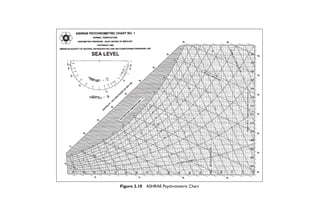
Due to the large variety of materials, weights, and weave of fabrics, clothing
estimates are just rough estimates. Each article has an insulating value, unit “clo.”
For example: a long-sleeved sweat shirt is 0.34 clo, straight trousers (thin)
are 0.15 clo, light underwear is 0.04 clo, ankle-length athletic socks are 0.02 clo,
and sandals are 0.02 clo. These clo values can be added to give an overall
clothing insulation value. In this case, the preceding set of clothes has an over-
all clothing insulation value of 0.57 clo.
Typical values for clothing ensembles are shown in Figure 3.2. All include
shoes, socks, and light underwear.
Later in this Chapter we will introduce a chart, Figure 3.4, that illustrates
comfortable conditions with 0.5 clo and 1.0 clo. As you can see from Figure 3.2,
0.5 clo is very light clothing, and 1.0 clo is heavy indoor clothing.
3. Occupants’ Expectations
People’s expectations affect their perception of comfort in a building. Consider
the following three scenarios that all occur on a very hot day:
䊉 A person walks into an air-conditioned office building. The person expects
the building to be thermally comfortable.
Activity met*
Sleeping 0.7
Reading or writing, seated in office 1.0
Filing, standing in office 1.4
Walking about in office 1.7
Walking 2 mph 2.0
Housecleaning 2.0 to 3.4
Dancing, social 2.4 to 4.4
Heavy machine work 4.0
Figure 3.1 Typical Metabolic Heat Generation for Various Activities (Standard 55,
Normative Appendix A, Extracted data) [*1 met ⫽ 18.4 Btu/h ⭈ ft2]
Ensemble Description clo*
Trouser, short sleeve shirt 0.57
Knee-length skirt, short-sleeve shirt (sandals) 0.54
Trousers, long-sleeved shirt, suit jacket 0.96
Knee-length skirt, long-sleeved shirt, half slip,
panty hose, long-sleeved sweater 1.10
Long-sleeved coveralls, T-shirt 0.72
Figure 3.2 Typical Insulation Values for Clothing Ensembles (Standard 55, Appendix B,
Table B-1, extracted data) [*1 clo ⫽ 0.88°F ⭈ ft2 ⭈ h/Btu]
Thermal Comfort 35
䊉 A person walks into a prestigious hotel. The person expects it to be cool,
regardless of the outside temperature.
䊉 A person walks into an economical apartment building with obvious
natural ventilation and open windows. The person has lower expectations
for a cool environment. The person anticipates, even hopes, that it will be
cooler inside, but not to the same extent as the air-conditioned office build-
ing or the hotel.
Standard 55 recognizes that the expectations for thermal comfort are
significantly different in buildings where the occupants control opening
windows, as compared to a mechanically cooled building. To address this
difference, Standard 55 provides different criteria for naturally ventilated
buildings, as compared to the criteria for mechanically cooled, air-conditioned
buildings.
This difference in expectations also shows up in buildings where occu-
pants have a thermostat to control their zone. In general, if occupants have a
thermostat in their space, they are more satisfied with their space, even
when the performance of the thermostat is very restricted or non-existent
(dummy thermostat). This is discussed in the Section 3.3, “Conditions for
Comfort.”
4. Air Temperature
When we are referring to air temperature in the context of thermal comfort, we
are talking about the temperature in the space where the person is located.
This temperature can vary from head to toe and can vary with time.
5. Radiant Temperature
Radiant heat is heat that is transmitted from a hotter body to a cooler body with
no effect on the intervening space. An example of radiant heat transfer occurs
when the sun is shining on you. The radiant temperature is the temperature at
which a black sphere would emit as much radiant heat as it received from its
surroundings.
In an occupied space, the floor, walls and ceiling may be at a temperature that
is very close to the air temperature. For internal spaces, where the temperature
of the walls, floor and ceiling are almost the same as the air temperature, the
radiant temperature will be constant in all directions and virtually the same as
the air temperature.
When a person is sitting close to a large window on a cold, cloudy, winter
day, the average radiant temperature may be significantly lower than the air
temperature. Similarly, in spaces with radiant floors or other forms of radiant
heating, the average radiant temperature will be above the air temperature
during the heating season.
6. Humidity
Low humidity: We know that, for some people, low humidity can cause
specific problems, like dry skin, dry eyes and static electricity. However, low
humidity does not generally cause thermal discomfort. Standard 55 does not
define minimum humidity as an issue of thermal discomfort, nor does it
address those individuals who have severe responses to low humidity.
36 Fundamentals of HVAC
High humidity: Standard 55 does define the maximum humidity ratio for
comfort at 0.012 lb/lb. This level of moisture in the air can also cause serious
mold problems in the building and to its contents, since it is equivalent to
100% relative humidity at 62°F.
7. Air Speed
The higher the air speed over a person’s body, the greater the cooling effect. Air
velocity that exceeds 40 feet per minute (fpm), or cool temperatures combined
with any air movement, may cause discomfort —a draft. Drafts are most
noticeable when they blow across the feet and/or the head level, because indi-
viduals tend to have less protection from clothing in these areas of their body.
3.3 Conditions for Comfort
Standard 55 deals with indoor thermal comfort in normal living environments
and office-type environments. It does not deal with occupancy periods of less
than 15 minutes.
The Standard recognizes that individual perceptions of comfort can be
significantly modified by prior exposure. For example, consider people coming
into a building that is air-conditioned to 82°F on a very hot day, when it is
102°F outside. The building is obviously cooler as they enter it, a pleasant
experience. After they have been in the building for half an hour, they will have
adjusted and will probably consider the building excessively warm.
When considering issues of comfort, the Standard addresses two situations:
1. Buildings with occupant-operable windows
2. Buildings with mechanically conditioned spaces
Situation 1: Buildings with Occupant-Operable Windows
People behave differently when they have windows they can control. They
have different, less demanding, expectations due to their knowledge of the
external environment and their control over the windows. They will also
choose how they dress, knowing that the building temperatures will be signifi-
cantly influenced by external temperatures.
Figure 3.3, shows the acceptable range of “indoor operative temperatures”
plotted against “mean monthly air temperature” for
Activity levels of 1.0 to 1.3 met
Person not in direct sunlight
Air velocity below 40 fpm
No specific clothing ensemble values
This acceptable range is called the comfort envelope.
The indoor operative temperature is the average of the air temperature and
radiant temperature.
The mean monthly outdoor temperature is the average of the hourly
temperatures; data is normally available from government environmental-
monitoring departments.
Thermal Comfort 37
The chart only goes down to a mean monthly temperature of 50°F,
indicating that operant-controlled windows (opening windows) do not
provide acceptable thermal comfort conditions in cooler climates during the
winter.
The plot shows the range of comfortable operative temperatures for 80%
acceptability, the normal situation, and a narrower comfort band that will
provide a higher standard of comfort, 90% acceptability. For example, for a
location with a maximum summer mean-monthly temperature of 68°F, the
range for 80% acceptability is between 71°F and 80°F.
Note that the normal situation suggests that 20% of the occupants, or 1 in 5,
will not find the thermal conditions acceptable!
Situation 2: Buildings with Mechanically Conditioned Spaces
Mechanically conditioned spaces are arranged into three classes:
Class A – high comfort
Class B – normal comfort
Class C – relaxed standard of comfort
Standard 55 includes comfort charts for Class B spaces only. To calculate
comfort conditions for Classes A and C, the designer uses a BASIC com-
puter program. The BASIC program listing is included in Standard 55,
Appendix D.
The Class B thermal limits are based on 80% acceptability, leaving about
10% of the occupants not comfortable due to the overall thermal conditions
and 10% not comfortable due to local thermal discomfort.
Figure 3.3 Acceptable Operative Temperature Ranges for Naturally Conditioned
Spaces (Standard 55, Figure 5.3)
78.8°F
60.8°F
64.4°F
68.0°F
71.6°F
75.2°F
82.4°F
86.0°F
14
16
18
20
22
24
26
28
30
32
MEAN MONTHLY OUTDOOR AIR TEMPERATURE (°C)
INDOOR
OPERATIVE
TEMPERATURE
(°C)
90% ACCEPTABILITY LIMITS
80% ACCEPTABILITY LIMITS
5 10 15 20 25 30 35
50°F 59°F 68°F 77°F 86°F 95°F
38 Fundamentals of HVAC
Class B Comfort Criteria
The Standard provides a psychrometric chart, Figure 3.4, showing acceptable
conditions for a Class B space for:
Activity between 1.0 and 1.3 met
Clothing 0.5 to 1.0 clo
The air speed is to be below 40 fpm
The person must not be in direct sunlight
For spaces where it is reasonable to assume that clothing will be around
0.5 clo in the summer, and a design humidity of between 40 and 50%, the
acceptable conditions, the comfort envelope, will be within the heavy lines on
the chart.
Remember that the chart is for 80% acceptability, although ideally 100% of
the occupants would find the conditions thermally acceptable. The occupants
do have some limited flexibility with clothing in most situations. The ideal
situation, but prohibitively expensive in most cases, is to provide all the occu-
pants with their own temperature control.
Example 1: Let us suppose we wish to minimize the size of the air-condition-
ing plant; then we could choose design conditions of 81°F at 50% relative
humidity, rh and 82°F at 40% rh. It must be recognized that when the
designer designs on the limit, it means that more people are likely to be
uncomfortable than if the designer chooses to design for the center of
the comfort temperature band.
Figure 3.4 Acceptable Range of Operative Temperature and Humidity for Spaces that Meet
the Criteria Specified Above. (Standard 55, Figure 5.2.1.1)
Thermal Comfort 39
Example 2: Let us consider a different situation, a prestige office building
with, at the design stage, unknown tenants. Here we should allow for both
light dress and full suits, the full range 0.5 to 1.0 clo. If the design relative-
humidity is to be 50%, then we should select the area of overlap and choose
76°F as our design temperature.
Example 3: As a third example let us consider a desert town with an outside
design-condition of 90°F and 13% relative humidity. If we pass the incoming
air over a suitably sized evaporative cooler, the air will be cooled and
humidified to 78°F and 50% which is nicely within the comfort zone for
people with 0.5 clo. In this case, we can achieve acceptable thermal comfort
for supply ventilation using an evaporative cooler.
3.4 Managing Under Less Than Ideal Conditions
The above charts are based on relatively ideal conditions—conditions that do
not always exist. The Standard goes into considerable detail about the limits
for non-ideal conditions and we will briefly introduce them here.
Elevated Air Speed
Increasing the air speed over the body causes increased cooling. Elevated
air speed can be used to advantage to offset excessive space tempera-
tures. The temperature limits specified are increased by up to 5°F, as long
as the air speed is within the occupant’s control and limited to below
160 ft/min.
The personal desk fan provides a simple example of placing air speed under
individual control. For example, in the case of a naturally ventilated space
where the acceptable temperature range was 71°F to 80°F, the acceptable
temperature range would be increased to a higher range of 71°F to 85°F with
the addition of a fan that was controlled by the occupant.
Draft
Draft discomfort depends on air temperature, velocity and turbulence. In gen-
eral the steadier the draft the less the discomfort—it does not draw attention
to itself so much! People are much more sensitive to cold drafts than they are
to warm drafts. As a result the same velocity of air may produce complaints of
cold drafts while cooling in the summer but no complaints when heating in
the winter.
Vertical Temperature Difference
Vertical temperature difference between feet and head typically occurs
in heated buildings. Warm air is less dense and tends to rise. Therefore,
a warm air supply tends to rise, leaving the lower portion of the space
cooler.
Also, many buildings in cool climates have a poorly insulated floor slab-
on-grade, which makes for a cold floor and cool air just above the floor.
The variation in air temperature from feet to head is generally acceptable as
long as it does not exceed 5°F.
40 Fundamentals of HVAC
Floor Surface Temperatures
Floor surface temperatures should be within the range 66–84°F for people
wearing shoes and not sitting on the floor. The maximum temperature limits
the amount of heat that can be provided by a heated (radiant) floor. The mini-
mum temperature, 66°F, is much higher than most designers realize! Note that
a cold floor can make it impossible to produce thermal comfort, regardless of
the temperature of the space.
Cyclic Temperature Changes
In a space that is controlled by an on/off thermostat that reacts slowly to
temperature change, the space can experience a significant temperature range
in a short time. The occupants can perceive this variation as discomfort.
When the temperature cycles up and down fairly regularly with time, with a
cycle time of less than 15 minutes, the temperature range should be limited to
a range of 2°F.
Radiant Temperature Variation
Radiant temperature variation is acceptable, within limits. People are gen-
erally quite accepting of a warm wall, but warm ceilings are a source of
discomfort if the ceiling radiant temperature is more than 9°F above the gen-
eral radiant temperature.
A poorly insulated roof in a hot sunny climate can cause very uncomfortable
conditions due to the high radiant temperature of the ceiling.
3.5 Requirements of Non-Standard Groups
This has been a very brief look at the variations in thermal conditions that can
influence the basic comfort charts in Figures 3.1 and 3.2. There has been no
mention of different requirements for different age groups or sexes. Most
research is done on healthy adults, and Standard 55 admits this fact by noting
that there is little data on the comfort requirements for children, the disabled
or the infirm.
However, most research on differences between groups indicates that differ-
ent acceptability is due to different behavior, rather than different thermal
comfort requirements. For example, elderly people often like a warmer tem-
perature than younger people do. This is reasonable, since the elderly tend to
be much less active, resulting in a lower met rate. In a similar way, women are
thought to prefer a warmer temperature than men, but comparative studies
indicate that the reason for the difference is that women wear a lower clo
value ensemble of clothes.
Lastly there is the idea that people prefer their space to be cooler in summer
and warmer in winter. Consider a one-level house. In summer, it is hot and
sunny outside. As a result, the walls and roof become much warmer than they
are in cooler weather. For the occupant, the radiant temperature is higher,
and therefore, to maintain the same thermal conditions, the air temperature
needs to be lower. Conversely, in cold winter weather, the walls, windows and
ceilings become cooler and the occupant will need a higher air temperature to
maintain the same level of comfort.
Thermal Comfort 41
The Next Step
Having considered thermal comfort in this chapter we will go on to con-
sider indoor air comfort, termed Ventilation and Indoor Air Quality, in
Chapter 4.
Summary
This chapter has considered the many facets of thermal comfort. It is important
that you are aware that the air temperature at the thermostat is not always a
good indicator of thermal comfort. The design of the space and individual
clothing choices can have major influences on thermal comfort.
Section 3.1 Introduction – What is Thermal Comfort?
Standard 55 defines comfort as “that condition of mind which expresses satis-
faction with the thermal environment; it requires subjective evaluation.”
Section 3.2 Seven Factors influencing Comfort
You have personal experience of the seven factors that affect thermal
comfort: personal comfort, including activity level and clothing; individual
characteristics, including expectation; environmental conditions and archi-
tectural effects, including air temperature, radiant temperature, humidity,
and air speed.
Section 3.3 Conditions for Comfort
This section focuses on the factors that influence thermal comfort in normal
living environments and office-type environments with occupancy periods in
excess of 15 minutes. These include occupant operable windows and naturally
conditioned spaces, and mechanically conditioned spaces. Mechanically condi-
tioned spaces are arranged into three classes: Class A – high comfort; Class B –
normal comfort; Class C – relaxed standard of comfort. The Standard provides a
psychrometric chart showing 80% acceptable conditions for a Class B space for
activity between 1.0 and 1.3 met; clothing 0.5 to 1.0 clo; air speed below 40 fpm;
with the added condition that the person is not in direct sunlight. To calculate
comfort conditions for Classes A and C, the designer uses a BASIC computer
program.
Section 3.4 Managing Under Less Than Ideal Conditions
Non-ideal conditions include: elevated air speed, draft, vertical temperature
difference, floor surface temperatures, cyclic temperature changes, and radiant
temperature variation.
42 Fundamentals of HVAC
Section 3.5 Requirements of Non-Standard Groups
Most of the research for Standard 55 was based on the responses of healthy
adults. When designing for non-standard groups, consider their additional
needs for comfort.
Bibliography
1. ASHRAE, Standard 55-2004 Thermal Environmental Conditions for Human Occupancy
2. ASHRAE Handbook, Fundamentals, 2005
Chapter 4
Ventilation and Indoor Air Quality
Contents of Chapter 4
Study Objectives of Chapter 4
4.1 Introduction
4.2 Air Pollutants and Contaminants
4.3 Indoor Air Quality Effects on Health and Comfort
4.4 Controling of Indoor Air Quality
4.5 ASHRAE Standard 62 Ventilation for Acceptable Indoor Air Quality
The Next Step
Summary
Bibliography
Study Objectives of Chapter 4
Chapter 4 deals with the reasons for ventilating buildings and how ventilation
rates are chosen for specific situations. After studying the chapter, you should
be able to:
List, and give examples of the four types of indoor air contaminants
Describe the three methods of maintaining indoor air quality
Understand the criteria for filter selection
Understand the main concepts of the ASHRAE Standard 62.1-2004
ventilation rate procedure and how it differs from ASHRAE Standard
62.1-2001
4.1 Introduction
In Chapter 3, we covered two factors that affect comfort and activity, tempera-
ture and humidity. In this chapter, we will be discussing an additional factor,
Indoor Air Quality, IAQ. The maintenance of indoor air quality (IAQ) is one of
the major objectives of air-conditioning systems because IAQ problems are a
significant threat to health and productivity.
Those who study Indoor Air Quality consider the makeup of indoor air, and
how it affects the health, activities and comfort of those who occupy the space.
44 Fundamentals of HVAC
The primary factors that influence and degrade IAQ are particles, gases, and
vapors in the air. Maintenance of good indoor air quality is a significant issue
to both the HVAC design engineer and to those who maintain the system sub-
sequent to its design and installation.
To deal properly with the issues of IAQ, it is important to be aware of
The various types of pollutants and contaminants, their sources and their
effects on health.
The factors that influence pollutant and contaminant levels in buildings
䊉 The sources of pollutants.
䊉 The ways pollutants can be absorbed and re-emitted into the build-
ing spaces.
Ways of maintaining good IAQ by
䊉 Controlling the source of pollutants within the space.
䊉 Using filters to prevent pollutants and contaminants from entering
the space.
䊉 Diluting the pollutants and contaminants within the space.
ASHRAE has two ANSI approved standards on ventilation:
ANSI/
ASHRAE Standard 62.1-2004, Ventilation for Acceptable Indoor Air Quality1
(Standard 62.1-2004) which deals with ventilation in “all indoor or
enclosed spaces that people may occupy.”
ASHRAE/ANSI Standard 62.2-2004 Ventilation and Acceptable Indoor Air
Quality in Low Rise Residential Buildings2 (Standard 62.2) which deals,
in detail, with residential ventilation.
The scope of Standard 62.1-2004 deals specifically with “Release of moisture in
residential kitchens and bathrooms,” while Standard 62.2 deals with
“mechanical and natural ventilation systems and the building envelope
intended to provide acceptable indoor air quality in low-rise residential
buildings.”
Like other ASHRAE standards, these are consensus documents, pro-
duced by a volunteer committee of people who are knowledgeable in the
field. The standards have been publicly reviewed and are continuously
re-assessed. They have force of law only when adopted by a regulatory
agency, but are generally recognized as being the standard of minimum
practice.
4.2 Air Pollutants and Contaminants
Air pollutants and contaminants are unwanted airborne constituents that
may reduce the acceptability of air. The number and variety of contaminants
in the air is enormous. Some contaminants are brought into the conditioned
space from outside, and some are generated within the space itself. Figure 4.1
lists some of the most common indoor air contaminants and their most com-
mon sources.
4.3 Indoor Air Quality Effects on Health and Comfort
It is important to distinguish between the various contaminants in terms
of their health effects. The HVAC designer and building operator may
take different approaches to contaminants that can be detrimental to health
and those that are merely annoying. Although it is the annoying aspects
that will draw immediate attention from the occupants, it is the health
affecting contaminants that are of the utmost short and long term impor-
tance. It is useful to think of contaminants in terms of the following classes
of effect:
Fatal in the short term
Carcinogenic (cancer causing substances)
Health threatening
Annoying, with an impact on productivity and sense of well-being
Fatal in the Short Term
At times, contaminants are found in buildings in concentrations that can cause
death. These include airborne chemical substances, such as carbon monoxide,
or disease-causing bacteria and other biological contaminants.
Carbon monoxide, a colorless and odorless gas, is produced during incom-
plete combustion. It is attributed as the cause of many deaths each year. One
source of carbon monoxide is a malfunctioning combustion appliance, such as
a furnace, water heater or stove. Another possible source of carbon monoxide is
the exhaust that results from operating a combustion engine or motor vehicle in
an enclosed space.
Ventilation and Indoor Air Quality 45
Contaminants Major Source
Particles (particulates) Dust (generated inside and outside), smoking, cooking
Allergens (a substance that can Molds, pets, many other sources
cause an allergic reaction)
Bacteria and Viruses People, moisture, pets
Carbon Dioxide (CO2) Occupants breathing, combustion
Odoriferous chemicals People, cooking, molds, chemicals, smoking
Volatile Organic Compounds (VOCs) Construction materials, furnishings, cleaning products
Tobacco Smoke Smoking
Carbon Monoxide (CO) Incomplete and/or faulty combustion, smoking
Radon (Rn) Radioactive decay of radium in the soil
Formaldehyde (HCHO) Construction materials, furniture, smoking
Oxides of Nitrogen Combustion, smoking
Sulphur Dioxide Combustion
Ozone Photocopiers, electrostatic air cleaners
Figure 4.1 Common Air Contaminants
46 Fundamentals of HVAC
Certain disease-causing bacteria can be present in the air in the building.
These include contagious diseases, such as tuberculosis, exhaled by people
who are infected with the disease. The tubercle bacillus is very small and
tend to stay afloat in the air. Exposure can be minimized by isolating affected
individuals, and by using special ventilation methods.
A third group of contaminants are disease causing bacteria that are gener-
ated by physical activity or equipment. One, which is particularly dangerous
for people with a weak immune system, is legionella. Legionella is the bacteria
that causes Legionnaire’s Disease. Legionella multiplies very rapidly in warm,
impure water. If this water is then splashed or sprayed into the air, the
legionella bacteria become airborne and can be inhaled into a person’s lungs.
Once in the lungs, the bacteria pass through the lung wall and into the body.
The resultant flu-like disease is often fatal.
The source of a legionella outbreak can often be traced to a particular loca-
tion, such as a cooling tower or a domestic hot water system. Where we know
the source and the mechanism of transfer of disease to the individual, we call
it a “building related illness.”
The pollutants that are fatal in the short-term are often unnoticeable except
as a result of their health effects.
Carcinogens
Carcinogens are among the most significant contaminants because of their
potential to cause cancer in the long-term. The risk of cancer increases with
level and time of exposure to the substance. The exposure may be unnotice-
able and not have any immediately apparent impact in the short-term.
However, in the long-term, even low levels of exposure may lead to severe,
irreversible health problems.
Environmental tobacco smoke (ETS) has been one of the major concerns in
maintaining good indoor air quality. Concern has been heightened by
increased evidence of its role in lung and heart disease. Most tobacco-related
deaths occur among the smokers themselves, but tobacco smoke in the indoor
air can also cause cancer in non-smokers. The smoke also causes physical
irritation, annoyance and dirt on all exposed surfaces.
Another carcinogen of concern in some places is the gas radon. Radon is a
naturally occurring radioactive gas that results from the decay of radium in
the soil. This radioactive gas leaks into buildings where it can be inhaled and
potentially cause cancer. In places where radon is an issue, it can be controlled
by venting the crawlspace, sealing all cracks, or by pressurizing the interior so
as to minimize radon entry.
Health Threatening
Many indoor air contaminants (such as allergens, volatile organic compounds,
bacteria, viruses, mold spores, ozone and particulates) can be physically irri-
tating or health threatening, although they are not usually fatal. Among the
most common symptoms is the irritation of delicate tissues such as the eyes,
skin, or mucous membranes. Many contaminants cause cold-like symptoms
that are often mistaken as the effects of a viral infection.
In some buildings, a significant proportion of the occupants may experience
symptoms. If the symptoms disappear when the occupants have left the build-
ing, one can surmise that something in the building is causing the symptoms.
If 20% or more of the occupants experience the symptoms only when they are
in the building, then they are considered to be suffering from “sick building
syndrome.”
Annoying, with an Impact on Productivity and Sense of Well-Being
Although not health threatening, many odoriferous chemicals are annoying
and may be distracting enough to affect productivity without threatening
health. These include body odors, some chemicals, the smells of spoiling food,
and some molds that do not have more serious effects. In high enough concen-
trations, some contaminants have physical effects that are gradual and subtle
enough not to be immediately noticed.
4.4 Controlling Indoor Air Quality
Maintaining acceptable IAQ depends on the judicious use of three methods:
Source control
Filtration
Dilution
4.4.1 Source Control
The most important method of maintaining acceptable indoor air quality is by
controlling sources of contaminants and pollutants. Sources can be controlled
by restricting their access to the space, either by design or by appropriate
maintenance procedures, and by exhausting pollutants that are generated
within the space. Avoiding the use of volatile solvents and banning smoking
are two simple indoor examples.
Another example of source control is found in a new requirement in
Standard 62.1-2004 where it states that water for humidifiers “shall originate
directly from a potable source or from a source with equal or better water
quality.” In the past, steam from the steam heating system was often used for
humidification of buildings. This steam was frequently treated with anti-
corrosion additives that would not be acceptable in potable water. Now, this
steam is not an acceptable source for direct humidification.
When designing the air intake system, one should always deliberately
reduce the likelihood of pollutants coming in from outside. Methods include
locating intakes:
Away from the ground, where dust blows by
Away from loading docks, where there are higher concentrations of pollu-
tants from vehicles
Away from outlets on the roof that vent things, such as toilets, furnaces,
drains, and fume hoods
One common source of indoor pollution is mold. The spores and dead parti-
cles of mold adversely affect many people. To prevent mold, keep the building
fabric and contents reasonably dry. As a general rule, maintain the relative
Ventilation and Indoor Air Quality 47
48 Fundamentals of HVAC
humidity below 60% to prevent mold growth. This is a challenge in a hot,
humid climate with air-conditioned buildings where the outside air contains
so much moisture. For example, a new prestigious hotel in Hawaii had to be
closed within a year of opening, due to mold in over 400 bedrooms. Remedial
costs will exceed $US10 million.
One source of mold, that is often neglected, is the drain pan beneath a
cooling coil. The coil collects moisture and, being wet, some dirt out of the air.
Ideally, this moisture and dirt drips down into the tray and drains away.
Unfortunately, (and frequently), if the tray has a slope-to-drain ratio that is less
than the required 1/8 inch per foot, a layer of sludge can form in the tray and
grow mold. If the coil is not used for cooling for a while, the tray dries out and
the crust of dried sludge can breakup and get carried through the system into
the occupied spaces. Regular cleaning of the tray is required to minimize the
problem.
If the pollution is from a specific source indoors, then direct exhaust can be
used to control the pollutants. For example: the hood over a cooking range
pulls fumes directly from the stove and exhausts them; exhausting the fumes
from large photocopiers avoids contaminating the surrounding office space;
and the laboratory fume cabinet draws chemical fumes directly to outside.
When designing any direct exhaust system, one should attempt to collect the
pollutant before it mixes with much room air. This reduces the required
exhaust air volume and hence reduces the amount of conditioned air required
to make up for the exhaust.
The design of exhaust systems for a large variety of situations is very clearly
explained and accompanied with explanatory diagrams in Industrial Ventilation3,
published by the American Conference of Governmental Industrial Hygienists.
4.4.2 Filtration
Filtration is the removal of contaminants from the air. Both particulate
(particles of all sizes) and gaseous contaminants can be removed, but since
gaseous filtration is a rather specialized subject, we will not discuss it in
this course.
Particulate filters work by having the particles trapped by, or adhere to, the
filter medium. The actual performance of a filter depends on several factors,
including particle size, air velocity through the filter medium, filter material
and density, and dirt buildup on the filter. The main operating characteristics
used to distinguish between filters are:
Efficiency in removing dust particles of varying sizes
Resistance to airflow
Dust-holding capacity (weight per filter)
Choosing a filter is a matter of balancing requirements against initial pur-
chase cost, operating cost and effectiveness. In general, both the initial cost
and the operating cost of the filter will be affected by the size of the particles
that need to be filtered out, and the required efficiency of the filter: the smaller
the particle size and the greater the efficiency required, the more expensive the
filter costs.
The Figure 4.2 shows a sample of particles and their range of size.
Information on filter performance is usually based on a standard. For the
HVAC industry, ASHRAE has produced two standards. The first was ASHRAE
Standard 52.1-1992 Gravimetric and Dust Spot Procedures for Testing Air Cleaning
Devices used in General Ventilation for Removing Particulate Matter4 (Standard
52.1). Testing a filter to Standard 52.1 produces an “ASHRAE atmospheric dust
spot efficiency” and an “ASHRAE arrestance.” The “dust spot” efficiency is a
measure of how well the filter removes the finer particles that cause staining,
and the “arrestance” is a measure of the weight of dust that is collected before
the resistance of the filter rises excessively. Unfortunately, the dust spot effi-
ciency does not give much information about filter performance for different
particle sizes and does not differentiate among less efficient filters.
As a result, a new standard was introduced, ASHRAE 52.2-1999 Method for
Testing General Ventilation Air-Cleaning Devices for the Removal Efficiency by
Particle Size5. It is based on using a particle counter to count the number of
particles in twelve different size fractions. This data is used to classify a filter
into one of 20 “Minimum Efficiency Reporting Values” called MERV. The least
efficient filter is MERV 1 and the most efficient, MERV 20. Figure 4.3 shows
typical filters with their range of performance and typical applications.
There are numerous types of filters, made with a variety of filter media. The
simplest, cheapest, and generally least effective, is the panel filter. The panel
filter, commonly used in residential systems, is a pad of filter media across the
air stream. The pad can be aluminum mesh, to provide a robust washable unit,
typically having a MERV rating 1 to 3. The media may be a bonded fiberglass
cloth with a MERV rating up to 4. There are many other constructions that are
designed to satisfy the market at an affordable price.
The performance of the panel filter can be improved by mounting panel
filters at an angle to the air stream to form an extended surface. For the same
air velocity through the duct, the filter area is increased and the velocity
through the media is decreased to improve performance.
The filtering performance and dust holding capacity can be further
improved by pleating the media. Variations of pleated media filters cover the
MERV range from 5 to 8.
To achieve a higher dust holding capacity, the media can be reinforced and
formed into bags of up to 36 inches deep. The bags are kept inflated by the
flow of air through them during system operation.
These arrangements are shown diagrammatically in Figure 4.3.
Ventilation and Indoor Air Quality 49
Figure 4.2 Particle Diameter, Microns (millionths of a meter)
50 Fundamentals of HVAC
Two of the factors that influence filter performance are the filter media and
the air velocity through the media. Some filters have graded media with a
coarse first layer to collect most of the large particles, and then one or more
finer layers to catch progressively smaller particles. As a result of the grading,
the final fine layer does not get quickly clogged with large particles. Pleated
and bag filters extend the surface of the filter. This reduces the velocity of the
air through the fabric and greatly increases the collection area for the particles,
resulting in a much higher dust-holding capacity.
For ventilation systems, filters with a MERV above 8 are almost always
provided with a pre-filter of MERV 4 or less to catch the large particles, lint
and insects. It is more economical to remove the large particles with a course
filter and prolong the life of the better filter.
Electronic filters can be used as an alternative to the media filters discussed
above. In an electronic filter, the air passes through an array of wires. The
wires are maintained at a high voltage, which generates an electrical charge
on the dust particles. The air then passes on between a set of flat plates that
alternate between high voltage and low voltage. The charged dust particles
are attracted to the plates and adhere to them. These filters can be very effi-
cient but they require cleaning very frequently to maintain their performance.
Larger systems often include automatic wash systems to maintain the per-
formance.
Filter Characteristics
Let us return to the three main filter characteristics:
Efficiency in removing dust particles of varying sizes
Resistance to airflow
Dust-holding capacity
Efficiency in removing dust particles of varying sizes is influenced by how clean
the space is required to be, and whether any particular particles are an issue.
Thus one might choose a MERV 5 to 8 filter in an ordinary office building, but
a MERV 11 to 13 filter in a prestige office complex. The higher MERV filters
cost more to install and to operate but they reduce dirt in the building and so
they save on cleaning and redecorating costs.
AIR FLOW
PANEL FILTER ANGLED PANEL
FILTERS
BAG FILTER
Figure 4.3 Basic Filter Media Filter Arrangements
Ventilation and Indoor Air Quality 51
Standard 52.2
Minimum Approximate
Efficiency Standard 52.1 Application Guidelines
Reporting Results
Value (MERV)
Dust Spot Arrestance Typical Typical Typical Air Cleaner/
Efficiency Controlled Applications Filter Type
Contaminant and Limitations
20 n/a n/a Larger than Cleanrooms HEPA/ULPA filters
19 n/a n/a 0.3 ␮m particles Pharmaceutical ranging from 99.97%
18 n/a n/a Virus manufacturing efficiency on 0.3 mm
17 n/a n/a All combustion Orthopedic particles to 99.999%
smoke surgery efficiency on
Sea salt 0.1–0.2 mm particles
Radon progeny
16 na n/a 0.3–1.0 ␮m Hospital Bag filters
15 ⬎95% n/a Particle size, and inpatient care Nonsupported
14 90–95% ⬎98% all over 1 ␮m General surgery (flexible) microfine
13 80–90% ⬎98% All bacteria Superior fiberglass or
Most tobacco commercial synthetic media
smoke buildings 12 to 36 inches deep,
Sneeze nuclei 6 to 12 pockets
12 70–75% ⬎95% 1.0–3.0 ␮m Hospital Box filters
11 60–65% ⬎95% Particle size, and laboratories Rigid style cartridge
10 50–55% ⬎95% all over 3.0 ␮m Better commercial filters 6 to 12 inches
9 40–45% ⬎90% Legionella buildings deep may use lofted
Auto emissions Superior (air laid) or paper
Welding fumes residential (wet laid) media
8 30–35% ⬎90% 3.0–10.0 ␮m Commercial Pleated filters
7 25–30% ⬎90% Particle size, and buildings Disposable extended
6 ⬍20% 85–90% all over 10 ␮m Better residential surface, 1 to 5 inch
5 ⬍20% 80–85% Mold Industrial thick with cotton-
Spores workplaces polyester blend media,
Cement dust cardboard frame
Cartridge filters
Graded density viscous
coated cube or pocket
filters, synthetic media
Throwaway Disposable
synthetic media panel
filters
4 ⬍20% 75–80% ⬎10.0 ␮m Minimum filtration Throwaway Disposable
3 ⬍20% 70–75% Particle size Residential fiberglass or synthetic
2 ⬍20% 65–70% Pollen Window air panel filters
1 ⬍20% ⬍65% Dust mites conditioners Washable Aluminum
Sanding dust mesh, latex coated
Textile fibers animal hair, or foam
rubber panels
Electrostatic Self
charging (passive)
woven polycarbonate
panel filter
Figure 4.4 Filter Test Performance and Applications (extracted from ASHRAE Standard
52.2-1999, Page 39)
52 Fundamentals of HVAC
When it comes to medical facilities, MERV 14 to 16 filters will remove most
bacteria and can be used for most patient spaces. For removal of all bacteria
and viruses, a MERV 17, called a HEPA filter, is the standard filter. HEPA fil-
ters have an efficiency of 99.7% against 0.3 micron particles.
Resistance to airflow directly affects the fan horsepower required to drive
the air through the filter. Many less expensive, pre-packaged systems do not
have fans that are capable of developing the pressure to drive air through
the dense filter material of the higher MERV rated filters. Typically, most
domestic systems will handle the pressure drop of a MERV 5 or 6 filter, but
not higher.
Dust-holding capacity influences the filter life between replacements. A pleated
filter with MERV 7 or 8 may be all that is required, but a bag filter with MERV
9 or 10 can have a much higher dust holding capacity. The bag filter could,
therefore, be a better choice in a very dirty environment or where there is a high
cost to shut down the system and change the filters.
4.4.3 Dilution
In most places the outside air is relatively free of pollutants, other than large
dust particles, birds, and insects. When this air is brought into a space,
through a screen and filter to remove the coarse contaminants, it can be used
to dilute any contaminants in the space. We also need a small supply of out-
side air to provide us with oxygen to breathe and to dilute the carbon dioxide
we exhale. Dilution ventilation is the standard method of controlling general
pollutants in buildings and the methods and quantities required are detailed
in Standard 62.1-2004, which is the subject of the next section, 4.5.
4.5 ASHRAE Standard 62 Ventilation for Acceptable
Indoor Air Quality
ANSI/ASHRAE Standard 62, Ventilation for Acceptable Indoor Air Quality1 was
published in 1971, 1981 and again fully revised in 1989. The complete revisions
made it easy to reference in Building Codes. Designers could refer to the edi-
tion stipulated, and there was no question about the reference. The policy was
changed for this standard in 1997, to align with the ANSI “continuous mainte-
nance” process. Under continuous maintenance, the Standard is updated a bit
at a time and is not required to be a consistent, whole document. The informa-
tion in this section is based on the 2004 printed edition.
Standard 62.1-2004 applies to “all indoor or enclosed spaces that people
may occupy” with the provision that additional requirements may be neces-
sary for laboratory, industrial, and other spaces. As noted at the beginning of
this chapter in the introduction, residential ventilation is specifically covered
in Standard 62.2-2004 Ventilation and Acceptable Indoor Air Quality in Low-Rise
Residential Buildings. You should also note that many local authorities have
more demanding and specific requirements for residential ventilation than
the ASHRAE standards. For industrial occupancies, refer to Industrial
Ventilation, published by the American Conference of Governmental
Industrial Hygienists.
The first section of Standard 62.1-2004 states
“The purpose of this standard is to specify minimum ventilation rates
and indoor air quality that will be acceptable to human occupants and
are intended to minimize the potential for adverse health effects.”
Note that this is a minimum standard, that it is aimed at providing “accept-
able indoor air quality” which is defined as:
“air in which there are no known contaminants at harmful concen-
trations as determined by cognizant authorities and with which a
substantial majority (80% or more) of the people exposed do not
express dissatisfaction.”
The Standard defines two types of requirements to maintain indoor air
quality: requirements to limit contamination; and requirements to provide
ventilation to dilute and remove contaminants. The requirements to limit
contamination also include several system and building design require-
ments to minimize moisture problems that typically lead to mold problems
including:
Requirements for filtering
Separation distance between outside air inlets and contaminated exhausts
Rules about recirculation of air between zones that have different contami-
nation levels
Requirements for maintenance and operation
Requirements for design and maintenance documentation
Standard 62.1-2004 requires that “Air from smoking areas shall not be recir-
culated or transferred to no-smoking areas.” Also smoking areas “shall have
more ventilation and/or air cleaning than comparable no-smoking areas.”
However no specific recommendations are included for smoking areas.
There are two approaches to providing ventilation for the occupants to
breathe and to dilute the inevitable pollutants:
䊉 “The Indoor Air Quality Procedure” Acceptable air quality is achieved
within the space by controlling known and specifiable contaminants to
acceptable limits. The application of the Indoor Air Quality Procedure
allows the use of particulate and gaseous filters to assist in maintaining
acceptable indoor air quality. The complexity of the procedure is beyond
this course and will not be discussed.
䊉 “The Ventilation Rate Procedure” Acceptable air quality is achieved by
providing ventilation air of the specified quality and quantity.
The Ventilation Rate Procedure is based on providing an adequate supply
of acceptable outdoor air to dilute and remove contaminants in the space to
provide acceptable IAQ. Acceptable outdoor air must have pollution levels
within national standards.
The basic required outside air for ventilation is based on a rate, cfm, per
person, plus a rate per square foot, cfm/ft2. This basic requirement is
then adjusted to allow for the ventilation effectiveness in each space and the
Ventilation and Indoor Air Quality 53
54 Fundamentals of HVAC
effectiveness of the system. Let us briefly go through those steps. An excerpt
of the base ventilation data from Table 6–1 in Standard 62.1-2004 is shown in
Figure 4.5.
Look at the first occupancy category, the hotel bedroom. The requirement
is here is for 5 cfm per person and 0.06 cfm/ft2. Based on the default occu-
pancy density of 10 persons per 1000 ft2 the combined outdoor rate per
1000 ft2 is
10 people ⭈ 5 cfm/person ⫹ 1000 ft2 ⭈ 0.06 cfm/ft2 ⫽ 50 cfm ⫹ 60 cfm ⫽ 110 cfm
TABLE 6-1 MINIMUM VENTILATION RATES IN BREATHING ZONE
(This table is not valid in isolation; it must be used in conjunction with the accompanying notes.)
Default Values
People Outdoor Area Outdoor Occupant Combined
Occupancy Category
Air Rate Rp Air Rate Ra Density Outdoor Air Rate Air
Notes (see Note 4) (see Note 5) Class
cfm/ L/s⭈ cfm/ft2 L/s⭈m2 #/1000 ft2 or cfm/ L/s⭈
person person #/100 m2 person person
Hotels, Motels, Resorts, Dormitories
Bedroom/living Room 5 2.5 0.06 0.3 10 11 5.5 1
Barracks sleeping areas 5 2.5 0.06 0.3 20 8 4.0 1
Lobbies/prefunction 7.5 3.8 0.06 0.3 30 10 4.8 1
Multi-purpose assembly 5 2.5 0.06 0.3 120 6 2.8 1
Office Buildings
Office space 5 2.5 0.06 0.3 5 17 8.5 1
Reception areas 5 2.5 0.06 0.3 30 7 3.5 1
Telephone/data entry 5 2.5 0.06 0.3 60 6 3.0 1
Main entry lobbies 5 2.5 0.06 0.3 10 11 5.5 1
GENERAL NOTES FOR TABLE 6–1
1 Related Requirements: The rates in this table are based on all other applicable requirements of this
standard being met.
2 Smoking: This table applies to no-smoking areas. Rates for smoking-permitted spaces must be deter-
mined using other methods. See Section 6.2.9 for ventilation requirements in smoking areas.
3 Air Density: Volumetric airflow rates are based on an air density of 0.075 lbda/ft3 (1.2 kgda/m3), which
corresponds to dry air at a barometric pressure of 1 atm (101.3 kPa) and an air temperature of 70°F
(21°C). Rates may be adjusted for actual density but such adjustment is not required for compliance
with this standard.
4 Default Occupant Density: The default occupant density shall be used when actual occupant density is
not known.
5 Default Combined Outdoor Air Rate (per person): This rate is based on the default occupant density.
6 Unlisted Occupancies: If the occupancy category for a proposed space or zone is not listed, the require-
ments for the listed occupancy category that is most similar in terms of occupant density, activities and
building construction shall be used.
7 Residential facilities, Healthcare facilities and Vehicles: Rates shall be determined in accordance
with Appendix E.
Figure 4.5 Parts of Table 6-1, ASHRAE Standard 62.1-2004
The default combined outdoor air rate is thus 110 cfm for 10 people occupy-
ing 1000 ft2. Divided by the default population of 10 persons we get
11 cfm/person for the base requirement per person.
Now look at the last hotel category, multi-purpose assembly. The rate per
person, 5 cfm, and rate per ft2, 0.06 cfm, are the same. What is different is the
default occupancy density of 120 persons/1000 ft2. With the much higher
occupancy density the ventilation for the space is much less significant and
therefore the combined outdoor air rate per person is halved to 5.5 cfm, shown
rounded up to 6 cfm in the table.
These default outdoor air rates must then be adjusted to allow for the
proportion of ventilation air that actually circulates through the breathing
zone. If we suppose that only 90% of the outdoor air enters the breathing
zone, and the other 10% circulates above the breathing zone and is
exhausted, then only the 90% of outside air is being used effectively.
Therefore, the proportion of air that actually circulates into the breathing
zone is called zone air distribution effectiveness. In the example, the zone
air distribution effectiveness would be 0.9. The breathing zone is defined
as between 3 and 72 inches from the floor and 24 inches from walls or air-
conditioning equipment.
Let us consider a space with the ventilation air being provided from a ceil-
ing outlet. Standard 62.1-2004 gives the zone air distribution effectiveness for
cool air supplied at ceiling level as “1.” To obtain the corrected ventilation rate,
we divide the base rate by the zone air distribution effectiveness. In this case,
default outdoor air rate divided by a zone air distribution effectiveness of “1”
means the default rate is unchanged.
Now let us suppose that the same system is used for heating in the winter.
In this example, the maximum design supply temperature is 95°F and space
design temperature is 72°F. The supply air temperature is
95°F ⫺ 72°F ⫽ 23°F
above the temperature of the space. According to Standard 62.1-2004, “For
warm air over 15°F above space temperature supplied at ceiling level and
ceiling return, the zone air distribution effectiveness is 0.8.” In this example,
with the default rate divided by 0.8, we obtain the corrected required venti-
lation, 1/0.8 ⫽ 1.25. This means that the outside air requirement has
increased by 25%, compared to the cooling-only situation. If this system
runs all year, then the ventilation should be designed for the higher winter
requirement.
Thus far, we have used the Table 6-2 rates to obtain base ventilation rates
and then corrected those to recognize zone air distribution effectiveness within
the space. Now we must consider the effectiveness of the system.
If the system supplies just one zone or 100% outside air to several zones,
the calculated rate is used. However, if the system serves multiple zones
with a mixture of outside air and recirculated return air, we may have to
make a system adjustment to allow for differing proportions of outside air
going to different zones.
For example, an office building might require 15% outside air to the
offices, but 25% to the one conference room. If the system provides only
15%, then the conference room will be under-ventilated. However, 25% for
the conference room will provide much more than the required ventilation
Ventilation and Indoor Air Quality 55
56 Fundamentals of HVAC
to the rest of the offices. Standard 62.1-2004 includes a simple calculation to
obtain a rate between 15% and 25% that provides adequate outside air for
all the zones.
Further adjustments can be made to allow for variable occupancy and for
short interruptions in system operation. Just one example of this type of
adjustment can occur in churches with high ceilings. If the services are of lim-
ited duration, say under an hour and a half, and the volume of the zone is
large per person, then the outside air ventilation rate can be based on an aver-
age population over a calculated period. This may substantially reduce the
required flow of outside air.
This discussion has all been based on Standard 62.1-2004. In many jurisdic-
tions, earlier versions of the standard will remain the legal requirement for
many years. If this is the case in your jurisdiction, it is important to know that
previous versions of the Standard generally calculated the required ventilation
based on cfm-per-person and took no separate account of the size of the zone.
The simpler requirement facilitated a simple method of adjusting ventilation
rates to meet actual occupancy needs in densely occupied spaces. The follow-
ing section describes how carbon dioxide can be used to determine ventilation
requirements in these situations.
4.5.1 The Use of Carbon Dioxide to Control Ventilation Rate
All versions of the Standard allow for reduced ventilation when the popula-
tion density is known to be lower. For example, the ventilation for a movie
theatre must be sized for full occupancy, although the theatre may often be
less than half-full. In these “less-than-full” times it would save energy if we
could reduce the ventilation rate to match the actual population. In the ver-
sions of Standard 62 that preceded 2004, the ventilation rates were based on
cfm/person. As a result, the ventilation could be adjusted based on the num-
ber of people present.
Conveniently for the purposes of measurement, people inhale air that
contains oxygen and exhale a little less oxygen and some carbon dioxide.
The amount of carbon dioxide, CO2, that is exhaled is proportional to a
person’s activity: more CO2 is exhaled the more active the person. This
exhaled CO2 can be measured and used to assess the number of people
present.
In our movie theatre, the people (assume adults) are all seated and the
metabolic rate is about 1.2 met. At 1.2 met, the average CO2 exhaled by
adults is 0.011 cfm. At the same time as the people are exhaling CO2, the
ventilation air is bringing in outside air with a low level of CO2, as dia-
grammed in Figure 4.6.
This process can be expressed in the formula:
VCspace ⫽ N ⫹ VCoutside (Equation 4-1)
where V ⫽ volume of outside air, cfm, entering the space
Coutside ⫽ concentration, ft3/ft3, of CO2 in outside air
N ⫽ volume of CO2 produced by a person, cfm
Cspace ⫽ concentration, ft3/ft3, of CO2 in exhaust air
For the movie theatre example (the same as the hotel assembly-room) the
required ventilation rate is 15 cfm per person. Inserting the values for V and
N produces:
VCspace ⫽ N ⫹ VCoutside
15 cfm ⭈ Cspace ⫽ 0.011 cfm ⫹ 15 cfm ⭈ Coutside
15 cfm ⭈ Cspace ⫺ 15 cfm ⭈ Coutside ⫽ 0.011 cfm
(15 cfm ⭈ Cspace ⫺ 15 cfm ⭈ Coutside)/15 cfm ⫽ 0.011 cfm/15 cfm
Coutside ⫺ Cspace ⫽ 0.011/15 (ft3
/ft3)
Coutside ⫺ Cspace ⫽ 0.000733 (ft3
/ft3)
This is about 700 parts per million of CO2 in the exhaust air
Note that this calculation is based on the ventilation for one person and the
CO2 produced by one person. The result is the same, regardless of how many
people are in the space, since everything is proportional.
The outside CO2 is typically in the range of 350 to 400 parts per million,
ppm, so the incoming CO2 level is raised by the CO2 from the occupants:
350 ⫹ 700 ⫽ 1050 ppm.
In polluted cities, the CO2 level might be much higher at, say, 650 ppm, in
which case the inside level will be
650 ⫹ 700 ⫽ 1350 ppm
for the same ventilation rate.
In our theatre, we can install a CO2 sensor to measure the CO2 level, and con-
nect it to a controller to open the outside air dampers to maintain the CO2 level
at no higher than 1000 ppm. In this way the outside air provided matches the
requirements of the people present. If the outside CO2 concentration is above
300 ppm, then our controller, set at 1000 ppm, will cause over-ventilation rather
than under-ventilation.
In this process CO2 is used as a surrogate indicator for the number of people
present.
Ventilation and Indoor Air Quality 57
EXHAUST AIR
WITH A HIGHER LEVEL
OF CARBON DIOXIDE
OUTSIDE AIR,
LOW LEVEL OF
CARBON DIOXIDE
Figure 4.6 Addition of Carbon Dioxide in an Occupied Space
58 Fundamentals of HVAC
The use of CO2 control works really well in a densely populated space
served by a dedicated system. It works poorly in a building with a very vari-
able and low population.
This calculation assumes a perfect world. As we all know, this is a false
assumption. The main assumptions are:
Perfect mixing. Mixing is usually quite good but some ventilation air may
not reach the occupied space.
Steady state. It will take from 15 minutes to several hours for the CO2 con-
centration to become really steady. The length of time depends on the
volume of space per person. In densely populated spaces, steady state
can be reached quite quickly, but in low population density areas, it can
take hours.
An even distribution of people in the space. If people are clumped together
then the level will be higher in their area and lower in the less densely
occupied parts of the space.
This simple use of carbon dioxide as a surrogate cannot be used under the
requirements of Standard 62.1-2004, due to the cfm/ft2 ventilation requirement
for the space. More sophisticated methods are possible for use under the require-
ments of Standard 62.1-2004, but they are beyond the scope of this course.
The Next Step
Having introduced the ideas of: Air-conditioning zones in Chapter 2; Thermal
comfort in Chapter 3; and Indoor air quality and ventilation rates in this
Chapter, we will go on in Chapter 5 to consider why air conditioning zones
are required, how to choose zones and how they can be controlled.
Summary
Chapter 4 deals with the reasons for ventilating buildings, how ventilation
rates are chosen for specific situations, and the how to determine and maintain
good indoor air quality, IAQ.
4.1 Introduction
The maintenance of good indoor air quality (IAQ) is one of the major objec-
tives of air-conditioning systems, because IAQ problems are a significant
threat to health and productivity. The primary factors that influence and
degrade IAQ are particles, gases, and vapors in the air.
4.2 Air Pollutants and Contaminants
Air pollutants and contaminants are unwanted airborne constituents that may
reduce the acceptability of air. Some contaminants are brought into the condi-
tioned space from outside, and some are generated within the space itself.
4.3 Indoor Air Quality Effects on Health and Comfort
Contaminants can be classified based on their effects: fatal in the short term,
carcinogenic (cancer causing substances), health threatening, and annoying,
with an impact on productivity and sense of well-being
4.4 Controlling Indoor Air Quality
Maintaining acceptable IAQ depends on the judicious use of three methods:
source control, filtration, and dilution. This section also included a more detailed
discussion on source control, and on filtration.
4.5 ASHRAE Standard 62 Ventilation for Acceptable Indoor Air Quality
ANSI/ASHRAE Standard 62, Ventilation for Acceptable Indoor Air Quality1 was
published in 1971, 1981 and again fully revised in 1989. The complete revisions
made it easy to reference in Building Codes. In many jurisdictions, earlier
versions of the standard will remain the legal requirement for many years
Since 1997, to align with the ANSI “continuous maintenance” process, the
Standard is updated a bit at a time and is not required to be a consistent,
whole document. Standard 62.1-2004 applies to “all indoor or enclosed spaces
that people may occupy” with the provision that additional requirements may
be necessary for laboratory, industrial, and other spaces.
We introduced the idea of the ventilation rate procedure, and the formula
VCspace ⫽ N ⫹ VCoutside
Bibliography
1. ASHRAE/
ANSI Standard 62.1-2004 Ventilation For Acceptable Indoor Air Quality
2. ASHRAE/ANSI Standard 62.2-2004 Ventilation and Acceptable Indoor Air Quality
in Low Rise Residential Buildings
3. Industrial Ventilation published by the American Conference of Governmental
Industrial Hygienists 23rd edition 1998
4. ASHRAE Standard 52.1-1992 Gravimetric and Dust Spot Procedures for Testing Air
Cleaning Devices used in General Ventilation for Removing Particulate Matter
5. ASHRAE 52.2-1999 Method for Testing General Ventilation Air-Cleaning Devices for
the Removal Efficiency by Particle Size
Ventilation and Indoor Air Quality 59
Chapter 5
Zones
Contents of Chapter 5
Study Objectives of Chapter 5
5.1 Introduction
5.2 What is a Zone?
5.3 Zoning Design
5.4 Controlling the Zone
The Next Step
Summary
Study Objectives of Chapter 5
We have talked, in a general way, about spaces and zones earlier in Chapter 2,
section 2.4. In this chapter we will go into detail about the reasons for choos-
ing zones, economic considerations and how zone controls operate. After
studying the chapter, you should be able to:
Define a space and give examples of spaces.
Define a zone and give examples of zones.
List a number of reasons for zoning a building and give examples of the
reasons.
Make logical choices about where to locate a thermostat.
5.1 Introduction
In Chapter 2, we discussed the fact that spaces have different users and
different requirements, and in Chapter 4 we discussed issues of thermal
comfort. To maximize thermal comfort, systems can be designed to provide
independent control in the different spaces, based on their users and require-
ments. Each space, or group of spaces, that has an independent control is
called a “zone.”
In this chapter, we consider what constitutes a zone, the factors that
influence zone choices, and the issues concerning location of the zone
thermostat.
Zones 61
5.2 What is a Zone?
We have introduced and used the words “space” and “zone” in previous
chapters.
To recap, a “space” is a part of a building that is not necessarily separated
by walls and floors. A space can be large, like an aircraft hanger, or small, like
a personal office.
A “zone” is a part of a building whose HVAC system is controlled by a
single sensor. The single sensor is usually, but not always, a thermostat.
Either directly or indirectly, a thermostat controls the temperature at its
location.
A zone may include several spaces, such as a row of offices whose tempera-
ture is controlled by one thermostat in one of the offices. On the other hand a
zone may be a part of a space, such as the area by the window in a large open
area office.
The zone may be supplied by its own, separate HVAC system, or the zone
may be supplied from a central system that has a separate control for each zone.
Some examples of spaces and zones are shown in Figure 5.1.
Having established the meaning of a zone let us now consider the various
reasons for having zones in a building’s HVAC system.
Space Zones Reason for zones
A theatre used for 1. Audience seating The audience area requires cooling and high
live performance ventilation when the audience is present.
2. Stage The stage requires low ventilation and low
cooling until all the lights are turned on,
and then high cooling is required.
Indoor ice rink 1. Spectators Spectators need ventilation and warmth.
2. Ice sheet The ice sheet needs low air speeds and low
temperature to minimize melting.
3. Space above The space above the spectators and ice may
need moisture removal to prevent fogging
Deep office 1. By the windows People by the window may be affected by
the heat load from the sun and by the cool
window in winter, external factors.
2. Interior area The interior zone load will change due to the
occupants, lights, and any equipment – a
cooling load all year.
Large church or 1. Within 6 feet of The occupied zone is within 6 feet of the
mosque the floor floor and needs to be comfortably warm or
cool for congregation.
2. Above six feet The space above does not need to be
conditioned for the congregation
Airport 1. Lobby This is a huge space with a variety of uses,
2. Security and extremely variable occupancy and
3. Retail outlets loads.
4. Check-in Each zone requires its own conditions.
Figure 5.1 Examples of Spaces and Zones
62 Fundamentals of HVAC
5.3 Zoning Design
There are several types of zones. These zones are differentiated based on what
is to be controlled, and the variability of what is to be controlled. The most
common control parameters are: thermal (temperature), humidity, ventilation,
operating periods, freeze protection, pressure and importance.
The most common reason for needing zones is variation in thermal loads.
Consider the simple building floor plan shown in Figure 5.2. Let us assume it
has the following characteristics:
Well-insulated
A multi-story building, identical plan on every floor
Provided with significant areas of window for all exterior spaces
Low loads due to people and equipment in all spaces
Located in the northern hemisphere
In this example, we will first consider the perimeter zone requirements on
intermediate floors due to changes in thermal loads. These changes can occur
because of the movement of the sun around the building during the course of
a sunny day. These changes in thermal loads take place because the spaces
receive solar heat from the sun, called solar gain.
The designer’s objective is to use zones to keep all spaces at the set-point
temperature. The set-point temperature is the temperature that the thermostat
is set to maintain.
Early in the morning, the sun rises in the east. It shines on the easterly walls
and through the east windows into spaces NE and SE. Relative to the rest
of the building, these spaces, NE and SE, need more cooling to stay at the
set-point temperature.
As the morning progresses towards midday, the sun moves around to the south
so that the SE, S and SW spaces receive solar gain. However, the solar heat load
for the NE space has dropped, since the sun has moved around the building.
As the afternoon progresses, the sun moves around to the west to provide
solar gain to spaces SW and NW.
Figure 5.2 Building Plan
Zones 63
Zoning Design Considerations
While most of the spaces have been experiencing a period of solar gain, the
two N spaces have had no direct solar gain. Thus, the load in the two N spaces
is only dependent on the outside temperature and internal loads, like lights.
These two factors are approximately the same for each space. Therefore these
two N spaces could share a common thermostat to control their temperature
and it would not matter whether the thermostat was located in one space or
the other. These two spaces would then be a single zone, sharing a single ther-
mostat for the temperature control of the two spaces.
The two S spaces have similar thermal conditions with high solar gain
through the middle of the day. Both of the two S spaces could also share a
thermostat, since they have similar solar and other loads.
The remaining spaces: NE, SE, SW, and NW, all have different solar gains at
different times. In order to maintain the set-point temperature, they would
each need their own thermostat.
Thus, if we wanted to deal with the solar gain variability in each of these
eight spaces, we would need six zones. Note that this discussion is consider-
ing zoning on the basis of only solar loads.
In real life there may not be enough funds allocated for six zones. Thus, the
designer might combine the two N spaces with the NE space; on the basis that
a little overheating in NE space in the early morning would be acceptable.
Then the choice is between N and NE spaces for the thermostat location. Since
it is generally better to keep the majority happy, the designer would choose to
put the thermostat in an N space. However, if the designer knew that the NE
space was going to be allocated to an important person, the choice could be to
put the thermostat in the NE space!
In a similar way the two S spaces and the SE space could be combined,
since they all experience the midday solar gain. Lastly the SW and NW spaces
could be combined, since they both experience the high solar gain of the late
afternoon.
In this way, the six zones could be reduced to three. The effect would be to
have considerable loss of temperature control performance, but there would
also be a coincident reduction in the installation cost.
The balance between performance and cost is a constant challenge for the
designer. Too few zones could lead to unacceptable performance and potential
liability, while excessive zoning increases costs and maintenance requirements.
Interior and Roof Zones
The discussion so far has ignored both the internal zone and the effect of the
roof. The internal zones on intermediate floors are surrounded by conditioned
spaces. As a result, they never need heating, are not affected by solar gain and
need cooling when occupied all year. In a cool climate this can often create a
situation where all exterior zones require heating but the interior zones still
require cooling. The different behavior of interior zones can be dealt with by
putting them on a separate system.
The top floor perimeter zones are also different from the intermediate floor
zones since they have the added summer roof solar gain and the winter heat
loss. On the top floor, interior zones are also affected by solar gain and winter
heat loss. As a result the top floor design needs special consideration with
additional cooling and heating abilities.
64 Fundamentals of HVAC
Choosing zones is always a cost/benefit trade-off issue. In an ideal world,
every occupant would have control of their own part of the space. In practice
the cost is generally not warranted. As a result the designer has to go through
a selection process, like we did in this example, to decide which spaces in a
building can be combined. In our example, we only considered solar gain, but
in a real building the designer must consider all relevant factors. Common
factors are outlined below:
Thermal Variation
Solar gain. As shown in the example, solar gain through windows can create a
significant difference in cooling load, or the need for heating, at varying times
of the day according to window orientation.
Wall or roof heat gains or heat losses. The spaces under the roof in a multi-floor
building will experience more heat gain in summer, or heat loss in winter, than
spaces on the lower floors.
Occupancy. The use of spaces and the importance of maintaining good
temperature control will influence how critical zoning is.
Equipment and associated heat loads. Equipment that gives off significant heat
may require a separate zone in order to maintain a reasonable temperature for
the occupants. For example, a row of private offices may have worked well as
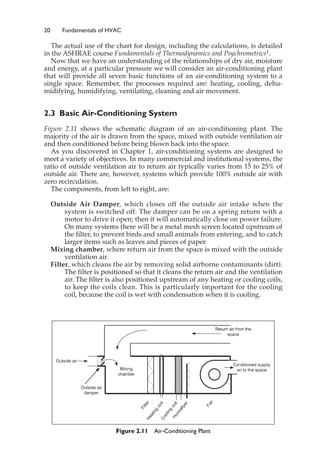
a single zone, but the addition of a personal computer and a server in one of
those offices would make it very warm compared to the other offices. This
office could require separate zone design.
Freeze protection in cold climates. In a cold climate, the perimeter walls and roof
lose heat to the outside. Therefore, it is often advantageous to designate the
perimeter spaces as separate heating zones from those in the core of the building.
Ventilation with Outside Air
Occupancy by people. In a typical office building, the population density is rela-
tively low. However, conference rooms have a fairly high potential population
density and therefore, a very variable, and not continuous, ventilation load.
Therefore, conference rooms are often treated as different zones for ventilation
and for time of operation, compared to the offices in a building.
Exhausts from washrooms. As noted in Chapter 4, washrooms may be treated
as a separate zone and provided only with exhaust. The exhausted air may be
up of air from the surrounding spaces.
Exhausts from equipment and fume hoods. Often, equipment is required to
operate continuously, although the majority of the building is only occupied
during working hours, Monday to Friday. In these cases, it may be advanta-
geous to treat the spaces with continuous exhaust as a separate zone or even
service them from a separate system.
Time of Operation
Timed. In many buildings, the time of operation of spaces differs. For example,
an office building might have several floors occupied by tenants who are happy
with full service only during working hours from Monday to Friday. One floor
could be occupied by a weather forecasting organization that required full oper-
ation 24 hours-a-day seven days a week. In this case it might be advantageous to
have the building zoned to only provide service when and where needed.
Zones 65
On demand – manual control or manual start for timed run. In many buildings
there are spaces that are only used on occasion. They may be designed as sepa-
rate zones, which are switched on when needed. The activation can be by means
of an occupancy sensor, or by a manual start switch in the space, which runs the
zone for a predetermined time. For example a low-use lecture theatre in a uni-
versity building might be provided with a push button start that would energize
the controls to run the space air conditioning for two hours before switching off.
Humidity
High humidity in hot humid climates for mold protection. In hot, humid climates,
the moisture can infiltrate into the building through leaks in the walls, doors
and windows. This can cause the building contents to mold unless dehumidi-
fication is activated.
Humidity sensors can be installed in individual representative zones that
will measure relative humidity. If these sensors detect excess humidity in these
zones, they can trigger the system to provide system wide dehumidification.
The control system can be designed to provide dehumidification without
ventilation during unoccupied hours.
Museum and art gallery requirements for good humidity control. High quality
museums and art galleries have to maintain accurate control of the humidity
in the storage and exhibit areas. This humidity control is generally not required
in other spaces like offices, restaurants, merchandising and lobby areas.
Therefore museum and art gallery often have at least two systems, to provide
the collections with the required humidity control.
Pressure
Air flows from places at a higher pressure to places at a lower pressure.
A difference in pressure can be used to control the movement of airborne
contaminants in the building. For example, in a hospital, the tuberculosis (TB)
patient rooms can be kept at a negative pressure compared to surrounding areas,
to ensure that no TB germs, known as bacilli, migrate into surrounding areas.
In a similar way, kitchens, smoking rooms, and toilets are kept negative to
contain the smells by exhausting more air than is supplied to the spaces.
Conversely, a photographic processing laboratory is kept at a positive pressure
to minimize the entry of dust.
Zoning Problems
One recurring problem with zoning is changes in building use after the design
has been completed. If there are likely to be significant changes in layout or
use, then the designer should choose a system and select zones that will make
zone modification as economical and easy as practical.
Having reviewed the reasons for choosing to zone a building, let’s consider
the control of the zone.
5.4 Controlling the Zone
The most common zone control device is the thermostat. It should be placed
where it is most representative of the occupants’ thermal experience. A thermostat
is usually mounted on the wall. It is designed to keep a constant temperature
66 Fundamentals of HVAC
where it is, but it has no intelligence; it does not know what is going on
around it. The following are some of the issues to be aware of when choosing
the thermostat location.
䊉 Mounting the thermostat in a location where the sun can shine on it will
cause it to overcool the zone when the sun shines on it. The sun provides
considerable radiant heat to the thermostat. The thermostat interprets the
radiant heat as though the whole location had grown too warm, and it
will signal the air conditioning system that it requires a lower air temper-
ature. As a result, the occupants will be cold, and cooling expenses will
escalate.
䊉 In many hotels, the thermostat is mounted by the door to the meeting room.
If the door is left open, a cold or warm draft from the corridor can signifi-
cantly, and randomly, influence the thermostat.
䊉 In some conference or assembly rooms, the thermostat is mounted above
lighting dimmer switches. These switches produce heat that rises up into
the thermostat. This makes the thermostat think that the room is warmer
than it actually is. If the dimmers are left alone and their output is constant,
the thermostat can be set at a set point that allows for the heating from the
dimmers. Unfortunately the dimmers heat output changes if the dimmer
setting is adjusted, so adjusting the lighting level will alter the thermostat
performance.
䊉 Mounting a thermostat on an outside wall can also cause problems. If the
wall becomes warm due to the sun shining on it, the thermostat will lower
the air temperature to compensate. This offsets the increased radiant
temperature of the wall on the occupants, but usually the effect is far too
much and the room becomes cool for the occupants. In a similar way,
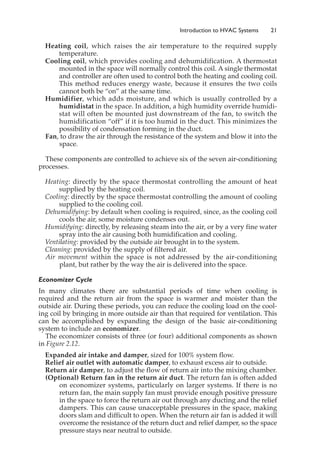
in the winter the wall becomes cool and a cool draft will move down
the wall over the thermostat, causing it to raise the air temperature to
compensate.
䊉 There are times when heat from equipment can offset the thermostat. A
computer mounted on a desk under a thermostat can easily generate
enough heat to cause the thermostat to lower the air temperature. If the
computer is only turned on periodically, (perhaps to drive a printer,) this
offset will occur at apparently random times, creating a difficult problem
for the maintenance staff to resolve.
䊉 If the thermostat is mounted where it is directly affected by the heating or
the cooling of the space, it will likely not maintain comfortable conditions.
For example, let us imagine that the air-conditioning system air-supply
blows directly onto the thermostat. In the heating mode, the thermostat will
warm up quickly when the hot air stream blows over it. Therefore, it will
quickly determine that the room is warm enough and turn off the heat. The
result will be rapid cycling of the thermostat and the room will be kept
cooler than the set-point temperature. Conversely, when in the cooling
mode, the thermostat will be quickly cooled and will cycle rapidly, keeping
the room warmer than the set-point temperature.
If the system has been adjusted to work satisfactorily during the heating
season, then when the system changes over to cooling, the thermostat will
keep the zone warmer than it did when in the heating mode. Complaints
will result and the thermostat will get adjusted to satisfactory operation in
the cooling mode. When the season changes, the shift will reverse and
Zones 67
readjustment will be required once more. This is the sort of regular
seasonal problem that occurs in many air-conditioning systems.
䊉 Wall-mounted thermostats generally have a cable connecting them to the rest of
the control system. The hole, tubing or conduit can allow air from an adjoining
space or the ceiling to blow into the thermostat, giving it a false signal.
䊉 Lastly, mounting a thermostat near an opening window can also cause
random air temperature variations as outside air blows, or does not blow,
over the thermostat.
Humidity
While this discussion has been all about thermostats and poor temperature
control, the issues are very similar for humidity, which is controlled by
humidistats. The result of failing to consider placement of the humidistat will
be poor humidity control. Remember, as we discussed in Chapter 2, section
2.2.1, if the temperature rises, then relative humidity drops and conversely, if
the temperature falls then the humidity rises.
The Next Step
Having considered the issues around zones, we are now going to consider
typical systems that provide zone control. In Chapter 6 we will be considering
single zone systems and in Chapter 7, systems with many zones.
Summary
5.2 What is a Zone?
A zone is a part of a building whose HVAC system is controlled by a single
sensor. The single sensor is usually, but not always, a thermostat. Either
directly or indirectly, a thermostat controls the temperature at its location.
5.3 Zoning Design
Zones are chosen based on what is to be controlled and the variability of what
is to be controlled. The most common control parameters include: tempera-
ture, humidity, ventilation, operating periods, freeze protection, pressure, and
importance.
5.4 Controlling the Zone
The most common zone control is the thermostat. It should be placed where it
is most representative of the occupants’ thermal experience. A thermostat does
its best to keep a constant temperature where it is. It has no intelligence; it
does not know what is going on around it. Therefore, in order to maintain a
set point for the zone, the thermostat must be located away from temperature
affecting sources, like drafts, windows and equipment.
Chapter 6
Single Zone Air Handlers
and Unitary Equipment
Contents of Chapter 6
Study Objectives of Chapter 6
6.1 Introduction
6.2 Examples of Buildings with Single-zone Package Air-Conditioning Units
6.3 Air-Handling Unit Components
6.4 Refrigeration Equipment
6.5 System Performance Requirements
6.6 Rooftop Units
6.7 Split Systems
The Next Step
Summary
Bibliography
Study Objectives of Chapter 6
After studying Chapter 6, you will be able to:
Identify the main components of a single zone air handler and describe their
operation.
Describe the parameters that have to be known to choose an air-conditioning
air-handling unit.
Describe how the vapor compression refrigeration cycle works.
Identify the significant issues in choosing a single-zone rooftop air-
conditioning unit.
Understand the virtues of a split system.
6.1 Introduction
In the previous chapters we have discussed ventilation for maintaining indoor
air quality, the thermal requirements for comfort, and reasons for zoning a
building. In this chapter we are going to consider packaged single-zone
air-conditioning equipment, examine issues of system choice and provide a
general description of system control issues. We will return to controls in more
depth in Chapter 11.
Single Zone Air Handlers and Unitary Equipment 69
The single-zone air-conditioning equipment we will be discussing is the
piece of equipment that was introduced in Chapter 2, Figure 2.12. This unit is
typically referred to as the single zone air handler, or air-handling unit, often
abbreviated to AHU. In this chapter, we will refer to it as the air handler or
the unit. The air handler draws in and mixes outside air with air that is being
recirculated, or returned from the building, called return air. Once the outside
air and the return air are mixed, the unit conditions the mixed air, blows the
conditioned air into the space and exhausts any excess air to outside, using the
return-air fan.
Before getting into a discussion of the components of a single-zone package
air-conditioning unit, we need some context as to where it fits into the whole
building or site systems.
6.2 Examples of Buildings with Single-zone Package
Air-Conditioning Units
Figure 6.1 shows four identical single story buildings, A, B, C, and D. Each has a
single-zone package air-conditioning unit (marked “AHU”) located on the roof.
Building A: This unit has only an electrical supply. This single electrical
supply provides all the power for heating, cooling, humidifying, and
for driving the fans.
Building B: This unit has the electrical supply for cooling, humidifying, and
for driving the fans, while the gas line, shown as “gas supply,” provides
heating.
These first two arrangements are commonly available as factory engineered,
off the shelf, rooftop packages. Among these packaged units, there is a great
range in size, quality, and features. The most basic provide few, if any, options.
They are relatively difficult to service and have a relatively short life. At the
other end of the spectrum, there are large units with walk-in service access
and numerous energy-conserving options. These are designed to last as long
as any indoor equipment.
As well as the total pre-packaged units, there are units, typically in larger
buildings or complexes of buildings, where the heating is provided from a
central service. For example, a boiler room can produce hot water that is piped
around the building or buildings to provide heat. Each air-handling unit that
needs heating has hot water piped to it.
Building C: This unit has the electrical supply for cooling, humidifying, and
for driving the fans. It also has supply and return hot-water pipes coming
from a boiler room in another building. The unit contains a hot-water
heating coil and control valve, which together take as much heat as
needed from the hot water supply system.
Building D: In the same way, there may be a central chiller plant that pro-
duces cold water at 42°F – 48°F, called chilled water. This chilled water
is piped around the building, or buildings, to provide the air-handling
units with cooling. Like the heating coil and control valve in Building
C, there will be a cooling coil and control valve in each unit, to provide
the cooling and dehumidification.
70 Fundamentals of HVAC
To recap, a packaged unit can require just an electrical source of power, or
it may get heating in the form of a gas or hot water supply, and may get
cooling from a source of chilled water. The basic operation of the unit stays
the same; it is just the source of heating and cooling energy that may change.
6.3 Air-Handling Unit Components
You should recognize Figure 6.2, which was originally introduced in Chapter 2,
Figure 2.12. It shows the basic air-handler unit with the economizer cycle.
Some new details have been added in this diagram. In the following section,
we will go through each of the components in the unit, we will discuss what
each component does, and, in general terms, how each component can be
controlled. This unit is typically referred to as the single-zone air handler.
The overall functions of the air-handler are to draw in outside air and return
air, mix them, condition the mixed air, blow the conditioned air into the space,
and exhaust any excess air to outside.
Air Inlet and Mixing Section
The inlet louver and screen restrict entry into the system. The inlet louver is
designed to minimize the entry of rain and snow. A very simple design for the
inlet louver is shown in the diagram. Maintaining slow air-speed through the
Figure 6.1 Single Zone Rooftop Air-Conditioning Unit, Energy Supplies
Single Zone Air Handlers and Unitary Equipment 71
louver avoids drawing rain into the system. More sophisticated, and more
costly designs allow higher inlet-velocities without bringing in the rain.
The screen is usually a robust galvanized-iron mesh, which restricts entry of
animals, birds, insects, leaves, etc.
Once the outside air has been drawn in, it is mixed with return air. In
Figure 6.2, a parallel blade damper is shown for both the outside air damper
and the relief air damper.
Figure 6.2 Air-Conditioning System: Single-Zone Air Handler
/ / / / / /
These dampers direct the air streams toward each other, causing turbulence
and mixing. Mixing the air streams is extremely important in very cold climates,
since the outside air could freeze coils that contain water as the heating
medium. A special mixing section is installed in some systems where there is
very little space for the mixing to naturally occur.
It is also possible to install opposed blade dampers:
/  /  / 
These do a better job of accurately controlling the flow, but a rather poorer
job of promoting mixing.
72 Fundamentals of HVAC
Some air will be exhausted directly to the outside from washrooms and
other specific sources, like kitchens. The remainder will be drawn back
through the return air duct by the return air fan and either used as return air,
or exhausted to outside through the relief air damper. This exhausted air is
called the relief air. The relief air plus the washroom exhaust and other
specific exhaust air will approximately equal the outside air that is brought in.
Thus, as the incoming outside air increases, so does the relief air. It is common,
therefore, to link the outside-air damper, the return-air damper and the relief-
air dampers and use a single device, called an actuator, to move the dampers
in unison. When the system is “off,” the outside-air and relief-air dampers
are fully closed, and the return-air damper is fully open. The system can be
started and all the air will recirculate through the return damper. As the
damper actuator drives the three dampers, the outside-air and relief-air
dampers open in unison as the return-air damper closes.
Mixed Temperature Sensor
Generally, the control system needs to know the temperature of the mixed
air for temperature control. A mixed-temperature sensor can be strung across
the air stream to obtain an average temperature. If mixing is poor, then
the average temperature will be incorrect. To maximize mixing before the
temperature is measured, the mixed temperature sensor is usually installed
downstream of the filter.
When the plant starts up, the return air flows through the return damper
and over the mixed temperature sensor. Because there is no outside air in
the flow, the mixed-air temperature is equal to the return-air temperature. The
dampers open, and outside air is brought into the system, upstream of the
mixed-air sensor. If the outside temperature is higher than the return tempera-
ture, as the proportion of outside air is increased, the mixed-air temperature
will rise. Conversely, if it is cold outside, as the proportion of outside air is
increased, the mixed-air temperature will drop. In this situation, it is common
to set the control system to provide a mixed-air temperature somewhere
between 55 and 60°F. The control system can simply adjust the position of
the dampers to maintain the set mixed temperature.
For example, consider a system with a required mixed temperature of
55°F and return temperature of 73°F. When the outside temperature is 55°F,
100% outside air will provide the required 55°F. When the outside air
temperature is below 55°F, the required mixed temperature of 55°F can be
achieved by mixing outside air and return air. As the outside temperature
drops, the percentage required to maintain 55°F will decrease. If the return
temperature is 73°F, at 37°F there will be 50% outside air, and at 1°F, 20%
outside air.
If the building’s ventilation requirements are for a minimum of 20% outside
air, then any outside temperature below 1°F will cause the mixed temperature
to drop below 55°F. In this situation, the mixed air will be cooler than 55°F and
will have to be heated to maintain 55°F. The mixed-air temperature-sensor
will register a temperature below 55°F. The heating coil will then turn “on” to
provide enough heat to raise the supply-air temperature (as measured by the
supply-temperature sensor) to 55°F.
Now let us consider what happens when the outside-air temperature rises
above 55°F. Up to 73°F, the temperature of the outside air will be lower
Single Zone Air Handlers and Unitary Equipment 73
than the return air, so it would seem best to use 100% outside air until
the outside temperature reaches 73°F. In practice, this is not always true,
because the moisture content of the outside air will influence the decision.
In a very damp climate, the changeover will be set much lower than 73°F,
since the enthalpy of the moist, outside air will be much higher than the
dryer return air, at 73°F. Above the pre-determined changeover tempera-
ture, the dampers revert to the minimum ventilation rate, 20% outside air
in this example.
The last few paragraphs have discussed the how the system is controlled,
called the control operation. These control operations can be summarized in
the following point form, often called the control logic:
When system off, the outside air and relief air dampers fully closed, return
air dampers fully open.
When system starts, if outside temperature above 70°F, adjust dampers to
provide x cubic feet per minute (cfm) of outside air.
When system starts, if outside temperature below 70°F, modulate dampers
to maintain 55°F mixed temperature with a minimum of x cfm of
outside air.
The requirement for a minimum volume of outside air means that the
controller must have a way of measuring the outside air volume. This can
be achieved in a number of ways that are explained in the ASHRAE Course
Fundamentals of Air System Design1.
The preceding text has talked about air volumes without getting into spe-
cific numbers. Note that the weight (mass if you leave earth) of outside air
entering the building must equal the weight of air that leaves the building.
The volume of air that is entering and leaving will usually be different, since
the volume increases with increasing temperature. For example:
82 lb/min, 1000 cfm of outside air, at 25°F, enters a building.
It is heated, and leaves the building as
82 lb/min, 1100 cfm at 75°F (10% greater volume, same weight)
Filter
All packaged units include as least minimal filters. Often it is beneficial to
specify better filters, as we discussed in Chapter 4.4.
Heating Coil
Some systems require very high proportions, or even 100% outside air. In most
climates this will necessitate installing a heating coil to raise the mixed air
temperature. The heat for the heating coil can be provided by electricity, gas,
water or steam.
The electric coil is the simplest choice, but the cost of electricity often makes
it an uneconomic one.
A gas-fired heater often has the advantage of lower fuel cost, but control can
be an issue. Inexpensive gas heaters are “on-off” or “high-low-off” rather than
74 Fundamentals of HVAC
fully modulating. As a result, the output temperature has step changes. If the
unit runs continuously with the heat turning on and off, then the supply
temperature will go up and down with the heater cycle and occupants may
experience a draft.
Hot water coils are the most controllable, but there is a possibility that
they will freeze in cold weather. If below-freezing temperatures are common,
then it is wise to take precautions against coil freezing. Many designers will,
therefore, include a low-temperature alarm and arrange the controls to keep
the coil warm or hot, when the unit is off during cold weather.
This is one of the times when the designer needs to take precautions against
the consequences of the failure of a component. If, for example, the damper
linkage fails, the unit may be “off,” with the outside dampers partially open to
the freezing weather. The consequence, a frozen coil, is serious since it will
take time to get it repaired or replaced.
Cooling Coil
Cooling is usually achieved with a coil cooled by cold water, or a refrigerant.
The cold water is normally between 42°F and 48°F. There are numerous refrig-
erants that can be used, and we will discus the refrigerant cycle and how it
works in the next section. Whether using chilled water or a refrigerant, the coil
will normally be cooler than the dew point of the air and thus condensation
will occur on the coil. This condensation will run down the coil fins to drain
away.
With refrigeration coils in packaged systems, there is limited choice in the
dehumidification capacity of the coil.
Humidifier
A humidifier is a device for adding moisture to the air. The humidifier can
either inject a water-spray or steam into the air.
The water-spray consists of very fine droplets, which evaporate into the air.
The supply of water must be from a potable source, fit for human consump-
tion. If impurities have not been removed by reverse osmosis or some other
method, the solids will form a very fine dust as the water droplets evaporate.
This dust may, or may not, be acceptable.
The alternative is to inject steam into the air stream. Again, the steam must
be potable.
The humidifier will normally be controlled by a humidistat, which is
mounted in the space or in the return airflow from the space. Excessive opera-
tion of the humidifier could cause condensation on the duct surface and result
in water dripping out of the duct. To avoid this possibility, a high humidity
sensor is often installed in the duct, just downstream from the unit. In
addition, one might not want the humidifier to run when the cooling coil is in
operation.
The unit control logic will then be:
Humidifier off when unit off
Humidifier off when cooling in operation
Humidifier controlled by space humidistat when unit in operation
Humidifier to shut down until manually reset if high limit humidity sensor
operates
Single Zone Air Handlers and Unitary Equipment 75
Fan
The fan provides the energy to drive the air through the system. There are two
basic types of fan, the centrifugal, and the axial.
Within the centrifugal fan, air enters a cylindrical set of rotating blades and
is centrifuged, thrust radially outwards, into a scroll casing. This fan is a very
popular choice due to its ability to generate substantial pressure without
excessive noise.
The other type of fan is the axial fan, where the air passes through a rotating
set of blades, like an aircraft propeller, which pushes the air along. This is a
simpler, straight-through design that works really well in situations that
require high volumes at a low pressure-drop. When this type of fan is made
for really low pressure-drops, wide pressed-sheet-metal blades are used and it
is called a propeller fan.
Return Fan
A return fan is usually included on larger systems, unless there is some other
exhaust system to control building pressure. If there is no return fan, the build-
ing will have a pressure that is a bit above ambient (outside). In a hot, humid
climate, this is beneficial since it minimizes the infiltration of outside air into
the building, where it could cause condensation and mildew. In cold climates,
the excess pressure above ambient can cause leakage of moist air into the wall,
where it freezes and causes serious damage.
Having briefly reviewed the unit components, we are going to take time to
consider the refrigeration cycle and its operation.
6.4 Refrigeration Equipment
Heat naturally flows from warmer places to cooler places. Refrigeration
equipment is used to transfer heat from a cooler place to a warmer place. In
the domestic refrigerator, the refrigeration equipment absorbs heat from
inside the refrigerator and discharges heat into the house. On a much larger
scale, refrigeration machines are used to chill water that is then pumped
around buildings to provide cooling in air-conditioning systems. The heat
removed from the water is expelled into the atmosphere through a hot,
air-cooled coil, or by evaporating water in a cooling tower.
The domestic refrigerator and most other refrigeration systems use the same
basic process of vapor compression and expansion. An alternative process,
adsorption, is used but we are not covering it in this course. The vapor
compression refrigeration system comprises four components: compressor,
condenser, expansion valve, and evaporator. Figure 6.3 shows the arrangement.
Compressor—which compresses refrigerant vapor to a high pressure, making
it hot in the process.
Condenser—in which air or water cooling reduces the temperature of the
refrigerant sufficiently to cause it to condense into liquid refrigerant
and give up its latent heat of evaporation. Latent heat of evaporation is
the heat required to convert a liquid to a vapor at a particular tempera-
ture and pressure and is the heat released when a vapor condenses at a
particular temperature and pressure.
76 Fundamentals of HVAC
Expansion valve—which allows a controlled amount of the liquid refrigerant
to flow through into the low-pressure section of the circuit.
Evaporator—in which air or water heats the liquid refrigerant so that it evapo-
rates (boils) back into a vapor as it absorbs its latent heat of evaporation.
As the refrigerant flows round and round the circuit, it picks up enthalpy,
heat, at the evaporator and more heat as it is compressed in the compressor.
The sum of the evaporator and compressor enthalpy is rejected from the con-
denser. The system effectiveness is higher, the greater the ratio of evaporator
enthalpy to compressor enthalpy. One wants the most heat transferred for the
least compressor work. The enthalpy flow into and out of the refrigerant is
shown in the Figure 6.4.
In a very small, simple system, such as the domestic refrigerator, the expan-
sion device is a length of very small-bore tube that restricts the refrigerant
liquid flow from the high-pressure side to the low-pressure side. A thermostat
in the refrigerator turns the compressor “on” when cooling is required, and
“off” again when the inside of the refrigerator is cool enough.
Moving up in size from the domestic refrigerator to the window air condi-
tioner, Figure 6.5 shows the refrigeration circuit with a box around it. The
evaporator fan draws room air over the evaporator coil to cool it. The con-
denser is outside and the condenser fan draws outside air over the condenser
coil to reject heat into the outside air.
The evaporator coil is designed to operate cool enough to produce some
condensation on the coil. This condensate water is piped through to the outside
and may just drip out of the unit or be evaporated in the condenser airflow.
Figure 6.3 Basic Vapor Compression Refrigeration Cycle
Single Zone Air Handlers and Unitary Equipment 77
The capacity of the unit is highest when the inside and outside temperatures
are close to each other. As the outside temperature rises, so the capacity of the
unit falls. It is therefore very important to know the anticipated maximum
temperature at which the unit is to perform.
The refrigerator and the window air conditioner have air flowing across
both the evaporator and condenser to achieve heat transfer. Many systems use
water as an intermediate heat-transfer medium. The evaporator coil can be in
a water-filled shell to produce chilled water. This chilled water can then be
piped around the building, or even from building to building, to provide cool-
ing as and where it is needed.
This central water-chilling plant can consist of one or more chillers that are
sequenced to match their capacity with the load. In this way the noisy refriger-
ation equipment can be separated from occupied areas, and maintenance does
not take place in occupied areas.
Water can also be used on the condenser side of the refrigeration system.
Here the condenser heats the water, which is generally then pumped to one or
more cooling towers. A cooling tower is a piece of equipment for cooling water
by evaporation. The warmed condenser water enters at the top through a series
of nozzles, which spread the water over an array of wooden or plastic surfaces.
Figure 6.4 Enthalpy Flow in Vapor Compression Refrigeration Cycle
EXPANSION DEVICE
COMPRESSOR
CONDENSER
HIGH PRESSURE - HOT
LOW PRESSURE - COLD
EVAPORATOR
REFRIGERANT
ENTHALPY
ENTHALPY ABSORBED
BY THE EVAPORATOR
ENTHALPY ADDED
BY COMPRESSOR ENTHALPY
REJECTED BY
CONDENSER
78 Fundamentals of HVAC
Most cooling towers also have a fan to force air through the surfaces, causing
some of the water to evaporate and cool the remaining water. The cooled water
flows down into a sump, to be pumped back through the condenser.
Heat Pump
The previous discussion is focused on pumping heat from a cooled space and
rejecting heat to outside. There are times when the reverse process is valuable.
If the outside temperature is not too cold, one could install a window air
conditioner back-to-front. Then, it would cool outside and warm inside. The
total heat rejected to the inside would be the sum of the electrical energy put
into the compressor, plus heat absorbed from the outside air. It would be
pumping the heat into the space – hence we call it a heat pump. In milder
climates, a heat pump can obtain useful heat from the ambient air.
In practice, one does not take out the window air conditioner and install it
the other-way-round for heating, since the reversal can be achieved with a
special valve in the refrigeration circuit. Figure 6.6 shows the heat pump cir-
cuit. It has been drawn slightly differently from the previous two figures, but
Figure 6.5 Window Air Conditioner
Single Zone Air Handlers and Unitary Equipment 79
the circuit is the same, evaporator, compressor, condenser, and expansion
device. In the upper diagram the refrigerant is flowing, as in previous dia-
grams, and heat is being ‘pumped’ from the inside coil to be rejected by the
outside coil. In the lower diagram the reversing valve has been switched to
reverse the flow of refrigerant in the inside and outside coils. Heat in now
absorbed from outside and rejected by the inside coil, heating the inside.
The performance of the air-to-air heat pump drops as the temperature
difference increases, so they are not very effective with an outside air tempera-
ture below freezing.
Another source of heat, or sink for waste heat, is the ground. In many
places, one can lay coils of pipe in the ground, in trenches or in vertical bore-
holes, and circulate water. The water will be heated by the surrounding soil, if
it is cold, and cooled by the surrounding soil if it is hot. In the example, shown
in Figure 6.6, the heat pump has a ground water heated/cooled coil and a
Figure 6.6 Heat Pump with Reversing Valve
80 Fundamentals of HVAC
cooled/heated air coil for the building. Figure 6.6 shows the circuit, including
the reversing valve operation.
Refrigeration is a very important part of the air-conditioning industry.
The ASHRAE Course, Fundamentals of Refrigeration2 will teach you about the
systems, components, system control and cooling loads.
6.5 System Performance Requirements
Before choosing a system, you need an understanding of the types of loads you
want the system to manage. Typically, the summer cooling-loads will be the
main determinant of the choice of unit. The heating loads are usually easily
dealt with by choosing a suitable heater to go with the chosen unit. The summer
loads, though, will be dependent on several, somewhat interrelated factors:
Outside summer design temperature. This affects the cooling load in three
ways:
Interior load—The interior load is calculated using the outside temperature
plus solar heat gain acquired due to heat transfer through the fabric of
the building.
Outside air temperature—The load from the outside air temperature will also
partly determine the cooling load of the outside air that is being
brought into the building for ventilation.
Effectiveness of the refrigeration system—If the refrigeration system is air-
cooled, the outside temperature will influence the effectiveness of the
refrigeration system.
Outside summer design humidity. The outside design humidity will be a
factor in the ventilation air load and the removal of moisture from any air that
leaks into the building. Cooling tower performance is also directly affected by
the humidity; performance falls as humidity rises.
Inside summer design temperature and humidity. The warmer and damper
the inside is allowed to be, the smaller the difference between inside and
outside, hence the lower the load on the system. This is particularly important
when you are making system choices.
Slight under-sizing, which is cheaper to buy, means that occasionally the
design temperatures will be exceeded. However, when the unit is slightly
under-sized, it will be running nearer full load for more of the time.
Depending on the situation, this may be the most economical choice.
Inside summer generation of heat and moisture. These will be added to the
building loads to establish the total loads on the system.
Summer ventilation requirements. This is the ventilation for people, typi-
cally based on ASHRAE Standard 62.1, 2004 plus any additional ventilation
for specific equipment. The higher the ventilation requirements, the greater
the load due to cooling and dehumidifying the outside air that is brought in.
Once these basic criteria are established, load calculation can be done.
Depending on the situation, summer cooling and winter heating loads may
be estimated with fairly simple hand calculation methods for the peak-load
summer-cooling and for the peak-load winter-heating. In other cases, an
hour-by-hour computer simulation of the building may be done, in order to
assess peak-load and intermediate-load performance.
Single Zone Air Handlers and Unitary Equipment 81
The following example illustrates some of the issues for system performance.
A building has the following conditions:
The design room condition is 75°F and 50% relative humidity.
The outside design condition is 95°F and 40% relative humidity.
The sensible heat load is 200,000 Btu/h. Sensible heat is heat that causes
change in temperature.
The moisture heat load, or “Latent heat” is 20,000 Btu/h. Latent heat is the
energy that is absorbed by water which causes the water to evaporate.
To calculate the loads, first divide the latent load by the sensible load. This
provides us with the percentage of sensible heat that must be removed from
the system.
For example, if the latent load is 20,000 Btu per hour (Btu/h) and the sensible
load is 200,000 Btu/h, the ratio would be 1/10. With an all-air system, the air
supply must be at a temperature and moisture content that requires 10 times as
much sensible heat as latent heat to reach room temperature. We can plot a line
on which the air supply must be to meet the design room condition.
You can easily plot this on the psychrometric chart as is shown in Figure 6.7.
First, note the enthalpy of the air at the desired room condition.
Draw a vertical line downward from the room condition.
Mark on the line where the enthalpy line is 1 Btu/lb less than room conditions.
From this point, draw a horizontal line to the left. Mark off where the
enthalpy is 10 Btu/lb less.
Draw a line from here to the room condition.
This illustrates that, for the supply air to meet the designed room condition,
it must be supplied at some point on this line. If it is supplied close to the
designed room-condition the volume will have to be large.
Figure 6.7 Space, Outside and Mixed Conditions
82 Fundamentals of HVAC
The calculation of heating loads is relatively straightforward, but cooling-
load calculation is more challenging, due to the movement of the sun and
changing loads throughout the day. Calculating heating and cooling loads is
the subject of the ASHRAE Course Fundamentals of Heating and Cooling Loads3.
Decision Factors for Choosing Units
When choosing equipment, several factors must be balanced.
The initial cost to purchase and install versus the ongoing cost of operation
and maintenance. Most heating and cooling systems reach peak load
very occasionally and then only for a short period of time. Most of the
time, the equipment is operating at loads much below peak. Equipment
either improves in efficiency at lower load—a characteristic of many
boilers—or it falls—a characteristic of many refrigeration units. When
choosing refrigeration equipment, it can be very worthwhile to consider
the part-load performance. It is in the part-load performance evaluation
that hour-by-hour computer simulations become a really necessary tool.
Load versus capacity. Note that we have been talking about “loads,” but
when you look in manufacturers’ data sheets, they talk about “plant
capacity.” “Loads” and “capacity” are the same issue, but loads are
the calculated building requirements, while capacity is the plant
equipment’s ability to handle the load. When purchasing packaged
plant equipment, the plant capacity often does not exactly match the
calculated building loads. One of the challenges for the designer is
choosing the most suitable package, even though it does not exactly
match the calculated building loads. This issue is illustrated in the
following section on rooftop units.
6.6 Rooftop Units
A typical rooftop system is diagrammed in Figure 6.8. The return air is drawn up
into the base of the unit and the supply air is blown vertically down from the
bottom of the unit into the space below. As an alternative, the ducts can project
from the end of the unit to run across the roof before entering the building.
The major advantages of these units are
No working parts in the occupied space—so maintenance can be carried out
without disrupting activities within the building and maintenance can be
carried out without access to the building when the building is closed.
No space is built for the unit—which saves construction costs.
No delay for detailed manufacturer design work—because the unit is pre-designed.
No wide access during construction—because the unit is outside the building
envelope, the contractor does not have to keep an access available for
the unit to be moved in during construction.
There are, of course, disadvantages.
Critical units must be maintained regardless of the weather conditions—That
means that maintenance could be required in heavy rain, snow, or high
Single Zone Air Handlers and Unitary Equipment 83
winds. This potential problem can be managed by having a mainte-
nance access space located along one side of the unit.
Choice of performance is limited to the available set of components—This is
often not enough of a problem to make the unit unacceptable, and can
frequently be overcome by using a split unit, which we will be
discussing in the next section.
Choosing a rooftop unit is fairly straightforward. One needs to know both
inside and outside design-temperatures, required airflow, in cfm, mixed-air
temperature, and the required sensible and latent cooling-loads.
Figure 6.8 Rooftop Unit
84 Fundamentals of HVAC
The mixed-air temperature can be calculated based on the return-air
temperature, the-outside air temperature and the required proportion of
outside air. Referring back to the example, shown in Figure 6.7 above, the
room temperature, which we will consider to be return temperature, was
75°F, and the outside ambient temperature was 95°F. If 20% outside air is
required, then the mixed temperature can be estimated by proportion
95°F ⭈ 0.2 ⫹ 75°F ⭈ 0.8 ⫽ 79°F
The calculation of airflow is covered in detail in ASHRAE Course
Fundamentals for Air System Design1.
It is important that the airflow is correctly calculated and that the unit is
setup and balanced to provide the correct airflow. With direct expansion
refrigeration circuits, too little airflow over the evaporator can cause problems:
Imagine that the airflow is much slower than design. The slow speed past
the coil will allow the air to cool further, and if the coil is below freezing, for
ice to start to form. The slow flow will also reduce the heat being absorbed
into the evaporator, so the compressor’s suction will be drawing with little
refrigerant vapor coming in. As a result, the pressure in the evaporator will
fall, causing the evaporator temperature to fall, which again, will tend to cause
freezing. Once ice formation starts, the ice starts to block the flow, causing
even slower airflow until the coil is encased in ice. Ice formation on the evapo-
rator can also be caused by too little refrigerant in the system – a common
result of a slow refrigerant leak.
As noted in the previous discussion of loads versus capacity, air-handling
units come in discrete sizes, so a perfect match of unit and calculated loads does
not happen. From the example in Figure 6.7, for our loads of 200,000 Btu/h
sensible load and 20,000 Btu/h latent load, let us assume the closest unit has
a performance of 240,000 Btu/h sensible and 60,000 Btu/h latent capacity. This
looks excessively oversized, but two factors have to be considered: First the
unit’s sensible capacity does not take into account the heat from the supply
fans in the unit. Suppose the fan load was 6 kW (3,412 Btu/hr ⫽ 1 kW) then the
fan-heat added to the cool air would be:
6 ⭈ 3412 Btu/h ⫽ 20,472 Btu/h
The effective sensible heat capacity of the unit is thus:
240,000 Btu/h ⫺ 20,472 Btu/h ⫽ 219,528 Btu/h
This is a very close match to the required capacity.
The 60,000 Btu/h moisture removal, when compared to the required
20,000 Btu/h, is a common issue in dry climates. The coil removes more
moisture than required. There are two results. First, more energy is used
than required to maintain the design conditions. Second, the real conditions
will be drier than the design condition.
The converse problem, of too little moisture removal, occurs in hot moist
climates, particularly where higher proportions of outside air are required. In
this case, and others, it may not be possible to find a package rooftop-unit for
the duty and it may be advantageous, or necessary, to take special measures to
remove moisture. Some of these are discussed in Chapter 13.
Single Zone Air Handlers and Unitary Equipment 85
Heating choices are generally less of an issue, but the designer still has to be
aware of potential problems. As noted earlier, electrical heaters are normally
available with stepped capacity, but gas heaters are often on-off or high-low-off.
If the unit runs continuously as the gas-heater cycle, the air supply will fluctuate
in temperature and sometimes blow warm, and sometimes blow cold. Take
care to ensure that the occupants do not have an intermittent cold draft blowing
on them.
Having considered the single-zone air handler, with particular emphasis on
the rooftop unit, let us now consider another popular single-zone system, the
split system.
6.7 Split Systems
In the rooftop unit, all the plant was in a single housing and was purchased
as a manufacturer’s pre-design. In general, the package rooftop-units are
designed for popular duties, and to be as light and compact as possible, since
they have to be lifted onto the roof. In the split system, the compressor/
condenser part of the refrigeration system is chosen separately from the rest
of the system and connected by the refrigerant lines to the air system, which
includes the evaporator. The pipes, even with their insulation, are only inches
in diameter, compared to ducts that are, typically, feet in diameter. The separa-
tion of the two parts of the refrigeration system to produce the split system
is diagrammed in Figure 6.9. The system can range in size from the small
residential systems where the inside coil is mounted on the furnace air outlet
to substantial commercial units serving a building.
The split system allows the designer a much greater choice of performance.
For example, designing a unit for operation in an ice rink requires a low space
temperature, hence a non-package situation. This requirement is well suited to
the flexibility of the split system.
The other main advantage of the split system is that it allows the air
handling part of the unit to be indoors, where it is easier to maintain and does
not need to be weatherproofed. The noise of the compressor is outside and can
be located at some distance from the air-handling unit. For example, in a
three-storey building, all the condensers can be mounted on the roof, while
the air handlers are on the floor they serve. This allows the ducting to be
run horizontally on each floor and only requires a small vertical duct for
the refrigerant lines from the three units to the roof.
Figure 6.9 Split System
86 Fundamentals of HVAC
The Next Step
We have considered single zone air-conditioning systems in this chapter.
We focused on rooftop and split systems. We considered the components
they contain, how the components operate and some of the limitations of
off-the-shelf equipment. Finally we looked at a simple choice of rooftop and
spilt system and the resulting space conditions.
In the next chapter we will look at how these single zone systems can be
modified to produce multi-zone systems.
Summary
In this chapter, we discussed issues of system choice and provided a general
description of system control issues. We will return to controls in more depth
in Chapter 11.
6.2 Examples of Buildings with Single zone Package
Air-Conditioning Units
For heating and cooling, a packaged unit may require: just an electrical source
of power, or a gas or hot water supply, and/or a source of chilled water. The
basic operation of the unit stays the same; it is just the source of heating and
cooling energy that may change.
6.3 Air Handling Unit Components
The overall functions of the air-handler are to draw in outside air and return
air, mix them, condition the mixed air, blow the conditioned air into the
space and exhaust any excess air to outside. Components of the unit can
include: inlet louver screen, the parallel blade damper, opposed blade
damper, the relief air damper, actuator, the mixed temperature sensor, filter
heating coil, cooling coil, humidifier, fan, return fan. The concept of control
logic was introduced as a method to summarize the operation of the compo-
nents of the system.
6.4 Refrigeration Equipment
The vapor compression refrigeration cycle is generally the basis of mechanical
refrigeration. The vapor compression refrigeration system comprises four compo-
nents: compressor, condenser, expansion valve, and evaporator. This system can
be used directly, to provide cooling to, typically, a local coil. To provide cooling
for several coils at greater distances, refrigeration machines are used to chill water
that is then pumped around buildings to provide cooling in air-conditioning
systems. The heat removed from the water is expelled into the atmosphere
through a hot, air-cooled coil, or by evaporating water in a cooling tower.
The components are matched to work together with a specific charge of
refrigerant. If you operate the system with too little refrigerant or too little air
or water flow over the evaporator or condenser, problems can arise.
Single Zone Air Handlers and Unitary Equipment 87
While cooling is achieved by pumping heat from a cooled space and rejecting
heat to outside, you can reverse the process, in a mild climate, with a heat
pump, to obtain heat from ambient air. Similarly, the ground can be used as a
source of heat or a sink for waste heat, by using a ground source heat pump.
6.5 System Performance Requirements
Before choosing a system, you need an understanding of the types of loads you
want the system to manage. Summer cooling loads will be the main determi-
nant of the choice of unit. These summer factors are used to determine the sum-
mer load: outside design temperature; outside design humidity; inside design
temperature and humidity; inside generation of heat and moisture; ventilation
requirements. Once you have determined summer loads, additional decision
factors for unit choice are the initial cost to purchase and install, versus the
ongoing cost of operation and maintenance; and load versus capacity.
6.6 Rooftop Units
In a typical rooftop unit, the return air is drawn up into the base of the unit and
the supply air is blown vertically down from the bottom of the unit into the
space below. As an alternative, the ducts can come out of the end of the unit to
run across the roof before entering the building. Advantages and disadvantages
of rooftop units were discussed.
Choice factors to choose a rooftop unit: inside and outside design tempera-
tures, required airflow in cfm, mixed air temperature, and the required sensible
and latent cooling loads.
It is important that the airflow is correctly calculated and that the unit is
setup and balanced to provide the correct airflow. With direct expansion refrig-
eration circuits, too little airflow over the evaporator can cause icing problems.
Units come in discrete sizes so a perfect match of unit and calculated loads
does not happen. As a result, the design conditions may be jeopardized, and
or extra energy costs may arise.
6.7 Split Systems
In the split system, the compressor/condenser part of the refrigeration system
separate from the evaporator coil and connected by the refrigerant lines to the
air system, which includes the evaporator.
Advantages of the split system: It allows the designer a much greater choice of
performance; it allows the air handling part of the unit to be indoors, where it is
easier to maintain and does not need to be weatherproofed. The noise of the com-
pressor is outside and can be located at some distance from the air-handling unit.
Bibliography
1. ASHRAE Fundamentals of Air System Design
2. ASHRAE Fundamentals of Refrigeration
3. ASHRAE Fundamentals of Heating and Cooling Loads
Chapter 7
Multiple Zone Air Systems
Contents of Chapter 7
Study Objectives of Chapter 7
7.1 Introduction
7.2 Single-Duct, Zoned Reheat, Constant-Volume Systems
7.3 Single-Duct, Variable-Air-Volume Systems
7.4 By-pass Box Systems
7.5 Constant Volume Dual-Duct, All-Air Systems
7.6 Multizone Systems
7.7 Three-Deck Multizone Systems
7.8 Dual-Duct, Variable-Air-Volume Systems
7.9 Dual Path Outside Air Systems
The Next Step
Summary
Study Objectives of Chapter 7
Chapter 7 shows the most common ways that a single-supply air system can
be adapted to provide all-air air conditioning to many zones with differing
loads. After studying the chapter, you should be able to:
Identify, describe and diagrammatically sketch the most common all-air
air-conditioning systems.
Understand the relative efficiency or inefficiency of each type of multiple
zone air system.
Explain why systems that serve many zones, and that have a variable-supply
air volume, are more energy-efficient than those with constant-supply
volumes.
7.1 Introduction
In the last chapter, we considered two types of single zone direct expansion
systems: the packaged rooftop system and the split system. The direct-expansion-
refrigeration rooftop unit contained all the necessary components to condition a
single air supply for air-conditioning purposes.
Multiple Zone Air Systems 89
These same components can be manufactured in a wide range of type and size.
As an alternative to a rooftop unit, they can be installed indoors, in a mechanical
room, with the different components connected by sheet-metal ducting.
Both the packaged rooftop unit and the inside, single-zone unit produce the
same output: a supply of treated air at a particular temperature.
The heating or cooling effect of this treated airflow, when it enters a zone, is
dependent upon two factors:
The flow rate, (measured in cubic feet per minute, cfm).
The temperature difference between the supply air and the zone temperature,
(measured in degrees Fahrenheit, °F).
When the unit is supplying one space, or zone, the temperature in the zone
can be controlled by
Changing the air volume flow rate to the space.
Changing the supply air temperature.
Changing both air volume flow and supply air temperature.
In many buildings, the unit must serve several zones, and each zone has its
own varying load. To maintain temperature control, each zone has an individual
thermostat that controls the volume and/or temperature of the air coming into
the zone.
Air-conditioning systems that use just air for air conditioning are called “all-air
systems”.
These all-air systems have a number of advantages:
Centrally located equipment—operation and maintenance can be consoli-
dated in unoccupied areas, which facilitates containment of noise.
Least infringement on conditioned floor space—conditioned area is free of
drains, electrical equipment, power wiring and filters (in most systems).
Greatest potential for the use of an economizer cycle—as discussed in
Chapter 2, this can reduce the mechanical refrigeration requirements
by using outside air for cooling, and therefore reduce overall system
operating costs.
Zoning flexibility and choice—simultaneous availability of heating or cooling
during seasonal fluctuations, like spring and fall. The system is adaptable
to automatic seasonal changeover.
Full design freedom—allows for optimum air distribution for air motion
and draft control.
Generally good humidity control—for both humidification and dehumidifi-
cation.
All-air systems generally have the following disadvantages:
Increased space requirements—significant additional duct space require-
ments for duct risers and ceiling distribution ducts.
Construction dust—due to problems with construction-dust, all-air systems
are generally available for heating later in the construction schedule
than systems that use water to convey heat.
Closer coordination required—all-air systems call for close cooperation
between architectural, mechanical and structural designers.
90 Fundamentals of HVAC
In addition to these general disadvantages, constant-volume-reheat systems
are particularly high energy consumers because they first cool the air, and then
reheat it. Because the reheat coils are sometimes hot water coils, an additional
potential disadvantage is a problem with leaking hot-water coils. We will discuss
these systems in more detail in the next section.
To make these all-air systems work for many zones requires some form of
zone control. In this chapter we will consider how zone control can be achieved
with all-air air-conditioning systems.
The simplest, and one that we will start with, is the constant-volume-reheat
system.
7.2 Single-Duct, Zoned Reheat, Constant Volume Systems
The reheat system is a modification of the single-zone system. The reheat
system permits zone control by reheating the cool airflow to the temperature
required for a particular zone. Figure 7.1 shows a reheat system, with ceiling
supply diffusers in the space.
A constant volume of conditioned air is supplied from a central unit at a
normally, fixed temperature, (typically 55°F). This fixed temperature is designed
to offset the maximum cooling load in all zones of the space. If the actual cooling
load is less than peak, then the reheat coil provides heat equal to the difference
between the peak and actual loads. When heating is required, the heater heats
the air above zone temperature to provide heating.
The reheat coil is located close to the zone and it is controlled by the zone
thermostat. Reheat coils are usually hot water or electric coils. As noted above,
if the reheat coils are hot water, then there can be a problem with leakage.
A reheat system is often used in hospitals, in laboratories, or other spaces
where wide load-variations are expected.
When primary air passes quickly over a vent, it draws some room air into the
vent. This process is called induction. There are two variations on the reheat
system that both use induced room air: the Induction Reheat Unit, shown in
Figure 7.2; and the Low-Temperature Reheat Unit with Induced Air shown in
Figure 7.3.
The Induction Reheat Unit shown in Figure 7.2 shows the primary
supply of air, blown into the unit and directed through the induction
Figure 7.1 Reheat System
Multiple Zone Air Systems 91
Figure 7.2 Induction Reheat Unit
Figure 7.3 Low-Temperature Reheat Unit with Induced Air
nozzle. The reduced aperture of the nozzle forces the air to speed up and
move quickly to the unit exit, into the room. As the primary air passes
quickly past the reheat coil, it draws, or induces, air from the room into
the unit. The room air passes across the reheat coil and mixes with the
primary air.
92 Fundamentals of HVAC
Units like this are often mounted beneath windows, where they offset any
downdraft in cold weather. In addition, even when the air supply is turned
“off,” hot water in the coil will still provide some heating.
The second type of induction reheat system, the Low-Temperature Reheat
Unit with Induced Air, shown in Figure 7.3, is used where very cold supply
air is provided. In some systems, the supply air can be as cold as 40°F. This
could create intolerable drafts and serious condensation on the supply outlets.
In this system, the primary air is preheated when necessary, but room air is
always induced to mix with the primary air to ensure that the flow into the
space is not excessively cold.
There are two primary advantages to this system:
䊉 Duct sizing: When the system is designed to use 40°F supply air, ducts can
be sized for half the air volume, compared to the ducts required for a 55°F
supply-air temperature. This results in a lower installation cost, and a
smaller requirement for duct space.
䊉 The small volume of supply air may be exhausted from the room rather
than returned to the main cooling system, possibly eliminating the need for
return ductwork.
Overall, reheat systems are simple, and initial costs, the costs of design and
construction, are reasonable. Reheat systems provide good humidity control,
good temperature control, good air circulation, and good air quality.
The problem with all reheat systems is their energy inefficiency, so they
are expensive systems to run. Generally, when the load is less than the peak
cooling load, the cooling effect and the reheat are working against each other to
neutralize their contributions. This means, in a no-load situation, the refrigeration
is going at full blast and the reheat is just matching the cooling effect. There are
two energy drains for no load! This is not quite as severe as it sounds because the
no-load condition is the worst-case scenario, and it only occurs for a relatively
small amount of the time.
Overall, though, reheat is energy expensive. As a result, these systems have
fallen out of favor in recent times.
7.3 Single-Duct, Variable Air Volume Systems
Buildings that are located in continuously warm climates, and interior spaces
in any climate, require no heating, only cooling. For cooling-only situations, it
would be ideal to supply only as much cooling and ventilation as the zone
actually requires at the particular moment. A system that comes close to the
ideal is the variable-air-volume system “VAV”.
The variable air volume system is designed with a volume control damper,
controlled by the zone thermostat, in each zone. This damper acts as a throttle to
allow more or less cool air into the zone. The VAV system adjusts for varying
cooling loads in different zones by individually throttling the supply air volume
to each zone. Regardless of the variations in the cooling load, a minimum flow
of ventilation air is always provided and care must be taken to ensure that the
required volume of ventilation air is provided.
In a VAV system, as the zone becomes cooler, the cooling load decreases
and the cool airflow to the zone decreases. Eventually it reaches the minimum
value necessary for adequate ventilation and air supply, Figure 7.4. When this
Multiple Zone Air Systems 93
minimum airflow is reached, if the zone is still too cool, heating is provided by
a thermostatically controlled reheat coil or a baseboard heater.
This means there may be some energy wasted in the VAV system, due to
heating and cooling at the same time. However, this energy waste is far less
than in the terminal reheat system, since the cooling ventilation air is reduced
to a minimum before the heating starts.
The total supply-airflow rate in a VAV system will vary as the zone dampers
adjust the flow to each zone. Therefore, the supply fan must be capable of vary-
ing its flow rate. The variation in flow rate must be achieved without allowing
the duct pressure to rise excessively or to drop below the pressure required by
the VAV boxes for their proper operation. This pressure control is often achieved
by using a pressure sensor in the duct to adjust a fan-speed control unit.
Similarly, the return fan is controlled to meet the varying supply-air volume.
There are other methods that are discussed in the ASHRAE Course,
Fundamentals of Air System Design.
In systems where the fan speed is reduced to reduce the volume flow, the
fan power drops substantially as the flow reduces. This reduction in fan power
is a major contribution to the economy of the VAV system.
VAV systems may have variable volume return air fans that are controlled by
pressure in the building or are controlled to track the supply-fan volume flow.
In small systems, the variable-volume supply may be achieved by using a
relief damper, called a “bypass,” at the air-handling unit. The bypass allows
air from the supply duct through a control damper into the return duct, as
shown in Figure 7.5.
Figure 7.4 Variable Air Volume System
Figure 7.5 Variable Air Volume System With Bypass
94 Fundamentals of HVAC
As the zones reduce their air requirements, the bypass damper opens to
maintain constant flow through the supply fan. This arrangement allows for
the constant volume required by the refrigeration circuit. For smaller systems,
this method can provide very effective zone control without creating problems
that may occur when the airflow is varied across the direct expansion refrigera-
tion coil. Unfortunately, this system keeps the fan working at near full load.
VAV Advantages
Advantages of the variable volume system are the low initial costs and low
operating costs. Initial costs are low because the system only requires single
runs of duct and a simple control at the end of the duct. Operating costs are
low because the volume of air, and therefore the refrigeration and fan power,
closely follow the actual load of the building. There is little of the cool-and-
reheat inefficiency of the reheat system.
VAV Problems
There are potential problem areas with variable air volume systems. These
include: poor air circulation in the conditioned space at lower flows; dumping of
cold air into an occupied zone at low flows; and inadequate fresh air supplied to
the zone. Improved diffusers have made it possible for the designer to avoid
dumping and poor room circulation. However, the problem of inadequate out-
side air for ventilation needs additional care when the system is being designed.
For example, as we saw in the last chapter, in a constant volume system
where all the zones require 20% outside air, setting the outside air to 20% on
the main unit ensures that each zone receives 20% outside air. In the VAV sys-
tem, one cannot set the outside air proportion. As the zone flows are reduced
due to low thermal load, the proportion of outside-air-for-ventilation needs to
increase. As a result, the outside-air volume must be maintained at all volume
flows. This can be achieved in a number of ways, but the process requires a
sophisticated, and potentially more expensive control system that is not
required in constant volume systems.
7.4 By-pass Box Systems
Where the main supply unit must handle a constant volume of air, by-pass boxes
can provide a variable volume of air to the zones served. The bypass boxes can
be used on each zone, or as you saw in Figure 7.4, a single central by-pass can be
used with variable volume boxes serving each zone.
Figure 7.6 shows the use of the by-pass box on each zone. A thermostat in each
zone controls the damper in the by-pass box serving the zone. The flow of air to
each box is essentially constant. The bypass box, shown on the left, is set for full
flow to the zone. The box in the center is passing some air to the zone and
bypassing the balance. The zone on the right is unoccupied, and the box is set to
bypass the full flow. The zone thermostat controls how much of the air is
directed into the zone and how much is by-passed into the return-air system. In
many buildings, the return can be via the space above the dropped ceiling, the
ceiling plenum, and then, via a duct, back to the return of the air-handling unit.
With the by-pass system, it is important to keep the ceiling plenum at a
negative pressure, so that the excess cooling air does not leak into the zone.
Multiple Zone Air Systems 95
The danger of keeping the ceiling at negative pressure, though, is that this
can cause infiltration of outside air through the walls and roof joints, resulting
in moisture and load challenges.
7.5 Constant Volume Dual-Duct, All-Air Systems
A dual-duct system employs a different approach for establishing zone control.
In a dual-duct system, cooling and heating coils are placed in separate ducts,
and the hot and cold air flow streams are mixed, as needed, for temperature
control within each zone.
In this system, the air from the supply fan is split into two parallel ducts,
downstream of the fan. One duct is for heating and the other for cooling. A
layout of three zones of a dual-duct system is shown in Figure 7.7.
The duct with the heating coil is known as the hot deck, and the duct with
the cooling coil is the cold deck. These constant volume dual-duct systems
usually use a single, constant-volume supply fan to supply the two ducts.
The dual-duct system can also be drawn diagrammatically as shown in
Figure 7.8. Satisfy yourself that the two figures show the same system,
although they look very different.
Figure 7.6 By-Pass Boxes on Each Zone
Figure 7.7 Dual-Duct System, Double Line Diagram
96 Fundamentals of HVAC
Dual-duct systems achieve the zoned temperature control by mixing the hot
and cold air streams in a dual-duct box while maintaining a constant airflow. As
in the reheat system described earlier, the heating and cooling effects are fighting
against each other when the load is less than peak load. The combined energy
use leads to energy inefficiency, which is the biggest disadvantage of dual-duct
systems. The energy inefficiency may be reduced by these methods:
Minimizing the temperature of the hot deck using control logic based on
zone loads or outside temperature
Raising the cold deck temperature when temperature and humidity condi-
tions make it practical
Using variable volume dual-duct mixing boxes
The system also has a high first cost, since it requires two supply ducts. These
two ducts need additional space above the ceiling for the second supply duct
and connections.
Dual-duct systems were popular in the 1960s and 1970s and many are installed
in hospitals, museums, universities, and laboratories. Due to the relatively high
installation and operating costs, dual-duct systems have fallen out of favor
except in hospitals and laboratories, where their ability to serve highly variable
sensible-heat loads at constant airflow make them attractive. Another advantage
of dual-duct systems is that there are no reheat coils near the zones, so the prob-
lems of leaking hot water coils is avoided.
The dual-duct system delivers a constant volume of air, with varying percent-
ages of hot and cold air, as shown in Figure 7.9.
In Figure 7.9, there are plots of percentage flow from the hot and cold air
streams as a function of room temperature. The sum of the hot and cold air-
stream percentages always adds up to 100%. For the room temperature setpoint
range, also known as the throttling range, of 70°F to 72°F, the thermostat will
control the hot-air flow linearly, from 100% at 70°F to 0% at 72°F. Outside the
throttling-temperature range, the flow is either all hot air or all cold air.
In Figure 7.10, there is a different view of the same process over the throttling
range.
There are two plots. One plot, the solid line, shows how the delivered air
temperature will vary as the thermostat controls the percentage mixture of hot
Figure 7.8 Dual-Duct System, Single Line Diagram
Multiple Zone Air Systems 97
Figure 7.9 Air Flow in a Dual-Duct System
Figure 7.10 Delivered Air Temperature in a Dual-Duct System
and cold streams. The delivered air-temperature scale is on the right-hand side
of the graph, and the room-temperature scale is on the horizontal axis.
At a room temperature of 70°F and below, with 100% hot air, the delivery
temperature is at 110°F. At a room temperature of 72°F and above, with 100%
98 Fundamentals of HVAC
cold air, the delivery temperature is 55°F. At room temperatures between 70°
and 72°F, the delivery temperature varies linearly with the room temperature.
The second plot in Figure 7.10, the dashed line, is that of the net cooling or
heating power delivered to the zone to meet the load. The scale for the power
variable is on the vertical axis, on the left-hand side of the graph. Zero power, (or
no net delivered heating or cooling) is at mid-height on the vertical axis. Above
the mid-height, there is net heating and below mid-height, there is net cooling.
It is important to observe that, because this is a constant volume system, zero
power does not mean zero energy use. Zero power corresponds to an equal
amount of heating and cooling, so that the heating and cooling effects cancel
each other out, and give a neutral temperature effect on the zone.
As shown in Figure 7.9, below a room temperature of 70°F, the flow is 100%
heating at 110°F; and above a room temperature of 72°F, the flow is 100% cooling
at 55°F. Between 70° and 72°F, the flow is a linear mixture of hot and cold air.
7.6 Multizone Systems
The multizone system is thermodynamically the same as the dual-duct system.
They both involve mixing varying proportions of a hot-air stream with a cold-air
stream to obtain the required supply temperature for that zone. In the dual-duct
system, the mixing occurs close to the zone, in the dual-duct box. In the multizone
system, as shown in Figure 7.11, the mixing occurs at the main air-handling unit.
The basic multizone system has the fan blowing the mixed air over a heating
coil and a cooling coil in parallel configuration. As you know, in the dual-duct
system, the resulting hot and cold air is ducted through the building to dual-duct
mixing boxes. In contrast, in the multizone system, the heating and cooling air-
flows are mixed in the air-handling unit at the coils using pairs of dampers.
The hot deck coil is arranged above the cold deck coil and they are sectioned
off into zones; just two sections are shown in the figure. Each section has a
two-section damper that opens to the cold deck as it closes to the hot deck.
Each damper pair is driven by an actuator pushing the crank at the end of the
damper shaft. The mixed air from each section is then ducted to a zone.
Figure 7.11 Mixing at the Air Conditioning Unit in a Multizone System
Multiple Zone Air Systems 99
As in the dual-duct system, a certain amount of energy inefficiency occurs
because the air is being both heated and cooled at the same time.
7.7 Three-deck Multizone Systems
The three-deck multizone system is a possible solution to overcome the energy
inefficiency of the overlapping use of heating and cooling in a traditional multi-
zone system.
The three-deck system is similar to the dual-duct and multizone systems,
except that there is an additional (third) air stream that is neither heated nor
cooled. Hot and cold air are never mixed in the three-deck system. Instead,
thermal zones that require cooling receive a mixture of cold and neutral air, and
thermal zones that require heating receive a mixture of hot and neutral air. The
air flow control is shown in Figure 7.12. Thus, the three-deck system avoids the
energy waste due to the mixing of hot and cold air streams.
The neutral air in the three-deck system is neither heated nor cooled and its
temperature will change with the season. In summer, the neutral air will be
warmer than the cold deck air. Consequently, the neutral air will take the place of
the hot-deck air, eliminating the need for the heating coil in summer. In winter,
the neutral air will be cooler than the hot deck, thus replacing the cold deck and
the need for activating the cooling coil in winter. The net annual result is that
there is no penalty for having heating and cooling coils operating simultaneously.
7.8 Dual-Duct, Variable Air Volume Systems
The dual-duct, variable air volume (VAV) system provides the thermal
efficiency of the VAV system while generally maintaining higher air flows,
and thus better circulation of air in the room, when heating is required. The
difference is that the air is not drawn into the building by a constant volume
fan, as it is in the usual dual-duct system, but it is split into two air streams
that flow through two variable-volume fans. One air stream passes through
Figure 7.12 Air Flow for Three-deck, Multizone System
100 Fundamentals of HVAC
a heating coil and one through a cooling coil. The two air streams are then
ducted throughout the building.
The mixing of these two air streams is carried out in a mixing box serving each
thermal zone. These mixing boxes can vary both the proportions of hot and cold
air, and also the total flow rate of air to the zone. This is in contrast to the more
conventional dual-duct system where the airflow delivered by the mixing box is
constant.
The variation of flow in the dual-duct, variable-air-volume system is shown in
Figure 7.13. This diagram indicates equal volume flows for both heating air and
cooling air. Depending on the climate and resulting loads, the heating flow many
be 50% less than the cooling airflow, but the control logic is the same. At maxi-
mum cooling load, the box provides sufficient cold air to meet the load. As the
cooling load decreases, the volume of cold air is decreased, without addition of
hot air to change the temperature. When the cooling load reaches the point where
the cold airflow equals the minimum allowable flow, the cold flow continues to
decrease, but the hot air is added to maintain sufficient total flow. As the heating
load increases, the total flow remains constant while its temperature is increased
above room temperature by increasing the proportion of air from the hot deck.
When the cold deck flow reaches zero, the temperature of the delivered air will
be the hot deck temperature. As the heating load increases further, the require-
ment for more heat is satisfied by increasing the volume flow-rate of hot air.
7.9 Dual Path Outside Air Systems
Throughout this text, our examples have shown the outside ventilation air being
mixed with return air before being processed and supplied to the building. This
mixing method works well in cooler, dryer climates. This does not work as well
in warm/hot, humid climates. The reason is very simple: the main cooling coil
Figure 7.13 Air Flow for a Dual-Duct, Variable Air Volume System
Multiple Zone Air Systems 101
cannot remove enough moisture without overcooling the whole air stream. What
is required is high moisture removal without full cooling.
An effective way around this problem is to use a dual path system. The outside
air comes in through a separate, dedicated cooling coil before mixing with the
return air. This dedicated outdoor air coil has two functions.
Dehumidification: The system is designed and operated to dehumidify the
outside air to a little below the required space-moisture content.
Cooling: The system cools the outside air to about the same temperature as
the main coil, when the main coil is at maximum cooling.
When the system is in operation, the fully cooled outside air, say 20%, mixes
with 80% return air before it reaches the main cooling coil. The mixture is
equivalent to the full airflow, substantially dehumidified and 20% cooled. The
main cooling coil now provides the required extra cooling that the system
needs, and a modest, achievable, requirement for dehumidification.
The challenge of providing adequate dehumidification at an acceptable cost
is an ongoing challenge in moist climates. The dual path method described
above is one of the many ways available to tackle the challenge of removing
moisture without overcooling.
The Next Step
This chapter has been all about all-air systems that serve many zones. In many
cases systems with separate water heating and or cooling can be very effective.
For instance, in a very cold climate, it is often more comfortable to provide a
perimeter hot water heating system and use the air system for cooling, ventila-
tion air supply, and fine temperature control. This also allows the air system to
be turned off when the building is unoccupied, even though the heating sys-
tem must remain on to prevent over-cooling or freezing.
In the next chapter, Chapter 8 we will consider water systems and how
they coordinate with air systems we have discussed in this chapter and the
previous one.
Summary
This chapter has introduced the various ways zoning can be achieved with all-air
air-conditioning systems. They are all based on individually varying the air flow
and/or temperature supplied to each zone.
7.2 The Reheat System
Reheat is the simplest system, known for both its reliability and the down
side, its high energy wastage. Two induction variations were introduced: one
that also provides some night time heating; and the other that accommodates
very low supply-air temperatures.
102 Fundamentals of HVAC
7.3 Variable Air Volume, VAV System
More energy efficient than reheat, VAV is a very flexible system with many
virtues. When there is a low load, however, it does offer challenges for main-
taining adequate ventilation air and good room air distribution.
7.4 The Bypass System
A variation on the VAV system, the bypass system, is suitable for providing good
control in smaller systems, and for constant flow over a direct-expansion cooling
coil. Designers must be cautious to ensure that bypassed air goes straight back to
the air conditioning unit, but it is generally a simple system to design.
7.5 The Dual-Duct System
The system provides full airflow when the system is on, but, like the reheat
system, suffers from the energy penalty of simultaneous heating and cooling.
A very attractive feature of the dual-duct system is that there are no reheat
coils near the zones, so the problems of leaking hot water coils is avoided.
7.6 The Multizone System
A system thermodynamically similar to the dual-duct system, the multizone
system features a different layout. The multizone system is not as energy effi-
cient as the VAV system, and requires a separate duct to each zone. However,
the multizone system has the advantage of requiring no maintenance outside
the mechanical room, except for the zone temperature-sensors and associated
cable.
7.7 Three-deck Multizone System
The more modern introduction of the third, neutral duct to the multizone system,
avoids the conflict of concurrent heating and cooling.
7.8 Dual-Duct, Variable Air Volume System
A modification of the dual-duct system, this system uses variable volume
dual-duct boxes to provide the thermal efficiency of the VAV system, while
maintaining higher air flows, and thus better room air circulation when
heating is required.
7.9 Dual Path Outside Air System
This system could be used to reduce the problem with excess moisture in the
air that arises in warm/hot, humid climates.
Chapter 8
Hydronic Systems
Contents of Chapter 8
Study Objectives of Chapter 8
8.1 Introduction
8.2 Natural Convection and Low Temperature Radiation Heating Systems
8.3 Panel Heating and Cooling
8.4 Fan Coils
8.5 Two Pipe Induction Systems
8.6 Water Source Heat Pumps
The Next Step
Summary
Bibliography
Study Objectives of Chapter 8
Chapter 8 introduces hydronic systems, which are also known as water systems.
Hydronic systems, in this text, are systems that use water or steam as the heat
transfer medium. In some places, the term “hydronic” has become associated
with just radiant floor heating systems, which is a rather narrower definition
than we are using in this text. We will discuss radiant floor heating systems
in 8.3: Panel Heating and Cooling.
Hydronic systems have their own characteristics, benefits and challenges.
After studying the chapter, you should be able to:
Describe five types of hydronic systems
Explain the main benefits of hydronic systems
Discuss some of the challenges of hydronic systems
Explain the operation and benefits of a water-source heat pump system
8.1 Introduction
In the previous two chapters, we discussed single zone and multiple-zone
all-air air-conditioning systems. In Chapter 7, Section 7.2, we mentioned that
water coils could be used in the main air-handling unit and for the reheat
coils in the reheat and VAV systems. In this chapter we are going to consider
systems where water-heated and/or water-cooled equipment provide most
of the heating and/or cooling.
104 Fundamentals of HVAC
In some buildings, these systems will use low-pressure steam instead of hot
water for heating. The performance is generally similar to hot water systems,
with higher outputs due to the higher temperature of the steam. However, con-
trol in these steam systems is generally inferior, due to the fixed temperature of
steam. For steam systems and boilers see Chapters 10 and 27 respectively of
ASHRAE 2000 Systems and Equipment Handbook. The properties of steam, the
theory of two-phase flow and steam pipe sizing, are covered in Chapters 6, 4,
and 35 of ASHRAE 2001 Fundamentals Handbook.
Throughout the rest of this chapter, we will assume that hot water is being
used as the heating medium.
Because of their ability to produce high output on an ‘as-needed basis,’
hydronic systems are most commonly used where high and variable sensible
heating and/or cooling loads occur. These are typically
䊉 Perimeter zones, with high solar heat gains or
䊉 Perimeter areas in cooler to cold climates where there are substantial
perimeter heat losses.
The entrance lobby of a building in a cold climate is an example of an ideal
use for these systems. They are frequently used in office buildings, hospitals,
hotels, schools, apartment buildings and research laboratories in conjunction
with ventilation and cooling air systems.
Hydronic systems advantages:
Noise reduction—Virtually silent operation
Economy, due to limited operational costs—Large amounts of heat from
small local equipment
Economy due to limited first costs—Pipes are small compared to ducts for
the same heat transfer around a building
Energy efficiency—Low energy consumption at low load
Hydronic systems disadvantages:
Ventilation—Provision of outside air for ventilation is either absent or poor
System failure—Danger from freezing and from leaks
Humidity—Control is either absent or generally poor
We will start our discussion with simple heating systems that operate by
allowing heat to escape from a hot surface by natural convection and low
temperature radiation.
8.2 Natural Convection and Low Temperature
Radiation Heating Systems
The very simplest water heating systems consist of pipes with hot water
flowing through them. The output from a bare pipe is generally too low to
be effective, so an extended surface is used to dissipate more heat. There is a
Hydronic Systems 105
vast array of heat emitters. A small selection of types is shown in Figures 8.1
and 8.2. Note that there are regional variations both in styles available, and
in their popularity. For example, the hot-water panel-radiator is popular in
Europe for both domestic and commercial heating systems. In North
America, variations on the finned-tube radiator are most popular. The panel
radiator shown in Figure 8.1 is manufactured in a range of heights, from 8 to
36 inches, and in lengths up to 8 feet.
Figure 8.2 Terminal Units
Figure 8.1 Wall-Mounted Single and Double Panel Radiators
106 Fundamentals of HVAC
The radiator emits heat by both radiation and convection. The unit temper-
ature is typically below 220°F and is considered ‘low temperature’ as far as
radiation is concerned. In the final chapter of this book, we will review higher
temperature radiant heaters and their specific characteristics and uses.
Starting at the left, we see the classic sectional radiator. Originally made
from cast iron, there are now pressed-steel versions being manufactured. All of
these terminal units are closed systems that heat the room-air as it contacts the
heated coils.
The convector is a coil, mounted horizontally, at the bottom of a casing. The
casing is open at the bottom and has louvers near, or in, the top. The coil heats
the air, which becomes less dense and rises up the unit. The column of warm,
less dense air causes a continuous flow over the coil, convecting heat from the
unit. This warm air, rising in an enclosure, is called the “chimney effect,” since
it is most often experienced in the draft up a chimney. The taller the chimney,
or in this case the taller the casing, the greater the draft through the unit, and
the higher the output.
Convectors are typically used where medium output is required in a short
length of wall.
The finned tube is similar to the convector, but the unit is long, and typically,
runs around the perimeter of the building. The hot water enters one end and
cools as it flows through the finned tube. If the fins on the tube are at a constant
spacing, the output will fall as the water cools down. This drop in output can
be offset, to some extent, by having sections of pipe with no fins at the hot end
and also by changing the fin spacing along the tube.
Since the output occurs along the length of the unit, it nicely balances the
heat loss through walls and windows, providing a thermally comfortable
space without downdrafts. The construction is normally quite lightweight
though, so if the finned tube is to be installed where someone may sit or
stand upon it, a more robust version should be chosen. Some designs permit
limited, manual adjustment to the output, accomplished by setting a flap
damper in the unit.
The copper baseboard radiator is a small residential version of the finned
tube. Cast iron baseboards have the advantage of being robust, however low
output and substantial material make them less popular nowadays. Finally,
the aluminum baseboard unit consists of pipes bonded to an aluminum sheet
that emits almost all its heat by radiation, with a consequently low output.
These water heaters can all be controlled in two ways:
By varying the water flow
By varying the water supply temperature.
Varying the Water Flow
Local zone control can be achieved by throttling the water flow. The simplest
way to achieve this is with a self-contained control valve, mounted on the
pipe. This valve contains a capsule of material that experiences large changes
in volume, based on room temperature. As the temperature rises, the material
expands and drives the valve closed. The valve settings are not marked with
temperatures and it is a matter of trial-and-error to find the comfortable set-
ting. A better, but more expensive, method of control is a wall thermostat and
water control valve.
Hydronic Systems 107
Control by modulating, or adjusting, the water flow works best when the
load is high and the flow is high. For example, a finned tube, operating at
low load with a low flow, will have almost full output just at the entry point
of the water, but the water cools down to provide no output of heat at the far
end. Both this issue and unnecessary pipe losses can be greatly reduced by
modulating the water temperature.
Varying the Water Temperature
The heat loss through a wall or window is proportional to the temperature
difference across the wall or window. Thus, one can arrange a control system
to increase the water temperature as the outside temperature falls, so that the
heat output from the water will increase in step with the increase in heating
load. This control system is called outdoor reset. In a simple outdoor reset
system, the water flow temperature might be set to 180°F at the anticipated
minimum outside design temperature, dropping to 70°F at an outside
temperature of 70°F.
The output from the heater is not exactly linearly proportional to the water
temperature. The actual output rises proportionately faster, the higher the
temperature difference between heater and space. This disparity does not mat-
ter if the zone thermostat controls the zone temperature. Outdoor reset
Minimizes uncontrolled heat loss from distribution piping.
Improves zone control by keeping the zone flow control valves operating
near full capacity.
Achieves a more even temperature in the heaters, since the flow stays up.
Together, outdoor reset of water supply temperature and zone throttling
provide excellent temperature control of hydronic systems.
Meeting Ventilation Requirements
These hydronic heating systems do not provide any ventilation air from out-
side. When water systems are in use, ventilation requirements can be met in
one of 3 ways:
Open windows
Window air conditioners
Separate ventilation systems with optional cooling.
Open Windows: Water systems are often used with occupant-controlled
windows (opening windows) where the room depth is limited and the out-
door temperatures make it practical to open windows.
Window Air conditioners: One step up from heating and opening windows
is heating and the window air-conditioner.
Separate ventilation systems with optional cooling: The alternative is to
install a separate system to provide ventilation and, if needed, cooling. This is
a very common design in cooler climates for two reasons. First, the water heat-
ing around the perimeter is very comfortable and, second, it means that the air
system can be shut off when the building is unoccupied, leaving the heating
operating and keeping the building warm. Many office buildings operate only
five days a week, twelve hours a day, so the air system can be turned off for
108 Fundamentals of HVAC
108 hours and only run 60 hours a week, saving 64% of the running hours of
the ventilation system. Figure 8.3 shows perimeter fan coils which provide
heating and cooling plus a ventilation system using the corridor ceiling space
for the ventilation supply duct.
The control of the hydronic heating system and ventilation/cooling system
should be coordinated to avoid energy waste. Let us assume for a moment that
each system has its own thermostat in each zone. If the heating thermostat is
set warmer than the cooling thermostat, both systems will increase output until
one is running flat out. Therefore, it is important to have a single thermostat
controlling both the water heating system and the air-conditioning system.
Ideally, this thermostat will have a dead band, which is a temperature range of,
say, 2°F between turning off the cooling and turning on the heating.
In hot moist climates, the primary ventilation air must be supplied with a low
moisture content to minimize mold problems. In addition, it is advantageous
to keep the building pressure positive with respect to outside, so as to minimize
local infiltration that might cause excessive moisture inside.
8.3 Panel Heating and Cooling
The floor or ceiling of the space can be used as the heater or cooler. A floor that
uses the floor surface for heating is called a radiant floor.
Figure 8.3 Ventilation from a Separate Duct System
Figure 8.4 Concrete Radiant Floor
Hydronic Systems 109
The radiant floor is heated by small-bore plastic piping that snakes back and
forth at even spacing over the entire area that requires heating. The output can be
adjusted from area to area by adjusting the loop spacing, typically 6 to 18 inches,
and circuiting the pipe loop. Typically the water is supplied first to the perimeter,
to produce the higher output at the perimeter.
The acceptable floor surface temperature for occupants’ feet limits the output.
You may remember from Section 3.4, on human comfort, that ASHRAE Standard
55 limited the floor temperature to a range of 66–84°F for people wearing shoes
who were not sitting on the floor. The maximum temperature limits the amount
of heat that can be provided by a radiant floor.
Though radiant floors are often more expensive to install than other forms
of heating, they can be very effective and economical to run, since they do not
generate significant thermal stratification. As a result, the system is very com-
fortable and ideal for children and the elderly. Control is usually achieved by
outdoor reset of water temperature and individual thermostats for each zone.
The system can also be installed in outside pavement by using an inhibited
glycol (anti-freeze) mixture instead of plain water. This can be used to prevent
icing of walkways, parking garage ramps and the floor of loading bays that
are open to the weather.
Ceilings can also be used for heating and/or cooling. As noted in 3.4, when
using ceilings for heating, care must be taken to avoid radiating too much heat
onto occupants’ heads. For ceilings down at 10 feet, the maximum temperature
is 140°F. This maximum rises to 180°F at 18 feet ceiling height. When cooling,
you circulate chilled water, instead of hot water through the ceiling panel pipe.
The water temperature must be kept warm enough to ensure that condensation
problems do not occur. The temperature difference between the ceiling panel
and the space is quite limited. This limits the cooling capacity of the ceiling sys-
tem and effectively limits its use to spaces that do not have high cooling loads.
Typically, a metal ceiling tile has a metal water pipe bonded to it, so that the
whole surface becomes the heat emitter. There are many designs; one is shown
in Figure 8.5.
The system has the advantage of taking up no floor or wall space and it
collects no more dirt than a normal ceiling, making it very attractive for use in
hospitals and other places that must be kept very clean.
8.4 Fan Coils
Up to now, the systems we have considered are passive (no moving parts)
heating and cooling systems. We will now consider fan coils. As their name
suggests, these units consist of a fan and a coil. Fan coils can be used for just
heating or for both heating and cooling. In heating-only fan coils, the heating
coil usually has fairly widely spaced fins so a lint filter is not critical. In dusty,
linty environments, this may necessitate occasional vacuuming of the coil to
remove lint buildup. Fan coils can be mounted against the wall at the ceiling.
A typical fan-coil unit is illustrated in Figure 8.6.
When the fan-coil is used for heating, the hot water normally runs through
the unit continuously. Some heat is emitted by natural convention, even when
the fan is “off.” When the thermostat switches the fan “on,” full output is
achieved. A thermostat within the unit works well in circulation areas, such
as entrances and corridors, where temperature control is not critical, and
110 Fundamentals of HVAC
temperature differential is large. Generally, in occupied spaces, a room
thermostat should be used to control the unit, to provide more accurate control.
Some units are provided with two or three speed controls for the fan,
allowing adjustment in output of heat and generated noise. Many designers will
choose a unit that is designed to run at middle speed, to minimize the noise
Figure 8.6 Typical Fan-Coil Unit
Figure 8.5 Example of Ceiling Radiant Panels
Hydronic Systems 111
from the unit. Another way to minimize noise from the unit is to mount the
unit in the ceiling space in the corridor and duct the air from the unit into
the room.
Hot-water fan coils. These are an ideal method of providing heat to the
high, sporadic, loads in entrances. In cold climates, if the outside door does
not close, the unit can freeze, so it is wise to include a thermostat that prevents
the fan from running if the outflow water temperature drops below 120°F.
Fan-coils may be run on an outdoor-reset water system, but this limits their
output and keeps the fan running more than if a constant, say 180°F, water
temperature is supplied to the unit.
Changeover system. The same fan coil can be used for heating or for cooling,
but with chilled water instead of hot water. This is called a changeover system.
If a coil is used for cooling, it can become wet, due to condensation, and so it
requires a condensate drain. The drain requires a slope of 1/8 inch per foot, to
ensure that the condensate does not form a stagnant pool in the condensate
pan. Failure to provide an adequate slope can result in mold growth and conse-
quent indoor air quality, IAQ, problems. For ceiling-mounted units, providing
an adequate slope for the drain can be a real challenge.
If the coil is designed to run dry, with no condensation, then a filter is not
absolutely necessary. However, if the coil may run wet, it must be protected
with a filter with efficiency minimum efficiency reporting value (MERV) of not
less than 6 when rated in accordance with ANSI/
ASHRAE Standard 52.2, to
minimize lint and dust buildup on the coil. Both the filter and the drain require
regular maintenance and therefore access to the unit must be available.
Timing is the challenge of changeover systems: when to change over from
heating to cooling and vice versa. For manual changeover systems, the spring
and fall can create real headaches for the operator. The system needs to be
heating at night but cooling for the afternoon. The question for the operator is
“What time should the change occur?” The challenge can be reduced if there
is a ventilation system with temperature control. When it is cool outside, the
ventilation air is supplied cool, thereby providing some cooling. When it is
warm outside, the ventilation air is supplied warm and that will provide a
little heating.
Generally, the operator will choose a day and change the system over, so
that the spaces are either excessively warm in the afternoon or cool in the
morning. The advent of computerized controls has enabled designers to
include sophisticated automatic programs that deal with the changeover issue
far more effectively than through manual operation.
Four-Pipe system: As an alternative design to a changeover system, the unit
can include two coils, heating and cooling, each with its own water circuit.
This is called a four-pipe system, since there are a total of four pipes serving
the two coils. This system is more expensive to install but it is a more efficient
system that completely avoids the problem of timing for change over from
heating to cooling.
The four-pipe fan-coil system is ideal for places like hotels, where rooms
may be unoccupied for long periods. The temperature can be allowed to
drift well above or below the comfort level, since the fan-coil has enough
output on full-speed to quickly bring the room to a comfortable tempera-
ture. Once the comfortable temperature is achieved, the occupant can turn
the unit down to a slower speed so that the temperature is maintained with
minimal fan noise.
112 Fundamentals of HVAC
8.5 Two Pipe Induction Systems
When air moves through a space with speed, additional air from the space
is caught up in the flow, and moves with the flow of the air. When this
occurs, the room air that is caught up in the flow is called entrained air, or
secondary air.
The two-pipe induction system uses ventilation air at medium pressure to
entrain room air across a coil that either heats or cools. The ventilation-air, called
primary air, is supplied at medium pressure and discharged through an array of
vertical-facing nozzles. The high-velocity air causes an entrained flow of room
air over the coil and up through the unit, to discharge into the room. The flow of
room air through the unit has little energy, so obstructing the inlet or the outlet
with furniture, books etc. can seriously reduce the performance of the unit.
The coil in the induction unit is heated or cooled by water. For cooling, the
coil should be designed to run dry, but it may run wet, so a condensate tray is
normally necessary. In a hot, humid climate, to minimize the infiltration of
moist air and reduce the likelihood of the coil running wet, the building pres-
sure should be maintained positive. A lint filter should be provided to protect
the coil. This filter will need to be changed regularly, so good access to the
front of the unit is required.
The induction unit produces some noise due to the high nozzle velocity.
This makes it less suitable for sleeping areas. The air noise is tone-free, though,
and thus not annoying in most occupied spaces if silence is not a prerequisite.
The units are typically installed under a window, and when the air system is
turned off the unit will provide some heat by natural convection, if hot water
is flowing through the coil.
Figure 8.7 Induction Unit
Hydronic Systems 113
8.6 Water Source Heat Pumps
Water source heat pumps are reversible refrigeration units. The refrigeration
circuit is the one we considered in Chapter 6, Figure 6-6 except that one coil is
water cooled/heated instead of air cooled/heated. The heat pump can either
transfer heat from water into the zone or extract heat from the zone and reject
it into water. This ability finds two particular uses in building air conditioning:
The use of heat from the ground
The transfer of heat around a building.
The Use of Heat from the Ground
There is a steady flow of heat from the core of the earth to the surface. As a
result, a few feet below the surface, the ground temperature remains fairly
steady. In cool climates, well below the frost line, this ground heat temperature
may be only 40°F, but in the southern United States it reaches 70°F. This con-
stant temperature can be utilized in two ways. Where there is groundwater
available, two, properly distanced, wells can be dug and the water pumped up
and through a heat pump. The heat pump can cool the water and heat the
building or, in reverse, heat the water and cool the building.
Where the water is too corrosive to use, or not available, water filled coils of
plastic pipe can be laid in the ground in horizontal or vertical arrays to absorb
heat from, or dissipate heat into, the ground. This use of heat from the ground
by a heat pump is commonly called a “ground-source heat pump.”
The ground-source heat pump provides relatively economical heating or
cooling using electricity. The ground-source heat pump has a much higher
cooling efficiency than an air-cooler air-conditioning unit, making it very
attractive in areas where the summer electricity price is very high or supply
capacity is limited. In places where other fuels for heating are expensive, the
ground-source heat pump can be very attractive.
The Transfer of Heat Around a Building
The second use of heat pumps in building air conditioning is the water loop
heat pump system. Here each zone is provided with one or more, heat pumps,
connected to a water pipe loop around the building, see Figure 8.9. The water
is circulated at 60°F to 90°F and the pipe is normally not insulated. Each zone
heat pump uses the water to provide heating or cooling as required by that
zone.
As you can see in Figure 8.8, there is a boiler to provide heating and a
cooling tower to reject heat when the building has a net need for heating or
cooling. The boiler, or tower, is used when required to maintain the circula-
tion water within the set temperature limits. The system provides local
heating or cooling at any time and each heat pump can be scheduled and
controlled independently.
The question is: “why would anyone design a system that required so much
equipment in a building?”
䊉 In many buildings there are significant interior spaces that always require
cooling, due to the heat from occupants, lighting, and equipment. This heat
is put into the water loop and can then be used in exterior zones for heating.
114 Fundamentals of HVAC
䊉 In addition, there are often times when the solar heat gain on the south side
of a building requires zone cooling when the sun shines, while the north
side of the building still requires heating.
䊉 Lastly there are buildings with significant heat generation equipment, such
as computer rooms, server racks, and telephone equipment, where
the waste heat from these operations can be used to heat the rest of the
building.
Figure 8.8 Heat Recovery System Using Water-to-Air Heat Pumps in a Closed Loop
Hydronic Systems 115
The heat pump units require regular filter changes to ensure that airflow is
maintained, since they each include a direct expansion refrigeration circuit. In
addition, the water circuiting must be designed to maintain a constant flow
through the operating units, even when other units are removed for repair.
This issue will come up again when we are discussing water piping in the next
chapter, Chapter 9.
These closed loop systems are very effective in multiuse buildings, buildings
with substantial core areas and heating loads, and buildings where occupancy
is variable in both time and quantity. Examples include offices, hotels, commer-
cial, colleges, and laboratories.
The Next Step
Having considered a variety of hydronic systems in this chapter we will go on
in Chapter 9 to consider the pumping, piping, balancing and control of water
systems.
Summary
This chapter has covered the more common hydronic systems used in air-
conditioning buildings.
8.2 Natural Convection and Low Temperature Radiation
Heating Systems
The very simplest water heating systems consist of pipes with hot water flowing
through them. The output from a bare pipe is generally too low to be effective,
so an extended surface is used to dissipate more heat. The radiator emits heat by
both radiation and convection. These water heaters can all be controlled by
varying the water flow or by varying the water supply temperature.
These hydronic heating systems do not provide any ventilation air from out-
side. When water systems are in use, ventilation requirements can be met by
opening windows, window air conditioners, or separate ventilation systems
with optional cooling.
8.3 Panel Heating and Cooling
Radiant floors use the floor surface for heating. Ceilings can also be used for
heating and/or cooling. The system has the advantage of taking up no floor or
wall space and it collects no more dirt than a normal ceiling.
8.4 Fan Coils
Fan coils can be used for just heating or for both heating and cooling. When
the fan-coil is used for heating, the hot water normally runs through the unit
continuously. Some heat is emitted by natural convention, even when the fan
116 Fundamentals of HVAC
is off. When the thermostat switches the fan on, full output is achieved. Some
units are provided with two, or three speed controls for the fan, allowing
adjustment in output of heat and generated noise. Types of fan coils include:
Hot-water fan coils, changeover systems, and four-pipe systems.
8.5 Two Pipe Induction Systems
The two-pipe induction system uses ventilation air at medium pressure to
entrain room air across a coil that either heats or cools. The units are typically
installed under a window, and when the air system is turned off, the unit
will provide some heat by natural convection if hot water is flowing through
the coil.
8.6 Water Source Heat Pumps
Water source heat pumps are refrigeration units that can either pump heat
from water into the zone or extract heat from the zone and reject it into water.
This ability finds two particular uses in building air conditioning:
1. The use of heat from the ground
2. The transfer of heat around a building.
Bibliography
1. ASHRAE 2000 Systems and Equipment Handbook
2. ASHRAE 2001 Fundamentals Handbook
Chapter 9
Hydronic System Architecture
Contents of Chapter 9
Study Objectives of Chapter 9
9.1 Introduction
9.2 Steam
9.3 Water Systems
9.4 Hot Water
9.5 Chilled Water
9.6 Condenser Water
The Next Step
Summary
Bibliography
Study Objectives of Chapter 9
Chapter 9 introduces you to the various hydronic distribution systems and
some of their characteristics. Because this chapter is in a fundamentals course,
we will not be developing detailed design information. For detailed informa-
tion about water systems, you can take the ASHRAE Course, Fundamentals of
Water Systems1.
When you have completed this chapter, you should be familiar with:
Steam systems: The general operation and some of the advantages and
disadvantages of steam distribution systems.
Hot water heating systems: The main piping-layout options, pumping
requirements and characteristics
Chilled water systems: The popular piping arrangements and characteristics
Open water systems: The behavior of a condenser, condenser requirements,
and cooling tower operation
9.1 Introduction
In previous chapters, we have considered a variety of systems that need a
source of heat or cooling to operate. Many of these systems use water or steam
for this source. This chapter will introduce you to the basic layout options
for heating and cooling piping arrangements that distribute water or steam,
118 Fundamentals of HVAC
hydronic circuits. It will also provide a brief discussion of the differences in
their hydronic characteristics.
In each case, a flow of water or steam is distributed from a either a central
boiler or a chiller, the refrigeration equipment used to produce chilled water,
to the hydronic circuits. The hydronic circuits circulate the water or steam
through the building, where it loses or gains heat before returning to be
re-heated or re-cooled.
The water or steam is treated with chemicals to inhibit corrosion and bacterial
growth in the system.
9.2 Steam
Steam results from boiling water. As the water boils, it takes up latent heat of
vaporization and expands to about 1,600 times its original volume at atmos-
pheric pressure. Steam is a gas, and in a vessel, it quickly expands to fill
the space available at a constant pressure throughout the vessel. In this case,
the relevant space is the boiler(s) and the pipe that runs from the boiler
and around the building. The pipe rapidly fills with steam, and the pressure
is virtually the same from end to end under no-flow conditions. As flow
increases, there is a pressure drop due to friction against the pipe wall and due
to the energy needed to produce flow.
When the steam gives up its latent heat of evaporation in an end-use device,
such as a coil, fan coil, or radiator, it condenses back to water, and the water is
called “condensate.” This condensate is removed from the steam system by
means of a “steam trap.” A steam trap is so-named because it traps the steam
while allowing the condensate out of the higher-pressure steam system into
the lower-pressure condensate return pipe.
Traps are typically thermostatic or float operated.
Thermostatic Trap: In the thermostatic trap, a bellows is used to hold the trap
exit closed when heated by steam. The bellows is filled with a fluid that boils at
just below the steam temperature. When the trap fills with air or condensate,
the temperature drops and the bellows contract, letting the air or condensate
flow out. As soon as the air or condensate is expelled and the trap fills with
steam, the heated bellows expands, trapping the steam.
Figure 9.1 Steam Traps
Float and Thermostatic Trap: This versatile trap uses the much higher density
of condensate to lift a float to open the trap and release the large quantities of
condensate produced under startup and high-load periods. When filling the sys-
tem, large volumes of air must be vented. The thermostatic element works well
for this function. During operation at low loads, the float functions well to drain
the slow accumulation of condensate. In most systems, the condensate is grav-
ity-piped to a condensate collection tank, before being intermittently pumped
back to the boiler makeup tank. Due to the much smaller volume of condensate,
the condensate return piping is smaller in diameter than the steam supply pipe.
Regardless of which trap is used, the returned condensate and any required
makeup treated water are pumped into the boiler to be boiled into steam again.
The initial water fill and all water added to the steam boiler must be treated to
remove oxygen and harmful chemicals that could cause serious corrosion in the
boiler and pipe work. The addition of these chemicals means that the water in
the system is not potable, not suitable for human consumption. As a result, the
steam from the heating distribution system is unsuitable for injecting into the
air for humidification. However, the heating steam can be used to indirectly
evaporate potable water for humidification, where required.
Because steam has low density and the ability to move itself throughout the
system, it is ideal for use in tall buildings. The steam makes its own way to
where it is needed and gravity brings the condensate back down again.
Figure 9.2 shows the main components of a small steam system. The
condensate is pumped into the boiler where it is boiled into steam. The steam
expands down the main and into any heater that has an open valve. As the
heater gives off heat, the steam condenses. The condensate collects at the
bottom of the heater and is drained away by the trap.
Steam systems are divided into two categories: low-pressure systems and
high-pressure systems. Low-pressure systems operate at no more than 15 “psig”,
meaning no more than 15 pounds-per-square-inch pressure higher than the local
atmospheric pressure. High-pressure systems operate above 15 psig.
Safety Issues
In order to maintain the system pressure, the boiler output needs to be contin-
uously balanced with the load. Because steam has the capacity to expand at
high velocity in all directions, a poor boiler operation can cause an accident.
Hydronic System Architecture 119
Figure 9.2 Steam System
120 Fundamentals of HVAC
The requirements for boiler operations on low-pressure systems are very
much less stringent compared to high-pressure systems. Early in the twentieth
century, there were numerous boiler explosions. As a result, the American
Society of Mechanical Engineers wrote strict codes for the manufacture of
steam boilers and associated piping and equipment. Those codes have drasti-
cally reduced the number of failures in North America.
The local pressure vessel regulations are relatively rigorously enforced in
most countries. The rules and regulations for both manufacture and operation
vary substantially in different countries, so having local information is always
a high priority when you are designing or operating a steam pressure system.
Steam systems need to be installed carefully, maintaining a downward slope
of 1 in 500 to avoid condensate collecting, called ponding, in the steam pipe. If
condensate ponds in the steam pipe and the steam flow increases significantly,
a slug of condensate can be lifted and carried by the steam at very high veloc-
ity until it reaches a bend or other obstruction. The slug of water can attain a
high momentum and may break the joint or valve. Not only can the pipe be
ruptured, but as soon as the pipe is ruptured, the steam is free to escape and
can easily burn, or kill, anyone in the area.
The advantages of steam are
Very high heat transfer.
No need for supply pumps.
Easy to add loads because the system adjusts to balance the loads.
These systems are much less popular than they used to be, but they are still
an attractive choice for distribution of large amounts of heat around numerous
or high buildings.
9.3 Water Systems
Water systems are more commonly used for heating than are steam systems.
The advantages of water over steam include the fact that water is safer and
more controllable than steam.
Water is safer because the system pressure is not determined by continu-
ously balancing the boiler output with load, and because water does not have
the capacity to expand at high velocity in all directions.
Water is more controllable for heating since the water temperature can
easily be changed to modify the heat transfer.
Water System Design Issues: Pipe Construction
Water for heating and cooling is transferred in pipes that are generally made
of steel, copper or iron. Steel is normally a less expensive material and is most
popular for sizes over 1 inch. Copper is a more expensive material but it is
very popular at 1 inch and narrower, due to its ease of installation. Long runs
with few fittings favor steel, while the more complex connections to equip-
ment favor the easy installation of copper.
Water System Design Issues: Pipe Distribution
Heating or cooling water can be piped around a building in two ways, either
“direct return” or “reverse return.” The direct return is diagrammed in Figure 9.3.
The simple circuit in Figure 9.3 consists of a boiler; four identical heaters A,
B, C, D; a pump to drive the water round the circuit; and interconnecting
pipes. When the pump is running, water will flow from the boiler to each
heater, through the heater, and back to the pump, to be pumped around the
circuit again.
There is friction to the water flowing through the pipes and the water favors
the path of least resistance. The circuit: boiler : pump : heater D : boiler,
is much shorter than the circuit: boiler : pump : heater A : boiler. As a
result more water will flow through heater D than through heater A.
In order to have the same flow through all the heaters, extra resistance has
to be added to heaters B, C and D. Adding balancing valves, as shown in
Figure 9.4, makes this possible.
Hydronic System Architecture 121
Figure 9.3 Direct Return Piping
Figure 9.4 Direct Return Piping with Balancing Valves
122 Fundamentals of HVAC
After the system has been installed, a balancing contractor will adjust the
balancing valves to create an equal flow through heaters A and B, then an equal
flow through heaters A and C and finally an equal flow through heaters A and D.
This simple, step-by-step, procedure will produce the highest balanced set of
flows for the four heaters.
The total flow may be more or less than design, but the flows will be equal.
If the flow is more than required, it is possible, but difficult, to go back and
rebalance to a specific lower flow.
In practice, a single balancing valve in the main loop, often between the pump
and boiler, can be used to reduce the total flow. As the total flow is reduced, the
flow in each heater will reduce in the same proportion. This circuit works well,
once it has been balanced. On most systems, a valve is installed on each side of
heaters so that the heater can be valved-off and repaired without having to shut
down and drain the whole system.
Let us now imagine that one of the heaters failed and in the process of
removing it, the balancing valve is closed. When the heater has been replaced the
question is “How much should the balancing valve be opened?” Did anyone
take note of the valve position before it was moved? If not, the balancing valve
will likely be left fully open. The system may work satisfactorily with the balance
valve open, or, it may not. This problem of being dependent on balancing valves
can largely be overcome by using a different piping arrangement, the reverse
return as shown in Figure 9.5. Here the pipe length for the flow loop boiler :
pump : heater : boiler is the same for all heaters. Verify this for yourself by
tracing the water path through heater D and then the path through heater A. As a
result, the flow will be the same in each heater; the piping is self-balancing.
The reverse-return piping costs more due to the additional return length of
pipe. There are cases where the flow is critical, for example, direct expansion
refrigeration heat pumps. In this case, the additional cost of reverse return
piping is worthwhile. The maintenance staff only needs to fully open the
valves to a unit to know it has full flow.
In circuits where exact balance is not critical, a system with direct return and
balancing valves is a good choice.
Figure 9.5 Reverse Return Piping
Having considered the two main piping arrangements let us now go on to
the flow of water and pumps.
Water System Design Issues: Flow
The resistance to water flow in pipes, called the head, is dependent on several
factors including surface roughness, turbulence, and pipe size. When we design
a system, we calculate the expected resistance for the design flow in each part of
the circuit. The sum of the resistances gives the total resistance, or system head.
Under normal flow rates, the resistance rises by a factor of 1.85 to 1.9 as the
flow rises (flow1.85 to flow1.9). Doubling the flow increases the resistance about
three and a half times.
The actual head loss in pipes is normally read from tables, to avoid repetitive
complex calculations. Based on this table data and the knowledge that the head
is proportional to flow1.85 we can plot the system curve of flow or capacity, ver-
sus head.
Pump manufacturers test their pumps to establish what flows the pump
generates at a range of heads. At a particular pump speed, measured in revo-
lutions per minute, rpm, they will measure the head with no flow, and again
at increasing flows, or capacities. They can then plot the pump head against
flow or capacity to produce a pump curve. A pump curve and calculated
system curve are shown in Figure 9.6.
The pump curve in this figure shows a peak head of 90 feet with no flow
that gradually drops to about 65 feet at 74 gallons per minute, gpm, where it
crosses the calculated system curve. If the design calculations were correct, the
operating point for this pump will be at the intersection of the two curves.
In practice, the system curve often turns out to be higher or lower than the
calculated design. The effects of this, and remedies for it, are covered in the
course ASHRAE Fundamentals of Water Systems.
The layout of piping in a building is very dependent on load locations and
where pipe access is available. Figure 8.8, in the last chapter, showed a single riser
Hydronic System Architecture 123
Figure 9.6 System and Pump Curves
124 Fundamentals of HVAC
in the building with a reverse return loop around every floor. This works well for
heat pumps mounted in the ceiling, with the pipes running in the ceiling.
Conversely, it often does not work very well for equipment, such as radiators,
fan coils and induction units, mounted near the floor at the perimeter of the
building. For these, multiple risers around the building may be a better solution,
as shown in Figure 9.7.
Having introduced piping layouts and pumps let us go on to consider the
three main types of water circuits and some of their characteristics.
9.4 Hot Water
Within buildings, hot water is the fluid that is most commonly used for heat-
distribution. The amount of heat that is transferred is proportional to the tem-
perature difference between supply and return. Maximizing the supply-return
temperature difference minimizes the water quantity and pipe size require-
ments. Unfortunately, the economy of smaller water quantities with a high
temperature difference creates a need for larger, and more costly, heaters and
heat exchangers. The design challenge is thus to find the best balance between
cost to install and cost to operate.
For general use, in buildings where the public may touch the pipes, the
normal operating supply temperature is 180°F. In the past, return tempera-
tures were 160°F, but temperatures of 150°F, or even 140°F, are now often used
for overall operating economy. Systems can also be designed to operate with a
180°F flow, except under peak load conditions. Peak load conditions hardly
ever occur, but if they do, then the flow temperature can be raised as high as
200°F.
These systems can operate at very low pressure, since the only require-
ment is that the pipes remain full. For working temperatures above 200°F, at
sea level, systems must be pressurized to avoid the possibility of the water
boiling.
Figure 9.7 Multiple Risers
As discussed in the previous chapter, radiant floors operate with a maximum
surface temperature of 84°F. They need heating water at 120°F or less, much cooler
than 180°F. This can be achieved by mixing cool return water with the 180°F water
to provide a supply to the floor at 120°F or less. Alternatively, and very fuel
efficiently, they can be supplied from a condensing boiler or ground source heat
pump, both of which have a maximum flow temperature of about 120°F.
For distribution between buildings, higher temperatures—up to 450°F—can
be used. The high temperature hot water is passed through a heat exchanger
in each building to provide the, typically, 180°F water for distribution around
the building and for heating domestic hot water.
Pipes should be insulated to avoid wasteful heat loss. Thus pipes in the
boiler room should be insulated, but pipes in a zone that is feeding a radiator
may not need to be insulated, since the heat loss just adds to the radiator out-
put. However, if a pipe presents an exposed surface that could cause a burn,
insulation should be used.
Insulation thickness should take into account the temperature difference
between the water and surroundings. Thus, rather thicker insulation should
be used on pipes that run outside a building than inside the building.
9.4.1 Energy Efficiency in Hot Water Systems
There are many ways to control and increase energy efficiency in the hot
water systems. The control method that we will discuss is the outdoor reset, a
common control strategy that takes advantage of the temperature differential
between the cold outside and the warm inside the building to adjust the heat
output. Then we will consider pumps and the energy savings that we can
obtain through reducing the flow in hot water systems:
The heat loss from a building in cold weather is proportional to the differ-
ence between the temperature inside the building and the temperature outside
the building. Similarly, the heat output from a convection heater is roughly
proportional to the difference in between the space temperature and the
heating-supply-water temperature. Outdoor reset makes combined use of
these two relationships by adjusting the heating-water temperature with
changes in outdoor temperature. With the correct schedule, the water flow
remains constant and the heat output just balances the building heat loss.
This outdoor reset system has advantages, but it does mean that the heating
water flow is 100% all through the heating season. This continuous full flow
involves a significant pumping cost.
In the last section we noted that the head is proportional to the flow1.85. The
pumping power is proportional to the head, times the flow. So, doubling the
flow requires
2 ( 21.85) ⫽ 7.2 times the power!
Here is an incentive to reduce flow. If, instead of modulating the water
temperature, it remained constant at, say 180°F, and the flow was varied by
thermostatic valves, the required flow would be much less than 100% most of
the time. In fact, since most heating systems are oversized, the flow would
never reach 100%. However, as soon as the flow varies, we need a method of
varying the pump capacity.
Hydronic System Architecture 125
126 Fundamentals of HVAC
In the following sections, we will consider two methods of varying pump
capacity:
1. Varying pump speed
2. Using pumps in parallel
Varying Pump Speed Variable speed drives are now readily available and
can be used to adjust pump speed according to load. The pump curve remains
the same shape, but shrinks as the speed reduces. Typical pump curves for
various speeds are shown in Figure 9.8.
The arrows in the figure indicate that the head is about 25% at 50% speed
and 50% flow, while the power consumption is about 10% at 50% flow.
The figure also shows the pump shaft power, which is the power used by
the pump, without consideration of any bearing or motor inefficiencies. Since
motor efficiency generally drops significantly at low speeds, the overall reduc-
tion in power is much less than the figure indicates at low flows.
Pumps In Parallel Another way to reduce flow is to use two identical
pumps in parallel. Each pump experiences the same head, and their flows add
to equal the system flow. A check valve is included with each pump, so that
when only one pump is running, the water cannot flow backwards through
the pump that is “off.” The piping arrangement is shown in Figure 9.9.
With both pumps running, the design flow is at the system operating point.
When one pump is shut off, the flow and head drop to the single pump curve as
shown in Figure 9.8. This flow is between 70% and 80% of full flow, depending
on pump design. Note that the power required by the single pump is slightly
higher when running on its own and the motor must be sized for this duty.
The use of parallel pumps for a heating system has two advantages: First, it
produces a substantial reduction in energy use for all the hours the system is
using only one pump; second, it provides automatic stand-by to at least 70%
duty when one of the pumps fails.
Figure 9.8 Variable Speed Pump Curves
9.5 Chilled Water
Chilled water typically has a supply temperature of between 42°F and 48°F.
Historically, the return temperature was often chosen to be 10°F above the
flow temperature. With the higher cost of fuel and the concern over energy
usage, it is usually cost effective to design for a higher difference of 15°F or
even 20°F. The higher return temperatures require larger coils, and create chal-
lenges when high dehumidification is required.
On the other hand, doubling the temperature difference halves the volume
flow, and, consequently, reduces the purchase cost of piping and pumps, as
well as substantially reducing ongoing pumping power costs.
With a flow temperature in the range 42°F to 48°F, the piping must be insu-
lated to reduce heat gain and avoid condensation. The insulation requires a
moisture barrier on the outside to prevent condensation on the pipe.
Chillers, the refrigeration equipment used to produce chilled water, mostly
use a direct expansion evaporator. Therefore, the flow must be maintained
fairly constant to prevent the possibility of freezing the water. The chiller
Hydronic System Architecture 127
Figure 9.9 Pumps in Parallel
Figure 9.10 Operating Conditions for Parallel Operation
128 Fundamentals of HVAC
requires constant flow but it would be both convenient and economical to
have variable flow to the loads. To achieve this, the chiller and loads can be
hydraulically “decoupled.” Decoupled, in this context, means that the flows in
the chiller circuit do not influence flows in the load circuit. Conversely,
changes in the flows in the load circuit do not affect the chiller circuit.
A diagram of two chillers and loads is shown in Figure 9.11. The two chillers
are piped in parallel in their own independent pipe loop, shown bold in the
Figure. The chiller loop can run even if the distribution pumps are off. Similarly,
the distribution loop can run with the chiller pumps off. The short section of
shared pipe allows both loops to operate independently of each other, decoupled.
Each chiller has a pump that runs when the chiller runs, producing a chiller-
circuit flow of 50% or 100%. The flow in the cooling-loads circuit is dependent
on the distribution pumps and whether the valves are fully open or throttling
(reducing) the flow. If the chiller flow is higher than the coil circuit, water will
flow through the short common section of pipe as the excess chiller water
flows round and round the chiller loop. If the chiller flow is less than the coil
circuit flow, than some coil return water will flow through the short common
section of pipe and mix with the chilled water. When this happens, a flow or
temperature sensor will detect it and start another chiller.
The loads in Figures 9.11 and 9.12 are shown as having two way valves
which have no flow when they are closed. If all the valves were to close, the
pump would be pumping against a closed circuit. To avoid problems occur-
ring when this happens, a bypass valve is shown across the end of each branch
circuit to allow a minimum flow under all conditions.
The arrangement in Figure 9.11, with distribution pumps serving all loads,
requires these pumps to run regardless of the load. On projects where sections
of load may be shut down while others are running, a “distributed” pumping
arrangement may be more efficient. In Figure 9.12 each secondary loop has its
own pump, which is sized to deal with its own loop resistance and the main
loop resistance. This system allows pumps 1, 2, and 3 to be run independently,
when necessary, to serve their own loads.
The development of economical and sophisticated computer control and
affordable variable speed drives, now enables designers to organize piping and
Figure 9.11 Chiller System with Decoupled Flows
pumping systems that really match need to power, compared to the historical sit-
uation where the system used full pump power whenever the system was “on.”
9.6 Condenser Water
Condenser water is water that flows through the condenser of a chiller to cool
the refrigerant. Condenser water from a chiller typically leaves the chiller at
95°F and returns from the cooling tower at 85°F or cooler. The cooling tower is
a device that is used for evaporative cooling of water.
In Figure 9.13 the hot, 95°F, water from the chiller condenser flows in at the
top. It is then sprayed, or dripped, over fill, before collecting in the tray at the
Hydronic System Architecture 129
Figure 9.12 Distributed Secondary Pumping
Figure 9.13 Evaporative Cooling Tower
130 Fundamentals of HVAC
bottom. Air enters the lower part of the tower and rises through the tower,
evaporating moisture and being cooled in the process, before exiting at the top.
We will consider cooling towers in more detail in the next chapter, but the
tower has a hydraulic characteristic that we will cover here. The water has two
open surfaces, the one at the top sprays and the other at the sump surface.
This is an open-water system. An open-water system is one with two, or more
open water surfaces. A closed-water system has only one water surface.
Figure 9.14 shows an outline elevation of the complete cooling tower and
chiller condenser water circuit. The water loop has two water surfaces, one at
the top water sprays and one below at the sump water surface. When the pump
is “off,” the water will drain down to an equal level in the tower sump and in
the pipe riser, as indicated by the horizontal dotted line in Figure 9.14. When the
pump starts, it first has to lift the water up the vertical pipe before it can circu-
late it. The distance that the pump has to lift the water is called the “static lift.”
Once running, the pump has to provide the power to overcome both the static
lift and the head, to overcome friction, to maintain the water flow.
Figure 9.15 shows a closed water circuit. It is shown with one water surface
open to the atmosphere. Whether the pump runs or not, the water level stays
constant. When the pump starts, it only has to overcome friction to establish
and maintain the water flow. When the pump stops, the flow stops, but there
is no change in the water level in the tank. The open surface is required to
allow for expansion and contraction as the water temperature changes during
operation. In larger systems and most North American systems, the one open
water surface is in a closed tank of compressed air rather than open to atmos-
phere, as is common in other parts of the world.
The cooling tower provides maintenance challenges. It contains warm water
and dust, so it easily supports the multiplication of the potentially lethal bacte-
ria, legionella.
We will return to cooling towers, their design, interconnection and operation
when we discus central plants in the next chapter.
Figure 9.14 Open Water Circuit
The Next Step
This chapter has covered hydronics architecture, specifically the piping
systems for steam, hot water, chilled water and condenser water. In Chapter 10
we are going to consider the central plant boilers, chillers and cooling towers
that produce the sources of steam and water at various temperatures.
Summary
In this chapter, we covered hydronics systems, systems involving the flow of
steam or water to transfer heat or cooling from one place to another.
9.2 Steam Systems
Principal ideas of this section include: how steam is used; its behavior as a gas
and how it condenses as it gives up its latent heat; how the resultant conden-
sate is drained out of the steam pipes by traps and then returned to the boiler,
to be boiled into steam again.
9.3 Water Systems
In this section we described water systems and the economical direct arrange-
ment and the more costly, but largely self-balancing, reverse-return piping
arrangement. Once a system has been designed, the design flow and head are
known and can be plotted on the same graph as the pump curve, to find the
expected operating condition.
Hydronic System Architecture 131
Figure 9.15 Closed Water Circuit
132 Fundamentals of HVAC
9.4 Hot Water Systems
From general water systems, we moved into hot water systems. The use, and
energy savings of variable speed pumps was introduced. This was followed
by a discussion of how two pumps in parallel can be used to provide reduced
energy consumption for most of the heating season, as well as substantial,
automatically-available, stand-by capacity should a pump fail.
9.5 Chilled Water
Because chilled water systems need constant water flow through the chiller
evaporator, the economies of variable flow can be achieved through decoupled
and distributed piping arrangements.
9.6 Cooling Towers
Cooling towers were described as well as the difference between open and
closed water systems. The hot water and chilled water circuits are normally
closed systems, but the cooling tower is an open system. The open system has
a modified design requirement, since the pump must not only overcome the
friction, head, to flow around the circuit, but must also provide lift to raise the
water from the balance point to the highest point in the system.
Bibliography
1. ASHRAE Course Fundamentals of Water System Design
2. 2004 ASHRAE Handbook Systems and Equipment
3. 2001 ASHRAE Handbook Fundamentals
Chapter 10
Central Plants
Contents of Chapter 10
Study Objectives of Chapter 10
10.1 Introduction
10.2 Central Plant Versus Local Plant
10.3 Boilers
10.4 Chillers
10.5 Cooling Towers
The Next Step
Summary
Bibliography
Study Objectives of Chapter 10
In the last chapters we have discussed various air-conditioning systems and the
fact that heating and cooling can be provided from a central plant by means of
hot water, steam, and chilled water. In this chapter we will consider central
plants. We will start with some general considerations about what they produce,
their advantages, and their disadvantages. After studying the chapter, you
should be able to:
Discuss some advantages and disadvantages of central plants.
Identify the main types of boiler and sketch a twin boiler circuit.
Describe the operation of chillers, and be able to sketch a dual chiller install-
ation with primary only, and primary-secondary chilled water circuits.
Understand the operation of cooling towers, what affects their performance
and what regular maintenance is required for safe and reliable operation.
10.1 Introduction
Central plants, for this course, include boilers, producing steam or hot water,
and chillers, producing chilled water. These pieces of equipment can satisfy the
heating and cooling requirements for a complete building. In a central plant, the
boilers and chillers are located in a single space in the building, and their output
is piped to all the various air-conditioning units and systems in the building.
They are used in all types of larger buildings. Their initial cost is often higher
than packaged units and they require installation floor area as well as space
134 Fundamentals of HVAC
through the buildings for distribution pipes. Central plants generally require
less maintenance than numerous smaller package systems and the equipment
usually has a longer life.
This central plant concept can be extended to provide heating and cooling to
many buildings on a campus or part of a town. The equipment for these larger
systems is often housed in a separate building which reduces, or avoids, noise
and safety issues.
We will be discussing some of the advantages and disadvantages of central
plants and then we will go on to consider the main items of equipment found
in central plants: boilers, chillers and cooling towers.
Boilers are pressure vessels and their installation and operation are strictly
prescribed by codes. Their general construction, operation, and main safety
features will be discussed.
Chillers come in a huge range of sizes and types and we will briefly introduce
them. We will discuss their particular requirements for chilled water piping and
specialized control.
The job of the chiller is to remove heat from the chilled water and reject it to
the condenser. The condensers are often water-cooled. The cooling water is
called “condenser water.” The condenser water flows to a cooling tower,
where it is cooled before it returns to the chiller to be heated once again. This
will be discussed in detail in 10.4.
Cooling towers are devices used to cool water by evaporation. Water is
sprayed or dripped over material with a large surface area, while outdoor air
is drawn through. Some water evaporates, cooling the bulk of the water before
it returns to the chiller.
10.2 Central Plant Versus Local Plant in a Building
There is no rule about when a central plant is the right answer or when distrib-
uted packages or systems should be used. Circumstances differ from project to
project, and location to location. The good designer will assess each project on
the merits of that situation and involve the client in making the most suitable
choice for the project.
In this section we are going to consider, in a general way, some of the technical
issues that can influence the choice. We are not going to consider the internal
politics that can have major influences and costs in time and money. In addition
to politics, the availability of money for installation versus operating costs can
have a major impact on system choices. For minimum installation-cost, the pack-
age approach usually wins.
Here are some true statements in favor of central plants. Read them. Can you
think of a reason why each one of them might, in some circumstances, be wrong,
or irrelevant? Write down your suggested reason.
“It is easy to have someone watching the plant if it is all in one place.”
“The large central plant equipment is always much more efficient than small local
plant.”
“The endless cost of local plant replacement makes it uneconomic compared to a
main central plant.”
It is alright if you did not think of reasons, but do be aware that technology
has changed over the last half century and you should think about whether
categorical statements or “rules-of-thumb” are correct or relevant in your particu-
lar situation. You cannot go against the laws of physics, but there are many more
ways of doing things than there were.
Let us consider each of the above statements in turn.
“It is easy to have someone watching the plant if it is all in one place.”
This statement is true if visual inspection of the plant is useful. A hundred years
ago, the look and sound of the plant were the best, and only, indicators of
performance. Operators “knew their plant” and almost intuitively knew when
things needed attention. Now, in the 21st century, plant is much more complex
and we have excellent monitoring equipment available at a reasonable price.
The information from those monitors can be instantly, and remotely, available.
So instead of paying someone to physically watch the central plant, the building
owner can pay someone to monitor the performance of, not just the central
plant, but all the plant, regardless of where it is located in the buildings. Now,
using the internet, many buildings can be monitored from anywhere in the
world with fast and reliable internet service.
The second statement, “The large central plant equipment is always more efficient
than small local plant,” is generally true but not always relevant. For example, an
apartment building might have a large central boiler that provides both hot
water for heating, and domestic hot water. In winter this is an efficient system.
However throughout the summer the boiler will be running sporadically at very
low load. It will take a considerable amount of energy to heat up the boiler before
it starts to heat the domestic water, and this heat will dissipate to atmosphere
before it is called on to heat the water again—very inefficient. The unit has a high
efficiency at full load but when its efficiency is averaged over the year, “seasonal
efficiency,” may be surprisingly low.
In this situation, it may be beneficial to install a series of small hot-water
heaters for the domestic hot water, although they are not as efficient as the
main boiler at full load. Their advantage is that they only run when needed
and have low standby losses.
The last statement “The endless cost of local plant replacement makes it uneconomic
compared to a main central plant.” is also true in some cases, but definitely not in
other cases. In many organizations, replacement of smaller pieces of equipment
are paid for as part of the maintenance operations’ budget. On the other hand,
major plant replacements are paid for out of a separate ‘capital’ fund. From
the point-of-view of the maintenance managers, small, local plant is an endless
expense to their maintenance budget, while other budgets fund large, central-
plant replacements from the capital account. When it comes to new facilities, the
maintenance managers in this situation are likely to be biased against small,
packaged-plant equipment, because its replacement costs will all fall on their
maintenance budget.
Let us go back to the reasons you wrote down as to why these three statements
about central plant might be wrong. Are you still comfortable with them and can
you think of others?
This section has deliberately been encouraging you to think about the some of
the pros and cons of central plants. Now let us consider three other advantages.
1. “It is so much easier to maintain a high standard of operation and maintenance
of a few large units in a single place, instead of lots of little packages all over
the site.”
Central Plants 135
136 Fundamentals of HVAC
Plant operators know that having complete information about the plant,
all the tools in one place, space to work, and protection from the weather, all
make central plant maintenance very attractive.
2. “Trying to optimize many package units is really difficult compared to the
two identical chillers and boilers in our central plant.”
A few central pieces of equipment can be monitored relatively easily
and adjusted by the maintenance staff. When there are many units all
over the building, it becomes difficult to remember which one is which
and their individual quirks and characteristics.
3. “Heat recovery from central plant chillers and boilers is financially worth
while.”
Heat recovery is the recovery of heat that would otherwise have gone
to waste. For example, the chiller absorbs heat from the chilled water
and rejects it through the condenser to atmosphere. In a hospital with
substantial hot water loads, some of this waste heat could be used to
preheat the domestic hot water and perhaps to heat the air-conditioning
reheat coils.
In a similar way, additional heat can be recovered from boiler flue gases
by means of a recuperator. This is a device consisting of water sprays in a
corrosion resistant section of flue. The water heats to around 120°F and is
pumped through a water-to-water heat exchanger to provide water at
about 115°F. This water can be used in an oversized coil for preheating
outdoor air.
Both the heat-recovery from the chillers and recuperator-heat from the
boilers are examples of the improved energy efficiency that is often not
economically feasible on the smaller distributed-packaged equipment.
10.3 Boilers
Boilers are pressure vessels used to produce steam or hot water. They are differ-
ent from furnaces, a term usually used to refer to air heaters of any size. Boilers
come in a vast range of types and sizes.
The critical design factor is pressure. Boilers are fitted with safety valves
that release the steam or water if the pressure rises significantly above the
design pressure. The safety-equipment requirement and staff-monitoring
requirements are far less stringent for low-pressure boilers, so there is a
significant incentive to use low-pressure except where high pressure is
needed, or more economic.
A “low-pressure” steam boiler operates at a pressure of no more than
15 pounds per square inch, 15 psig, more than the local atmospheric pressure.
This means 15 psig as measured by a gauge exposed to the local atmospheric
pressure. In comparison, “low-pressure” hot water boilers are allowed up
to 160 psig. There is a good reason for the extreme difference in allowable
pressure:
When a steam boiler fails, the effect can be catastrophic: as the steam
expands uncontrollably, it is like a bomb going off. In comparison, when a
hot water system bursts, the hot water pours out, but there is no explosive
blast like there is with steam. For this reason, “low-pressure” hot water
boilers are allowed up to the higher pressure of 160 psig.
Boilers and system components are regulated by codes. These codes are gener-
ally written, and updated, by practitioners in their geographic area. The main
codes in North America are those issued by the American Society of Mechanical
Engineers (ASME) Boiler and Pressure Vessel Code while the European Community
has their own, and in many areas, much less demanding set of codes. It is there-
fore critical that a designer or operator knows the local code requirements, since
their experience from one place may not be relevant in another jurisdiction.
Boiler Components
Boilers have two sections, the combustion section and the heat transfer section.
The combustion section is the space in which the fuel-air mixture burns.
Figure 10.1 shows a commercial boiler with the combustion chamber at the bot-
tom. In this boiler, the base is insulated, but the top and sides of the combustion
chamber are heat transfer surfaces. The proportion of air significantly influences
the efficiency. If there is excess air, it is heated as it goes through the boiler, carry-
ing heat with it up the chimney. Too little air will cause poor combustion, usu-
ally producing noxious combustions products and, in the extreme, may cause
extra expense by allowing unburnt fuel through the boiler and up the chimney.
The second section of the boiler is the heat-transfer section. This section
comprises the two upper spaces in Figure 10.1, where the hot gases pass right-
to-left and then left-to-right, before exiting to go up the flue. In large boilers,
the heat transfer section will be fabricated of cast iron sections that are bolted
together, or of welded steel plate and tubes. In smaller, particularly domestic,
boilers, the heat-transfer section may be fabricated from copper, aluminum or
stainless steel sheet. Boilers can be designed for any fuel: electricity, gas, oil, or
Central Plants 137
Figure 10.1 Three-Pass Commercial Water Tube Boiler
138 Fundamentals of HVAC
coal are the most usual. In this age of recycling and sustainability, there is also
an initiative to use urban and manufacturing waste as fuel.
In all boilers, there is a need to modulate, or adjust, the heat input. Gas and
oil burners may be cycled “on” and “off.” The longer the “on” cycle, the greater
the heat input. With the “on-off” cycle, the water temperature or steam output
will vary up and down, particularly at low loads. This may not matter, but the
efficiency improves and cycling effect is much reduced by having a burner with
“high-low-off” cycles.
On larger units, a modulating burner will usually be installed that can adjust
the output from 100% down to some minimum output. The burner modulation
range is called the “turn-down ratio,” which is the ratio between full “on” and
the lowest continuous operation. A burner that can operate at anywhere from
100% output down to 10% output has a 10:1 turn-down ratio. With a modulat-
ing burner, efficiency increases as the output drops. This increase in efficiency
is due to the increase in the ratio of heat-exchanger surface-area to heat-input
as the output, or firing rate, is reduced.
In a coal-fired boiler, the adjustment is achieved by altering the draft of
combustion air through the grate. As the air supply increases, the fuel burns
faster and hotter, increasing the boiler output.
In general, boiler efficiency drops as the mean temperature of the heated
fluid rises. As a result, a hot-water boiler will be more efficient heating water
from 150°F to 170°F (mean temperature 160°F) than from 160°F to 180°F (mean
temperature 170°F). However, the cooler the mean temperature of the heated
fluid, the larger the heat-transfer surfaces must be. Here we have another
example of where the designer must consider trading the higher ongoing costs
and use of fuel against initial equipment costs.
Because boiler operation is critical for the facility, it is often valuable to have a
two boiler system, so that there is always one available for maintenance back up.
Figure 10.2 shows a hot water system with two boilers.
The boilers, which are connected in parallel so that one can be valved off
and serviced or replaced while the other continues to operate.
Two pumps, so that pump failure does not prevent operation.
A pressure tank which maintains system pressure and accommodates
the changes in water volume as the system is heated up from cold. The
Figure 10.2 Hot Water Heating System with Two Boilers
pressure tank often has a membrane in it that separates the water from
the air, to prevent absorption of oxygen from the air. If the water level
drops too low, more water is pumped into the system; if the pressure
needs to be increased, more air is pumped into the top of the tank.
A spring-loaded safety valve, which is provided for each boiler. The valve
is set to release at some pre-determined pressure. Then if, for example,
the burner controls jammed at full fire, the hot water or steam would be
released, protecting the system from bursting.
A low water detector/cutout, which is fitted for each boiler. This safety
device prevents the boiler from operating with little, or no, water and
overheating, which could easily cause serious damage to the unit.
Dissolved oxygen and other chemicals in normal domestic water can cause
severe corrosion and fouling of the heating system, especially with steel
pipework. In closed hot water systems, water treatment chemicals may be
added as the system is filled. Then, periodically, the system water quality is
checked and any needed additional treatment added.
In steam systems, the makeup water must be treated to remove oxygen and
dissolved solids before it enters the boiler. This is to prevent the boiler from
filling with dissolved solids, since steam (pure water) is continuously boiled
off. The steam is very corrosive, so a chemical treatment is included to offset
the corrosive characteristics. Thus, there is a need for frequent monitoring,
since any failure of treatment can cause problems in the boiler and distribution
systems.
With the two boilers in parallel, about half the water will flow through each
boiler. If just one boiler is firing, the supply temperature will be based on the
average temperature of the return water from the idle boiler and the heated
water from the firing boiler. If the supply-temperature requirement equals the
temperature that is produced by the operating boiler, then the flow through
the idle boiler must be stopped, by closing the inlet valve. For systems with
low summer loads, this is ideal since the efficiency is maintained and the idle
boiler can be serviced with no interruption of hot-water production.
Note that with steam boilers, if one is running, both will fill with steam to
the same pressure. The operating boiler keeps the second boiler hot and ready
to fire.
Having considered the heating plant, now let us turn our attention to cooling
and consider chillers and cooling towers that, together, provide central chilled
water in many buildings.
10.4 Chillers
Shown in Figure 10.3, is fundamentally the same as the basic refrigeration circuit
you were introduced to in Figure 6.3, Chapter 6, Section 6.3 except that, instead
of the evaporator and condenser being air-cooled, they are now water-cooled.
As you can see in the drawing, there are two flows of water, labeled the chilled
water and the condenser water. The water that flows through the evaporator coil
gives up heat, and becomes cooler. The cooled water is referred to as “chilled
water.” The water that flows through the condenser, called the “condenser
water,” becomes warmer and is piped away to a cooling tower to be cooled
before returning to the condenser to be warmed again.
Central Plants 139
140 Fundamentals of HVAC
The size of the cooling load determines the requirements for chiller capacity.
This requirement can be met by one or more chillers. The standard measure of
chiller capacity is the ton, a heat absorption capacity of 12,000 Btu per hour. The
historical origin of this unit is from the early days of refrigeration, when ice
production was the main use. In 24 hours, 12,000 Btu per hour produces one ton
(2,000 pounds) of ice. Residential air-conditioners are typically one to three tons;
central chillers, delivered as complete, preassembled packages from the factory,
can be as large as 2,400 tons; and built-up units can go up to 10,000 tons.
The main difference between chillers is the type of compressor:
Smaller compressors are often reciprocating units, very much like an auto-
mobile engine, with pistons compressing the refrigerant.
Larger units may have screw or scroll compressors. These compressors are
called “positive-displacement,” since they have an eccentric scroll or
screw that traps a quantity of refrigerant and squeezes it into a much
smaller volume as the screw or scroll rotates.
Finally, for 75 tons up to the largest machines, there is the centrifugal
compressor. It has a set of radial blades spinning at high speed that
compress the refrigerant.
The choice of compressors is influenced by efficiency at full and part load,
ability to run at excess load, size, and other factors. At times of lower load, the
capacity of the reciprocating compressor can be reduced in steps by unloading
cylinders. The other types of machine can all have their capacity reduced, to
some degree, by using a variable speed drive. In addition, the centrifugal
machine has inlet guide vanes that reduce the capacity down to below 50%.
When designing a central plant, it is often worth some additional investment
in plant and space to have two 50% capacity chillers instead of a single chiller
for the following reasons:
There is 50% capacity available in case of a chiller failing.
The starting current is halved, lowering the demands on the electrical system.
Chiller efficiency is higher, the higher the load on the chiller. When load is
lower, the second chiller can be turned off.
Figure 10.3 Water Chiller with Water Cooled Condenser
Maintenance work can be carried out during the cooling season during
times of low load.
A variable chilled water flow arrangement is shown in Figure 10.4. The chillers
are shown with the condensers dotted, since they are not relevant to the chilled
water circuit.
As you can see in the diagram, at full load, both chillers and pumps are
running, and the valves in the coil circuits are fully open. As the load decreases,
the temperature sensors, in front of each coil, start to close their valve, restricting
the flow through the coil. The flow sensor, in the chilled-water pipe from the
chillers, senses the flow reduction, and restores flow by opening the bypass
valve to maintain chiller flow.
When the load drops below 50%, one of the chillers and pumps can switch off,
leaving one pump and one chiller to serve the load. The check valve in front of
the pump that is “off” closes, to prevent the chilled water from flowing back
through it. The output of each chiller is adjusted to maintain the chilled water
set-point temperature. As the cooling load on the two coils drops, the return-
water temperature will fall and the chiller will throttle back to avoid over-cooling
the chilled water.
Load estimation is quite accurate nowadays, so chillers should be sized to
match the estimated load without a ‘safety’ factor. This is particularly important
where there is just one chiller, since it has to handle all load requirements,
including low load. If the chiller is a little undersized, there will be a few hours
more a year when the chilled water temperature will drift up a bit. This is
generally far better than over-sizing. Over-sizing costs more in chiller purchase
price, larger pumps, and other components. The larger chiller will have a lower
operating efficiency, so it will have a higher operating and maintenance cost, as
well as more difficulty dealing with low loads.
If failure to meet the load is critical, such as in some manufacturing operations,
then the issue of sizing to the load is combined with the issue of having standby
Central Plants 141
Figure 10.4 Two Chiller Piping with Constant Chiller Flow
142 Fundamentals of HVAC
capacity for a failed machine. In this case the manufacturing operation should
have two units sized to 50% of the load each, with a third 50% unit as standby.
10.5 Cooling Towers
Cooling towers are a particular type of big evaporative cooler.
The following description details the sequence of activity in the natural-draft
tower, shown in Figure 10.5:
1. Hot water (typically at 95°F,) is sprayed down onto an extended surface “fill.”
The fill normally consists of an array of indented plastic sheets, wood boards,
or other material with a large surface area.
2. The water coats the fill surface and flows down to drop into the sump at
the bottom.
3. At the same time, air is entering near the bottom and rising through the
wet fill.
4. Some of the descending water evaporates into the rising air and the almost
saturated air rises out of the tower.
5. The latent heat of evaporation, absorbed by the water that does evaporate,
cools the remaining water.
6. The cooled water in the sump is then pumped back to the chiller to be
reheated.
The cooling performance and consistency of operation under various weather
conditions can be greatly improved by using a fan to either drive (forced draft)
or draw (induced draft) the air through the cooling tower. The addition of a fan
increases the speed of the air flowing through the tower, and smaller water drops
Figure 10.5 Typical Natural-Draft Open Cooling Tower
may become entrained in the air stream. These drops, if allowed to escape,
would be wasted water and could cause wetting of nearby buildings or vehicles.
Therefore an array of sheets, called “drift eliminators” is included to catch the
drops and return the water to the spray area.
In the open cooling tower, the condenser water is exposed, or open, to the
air and it will collect dirt from the atmosphere. Strainers will remove the larger
particles but some contamination is inevitable. This contamination can be
avoided by using a closed-cooling tower, as is shown in Figure 10.6. Here, the
fluid to be cooled is contained in a coil of pipe in place of the fill. This closed
tower is an induced-draft tower (the fan draws the air through the tower) and
includes drift eliminators.
The figure shows water in the closed coil. Alternatively, refrigerant can be
passed through the coil and then the refrigerant pipe loop in the tower is the
refrigerant circuit condenser.
In a typical cooling tower, at full load, the closed circuit fluid, water or
refrigerant, can be cooled 30–35°F cooler than with an air-cooled coil. This
substantially increases the performance of the refrigeration system.
Now that you understand the physical arrangement of the cooling tower, let
us consider what is going on inside of the tower. Figure 10.7 shows the basic
operation of the cooling tower. On the left, the warm water is falling and
becoming cooler while on the right, air rises through the tower and becomes
more saturated with water vapor. The evaporating water absorbs its latent heat
of evaporation from the surrounding air and water before it is carried up
and out of the tower in the flow of air. In effect, the air is a vehicle for removing
the evaporated water.
The cooling performance of the tower is dependent on the enthalpy of the
ambient air entering the tower. Remember, the drier and cooler the air,
Central Plants 143
Figure 10.6 Induced Draft, Closed Circuit Cooling Tower
144 Fundamentals of HVAC
the lower its enthalpy. The lower the enthalpy of the entering air, the greater
the evaporation, and therefore, the greater cooling performance.
Surprisingly, the temperature of the air may rise, stay the same or fall as it
passes upwards through the tower.
Look at Figure 10.8, and consider these two scenarios:
Scenario 1: Air at Condition 1, enters the tower and is heated and humidified
as it rises through the tower, to leave the tower virtually saturated at Condition 3.
As the water cools, it provides heat to raise the air temperature.
In this first situation, from Condition 1 to Condition 3, the amount of water
evaporated to absorb latent heat was equal to the reduction in the water enthalpy
less the cooling provided by the cool air being warmed:
Total latent heat of evaporation ⫽ Reduction in water enthalpy ⫺ air cooling effect
Figure 10.7 Flow of Water, Water Vapor, and Air in a Cooling Tower
Figure 10.8 Cooling Tower Psychrometric Chart for Air
Scenario 2: In contrast, when warmer air, at roughly the same enthalpy, enters
the tower at Condition 2, it will be cooled and humidified as it passes through
the tower to leave at Condition 3. The reduction in air temperature is achieved
through additional evaporation.
In this situation, from Condition 2 to Condition 3, the amount of water evapo-
rated to absorb latent heat was equal to the reduction in enthalpy of the water
plus the heat required to lower the air temperature:
Total latent heat of evaporation ⫽ Reduction in water enthalpy ⫹ air heating effect
Overall, the tower has approximately the same cooling effect on the water
for entering air with the same enthalpy whatever the entering air temperature.
However, with the same enthalpy, as the air becomes hotter and dryer more
evaporation will take place.
The tower capacity can be reduced in several ways. The fan can be cycled
on-and-off, but the frequent starts are very hard on the motor. Better, for both
energy conservation and motor life, is to use a two-speed motor and cycle
between high, low and off. For slightly better control and energy savings, a
variable speed fan can be used.
The water that is evaporated leaves behind any dissolved chemicals. At full
load this can be as much as 1% of flow. In addition, the water cleans the air,
removing dust and debris. Since the water is warm and full of nutrients, it is
an ideal site for bacterial growth, legionella in particular. It is thus critical that
the tower is regularly cleaned of dirt buildup and treated, to prevent biological
growth.
The Next Step
We have considered components, systems and, in this chapter, central plant.
Along the way, equipment has been ‘controlled’ and energy saving has been
mentioned. In the next chapter, Chapter 11, we will focus on controls and how
they work. We will revisit several of the systems you have already learnt
about, and consider their particular control features. Then after controls, we
will consider energy conservation in Chapter 12.
Summary
This chapter has been concerned with central plant, specifically with boilers,
producing steam or hot water, chillers producing chilled water and cooling
towers that cool the chillers.
10.1 Introduction
Central plants generally require less maintenance than numerous smaller package
systems and the equipment usually has a longer life. Other advantages include
ease of operation and maintenance in a central location; efficiency; heat recovery
options; less maintenance and a longer life. Cons include: cost of installation, space
Central Plants 145
146 Fundamentals of HVAC
requirements for the equipment and for the distribution pipes. Issues of seasonal
efficiency were also raised.
10.2 Central Plant Versus Local Plant in a Building
Issues that can influence the choice include installation costs vs. operating costs.
For minimum installation cost, the package approach usually wins. However, the
central plant has several operational benefits.
10.3 Boilers
Boilers are pressure vessels used to produce steam or hot water. The critical
design factor for boilers is pressure. A low-pressure steam boiler operates at a
pressure of no more than 15 psig. Low-pressure hot water boilers are allowed
up to 160 psig.
Boilers and system components are covered by local code requirements. The
safety equipment and staff monitoring requirements are far less stringent for
low-pressure boilers so there is a significant incentive to use low-pressure.
Boilers have two sections: The combustion section is the space where the fuel-
air mixture burns; the second section of the boiler is the heat transfer section.
In all boilers there is a need to modulate the heat input. On smaller units, the
efficiency improves and cycling effect is reduced by having a “high-low-off”
burner. On larger units, a modulating burner can adjust the output from 100%
down to some minimum output. The burner modulation range is called the
“turn-down ratio.” With a modulating burner, efficiency increases as the output
drops and efficiency drops as the mean temperature of the heated fluid rises.
Boilers can run in parallel: With two water boilers, about half the water will
flow through each boiler; with steam boilers, if one is running both will fill
with steam to the same pressure.
In steam systems, there is a constant loss of water in the condensate return
system. To prevent problems with solids build-up in the boiler and distribution
pipe corrosion, continuous high quality water treatment is required.
10.4 Chillers
Chillers are refrigeration machines with water, or brine, heating the evaporator.
The standard measure of chiller capacity is the ton, a heat absorption capacity of
12,000 Btu per hour. The main difference between chillers is the type of compres-
sor. Smaller compressors are often reciprocating units, larger units may have
screw or scroll positive-displacement compressors, and for 75 tons up to the
largest machines, there is the centrifugal compressor.
Chillers should be sized to match the estimated load without a ‘safety’ factor.
An oversized chiller will have a lower operating efficiency, so it will have a
higher operating and maintenance cost, as well as more difficulty dealing with
low loads. When designing a central plant, it is often worth having two 50%
capacity chillers instead of a single chiller. If failure to meet the load is mission
critical, use two units sized to 50% of the load each, with a third 50% unit as
standby.
10.5 Cooling Towers
Cooling towers are a particular type of big evaporative cooler. In the cooling
tower, warm water is exposed to a flow of air, causing evaporation and therefore,
cooling of the water.
The psychrometric chart can be used to illustrate the workings of the cooling
tower.
It is often considered worthwhile to over size the tower to ensure that full
chiller capacity will always be available. The tower capacity can be reduced:
by using a fan that can be cycled on and off; with a two-speed motor that can
cycle between high, low and off; or a variable speed fan can be used.
A danger of cooling towers arises from the warm, nutrient rich environment
that can propagate bacteria growth, therefore, the tower should be regularly
cleaned of dirt buildup and treated, to prevent biological growth. In addition,
some water must be bled off to prevent the build-up of dissolved solids.
Bibliography
1. 2004 ASHRAE Systems and Equipment
2. 2003 ASHRAE HVAC Applications
3. (ASME) Boiler and Pressure Vessel Code
Central Plants 147
Chapter 11
Controls
Contents of Chapter 11
Study Objectives of Chapter 11
11.1 Introduction
11.2 Basic Control
11.3 Typical Control Loops
11.4 Introduction to Direct Digital Control, DDC
11.5 Direct Digital Control of an Air-Handler
11.6 Architecture and Advantages of Direct Digital Controls
The Next Step
Summary
Bibliography
Study Objectives of Chapter 11
Chapter 11 starts off by describing the basics of control and introducing you to
some of the terminology of HVAC controls. After this introduction, we consider
the physical structure and software of Direct Digital Control, DDC, systems. In
this section, we demonstrate some of the control possibilities that are available
with DDC by revisiting some of the references to controls in earlier chapters.
Finally, there is a brief introduction to the architecture of DDC systems and
their advantages. After studying the chapter, you should be able to:
Explain the following terms: normally open valve, modulating, proportional
control, controlled variable, setpoint, sensor, controller, and controlled
device.
Describe an open control loop and a closed control loop and explain the
difference between them.
Explain how the DDC system replaces conventional controllers.
List the four main DDC point types and give an example of each one.
Explain how the knowledge in a DDC system can be put to good use.
11.1 Introduction
Every piece of equipment that we have introduced in this course requires controls
for operation. Some equipment, such as a rooftop package unit, will likely come
with factory-installed controls, except for the thermostat. The thermostat has to be
mounted in the space and wired to the packaged unit. In other built-up systems,
Controls 149
every control component may be specified by the designer and purchased and
installed under a separate contract from the rest of the equipment.
Whether the controls are a factory package or built-up on site, well-designed
controls are a critical part of any HVAC system. The controls for a system may
differ from project to project for a number of reasons. Design considerations for
controls choices include availability of expertise in maintenance and operations
of the controls, repair and maintenance expense budgets and capital costs of
control equipment.
To elaborate, one should always choose controls that are suited to the avail-
able maintenance and repair expertise and availability. Find out how the client
will be arranging maintenance of the system. As an example, it is generally
unwise to choose the latest and greatest high-tech controls for a remote school,
unless the school has a maintenance system in place to support the controls. It
is generally better to aim for simplicity and reliability in this type of situation.
On the other hand, if the client has experienced, well-trained, controls staff
available, on site or by contract, there is an opportunity to specify something
quite sophisticated. As always, economics plays a controlling role and the
challenge is to demonstrate how the sophisticated computerized system will
perform better and save energy compared to a simple off-the-shelf option.
There are several types of controls and each has specific features that make
it by far the best choice in particular circumstances. The following is a brief
introduction to the main types.
Control Types
Controls fall into broad categories based on a particular feature.
Self-powered Controls require no external power. Various radiator valves and
ceiling VAV diffusers have self-powered temperature controls. These units are
operated by the expansion and contraction of a bellows that is filled with a wax
with a high coefficient of expansion. As the temperature rises, the wax expands,
lengthening the bellows. This closes the radiator valve (cuts back on heating) or
opens the VAV diffuser (increases the cooling). The advantage of these units is
that they require no wiring or other connection so installation cost is minimal.
Electric Controls are powered by electricity. We will introduce two types of
electric controls in this course:
On/off Electric Controls are used in almost every system to turn electrical
equipment on and off. The electric thermostat is the most common example.
Modulating Electric Controls are based on small electric motors and resistors
that provide variable control.
Pneumatic Controls are controls that use air pressure: the signal transmission
is by air pressure variation and control effort is through air pressure on a di-
aphragm or piston. For example, a temperature sensor may vary the pressure
to the controller in the range of 3 psig to 15 psig (pounds per square inch
gauge). The controller will compare the thermostat line pressure with the set-
point pressure and, based on the difference, adjust the pressure to the heating
valve to open, or to close, the valve. The heating valve will typically have a
spring to drive it fully open and the increasing air pressure will close the valve
against the spring. The valve is called a “normally open” valve, since failure
of the air system would have air pressure fall to zero and the spring would
open the valve. A “normally closed” valve is the opposite, with the spring
holding it closed until the air pressure opens the valve.
150 Fundamentals of HVAC
Pneumatic controls require a continuous source of compressed air at 15 psig
for sensing and controlling. When considering the total cost of the pneumatic
system, the provision of the compressor(s), the operation and maintenance cost,
and the energy lost with leaks have to be factored into the total cost. However,
the pneumatic system does have the advantage of relatively inexpensive and
powerful actuators (a device that moves a valve or damper) and it is relatively
easy to learn to maintain and service.
Electronic Controls, or more correctly Analogue Electronic Controls, use
varying voltages and currents in semiconductors to provide modulating con-
trols. They have never found great acceptance in the HVAC industry, since
Direct Digital Controls offered much more usability at a much lower price.
Direct Digital Controls, DDC, are controls operated by one, or more, small
computer processors. The computer processor uses a software program of
instructions to make decisions based on the available input information. The
processor operates only with digital signals and has a variety of built-in inter-
face components so that it can receive information and output control signals.
There are many instances where the types of controls are mixed. For example
a DDC system could have all electric “sensors,” the units that measure temper-
ature, humidity, pressure or other variable properties. This same system may
also have pneumatic actuators on all the valves, since pneumatics provide con-
siderable power and control at low cost. A “transducer” creates the interface
between the electrical output of the DDC system and the valve. The transducer
takes in the DDC signal, say a voltage between zero and ten volts, and converts
it to an output of 3psi to 15psi. Thus, at zero volts the output will be 3psi, rising
to 15psi at ten volts.
We will spend considerable time on DDC controls later in the chapter. For
now, let us consider the basics of controls—what makes them work.
11.2 Basic Control
You instinctively know about control. You control all sorts of actions in your
daily life. In this section we are going to introduce the basic ideas of controls.
Your understanding of the rest of the chapter depends on you being really
comfortable with the ideas in this section. Take the time to think about the
ideas presented and how controls operate.
We are going to start with the simplest of controls, “on-off.” As the name
implies, the element being controlled is either “on,” or “off.”
Consider a domestic hot water tank with a thermostatically
controlled electric heating element near the bottom. Water becomes
less dense as it is heated above 39.4°F, so, as the element heats the
water, hot water will rise to the top. When the water at the thermo-
statically controlled element is hot, all the water above it is hot and
the thermostat will turn off the heating element.
Now, let us assume someone runs a little hot water. Cold water
enters the bottom of the tank and cools the thermostat. The thermo-
stat switches the element “on” and soon the tank is filled with all
hot water once more. Suppose that later, one person runs a shower
Controls 151
as someone else is running hot water for washing clothes. Although
the element will come on, it can’t keep up with this large load. Very
soon all the hot water is gone and the tank is full of cold water. Both
users turn off the taps. The element at the bottom of the tank will
slowly heat the whole tank back up to the required temperature.
In order to achieve a quick recovery of hot water, we need a second element
near the top of the tank. An element near the top of the tank only has to heat
the water above it, so it will get a small amount of water up to temperature
much more quickly. Now we have two elements. Do we need them on at the
same time? No. If the top element is needed, the bottom element is not needed.
So, when the top element turns on, for quick recovery, it also breaks the circuit
to the bottom element. Once the water above the top element is hot, that
element switches “off” and the bottom element switches “on” to heat the rest
of the water in the tank. This give us an ‘either/or’ control decision – either
the top or the bottom element can be “on.”
The result is a tank that heats a little water quickly, and, in a much longer
time, heats the full tank, with the electrical load of one heating element.
This is a simple example of how “on-off” controls can be cascaded to produce
simple, but very effective, control. With some ingenuity, quite complex and
extremely reliable electric controls can be developed.
Now let us move on from “on-off” to “modulating” controls. Modulating
means ‘variable’. One type of modulating control is proportional control. This
is best explained with a ‘hands-on’ demonstration.
Take a jug and fill it with water.
Take a tumbler, and place it in a spot that won’t be damaged if water
overflows (like in a sink).
Next, see how quickly you can fill the glass so that the water level is right
up at the rim of the glass–so full you’d need a very steady hand to
drink it!
If you didn’t actually do the task, take a few moments to relax, and visualize
the empty glass with the full jug on the table beside it. The jug is heavy as you
pick it up and start to pour. You hear the water flowing in, feel yourself
tipping the jug, see the level rising and feel that tension as you slow the flow
to drips, to make it just reaches the top, and then you stop pouring.
What happens? When you see the glass empty or just starting to fill, the water
level is a long way from the rim. Naturally, you start pouring quite quickly. As
the glass fills, you slow the flow until you’re just dripping the water in, to get the
glass quite full, to the rim, without going over. The change in rate at which you
pour is roughly proportional to the distance of the water from the rim. This
change in rate is called the gain. You are acting as a “proportional controller.”
Proportional control is the basis of the majority of control loops—the rate is
proportional to the distance from the target—the setpoint.
Now imagine this more complicated scenario of proportional control. In this
scenario, we will be demonstrating offset and overshoot.
Someone has attached a hose to the bottom of your glass and runs
it to a tap downstairs, out of your sight. Your job, now, is to keep
the glass full. You fill the glass, and then you notice the level is
152 Fundamentals of HVAC
dropping slowly. In response, you start to pour slowly, just keeping
the glass near full. Then, you realize the level is dropping faster, so
you tip the jug. Suddenly the glass is full–it is overflowing!
What happened?
Initially, the hose tap was opened just a little, and it was easy for
you to pour slowly to keep the level near the rim. When the tap
was opened wide, though, the jug had to be tipped a lot to keep up,
so when the tap was suddenly closed, it took a moment for you to
realize that the water level in the glass was rising rapidly. It took
another moment—too long—to straighten the jug and stop the flow,
and the water overflowed over the top of the glass.
Just like you, a control system has an easy time with slow steady changes.
Note though, you had to notice that the water level had dropped before you
started to pour. This created a time delay. Note also that you attempted to
keep the glass almost full rather than totally full. This represented an “offset”
from target, the setpoint. Then, when the glass started to drain rapidly you
poured faster, to keep it from being empty, rather than trying to maintain the
level just at the rim – even more offset.
Finally, the drain on your glass stopped, and you were too slow to straighten
the jug and stop the flow. The water overflowed – serious “overshoot”! This
overshoot could have been reduced if you had been restricted on how fast you
could pour. If you had less gain you would have had less ability to keep up
with sudden changes and the overshoot would have been much less.
You now have some feel for controls and what they do. There are many
added refinements to controller action that are explained in the ASHRAE
Course, Fundamentals of Controls1.
Now lets consider some real HVAC examples.
There are two types of control “closed loop” and “open loop.” Let us start
by considering the main components of a closed loop control as shown in
Figure 11.1.
The top half of the figure illustrates a simple air heating control loop. A
temperature sensor measures the temperature of the heated air and sends that
information to the controller. The controller is also provided with the required
setpoint (similar to the setting on the front of a room thermostat). The
controller first compares the measured temperature with the setpoint and,
based on the difference, if any, generates an output signal to the valve. If the
sensed temperature were a little higher than the setpoint, the controller would
generate an output to close the valve a little. The valve would close, reducing
the heating coil output. The air would be warmed less and the temperature
sensor would register a lower temperature and sends that information to the
controller—and so on round and round the closed control loop.
The lower part of the figure is the same process with the generic names for
the parts of the control loop.
The “controlled variable” is the variable, in this case, temperature, that
is being controlled. Controlled variables are typically temperature,
humidity, pressure and fan or pump speed.
The “setpoint” is the desired value of the controlled variable. In this
example it is the air temperature that is required.
Controls 153
The “sensor” measures the controlled variable and conveys values to the
controller. In this case the sensor measures temperature.
The “controller” seeks to maintain the setpoint. The controller
compares the value from the sensor with the setpoint and, based
on the difference, generates a signal to the controlled device for
corrective action.
Note that a room thermostat contains the temperature setpoint,
which is your adjustment of the setting on the front of a room thermo-
stat. It also contains the room temperature sensor and the controller. A
humidistat is the same, except that it is sensing relative humidity.
The “controlled device” responds to signals received from the controller
to vary the process—heating in this example. It may be a valve,
damper, electric relay or a motor driving a pump or a fan. In the
example it is the valve controlling hot water or steam to the coil.
Figure 11.1 Closed Loop Control
154 Fundamentals of HVAC
To make sure you understand the above definitions, think about the simple
example of pouring water in to fill the glass. What do you think were the
following?
Setpoint
Sensor
Controller
Controlled device
Controlled variable
Answers are included at the end of this section.
So far, we have been discussing closed loop control—based on feedback, the
controller makes continuous adjustments in order to maintain conditions that
are close to the setpoint.
Another type of control called “open loop” control, where there is no feed-
back. Consider a simple time clock that controls a piece of equipment. The time
clock is set to switch “on” at a specific time and switch “off” at a later time. The
time clock goes on switching “on” and “off” whether the equipment starts or
not. In fact, it will go on switching even if the equipment is disconnected. There
is no feedback to the time clock, it just does what it was set to do.
In Chapter 8 we introduced the idea of “outdoor reset.” Outdoor reset is a
method of adjusting the temperature of a heating source, or cooling source,
according to changes in outdoor temperature. This is an example of open loop
control.
We are going to add outdoor reset to our air heating system, as illustrated in
Figure 11.2, below.
Figure 11.2 illustrates the same closed control loop as in Figure 11.1, but
with outdoor reset added. The ambient (outdoor) temperature sensor provides
Figure 11.2 Open and Closed Control Loops
Controls 155
Controller #1 with a signal, and the setpoint is provided as a variable accord-
ing to the outdoor temperature. This is illustrated as a little graph, in the top
right hand corner, showing a falling supply setpoint temperature (Y axis) as
the temperature rises (X axis). The output of Controller #1 is the setpoint for
our closed loop controller. The open loop measures temperature and provides
an output. It has no involvement with the result; it just does its routine – open
loop control – no feedback.
Alternatively, we could have chosen to use a chilled water system and to use
outdoor reset to raise the chilled water temperature as the outside temperature
dropped.
Outdoor reset is a common requirement, so manufacturers frequently pack-
age the two controllers into one housing and call it a ‘reset controller’. This
packaging of several components of the control loop is similar to the thermo-
stat package where the setpoint, the temperature sensor and the controller are
packaged in one little box.
11.3 Typical Control loops
Having considered the basics of control loops in the previous section, now lets
look at some real, more complete, control loops. We will start by adding time
control, another open loop, to our previous example, as Figure 11.3.
A time clock now provides power to the controllers according to a schedule.
Typical commercial thermostats include the 5–1–1 time clock function. 5–1–1
means that they have independent time schedules for the 5 weekdays, 1 for
Saturday, and 1 for Sunday.
Figure 11.3 Controls with Time Clock Added
156 Fundamentals of HVAC
The system shown also has a manual-override switch that allows the
occupant to switch the system ‘on’ when the time clock has it ‘off’. There is
an obvious energy waste issue here, since the occupant may forget to switch
back to the time clock. In most time clocks, the manual switch is part of the
unit, rather than a remote switch as shown in the figure.
In addition, in the figure, there is an indicator light to show that the system is
‘on’. When the time clock switches ‘on’, it provides power to the lamp and power
to the controllers. It has no idea whether the controllers are ‘on’ or even whether
they are connected! The lamp does not indicate that the system is working. What
it indicates is that power from the time clock is available. This type of open-loop
indication is very common. If you are involved in trouble shooting equipment,
think about the real information provided. Even if the lamp ‘off ‘, it does not
mean there is no power to the controllers–the lamp could have burnt out!
In our diagram there is just one heating coil being controlled. In many pack-
aged units, there will be two stages of cooling and two stages of heating. A single
5–1–1 thermostat will provide full control, turning ‘on’ one stage of cooling, and
then the second stage, or one, and then the second stage of heating. The really
good feature of a single, packaged thermostat is that there cannot be any overlap
of control. For example, if a separate thermostat were used for heating and
another for cooling, they could mistakenly be set so that the first stage of heating
was ‘on’ when the first stage of cooling starts – a real waste of energy.
This issue of staging controls so that energy use is minimized is important
in many areas. An example is the sequencing of control in a VAV box with a
reheat coil. A VAV system provides cold air for cooling and ventilation. Should
a zone require less cooling than is provided at the minimum airflow for venti-
lation, then the reheat coil is turned on. In the control system for the box, there
are two important requirements:
1. The heating coil must only be activated at minimum airflow.
2. There must be minimal cycling between ‘coil on’ and ‘coil off’.
To achieve this, a single controller is used to control both the airflow and the
coil, in sequence. The heating valve and volume damper are normally closed.
The volume damper has a minimum setting for minimum ventilation.
As an example, the box and controller actions are shown in Figure 11.4.
Starting on the left, when the space is cold, the controller opens the heating
valve fully. As the zone warms up, the controller closes the heating valve.
Figure 11.4 VAV Box with Reheat
Controls 157
Once the heating valve is closed, there is a dead band of temperature change
(no heating, no additional cooling) before the controller starts to open the
volume damper to increase the cooling up to maximum.
In addition to the simple control loops we have discussed, there are more
complex loops that have many inputs. Staying with VAV for a moment, there are
many systems where the fan speed is controlled by the requirements of the VAV
boxes. A system, for example, might have 50 or more boxes. We want each to have
enough air but we don’t want to run the fan any more than needed. To manage
this, we need to know when each box has adequate air flowing through it.
A VAV box has enough air if its damper is not fully open. Thus, we would
be very confident that if every box has its damper at less that 95% open, there
is enough air pressure in the system. However, determining if every box meets
this condition is only practical in a DDC system. We will begin to examine
these DDC systems in the next section.
11.4 Introduction to Direct Digital Control, DDC
As briefly mentioned earlier, small computer processors operate Direct Digital
Controls, DDC. ‘Digital’ means that they operate on a series of pulses, as
does the typical PC computer. In the DDC system, all the inputs and outputs
remain, however, they are not processed in the controllers, but are carried out
in a computer, based on instructions called the “control logic.”
Figure 11.5, which follows, is the same control diagram that we saw in
Figure 11.3, but with the controlling components, (the time clock, and the two
controllers), blanked out. All the system that has been blanked out is now
replaced by software activity in the computer.
Figure 11.5 Control Scheme (from 11–3) without Controlling Components
158 Fundamentals of HVAC
In Figure 11.5, each input to or output from the DDC computer has been
identified as one of the following
On/off input – manual switch
On/off output – power to light
Variable input – temperature from sensor
Variable output – power to the valve
These are the four main types of input and output in a control system. Lets
consider each one briefly in terms of a DDC system.
On/off input. A switch, a relay, or another device closes, making a
circuit complete. This on/off behavior has traditionally been called
“digital.” Therefore in DDC terms it is generally called a “Digital
Input,” or DI.
The term ‘digital’ is not considered technically correct, since there is
no series of pulses, just one ‘on’ or ‘off’. Thus, for on/off points the
term “Binary” is considered more correct, and the term is being
encouraged in place of ‘digital’. So, “Binary Input,” BI, is the officially
approved designation of an ‘on/off’ input.
On/off output. The on/off output either provides power or it does not.
The lamp is either powered, ‘on’, or not powered, ‘off’. In a similar
way, this is called a “Digital Output,” DO or more correctly, binary
output, BO.
Variable input. A varying signal, such as temperature, humidity or
pressure, is called an “analogue” signal. In DDC terms, the input
signal from an analogue, or varying, signal is called an “Analogue
Input,” or AI.
Variable output. In the same way, the variable output to open or close a
valve, to adjust a damper, or to change fan speeds, is an “Analogue
Output,” AO.
You might think the next step is to connect these DI, DO, AI, AO points
to the computer. Things are not quite that simple. A sensor that measures
temperature, produces an analogue, varying signal and our computer needs
a digital signal. So between each AI device and the processor there is an
“A/D,” “analogue to digital,” device. These A/D devices, for AIs, are usu-
ally built in with the computer.
Similarly, for AO points there is a “D/A,” or “digital to analogue,” device
that converts the digital signal to a 0–10 volts or 4–20 milliamp electrical signal.
This signal has too little power to operate a valve or damper. If, for example,
the controlled device is a valve that is powered by compressed air, the analogue
electrical signal will go to a “transducer” in which the electrical signal will be
converted to an air pressure that drives the valve. If the valve is electrically
powered, the transducer will convert the low power, analogue signal to a
powerful electric current.
Only standard telephone cable is required to carry the analogue electrical
signal, hence the transducer is often separate from the processor and close to the
controlled device. This is because it is far less effort, and cost, to run standard
telephone cabling to the transducer rather than to run the air line (or electric
power cable) to the processor location and back to the valve.
Controls 159
Naming Conventions
In a DDC system every input and every output must have a unique name. There
are a variety of naming conventions depending on personal preference and the
size and complexity of the system. Many are based on a hierarchy of elements
such as
Type ⫺ Building ⫺ System ⫺ Point ⫺ Detail
‘Detail’ allows for a number of identical points, VAV boxes for example. If
we assume our build is called ‘NEW’, our points list might be:
AI NEW AH1 OAT AI, in NEW, on air-handler1, outside air temperature
AI NEW AH1 DT AI, in NEW, on air-handler 1, duct temperature
AO NEW AH1 DT AO, in NEW, on air-handler1, duct temperature control
DI NEW AH1 MAN DI, in NEW, on air-handler1, manual control
DO NEW AH1 IND DO, in NEW, on air-handler1, indicator light
Sequence of Operations
Now look back at Figure 11.5. As we noticed earlier, the controllers and time
clock are all blanked out. In a DDC system, all the actions of the controllers and
time clock are carried out through software in the small computer processor.
The software is a set of ordered operations, which is often called the “sequence
of operation.” What do we require our software to do? The following is a very
simple ‘English Language’ sequence of operations.
Do the following things:
If the time is between xx:xx a.m. and yy:yy p.m. run mode is ‘ON’, otherwise run
mode is ‘OFF’
If the manual switch is closed, DI, run mode is ‘ON’
If run mode is ‘OFF’ close heating valve
If the system is in run mode ‘ON’, do the following commands
Check ambient temperature, AI, and remember the value as ‘ambient’
Using ‘ambient’ lookup required setpoint from (graphic) schedule to find required
air setpoint temperature. Remember this value as ‘setpoint’
Check air temperature in the duct, AI, and remember it as ‘temperature’
If ‘temperature’ is less than ‘setpoint’ increase output to valve, AO
If ‘temperature’ is greater than ‘setpoint’ decrease output to valve, AO
Go back to the beginning
These instructions are typically written into the DDC processor using a stan-
dard personal computer, PC. The programming may be a more formal version
of our little example, or may use graphic symbols instead. The DDC processor
can also be programmed to sound alarms, issue warnings, write messages,
plot graphs, and draw graphics through the PC.
So now we can redraw Figure 11.5, to show the DDC system, Figure 11.6.
As it is shown, there is no way of accessing the processor. In a real system, there
is a communication connection providing access from a computer, typically a
desktop PC or a laptop computer. The PC has many names including “the oper-
ator interface,” “front end,” or “operator machine interface” (OMI). Assuming
that this panel has everything it needs to run the system, it is called a “standalone
panel.” Standalone means it has everything to keep running on its own.
160 Fundamentals of HVAC
A really important thing to understand is that the DDC controller can record
what happens over time and either directly use that information in useful
ways or provide it to the operator.
In our simple system, for example, the DDC system could check how many
hours the manual switch had been on. If it had been on more than three hours,
it could issue an alarm to the PC, asking the operator if it should still be in
manual. This alarm could repeat every two hours to remind the operator to
change back to the schedule.
In addition, there are some faults it could be programmed to detect. The
heating valve is normally closed when the system is ‘OFF’. When the system
starts, the duct temperature should be no hotter than the building or the
outside ambient temperature. Now, our system does not know the building
temperature, but we could assume it would be no higher than 80°F. Thus, we
could have a software routine that checked, on startup, that the duct tempera-
ture was both no higher than 5°F above ambient, and no higher than 85°F.
If the duct temperature were above both these two checks, it could issue a
warning that the heating valve may not be shutting off completely.
It is this ability to collect information about every point and to process it,
that makes DDC so powerful. Treating it as only a controller replacement is to
miss out on the real power of the system.
Lets consider a very simple illustration of this power of knowledge that can
be written into a DDC system. We are going to consider two offices served by
a single VAV box as illustrated in Figure 11.7.
The objective is to provide the occupants with conditions that are as
comfortable as possible. If we connect an occupancy sensor and temperature
sensor in each office, the DDC system will know if the office is occupied and
the current temperature in each office. When both offices are occupied, the
system can average the temperatures of the two offices and keep the average
as close to setpoint as possible. Now, when the occupancy sensor detects that
one of the offices is vacated, the controller can wait a few minutes to avoid
annoyance and then slowly change to controlling based on just the occupied
office temperature.
Figure 11.6 DDC Control Schematic
Controls 161
In addition to improving the temperature control, the occupancy sensors
also allow the system to modify the amount of outside air being brought in. If
one office is vacated, the outside-air volume can be reduced by the assigned
volume for the empty office.
Finally, when both offices are empty, the system does not need to maintain the
temperature to the same tight limits, and there is no requirement for ventilation
air, so, if there is no thermal load, the VAV box can be completely closed. Similar
to the example of CO2 control, in Chapter 4, Section 4.5.1, the system only
provides service to occupants who are present.
There is one more advantage. The system can be designed to prevent the
lights being left on for long periods when the office is unoccupied. One method
is to provide power to the lighting circuits (not switch them on, just provide
power) when the room is sensed as being occupied. The occupant can switch
the light on and off when they like, but when they leave, it will soon go out.
The system delays turning the light off for several minutes, to avoid annoyance
when the occupant is only away for a few minutes.
This section has introduced you to basic ideas of DDC.
䊉 The sensors and actuators stay, but all the control logic is in the software.
䊉 There are four types of input and output, DO (BO), DI (BI), AO and AI.
䊉 The complete software is a set of instructions that the DDC system can
interpret and act upon.
In the next section, we are going to consider the points and sequence of opera-
tion of an air-handler. Then in Section 11.6 we will consider how DDC units can
be interconnected, and can share information with each other and the operators
to make a full-scale control system, rather than a collection of control loops.
11.5 Direct Digital Control of an Air-Handler
In this section we are going to consider a constant-volume air-handler serving
a single zone, designated ‘001’. The air handler uses space temperature for
control, with no mixed air control, unlike air-handlers that we have discussed
before. This is a design choice, unless there is a local code that requires a spe-
cific method. Where ASHRAE/IESNA Standard 90.1-2004 Energy Standard for
Figure 11.7 Two Offices Served by one VAV Box
162 Fundamentals of HVAC
Buildings Except Low-Rise Residential Buildings3 is incorporated into the local
building code requirements, the use of mixed air control is not allowed. We will
discus this standard in the next chapter.
To specify a DDC control system, ideally, one produces three things:
1. A schematic of the system with the control points labeled, Figure 11.8
2. A list of control points with their characteristics, Figure 11.9
3. A schedule of operations
The schematic with the points labeled is not always provided, but it can
avoid arguments about the location of points after installation, and it provides
the maintenance staff with a map for locating points.
Sequence of Operation
Schedule: Provide calendar/time schedule with minimum of three occupied periods
each day.
Unoccupied: When calendar schedule is in unoccupied mode, and if space
temperature is above 60°F, the fan shall be off, heating valve closed, cooling
valve closed. If space temperature falls below 60°F, then the outside
dampers and cooling valve to stay closed, heating valve to 100% open, and
start fan. When space temperature reaches 65°F, turn fan off and heating
valve closed.
Occupied: When calendar schedule is in occupied mode, the fan shall be
turned on and after 300 seconds, the heating valve, outside air dampers
and cooling coil shall be controlled in sequence to maintain space
temperature at 72°F.
Figure 11.8 System Schematic
Inputs Outputs
Analog Digital Analog Digital Alarms
Point
System: Air-handler 1 designation
Outside air temperature AI AH1 OA T 1 X
Mixed air dampers AO AH1 MAD 7 X
Filter pressure DI AH1 FT P X X Filter change alarm
Heating coil AO AH1 HC 7 X
Freeze thermostat DI AH 1 FR T X X Freeze alarm
Cooling coil AO AH1 CC 7 X
Humidifier AO AH1 HM 7 X
Supply fan on/off DO AH1 SF X
Supply fan electric current AI AH1 SF EC 6 X 10⁵% 80% Fan current high
alarm or low alarm
Supply air temperature AI AH1 SA T 2 X
Supply air humidity AI AH1 SA H 4 X 85% Supply air high
humidity alarm
Space 001 temperature AI AH1 001 T 3 X 85 53 Space temp high or
space temp low
alarm
Space 001 humidity AI AH1 001 H 5 X 60% Space humidity high
alarm
Device
number
Temperature
Humidity
Flow
Electric
current
Freeze
thermostat
Differential
pressure
Flow
switch
Transducer
Current
4–20
ma
Voltage
0–10
Vdc
Contact
Solenoid
valve
Relay
Contact
open
Contact
closed
Value
greater
than
Value
less
than
Comments
Figure 11.9 Control Points and Characteristics
164 Fundamentals of HVAC
The control sequence shall be: heating valve fully open at 0% and going to fully
closed at 33%, at 34% the dampers will be at their minimum position of 20% and
will move to fully open at controller 66%, the cooling valve will be fully closed
until 66% and will be fully open at 100%
Economizer control: When the outside temperature is above 66°F, the outside
air dampers shall be set back to minimum position of 20%, overriding the room
controller requirement.
Fan Control Alarm: If the fan has been commanded on for 30 seconds, and the fan
current is below alarm setpoint 85% of commissioned current, the fan shall be
instructed to stop, outside air dampers closed, and heating and cooling valves
closed. An alarm of ‘low fan current’ shall be issued.
If the fan has been commanded off for 10 seconds, and the fan current is
above the low limit, the fan shall be commanded off, and dampers, heating
coil and cooling coil shall be controlled as in occupied mode. An alarm of ‘fan
failing to stop’ shall be issued.
Filter alarm: If the filter pressure drop exceeds 0.3 inches water gauge, the filter
alarm shall be issued.
Freeze Alarm: If the supply air temperature drops below 45°F, hardware
freezestat operates, system changes to unoccupied mode and issues
‘freeze’ alarm.
Manual override: If the manual override is sensed, run in ‘occupied mode’ for
3 hours.
System status: 280 seconds after entering ‘occupied mode’ the room temperature,
supply temperature, and ambient temperature shall be recorded along with
current date and time.
Note that, in this case, the point names are given in full. It really helps
future maintenance if a point naming convention is established and enforced,
including having the contractor label every input and every output device
with its point name. It also discourages the contractor from accidentally drop-
ping into the naming convention of the last project!
The convention used here is only an example, chosen to make this text easy to
understand. Many naming conventions do not include the spaces and many
do not include the AI, AO, DI, DO but make the name self explanatory. For
example, instead of AO AH1 CC, they might use AH1 CCV, meaning AH1
Cooling Coil Valve.
The column ‘Device number’ refers the contractor to the specification for
the device. In this case, device number 1 is an outdoor air temperature sensor,
device number 2 is a duct temperature sensor, and device number 3 is a room
temperature sensor.
Most of the sequence of operations shown here can be achieved with any
control system. Two DDC specific routines have been included, to aid mainte-
nance and to help avoid energy waste:
The first is to start the fan leaving all controls alone. The fan will circulate
air from the space, so after 280 seconds the sensors should have stabilized The
space temperature sensor should record the same temperature as the supply
air temperature, except for the small rise in temperature due to fan energy that
occurs as the air goes through the fan. Lets suppose this rise is normally 1°F on
this example system.
One cool day, when the chilled water system is shut down, the operator
checks the startup temperature rise. It is surprising to note that it is minus 4°F,
Controls 165
so something has gone wrong. It is cool outside, so the outside dampers could
be letting in cold air, even when they are controlled to be fully closed. It is also
possible that the space temperature sensor or supply air temperature sensor is
providing the wrong reading. The operator does not know which is the actual
problem but will probably start by checking the dampers.
The erroneous temperature difference will provide different possibilities
for what is wrong under different weather conditions, depending on
whether the chilled water was available, and whether the temperature
difference was positive or negative. The designer can fairly easily work up a
written decision tree of possible problems to help the operator. As all the
information is available in the DDC system, the designer can also program
the system to work through the decision tree and present the operator with
the possible problems to check.
This level of sophistication is becoming available on factory produced stan-
dard products. On larger systems, and for remotely monitored sites, this type
of self-analysis is becoming a valuable feature of high-level DDC systems.
However, it is generally not warranted on a small, simple system where the
programming is being written for that one project.
The second specific DDC feature is using a current sensor on one of
the cables to the fan to provide a measure of fan current. Our example is a
constant volume system, so the load on the fan will be relatively constant. It
will not be completely constant, since the pressure drop across the filters
will rise as the filters become loaded with dirt. Based on the actual fan cur-
rent when the system is commissioned, a high alarm point and a low alarm
point can be chosen. Then, if a bearing starts to fail, the load will typically
rise, and this can be detected before bearing failure and possible destruction
of the fan. Also, if the fan is belt driven and the belts slip or break, the fan
current will drop substantially. This will also be detected. Finally, if the fan
starter or motor fails, there will be no motor current, again sensed as low
current and alarmed.
These are just two examples of how a small change in how the DDC controls
are arranged can provide for better control and maintenance.
Now that we have considered the basics of DDC and a sample system we
will move on to how systems are interconnected and built up into networks
serving a whole building or many buildings.
11.6 Architecture and Advantages of Direct Digital Controls
So far we have considered the controls of a single, simple system connected to a
single DDC panel. In many buildings, there will be several systems, often with
many more points controlling air-handlers, VAV boxes, heating valves, pumps,
boilers and chillers. Wiring from a single huge DDC panel is not a practical
option for two reasons. First, failure of the unit means failure of the entire
system, and secondly, the wiring becomes very extensive and expensive.
Instead, the system is broken down into smaller panels that are linked together
on a communications cable, called a “communications network.”
It sounds simple, and it is if the system uses equipment from only one
manufacturer. However, when more than one manufacturer is involved, it is
not as simple. There are three communication issues that create problems. Let
us identify them in terms of human communication first.
166 Fundamentals of HVAC
Languages
The problem is very similar to the problems of human language. In order for
people from different countries to communicate, interpretation or language
translation is required.
Similarly, in the controls world, different companies have worked up different
languages. The languages differ both in terms of the words and in terms of
sentence structure. There are two ways of enabling communication so that one
manufacturer’s equipment can communicate with another manufacturer’s
equipment that uses a different programming language. The first is to have an
interpreter, called a “gateway,” between the two units. The second way is to
program an additional, common language into both manufacturers’ units.
Vocabulary and Idea Complexity
Different people learn different sets of words in the same language. For
simple, everyday things, like bread and water, everyone learns the words in
each language. In addition, different people are trained in different skills.
Consider, for example, when an engineer and an accountant want to discuss
the long-term value of a project. They can find themselves having great
difficulty communicating, because they have different vocabularies and
different thinking skills in the same language.
Transmission Method and Speed
Finally, people send messages over long distances by a variety of methods at
various speeds. For example, consider a letter being faxed to a remote recipient.
It first goes through the fax machine (gateway) to be converted into telephone
data. The telephone data is routed through various telephone exchanges
(routers) till it reaches the receiving fax machine (gateway) that converts the
data back into the original text letter.
In addition to the method, there is an issue of speed. Faxing is a quick and
easy way of sending a letter, but if a whole book of text is to be sent, the much
higher speed available on the Internet is considerably more attractive.
The issues of language, vocabulary and idea complexity, and transmission
method and speed are very much the same in DDC systems.
Typically, a DDC panel includes software that provides the sequence of
control activities and software for communicating with other panels. The
internal software is generally proprietary to each manufacturer, and the commu-
nications software can be proprietary or public. There are several good, reliable
communication languages, called “protocols” for simple information such as
‘the temperature is 100F’, ‘open to 60%’. The problems arise as soon as higher
level communications, including any form of logic, are required.
In an attempt to eliminate the cost and challenges of no communication
or expensive and limited gateways, ASHRAE produced a communications
standard called “BACnet.” This is a public communications protocol that is
designed to allow communication at all levels in a DDC system. It is docu-
mented in ASHRAE Standard 135-2004 A Data Communication Protocol for
Building Automation and Control Networks2.
BACnet is particularly aimed at facilitating communications between differ-
ent vendors’ products at all levels. This allows buyers to have more vendor
choice. It is important to note, though, that while the BacNet standard estab-
lishes rules, the designer still has to be very careful, since the number of rules
Controls 167
used by different manufactures can make ‘BACnet compatible’ systems and
components unable to communicate. However, with careful specification, one
can obtain units and components from a variety of manufacturers that will
communicate with each other.
The ability of different manufacturers’ equipment to work together on a
network is called “interoperability.” To assist in ensuring interoperability and
the use of BACnet, a BACnet interoperability association has been formed to
test and certify products.
System Architecture
Let us now consider a DDC system and how it might be arranged—the system
architecture. Consider the system illustrated in Figure 11.10.
Across the top of the figure is a high-speed network connecting main
standalone panels and the operator terminal. In this example, the standalone
panel on the left uses a different communication protocol (language) from
the protocols used by the other two panels and the operator workstation.
Therefore, a gateway (translator) connects the standalone panel on the left
to the network. A “gateway” is a processor specifically designed to accept
specific information in one protocol and send out the same information in
another protocol.
Note that gateways are specific in terms of ‘protocol in’ and ‘protocol out’
and are often not comprehensive. By “not comprehensive,” we mean that only
Figure 11.10 DDC System
168 Fundamentals of HVAC
specifically chosen information, not all information, can be translated (think of
it as a translator with a limited vocabulary and limited intelligence).
The standalone panel on the left has a lower speed network of devices
connected to it. The sub-panels might be small processors dealing with an
air-handling unit, while the “data gathering panel” DGP, may be simply
gathering outside temperature and some room temperatures and transmit-
ting them to the other panels.
The central standalone panel does all the processing for its branch of the
system, with remote DGPs to collect inputs and drive outputs. A laptop is tem-
porarily connected to one of the DGPs to allow the operator/maintenance staff
to interrogate the system. The use of a laptop allows the operator/maintenance
staff to have access to every function on that network branch, but it may not
allow access through the standalone panel to the rest of the system.
The right-hand standalone panel is shown as having numerous VAV box
custom controllers connected to it. These controllers are factory-produced,
with fixed software routines built in to them. Programming involves setting
setpoints and choosing which functions are to be active. These custom
controllers are attractive because they are economical, but they are restrictive,
in that only the pre-written instructions can be used.
In Figure 11.10 there are a variety of devices in various arrangements with
an operator PC as the local human interface. In addition, a phone “modem” is
shown allowing communications with the system via a telephone from any-
where in the world. The modem is a device that converts the digital signals
from the PC to audio signals, to allow them to travel on the telephone lines.
There are three strikes against modems: they are slow, telephone charges can
be prohibitive, and only one connection can be made to the modem.
These restrictions are now being removed by adding a “web server.” A web
server is another computer! The web server connects between the high-speed
network and the Internet. It is programmed to take information from the DDC
system and to present it, on demand, as web pages on the Internet. This
enables anyone who has the appropriate access password to access the system,
via the Internet, from anywhere in the world, at no additional cost.
Within the facility, web access allows any PC with web access to be used as
an operator station, instead of only specifically designated operator stations.
This is much more flexible than having to go to the operator’s terminal to
access the system. For example, the energy manager can use an office PC to
access energy data on the machine that is used for normal day-to-day office
work.
This chapter has done no more than introduce you to some of the basics and
general ideas of DDC. The system has advantages including:
䊉 Increased accuracy and control performance
䊉 System flexibility and sophistication that is limited only by your ingenuity
and the available financial resources.
䊉 The system ability to store knowledge about the internal behavior over time
and to present this information in ways that assist in energy saving, moni-
toring, and improved maintenance.
䊉 Remote access to the entire system to modify software, alter control settings,
adjust setpoints and schedules via phone or via the Internet.
䊉 With increased use and the falling price of computer systems in general,
DDC is often less expensive than conventional controls.
Controls 169
Then, there are the disadvantages:
䊉 DDC systems are not simple. Qualified maintenance and operations people
are critical to ongoing success. They must be trained so that they understand
how the system is designed to operate.
䊉 Extending an existing system can be a really frustrating challenge due to the
frequent lack of interoperability between different manufacturers’ products
and even between upgrades of the same manufacturer’s products.
For fairly detailed information on the specification of DDC systems ASHRAE
Guideline 13-2000 Specifying Direct Digital Control Systems4 is available.
The Next Step
In Chapter 12 we move on to consider energy conservation. We will review
the subject in general before a brief discussion of the ASHRAE/IESNA
Standard 90.1-2001 Energy Standard for Buildings Except Low-Rise Residential
Buildings and some heat recovery and evaporative cooling energy saving
methods.
Summary
Chapter 11 has been an introduction to the ideas behind controls. This is a vast
field and we have only provided a glimpse of the subject. A more technical
and detailed introduction to controls is available as a Self-Study Course in this
series Fundamentals of Controls.
The chapter started off with some general discussion on control types: self-
powered, electric controls, pneumatic controls, electronic (analogue elec-
tronic), and direct digital controls. Each of these types has a niche where it is a
very good choice but there is a general trend towards DDC controls. We then
considered a very simple electric control of a two-element hot water heater to
show how controls can be considered in a logical way. Next we introduced the
control loop and the difference between open loop control (no feedback) and
closed loop control (with feedback). The parts of a control loop that you
should be able to identify are: setpoint, sensor, controller, controlled device,
and controlled variable.
To illustrate the main issues with modulating controls, we had you imagine
pouring water into a glass. The ideas illustrated were
Proportional control is control in which the control action increases in
proportion to the error from the setpoint
Offset is the change of apparent setpoint as the control action increases in a
proportional controller
Gain the ability of the controller to make a large change in control signal
Overshoot is the result of applying too large a control signal and being unable
to reduce it in time to prevent overshooting the control point
Speed of reaction is the time it takes for the controller to initiate a significant
change
170 Fundamentals of HVAC
Having considered the standard control loops we went on to consider the
four main types of DDC points:
Digital/Binary Input: a circuit such as a switch closing
Digital/Binary Output: providing power to switch a relay, motor starter, or
two-position control valve.
Analogue Input: typically a signal from a temperature, pressure or electric
current sensor.
Analogue Output: providing a variable signal to a valve, damper or motor
speed controller, often via a transducer that changes the low power
signal to a pneumatic or electric power source with the necessary
power to drive the valve or damper.
Having introduced the four main point types, we introduced the concept
of using a point identification scheme, then we considered a very simple
example of a sequence of operations which are the logical instructions for
the DDC controller to execute, to provide the required control. The required
information to specify a DDC system control was then illustrated with a
single air handler. The list of control points and schedule of operations is
always required, but the schematic can be omitted, though doing so can lead
to misunderstandings at the time of installation.
As well as accuracy, a major advantage of DDC is the ability to record data
and either use it for more intelligent control or as information for the operator.
Finally we considered DDC architecture, introduced BACnet and interoper-
ability and listed the pros and cons of DDC.
Bibliography
1. ASHRAE Self Directed Learning Course Fundamentals of Controls
2. ASHRAE Standard 135-2001 A Data Communication Protocol for Building Automation
and Control Networks
3. ASHRAE/IESNA Standard 90.1-2001 Energy Standard for Buildings Except Low-Rise
Residential Buildings
4. ASHRAE Guideline 13-2000 Specifying Direct Digital Controls Systems
Chapter 12
Energy Conservation Measures
Contents of Chapter 12
Study Objectives of Chapter 12
12.1 Introduction
12.2 Energy Considerations for Buildings
12.3 ASHRAE/IESNA Standard 90.1
12.4 Heat Recovery
12.5 Air-Side and Water-Side Economizers
12.6 Evaporative Cooling
12.7 Control of Building Pressure
Bibliography
Study Objectives of Chapter 12
There are three primary objectives in Chapter 12:
First we will introduce you to some basic ideas about energy conservation.
The second objective is to introduce you to ASHRAE/IESNA Standard 90.1
2004 Energy Standard for Buildings Except Low-Rise Residential Buildings1.
(Standard 90.1) This standard, produced cooperatively by ASHRAE and the
Illuminating Engineering Society of North America, is becoming the mini-
mum standard for new buildings in the USA.
Lastly, we are going to look at four ways that HVAC systems can be designed
to use less energy.
After studying the chapter, you should be able to:
Explain energy conservation and some basic ways of thinking about it.
Describe, generally, the contents of Standard 90.1.
Describe the equipment and operation of the heat wheel, heat pipe and
runaround methods of heat recovery.
Describe the process and be able to provide examples of uses of evaporative
cooling.
Explain the significance of building pressure.
172 Fundamentals of HVAC
12.1 Introduction
During this course we have mentioned and discussed the differences between
initial cost and cost-in-use that are relevant to various types of equipment.
In many instances, the savings on the initial cost of equipment is squandered
because the equipment is more expensive to run, due to excessive energy costs
that are incurred over the life of the building.
The objective of energy conservation is to use less energy. This is accomplished
by various methods, including recycling energy where useful. Energy conserva-
tion should be part of the entire life cycle of a building: it should be a considera-
tion during the initial conception of a building, through its construction, during
the operation and maintenance of the building throughout its life, and even in
deconstruction.
It is important for everyone who participates in the design, operation and
maintenance of the building to realize that, however energy efficient the system
as initially designed and installed, the energy efficiency will degrade unless it is
operated correctly and deliberately maintained.
In order to improve the energy performance of buildings and provide a
benchmark for comparison ASHRAE/IESNA has issued Standard 90.1 Energy
Standard for Buildings Except Low-Rise Residential Buildings. The Standard
sets out minimum criteria for the building construction and mechanical and
electrical equipment in the building and we will discuss it later in the chapter.
12.2 Energy Considerations for Buildings
The energy consumption of a building is determined from the very first design
decisions through to final demolition.
Conception and Design
In the very beginning of the design process, many architectural choices can
be made to significantly increase, or decrease, the energy consumption of a
building. For example, large un-shaded windows that face the afternoon sun
can greatly increase the cooling load. Alternatively, the same windows, facing
north produce a relatively small cooling load.
It is at the early design stage that the mechanical designer should become
seriously involved in the building design as a whole. Historically, the architect
would design the building, and then send a set of plans to the mechanical
designer to design the HVAC. This model does not work well to produce
energy-efficient buildings, because many early design choices can facilitate
energy conserving design or make them totally impossible or uneconomic.
Consider this Example:
In cold climates, a perimeter hot water heating system is often used to offset the
heating losses through the wall and windows. Because modern windows are
available with insulation values, that approach the insulation value of tradi-
tional walls, if the architectural design specifies walls and windows with
higher insulation values, the perimeter heating system requirements could be
avoided. However, this is a suggestion that would typically be made by the
mechanical designer, and the choice can only be made very early in the project.
If the mechanical designer suggests a more energy efficient design, this could
have a negative impact on the mechanical design fee. Why? Building owners
often contract with the design team members for a fee that is based on a
percentage of their individual portion of the building cost. In the example just
given, the fee for the mechanical designers would include a percentage of the
cost of the perimeter heating system. As a result, if the mechanical designers
suggest that the perimeter heating be omitted in favor of higher priced win-
dows, the they could be forfeiting a substantial portion of their fee. Hardly an
incentive to the engineer to suggest the idea!
Since this method of calculating the mechanical design fee does not encour-
age energy conservation, what other alternatives are available?
Imagine an alternative fee structure, where the total design fee for the
mechanical design would be calculated as a percentage of the cost of the com-
pleted building, rather than of the specific mechanical design elements. Then,
the mechanical designers could make design suggestions that would not have
a negative impact on their design fees. Furthermore, imagine what would
happen if the contract also specified that an objective of the building design
included energy savings, and provided the entire design team with financial
bonuses based on achieving the energy savings. Then the design team would
have an incentive to spend time on designing energy efficient buildings!
How could this bonus incentive be structured? Consider what would happen
if the bonus represented half the energy savings that were achieved during
the first five years after the building was completed, (based on the estimated
energy costs for a conventional building design). In this case, the design team
would have an incentive to design for maximum energy savings. The result
would be that the operating expense for the owner would be reduced by half
the energy cost reduction during the first five years, and after the first five
years, the owner would receive the benefit of all future energy-related savings.
In this scenario, the owner could save money by setting up the contract to
encourage desired behavior! Notice that there is not necessarily any additional
capital cost to the owner, only the likelihood of operational cost savings: a huge
return based only on some contract wording.
In case you are thinking it would never work, you should know that many
owners are willing to contract to have energy conservation specialists come
back, after construction is completed, and to pay them a significant fee, in
addition to retrofit costs, to fix what could have been achieved as part of the
original design at a fraction of the cost. We will discuss energy conservation
that can be achieved through retrofit in the section entitled: “Turn it in.”
Construction
The best possible building plans can be made a mockery by poor construction. If
windows and doors are not sealed to the walls, and/or if insulation is installed
unevenly and with gaps, the air-leakage can be costly in terms of both energy
and building deterioration. The mechanical plant must be installed and set
working correctly. Many systems are surprisingly robust, and gross errors in
installation can go undetected, making the building less energy efficient —and
less comfortable—than it was designed to be.
Operation
If the staff does not know how a system is meant to work, there is a very
high probability that they will operate it differently and, more than likely,
not as efficiently. It is really important that staff are taught how the systems
Energy Conservation Measures 173
174 Fundamentals of HVAC
are designed to work and provided with clear, easy to understand, written
instructions for later reference. A pile of manufacturer’s leaflets may look
pretty but it does not explain how all the bits are meant to work together.
Maintenance
With limited maintenance, even the best equipment will falter and fail:
Controls do not hold their calibration and work indefinitely. Control linkages
wear out; damper seals lose their flexibility; cooling towers fill up with dust;
the fill degenerates; and chiller tubes get fouled with a coating which reduces
their heat transfer performance. The list of maintenance requirements is very
long, but critical for maintaining energy-efficient building performance.
Three Ways to Save Energy
The mantra of energy savings is: Turn it off. Turn it down. Turn it in.
Turn it off
This is the simplest and almost always, the least expensive method to imple-
ment, and it has the highest saving. If a service is not required, can it be turned
off? There are usually several alternatives that can be considered to shorten
the running time to the minimum.
Opportunities to “Turn it off” can be found at the design phase and at the
operational phase of a building’s life cycle.
Let us take a simple example of stairway lighting in a mild climate. For this
example, we will ignore any local issues of safety or legislation:
A four-storey apartment building has stairs for access. If the stairs are fully
enclosed, the lights must be “on” all the time for people to see their way up
and down the stairs.
The first alternative for energy savings can be identified early in the design
phase of the building: Designing the stairs with large windows allows the
lights to be turned off during daylight hours. The light switching can easily be
done with an astronomical clock, or better still, a photocell. The astronomical
clock allows for the changing lengths of the day, while the photocell senses the
light level and switches on and off at a preset light level.
At both the design and the operation phase of the building’s life cycle, a
second savings opportunity exists. To discover it, consider asking the question:
“What is the objective of having the lights on?” The lights are to provide illumi-
nation for people to go up and down the stairs. The next question is, “Is there a
way to provide illumination when it is required, and yet not have the lights on
when it is not required?” Several solutions come to mind. A low tech solution
could be the installation of a pneumatic push-button timer switch at each level.
Then, people entering the stairwell could push the button and turn the lights
on for, say, ten minutes. The advantage is that, now, we have a simple system
that provides the required service when it is required. However, there is an
education requirement with a system like this. People need to be shown where
the light switch is located. And they need to be taught that, even if the stairwell
has been illuminated because an earlier person turned the switch “on,” they
still have to reactivate the switch, in order to provide continuous illumination
while they are in the stairwell. For example, if one person has entered the stair-
well and depressed the switch, the stairwell will be illuminate for ten minutes.
Nine minutes later, a second person, enters the stairwell and, because the light
is “on,” does not look for a switch. While that second person is in the stairwell,
the lights will go off, leaving that person in the dark. As a result, graphics-
based signage would be required, to manage issues based on language and
reading skills. Therefore, to alleviate these signage issues, as an alternative, the
switch could be wired to detect and respond to the opening of the lobby door
or motion detectors could be used to turn the lights “on.”
The above example illustrates how a building design choice, in this case, win-
dows, allowed a substantial reduction in operating hours. Then thinking about
“What is the objective?” allowed a further, large, reduction in operating hours.
Determining design parameters based on a requirement to “turn it off”
may seem extreme, but it is the norm in many parts of the world. You would
probably be surprised at how many opportunities you could find in your
own experiences where things could be turned off, and energy could be
saved, if the focus was on providing only what is needed.
Now let’s go on the second approach, which tends to be more complicated,
and therefore more costly, to work out and implement.
Turn it down
“Turn it down” meaning reduce the amount of heating, cooling or other process
while still providing the required service. In Chapter 4, when we covered CO2
control of ventilation air, we discussed the idea of only providing the required
amount of a service at the time it is needed. As you recall, CO2 was used as a
surrogate (indicator) for assessing the room population and deciding how much
outside air was required for the current occupants. Using CO2 as a surrogate
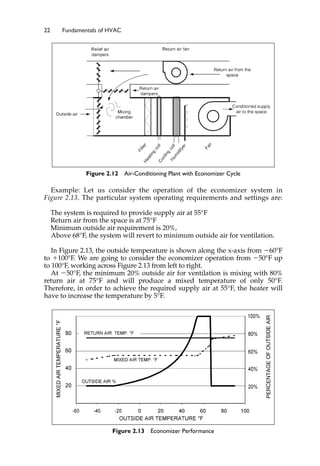
allowed the amount of outside air to be turned down when the room population
was low.
There are numerous examples of using “turn it down” as an energy conser-
vation tool. Two that are commonly implemented include:
Heating reset: In Chapter 8 we discussed resetting the heating water temperature
down, as the load drops. This reduces piping heat losses and improves control.
However, on a variable speed pumping system, lowering the water temperature
increases water volume required and so increases pumping power. The issue is
finding the best balance between temperature reset and pumping power.
Chilled water temperature reset: The chilled water system is designed for the
hottest and most humid afternoons that happen a few times a year. The rest of
the time the chilled water system is not running to full capacity. Except in a
very humid climate, where dehumidification is always a challenge, the chilled
water temperature can probably be reset up a degree or two or more. This
improves chiller performance and generally saves energy.
Turn it in
“Turn it in” means “replace with a new one.” This is the third way of saving
energy. It is almost always the most difficult to justify, since it is the most
costly. For example, your building may have a forty-year-old boiler with a
seasonal efficiency of only 50%. A modern boiler might raise the seasonal
efficiency to 70% and provide a fuel saving of 28%. Although the percentage
saving is substantial, it can be frustrating to find that it would take 12 years
to pay for a new boiler out of the savings. Typically, a 12-year payback is too
long for the financial officer to accept.
Energy Conservation Measures 175
176 Fundamentals of HVAC
It almost never pays in energy savings to replace building fabric. For example,
replacing single pane windows with double or triple pane or replacing a roof
with a much better insulated roof usually have energy savings that pay for
the work in 30 years or more. However, if the windows are going to be replaced
because they are old and the frames have rotted, then it almost always worth
spending a bit extra on a higher energy-efficient unit. Here, one is comparing the
extra cost of better windows against the extra energy savings, and it is usually an
attractive investment.
While it almost never pays to replace building fabric, we should also note
that it is usually economically worthwhile to repair the building fabric, par-
ticularly where there are air holes. For example, many industrial buildings
have concrete block walls up to the roof. Over time, the block walls may well
drop a bit, leaving a gap between wall and roof. Plugging this gap with
expanding foam is a simple task and can reduce the uncontrolled flow of
air into, and out of, the building. In a humid climate, this can substantially
reduce the dehumidification load; in a cool climate, it could provide substan-
tial heating energy saving.
It is exactly the same for the plant. The boiler may be 40 years old but it will
work better if the burner is regularly serviced.
Chillers are another area of consideration. Due to the regulated phase-out
of CFC refrigerants, many owners are being forced to consider chiller
replacement. If the chiller is to be replaced anyways, it is worth taking the
time to calculate the extra savings that are available from a high efficiency
unit as compared to the extra cost for the unit. It is highly likely that the
difference in cost for the high efficiency chiller will have a speedy payback
in energy savings.
Having introduced three ways of saving energy – Turn it off – Turn it down –
Turn it in, let’s move on to a Standard that sets minimum requirements for
energy saving in new buildings and major renovations.
12.3 ASHRAE/IESNA Standard 90.1
ASHRAE and the Illuminating Society of North America (IESNA) wrote
ASHRAE/IESNA Standard 90.1 Energy Standard for Buildings Except Low-Rise
Residential Buildings (Standard 90.1) as a joint venture. The latest printed edition
is 2004, which was used for this text. There is a detailed, well-illustrated, and
explanatory companion document, 90.1 User’s Manual ANSI/ASHRAE/IESNA
Standard 90.1-2004 Energy Standard for Buildings Except Low-Rise Residential
Building2.
The purpose of the Standard is “to provide minimum requirements for
energy-efficient design of buildings except low-rise residential buildings.” It is
a minimum standard and there are some energy reduction programs such as
“Leadership in Energy and Environmental Design, LEED,” that encourage
designs to have a lower energy cost than the Standard prescriptive cost. Note
that the LEED program gives no acknowledgement unless design energy cost
is at least 15% below the Standard 90.1 requirements.
The Standard 90.1 requirements can be met by either complying with all
“Prescriptive and Performance Requirements” or by producing a design that
has no higher energy cost in a year than a prescribed calculated “Energy Cost
Budget.”
Prescriptive and Performance Requirements
The Standard is divided into sections that often fall to different designers. The
first section of the Standard is the “Administration and Enforcement” section,
to help designers and code officials. It then has six prescriptive sections that
define the performance of the components of the building. Finally, it concludes
with a calculation method, the “Energy Cost Budget Method” section.
The following is a brief introduction to the sections.
Building Envelope
The objective of the Standard is to ensure that design choices are both energy-
efficient and cost-effective. Therefore, for example, the insulation requirements
are more demanding in the colder climates.
The Standard divides climates according to temperature and moisture con-
ditions. The temperature divisions range from the continuously hot, with no
heating demands, through to the continuous heating with no cooling require-
ments. The designer chooses the temperature range relating to the building
location, and, on a single page finds the thermal transmission requirements for
the building fabric: roofs, walls, floors, doors and fenestration (windows). This
is the section for the architect!
The Standard requires slightly higher performance for residential buildings,
since they are generally in operation 24 hours of every day. In comparison,
many non-residential buildings are in full operation for less than half the
hours in a week.
One of the major problem areas of modern buildings is the sealing around
penetrations in the building envelope. The building envelope includes the entire
perimeter of the building: the windows, doors, walls, and the roof. The allow-
able leakage around windows and doors is defined. All other parts of the build-
ing envelope are covered by the hope-filled request: “The following areas of the
building envelope shall be sealed, caulked, gasketed, or weather stripped to
minimize leakage.” In order to reduce the likelihood of future problems, it is
worth the effort to ensure that the contractor fulfills this as a requirement.
The Standard allows some trade-off between the various sections of the build-
ing envelope as long as the required overall envelope performance is maintained.
Heating, Ventilating, and Air conditioning
For single zone buildings of less than 25,000 ft2 and only one or two floors,
there is a simplified approach, due to the limited number of choices that
designers can make for equipment. As long as the building is a single zone,
with one unit, the code requires that the unit will comply with a few straight-
forward energy saving requirements.
For larger buildings there are numerous requirements for minimum equip-
ment efficiencies in terms of Energy Efficiency Ratio, “EER,” Coefficient of
Performance, “COP,” and Integrated Part-Load Value “IPLV.” The following
section explains the meaning of each of these terms.
EER Energy Efficiency Ratio is the ratio of net cooling capacity in
Btu/hour to electrical input in Watts. A small window air-conditioner, for
example, is required to have a minimum EER of 9.7. This is the same as
saying that it will provide 9.7 Btu/hour of cooling for an input of 1 watt,
Energy Conservation Measures 177
178 Fundamentals of HVAC
under specific test conditions. A watt is 3.412 Btu/hour so the EER of 9.7
requires 9.7 Btu/hour cooling for 3.412 Btu/hour energy input. This works
out to about 2.84 times as much cooling energy as compressor energy.
The requirements for water chillers are given in IPLV and COP.
IPLV, Integrated Part-Load Value is a weighted average value of EER based
on full and part load performance and is used instead of EER on larger electri-
cally driven air-conditioners.
COP, Coefficient Of Performance, is the heat removal to energy input
in consistent units. For air-cooled chillers, the minimum requirement is COP
of 2.8. However, a water cooled centrifugal chiller over 300 tons, has a
required minimum COP of 6.0, twice the cooling capacity per watt of the
air-cooled machine. This is an area where judicious choice of equipment can
make large differences in energy consumption.
In Chapter 10.1, we discussed the statement that “big plant is more efficient.”
In the case of chillers, this is very true. Unfortunately, COP efficiency is not the
only relevant consideration. Other energy inputs for the central plant include
the energy for pumping the chilled water to end use and the condenser water to
the cooling tower. In addition, the distribution-pipe heat gains must be deducted
from the cooling capacity.
Having defined minimum equipment performance, the Standard then goes
on to establish rules about controls and installation including insulation, sys-
tem balancing and commissioning, to ensure minimum equipment utilization
efficiency. We have already discussed some of the controls requirements in the
previous chapter.
Service Water Heating
The section on service water heating covers minimum equipment performance
and maximum standby loss. Also detailed are pipe insulation and recirculation
requirements.
Lighting
On average, in the USA, buildings use about 35% of their total energy for light-
ing. This provides a big opportunity for savings. The Standard allows a specific
number of Watts per square foot, W/ft2, however, the designer is given a certain
amount of leeway in the calculations: The allowed W/ft2 can be calculated on
the basis of type of building or on a room-by-room basis. The Standard allows
trading between areas and between lighting and HVAC, as long as the net
energy cost through the year is not increased above the prescribed allowance.
The Standard recognizes variation in use of the same type of space in different
types of buildings. So, for example, corridors generally have an allowance of
0.5 W/ft2 but this is raised to 1.0 W/ft2 for hospitals.
Energy-Cost Budget Method
The energy-cost budget is a way to allow designers to have the flexibility to
design the building according to their needs, as long as it does not cost more
in energy than the Standard permits. To use the Energy-Cost Budget Method,
the designer is instructed to calculate the energy-cost budget for standard
plant equipment, then to compare that to the cost of the energy required by
the equipment chosen.
The Energy-Cost Budget, ECB, requires the use of hour-by-hour building
energy analysis software. No particular software is specified, but software
performance is mandated. Local utility rates are used in the simulation. The
building has to be analyzed, using the prescribed building envelope and
equipment efficiencies, to obtain the ‘energy-cost budget’ and again with
actual envelope and equipment. Compliance is achieved when the ‘design
energy-cost’ does not exceed the ‘energy-cost budget’.
If you become involved in using Standard 90.1, remember that the User
Manual provides a clear, easy-to-follow explanation of how to use and apply
the Standard.
12.4 Heat Recovery
When designing to comply with the Standard, designers can minimize energy
use by reducing the energy requirements of a building, and/or by energy recov-
ery. During design, always aim first to minimize energy use before considering
energy recovery. The reason is that heat recovery is almost always involved with
“low-grade heat.” Low-grade heat is heat that is at a temperature relatively
close to the temperature at which it can be used at all. Low-grade heat requires
oversized heat transfer surfaces and can often only fill a part of the load. For
example, the condenser water from a chiller at 95°F can be used to preheat
domestic service water to 90°F but no hotter. A valuable contribution, but it does
not do the whole task, since 140°F is the typical requirement.
There are cases where systems can be deliberately chosen to integrate with
low heat sources. A good example of this is the use of condensing boilers with
radiant floor heating systems. The condensing boiler is a boiler with an addi-
tional flue gas heat recovery section. In this additional flue gas cooling section,
the water vapor in the flue gas is condensed, causing it to give up its latent
heat. This increases the boiler efficiency from a maximum of about 85%, with a
flow temperature of 180°F, to about 95% with a 105°F flow temperature. Since
radiant flooring operates at low water temperature, the condensing boiler is an
excellent match for the radiant floor. Note that condensing only begins to occur
below 135°F, so buying a condensing boiler and running it near 135°F will
reduce the boiler efficiency since it will not condense the flue gas water vapor.
Energy Recovery Coils: Run-Around Coils
One way to achieve energy recovery is with run-around energy recovery coils.
A typical run-around coil arrangement is shown in Figure 12.1.
In summer, the conditioned exhaust air cools the fluid in the exhaust air coil.
This fluid is then pumped over to the supply air coil to pre-cool the incoming
outside air.
In winter the heat transfer works the other way: the warm exhaust air heats
the fluid in the exhaust air coil, which is then pumped over to the supply air
coil to heat the cold incoming air.
At intermediate temperatures the system is shut off, since it is not useful.
When outside temperatures are below freezing, the three-way valve is used
with a glycol anti-freeze mixture in the coils. In cold weather, some of the fluid
Energy Conservation Measures 179
180 Fundamentals of HVAC
bypasses the supply air coil, to avoid overcooling. The mixture of very cold
fluid from the supply air coil and diverted fluid, mix to a temperature that is
high enough to avoid causing frost on the exhaust air coil. The maximum
amount of cooling that can be achieved with the exhaust air coil is limited by
the temperature at which frost starts to form in the coil. This frosting of the
exhaust coil effectively sets a limit to the transfer possible at low temperatures.
In Figure 12.1, a filter is shown in front of the exhaust air coil. It is impor-
tant to include this filter, since omitting it will soon cause a clogged coil. This
is particularly true if the coil runs wet with condensation in cold weather.
The run-around coil system has three particular advantages.
1. There is no possibility of cross contamination between the two air
streams. This factor makes it suitable for hospital or fume hood exhaust
heat recovery.
2. The two coils do not have to be adjacent to one another. A laboratory
building could have the outside air intake low in the building and the
fume hood exhaust on the roof, with the run-around pipes connecting the
two coils.
3. The run-around coils only transfer sensible heat, and do not condense the
water in the exhaust, making them suitable for swimming pool recovery
systems.
Heat Pipes
A heat pipe is a length of pipe with an interior wick that contains a charge of
refrigerant, as shown in Figure 12.2.
Figure 12.1 Run-Around Energy Recovery Coils
The type and quantity of refrigerant that is installed is chosen for the
particular temperature requirements. In operation, the pipe is approximately
horizontal and one end is warmed, which evaporates refrigerant. The refrig-
erant vapor fills the tube. If the other half of the tube is cooled, the refrigerant
will condense and flow along the wick to the heated end, to be evaporated
once more. This heat-driven refrigeration cycle is surprisingly efficient.
The normal heat pipe unit consists of a bundle of pipes with external fins
and a central divider plate. Figure 12.3 shows a view down onto a unit that is
mounted in the relief and intake air streams to an air-handling unit. Flexible
connections are shown which facilitate the tipping. To adjust the heat transfer,
one end or the other end of the tubes would be lifted.
The outside air is cold as it comes in over the warm coil. This warms the
air, and the tube is cooled. The cooled refrigerant inside condenses, giving
up its latent heat, which heats the air. The re-condensed refrigerant wicks
across to the exhaust side and then absorbs heat from the exhaust air. This
Energy Conservation Measures 181
Figure 12.2 Cut Away Section of a Heat Pipe
Figure 12.3 Heat Pipe Assembly in Exhaust and Outside Air Entry
182 Fundamentals of HVAC
heat evaporates the refrigerant back into a vapor which fills the pipe, and is
again available to warm the cold outside air.
The usual heat-pipe unit must be approximately horizontal to work well.
A standard way to reduce the heat transfer is to tilt the evaporator (cold)
end up a few degrees. This tilt control first reduces, and then halts, the flow
of refrigerant to the evaporator end, and the process stops.
Figure 12.3 was based on winter operation. In summer, the unit only has to
be tilted to work the other way and cool the incoming outside air as it heats
the outgoing exhaust air.
The unit is designed as a sensible heat transfer device, though allowing
condensation to occur on the cold end can transfer worthwhile latent heat.
Effectiveness ratings range up to 80% with 14 rows of tubes. However, each
additional row contributes proportionally less to the overall performance.
As a result, the economic choice is ten or fewer rows.
A major advantage of the units is very low, to no, cross contamination.
Desiccant Wheels
Desiccants are chemicals that are quick to pick up heat and moisture, and
quick to give them up again if exposed to a cooler, drier atmosphere. A matrix,
as indicated on the left of Figure 12.4, may be coated with such a chem-
ical and made up into a wheel several inches thick. In use, the supply air
is ducted through one half of the wheel and the exhaust air through the
other half.
Let us suppose it is a hot summer day, so the exhaust is cooler and drier
than the supply of outside air. The chemical coating in the section of the coil
in the exhaust stream becomes relatively cool and dry. Now the wheel
is slowly rotated and the cool, dry section moves into the incoming hot,
humid air, drying and cooling the air. Similarly, a section is moving from
hot and humid into cool and dry, where it gives up moisture and becomes
cooler.
The wheel speed, a few revolutions per minute, is adjusted to maximize
the transfer of heat and moisture. Control of wheel speed to truly maximize
savings is a complex issue, since the transfer of sensible and of latent heat do
not vary in direct relation to each other.
The depth of the wheel is filled with exhaust air as it passes into the supply
air stream, so there is some cross-contamination. There are ways of minimizing
this cross contamination, but it cannot be eliminated. In most comfort situations,
the cross contamination in a well-made unit is quite acceptable.
Figure 12.4 Desiccant Wheel Matrix and Operation
12.5 Air-Side and Water-Side Economizers
Air-Side Economizers
In the previous chapters, you have been introduced to the air-side economizer on
air-handling units. It is the mixing arrangement that allows up to 100% outside
air to be drawn in and relieved in order to take advantage of cool outside air,
providing “free cooling.” Nothing is free! The air-side economizer equipment
costs extra to purchase, there are more components to maintain, and, depending
on the climate, the hours when the economizer is actually saving cooling energy
may be very limited. In climates that are warm and humid, the number of hours
when the outside air has a lower enthalpy than the return air enthalpy may be
very few. Thus, Standard 90.1 does not require air-side economizers in most of
Florida.
One critical issue with economizers is that their controls must be integrated
with the mechanical cooling. This prevents the economizer from increasing the
mechanical refrigeration load.
Standard 90.1 has very specific requirements on the control of economizers
and, in particular, prohibits the use of mixed air control for economizers on
systems that serve more than one zone. Instead, the Standard requires that a
supply air thermostat be used to control the cooling coil and economizer. This
control method works well as long as the chilled water valve and, if there is
one, the heating valve, close fully. If the valves do not close, due to being worn
or incorrectly set up, it is possible for the system to use much more energy
than expected. Therefore, when this control method is used, it is important
that the system be maintained, or that a control sequence is included that will
show up the fact that one of the valves is not closing correctly. This control
sequence was discussed in section 11.5.
Advantages of the air-side economizer
䊉 A low air pressure drop.
䊉 Substantial mechanical-cooling energy savings.
䊉 Reduced water usage in cooling tower systems.
Disadvantages of the air-side economizer
䊉 Extra capital cost for the 100% intake and relief air equipment, which includes
a return fan on larger systems.
䊉 A higher ongoing electrical operating expense.
䊉 A potential requirement for additional humidification during winter operation.
Water-Side Economizers
The water-side economizer consists of a water-cooled coil, located in the air
stream just before the mechanical-cooling coil. The coil can be supplied with
water directly from the cooling tower or via a plate heat exchanger. If the
water is supplied directly from the tower, the water treatment and cleaning
process must be of a high standard, to ensure that the valves and coil do not
clog up with dirt. If a heat exchanger is used, there is the additional cost of the
exchanger, and the heat transfer will be less efficient, since there has to be a
temperature rise across the exchanger for it to work.
Energy Conservation Measures 183
184 Fundamentals of HVAC
There are several possible arrangements, depending on the particular equip-
ment and sizes. One example for packaged units is shown in Figure 12.5. The
three-port valve determines how much of the tower water flows through the
economizer coil, and the two-port valve determines how much water bypasses
the condenser to avoid the condenser being overcooled.
Note that the three-port valve can be replaced with two two-port valves, as
shown in the detail. The valves would be sequenced so that, as one opens, the
other closes, to provide the same effect as the mixing valve, but often at lower
cost in small sizes.
The “head pressure” is the pressure in the refrigeration condenser. If the
head pressure falls below the required pressure, the valve is opened to reduce
water flow through the condenser. On cool days, when the tower produces
very cold water, the valve will stay open, since adequate cooling is provided at
well below full design flow.
Advantages of water-side economizers
䊉 Water-side economizers reduce compressor energy requirements by pre-
cooling the air.
䊉 Unlike air-side economizers, which need full sized intake and relief ducts
for 100% outside air entry or for 100% exhaust, water-side economizers
simply require space for two pipes.
䊉 Unlike the air-side economizer, the water-side economizer does not lower
the humidity in winter, saving on possible humidification costs.
Disadvantages of a water-side economizer
䊉 Higher resistance to airflow, therefore higher fan energy costs.
䊉 Increased tower operation with consequent reduction in life.
䊉 Increased water and chemicals cost.
Figure 12.5 Water-Side Economizer and Alternate Use of Two-Port Valves
12.6 Evaporative Cooling
You have been introduced to the idea of evaporative cooling several times so
far in this course. In Chapter 2 the process of using direct evaporation was
introduced in connection with the psychrometric chart.
Direct Evaporative Cooling
The direct evaporative cooler simply evaporates moisture into the air, reducing
the temperature at approximately constant enthalpy. In a hot dry climate this
process may often be enough to provide comfortable conditions for people.
In medium to wet climates, the increase in moisture content is frequently
not acceptable for sedentary human comfort but is considered acceptable for
high effort work places and is ideal for some operations, such as greenhouses.
Indirect Evaporative Cooling
An indirect evaporative cooler uses evaporation to cool a surface, such as a
coil, that is then used to cool the incoming air. The indirect evaporative cooler,
which reduces both temperature and enthalpy, can be very effective in all but
the most extreme conditions. The two processes are shown on the psychromet-
ric chart, Figure 12.6.
A previous Figure, Figure 12.5 showed the indirect cooler as the “water-side
economizer,” located before the mechanical cooling coil. That is just one
arrangement of two-stage cooling.
Figure 12.7 shows an alternative to this arrangement.
In this indirect evaporative-intake cooler, water flows down the outside of
the air intake passages. As it flows down, outside air is drawn up over the
water causing evaporation and cooling. The cooled water cools the intake air
passages and hence the intake air. This is shown diagrammatically on the left
side of Figure 12.7. The unit is mounted at the intake to the air-handler as
shown on the right hand side of Figure 12.7.
Depending on the local climate, a unit like this can reduce the peak
mechanical refrigeration by 30% to 70% with a very low water and energy
requirement from the indirect cooler. The performance may be improved
even further if the relief air from the building is used as the air that passes
over the evaporative surface.
Energy Conservation Measures 185
Figure 12.6 Psychrometric Chart Showing Direct and Indirect Evaporative Cooling
186 Fundamentals of HVAC
To quote from ASHRAE 2000 HVAC Systems and Equipment3, Chapter 19:
“Direct evaporative coolers for residences in desert regions typically
require 70% less energy than direct expansion air conditioners. For
instance, in El Paso, Texas, the typical evaporative cooler consumes
609 kWh per cooling season as compared to 3901 kWh per season
for a typical vapor compression air conditioner with a SEER 10. This
equates to an average demand of 0.51 kW based on 1200 operating
hours, as compared to an average demand of 3.25 kW for a vapor
compression air conditioner.”
The main advantages of evaporative cooling include:
Substantial energy and cost savings
Reduced peak power demand and reduced size of mechanical refrigeration
equipment
Easily integrated into built-up systems
The big disadvantage for evaporative cooling is that many designers don’t
understand the opportunity!
12.7 Control of Building Pressure
Control of building pressure can have a significant effect on energy use,
drafts through exterior doors, and comfort. In a hot and humid climate, it is
valuable to keep the building at a slightly positive pressure. This ensures
that dry air, from inside the building, enters the walls rather than allowing
humid air from outside to enter the building through the wall and likely
cause mould growth. In a cold climate, the building should be kept close
to outside pressure, or slightly negative, to prevent the warm, moist air
from inside the building from entering the wall where it could and cause
condensation or ice.
Figure 12.7 Indirect Evaporative Intake Cooler
When an economizer is running with 100% outside air, the same amount of
air must also leave the building. On small systems, no return or exhaust fan is
provided, on the assumption that the washroom exhaust plus leakage will be
adequate to balance the amount of air coming in.
In milder climates, intermediate size plants can be accommodated with
“barometric dampers.” Barometric dampers blow open when there is a
slightly greater pressure, than outside at that location in the building ‘At that
location’ is included as a proviso, since the wind can make a huge difference
to the pressure at different points around a building. If the wind is blowing
towards the damper, it will tend to keep it shut. On the other hand if the
damper is on the leeward side of the building, the wind will tend to open it.
On the larger economizer systems, typically the ones shown in the figures
in this text, complete with a return fan, the return/relief fan and relief
damper can be used to control building pressure. The least efficient method is
to separately control the relief damper and effectively throttle the relief fan
flow. Better, is to add a speed control for the return fan so that it maintains a
set minimum outlet pressure. This will ensure adequate return air for the
main supply fan and allow the relief damper to control the building pressure.
The Final Step
Chapter 13 is the final chapter. In it we cover two groups of topics that did not
fit into the flow of the previous chapters. The first group deals with heating
and heat storage. The second group deals with air distribution in rooms and
separate outdoor air systems.
Finally, there are some suggestions for you for future courses and other sources
of information.
Summary
12.2 Energy Considerations in Buildings
The objective of energy conservation is to use less energy and to recycle
energy where useful. In the design of new facilities it is very important that
the whole design team, including the client, have energy conservation as an
objective. There is considerable synergy to be gained from a group effort. The
client has the ability to set up a design contract that encourages energy conser-
vation to the mutual financial benefit of the team and the client.
There are three ways of achieving energy conservation: Turn It Off, turning
equipment off, Turn It Down, reducing equipment output and Turn It In, by
replacing equipment with something more efficient. Of these three ways,
‘turning equipment off’ is usually the most cost effective, with ‘turning down’
second. Replacement is often not economic.
12.3 ASHRAE/IESNA Standard 90.1-2001
To assist in energy conservation ASHRAE/IESNA Standard 90.1-2001 Energy
Standard for Buildings Except Low-Rise Residential Buildings was produced,
and it is now being adopted in parts of the USA. This standard sets minimum
Energy Conservation Measures 187
188 Fundamentals of HVAC
requirements for the building envelope, electrical systems including lighting,
and the HVAC, under a prescriptive approach. The HVAC section covers the
efficiency of individual equipment, as well as how they are to be intercon-
nected and controlled. In addition, the design team may choose to meet
the Standard using the performance route, the Energy Cost Budget Method,
in which the design team demonstrate that their design will have no higher
energy cost than the prescriptive design would have cost.
The requirements are designed to be easily cost effective and many programs,
such as the LEED program, require substantially lower energy consumption than
the Standard requires, to be recognized as energy conserving designs.
12.4 Heat Recovery
Heat recovery is the reuse of surplus heat from a building, often the exhaust
air. Methods of recovering heat from the exhaust were described. These
included:
Run-around coils, which are a system where a fluid, water or glycol mixture,
is pumped through coils in the exhaust and outside air intake. This transfers
heat from the intake air in summer and adds heat to the incoming air in winter.
The system has advantages of no cross contamination and the intake and
exhaust can be remote from each other just interconnected by the pair of
run-around coil pipes.
The heat pipe and desiccant wheels were also described. They both require
the intake and exhaust air to pass by each other and have a cross contamina-
tion challenge. On the other hand they are often less costly and more effective
than the run-around coil.
12.5 Air-Side and Water-Side Economizers
The airside economizer is the use of outside air to provide cooling when
the outside ambient temperature and humidity can provide ‘free cooling’. The
system is not economic in very hot humid climates and it creates a low humid-
ity indoors in cold weather.
The waterside economizer uses water, cooled in a cooling tower, to lower
the incoming air temperature by means of a pre-cooling coil. The system takes
up little space and does not require the large intake duct that the air–side
economizer requires. It also has the advantage of not lowering the indoor
humidity in cold weather.
12.6 Evaporative Cooling
Evaporative cooling can be direct or indirect. Direct evaporative cooling
reduces the temperature and raises the humidity by direct evaporation of
water in the air. For human comfort, this is a very acceptable situation in a hot
dry climate but not useful in a hot and humid climate. For some industrial
processes and greenhouses in particular, it can be very effective in all but the
most humid climates.
Indirect evaporative cooling uses water that has been cooled by a cooling
tower, or by direct evaporation on the outside of a coil, in the incoming air
stream. Indirect evaporative cooling lowers both the temperature and the
enthalpy. In many climates this can significantly reduce the required size of
the mechanical cooling and drastically cut the electrical consumption by low-
ering the load on the mechanical cooling system.
12.7 Control of Building Pressure
If the building pressure is much higher than outside pressure, there will be
leakage outwards. Similarly a low inside pressure draws air in through all
the building cracks and leaks. Neither over nor under pressure is desirable, as
they cause discomfort, energy waste and deterioration of the building fabric.
Bibliography
1. ASHRAE/IESNA Standard 90.1 2004 Energy Standard for Buildings Except
Low-Rise Residential Buildings
2. ASHRAE User’s Manual ANSI/ASHRAE/IESNA Standard 90.1 2004
3. ASHRAE 2000 HVAC Systems and Equipment
Energy Conservation Measures 189
Chapter 13
Special Applications
Contents of Chapter 13
Study Objectives of Chapter 13
13.1 Introduction
13.2 Radiant Heating and Cooling Systems
13.3 Thermal Storage Systems
13.4 The Ground as Heat Source and Sink
13.5 Occupant Controlled Windows with HVAC
13.6 Room Air Distribution Systems
13.7 Decoupled, or Dual Path, and Dedicated Outdoor Air Systems
Summary
Your Next Step
Bibliography
Study Objectives of Chapter 13
Chapter 13 introduces a diverse group of subjects dealing with HVAC. When
you have completed the chapter you should be able to:
䊉 State two reasons for using thermal storage.
䊉 Identify two good features of radiant heating and name three examples of
where it can be an excellent system choice.
䊉 Describe at least three room air-distribution systems.
䊉 Explain why it can be advantageous to have a separate outside air unit as
well as the main air-handler.
䊉 Explain the challenges of having operable windows, windows that people
can open and close, with an HVAC system.
13.1 Introduction
This final chapter covers some special heating, cooling and ventilation applica-
tions. We start with radiant heating and cooling, an idea that was partially
introduced when we discussed radiant floors in Chapter 8.
From radiant heating and cooling we move on to thermal storage. Thermal
storage is a method of reducing the need for large equipment and reducing
energy expenses. Thermal storage is achieved by having the heating or cooling
equipment operate during low load periods, to charge a thermal storage system
Special Applications 191
for later peak-load use. Under certain circumstances, storage of heating or cool-
ing capacity can reduce both installation costs and operating expenses.
From thermal storage systems, we move on to consider the ground as a vast
heat source or sink. Following these three sections, we continue with sections
dealing with ventilation. The first ventilation topic is a detailed discussion of
the issues dealing with operable, ‘occupant controlled’, windows and the
HVAC systems serving these spaces. When occupants are in control of open-
ing and closing windows, there is a largely uncontrolled movement of air in a
space. In comparison, following this discussion, we examine the issues of air
distribution in rooms that don’t have operable windows.
We will discuss various standard ways of delivering air to rooms and their
relative merits and popularity. Then, we will take a brief look at separate dedi-
cated outside air units that are particularly valuable in dealing with locations
where there is high humidity and substantial outdoor air requirements.
Then it is time to wrap-up with some suggestions for your future.
13.2 Radiant Heating and Cooling Systems
As you recall from Chapter 3, radiant heat passes in straight lines from a
hotter to a cooler body with no affect on the intervening air.
Radiant heaters and coolers are defined as units that achieve more than 50%
of their cooling or heating output through radiation (as compared to convection
and conduction). We have already discussed radiant floors and ceilings under
the heading ‘Panel Heating and Cooling’ in Chapter 8. These panel units
operate well below 300°F, and are classified as ‘low temperature’. Radiant floors
operate at a relatively low temperature, with a maximum surface temperature,
for comfort conditioning, of 84°F.
In this section, we will consider high temperature units that operate at over
300°F, revisit radiant floors and briefly consider radiant ceiling panels.
High Temperature Radiant Units
High temperature, or infrared, units operate at over 300°F. Examples range
from units with a hot pipe, to ceramic grids heated to red/white heat by a gas
flame, up to electric lamps. These are heaters that are far too hot to get really
close to or to touch. There are three main types of high temperature units:
high, medium and low intensity.
䊉 High intensity units are electric lamps operating from 1800–5000°F.
䊉 Medium intensity units operate in the 1200–1800°F range and are either
metal-sheathed electric units or a ceramic matrix heated by a gas burner.
䊉 Low intensity units are gas-fired, using the flue as the radiating element—
basically a gas burner with a flue pipe (chimney) typically 20–30 feet long,
with a 4-inch diameter, as shown in Figure 13.1. A low-intensity unit oper-
ates as a flue that runs horizontally through the space. It will usually, but
not always, vent outside and have a reflector over the flue to reflect the
radiant heat downward.
These low intensity units can run up to 1200°F, have a dull red glow, and take
only three, or four, minutes to reach operating temperature. Since they are gas
fired, adequate combustion-air must be provided, as required by local codes.
192 Fundamentals of HVAC
A single burner low intensity unit is shown in Figure 13.1. The blower
assembly provides the required forced draft through the burner and long flue.
The flue gas temperature drops as it gives up heat along the tube. As a result,
the output drops along the length of the unit. Manufacturers can use different
strategies to offset this drop in output; tube materials with a lower radiant
output in the early sections, or larger tubes in the latter sections.
These strategies are not enough in larger installations, and so units with
multiple burners are used. However, multiple-burner units introduce addi-
tional complexity into the system. For example, the same forced-draft method
cannot be used, since, if one of the blowers failed, the others would blow
fumes into the building through the inoperative blower. To avoid this possibil-
ity, multi-burner units have an exhaust fan, called a vacuum pump, to draw all
the products of combustion from the flue. This is done to ensure that all flue
gases are exhausted. This type of arrangement is shown in Figure 13.2. For fur-
ther control of output, high-low, or modulating, burners can be used.
The burner controls are in the self-contained blower-burner assembly, with the
whole unit controlled by a long-cycle (slow to respond) thermostat or a proprietary
temperature control system. The location of this control is significant.
It is important to remember, from Chapter 3, that both ambient air temperature
and the radiant effect of the heater(s) will affect the thermostat. Let us go back to
the radiant floor for a simple example. If the thermostat is located on an inner
wall (far away from the window), the floor and adjacent warm walls will pre-
dominantly influence it. As a result the room tends to be cool for occupants in
cold weather, since the cool external wall and windows do not adequately influ-
ence the thermostat. This effect is significantly reduced if the thermostat is placed
on a side wall (nearer the window), well away from the inner wall so that the
cool outside wall and window will have a more significant effect on the thermo-
stat. This alternative could result in the room becoming uncomfortably warm.
EXHAUST
REFLECTOR
RADIANT HEATING
TUBE
BLOWER
ASSEMBLY
GAS IN
AIR IN
BURNER ASSEMBLY
Figure 13.1 Tube Type Radiant Heater
Special Applications 193
The effect of location is even more pronounced with radiant heaters. As a
result, it takes skill and experience to make an effective choice of thermostat
location. This is one of those occasions when asking, and taking, the advice of
an experienced manufacturer can be really worthwhile.
Since the multi-burner radiant-heater units run very hot, they must be out of
the reach of occupants. They must also be mounted so that they cannot overheat
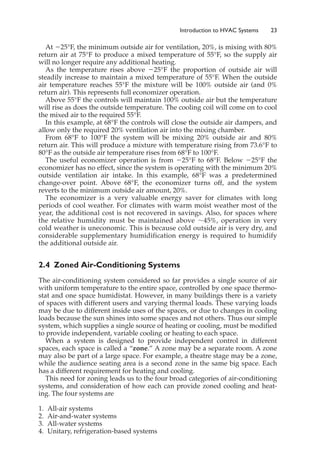
objects immediately beneath them.
For instance, suppose a machine shop was fitted out with radiant heaters
that were mounted 15 feet above the floor. This would provide a comfortable
work environment for the staff. However, consider what would happen if the
heaters were mounted directly above a floor space that was also used by deliv-
ery vehicles that drive into the shop to be loaded or unloaded. In that case, the
top of the vehicles would be dangerously close to the heater and could end up
with a burnt roof. This problem can often be avoided by designing the heater
layout so the heaters are above the work areas only, at a safe distance from
vehicle access routes.
Radiant heaters are particularly suitable where high spaces must be heated
without obstructing the space, as in aircraft hangers, factories, warehouses,
and gymnasiums. They are also valuable where the staff and floor is to be kept
warm, but not the space, such as in loading docks, outdoor entrances, and
swimming pools.
Radiant heaters are also suitable for racetrack stands and spectator seating
around ice rinks. In the ice rink they have the ability to be directed at the
seating with a fairly sharp cutoff to prevent heating the ice surface, and they
do little to raise the air temperature that would also affect the ice.
BURNER
ASSEMBLIES
COMBUSTION
CHAMBER
RADIANT
TUBE
OPTIONAL
BURNER
ASSEMBLIES
REFLECTOR
VACUUM PUMP
EXHAUST
Figure 13.2 Multi-Burner Radiant Heater (Part of Figure 1, Page 15.2, from Systems Handbook)
194 Fundamentals of HVAC
Radiant Cooling
Radiant cooling was introduced in Section 3 of Chapter 8. Radiant cooling is
always achieved by using a ‘large area’ panel system, since the transfer per
square foot is quite limited. This is largely because the chilled-water tempera-
ture must be kept warm enough to avoid any condensation. The ceiling may
be either a plastered ceiling with embedded pipes or a metal pan ceiling with
the pipes attached to the panels.
Just like the radiant floor, the radiant cooling ceiling requires no equipment or
floor space within the occupied area. With the plaster ceiling there is nothing in
the room. This makes it an attractive choice in some hospital situations where
cleaning needs to be minimized. Only ventilation air has to be moved around
the building and supplied to each room. However, it is critical that the moisture
level, relative humidity, in the building be kept low enough to prevent problems
that may occur due to condensation on any part of the ceiling panels.
The performance of radiant ceilings is well understood by the various
manufacturers of the many different designs and they, and the architect,
should be involved early in the design stages. If a metal panel system is
chosen, it must fit in with the dimensional requirements of the ceiling.
Panels radiate upwards as well as downwards. An un-insulated panel will
cool the space below as well as the floor or roof above it. If cooling is not
desirable above the panel, the panel can have insulation placed on the top of
it. Conversely, if the cooling is designed to radiate upwards, be sure that an
acoustic pad is not specified above a panel, since the acoustic pad will also
provide thermal insulation.
One negative of this system is the extended length of time it takes to return
the space to comfort levels after the temperature has drifted up. Operators of
radiant cooling panel systems need to be aware of the relatively slow response
of these systems—even those with light metal panels. As a result, it is not a
good idea to allow the temperature to drift up when the space is unoccupied,
even though this strategy may appear to result in energy savings.
13.3 Thermal Storage Systems
Thermal storage systems normally involve the generation of cooling or heating,
or both, at off hours while storing this energy for use at a later time, generally
to be discharged during peak energy use periods such that overall energy costs
are reduced. These systems can be “active” or “passive”.
13.3.1 Passive Thermal Storage
“Passive Thermal Storage” refers to using some part of the building mass, or
contents, to store heating or to store cooling capacity. The very simplest form of
passive storage is the choice to construct a building using heavy construction;
block walls, block partitions, concrete floors, and concrete roof decks.
During the cooling season, the mass of the building walls and roof can
be cooled at night by the air conditioning system, and when favorable, by
the cool night air. When the night air is sufficiently cool, then ventilating
the building, by either opening the windows or running the ventilation
Special Applications 195
system, can cool the structure. Then, during the day, the sun has to heat the
mass of the structure before the inside temperature rises. In addition, the
walls and roof have considerable stored heat when the sun goes down and
the warm surfaces of roof and wall re-emit a proportion of heat back to the
outside.
The interior mass acts as a thermal flywheel, absorbing heat through the
day and re-emitting heat through the evening and night. The result is a lower
peak cooling load, hence smaller refrigeration equipment is required. In addi-
tion, there is a lower total cooling load, due to the heat stored in the day and
zre-emitted outside during the night.
Passive water heating is also very popular in warmer climates. A black
plastic water-storage tank on the roof will absorb heat through the day,
warming the water. If this solar-warmed water is used for the domestic hot-
water supply, to wash basins, and for the cold-water supply, to the showers,
then hot water is not needed for hand-washing or cool showers. For a hot
shower, the already warmed water must be additionally heated by a conven-
tional water heater. This system has the further advantage of operating at
low pressure. The system is very energy-efficient but there is the potential
hazard of breeding legionella (see Chapter 4) in the solar-warmed storage
tank.
There are many excellent books detailing the variations on solar-heated
water storage and using the building to store, or reject, solar heat. One word of
caution: the local climate makes a huge difference to the overall effectiveness
of a solar heating project. For instance, in a climate where the temperature
never drops to freezing, water systems need no protection against freezing. In
climates where the temperature does drop to freezing, there are two issues to
face: first is the shorter proportion of the year when the system can be used,
and second, freeze protection is always more challenging than you would
expect, so consult with an expert.
13.3.2 Active Thermal Storage
Active thermal storage takes place when a material is specifically cooled or
heated, with the object of using the cooling or heating effect at a later time.
Perhaps the simplest example is the electric thermal storage (ETS) heater,
called a ‘brick’ or ‘block storage’ heater in certain parts of the world. These
units are commonly used in residences to provide off-peak electric power for
heating. The ETS consists of an insulated metal casing filled with high-density
magnetite or magnesite blocks. A central electric heater heats the blocks to a
temperature as high as 1400°F during off-peak hours, during the night. The
units passively discharge through the day and may have a fan to boost output
when needed—particularly in late afternoon towards the end of their
discharge period.
The units are relatively inexpensive, and, with suitable electrical rate incen-
tives, ETS provide an effective way for a utility to move residential electric
heating loads from the day to the night. This allows the utility to level their
load, which is almost always to the utility’s benefit. This benefit also lowers
the energy cost for the consumer, a true win-win situation.
Since the issue of electrical rate structures has been introduced, this is
perhaps a good moment to review some of their more typical features.
196 Fundamentals of HVAC
Electricity Rate Structures
Virtually all electric-utilities must have users for the power they produce at
the moment they produce it. Unlike gas, electricity cannot be stored for
later use. Electricity has its highest demand period during the weekdays
and, in air-conditioned climates, primarily in the afternoon. In order to
serve the peak, the utility must have that installed capacity available. That
peak capacity sits idle the rest of the day, earning no revenue.
The following description is of a basic electrical rate structure, though
there are many other features applied to encourage a balance between the
particular utility and their users.
Consumption Charge and Demand Charge
To balance their costs and income, utilities use two methods of charging
those with high peaks in their load. The high peaks are addressed by a
“demand charge”. The demand charge is, typically, based on the highest
load in any 5–15 minute period in the month. The utility meter is continu-
ally checking the average load over the previous few minutes and record-
ing the highest peak demand. In addition to the demand charge the utility
charges a consumption charge based on the quantity of electricity used.
This consumption charge covers all the costs of production.
For example, each month, a utility charges for electricity based on two factors:
Demand Charge: $10 per kW of demand (kilowatt ⫽ 1,000 watts, equivalent
to 10 100-watt light bulbs)
Consumption Charge: $0.07 per kWh. (a kilowatt hour, kWh, is the energy
used by a 1 kilowatt load in one hour.
Consider a one-kilowatt load on for one hour in a month. It will cost
Demand Charge $10.00
Consumption Charge one hour * $0.07 $0.07
$10.07
The same heater, on for the whole month (30 days of 24 hours) will cost
Demand charge $10.00
Consumption Charge 30days * 24hours * $0.07 ⫽ $50.40
$60.40
The effective cost of just one hour of operation in the month
$10.07/1 ⫽ $10.07 per hour.
The hourly cost for the whole month was
$60.40 / (30*24) ⫽ $0.084 per hour.
This is significant encouragement to avoid short peaks!
Special Applications 197
13.3.3 Chilled Water and Ice Storage Systems Introduction
Now we are going to move on from passive storage systems and our discus-
sion on electricity rates to consider water and ice storage systems. Why go to
the extra effort to use storage? There are two common reasons: to reduce
installation costs where possible and to reduce operating costs. Storage is also
being increasingly used as emergency cooling capacity for critical installations,
such as computer data centers.
1. To reduce installation costs:
Consider a specialized-use building, like a church, that has a cooling system
designed for the capacity based on the peak attendance that occurs one day a
week. For the remainder of the week, though, small attendance is the norm. A
small cooling plant and storage system may be much less costly to install and,
generally, less costly in electricity bills.
Consider Figure 13.3. The chiller is shown running continuously producing
almost ten units of cooling capacity. The solid line is the load on a particular
day. Starting at the left, midnight, the chiller is serving the load—about 2
units—and the spare capacity is charging the storage. At about 13:00, the load
equals chiller capacity and from then until 21:00, the load over-and-above
chiller capacity is met from storage. Effectively, the excess chiller capacity at
night has been stored for use during the high load in the afternoon.
In some situations this lower installation cost may be achieved even with
full daily usage. Factors that can contribute include: smaller chiller, smaller
electrical supply, a financial incentive from the utility, and, when ice is the
storage medium, even smaller pumps, pipes, fans and ducts are possible.
Large peaks are easily produced with larger chillers. On one campus, the
maintenance staff decided to test run two 1,000-ton chillers on a weekday
in early spring, the last day of the month. They wanted to make sure the
chillers would be ready when the weather warmed up. Adding the two
chillers’ demand charge for the test run cost over $21,000, simply because
the chillers pushed the peak demand up for the month!
Time-of-use Rate Schedule
Next, the utility may have a “time-of-use” rate schedule. Earlier we men-
tioned that low rates encourage the use of night-storage heating through
the use of electric-storage heaters. On the other hand, many utilities will
charge a hefty premium for power between, for example, noon and 5 p.m.
Here the utility is aiming to discourage use in this specific time period in
order to minimize their peak.
Both peak demand and time-of-use pricing structures favor the use of
thermal storage. In addition, many utilities will give substantial financial
incentives to designs that reduce peak demand on their systems. It is always
worth checking on what is available and whether the utility will provide
financial incentives to help with design in order to maximize savings.
198 Fundamentals of HVAC
2. To reduce operating costs:
We have already discussed demand and time-of-day pricing structures that
encourage night-time use and discourage afternoon use. As demonstrated, it can
be worthwhile to run the chiller during the night and on weekends to avoid
demand charges, and overnight and in the morning to avoid time-of-use charges.
Chilled Water Storage
Let’s consider water first. Water holds 1 Btu/lb for every 1°F change in
temperature. If our stored water is available at 41°F and return temperature
from the cooling coils is 56°F, then every pound will have a storage capacity
of 56 Btu ⫺ 41 Btu ⫽ 15 Btu. A cubic foot of water weighs 62.4 lbs, so a cubic
foot of our stored water represents:
15 Btu/lb ⭈ 62.4 lb/ft3 ⫽ 936 Btu/ft3
By definition, a ton of air conditioning is 12,000 Btu/hr, so, theoretically, to
store a ton-hour will require:
12,000 Btu/ (936 Btu/ft3) ⫽ 12.8 ft3
In fact, it will require 10% to 50% more, since there are the inevitable losses
in the system as the water is pumped in and out, as well as heat gains through
the insulated tank wall.
Chilled-water storage is generally conducted with normal, or slightly lower
than normal, chilled-water supply temperatures. As a result, producing chilled
water for storage can be done using a standard chiller running at approxi-
mately the same efficiencies used for conventional chilled-water systems.
Chilled-water storage systems tend to dominate the large-system market with
tanks that have capacities of half a million cubic feet and more.
Now, let’s consider the use of ice for thermal storage. One cannot make and
store a solid block of ice; one needs a mechanism to get the heat in and out. For
the sake of example, let’s assume 70% of our storage volume is ice and our
system simply recovers the “latent heat of fusion”. The latent heat of fusion of
–10
–5
0
5
10
15
20
1
3
5
7
9
11
13
15
17
19
21
23
TIME, MIDNIGHT TO MIDNIGHT, HOURS
COOLING
CAPACITY
CHILLER
INTO STORAGE
LOAD
Figure 13.3 24 Hour Cooling Load Profile
Special Applications 199
water is 144Btu/lb, which is the heat absorbed to melt one pound of ice or
convert one pound of water to ice at 32°F. The latent heat of fusion of 1ft3 of ice is
144 Btu/lb ⭈ 62.4 lb/ft3 ⫽ 8986Btu/ft3.
In our example, only 70% of the volume can be ice, so the latent heat of
fusion storage would be
8,986 Btu/ft3 ⭈ 0.7 ⫽ 6290 Btu/ft3.
This means chilled water requires about four to seven times the storage
volume that ice requires for the same amount of cool storage volume. So, the
big advantage of using ice storage is that a much smaller volume of storage is
required. However, to achieve this small volume, the chiller must produce
much lower discharge temperatures, below 30°F, instead of 40°F, so the chiller
efficiency is lower. In addition, the production and handling of an ice storage
system generally requires a more sophisticated plant. This smaller space
requirement makes ice storage generally more popular for single buildings.
As a result, (to be very simplistic) there is a choice between:
1. Water: A relatively simple and more efficient chilled-water production with
larger storage-space requirements.
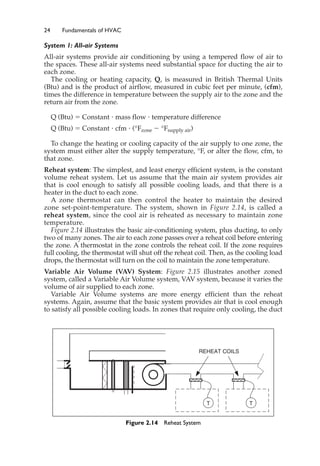
or
2. Ice: A relatively more complex system with a less efficient chiller, producing
ice and using a smaller storage space requirements.
These underused techniques of water and ice storage are clearly explained
in considerable detail in ASHRAE’s Design Guide for Cool Thermal Storage.
In the next sections, we will discuss the basics of practical water and ice
storage systems.
13.3.4 Chilled-water Storage
Storing chilled water is normally done in a large stratified tank, cold at the
bottom and warmer at the top. Stratification is required to avoid mixing
warmer and cooler water while the tank is charged and discharged.
Conveniently, water has a maximum density at 39.2°F. So, water that is
warmer than 39.2°F will float above water that is at 39.2°F.
Chiller water enters the bottom of the tank, at low velocity, through a dif-
fuser, as shown in Figure 13.4. Typically, the diffuser is a loop, or an array of
pipes with slots, to allow the water in or out with minimal directional velocity,
to minimize mixing. The chilled water enters at 40°F (just above 39.2°F) and
the warmer water at the top stays stratified above the 40°F water. As more
warm water is pumped from the top of the tank, through the chiller, and
returned very gently to the bottom of the tank, the cold layer gradually moves
up the tank. When discharging, chilled water is withdrawn at the bottom of
the tank and an equal volume of warmed water is returned to the top of the
tank. A similar diffuser at the top of the tank minimizes turbulent motion and
mixing in the water. The process produces a thermal gradient in the tank, such
as shown on the right of Figure 13.4.
200 Fundamentals of HVAC
50 FEET DIAMETER
30
FEET
HIGH
0
3
6
9
12
15
18
21
24
27
32 40 48 56 64
THERMOCLINE
DEPTH
OF
TANK-FEET
WATER TEMPERATURE °F
TANK
58,900 CUBIC FEET
ABOUT 4200 TON HOURS
CHILLED
WATER IN
WARM
WATER OUT
Figure 13.4 Chilled-water Storage Tank with Typical Thermal Gradient
Figure 13.5 Simple Chilled-water Storage System
STORAGE TANK
VARIABLE VOLUME
DISTRIBUTION PUMP
WARM
COLD
TANK VENT TO
ATMOSPHERE
CHILLER
CHILLER
PUMP
VARIABLE FLOW LOADS
NOTE: FLOW CONTROL
VALVES FOR CHILLER
AND TANK ARE
NOT SHOWN
In Figure 13.5, a simple circuit is shown with the loads and chiller-circuits
below the water level of the storage tank. Valves to control the flows between
tank and chiller are not shown in Figure 13.5, since there are several alternatives.
There are two pipe-loops connected to the storage tank: one belongs to the
Special Applications 201
chiller and the chiller pump, and the other is the load circuit, consisting of the
variable volume pump, and variable flow loads.
There are up to six possible operating conditions with a storage system, as
shown in Figure 13.6.
To maximize savings, the designer must give special consideration to the
control of larger storage systems. The seasons when full tank capacity is not
required are a particular challenge. On one hand, it is wasteful to over store.
On the other hand, if you under store, then you could be faced with much
higher electricity charges, or a lack of sufficient capacity at peak load periods.
Because these penalties are usually much more costly than any savings that
could be achieved by reducing storage, full storage is generally used.
For maximum storage, the temperature difference between the chilled-water
supply and return water must be as large as possible. In general, chilled-water
storage is not economical with a temperature differential below 12°F. A storage
temperature difference of 20°F should be the target to make the system as
economical as possible..
Chilled-water storage is not high-tech. Water tanks are a common item in
both steel and concrete and the controls do not have to be very complex.
Chiller efficiencies are, often, lower because of the lower chilled-water supply
temperature required. (Remember from Chapter 6, Section 6–3, the efficiency
of a refrigeration circuit falls as the difference in temperature between evapo-
rator and condenser increases.) However, the chiller efficiency that can be
achieved is maximized, since the chiller can always run at full load and the
operation is largely at night when ambient temperatures around the cooling
towers are lower, allowing a lower condenser-water supply-temperature.
Efficiency can also be improved by using a larger cooling tower, which will
drop the condenser-water supply-temperature
Exposed tanks should be insulated to minimize heat gain to the cooled
stored water. The size of the storage tank should allow for:
heat transfer and mixing between warm and cold water levels
ambient heat gain
pumping power
The net useful cooling output typically varies between 80% and 90% of the
input cooling.
One particularly effective use of chilled-water storage is in the capacity
extension of existing facilities.
For example: suppose the client has a building that is running well and needs
a substantial addition. You could choose to buy additional chiller capacity for
the additional load. Alternatively, it may be far more economical, on space,
installation cost and operating cost, to add chilled-water storage and have
the existing plant run more continuously through the evening, to serve the
increased load.
Figure 13.6 Possible Storage Operating Modes
STORAGE Charging Charging Discharging Discharging
CHILLERS Charging Meeting load Meeting load Meeting load Off
LOADS Off On On On On
202 Fundamentals of HVAC
13.3.5 Ice Storage
There are four main methods of generating ice for ice storage systems: coils,
with external melt; coils, with internal melt; ice harvesting; and water in
numerous plastic containers.
In External melt systems, ice forms around coil of pipe in a tank. The coils
are cooled, and may be steel or plastic. Just two of the pipes in the coil are
shown in Figure 13.7. The pipes are spaced so that when fully charged with,
for example, 2.5 inches of radial ice, there is still space for chilled water to flow
between the iced pipes.
In Internal melt systems the pipes are closer together and cold brine—water
containing an antifreeze chemical—passes through the pipes, which causes a
block of ice to form around the pipes. To discharge, warm brine passes
through the pipes melting the ice around them.
Ice harvesting systems generally have a set of vertical flat, hollow panels
above a tank of water, as indicated in the schematic, Figure 13.8. The panels
cycle between two functions, first as a chiller evaporator, and then as a
condenser, just like the heat pump circuit we discussed in Chapter 6.
The process begins with the panels acting as the chiller evaporator: Water, is
continuously pumped over the plates and a layer of ice begins to form on the
plates. After 20–30 minutes the ice reaches an optimum thickness and the
refrigerant cycle is reversed. Then the panels act as the condenser: The hot
condenser gas then melts the ice at the plate surface and it falls into the tank.
Ice harvesting systems are attractive since they can be purchased as factory
designed-and-built systems. If needed, they can have a very high discharge
rate, and the full 24-hour charge can be removed in as little as half an hour.
Cooling is removed by passing return chilled water through the ice harvester
and ice-water storage tank to achieve a chilled-water supply temperature of
34–36°F. This is much colder than the 42°F, or warmer, water from standard
chilled-water systems, even those using chilled-water storage.
Lastly, water can be contained in plastic spheres. The spheres are either
partially filled with water with some air to allow for expansion on freezing or
the spheres have depressions which fill out as the water expands, as it freezes.
WATER AROUND
TUBE DURING
DISCHARGE
WARM RETURN WATER FLOWS
THROUGH ICE-COVERED PIPES
MELTING THE ICE
ICE ICE
ICE
ICE
CHARGING
DISCHARGING
ICE
ICE
EXTERNAL MELT
INTERNAL MELT
Figure 13.7 External Melt and Internal Melt Ice Storage Systems
Special Applications 203
In these systems, chilled water containing an antifreeze flows through a tank
full of these spheres, to either store or extract cooling.
The major advantages of ice-storage systems are smaller storage tanks and
lower chilled-water supply temperatures. The lower chilled-water supply tem-
peratures can be used to increase the system water-temperature differentials and
to produce very cool, low temperature, supply-air for distribution to the build-
ing’s occupied spaces. This results in smaller pipes and smaller air-distribution
ducts and supply-air fans. The low-temperature air-supply system does require
carefully designed diffusers that do not dump cold air onto the occupants.
The cooler chilled-water supply temperature from ice storage can be very
useful in extending an existing chilled-water system. Suppose there are several
buildings on a main chilled-water loop and the client wants to add another
building at the end, farthest from the chilled-water plant. The option of increas-
ing the chilled-water pipe-size may be prohibitively costly and disruptive. By
adding ice-storage, the chilled-water supply-temperature can be reduced from
42°F to 35°F. If the original system was designed for 42°F chilled-water supply
and 55°F return, the temperature rise was
55°F ⫺ 42°F ⫽ 13°F.
Now with chilled water at 35°F the temperature difference is
55°F ⫺ 35°F ⫽ 20°F.
With the same volume flow, the capacity of the piping mains has been
increased by 50%, which now allows this system’s pipes to serve the remote
building without replacing them with larger pipes. Adding insulation to the
existing pipes may be needed.
Figure 13.8 Ice Harvesting
ICE WATER
RECIRCULATION PUMP
CHILLED WATER
PUMP
CHILLED WATER
LOAD
ICE HARVESTER
ICE AND WATER TANK
204 Fundamentals of HVAC
To achieve the projected savings in energy costs, if the system is not fully
automated, the operating staff must completely understand and be able to
apply the control strategies of the design. With today’s technology, these can be
performed by Direct Digital Controls (DDC), through software. Using DDC,
the control sequences can be made fully automatic and therefore, less depend-
ent on the operating staff. However, this does require that these systems be
commissioned to ensure that the automatic control functions as intended.
Be warned that it is surprising how often operating and maintenance staff
defeat the cleverest software by switching just one piece of equipment to
‘manual’!
There are several other, less popular, active storage methods that you can
research elsewhere. Be aware that ‘less popular’ does not mean ‘unpopular’.
Many systems are ideal choices for some specific situations but are not practi-
cal for every project. Local knowledge and your research can help find the best
choice for your project.
13.4 The Ground as Heat Source and Sink
The ground can be treated as a large heat source or as a heat sink. In other
words, one can extract heat from the ground or reject heat to the ground.
The temperature only a few feet below the surface varies half as much as the
ambient temperature. Below 10 feet the temperature remains fairly constant in
most places.
There are three general methods of using the ground as a heat source or
sink: the well, the horizontal field and the vertical field.
The Well: The oldest method, and, in some places, the easiest, is to dig a well,
then pump the water up and through the heat pump before piping it to drain.
Many local codes will not permit this approach and will require you to have a
second well some distance away to discharge the water back into the ground.
This all assumes your location has a readily accessible, adequate and reliable
flow of ‘sweet’ water. ‘Sweet’ meaning it has no undesirable characteristics,
such as dissolved salts that will corrode away both pumps and heat
exchangers very quickly. Local knowledge and test holes can be invaluable.
The horizontal field and vertical field refer to pipe loops in the ground that
transfer heat to or from the ground.
The Vertical Field:
1. The field has been prepared and planned, and then vertical bore holes are
drilled.
The vertical depth for the boreholes ranges from 50 to 500 feet, depending on
ground conditions and the cost to drill the holes to these depths. Boreholes
must be spaced well apart to avoid having them thermally affecting each
other. The effect is minimized with a row of holes, but this is not always an
attractive alternative. A rule of thumb is 20 feet apart, but local conditions,
such as underground water flow, can reduce this distance. A test hole can
be bored and used to test the heat transfer characteristics of the local soil
conditions to help determine the number of wells and spacing required.
2. Durable U-shaped plastic pipe loops are lowered into the boreholes.
Special Applications 205
3. Each borehole is back-filled with excavated material or with a special
mixture to enhance heat transfer with the ground.
4. The ends of the pipes are connected to headers, which are routed back to a
building to pumps within the building. The pumps are connected to piping
that is circuited to one, or more, water coils, each on one side of a heat pump.
Vertical ground source systems have the following advantages:
䊉 They utilize smaller areas of land than the horizontal system.
䊉 Their performance is quite stable(when spaced and sized properly), since
the ground temperature does not vary with the seasons.
䊉 They use the lowest pumping energy and the least amount of pipe.
䊉 They often provide the most efficient performance.
Vertical ground source systems have two disadvantages that vary according
to location:
䊉 They are generally more expensive to install than horizontal systems and
can be prohibitively expensive in hard rock areas.
䊉 The availability of qualified contractors is very limited in some areas.
The Horizontal Field: This method involves burying pipe loops in trenches
or open pits at a depth of at least 4 feet. There is a variety of pipe loop
arrangements that are designed to take advantage of local conditions.
Horizontal systems have the following advantages:
䊉 They are relatively easy to install with readily available, non-specialist,
equipment in areas without rock.
䊉 For rural residential systems, the land requirement is usually not a restriction.
䊉 They usually have a lower installed cost than vertical systems and they are
potentially easier to repair.
Disadvantages
䊉 They require a much larger land area.
䊉 They have a more significant variable system performance than the vertical
arrangement, due to greater variations in ground temperature that arise
from seasonal temperatures, rainfall and shallower burial depth.
䊉 Their efficiency is generally lower than the vertical arrangement, due to
fluid temperature and slightly higher pumping requirements.
Correctly sizing a heat pump for winter heating and summer cooling can be
a difficult task. In many climates with cold winters, the winter heating load
can be much higher than the summer cooling load. Installing a heat pump that
is big enough to do both tasks is often a mistake. If the unit is oversized for
summer cooling, it will cycle excessively and dehumidification will be very
poor to non-existent. The maximum over-sizing above summer load should
not exceed 25% for reasonable summer performance. The winter heating load
that is not supplied by the heat pump is best provided by supplemental heat.
One relatively new opportunity to deal with this issue is the two-speed
compressor unit. Two-speed units may allow for correct sizing for the summer
206 Fundamentals of HVAC
load by cooling at low speed, while high speed may allow the winter heating
load to be more closely met. For heating in these climates, it is very efficient to
use a radiant floor system. This is because the temperature difference between
the ground and the heat pump heating-supply temperature is lower, thereby,
providing a significantly higher efficiency.
An extension of the idea of using “natural” sources for heating or cooling is
the idea of using natural ventilation from operable windows. This will be
covered in the next section.
13.5 Occupant Controlled Windows with HVAC
People like to think they have control of their environment. For air-conditioned
buildings without operable windows, there is a desire “to have a thermostat in
my office.” In fact, many maintenance staff have discovered that the presence
of a thermostat can be very satisfying even when it is not connected! Hence the
use of the phrase ‘dummy thermostat.’
This desire for control is often successfully exercised in the demand for
occupant controlled windows, operable windows. Unfortunately, people are
not good at assessing when to have the window open or when to close it. This
is where good communication can have a very beneficial effect. People are
generally cooperative if they understand why they should be cooperative.
You would be surprised at how many buildings have occupants running win-
dow air-conditioners while the windows are open. The owners make no effort
to explain the waste and lack of dehumidification that occurs when the
air-conditioner is cooling while the window is open on a hot, humid day. The
result is fewer satisfied occupants and the owner has a higher electricity, or
energy, bill. If you are faced with a situation like this, try to let the occupants
know the benefits that will affect them if they use the system more efficiently.
Actual ventilation depends on orientation, building height, wind direction
and wind speed. In narrow buildings with windows on both sides, a cross
flow can be very effective. One problem is that on the incoming side occupants
may experience an unacceptable draft if they are close to the windows.
In winter, in colder climates, the warm, less dense air in buildings tends to
rise. As a result, there is a constant inflow of air through openings that are
low in the building and a outflow high in the building. An occupant who
opens a ground floor window in a three story apartment building receives an
incoming icy blast. The window is quickly shut and remains closed. On the
other hand, the person on the third floor can open their window wide and
the warm air from the building will flow outward. They can leave their win-
dow open, letting the warm air, and energy, of the building continuously
vent outside. In this situation, the windows are unusable low in the building
and a great waste of energy for negligible ventilation high in the building.
The problem of providing enough ventilation without a huge energy waste
is addressed in Canada and parts of northern Europe by requiring mechani-
cal ventilation in residences. This has, in turn, made a variety of heat recov-
ery units quite popular, and in many places mandatory, although their cost is
often not recovered from the energy savings when fan power is included in
the calculations.
In mild climates, operable windows can be used to both ventilate the build-
ing and provide overnight pre-cooling with judicious building design and use.
Special Applications 207
The ventilation benefits of windows, and the challenges of their operation
are being addressed in some new buildings by having the windows controlled
automatically. The control system may have sensors for wind direction and
speed, solar intensity as well as interior and exterior temperature sensors to
aid in the decision making process.
13.6 Room Air Distribution Systems
In mixing ventilating systems, the air is supplied, typically at 55–57°F, at a
velocity of over 100fpm, (feet per minute), through an outlet diffuser or grill,
at the ceiling or high in the sidewall. The objective is to have the supply air
entrain and circulate the room air, to achieve good mixing. Figure 13.9.
The flow from a typical ceiling diffuser has a velocity profile as shown in
Figure 13.9. The air velocity falls as more room air is entrained and the design
should have the velocity no higher than 50 fpm in the occupied zone. When cool-
ing, as shown on the left in Figure 13.7, the cool air is blown out across the ceiling
and, although cool and dense, does not immediately drop due to the “Coanda”
effect. The Coanda effect is the property of air to stay against a surface. For the
cool air to drop from the ceiling, room air would have to move in above it, since
otherwise a vacuum would be formed. This takes time to occur, with the result
that the cool supply air travels far further across the ceiling before dropping than
would the same flow if it had been discharged well below the ceiling.
The ceiling diffuser works well in the cooling mode. Unfortunately, it does not
work very well in heating mode, since the warm, less dense, supply air stays
up at the ceiling, out of the occupied zone. The buoyancy effect is particularly
problematic with the supply air temperature more than 15°F higher than the
general room temperature. The flow is shown on the right of Figure 13.9. The air
enters the room and stays at the ceiling level except where the cool window
creates a downdraft that provides a cool to cold draft over the occupants’ feet.
Mixing works well for cooling and can produce an even temperature
throughout the space. Disadvantages include:
䊉 The air velocity has to be low enough throughout the occupied area to avoid
drafts, so there is a tendency for inadequate air movement in some areas.
䊉 Any pollutants in the space can be spread throughout the space.
䊉 All loads must be absorbed within the mixed air.
Figure 13.9 Ceiling Diffuser Airflow Pattern for Cooling and Heating
COOLING HEATING
208 Fundamentals of HVAC
Displacement ventilation is the opposite of mixing. Displacement ventila-
tion aims to avoid mixing in the occupied zone. Air, a little cooler than the
space, is introduced at a low velocity (⬍100 fpm) through large area diffusers
in the wall close to the floor. The air flows slowly and steadily across the space
until it passes a warm object–a person or a piece of equipment. The warmth
causes some of the air to rise up out of the occupied zone carrying pollutants
and heat with it. Above the occupied zone, mixing occurs and the return outlet
at the ceiling level draws the some of the mixed air out of the space. The flow
pattern is shown in Figure 13.10.
The air supplied cannot be more than about 7°F less than the occupied space
temperature, in order to avoid excessive cooling on the people closest to the
outlets. This restriction severely limits the effective cooling capacity of the
system. For cooler climates, such as Scandinavia, where the system is very
popular, this load restriction is not as significant. Where higher internal loads
must be absorbed, there are methods of entraining room air into the supply air
to increase the effective flow into the room while still staying within 7°F less
than room temperature.
The air movement in the space separates into the lower displacement zone
with a recirculation zone above. In a well-designed space, the recirculation
zone is just above the occupied zone.
The objective of the system is to have the occupants and the equipment in
a flow of clean air, with their own heat causing convection around them. This
will lift their pollutants up, out of the occupied zone. In addition, the convec-
tion heat from surfaces and lights above the occupied zone do not affect the
temperature in the occupied zone. As a result the air leaving the room can be
warmer than would be acceptable in the occupied zone.
Under Floor Air Distribution, UFAD, is supplied from a raised floor
through numerous small floor grilles. The floor typically consists of 24 inch
square metal plates, or tiles, supported by a 10–18 inch high supporting leg, or
column, at each corner. Some of the tiles have outlet grilles installed in them.
The tiles can be lifted and moved around, making grille re-location, addition,
or removal, a simple task as shown in Figure 13.11.
Air, at 58–64°F, is supplied to the cavity and discharges through the floor
grilles. The floor grilles are designed to create mixing, so that the velocity is
below 50 fpm within 4 feet of the floor. You can think of the air as turbulent
Figure 13.10 Schematic of Displacement Ventilation
Special Applications 209
columns spreading out above the 4-foot level to form a vertical displacement
flow towards the ceiling. Return air is taken from the ceiling or high on the
wall. The rising column of air takes contaminants with it up and out of the
breathing zone. This sweep-away action is considered more effective rather
than mix-and-dilute. As a result, the ventilation requirements of ASHRAE
Standard 62.1 can be satisfied with 10% less outside air.
There are numerous outlets, since the individual outlet volume is typically
limited to 100 cfm. The entering air does not sweep past the occupants, as occurs
in displacement ventilation, so there is no restriction on cooling capacity. There
is, however, a limit on how well the system will work with rapidly changing
loads. For spaces with high solar loads, thermostatically controlled fans or other
methods are required to modulate the capacity to match the changing load.
Since the air is rising towards the ceiling, the convection heat loads above
the occupied zone do not influence the occupied zone temperature. Therefore,
the return air temperature can be warmer than the occupied zone and a return
air temperature sensor is a poor indicator of occupied zone temperature.
The cool air flows continuously over the structural floor that somewhat acts
as a passive thermal storage unit. This storage can be used to reduce peak
loads.
For perimeter heating, small fan-coil units can be installed under the floor,
using finned hot water pipes or electric coils. In a similar way, conference
rooms that have a highly variable load can have a thermostatically controlled
fan to boost the flow into the room when it is in use.
A modification of the under-floor system with individual grilles is the use of
a porous floor. The floor tiles are perforated with an array of small holes, and a
porous carpet tile allows air to flow upwards over the entire tile area. This is a
modification of the standard grill and has yet to gain popularity.
The under-floor air delivery system has the following advantages:
䊉 Changing the layouts of partitions, electrical and communications cables is
easy. For buildings with high “churn” (frequent layout changes) this flexi-
bility may, in itself, make the added cost of the floor economically justified.
Figure 13.11 Under-Floor Air Distribution (UFAD)
FAN COIL
210 Fundamentals of HVAC
䊉 The flow of air across the concrete structural floor provides passive thermal
storage.
䊉 When the main supply duct and branches to the floor plenums are part of a
well-integrated architectural design, the air supply pressure drop can be
very low, resulting in fan-horsepower savings.
䊉 Less ventilation outside air can potentially be used.
Disadvantages include:
䊉 A significant cost per square foot for the floor system supply, installation
and maintenance.
䊉 A tendency to require a greater floor-to-floor height, since space for lights
and return air ducts is still required at the ceiling level.
Our fourth and final type of air distribution system is most often a varia-
tion of the under-floor system. It is the TaskAmbient Conditioning system,
TAC. With TAC each occupant workstation is supplied with cooling air and
a degree of control over this airflow, airflow direction and temperature,
as shown in Figure 13.12. In a typical arrangement one, or two, supply air
nozzles are mounted above the work surface. The occupant can easily alter
the velocity and direction of flow. Temperature may be controlled by mixing
room air into the supply air, or by a resistance or radiant electric heater
controlled by the occupant.
The ability to control their own environment is very popular with the
occupants, though the measured conditions are not greatly different from
occupants in the same building without a TAC. One specific advantage
of the TAC for the occupant is the ability to modify the air speed. Since this
system is in addition to the under-floor supply, there is significant research
work being done to prove that the cost is more than recovered in improved
staff productivity.
This completes our look at supplying air to occupied spaces. As with so
many issues in HVAC, the climate and the local norms and experience will
often drive decisions as much as technical merit.
Figure 13.12 Task/Ambient Conditioning Supplied from Under-Floor Distribution
Special Applications 211
Having discussed room air distribution we are now going to move to the
other end of the system, where the ventilation air is brought into the building
through the air handler.
13.7 Decoupled or Dual Path, and Dedicated Outdoor
Air Systems
Our last area of discussion relates to outdoor air. There are situations where
mixing the outdoor air with return air and conditioning the mixture is not a
good choice.
Let us consider the following example: a humid climate, on a cloudy, very
high humidity day that is warm, but not hot.
The typical package air-conditioning system will do a poor job, since the
cooling coil will take out very little moisture, because there isn’t adequate
sensible load to keep the unit running continuously. The challenge is shown
on the psychrometric chart, Figure 13.13.
Point 1 is the outdoor air at 80°F and 80% relative humidity.
Point 2 is the return air from the space at 75°F and 55% relative humidity.
Point 3 shows 20% outside air (Point 1) mixed with 80% return air from the
space (Point 2).
Let us assume that the cooling load only requires cooling the air to 65°F.
Point 4 shows this air cooled to the required 65°F. Unfortunately, the condi-
tion of the mixed and cooled air at Point 4 contains more moisture than
the space.
If this air were introduced into the space, the relative humidity would rise
until some equilibrium balance was achieved. To prevent this uncontrolled
Figure 13.13 Ineffective Performance of Cooling Coil for Moisture Removal
W(lbm/lbm)
0.004
0.008
0.012
0.016
0.02
100 rh(%) 80
40
40 t(F)
50
50
60
60
70
70 80 90
1
2
3
4
212 Fundamentals of HVAC
increase in moisture, the air going through the coil must be cooled substan-
tially more than is needed for sensible cooling. This is generally not accept-
able, as the overcooling would be have to be offset by some form of reheating.
Alternative methods of moisture removal are necessary.
This can be achieved in many ways. One way is by treating the outside
air before it is introduced into the main air-handling unit. A single cooling
coil, designed for the low outdoor air volume and high dehumidification
load, may cool and dehumidify this outside air. Typically, this is a deep coil,
with a low air-velocity that provides enough time for substantial moisture
removal.
In Figure 13.14, we see the diagram illustrating this method:
Point 1 is outside air at the same conditions of 80°F and 80% relative humidity.
Point 2 is the condition of the return air that is mixed with air from the new
Point 3.
Point 3 is air that has been cooled and dehumidified to 55°F and 95% relative
humidity—a condition that has a much lower moisture content than the
space. (Remember, the higher relative humidity at a lower temperature
can still mean a lower moisture content.)
Point 4 shows that the mixed air has a lower moisture content than the
return air from the space.
If the outside air is 20% of the mixture, it provides about 20% sensible cooling,
leaving the main cooling coil to do only as much additional sensible cooling as
is necessary.
Another method of achieving the required dehumidification is to provide a
bypass around the main cooling coil. A part of the air, let us say 50%, flows
through the main cooling coil. This 50% flows at half the velocity through
Figure 13.14 Cooling and Dehumidifying Outside Air Before Mixing with Return Air
W(lbm/lbm)
0.004
0.008
0.012
0.016
0.02
100 rh(%)
40
50
60
70
80
40 t(F) 50 60 70 80 90
1
2
3
4
Special Applications 213
the main cooling coil, allowing the air to cool down and condense significant
moisture. The other 50% of the air bypasses the coil before mixing with the
sub-cooled air. The two air streams then mix to produce a mixture with half
the sensible cooling and well over half the latent cooling (moisture removal),
much better than if no air bypassed the coil. Another variation of this is to
bypass only drier room return-air around the cooling coil and have a portion
of the return air mix with the outside air, which is then sub-cooled as it passes
through the coil.
We have briefly considered using alternative arrangements to deal with
high moisture removal. Now we will consider a situation where different
requirements make a dual-path system attractive.
Consider a building that includes a large kitchen and an eating area. The
building could be designed to have all the necessary kitchen makeup air come
in through the main air handler. However, because the kitchen is a more
industrial-type environment, rather than an office-type environment, the
kitchen makeup air does not need to be conditioned to the same moisture and
temperature conditions as the main air supply to the building. In addition, the
kitchen may start operation before the rest of the building and shut down well
before the rest of the building. This is a case of a mismatch in requirements
and a mismatch in timing.
Therefore, it is often better to provide the kitchen makeup air from two
sources. First, there is the air from the eating area. In order to avoid distributing
food smells around the building, this air from the eating area should not be
returned to the main air handler. Instead, it should form the first part of the
kitchen exhaust hood makeup air. The transfer can be by a plain opening, an
open door, or a duct with a fire damper, depending on local codes and design
requirements. The rest of the kitchen exhaust makeup air can be provided from
a separate air handler designed to condition the incoming air to provide suit-
able kitchen working conditions, often a much less onerous requirement.
Summary
13.2 Radiant Heating and Cooling Systems
Radiant heaters are defined as units that have more than 50% of their heating
output achieved through radiation.
Radiant Heating: High temperature, or infrared, units operate at over 300°F.
There are three main types of high temperature units:
䊉 High intensity units are electric lamps operating from 1800–5000°F.
䊉 Medium intensity units operate in the 1200–1800°F range and are either
metal-sheathed electric units or a ceramic matrix heated by a gas burner.
䊉 Low intensity units are gas-fired and use the flue as the radiating element
Important safety and control issues to consider include both heater location
and thermostat location.
Radiant Cooling: This is always achieved by using a ‘large area’ panel system.
Issues for consideration include: space moisture level, location of insulation on
the panels, and the response time of the system.
214 Fundamentals of HVAC
13.3 Thermal Storage Systems
Thermal storage can be “active” or “passive”.
Passive thermal storage uses some part of the building mass or contents like a
thermal flywheel to store heat or cooling and to release it over time to reduce
the heating or cooling load.
Active thermal storage takes place when a material is specifically cooled or
heated, with the object of using the cooling or heating effect at a later time.
Chilled Water and Ice Storage
There are two reasons to use chilled water and ice storage: to potentially
reduce installation costs and to reduce operating costs.
Chilled-water Storage: Storing chilled water is normally done in a large strati-
fied tank, cold at the bottom and warmer at the top. One particular economical
use of chilled-water storage is in the capacity extension of existing facilities.
Ice Storage: There are four main methods of generating ice for ice storage
systems: coils with external melt; coils with internal melt; ice harvesting; and
water in numerous plastic containers. Ice storage can result in smaller pipes,
ductwork, and fans, when low-temperature supply-air is used. Ice storage
requires less space than water for the same storage capacity.
13.4 The Ground as Heat Source and Sink
The ground can be treated as a large heat source or as a heat sink: one can
extract heat from the ground or reject heat to the ground. There are three gen-
eral methods of using the ground as a source or sink, the well, the horizontal
field and the vertical field.
13.5 Occupant Controlled Windows with HVAC
People like to think they have control of their environment, resulting in a
demand for occupant controlled windows, operable windows. Unfortunately,
people are not good at assessing when to have the window open or when to
close it.
Actual ventilation depends on orientation, building height, wind direction
and wind speed. In mild climates, operable windows can be used to both ven-
tilate the building and provide overnight pre-cooling with judicious building
design and use.
13.6 Room Air Distribution Systems
There are four main types of room-air distribution: mixing, displacement, un-
der-floor, and task control. Mixing is by far the most popular in North
America and task control has yet to gain popularity.
Special Applications 215
13.7 Decoupled, or Dedicated Outdoor Air Systems
There are situations where mixing the outdoor air with return air and condi-
tioning the mixture is not a good choice, like in warm, humid climates; or
where fumes should not be recirculated with the building air.
Your Next Step
The objective of this course has been to provide you with an understanding of
HVAC in general, and to introduce you to the more common systems used in
the HVAC industry. We have not gone into great detail on any subject but
hope to have provided you with enough knowledge to understand how sys-
tems work and to decide what you want to know more about.
Fundamentals Series
For further study, ASHRAE has the following titles in this Fundamentals
Series.
䊉 Fundamentals of Thermodynamics and Psychrometrics
䊉 Fundamentals of Heating and Cooling Loads
䊉 Fundamentals of Air System Design
䊉 Fundamentals of Water System Design
䊉 Fundamentals of Heating Systems
䊉 Fundamentals of Electrical Systems and Building Electrical Energy Use
䊉 Fundamentals of HVAC Control Systems
䊉 Fundamentals of Refrigeration
ASHRAE Handbooks
The four ASHRAE Handbooks are an excellent source of information on all
aspects of HVAC and R. One volume is updated and published each year on a
four-year cycle. Members receive a copy of the current year’s edition each year
and copies can be individually purchased.
All four handbooks can also be obtained on a CD.
Fundamentals – This volume contains information on the properties and
behavior of air, water and other fluids, and how they flow in ducts
and pipes. It includes the theory and practice of calculating heat gains
and heat losses through all types of building materials.
Systems and Equipment – This volume includes HVAC systems, air
handling and heating equipment, package equipment, and general
components such as pumps, cooling towers, duct construction and fans.
Applications – This Handbook begins with a section on how to apply
systems and equipment to comfort, industrial and transportation
situations. Following this, there is a section on general issues, such as
operation and maintenance, and energy management. The Handbook
finishes with general applications such as the design of intakes
and exhausts, seismic restraint, water treatment and evaporative
cooling.
216 Fundamentals of HVAC
Refrigeration – This volume provides very detailed information on all
aspects of refrigeration equipment and practices, followed by sections
on food storage, food freezing, low temperature refrigeration, and
industrial applications that include ice rinks.
The ASHRAE Handbooks are, as a matter of policy, not commercial. They do
not recommend any product. Therefore, they lack the reality (or dreams?) of the
manufacturers’ sales and engineering materials. Don’t hesitate to ask manufac-
turers for sales materials and read them with an alert mind. Is there something
here that could really work well in this situation? Is this too good to be true? If
so, why? Be realistic, manufacturers put the best light on their product. The
challenge for you is to find the product that will perform well in your situation.
Manufacturers
Manufacturers put significant effort into training their staff about their prod-
ucts. Do not be shy to ask them about their products. When choosing a product,
ask the representative: “What would you suggest?” “Is it suitable?” “Is there
something better?” “Is there something less expensive?” “Is there something
more efficient?” “Who has one of these in and working and can I call them?” Be
sure to ask more than one manufacturer’s representative for information, so
you can get a different perspective on what is available for your application.
Keep asking, keep learning and have fun doing it.
Bibliography
1. ASHRAE Handbook 2001 Fundamentals
2. ASHRAE Handbook 2002 Refrigeration
3. ASHRAE Handbook 2003 Applications
4. ASHRAE Handbook 2004 Systems and Equipment
5. ASHRAE Design Guide for Cool Thermal Storage, 1993
6. ASHRAE Underfloor Air Distribution Design Guide, 2003
7. ASHRAE Humidity Control Design Guide, 2001
Epilogue
This story is not a part of the text of the book. I have heard and read a number
of variations of it over the years. To me, it speaks of the importance of what we
are doing, and what we can be doing, as members of this profession:
Long ago a king decided to go out on his own to see his kingdom. He borrowed some
merchant’s clothes and dressed so that no one would recognize him.
He came to a large building site and went in while the gatekeeper was dealing with
a delivery of huge wooden beams. As he walked around the site he came upon a stone-
mason, who was chiseling at a large piece of stone.
“What are you doing?” the king asked.
“Oh, I’m making this stone to fit that corner over there.” said the man, pointing.
“Very good.” Said the king, and walked on. The king approached another stonema-
son and asked “What are you doing?”
Special Applications 217
“I’m doing my job. I’m a stonemason. It’s great working here, lots of overtime,
enough to pay for an extension to the cottage.” said the man with a big grin.
“Very good.” said the king, and walked on.
The king stood and watched the third stonemason, who was carefully working on a
detail, before asking him “What are you doing?”
The man paused, and looked up, considering his reply. Then he answered “I am
building a cathedral.”
This Page is Intentionally Left Blank
Index
acoustical environment 7
active thermal storage 195–7, 214
activity level, and comfort 8, 33
actuator 72
adiabatic process 16, 30
air-and-water systems 25
air-conditioning systems
basic system 20–3
choice of system 26–30, 31, 82, 87
components 20–1, 30–1, 70–5, 86
controls 26
definition 4
economizer cycle 21–3, 31, 89
processes 3–4, 9
rooftop units 82–5, 87
single-zone systems 68–87
split systems 85, 87
system performance
requirements 80–2, 87
window air-conditioners 4, 26, 76–8,
107, 177–8
zoned systems 23–6, 31
air distribution systems 207–11, 214
air handlers see single-zone air handlers
air inlet 70–2
air quality, and comfort 7
air-side economizers 183, 188
air speed, and comfort 36, 39
air temperature
and comfort 35
mixed-temperature sensor 72–3
variations 39–40
all-air systems 24–5
advantages 89
by-pass box systems 94–5
disadvantages 89–90
dual-duct systems 95–8, 102
dual-duct variable air volume systems
99–100, 102
dual path outside air systems 100–1
multizone systems 98–9, 102
reheat systems 24, 90–2, 101
three-deck multizone systems 99, 102
variable air volume (VAV) system 24–5,
92–4, 102
all-water systems 25
analogue electronic controls 150
analogue input and output 158, 170
art work preservation, HVAC
systems 5–6
ASHRAE (American Society of Heating,
Refrigerating and Air-Conditioning
Engineers)
psychrometric chart 18–20
Guideline 13-2000 Specifying Direct
Digital Control Systems 169
Standard 52.1-1992 Gravimetric and Dust
Spot Procedures for Testing Air
Cleaning Devices 49
Standard 52.2-1999 Method for Testing
General Ventilation Air Cleaning
Devices for the Removal Efficiency by
Particle Size 49–52, 111
Standard 55-2004 Thermal Environmental
Conditions for Human Occupancy
32–3, 35–42, 109
Standard 62 Ventilation for Acceptable
Indoor Air Quality 52, 59
Standard 62.1-2004 Ventilation for
Acceptable Indoor Air Quality 44, 47,
52–6, 59, 209
Standard 62.2-2004 Ventilation and
Acceptable Indoor Air Quality in Low
Rise Residential Buildings 44, 52
220 Index
ASHRAE (Continued)
ASHRAE/IESNA Standard 90.1-2004
Energy Standard for Buildings
Except Low-Rise Residential
Buildings 3, 161–2, 171,
176–9, 187–8
Standard 135-2004 A Data
Communication Protocol for Building
Automation and Control Networks
166–7
axial fan 75
BACnet 166–7
bag filter 50, 52
barometric dampers 187
boilers
central plant 136–9, 146
condensing boiler 179
replacement 175–6
steam boilers 139
two boiler system 138–9, 146
boreholes 204–5
breathing zone 55
building design
and air-conditioning 26–7
and energy conservation 172–6, 177
bypass box systems 94–5, 102
bypass damper 93–4
carbon dioxide 56–8
carbon monoxide 45
carcinogens 46
ceiling plenum 94
ceilings, radiant heating and cooling
109, 194
central plants 133–47
boilers 133–4, 136–9, 146
chillers 133–4, 139–42, 146
comparison with local plants 134–5,
145–6
cooling towers 142–5, 147
centrifugal compressor 140
centrifugal fan 75
changeover system, fan coils 111
chilled water, storage 197–201, 214
chilled water system 127–9, 132,
141–2, 175
chillers
central plant 127–9, 139–42, 146
energy efficiency 176, 178
client issues 28
climate
and dual-path systems 100–1
and economizer cycle 21–3, 31
effects of 4
and single zone air-handlers 72–3, 75
and thermal storage 195
and zones 62–5
closed loop controls 152–4, 169
closed water circuit 130–1, 132
clothing, and comfort 8, 33–4
Coanda effect 207
Coefficient of Performance (COP) 177, 178
comfort
and environment 6–8, 9
and indoor air quality 45, 47, 59
see also thermal comfort
comfort cooling see air-conditioning
systems
comfort envelope 36
compressor, in refrigeration equipment
75, 140
computers see Direct Digital Controls
(DDC)
condensate, steam systems 118–19
condenser, in refrigeration equipment 75
condenser water 129–30, 134, 139–42
condensing boiler 179
contaminants
filtration 48–52
health effects 45–7
indoor air quality 44–5, 58–9
source control 47–8
controlled device 153
controlled variable 152
controller 153
control logic 73, 157
controls
basics 150–5, 169
choice of 149
closed loop 152–4, 169
Direct Digital Controls (DDC) 150,
157–69
economizers 183
electric 149
electronic 150
languages 166
open loop 154
pneumatic 149–50
self-powered 149
thermal storage 204
time control 155–6
convection heating 104–8, 115
cooling
evaporative cooling 185–6, 188–9
radiant cooling 108–9, 194, 213
cooling coil 17–18, 21, 74
cooling towers 77–8, 129–30, 132, 134,
142–5, 147
costs 172
dampers
in air-conditioning system 20, 71–2
bypass damper 93–4
data gathering panel (DGP) 168
dead band 108
decoupled outdoor air systems 211–13,
215
dehumidification 101
desiccant wheels 182
dew point temperature 12
digital/binary input and output 158, 170
dilution ventilation 52
Direct Digital Controls (DDC) 150,
157–69, 204
inputs and outputs 158–9
naming conventions 159, 164
sequence of operations 159,
162–4, 170
single-zone air handlers 161–5
system architecture 167–9
direct evaporative cooling 185, 188
disease, and air quality 46
displacement ventilation 208
drafts 39
drift eliminators 143
dual-duct systems 95–8, 102
dual-duct variable air volume systems
99–100, 102
dual-path outside air systems 100–1, 102,
211–13
dust spot efficiency 49
economizers
air-side economizers 183, 188
economizer cycle 21–3, 31, 89
water-side 183–4, 188
electric controls 149
electricity, costs 196–7
electric thermal storage (ETS)
heater 195–7
electronic controls 150
electronic filter 50
energy conservation
air-side economizers 183, 188
ASHRAE/IESNA Standard 90.1 3,
176–9, 187–8
building design 171–6
building pressure control 186–7, 189
evaporative cooling 185–6, 188–9
heat recovery 179–82
water-side economizers 183–4, 188
energy-cost budget method 178–9, 188
energy efficiency, hot water
systems 125–7
Energy Efficiency Ratio (EER) 177–8
enthalpy 14–15, 30, 76–7
entrained air 112
environment, for human comfort 6–8, 9
evaporative cooling 185–6, 188–9
evaporator 76
expansion valve 76
expectations, and comfort 8, 34–5
fan, in air-conditioning system 21, 75
fan coils 109–11, 115–16
farm animals, HVAC systems 5
filters 20, 48–52, 73
firing rate 138
float and thermostatic steam trap 119
floors
radiant floor 108–9, 125, 191, 192
surface temperature 40
four-pipe system, fan coil 111
frozen food storage, HVAC systems 5
gain 151–2, 169
greenhouse gas emissions 3
ground, heat source and sink 113,
204–6, 214
head
pressure 184
water flow 123
health, and air contaminants 45–7, 59
heating
hydronic systems 103–16
psychrometric chart 15
radiant heating 191–3, 213
steam systems 104, 118–20, 131
water systems 120–4, 131
Index 221
222 Index
heating coil
in air-conditioning system 21, 73–4
fan coils 109–11, 115–16
heat pipes 180–2
heat pumps
air-to-air system 78–80
closed loop systems 114–15
ground source heat pumps 113
water source heat pumps 113–15, 116
heat recovery 136, 179–82, 188
desiccant wheels 182, 188
heat pipes 180–2, 188
run-around energy recovery coils
179–80, 188
HEPA filter 52
hospitals
ceiling panel heating 109
dual-duct systems 96
filters 51
HVAC systems 5
hotels
expectations 8, 35
four-pipe fan-coil system 111
ventilation 54–5
hot-water fan coils 111
hot water systems 124–7, 132
boilers 136–9, 146
energy efficiency 125–7, 175
human comfort see comfort
humidification, psychrometric
chart 15–17
humidifier, in air-conditioning
system 21, 74
humidistat 21, 67
humidity
and comfort 35–6
dehumidification 101
relative humidity 12–15
and zones 65, 67
humidity ratio (W) 11
HVAC (Heating, Ventilating and Air
Conditioning)
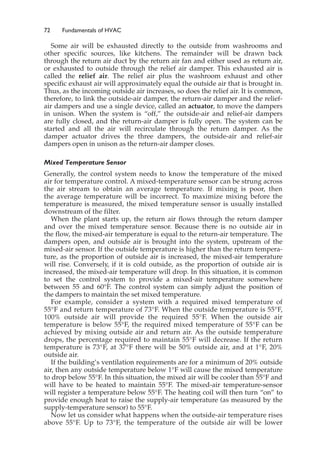
history of 2–3, 8–9
system objectives 4–6, 9
hydronic circuits 117–18
hydronic systems 103–16
advantages 104
architecture of 117–32
control of 106–7
disadvantages 104
fan coils 109–11, 115–16
natural convection and low temperature
radiation systems 104–8, 115
panel heating and cooling 108–9, 115
steam piping systems 118–20, 131
two pipe induction systems 112, 116
and ventilation 107–8
water piping systems 120–30, 131
water source heat pumps 113–15, 116
ice, storage 202–4, 214
IESNA (Illuminating Engineering Society
of North America) see
ASHRAE/IESNA Standard 90.1-2004
indirect evaporative cooling 185–6, 188–9
individuals, and comfort 8, 40
indoor air quality (IAQ) 3, 43–4, 58–9
contaminants 44–7
dilution 52
filtration 48–52
source control 47–8
ventilation 52–8
induction, two pipe induction systems
112, 116
Induction Reheat Unit 90–2
infiltration 14
Integrated Part-Load Value (IPLV)
177, 178
Internet 168
interoperability 167
languages, controls 166
latent heat 14, 15, 30, 81
latent heat of fusion 198–9
Leadership in Energy and Environmental
Design (LEED) 176, 188
legionella 46, 130, 145, 195
lighting
and comfort 7
energy conservation 174–5, 178
and HVAC 3
low-grade heat 179
Low-Temperature Reheat Unit with
Induced Air 90, 91, 92
mechanically conditioned spaces, comfort
conditions 37–9
MERV (Minimum Efficiency Reporting
Values) 49–52, 111
mixed temperature sensor, in
air-conditioning system 72–3
mixing chamber, in air-conditioning
system 20
modulating controls 151–4
mold, control of 47–8
multiple zone air systems 88–102
multizone systems 98–9, 102
offset 151–2, 169
on-off controls 150–1
on-off input and output 158
open loop control system 154, 169
open water circuit 130, 132
outdoor air, dual-path system 100–1,
211–13, 215
outdoor reset 107, 125, 154–5
outside air damper, in air-conditioning
system 20, 71–2
overshoot 151–2, 169
panel filter 49–50
panel heating and cooling 108–9, 115, 191,
194
passive thermal storage 194–5, 214
personal environment model 6
physical space, and comfort 7
piping, water systems 120–3
pleated filter 50, 52
pneumatic controls 149–50
pollutants see contaminants
ponding, steam systems 120
pressure
building pressure 186–7, 189
and zones 65
proportional control 151–2, 169
protocols 166
psychosocial situation 7
psychrometric chart 11–20, 30
acceptable temperature and
humidity 38
cooling coil 18
cooling towers 144, 147
design of 11
evaporative cooling 185
heating 15
humidification 15–17
relative humidity 12–15
pump curve 123, 126
pumps
hot water systems 126–7
water systems 123–4
radiant cooling 108–9, 194
radiant floor 108–9, 125, 191, 192
radiant heating
high temperature 191–3, 213
low temperature 104–8, 115, 191
radiant temperature 35, 40
radiators, heating system 105–6, 115
radon 46
reciprocating compressor 140
recuperator 136
refrigerant-based systems 26
refrigeration
equipment 75–80, 86–7
history of 2
see also chillers
reheat system 24, 90–2, 101
Induction Reheat Unit 90–2
Low-Temperature Reheat Unit with
Induced Air 90, 91, 92
relative humidity 12–15
relief air 72
reset
chilled water 175
heating 175
outdoor reset 107, 125, 154–5
reset controller 155
return fan 75
rooftop units 82–5, 87
room air distribution
systems 207–11, 214
run-around energy recovery coils
179–80, 188
safety issues, steam systems 119–20,
136–7
saturation line 12
saturation point 12
seasonal efficiency 135
secondary air see entrained air
self-powered controls 149
sensible heat 14, 81
sensor 153
setpoint 152
setpoint temperature 62, 154–5
sick building syndrome 47
Index 223
224 Index
single-zone air handlers 68–87
components 70–5, 86
direct digital control (DDC) 161–5
solar gain 62–4
solar heating, water 195
spaces
attributes for comfort 7
and zones 60–1
speed of reaction 169
split systems 85, 87
standalone panel 159
static lift 130
steam systems 104, 118–20, 131
boilers 139, 146
safety issues 119–20, 136–7
steam traps 118–19
storage heater 195–7
stratified tank 199–200
system choice matrix 28–30, 31
system curve 123
system head 123
Task/Ambient Conditioning system
(TAC) 210
temperature see air temperature; radiant
temperature
thermal comfort
conditions for 7, 36–9, 41
definition 32–3, 41
factors 33–6, 41
non-ideal conditions 39–40, 41
non-standard groups 40, 42
thermal storage 190–1, 194–204, 214
active 195–7
chilled water storage 197–201
controls 204
ice storage 202–4
passive 194–5
thermal variation, zones 64
thermostatic steam trap 118
thermostats 61, 65–7, 108, 192–3, 206
three-deck multizone systems 99, 102
time control 155–6
timing, and zones 64–5
tobacco smoke 46
transducer 158
turn-down ratio 138
Turn it off, Turn it down, Turn it in
174–6, 187
two pipe induction systems 112, 116
Under Floor Air Distribution
(UFAD) 208–10
unitary refrigerant-based systems 26
variable air volume (VAV) systems 24–5,
92–4, 102
controls 156–7
direct digital control (DDC) 160–1
dual-duct system 99–100, 102
variable input and output 158
ventilation
acceptable indoor air quality 52–8
air distribution 207–11, 214
and hydronic heating systems 107–8
occupant-operated windows 36–7, 107,
191, 206–7, 214
zones 64
vertical temperature difference 39
water heating, passive 195
water piping systems 120–4, 131
chilled water systems 127–9,
132, 146
condenser water 129–30
hot water systems 124–7, 132
water-side economizers 183–4, 188
water source heat pumps 113–15, 116
water systems see hydronic systems
water vapor, humidity ratio 11
web server 168
wells 204
window air-conditioners 4, 26, 76–8, 107,
177–8
windows
and energy conservation 172–3,
174, 177
occupant-controlled 36–7, 107, 191,
206–7, 214
and zones 61–2
zone air distribution effectiveness 55
zoned air-conditioning systems 23–6, 31
all-air systems 24–5, 89–102
see also single-zone air handlers
zones
control of 65–7
definition 61, 67
design 62–5

Funda_HVAC_system.pdf

  • 2.
  • 3.
    This Page isIntentionally Left Blank
  • 4.
    Fundamentals of HVACSystems Prepared by Robert McDowall, P. Eng. Engineering Change Inc. American Society of Heating, Refrigerating and Air-Conditioning Engineers Inc. 1791 Tullie Circle NE, Atlanta, GA 30329, USA AMSTERDAM • BOSTON • HEIDELBERG • LONDON NEW YORK • OXFORDPARIS • SAN DIEGO SAN FRANCISCO • SINGAPORE • SYDNEY • TOKYO Butterworth-Heinemann is an imprint of Elsevier
  • 5.
    Butterworth-Heinemann is animprint of Elsevier Linacre House, Jordan Hill, Oxford OX2 8DP, UK The Boulevard, Langford Lane, Kidlington, Oxford OX5 1GB, UK 84 Theobald’s Road, London WC1X 8RR, UK Radarweg 29, PO Box 211, 1000 AE Amsterdam, The Netherlands 30 Corporate Drive, Suite 400, Burlington, MA 01803, USA 525 B Street, Suite 1900, San Diego, CA 92101-4495, USA First edition 2006 Copyright © 2006, American Society of Heating, Refrigerating and Air-Conditioning Engineers, Inc. and Elsevier Inc Published by Elsevier 2006. All rights reserved The right of American Society of Heating, Refrigerating and Air-Conditioning Engineers, Inc. and Elsevier Inc to be identified as the author of this work has been asserted in accordance with the Copyright, Designs and Patents Act 1988 No part of this publication may be reproduced, stored in a retrieval system or transmitted in any form or by any means electronic, mechanical, photocopying, recording or otherwise without the prior written permission of the publisher Permissions may be sought directly from Elsevier’s Science & Technology Rights Department in Oxford, UK: phone (⫹44) (0) 1865 843830; fax (⫹44) (0) 1865 853333; email: permissions@elsevier.com. Alternatively you can submit your request online by visiting the Elsevier web site at http://elsevier.com/locate/permissions, and selecting Obtaining Permission to use Elsevier material Notice No responsibility is assumed by the publisher for any injury and/or damage to persons or property as a matter of products liability, negligence or otherwise, or from any use or operation of any methods, products, instructions or ideas contained in the material herein. Because of rapid advances in the medical sciences, in particular, independent verification of diagnoses and drug dosages should be made British Library Cataloguing in Publication Data A catalogue record for this book is available from the British Library Library of Congress Cataloging-in-Publication Data A catalog record for this book is available from the Library of Congress ISBN–13: 978-0-12-372497-7 ISBN–10: 0-12-372497-X Printed and bound in Great Briatin 06 07 08 09 10 10 9 8 7 6 5 4 3 2 1 Working together to grow libraries in developing countries www.elsevier.com | www.bookaid.org | www.sabre.org For information on all Butterworth-Heinemann publications visit our web site at books.elsevier.com
  • 6.
    Contents Foreword ix 1 Introductionto HVAC 1 Study Objectives of Chapter 1 1 1.1 Introduction 1 1.2 Brief History of HVAC 2 1.3 Scope of Modern HVAC 3 1.4 Introduction to Air-conditioning Processes 3 1.5 Objective: What is your system to achieve? 4 1.6 Environment For Human Comfort 6 The Next Step 8 Summary 8 Bibliography 9 2 Introduction to HVAC Systems 10 Study Objectives of Chapter 2 10 2.1 Introduction 10 2.2 Introducing the Psychrometric Chart 11 2.3 Basic Air-Conditioning System 20 2.4 Zoned Air-Conditioning Systems 23 2.5 Choosing an Air-Conditioning System 26 2.6 System Choice Matrix 28 The Next Step 30 Summary 30 Bibliography 31 3 Thermal Comfort 32 Study Objectives of Chapter 3 32 3.1 Introduction: What is Thermal Comfort? 32 3.2 Seven Factors Influencing Thermal Comfort 33 3.3 Conditions for Comfort 36 3.4 Managing Under Less Than Ideal Conditions 39 3.5 Requirements of Non-Standard Groups 40 The Next Step 41 Summary 41 Bibliography 42
  • 7.
    vi Contents 4 Ventilationand Indoor Air Quality 43 Study Objectives of Chapter 4 43 4.1 Introduction 43 4.2 Air Pollutants and Contaminants 44 4.3 Indoor Air Quality Effects on Health and Comfort 45 4.4 Controlling Indoor Air Quality 47 4.5 ASHRAE Standard 62 Ventilation for Acceptable Indoor Air Quality 52 The Next Step 58 Summary 58 Bibliography 59 5 Zones 60 Study Objectives of Chapter 5 60 5.1 Introduction 60 5.2 What is a Zone? 61 5.3 Zoning Design 62 5.4 Controlling the Zone 65 The Next Step 67 Summary 67 6 Single Zone Air Handlers and Unitary Equipment 68 Study Objectives of Chapter 6 68 6.1 Introduction 68 6.2 Examples of Buildings with Single-zone Package Air-Conditioning Units 69 6.3 Air-Handling Unit Components 70 6.4 Refrigeration Equipment 75 6.5 System Performance Requirements 80 6.6 Rooftop Units 82 6.7 Split Systems 85 The Next Step 86 Summary 86 Bibliography 87 7 Multiple Zone Air Systems 88 Study Objectives of Chapter 7 88 7.1 Introduction 88 7.2 Single-Duct, Zoned Reheat, Constant Volume Systems 90 7.3 Single-Duct, Variable Air Volume Systems 92 7.4 By-Pass Box Systems 94 7.5 Constant Volume Dual-Duct, All-Air Systems 95 7.6 Multizone Systems 98 7.7 Three-deck Multizone Systems 99 7.8 Dual-Duct, Variable Air Volume Systems 99 7.9 Dual Path Outside Air Systems 100 The Next Step 101 Summary 101
  • 8.
    8 Hydronic Systems103 Study Objectives of Chapter 8 103 8.1 Introduction 103 8.2 Natural Convection and Low Temperature Radiation Heating Systems 104 8.3 Panel Heating and Cooling 108 8.4 Fan Coils 109 8.5 Two Pipe Induction Systems 112 8.6 Water Source Heat Pumps 113 The Next Step 115 Summary 115 Bibliography 116 9 Hydronic System Architecture 117 Study Objectives of Chapter 9 117 9.1 Introduction 117 9.2 Steam 118 9.3 Water Systems 120 9.4 Hot Water 124 9.5 Chilled Water 127 9.6 Condenser Water 129 The Next Step 131 Summary 131 Bibliography 132 10 Central Plants 133 Study Objectives of Chapter 10 133 10.1 Introduction 133 10.2 Central Plant Versus Local Plant in a Building 134 10.3 Boilers 136 10.4 Chillers 139 10.5 Cooling Towers 142 The Next Step 145 Summary 145 Bibliography 147 11 Controls 148 Study Objectives of Chapter 11 148 11.1 Introduction 148 11.2 Basic Control 150 11.3 Typical Control loops 155 11.4 Introduction to Direct Digital Control, DDC 157 11.5 Direct Digital Control of an Air-Handler 161 11.6 Architecture and Advantages of Direct Digital Controls 165 The Next Step 169 Summary 169 Bibliography 170 Contents vii
  • 9.
    viii Contents 12 EnergyConservation Measures 171 Study Objectives of Chapter 12 171 12.1 Introduction 172 12.2 Energy Considerations for Buildings 172 12.3 ASHRAE/IESNA Standard 90.1 176 12.4 Heat Recovery 179 12.5 Air-Side and Water-Side Economizers 183 12.6 Evaporative Cooling 185 12.7 Control of Building Pressure 186 The Final Step 187 Summary 187 Bibliography 189 13 Special Applications 190 Study Objectives of Chapter 13 190 13.1 Introduction 190 13.2 Radiant Heating and Cooling Systems 191 13.3 Thermal Storage Systems 194 13.4 The Ground as Heat Source and Sink 204 13.5 Occupant Controlled Windows with HVAC 206 13.6 Room Air Distribution Systems 207 13.7 Decoupled or Dual Path, and Dedicated Outdoor Air Systems 211 Summary 213 Your Next Step 215 Bibliography 216 Index 219
  • 10.
    Foreword Welcome to theASHRAE Learning Institute’s Fundamentals of HVAC&R eLearning System series. This is the Course Reader to accompany the Fundamentals of HVAC Systems online modules. To help you learn at your convenience, this Course Reader is also available to you as an eBook included with the online Course Modules. The Course Reader will provide you with background information to help you develop in-depth knowledge of the Fundamentals of HVAC Systems, to improve your skills in HVAC&R and to earn the 35 PDHs/3.5 CEUs awarded for successful completion of the Fundamentals of HVAC Systems Learning course. We look forward to working with you and helping you achieve maximum results from the course.
  • 11.
    This Page isIntentionally Left Blank
  • 12.
    Chapter 1 Introduction toHVAC Contents of Chapter 1 Study Objectives of Chapter 1 1.1 Introduction 1.2 History of HVAC 1.3 Scope of Modern HVAC 1.4 Introduction To Air-Conditioning Processes 1.5 Objective: what is your system to achieve? 1.6 Environment For Human Comfort The Next Step Summary Bibliography Study Objectives of Chapter 1 Chapter 1 introduces the history, uses and main processes of heating, ventilat- ing and air conditioning. There are no calculations to be done. The ideas will be addressed in detail in later chapters. After studying the chapter, you should be able to: Define heating, ventilating and air conditioning. Describe the purposes of heating, ventilating and air conditioning. Name and describe seven major air-conditioning processes. Identify five main aspects of a space that influence an occupant’s comfort. 1.1 Introduction Heating, Ventilating and Air Conditioning, HVAC, is a huge field. HVAC sys- tems include a range from the simplest hand-stoked stove, used for comfort heating, to the extremely reliable total air-conditioning systems found in sub- marines and space shuttles. Cooling equipment varies from the small domestic unit to refrigeration machines that are 10,000 times the size, which are used in industrial processes. Depending on the complexity of the requirements, the HVAC designer must consider many more issues than simply keeping temperatures comfortable. This chapter will introduce you to the fundamental concepts that are used by designers to make decisions about system design, operation, and maintenance.
  • 13.
    2 Fundamentals ofHVAC 1.2 Brief History of HVAC For millennia, people have used fire for heating. Initially, the air required to keep the fire going ensured adequate ventilation for the occupants. However, as central furnaces with piped steam or hot water became available for heat- ing, the need for separate ventilation became apparent. By the late 1880s, rules of thumb for ventilation design were developed and used in many countries. In 1851 Dr. John Gorrie was granted U.S. patent 8080 for a refrigeration machine. By the 1880s, refrigeration became available for industrial purposes. Initially, the two main uses were freezing meat for transport and making ice. However, in the early 1900s there was a new initiative to keep buildings cool for comfort. Cooling the New York Stock Exchange, in 1902, was one of the first comfort cooling systems. Comfort cooling was called “air conditioning.” Our title, “HVAC,” thus captures the development of our industry. The term “air conditioning” has gradually changed, from meaning just cooling, to the total control of: 䊉 Temperature 䊉 Moisture in the air (humidity) 䊉 Supply of outside air for ventilation 䊉 Filtration of airborne particles 䊉 Air movement in the occupied space Throughout the rest of this text we will use the term “air conditioning” to include all of these issues and continue to use “HVAC” where only some of the elements of full air conditioning are being controlled. To study the historical record of HVAC is to take a fascinating trip through the tremendous technical and scientific record of society. There are the pioneers such as Robert Boyle, Sadi Carnot, John Dalton, James Watt, Benjamin Franklin, John Gorrie, Lord Kelvin, Ferdinand Carré, Willis Carrier and Thomas Midgley, along with many others, who have brought us to our current state. Air-conditioning technology has developed since 1900 through the joint accomplishments of sci- ence and engineering. Advances in thermodynamics, fluid mechanics, electricity, electronics, construction, materials, medicine, controls and social behavior are the building blocks to better engineered products of air conditioning. Historical accounts are not required as part of this course but, for the enjoyment and perspective it provides, it is worth reading an article such as “Milestones in Air Conditioning,” by Walter A. Grant1 or the book about Willis Carrier, The Father of Air Conditioning.2 The textbook Principles of Heating, Ventilating, and Air Conditioning,3 starts with a concise and comprehensive his- tory of the HVAC industry. HVAC evolved based on: 䊉 Technological discoveries, such as refrigeration, that were quickly adopted for food storage. 䊉 Economic pressures, such as the reduction in ventilation rates after the 1973 energy crisis. 䊉 Computerization and networking, used for sophisticated control of large complex systems serving numerous buildings. 䊉 Medical discoveries, such as the effects of second hand smoke on people, which influenced ventilation methods.
  • 14.
    1.3 Scope ofModern HVAC Modern air conditioning is critical to almost every facet of advancing human activity. Although there have been great advances in HVAC, there are several areas where active research and debate continue. Indoor air quality is one that directly affects us. In many countries of the world there is a rapid rise in asthmatics and increasing dissatisfaction with indoor-air-quality in buildings and planes. The causes and effects are extremely complex. A significant scientific and engineering field has devel- oped to investigate and address these issues. Greenhouse gas emissions and the destruction of the earth’s protective ozone layer are concerns that are stimulating research. New legislation and guide- lines are evolving that encourage: recycling; the use of new forms of energy; less energy usage; and low polluting materials, particularly refrigerants. All these issues have a significant impact on building design, including HVAC systems and the design codes. Energy conservation is an ongoing challenge to find novel ways to reduce consumption in new and existing buildings without compromising comfort and indoor air quality. Energy conservation requires significant cooperation between disciplines. For example, electric lighting produces heat. When a system is in a cooling mode, this heat is an additional cooling load. Conversely, when the system is in a heating mode, the lighting heat reduces the load on the building heating system. This interaction between lighting and HVAC is the reason that ASHRAE and the Illuminating Engineering Society of North America (IESNA) joined forces to write the building energy conservation standard, Standard 90.1–2004, Energy Standard for Buildings Except Low-Rise Residential Buildings4. 1.4 Introduction to Air-conditioning Processes As mentioned earlier, the term “air conditioning,” when properly used, now means the total control of temperature, moisture in the air (humidity), supply of outside air for ventilation, filtration of airborne particles, and air movement in the occupied space. There are seven main processes required to achieve full air conditioning and they are listed and explained below: The processes are: 1. Heating—the process of adding thermal energy (heat) to the conditioned space for the purposes of raising or maintaining the temperature of the space. 2. Cooling—the process of removing thermal energy (heat) from the condi- tioned space for the purposes of lowering or maintaining the temperature of the space. 3. Humidifying—the process of adding water vapor (moisture) to the air in the conditioned space for the purposes of raising or maintaining the moisture content of the air. 4. Dehumidifying—the process of removing water vapor (moisture) from the air in the conditioned space for the purposes of lowering or maintaining the moisture content of the air. 5. Cleaning—the process of removing particulates, (dust etc.,) and biological contaminants, (insects, pollen etc.,) from the air delivered to the condi- tioned space for the purposes of improving or maintaining the air quality. Introduction to HVAC 3
  • 15.
    4 Fundamentals ofHVAC 6. Ventilating—the process of exchanging air between the outdoors and the conditioned space for the purposes of diluting the gaseous contaminants in the air and improving or maintaining air quality, composition and fresh- ness. Ventilation can be achieved either through natural ventilation or mechanical ventilation. Natural ventilation is driven by natural draft, like when you open a window. Mechanical ventilation can be achieved by using fans to draw air in from outside or by fans that exhaust air from the space to outside. 7. Air Movement—the process of circulating and mixing air through conditioned spaces in the building for the purposes of achieving the proper ventilation and facilitating the thermal energy transfer. The requirements and importance of the seven processes varies. In a climate that stays warm all year, heating may not be required at all. Conversely, in a cold climate the periods of heat in the summer may be so infrequent as to make cooling unnecessary. In a dry desert climate, dehumidification may be redundant, and in a hot, humid climate dehumidification may be the most important design aspect of the air-conditioning system. Defining Air conditioning The actual use of the words “air conditioning” varies considerably, so it is always advisable to check what is really meant. Consider, for example, “win- dow air conditioners.” The vast majority provide cooling, some dehumidifica- tion, some filtering, and some ventilation when the outside temperature is well above freezing. They have no ability to heat or to humidify the conditioned space and do not cool if it is cold outside. In colder climates, heating is often provided by a separate, perimeter heating system, that is located within the outside walls. The other functions: cooling, humidification, dehumidification, cleaning, ventilating and air movement, are all provided by a separate air system, often referred to as the “air-conditioning system.” It is important to remember that both the heat- ing and the air system together form the “air-conditioning” system for the space. 1.5 Objective: What is your system to achieve? Before starting to design a system, it is critical that you know what your system is to achieve. Often, the objective is to provide a comfortable environment for the human occupants, but there are many other possible objectives: creating a suitable environment for farm animals; regulating a hospital operating room; main- taining cold temperatures for frozen food storage; or maintaining temperature and humidity to preserve wood and fiber works of art. Whatever the situation, it is important that the objective criteria for system success are clearly identi- fied at the start of the project, because different requirements need different design considerations. Let us very briefly consider some specific design situations and the types of performance requirements for HVAC systems.
  • 16.
    Example 1: Farmanimals. The design issues are economics, the health and well being of both animals and workers, plus any regulations. Farm animal spaces are always ventilated. Depending on the climate, cooling and/or heating may be provided, controlled by a simple thermostat. The ventilation rate may be varied to: 䊉 Maintain indoor air quality (removal of body and excrement fumes.) 䊉 Maintain inside design temperature (bring in cool air and exhaust hot air.) 䊉 Remove moisture (bring in drier air and exhaust moist air.) 䊉 Change the air movement over the animals (higher air speed provides cooling.) A complex control of ventilation to meet the four design requirements may well be very cost effective. However, humidification and cleaning are not required. Example 2: Hospital operating room. This is a critical environment, often served by a dedicated air-conditioning system. The design objectives include: 䊉 Heating, to avoid the patient from becoming too cold. 䊉 Cooling, to prevent the members of the operating team from becoming too hot. 䊉 Control adjustment by the operating team for temperatures between 65°F (Fahrenheit) and 80°F. 䊉 Humidifying, to avoid low humidity and the possibility of static electricity sparks. 䊉 Dehumidifying, to minimize any possibility of mold and to minimize operating team discomfort. 䊉 Cleaning the incoming air with very high efficiency filters, to remove any airborne organisms that could infect the patient. 䊉 Ventilating, to remove airborne contaminants and to keep the theatre fresh. 䊉 Providing steady air movement from ceiling supply air outlets down over the patient for exhaust near the floor, to minimize contamination of the operating site. This situation requires a very comprehensive air-conditioning system. Example 3: Frozen food storage. The ideal temperature for long storage varies: i.e. ice cream requires temperatures below ⫺12°F and meat requires temperatures below ⫺5°F. The design challenge is to ensure that the temperature is accurately maintained and that the temperature is as even as possible through- out the storage facility. Here, accurate cooling and good air movement are the prime issues. Although cooling and air movement are required, we refer to this system as a “freezer,” not as an air-conditioning system, because heating, ventilation, humidification and dehumidification are not controlled. Example 4: Preserving wood and fiber works of art. The objectives in this environ- ment are to minimize any possibility of mold, by keeping the humidity low, and to minimize drying out, by keeping the humidity up. In addition, it is important to minimize the expansion and contraction of specimens that can Introduction to HVAC 5
  • 17.
    6 Fundamentals ofHVAC occur as the moisture content changes. As a result the design challenge is to maintain a very steady humidity, reasonably steady temperature, and to minimize required ventilation, from a system that runs continuously. For this situation, the humidity control is the primary issue and temperature control is secondary. Typically, this situation will require all seven of the air-conditioning features and we will describe the space as fully “air-conditioned.” Now let us go on to consider the more complex subject of human comfort in a space. 1.6 Environment For Human Comfort “Provide a comfortable environment for the occupants” sounds like a simple objective, until you start to consider the variety of factors that influence the comfort of an individual. Figure 1.1 is a simplified diagram of the three main groups of factors that affect comfort. THERMAL CONDITIONS INCLUDING HUMIDITY AIR QUALITY ACOUSTICAL (NOISE) LIGHTING PHYSICAL – ARCHITECTURAL, FURNITURE HEALTH VULNERABILITY EXPECTATIONS ENVIRONMENTAL CONDITIONS INDIVIDUAL CHARACTERISTICS PRODUCTIVITY RATING OF THE SPACE SYMPTOMS CLOTHING ACTIVITY LEVEL PSYCHOSOCIAL INDIVIDUAL PERSON Figure 1.1 Personal Environment Model (adapted with permission from “The construct of comfort: a framework for research” by W.S. Cain5)
  • 18.
    䊉 Attributes ofthe space – on the left 䊉 Characteristics of the individual – on the right 䊉 Clothing and activity of the individual – high center 1.6.1 Attributes of the Space Influencing Comfort As you can see, six attributes of the space influence comfort: thermal, air qual- ity, acoustical, lighting, physical, and psychosocial. Of these, only the thermal conditions and air quality can be directly controlled by the HVAC system. The acoustical (noise) environment may be influenced to some extent. The lighting and architectural aspects are another field, but these can influence how the HVAC is perceived. The psychosocial environment (how people interact socia- bly, or unsociably!) in the space is largely dependent on the occupants, rather than the design of the space. We will briefly consider these six aspects of the space and their influence on comfort. 1. Thermal conditions include more than simply the air temperature. If the air speed is very high, the space will be considered drafty. If there is no air movement, occupants may consider the space ‘stuffy’. The air velocity in a mechanically conditioned space is largely controlled by the design of the system. On the other hand, suppose the occupants are seated by a large un- shaded window. If the air temperature stays constant, they will feel very warm when the sun is shining on them and cooler when clouds hide the sun. This is a situation where the architectural design of the space affects the thermal comfort of the occupant, independently of the temperature of the space. 2. The air quality in a space is affected by pollution from the occupants and other contents of the space. This pollution is, to a greater or lesser extent, reduced by the amount of outside air brought into the space to dilute the pollutants. Typically, densely occupied spaces, like movie theatres, and heavy polluting activities, such as cooking, require a much higher amount of outside air than an office building or a residence. 3. The acoustical environment may be affected by outside traffic noise, other occupants, equipment, and the HVAC system. Design requirements are dictated by the space. A designer may have to be very careful to design a virtually silent system for a recording studio. On the other hand, the design for a noisy foundry may not require any acoustical design consideration. 4. The lighting influences the HVAC design, since all lights give off heat. The lighting also influences the occupants’ perception of comfort. If the lights are much too bright, the occupants may feel uncomfortable. 5. The physical aspects of the space that have an influence on the occupants include both the architectural design aspects of the space, and the interior design. Issues like chair comfort, the height of computer keyboards, or reflections off computer screens have no relation to the HVAC design, however they may affect how occupants perceive the overall comfort of the space. 6. The psychosocial situation, the interaction between people in the space, is not a design issue but can create strong feelings about the comfort of the space. Introduction to HVAC 7
  • 19.
    8 Fundamentals ofHVAC 1.6.2 Characteristics of the Individual that Influence Comfort Now let us consider the characteristics of the occupants of the space. All people bring with them health, vulnerabilities and expectations. Their health may be excellent and they may not even notice the draft from the air conditioning. On the other hand if the occupants are patients in a doctor’s waiting room, they could perceive a cold draft as very uncomfortable and distressing. The occupants can also vary in vulnerability. For example, cool floors will likely not affect an active adult who is wearing shoes. The same floor may be uncomfortably cold for the baby who is crawling around on it. Lastly the occupants bring their expectations. When we enter a prestigious hotel, we expect it to be comfortable. When we enter an air-conditioned build- ing in summer, we expect it to be cool. The expectations may be based on pre- vious experience in the space or based on the visual perception of the space. For example, when you enter the changing room in the gym, you expect it to be smelly, and your expectations make you more tolerant of the reality. 1.6.3 Clothing and Activity as a function of Individual Comfort The third group of factors influencing comfort is the amount of clothing and the activity level of the individual. If we are wearing light clothing, the space needs to be warmer for comfort than if we are heavily clothed. Similarly, when we are involved in strenuous activity, we generate considerable body heat and are comfortable with a lower space temperature. In the summer, in many business offices, managers wear suits with shirts and jackets while staff members may have bare arms, and light clothing. The same space may be thermally comfortable to one group and uncomfortable to the other. There is much more to comfort than most people realize. These various aspects of comfort will be covered in more detail in later chapters. The Next Step Chapter 2 introduces the concept of an air-conditioning system. We will then consider characteristics of systems and how various parameters influence system choice. Chapter 2 is broad in scope and will introduce you the content and value of the other ASHRAE Self-Study Courses. Summary This has been an introduction to heating, ventilating and air conditioning and some of the terminology and main processes that are involved in air conditioning. 1.2 Brief History of HVAC The field of HVAC started in the mid 1800s. The term “air conditioning” has gradually changed from meaning just cooling, to the total control of temperature,
  • 20.
    moisture in theair (humidity), supply of outside air for ventilation, filtration of airborne particles and air movement in the occupied space. 1.3 Scope of Modern HVAC Some of the areas of research, regulation and responsibility include indoor air quality, greenhouse gas emissions, and energy conservation. 1.4 Introduction to Air-conditioning Processes There are seven main processes required to achieve full air conditioning: heat- ing, cooling, humidifying, dehumidifying, cleaning, ventilating, air movement. The requirements and importance of the seven processes vary with the climate. 1.5 System Objectives Before starting to design a system, it is critical that you know what your system is supposed to achieve. The objective will determine the type of system to select, and the performance goals for it. 1.6 Environment For Human Comfort The requirements for human comfort are affected by: the physical space; the characteristics of the individual, including health, vulnerability and expecta- tions; and the clothing and activities of the individual. Six attributes of the physical space that influence comfort are thermal, air quality, acoustical, lighting, physical, and the psychosocial environment. Of these, only the thermal conditions and air quality can be directly controlled by the HVAC system. The acoustical (noise) environment may be influenced to some extent. The lighting and architectural aspects can influence how the HVAC is perceived. The psychosocial environment in the space is largely dependent on the occupants rather than the design of the space. Bibliography 1. Grant, W. 1969. “Milestones in Air Conditioning.” ASHRAE Journal. Atlanta: ASHRAE. Vol. 11, No. 9, pp. 45–51. 2. Ingels, M. 1991. The Father of Air Conditioning. Louisville, KY: Fetter Printing Co. 3. Sauer, Harry J. Jr., Ronald H. Howell, William J. Coad. 2001. Principles of Heating, Ventilating, and Air Conditioning. Atlanta: ASHRAE. 4. Standard 90.1–2004 Energy Standard for Buildings Except Low-Rise Residential Buildings. Atlanta: ASHRAE. 5. Cain, W.S. 2002. “The construct of comfort: a framework for research” Indoor Air 2002, Proceedings: Indoor Air 2002 Volume II, pp.12–20. Introduction to HVAC 9
  • 21.
    Chapter 2 Introduction toHVAC Systems Contents of Chapter 2 Study Objectives of Chapter 2 2.1 Introduction 2.2 Introducing the Psychrometric Chart 2.3 Basic Air-Conditioning System 2.4 Zoned Air-Conditioning Systems 2.5 Choosing an Air-Conditioning System 2.6 System Choice Matrix The Next Step Summary Bibliography Study Objectives of Chapter 2 Chapter 2 begins with an introduction to a graphical representation of air- conditioning processes called the psychrometric chart. Next, an air-conditioning system is introduced followed by a discussion about how it can be adapted to serve many spaces. The chapter ends with a brief introduction to the idea of using a factor matrix to help choose an air-conditioning system. Chapter 2 is broad in scope and will also introduce you to the content and value of other, more in depth, ASHRAE Self-Study Courses. After studying Chapter 2, you should be able to: Understand and describe the major concepts of the psychrometric chart. Define the main issues to be considered when designing a system. Name the four major system types and explain their differences. Describe the main factors to be considered in a matrix selection process. 2.1 Introduction In Chapter 1 we introduced the seven main air-conditioning processes and the task of establishing objectives for air-conditioning design. In this chapter we will consider How these processes are described graphically in the psychrometric chart. How these processes are combined to form an air-conditioning system.
  • 22.
    The range ofheating, ventilating and air-conditioning systems. How system choices are made. 2.2 Introducing the Psychrometric Chart Many of the air-conditioning processes involve air that is experiencing energy changes. These changes arise from changes in the air’s temperature and its moisture content. The relationships between temperature, moisture content, and energy are most easily understood using a visual aid called the “psychrometric chart.” The psychrometric chart is an industry-standard tool that is used to visualize the interrelationships between dry air, moisture and energy. If you are responsible for the design or maintenance of any aspect of air conditioning in buildings, a clear and comfortable understanding of the chart will make your job easier. Initially, the chart can be intimidating, but as you work with it you will discover that the relationships that it illustrates are relatively easy to understand. Once you are comfortable with it, you will discover that it is a tool that can make it easier to troubleshoot air-conditioning problems in buildings. The ASHRAE course, Fundamentals of Thermodynamics and Psychrometrics1 goes into great detail about the use of the chart. That course also provides calculations and discussion about how the chart can be used as a design and troubleshooting tool. In this course, however, we will only introduce the psychrometric chart, and provide a very brief overview of its structure. The Design of the Psychrometric Chart The psychrometric chart is built upon two simple concepts. 1. Indoor air is a mixture of dry air and water vapor. 2. There is a specific amount of energy in the mixture at a specific temperature and pressure. Psychrometric Chart Concept 1: Indoor Air is a Mixture of Dry Air and Water Vapor. The air we live in is a mixture of both dry air and water vapor. Both are invisible gases. The water vapor in air is also called moisture or humidity. The quantity of water vapor in air is expressed as “pounds of water vapor per pound of air.” This ratio is called the “humidity ratio,” abbreviation W and the units are pounds of water/pound of dry air, lbw/lbda, often abbreviated to lb/lb. The exact properties of moist air vary with pressure. Because pressure reduces as altitude increases, the properties of moist air change with altitude. Typically, psychrometric charts are printed based on standard pressure at sea level. For the rest of this course we will consider pressure as constant. To understand the relationship between water vapor, air and temperature, we will consider two conditions: First Condition: The temperature is constant, but the quantity of water vapor is increasing. If the temperature remains constant, then, as the quantity of water vapor in the air increases, the humidity increases. However, at every temperature point, there is a maximum amount of water vapor that can co-exist with the air. The point Introduction to HVAC Systems 11
  • 23.
    12 Fundamentals ofHVAC at which this maximum is reached is called the saturation point. If more water vapor is added after the saturation point is reached, then an equal amount of water vapor condenses, and takes the form of either water droplets or ice crystals. Outdoors, we see water droplets in the air as fog, clouds or rain and we see ice crystals in the air as snow or hail. The psychrometric chart only considers the conditions up to the saturation point; therefore, it only considers the effects of water in the vapor phase, and does not deal with water droplets or ice crystals. Second Condition: The temperature is dropping, but the quantity of water vapor is constant. If the air is cooled sufficiently, it reaches the saturation line. If it is cooled even more, moisture will condense out and dew forms. For example, if a cold canned drink is taken out of the refrigerator and left for a few minutes, the container gets damp. This is because the moist air is in contact with the chilled container. The container cools the air that it contacts to a temper- ature that is below saturation, and dew forms. This temperature, at which the air starts to produce condensation, is called the dew point temperature. Relative Humidity Figure 2.1 is a plot of the maximum quantity of water vapor per pound of air against air temperature. The X-axis is temperature. The Y-axis is the propor- tion of water vapor to dry air, measured in pounds of water vapor per pound of dry air. The curved “maximum water vapor line” is called the “saturation line.” It is also known as 100% relative humidity, abbreviated to 100% rh. At any point on the saturation line, the air has 100% of the water vapor per pound of air that can coexist with dry air at that temperature. When the same volume of air contains only half the weight of water vapor that it has the capacity to hold at that temperature, we call it 50% relative humidity or 50% rh. This is shown in Figure 2.2. Air at any point on the 50% rh line has half the water vapor that the same volume of air could have at that temperature. As you can see on the chart, the maximum amount of water vapor that moist air can contain increases rapidly with increasing temperature. For example, moist air at the freezing point, 32°F, can contain only 0.4% of its weight as Figure 2.1 Psychrometric Chart – Saturation Line
  • 24.
    water vapor. However,indoors, at a temperature of 72°F the moist air can contain nearly 1.7% of its weight as water vapor—over four times as much. Consider Figure 2.3, and this example: On a miserable wet day it might be 36°F outside, with the air rather humid, at 70% relative humidity. Bring that air into your building. Heat it to 70°F. This brings the relative humidity down to about 20%. This change in relative humidity is shown in Figure 2.3, from Point 1 : 2. A cool damp day outside provides air for a dry day indoors! Note that the absolute amount of water vapor in the air has remained the same, at 0.003 pounds of water vapor per pound of dry air; but as the temperature rises, the relative humidity falls. Here is an example for you to try, using Figure 2.3. Suppose it is a warm day with an outside temperature of 90°F and relative humidity at 40%. We have an air-conditioned space that is at 73°F. Some Introduction to HVAC Systems 13 Figure 2.2 Psychrometric Chart – 50% Relative Humidity Line Figure 2.3 Psychrometric Chart – Change in Relative Humidity with Change in Temperature
  • 25.
    14 Fundamentals ofHVAC of the outside air leaks into our air-conditioned space. This leakage is called infiltration. Plot the process on Figure 2.3. Find the start condition, 90°F and 40% rh, moisture content 0.012 lb/lb. Then cool this air: move left, at constant moisture content to 73°F. Notice that the cooled air now has a relative humidity of about 70%. Relative humidity of 70% is high enough to cause mold problems in buildings. Therefore in hot moist climates, to prevent infiltration and mold generation, it is valuable to maintain a small positive pressure in buildings. Psychrometric Chart Concept 2: There is a specific amount of energy in the air mix- ture at a specific temperature and pressure. This brings us to the second concept that the psychrometric chart illustrates. There is a specific amount of energy in the air water-vapor mixture at a specific temperature. The energy of this mixture is dependent on two measures: 1. The temperature of the air. 2. The proportion of water vapor in the air. There is more energy in air at higher temperatures. The addition of heat to raise the temperature is called adding “sensible heat.” There is also more energy when there is more water vapor in the air. The energy that the water vapor contains is referred to as its “latent heat.” The measure of the total energy of both the sensible heat in the air and the latent heat in the water vapor is commonly called “enthalpy.” Enthalpy can be raised by adding energy to the mixture of dry air and water vapor. This can be accomplished by adding either or both 䊉 Sensible heat to the air 䊉 More water vapor, which increases the latent heat of the mixture Figure 2.4 Psychrometric Chart – Enthalpy
  • 26.
    On the psychrometricchart, lines of constant enthalpy slope down from left to right as shown in Figure 2.4 and are labeled “Enthalpy.” The zero is arbitrarily chosen as zero at 0°F and zero moisture content. The unit measure for enthalpy is British Thermal Units per pound of dry air, abbreviated as Btu/lb. Heating The process of heating involves the addition of sensible heat energy. Figure 2.5 illustrates outside air at 47°F and almost 90% relative humidity that has been heated to 72°F. This process increases the enthalpy in the air from approximately 18 Btu/lb to 24 Btu/lb. Note that the process line is horizontal because no water vapor is being added to, or removed from the air—we are just heating the mixture. In the process, the relative humidity drops from almost 90% rh down to about 36% rh. Here is an example for you to try. Plot this process on Figure 2.6. Suppose it is a cool day with an outside temperature of 40°F and 60% rh. We have an air-conditioned space and the air is heated to 70°F. There is no change in the amount of water vapor in the air. The enthalpy rises from about 13 Btu/lb to 20 Btu/lb, an increase of 7 Btu/lb. As you can see, the humidity would have dropped to 20% rh. This is quite dry so let us assume that we are to raise the humidity to a more comfortable 40%. As you can see on the chart, this raises the enthalpy by an additional 3.5 Btu/lb. Humidification The addition of water vapor to air is a process called “humidification.” Humidification occurs when water absorbs energy, evaporates into water vapor, and mixes with air. The energy that the water absorbs is called “latent heat.” There are two ways for humidification to occur. In both methods, energy is added to the water to create water vapor. Introduction to HVAC Systems 15 Figure 2.5 Psychrometric Chart – Heating air from 47°F to 72°F
  • 27.
    16 Fundamentals ofHVAC 1. Water can be heated. When heat energy is added to the water, the water is transformed to its gaseous state, steam, that mixes into the air. In Figure 2.6, the vertical line, from Point 1 to Point 2, shows this process. The heat energy, 3.5 Btu/lb, is put into the water to generate steam (vaporize it), which is then mixed with the air. In practical steam humidifiers, the added steam is hotter than the air and the piping loses some heat into the air. Therefore, the air is both humidified and heated due to the addition of the water vapor. This combined humidifi- cation and heating is shown by the dotted line which slopes a little to the right in Figure 2.6. 2. Water can evaporate by spraying a fine mist of water droplets into the air. The fine water droplets absorb heat from the air as they evaporate. Alter- natively, but using the same evaporation process, air can be passed over a wet fabric, or wet surface, enabling the water to evaporate into the air. In an evaporative humidifier, the evaporating water absorbs heat from the air to provide its latent heat for evaporation. As a result, the air temperature drops as it is humidified. The process occurs with no external addition or removal of heat. It is called an adiabatic process. Since there is no change in the heat energy (enthalpy) in the air stream, the addition of moisture, by evaporation, occurs along a line of constant enthalpy. Figure 2.7 shows the process. From Point 1, the moisture evaporates into the air and the temperature falls to 56°F, Point 2. During this evaporation, the rela- tive humidity rises to about 65%. To reach our target of 70°F and 40% rh we must now heat the moistened air at Point 2 from 56°F to 70°F, Point 3, requiring 3.5 Btu/lb of dry air. To summarize, we can humidify by adding heat to water to produce steam and mixing the steam with the air, or we can evaporate the moisture and heat the moistened air. We achieve the same result with the same input of heat by two different methods. The process of evaporative cooling can be used very effectively in a hot, dry desert climate to pre-cool the incoming ventilation air. For example, Figure 2.6 Psychrometric Chart – Adding Moisture with Steam
  • 28.
    outside air at90°F and 15% relative humidity could be cooled to 82°F by passing it through an evaporative cooler. The relative humidity will rise, but only to about 27%. Even with no mechanical refrigeration, this results in a pleasant reduction in air temperature without raising the relative humidity excessively. Cooling and Dehumidification Cooling is most often achieved in an air-conditioning system by passing the moist air over a cooling coil. As illustrated in Figure 2.8, a coil is constructed of a long serpentine pipe through which a cold liquid or gas flows. This cold fluid is either chilled water, typically between 40°F and 45°F, or a refrigerant. The pipe is lined with fins to increase the heat transfer from the air to the cold fluid in the pipe. Figure 2.8 shows the face of the coil, in the direction of airflow. Depending on the coil design, required temperature Introduction to HVAC Systems 17 Figure 2.7 Psychrometric Chart – Adding Moisture, Evaporative Humidifier FACE VIEW OF FINNED COIL SHOWING COOLANT FLOW. COOLANT FLOW Figure 2.8 Cooling Coil
  • 29.
    18 Fundamentals ofHVAC drop, and moisture removal performance, the coil may have 2 to 8 rows of piping. Generally the more rows, the higher the moisture removal ability of the coil. There are two results. First, the cooling coil cools the air as the air passes over the coils. Second, because the cooling fluid in the coil is usually well below the saturation temperature of the air, moisture condenses on the coil, and drips off, to drain away. This process reduces the enthalpy, or heat, of the air mixture and increases the enthalpy of the chilled water or refrigerant. In another part of the system, this added heat must be removed from the chilled water or refrigerant to recool it for reuse in the cooling coil. The amount of moisture that is removed depends on several factors including: 䊉 The temperature of the cooling fluid 䊉 The depth of the coil 䊉 Whether the fins are flat or embossed 䊉 The air velocity across the coil. An example of the typical process is shown in Figure 2.9. The warm moist air comes into the building at 80°F and 50% rh, and passes through a cooling coil. In this process, the air is being cooled to 57°F. As the moisture condenses on the coil, it releases its latent heat and this heat has to be removed by the cooling fluid. In Figure 2.9 the moisture removal enthalpy, A : B, is about a third of the enthalpy required to cool the air, B : C. This has been a very brief introduction to the concepts of the psychrometric chart. A typical chart is shown in Figure 2.10. It looks complicated, but you know the simple underlying ideas: Indoor air is a mixture of dry air and water vapor. There is a specific amount of total energy, called enthalpy, in the mixture at a specific temperature, moisture content and pressure. There is a maximum limit to the amount of water vapor in the mixture at any particular temperature. Figure 2.9 Psychrometric Chart – Cooling Across a Wet Cooling Coil
  • 30.
    Figure 2.10 ASHRAEPsychrometric Chart
  • 31.
    20 Fundamentals ofHVAC The actual use of the chart for design, including the calculations, is detailed in the ASHRAE course Fundamentals of Thermodynamics and Psychrometrics1. Now that we have an understanding of the relationships of dry air, moisture and energy, at a particular pressure we will consider an air-conditioning plant that will provide all seven basic functions of an air-conditioning system to a single space. Remember, the processes required are: heating, cooling, dehu- midifying, humidifying, ventilating, cleaning and air movement. 2.3 Basic Air-Conditioning System Figure 2.11 shows the schematic diagram of an air-conditioning plant. The majority of the air is drawn from the space, mixed with outside ventilation air and then conditioned before being blown back into the space. As you discovered in Chapter 1, air-conditioning systems are designed to meet a variety of objectives. In many commercial and institutional systems, the ratio of outside ventilation air to return air typically varies from 15 to 25% of outside air. There are, however, systems which provide 100% outside air with zero recirculation. The components, from left to right, are: Outside Air Damper, which closes off the outside air intake when the system is switched off. The damper can be on a spring return with a motor to drive it open; then it will automatically close on power failure. On many systems there will be a metal mesh screen located upstream of the filter, to prevent birds and small animals from entering, and to catch larger items such as leaves and pieces of paper. Mixing chamber, where return air from the space is mixed with the outside ventilation air. Filter, which cleans the air by removing solid airborne contaminants (dirt). The filter is positioned so that it cleans the return air and the ventilation air. The filter is also positioned upstream of any heating or cooling coils, to keep the coils clean. This is particularly important for the cooling coil, because the coil is wet with condensation when it is cooling. Figure 2.11 Air-Conditioning Plant
  • 32.
    Heating coil, whichraises the air temperature to the required supply temperature. Cooling coil, which provides cooling and dehumidification. A thermostat mounted in the space will normally control this coil. A single thermostat and controller are often used to control both the heating and cooling coil. This method reduces energy waste, because it ensures the two coils cannot both be “on” at the same time. Humidifier, which adds moisture, and which is usually controlled by a humidistat in the space. In addition, a high humidity override humidi- stat will often be mounted just downstream of the fan, to switch the humidification “off” if it is too humid in the duct. This minimizes the possibility of condensation forming in the duct. Fan, to draw the air through the resistance of the system and blow it into the space. These components are controlled to achieve six of the seven air-conditioning processes. Heating: directly by the space thermostat controlling the amount of heat supplied by the heating coil. Cooling: directly by the space thermostat controlling the amount of cooling supplied to the cooling coil. Dehumidifying: by default when cooling is required, since, as the cooling coil cools the air, some moisture condenses out. Humidifying: directly, by releasing steam into the air, or by a very fine water spray into the air causing both humidification and cooling. Ventilating: provided by the outside air brought in to the system. Cleaning: provided by the supply of filtered air. Air movement within the space is not addressed by the air-conditioning plant, but rather by the way the air is delivered into the space. Economizer Cycle In many climates there are substantial periods of time when cooling is required and the return air from the space is warmer and moister than the outside air. During these periods, you can reduce the cooling load on the cool- ing coil by bringing in more outside air than that required for ventilation. This can be accomplished by expanding the design of the basic air-conditioning system to include an economizer. The economizer consists of three (or four) additional components as shown in Figure 2.12. Expanded air intake and damper, sized for 100% system flow. Relief air outlet with automatic damper, to exhaust excess air to outside. Return air damper, to adjust the flow of return air into the mixing chamber. (Optional) Return fan in the return air duct. The return fan is often added on economizer systems, particularly on larger systems. If there is no return fan, the main supply fan must provide enough positive pressure in the space to force the return air out through any ducting and the relief dampers. This can cause unacceptable pressures in the space, making doors slam and difficult to open. When the return air fan is added it will overcome the resistance of the return duct and relief damper, so the space pressure stays near neutral to outside. Introduction to HVAC Systems 21
  • 33.
    22 Fundamentals ofHVAC Figure 2.12 Air-Conditioning Plant with Economizer Cycle Example: Let us consider the operation of the economizer system in Figure 2.13. The particular system operating requirements and settings are: The system is required to provide supply air at 55°F Return air from the space is at 75°F Minimum outside air requirement is 20%, Above 68°F, the system will revert to minimum outside air for ventilation. In Figure 2.13, the outside temperature is shown along the x-axis from ⫺60°F to ⫹100°F. We are going to consider the economizer operation from ⫺50°F up to 100°F, working across Figure 2.13 from left to right. At ⫺50°F, the minimum 20% outside air for ventilation is mixing with 80% return air at 75°F and will produce a mixed temperature of only 50°F. Therefore, in order to achieve the required supply air at 55°F, the heater will have to increase the temperature by 5°F. Figure 2.13 Economizer Performance
  • 34.
    At ⫺25°F, theminimum outside air for ventilation, 20%, is mixing with 80% return air at 75°F to produce a mixed temperature of 55°F, so the supply air will no longer require any additional heating. As the temperature rises above ⫺25°F the proportion of outside air will steadily increase to maintain a mixed temperature of 55°F. When the outside air temperature reaches 55°F the mixture will be 100% outside air (and 0% return air). This represents full economizer operation. Above 55°F the controls will maintain 100% outside air but the temperature will rise as does the outside temperature. The cooling coil will come on to cool the mixed air to the required 55°F. In this example, at 68°F the controls will close the outside air dampers, and allow only the required 20% ventilation air into the mixing chamber. From 68°F to 100°F the system will be mixing 20% outside air and 80% return air. This will produce a mixture with temperature rising from 73.6°F to 80°F as the outside air temperature rises from 68°F to 100°F. The useful economizer operation is from ⫺25°F to 68°F. Below ⫺25°F the economizer has no effect, since the system is operating with the minimum 20% outside ventilation air intake. In this example, 68°F was a predetermined change-over point. Above 68°F, the economizer turns off, and the system reverts to the minimum outside air amount, 20%. The economizer is a very valuable energy saver for climates with long periods of cool weather. For climates with warm moist weather most of the year, the additional cost is not recovered in savings. Also, for spaces where the relative humidity must be maintained above ⬃45%, operation in very cold weather is uneconomic. This is because cold outside air is very dry, and considerable supplementary humidification energy is required to humidify the additional outside air. 2.4 Zoned Air-Conditioning Systems The air-conditioning system considered so far provides a single source of air with uniform temperature to the entire space, controlled by one space thermo- stat and one space humidistat. However, in many buildings there is a variety of spaces with different users and varying thermal loads. These varying loads may be due to different inside uses of the spaces, or due to changes in cooling loads because the sun shines into some spaces and not others. Thus our simple system, which supplies a single source of heating or cooling, must be modified to provide independent, variable cooling or heating to each space. When a system is designed to provide independent control in different spaces, each space is called a “zone.” A zone may be a separate room. A zone may also be part of a large space. For example, a theatre stage may be a zone, while the audience seating area is a second zone in the same big space. Each has a different requirement for heating and cooling. This need for zoning leads us to the four broad categories of air-conditioning systems, and consideration of how each can provide zoned cooling and heat- ing. The four systems are 1. All-air systems 2. Air-and-water systems 3. All-water systems 4. Unitary, refrigeration-based systems Introduction to HVAC Systems 23
  • 35.
    24 Fundamentals ofHVAC System 1: All-air Systems All-air systems provide air conditioning by using a tempered flow of air to the spaces. These all-air systems need substantial space for ducting the air to each zone. The cooling or heating capacity, Q, is measured in British Thermal Units (Btu) and is the product of airflow, measured in cubic feet per minute, (cfm), times the difference in temperature between the supply air to the zone and the return air from the zone. Q (Btu) ⫽ Constant ⭈ mass flow ⭈ temperature difference Q (Btu) ⫽ Constant ⭈ cfm ⭈ (°Fzone ⫺ °Fsupply air) To change the heating or cooling capacity of the air supply to one zone, the system must either alter the supply temperature, °F, or alter the flow, cfm, to that zone. Reheat system: The simplest, and least energy efficient system, is the constant volume reheat system. Let us assume that the main air system provides air that is cool enough to satisfy all possible cooling loads, and that there is a heater in the duct to each zone. A zone thermostat can then control the heater to maintain the desired zone set-point-temperature. The system, shown in Figure 2.14, is called a reheat system, since the cool air is reheated as necessary to maintain zone temperature. Figure 2.14 illustrates the basic air-conditioning system, plus ducting, to only two of many zones. The air to each zone passes over a reheat coil before entering the zone. A thermostat in the zone controls the reheat coil. If the zone requires full cooling, the thermostat will shut off the reheat coil. Then, as the cooling load drops, the thermostat will turn on the coil to maintain the zone temperature. Variable Air Volume (VAV) System: Figure 2.15 illustrates another zoned system, called a Variable Air Volume system, VAV system, because it varies the volume of air supplied to each zone. Variable Air Volume systems are more energy efficient than the reheat systems. Again, assume that the basic system provides air that is cool enough to satisfy all possible cooling loads. In zones that require only cooling, the duct T T REHEAT COILS Figure 2.14 Reheat System
  • 36.
    to each zonecan be fitted with a control damper that can be throttled to reduce the airflow to maintain the desired temperature. In both types of systems, all the air-conditioning processes are achieved through the flow of air from a central unit into each zone. Therefore they are called “all-air systems.” We will discuss these systems in a bit more detail in Chapter 7. However, to design and choose systems, you will need the detailed information found in the ASHRAE course Fundamentals of Air System Design2. System 2: Air-and-water Systems Another group of systems, air-and-water systems, provide all the primary ven- tilation air from a central system, but local units provide additional condition- ing. The primary ventilation system also provides most, or all, of the humidity control by conditioning the ventilation air. The local units are usually supplied with hot or chilled water. These systems are particularly effective in perimeter spaces, where high heating and cooling loads occur. Although they may use electric coils instead of water, they are grouped under the title “air-and-water systems.” For example, in cold climates substantial heating is often required at the perimeter walls. In this situation, a hot-water-heating system can be installed around the perimeter of the building while a central air system pro- vides cooling and ventilation. System 3: All-water Systems When the ventilation is provided through natural ventilation, by opening windows, or other means, there is no need to duct ventilation air to the zones from a central plant. This allows all processes other than ventilation to be pro- vided by local equipment supplied with hot and chilled water from a central plant. These systems are grouped under the name “all-water systems.” The largest group of all-water systems are heating systems. We will introduce these systems, pumps and piping in Chapters 8 and 9. The detailed design of these heating systems is covered in the ASHRAE course Fundamentals of Heating Systems3. Both the air-and-water and all-water systems rely on a central supply of hot water for heating and chilled water for cooling. The detailed designs and calcu- lations for these systems can be found in the ASHRAE course Fundamentals of Water System Design4. Introduction to HVAC Systems 25 T T VARIABLE VOLUME DAMPERS Figure 2.15 Variable Air Volume (VAV) System
  • 37.
    26 Fundamentals ofHVAC System 4: Unitary, Refrigerant-based Systems The final type of system uses local refrigeration equipment and heaters to provide air conditioning. They are called “unitary refrigerant–based systems” and we will discuss them in more detail in Chapter 6. The window air-conditioner is the simplest example of this type of system. In these systems, ventilation air may be brought in by the unit, by opening windows, or from a central ventilation air system. The unitary system has local refrigerant-based cooling. In comparison, the other types of systems use a central refrigeration unit to either cool the air- conditioning airflow or to chill water for circulation to local cooling units. The design, operation and choice of refrigeration equipment is a huge field of knowledge in itself. Refrigeration equipment choices, design, installation, and operating issues are introduced in the ASHRAE course Fundamentals of Refrigeration5. System Control We have not yet considered how any of these systems can be controlled. Controls have become a vast area of knowledge with the use of solid-state sensors, com- puters, radio and the Internet. Basic concepts will be introduced throughout this text, with a focused discussion in Chapter 11. For an in-depth introduction to controls, ASHRAE provides the course Fundamentals of HV AC Control Systems6. 2.5 Choosing an Air-Conditioning System Each of the four general types of air-conditioning systems has numerous variations, so choosing a system is not a simple task. With experience, it becomes easier. However, a new client, a new type of building or a very different climate can be a challenge. We are now going to briefly outline the range of factors that affect system choice and finish by introducing a process that designers can use to help choose a system. The factors, or parameters that influence system choice can conveniently be divided into the following groups: 䊉 Building design 䊉 Location issues 䊉 Utilities: availability and cost 䊉 Indoor requirements and loads 䊉 Client issues Building Design The design of the building has a major influence on system choice. For example, if there is very little space for running ducts around the building, an all-air system may not fit in the available space. Location Issues The building location determines the weather conditions that will affect the building and its occupants. For the specific location we will need to consider factors like:
  • 38.
    site conditions peak summercooling conditions summer humidity peak winter heating conditions wind speeds sunshine hours typical snow accumulation depths The building location and, at times, the client, will determine what national, local, and facility specific codes must be followed. Typically, the designer must follow the local codes. These include: Building code that includes a section on HVAC design including ventilation. Fire code that specifies how the system must be designed to minimize the start and spread of fire and smoke. Energy code that mandates minimum energy efficiencies for the building and components. We will be considering the ASHRAE Standard 90.1 2004 Energy Standard for Buildings Except Low-Rise Residential Buildings7 and other energy conservation issues in Chapter 12. In addition, some types of buildings, such as medical facilities, are designed to consensus codes which may not be required by local authorities but which may be mandated by the client. An example is The American Institute of Architects Guidelines for Design and Construction of Hospital and Health Care Facilities8, which has guidelines that are extremely onerous in some climates. Utilities: Availability and Cost The choice of system can be heavily influenced by available utilities and their costs to supply and use. So, if chilled water is available from the adjacent building, it would probably be cost advantageous to use it, rather than install new unitary refrigerant-based units in the new building. Then again, the cost of electricity may be very high at peak periods, encour- aging the design of an electrically-efficient system with low peak-demand for electricity. We will be introducing some of the ways to limit the cost of peak- time electricity in our final chapter, Chapter 13. The issues around electrical pricing and usage have become very well publi- cized in North America over recent years. The ASHRAE course Fundamentals of Electrical Systems and Building Electrical Energy Use10 introduces this topic. Indoor Requirements and Loads The location effects and indoor requirements provide all the necessary infor- mation for load calculation for the systems. The thermal and moisture loads – Occupants’ requirements and heat output from lighting and equipment affect the demands on the air-conditioning system. Outside ventilation air – The occupants and other polluting sources, such as cooking, will determine the requirements. Zoning – The indoor arrangement of spaces and uses will determine if, and how, the system is to be zoned. Introduction to HVAC Systems 27
  • 39.
    28 Fundamentals ofHVAC Other indoor restrictions may be very project, or even zone specific. For example, a sound recording studio requires an extremely quiet system and negligible vibration. The methods of calculating the heating and cooling loads are fully explained, with examples, in the ASHRAE course Fundamentals of Heating and Cooling Loads9. Client Issues Buildings cost money to construct and to use. Therefore, the designer has to consider the clients’ requirements both for construction and for in-use costs. For example, the available construction finances may dictate a very simple system. Alternatively, the client may wish to finance a very sophisticated, and more expensive system to achieve superior performance, or to reduce in-use costs. In addition to cost structures, the availability of maintenance staff must be con- sidered. A building at a very remote site should have simple, reliable systems, unless very competent and well-supported maintenance staff will be available. Clients’ approvals may be gained, or lost, based on their own previous experience with other projects or systems. Therefore, it is important for the designer to find out, in advance, if the client has existing preconceptions about potential systems. System Choice While all the above factors are considered when choosing a system, the first step in making a choice is to calculate the system loads and establish the number and size of the zones. Understanding of the loads may eliminate some systems from consideration. For example: 䊉 In warm climates where heating is not required only systems providing cooling need be considered. 䊉 If there are significant variations in operating hours between zones, a system which cannot be shut down on a zone-by-zone basis may not be worth considering. Typically, after some systems have been eliminated for specific reasons, one needs to do a point-by-point comparison to make a final choice. This is where the system-choice matrix is a very useful tool. 2.6 System Choice Matrix The matrix method of system choice consists of a list of relevant factors that affect system choice and a tabular method of comparing the systems under consideration. Figure 2.16 provides an illustration of the matrix method of choosing a system. In the left column of the matrix are the relevant factors that will be used to eval- uate the systems, and the top row shows the systems under consideration. In our example, we have simplified the matrix in both dimensions. We have strictly limited our relevant factors, and we have limited our choices down to two systems, the reheat system and a VAV system. Note that in a real matrix you would include all the relevant issues, as discussed in the preceding section. You would also probably have several systems under consideration.
  • 40.
    In this example,the relevant design issues for this building are as follows: 䊉 The building requires cooling but no heating. 䊉 Some areas of the building will be in use for 24 hours every day of the week. Other areas will be used just during the day, Monday to Friday. 䊉 The client has indicated that operational expenses (ongoing) are more important than construction costs (one time). As you can see, the matrix has a list of relevant issues down the left hand side. Each issue may have a greater or lesser importance. In the column headed “Relative importance” one assigns a multiplier between 1 and 10, with 10 meaning “extremely important” and 1 meaning “not important.” So if, for our example, temperature control is very important it might be rated “9” and the ability to Zone – which is critical to economic operation in this particular building, requires a relative importance of 10. As you can see in the matrix, it is possible for two factors to share the same relative importance. Once the relative importances have been assigned, it is time to assess the systems under consideration. In our example, both systems have excellent cooling capacity. They each score “10” under performance for this factor. When we consider the requirement for zone occupancy-timing, however, we note that the reheat system does not have any ability to shut off one part of the system and leave another running. Therefore, it scores only “1” for this requirement. The VAV system, on the other hand, has the capacity to shut off any zone at any time though the main fan still has to run, even if only one zone is on. Therefore the VAV system scores “9” for this factor. The VAV system also gets a higher score for first cost (construction cost) and for operating expense. After each factor has been considered, the “relative performance” number is multiplied by the “relative importance” multiplier, to obtain the relative score for that item. The results for each system are totaled, and compared. In this example, the VAV has a higher score and would be chosen. The method is an excellent way of methodically assessing system alterna- tives. However, it should be used intelligently. If a system fails on a critical Introduction to HVAC Systems 29 System 1 System 2 Reheat Variable Air Volume Relative Relative Relative Relative Relative Importance Performance Score Performance Score Cooling Capacity 8 10 80 10 80 Temperature Control 9 10 90 8 72 Zone Occupancy Timing 10 1 10 9 90 First Cost 5 7 35 5 25 Operating Cost 8 3 24 8 64 Totals 239 331 Figure 2.16 Matrix for Systems Choice
  • 41.
    30 Fundamentals ofHVAC requirement, it should be eliminated, even if its total score may be the high- est. For example, on a prison project, one would likely exclude any system that requires maintenance from the cells, regardless of how high it scored on a matrix! For a more complete listing of issues for use in a matrix see Chapter 1 of ASHRAE Systems and Equipment Handbook11 2004 and for information on operating and other costs see Chapter 35 in the ASHRAE Applications Handbook12 2003. The Next Step Having introduced systems and the range of design issues, the next two chap- ters will cover two specific subjects which dictate design requirements: Thermal Comfort in Chapter 3, and Ventilation and Indoor Air Quality in Chapter 4. Summary 2.2 The Psychrometric Chart The psychrometric chart is a visual aid that demonstrates the relationships of air temperature, moisture content, and energy. It is built upon three simple concepts: Indoor air is a mixture of dry air and water vapor. At any given temperature, there is a maximum amount of water vapor that the mixture can sustain. The saturation line represents this maximum. When moist air is cooled to a temperature below the saturation line, the water vapor condenses, and the air is dehumidified. The addition of water to air is called humidification. This occurs when water absorbs energy, evaporates into water vapor and mixes with air. Humidification can take place when water is heated, to produce steam that mixes into the air, or when water evaporates into the air. Evaporation occurs with no external addition or removal of heat. It is called an “adiabatic process.” The energy that the water vapor absorbs as it evaporates is referred to as its “latent heat.” There is a specific amount of energy in the dry air/water vapor mixture at a specific temperature and pressure. The energy of this mixture, at a particular pressure, is dependent on two measures: the temperature of the air, and the quantity of water vapor in the air. The total energy of the air/water vapor mixture is called “Enthalpy.” The unit measure for enthalpy is British Thermal Units per pound of dry air, abbreviated as Btu/lb. 2.3 The Components of a Basic Air-Conditioning System These include the outside air damper, the mixing chamber, the filter, the heat- ing coil, the cooling coil, the humidifier and the fan. These components are controlled to achieve six of the seven air-conditioning processes: heating, humidifying, cooling, dehumidifying, ventilating, and cleaning.
  • 42.
    The economizer cycleis an energy saver for climates with long periods of cool weather. The economizer consists of three, or four additional compo- nents: expanded air intake and damper sized for 100% flow; relief outlet with damper to exhaust excess air to outside; return air damper to adjust the flow of return air into the mixing chamber; (optional) return fan in the return air duct. 2.4 Zoned Air-Conditioning Systems Zoning is used to provide variable heating or cooling in different spaces using: all-air systems, like reheat and variable air volume systems; air-and-water systems, all-water systems, and unitary, refrigeration-based systems. 2.5 Choosing an Air-Conditioning System Design factors for choosing an air-conditioning system include: building design, location issues, utilities – availability and cost, indoor requirements and loads, and client issues. 2.6 System Choice Matrix To determine the relative importance of the different design factors, you can use a System Choice Matrix to compare the systems that are under consideration. Bibliography 1. Fundamentals of Thermodynamics and Psychrometrics. ASHRAE Learning Institute Publication. 2. Fundamentals of Air System Design. ASHRAE Learning Institute Publication. 3. Fundamentals of Heating Systems. ASHRAE Learning Institute Publication. 4. Fundamentals of Water System Design. ASHRAE Learning Institute Publication. 5. Fundamentals of Refrigeration. ASHRAE Learning Institute Publication. 6. Fundamentals of HV AC Control Systems. ASHRAE Learning Institute Publication. 7. Standard 90.1-2004 Energy Standard for Buildings Except Low-Rise Residential Buildings. ASHRAE 8. Guidelines for Design and Construction of Hospital and Health Care Facilities. 2001. The American Institute of Architects Washington, DC 9. Fundamentals of Heating and Cooling Loads. ASHRAE Learning Institute Publication. 10. Fundamentals of Electrical Systems and Building Electrical Energy Use. ASHRAE Learning Institute Publication. 11. ASHRAE Systems and Equipment Handbook, 2004 12. ASHRAE Applications Handbook, 2003 Introduction to HVAC Systems 31
  • 43.
    Chapter 3 Thermal Comfort Contentsof Chapter 3 Study Objectives of Chapter 3 3.1 Introduction – What is Thermal Comfort? 3.2 Seven Factors Influencing Thermal Comfort 3.3 Conditions for Comfort 3.4 Managing Under Less Than Ideal Conditions 3.5 Requirements of Non-Standard Groups The Next Step Summary Bibliography Study Objectives of Chapter 3 Having studied this chapter you should be able to: List seven factors influencing thermal comfort. Explain why thermal comfort depends on the individual as well as the thermal conditions. Choose acceptable thermal design conditions. 3.1 Introduction: What is Thermal Comfort? In Chapter 1, Sections 1.6.1 and 1.6.2, we introduced the Personal Environmental Model that illustrated the main factors that affect human comfort in an envi- ronment. In this chapter, we will focus only on those specific factors that affect thermal comfort. Thermal comfort is primarily controlled by a building’s heating, ventilating and air-conditioning systems, though the architectural design of the building may also have significant influences on thermal comfort. This chapter is largely based on ASHRAE’s Standard 55-2004 Thermal Environmental Conditions for Human Occupancy1. In this text, we will abbreviate the title to “Standard 55.” For a much more in-depth discussion of thermal comfort and the way experimental results are presented, see Chapter 8 of the ASHRAE Handbook, 2005, Fundamentals2. Standard 55 defines thermal comfort as “that condition of mind which expresses satisfaction with the thermal environment and is assessed by
  • 44.
    Thermal Comfort 33 subjectiveevaluation.” There is no way “state of mind” can be measured. As a result, all comfort data are based on researchers asking questions about particular situations, to build a numerical model of comfort conditions. The model is based on answers to questions by many people under many differ- ent experimental conditions. In the next section, we will consider seven factors influencing comfort and then define acceptable thermal comfort conditions. 3.2 Seven Factors Influencing Thermal Comfort You are a person, so you already know a lot about thermal comfort. You have a lifetime of experience. You know that physical exertion makes you “hot and sweaty.” You know you can be more comfortable in a cooler space if you wear more clothes, or warmer clothes. You know that the air temperature matters and that the radiant heat from a fire can help keep you warm and comfortable. You have likely experienced feeling hot in a very humid space and been aware of a cold draft. You have anticipated that a space will be warm and comfort- able or cool and comfortable when you get inside. As a result, you have personal experience of the seven factors that affect thermal comfort. Personal 1. Activity level 2. Clothing Individual Characteristics 3. Expectation Environmental Conditions and Architectural Effects 4. Air temperature 5. Radiant temperature 6. Humidity 7. Air speed 1. Activity Level The human body continuously produces heat through a process call “metabolism.” This heat must be emitted from the body to maintain a fairly constant core temperature, and ideally, a comfortable skin temperature. We produce heat at a minimum rate when asleep. As activity increases, from sitting to walking to running, so the metabolic heat produced increases. The standard measure of activity level is the “met.” One met is the metabolic rate (heat output per unit area of skin) for an individual who is seated and at rest. Typical activity levels and the corresponding met values are shown in Figure 3.1. 2. Clothing In occupied spaces, clothing acts as an insulator, slowing the heat loss from the body. As you know from experience, if you are wearing clothing that is an effective insulator, you can withstand, and feel comfortable in lower temperatures.
  • 45.
    34 Fundamentals ofHVAC To predict thermal comfort we must have an idea of the clothing that will be worn by the occupants. Due to the large variety of materials, weights, and weave of fabrics, clothing estimates are just rough estimates. Each article has an insulating value, unit “clo.” For example: a long-sleeved sweat shirt is 0.34 clo, straight trousers (thin) are 0.15 clo, light underwear is 0.04 clo, ankle-length athletic socks are 0.02 clo, and sandals are 0.02 clo. These clo values can be added to give an overall clothing insulation value. In this case, the preceding set of clothes has an over- all clothing insulation value of 0.57 clo. Typical values for clothing ensembles are shown in Figure 3.2. All include shoes, socks, and light underwear. Later in this Chapter we will introduce a chart, Figure 3.4, that illustrates comfortable conditions with 0.5 clo and 1.0 clo. As you can see from Figure 3.2, 0.5 clo is very light clothing, and 1.0 clo is heavy indoor clothing. 3. Occupants’ Expectations People’s expectations affect their perception of comfort in a building. Consider the following three scenarios that all occur on a very hot day: 䊉 A person walks into an air-conditioned office building. The person expects the building to be thermally comfortable. Activity met* Sleeping 0.7 Reading or writing, seated in office 1.0 Filing, standing in office 1.4 Walking about in office 1.7 Walking 2 mph 2.0 Housecleaning 2.0 to 3.4 Dancing, social 2.4 to 4.4 Heavy machine work 4.0 Figure 3.1 Typical Metabolic Heat Generation for Various Activities (Standard 55, Normative Appendix A, Extracted data) [*1 met ⫽ 18.4 Btu/h ⭈ ft2] Ensemble Description clo* Trouser, short sleeve shirt 0.57 Knee-length skirt, short-sleeve shirt (sandals) 0.54 Trousers, long-sleeved shirt, suit jacket 0.96 Knee-length skirt, long-sleeved shirt, half slip, panty hose, long-sleeved sweater 1.10 Long-sleeved coveralls, T-shirt 0.72 Figure 3.2 Typical Insulation Values for Clothing Ensembles (Standard 55, Appendix B, Table B-1, extracted data) [*1 clo ⫽ 0.88°F ⭈ ft2 ⭈ h/Btu]
  • 46.
    Thermal Comfort 35 䊉A person walks into a prestigious hotel. The person expects it to be cool, regardless of the outside temperature. 䊉 A person walks into an economical apartment building with obvious natural ventilation and open windows. The person has lower expectations for a cool environment. The person anticipates, even hopes, that it will be cooler inside, but not to the same extent as the air-conditioned office build- ing or the hotel. Standard 55 recognizes that the expectations for thermal comfort are significantly different in buildings where the occupants control opening windows, as compared to a mechanically cooled building. To address this difference, Standard 55 provides different criteria for naturally ventilated buildings, as compared to the criteria for mechanically cooled, air-conditioned buildings. This difference in expectations also shows up in buildings where occu- pants have a thermostat to control their zone. In general, if occupants have a thermostat in their space, they are more satisfied with their space, even when the performance of the thermostat is very restricted or non-existent (dummy thermostat). This is discussed in the Section 3.3, “Conditions for Comfort.” 4. Air Temperature When we are referring to air temperature in the context of thermal comfort, we are talking about the temperature in the space where the person is located. This temperature can vary from head to toe and can vary with time. 5. Radiant Temperature Radiant heat is heat that is transmitted from a hotter body to a cooler body with no effect on the intervening space. An example of radiant heat transfer occurs when the sun is shining on you. The radiant temperature is the temperature at which a black sphere would emit as much radiant heat as it received from its surroundings. In an occupied space, the floor, walls and ceiling may be at a temperature that is very close to the air temperature. For internal spaces, where the temperature of the walls, floor and ceiling are almost the same as the air temperature, the radiant temperature will be constant in all directions and virtually the same as the air temperature. When a person is sitting close to a large window on a cold, cloudy, winter day, the average radiant temperature may be significantly lower than the air temperature. Similarly, in spaces with radiant floors or other forms of radiant heating, the average radiant temperature will be above the air temperature during the heating season. 6. Humidity Low humidity: We know that, for some people, low humidity can cause specific problems, like dry skin, dry eyes and static electricity. However, low humidity does not generally cause thermal discomfort. Standard 55 does not define minimum humidity as an issue of thermal discomfort, nor does it address those individuals who have severe responses to low humidity.
  • 47.
    36 Fundamentals ofHVAC High humidity: Standard 55 does define the maximum humidity ratio for comfort at 0.012 lb/lb. This level of moisture in the air can also cause serious mold problems in the building and to its contents, since it is equivalent to 100% relative humidity at 62°F. 7. Air Speed The higher the air speed over a person’s body, the greater the cooling effect. Air velocity that exceeds 40 feet per minute (fpm), or cool temperatures combined with any air movement, may cause discomfort —a draft. Drafts are most noticeable when they blow across the feet and/or the head level, because indi- viduals tend to have less protection from clothing in these areas of their body. 3.3 Conditions for Comfort Standard 55 deals with indoor thermal comfort in normal living environments and office-type environments. It does not deal with occupancy periods of less than 15 minutes. The Standard recognizes that individual perceptions of comfort can be significantly modified by prior exposure. For example, consider people coming into a building that is air-conditioned to 82°F on a very hot day, when it is 102°F outside. The building is obviously cooler as they enter it, a pleasant experience. After they have been in the building for half an hour, they will have adjusted and will probably consider the building excessively warm. When considering issues of comfort, the Standard addresses two situations: 1. Buildings with occupant-operable windows 2. Buildings with mechanically conditioned spaces Situation 1: Buildings with Occupant-Operable Windows People behave differently when they have windows they can control. They have different, less demanding, expectations due to their knowledge of the external environment and their control over the windows. They will also choose how they dress, knowing that the building temperatures will be signifi- cantly influenced by external temperatures. Figure 3.3, shows the acceptable range of “indoor operative temperatures” plotted against “mean monthly air temperature” for Activity levels of 1.0 to 1.3 met Person not in direct sunlight Air velocity below 40 fpm No specific clothing ensemble values This acceptable range is called the comfort envelope. The indoor operative temperature is the average of the air temperature and radiant temperature. The mean monthly outdoor temperature is the average of the hourly temperatures; data is normally available from government environmental- monitoring departments.
  • 48.
    Thermal Comfort 37 Thechart only goes down to a mean monthly temperature of 50°F, indicating that operant-controlled windows (opening windows) do not provide acceptable thermal comfort conditions in cooler climates during the winter. The plot shows the range of comfortable operative temperatures for 80% acceptability, the normal situation, and a narrower comfort band that will provide a higher standard of comfort, 90% acceptability. For example, for a location with a maximum summer mean-monthly temperature of 68°F, the range for 80% acceptability is between 71°F and 80°F. Note that the normal situation suggests that 20% of the occupants, or 1 in 5, will not find the thermal conditions acceptable! Situation 2: Buildings with Mechanically Conditioned Spaces Mechanically conditioned spaces are arranged into three classes: Class A – high comfort Class B – normal comfort Class C – relaxed standard of comfort Standard 55 includes comfort charts for Class B spaces only. To calculate comfort conditions for Classes A and C, the designer uses a BASIC com- puter program. The BASIC program listing is included in Standard 55, Appendix D. The Class B thermal limits are based on 80% acceptability, leaving about 10% of the occupants not comfortable due to the overall thermal conditions and 10% not comfortable due to local thermal discomfort. Figure 3.3 Acceptable Operative Temperature Ranges for Naturally Conditioned Spaces (Standard 55, Figure 5.3) 78.8°F 60.8°F 64.4°F 68.0°F 71.6°F 75.2°F 82.4°F 86.0°F 14 16 18 20 22 24 26 28 30 32 MEAN MONTHLY OUTDOOR AIR TEMPERATURE (°C) INDOOR OPERATIVE TEMPERATURE (°C) 90% ACCEPTABILITY LIMITS 80% ACCEPTABILITY LIMITS 5 10 15 20 25 30 35 50°F 59°F 68°F 77°F 86°F 95°F
  • 49.
    38 Fundamentals ofHVAC Class B Comfort Criteria The Standard provides a psychrometric chart, Figure 3.4, showing acceptable conditions for a Class B space for: Activity between 1.0 and 1.3 met Clothing 0.5 to 1.0 clo The air speed is to be below 40 fpm The person must not be in direct sunlight For spaces where it is reasonable to assume that clothing will be around 0.5 clo in the summer, and a design humidity of between 40 and 50%, the acceptable conditions, the comfort envelope, will be within the heavy lines on the chart. Remember that the chart is for 80% acceptability, although ideally 100% of the occupants would find the conditions thermally acceptable. The occupants do have some limited flexibility with clothing in most situations. The ideal situation, but prohibitively expensive in most cases, is to provide all the occu- pants with their own temperature control. Example 1: Let us suppose we wish to minimize the size of the air-condition- ing plant; then we could choose design conditions of 81°F at 50% relative humidity, rh and 82°F at 40% rh. It must be recognized that when the designer designs on the limit, it means that more people are likely to be uncomfortable than if the designer chooses to design for the center of the comfort temperature band. Figure 3.4 Acceptable Range of Operative Temperature and Humidity for Spaces that Meet the Criteria Specified Above. (Standard 55, Figure 5.2.1.1)
  • 50.
    Thermal Comfort 39 Example2: Let us consider a different situation, a prestige office building with, at the design stage, unknown tenants. Here we should allow for both light dress and full suits, the full range 0.5 to 1.0 clo. If the design relative- humidity is to be 50%, then we should select the area of overlap and choose 76°F as our design temperature. Example 3: As a third example let us consider a desert town with an outside design-condition of 90°F and 13% relative humidity. If we pass the incoming air over a suitably sized evaporative cooler, the air will be cooled and humidified to 78°F and 50% which is nicely within the comfort zone for people with 0.5 clo. In this case, we can achieve acceptable thermal comfort for supply ventilation using an evaporative cooler. 3.4 Managing Under Less Than Ideal Conditions The above charts are based on relatively ideal conditions—conditions that do not always exist. The Standard goes into considerable detail about the limits for non-ideal conditions and we will briefly introduce them here. Elevated Air Speed Increasing the air speed over the body causes increased cooling. Elevated air speed can be used to advantage to offset excessive space tempera- tures. The temperature limits specified are increased by up to 5°F, as long as the air speed is within the occupant’s control and limited to below 160 ft/min. The personal desk fan provides a simple example of placing air speed under individual control. For example, in the case of a naturally ventilated space where the acceptable temperature range was 71°F to 80°F, the acceptable temperature range would be increased to a higher range of 71°F to 85°F with the addition of a fan that was controlled by the occupant. Draft Draft discomfort depends on air temperature, velocity and turbulence. In gen- eral the steadier the draft the less the discomfort—it does not draw attention to itself so much! People are much more sensitive to cold drafts than they are to warm drafts. As a result the same velocity of air may produce complaints of cold drafts while cooling in the summer but no complaints when heating in the winter. Vertical Temperature Difference Vertical temperature difference between feet and head typically occurs in heated buildings. Warm air is less dense and tends to rise. Therefore, a warm air supply tends to rise, leaving the lower portion of the space cooler. Also, many buildings in cool climates have a poorly insulated floor slab- on-grade, which makes for a cold floor and cool air just above the floor. The variation in air temperature from feet to head is generally acceptable as long as it does not exceed 5°F.
  • 51.
    40 Fundamentals ofHVAC Floor Surface Temperatures Floor surface temperatures should be within the range 66–84°F for people wearing shoes and not sitting on the floor. The maximum temperature limits the amount of heat that can be provided by a heated (radiant) floor. The mini- mum temperature, 66°F, is much higher than most designers realize! Note that a cold floor can make it impossible to produce thermal comfort, regardless of the temperature of the space. Cyclic Temperature Changes In a space that is controlled by an on/off thermostat that reacts slowly to temperature change, the space can experience a significant temperature range in a short time. The occupants can perceive this variation as discomfort. When the temperature cycles up and down fairly regularly with time, with a cycle time of less than 15 minutes, the temperature range should be limited to a range of 2°F. Radiant Temperature Variation Radiant temperature variation is acceptable, within limits. People are gen- erally quite accepting of a warm wall, but warm ceilings are a source of discomfort if the ceiling radiant temperature is more than 9°F above the gen- eral radiant temperature. A poorly insulated roof in a hot sunny climate can cause very uncomfortable conditions due to the high radiant temperature of the ceiling. 3.5 Requirements of Non-Standard Groups This has been a very brief look at the variations in thermal conditions that can influence the basic comfort charts in Figures 3.1 and 3.2. There has been no mention of different requirements for different age groups or sexes. Most research is done on healthy adults, and Standard 55 admits this fact by noting that there is little data on the comfort requirements for children, the disabled or the infirm. However, most research on differences between groups indicates that differ- ent acceptability is due to different behavior, rather than different thermal comfort requirements. For example, elderly people often like a warmer tem- perature than younger people do. This is reasonable, since the elderly tend to be much less active, resulting in a lower met rate. In a similar way, women are thought to prefer a warmer temperature than men, but comparative studies indicate that the reason for the difference is that women wear a lower clo value ensemble of clothes. Lastly there is the idea that people prefer their space to be cooler in summer and warmer in winter. Consider a one-level house. In summer, it is hot and sunny outside. As a result, the walls and roof become much warmer than they are in cooler weather. For the occupant, the radiant temperature is higher, and therefore, to maintain the same thermal conditions, the air temperature needs to be lower. Conversely, in cold winter weather, the walls, windows and ceilings become cooler and the occupant will need a higher air temperature to maintain the same level of comfort.
  • 52.
    Thermal Comfort 41 TheNext Step Having considered thermal comfort in this chapter we will go on to con- sider indoor air comfort, termed Ventilation and Indoor Air Quality, in Chapter 4. Summary This chapter has considered the many facets of thermal comfort. It is important that you are aware that the air temperature at the thermostat is not always a good indicator of thermal comfort. The design of the space and individual clothing choices can have major influences on thermal comfort. Section 3.1 Introduction – What is Thermal Comfort? Standard 55 defines comfort as “that condition of mind which expresses satis- faction with the thermal environment; it requires subjective evaluation.” Section 3.2 Seven Factors influencing Comfort You have personal experience of the seven factors that affect thermal comfort: personal comfort, including activity level and clothing; individual characteristics, including expectation; environmental conditions and archi- tectural effects, including air temperature, radiant temperature, humidity, and air speed. Section 3.3 Conditions for Comfort This section focuses on the factors that influence thermal comfort in normal living environments and office-type environments with occupancy periods in excess of 15 minutes. These include occupant operable windows and naturally conditioned spaces, and mechanically conditioned spaces. Mechanically condi- tioned spaces are arranged into three classes: Class A – high comfort; Class B – normal comfort; Class C – relaxed standard of comfort. The Standard provides a psychrometric chart showing 80% acceptable conditions for a Class B space for activity between 1.0 and 1.3 met; clothing 0.5 to 1.0 clo; air speed below 40 fpm; with the added condition that the person is not in direct sunlight. To calculate comfort conditions for Classes A and C, the designer uses a BASIC computer program. Section 3.4 Managing Under Less Than Ideal Conditions Non-ideal conditions include: elevated air speed, draft, vertical temperature difference, floor surface temperatures, cyclic temperature changes, and radiant temperature variation.
  • 53.
    42 Fundamentals ofHVAC Section 3.5 Requirements of Non-Standard Groups Most of the research for Standard 55 was based on the responses of healthy adults. When designing for non-standard groups, consider their additional needs for comfort. Bibliography 1. ASHRAE, Standard 55-2004 Thermal Environmental Conditions for Human Occupancy 2. ASHRAE Handbook, Fundamentals, 2005
  • 54.
    Chapter 4 Ventilation andIndoor Air Quality Contents of Chapter 4 Study Objectives of Chapter 4 4.1 Introduction 4.2 Air Pollutants and Contaminants 4.3 Indoor Air Quality Effects on Health and Comfort 4.4 Controling of Indoor Air Quality 4.5 ASHRAE Standard 62 Ventilation for Acceptable Indoor Air Quality The Next Step Summary Bibliography Study Objectives of Chapter 4 Chapter 4 deals with the reasons for ventilating buildings and how ventilation rates are chosen for specific situations. After studying the chapter, you should be able to: List, and give examples of the four types of indoor air contaminants Describe the three methods of maintaining indoor air quality Understand the criteria for filter selection Understand the main concepts of the ASHRAE Standard 62.1-2004 ventilation rate procedure and how it differs from ASHRAE Standard 62.1-2001 4.1 Introduction In Chapter 3, we covered two factors that affect comfort and activity, tempera- ture and humidity. In this chapter, we will be discussing an additional factor, Indoor Air Quality, IAQ. The maintenance of indoor air quality (IAQ) is one of the major objectives of air-conditioning systems because IAQ problems are a significant threat to health and productivity. Those who study Indoor Air Quality consider the makeup of indoor air, and how it affects the health, activities and comfort of those who occupy the space.
  • 55.
    44 Fundamentals ofHVAC The primary factors that influence and degrade IAQ are particles, gases, and vapors in the air. Maintenance of good indoor air quality is a significant issue to both the HVAC design engineer and to those who maintain the system sub- sequent to its design and installation. To deal properly with the issues of IAQ, it is important to be aware of The various types of pollutants and contaminants, their sources and their effects on health. The factors that influence pollutant and contaminant levels in buildings 䊉 The sources of pollutants. 䊉 The ways pollutants can be absorbed and re-emitted into the build- ing spaces. Ways of maintaining good IAQ by 䊉 Controlling the source of pollutants within the space. 䊉 Using filters to prevent pollutants and contaminants from entering the space. 䊉 Diluting the pollutants and contaminants within the space. ASHRAE has two ANSI approved standards on ventilation: ANSI/ ASHRAE Standard 62.1-2004, Ventilation for Acceptable Indoor Air Quality1 (Standard 62.1-2004) which deals with ventilation in “all indoor or enclosed spaces that people may occupy.” ASHRAE/ANSI Standard 62.2-2004 Ventilation and Acceptable Indoor Air Quality in Low Rise Residential Buildings2 (Standard 62.2) which deals, in detail, with residential ventilation. The scope of Standard 62.1-2004 deals specifically with “Release of moisture in residential kitchens and bathrooms,” while Standard 62.2 deals with “mechanical and natural ventilation systems and the building envelope intended to provide acceptable indoor air quality in low-rise residential buildings.” Like other ASHRAE standards, these are consensus documents, pro- duced by a volunteer committee of people who are knowledgeable in the field. The standards have been publicly reviewed and are continuously re-assessed. They have force of law only when adopted by a regulatory agency, but are generally recognized as being the standard of minimum practice. 4.2 Air Pollutants and Contaminants Air pollutants and contaminants are unwanted airborne constituents that may reduce the acceptability of air. The number and variety of contaminants in the air is enormous. Some contaminants are brought into the conditioned space from outside, and some are generated within the space itself. Figure 4.1 lists some of the most common indoor air contaminants and their most com- mon sources.
  • 56.
    4.3 Indoor AirQuality Effects on Health and Comfort It is important to distinguish between the various contaminants in terms of their health effects. The HVAC designer and building operator may take different approaches to contaminants that can be detrimental to health and those that are merely annoying. Although it is the annoying aspects that will draw immediate attention from the occupants, it is the health affecting contaminants that are of the utmost short and long term impor- tance. It is useful to think of contaminants in terms of the following classes of effect: Fatal in the short term Carcinogenic (cancer causing substances) Health threatening Annoying, with an impact on productivity and sense of well-being Fatal in the Short Term At times, contaminants are found in buildings in concentrations that can cause death. These include airborne chemical substances, such as carbon monoxide, or disease-causing bacteria and other biological contaminants. Carbon monoxide, a colorless and odorless gas, is produced during incom- plete combustion. It is attributed as the cause of many deaths each year. One source of carbon monoxide is a malfunctioning combustion appliance, such as a furnace, water heater or stove. Another possible source of carbon monoxide is the exhaust that results from operating a combustion engine or motor vehicle in an enclosed space. Ventilation and Indoor Air Quality 45 Contaminants Major Source Particles (particulates) Dust (generated inside and outside), smoking, cooking Allergens (a substance that can Molds, pets, many other sources cause an allergic reaction) Bacteria and Viruses People, moisture, pets Carbon Dioxide (CO2) Occupants breathing, combustion Odoriferous chemicals People, cooking, molds, chemicals, smoking Volatile Organic Compounds (VOCs) Construction materials, furnishings, cleaning products Tobacco Smoke Smoking Carbon Monoxide (CO) Incomplete and/or faulty combustion, smoking Radon (Rn) Radioactive decay of radium in the soil Formaldehyde (HCHO) Construction materials, furniture, smoking Oxides of Nitrogen Combustion, smoking Sulphur Dioxide Combustion Ozone Photocopiers, electrostatic air cleaners Figure 4.1 Common Air Contaminants
  • 57.
    46 Fundamentals ofHVAC Certain disease-causing bacteria can be present in the air in the building. These include contagious diseases, such as tuberculosis, exhaled by people who are infected with the disease. The tubercle bacillus is very small and tend to stay afloat in the air. Exposure can be minimized by isolating affected individuals, and by using special ventilation methods. A third group of contaminants are disease causing bacteria that are gener- ated by physical activity or equipment. One, which is particularly dangerous for people with a weak immune system, is legionella. Legionella is the bacteria that causes Legionnaire’s Disease. Legionella multiplies very rapidly in warm, impure water. If this water is then splashed or sprayed into the air, the legionella bacteria become airborne and can be inhaled into a person’s lungs. Once in the lungs, the bacteria pass through the lung wall and into the body. The resultant flu-like disease is often fatal. The source of a legionella outbreak can often be traced to a particular loca- tion, such as a cooling tower or a domestic hot water system. Where we know the source and the mechanism of transfer of disease to the individual, we call it a “building related illness.” The pollutants that are fatal in the short-term are often unnoticeable except as a result of their health effects. Carcinogens Carcinogens are among the most significant contaminants because of their potential to cause cancer in the long-term. The risk of cancer increases with level and time of exposure to the substance. The exposure may be unnotice- able and not have any immediately apparent impact in the short-term. However, in the long-term, even low levels of exposure may lead to severe, irreversible health problems. Environmental tobacco smoke (ETS) has been one of the major concerns in maintaining good indoor air quality. Concern has been heightened by increased evidence of its role in lung and heart disease. Most tobacco-related deaths occur among the smokers themselves, but tobacco smoke in the indoor air can also cause cancer in non-smokers. The smoke also causes physical irritation, annoyance and dirt on all exposed surfaces. Another carcinogen of concern in some places is the gas radon. Radon is a naturally occurring radioactive gas that results from the decay of radium in the soil. This radioactive gas leaks into buildings where it can be inhaled and potentially cause cancer. In places where radon is an issue, it can be controlled by venting the crawlspace, sealing all cracks, or by pressurizing the interior so as to minimize radon entry. Health Threatening Many indoor air contaminants (such as allergens, volatile organic compounds, bacteria, viruses, mold spores, ozone and particulates) can be physically irri- tating or health threatening, although they are not usually fatal. Among the most common symptoms is the irritation of delicate tissues such as the eyes, skin, or mucous membranes. Many contaminants cause cold-like symptoms that are often mistaken as the effects of a viral infection. In some buildings, a significant proportion of the occupants may experience symptoms. If the symptoms disappear when the occupants have left the build- ing, one can surmise that something in the building is causing the symptoms.
  • 58.
    If 20% ormore of the occupants experience the symptoms only when they are in the building, then they are considered to be suffering from “sick building syndrome.” Annoying, with an Impact on Productivity and Sense of Well-Being Although not health threatening, many odoriferous chemicals are annoying and may be distracting enough to affect productivity without threatening health. These include body odors, some chemicals, the smells of spoiling food, and some molds that do not have more serious effects. In high enough concen- trations, some contaminants have physical effects that are gradual and subtle enough not to be immediately noticed. 4.4 Controlling Indoor Air Quality Maintaining acceptable IAQ depends on the judicious use of three methods: Source control Filtration Dilution 4.4.1 Source Control The most important method of maintaining acceptable indoor air quality is by controlling sources of contaminants and pollutants. Sources can be controlled by restricting their access to the space, either by design or by appropriate maintenance procedures, and by exhausting pollutants that are generated within the space. Avoiding the use of volatile solvents and banning smoking are two simple indoor examples. Another example of source control is found in a new requirement in Standard 62.1-2004 where it states that water for humidifiers “shall originate directly from a potable source or from a source with equal or better water quality.” In the past, steam from the steam heating system was often used for humidification of buildings. This steam was frequently treated with anti- corrosion additives that would not be acceptable in potable water. Now, this steam is not an acceptable source for direct humidification. When designing the air intake system, one should always deliberately reduce the likelihood of pollutants coming in from outside. Methods include locating intakes: Away from the ground, where dust blows by Away from loading docks, where there are higher concentrations of pollu- tants from vehicles Away from outlets on the roof that vent things, such as toilets, furnaces, drains, and fume hoods One common source of indoor pollution is mold. The spores and dead parti- cles of mold adversely affect many people. To prevent mold, keep the building fabric and contents reasonably dry. As a general rule, maintain the relative Ventilation and Indoor Air Quality 47
  • 59.
    48 Fundamentals ofHVAC humidity below 60% to prevent mold growth. This is a challenge in a hot, humid climate with air-conditioned buildings where the outside air contains so much moisture. For example, a new prestigious hotel in Hawaii had to be closed within a year of opening, due to mold in over 400 bedrooms. Remedial costs will exceed $US10 million. One source of mold, that is often neglected, is the drain pan beneath a cooling coil. The coil collects moisture and, being wet, some dirt out of the air. Ideally, this moisture and dirt drips down into the tray and drains away. Unfortunately, (and frequently), if the tray has a slope-to-drain ratio that is less than the required 1/8 inch per foot, a layer of sludge can form in the tray and grow mold. If the coil is not used for cooling for a while, the tray dries out and the crust of dried sludge can breakup and get carried through the system into the occupied spaces. Regular cleaning of the tray is required to minimize the problem. If the pollution is from a specific source indoors, then direct exhaust can be used to control the pollutants. For example: the hood over a cooking range pulls fumes directly from the stove and exhausts them; exhausting the fumes from large photocopiers avoids contaminating the surrounding office space; and the laboratory fume cabinet draws chemical fumes directly to outside. When designing any direct exhaust system, one should attempt to collect the pollutant before it mixes with much room air. This reduces the required exhaust air volume and hence reduces the amount of conditioned air required to make up for the exhaust. The design of exhaust systems for a large variety of situations is very clearly explained and accompanied with explanatory diagrams in Industrial Ventilation3, published by the American Conference of Governmental Industrial Hygienists. 4.4.2 Filtration Filtration is the removal of contaminants from the air. Both particulate (particles of all sizes) and gaseous contaminants can be removed, but since gaseous filtration is a rather specialized subject, we will not discuss it in this course. Particulate filters work by having the particles trapped by, or adhere to, the filter medium. The actual performance of a filter depends on several factors, including particle size, air velocity through the filter medium, filter material and density, and dirt buildup on the filter. The main operating characteristics used to distinguish between filters are: Efficiency in removing dust particles of varying sizes Resistance to airflow Dust-holding capacity (weight per filter) Choosing a filter is a matter of balancing requirements against initial pur- chase cost, operating cost and effectiveness. In general, both the initial cost and the operating cost of the filter will be affected by the size of the particles that need to be filtered out, and the required efficiency of the filter: the smaller the particle size and the greater the efficiency required, the more expensive the filter costs. The Figure 4.2 shows a sample of particles and their range of size.
  • 60.
    Information on filterperformance is usually based on a standard. For the HVAC industry, ASHRAE has produced two standards. The first was ASHRAE Standard 52.1-1992 Gravimetric and Dust Spot Procedures for Testing Air Cleaning Devices used in General Ventilation for Removing Particulate Matter4 (Standard 52.1). Testing a filter to Standard 52.1 produces an “ASHRAE atmospheric dust spot efficiency” and an “ASHRAE arrestance.” The “dust spot” efficiency is a measure of how well the filter removes the finer particles that cause staining, and the “arrestance” is a measure of the weight of dust that is collected before the resistance of the filter rises excessively. Unfortunately, the dust spot effi- ciency does not give much information about filter performance for different particle sizes and does not differentiate among less efficient filters. As a result, a new standard was introduced, ASHRAE 52.2-1999 Method for Testing General Ventilation Air-Cleaning Devices for the Removal Efficiency by Particle Size5. It is based on using a particle counter to count the number of particles in twelve different size fractions. This data is used to classify a filter into one of 20 “Minimum Efficiency Reporting Values” called MERV. The least efficient filter is MERV 1 and the most efficient, MERV 20. Figure 4.3 shows typical filters with their range of performance and typical applications. There are numerous types of filters, made with a variety of filter media. The simplest, cheapest, and generally least effective, is the panel filter. The panel filter, commonly used in residential systems, is a pad of filter media across the air stream. The pad can be aluminum mesh, to provide a robust washable unit, typically having a MERV rating 1 to 3. The media may be a bonded fiberglass cloth with a MERV rating up to 4. There are many other constructions that are designed to satisfy the market at an affordable price. The performance of the panel filter can be improved by mounting panel filters at an angle to the air stream to form an extended surface. For the same air velocity through the duct, the filter area is increased and the velocity through the media is decreased to improve performance. The filtering performance and dust holding capacity can be further improved by pleating the media. Variations of pleated media filters cover the MERV range from 5 to 8. To achieve a higher dust holding capacity, the media can be reinforced and formed into bags of up to 36 inches deep. The bags are kept inflated by the flow of air through them during system operation. These arrangements are shown diagrammatically in Figure 4.3. Ventilation and Indoor Air Quality 49 Figure 4.2 Particle Diameter, Microns (millionths of a meter)
  • 61.
    50 Fundamentals ofHVAC Two of the factors that influence filter performance are the filter media and the air velocity through the media. Some filters have graded media with a coarse first layer to collect most of the large particles, and then one or more finer layers to catch progressively smaller particles. As a result of the grading, the final fine layer does not get quickly clogged with large particles. Pleated and bag filters extend the surface of the filter. This reduces the velocity of the air through the fabric and greatly increases the collection area for the particles, resulting in a much higher dust-holding capacity. For ventilation systems, filters with a MERV above 8 are almost always provided with a pre-filter of MERV 4 or less to catch the large particles, lint and insects. It is more economical to remove the large particles with a course filter and prolong the life of the better filter. Electronic filters can be used as an alternative to the media filters discussed above. In an electronic filter, the air passes through an array of wires. The wires are maintained at a high voltage, which generates an electrical charge on the dust particles. The air then passes on between a set of flat plates that alternate between high voltage and low voltage. The charged dust particles are attracted to the plates and adhere to them. These filters can be very effi- cient but they require cleaning very frequently to maintain their performance. Larger systems often include automatic wash systems to maintain the per- formance. Filter Characteristics Let us return to the three main filter characteristics: Efficiency in removing dust particles of varying sizes Resistance to airflow Dust-holding capacity Efficiency in removing dust particles of varying sizes is influenced by how clean the space is required to be, and whether any particular particles are an issue. Thus one might choose a MERV 5 to 8 filter in an ordinary office building, but a MERV 11 to 13 filter in a prestige office complex. The higher MERV filters cost more to install and to operate but they reduce dirt in the building and so they save on cleaning and redecorating costs. AIR FLOW PANEL FILTER ANGLED PANEL FILTERS BAG FILTER Figure 4.3 Basic Filter Media Filter Arrangements
  • 62.
    Ventilation and IndoorAir Quality 51 Standard 52.2 Minimum Approximate Efficiency Standard 52.1 Application Guidelines Reporting Results Value (MERV) Dust Spot Arrestance Typical Typical Typical Air Cleaner/ Efficiency Controlled Applications Filter Type Contaminant and Limitations 20 n/a n/a Larger than Cleanrooms HEPA/ULPA filters 19 n/a n/a 0.3 ␮m particles Pharmaceutical ranging from 99.97% 18 n/a n/a Virus manufacturing efficiency on 0.3 mm 17 n/a n/a All combustion Orthopedic particles to 99.999% smoke surgery efficiency on Sea salt 0.1–0.2 mm particles Radon progeny 16 na n/a 0.3–1.0 ␮m Hospital Bag filters 15 ⬎95% n/a Particle size, and inpatient care Nonsupported 14 90–95% ⬎98% all over 1 ␮m General surgery (flexible) microfine 13 80–90% ⬎98% All bacteria Superior fiberglass or Most tobacco commercial synthetic media smoke buildings 12 to 36 inches deep, Sneeze nuclei 6 to 12 pockets 12 70–75% ⬎95% 1.0–3.0 ␮m Hospital Box filters 11 60–65% ⬎95% Particle size, and laboratories Rigid style cartridge 10 50–55% ⬎95% all over 3.0 ␮m Better commercial filters 6 to 12 inches 9 40–45% ⬎90% Legionella buildings deep may use lofted Auto emissions Superior (air laid) or paper Welding fumes residential (wet laid) media 8 30–35% ⬎90% 3.0–10.0 ␮m Commercial Pleated filters 7 25–30% ⬎90% Particle size, and buildings Disposable extended 6 ⬍20% 85–90% all over 10 ␮m Better residential surface, 1 to 5 inch 5 ⬍20% 80–85% Mold Industrial thick with cotton- Spores workplaces polyester blend media, Cement dust cardboard frame Cartridge filters Graded density viscous coated cube or pocket filters, synthetic media Throwaway Disposable synthetic media panel filters 4 ⬍20% 75–80% ⬎10.0 ␮m Minimum filtration Throwaway Disposable 3 ⬍20% 70–75% Particle size Residential fiberglass or synthetic 2 ⬍20% 65–70% Pollen Window air panel filters 1 ⬍20% ⬍65% Dust mites conditioners Washable Aluminum Sanding dust mesh, latex coated Textile fibers animal hair, or foam rubber panels Electrostatic Self charging (passive) woven polycarbonate panel filter Figure 4.4 Filter Test Performance and Applications (extracted from ASHRAE Standard 52.2-1999, Page 39)
  • 63.
    52 Fundamentals ofHVAC When it comes to medical facilities, MERV 14 to 16 filters will remove most bacteria and can be used for most patient spaces. For removal of all bacteria and viruses, a MERV 17, called a HEPA filter, is the standard filter. HEPA fil- ters have an efficiency of 99.7% against 0.3 micron particles. Resistance to airflow directly affects the fan horsepower required to drive the air through the filter. Many less expensive, pre-packaged systems do not have fans that are capable of developing the pressure to drive air through the dense filter material of the higher MERV rated filters. Typically, most domestic systems will handle the pressure drop of a MERV 5 or 6 filter, but not higher. Dust-holding capacity influences the filter life between replacements. A pleated filter with MERV 7 or 8 may be all that is required, but a bag filter with MERV 9 or 10 can have a much higher dust holding capacity. The bag filter could, therefore, be a better choice in a very dirty environment or where there is a high cost to shut down the system and change the filters. 4.4.3 Dilution In most places the outside air is relatively free of pollutants, other than large dust particles, birds, and insects. When this air is brought into a space, through a screen and filter to remove the coarse contaminants, it can be used to dilute any contaminants in the space. We also need a small supply of out- side air to provide us with oxygen to breathe and to dilute the carbon dioxide we exhale. Dilution ventilation is the standard method of controlling general pollutants in buildings and the methods and quantities required are detailed in Standard 62.1-2004, which is the subject of the next section, 4.5. 4.5 ASHRAE Standard 62 Ventilation for Acceptable Indoor Air Quality ANSI/ASHRAE Standard 62, Ventilation for Acceptable Indoor Air Quality1 was published in 1971, 1981 and again fully revised in 1989. The complete revisions made it easy to reference in Building Codes. Designers could refer to the edi- tion stipulated, and there was no question about the reference. The policy was changed for this standard in 1997, to align with the ANSI “continuous mainte- nance” process. Under continuous maintenance, the Standard is updated a bit at a time and is not required to be a consistent, whole document. The informa- tion in this section is based on the 2004 printed edition. Standard 62.1-2004 applies to “all indoor or enclosed spaces that people may occupy” with the provision that additional requirements may be neces- sary for laboratory, industrial, and other spaces. As noted at the beginning of this chapter in the introduction, residential ventilation is specifically covered in Standard 62.2-2004 Ventilation and Acceptable Indoor Air Quality in Low-Rise Residential Buildings. You should also note that many local authorities have more demanding and specific requirements for residential ventilation than the ASHRAE standards. For industrial occupancies, refer to Industrial Ventilation, published by the American Conference of Governmental Industrial Hygienists.
  • 64.
    The first sectionof Standard 62.1-2004 states “The purpose of this standard is to specify minimum ventilation rates and indoor air quality that will be acceptable to human occupants and are intended to minimize the potential for adverse health effects.” Note that this is a minimum standard, that it is aimed at providing “accept- able indoor air quality” which is defined as: “air in which there are no known contaminants at harmful concen- trations as determined by cognizant authorities and with which a substantial majority (80% or more) of the people exposed do not express dissatisfaction.” The Standard defines two types of requirements to maintain indoor air quality: requirements to limit contamination; and requirements to provide ventilation to dilute and remove contaminants. The requirements to limit contamination also include several system and building design require- ments to minimize moisture problems that typically lead to mold problems including: Requirements for filtering Separation distance between outside air inlets and contaminated exhausts Rules about recirculation of air between zones that have different contami- nation levels Requirements for maintenance and operation Requirements for design and maintenance documentation Standard 62.1-2004 requires that “Air from smoking areas shall not be recir- culated or transferred to no-smoking areas.” Also smoking areas “shall have more ventilation and/or air cleaning than comparable no-smoking areas.” However no specific recommendations are included for smoking areas. There are two approaches to providing ventilation for the occupants to breathe and to dilute the inevitable pollutants: 䊉 “The Indoor Air Quality Procedure” Acceptable air quality is achieved within the space by controlling known and specifiable contaminants to acceptable limits. The application of the Indoor Air Quality Procedure allows the use of particulate and gaseous filters to assist in maintaining acceptable indoor air quality. The complexity of the procedure is beyond this course and will not be discussed. 䊉 “The Ventilation Rate Procedure” Acceptable air quality is achieved by providing ventilation air of the specified quality and quantity. The Ventilation Rate Procedure is based on providing an adequate supply of acceptable outdoor air to dilute and remove contaminants in the space to provide acceptable IAQ. Acceptable outdoor air must have pollution levels within national standards. The basic required outside air for ventilation is based on a rate, cfm, per person, plus a rate per square foot, cfm/ft2. This basic requirement is then adjusted to allow for the ventilation effectiveness in each space and the Ventilation and Indoor Air Quality 53
  • 65.
    54 Fundamentals ofHVAC effectiveness of the system. Let us briefly go through those steps. An excerpt of the base ventilation data from Table 6–1 in Standard 62.1-2004 is shown in Figure 4.5. Look at the first occupancy category, the hotel bedroom. The requirement is here is for 5 cfm per person and 0.06 cfm/ft2. Based on the default occu- pancy density of 10 persons per 1000 ft2 the combined outdoor rate per 1000 ft2 is 10 people ⭈ 5 cfm/person ⫹ 1000 ft2 ⭈ 0.06 cfm/ft2 ⫽ 50 cfm ⫹ 60 cfm ⫽ 110 cfm TABLE 6-1 MINIMUM VENTILATION RATES IN BREATHING ZONE (This table is not valid in isolation; it must be used in conjunction with the accompanying notes.) Default Values People Outdoor Area Outdoor Occupant Combined Occupancy Category Air Rate Rp Air Rate Ra Density Outdoor Air Rate Air Notes (see Note 4) (see Note 5) Class cfm/ L/s⭈ cfm/ft2 L/s⭈m2 #/1000 ft2 or cfm/ L/s⭈ person person #/100 m2 person person Hotels, Motels, Resorts, Dormitories Bedroom/living Room 5 2.5 0.06 0.3 10 11 5.5 1 Barracks sleeping areas 5 2.5 0.06 0.3 20 8 4.0 1 Lobbies/prefunction 7.5 3.8 0.06 0.3 30 10 4.8 1 Multi-purpose assembly 5 2.5 0.06 0.3 120 6 2.8 1 Office Buildings Office space 5 2.5 0.06 0.3 5 17 8.5 1 Reception areas 5 2.5 0.06 0.3 30 7 3.5 1 Telephone/data entry 5 2.5 0.06 0.3 60 6 3.0 1 Main entry lobbies 5 2.5 0.06 0.3 10 11 5.5 1 GENERAL NOTES FOR TABLE 6–1 1 Related Requirements: The rates in this table are based on all other applicable requirements of this standard being met. 2 Smoking: This table applies to no-smoking areas. Rates for smoking-permitted spaces must be deter- mined using other methods. See Section 6.2.9 for ventilation requirements in smoking areas. 3 Air Density: Volumetric airflow rates are based on an air density of 0.075 lbda/ft3 (1.2 kgda/m3), which corresponds to dry air at a barometric pressure of 1 atm (101.3 kPa) and an air temperature of 70°F (21°C). Rates may be adjusted for actual density but such adjustment is not required for compliance with this standard. 4 Default Occupant Density: The default occupant density shall be used when actual occupant density is not known. 5 Default Combined Outdoor Air Rate (per person): This rate is based on the default occupant density. 6 Unlisted Occupancies: If the occupancy category for a proposed space or zone is not listed, the require- ments for the listed occupancy category that is most similar in terms of occupant density, activities and building construction shall be used. 7 Residential facilities, Healthcare facilities and Vehicles: Rates shall be determined in accordance with Appendix E. Figure 4.5 Parts of Table 6-1, ASHRAE Standard 62.1-2004
  • 66.
    The default combinedoutdoor air rate is thus 110 cfm for 10 people occupy- ing 1000 ft2. Divided by the default population of 10 persons we get 11 cfm/person for the base requirement per person. Now look at the last hotel category, multi-purpose assembly. The rate per person, 5 cfm, and rate per ft2, 0.06 cfm, are the same. What is different is the default occupancy density of 120 persons/1000 ft2. With the much higher occupancy density the ventilation for the space is much less significant and therefore the combined outdoor air rate per person is halved to 5.5 cfm, shown rounded up to 6 cfm in the table. These default outdoor air rates must then be adjusted to allow for the proportion of ventilation air that actually circulates through the breathing zone. If we suppose that only 90% of the outdoor air enters the breathing zone, and the other 10% circulates above the breathing zone and is exhausted, then only the 90% of outside air is being used effectively. Therefore, the proportion of air that actually circulates into the breathing zone is called zone air distribution effectiveness. In the example, the zone air distribution effectiveness would be 0.9. The breathing zone is defined as between 3 and 72 inches from the floor and 24 inches from walls or air- conditioning equipment. Let us consider a space with the ventilation air being provided from a ceil- ing outlet. Standard 62.1-2004 gives the zone air distribution effectiveness for cool air supplied at ceiling level as “1.” To obtain the corrected ventilation rate, we divide the base rate by the zone air distribution effectiveness. In this case, default outdoor air rate divided by a zone air distribution effectiveness of “1” means the default rate is unchanged. Now let us suppose that the same system is used for heating in the winter. In this example, the maximum design supply temperature is 95°F and space design temperature is 72°F. The supply air temperature is 95°F ⫺ 72°F ⫽ 23°F above the temperature of the space. According to Standard 62.1-2004, “For warm air over 15°F above space temperature supplied at ceiling level and ceiling return, the zone air distribution effectiveness is 0.8.” In this example, with the default rate divided by 0.8, we obtain the corrected required venti- lation, 1/0.8 ⫽ 1.25. This means that the outside air requirement has increased by 25%, compared to the cooling-only situation. If this system runs all year, then the ventilation should be designed for the higher winter requirement. Thus far, we have used the Table 6-2 rates to obtain base ventilation rates and then corrected those to recognize zone air distribution effectiveness within the space. Now we must consider the effectiveness of the system. If the system supplies just one zone or 100% outside air to several zones, the calculated rate is used. However, if the system serves multiple zones with a mixture of outside air and recirculated return air, we may have to make a system adjustment to allow for differing proportions of outside air going to different zones. For example, an office building might require 15% outside air to the offices, but 25% to the one conference room. If the system provides only 15%, then the conference room will be under-ventilated. However, 25% for the conference room will provide much more than the required ventilation Ventilation and Indoor Air Quality 55
  • 67.
    56 Fundamentals ofHVAC to the rest of the offices. Standard 62.1-2004 includes a simple calculation to obtain a rate between 15% and 25% that provides adequate outside air for all the zones. Further adjustments can be made to allow for variable occupancy and for short interruptions in system operation. Just one example of this type of adjustment can occur in churches with high ceilings. If the services are of lim- ited duration, say under an hour and a half, and the volume of the zone is large per person, then the outside air ventilation rate can be based on an aver- age population over a calculated period. This may substantially reduce the required flow of outside air. This discussion has all been based on Standard 62.1-2004. In many jurisdic- tions, earlier versions of the standard will remain the legal requirement for many years. If this is the case in your jurisdiction, it is important to know that previous versions of the Standard generally calculated the required ventilation based on cfm-per-person and took no separate account of the size of the zone. The simpler requirement facilitated a simple method of adjusting ventilation rates to meet actual occupancy needs in densely occupied spaces. The follow- ing section describes how carbon dioxide can be used to determine ventilation requirements in these situations. 4.5.1 The Use of Carbon Dioxide to Control Ventilation Rate All versions of the Standard allow for reduced ventilation when the popula- tion density is known to be lower. For example, the ventilation for a movie theatre must be sized for full occupancy, although the theatre may often be less than half-full. In these “less-than-full” times it would save energy if we could reduce the ventilation rate to match the actual population. In the ver- sions of Standard 62 that preceded 2004, the ventilation rates were based on cfm/person. As a result, the ventilation could be adjusted based on the num- ber of people present. Conveniently for the purposes of measurement, people inhale air that contains oxygen and exhale a little less oxygen and some carbon dioxide. The amount of carbon dioxide, CO2, that is exhaled is proportional to a person’s activity: more CO2 is exhaled the more active the person. This exhaled CO2 can be measured and used to assess the number of people present. In our movie theatre, the people (assume adults) are all seated and the metabolic rate is about 1.2 met. At 1.2 met, the average CO2 exhaled by adults is 0.011 cfm. At the same time as the people are exhaling CO2, the ventilation air is bringing in outside air with a low level of CO2, as dia- grammed in Figure 4.6. This process can be expressed in the formula: VCspace ⫽ N ⫹ VCoutside (Equation 4-1) where V ⫽ volume of outside air, cfm, entering the space Coutside ⫽ concentration, ft3/ft3, of CO2 in outside air N ⫽ volume of CO2 produced by a person, cfm Cspace ⫽ concentration, ft3/ft3, of CO2 in exhaust air
  • 68.
    For the movietheatre example (the same as the hotel assembly-room) the required ventilation rate is 15 cfm per person. Inserting the values for V and N produces: VCspace ⫽ N ⫹ VCoutside 15 cfm ⭈ Cspace ⫽ 0.011 cfm ⫹ 15 cfm ⭈ Coutside 15 cfm ⭈ Cspace ⫺ 15 cfm ⭈ Coutside ⫽ 0.011 cfm (15 cfm ⭈ Cspace ⫺ 15 cfm ⭈ Coutside)/15 cfm ⫽ 0.011 cfm/15 cfm Coutside ⫺ Cspace ⫽ 0.011/15 (ft3 /ft3) Coutside ⫺ Cspace ⫽ 0.000733 (ft3 /ft3) This is about 700 parts per million of CO2 in the exhaust air Note that this calculation is based on the ventilation for one person and the CO2 produced by one person. The result is the same, regardless of how many people are in the space, since everything is proportional. The outside CO2 is typically in the range of 350 to 400 parts per million, ppm, so the incoming CO2 level is raised by the CO2 from the occupants: 350 ⫹ 700 ⫽ 1050 ppm. In polluted cities, the CO2 level might be much higher at, say, 650 ppm, in which case the inside level will be 650 ⫹ 700 ⫽ 1350 ppm for the same ventilation rate. In our theatre, we can install a CO2 sensor to measure the CO2 level, and con- nect it to a controller to open the outside air dampers to maintain the CO2 level at no higher than 1000 ppm. In this way the outside air provided matches the requirements of the people present. If the outside CO2 concentration is above 300 ppm, then our controller, set at 1000 ppm, will cause over-ventilation rather than under-ventilation. In this process CO2 is used as a surrogate indicator for the number of people present. Ventilation and Indoor Air Quality 57 EXHAUST AIR WITH A HIGHER LEVEL OF CARBON DIOXIDE OUTSIDE AIR, LOW LEVEL OF CARBON DIOXIDE Figure 4.6 Addition of Carbon Dioxide in an Occupied Space
  • 69.
    58 Fundamentals ofHVAC The use of CO2 control works really well in a densely populated space served by a dedicated system. It works poorly in a building with a very vari- able and low population. This calculation assumes a perfect world. As we all know, this is a false assumption. The main assumptions are: Perfect mixing. Mixing is usually quite good but some ventilation air may not reach the occupied space. Steady state. It will take from 15 minutes to several hours for the CO2 con- centration to become really steady. The length of time depends on the volume of space per person. In densely populated spaces, steady state can be reached quite quickly, but in low population density areas, it can take hours. An even distribution of people in the space. If people are clumped together then the level will be higher in their area and lower in the less densely occupied parts of the space. This simple use of carbon dioxide as a surrogate cannot be used under the requirements of Standard 62.1-2004, due to the cfm/ft2 ventilation requirement for the space. More sophisticated methods are possible for use under the require- ments of Standard 62.1-2004, but they are beyond the scope of this course. The Next Step Having introduced the ideas of: Air-conditioning zones in Chapter 2; Thermal comfort in Chapter 3; and Indoor air quality and ventilation rates in this Chapter, we will go on in Chapter 5 to consider why air conditioning zones are required, how to choose zones and how they can be controlled. Summary Chapter 4 deals with the reasons for ventilating buildings, how ventilation rates are chosen for specific situations, and the how to determine and maintain good indoor air quality, IAQ. 4.1 Introduction The maintenance of good indoor air quality (IAQ) is one of the major objec- tives of air-conditioning systems, because IAQ problems are a significant threat to health and productivity. The primary factors that influence and degrade IAQ are particles, gases, and vapors in the air. 4.2 Air Pollutants and Contaminants Air pollutants and contaminants are unwanted airborne constituents that may reduce the acceptability of air. Some contaminants are brought into the condi- tioned space from outside, and some are generated within the space itself.
  • 70.
    4.3 Indoor AirQuality Effects on Health and Comfort Contaminants can be classified based on their effects: fatal in the short term, carcinogenic (cancer causing substances), health threatening, and annoying, with an impact on productivity and sense of well-being 4.4 Controlling Indoor Air Quality Maintaining acceptable IAQ depends on the judicious use of three methods: source control, filtration, and dilution. This section also included a more detailed discussion on source control, and on filtration. 4.5 ASHRAE Standard 62 Ventilation for Acceptable Indoor Air Quality ANSI/ASHRAE Standard 62, Ventilation for Acceptable Indoor Air Quality1 was published in 1971, 1981 and again fully revised in 1989. The complete revisions made it easy to reference in Building Codes. In many jurisdictions, earlier versions of the standard will remain the legal requirement for many years Since 1997, to align with the ANSI “continuous maintenance” process, the Standard is updated a bit at a time and is not required to be a consistent, whole document. Standard 62.1-2004 applies to “all indoor or enclosed spaces that people may occupy” with the provision that additional requirements may be necessary for laboratory, industrial, and other spaces. We introduced the idea of the ventilation rate procedure, and the formula VCspace ⫽ N ⫹ VCoutside Bibliography 1. ASHRAE/ ANSI Standard 62.1-2004 Ventilation For Acceptable Indoor Air Quality 2. ASHRAE/ANSI Standard 62.2-2004 Ventilation and Acceptable Indoor Air Quality in Low Rise Residential Buildings 3. Industrial Ventilation published by the American Conference of Governmental Industrial Hygienists 23rd edition 1998 4. ASHRAE Standard 52.1-1992 Gravimetric and Dust Spot Procedures for Testing Air Cleaning Devices used in General Ventilation for Removing Particulate Matter 5. ASHRAE 52.2-1999 Method for Testing General Ventilation Air-Cleaning Devices for the Removal Efficiency by Particle Size Ventilation and Indoor Air Quality 59
  • 71.
    Chapter 5 Zones Contents ofChapter 5 Study Objectives of Chapter 5 5.1 Introduction 5.2 What is a Zone? 5.3 Zoning Design 5.4 Controlling the Zone The Next Step Summary Study Objectives of Chapter 5 We have talked, in a general way, about spaces and zones earlier in Chapter 2, section 2.4. In this chapter we will go into detail about the reasons for choos- ing zones, economic considerations and how zone controls operate. After studying the chapter, you should be able to: Define a space and give examples of spaces. Define a zone and give examples of zones. List a number of reasons for zoning a building and give examples of the reasons. Make logical choices about where to locate a thermostat. 5.1 Introduction In Chapter 2, we discussed the fact that spaces have different users and different requirements, and in Chapter 4 we discussed issues of thermal comfort. To maximize thermal comfort, systems can be designed to provide independent control in the different spaces, based on their users and require- ments. Each space, or group of spaces, that has an independent control is called a “zone.” In this chapter, we consider what constitutes a zone, the factors that influence zone choices, and the issues concerning location of the zone thermostat.
  • 72.
    Zones 61 5.2 Whatis a Zone? We have introduced and used the words “space” and “zone” in previous chapters. To recap, a “space” is a part of a building that is not necessarily separated by walls and floors. A space can be large, like an aircraft hanger, or small, like a personal office. A “zone” is a part of a building whose HVAC system is controlled by a single sensor. The single sensor is usually, but not always, a thermostat. Either directly or indirectly, a thermostat controls the temperature at its location. A zone may include several spaces, such as a row of offices whose tempera- ture is controlled by one thermostat in one of the offices. On the other hand a zone may be a part of a space, such as the area by the window in a large open area office. The zone may be supplied by its own, separate HVAC system, or the zone may be supplied from a central system that has a separate control for each zone. Some examples of spaces and zones are shown in Figure 5.1. Having established the meaning of a zone let us now consider the various reasons for having zones in a building’s HVAC system. Space Zones Reason for zones A theatre used for 1. Audience seating The audience area requires cooling and high live performance ventilation when the audience is present. 2. Stage The stage requires low ventilation and low cooling until all the lights are turned on, and then high cooling is required. Indoor ice rink 1. Spectators Spectators need ventilation and warmth. 2. Ice sheet The ice sheet needs low air speeds and low temperature to minimize melting. 3. Space above The space above the spectators and ice may need moisture removal to prevent fogging Deep office 1. By the windows People by the window may be affected by the heat load from the sun and by the cool window in winter, external factors. 2. Interior area The interior zone load will change due to the occupants, lights, and any equipment – a cooling load all year. Large church or 1. Within 6 feet of The occupied zone is within 6 feet of the mosque the floor floor and needs to be comfortably warm or cool for congregation. 2. Above six feet The space above does not need to be conditioned for the congregation Airport 1. Lobby This is a huge space with a variety of uses, 2. Security and extremely variable occupancy and 3. Retail outlets loads. 4. Check-in Each zone requires its own conditions. Figure 5.1 Examples of Spaces and Zones
  • 73.
    62 Fundamentals ofHVAC 5.3 Zoning Design There are several types of zones. These zones are differentiated based on what is to be controlled, and the variability of what is to be controlled. The most common control parameters are: thermal (temperature), humidity, ventilation, operating periods, freeze protection, pressure and importance. The most common reason for needing zones is variation in thermal loads. Consider the simple building floor plan shown in Figure 5.2. Let us assume it has the following characteristics: Well-insulated A multi-story building, identical plan on every floor Provided with significant areas of window for all exterior spaces Low loads due to people and equipment in all spaces Located in the northern hemisphere In this example, we will first consider the perimeter zone requirements on intermediate floors due to changes in thermal loads. These changes can occur because of the movement of the sun around the building during the course of a sunny day. These changes in thermal loads take place because the spaces receive solar heat from the sun, called solar gain. The designer’s objective is to use zones to keep all spaces at the set-point temperature. The set-point temperature is the temperature that the thermostat is set to maintain. Early in the morning, the sun rises in the east. It shines on the easterly walls and through the east windows into spaces NE and SE. Relative to the rest of the building, these spaces, NE and SE, need more cooling to stay at the set-point temperature. As the morning progresses towards midday, the sun moves around to the south so that the SE, S and SW spaces receive solar gain. However, the solar heat load for the NE space has dropped, since the sun has moved around the building. As the afternoon progresses, the sun moves around to the west to provide solar gain to spaces SW and NW. Figure 5.2 Building Plan
  • 74.
    Zones 63 Zoning DesignConsiderations While most of the spaces have been experiencing a period of solar gain, the two N spaces have had no direct solar gain. Thus, the load in the two N spaces is only dependent on the outside temperature and internal loads, like lights. These two factors are approximately the same for each space. Therefore these two N spaces could share a common thermostat to control their temperature and it would not matter whether the thermostat was located in one space or the other. These two spaces would then be a single zone, sharing a single ther- mostat for the temperature control of the two spaces. The two S spaces have similar thermal conditions with high solar gain through the middle of the day. Both of the two S spaces could also share a thermostat, since they have similar solar and other loads. The remaining spaces: NE, SE, SW, and NW, all have different solar gains at different times. In order to maintain the set-point temperature, they would each need their own thermostat. Thus, if we wanted to deal with the solar gain variability in each of these eight spaces, we would need six zones. Note that this discussion is consider- ing zoning on the basis of only solar loads. In real life there may not be enough funds allocated for six zones. Thus, the designer might combine the two N spaces with the NE space; on the basis that a little overheating in NE space in the early morning would be acceptable. Then the choice is between N and NE spaces for the thermostat location. Since it is generally better to keep the majority happy, the designer would choose to put the thermostat in an N space. However, if the designer knew that the NE space was going to be allocated to an important person, the choice could be to put the thermostat in the NE space! In a similar way the two S spaces and the SE space could be combined, since they all experience the midday solar gain. Lastly the SW and NW spaces could be combined, since they both experience the high solar gain of the late afternoon. In this way, the six zones could be reduced to three. The effect would be to have considerable loss of temperature control performance, but there would also be a coincident reduction in the installation cost. The balance between performance and cost is a constant challenge for the designer. Too few zones could lead to unacceptable performance and potential liability, while excessive zoning increases costs and maintenance requirements. Interior and Roof Zones The discussion so far has ignored both the internal zone and the effect of the roof. The internal zones on intermediate floors are surrounded by conditioned spaces. As a result, they never need heating, are not affected by solar gain and need cooling when occupied all year. In a cool climate this can often create a situation where all exterior zones require heating but the interior zones still require cooling. The different behavior of interior zones can be dealt with by putting them on a separate system. The top floor perimeter zones are also different from the intermediate floor zones since they have the added summer roof solar gain and the winter heat loss. On the top floor, interior zones are also affected by solar gain and winter heat loss. As a result the top floor design needs special consideration with additional cooling and heating abilities.
  • 75.
    64 Fundamentals ofHVAC Choosing zones is always a cost/benefit trade-off issue. In an ideal world, every occupant would have control of their own part of the space. In practice the cost is generally not warranted. As a result the designer has to go through a selection process, like we did in this example, to decide which spaces in a building can be combined. In our example, we only considered solar gain, but in a real building the designer must consider all relevant factors. Common factors are outlined below: Thermal Variation Solar gain. As shown in the example, solar gain through windows can create a significant difference in cooling load, or the need for heating, at varying times of the day according to window orientation. Wall or roof heat gains or heat losses. The spaces under the roof in a multi-floor building will experience more heat gain in summer, or heat loss in winter, than spaces on the lower floors. Occupancy. The use of spaces and the importance of maintaining good temperature control will influence how critical zoning is. Equipment and associated heat loads. Equipment that gives off significant heat may require a separate zone in order to maintain a reasonable temperature for the occupants. For example, a row of private offices may have worked well as a single zone, but the addition of a personal computer and a server in one of those offices would make it very warm compared to the other offices. This office could require separate zone design. Freeze protection in cold climates. In a cold climate, the perimeter walls and roof lose heat to the outside. Therefore, it is often advantageous to designate the perimeter spaces as separate heating zones from those in the core of the building. Ventilation with Outside Air Occupancy by people. In a typical office building, the population density is rela- tively low. However, conference rooms have a fairly high potential population density and therefore, a very variable, and not continuous, ventilation load. Therefore, conference rooms are often treated as different zones for ventilation and for time of operation, compared to the offices in a building. Exhausts from washrooms. As noted in Chapter 4, washrooms may be treated as a separate zone and provided only with exhaust. The exhausted air may be up of air from the surrounding spaces. Exhausts from equipment and fume hoods. Often, equipment is required to operate continuously, although the majority of the building is only occupied during working hours, Monday to Friday. In these cases, it may be advanta- geous to treat the spaces with continuous exhaust as a separate zone or even service them from a separate system. Time of Operation Timed. In many buildings, the time of operation of spaces differs. For example, an office building might have several floors occupied by tenants who are happy with full service only during working hours from Monday to Friday. One floor could be occupied by a weather forecasting organization that required full oper- ation 24 hours-a-day seven days a week. In this case it might be advantageous to have the building zoned to only provide service when and where needed.
  • 76.
    Zones 65 On demand– manual control or manual start for timed run. In many buildings there are spaces that are only used on occasion. They may be designed as sepa- rate zones, which are switched on when needed. The activation can be by means of an occupancy sensor, or by a manual start switch in the space, which runs the zone for a predetermined time. For example a low-use lecture theatre in a uni- versity building might be provided with a push button start that would energize the controls to run the space air conditioning for two hours before switching off. Humidity High humidity in hot humid climates for mold protection. In hot, humid climates, the moisture can infiltrate into the building through leaks in the walls, doors and windows. This can cause the building contents to mold unless dehumidi- fication is activated. Humidity sensors can be installed in individual representative zones that will measure relative humidity. If these sensors detect excess humidity in these zones, they can trigger the system to provide system wide dehumidification. The control system can be designed to provide dehumidification without ventilation during unoccupied hours. Museum and art gallery requirements for good humidity control. High quality museums and art galleries have to maintain accurate control of the humidity in the storage and exhibit areas. This humidity control is generally not required in other spaces like offices, restaurants, merchandising and lobby areas. Therefore museum and art gallery often have at least two systems, to provide the collections with the required humidity control. Pressure Air flows from places at a higher pressure to places at a lower pressure. A difference in pressure can be used to control the movement of airborne contaminants in the building. For example, in a hospital, the tuberculosis (TB) patient rooms can be kept at a negative pressure compared to surrounding areas, to ensure that no TB germs, known as bacilli, migrate into surrounding areas. In a similar way, kitchens, smoking rooms, and toilets are kept negative to contain the smells by exhausting more air than is supplied to the spaces. Conversely, a photographic processing laboratory is kept at a positive pressure to minimize the entry of dust. Zoning Problems One recurring problem with zoning is changes in building use after the design has been completed. If there are likely to be significant changes in layout or use, then the designer should choose a system and select zones that will make zone modification as economical and easy as practical. Having reviewed the reasons for choosing to zone a building, let’s consider the control of the zone. 5.4 Controlling the Zone The most common zone control device is the thermostat. It should be placed where it is most representative of the occupants’ thermal experience. A thermostat is usually mounted on the wall. It is designed to keep a constant temperature
  • 77.
    66 Fundamentals ofHVAC where it is, but it has no intelligence; it does not know what is going on around it. The following are some of the issues to be aware of when choosing the thermostat location. 䊉 Mounting the thermostat in a location where the sun can shine on it will cause it to overcool the zone when the sun shines on it. The sun provides considerable radiant heat to the thermostat. The thermostat interprets the radiant heat as though the whole location had grown too warm, and it will signal the air conditioning system that it requires a lower air temper- ature. As a result, the occupants will be cold, and cooling expenses will escalate. 䊉 In many hotels, the thermostat is mounted by the door to the meeting room. If the door is left open, a cold or warm draft from the corridor can signifi- cantly, and randomly, influence the thermostat. 䊉 In some conference or assembly rooms, the thermostat is mounted above lighting dimmer switches. These switches produce heat that rises up into the thermostat. This makes the thermostat think that the room is warmer than it actually is. If the dimmers are left alone and their output is constant, the thermostat can be set at a set point that allows for the heating from the dimmers. Unfortunately the dimmers heat output changes if the dimmer setting is adjusted, so adjusting the lighting level will alter the thermostat performance. 䊉 Mounting a thermostat on an outside wall can also cause problems. If the wall becomes warm due to the sun shining on it, the thermostat will lower the air temperature to compensate. This offsets the increased radiant temperature of the wall on the occupants, but usually the effect is far too much and the room becomes cool for the occupants. In a similar way, in the winter the wall becomes cool and a cool draft will move down the wall over the thermostat, causing it to raise the air temperature to compensate. 䊉 There are times when heat from equipment can offset the thermostat. A computer mounted on a desk under a thermostat can easily generate enough heat to cause the thermostat to lower the air temperature. If the computer is only turned on periodically, (perhaps to drive a printer,) this offset will occur at apparently random times, creating a difficult problem for the maintenance staff to resolve. 䊉 If the thermostat is mounted where it is directly affected by the heating or the cooling of the space, it will likely not maintain comfortable conditions. For example, let us imagine that the air-conditioning system air-supply blows directly onto the thermostat. In the heating mode, the thermostat will warm up quickly when the hot air stream blows over it. Therefore, it will quickly determine that the room is warm enough and turn off the heat. The result will be rapid cycling of the thermostat and the room will be kept cooler than the set-point temperature. Conversely, when in the cooling mode, the thermostat will be quickly cooled and will cycle rapidly, keeping the room warmer than the set-point temperature. If the system has been adjusted to work satisfactorily during the heating season, then when the system changes over to cooling, the thermostat will keep the zone warmer than it did when in the heating mode. Complaints will result and the thermostat will get adjusted to satisfactory operation in the cooling mode. When the season changes, the shift will reverse and
  • 78.
    Zones 67 readjustment willbe required once more. This is the sort of regular seasonal problem that occurs in many air-conditioning systems. 䊉 Wall-mounted thermostats generally have a cable connecting them to the rest of the control system. The hole, tubing or conduit can allow air from an adjoining space or the ceiling to blow into the thermostat, giving it a false signal. 䊉 Lastly, mounting a thermostat near an opening window can also cause random air temperature variations as outside air blows, or does not blow, over the thermostat. Humidity While this discussion has been all about thermostats and poor temperature control, the issues are very similar for humidity, which is controlled by humidistats. The result of failing to consider placement of the humidistat will be poor humidity control. Remember, as we discussed in Chapter 2, section 2.2.1, if the temperature rises, then relative humidity drops and conversely, if the temperature falls then the humidity rises. The Next Step Having considered the issues around zones, we are now going to consider typical systems that provide zone control. In Chapter 6 we will be considering single zone systems and in Chapter 7, systems with many zones. Summary 5.2 What is a Zone? A zone is a part of a building whose HVAC system is controlled by a single sensor. The single sensor is usually, but not always, a thermostat. Either directly or indirectly, a thermostat controls the temperature at its location. 5.3 Zoning Design Zones are chosen based on what is to be controlled and the variability of what is to be controlled. The most common control parameters include: tempera- ture, humidity, ventilation, operating periods, freeze protection, pressure, and importance. 5.4 Controlling the Zone The most common zone control is the thermostat. It should be placed where it is most representative of the occupants’ thermal experience. A thermostat does its best to keep a constant temperature where it is. It has no intelligence; it does not know what is going on around it. Therefore, in order to maintain a set point for the zone, the thermostat must be located away from temperature affecting sources, like drafts, windows and equipment.
  • 79.
    Chapter 6 Single ZoneAir Handlers and Unitary Equipment Contents of Chapter 6 Study Objectives of Chapter 6 6.1 Introduction 6.2 Examples of Buildings with Single-zone Package Air-Conditioning Units 6.3 Air-Handling Unit Components 6.4 Refrigeration Equipment 6.5 System Performance Requirements 6.6 Rooftop Units 6.7 Split Systems The Next Step Summary Bibliography Study Objectives of Chapter 6 After studying Chapter 6, you will be able to: Identify the main components of a single zone air handler and describe their operation. Describe the parameters that have to be known to choose an air-conditioning air-handling unit. Describe how the vapor compression refrigeration cycle works. Identify the significant issues in choosing a single-zone rooftop air- conditioning unit. Understand the virtues of a split system. 6.1 Introduction In the previous chapters we have discussed ventilation for maintaining indoor air quality, the thermal requirements for comfort, and reasons for zoning a building. In this chapter we are going to consider packaged single-zone air-conditioning equipment, examine issues of system choice and provide a general description of system control issues. We will return to controls in more depth in Chapter 11.
  • 80.
    Single Zone AirHandlers and Unitary Equipment 69 The single-zone air-conditioning equipment we will be discussing is the piece of equipment that was introduced in Chapter 2, Figure 2.12. This unit is typically referred to as the single zone air handler, or air-handling unit, often abbreviated to AHU. In this chapter, we will refer to it as the air handler or the unit. The air handler draws in and mixes outside air with air that is being recirculated, or returned from the building, called return air. Once the outside air and the return air are mixed, the unit conditions the mixed air, blows the conditioned air into the space and exhausts any excess air to outside, using the return-air fan. Before getting into a discussion of the components of a single-zone package air-conditioning unit, we need some context as to where it fits into the whole building or site systems. 6.2 Examples of Buildings with Single-zone Package Air-Conditioning Units Figure 6.1 shows four identical single story buildings, A, B, C, and D. Each has a single-zone package air-conditioning unit (marked “AHU”) located on the roof. Building A: This unit has only an electrical supply. This single electrical supply provides all the power for heating, cooling, humidifying, and for driving the fans. Building B: This unit has the electrical supply for cooling, humidifying, and for driving the fans, while the gas line, shown as “gas supply,” provides heating. These first two arrangements are commonly available as factory engineered, off the shelf, rooftop packages. Among these packaged units, there is a great range in size, quality, and features. The most basic provide few, if any, options. They are relatively difficult to service and have a relatively short life. At the other end of the spectrum, there are large units with walk-in service access and numerous energy-conserving options. These are designed to last as long as any indoor equipment. As well as the total pre-packaged units, there are units, typically in larger buildings or complexes of buildings, where the heating is provided from a central service. For example, a boiler room can produce hot water that is piped around the building or buildings to provide heat. Each air-handling unit that needs heating has hot water piped to it. Building C: This unit has the electrical supply for cooling, humidifying, and for driving the fans. It also has supply and return hot-water pipes coming from a boiler room in another building. The unit contains a hot-water heating coil and control valve, which together take as much heat as needed from the hot water supply system. Building D: In the same way, there may be a central chiller plant that pro- duces cold water at 42°F – 48°F, called chilled water. This chilled water is piped around the building, or buildings, to provide the air-handling units with cooling. Like the heating coil and control valve in Building C, there will be a cooling coil and control valve in each unit, to provide the cooling and dehumidification.
  • 81.
    70 Fundamentals ofHVAC To recap, a packaged unit can require just an electrical source of power, or it may get heating in the form of a gas or hot water supply, and may get cooling from a source of chilled water. The basic operation of the unit stays the same; it is just the source of heating and cooling energy that may change. 6.3 Air-Handling Unit Components You should recognize Figure 6.2, which was originally introduced in Chapter 2, Figure 2.12. It shows the basic air-handler unit with the economizer cycle. Some new details have been added in this diagram. In the following section, we will go through each of the components in the unit, we will discuss what each component does, and, in general terms, how each component can be controlled. This unit is typically referred to as the single-zone air handler. The overall functions of the air-handler are to draw in outside air and return air, mix them, condition the mixed air, blow the conditioned air into the space, and exhaust any excess air to outside. Air Inlet and Mixing Section The inlet louver and screen restrict entry into the system. The inlet louver is designed to minimize the entry of rain and snow. A very simple design for the inlet louver is shown in the diagram. Maintaining slow air-speed through the Figure 6.1 Single Zone Rooftop Air-Conditioning Unit, Energy Supplies
  • 82.
    Single Zone AirHandlers and Unitary Equipment 71 louver avoids drawing rain into the system. More sophisticated, and more costly designs allow higher inlet-velocities without bringing in the rain. The screen is usually a robust galvanized-iron mesh, which restricts entry of animals, birds, insects, leaves, etc. Once the outside air has been drawn in, it is mixed with return air. In Figure 6.2, a parallel blade damper is shown for both the outside air damper and the relief air damper. Figure 6.2 Air-Conditioning System: Single-Zone Air Handler / / / / / / These dampers direct the air streams toward each other, causing turbulence and mixing. Mixing the air streams is extremely important in very cold climates, since the outside air could freeze coils that contain water as the heating medium. A special mixing section is installed in some systems where there is very little space for the mixing to naturally occur. It is also possible to install opposed blade dampers: / / / These do a better job of accurately controlling the flow, but a rather poorer job of promoting mixing.
  • 83.
    72 Fundamentals ofHVAC Some air will be exhausted directly to the outside from washrooms and other specific sources, like kitchens. The remainder will be drawn back through the return air duct by the return air fan and either used as return air, or exhausted to outside through the relief air damper. This exhausted air is called the relief air. The relief air plus the washroom exhaust and other specific exhaust air will approximately equal the outside air that is brought in. Thus, as the incoming outside air increases, so does the relief air. It is common, therefore, to link the outside-air damper, the return-air damper and the relief- air dampers and use a single device, called an actuator, to move the dampers in unison. When the system is “off,” the outside-air and relief-air dampers are fully closed, and the return-air damper is fully open. The system can be started and all the air will recirculate through the return damper. As the damper actuator drives the three dampers, the outside-air and relief-air dampers open in unison as the return-air damper closes. Mixed Temperature Sensor Generally, the control system needs to know the temperature of the mixed air for temperature control. A mixed-temperature sensor can be strung across the air stream to obtain an average temperature. If mixing is poor, then the average temperature will be incorrect. To maximize mixing before the temperature is measured, the mixed temperature sensor is usually installed downstream of the filter. When the plant starts up, the return air flows through the return damper and over the mixed temperature sensor. Because there is no outside air in the flow, the mixed-air temperature is equal to the return-air temperature. The dampers open, and outside air is brought into the system, upstream of the mixed-air sensor. If the outside temperature is higher than the return tempera- ture, as the proportion of outside air is increased, the mixed-air temperature will rise. Conversely, if it is cold outside, as the proportion of outside air is increased, the mixed-air temperature will drop. In this situation, it is common to set the control system to provide a mixed-air temperature somewhere between 55 and 60°F. The control system can simply adjust the position of the dampers to maintain the set mixed temperature. For example, consider a system with a required mixed temperature of 55°F and return temperature of 73°F. When the outside temperature is 55°F, 100% outside air will provide the required 55°F. When the outside air temperature is below 55°F, the required mixed temperature of 55°F can be achieved by mixing outside air and return air. As the outside temperature drops, the percentage required to maintain 55°F will decrease. If the return temperature is 73°F, at 37°F there will be 50% outside air, and at 1°F, 20% outside air. If the building’s ventilation requirements are for a minimum of 20% outside air, then any outside temperature below 1°F will cause the mixed temperature to drop below 55°F. In this situation, the mixed air will be cooler than 55°F and will have to be heated to maintain 55°F. The mixed-air temperature-sensor will register a temperature below 55°F. The heating coil will then turn “on” to provide enough heat to raise the supply-air temperature (as measured by the supply-temperature sensor) to 55°F. Now let us consider what happens when the outside-air temperature rises above 55°F. Up to 73°F, the temperature of the outside air will be lower
  • 84.
    Single Zone AirHandlers and Unitary Equipment 73 than the return air, so it would seem best to use 100% outside air until the outside temperature reaches 73°F. In practice, this is not always true, because the moisture content of the outside air will influence the decision. In a very damp climate, the changeover will be set much lower than 73°F, since the enthalpy of the moist, outside air will be much higher than the dryer return air, at 73°F. Above the pre-determined changeover tempera- ture, the dampers revert to the minimum ventilation rate, 20% outside air in this example. The last few paragraphs have discussed the how the system is controlled, called the control operation. These control operations can be summarized in the following point form, often called the control logic: When system off, the outside air and relief air dampers fully closed, return air dampers fully open. When system starts, if outside temperature above 70°F, adjust dampers to provide x cubic feet per minute (cfm) of outside air. When system starts, if outside temperature below 70°F, modulate dampers to maintain 55°F mixed temperature with a minimum of x cfm of outside air. The requirement for a minimum volume of outside air means that the controller must have a way of measuring the outside air volume. This can be achieved in a number of ways that are explained in the ASHRAE Course Fundamentals of Air System Design1. The preceding text has talked about air volumes without getting into spe- cific numbers. Note that the weight (mass if you leave earth) of outside air entering the building must equal the weight of air that leaves the building. The volume of air that is entering and leaving will usually be different, since the volume increases with increasing temperature. For example: 82 lb/min, 1000 cfm of outside air, at 25°F, enters a building. It is heated, and leaves the building as 82 lb/min, 1100 cfm at 75°F (10% greater volume, same weight) Filter All packaged units include as least minimal filters. Often it is beneficial to specify better filters, as we discussed in Chapter 4.4. Heating Coil Some systems require very high proportions, or even 100% outside air. In most climates this will necessitate installing a heating coil to raise the mixed air temperature. The heat for the heating coil can be provided by electricity, gas, water or steam. The electric coil is the simplest choice, but the cost of electricity often makes it an uneconomic one. A gas-fired heater often has the advantage of lower fuel cost, but control can be an issue. Inexpensive gas heaters are “on-off” or “high-low-off” rather than
  • 85.
    74 Fundamentals ofHVAC fully modulating. As a result, the output temperature has step changes. If the unit runs continuously with the heat turning on and off, then the supply temperature will go up and down with the heater cycle and occupants may experience a draft. Hot water coils are the most controllable, but there is a possibility that they will freeze in cold weather. If below-freezing temperatures are common, then it is wise to take precautions against coil freezing. Many designers will, therefore, include a low-temperature alarm and arrange the controls to keep the coil warm or hot, when the unit is off during cold weather. This is one of the times when the designer needs to take precautions against the consequences of the failure of a component. If, for example, the damper linkage fails, the unit may be “off,” with the outside dampers partially open to the freezing weather. The consequence, a frozen coil, is serious since it will take time to get it repaired or replaced. Cooling Coil Cooling is usually achieved with a coil cooled by cold water, or a refrigerant. The cold water is normally between 42°F and 48°F. There are numerous refrig- erants that can be used, and we will discus the refrigerant cycle and how it works in the next section. Whether using chilled water or a refrigerant, the coil will normally be cooler than the dew point of the air and thus condensation will occur on the coil. This condensation will run down the coil fins to drain away. With refrigeration coils in packaged systems, there is limited choice in the dehumidification capacity of the coil. Humidifier A humidifier is a device for adding moisture to the air. The humidifier can either inject a water-spray or steam into the air. The water-spray consists of very fine droplets, which evaporate into the air. The supply of water must be from a potable source, fit for human consump- tion. If impurities have not been removed by reverse osmosis or some other method, the solids will form a very fine dust as the water droplets evaporate. This dust may, or may not, be acceptable. The alternative is to inject steam into the air stream. Again, the steam must be potable. The humidifier will normally be controlled by a humidistat, which is mounted in the space or in the return airflow from the space. Excessive opera- tion of the humidifier could cause condensation on the duct surface and result in water dripping out of the duct. To avoid this possibility, a high humidity sensor is often installed in the duct, just downstream from the unit. In addition, one might not want the humidifier to run when the cooling coil is in operation. The unit control logic will then be: Humidifier off when unit off Humidifier off when cooling in operation Humidifier controlled by space humidistat when unit in operation Humidifier to shut down until manually reset if high limit humidity sensor operates
  • 86.
    Single Zone AirHandlers and Unitary Equipment 75 Fan The fan provides the energy to drive the air through the system. There are two basic types of fan, the centrifugal, and the axial. Within the centrifugal fan, air enters a cylindrical set of rotating blades and is centrifuged, thrust radially outwards, into a scroll casing. This fan is a very popular choice due to its ability to generate substantial pressure without excessive noise. The other type of fan is the axial fan, where the air passes through a rotating set of blades, like an aircraft propeller, which pushes the air along. This is a simpler, straight-through design that works really well in situations that require high volumes at a low pressure-drop. When this type of fan is made for really low pressure-drops, wide pressed-sheet-metal blades are used and it is called a propeller fan. Return Fan A return fan is usually included on larger systems, unless there is some other exhaust system to control building pressure. If there is no return fan, the build- ing will have a pressure that is a bit above ambient (outside). In a hot, humid climate, this is beneficial since it minimizes the infiltration of outside air into the building, where it could cause condensation and mildew. In cold climates, the excess pressure above ambient can cause leakage of moist air into the wall, where it freezes and causes serious damage. Having briefly reviewed the unit components, we are going to take time to consider the refrigeration cycle and its operation. 6.4 Refrigeration Equipment Heat naturally flows from warmer places to cooler places. Refrigeration equipment is used to transfer heat from a cooler place to a warmer place. In the domestic refrigerator, the refrigeration equipment absorbs heat from inside the refrigerator and discharges heat into the house. On a much larger scale, refrigeration machines are used to chill water that is then pumped around buildings to provide cooling in air-conditioning systems. The heat removed from the water is expelled into the atmosphere through a hot, air-cooled coil, or by evaporating water in a cooling tower. The domestic refrigerator and most other refrigeration systems use the same basic process of vapor compression and expansion. An alternative process, adsorption, is used but we are not covering it in this course. The vapor compression refrigeration system comprises four components: compressor, condenser, expansion valve, and evaporator. Figure 6.3 shows the arrangement. Compressor—which compresses refrigerant vapor to a high pressure, making it hot in the process. Condenser—in which air or water cooling reduces the temperature of the refrigerant sufficiently to cause it to condense into liquid refrigerant and give up its latent heat of evaporation. Latent heat of evaporation is the heat required to convert a liquid to a vapor at a particular tempera- ture and pressure and is the heat released when a vapor condenses at a particular temperature and pressure.
  • 87.
    76 Fundamentals ofHVAC Expansion valve—which allows a controlled amount of the liquid refrigerant to flow through into the low-pressure section of the circuit. Evaporator—in which air or water heats the liquid refrigerant so that it evapo- rates (boils) back into a vapor as it absorbs its latent heat of evaporation. As the refrigerant flows round and round the circuit, it picks up enthalpy, heat, at the evaporator and more heat as it is compressed in the compressor. The sum of the evaporator and compressor enthalpy is rejected from the con- denser. The system effectiveness is higher, the greater the ratio of evaporator enthalpy to compressor enthalpy. One wants the most heat transferred for the least compressor work. The enthalpy flow into and out of the refrigerant is shown in the Figure 6.4. In a very small, simple system, such as the domestic refrigerator, the expan- sion device is a length of very small-bore tube that restricts the refrigerant liquid flow from the high-pressure side to the low-pressure side. A thermostat in the refrigerator turns the compressor “on” when cooling is required, and “off” again when the inside of the refrigerator is cool enough. Moving up in size from the domestic refrigerator to the window air condi- tioner, Figure 6.5 shows the refrigeration circuit with a box around it. The evaporator fan draws room air over the evaporator coil to cool it. The con- denser is outside and the condenser fan draws outside air over the condenser coil to reject heat into the outside air. The evaporator coil is designed to operate cool enough to produce some condensation on the coil. This condensate water is piped through to the outside and may just drip out of the unit or be evaporated in the condenser airflow. Figure 6.3 Basic Vapor Compression Refrigeration Cycle
  • 88.
    Single Zone AirHandlers and Unitary Equipment 77 The capacity of the unit is highest when the inside and outside temperatures are close to each other. As the outside temperature rises, so the capacity of the unit falls. It is therefore very important to know the anticipated maximum temperature at which the unit is to perform. The refrigerator and the window air conditioner have air flowing across both the evaporator and condenser to achieve heat transfer. Many systems use water as an intermediate heat-transfer medium. The evaporator coil can be in a water-filled shell to produce chilled water. This chilled water can then be piped around the building, or even from building to building, to provide cool- ing as and where it is needed. This central water-chilling plant can consist of one or more chillers that are sequenced to match their capacity with the load. In this way the noisy refriger- ation equipment can be separated from occupied areas, and maintenance does not take place in occupied areas. Water can also be used on the condenser side of the refrigeration system. Here the condenser heats the water, which is generally then pumped to one or more cooling towers. A cooling tower is a piece of equipment for cooling water by evaporation. The warmed condenser water enters at the top through a series of nozzles, which spread the water over an array of wooden or plastic surfaces. Figure 6.4 Enthalpy Flow in Vapor Compression Refrigeration Cycle EXPANSION DEVICE COMPRESSOR CONDENSER HIGH PRESSURE - HOT LOW PRESSURE - COLD EVAPORATOR REFRIGERANT ENTHALPY ENTHALPY ABSORBED BY THE EVAPORATOR ENTHALPY ADDED BY COMPRESSOR ENTHALPY REJECTED BY CONDENSER
  • 89.
    78 Fundamentals ofHVAC Most cooling towers also have a fan to force air through the surfaces, causing some of the water to evaporate and cool the remaining water. The cooled water flows down into a sump, to be pumped back through the condenser. Heat Pump The previous discussion is focused on pumping heat from a cooled space and rejecting heat to outside. There are times when the reverse process is valuable. If the outside temperature is not too cold, one could install a window air conditioner back-to-front. Then, it would cool outside and warm inside. The total heat rejected to the inside would be the sum of the electrical energy put into the compressor, plus heat absorbed from the outside air. It would be pumping the heat into the space – hence we call it a heat pump. In milder climates, a heat pump can obtain useful heat from the ambient air. In practice, one does not take out the window air conditioner and install it the other-way-round for heating, since the reversal can be achieved with a special valve in the refrigeration circuit. Figure 6.6 shows the heat pump cir- cuit. It has been drawn slightly differently from the previous two figures, but Figure 6.5 Window Air Conditioner
  • 90.
    Single Zone AirHandlers and Unitary Equipment 79 the circuit is the same, evaporator, compressor, condenser, and expansion device. In the upper diagram the refrigerant is flowing, as in previous dia- grams, and heat is being ‘pumped’ from the inside coil to be rejected by the outside coil. In the lower diagram the reversing valve has been switched to reverse the flow of refrigerant in the inside and outside coils. Heat in now absorbed from outside and rejected by the inside coil, heating the inside. The performance of the air-to-air heat pump drops as the temperature difference increases, so they are not very effective with an outside air tempera- ture below freezing. Another source of heat, or sink for waste heat, is the ground. In many places, one can lay coils of pipe in the ground, in trenches or in vertical bore- holes, and circulate water. The water will be heated by the surrounding soil, if it is cold, and cooled by the surrounding soil if it is hot. In the example, shown in Figure 6.6, the heat pump has a ground water heated/cooled coil and a Figure 6.6 Heat Pump with Reversing Valve
  • 91.
    80 Fundamentals ofHVAC cooled/heated air coil for the building. Figure 6.6 shows the circuit, including the reversing valve operation. Refrigeration is a very important part of the air-conditioning industry. The ASHRAE Course, Fundamentals of Refrigeration2 will teach you about the systems, components, system control and cooling loads. 6.5 System Performance Requirements Before choosing a system, you need an understanding of the types of loads you want the system to manage. Typically, the summer cooling-loads will be the main determinant of the choice of unit. The heating loads are usually easily dealt with by choosing a suitable heater to go with the chosen unit. The summer loads, though, will be dependent on several, somewhat interrelated factors: Outside summer design temperature. This affects the cooling load in three ways: Interior load—The interior load is calculated using the outside temperature plus solar heat gain acquired due to heat transfer through the fabric of the building. Outside air temperature—The load from the outside air temperature will also partly determine the cooling load of the outside air that is being brought into the building for ventilation. Effectiveness of the refrigeration system—If the refrigeration system is air- cooled, the outside temperature will influence the effectiveness of the refrigeration system. Outside summer design humidity. The outside design humidity will be a factor in the ventilation air load and the removal of moisture from any air that leaks into the building. Cooling tower performance is also directly affected by the humidity; performance falls as humidity rises. Inside summer design temperature and humidity. The warmer and damper the inside is allowed to be, the smaller the difference between inside and outside, hence the lower the load on the system. This is particularly important when you are making system choices. Slight under-sizing, which is cheaper to buy, means that occasionally the design temperatures will be exceeded. However, when the unit is slightly under-sized, it will be running nearer full load for more of the time. Depending on the situation, this may be the most economical choice. Inside summer generation of heat and moisture. These will be added to the building loads to establish the total loads on the system. Summer ventilation requirements. This is the ventilation for people, typi- cally based on ASHRAE Standard 62.1, 2004 plus any additional ventilation for specific equipment. The higher the ventilation requirements, the greater the load due to cooling and dehumidifying the outside air that is brought in. Once these basic criteria are established, load calculation can be done. Depending on the situation, summer cooling and winter heating loads may be estimated with fairly simple hand calculation methods for the peak-load summer-cooling and for the peak-load winter-heating. In other cases, an hour-by-hour computer simulation of the building may be done, in order to assess peak-load and intermediate-load performance.
  • 92.
    Single Zone AirHandlers and Unitary Equipment 81 The following example illustrates some of the issues for system performance. A building has the following conditions: The design room condition is 75°F and 50% relative humidity. The outside design condition is 95°F and 40% relative humidity. The sensible heat load is 200,000 Btu/h. Sensible heat is heat that causes change in temperature. The moisture heat load, or “Latent heat” is 20,000 Btu/h. Latent heat is the energy that is absorbed by water which causes the water to evaporate. To calculate the loads, first divide the latent load by the sensible load. This provides us with the percentage of sensible heat that must be removed from the system. For example, if the latent load is 20,000 Btu per hour (Btu/h) and the sensible load is 200,000 Btu/h, the ratio would be 1/10. With an all-air system, the air supply must be at a temperature and moisture content that requires 10 times as much sensible heat as latent heat to reach room temperature. We can plot a line on which the air supply must be to meet the design room condition. You can easily plot this on the psychrometric chart as is shown in Figure 6.7. First, note the enthalpy of the air at the desired room condition. Draw a vertical line downward from the room condition. Mark on the line where the enthalpy line is 1 Btu/lb less than room conditions. From this point, draw a horizontal line to the left. Mark off where the enthalpy is 10 Btu/lb less. Draw a line from here to the room condition. This illustrates that, for the supply air to meet the designed room condition, it must be supplied at some point on this line. If it is supplied close to the designed room-condition the volume will have to be large. Figure 6.7 Space, Outside and Mixed Conditions
  • 93.
    82 Fundamentals ofHVAC The calculation of heating loads is relatively straightforward, but cooling- load calculation is more challenging, due to the movement of the sun and changing loads throughout the day. Calculating heating and cooling loads is the subject of the ASHRAE Course Fundamentals of Heating and Cooling Loads3. Decision Factors for Choosing Units When choosing equipment, several factors must be balanced. The initial cost to purchase and install versus the ongoing cost of operation and maintenance. Most heating and cooling systems reach peak load very occasionally and then only for a short period of time. Most of the time, the equipment is operating at loads much below peak. Equipment either improves in efficiency at lower load—a characteristic of many boilers—or it falls—a characteristic of many refrigeration units. When choosing refrigeration equipment, it can be very worthwhile to consider the part-load performance. It is in the part-load performance evaluation that hour-by-hour computer simulations become a really necessary tool. Load versus capacity. Note that we have been talking about “loads,” but when you look in manufacturers’ data sheets, they talk about “plant capacity.” “Loads” and “capacity” are the same issue, but loads are the calculated building requirements, while capacity is the plant equipment’s ability to handle the load. When purchasing packaged plant equipment, the plant capacity often does not exactly match the calculated building loads. One of the challenges for the designer is choosing the most suitable package, even though it does not exactly match the calculated building loads. This issue is illustrated in the following section on rooftop units. 6.6 Rooftop Units A typical rooftop system is diagrammed in Figure 6.8. The return air is drawn up into the base of the unit and the supply air is blown vertically down from the bottom of the unit into the space below. As an alternative, the ducts can project from the end of the unit to run across the roof before entering the building. The major advantages of these units are No working parts in the occupied space—so maintenance can be carried out without disrupting activities within the building and maintenance can be carried out without access to the building when the building is closed. No space is built for the unit—which saves construction costs. No delay for detailed manufacturer design work—because the unit is pre-designed. No wide access during construction—because the unit is outside the building envelope, the contractor does not have to keep an access available for the unit to be moved in during construction. There are, of course, disadvantages. Critical units must be maintained regardless of the weather conditions—That means that maintenance could be required in heavy rain, snow, or high
  • 94.
    Single Zone AirHandlers and Unitary Equipment 83 winds. This potential problem can be managed by having a mainte- nance access space located along one side of the unit. Choice of performance is limited to the available set of components—This is often not enough of a problem to make the unit unacceptable, and can frequently be overcome by using a split unit, which we will be discussing in the next section. Choosing a rooftop unit is fairly straightforward. One needs to know both inside and outside design-temperatures, required airflow, in cfm, mixed-air temperature, and the required sensible and latent cooling-loads. Figure 6.8 Rooftop Unit
  • 95.
    84 Fundamentals ofHVAC The mixed-air temperature can be calculated based on the return-air temperature, the-outside air temperature and the required proportion of outside air. Referring back to the example, shown in Figure 6.7 above, the room temperature, which we will consider to be return temperature, was 75°F, and the outside ambient temperature was 95°F. If 20% outside air is required, then the mixed temperature can be estimated by proportion 95°F ⭈ 0.2 ⫹ 75°F ⭈ 0.8 ⫽ 79°F The calculation of airflow is covered in detail in ASHRAE Course Fundamentals for Air System Design1. It is important that the airflow is correctly calculated and that the unit is setup and balanced to provide the correct airflow. With direct expansion refrigeration circuits, too little airflow over the evaporator can cause problems: Imagine that the airflow is much slower than design. The slow speed past the coil will allow the air to cool further, and if the coil is below freezing, for ice to start to form. The slow flow will also reduce the heat being absorbed into the evaporator, so the compressor’s suction will be drawing with little refrigerant vapor coming in. As a result, the pressure in the evaporator will fall, causing the evaporator temperature to fall, which again, will tend to cause freezing. Once ice formation starts, the ice starts to block the flow, causing even slower airflow until the coil is encased in ice. Ice formation on the evapo- rator can also be caused by too little refrigerant in the system – a common result of a slow refrigerant leak. As noted in the previous discussion of loads versus capacity, air-handling units come in discrete sizes, so a perfect match of unit and calculated loads does not happen. From the example in Figure 6.7, for our loads of 200,000 Btu/h sensible load and 20,000 Btu/h latent load, let us assume the closest unit has a performance of 240,000 Btu/h sensible and 60,000 Btu/h latent capacity. This looks excessively oversized, but two factors have to be considered: First the unit’s sensible capacity does not take into account the heat from the supply fans in the unit. Suppose the fan load was 6 kW (3,412 Btu/hr ⫽ 1 kW) then the fan-heat added to the cool air would be: 6 ⭈ 3412 Btu/h ⫽ 20,472 Btu/h The effective sensible heat capacity of the unit is thus: 240,000 Btu/h ⫺ 20,472 Btu/h ⫽ 219,528 Btu/h This is a very close match to the required capacity. The 60,000 Btu/h moisture removal, when compared to the required 20,000 Btu/h, is a common issue in dry climates. The coil removes more moisture than required. There are two results. First, more energy is used than required to maintain the design conditions. Second, the real conditions will be drier than the design condition. The converse problem, of too little moisture removal, occurs in hot moist climates, particularly where higher proportions of outside air are required. In this case, and others, it may not be possible to find a package rooftop-unit for the duty and it may be advantageous, or necessary, to take special measures to remove moisture. Some of these are discussed in Chapter 13.
  • 96.
    Single Zone AirHandlers and Unitary Equipment 85 Heating choices are generally less of an issue, but the designer still has to be aware of potential problems. As noted earlier, electrical heaters are normally available with stepped capacity, but gas heaters are often on-off or high-low-off. If the unit runs continuously as the gas-heater cycle, the air supply will fluctuate in temperature and sometimes blow warm, and sometimes blow cold. Take care to ensure that the occupants do not have an intermittent cold draft blowing on them. Having considered the single-zone air handler, with particular emphasis on the rooftop unit, let us now consider another popular single-zone system, the split system. 6.7 Split Systems In the rooftop unit, all the plant was in a single housing and was purchased as a manufacturer’s pre-design. In general, the package rooftop-units are designed for popular duties, and to be as light and compact as possible, since they have to be lifted onto the roof. In the split system, the compressor/ condenser part of the refrigeration system is chosen separately from the rest of the system and connected by the refrigerant lines to the air system, which includes the evaporator. The pipes, even with their insulation, are only inches in diameter, compared to ducts that are, typically, feet in diameter. The separa- tion of the two parts of the refrigeration system to produce the split system is diagrammed in Figure 6.9. The system can range in size from the small residential systems where the inside coil is mounted on the furnace air outlet to substantial commercial units serving a building. The split system allows the designer a much greater choice of performance. For example, designing a unit for operation in an ice rink requires a low space temperature, hence a non-package situation. This requirement is well suited to the flexibility of the split system. The other main advantage of the split system is that it allows the air handling part of the unit to be indoors, where it is easier to maintain and does not need to be weatherproofed. The noise of the compressor is outside and can be located at some distance from the air-handling unit. For example, in a three-storey building, all the condensers can be mounted on the roof, while the air handlers are on the floor they serve. This allows the ducting to be run horizontally on each floor and only requires a small vertical duct for the refrigerant lines from the three units to the roof. Figure 6.9 Split System
  • 97.
    86 Fundamentals ofHVAC The Next Step We have considered single zone air-conditioning systems in this chapter. We focused on rooftop and split systems. We considered the components they contain, how the components operate and some of the limitations of off-the-shelf equipment. Finally we looked at a simple choice of rooftop and spilt system and the resulting space conditions. In the next chapter we will look at how these single zone systems can be modified to produce multi-zone systems. Summary In this chapter, we discussed issues of system choice and provided a general description of system control issues. We will return to controls in more depth in Chapter 11. 6.2 Examples of Buildings with Single zone Package Air-Conditioning Units For heating and cooling, a packaged unit may require: just an electrical source of power, or a gas or hot water supply, and/or a source of chilled water. The basic operation of the unit stays the same; it is just the source of heating and cooling energy that may change. 6.3 Air Handling Unit Components The overall functions of the air-handler are to draw in outside air and return air, mix them, condition the mixed air, blow the conditioned air into the space and exhaust any excess air to outside. Components of the unit can include: inlet louver screen, the parallel blade damper, opposed blade damper, the relief air damper, actuator, the mixed temperature sensor, filter heating coil, cooling coil, humidifier, fan, return fan. The concept of control logic was introduced as a method to summarize the operation of the compo- nents of the system. 6.4 Refrigeration Equipment The vapor compression refrigeration cycle is generally the basis of mechanical refrigeration. The vapor compression refrigeration system comprises four compo- nents: compressor, condenser, expansion valve, and evaporator. This system can be used directly, to provide cooling to, typically, a local coil. To provide cooling for several coils at greater distances, refrigeration machines are used to chill water that is then pumped around buildings to provide cooling in air-conditioning systems. The heat removed from the water is expelled into the atmosphere through a hot, air-cooled coil, or by evaporating water in a cooling tower. The components are matched to work together with a specific charge of refrigerant. If you operate the system with too little refrigerant or too little air or water flow over the evaporator or condenser, problems can arise.
  • 98.
    Single Zone AirHandlers and Unitary Equipment 87 While cooling is achieved by pumping heat from a cooled space and rejecting heat to outside, you can reverse the process, in a mild climate, with a heat pump, to obtain heat from ambient air. Similarly, the ground can be used as a source of heat or a sink for waste heat, by using a ground source heat pump. 6.5 System Performance Requirements Before choosing a system, you need an understanding of the types of loads you want the system to manage. Summer cooling loads will be the main determi- nant of the choice of unit. These summer factors are used to determine the sum- mer load: outside design temperature; outside design humidity; inside design temperature and humidity; inside generation of heat and moisture; ventilation requirements. Once you have determined summer loads, additional decision factors for unit choice are the initial cost to purchase and install, versus the ongoing cost of operation and maintenance; and load versus capacity. 6.6 Rooftop Units In a typical rooftop unit, the return air is drawn up into the base of the unit and the supply air is blown vertically down from the bottom of the unit into the space below. As an alternative, the ducts can come out of the end of the unit to run across the roof before entering the building. Advantages and disadvantages of rooftop units were discussed. Choice factors to choose a rooftop unit: inside and outside design tempera- tures, required airflow in cfm, mixed air temperature, and the required sensible and latent cooling loads. It is important that the airflow is correctly calculated and that the unit is setup and balanced to provide the correct airflow. With direct expansion refrig- eration circuits, too little airflow over the evaporator can cause icing problems. Units come in discrete sizes so a perfect match of unit and calculated loads does not happen. As a result, the design conditions may be jeopardized, and or extra energy costs may arise. 6.7 Split Systems In the split system, the compressor/condenser part of the refrigeration system separate from the evaporator coil and connected by the refrigerant lines to the air system, which includes the evaporator. Advantages of the split system: It allows the designer a much greater choice of performance; it allows the air handling part of the unit to be indoors, where it is easier to maintain and does not need to be weatherproofed. The noise of the com- pressor is outside and can be located at some distance from the air-handling unit. Bibliography 1. ASHRAE Fundamentals of Air System Design 2. ASHRAE Fundamentals of Refrigeration 3. ASHRAE Fundamentals of Heating and Cooling Loads
  • 99.
    Chapter 7 Multiple ZoneAir Systems Contents of Chapter 7 Study Objectives of Chapter 7 7.1 Introduction 7.2 Single-Duct, Zoned Reheat, Constant-Volume Systems 7.3 Single-Duct, Variable-Air-Volume Systems 7.4 By-pass Box Systems 7.5 Constant Volume Dual-Duct, All-Air Systems 7.6 Multizone Systems 7.7 Three-Deck Multizone Systems 7.8 Dual-Duct, Variable-Air-Volume Systems 7.9 Dual Path Outside Air Systems The Next Step Summary Study Objectives of Chapter 7 Chapter 7 shows the most common ways that a single-supply air system can be adapted to provide all-air air conditioning to many zones with differing loads. After studying the chapter, you should be able to: Identify, describe and diagrammatically sketch the most common all-air air-conditioning systems. Understand the relative efficiency or inefficiency of each type of multiple zone air system. Explain why systems that serve many zones, and that have a variable-supply air volume, are more energy-efficient than those with constant-supply volumes. 7.1 Introduction In the last chapter, we considered two types of single zone direct expansion systems: the packaged rooftop system and the split system. The direct-expansion- refrigeration rooftop unit contained all the necessary components to condition a single air supply for air-conditioning purposes.
  • 100.
    Multiple Zone AirSystems 89 These same components can be manufactured in a wide range of type and size. As an alternative to a rooftop unit, they can be installed indoors, in a mechanical room, with the different components connected by sheet-metal ducting. Both the packaged rooftop unit and the inside, single-zone unit produce the same output: a supply of treated air at a particular temperature. The heating or cooling effect of this treated airflow, when it enters a zone, is dependent upon two factors: The flow rate, (measured in cubic feet per minute, cfm). The temperature difference between the supply air and the zone temperature, (measured in degrees Fahrenheit, °F). When the unit is supplying one space, or zone, the temperature in the zone can be controlled by Changing the air volume flow rate to the space. Changing the supply air temperature. Changing both air volume flow and supply air temperature. In many buildings, the unit must serve several zones, and each zone has its own varying load. To maintain temperature control, each zone has an individual thermostat that controls the volume and/or temperature of the air coming into the zone. Air-conditioning systems that use just air for air conditioning are called “all-air systems”. These all-air systems have a number of advantages: Centrally located equipment—operation and maintenance can be consoli- dated in unoccupied areas, which facilitates containment of noise. Least infringement on conditioned floor space—conditioned area is free of drains, electrical equipment, power wiring and filters (in most systems). Greatest potential for the use of an economizer cycle—as discussed in Chapter 2, this can reduce the mechanical refrigeration requirements by using outside air for cooling, and therefore reduce overall system operating costs. Zoning flexibility and choice—simultaneous availability of heating or cooling during seasonal fluctuations, like spring and fall. The system is adaptable to automatic seasonal changeover. Full design freedom—allows for optimum air distribution for air motion and draft control. Generally good humidity control—for both humidification and dehumidifi- cation. All-air systems generally have the following disadvantages: Increased space requirements—significant additional duct space require- ments for duct risers and ceiling distribution ducts. Construction dust—due to problems with construction-dust, all-air systems are generally available for heating later in the construction schedule than systems that use water to convey heat. Closer coordination required—all-air systems call for close cooperation between architectural, mechanical and structural designers.
  • 101.
    90 Fundamentals ofHVAC In addition to these general disadvantages, constant-volume-reheat systems are particularly high energy consumers because they first cool the air, and then reheat it. Because the reheat coils are sometimes hot water coils, an additional potential disadvantage is a problem with leaking hot-water coils. We will discuss these systems in more detail in the next section. To make these all-air systems work for many zones requires some form of zone control. In this chapter we will consider how zone control can be achieved with all-air air-conditioning systems. The simplest, and one that we will start with, is the constant-volume-reheat system. 7.2 Single-Duct, Zoned Reheat, Constant Volume Systems The reheat system is a modification of the single-zone system. The reheat system permits zone control by reheating the cool airflow to the temperature required for a particular zone. Figure 7.1 shows a reheat system, with ceiling supply diffusers in the space. A constant volume of conditioned air is supplied from a central unit at a normally, fixed temperature, (typically 55°F). This fixed temperature is designed to offset the maximum cooling load in all zones of the space. If the actual cooling load is less than peak, then the reheat coil provides heat equal to the difference between the peak and actual loads. When heating is required, the heater heats the air above zone temperature to provide heating. The reheat coil is located close to the zone and it is controlled by the zone thermostat. Reheat coils are usually hot water or electric coils. As noted above, if the reheat coils are hot water, then there can be a problem with leakage. A reheat system is often used in hospitals, in laboratories, or other spaces where wide load-variations are expected. When primary air passes quickly over a vent, it draws some room air into the vent. This process is called induction. There are two variations on the reheat system that both use induced room air: the Induction Reheat Unit, shown in Figure 7.2; and the Low-Temperature Reheat Unit with Induced Air shown in Figure 7.3. The Induction Reheat Unit shown in Figure 7.2 shows the primary supply of air, blown into the unit and directed through the induction Figure 7.1 Reheat System
  • 102.
    Multiple Zone AirSystems 91 Figure 7.2 Induction Reheat Unit Figure 7.3 Low-Temperature Reheat Unit with Induced Air nozzle. The reduced aperture of the nozzle forces the air to speed up and move quickly to the unit exit, into the room. As the primary air passes quickly past the reheat coil, it draws, or induces, air from the room into the unit. The room air passes across the reheat coil and mixes with the primary air.
  • 103.
    92 Fundamentals ofHVAC Units like this are often mounted beneath windows, where they offset any downdraft in cold weather. In addition, even when the air supply is turned “off,” hot water in the coil will still provide some heating. The second type of induction reheat system, the Low-Temperature Reheat Unit with Induced Air, shown in Figure 7.3, is used where very cold supply air is provided. In some systems, the supply air can be as cold as 40°F. This could create intolerable drafts and serious condensation on the supply outlets. In this system, the primary air is preheated when necessary, but room air is always induced to mix with the primary air to ensure that the flow into the space is not excessively cold. There are two primary advantages to this system: 䊉 Duct sizing: When the system is designed to use 40°F supply air, ducts can be sized for half the air volume, compared to the ducts required for a 55°F supply-air temperature. This results in a lower installation cost, and a smaller requirement for duct space. 䊉 The small volume of supply air may be exhausted from the room rather than returned to the main cooling system, possibly eliminating the need for return ductwork. Overall, reheat systems are simple, and initial costs, the costs of design and construction, are reasonable. Reheat systems provide good humidity control, good temperature control, good air circulation, and good air quality. The problem with all reheat systems is their energy inefficiency, so they are expensive systems to run. Generally, when the load is less than the peak cooling load, the cooling effect and the reheat are working against each other to neutralize their contributions. This means, in a no-load situation, the refrigeration is going at full blast and the reheat is just matching the cooling effect. There are two energy drains for no load! This is not quite as severe as it sounds because the no-load condition is the worst-case scenario, and it only occurs for a relatively small amount of the time. Overall, though, reheat is energy expensive. As a result, these systems have fallen out of favor in recent times. 7.3 Single-Duct, Variable Air Volume Systems Buildings that are located in continuously warm climates, and interior spaces in any climate, require no heating, only cooling. For cooling-only situations, it would be ideal to supply only as much cooling and ventilation as the zone actually requires at the particular moment. A system that comes close to the ideal is the variable-air-volume system “VAV”. The variable air volume system is designed with a volume control damper, controlled by the zone thermostat, in each zone. This damper acts as a throttle to allow more or less cool air into the zone. The VAV system adjusts for varying cooling loads in different zones by individually throttling the supply air volume to each zone. Regardless of the variations in the cooling load, a minimum flow of ventilation air is always provided and care must be taken to ensure that the required volume of ventilation air is provided. In a VAV system, as the zone becomes cooler, the cooling load decreases and the cool airflow to the zone decreases. Eventually it reaches the minimum value necessary for adequate ventilation and air supply, Figure 7.4. When this
  • 104.
    Multiple Zone AirSystems 93 minimum airflow is reached, if the zone is still too cool, heating is provided by a thermostatically controlled reheat coil or a baseboard heater. This means there may be some energy wasted in the VAV system, due to heating and cooling at the same time. However, this energy waste is far less than in the terminal reheat system, since the cooling ventilation air is reduced to a minimum before the heating starts. The total supply-airflow rate in a VAV system will vary as the zone dampers adjust the flow to each zone. Therefore, the supply fan must be capable of vary- ing its flow rate. The variation in flow rate must be achieved without allowing the duct pressure to rise excessively or to drop below the pressure required by the VAV boxes for their proper operation. This pressure control is often achieved by using a pressure sensor in the duct to adjust a fan-speed control unit. Similarly, the return fan is controlled to meet the varying supply-air volume. There are other methods that are discussed in the ASHRAE Course, Fundamentals of Air System Design. In systems where the fan speed is reduced to reduce the volume flow, the fan power drops substantially as the flow reduces. This reduction in fan power is a major contribution to the economy of the VAV system. VAV systems may have variable volume return air fans that are controlled by pressure in the building or are controlled to track the supply-fan volume flow. In small systems, the variable-volume supply may be achieved by using a relief damper, called a “bypass,” at the air-handling unit. The bypass allows air from the supply duct through a control damper into the return duct, as shown in Figure 7.5. Figure 7.4 Variable Air Volume System Figure 7.5 Variable Air Volume System With Bypass
  • 105.
    94 Fundamentals ofHVAC As the zones reduce their air requirements, the bypass damper opens to maintain constant flow through the supply fan. This arrangement allows for the constant volume required by the refrigeration circuit. For smaller systems, this method can provide very effective zone control without creating problems that may occur when the airflow is varied across the direct expansion refrigera- tion coil. Unfortunately, this system keeps the fan working at near full load. VAV Advantages Advantages of the variable volume system are the low initial costs and low operating costs. Initial costs are low because the system only requires single runs of duct and a simple control at the end of the duct. Operating costs are low because the volume of air, and therefore the refrigeration and fan power, closely follow the actual load of the building. There is little of the cool-and- reheat inefficiency of the reheat system. VAV Problems There are potential problem areas with variable air volume systems. These include: poor air circulation in the conditioned space at lower flows; dumping of cold air into an occupied zone at low flows; and inadequate fresh air supplied to the zone. Improved diffusers have made it possible for the designer to avoid dumping and poor room circulation. However, the problem of inadequate out- side air for ventilation needs additional care when the system is being designed. For example, as we saw in the last chapter, in a constant volume system where all the zones require 20% outside air, setting the outside air to 20% on the main unit ensures that each zone receives 20% outside air. In the VAV sys- tem, one cannot set the outside air proportion. As the zone flows are reduced due to low thermal load, the proportion of outside-air-for-ventilation needs to increase. As a result, the outside-air volume must be maintained at all volume flows. This can be achieved in a number of ways, but the process requires a sophisticated, and potentially more expensive control system that is not required in constant volume systems. 7.4 By-pass Box Systems Where the main supply unit must handle a constant volume of air, by-pass boxes can provide a variable volume of air to the zones served. The bypass boxes can be used on each zone, or as you saw in Figure 7.4, a single central by-pass can be used with variable volume boxes serving each zone. Figure 7.6 shows the use of the by-pass box on each zone. A thermostat in each zone controls the damper in the by-pass box serving the zone. The flow of air to each box is essentially constant. The bypass box, shown on the left, is set for full flow to the zone. The box in the center is passing some air to the zone and bypassing the balance. The zone on the right is unoccupied, and the box is set to bypass the full flow. The zone thermostat controls how much of the air is directed into the zone and how much is by-passed into the return-air system. In many buildings, the return can be via the space above the dropped ceiling, the ceiling plenum, and then, via a duct, back to the return of the air-handling unit. With the by-pass system, it is important to keep the ceiling plenum at a negative pressure, so that the excess cooling air does not leak into the zone.
  • 106.
    Multiple Zone AirSystems 95 The danger of keeping the ceiling at negative pressure, though, is that this can cause infiltration of outside air through the walls and roof joints, resulting in moisture and load challenges. 7.5 Constant Volume Dual-Duct, All-Air Systems A dual-duct system employs a different approach for establishing zone control. In a dual-duct system, cooling and heating coils are placed in separate ducts, and the hot and cold air flow streams are mixed, as needed, for temperature control within each zone. In this system, the air from the supply fan is split into two parallel ducts, downstream of the fan. One duct is for heating and the other for cooling. A layout of three zones of a dual-duct system is shown in Figure 7.7. The duct with the heating coil is known as the hot deck, and the duct with the cooling coil is the cold deck. These constant volume dual-duct systems usually use a single, constant-volume supply fan to supply the two ducts. The dual-duct system can also be drawn diagrammatically as shown in Figure 7.8. Satisfy yourself that the two figures show the same system, although they look very different. Figure 7.6 By-Pass Boxes on Each Zone Figure 7.7 Dual-Duct System, Double Line Diagram
  • 107.
    96 Fundamentals ofHVAC Dual-duct systems achieve the zoned temperature control by mixing the hot and cold air streams in a dual-duct box while maintaining a constant airflow. As in the reheat system described earlier, the heating and cooling effects are fighting against each other when the load is less than peak load. The combined energy use leads to energy inefficiency, which is the biggest disadvantage of dual-duct systems. The energy inefficiency may be reduced by these methods: Minimizing the temperature of the hot deck using control logic based on zone loads or outside temperature Raising the cold deck temperature when temperature and humidity condi- tions make it practical Using variable volume dual-duct mixing boxes The system also has a high first cost, since it requires two supply ducts. These two ducts need additional space above the ceiling for the second supply duct and connections. Dual-duct systems were popular in the 1960s and 1970s and many are installed in hospitals, museums, universities, and laboratories. Due to the relatively high installation and operating costs, dual-duct systems have fallen out of favor except in hospitals and laboratories, where their ability to serve highly variable sensible-heat loads at constant airflow make them attractive. Another advantage of dual-duct systems is that there are no reheat coils near the zones, so the prob- lems of leaking hot water coils is avoided. The dual-duct system delivers a constant volume of air, with varying percent- ages of hot and cold air, as shown in Figure 7.9. In Figure 7.9, there are plots of percentage flow from the hot and cold air streams as a function of room temperature. The sum of the hot and cold air- stream percentages always adds up to 100%. For the room temperature setpoint range, also known as the throttling range, of 70°F to 72°F, the thermostat will control the hot-air flow linearly, from 100% at 70°F to 0% at 72°F. Outside the throttling-temperature range, the flow is either all hot air or all cold air. In Figure 7.10, there is a different view of the same process over the throttling range. There are two plots. One plot, the solid line, shows how the delivered air temperature will vary as the thermostat controls the percentage mixture of hot Figure 7.8 Dual-Duct System, Single Line Diagram
  • 108.
    Multiple Zone AirSystems 97 Figure 7.9 Air Flow in a Dual-Duct System Figure 7.10 Delivered Air Temperature in a Dual-Duct System and cold streams. The delivered air-temperature scale is on the right-hand side of the graph, and the room-temperature scale is on the horizontal axis. At a room temperature of 70°F and below, with 100% hot air, the delivery temperature is at 110°F. At a room temperature of 72°F and above, with 100%
  • 109.
    98 Fundamentals ofHVAC cold air, the delivery temperature is 55°F. At room temperatures between 70° and 72°F, the delivery temperature varies linearly with the room temperature. The second plot in Figure 7.10, the dashed line, is that of the net cooling or heating power delivered to the zone to meet the load. The scale for the power variable is on the vertical axis, on the left-hand side of the graph. Zero power, (or no net delivered heating or cooling) is at mid-height on the vertical axis. Above the mid-height, there is net heating and below mid-height, there is net cooling. It is important to observe that, because this is a constant volume system, zero power does not mean zero energy use. Zero power corresponds to an equal amount of heating and cooling, so that the heating and cooling effects cancel each other out, and give a neutral temperature effect on the zone. As shown in Figure 7.9, below a room temperature of 70°F, the flow is 100% heating at 110°F; and above a room temperature of 72°F, the flow is 100% cooling at 55°F. Between 70° and 72°F, the flow is a linear mixture of hot and cold air. 7.6 Multizone Systems The multizone system is thermodynamically the same as the dual-duct system. They both involve mixing varying proportions of a hot-air stream with a cold-air stream to obtain the required supply temperature for that zone. In the dual-duct system, the mixing occurs close to the zone, in the dual-duct box. In the multizone system, as shown in Figure 7.11, the mixing occurs at the main air-handling unit. The basic multizone system has the fan blowing the mixed air over a heating coil and a cooling coil in parallel configuration. As you know, in the dual-duct system, the resulting hot and cold air is ducted through the building to dual-duct mixing boxes. In contrast, in the multizone system, the heating and cooling air- flows are mixed in the air-handling unit at the coils using pairs of dampers. The hot deck coil is arranged above the cold deck coil and they are sectioned off into zones; just two sections are shown in the figure. Each section has a two-section damper that opens to the cold deck as it closes to the hot deck. Each damper pair is driven by an actuator pushing the crank at the end of the damper shaft. The mixed air from each section is then ducted to a zone. Figure 7.11 Mixing at the Air Conditioning Unit in a Multizone System
  • 110.
    Multiple Zone AirSystems 99 As in the dual-duct system, a certain amount of energy inefficiency occurs because the air is being both heated and cooled at the same time. 7.7 Three-deck Multizone Systems The three-deck multizone system is a possible solution to overcome the energy inefficiency of the overlapping use of heating and cooling in a traditional multi- zone system. The three-deck system is similar to the dual-duct and multizone systems, except that there is an additional (third) air stream that is neither heated nor cooled. Hot and cold air are never mixed in the three-deck system. Instead, thermal zones that require cooling receive a mixture of cold and neutral air, and thermal zones that require heating receive a mixture of hot and neutral air. The air flow control is shown in Figure 7.12. Thus, the three-deck system avoids the energy waste due to the mixing of hot and cold air streams. The neutral air in the three-deck system is neither heated nor cooled and its temperature will change with the season. In summer, the neutral air will be warmer than the cold deck air. Consequently, the neutral air will take the place of the hot-deck air, eliminating the need for the heating coil in summer. In winter, the neutral air will be cooler than the hot deck, thus replacing the cold deck and the need for activating the cooling coil in winter. The net annual result is that there is no penalty for having heating and cooling coils operating simultaneously. 7.8 Dual-Duct, Variable Air Volume Systems The dual-duct, variable air volume (VAV) system provides the thermal efficiency of the VAV system while generally maintaining higher air flows, and thus better circulation of air in the room, when heating is required. The difference is that the air is not drawn into the building by a constant volume fan, as it is in the usual dual-duct system, but it is split into two air streams that flow through two variable-volume fans. One air stream passes through Figure 7.12 Air Flow for Three-deck, Multizone System
  • 111.
    100 Fundamentals ofHVAC a heating coil and one through a cooling coil. The two air streams are then ducted throughout the building. The mixing of these two air streams is carried out in a mixing box serving each thermal zone. These mixing boxes can vary both the proportions of hot and cold air, and also the total flow rate of air to the zone. This is in contrast to the more conventional dual-duct system where the airflow delivered by the mixing box is constant. The variation of flow in the dual-duct, variable-air-volume system is shown in Figure 7.13. This diagram indicates equal volume flows for both heating air and cooling air. Depending on the climate and resulting loads, the heating flow many be 50% less than the cooling airflow, but the control logic is the same. At maxi- mum cooling load, the box provides sufficient cold air to meet the load. As the cooling load decreases, the volume of cold air is decreased, without addition of hot air to change the temperature. When the cooling load reaches the point where the cold airflow equals the minimum allowable flow, the cold flow continues to decrease, but the hot air is added to maintain sufficient total flow. As the heating load increases, the total flow remains constant while its temperature is increased above room temperature by increasing the proportion of air from the hot deck. When the cold deck flow reaches zero, the temperature of the delivered air will be the hot deck temperature. As the heating load increases further, the require- ment for more heat is satisfied by increasing the volume flow-rate of hot air. 7.9 Dual Path Outside Air Systems Throughout this text, our examples have shown the outside ventilation air being mixed with return air before being processed and supplied to the building. This mixing method works well in cooler, dryer climates. This does not work as well in warm/hot, humid climates. The reason is very simple: the main cooling coil Figure 7.13 Air Flow for a Dual-Duct, Variable Air Volume System
  • 112.
    Multiple Zone AirSystems 101 cannot remove enough moisture without overcooling the whole air stream. What is required is high moisture removal without full cooling. An effective way around this problem is to use a dual path system. The outside air comes in through a separate, dedicated cooling coil before mixing with the return air. This dedicated outdoor air coil has two functions. Dehumidification: The system is designed and operated to dehumidify the outside air to a little below the required space-moisture content. Cooling: The system cools the outside air to about the same temperature as the main coil, when the main coil is at maximum cooling. When the system is in operation, the fully cooled outside air, say 20%, mixes with 80% return air before it reaches the main cooling coil. The mixture is equivalent to the full airflow, substantially dehumidified and 20% cooled. The main cooling coil now provides the required extra cooling that the system needs, and a modest, achievable, requirement for dehumidification. The challenge of providing adequate dehumidification at an acceptable cost is an ongoing challenge in moist climates. The dual path method described above is one of the many ways available to tackle the challenge of removing moisture without overcooling. The Next Step This chapter has been all about all-air systems that serve many zones. In many cases systems with separate water heating and or cooling can be very effective. For instance, in a very cold climate, it is often more comfortable to provide a perimeter hot water heating system and use the air system for cooling, ventila- tion air supply, and fine temperature control. This also allows the air system to be turned off when the building is unoccupied, even though the heating sys- tem must remain on to prevent over-cooling or freezing. In the next chapter, Chapter 8 we will consider water systems and how they coordinate with air systems we have discussed in this chapter and the previous one. Summary This chapter has introduced the various ways zoning can be achieved with all-air air-conditioning systems. They are all based on individually varying the air flow and/or temperature supplied to each zone. 7.2 The Reheat System Reheat is the simplest system, known for both its reliability and the down side, its high energy wastage. Two induction variations were introduced: one that also provides some night time heating; and the other that accommodates very low supply-air temperatures.
  • 113.
    102 Fundamentals ofHVAC 7.3 Variable Air Volume, VAV System More energy efficient than reheat, VAV is a very flexible system with many virtues. When there is a low load, however, it does offer challenges for main- taining adequate ventilation air and good room air distribution. 7.4 The Bypass System A variation on the VAV system, the bypass system, is suitable for providing good control in smaller systems, and for constant flow over a direct-expansion cooling coil. Designers must be cautious to ensure that bypassed air goes straight back to the air conditioning unit, but it is generally a simple system to design. 7.5 The Dual-Duct System The system provides full airflow when the system is on, but, like the reheat system, suffers from the energy penalty of simultaneous heating and cooling. A very attractive feature of the dual-duct system is that there are no reheat coils near the zones, so the problems of leaking hot water coils is avoided. 7.6 The Multizone System A system thermodynamically similar to the dual-duct system, the multizone system features a different layout. The multizone system is not as energy effi- cient as the VAV system, and requires a separate duct to each zone. However, the multizone system has the advantage of requiring no maintenance outside the mechanical room, except for the zone temperature-sensors and associated cable. 7.7 Three-deck Multizone System The more modern introduction of the third, neutral duct to the multizone system, avoids the conflict of concurrent heating and cooling. 7.8 Dual-Duct, Variable Air Volume System A modification of the dual-duct system, this system uses variable volume dual-duct boxes to provide the thermal efficiency of the VAV system, while maintaining higher air flows, and thus better room air circulation when heating is required. 7.9 Dual Path Outside Air System This system could be used to reduce the problem with excess moisture in the air that arises in warm/hot, humid climates.
  • 114.
    Chapter 8 Hydronic Systems Contentsof Chapter 8 Study Objectives of Chapter 8 8.1 Introduction 8.2 Natural Convection and Low Temperature Radiation Heating Systems 8.3 Panel Heating and Cooling 8.4 Fan Coils 8.5 Two Pipe Induction Systems 8.6 Water Source Heat Pumps The Next Step Summary Bibliography Study Objectives of Chapter 8 Chapter 8 introduces hydronic systems, which are also known as water systems. Hydronic systems, in this text, are systems that use water or steam as the heat transfer medium. In some places, the term “hydronic” has become associated with just radiant floor heating systems, which is a rather narrower definition than we are using in this text. We will discuss radiant floor heating systems in 8.3: Panel Heating and Cooling. Hydronic systems have their own characteristics, benefits and challenges. After studying the chapter, you should be able to: Describe five types of hydronic systems Explain the main benefits of hydronic systems Discuss some of the challenges of hydronic systems Explain the operation and benefits of a water-source heat pump system 8.1 Introduction In the previous two chapters, we discussed single zone and multiple-zone all-air air-conditioning systems. In Chapter 7, Section 7.2, we mentioned that water coils could be used in the main air-handling unit and for the reheat coils in the reheat and VAV systems. In this chapter we are going to consider systems where water-heated and/or water-cooled equipment provide most of the heating and/or cooling.
  • 115.
    104 Fundamentals ofHVAC In some buildings, these systems will use low-pressure steam instead of hot water for heating. The performance is generally similar to hot water systems, with higher outputs due to the higher temperature of the steam. However, con- trol in these steam systems is generally inferior, due to the fixed temperature of steam. For steam systems and boilers see Chapters 10 and 27 respectively of ASHRAE 2000 Systems and Equipment Handbook. The properties of steam, the theory of two-phase flow and steam pipe sizing, are covered in Chapters 6, 4, and 35 of ASHRAE 2001 Fundamentals Handbook. Throughout the rest of this chapter, we will assume that hot water is being used as the heating medium. Because of their ability to produce high output on an ‘as-needed basis,’ hydronic systems are most commonly used where high and variable sensible heating and/or cooling loads occur. These are typically 䊉 Perimeter zones, with high solar heat gains or 䊉 Perimeter areas in cooler to cold climates where there are substantial perimeter heat losses. The entrance lobby of a building in a cold climate is an example of an ideal use for these systems. They are frequently used in office buildings, hospitals, hotels, schools, apartment buildings and research laboratories in conjunction with ventilation and cooling air systems. Hydronic systems advantages: Noise reduction—Virtually silent operation Economy, due to limited operational costs—Large amounts of heat from small local equipment Economy due to limited first costs—Pipes are small compared to ducts for the same heat transfer around a building Energy efficiency—Low energy consumption at low load Hydronic systems disadvantages: Ventilation—Provision of outside air for ventilation is either absent or poor System failure—Danger from freezing and from leaks Humidity—Control is either absent or generally poor We will start our discussion with simple heating systems that operate by allowing heat to escape from a hot surface by natural convection and low temperature radiation. 8.2 Natural Convection and Low Temperature Radiation Heating Systems The very simplest water heating systems consist of pipes with hot water flowing through them. The output from a bare pipe is generally too low to be effective, so an extended surface is used to dissipate more heat. There is a
  • 116.
    Hydronic Systems 105 vastarray of heat emitters. A small selection of types is shown in Figures 8.1 and 8.2. Note that there are regional variations both in styles available, and in their popularity. For example, the hot-water panel-radiator is popular in Europe for both domestic and commercial heating systems. In North America, variations on the finned-tube radiator are most popular. The panel radiator shown in Figure 8.1 is manufactured in a range of heights, from 8 to 36 inches, and in lengths up to 8 feet. Figure 8.2 Terminal Units Figure 8.1 Wall-Mounted Single and Double Panel Radiators
  • 117.
    106 Fundamentals ofHVAC The radiator emits heat by both radiation and convection. The unit temper- ature is typically below 220°F and is considered ‘low temperature’ as far as radiation is concerned. In the final chapter of this book, we will review higher temperature radiant heaters and their specific characteristics and uses. Starting at the left, we see the classic sectional radiator. Originally made from cast iron, there are now pressed-steel versions being manufactured. All of these terminal units are closed systems that heat the room-air as it contacts the heated coils. The convector is a coil, mounted horizontally, at the bottom of a casing. The casing is open at the bottom and has louvers near, or in, the top. The coil heats the air, which becomes less dense and rises up the unit. The column of warm, less dense air causes a continuous flow over the coil, convecting heat from the unit. This warm air, rising in an enclosure, is called the “chimney effect,” since it is most often experienced in the draft up a chimney. The taller the chimney, or in this case the taller the casing, the greater the draft through the unit, and the higher the output. Convectors are typically used where medium output is required in a short length of wall. The finned tube is similar to the convector, but the unit is long, and typically, runs around the perimeter of the building. The hot water enters one end and cools as it flows through the finned tube. If the fins on the tube are at a constant spacing, the output will fall as the water cools down. This drop in output can be offset, to some extent, by having sections of pipe with no fins at the hot end and also by changing the fin spacing along the tube. Since the output occurs along the length of the unit, it nicely balances the heat loss through walls and windows, providing a thermally comfortable space without downdrafts. The construction is normally quite lightweight though, so if the finned tube is to be installed where someone may sit or stand upon it, a more robust version should be chosen. Some designs permit limited, manual adjustment to the output, accomplished by setting a flap damper in the unit. The copper baseboard radiator is a small residential version of the finned tube. Cast iron baseboards have the advantage of being robust, however low output and substantial material make them less popular nowadays. Finally, the aluminum baseboard unit consists of pipes bonded to an aluminum sheet that emits almost all its heat by radiation, with a consequently low output. These water heaters can all be controlled in two ways: By varying the water flow By varying the water supply temperature. Varying the Water Flow Local zone control can be achieved by throttling the water flow. The simplest way to achieve this is with a self-contained control valve, mounted on the pipe. This valve contains a capsule of material that experiences large changes in volume, based on room temperature. As the temperature rises, the material expands and drives the valve closed. The valve settings are not marked with temperatures and it is a matter of trial-and-error to find the comfortable set- ting. A better, but more expensive, method of control is a wall thermostat and water control valve.
  • 118.
    Hydronic Systems 107 Controlby modulating, or adjusting, the water flow works best when the load is high and the flow is high. For example, a finned tube, operating at low load with a low flow, will have almost full output just at the entry point of the water, but the water cools down to provide no output of heat at the far end. Both this issue and unnecessary pipe losses can be greatly reduced by modulating the water temperature. Varying the Water Temperature The heat loss through a wall or window is proportional to the temperature difference across the wall or window. Thus, one can arrange a control system to increase the water temperature as the outside temperature falls, so that the heat output from the water will increase in step with the increase in heating load. This control system is called outdoor reset. In a simple outdoor reset system, the water flow temperature might be set to 180°F at the anticipated minimum outside design temperature, dropping to 70°F at an outside temperature of 70°F. The output from the heater is not exactly linearly proportional to the water temperature. The actual output rises proportionately faster, the higher the temperature difference between heater and space. This disparity does not mat- ter if the zone thermostat controls the zone temperature. Outdoor reset Minimizes uncontrolled heat loss from distribution piping. Improves zone control by keeping the zone flow control valves operating near full capacity. Achieves a more even temperature in the heaters, since the flow stays up. Together, outdoor reset of water supply temperature and zone throttling provide excellent temperature control of hydronic systems. Meeting Ventilation Requirements These hydronic heating systems do not provide any ventilation air from out- side. When water systems are in use, ventilation requirements can be met in one of 3 ways: Open windows Window air conditioners Separate ventilation systems with optional cooling. Open Windows: Water systems are often used with occupant-controlled windows (opening windows) where the room depth is limited and the out- door temperatures make it practical to open windows. Window Air conditioners: One step up from heating and opening windows is heating and the window air-conditioner. Separate ventilation systems with optional cooling: The alternative is to install a separate system to provide ventilation and, if needed, cooling. This is a very common design in cooler climates for two reasons. First, the water heat- ing around the perimeter is very comfortable and, second, it means that the air system can be shut off when the building is unoccupied, leaving the heating operating and keeping the building warm. Many office buildings operate only five days a week, twelve hours a day, so the air system can be turned off for
  • 119.
    108 Fundamentals ofHVAC 108 hours and only run 60 hours a week, saving 64% of the running hours of the ventilation system. Figure 8.3 shows perimeter fan coils which provide heating and cooling plus a ventilation system using the corridor ceiling space for the ventilation supply duct. The control of the hydronic heating system and ventilation/cooling system should be coordinated to avoid energy waste. Let us assume for a moment that each system has its own thermostat in each zone. If the heating thermostat is set warmer than the cooling thermostat, both systems will increase output until one is running flat out. Therefore, it is important to have a single thermostat controlling both the water heating system and the air-conditioning system. Ideally, this thermostat will have a dead band, which is a temperature range of, say, 2°F between turning off the cooling and turning on the heating. In hot moist climates, the primary ventilation air must be supplied with a low moisture content to minimize mold problems. In addition, it is advantageous to keep the building pressure positive with respect to outside, so as to minimize local infiltration that might cause excessive moisture inside. 8.3 Panel Heating and Cooling The floor or ceiling of the space can be used as the heater or cooler. A floor that uses the floor surface for heating is called a radiant floor. Figure 8.3 Ventilation from a Separate Duct System Figure 8.4 Concrete Radiant Floor
  • 120.
    Hydronic Systems 109 Theradiant floor is heated by small-bore plastic piping that snakes back and forth at even spacing over the entire area that requires heating. The output can be adjusted from area to area by adjusting the loop spacing, typically 6 to 18 inches, and circuiting the pipe loop. Typically the water is supplied first to the perimeter, to produce the higher output at the perimeter. The acceptable floor surface temperature for occupants’ feet limits the output. You may remember from Section 3.4, on human comfort, that ASHRAE Standard 55 limited the floor temperature to a range of 66–84°F for people wearing shoes who were not sitting on the floor. The maximum temperature limits the amount of heat that can be provided by a radiant floor. Though radiant floors are often more expensive to install than other forms of heating, they can be very effective and economical to run, since they do not generate significant thermal stratification. As a result, the system is very com- fortable and ideal for children and the elderly. Control is usually achieved by outdoor reset of water temperature and individual thermostats for each zone. The system can also be installed in outside pavement by using an inhibited glycol (anti-freeze) mixture instead of plain water. This can be used to prevent icing of walkways, parking garage ramps and the floor of loading bays that are open to the weather. Ceilings can also be used for heating and/or cooling. As noted in 3.4, when using ceilings for heating, care must be taken to avoid radiating too much heat onto occupants’ heads. For ceilings down at 10 feet, the maximum temperature is 140°F. This maximum rises to 180°F at 18 feet ceiling height. When cooling, you circulate chilled water, instead of hot water through the ceiling panel pipe. The water temperature must be kept warm enough to ensure that condensation problems do not occur. The temperature difference between the ceiling panel and the space is quite limited. This limits the cooling capacity of the ceiling sys- tem and effectively limits its use to spaces that do not have high cooling loads. Typically, a metal ceiling tile has a metal water pipe bonded to it, so that the whole surface becomes the heat emitter. There are many designs; one is shown in Figure 8.5. The system has the advantage of taking up no floor or wall space and it collects no more dirt than a normal ceiling, making it very attractive for use in hospitals and other places that must be kept very clean. 8.4 Fan Coils Up to now, the systems we have considered are passive (no moving parts) heating and cooling systems. We will now consider fan coils. As their name suggests, these units consist of a fan and a coil. Fan coils can be used for just heating or for both heating and cooling. In heating-only fan coils, the heating coil usually has fairly widely spaced fins so a lint filter is not critical. In dusty, linty environments, this may necessitate occasional vacuuming of the coil to remove lint buildup. Fan coils can be mounted against the wall at the ceiling. A typical fan-coil unit is illustrated in Figure 8.6. When the fan-coil is used for heating, the hot water normally runs through the unit continuously. Some heat is emitted by natural convention, even when the fan is “off.” When the thermostat switches the fan “on,” full output is achieved. A thermostat within the unit works well in circulation areas, such as entrances and corridors, where temperature control is not critical, and
  • 121.
    110 Fundamentals ofHVAC temperature differential is large. Generally, in occupied spaces, a room thermostat should be used to control the unit, to provide more accurate control. Some units are provided with two or three speed controls for the fan, allowing adjustment in output of heat and generated noise. Many designers will choose a unit that is designed to run at middle speed, to minimize the noise Figure 8.6 Typical Fan-Coil Unit Figure 8.5 Example of Ceiling Radiant Panels
  • 122.
    Hydronic Systems 111 fromthe unit. Another way to minimize noise from the unit is to mount the unit in the ceiling space in the corridor and duct the air from the unit into the room. Hot-water fan coils. These are an ideal method of providing heat to the high, sporadic, loads in entrances. In cold climates, if the outside door does not close, the unit can freeze, so it is wise to include a thermostat that prevents the fan from running if the outflow water temperature drops below 120°F. Fan-coils may be run on an outdoor-reset water system, but this limits their output and keeps the fan running more than if a constant, say 180°F, water temperature is supplied to the unit. Changeover system. The same fan coil can be used for heating or for cooling, but with chilled water instead of hot water. This is called a changeover system. If a coil is used for cooling, it can become wet, due to condensation, and so it requires a condensate drain. The drain requires a slope of 1/8 inch per foot, to ensure that the condensate does not form a stagnant pool in the condensate pan. Failure to provide an adequate slope can result in mold growth and conse- quent indoor air quality, IAQ, problems. For ceiling-mounted units, providing an adequate slope for the drain can be a real challenge. If the coil is designed to run dry, with no condensation, then a filter is not absolutely necessary. However, if the coil may run wet, it must be protected with a filter with efficiency minimum efficiency reporting value (MERV) of not less than 6 when rated in accordance with ANSI/ ASHRAE Standard 52.2, to minimize lint and dust buildup on the coil. Both the filter and the drain require regular maintenance and therefore access to the unit must be available. Timing is the challenge of changeover systems: when to change over from heating to cooling and vice versa. For manual changeover systems, the spring and fall can create real headaches for the operator. The system needs to be heating at night but cooling for the afternoon. The question for the operator is “What time should the change occur?” The challenge can be reduced if there is a ventilation system with temperature control. When it is cool outside, the ventilation air is supplied cool, thereby providing some cooling. When it is warm outside, the ventilation air is supplied warm and that will provide a little heating. Generally, the operator will choose a day and change the system over, so that the spaces are either excessively warm in the afternoon or cool in the morning. The advent of computerized controls has enabled designers to include sophisticated automatic programs that deal with the changeover issue far more effectively than through manual operation. Four-Pipe system: As an alternative design to a changeover system, the unit can include two coils, heating and cooling, each with its own water circuit. This is called a four-pipe system, since there are a total of four pipes serving the two coils. This system is more expensive to install but it is a more efficient system that completely avoids the problem of timing for change over from heating to cooling. The four-pipe fan-coil system is ideal for places like hotels, where rooms may be unoccupied for long periods. The temperature can be allowed to drift well above or below the comfort level, since the fan-coil has enough output on full-speed to quickly bring the room to a comfortable tempera- ture. Once the comfortable temperature is achieved, the occupant can turn the unit down to a slower speed so that the temperature is maintained with minimal fan noise.
  • 123.
    112 Fundamentals ofHVAC 8.5 Two Pipe Induction Systems When air moves through a space with speed, additional air from the space is caught up in the flow, and moves with the flow of the air. When this occurs, the room air that is caught up in the flow is called entrained air, or secondary air. The two-pipe induction system uses ventilation air at medium pressure to entrain room air across a coil that either heats or cools. The ventilation-air, called primary air, is supplied at medium pressure and discharged through an array of vertical-facing nozzles. The high-velocity air causes an entrained flow of room air over the coil and up through the unit, to discharge into the room. The flow of room air through the unit has little energy, so obstructing the inlet or the outlet with furniture, books etc. can seriously reduce the performance of the unit. The coil in the induction unit is heated or cooled by water. For cooling, the coil should be designed to run dry, but it may run wet, so a condensate tray is normally necessary. In a hot, humid climate, to minimize the infiltration of moist air and reduce the likelihood of the coil running wet, the building pres- sure should be maintained positive. A lint filter should be provided to protect the coil. This filter will need to be changed regularly, so good access to the front of the unit is required. The induction unit produces some noise due to the high nozzle velocity. This makes it less suitable for sleeping areas. The air noise is tone-free, though, and thus not annoying in most occupied spaces if silence is not a prerequisite. The units are typically installed under a window, and when the air system is turned off the unit will provide some heat by natural convection, if hot water is flowing through the coil. Figure 8.7 Induction Unit
  • 124.
    Hydronic Systems 113 8.6Water Source Heat Pumps Water source heat pumps are reversible refrigeration units. The refrigeration circuit is the one we considered in Chapter 6, Figure 6-6 except that one coil is water cooled/heated instead of air cooled/heated. The heat pump can either transfer heat from water into the zone or extract heat from the zone and reject it into water. This ability finds two particular uses in building air conditioning: The use of heat from the ground The transfer of heat around a building. The Use of Heat from the Ground There is a steady flow of heat from the core of the earth to the surface. As a result, a few feet below the surface, the ground temperature remains fairly steady. In cool climates, well below the frost line, this ground heat temperature may be only 40°F, but in the southern United States it reaches 70°F. This con- stant temperature can be utilized in two ways. Where there is groundwater available, two, properly distanced, wells can be dug and the water pumped up and through a heat pump. The heat pump can cool the water and heat the building or, in reverse, heat the water and cool the building. Where the water is too corrosive to use, or not available, water filled coils of plastic pipe can be laid in the ground in horizontal or vertical arrays to absorb heat from, or dissipate heat into, the ground. This use of heat from the ground by a heat pump is commonly called a “ground-source heat pump.” The ground-source heat pump provides relatively economical heating or cooling using electricity. The ground-source heat pump has a much higher cooling efficiency than an air-cooler air-conditioning unit, making it very attractive in areas where the summer electricity price is very high or supply capacity is limited. In places where other fuels for heating are expensive, the ground-source heat pump can be very attractive. The Transfer of Heat Around a Building The second use of heat pumps in building air conditioning is the water loop heat pump system. Here each zone is provided with one or more, heat pumps, connected to a water pipe loop around the building, see Figure 8.9. The water is circulated at 60°F to 90°F and the pipe is normally not insulated. Each zone heat pump uses the water to provide heating or cooling as required by that zone. As you can see in Figure 8.8, there is a boiler to provide heating and a cooling tower to reject heat when the building has a net need for heating or cooling. The boiler, or tower, is used when required to maintain the circula- tion water within the set temperature limits. The system provides local heating or cooling at any time and each heat pump can be scheduled and controlled independently. The question is: “why would anyone design a system that required so much equipment in a building?” 䊉 In many buildings there are significant interior spaces that always require cooling, due to the heat from occupants, lighting, and equipment. This heat is put into the water loop and can then be used in exterior zones for heating.
  • 125.
    114 Fundamentals ofHVAC 䊉 In addition, there are often times when the solar heat gain on the south side of a building requires zone cooling when the sun shines, while the north side of the building still requires heating. 䊉 Lastly there are buildings with significant heat generation equipment, such as computer rooms, server racks, and telephone equipment, where the waste heat from these operations can be used to heat the rest of the building. Figure 8.8 Heat Recovery System Using Water-to-Air Heat Pumps in a Closed Loop
  • 126.
    Hydronic Systems 115 Theheat pump units require regular filter changes to ensure that airflow is maintained, since they each include a direct expansion refrigeration circuit. In addition, the water circuiting must be designed to maintain a constant flow through the operating units, even when other units are removed for repair. This issue will come up again when we are discussing water piping in the next chapter, Chapter 9. These closed loop systems are very effective in multiuse buildings, buildings with substantial core areas and heating loads, and buildings where occupancy is variable in both time and quantity. Examples include offices, hotels, commer- cial, colleges, and laboratories. The Next Step Having considered a variety of hydronic systems in this chapter we will go on in Chapter 9 to consider the pumping, piping, balancing and control of water systems. Summary This chapter has covered the more common hydronic systems used in air- conditioning buildings. 8.2 Natural Convection and Low Temperature Radiation Heating Systems The very simplest water heating systems consist of pipes with hot water flowing through them. The output from a bare pipe is generally too low to be effective, so an extended surface is used to dissipate more heat. The radiator emits heat by both radiation and convection. These water heaters can all be controlled by varying the water flow or by varying the water supply temperature. These hydronic heating systems do not provide any ventilation air from out- side. When water systems are in use, ventilation requirements can be met by opening windows, window air conditioners, or separate ventilation systems with optional cooling. 8.3 Panel Heating and Cooling Radiant floors use the floor surface for heating. Ceilings can also be used for heating and/or cooling. The system has the advantage of taking up no floor or wall space and it collects no more dirt than a normal ceiling. 8.4 Fan Coils Fan coils can be used for just heating or for both heating and cooling. When the fan-coil is used for heating, the hot water normally runs through the unit continuously. Some heat is emitted by natural convention, even when the fan
  • 127.
    116 Fundamentals ofHVAC is off. When the thermostat switches the fan on, full output is achieved. Some units are provided with two, or three speed controls for the fan, allowing adjustment in output of heat and generated noise. Types of fan coils include: Hot-water fan coils, changeover systems, and four-pipe systems. 8.5 Two Pipe Induction Systems The two-pipe induction system uses ventilation air at medium pressure to entrain room air across a coil that either heats or cools. The units are typically installed under a window, and when the air system is turned off, the unit will provide some heat by natural convection if hot water is flowing through the coil. 8.6 Water Source Heat Pumps Water source heat pumps are refrigeration units that can either pump heat from water into the zone or extract heat from the zone and reject it into water. This ability finds two particular uses in building air conditioning: 1. The use of heat from the ground 2. The transfer of heat around a building. Bibliography 1. ASHRAE 2000 Systems and Equipment Handbook 2. ASHRAE 2001 Fundamentals Handbook
  • 128.
    Chapter 9 Hydronic SystemArchitecture Contents of Chapter 9 Study Objectives of Chapter 9 9.1 Introduction 9.2 Steam 9.3 Water Systems 9.4 Hot Water 9.5 Chilled Water 9.6 Condenser Water The Next Step Summary Bibliography Study Objectives of Chapter 9 Chapter 9 introduces you to the various hydronic distribution systems and some of their characteristics. Because this chapter is in a fundamentals course, we will not be developing detailed design information. For detailed informa- tion about water systems, you can take the ASHRAE Course, Fundamentals of Water Systems1. When you have completed this chapter, you should be familiar with: Steam systems: The general operation and some of the advantages and disadvantages of steam distribution systems. Hot water heating systems: The main piping-layout options, pumping requirements and characteristics Chilled water systems: The popular piping arrangements and characteristics Open water systems: The behavior of a condenser, condenser requirements, and cooling tower operation 9.1 Introduction In previous chapters, we have considered a variety of systems that need a source of heat or cooling to operate. Many of these systems use water or steam for this source. This chapter will introduce you to the basic layout options for heating and cooling piping arrangements that distribute water or steam,
  • 129.
    118 Fundamentals ofHVAC hydronic circuits. It will also provide a brief discussion of the differences in their hydronic characteristics. In each case, a flow of water or steam is distributed from a either a central boiler or a chiller, the refrigeration equipment used to produce chilled water, to the hydronic circuits. The hydronic circuits circulate the water or steam through the building, where it loses or gains heat before returning to be re-heated or re-cooled. The water or steam is treated with chemicals to inhibit corrosion and bacterial growth in the system. 9.2 Steam Steam results from boiling water. As the water boils, it takes up latent heat of vaporization and expands to about 1,600 times its original volume at atmos- pheric pressure. Steam is a gas, and in a vessel, it quickly expands to fill the space available at a constant pressure throughout the vessel. In this case, the relevant space is the boiler(s) and the pipe that runs from the boiler and around the building. The pipe rapidly fills with steam, and the pressure is virtually the same from end to end under no-flow conditions. As flow increases, there is a pressure drop due to friction against the pipe wall and due to the energy needed to produce flow. When the steam gives up its latent heat of evaporation in an end-use device, such as a coil, fan coil, or radiator, it condenses back to water, and the water is called “condensate.” This condensate is removed from the steam system by means of a “steam trap.” A steam trap is so-named because it traps the steam while allowing the condensate out of the higher-pressure steam system into the lower-pressure condensate return pipe. Traps are typically thermostatic or float operated. Thermostatic Trap: In the thermostatic trap, a bellows is used to hold the trap exit closed when heated by steam. The bellows is filled with a fluid that boils at just below the steam temperature. When the trap fills with air or condensate, the temperature drops and the bellows contract, letting the air or condensate flow out. As soon as the air or condensate is expelled and the trap fills with steam, the heated bellows expands, trapping the steam. Figure 9.1 Steam Traps
  • 130.
    Float and ThermostaticTrap: This versatile trap uses the much higher density of condensate to lift a float to open the trap and release the large quantities of condensate produced under startup and high-load periods. When filling the sys- tem, large volumes of air must be vented. The thermostatic element works well for this function. During operation at low loads, the float functions well to drain the slow accumulation of condensate. In most systems, the condensate is grav- ity-piped to a condensate collection tank, before being intermittently pumped back to the boiler makeup tank. Due to the much smaller volume of condensate, the condensate return piping is smaller in diameter than the steam supply pipe. Regardless of which trap is used, the returned condensate and any required makeup treated water are pumped into the boiler to be boiled into steam again. The initial water fill and all water added to the steam boiler must be treated to remove oxygen and harmful chemicals that could cause serious corrosion in the boiler and pipe work. The addition of these chemicals means that the water in the system is not potable, not suitable for human consumption. As a result, the steam from the heating distribution system is unsuitable for injecting into the air for humidification. However, the heating steam can be used to indirectly evaporate potable water for humidification, where required. Because steam has low density and the ability to move itself throughout the system, it is ideal for use in tall buildings. The steam makes its own way to where it is needed and gravity brings the condensate back down again. Figure 9.2 shows the main components of a small steam system. The condensate is pumped into the boiler where it is boiled into steam. The steam expands down the main and into any heater that has an open valve. As the heater gives off heat, the steam condenses. The condensate collects at the bottom of the heater and is drained away by the trap. Steam systems are divided into two categories: low-pressure systems and high-pressure systems. Low-pressure systems operate at no more than 15 “psig”, meaning no more than 15 pounds-per-square-inch pressure higher than the local atmospheric pressure. High-pressure systems operate above 15 psig. Safety Issues In order to maintain the system pressure, the boiler output needs to be contin- uously balanced with the load. Because steam has the capacity to expand at high velocity in all directions, a poor boiler operation can cause an accident. Hydronic System Architecture 119 Figure 9.2 Steam System
  • 131.
    120 Fundamentals ofHVAC The requirements for boiler operations on low-pressure systems are very much less stringent compared to high-pressure systems. Early in the twentieth century, there were numerous boiler explosions. As a result, the American Society of Mechanical Engineers wrote strict codes for the manufacture of steam boilers and associated piping and equipment. Those codes have drasti- cally reduced the number of failures in North America. The local pressure vessel regulations are relatively rigorously enforced in most countries. The rules and regulations for both manufacture and operation vary substantially in different countries, so having local information is always a high priority when you are designing or operating a steam pressure system. Steam systems need to be installed carefully, maintaining a downward slope of 1 in 500 to avoid condensate collecting, called ponding, in the steam pipe. If condensate ponds in the steam pipe and the steam flow increases significantly, a slug of condensate can be lifted and carried by the steam at very high veloc- ity until it reaches a bend or other obstruction. The slug of water can attain a high momentum and may break the joint or valve. Not only can the pipe be ruptured, but as soon as the pipe is ruptured, the steam is free to escape and can easily burn, or kill, anyone in the area. The advantages of steam are Very high heat transfer. No need for supply pumps. Easy to add loads because the system adjusts to balance the loads. These systems are much less popular than they used to be, but they are still an attractive choice for distribution of large amounts of heat around numerous or high buildings. 9.3 Water Systems Water systems are more commonly used for heating than are steam systems. The advantages of water over steam include the fact that water is safer and more controllable than steam. Water is safer because the system pressure is not determined by continu- ously balancing the boiler output with load, and because water does not have the capacity to expand at high velocity in all directions. Water is more controllable for heating since the water temperature can easily be changed to modify the heat transfer. Water System Design Issues: Pipe Construction Water for heating and cooling is transferred in pipes that are generally made of steel, copper or iron. Steel is normally a less expensive material and is most popular for sizes over 1 inch. Copper is a more expensive material but it is very popular at 1 inch and narrower, due to its ease of installation. Long runs with few fittings favor steel, while the more complex connections to equip- ment favor the easy installation of copper. Water System Design Issues: Pipe Distribution Heating or cooling water can be piped around a building in two ways, either “direct return” or “reverse return.” The direct return is diagrammed in Figure 9.3.
  • 132.
    The simple circuitin Figure 9.3 consists of a boiler; four identical heaters A, B, C, D; a pump to drive the water round the circuit; and interconnecting pipes. When the pump is running, water will flow from the boiler to each heater, through the heater, and back to the pump, to be pumped around the circuit again. There is friction to the water flowing through the pipes and the water favors the path of least resistance. The circuit: boiler : pump : heater D : boiler, is much shorter than the circuit: boiler : pump : heater A : boiler. As a result more water will flow through heater D than through heater A. In order to have the same flow through all the heaters, extra resistance has to be added to heaters B, C and D. Adding balancing valves, as shown in Figure 9.4, makes this possible. Hydronic System Architecture 121 Figure 9.3 Direct Return Piping Figure 9.4 Direct Return Piping with Balancing Valves
  • 133.
    122 Fundamentals ofHVAC After the system has been installed, a balancing contractor will adjust the balancing valves to create an equal flow through heaters A and B, then an equal flow through heaters A and C and finally an equal flow through heaters A and D. This simple, step-by-step, procedure will produce the highest balanced set of flows for the four heaters. The total flow may be more or less than design, but the flows will be equal. If the flow is more than required, it is possible, but difficult, to go back and rebalance to a specific lower flow. In practice, a single balancing valve in the main loop, often between the pump and boiler, can be used to reduce the total flow. As the total flow is reduced, the flow in each heater will reduce in the same proportion. This circuit works well, once it has been balanced. On most systems, a valve is installed on each side of heaters so that the heater can be valved-off and repaired without having to shut down and drain the whole system. Let us now imagine that one of the heaters failed and in the process of removing it, the balancing valve is closed. When the heater has been replaced the question is “How much should the balancing valve be opened?” Did anyone take note of the valve position before it was moved? If not, the balancing valve will likely be left fully open. The system may work satisfactorily with the balance valve open, or, it may not. This problem of being dependent on balancing valves can largely be overcome by using a different piping arrangement, the reverse return as shown in Figure 9.5. Here the pipe length for the flow loop boiler : pump : heater : boiler is the same for all heaters. Verify this for yourself by tracing the water path through heater D and then the path through heater A. As a result, the flow will be the same in each heater; the piping is self-balancing. The reverse-return piping costs more due to the additional return length of pipe. There are cases where the flow is critical, for example, direct expansion refrigeration heat pumps. In this case, the additional cost of reverse return piping is worthwhile. The maintenance staff only needs to fully open the valves to a unit to know it has full flow. In circuits where exact balance is not critical, a system with direct return and balancing valves is a good choice. Figure 9.5 Reverse Return Piping
  • 134.
    Having considered thetwo main piping arrangements let us now go on to the flow of water and pumps. Water System Design Issues: Flow The resistance to water flow in pipes, called the head, is dependent on several factors including surface roughness, turbulence, and pipe size. When we design a system, we calculate the expected resistance for the design flow in each part of the circuit. The sum of the resistances gives the total resistance, or system head. Under normal flow rates, the resistance rises by a factor of 1.85 to 1.9 as the flow rises (flow1.85 to flow1.9). Doubling the flow increases the resistance about three and a half times. The actual head loss in pipes is normally read from tables, to avoid repetitive complex calculations. Based on this table data and the knowledge that the head is proportional to flow1.85 we can plot the system curve of flow or capacity, ver- sus head. Pump manufacturers test their pumps to establish what flows the pump generates at a range of heads. At a particular pump speed, measured in revo- lutions per minute, rpm, they will measure the head with no flow, and again at increasing flows, or capacities. They can then plot the pump head against flow or capacity to produce a pump curve. A pump curve and calculated system curve are shown in Figure 9.6. The pump curve in this figure shows a peak head of 90 feet with no flow that gradually drops to about 65 feet at 74 gallons per minute, gpm, where it crosses the calculated system curve. If the design calculations were correct, the operating point for this pump will be at the intersection of the two curves. In practice, the system curve often turns out to be higher or lower than the calculated design. The effects of this, and remedies for it, are covered in the course ASHRAE Fundamentals of Water Systems. The layout of piping in a building is very dependent on load locations and where pipe access is available. Figure 8.8, in the last chapter, showed a single riser Hydronic System Architecture 123 Figure 9.6 System and Pump Curves
  • 135.
    124 Fundamentals ofHVAC in the building with a reverse return loop around every floor. This works well for heat pumps mounted in the ceiling, with the pipes running in the ceiling. Conversely, it often does not work very well for equipment, such as radiators, fan coils and induction units, mounted near the floor at the perimeter of the building. For these, multiple risers around the building may be a better solution, as shown in Figure 9.7. Having introduced piping layouts and pumps let us go on to consider the three main types of water circuits and some of their characteristics. 9.4 Hot Water Within buildings, hot water is the fluid that is most commonly used for heat- distribution. The amount of heat that is transferred is proportional to the tem- perature difference between supply and return. Maximizing the supply-return temperature difference minimizes the water quantity and pipe size require- ments. Unfortunately, the economy of smaller water quantities with a high temperature difference creates a need for larger, and more costly, heaters and heat exchangers. The design challenge is thus to find the best balance between cost to install and cost to operate. For general use, in buildings where the public may touch the pipes, the normal operating supply temperature is 180°F. In the past, return tempera- tures were 160°F, but temperatures of 150°F, or even 140°F, are now often used for overall operating economy. Systems can also be designed to operate with a 180°F flow, except under peak load conditions. Peak load conditions hardly ever occur, but if they do, then the flow temperature can be raised as high as 200°F. These systems can operate at very low pressure, since the only require- ment is that the pipes remain full. For working temperatures above 200°F, at sea level, systems must be pressurized to avoid the possibility of the water boiling. Figure 9.7 Multiple Risers
  • 136.
    As discussed inthe previous chapter, radiant floors operate with a maximum surface temperature of 84°F. They need heating water at 120°F or less, much cooler than 180°F. This can be achieved by mixing cool return water with the 180°F water to provide a supply to the floor at 120°F or less. Alternatively, and very fuel efficiently, they can be supplied from a condensing boiler or ground source heat pump, both of which have a maximum flow temperature of about 120°F. For distribution between buildings, higher temperatures—up to 450°F—can be used. The high temperature hot water is passed through a heat exchanger in each building to provide the, typically, 180°F water for distribution around the building and for heating domestic hot water. Pipes should be insulated to avoid wasteful heat loss. Thus pipes in the boiler room should be insulated, but pipes in a zone that is feeding a radiator may not need to be insulated, since the heat loss just adds to the radiator out- put. However, if a pipe presents an exposed surface that could cause a burn, insulation should be used. Insulation thickness should take into account the temperature difference between the water and surroundings. Thus, rather thicker insulation should be used on pipes that run outside a building than inside the building. 9.4.1 Energy Efficiency in Hot Water Systems There are many ways to control and increase energy efficiency in the hot water systems. The control method that we will discuss is the outdoor reset, a common control strategy that takes advantage of the temperature differential between the cold outside and the warm inside the building to adjust the heat output. Then we will consider pumps and the energy savings that we can obtain through reducing the flow in hot water systems: The heat loss from a building in cold weather is proportional to the differ- ence between the temperature inside the building and the temperature outside the building. Similarly, the heat output from a convection heater is roughly proportional to the difference in between the space temperature and the heating-supply-water temperature. Outdoor reset makes combined use of these two relationships by adjusting the heating-water temperature with changes in outdoor temperature. With the correct schedule, the water flow remains constant and the heat output just balances the building heat loss. This outdoor reset system has advantages, but it does mean that the heating water flow is 100% all through the heating season. This continuous full flow involves a significant pumping cost. In the last section we noted that the head is proportional to the flow1.85. The pumping power is proportional to the head, times the flow. So, doubling the flow requires 2 ( 21.85) ⫽ 7.2 times the power! Here is an incentive to reduce flow. If, instead of modulating the water temperature, it remained constant at, say 180°F, and the flow was varied by thermostatic valves, the required flow would be much less than 100% most of the time. In fact, since most heating systems are oversized, the flow would never reach 100%. However, as soon as the flow varies, we need a method of varying the pump capacity. Hydronic System Architecture 125
  • 137.
    126 Fundamentals ofHVAC In the following sections, we will consider two methods of varying pump capacity: 1. Varying pump speed 2. Using pumps in parallel Varying Pump Speed Variable speed drives are now readily available and can be used to adjust pump speed according to load. The pump curve remains the same shape, but shrinks as the speed reduces. Typical pump curves for various speeds are shown in Figure 9.8. The arrows in the figure indicate that the head is about 25% at 50% speed and 50% flow, while the power consumption is about 10% at 50% flow. The figure also shows the pump shaft power, which is the power used by the pump, without consideration of any bearing or motor inefficiencies. Since motor efficiency generally drops significantly at low speeds, the overall reduc- tion in power is much less than the figure indicates at low flows. Pumps In Parallel Another way to reduce flow is to use two identical pumps in parallel. Each pump experiences the same head, and their flows add to equal the system flow. A check valve is included with each pump, so that when only one pump is running, the water cannot flow backwards through the pump that is “off.” The piping arrangement is shown in Figure 9.9. With both pumps running, the design flow is at the system operating point. When one pump is shut off, the flow and head drop to the single pump curve as shown in Figure 9.8. This flow is between 70% and 80% of full flow, depending on pump design. Note that the power required by the single pump is slightly higher when running on its own and the motor must be sized for this duty. The use of parallel pumps for a heating system has two advantages: First, it produces a substantial reduction in energy use for all the hours the system is using only one pump; second, it provides automatic stand-by to at least 70% duty when one of the pumps fails. Figure 9.8 Variable Speed Pump Curves
  • 138.
    9.5 Chilled Water Chilledwater typically has a supply temperature of between 42°F and 48°F. Historically, the return temperature was often chosen to be 10°F above the flow temperature. With the higher cost of fuel and the concern over energy usage, it is usually cost effective to design for a higher difference of 15°F or even 20°F. The higher return temperatures require larger coils, and create chal- lenges when high dehumidification is required. On the other hand, doubling the temperature difference halves the volume flow, and, consequently, reduces the purchase cost of piping and pumps, as well as substantially reducing ongoing pumping power costs. With a flow temperature in the range 42°F to 48°F, the piping must be insu- lated to reduce heat gain and avoid condensation. The insulation requires a moisture barrier on the outside to prevent condensation on the pipe. Chillers, the refrigeration equipment used to produce chilled water, mostly use a direct expansion evaporator. Therefore, the flow must be maintained fairly constant to prevent the possibility of freezing the water. The chiller Hydronic System Architecture 127 Figure 9.9 Pumps in Parallel Figure 9.10 Operating Conditions for Parallel Operation
  • 139.
    128 Fundamentals ofHVAC requires constant flow but it would be both convenient and economical to have variable flow to the loads. To achieve this, the chiller and loads can be hydraulically “decoupled.” Decoupled, in this context, means that the flows in the chiller circuit do not influence flows in the load circuit. Conversely, changes in the flows in the load circuit do not affect the chiller circuit. A diagram of two chillers and loads is shown in Figure 9.11. The two chillers are piped in parallel in their own independent pipe loop, shown bold in the Figure. The chiller loop can run even if the distribution pumps are off. Similarly, the distribution loop can run with the chiller pumps off. The short section of shared pipe allows both loops to operate independently of each other, decoupled. Each chiller has a pump that runs when the chiller runs, producing a chiller- circuit flow of 50% or 100%. The flow in the cooling-loads circuit is dependent on the distribution pumps and whether the valves are fully open or throttling (reducing) the flow. If the chiller flow is higher than the coil circuit, water will flow through the short common section of pipe as the excess chiller water flows round and round the chiller loop. If the chiller flow is less than the coil circuit flow, than some coil return water will flow through the short common section of pipe and mix with the chilled water. When this happens, a flow or temperature sensor will detect it and start another chiller. The loads in Figures 9.11 and 9.12 are shown as having two way valves which have no flow when they are closed. If all the valves were to close, the pump would be pumping against a closed circuit. To avoid problems occur- ring when this happens, a bypass valve is shown across the end of each branch circuit to allow a minimum flow under all conditions. The arrangement in Figure 9.11, with distribution pumps serving all loads, requires these pumps to run regardless of the load. On projects where sections of load may be shut down while others are running, a “distributed” pumping arrangement may be more efficient. In Figure 9.12 each secondary loop has its own pump, which is sized to deal with its own loop resistance and the main loop resistance. This system allows pumps 1, 2, and 3 to be run independently, when necessary, to serve their own loads. The development of economical and sophisticated computer control and affordable variable speed drives, now enables designers to organize piping and Figure 9.11 Chiller System with Decoupled Flows
  • 140.
    pumping systems thatreally match need to power, compared to the historical sit- uation where the system used full pump power whenever the system was “on.” 9.6 Condenser Water Condenser water is water that flows through the condenser of a chiller to cool the refrigerant. Condenser water from a chiller typically leaves the chiller at 95°F and returns from the cooling tower at 85°F or cooler. The cooling tower is a device that is used for evaporative cooling of water. In Figure 9.13 the hot, 95°F, water from the chiller condenser flows in at the top. It is then sprayed, or dripped, over fill, before collecting in the tray at the Hydronic System Architecture 129 Figure 9.12 Distributed Secondary Pumping Figure 9.13 Evaporative Cooling Tower
  • 141.
    130 Fundamentals ofHVAC bottom. Air enters the lower part of the tower and rises through the tower, evaporating moisture and being cooled in the process, before exiting at the top. We will consider cooling towers in more detail in the next chapter, but the tower has a hydraulic characteristic that we will cover here. The water has two open surfaces, the one at the top sprays and the other at the sump surface. This is an open-water system. An open-water system is one with two, or more open water surfaces. A closed-water system has only one water surface. Figure 9.14 shows an outline elevation of the complete cooling tower and chiller condenser water circuit. The water loop has two water surfaces, one at the top water sprays and one below at the sump water surface. When the pump is “off,” the water will drain down to an equal level in the tower sump and in the pipe riser, as indicated by the horizontal dotted line in Figure 9.14. When the pump starts, it first has to lift the water up the vertical pipe before it can circu- late it. The distance that the pump has to lift the water is called the “static lift.” Once running, the pump has to provide the power to overcome both the static lift and the head, to overcome friction, to maintain the water flow. Figure 9.15 shows a closed water circuit. It is shown with one water surface open to the atmosphere. Whether the pump runs or not, the water level stays constant. When the pump starts, it only has to overcome friction to establish and maintain the water flow. When the pump stops, the flow stops, but there is no change in the water level in the tank. The open surface is required to allow for expansion and contraction as the water temperature changes during operation. In larger systems and most North American systems, the one open water surface is in a closed tank of compressed air rather than open to atmos- phere, as is common in other parts of the world. The cooling tower provides maintenance challenges. It contains warm water and dust, so it easily supports the multiplication of the potentially lethal bacte- ria, legionella. We will return to cooling towers, their design, interconnection and operation when we discus central plants in the next chapter. Figure 9.14 Open Water Circuit
  • 142.
    The Next Step Thischapter has covered hydronics architecture, specifically the piping systems for steam, hot water, chilled water and condenser water. In Chapter 10 we are going to consider the central plant boilers, chillers and cooling towers that produce the sources of steam and water at various temperatures. Summary In this chapter, we covered hydronics systems, systems involving the flow of steam or water to transfer heat or cooling from one place to another. 9.2 Steam Systems Principal ideas of this section include: how steam is used; its behavior as a gas and how it condenses as it gives up its latent heat; how the resultant conden- sate is drained out of the steam pipes by traps and then returned to the boiler, to be boiled into steam again. 9.3 Water Systems In this section we described water systems and the economical direct arrange- ment and the more costly, but largely self-balancing, reverse-return piping arrangement. Once a system has been designed, the design flow and head are known and can be plotted on the same graph as the pump curve, to find the expected operating condition. Hydronic System Architecture 131 Figure 9.15 Closed Water Circuit
  • 143.
    132 Fundamentals ofHVAC 9.4 Hot Water Systems From general water systems, we moved into hot water systems. The use, and energy savings of variable speed pumps was introduced. This was followed by a discussion of how two pumps in parallel can be used to provide reduced energy consumption for most of the heating season, as well as substantial, automatically-available, stand-by capacity should a pump fail. 9.5 Chilled Water Because chilled water systems need constant water flow through the chiller evaporator, the economies of variable flow can be achieved through decoupled and distributed piping arrangements. 9.6 Cooling Towers Cooling towers were described as well as the difference between open and closed water systems. The hot water and chilled water circuits are normally closed systems, but the cooling tower is an open system. The open system has a modified design requirement, since the pump must not only overcome the friction, head, to flow around the circuit, but must also provide lift to raise the water from the balance point to the highest point in the system. Bibliography 1. ASHRAE Course Fundamentals of Water System Design 2. 2004 ASHRAE Handbook Systems and Equipment 3. 2001 ASHRAE Handbook Fundamentals
  • 144.
    Chapter 10 Central Plants Contentsof Chapter 10 Study Objectives of Chapter 10 10.1 Introduction 10.2 Central Plant Versus Local Plant 10.3 Boilers 10.4 Chillers 10.5 Cooling Towers The Next Step Summary Bibliography Study Objectives of Chapter 10 In the last chapters we have discussed various air-conditioning systems and the fact that heating and cooling can be provided from a central plant by means of hot water, steam, and chilled water. In this chapter we will consider central plants. We will start with some general considerations about what they produce, their advantages, and their disadvantages. After studying the chapter, you should be able to: Discuss some advantages and disadvantages of central plants. Identify the main types of boiler and sketch a twin boiler circuit. Describe the operation of chillers, and be able to sketch a dual chiller install- ation with primary only, and primary-secondary chilled water circuits. Understand the operation of cooling towers, what affects their performance and what regular maintenance is required for safe and reliable operation. 10.1 Introduction Central plants, for this course, include boilers, producing steam or hot water, and chillers, producing chilled water. These pieces of equipment can satisfy the heating and cooling requirements for a complete building. In a central plant, the boilers and chillers are located in a single space in the building, and their output is piped to all the various air-conditioning units and systems in the building. They are used in all types of larger buildings. Their initial cost is often higher than packaged units and they require installation floor area as well as space
  • 145.
    134 Fundamentals ofHVAC through the buildings for distribution pipes. Central plants generally require less maintenance than numerous smaller package systems and the equipment usually has a longer life. This central plant concept can be extended to provide heating and cooling to many buildings on a campus or part of a town. The equipment for these larger systems is often housed in a separate building which reduces, or avoids, noise and safety issues. We will be discussing some of the advantages and disadvantages of central plants and then we will go on to consider the main items of equipment found in central plants: boilers, chillers and cooling towers. Boilers are pressure vessels and their installation and operation are strictly prescribed by codes. Their general construction, operation, and main safety features will be discussed. Chillers come in a huge range of sizes and types and we will briefly introduce them. We will discuss their particular requirements for chilled water piping and specialized control. The job of the chiller is to remove heat from the chilled water and reject it to the condenser. The condensers are often water-cooled. The cooling water is called “condenser water.” The condenser water flows to a cooling tower, where it is cooled before it returns to the chiller to be heated once again. This will be discussed in detail in 10.4. Cooling towers are devices used to cool water by evaporation. Water is sprayed or dripped over material with a large surface area, while outdoor air is drawn through. Some water evaporates, cooling the bulk of the water before it returns to the chiller. 10.2 Central Plant Versus Local Plant in a Building There is no rule about when a central plant is the right answer or when distrib- uted packages or systems should be used. Circumstances differ from project to project, and location to location. The good designer will assess each project on the merits of that situation and involve the client in making the most suitable choice for the project. In this section we are going to consider, in a general way, some of the technical issues that can influence the choice. We are not going to consider the internal politics that can have major influences and costs in time and money. In addition to politics, the availability of money for installation versus operating costs can have a major impact on system choices. For minimum installation-cost, the pack- age approach usually wins. Here are some true statements in favor of central plants. Read them. Can you think of a reason why each one of them might, in some circumstances, be wrong, or irrelevant? Write down your suggested reason. “It is easy to have someone watching the plant if it is all in one place.” “The large central plant equipment is always much more efficient than small local plant.” “The endless cost of local plant replacement makes it uneconomic compared to a main central plant.” It is alright if you did not think of reasons, but do be aware that technology has changed over the last half century and you should think about whether
  • 146.
    categorical statements or“rules-of-thumb” are correct or relevant in your particu- lar situation. You cannot go against the laws of physics, but there are many more ways of doing things than there were. Let us consider each of the above statements in turn. “It is easy to have someone watching the plant if it is all in one place.” This statement is true if visual inspection of the plant is useful. A hundred years ago, the look and sound of the plant were the best, and only, indicators of performance. Operators “knew their plant” and almost intuitively knew when things needed attention. Now, in the 21st century, plant is much more complex and we have excellent monitoring equipment available at a reasonable price. The information from those monitors can be instantly, and remotely, available. So instead of paying someone to physically watch the central plant, the building owner can pay someone to monitor the performance of, not just the central plant, but all the plant, regardless of where it is located in the buildings. Now, using the internet, many buildings can be monitored from anywhere in the world with fast and reliable internet service. The second statement, “The large central plant equipment is always more efficient than small local plant,” is generally true but not always relevant. For example, an apartment building might have a large central boiler that provides both hot water for heating, and domestic hot water. In winter this is an efficient system. However throughout the summer the boiler will be running sporadically at very low load. It will take a considerable amount of energy to heat up the boiler before it starts to heat the domestic water, and this heat will dissipate to atmosphere before it is called on to heat the water again—very inefficient. The unit has a high efficiency at full load but when its efficiency is averaged over the year, “seasonal efficiency,” may be surprisingly low. In this situation, it may be beneficial to install a series of small hot-water heaters for the domestic hot water, although they are not as efficient as the main boiler at full load. Their advantage is that they only run when needed and have low standby losses. The last statement “The endless cost of local plant replacement makes it uneconomic compared to a main central plant.” is also true in some cases, but definitely not in other cases. In many organizations, replacement of smaller pieces of equipment are paid for as part of the maintenance operations’ budget. On the other hand, major plant replacements are paid for out of a separate ‘capital’ fund. From the point-of-view of the maintenance managers, small, local plant is an endless expense to their maintenance budget, while other budgets fund large, central- plant replacements from the capital account. When it comes to new facilities, the maintenance managers in this situation are likely to be biased against small, packaged-plant equipment, because its replacement costs will all fall on their maintenance budget. Let us go back to the reasons you wrote down as to why these three statements about central plant might be wrong. Are you still comfortable with them and can you think of others? This section has deliberately been encouraging you to think about the some of the pros and cons of central plants. Now let us consider three other advantages. 1. “It is so much easier to maintain a high standard of operation and maintenance of a few large units in a single place, instead of lots of little packages all over the site.” Central Plants 135
  • 147.
    136 Fundamentals ofHVAC Plant operators know that having complete information about the plant, all the tools in one place, space to work, and protection from the weather, all make central plant maintenance very attractive. 2. “Trying to optimize many package units is really difficult compared to the two identical chillers and boilers in our central plant.” A few central pieces of equipment can be monitored relatively easily and adjusted by the maintenance staff. When there are many units all over the building, it becomes difficult to remember which one is which and their individual quirks and characteristics. 3. “Heat recovery from central plant chillers and boilers is financially worth while.” Heat recovery is the recovery of heat that would otherwise have gone to waste. For example, the chiller absorbs heat from the chilled water and rejects it through the condenser to atmosphere. In a hospital with substantial hot water loads, some of this waste heat could be used to preheat the domestic hot water and perhaps to heat the air-conditioning reheat coils. In a similar way, additional heat can be recovered from boiler flue gases by means of a recuperator. This is a device consisting of water sprays in a corrosion resistant section of flue. The water heats to around 120°F and is pumped through a water-to-water heat exchanger to provide water at about 115°F. This water can be used in an oversized coil for preheating outdoor air. Both the heat-recovery from the chillers and recuperator-heat from the boilers are examples of the improved energy efficiency that is often not economically feasible on the smaller distributed-packaged equipment. 10.3 Boilers Boilers are pressure vessels used to produce steam or hot water. They are differ- ent from furnaces, a term usually used to refer to air heaters of any size. Boilers come in a vast range of types and sizes. The critical design factor is pressure. Boilers are fitted with safety valves that release the steam or water if the pressure rises significantly above the design pressure. The safety-equipment requirement and staff-monitoring requirements are far less stringent for low-pressure boilers, so there is a significant incentive to use low-pressure except where high pressure is needed, or more economic. A “low-pressure” steam boiler operates at a pressure of no more than 15 pounds per square inch, 15 psig, more than the local atmospheric pressure. This means 15 psig as measured by a gauge exposed to the local atmospheric pressure. In comparison, “low-pressure” hot water boilers are allowed up to 160 psig. There is a good reason for the extreme difference in allowable pressure: When a steam boiler fails, the effect can be catastrophic: as the steam expands uncontrollably, it is like a bomb going off. In comparison, when a hot water system bursts, the hot water pours out, but there is no explosive blast like there is with steam. For this reason, “low-pressure” hot water boilers are allowed up to the higher pressure of 160 psig.
  • 148.
    Boilers and systemcomponents are regulated by codes. These codes are gener- ally written, and updated, by practitioners in their geographic area. The main codes in North America are those issued by the American Society of Mechanical Engineers (ASME) Boiler and Pressure Vessel Code while the European Community has their own, and in many areas, much less demanding set of codes. It is there- fore critical that a designer or operator knows the local code requirements, since their experience from one place may not be relevant in another jurisdiction. Boiler Components Boilers have two sections, the combustion section and the heat transfer section. The combustion section is the space in which the fuel-air mixture burns. Figure 10.1 shows a commercial boiler with the combustion chamber at the bot- tom. In this boiler, the base is insulated, but the top and sides of the combustion chamber are heat transfer surfaces. The proportion of air significantly influences the efficiency. If there is excess air, it is heated as it goes through the boiler, carry- ing heat with it up the chimney. Too little air will cause poor combustion, usu- ally producing noxious combustions products and, in the extreme, may cause extra expense by allowing unburnt fuel through the boiler and up the chimney. The second section of the boiler is the heat-transfer section. This section comprises the two upper spaces in Figure 10.1, where the hot gases pass right- to-left and then left-to-right, before exiting to go up the flue. In large boilers, the heat transfer section will be fabricated of cast iron sections that are bolted together, or of welded steel plate and tubes. In smaller, particularly domestic, boilers, the heat-transfer section may be fabricated from copper, aluminum or stainless steel sheet. Boilers can be designed for any fuel: electricity, gas, oil, or Central Plants 137 Figure 10.1 Three-Pass Commercial Water Tube Boiler
  • 149.
    138 Fundamentals ofHVAC coal are the most usual. In this age of recycling and sustainability, there is also an initiative to use urban and manufacturing waste as fuel. In all boilers, there is a need to modulate, or adjust, the heat input. Gas and oil burners may be cycled “on” and “off.” The longer the “on” cycle, the greater the heat input. With the “on-off” cycle, the water temperature or steam output will vary up and down, particularly at low loads. This may not matter, but the efficiency improves and cycling effect is much reduced by having a burner with “high-low-off” cycles. On larger units, a modulating burner will usually be installed that can adjust the output from 100% down to some minimum output. The burner modulation range is called the “turn-down ratio,” which is the ratio between full “on” and the lowest continuous operation. A burner that can operate at anywhere from 100% output down to 10% output has a 10:1 turn-down ratio. With a modulat- ing burner, efficiency increases as the output drops. This increase in efficiency is due to the increase in the ratio of heat-exchanger surface-area to heat-input as the output, or firing rate, is reduced. In a coal-fired boiler, the adjustment is achieved by altering the draft of combustion air through the grate. As the air supply increases, the fuel burns faster and hotter, increasing the boiler output. In general, boiler efficiency drops as the mean temperature of the heated fluid rises. As a result, a hot-water boiler will be more efficient heating water from 150°F to 170°F (mean temperature 160°F) than from 160°F to 180°F (mean temperature 170°F). However, the cooler the mean temperature of the heated fluid, the larger the heat-transfer surfaces must be. Here we have another example of where the designer must consider trading the higher ongoing costs and use of fuel against initial equipment costs. Because boiler operation is critical for the facility, it is often valuable to have a two boiler system, so that there is always one available for maintenance back up. Figure 10.2 shows a hot water system with two boilers. The boilers, which are connected in parallel so that one can be valved off and serviced or replaced while the other continues to operate. Two pumps, so that pump failure does not prevent operation. A pressure tank which maintains system pressure and accommodates the changes in water volume as the system is heated up from cold. The Figure 10.2 Hot Water Heating System with Two Boilers
  • 150.
    pressure tank oftenhas a membrane in it that separates the water from the air, to prevent absorption of oxygen from the air. If the water level drops too low, more water is pumped into the system; if the pressure needs to be increased, more air is pumped into the top of the tank. A spring-loaded safety valve, which is provided for each boiler. The valve is set to release at some pre-determined pressure. Then if, for example, the burner controls jammed at full fire, the hot water or steam would be released, protecting the system from bursting. A low water detector/cutout, which is fitted for each boiler. This safety device prevents the boiler from operating with little, or no, water and overheating, which could easily cause serious damage to the unit. Dissolved oxygen and other chemicals in normal domestic water can cause severe corrosion and fouling of the heating system, especially with steel pipework. In closed hot water systems, water treatment chemicals may be added as the system is filled. Then, periodically, the system water quality is checked and any needed additional treatment added. In steam systems, the makeup water must be treated to remove oxygen and dissolved solids before it enters the boiler. This is to prevent the boiler from filling with dissolved solids, since steam (pure water) is continuously boiled off. The steam is very corrosive, so a chemical treatment is included to offset the corrosive characteristics. Thus, there is a need for frequent monitoring, since any failure of treatment can cause problems in the boiler and distribution systems. With the two boilers in parallel, about half the water will flow through each boiler. If just one boiler is firing, the supply temperature will be based on the average temperature of the return water from the idle boiler and the heated water from the firing boiler. If the supply-temperature requirement equals the temperature that is produced by the operating boiler, then the flow through the idle boiler must be stopped, by closing the inlet valve. For systems with low summer loads, this is ideal since the efficiency is maintained and the idle boiler can be serviced with no interruption of hot-water production. Note that with steam boilers, if one is running, both will fill with steam to the same pressure. The operating boiler keeps the second boiler hot and ready to fire. Having considered the heating plant, now let us turn our attention to cooling and consider chillers and cooling towers that, together, provide central chilled water in many buildings. 10.4 Chillers Shown in Figure 10.3, is fundamentally the same as the basic refrigeration circuit you were introduced to in Figure 6.3, Chapter 6, Section 6.3 except that, instead of the evaporator and condenser being air-cooled, they are now water-cooled. As you can see in the drawing, there are two flows of water, labeled the chilled water and the condenser water. The water that flows through the evaporator coil gives up heat, and becomes cooler. The cooled water is referred to as “chilled water.” The water that flows through the condenser, called the “condenser water,” becomes warmer and is piped away to a cooling tower to be cooled before returning to the condenser to be warmed again. Central Plants 139
  • 151.
    140 Fundamentals ofHVAC The size of the cooling load determines the requirements for chiller capacity. This requirement can be met by one or more chillers. The standard measure of chiller capacity is the ton, a heat absorption capacity of 12,000 Btu per hour. The historical origin of this unit is from the early days of refrigeration, when ice production was the main use. In 24 hours, 12,000 Btu per hour produces one ton (2,000 pounds) of ice. Residential air-conditioners are typically one to three tons; central chillers, delivered as complete, preassembled packages from the factory, can be as large as 2,400 tons; and built-up units can go up to 10,000 tons. The main difference between chillers is the type of compressor: Smaller compressors are often reciprocating units, very much like an auto- mobile engine, with pistons compressing the refrigerant. Larger units may have screw or scroll compressors. These compressors are called “positive-displacement,” since they have an eccentric scroll or screw that traps a quantity of refrigerant and squeezes it into a much smaller volume as the screw or scroll rotates. Finally, for 75 tons up to the largest machines, there is the centrifugal compressor. It has a set of radial blades spinning at high speed that compress the refrigerant. The choice of compressors is influenced by efficiency at full and part load, ability to run at excess load, size, and other factors. At times of lower load, the capacity of the reciprocating compressor can be reduced in steps by unloading cylinders. The other types of machine can all have their capacity reduced, to some degree, by using a variable speed drive. In addition, the centrifugal machine has inlet guide vanes that reduce the capacity down to below 50%. When designing a central plant, it is often worth some additional investment in plant and space to have two 50% capacity chillers instead of a single chiller for the following reasons: There is 50% capacity available in case of a chiller failing. The starting current is halved, lowering the demands on the electrical system. Chiller efficiency is higher, the higher the load on the chiller. When load is lower, the second chiller can be turned off. Figure 10.3 Water Chiller with Water Cooled Condenser
  • 152.
    Maintenance work canbe carried out during the cooling season during times of low load. A variable chilled water flow arrangement is shown in Figure 10.4. The chillers are shown with the condensers dotted, since they are not relevant to the chilled water circuit. As you can see in the diagram, at full load, both chillers and pumps are running, and the valves in the coil circuits are fully open. As the load decreases, the temperature sensors, in front of each coil, start to close their valve, restricting the flow through the coil. The flow sensor, in the chilled-water pipe from the chillers, senses the flow reduction, and restores flow by opening the bypass valve to maintain chiller flow. When the load drops below 50%, one of the chillers and pumps can switch off, leaving one pump and one chiller to serve the load. The check valve in front of the pump that is “off” closes, to prevent the chilled water from flowing back through it. The output of each chiller is adjusted to maintain the chilled water set-point temperature. As the cooling load on the two coils drops, the return- water temperature will fall and the chiller will throttle back to avoid over-cooling the chilled water. Load estimation is quite accurate nowadays, so chillers should be sized to match the estimated load without a ‘safety’ factor. This is particularly important where there is just one chiller, since it has to handle all load requirements, including low load. If the chiller is a little undersized, there will be a few hours more a year when the chilled water temperature will drift up a bit. This is generally far better than over-sizing. Over-sizing costs more in chiller purchase price, larger pumps, and other components. The larger chiller will have a lower operating efficiency, so it will have a higher operating and maintenance cost, as well as more difficulty dealing with low loads. If failure to meet the load is critical, such as in some manufacturing operations, then the issue of sizing to the load is combined with the issue of having standby Central Plants 141 Figure 10.4 Two Chiller Piping with Constant Chiller Flow
  • 153.
    142 Fundamentals ofHVAC capacity for a failed machine. In this case the manufacturing operation should have two units sized to 50% of the load each, with a third 50% unit as standby. 10.5 Cooling Towers Cooling towers are a particular type of big evaporative cooler. The following description details the sequence of activity in the natural-draft tower, shown in Figure 10.5: 1. Hot water (typically at 95°F,) is sprayed down onto an extended surface “fill.” The fill normally consists of an array of indented plastic sheets, wood boards, or other material with a large surface area. 2. The water coats the fill surface and flows down to drop into the sump at the bottom. 3. At the same time, air is entering near the bottom and rising through the wet fill. 4. Some of the descending water evaporates into the rising air and the almost saturated air rises out of the tower. 5. The latent heat of evaporation, absorbed by the water that does evaporate, cools the remaining water. 6. The cooled water in the sump is then pumped back to the chiller to be reheated. The cooling performance and consistency of operation under various weather conditions can be greatly improved by using a fan to either drive (forced draft) or draw (induced draft) the air through the cooling tower. The addition of a fan increases the speed of the air flowing through the tower, and smaller water drops Figure 10.5 Typical Natural-Draft Open Cooling Tower
  • 154.
    may become entrainedin the air stream. These drops, if allowed to escape, would be wasted water and could cause wetting of nearby buildings or vehicles. Therefore an array of sheets, called “drift eliminators” is included to catch the drops and return the water to the spray area. In the open cooling tower, the condenser water is exposed, or open, to the air and it will collect dirt from the atmosphere. Strainers will remove the larger particles but some contamination is inevitable. This contamination can be avoided by using a closed-cooling tower, as is shown in Figure 10.6. Here, the fluid to be cooled is contained in a coil of pipe in place of the fill. This closed tower is an induced-draft tower (the fan draws the air through the tower) and includes drift eliminators. The figure shows water in the closed coil. Alternatively, refrigerant can be passed through the coil and then the refrigerant pipe loop in the tower is the refrigerant circuit condenser. In a typical cooling tower, at full load, the closed circuit fluid, water or refrigerant, can be cooled 30–35°F cooler than with an air-cooled coil. This substantially increases the performance of the refrigeration system. Now that you understand the physical arrangement of the cooling tower, let us consider what is going on inside of the tower. Figure 10.7 shows the basic operation of the cooling tower. On the left, the warm water is falling and becoming cooler while on the right, air rises through the tower and becomes more saturated with water vapor. The evaporating water absorbs its latent heat of evaporation from the surrounding air and water before it is carried up and out of the tower in the flow of air. In effect, the air is a vehicle for removing the evaporated water. The cooling performance of the tower is dependent on the enthalpy of the ambient air entering the tower. Remember, the drier and cooler the air, Central Plants 143 Figure 10.6 Induced Draft, Closed Circuit Cooling Tower
  • 155.
    144 Fundamentals ofHVAC the lower its enthalpy. The lower the enthalpy of the entering air, the greater the evaporation, and therefore, the greater cooling performance. Surprisingly, the temperature of the air may rise, stay the same or fall as it passes upwards through the tower. Look at Figure 10.8, and consider these two scenarios: Scenario 1: Air at Condition 1, enters the tower and is heated and humidified as it rises through the tower, to leave the tower virtually saturated at Condition 3. As the water cools, it provides heat to raise the air temperature. In this first situation, from Condition 1 to Condition 3, the amount of water evaporated to absorb latent heat was equal to the reduction in the water enthalpy less the cooling provided by the cool air being warmed: Total latent heat of evaporation ⫽ Reduction in water enthalpy ⫺ air cooling effect Figure 10.7 Flow of Water, Water Vapor, and Air in a Cooling Tower Figure 10.8 Cooling Tower Psychrometric Chart for Air
  • 156.
    Scenario 2: Incontrast, when warmer air, at roughly the same enthalpy, enters the tower at Condition 2, it will be cooled and humidified as it passes through the tower to leave at Condition 3. The reduction in air temperature is achieved through additional evaporation. In this situation, from Condition 2 to Condition 3, the amount of water evapo- rated to absorb latent heat was equal to the reduction in enthalpy of the water plus the heat required to lower the air temperature: Total latent heat of evaporation ⫽ Reduction in water enthalpy ⫹ air heating effect Overall, the tower has approximately the same cooling effect on the water for entering air with the same enthalpy whatever the entering air temperature. However, with the same enthalpy, as the air becomes hotter and dryer more evaporation will take place. The tower capacity can be reduced in several ways. The fan can be cycled on-and-off, but the frequent starts are very hard on the motor. Better, for both energy conservation and motor life, is to use a two-speed motor and cycle between high, low and off. For slightly better control and energy savings, a variable speed fan can be used. The water that is evaporated leaves behind any dissolved chemicals. At full load this can be as much as 1% of flow. In addition, the water cleans the air, removing dust and debris. Since the water is warm and full of nutrients, it is an ideal site for bacterial growth, legionella in particular. It is thus critical that the tower is regularly cleaned of dirt buildup and treated, to prevent biological growth. The Next Step We have considered components, systems and, in this chapter, central plant. Along the way, equipment has been ‘controlled’ and energy saving has been mentioned. In the next chapter, Chapter 11, we will focus on controls and how they work. We will revisit several of the systems you have already learnt about, and consider their particular control features. Then after controls, we will consider energy conservation in Chapter 12. Summary This chapter has been concerned with central plant, specifically with boilers, producing steam or hot water, chillers producing chilled water and cooling towers that cool the chillers. 10.1 Introduction Central plants generally require less maintenance than numerous smaller package systems and the equipment usually has a longer life. Other advantages include ease of operation and maintenance in a central location; efficiency; heat recovery options; less maintenance and a longer life. Cons include: cost of installation, space Central Plants 145
  • 157.
    146 Fundamentals ofHVAC requirements for the equipment and for the distribution pipes. Issues of seasonal efficiency were also raised. 10.2 Central Plant Versus Local Plant in a Building Issues that can influence the choice include installation costs vs. operating costs. For minimum installation cost, the package approach usually wins. However, the central plant has several operational benefits. 10.3 Boilers Boilers are pressure vessels used to produce steam or hot water. The critical design factor for boilers is pressure. A low-pressure steam boiler operates at a pressure of no more than 15 psig. Low-pressure hot water boilers are allowed up to 160 psig. Boilers and system components are covered by local code requirements. The safety equipment and staff monitoring requirements are far less stringent for low-pressure boilers so there is a significant incentive to use low-pressure. Boilers have two sections: The combustion section is the space where the fuel- air mixture burns; the second section of the boiler is the heat transfer section. In all boilers there is a need to modulate the heat input. On smaller units, the efficiency improves and cycling effect is reduced by having a “high-low-off” burner. On larger units, a modulating burner can adjust the output from 100% down to some minimum output. The burner modulation range is called the “turn-down ratio.” With a modulating burner, efficiency increases as the output drops and efficiency drops as the mean temperature of the heated fluid rises. Boilers can run in parallel: With two water boilers, about half the water will flow through each boiler; with steam boilers, if one is running both will fill with steam to the same pressure. In steam systems, there is a constant loss of water in the condensate return system. To prevent problems with solids build-up in the boiler and distribution pipe corrosion, continuous high quality water treatment is required. 10.4 Chillers Chillers are refrigeration machines with water, or brine, heating the evaporator. The standard measure of chiller capacity is the ton, a heat absorption capacity of 12,000 Btu per hour. The main difference between chillers is the type of compres- sor. Smaller compressors are often reciprocating units, larger units may have screw or scroll positive-displacement compressors, and for 75 tons up to the largest machines, there is the centrifugal compressor. Chillers should be sized to match the estimated load without a ‘safety’ factor. An oversized chiller will have a lower operating efficiency, so it will have a higher operating and maintenance cost, as well as more difficulty dealing with low loads. When designing a central plant, it is often worth having two 50% capacity chillers instead of a single chiller. If failure to meet the load is mission critical, use two units sized to 50% of the load each, with a third 50% unit as standby.
  • 158.
    10.5 Cooling Towers Coolingtowers are a particular type of big evaporative cooler. In the cooling tower, warm water is exposed to a flow of air, causing evaporation and therefore, cooling of the water. The psychrometric chart can be used to illustrate the workings of the cooling tower. It is often considered worthwhile to over size the tower to ensure that full chiller capacity will always be available. The tower capacity can be reduced: by using a fan that can be cycled on and off; with a two-speed motor that can cycle between high, low and off; or a variable speed fan can be used. A danger of cooling towers arises from the warm, nutrient rich environment that can propagate bacteria growth, therefore, the tower should be regularly cleaned of dirt buildup and treated, to prevent biological growth. In addition, some water must be bled off to prevent the build-up of dissolved solids. Bibliography 1. 2004 ASHRAE Systems and Equipment 2. 2003 ASHRAE HVAC Applications 3. (ASME) Boiler and Pressure Vessel Code Central Plants 147
  • 159.
    Chapter 11 Controls Contents ofChapter 11 Study Objectives of Chapter 11 11.1 Introduction 11.2 Basic Control 11.3 Typical Control Loops 11.4 Introduction to Direct Digital Control, DDC 11.5 Direct Digital Control of an Air-Handler 11.6 Architecture and Advantages of Direct Digital Controls The Next Step Summary Bibliography Study Objectives of Chapter 11 Chapter 11 starts off by describing the basics of control and introducing you to some of the terminology of HVAC controls. After this introduction, we consider the physical structure and software of Direct Digital Control, DDC, systems. In this section, we demonstrate some of the control possibilities that are available with DDC by revisiting some of the references to controls in earlier chapters. Finally, there is a brief introduction to the architecture of DDC systems and their advantages. After studying the chapter, you should be able to: Explain the following terms: normally open valve, modulating, proportional control, controlled variable, setpoint, sensor, controller, and controlled device. Describe an open control loop and a closed control loop and explain the difference between them. Explain how the DDC system replaces conventional controllers. List the four main DDC point types and give an example of each one. Explain how the knowledge in a DDC system can be put to good use. 11.1 Introduction Every piece of equipment that we have introduced in this course requires controls for operation. Some equipment, such as a rooftop package unit, will likely come with factory-installed controls, except for the thermostat. The thermostat has to be mounted in the space and wired to the packaged unit. In other built-up systems,
  • 160.
    Controls 149 every controlcomponent may be specified by the designer and purchased and installed under a separate contract from the rest of the equipment. Whether the controls are a factory package or built-up on site, well-designed controls are a critical part of any HVAC system. The controls for a system may differ from project to project for a number of reasons. Design considerations for controls choices include availability of expertise in maintenance and operations of the controls, repair and maintenance expense budgets and capital costs of control equipment. To elaborate, one should always choose controls that are suited to the avail- able maintenance and repair expertise and availability. Find out how the client will be arranging maintenance of the system. As an example, it is generally unwise to choose the latest and greatest high-tech controls for a remote school, unless the school has a maintenance system in place to support the controls. It is generally better to aim for simplicity and reliability in this type of situation. On the other hand, if the client has experienced, well-trained, controls staff available, on site or by contract, there is an opportunity to specify something quite sophisticated. As always, economics plays a controlling role and the challenge is to demonstrate how the sophisticated computerized system will perform better and save energy compared to a simple off-the-shelf option. There are several types of controls and each has specific features that make it by far the best choice in particular circumstances. The following is a brief introduction to the main types. Control Types Controls fall into broad categories based on a particular feature. Self-powered Controls require no external power. Various radiator valves and ceiling VAV diffusers have self-powered temperature controls. These units are operated by the expansion and contraction of a bellows that is filled with a wax with a high coefficient of expansion. As the temperature rises, the wax expands, lengthening the bellows. This closes the radiator valve (cuts back on heating) or opens the VAV diffuser (increases the cooling). The advantage of these units is that they require no wiring or other connection so installation cost is minimal. Electric Controls are powered by electricity. We will introduce two types of electric controls in this course: On/off Electric Controls are used in almost every system to turn electrical equipment on and off. The electric thermostat is the most common example. Modulating Electric Controls are based on small electric motors and resistors that provide variable control. Pneumatic Controls are controls that use air pressure: the signal transmission is by air pressure variation and control effort is through air pressure on a di- aphragm or piston. For example, a temperature sensor may vary the pressure to the controller in the range of 3 psig to 15 psig (pounds per square inch gauge). The controller will compare the thermostat line pressure with the set- point pressure and, based on the difference, adjust the pressure to the heating valve to open, or to close, the valve. The heating valve will typically have a spring to drive it fully open and the increasing air pressure will close the valve against the spring. The valve is called a “normally open” valve, since failure of the air system would have air pressure fall to zero and the spring would open the valve. A “normally closed” valve is the opposite, with the spring holding it closed until the air pressure opens the valve.
  • 161.
    150 Fundamentals ofHVAC Pneumatic controls require a continuous source of compressed air at 15 psig for sensing and controlling. When considering the total cost of the pneumatic system, the provision of the compressor(s), the operation and maintenance cost, and the energy lost with leaks have to be factored into the total cost. However, the pneumatic system does have the advantage of relatively inexpensive and powerful actuators (a device that moves a valve or damper) and it is relatively easy to learn to maintain and service. Electronic Controls, or more correctly Analogue Electronic Controls, use varying voltages and currents in semiconductors to provide modulating con- trols. They have never found great acceptance in the HVAC industry, since Direct Digital Controls offered much more usability at a much lower price. Direct Digital Controls, DDC, are controls operated by one, or more, small computer processors. The computer processor uses a software program of instructions to make decisions based on the available input information. The processor operates only with digital signals and has a variety of built-in inter- face components so that it can receive information and output control signals. There are many instances where the types of controls are mixed. For example a DDC system could have all electric “sensors,” the units that measure temper- ature, humidity, pressure or other variable properties. This same system may also have pneumatic actuators on all the valves, since pneumatics provide con- siderable power and control at low cost. A “transducer” creates the interface between the electrical output of the DDC system and the valve. The transducer takes in the DDC signal, say a voltage between zero and ten volts, and converts it to an output of 3psi to 15psi. Thus, at zero volts the output will be 3psi, rising to 15psi at ten volts. We will spend considerable time on DDC controls later in the chapter. For now, let us consider the basics of controls—what makes them work. 11.2 Basic Control You instinctively know about control. You control all sorts of actions in your daily life. In this section we are going to introduce the basic ideas of controls. Your understanding of the rest of the chapter depends on you being really comfortable with the ideas in this section. Take the time to think about the ideas presented and how controls operate. We are going to start with the simplest of controls, “on-off.” As the name implies, the element being controlled is either “on,” or “off.” Consider a domestic hot water tank with a thermostatically controlled electric heating element near the bottom. Water becomes less dense as it is heated above 39.4°F, so, as the element heats the water, hot water will rise to the top. When the water at the thermo- statically controlled element is hot, all the water above it is hot and the thermostat will turn off the heating element. Now, let us assume someone runs a little hot water. Cold water enters the bottom of the tank and cools the thermostat. The thermo- stat switches the element “on” and soon the tank is filled with all hot water once more. Suppose that later, one person runs a shower
  • 162.
    Controls 151 as someoneelse is running hot water for washing clothes. Although the element will come on, it can’t keep up with this large load. Very soon all the hot water is gone and the tank is full of cold water. Both users turn off the taps. The element at the bottom of the tank will slowly heat the whole tank back up to the required temperature. In order to achieve a quick recovery of hot water, we need a second element near the top of the tank. An element near the top of the tank only has to heat the water above it, so it will get a small amount of water up to temperature much more quickly. Now we have two elements. Do we need them on at the same time? No. If the top element is needed, the bottom element is not needed. So, when the top element turns on, for quick recovery, it also breaks the circuit to the bottom element. Once the water above the top element is hot, that element switches “off” and the bottom element switches “on” to heat the rest of the water in the tank. This give us an ‘either/or’ control decision – either the top or the bottom element can be “on.” The result is a tank that heats a little water quickly, and, in a much longer time, heats the full tank, with the electrical load of one heating element. This is a simple example of how “on-off” controls can be cascaded to produce simple, but very effective, control. With some ingenuity, quite complex and extremely reliable electric controls can be developed. Now let us move on from “on-off” to “modulating” controls. Modulating means ‘variable’. One type of modulating control is proportional control. This is best explained with a ‘hands-on’ demonstration. Take a jug and fill it with water. Take a tumbler, and place it in a spot that won’t be damaged if water overflows (like in a sink). Next, see how quickly you can fill the glass so that the water level is right up at the rim of the glass–so full you’d need a very steady hand to drink it! If you didn’t actually do the task, take a few moments to relax, and visualize the empty glass with the full jug on the table beside it. The jug is heavy as you pick it up and start to pour. You hear the water flowing in, feel yourself tipping the jug, see the level rising and feel that tension as you slow the flow to drips, to make it just reaches the top, and then you stop pouring. What happens? When you see the glass empty or just starting to fill, the water level is a long way from the rim. Naturally, you start pouring quite quickly. As the glass fills, you slow the flow until you’re just dripping the water in, to get the glass quite full, to the rim, without going over. The change in rate at which you pour is roughly proportional to the distance of the water from the rim. This change in rate is called the gain. You are acting as a “proportional controller.” Proportional control is the basis of the majority of control loops—the rate is proportional to the distance from the target—the setpoint. Now imagine this more complicated scenario of proportional control. In this scenario, we will be demonstrating offset and overshoot. Someone has attached a hose to the bottom of your glass and runs it to a tap downstairs, out of your sight. Your job, now, is to keep the glass full. You fill the glass, and then you notice the level is
  • 163.
    152 Fundamentals ofHVAC dropping slowly. In response, you start to pour slowly, just keeping the glass near full. Then, you realize the level is dropping faster, so you tip the jug. Suddenly the glass is full–it is overflowing! What happened? Initially, the hose tap was opened just a little, and it was easy for you to pour slowly to keep the level near the rim. When the tap was opened wide, though, the jug had to be tipped a lot to keep up, so when the tap was suddenly closed, it took a moment for you to realize that the water level in the glass was rising rapidly. It took another moment—too long—to straighten the jug and stop the flow, and the water overflowed over the top of the glass. Just like you, a control system has an easy time with slow steady changes. Note though, you had to notice that the water level had dropped before you started to pour. This created a time delay. Note also that you attempted to keep the glass almost full rather than totally full. This represented an “offset” from target, the setpoint. Then, when the glass started to drain rapidly you poured faster, to keep it from being empty, rather than trying to maintain the level just at the rim – even more offset. Finally, the drain on your glass stopped, and you were too slow to straighten the jug and stop the flow. The water overflowed – serious “overshoot”! This overshoot could have been reduced if you had been restricted on how fast you could pour. If you had less gain you would have had less ability to keep up with sudden changes and the overshoot would have been much less. You now have some feel for controls and what they do. There are many added refinements to controller action that are explained in the ASHRAE Course, Fundamentals of Controls1. Now lets consider some real HVAC examples. There are two types of control “closed loop” and “open loop.” Let us start by considering the main components of a closed loop control as shown in Figure 11.1. The top half of the figure illustrates a simple air heating control loop. A temperature sensor measures the temperature of the heated air and sends that information to the controller. The controller is also provided with the required setpoint (similar to the setting on the front of a room thermostat). The controller first compares the measured temperature with the setpoint and, based on the difference, if any, generates an output signal to the valve. If the sensed temperature were a little higher than the setpoint, the controller would generate an output to close the valve a little. The valve would close, reducing the heating coil output. The air would be warmed less and the temperature sensor would register a lower temperature and sends that information to the controller—and so on round and round the closed control loop. The lower part of the figure is the same process with the generic names for the parts of the control loop. The “controlled variable” is the variable, in this case, temperature, that is being controlled. Controlled variables are typically temperature, humidity, pressure and fan or pump speed. The “setpoint” is the desired value of the controlled variable. In this example it is the air temperature that is required.
  • 164.
    Controls 153 The “sensor”measures the controlled variable and conveys values to the controller. In this case the sensor measures temperature. The “controller” seeks to maintain the setpoint. The controller compares the value from the sensor with the setpoint and, based on the difference, generates a signal to the controlled device for corrective action. Note that a room thermostat contains the temperature setpoint, which is your adjustment of the setting on the front of a room thermo- stat. It also contains the room temperature sensor and the controller. A humidistat is the same, except that it is sensing relative humidity. The “controlled device” responds to signals received from the controller to vary the process—heating in this example. It may be a valve, damper, electric relay or a motor driving a pump or a fan. In the example it is the valve controlling hot water or steam to the coil. Figure 11.1 Closed Loop Control
  • 165.
    154 Fundamentals ofHVAC To make sure you understand the above definitions, think about the simple example of pouring water in to fill the glass. What do you think were the following? Setpoint Sensor Controller Controlled device Controlled variable Answers are included at the end of this section. So far, we have been discussing closed loop control—based on feedback, the controller makes continuous adjustments in order to maintain conditions that are close to the setpoint. Another type of control called “open loop” control, where there is no feed- back. Consider a simple time clock that controls a piece of equipment. The time clock is set to switch “on” at a specific time and switch “off” at a later time. The time clock goes on switching “on” and “off” whether the equipment starts or not. In fact, it will go on switching even if the equipment is disconnected. There is no feedback to the time clock, it just does what it was set to do. In Chapter 8 we introduced the idea of “outdoor reset.” Outdoor reset is a method of adjusting the temperature of a heating source, or cooling source, according to changes in outdoor temperature. This is an example of open loop control. We are going to add outdoor reset to our air heating system, as illustrated in Figure 11.2, below. Figure 11.2 illustrates the same closed control loop as in Figure 11.1, but with outdoor reset added. The ambient (outdoor) temperature sensor provides Figure 11.2 Open and Closed Control Loops
  • 166.
    Controls 155 Controller #1with a signal, and the setpoint is provided as a variable accord- ing to the outdoor temperature. This is illustrated as a little graph, in the top right hand corner, showing a falling supply setpoint temperature (Y axis) as the temperature rises (X axis). The output of Controller #1 is the setpoint for our closed loop controller. The open loop measures temperature and provides an output. It has no involvement with the result; it just does its routine – open loop control – no feedback. Alternatively, we could have chosen to use a chilled water system and to use outdoor reset to raise the chilled water temperature as the outside temperature dropped. Outdoor reset is a common requirement, so manufacturers frequently pack- age the two controllers into one housing and call it a ‘reset controller’. This packaging of several components of the control loop is similar to the thermo- stat package where the setpoint, the temperature sensor and the controller are packaged in one little box. 11.3 Typical Control loops Having considered the basics of control loops in the previous section, now lets look at some real, more complete, control loops. We will start by adding time control, another open loop, to our previous example, as Figure 11.3. A time clock now provides power to the controllers according to a schedule. Typical commercial thermostats include the 5–1–1 time clock function. 5–1–1 means that they have independent time schedules for the 5 weekdays, 1 for Saturday, and 1 for Sunday. Figure 11.3 Controls with Time Clock Added
  • 167.
    156 Fundamentals ofHVAC The system shown also has a manual-override switch that allows the occupant to switch the system ‘on’ when the time clock has it ‘off’. There is an obvious energy waste issue here, since the occupant may forget to switch back to the time clock. In most time clocks, the manual switch is part of the unit, rather than a remote switch as shown in the figure. In addition, in the figure, there is an indicator light to show that the system is ‘on’. When the time clock switches ‘on’, it provides power to the lamp and power to the controllers. It has no idea whether the controllers are ‘on’ or even whether they are connected! The lamp does not indicate that the system is working. What it indicates is that power from the time clock is available. This type of open-loop indication is very common. If you are involved in trouble shooting equipment, think about the real information provided. Even if the lamp ‘off ‘, it does not mean there is no power to the controllers–the lamp could have burnt out! In our diagram there is just one heating coil being controlled. In many pack- aged units, there will be two stages of cooling and two stages of heating. A single 5–1–1 thermostat will provide full control, turning ‘on’ one stage of cooling, and then the second stage, or one, and then the second stage of heating. The really good feature of a single, packaged thermostat is that there cannot be any overlap of control. For example, if a separate thermostat were used for heating and another for cooling, they could mistakenly be set so that the first stage of heating was ‘on’ when the first stage of cooling starts – a real waste of energy. This issue of staging controls so that energy use is minimized is important in many areas. An example is the sequencing of control in a VAV box with a reheat coil. A VAV system provides cold air for cooling and ventilation. Should a zone require less cooling than is provided at the minimum airflow for venti- lation, then the reheat coil is turned on. In the control system for the box, there are two important requirements: 1. The heating coil must only be activated at minimum airflow. 2. There must be minimal cycling between ‘coil on’ and ‘coil off’. To achieve this, a single controller is used to control both the airflow and the coil, in sequence. The heating valve and volume damper are normally closed. The volume damper has a minimum setting for minimum ventilation. As an example, the box and controller actions are shown in Figure 11.4. Starting on the left, when the space is cold, the controller opens the heating valve fully. As the zone warms up, the controller closes the heating valve. Figure 11.4 VAV Box with Reheat
  • 168.
    Controls 157 Once theheating valve is closed, there is a dead band of temperature change (no heating, no additional cooling) before the controller starts to open the volume damper to increase the cooling up to maximum. In addition to the simple control loops we have discussed, there are more complex loops that have many inputs. Staying with VAV for a moment, there are many systems where the fan speed is controlled by the requirements of the VAV boxes. A system, for example, might have 50 or more boxes. We want each to have enough air but we don’t want to run the fan any more than needed. To manage this, we need to know when each box has adequate air flowing through it. A VAV box has enough air if its damper is not fully open. Thus, we would be very confident that if every box has its damper at less that 95% open, there is enough air pressure in the system. However, determining if every box meets this condition is only practical in a DDC system. We will begin to examine these DDC systems in the next section. 11.4 Introduction to Direct Digital Control, DDC As briefly mentioned earlier, small computer processors operate Direct Digital Controls, DDC. ‘Digital’ means that they operate on a series of pulses, as does the typical PC computer. In the DDC system, all the inputs and outputs remain, however, they are not processed in the controllers, but are carried out in a computer, based on instructions called the “control logic.” Figure 11.5, which follows, is the same control diagram that we saw in Figure 11.3, but with the controlling components, (the time clock, and the two controllers), blanked out. All the system that has been blanked out is now replaced by software activity in the computer. Figure 11.5 Control Scheme (from 11–3) without Controlling Components
  • 169.
    158 Fundamentals ofHVAC In Figure 11.5, each input to or output from the DDC computer has been identified as one of the following On/off input – manual switch On/off output – power to light Variable input – temperature from sensor Variable output – power to the valve These are the four main types of input and output in a control system. Lets consider each one briefly in terms of a DDC system. On/off input. A switch, a relay, or another device closes, making a circuit complete. This on/off behavior has traditionally been called “digital.” Therefore in DDC terms it is generally called a “Digital Input,” or DI. The term ‘digital’ is not considered technically correct, since there is no series of pulses, just one ‘on’ or ‘off’. Thus, for on/off points the term “Binary” is considered more correct, and the term is being encouraged in place of ‘digital’. So, “Binary Input,” BI, is the officially approved designation of an ‘on/off’ input. On/off output. The on/off output either provides power or it does not. The lamp is either powered, ‘on’, or not powered, ‘off’. In a similar way, this is called a “Digital Output,” DO or more correctly, binary output, BO. Variable input. A varying signal, such as temperature, humidity or pressure, is called an “analogue” signal. In DDC terms, the input signal from an analogue, or varying, signal is called an “Analogue Input,” or AI. Variable output. In the same way, the variable output to open or close a valve, to adjust a damper, or to change fan speeds, is an “Analogue Output,” AO. You might think the next step is to connect these DI, DO, AI, AO points to the computer. Things are not quite that simple. A sensor that measures temperature, produces an analogue, varying signal and our computer needs a digital signal. So between each AI device and the processor there is an “A/D,” “analogue to digital,” device. These A/D devices, for AIs, are usu- ally built in with the computer. Similarly, for AO points there is a “D/A,” or “digital to analogue,” device that converts the digital signal to a 0–10 volts or 4–20 milliamp electrical signal. This signal has too little power to operate a valve or damper. If, for example, the controlled device is a valve that is powered by compressed air, the analogue electrical signal will go to a “transducer” in which the electrical signal will be converted to an air pressure that drives the valve. If the valve is electrically powered, the transducer will convert the low power, analogue signal to a powerful electric current. Only standard telephone cable is required to carry the analogue electrical signal, hence the transducer is often separate from the processor and close to the controlled device. This is because it is far less effort, and cost, to run standard telephone cabling to the transducer rather than to run the air line (or electric power cable) to the processor location and back to the valve.
  • 170.
    Controls 159 Naming Conventions Ina DDC system every input and every output must have a unique name. There are a variety of naming conventions depending on personal preference and the size and complexity of the system. Many are based on a hierarchy of elements such as Type ⫺ Building ⫺ System ⫺ Point ⫺ Detail ‘Detail’ allows for a number of identical points, VAV boxes for example. If we assume our build is called ‘NEW’, our points list might be: AI NEW AH1 OAT AI, in NEW, on air-handler1, outside air temperature AI NEW AH1 DT AI, in NEW, on air-handler 1, duct temperature AO NEW AH1 DT AO, in NEW, on air-handler1, duct temperature control DI NEW AH1 MAN DI, in NEW, on air-handler1, manual control DO NEW AH1 IND DO, in NEW, on air-handler1, indicator light Sequence of Operations Now look back at Figure 11.5. As we noticed earlier, the controllers and time clock are all blanked out. In a DDC system, all the actions of the controllers and time clock are carried out through software in the small computer processor. The software is a set of ordered operations, which is often called the “sequence of operation.” What do we require our software to do? The following is a very simple ‘English Language’ sequence of operations. Do the following things: If the time is between xx:xx a.m. and yy:yy p.m. run mode is ‘ON’, otherwise run mode is ‘OFF’ If the manual switch is closed, DI, run mode is ‘ON’ If run mode is ‘OFF’ close heating valve If the system is in run mode ‘ON’, do the following commands Check ambient temperature, AI, and remember the value as ‘ambient’ Using ‘ambient’ lookup required setpoint from (graphic) schedule to find required air setpoint temperature. Remember this value as ‘setpoint’ Check air temperature in the duct, AI, and remember it as ‘temperature’ If ‘temperature’ is less than ‘setpoint’ increase output to valve, AO If ‘temperature’ is greater than ‘setpoint’ decrease output to valve, AO Go back to the beginning These instructions are typically written into the DDC processor using a stan- dard personal computer, PC. The programming may be a more formal version of our little example, or may use graphic symbols instead. The DDC processor can also be programmed to sound alarms, issue warnings, write messages, plot graphs, and draw graphics through the PC. So now we can redraw Figure 11.5, to show the DDC system, Figure 11.6. As it is shown, there is no way of accessing the processor. In a real system, there is a communication connection providing access from a computer, typically a desktop PC or a laptop computer. The PC has many names including “the oper- ator interface,” “front end,” or “operator machine interface” (OMI). Assuming that this panel has everything it needs to run the system, it is called a “standalone panel.” Standalone means it has everything to keep running on its own.
  • 171.
    160 Fundamentals ofHVAC A really important thing to understand is that the DDC controller can record what happens over time and either directly use that information in useful ways or provide it to the operator. In our simple system, for example, the DDC system could check how many hours the manual switch had been on. If it had been on more than three hours, it could issue an alarm to the PC, asking the operator if it should still be in manual. This alarm could repeat every two hours to remind the operator to change back to the schedule. In addition, there are some faults it could be programmed to detect. The heating valve is normally closed when the system is ‘OFF’. When the system starts, the duct temperature should be no hotter than the building or the outside ambient temperature. Now, our system does not know the building temperature, but we could assume it would be no higher than 80°F. Thus, we could have a software routine that checked, on startup, that the duct tempera- ture was both no higher than 5°F above ambient, and no higher than 85°F. If the duct temperature were above both these two checks, it could issue a warning that the heating valve may not be shutting off completely. It is this ability to collect information about every point and to process it, that makes DDC so powerful. Treating it as only a controller replacement is to miss out on the real power of the system. Lets consider a very simple illustration of this power of knowledge that can be written into a DDC system. We are going to consider two offices served by a single VAV box as illustrated in Figure 11.7. The objective is to provide the occupants with conditions that are as comfortable as possible. If we connect an occupancy sensor and temperature sensor in each office, the DDC system will know if the office is occupied and the current temperature in each office. When both offices are occupied, the system can average the temperatures of the two offices and keep the average as close to setpoint as possible. Now, when the occupancy sensor detects that one of the offices is vacated, the controller can wait a few minutes to avoid annoyance and then slowly change to controlling based on just the occupied office temperature. Figure 11.6 DDC Control Schematic
  • 172.
    Controls 161 In additionto improving the temperature control, the occupancy sensors also allow the system to modify the amount of outside air being brought in. If one office is vacated, the outside-air volume can be reduced by the assigned volume for the empty office. Finally, when both offices are empty, the system does not need to maintain the temperature to the same tight limits, and there is no requirement for ventilation air, so, if there is no thermal load, the VAV box can be completely closed. Similar to the example of CO2 control, in Chapter 4, Section 4.5.1, the system only provides service to occupants who are present. There is one more advantage. The system can be designed to prevent the lights being left on for long periods when the office is unoccupied. One method is to provide power to the lighting circuits (not switch them on, just provide power) when the room is sensed as being occupied. The occupant can switch the light on and off when they like, but when they leave, it will soon go out. The system delays turning the light off for several minutes, to avoid annoyance when the occupant is only away for a few minutes. This section has introduced you to basic ideas of DDC. 䊉 The sensors and actuators stay, but all the control logic is in the software. 䊉 There are four types of input and output, DO (BO), DI (BI), AO and AI. 䊉 The complete software is a set of instructions that the DDC system can interpret and act upon. In the next section, we are going to consider the points and sequence of opera- tion of an air-handler. Then in Section 11.6 we will consider how DDC units can be interconnected, and can share information with each other and the operators to make a full-scale control system, rather than a collection of control loops. 11.5 Direct Digital Control of an Air-Handler In this section we are going to consider a constant-volume air-handler serving a single zone, designated ‘001’. The air handler uses space temperature for control, with no mixed air control, unlike air-handlers that we have discussed before. This is a design choice, unless there is a local code that requires a spe- cific method. Where ASHRAE/IESNA Standard 90.1-2004 Energy Standard for Figure 11.7 Two Offices Served by one VAV Box
  • 173.
    162 Fundamentals ofHVAC Buildings Except Low-Rise Residential Buildings3 is incorporated into the local building code requirements, the use of mixed air control is not allowed. We will discus this standard in the next chapter. To specify a DDC control system, ideally, one produces three things: 1. A schematic of the system with the control points labeled, Figure 11.8 2. A list of control points with their characteristics, Figure 11.9 3. A schedule of operations The schematic with the points labeled is not always provided, but it can avoid arguments about the location of points after installation, and it provides the maintenance staff with a map for locating points. Sequence of Operation Schedule: Provide calendar/time schedule with minimum of three occupied periods each day. Unoccupied: When calendar schedule is in unoccupied mode, and if space temperature is above 60°F, the fan shall be off, heating valve closed, cooling valve closed. If space temperature falls below 60°F, then the outside dampers and cooling valve to stay closed, heating valve to 100% open, and start fan. When space temperature reaches 65°F, turn fan off and heating valve closed. Occupied: When calendar schedule is in occupied mode, the fan shall be turned on and after 300 seconds, the heating valve, outside air dampers and cooling coil shall be controlled in sequence to maintain space temperature at 72°F. Figure 11.8 System Schematic
  • 174.
    Inputs Outputs Analog DigitalAnalog Digital Alarms Point System: Air-handler 1 designation Outside air temperature AI AH1 OA T 1 X Mixed air dampers AO AH1 MAD 7 X Filter pressure DI AH1 FT P X X Filter change alarm Heating coil AO AH1 HC 7 X Freeze thermostat DI AH 1 FR T X X Freeze alarm Cooling coil AO AH1 CC 7 X Humidifier AO AH1 HM 7 X Supply fan on/off DO AH1 SF X Supply fan electric current AI AH1 SF EC 6 X 10⁵% 80% Fan current high alarm or low alarm Supply air temperature AI AH1 SA T 2 X Supply air humidity AI AH1 SA H 4 X 85% Supply air high humidity alarm Space 001 temperature AI AH1 001 T 3 X 85 53 Space temp high or space temp low alarm Space 001 humidity AI AH1 001 H 5 X 60% Space humidity high alarm Device number Temperature Humidity Flow Electric current Freeze thermostat Differential pressure Flow switch Transducer Current 4–20 ma Voltage 0–10 Vdc Contact Solenoid valve Relay Contact open Contact closed Value greater than Value less than Comments Figure 11.9 Control Points and Characteristics
  • 175.
    164 Fundamentals ofHVAC The control sequence shall be: heating valve fully open at 0% and going to fully closed at 33%, at 34% the dampers will be at their minimum position of 20% and will move to fully open at controller 66%, the cooling valve will be fully closed until 66% and will be fully open at 100% Economizer control: When the outside temperature is above 66°F, the outside air dampers shall be set back to minimum position of 20%, overriding the room controller requirement. Fan Control Alarm: If the fan has been commanded on for 30 seconds, and the fan current is below alarm setpoint 85% of commissioned current, the fan shall be instructed to stop, outside air dampers closed, and heating and cooling valves closed. An alarm of ‘low fan current’ shall be issued. If the fan has been commanded off for 10 seconds, and the fan current is above the low limit, the fan shall be commanded off, and dampers, heating coil and cooling coil shall be controlled as in occupied mode. An alarm of ‘fan failing to stop’ shall be issued. Filter alarm: If the filter pressure drop exceeds 0.3 inches water gauge, the filter alarm shall be issued. Freeze Alarm: If the supply air temperature drops below 45°F, hardware freezestat operates, system changes to unoccupied mode and issues ‘freeze’ alarm. Manual override: If the manual override is sensed, run in ‘occupied mode’ for 3 hours. System status: 280 seconds after entering ‘occupied mode’ the room temperature, supply temperature, and ambient temperature shall be recorded along with current date and time. Note that, in this case, the point names are given in full. It really helps future maintenance if a point naming convention is established and enforced, including having the contractor label every input and every output device with its point name. It also discourages the contractor from accidentally drop- ping into the naming convention of the last project! The convention used here is only an example, chosen to make this text easy to understand. Many naming conventions do not include the spaces and many do not include the AI, AO, DI, DO but make the name self explanatory. For example, instead of AO AH1 CC, they might use AH1 CCV, meaning AH1 Cooling Coil Valve. The column ‘Device number’ refers the contractor to the specification for the device. In this case, device number 1 is an outdoor air temperature sensor, device number 2 is a duct temperature sensor, and device number 3 is a room temperature sensor. Most of the sequence of operations shown here can be achieved with any control system. Two DDC specific routines have been included, to aid mainte- nance and to help avoid energy waste: The first is to start the fan leaving all controls alone. The fan will circulate air from the space, so after 280 seconds the sensors should have stabilized The space temperature sensor should record the same temperature as the supply air temperature, except for the small rise in temperature due to fan energy that occurs as the air goes through the fan. Lets suppose this rise is normally 1°F on this example system. One cool day, when the chilled water system is shut down, the operator checks the startup temperature rise. It is surprising to note that it is minus 4°F,
  • 176.
    Controls 165 so somethinghas gone wrong. It is cool outside, so the outside dampers could be letting in cold air, even when they are controlled to be fully closed. It is also possible that the space temperature sensor or supply air temperature sensor is providing the wrong reading. The operator does not know which is the actual problem but will probably start by checking the dampers. The erroneous temperature difference will provide different possibilities for what is wrong under different weather conditions, depending on whether the chilled water was available, and whether the temperature difference was positive or negative. The designer can fairly easily work up a written decision tree of possible problems to help the operator. As all the information is available in the DDC system, the designer can also program the system to work through the decision tree and present the operator with the possible problems to check. This level of sophistication is becoming available on factory produced stan- dard products. On larger systems, and for remotely monitored sites, this type of self-analysis is becoming a valuable feature of high-level DDC systems. However, it is generally not warranted on a small, simple system where the programming is being written for that one project. The second specific DDC feature is using a current sensor on one of the cables to the fan to provide a measure of fan current. Our example is a constant volume system, so the load on the fan will be relatively constant. It will not be completely constant, since the pressure drop across the filters will rise as the filters become loaded with dirt. Based on the actual fan cur- rent when the system is commissioned, a high alarm point and a low alarm point can be chosen. Then, if a bearing starts to fail, the load will typically rise, and this can be detected before bearing failure and possible destruction of the fan. Also, if the fan is belt driven and the belts slip or break, the fan current will drop substantially. This will also be detected. Finally, if the fan starter or motor fails, there will be no motor current, again sensed as low current and alarmed. These are just two examples of how a small change in how the DDC controls are arranged can provide for better control and maintenance. Now that we have considered the basics of DDC and a sample system we will move on to how systems are interconnected and built up into networks serving a whole building or many buildings. 11.6 Architecture and Advantages of Direct Digital Controls So far we have considered the controls of a single, simple system connected to a single DDC panel. In many buildings, there will be several systems, often with many more points controlling air-handlers, VAV boxes, heating valves, pumps, boilers and chillers. Wiring from a single huge DDC panel is not a practical option for two reasons. First, failure of the unit means failure of the entire system, and secondly, the wiring becomes very extensive and expensive. Instead, the system is broken down into smaller panels that are linked together on a communications cable, called a “communications network.” It sounds simple, and it is if the system uses equipment from only one manufacturer. However, when more than one manufacturer is involved, it is not as simple. There are three communication issues that create problems. Let us identify them in terms of human communication first.
  • 177.
    166 Fundamentals ofHVAC Languages The problem is very similar to the problems of human language. In order for people from different countries to communicate, interpretation or language translation is required. Similarly, in the controls world, different companies have worked up different languages. The languages differ both in terms of the words and in terms of sentence structure. There are two ways of enabling communication so that one manufacturer’s equipment can communicate with another manufacturer’s equipment that uses a different programming language. The first is to have an interpreter, called a “gateway,” between the two units. The second way is to program an additional, common language into both manufacturers’ units. Vocabulary and Idea Complexity Different people learn different sets of words in the same language. For simple, everyday things, like bread and water, everyone learns the words in each language. In addition, different people are trained in different skills. Consider, for example, when an engineer and an accountant want to discuss the long-term value of a project. They can find themselves having great difficulty communicating, because they have different vocabularies and different thinking skills in the same language. Transmission Method and Speed Finally, people send messages over long distances by a variety of methods at various speeds. For example, consider a letter being faxed to a remote recipient. It first goes through the fax machine (gateway) to be converted into telephone data. The telephone data is routed through various telephone exchanges (routers) till it reaches the receiving fax machine (gateway) that converts the data back into the original text letter. In addition to the method, there is an issue of speed. Faxing is a quick and easy way of sending a letter, but if a whole book of text is to be sent, the much higher speed available on the Internet is considerably more attractive. The issues of language, vocabulary and idea complexity, and transmission method and speed are very much the same in DDC systems. Typically, a DDC panel includes software that provides the sequence of control activities and software for communicating with other panels. The internal software is generally proprietary to each manufacturer, and the commu- nications software can be proprietary or public. There are several good, reliable communication languages, called “protocols” for simple information such as ‘the temperature is 100F’, ‘open to 60%’. The problems arise as soon as higher level communications, including any form of logic, are required. In an attempt to eliminate the cost and challenges of no communication or expensive and limited gateways, ASHRAE produced a communications standard called “BACnet.” This is a public communications protocol that is designed to allow communication at all levels in a DDC system. It is docu- mented in ASHRAE Standard 135-2004 A Data Communication Protocol for Building Automation and Control Networks2. BACnet is particularly aimed at facilitating communications between differ- ent vendors’ products at all levels. This allows buyers to have more vendor choice. It is important to note, though, that while the BacNet standard estab- lishes rules, the designer still has to be very careful, since the number of rules
  • 178.
    Controls 167 used bydifferent manufactures can make ‘BACnet compatible’ systems and components unable to communicate. However, with careful specification, one can obtain units and components from a variety of manufacturers that will communicate with each other. The ability of different manufacturers’ equipment to work together on a network is called “interoperability.” To assist in ensuring interoperability and the use of BACnet, a BACnet interoperability association has been formed to test and certify products. System Architecture Let us now consider a DDC system and how it might be arranged—the system architecture. Consider the system illustrated in Figure 11.10. Across the top of the figure is a high-speed network connecting main standalone panels and the operator terminal. In this example, the standalone panel on the left uses a different communication protocol (language) from the protocols used by the other two panels and the operator workstation. Therefore, a gateway (translator) connects the standalone panel on the left to the network. A “gateway” is a processor specifically designed to accept specific information in one protocol and send out the same information in another protocol. Note that gateways are specific in terms of ‘protocol in’ and ‘protocol out’ and are often not comprehensive. By “not comprehensive,” we mean that only Figure 11.10 DDC System
  • 179.
    168 Fundamentals ofHVAC specifically chosen information, not all information, can be translated (think of it as a translator with a limited vocabulary and limited intelligence). The standalone panel on the left has a lower speed network of devices connected to it. The sub-panels might be small processors dealing with an air-handling unit, while the “data gathering panel” DGP, may be simply gathering outside temperature and some room temperatures and transmit- ting them to the other panels. The central standalone panel does all the processing for its branch of the system, with remote DGPs to collect inputs and drive outputs. A laptop is tem- porarily connected to one of the DGPs to allow the operator/maintenance staff to interrogate the system. The use of a laptop allows the operator/maintenance staff to have access to every function on that network branch, but it may not allow access through the standalone panel to the rest of the system. The right-hand standalone panel is shown as having numerous VAV box custom controllers connected to it. These controllers are factory-produced, with fixed software routines built in to them. Programming involves setting setpoints and choosing which functions are to be active. These custom controllers are attractive because they are economical, but they are restrictive, in that only the pre-written instructions can be used. In Figure 11.10 there are a variety of devices in various arrangements with an operator PC as the local human interface. In addition, a phone “modem” is shown allowing communications with the system via a telephone from any- where in the world. The modem is a device that converts the digital signals from the PC to audio signals, to allow them to travel on the telephone lines. There are three strikes against modems: they are slow, telephone charges can be prohibitive, and only one connection can be made to the modem. These restrictions are now being removed by adding a “web server.” A web server is another computer! The web server connects between the high-speed network and the Internet. It is programmed to take information from the DDC system and to present it, on demand, as web pages on the Internet. This enables anyone who has the appropriate access password to access the system, via the Internet, from anywhere in the world, at no additional cost. Within the facility, web access allows any PC with web access to be used as an operator station, instead of only specifically designated operator stations. This is much more flexible than having to go to the operator’s terminal to access the system. For example, the energy manager can use an office PC to access energy data on the machine that is used for normal day-to-day office work. This chapter has done no more than introduce you to some of the basics and general ideas of DDC. The system has advantages including: 䊉 Increased accuracy and control performance 䊉 System flexibility and sophistication that is limited only by your ingenuity and the available financial resources. 䊉 The system ability to store knowledge about the internal behavior over time and to present this information in ways that assist in energy saving, moni- toring, and improved maintenance. 䊉 Remote access to the entire system to modify software, alter control settings, adjust setpoints and schedules via phone or via the Internet. 䊉 With increased use and the falling price of computer systems in general, DDC is often less expensive than conventional controls.
  • 180.
    Controls 169 Then, thereare the disadvantages: 䊉 DDC systems are not simple. Qualified maintenance and operations people are critical to ongoing success. They must be trained so that they understand how the system is designed to operate. 䊉 Extending an existing system can be a really frustrating challenge due to the frequent lack of interoperability between different manufacturers’ products and even between upgrades of the same manufacturer’s products. For fairly detailed information on the specification of DDC systems ASHRAE Guideline 13-2000 Specifying Direct Digital Control Systems4 is available. The Next Step In Chapter 12 we move on to consider energy conservation. We will review the subject in general before a brief discussion of the ASHRAE/IESNA Standard 90.1-2001 Energy Standard for Buildings Except Low-Rise Residential Buildings and some heat recovery and evaporative cooling energy saving methods. Summary Chapter 11 has been an introduction to the ideas behind controls. This is a vast field and we have only provided a glimpse of the subject. A more technical and detailed introduction to controls is available as a Self-Study Course in this series Fundamentals of Controls. The chapter started off with some general discussion on control types: self- powered, electric controls, pneumatic controls, electronic (analogue elec- tronic), and direct digital controls. Each of these types has a niche where it is a very good choice but there is a general trend towards DDC controls. We then considered a very simple electric control of a two-element hot water heater to show how controls can be considered in a logical way. Next we introduced the control loop and the difference between open loop control (no feedback) and closed loop control (with feedback). The parts of a control loop that you should be able to identify are: setpoint, sensor, controller, controlled device, and controlled variable. To illustrate the main issues with modulating controls, we had you imagine pouring water into a glass. The ideas illustrated were Proportional control is control in which the control action increases in proportion to the error from the setpoint Offset is the change of apparent setpoint as the control action increases in a proportional controller Gain the ability of the controller to make a large change in control signal Overshoot is the result of applying too large a control signal and being unable to reduce it in time to prevent overshooting the control point Speed of reaction is the time it takes for the controller to initiate a significant change
  • 181.
    170 Fundamentals ofHVAC Having considered the standard control loops we went on to consider the four main types of DDC points: Digital/Binary Input: a circuit such as a switch closing Digital/Binary Output: providing power to switch a relay, motor starter, or two-position control valve. Analogue Input: typically a signal from a temperature, pressure or electric current sensor. Analogue Output: providing a variable signal to a valve, damper or motor speed controller, often via a transducer that changes the low power signal to a pneumatic or electric power source with the necessary power to drive the valve or damper. Having introduced the four main point types, we introduced the concept of using a point identification scheme, then we considered a very simple example of a sequence of operations which are the logical instructions for the DDC controller to execute, to provide the required control. The required information to specify a DDC system control was then illustrated with a single air handler. The list of control points and schedule of operations is always required, but the schematic can be omitted, though doing so can lead to misunderstandings at the time of installation. As well as accuracy, a major advantage of DDC is the ability to record data and either use it for more intelligent control or as information for the operator. Finally we considered DDC architecture, introduced BACnet and interoper- ability and listed the pros and cons of DDC. Bibliography 1. ASHRAE Self Directed Learning Course Fundamentals of Controls 2. ASHRAE Standard 135-2001 A Data Communication Protocol for Building Automation and Control Networks 3. ASHRAE/IESNA Standard 90.1-2001 Energy Standard for Buildings Except Low-Rise Residential Buildings 4. ASHRAE Guideline 13-2000 Specifying Direct Digital Controls Systems
  • 182.
    Chapter 12 Energy ConservationMeasures Contents of Chapter 12 Study Objectives of Chapter 12 12.1 Introduction 12.2 Energy Considerations for Buildings 12.3 ASHRAE/IESNA Standard 90.1 12.4 Heat Recovery 12.5 Air-Side and Water-Side Economizers 12.6 Evaporative Cooling 12.7 Control of Building Pressure Bibliography Study Objectives of Chapter 12 There are three primary objectives in Chapter 12: First we will introduce you to some basic ideas about energy conservation. The second objective is to introduce you to ASHRAE/IESNA Standard 90.1 2004 Energy Standard for Buildings Except Low-Rise Residential Buildings1. (Standard 90.1) This standard, produced cooperatively by ASHRAE and the Illuminating Engineering Society of North America, is becoming the mini- mum standard for new buildings in the USA. Lastly, we are going to look at four ways that HVAC systems can be designed to use less energy. After studying the chapter, you should be able to: Explain energy conservation and some basic ways of thinking about it. Describe, generally, the contents of Standard 90.1. Describe the equipment and operation of the heat wheel, heat pipe and runaround methods of heat recovery. Describe the process and be able to provide examples of uses of evaporative cooling. Explain the significance of building pressure.
  • 183.
    172 Fundamentals ofHVAC 12.1 Introduction During this course we have mentioned and discussed the differences between initial cost and cost-in-use that are relevant to various types of equipment. In many instances, the savings on the initial cost of equipment is squandered because the equipment is more expensive to run, due to excessive energy costs that are incurred over the life of the building. The objective of energy conservation is to use less energy. This is accomplished by various methods, including recycling energy where useful. Energy conserva- tion should be part of the entire life cycle of a building: it should be a considera- tion during the initial conception of a building, through its construction, during the operation and maintenance of the building throughout its life, and even in deconstruction. It is important for everyone who participates in the design, operation and maintenance of the building to realize that, however energy efficient the system as initially designed and installed, the energy efficiency will degrade unless it is operated correctly and deliberately maintained. In order to improve the energy performance of buildings and provide a benchmark for comparison ASHRAE/IESNA has issued Standard 90.1 Energy Standard for Buildings Except Low-Rise Residential Buildings. The Standard sets out minimum criteria for the building construction and mechanical and electrical equipment in the building and we will discuss it later in the chapter. 12.2 Energy Considerations for Buildings The energy consumption of a building is determined from the very first design decisions through to final demolition. Conception and Design In the very beginning of the design process, many architectural choices can be made to significantly increase, or decrease, the energy consumption of a building. For example, large un-shaded windows that face the afternoon sun can greatly increase the cooling load. Alternatively, the same windows, facing north produce a relatively small cooling load. It is at the early design stage that the mechanical designer should become seriously involved in the building design as a whole. Historically, the architect would design the building, and then send a set of plans to the mechanical designer to design the HVAC. This model does not work well to produce energy-efficient buildings, because many early design choices can facilitate energy conserving design or make them totally impossible or uneconomic. Consider this Example: In cold climates, a perimeter hot water heating system is often used to offset the heating losses through the wall and windows. Because modern windows are available with insulation values, that approach the insulation value of tradi- tional walls, if the architectural design specifies walls and windows with higher insulation values, the perimeter heating system requirements could be avoided. However, this is a suggestion that would typically be made by the mechanical designer, and the choice can only be made very early in the project. If the mechanical designer suggests a more energy efficient design, this could
  • 184.
    have a negativeimpact on the mechanical design fee. Why? Building owners often contract with the design team members for a fee that is based on a percentage of their individual portion of the building cost. In the example just given, the fee for the mechanical designers would include a percentage of the cost of the perimeter heating system. As a result, if the mechanical designers suggest that the perimeter heating be omitted in favor of higher priced win- dows, the they could be forfeiting a substantial portion of their fee. Hardly an incentive to the engineer to suggest the idea! Since this method of calculating the mechanical design fee does not encour- age energy conservation, what other alternatives are available? Imagine an alternative fee structure, where the total design fee for the mechanical design would be calculated as a percentage of the cost of the com- pleted building, rather than of the specific mechanical design elements. Then, the mechanical designers could make design suggestions that would not have a negative impact on their design fees. Furthermore, imagine what would happen if the contract also specified that an objective of the building design included energy savings, and provided the entire design team with financial bonuses based on achieving the energy savings. Then the design team would have an incentive to spend time on designing energy efficient buildings! How could this bonus incentive be structured? Consider what would happen if the bonus represented half the energy savings that were achieved during the first five years after the building was completed, (based on the estimated energy costs for a conventional building design). In this case, the design team would have an incentive to design for maximum energy savings. The result would be that the operating expense for the owner would be reduced by half the energy cost reduction during the first five years, and after the first five years, the owner would receive the benefit of all future energy-related savings. In this scenario, the owner could save money by setting up the contract to encourage desired behavior! Notice that there is not necessarily any additional capital cost to the owner, only the likelihood of operational cost savings: a huge return based only on some contract wording. In case you are thinking it would never work, you should know that many owners are willing to contract to have energy conservation specialists come back, after construction is completed, and to pay them a significant fee, in addition to retrofit costs, to fix what could have been achieved as part of the original design at a fraction of the cost. We will discuss energy conservation that can be achieved through retrofit in the section entitled: “Turn it in.” Construction The best possible building plans can be made a mockery by poor construction. If windows and doors are not sealed to the walls, and/or if insulation is installed unevenly and with gaps, the air-leakage can be costly in terms of both energy and building deterioration. The mechanical plant must be installed and set working correctly. Many systems are surprisingly robust, and gross errors in installation can go undetected, making the building less energy efficient —and less comfortable—than it was designed to be. Operation If the staff does not know how a system is meant to work, there is a very high probability that they will operate it differently and, more than likely, not as efficiently. It is really important that staff are taught how the systems Energy Conservation Measures 173
  • 185.
    174 Fundamentals ofHVAC are designed to work and provided with clear, easy to understand, written instructions for later reference. A pile of manufacturer’s leaflets may look pretty but it does not explain how all the bits are meant to work together. Maintenance With limited maintenance, even the best equipment will falter and fail: Controls do not hold their calibration and work indefinitely. Control linkages wear out; damper seals lose their flexibility; cooling towers fill up with dust; the fill degenerates; and chiller tubes get fouled with a coating which reduces their heat transfer performance. The list of maintenance requirements is very long, but critical for maintaining energy-efficient building performance. Three Ways to Save Energy The mantra of energy savings is: Turn it off. Turn it down. Turn it in. Turn it off This is the simplest and almost always, the least expensive method to imple- ment, and it has the highest saving. If a service is not required, can it be turned off? There are usually several alternatives that can be considered to shorten the running time to the minimum. Opportunities to “Turn it off” can be found at the design phase and at the operational phase of a building’s life cycle. Let us take a simple example of stairway lighting in a mild climate. For this example, we will ignore any local issues of safety or legislation: A four-storey apartment building has stairs for access. If the stairs are fully enclosed, the lights must be “on” all the time for people to see their way up and down the stairs. The first alternative for energy savings can be identified early in the design phase of the building: Designing the stairs with large windows allows the lights to be turned off during daylight hours. The light switching can easily be done with an astronomical clock, or better still, a photocell. The astronomical clock allows for the changing lengths of the day, while the photocell senses the light level and switches on and off at a preset light level. At both the design and the operation phase of the building’s life cycle, a second savings opportunity exists. To discover it, consider asking the question: “What is the objective of having the lights on?” The lights are to provide illumi- nation for people to go up and down the stairs. The next question is, “Is there a way to provide illumination when it is required, and yet not have the lights on when it is not required?” Several solutions come to mind. A low tech solution could be the installation of a pneumatic push-button timer switch at each level. Then, people entering the stairwell could push the button and turn the lights on for, say, ten minutes. The advantage is that, now, we have a simple system that provides the required service when it is required. However, there is an education requirement with a system like this. People need to be shown where the light switch is located. And they need to be taught that, even if the stairwell has been illuminated because an earlier person turned the switch “on,” they still have to reactivate the switch, in order to provide continuous illumination while they are in the stairwell. For example, if one person has entered the stair- well and depressed the switch, the stairwell will be illuminate for ten minutes. Nine minutes later, a second person, enters the stairwell and, because the light
  • 186.
    is “on,” doesnot look for a switch. While that second person is in the stairwell, the lights will go off, leaving that person in the dark. As a result, graphics- based signage would be required, to manage issues based on language and reading skills. Therefore, to alleviate these signage issues, as an alternative, the switch could be wired to detect and respond to the opening of the lobby door or motion detectors could be used to turn the lights “on.” The above example illustrates how a building design choice, in this case, win- dows, allowed a substantial reduction in operating hours. Then thinking about “What is the objective?” allowed a further, large, reduction in operating hours. Determining design parameters based on a requirement to “turn it off” may seem extreme, but it is the norm in many parts of the world. You would probably be surprised at how many opportunities you could find in your own experiences where things could be turned off, and energy could be saved, if the focus was on providing only what is needed. Now let’s go on the second approach, which tends to be more complicated, and therefore more costly, to work out and implement. Turn it down “Turn it down” meaning reduce the amount of heating, cooling or other process while still providing the required service. In Chapter 4, when we covered CO2 control of ventilation air, we discussed the idea of only providing the required amount of a service at the time it is needed. As you recall, CO2 was used as a surrogate (indicator) for assessing the room population and deciding how much outside air was required for the current occupants. Using CO2 as a surrogate allowed the amount of outside air to be turned down when the room population was low. There are numerous examples of using “turn it down” as an energy conser- vation tool. Two that are commonly implemented include: Heating reset: In Chapter 8 we discussed resetting the heating water temperature down, as the load drops. This reduces piping heat losses and improves control. However, on a variable speed pumping system, lowering the water temperature increases water volume required and so increases pumping power. The issue is finding the best balance between temperature reset and pumping power. Chilled water temperature reset: The chilled water system is designed for the hottest and most humid afternoons that happen a few times a year. The rest of the time the chilled water system is not running to full capacity. Except in a very humid climate, where dehumidification is always a challenge, the chilled water temperature can probably be reset up a degree or two or more. This improves chiller performance and generally saves energy. Turn it in “Turn it in” means “replace with a new one.” This is the third way of saving energy. It is almost always the most difficult to justify, since it is the most costly. For example, your building may have a forty-year-old boiler with a seasonal efficiency of only 50%. A modern boiler might raise the seasonal efficiency to 70% and provide a fuel saving of 28%. Although the percentage saving is substantial, it can be frustrating to find that it would take 12 years to pay for a new boiler out of the savings. Typically, a 12-year payback is too long for the financial officer to accept. Energy Conservation Measures 175
  • 187.
    176 Fundamentals ofHVAC It almost never pays in energy savings to replace building fabric. For example, replacing single pane windows with double or triple pane or replacing a roof with a much better insulated roof usually have energy savings that pay for the work in 30 years or more. However, if the windows are going to be replaced because they are old and the frames have rotted, then it almost always worth spending a bit extra on a higher energy-efficient unit. Here, one is comparing the extra cost of better windows against the extra energy savings, and it is usually an attractive investment. While it almost never pays to replace building fabric, we should also note that it is usually economically worthwhile to repair the building fabric, par- ticularly where there are air holes. For example, many industrial buildings have concrete block walls up to the roof. Over time, the block walls may well drop a bit, leaving a gap between wall and roof. Plugging this gap with expanding foam is a simple task and can reduce the uncontrolled flow of air into, and out of, the building. In a humid climate, this can substantially reduce the dehumidification load; in a cool climate, it could provide substan- tial heating energy saving. It is exactly the same for the plant. The boiler may be 40 years old but it will work better if the burner is regularly serviced. Chillers are another area of consideration. Due to the regulated phase-out of CFC refrigerants, many owners are being forced to consider chiller replacement. If the chiller is to be replaced anyways, it is worth taking the time to calculate the extra savings that are available from a high efficiency unit as compared to the extra cost for the unit. It is highly likely that the difference in cost for the high efficiency chiller will have a speedy payback in energy savings. Having introduced three ways of saving energy – Turn it off – Turn it down – Turn it in, let’s move on to a Standard that sets minimum requirements for energy saving in new buildings and major renovations. 12.3 ASHRAE/IESNA Standard 90.1 ASHRAE and the Illuminating Society of North America (IESNA) wrote ASHRAE/IESNA Standard 90.1 Energy Standard for Buildings Except Low-Rise Residential Buildings (Standard 90.1) as a joint venture. The latest printed edition is 2004, which was used for this text. There is a detailed, well-illustrated, and explanatory companion document, 90.1 User’s Manual ANSI/ASHRAE/IESNA Standard 90.1-2004 Energy Standard for Buildings Except Low-Rise Residential Building2. The purpose of the Standard is “to provide minimum requirements for energy-efficient design of buildings except low-rise residential buildings.” It is a minimum standard and there are some energy reduction programs such as “Leadership in Energy and Environmental Design, LEED,” that encourage designs to have a lower energy cost than the Standard prescriptive cost. Note that the LEED program gives no acknowledgement unless design energy cost is at least 15% below the Standard 90.1 requirements. The Standard 90.1 requirements can be met by either complying with all “Prescriptive and Performance Requirements” or by producing a design that has no higher energy cost in a year than a prescribed calculated “Energy Cost Budget.”
  • 188.
    Prescriptive and PerformanceRequirements The Standard is divided into sections that often fall to different designers. The first section of the Standard is the “Administration and Enforcement” section, to help designers and code officials. It then has six prescriptive sections that define the performance of the components of the building. Finally, it concludes with a calculation method, the “Energy Cost Budget Method” section. The following is a brief introduction to the sections. Building Envelope The objective of the Standard is to ensure that design choices are both energy- efficient and cost-effective. Therefore, for example, the insulation requirements are more demanding in the colder climates. The Standard divides climates according to temperature and moisture con- ditions. The temperature divisions range from the continuously hot, with no heating demands, through to the continuous heating with no cooling require- ments. The designer chooses the temperature range relating to the building location, and, on a single page finds the thermal transmission requirements for the building fabric: roofs, walls, floors, doors and fenestration (windows). This is the section for the architect! The Standard requires slightly higher performance for residential buildings, since they are generally in operation 24 hours of every day. In comparison, many non-residential buildings are in full operation for less than half the hours in a week. One of the major problem areas of modern buildings is the sealing around penetrations in the building envelope. The building envelope includes the entire perimeter of the building: the windows, doors, walls, and the roof. The allow- able leakage around windows and doors is defined. All other parts of the build- ing envelope are covered by the hope-filled request: “The following areas of the building envelope shall be sealed, caulked, gasketed, or weather stripped to minimize leakage.” In order to reduce the likelihood of future problems, it is worth the effort to ensure that the contractor fulfills this as a requirement. The Standard allows some trade-off between the various sections of the build- ing envelope as long as the required overall envelope performance is maintained. Heating, Ventilating, and Air conditioning For single zone buildings of less than 25,000 ft2 and only one or two floors, there is a simplified approach, due to the limited number of choices that designers can make for equipment. As long as the building is a single zone, with one unit, the code requires that the unit will comply with a few straight- forward energy saving requirements. For larger buildings there are numerous requirements for minimum equip- ment efficiencies in terms of Energy Efficiency Ratio, “EER,” Coefficient of Performance, “COP,” and Integrated Part-Load Value “IPLV.” The following section explains the meaning of each of these terms. EER Energy Efficiency Ratio is the ratio of net cooling capacity in Btu/hour to electrical input in Watts. A small window air-conditioner, for example, is required to have a minimum EER of 9.7. This is the same as saying that it will provide 9.7 Btu/hour of cooling for an input of 1 watt, Energy Conservation Measures 177
  • 189.
    178 Fundamentals ofHVAC under specific test conditions. A watt is 3.412 Btu/hour so the EER of 9.7 requires 9.7 Btu/hour cooling for 3.412 Btu/hour energy input. This works out to about 2.84 times as much cooling energy as compressor energy. The requirements for water chillers are given in IPLV and COP. IPLV, Integrated Part-Load Value is a weighted average value of EER based on full and part load performance and is used instead of EER on larger electri- cally driven air-conditioners. COP, Coefficient Of Performance, is the heat removal to energy input in consistent units. For air-cooled chillers, the minimum requirement is COP of 2.8. However, a water cooled centrifugal chiller over 300 tons, has a required minimum COP of 6.0, twice the cooling capacity per watt of the air-cooled machine. This is an area where judicious choice of equipment can make large differences in energy consumption. In Chapter 10.1, we discussed the statement that “big plant is more efficient.” In the case of chillers, this is very true. Unfortunately, COP efficiency is not the only relevant consideration. Other energy inputs for the central plant include the energy for pumping the chilled water to end use and the condenser water to the cooling tower. In addition, the distribution-pipe heat gains must be deducted from the cooling capacity. Having defined minimum equipment performance, the Standard then goes on to establish rules about controls and installation including insulation, sys- tem balancing and commissioning, to ensure minimum equipment utilization efficiency. We have already discussed some of the controls requirements in the previous chapter. Service Water Heating The section on service water heating covers minimum equipment performance and maximum standby loss. Also detailed are pipe insulation and recirculation requirements. Lighting On average, in the USA, buildings use about 35% of their total energy for light- ing. This provides a big opportunity for savings. The Standard allows a specific number of Watts per square foot, W/ft2, however, the designer is given a certain amount of leeway in the calculations: The allowed W/ft2 can be calculated on the basis of type of building or on a room-by-room basis. The Standard allows trading between areas and between lighting and HVAC, as long as the net energy cost through the year is not increased above the prescribed allowance. The Standard recognizes variation in use of the same type of space in different types of buildings. So, for example, corridors generally have an allowance of 0.5 W/ft2 but this is raised to 1.0 W/ft2 for hospitals. Energy-Cost Budget Method The energy-cost budget is a way to allow designers to have the flexibility to design the building according to their needs, as long as it does not cost more in energy than the Standard permits. To use the Energy-Cost Budget Method, the designer is instructed to calculate the energy-cost budget for standard
  • 190.
    plant equipment, thento compare that to the cost of the energy required by the equipment chosen. The Energy-Cost Budget, ECB, requires the use of hour-by-hour building energy analysis software. No particular software is specified, but software performance is mandated. Local utility rates are used in the simulation. The building has to be analyzed, using the prescribed building envelope and equipment efficiencies, to obtain the ‘energy-cost budget’ and again with actual envelope and equipment. Compliance is achieved when the ‘design energy-cost’ does not exceed the ‘energy-cost budget’. If you become involved in using Standard 90.1, remember that the User Manual provides a clear, easy-to-follow explanation of how to use and apply the Standard. 12.4 Heat Recovery When designing to comply with the Standard, designers can minimize energy use by reducing the energy requirements of a building, and/or by energy recov- ery. During design, always aim first to minimize energy use before considering energy recovery. The reason is that heat recovery is almost always involved with “low-grade heat.” Low-grade heat is heat that is at a temperature relatively close to the temperature at which it can be used at all. Low-grade heat requires oversized heat transfer surfaces and can often only fill a part of the load. For example, the condenser water from a chiller at 95°F can be used to preheat domestic service water to 90°F but no hotter. A valuable contribution, but it does not do the whole task, since 140°F is the typical requirement. There are cases where systems can be deliberately chosen to integrate with low heat sources. A good example of this is the use of condensing boilers with radiant floor heating systems. The condensing boiler is a boiler with an addi- tional flue gas heat recovery section. In this additional flue gas cooling section, the water vapor in the flue gas is condensed, causing it to give up its latent heat. This increases the boiler efficiency from a maximum of about 85%, with a flow temperature of 180°F, to about 95% with a 105°F flow temperature. Since radiant flooring operates at low water temperature, the condensing boiler is an excellent match for the radiant floor. Note that condensing only begins to occur below 135°F, so buying a condensing boiler and running it near 135°F will reduce the boiler efficiency since it will not condense the flue gas water vapor. Energy Recovery Coils: Run-Around Coils One way to achieve energy recovery is with run-around energy recovery coils. A typical run-around coil arrangement is shown in Figure 12.1. In summer, the conditioned exhaust air cools the fluid in the exhaust air coil. This fluid is then pumped over to the supply air coil to pre-cool the incoming outside air. In winter the heat transfer works the other way: the warm exhaust air heats the fluid in the exhaust air coil, which is then pumped over to the supply air coil to heat the cold incoming air. At intermediate temperatures the system is shut off, since it is not useful. When outside temperatures are below freezing, the three-way valve is used with a glycol anti-freeze mixture in the coils. In cold weather, some of the fluid Energy Conservation Measures 179
  • 191.
    180 Fundamentals ofHVAC bypasses the supply air coil, to avoid overcooling. The mixture of very cold fluid from the supply air coil and diverted fluid, mix to a temperature that is high enough to avoid causing frost on the exhaust air coil. The maximum amount of cooling that can be achieved with the exhaust air coil is limited by the temperature at which frost starts to form in the coil. This frosting of the exhaust coil effectively sets a limit to the transfer possible at low temperatures. In Figure 12.1, a filter is shown in front of the exhaust air coil. It is impor- tant to include this filter, since omitting it will soon cause a clogged coil. This is particularly true if the coil runs wet with condensation in cold weather. The run-around coil system has three particular advantages. 1. There is no possibility of cross contamination between the two air streams. This factor makes it suitable for hospital or fume hood exhaust heat recovery. 2. The two coils do not have to be adjacent to one another. A laboratory building could have the outside air intake low in the building and the fume hood exhaust on the roof, with the run-around pipes connecting the two coils. 3. The run-around coils only transfer sensible heat, and do not condense the water in the exhaust, making them suitable for swimming pool recovery systems. Heat Pipes A heat pipe is a length of pipe with an interior wick that contains a charge of refrigerant, as shown in Figure 12.2. Figure 12.1 Run-Around Energy Recovery Coils
  • 192.
    The type andquantity of refrigerant that is installed is chosen for the particular temperature requirements. In operation, the pipe is approximately horizontal and one end is warmed, which evaporates refrigerant. The refrig- erant vapor fills the tube. If the other half of the tube is cooled, the refrigerant will condense and flow along the wick to the heated end, to be evaporated once more. This heat-driven refrigeration cycle is surprisingly efficient. The normal heat pipe unit consists of a bundle of pipes with external fins and a central divider plate. Figure 12.3 shows a view down onto a unit that is mounted in the relief and intake air streams to an air-handling unit. Flexible connections are shown which facilitate the tipping. To adjust the heat transfer, one end or the other end of the tubes would be lifted. The outside air is cold as it comes in over the warm coil. This warms the air, and the tube is cooled. The cooled refrigerant inside condenses, giving up its latent heat, which heats the air. The re-condensed refrigerant wicks across to the exhaust side and then absorbs heat from the exhaust air. This Energy Conservation Measures 181 Figure 12.2 Cut Away Section of a Heat Pipe Figure 12.3 Heat Pipe Assembly in Exhaust and Outside Air Entry
  • 193.
    182 Fundamentals ofHVAC heat evaporates the refrigerant back into a vapor which fills the pipe, and is again available to warm the cold outside air. The usual heat-pipe unit must be approximately horizontal to work well. A standard way to reduce the heat transfer is to tilt the evaporator (cold) end up a few degrees. This tilt control first reduces, and then halts, the flow of refrigerant to the evaporator end, and the process stops. Figure 12.3 was based on winter operation. In summer, the unit only has to be tilted to work the other way and cool the incoming outside air as it heats the outgoing exhaust air. The unit is designed as a sensible heat transfer device, though allowing condensation to occur on the cold end can transfer worthwhile latent heat. Effectiveness ratings range up to 80% with 14 rows of tubes. However, each additional row contributes proportionally less to the overall performance. As a result, the economic choice is ten or fewer rows. A major advantage of the units is very low, to no, cross contamination. Desiccant Wheels Desiccants are chemicals that are quick to pick up heat and moisture, and quick to give them up again if exposed to a cooler, drier atmosphere. A matrix, as indicated on the left of Figure 12.4, may be coated with such a chem- ical and made up into a wheel several inches thick. In use, the supply air is ducted through one half of the wheel and the exhaust air through the other half. Let us suppose it is a hot summer day, so the exhaust is cooler and drier than the supply of outside air. The chemical coating in the section of the coil in the exhaust stream becomes relatively cool and dry. Now the wheel is slowly rotated and the cool, dry section moves into the incoming hot, humid air, drying and cooling the air. Similarly, a section is moving from hot and humid into cool and dry, where it gives up moisture and becomes cooler. The wheel speed, a few revolutions per minute, is adjusted to maximize the transfer of heat and moisture. Control of wheel speed to truly maximize savings is a complex issue, since the transfer of sensible and of latent heat do not vary in direct relation to each other. The depth of the wheel is filled with exhaust air as it passes into the supply air stream, so there is some cross-contamination. There are ways of minimizing this cross contamination, but it cannot be eliminated. In most comfort situations, the cross contamination in a well-made unit is quite acceptable. Figure 12.4 Desiccant Wheel Matrix and Operation
  • 194.
    12.5 Air-Side andWater-Side Economizers Air-Side Economizers In the previous chapters, you have been introduced to the air-side economizer on air-handling units. It is the mixing arrangement that allows up to 100% outside air to be drawn in and relieved in order to take advantage of cool outside air, providing “free cooling.” Nothing is free! The air-side economizer equipment costs extra to purchase, there are more components to maintain, and, depending on the climate, the hours when the economizer is actually saving cooling energy may be very limited. In climates that are warm and humid, the number of hours when the outside air has a lower enthalpy than the return air enthalpy may be very few. Thus, Standard 90.1 does not require air-side economizers in most of Florida. One critical issue with economizers is that their controls must be integrated with the mechanical cooling. This prevents the economizer from increasing the mechanical refrigeration load. Standard 90.1 has very specific requirements on the control of economizers and, in particular, prohibits the use of mixed air control for economizers on systems that serve more than one zone. Instead, the Standard requires that a supply air thermostat be used to control the cooling coil and economizer. This control method works well as long as the chilled water valve and, if there is one, the heating valve, close fully. If the valves do not close, due to being worn or incorrectly set up, it is possible for the system to use much more energy than expected. Therefore, when this control method is used, it is important that the system be maintained, or that a control sequence is included that will show up the fact that one of the valves is not closing correctly. This control sequence was discussed in section 11.5. Advantages of the air-side economizer 䊉 A low air pressure drop. 䊉 Substantial mechanical-cooling energy savings. 䊉 Reduced water usage in cooling tower systems. Disadvantages of the air-side economizer 䊉 Extra capital cost for the 100% intake and relief air equipment, which includes a return fan on larger systems. 䊉 A higher ongoing electrical operating expense. 䊉 A potential requirement for additional humidification during winter operation. Water-Side Economizers The water-side economizer consists of a water-cooled coil, located in the air stream just before the mechanical-cooling coil. The coil can be supplied with water directly from the cooling tower or via a plate heat exchanger. If the water is supplied directly from the tower, the water treatment and cleaning process must be of a high standard, to ensure that the valves and coil do not clog up with dirt. If a heat exchanger is used, there is the additional cost of the exchanger, and the heat transfer will be less efficient, since there has to be a temperature rise across the exchanger for it to work. Energy Conservation Measures 183
  • 195.
    184 Fundamentals ofHVAC There are several possible arrangements, depending on the particular equip- ment and sizes. One example for packaged units is shown in Figure 12.5. The three-port valve determines how much of the tower water flows through the economizer coil, and the two-port valve determines how much water bypasses the condenser to avoid the condenser being overcooled. Note that the three-port valve can be replaced with two two-port valves, as shown in the detail. The valves would be sequenced so that, as one opens, the other closes, to provide the same effect as the mixing valve, but often at lower cost in small sizes. The “head pressure” is the pressure in the refrigeration condenser. If the head pressure falls below the required pressure, the valve is opened to reduce water flow through the condenser. On cool days, when the tower produces very cold water, the valve will stay open, since adequate cooling is provided at well below full design flow. Advantages of water-side economizers 䊉 Water-side economizers reduce compressor energy requirements by pre- cooling the air. 䊉 Unlike air-side economizers, which need full sized intake and relief ducts for 100% outside air entry or for 100% exhaust, water-side economizers simply require space for two pipes. 䊉 Unlike the air-side economizer, the water-side economizer does not lower the humidity in winter, saving on possible humidification costs. Disadvantages of a water-side economizer 䊉 Higher resistance to airflow, therefore higher fan energy costs. 䊉 Increased tower operation with consequent reduction in life. 䊉 Increased water and chemicals cost. Figure 12.5 Water-Side Economizer and Alternate Use of Two-Port Valves
  • 196.
    12.6 Evaporative Cooling Youhave been introduced to the idea of evaporative cooling several times so far in this course. In Chapter 2 the process of using direct evaporation was introduced in connection with the psychrometric chart. Direct Evaporative Cooling The direct evaporative cooler simply evaporates moisture into the air, reducing the temperature at approximately constant enthalpy. In a hot dry climate this process may often be enough to provide comfortable conditions for people. In medium to wet climates, the increase in moisture content is frequently not acceptable for sedentary human comfort but is considered acceptable for high effort work places and is ideal for some operations, such as greenhouses. Indirect Evaporative Cooling An indirect evaporative cooler uses evaporation to cool a surface, such as a coil, that is then used to cool the incoming air. The indirect evaporative cooler, which reduces both temperature and enthalpy, can be very effective in all but the most extreme conditions. The two processes are shown on the psychromet- ric chart, Figure 12.6. A previous Figure, Figure 12.5 showed the indirect cooler as the “water-side economizer,” located before the mechanical cooling coil. That is just one arrangement of two-stage cooling. Figure 12.7 shows an alternative to this arrangement. In this indirect evaporative-intake cooler, water flows down the outside of the air intake passages. As it flows down, outside air is drawn up over the water causing evaporation and cooling. The cooled water cools the intake air passages and hence the intake air. This is shown diagrammatically on the left side of Figure 12.7. The unit is mounted at the intake to the air-handler as shown on the right hand side of Figure 12.7. Depending on the local climate, a unit like this can reduce the peak mechanical refrigeration by 30% to 70% with a very low water and energy requirement from the indirect cooler. The performance may be improved even further if the relief air from the building is used as the air that passes over the evaporative surface. Energy Conservation Measures 185 Figure 12.6 Psychrometric Chart Showing Direct and Indirect Evaporative Cooling
  • 197.
    186 Fundamentals ofHVAC To quote from ASHRAE 2000 HVAC Systems and Equipment3, Chapter 19: “Direct evaporative coolers for residences in desert regions typically require 70% less energy than direct expansion air conditioners. For instance, in El Paso, Texas, the typical evaporative cooler consumes 609 kWh per cooling season as compared to 3901 kWh per season for a typical vapor compression air conditioner with a SEER 10. This equates to an average demand of 0.51 kW based on 1200 operating hours, as compared to an average demand of 3.25 kW for a vapor compression air conditioner.” The main advantages of evaporative cooling include: Substantial energy and cost savings Reduced peak power demand and reduced size of mechanical refrigeration equipment Easily integrated into built-up systems The big disadvantage for evaporative cooling is that many designers don’t understand the opportunity! 12.7 Control of Building Pressure Control of building pressure can have a significant effect on energy use, drafts through exterior doors, and comfort. In a hot and humid climate, it is valuable to keep the building at a slightly positive pressure. This ensures that dry air, from inside the building, enters the walls rather than allowing humid air from outside to enter the building through the wall and likely cause mould growth. In a cold climate, the building should be kept close to outside pressure, or slightly negative, to prevent the warm, moist air from inside the building from entering the wall where it could and cause condensation or ice. Figure 12.7 Indirect Evaporative Intake Cooler
  • 198.
    When an economizeris running with 100% outside air, the same amount of air must also leave the building. On small systems, no return or exhaust fan is provided, on the assumption that the washroom exhaust plus leakage will be adequate to balance the amount of air coming in. In milder climates, intermediate size plants can be accommodated with “barometric dampers.” Barometric dampers blow open when there is a slightly greater pressure, than outside at that location in the building ‘At that location’ is included as a proviso, since the wind can make a huge difference to the pressure at different points around a building. If the wind is blowing towards the damper, it will tend to keep it shut. On the other hand if the damper is on the leeward side of the building, the wind will tend to open it. On the larger economizer systems, typically the ones shown in the figures in this text, complete with a return fan, the return/relief fan and relief damper can be used to control building pressure. The least efficient method is to separately control the relief damper and effectively throttle the relief fan flow. Better, is to add a speed control for the return fan so that it maintains a set minimum outlet pressure. This will ensure adequate return air for the main supply fan and allow the relief damper to control the building pressure. The Final Step Chapter 13 is the final chapter. In it we cover two groups of topics that did not fit into the flow of the previous chapters. The first group deals with heating and heat storage. The second group deals with air distribution in rooms and separate outdoor air systems. Finally, there are some suggestions for you for future courses and other sources of information. Summary 12.2 Energy Considerations in Buildings The objective of energy conservation is to use less energy and to recycle energy where useful. In the design of new facilities it is very important that the whole design team, including the client, have energy conservation as an objective. There is considerable synergy to be gained from a group effort. The client has the ability to set up a design contract that encourages energy conser- vation to the mutual financial benefit of the team and the client. There are three ways of achieving energy conservation: Turn It Off, turning equipment off, Turn It Down, reducing equipment output and Turn It In, by replacing equipment with something more efficient. Of these three ways, ‘turning equipment off’ is usually the most cost effective, with ‘turning down’ second. Replacement is often not economic. 12.3 ASHRAE/IESNA Standard 90.1-2001 To assist in energy conservation ASHRAE/IESNA Standard 90.1-2001 Energy Standard for Buildings Except Low-Rise Residential Buildings was produced, and it is now being adopted in parts of the USA. This standard sets minimum Energy Conservation Measures 187
  • 199.
    188 Fundamentals ofHVAC requirements for the building envelope, electrical systems including lighting, and the HVAC, under a prescriptive approach. The HVAC section covers the efficiency of individual equipment, as well as how they are to be intercon- nected and controlled. In addition, the design team may choose to meet the Standard using the performance route, the Energy Cost Budget Method, in which the design team demonstrate that their design will have no higher energy cost than the prescriptive design would have cost. The requirements are designed to be easily cost effective and many programs, such as the LEED program, require substantially lower energy consumption than the Standard requires, to be recognized as energy conserving designs. 12.4 Heat Recovery Heat recovery is the reuse of surplus heat from a building, often the exhaust air. Methods of recovering heat from the exhaust were described. These included: Run-around coils, which are a system where a fluid, water or glycol mixture, is pumped through coils in the exhaust and outside air intake. This transfers heat from the intake air in summer and adds heat to the incoming air in winter. The system has advantages of no cross contamination and the intake and exhaust can be remote from each other just interconnected by the pair of run-around coil pipes. The heat pipe and desiccant wheels were also described. They both require the intake and exhaust air to pass by each other and have a cross contamina- tion challenge. On the other hand they are often less costly and more effective than the run-around coil. 12.5 Air-Side and Water-Side Economizers The airside economizer is the use of outside air to provide cooling when the outside ambient temperature and humidity can provide ‘free cooling’. The system is not economic in very hot humid climates and it creates a low humid- ity indoors in cold weather. The waterside economizer uses water, cooled in a cooling tower, to lower the incoming air temperature by means of a pre-cooling coil. The system takes up little space and does not require the large intake duct that the air–side economizer requires. It also has the advantage of not lowering the indoor humidity in cold weather. 12.6 Evaporative Cooling Evaporative cooling can be direct or indirect. Direct evaporative cooling reduces the temperature and raises the humidity by direct evaporation of water in the air. For human comfort, this is a very acceptable situation in a hot dry climate but not useful in a hot and humid climate. For some industrial processes and greenhouses in particular, it can be very effective in all but the most humid climates.
  • 200.
    Indirect evaporative coolinguses water that has been cooled by a cooling tower, or by direct evaporation on the outside of a coil, in the incoming air stream. Indirect evaporative cooling lowers both the temperature and the enthalpy. In many climates this can significantly reduce the required size of the mechanical cooling and drastically cut the electrical consumption by low- ering the load on the mechanical cooling system. 12.7 Control of Building Pressure If the building pressure is much higher than outside pressure, there will be leakage outwards. Similarly a low inside pressure draws air in through all the building cracks and leaks. Neither over nor under pressure is desirable, as they cause discomfort, energy waste and deterioration of the building fabric. Bibliography 1. ASHRAE/IESNA Standard 90.1 2004 Energy Standard for Buildings Except Low-Rise Residential Buildings 2. ASHRAE User’s Manual ANSI/ASHRAE/IESNA Standard 90.1 2004 3. ASHRAE 2000 HVAC Systems and Equipment Energy Conservation Measures 189
  • 201.
    Chapter 13 Special Applications Contentsof Chapter 13 Study Objectives of Chapter 13 13.1 Introduction 13.2 Radiant Heating and Cooling Systems 13.3 Thermal Storage Systems 13.4 The Ground as Heat Source and Sink 13.5 Occupant Controlled Windows with HVAC 13.6 Room Air Distribution Systems 13.7 Decoupled, or Dual Path, and Dedicated Outdoor Air Systems Summary Your Next Step Bibliography Study Objectives of Chapter 13 Chapter 13 introduces a diverse group of subjects dealing with HVAC. When you have completed the chapter you should be able to: 䊉 State two reasons for using thermal storage. 䊉 Identify two good features of radiant heating and name three examples of where it can be an excellent system choice. 䊉 Describe at least three room air-distribution systems. 䊉 Explain why it can be advantageous to have a separate outside air unit as well as the main air-handler. 䊉 Explain the challenges of having operable windows, windows that people can open and close, with an HVAC system. 13.1 Introduction This final chapter covers some special heating, cooling and ventilation applica- tions. We start with radiant heating and cooling, an idea that was partially introduced when we discussed radiant floors in Chapter 8. From radiant heating and cooling we move on to thermal storage. Thermal storage is a method of reducing the need for large equipment and reducing energy expenses. Thermal storage is achieved by having the heating or cooling equipment operate during low load periods, to charge a thermal storage system
  • 202.
    Special Applications 191 forlater peak-load use. Under certain circumstances, storage of heating or cool- ing capacity can reduce both installation costs and operating expenses. From thermal storage systems, we move on to consider the ground as a vast heat source or sink. Following these three sections, we continue with sections dealing with ventilation. The first ventilation topic is a detailed discussion of the issues dealing with operable, ‘occupant controlled’, windows and the HVAC systems serving these spaces. When occupants are in control of open- ing and closing windows, there is a largely uncontrolled movement of air in a space. In comparison, following this discussion, we examine the issues of air distribution in rooms that don’t have operable windows. We will discuss various standard ways of delivering air to rooms and their relative merits and popularity. Then, we will take a brief look at separate dedi- cated outside air units that are particularly valuable in dealing with locations where there is high humidity and substantial outdoor air requirements. Then it is time to wrap-up with some suggestions for your future. 13.2 Radiant Heating and Cooling Systems As you recall from Chapter 3, radiant heat passes in straight lines from a hotter to a cooler body with no affect on the intervening air. Radiant heaters and coolers are defined as units that achieve more than 50% of their cooling or heating output through radiation (as compared to convection and conduction). We have already discussed radiant floors and ceilings under the heading ‘Panel Heating and Cooling’ in Chapter 8. These panel units operate well below 300°F, and are classified as ‘low temperature’. Radiant floors operate at a relatively low temperature, with a maximum surface temperature, for comfort conditioning, of 84°F. In this section, we will consider high temperature units that operate at over 300°F, revisit radiant floors and briefly consider radiant ceiling panels. High Temperature Radiant Units High temperature, or infrared, units operate at over 300°F. Examples range from units with a hot pipe, to ceramic grids heated to red/white heat by a gas flame, up to electric lamps. These are heaters that are far too hot to get really close to or to touch. There are three main types of high temperature units: high, medium and low intensity. 䊉 High intensity units are electric lamps operating from 1800–5000°F. 䊉 Medium intensity units operate in the 1200–1800°F range and are either metal-sheathed electric units or a ceramic matrix heated by a gas burner. 䊉 Low intensity units are gas-fired, using the flue as the radiating element— basically a gas burner with a flue pipe (chimney) typically 20–30 feet long, with a 4-inch diameter, as shown in Figure 13.1. A low-intensity unit oper- ates as a flue that runs horizontally through the space. It will usually, but not always, vent outside and have a reflector over the flue to reflect the radiant heat downward. These low intensity units can run up to 1200°F, have a dull red glow, and take only three, or four, minutes to reach operating temperature. Since they are gas fired, adequate combustion-air must be provided, as required by local codes.
  • 203.
    192 Fundamentals ofHVAC A single burner low intensity unit is shown in Figure 13.1. The blower assembly provides the required forced draft through the burner and long flue. The flue gas temperature drops as it gives up heat along the tube. As a result, the output drops along the length of the unit. Manufacturers can use different strategies to offset this drop in output; tube materials with a lower radiant output in the early sections, or larger tubes in the latter sections. These strategies are not enough in larger installations, and so units with multiple burners are used. However, multiple-burner units introduce addi- tional complexity into the system. For example, the same forced-draft method cannot be used, since, if one of the blowers failed, the others would blow fumes into the building through the inoperative blower. To avoid this possibil- ity, multi-burner units have an exhaust fan, called a vacuum pump, to draw all the products of combustion from the flue. This is done to ensure that all flue gases are exhausted. This type of arrangement is shown in Figure 13.2. For fur- ther control of output, high-low, or modulating, burners can be used. The burner controls are in the self-contained blower-burner assembly, with the whole unit controlled by a long-cycle (slow to respond) thermostat or a proprietary temperature control system. The location of this control is significant. It is important to remember, from Chapter 3, that both ambient air temperature and the radiant effect of the heater(s) will affect the thermostat. Let us go back to the radiant floor for a simple example. If the thermostat is located on an inner wall (far away from the window), the floor and adjacent warm walls will pre- dominantly influence it. As a result the room tends to be cool for occupants in cold weather, since the cool external wall and windows do not adequately influ- ence the thermostat. This effect is significantly reduced if the thermostat is placed on a side wall (nearer the window), well away from the inner wall so that the cool outside wall and window will have a more significant effect on the thermo- stat. This alternative could result in the room becoming uncomfortably warm. EXHAUST REFLECTOR RADIANT HEATING TUBE BLOWER ASSEMBLY GAS IN AIR IN BURNER ASSEMBLY Figure 13.1 Tube Type Radiant Heater
  • 204.
    Special Applications 193 Theeffect of location is even more pronounced with radiant heaters. As a result, it takes skill and experience to make an effective choice of thermostat location. This is one of those occasions when asking, and taking, the advice of an experienced manufacturer can be really worthwhile. Since the multi-burner radiant-heater units run very hot, they must be out of the reach of occupants. They must also be mounted so that they cannot overheat objects immediately beneath them. For instance, suppose a machine shop was fitted out with radiant heaters that were mounted 15 feet above the floor. This would provide a comfortable work environment for the staff. However, consider what would happen if the heaters were mounted directly above a floor space that was also used by deliv- ery vehicles that drive into the shop to be loaded or unloaded. In that case, the top of the vehicles would be dangerously close to the heater and could end up with a burnt roof. This problem can often be avoided by designing the heater layout so the heaters are above the work areas only, at a safe distance from vehicle access routes. Radiant heaters are particularly suitable where high spaces must be heated without obstructing the space, as in aircraft hangers, factories, warehouses, and gymnasiums. They are also valuable where the staff and floor is to be kept warm, but not the space, such as in loading docks, outdoor entrances, and swimming pools. Radiant heaters are also suitable for racetrack stands and spectator seating around ice rinks. In the ice rink they have the ability to be directed at the seating with a fairly sharp cutoff to prevent heating the ice surface, and they do little to raise the air temperature that would also affect the ice. BURNER ASSEMBLIES COMBUSTION CHAMBER RADIANT TUBE OPTIONAL BURNER ASSEMBLIES REFLECTOR VACUUM PUMP EXHAUST Figure 13.2 Multi-Burner Radiant Heater (Part of Figure 1, Page 15.2, from Systems Handbook)
  • 205.
    194 Fundamentals ofHVAC Radiant Cooling Radiant cooling was introduced in Section 3 of Chapter 8. Radiant cooling is always achieved by using a ‘large area’ panel system, since the transfer per square foot is quite limited. This is largely because the chilled-water tempera- ture must be kept warm enough to avoid any condensation. The ceiling may be either a plastered ceiling with embedded pipes or a metal pan ceiling with the pipes attached to the panels. Just like the radiant floor, the radiant cooling ceiling requires no equipment or floor space within the occupied area. With the plaster ceiling there is nothing in the room. This makes it an attractive choice in some hospital situations where cleaning needs to be minimized. Only ventilation air has to be moved around the building and supplied to each room. However, it is critical that the moisture level, relative humidity, in the building be kept low enough to prevent problems that may occur due to condensation on any part of the ceiling panels. The performance of radiant ceilings is well understood by the various manufacturers of the many different designs and they, and the architect, should be involved early in the design stages. If a metal panel system is chosen, it must fit in with the dimensional requirements of the ceiling. Panels radiate upwards as well as downwards. An un-insulated panel will cool the space below as well as the floor or roof above it. If cooling is not desirable above the panel, the panel can have insulation placed on the top of it. Conversely, if the cooling is designed to radiate upwards, be sure that an acoustic pad is not specified above a panel, since the acoustic pad will also provide thermal insulation. One negative of this system is the extended length of time it takes to return the space to comfort levels after the temperature has drifted up. Operators of radiant cooling panel systems need to be aware of the relatively slow response of these systems—even those with light metal panels. As a result, it is not a good idea to allow the temperature to drift up when the space is unoccupied, even though this strategy may appear to result in energy savings. 13.3 Thermal Storage Systems Thermal storage systems normally involve the generation of cooling or heating, or both, at off hours while storing this energy for use at a later time, generally to be discharged during peak energy use periods such that overall energy costs are reduced. These systems can be “active” or “passive”. 13.3.1 Passive Thermal Storage “Passive Thermal Storage” refers to using some part of the building mass, or contents, to store heating or to store cooling capacity. The very simplest form of passive storage is the choice to construct a building using heavy construction; block walls, block partitions, concrete floors, and concrete roof decks. During the cooling season, the mass of the building walls and roof can be cooled at night by the air conditioning system, and when favorable, by the cool night air. When the night air is sufficiently cool, then ventilating the building, by either opening the windows or running the ventilation
  • 206.
    Special Applications 195 system,can cool the structure. Then, during the day, the sun has to heat the mass of the structure before the inside temperature rises. In addition, the walls and roof have considerable stored heat when the sun goes down and the warm surfaces of roof and wall re-emit a proportion of heat back to the outside. The interior mass acts as a thermal flywheel, absorbing heat through the day and re-emitting heat through the evening and night. The result is a lower peak cooling load, hence smaller refrigeration equipment is required. In addi- tion, there is a lower total cooling load, due to the heat stored in the day and zre-emitted outside during the night. Passive water heating is also very popular in warmer climates. A black plastic water-storage tank on the roof will absorb heat through the day, warming the water. If this solar-warmed water is used for the domestic hot- water supply, to wash basins, and for the cold-water supply, to the showers, then hot water is not needed for hand-washing or cool showers. For a hot shower, the already warmed water must be additionally heated by a conven- tional water heater. This system has the further advantage of operating at low pressure. The system is very energy-efficient but there is the potential hazard of breeding legionella (see Chapter 4) in the solar-warmed storage tank. There are many excellent books detailing the variations on solar-heated water storage and using the building to store, or reject, solar heat. One word of caution: the local climate makes a huge difference to the overall effectiveness of a solar heating project. For instance, in a climate where the temperature never drops to freezing, water systems need no protection against freezing. In climates where the temperature does drop to freezing, there are two issues to face: first is the shorter proportion of the year when the system can be used, and second, freeze protection is always more challenging than you would expect, so consult with an expert. 13.3.2 Active Thermal Storage Active thermal storage takes place when a material is specifically cooled or heated, with the object of using the cooling or heating effect at a later time. Perhaps the simplest example is the electric thermal storage (ETS) heater, called a ‘brick’ or ‘block storage’ heater in certain parts of the world. These units are commonly used in residences to provide off-peak electric power for heating. The ETS consists of an insulated metal casing filled with high-density magnetite or magnesite blocks. A central electric heater heats the blocks to a temperature as high as 1400°F during off-peak hours, during the night. The units passively discharge through the day and may have a fan to boost output when needed—particularly in late afternoon towards the end of their discharge period. The units are relatively inexpensive, and, with suitable electrical rate incen- tives, ETS provide an effective way for a utility to move residential electric heating loads from the day to the night. This allows the utility to level their load, which is almost always to the utility’s benefit. This benefit also lowers the energy cost for the consumer, a true win-win situation. Since the issue of electrical rate structures has been introduced, this is perhaps a good moment to review some of their more typical features.
  • 207.
    196 Fundamentals ofHVAC Electricity Rate Structures Virtually all electric-utilities must have users for the power they produce at the moment they produce it. Unlike gas, electricity cannot be stored for later use. Electricity has its highest demand period during the weekdays and, in air-conditioned climates, primarily in the afternoon. In order to serve the peak, the utility must have that installed capacity available. That peak capacity sits idle the rest of the day, earning no revenue. The following description is of a basic electrical rate structure, though there are many other features applied to encourage a balance between the particular utility and their users. Consumption Charge and Demand Charge To balance their costs and income, utilities use two methods of charging those with high peaks in their load. The high peaks are addressed by a “demand charge”. The demand charge is, typically, based on the highest load in any 5–15 minute period in the month. The utility meter is continu- ally checking the average load over the previous few minutes and record- ing the highest peak demand. In addition to the demand charge the utility charges a consumption charge based on the quantity of electricity used. This consumption charge covers all the costs of production. For example, each month, a utility charges for electricity based on two factors: Demand Charge: $10 per kW of demand (kilowatt ⫽ 1,000 watts, equivalent to 10 100-watt light bulbs) Consumption Charge: $0.07 per kWh. (a kilowatt hour, kWh, is the energy used by a 1 kilowatt load in one hour. Consider a one-kilowatt load on for one hour in a month. It will cost Demand Charge $10.00 Consumption Charge one hour * $0.07 $0.07 $10.07 The same heater, on for the whole month (30 days of 24 hours) will cost Demand charge $10.00 Consumption Charge 30days * 24hours * $0.07 ⫽ $50.40 $60.40 The effective cost of just one hour of operation in the month $10.07/1 ⫽ $10.07 per hour. The hourly cost for the whole month was $60.40 / (30*24) ⫽ $0.084 per hour. This is significant encouragement to avoid short peaks!
  • 208.
    Special Applications 197 13.3.3Chilled Water and Ice Storage Systems Introduction Now we are going to move on from passive storage systems and our discus- sion on electricity rates to consider water and ice storage systems. Why go to the extra effort to use storage? There are two common reasons: to reduce installation costs where possible and to reduce operating costs. Storage is also being increasingly used as emergency cooling capacity for critical installations, such as computer data centers. 1. To reduce installation costs: Consider a specialized-use building, like a church, that has a cooling system designed for the capacity based on the peak attendance that occurs one day a week. For the remainder of the week, though, small attendance is the norm. A small cooling plant and storage system may be much less costly to install and, generally, less costly in electricity bills. Consider Figure 13.3. The chiller is shown running continuously producing almost ten units of cooling capacity. The solid line is the load on a particular day. Starting at the left, midnight, the chiller is serving the load—about 2 units—and the spare capacity is charging the storage. At about 13:00, the load equals chiller capacity and from then until 21:00, the load over-and-above chiller capacity is met from storage. Effectively, the excess chiller capacity at night has been stored for use during the high load in the afternoon. In some situations this lower installation cost may be achieved even with full daily usage. Factors that can contribute include: smaller chiller, smaller electrical supply, a financial incentive from the utility, and, when ice is the storage medium, even smaller pumps, pipes, fans and ducts are possible. Large peaks are easily produced with larger chillers. On one campus, the maintenance staff decided to test run two 1,000-ton chillers on a weekday in early spring, the last day of the month. They wanted to make sure the chillers would be ready when the weather warmed up. Adding the two chillers’ demand charge for the test run cost over $21,000, simply because the chillers pushed the peak demand up for the month! Time-of-use Rate Schedule Next, the utility may have a “time-of-use” rate schedule. Earlier we men- tioned that low rates encourage the use of night-storage heating through the use of electric-storage heaters. On the other hand, many utilities will charge a hefty premium for power between, for example, noon and 5 p.m. Here the utility is aiming to discourage use in this specific time period in order to minimize their peak. Both peak demand and time-of-use pricing structures favor the use of thermal storage. In addition, many utilities will give substantial financial incentives to designs that reduce peak demand on their systems. It is always worth checking on what is available and whether the utility will provide financial incentives to help with design in order to maximize savings.
  • 209.
    198 Fundamentals ofHVAC 2. To reduce operating costs: We have already discussed demand and time-of-day pricing structures that encourage night-time use and discourage afternoon use. As demonstrated, it can be worthwhile to run the chiller during the night and on weekends to avoid demand charges, and overnight and in the morning to avoid time-of-use charges. Chilled Water Storage Let’s consider water first. Water holds 1 Btu/lb for every 1°F change in temperature. If our stored water is available at 41°F and return temperature from the cooling coils is 56°F, then every pound will have a storage capacity of 56 Btu ⫺ 41 Btu ⫽ 15 Btu. A cubic foot of water weighs 62.4 lbs, so a cubic foot of our stored water represents: 15 Btu/lb ⭈ 62.4 lb/ft3 ⫽ 936 Btu/ft3 By definition, a ton of air conditioning is 12,000 Btu/hr, so, theoretically, to store a ton-hour will require: 12,000 Btu/ (936 Btu/ft3) ⫽ 12.8 ft3 In fact, it will require 10% to 50% more, since there are the inevitable losses in the system as the water is pumped in and out, as well as heat gains through the insulated tank wall. Chilled-water storage is generally conducted with normal, or slightly lower than normal, chilled-water supply temperatures. As a result, producing chilled water for storage can be done using a standard chiller running at approxi- mately the same efficiencies used for conventional chilled-water systems. Chilled-water storage systems tend to dominate the large-system market with tanks that have capacities of half a million cubic feet and more. Now, let’s consider the use of ice for thermal storage. One cannot make and store a solid block of ice; one needs a mechanism to get the heat in and out. For the sake of example, let’s assume 70% of our storage volume is ice and our system simply recovers the “latent heat of fusion”. The latent heat of fusion of –10 –5 0 5 10 15 20 1 3 5 7 9 11 13 15 17 19 21 23 TIME, MIDNIGHT TO MIDNIGHT, HOURS COOLING CAPACITY CHILLER INTO STORAGE LOAD Figure 13.3 24 Hour Cooling Load Profile
  • 210.
    Special Applications 199 wateris 144Btu/lb, which is the heat absorbed to melt one pound of ice or convert one pound of water to ice at 32°F. The latent heat of fusion of 1ft3 of ice is 144 Btu/lb ⭈ 62.4 lb/ft3 ⫽ 8986Btu/ft3. In our example, only 70% of the volume can be ice, so the latent heat of fusion storage would be 8,986 Btu/ft3 ⭈ 0.7 ⫽ 6290 Btu/ft3. This means chilled water requires about four to seven times the storage volume that ice requires for the same amount of cool storage volume. So, the big advantage of using ice storage is that a much smaller volume of storage is required. However, to achieve this small volume, the chiller must produce much lower discharge temperatures, below 30°F, instead of 40°F, so the chiller efficiency is lower. In addition, the production and handling of an ice storage system generally requires a more sophisticated plant. This smaller space requirement makes ice storage generally more popular for single buildings. As a result, (to be very simplistic) there is a choice between: 1. Water: A relatively simple and more efficient chilled-water production with larger storage-space requirements. or 2. Ice: A relatively more complex system with a less efficient chiller, producing ice and using a smaller storage space requirements. These underused techniques of water and ice storage are clearly explained in considerable detail in ASHRAE’s Design Guide for Cool Thermal Storage. In the next sections, we will discuss the basics of practical water and ice storage systems. 13.3.4 Chilled-water Storage Storing chilled water is normally done in a large stratified tank, cold at the bottom and warmer at the top. Stratification is required to avoid mixing warmer and cooler water while the tank is charged and discharged. Conveniently, water has a maximum density at 39.2°F. So, water that is warmer than 39.2°F will float above water that is at 39.2°F. Chiller water enters the bottom of the tank, at low velocity, through a dif- fuser, as shown in Figure 13.4. Typically, the diffuser is a loop, or an array of pipes with slots, to allow the water in or out with minimal directional velocity, to minimize mixing. The chilled water enters at 40°F (just above 39.2°F) and the warmer water at the top stays stratified above the 40°F water. As more warm water is pumped from the top of the tank, through the chiller, and returned very gently to the bottom of the tank, the cold layer gradually moves up the tank. When discharging, chilled water is withdrawn at the bottom of the tank and an equal volume of warmed water is returned to the top of the tank. A similar diffuser at the top of the tank minimizes turbulent motion and mixing in the water. The process produces a thermal gradient in the tank, such as shown on the right of Figure 13.4.
  • 211.
    200 Fundamentals ofHVAC 50 FEET DIAMETER 30 FEET HIGH 0 3 6 9 12 15 18 21 24 27 32 40 48 56 64 THERMOCLINE DEPTH OF TANK-FEET WATER TEMPERATURE °F TANK 58,900 CUBIC FEET ABOUT 4200 TON HOURS CHILLED WATER IN WARM WATER OUT Figure 13.4 Chilled-water Storage Tank with Typical Thermal Gradient Figure 13.5 Simple Chilled-water Storage System STORAGE TANK VARIABLE VOLUME DISTRIBUTION PUMP WARM COLD TANK VENT TO ATMOSPHERE CHILLER CHILLER PUMP VARIABLE FLOW LOADS NOTE: FLOW CONTROL VALVES FOR CHILLER AND TANK ARE NOT SHOWN In Figure 13.5, a simple circuit is shown with the loads and chiller-circuits below the water level of the storage tank. Valves to control the flows between tank and chiller are not shown in Figure 13.5, since there are several alternatives. There are two pipe-loops connected to the storage tank: one belongs to the
  • 212.
    Special Applications 201 chillerand the chiller pump, and the other is the load circuit, consisting of the variable volume pump, and variable flow loads. There are up to six possible operating conditions with a storage system, as shown in Figure 13.6. To maximize savings, the designer must give special consideration to the control of larger storage systems. The seasons when full tank capacity is not required are a particular challenge. On one hand, it is wasteful to over store. On the other hand, if you under store, then you could be faced with much higher electricity charges, or a lack of sufficient capacity at peak load periods. Because these penalties are usually much more costly than any savings that could be achieved by reducing storage, full storage is generally used. For maximum storage, the temperature difference between the chilled-water supply and return water must be as large as possible. In general, chilled-water storage is not economical with a temperature differential below 12°F. A storage temperature difference of 20°F should be the target to make the system as economical as possible.. Chilled-water storage is not high-tech. Water tanks are a common item in both steel and concrete and the controls do not have to be very complex. Chiller efficiencies are, often, lower because of the lower chilled-water supply temperature required. (Remember from Chapter 6, Section 6–3, the efficiency of a refrigeration circuit falls as the difference in temperature between evapo- rator and condenser increases.) However, the chiller efficiency that can be achieved is maximized, since the chiller can always run at full load and the operation is largely at night when ambient temperatures around the cooling towers are lower, allowing a lower condenser-water supply-temperature. Efficiency can also be improved by using a larger cooling tower, which will drop the condenser-water supply-temperature Exposed tanks should be insulated to minimize heat gain to the cooled stored water. The size of the storage tank should allow for: heat transfer and mixing between warm and cold water levels ambient heat gain pumping power The net useful cooling output typically varies between 80% and 90% of the input cooling. One particularly effective use of chilled-water storage is in the capacity extension of existing facilities. For example: suppose the client has a building that is running well and needs a substantial addition. You could choose to buy additional chiller capacity for the additional load. Alternatively, it may be far more economical, on space, installation cost and operating cost, to add chilled-water storage and have the existing plant run more continuously through the evening, to serve the increased load. Figure 13.6 Possible Storage Operating Modes STORAGE Charging Charging Discharging Discharging CHILLERS Charging Meeting load Meeting load Meeting load Off LOADS Off On On On On
  • 213.
    202 Fundamentals ofHVAC 13.3.5 Ice Storage There are four main methods of generating ice for ice storage systems: coils, with external melt; coils, with internal melt; ice harvesting; and water in numerous plastic containers. In External melt systems, ice forms around coil of pipe in a tank. The coils are cooled, and may be steel or plastic. Just two of the pipes in the coil are shown in Figure 13.7. The pipes are spaced so that when fully charged with, for example, 2.5 inches of radial ice, there is still space for chilled water to flow between the iced pipes. In Internal melt systems the pipes are closer together and cold brine—water containing an antifreeze chemical—passes through the pipes, which causes a block of ice to form around the pipes. To discharge, warm brine passes through the pipes melting the ice around them. Ice harvesting systems generally have a set of vertical flat, hollow panels above a tank of water, as indicated in the schematic, Figure 13.8. The panels cycle between two functions, first as a chiller evaporator, and then as a condenser, just like the heat pump circuit we discussed in Chapter 6. The process begins with the panels acting as the chiller evaporator: Water, is continuously pumped over the plates and a layer of ice begins to form on the plates. After 20–30 minutes the ice reaches an optimum thickness and the refrigerant cycle is reversed. Then the panels act as the condenser: The hot condenser gas then melts the ice at the plate surface and it falls into the tank. Ice harvesting systems are attractive since they can be purchased as factory designed-and-built systems. If needed, they can have a very high discharge rate, and the full 24-hour charge can be removed in as little as half an hour. Cooling is removed by passing return chilled water through the ice harvester and ice-water storage tank to achieve a chilled-water supply temperature of 34–36°F. This is much colder than the 42°F, or warmer, water from standard chilled-water systems, even those using chilled-water storage. Lastly, water can be contained in plastic spheres. The spheres are either partially filled with water with some air to allow for expansion on freezing or the spheres have depressions which fill out as the water expands, as it freezes. WATER AROUND TUBE DURING DISCHARGE WARM RETURN WATER FLOWS THROUGH ICE-COVERED PIPES MELTING THE ICE ICE ICE ICE ICE CHARGING DISCHARGING ICE ICE EXTERNAL MELT INTERNAL MELT Figure 13.7 External Melt and Internal Melt Ice Storage Systems
  • 214.
    Special Applications 203 Inthese systems, chilled water containing an antifreeze flows through a tank full of these spheres, to either store or extract cooling. The major advantages of ice-storage systems are smaller storage tanks and lower chilled-water supply temperatures. The lower chilled-water supply tem- peratures can be used to increase the system water-temperature differentials and to produce very cool, low temperature, supply-air for distribution to the build- ing’s occupied spaces. This results in smaller pipes and smaller air-distribution ducts and supply-air fans. The low-temperature air-supply system does require carefully designed diffusers that do not dump cold air onto the occupants. The cooler chilled-water supply temperature from ice storage can be very useful in extending an existing chilled-water system. Suppose there are several buildings on a main chilled-water loop and the client wants to add another building at the end, farthest from the chilled-water plant. The option of increas- ing the chilled-water pipe-size may be prohibitively costly and disruptive. By adding ice-storage, the chilled-water supply-temperature can be reduced from 42°F to 35°F. If the original system was designed for 42°F chilled-water supply and 55°F return, the temperature rise was 55°F ⫺ 42°F ⫽ 13°F. Now with chilled water at 35°F the temperature difference is 55°F ⫺ 35°F ⫽ 20°F. With the same volume flow, the capacity of the piping mains has been increased by 50%, which now allows this system’s pipes to serve the remote building without replacing them with larger pipes. Adding insulation to the existing pipes may be needed. Figure 13.8 Ice Harvesting ICE WATER RECIRCULATION PUMP CHILLED WATER PUMP CHILLED WATER LOAD ICE HARVESTER ICE AND WATER TANK
  • 215.
    204 Fundamentals ofHVAC To achieve the projected savings in energy costs, if the system is not fully automated, the operating staff must completely understand and be able to apply the control strategies of the design. With today’s technology, these can be performed by Direct Digital Controls (DDC), through software. Using DDC, the control sequences can be made fully automatic and therefore, less depend- ent on the operating staff. However, this does require that these systems be commissioned to ensure that the automatic control functions as intended. Be warned that it is surprising how often operating and maintenance staff defeat the cleverest software by switching just one piece of equipment to ‘manual’! There are several other, less popular, active storage methods that you can research elsewhere. Be aware that ‘less popular’ does not mean ‘unpopular’. Many systems are ideal choices for some specific situations but are not practi- cal for every project. Local knowledge and your research can help find the best choice for your project. 13.4 The Ground as Heat Source and Sink The ground can be treated as a large heat source or as a heat sink. In other words, one can extract heat from the ground or reject heat to the ground. The temperature only a few feet below the surface varies half as much as the ambient temperature. Below 10 feet the temperature remains fairly constant in most places. There are three general methods of using the ground as a heat source or sink: the well, the horizontal field and the vertical field. The Well: The oldest method, and, in some places, the easiest, is to dig a well, then pump the water up and through the heat pump before piping it to drain. Many local codes will not permit this approach and will require you to have a second well some distance away to discharge the water back into the ground. This all assumes your location has a readily accessible, adequate and reliable flow of ‘sweet’ water. ‘Sweet’ meaning it has no undesirable characteristics, such as dissolved salts that will corrode away both pumps and heat exchangers very quickly. Local knowledge and test holes can be invaluable. The horizontal field and vertical field refer to pipe loops in the ground that transfer heat to or from the ground. The Vertical Field: 1. The field has been prepared and planned, and then vertical bore holes are drilled. The vertical depth for the boreholes ranges from 50 to 500 feet, depending on ground conditions and the cost to drill the holes to these depths. Boreholes must be spaced well apart to avoid having them thermally affecting each other. The effect is minimized with a row of holes, but this is not always an attractive alternative. A rule of thumb is 20 feet apart, but local conditions, such as underground water flow, can reduce this distance. A test hole can be bored and used to test the heat transfer characteristics of the local soil conditions to help determine the number of wells and spacing required. 2. Durable U-shaped plastic pipe loops are lowered into the boreholes.
  • 216.
    Special Applications 205 3.Each borehole is back-filled with excavated material or with a special mixture to enhance heat transfer with the ground. 4. The ends of the pipes are connected to headers, which are routed back to a building to pumps within the building. The pumps are connected to piping that is circuited to one, or more, water coils, each on one side of a heat pump. Vertical ground source systems have the following advantages: 䊉 They utilize smaller areas of land than the horizontal system. 䊉 Their performance is quite stable(when spaced and sized properly), since the ground temperature does not vary with the seasons. 䊉 They use the lowest pumping energy and the least amount of pipe. 䊉 They often provide the most efficient performance. Vertical ground source systems have two disadvantages that vary according to location: 䊉 They are generally more expensive to install than horizontal systems and can be prohibitively expensive in hard rock areas. 䊉 The availability of qualified contractors is very limited in some areas. The Horizontal Field: This method involves burying pipe loops in trenches or open pits at a depth of at least 4 feet. There is a variety of pipe loop arrangements that are designed to take advantage of local conditions. Horizontal systems have the following advantages: 䊉 They are relatively easy to install with readily available, non-specialist, equipment in areas without rock. 䊉 For rural residential systems, the land requirement is usually not a restriction. 䊉 They usually have a lower installed cost than vertical systems and they are potentially easier to repair. Disadvantages 䊉 They require a much larger land area. 䊉 They have a more significant variable system performance than the vertical arrangement, due to greater variations in ground temperature that arise from seasonal temperatures, rainfall and shallower burial depth. 䊉 Their efficiency is generally lower than the vertical arrangement, due to fluid temperature and slightly higher pumping requirements. Correctly sizing a heat pump for winter heating and summer cooling can be a difficult task. In many climates with cold winters, the winter heating load can be much higher than the summer cooling load. Installing a heat pump that is big enough to do both tasks is often a mistake. If the unit is oversized for summer cooling, it will cycle excessively and dehumidification will be very poor to non-existent. The maximum over-sizing above summer load should not exceed 25% for reasonable summer performance. The winter heating load that is not supplied by the heat pump is best provided by supplemental heat. One relatively new opportunity to deal with this issue is the two-speed compressor unit. Two-speed units may allow for correct sizing for the summer
  • 217.
    206 Fundamentals ofHVAC load by cooling at low speed, while high speed may allow the winter heating load to be more closely met. For heating in these climates, it is very efficient to use a radiant floor system. This is because the temperature difference between the ground and the heat pump heating-supply temperature is lower, thereby, providing a significantly higher efficiency. An extension of the idea of using “natural” sources for heating or cooling is the idea of using natural ventilation from operable windows. This will be covered in the next section. 13.5 Occupant Controlled Windows with HVAC People like to think they have control of their environment. For air-conditioned buildings without operable windows, there is a desire “to have a thermostat in my office.” In fact, many maintenance staff have discovered that the presence of a thermostat can be very satisfying even when it is not connected! Hence the use of the phrase ‘dummy thermostat.’ This desire for control is often successfully exercised in the demand for occupant controlled windows, operable windows. Unfortunately, people are not good at assessing when to have the window open or when to close it. This is where good communication can have a very beneficial effect. People are generally cooperative if they understand why they should be cooperative. You would be surprised at how many buildings have occupants running win- dow air-conditioners while the windows are open. The owners make no effort to explain the waste and lack of dehumidification that occurs when the air-conditioner is cooling while the window is open on a hot, humid day. The result is fewer satisfied occupants and the owner has a higher electricity, or energy, bill. If you are faced with a situation like this, try to let the occupants know the benefits that will affect them if they use the system more efficiently. Actual ventilation depends on orientation, building height, wind direction and wind speed. In narrow buildings with windows on both sides, a cross flow can be very effective. One problem is that on the incoming side occupants may experience an unacceptable draft if they are close to the windows. In winter, in colder climates, the warm, less dense air in buildings tends to rise. As a result, there is a constant inflow of air through openings that are low in the building and a outflow high in the building. An occupant who opens a ground floor window in a three story apartment building receives an incoming icy blast. The window is quickly shut and remains closed. On the other hand, the person on the third floor can open their window wide and the warm air from the building will flow outward. They can leave their win- dow open, letting the warm air, and energy, of the building continuously vent outside. In this situation, the windows are unusable low in the building and a great waste of energy for negligible ventilation high in the building. The problem of providing enough ventilation without a huge energy waste is addressed in Canada and parts of northern Europe by requiring mechani- cal ventilation in residences. This has, in turn, made a variety of heat recov- ery units quite popular, and in many places mandatory, although their cost is often not recovered from the energy savings when fan power is included in the calculations. In mild climates, operable windows can be used to both ventilate the build- ing and provide overnight pre-cooling with judicious building design and use.
  • 218.
    Special Applications 207 Theventilation benefits of windows, and the challenges of their operation are being addressed in some new buildings by having the windows controlled automatically. The control system may have sensors for wind direction and speed, solar intensity as well as interior and exterior temperature sensors to aid in the decision making process. 13.6 Room Air Distribution Systems In mixing ventilating systems, the air is supplied, typically at 55–57°F, at a velocity of over 100fpm, (feet per minute), through an outlet diffuser or grill, at the ceiling or high in the sidewall. The objective is to have the supply air entrain and circulate the room air, to achieve good mixing. Figure 13.9. The flow from a typical ceiling diffuser has a velocity profile as shown in Figure 13.9. The air velocity falls as more room air is entrained and the design should have the velocity no higher than 50 fpm in the occupied zone. When cool- ing, as shown on the left in Figure 13.7, the cool air is blown out across the ceiling and, although cool and dense, does not immediately drop due to the “Coanda” effect. The Coanda effect is the property of air to stay against a surface. For the cool air to drop from the ceiling, room air would have to move in above it, since otherwise a vacuum would be formed. This takes time to occur, with the result that the cool supply air travels far further across the ceiling before dropping than would the same flow if it had been discharged well below the ceiling. The ceiling diffuser works well in the cooling mode. Unfortunately, it does not work very well in heating mode, since the warm, less dense, supply air stays up at the ceiling, out of the occupied zone. The buoyancy effect is particularly problematic with the supply air temperature more than 15°F higher than the general room temperature. The flow is shown on the right of Figure 13.9. The air enters the room and stays at the ceiling level except where the cool window creates a downdraft that provides a cool to cold draft over the occupants’ feet. Mixing works well for cooling and can produce an even temperature throughout the space. Disadvantages include: 䊉 The air velocity has to be low enough throughout the occupied area to avoid drafts, so there is a tendency for inadequate air movement in some areas. 䊉 Any pollutants in the space can be spread throughout the space. 䊉 All loads must be absorbed within the mixed air. Figure 13.9 Ceiling Diffuser Airflow Pattern for Cooling and Heating COOLING HEATING
  • 219.
    208 Fundamentals ofHVAC Displacement ventilation is the opposite of mixing. Displacement ventila- tion aims to avoid mixing in the occupied zone. Air, a little cooler than the space, is introduced at a low velocity (⬍100 fpm) through large area diffusers in the wall close to the floor. The air flows slowly and steadily across the space until it passes a warm object–a person or a piece of equipment. The warmth causes some of the air to rise up out of the occupied zone carrying pollutants and heat with it. Above the occupied zone, mixing occurs and the return outlet at the ceiling level draws the some of the mixed air out of the space. The flow pattern is shown in Figure 13.10. The air supplied cannot be more than about 7°F less than the occupied space temperature, in order to avoid excessive cooling on the people closest to the outlets. This restriction severely limits the effective cooling capacity of the system. For cooler climates, such as Scandinavia, where the system is very popular, this load restriction is not as significant. Where higher internal loads must be absorbed, there are methods of entraining room air into the supply air to increase the effective flow into the room while still staying within 7°F less than room temperature. The air movement in the space separates into the lower displacement zone with a recirculation zone above. In a well-designed space, the recirculation zone is just above the occupied zone. The objective of the system is to have the occupants and the equipment in a flow of clean air, with their own heat causing convection around them. This will lift their pollutants up, out of the occupied zone. In addition, the convec- tion heat from surfaces and lights above the occupied zone do not affect the temperature in the occupied zone. As a result the air leaving the room can be warmer than would be acceptable in the occupied zone. Under Floor Air Distribution, UFAD, is supplied from a raised floor through numerous small floor grilles. The floor typically consists of 24 inch square metal plates, or tiles, supported by a 10–18 inch high supporting leg, or column, at each corner. Some of the tiles have outlet grilles installed in them. The tiles can be lifted and moved around, making grille re-location, addition, or removal, a simple task as shown in Figure 13.11. Air, at 58–64°F, is supplied to the cavity and discharges through the floor grilles. The floor grilles are designed to create mixing, so that the velocity is below 50 fpm within 4 feet of the floor. You can think of the air as turbulent Figure 13.10 Schematic of Displacement Ventilation
  • 220.
    Special Applications 209 columnsspreading out above the 4-foot level to form a vertical displacement flow towards the ceiling. Return air is taken from the ceiling or high on the wall. The rising column of air takes contaminants with it up and out of the breathing zone. This sweep-away action is considered more effective rather than mix-and-dilute. As a result, the ventilation requirements of ASHRAE Standard 62.1 can be satisfied with 10% less outside air. There are numerous outlets, since the individual outlet volume is typically limited to 100 cfm. The entering air does not sweep past the occupants, as occurs in displacement ventilation, so there is no restriction on cooling capacity. There is, however, a limit on how well the system will work with rapidly changing loads. For spaces with high solar loads, thermostatically controlled fans or other methods are required to modulate the capacity to match the changing load. Since the air is rising towards the ceiling, the convection heat loads above the occupied zone do not influence the occupied zone temperature. Therefore, the return air temperature can be warmer than the occupied zone and a return air temperature sensor is a poor indicator of occupied zone temperature. The cool air flows continuously over the structural floor that somewhat acts as a passive thermal storage unit. This storage can be used to reduce peak loads. For perimeter heating, small fan-coil units can be installed under the floor, using finned hot water pipes or electric coils. In a similar way, conference rooms that have a highly variable load can have a thermostatically controlled fan to boost the flow into the room when it is in use. A modification of the under-floor system with individual grilles is the use of a porous floor. The floor tiles are perforated with an array of small holes, and a porous carpet tile allows air to flow upwards over the entire tile area. This is a modification of the standard grill and has yet to gain popularity. The under-floor air delivery system has the following advantages: 䊉 Changing the layouts of partitions, electrical and communications cables is easy. For buildings with high “churn” (frequent layout changes) this flexi- bility may, in itself, make the added cost of the floor economically justified. Figure 13.11 Under-Floor Air Distribution (UFAD) FAN COIL
  • 221.
    210 Fundamentals ofHVAC 䊉 The flow of air across the concrete structural floor provides passive thermal storage. 䊉 When the main supply duct and branches to the floor plenums are part of a well-integrated architectural design, the air supply pressure drop can be very low, resulting in fan-horsepower savings. 䊉 Less ventilation outside air can potentially be used. Disadvantages include: 䊉 A significant cost per square foot for the floor system supply, installation and maintenance. 䊉 A tendency to require a greater floor-to-floor height, since space for lights and return air ducts is still required at the ceiling level. Our fourth and final type of air distribution system is most often a varia- tion of the under-floor system. It is the TaskAmbient Conditioning system, TAC. With TAC each occupant workstation is supplied with cooling air and a degree of control over this airflow, airflow direction and temperature, as shown in Figure 13.12. In a typical arrangement one, or two, supply air nozzles are mounted above the work surface. The occupant can easily alter the velocity and direction of flow. Temperature may be controlled by mixing room air into the supply air, or by a resistance or radiant electric heater controlled by the occupant. The ability to control their own environment is very popular with the occupants, though the measured conditions are not greatly different from occupants in the same building without a TAC. One specific advantage of the TAC for the occupant is the ability to modify the air speed. Since this system is in addition to the under-floor supply, there is significant research work being done to prove that the cost is more than recovered in improved staff productivity. This completes our look at supplying air to occupied spaces. As with so many issues in HVAC, the climate and the local norms and experience will often drive decisions as much as technical merit. Figure 13.12 Task/Ambient Conditioning Supplied from Under-Floor Distribution
  • 222.
    Special Applications 211 Havingdiscussed room air distribution we are now going to move to the other end of the system, where the ventilation air is brought into the building through the air handler. 13.7 Decoupled or Dual Path, and Dedicated Outdoor Air Systems Our last area of discussion relates to outdoor air. There are situations where mixing the outdoor air with return air and conditioning the mixture is not a good choice. Let us consider the following example: a humid climate, on a cloudy, very high humidity day that is warm, but not hot. The typical package air-conditioning system will do a poor job, since the cooling coil will take out very little moisture, because there isn’t adequate sensible load to keep the unit running continuously. The challenge is shown on the psychrometric chart, Figure 13.13. Point 1 is the outdoor air at 80°F and 80% relative humidity. Point 2 is the return air from the space at 75°F and 55% relative humidity. Point 3 shows 20% outside air (Point 1) mixed with 80% return air from the space (Point 2). Let us assume that the cooling load only requires cooling the air to 65°F. Point 4 shows this air cooled to the required 65°F. Unfortunately, the condi- tion of the mixed and cooled air at Point 4 contains more moisture than the space. If this air were introduced into the space, the relative humidity would rise until some equilibrium balance was achieved. To prevent this uncontrolled Figure 13.13 Ineffective Performance of Cooling Coil for Moisture Removal W(lbm/lbm) 0.004 0.008 0.012 0.016 0.02 100 rh(%) 80 40 40 t(F) 50 50 60 60 70 70 80 90 1 2 3 4
  • 223.
    212 Fundamentals ofHVAC increase in moisture, the air going through the coil must be cooled substan- tially more than is needed for sensible cooling. This is generally not accept- able, as the overcooling would be have to be offset by some form of reheating. Alternative methods of moisture removal are necessary. This can be achieved in many ways. One way is by treating the outside air before it is introduced into the main air-handling unit. A single cooling coil, designed for the low outdoor air volume and high dehumidification load, may cool and dehumidify this outside air. Typically, this is a deep coil, with a low air-velocity that provides enough time for substantial moisture removal. In Figure 13.14, we see the diagram illustrating this method: Point 1 is outside air at the same conditions of 80°F and 80% relative humidity. Point 2 is the condition of the return air that is mixed with air from the new Point 3. Point 3 is air that has been cooled and dehumidified to 55°F and 95% relative humidity—a condition that has a much lower moisture content than the space. (Remember, the higher relative humidity at a lower temperature can still mean a lower moisture content.) Point 4 shows that the mixed air has a lower moisture content than the return air from the space. If the outside air is 20% of the mixture, it provides about 20% sensible cooling, leaving the main cooling coil to do only as much additional sensible cooling as is necessary. Another method of achieving the required dehumidification is to provide a bypass around the main cooling coil. A part of the air, let us say 50%, flows through the main cooling coil. This 50% flows at half the velocity through Figure 13.14 Cooling and Dehumidifying Outside Air Before Mixing with Return Air W(lbm/lbm) 0.004 0.008 0.012 0.016 0.02 100 rh(%) 40 50 60 70 80 40 t(F) 50 60 70 80 90 1 2 3 4
  • 224.
    Special Applications 213 themain cooling coil, allowing the air to cool down and condense significant moisture. The other 50% of the air bypasses the coil before mixing with the sub-cooled air. The two air streams then mix to produce a mixture with half the sensible cooling and well over half the latent cooling (moisture removal), much better than if no air bypassed the coil. Another variation of this is to bypass only drier room return-air around the cooling coil and have a portion of the return air mix with the outside air, which is then sub-cooled as it passes through the coil. We have briefly considered using alternative arrangements to deal with high moisture removal. Now we will consider a situation where different requirements make a dual-path system attractive. Consider a building that includes a large kitchen and an eating area. The building could be designed to have all the necessary kitchen makeup air come in through the main air handler. However, because the kitchen is a more industrial-type environment, rather than an office-type environment, the kitchen makeup air does not need to be conditioned to the same moisture and temperature conditions as the main air supply to the building. In addition, the kitchen may start operation before the rest of the building and shut down well before the rest of the building. This is a case of a mismatch in requirements and a mismatch in timing. Therefore, it is often better to provide the kitchen makeup air from two sources. First, there is the air from the eating area. In order to avoid distributing food smells around the building, this air from the eating area should not be returned to the main air handler. Instead, it should form the first part of the kitchen exhaust hood makeup air. The transfer can be by a plain opening, an open door, or a duct with a fire damper, depending on local codes and design requirements. The rest of the kitchen exhaust makeup air can be provided from a separate air handler designed to condition the incoming air to provide suit- able kitchen working conditions, often a much less onerous requirement. Summary 13.2 Radiant Heating and Cooling Systems Radiant heaters are defined as units that have more than 50% of their heating output achieved through radiation. Radiant Heating: High temperature, or infrared, units operate at over 300°F. There are three main types of high temperature units: 䊉 High intensity units are electric lamps operating from 1800–5000°F. 䊉 Medium intensity units operate in the 1200–1800°F range and are either metal-sheathed electric units or a ceramic matrix heated by a gas burner. 䊉 Low intensity units are gas-fired and use the flue as the radiating element Important safety and control issues to consider include both heater location and thermostat location. Radiant Cooling: This is always achieved by using a ‘large area’ panel system. Issues for consideration include: space moisture level, location of insulation on the panels, and the response time of the system.
  • 225.
    214 Fundamentals ofHVAC 13.3 Thermal Storage Systems Thermal storage can be “active” or “passive”. Passive thermal storage uses some part of the building mass or contents like a thermal flywheel to store heat or cooling and to release it over time to reduce the heating or cooling load. Active thermal storage takes place when a material is specifically cooled or heated, with the object of using the cooling or heating effect at a later time. Chilled Water and Ice Storage There are two reasons to use chilled water and ice storage: to potentially reduce installation costs and to reduce operating costs. Chilled-water Storage: Storing chilled water is normally done in a large strati- fied tank, cold at the bottom and warmer at the top. One particular economical use of chilled-water storage is in the capacity extension of existing facilities. Ice Storage: There are four main methods of generating ice for ice storage systems: coils with external melt; coils with internal melt; ice harvesting; and water in numerous plastic containers. Ice storage can result in smaller pipes, ductwork, and fans, when low-temperature supply-air is used. Ice storage requires less space than water for the same storage capacity. 13.4 The Ground as Heat Source and Sink The ground can be treated as a large heat source or as a heat sink: one can extract heat from the ground or reject heat to the ground. There are three gen- eral methods of using the ground as a source or sink, the well, the horizontal field and the vertical field. 13.5 Occupant Controlled Windows with HVAC People like to think they have control of their environment, resulting in a demand for occupant controlled windows, operable windows. Unfortunately, people are not good at assessing when to have the window open or when to close it. Actual ventilation depends on orientation, building height, wind direction and wind speed. In mild climates, operable windows can be used to both ven- tilate the building and provide overnight pre-cooling with judicious building design and use. 13.6 Room Air Distribution Systems There are four main types of room-air distribution: mixing, displacement, un- der-floor, and task control. Mixing is by far the most popular in North America and task control has yet to gain popularity.
  • 226.
    Special Applications 215 13.7Decoupled, or Dedicated Outdoor Air Systems There are situations where mixing the outdoor air with return air and condi- tioning the mixture is not a good choice, like in warm, humid climates; or where fumes should not be recirculated with the building air. Your Next Step The objective of this course has been to provide you with an understanding of HVAC in general, and to introduce you to the more common systems used in the HVAC industry. We have not gone into great detail on any subject but hope to have provided you with enough knowledge to understand how sys- tems work and to decide what you want to know more about. Fundamentals Series For further study, ASHRAE has the following titles in this Fundamentals Series. 䊉 Fundamentals of Thermodynamics and Psychrometrics 䊉 Fundamentals of Heating and Cooling Loads 䊉 Fundamentals of Air System Design 䊉 Fundamentals of Water System Design 䊉 Fundamentals of Heating Systems 䊉 Fundamentals of Electrical Systems and Building Electrical Energy Use 䊉 Fundamentals of HVAC Control Systems 䊉 Fundamentals of Refrigeration ASHRAE Handbooks The four ASHRAE Handbooks are an excellent source of information on all aspects of HVAC and R. One volume is updated and published each year on a four-year cycle. Members receive a copy of the current year’s edition each year and copies can be individually purchased. All four handbooks can also be obtained on a CD. Fundamentals – This volume contains information on the properties and behavior of air, water and other fluids, and how they flow in ducts and pipes. It includes the theory and practice of calculating heat gains and heat losses through all types of building materials. Systems and Equipment – This volume includes HVAC systems, air handling and heating equipment, package equipment, and general components such as pumps, cooling towers, duct construction and fans. Applications – This Handbook begins with a section on how to apply systems and equipment to comfort, industrial and transportation situations. Following this, there is a section on general issues, such as operation and maintenance, and energy management. The Handbook finishes with general applications such as the design of intakes and exhausts, seismic restraint, water treatment and evaporative cooling.
  • 227.
    216 Fundamentals ofHVAC Refrigeration – This volume provides very detailed information on all aspects of refrigeration equipment and practices, followed by sections on food storage, food freezing, low temperature refrigeration, and industrial applications that include ice rinks. The ASHRAE Handbooks are, as a matter of policy, not commercial. They do not recommend any product. Therefore, they lack the reality (or dreams?) of the manufacturers’ sales and engineering materials. Don’t hesitate to ask manufac- turers for sales materials and read them with an alert mind. Is there something here that could really work well in this situation? Is this too good to be true? If so, why? Be realistic, manufacturers put the best light on their product. The challenge for you is to find the product that will perform well in your situation. Manufacturers Manufacturers put significant effort into training their staff about their prod- ucts. Do not be shy to ask them about their products. When choosing a product, ask the representative: “What would you suggest?” “Is it suitable?” “Is there something better?” “Is there something less expensive?” “Is there something more efficient?” “Who has one of these in and working and can I call them?” Be sure to ask more than one manufacturer’s representative for information, so you can get a different perspective on what is available for your application. Keep asking, keep learning and have fun doing it. Bibliography 1. ASHRAE Handbook 2001 Fundamentals 2. ASHRAE Handbook 2002 Refrigeration 3. ASHRAE Handbook 2003 Applications 4. ASHRAE Handbook 2004 Systems and Equipment 5. ASHRAE Design Guide for Cool Thermal Storage, 1993 6. ASHRAE Underfloor Air Distribution Design Guide, 2003 7. ASHRAE Humidity Control Design Guide, 2001 Epilogue This story is not a part of the text of the book. I have heard and read a number of variations of it over the years. To me, it speaks of the importance of what we are doing, and what we can be doing, as members of this profession: Long ago a king decided to go out on his own to see his kingdom. He borrowed some merchant’s clothes and dressed so that no one would recognize him. He came to a large building site and went in while the gatekeeper was dealing with a delivery of huge wooden beams. As he walked around the site he came upon a stone- mason, who was chiseling at a large piece of stone. “What are you doing?” the king asked. “Oh, I’m making this stone to fit that corner over there.” said the man, pointing. “Very good.” Said the king, and walked on. The king approached another stonema- son and asked “What are you doing?”
  • 228.
    Special Applications 217 “I’mdoing my job. I’m a stonemason. It’s great working here, lots of overtime, enough to pay for an extension to the cottage.” said the man with a big grin. “Very good.” said the king, and walked on. The king stood and watched the third stonemason, who was carefully working on a detail, before asking him “What are you doing?” The man paused, and looked up, considering his reply. Then he answered “I am building a cathedral.”
  • 229.
    This Page isIntentionally Left Blank
  • 230.
    Index acoustical environment 7 activethermal storage 195–7, 214 activity level, and comfort 8, 33 actuator 72 adiabatic process 16, 30 air-and-water systems 25 air-conditioning systems basic system 20–3 choice of system 26–30, 31, 82, 87 components 20–1, 30–1, 70–5, 86 controls 26 definition 4 economizer cycle 21–3, 31, 89 processes 3–4, 9 rooftop units 82–5, 87 single-zone systems 68–87 split systems 85, 87 system performance requirements 80–2, 87 window air-conditioners 4, 26, 76–8, 107, 177–8 zoned systems 23–6, 31 air distribution systems 207–11, 214 air handlers see single-zone air handlers air inlet 70–2 air quality, and comfort 7 air-side economizers 183, 188 air speed, and comfort 36, 39 air temperature and comfort 35 mixed-temperature sensor 72–3 variations 39–40 all-air systems 24–5 advantages 89 by-pass box systems 94–5 disadvantages 89–90 dual-duct systems 95–8, 102 dual-duct variable air volume systems 99–100, 102 dual path outside air systems 100–1 multizone systems 98–9, 102 reheat systems 24, 90–2, 101 three-deck multizone systems 99, 102 variable air volume (VAV) system 24–5, 92–4, 102 all-water systems 25 analogue electronic controls 150 analogue input and output 158, 170 art work preservation, HVAC systems 5–6 ASHRAE (American Society of Heating, Refrigerating and Air-Conditioning Engineers) psychrometric chart 18–20 Guideline 13-2000 Specifying Direct Digital Control Systems 169 Standard 52.1-1992 Gravimetric and Dust Spot Procedures for Testing Air Cleaning Devices 49 Standard 52.2-1999 Method for Testing General Ventilation Air Cleaning Devices for the Removal Efficiency by Particle Size 49–52, 111 Standard 55-2004 Thermal Environmental Conditions for Human Occupancy 32–3, 35–42, 109 Standard 62 Ventilation for Acceptable Indoor Air Quality 52, 59 Standard 62.1-2004 Ventilation for Acceptable Indoor Air Quality 44, 47, 52–6, 59, 209 Standard 62.2-2004 Ventilation and Acceptable Indoor Air Quality in Low Rise Residential Buildings 44, 52
  • 231.
    220 Index ASHRAE (Continued) ASHRAE/IESNAStandard 90.1-2004 Energy Standard for Buildings Except Low-Rise Residential Buildings 3, 161–2, 171, 176–9, 187–8 Standard 135-2004 A Data Communication Protocol for Building Automation and Control Networks 166–7 axial fan 75 BACnet 166–7 bag filter 50, 52 barometric dampers 187 boilers central plant 136–9, 146 condensing boiler 179 replacement 175–6 steam boilers 139 two boiler system 138–9, 146 boreholes 204–5 breathing zone 55 building design and air-conditioning 26–7 and energy conservation 172–6, 177 bypass box systems 94–5, 102 bypass damper 93–4 carbon dioxide 56–8 carbon monoxide 45 carcinogens 46 ceiling plenum 94 ceilings, radiant heating and cooling 109, 194 central plants 133–47 boilers 133–4, 136–9, 146 chillers 133–4, 139–42, 146 comparison with local plants 134–5, 145–6 cooling towers 142–5, 147 centrifugal compressor 140 centrifugal fan 75 changeover system, fan coils 111 chilled water, storage 197–201, 214 chilled water system 127–9, 132, 141–2, 175 chillers central plant 127–9, 139–42, 146 energy efficiency 176, 178 client issues 28 climate and dual-path systems 100–1 and economizer cycle 21–3, 31 effects of 4 and single zone air-handlers 72–3, 75 and thermal storage 195 and zones 62–5 closed loop controls 152–4, 169 closed water circuit 130–1, 132 clothing, and comfort 8, 33–4 Coanda effect 207 Coefficient of Performance (COP) 177, 178 comfort and environment 6–8, 9 and indoor air quality 45, 47, 59 see also thermal comfort comfort cooling see air-conditioning systems comfort envelope 36 compressor, in refrigeration equipment 75, 140 computers see Direct Digital Controls (DDC) condensate, steam systems 118–19 condenser, in refrigeration equipment 75 condenser water 129–30, 134, 139–42 condensing boiler 179 contaminants filtration 48–52 health effects 45–7 indoor air quality 44–5, 58–9 source control 47–8 controlled device 153 controlled variable 152 controller 153 control logic 73, 157 controls basics 150–5, 169 choice of 149 closed loop 152–4, 169 Direct Digital Controls (DDC) 150, 157–69 economizers 183 electric 149 electronic 150 languages 166 open loop 154 pneumatic 149–50 self-powered 149 thermal storage 204 time control 155–6
  • 232.
    convection heating 104–8,115 cooling evaporative cooling 185–6, 188–9 radiant cooling 108–9, 194, 213 cooling coil 17–18, 21, 74 cooling towers 77–8, 129–30, 132, 134, 142–5, 147 costs 172 dampers in air-conditioning system 20, 71–2 bypass damper 93–4 data gathering panel (DGP) 168 dead band 108 decoupled outdoor air systems 211–13, 215 dehumidification 101 desiccant wheels 182 dew point temperature 12 digital/binary input and output 158, 170 dilution ventilation 52 Direct Digital Controls (DDC) 150, 157–69, 204 inputs and outputs 158–9 naming conventions 159, 164 sequence of operations 159, 162–4, 170 single-zone air handlers 161–5 system architecture 167–9 direct evaporative cooling 185, 188 disease, and air quality 46 displacement ventilation 208 drafts 39 drift eliminators 143 dual-duct systems 95–8, 102 dual-duct variable air volume systems 99–100, 102 dual-path outside air systems 100–1, 102, 211–13 dust spot efficiency 49 economizers air-side economizers 183, 188 economizer cycle 21–3, 31, 89 water-side 183–4, 188 electric controls 149 electricity, costs 196–7 electric thermal storage (ETS) heater 195–7 electronic controls 150 electronic filter 50 energy conservation air-side economizers 183, 188 ASHRAE/IESNA Standard 90.1 3, 176–9, 187–8 building design 171–6 building pressure control 186–7, 189 evaporative cooling 185–6, 188–9 heat recovery 179–82 water-side economizers 183–4, 188 energy-cost budget method 178–9, 188 energy efficiency, hot water systems 125–7 Energy Efficiency Ratio (EER) 177–8 enthalpy 14–15, 30, 76–7 entrained air 112 environment, for human comfort 6–8, 9 evaporative cooling 185–6, 188–9 evaporator 76 expansion valve 76 expectations, and comfort 8, 34–5 fan, in air-conditioning system 21, 75 fan coils 109–11, 115–16 farm animals, HVAC systems 5 filters 20, 48–52, 73 firing rate 138 float and thermostatic steam trap 119 floors radiant floor 108–9, 125, 191, 192 surface temperature 40 four-pipe system, fan coil 111 frozen food storage, HVAC systems 5 gain 151–2, 169 greenhouse gas emissions 3 ground, heat source and sink 113, 204–6, 214 head pressure 184 water flow 123 health, and air contaminants 45–7, 59 heating hydronic systems 103–16 psychrometric chart 15 radiant heating 191–3, 213 steam systems 104, 118–20, 131 water systems 120–4, 131 Index 221
  • 233.
    222 Index heating coil inair-conditioning system 21, 73–4 fan coils 109–11, 115–16 heat pipes 180–2 heat pumps air-to-air system 78–80 closed loop systems 114–15 ground source heat pumps 113 water source heat pumps 113–15, 116 heat recovery 136, 179–82, 188 desiccant wheels 182, 188 heat pipes 180–2, 188 run-around energy recovery coils 179–80, 188 HEPA filter 52 hospitals ceiling panel heating 109 dual-duct systems 96 filters 51 HVAC systems 5 hotels expectations 8, 35 four-pipe fan-coil system 111 ventilation 54–5 hot-water fan coils 111 hot water systems 124–7, 132 boilers 136–9, 146 energy efficiency 125–7, 175 human comfort see comfort humidification, psychrometric chart 15–17 humidifier, in air-conditioning system 21, 74 humidistat 21, 67 humidity and comfort 35–6 dehumidification 101 relative humidity 12–15 and zones 65, 67 humidity ratio (W) 11 HVAC (Heating, Ventilating and Air Conditioning) history of 2–3, 8–9 system objectives 4–6, 9 hydronic circuits 117–18 hydronic systems 103–16 advantages 104 architecture of 117–32 control of 106–7 disadvantages 104 fan coils 109–11, 115–16 natural convection and low temperature radiation systems 104–8, 115 panel heating and cooling 108–9, 115 steam piping systems 118–20, 131 two pipe induction systems 112, 116 and ventilation 107–8 water piping systems 120–30, 131 water source heat pumps 113–15, 116 ice, storage 202–4, 214 IESNA (Illuminating Engineering Society of North America) see ASHRAE/IESNA Standard 90.1-2004 indirect evaporative cooling 185–6, 188–9 individuals, and comfort 8, 40 indoor air quality (IAQ) 3, 43–4, 58–9 contaminants 44–7 dilution 52 filtration 48–52 source control 47–8 ventilation 52–8 induction, two pipe induction systems 112, 116 Induction Reheat Unit 90–2 infiltration 14 Integrated Part-Load Value (IPLV) 177, 178 Internet 168 interoperability 167 languages, controls 166 latent heat 14, 15, 30, 81 latent heat of fusion 198–9 Leadership in Energy and Environmental Design (LEED) 176, 188 legionella 46, 130, 145, 195 lighting and comfort 7 energy conservation 174–5, 178 and HVAC 3 low-grade heat 179 Low-Temperature Reheat Unit with Induced Air 90, 91, 92 mechanically conditioned spaces, comfort conditions 37–9 MERV (Minimum Efficiency Reporting Values) 49–52, 111
  • 234.
    mixed temperature sensor,in air-conditioning system 72–3 mixing chamber, in air-conditioning system 20 modulating controls 151–4 mold, control of 47–8 multiple zone air systems 88–102 multizone systems 98–9, 102 offset 151–2, 169 on-off controls 150–1 on-off input and output 158 open loop control system 154, 169 open water circuit 130, 132 outdoor air, dual-path system 100–1, 211–13, 215 outdoor reset 107, 125, 154–5 outside air damper, in air-conditioning system 20, 71–2 overshoot 151–2, 169 panel filter 49–50 panel heating and cooling 108–9, 115, 191, 194 passive thermal storage 194–5, 214 personal environment model 6 physical space, and comfort 7 piping, water systems 120–3 pleated filter 50, 52 pneumatic controls 149–50 pollutants see contaminants ponding, steam systems 120 pressure building pressure 186–7, 189 and zones 65 proportional control 151–2, 169 protocols 166 psychosocial situation 7 psychrometric chart 11–20, 30 acceptable temperature and humidity 38 cooling coil 18 cooling towers 144, 147 design of 11 evaporative cooling 185 heating 15 humidification 15–17 relative humidity 12–15 pump curve 123, 126 pumps hot water systems 126–7 water systems 123–4 radiant cooling 108–9, 194 radiant floor 108–9, 125, 191, 192 radiant heating high temperature 191–3, 213 low temperature 104–8, 115, 191 radiant temperature 35, 40 radiators, heating system 105–6, 115 radon 46 reciprocating compressor 140 recuperator 136 refrigerant-based systems 26 refrigeration equipment 75–80, 86–7 history of 2 see also chillers reheat system 24, 90–2, 101 Induction Reheat Unit 90–2 Low-Temperature Reheat Unit with Induced Air 90, 91, 92 relative humidity 12–15 relief air 72 reset chilled water 175 heating 175 outdoor reset 107, 125, 154–5 reset controller 155 return fan 75 rooftop units 82–5, 87 room air distribution systems 207–11, 214 run-around energy recovery coils 179–80, 188 safety issues, steam systems 119–20, 136–7 saturation line 12 saturation point 12 seasonal efficiency 135 secondary air see entrained air self-powered controls 149 sensible heat 14, 81 sensor 153 setpoint 152 setpoint temperature 62, 154–5 sick building syndrome 47 Index 223
  • 235.
    224 Index single-zone airhandlers 68–87 components 70–5, 86 direct digital control (DDC) 161–5 solar gain 62–4 solar heating, water 195 spaces attributes for comfort 7 and zones 60–1 speed of reaction 169 split systems 85, 87 standalone panel 159 static lift 130 steam systems 104, 118–20, 131 boilers 139, 146 safety issues 119–20, 136–7 steam traps 118–19 storage heater 195–7 stratified tank 199–200 system choice matrix 28–30, 31 system curve 123 system head 123 Task/Ambient Conditioning system (TAC) 210 temperature see air temperature; radiant temperature thermal comfort conditions for 7, 36–9, 41 definition 32–3, 41 factors 33–6, 41 non-ideal conditions 39–40, 41 non-standard groups 40, 42 thermal storage 190–1, 194–204, 214 active 195–7 chilled water storage 197–201 controls 204 ice storage 202–4 passive 194–5 thermal variation, zones 64 thermostatic steam trap 118 thermostats 61, 65–7, 108, 192–3, 206 three-deck multizone systems 99, 102 time control 155–6 timing, and zones 64–5 tobacco smoke 46 transducer 158 turn-down ratio 138 Turn it off, Turn it down, Turn it in 174–6, 187 two pipe induction systems 112, 116 Under Floor Air Distribution (UFAD) 208–10 unitary refrigerant-based systems 26 variable air volume (VAV) systems 24–5, 92–4, 102 controls 156–7 direct digital control (DDC) 160–1 dual-duct system 99–100, 102 variable input and output 158 ventilation acceptable indoor air quality 52–8 air distribution 207–11, 214 and hydronic heating systems 107–8 occupant-operated windows 36–7, 107, 191, 206–7, 214 zones 64 vertical temperature difference 39 water heating, passive 195 water piping systems 120–4, 131 chilled water systems 127–9, 132, 146 condenser water 129–30 hot water systems 124–7, 132 water-side economizers 183–4, 188 water source heat pumps 113–15, 116 water systems see hydronic systems water vapor, humidity ratio 11 web server 168 wells 204 window air-conditioners 4, 26, 76–8, 107, 177–8 windows and energy conservation 172–3, 174, 177 occupant-controlled 36–7, 107, 191, 206–7, 214 and zones 61–2 zone air distribution effectiveness 55 zoned air-conditioning systems 23–6, 31 all-air systems 24–5, 89–102 see also single-zone air handlers zones control of 65–7 definition 61, 67 design 62–5