Chapter 5: Work and Energy
• 1st characteristic: Work is done when the force
applied causes a displacement of the object
(the object moves)
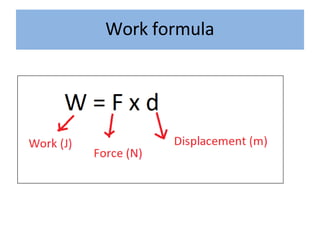
Work formula
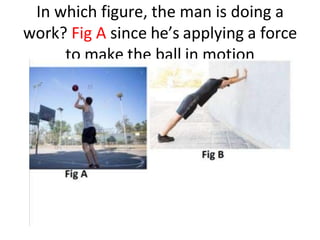
In which figure, the man is doing a
work? Fig A since he’s applying a force
to make the ball in motion
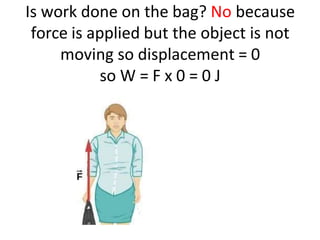
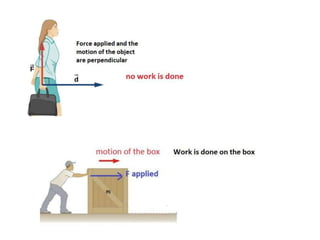
Is work done on the bag? No because
force is applied but the object is not
moving so displacement = 0
so W = F x 0 = 0 J
Sample Problem
Your car has run out of gas. Fortunately, there is a gas
station nearby. You must exert a force of 715 N on the
car in order to move it for 38 meters. Calculate the work
done to move the car.
Given : F= 715 N , d= 38 m
Unknown: W=??
Formula : W = F x d = 715 x 38 = 27170 J
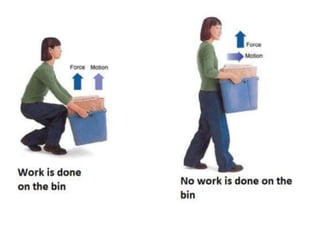
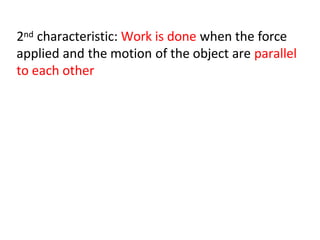
2nd characteristic: Work is done when the force
applied and the motion of the object are parallel
to each other
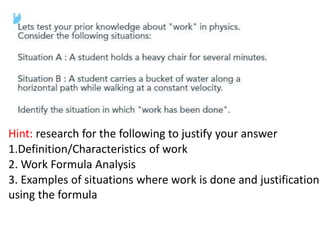
Hint: research for the following to justify your answer
1.Definition/Characteristics of work
2. Work Formula Analysis
3. Examples of situations where work is done and justification
using the formula
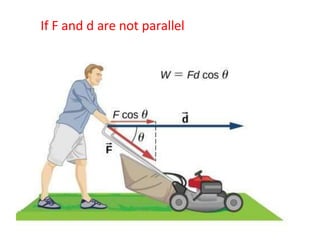
If F and d are not parallel
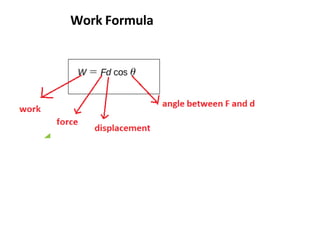
Work Formula
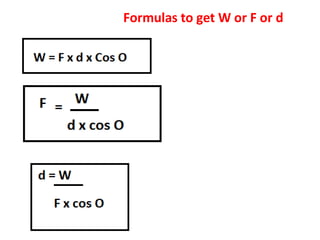
Formulas to get W or F or d
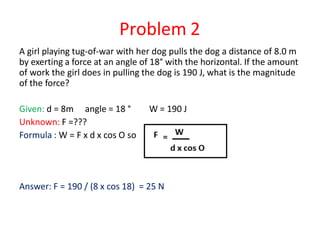
Problem 2
A girl playing tug-of-war with her dog pulls the dog a distance of 8.0 m
by exerting a force at an angle of 18° with the horizontal. If the amount
of work the girl does in pulling the dog is 190 J, what is the magnitude
of the force?
Given: d = 8m angle = 18 °
Unknown: F =???
Formula : W = F x d x cos O so
W = 190 J
Answer: F = 190 / (8 x cos 18) = 25 N
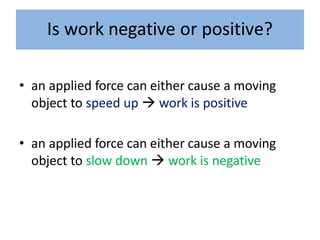
Is work negative or positive?
• an applied force can either cause a moving
object to speed up  work is positive
• an applied force can either cause a moving
object to slow down  work is negative
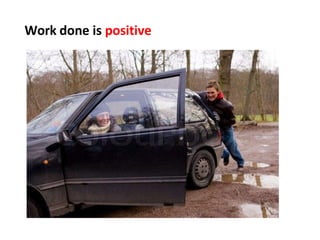
Work done is positive
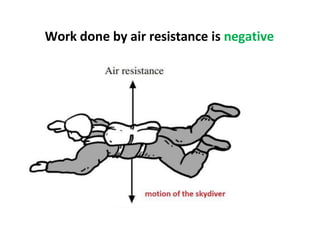
Work done by air resistance is negative
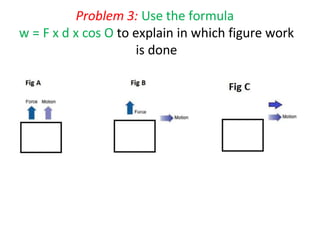
Problem 3: Use the formula
w = F x d x cos O to explain in which figure work
is done
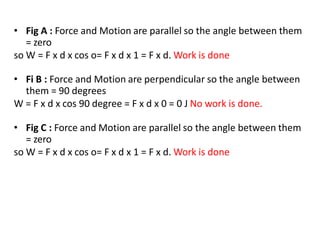
• Fig A : Force and Motion are parallel so the angle between them
= zero
so W = F x d x cos o= F x d x 1 = F x d. Work is done
• Fi B : Force and Motion are perpendicular so the angle between
them = 90 degrees
W = F x d x cos 90 degree = F x d x 0 = 0 J No work is done.
• Fig C : Force and Motion are parallel so the angle between them
= zero
so W = F x d x cos o= F x d x 1 = F x d. Work is done
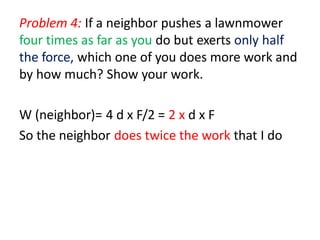
Problem 4: If a neighbor pushes a lawnmower
four times as far as you do but exerts only half
the force, which one of you does more work and
by how much? Show your work.
W (neighbor)= 4 d x F/2 = 2 x d x F
So the neighbor does twice the work that I do
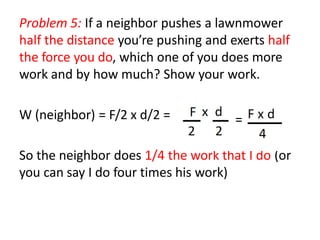
Problem 5: If a neighbor pushes a lawnmower
half the distance you’re pushing and exerts half
the force you do, which one of you does more
work and by how much? Show your work.
W (neighbor) = F/2 x d/2 =
So the neighbor does 1/4 the work that I do (or
you can say I do four times his work)
Bonus Problem 6:
The largest turtle ever caught in the United States had a mass of
800 kg. Suppose this turtle was raised 5.45 m onto the deck of a
research ship. What is the work it takes to lift the turtle this
distance at a constant velocity?

Chapter 5-Work and Energy.Student edition.pptx

  • 1.
    Chapter 5: Workand Energy
  • 2.
    • 1st characteristic:Work is done when the force applied causes a displacement of the object (the object moves)
  • 3.
  • 4.
    In which figure,the man is doing a work? Fig A since he’s applying a force to make the ball in motion
  • 5.
    Is work doneon the bag? No because force is applied but the object is not moving so displacement = 0 so W = F x 0 = 0 J
  • 6.
    Sample Problem Your carhas run out of gas. Fortunately, there is a gas station nearby. You must exert a force of 715 N on the car in order to move it for 38 meters. Calculate the work done to move the car. Given : F= 715 N , d= 38 m Unknown: W=?? Formula : W = F x d = 715 x 38 = 27170 J
  • 8.
    2nd characteristic: Workis done when the force applied and the motion of the object are parallel to each other
  • 9.
    Hint: research forthe following to justify your answer 1.Definition/Characteristics of work 2. Work Formula Analysis 3. Examples of situations where work is done and justification using the formula
  • 11.
    If F andd are not parallel
  • 12.
  • 13.
    Formulas to getW or F or d
  • 14.
    Problem 2 A girlplaying tug-of-war with her dog pulls the dog a distance of 8.0 m by exerting a force at an angle of 18° with the horizontal. If the amount of work the girl does in pulling the dog is 190 J, what is the magnitude of the force? Given: d = 8m angle = 18 ° Unknown: F =??? Formula : W = F x d x cos O so W = 190 J Answer: F = 190 / (8 x cos 18) = 25 N
  • 15.
    Is work negativeor positive? • an applied force can either cause a moving object to speed up  work is positive • an applied force can either cause a moving object to slow down  work is negative
  • 16.
    Work done ispositive
  • 17.
    Work done byair resistance is negative
  • 18.
    Problem 3: Usethe formula w = F x d x cos O to explain in which figure work is done
  • 19.
    • Fig A: Force and Motion are parallel so the angle between them = zero so W = F x d x cos o= F x d x 1 = F x d. Work is done • Fi B : Force and Motion are perpendicular so the angle between them = 90 degrees W = F x d x cos 90 degree = F x d x 0 = 0 J No work is done. • Fig C : Force and Motion are parallel so the angle between them = zero so W = F x d x cos o= F x d x 1 = F x d. Work is done
  • 20.
    Problem 4: Ifa neighbor pushes a lawnmower four times as far as you do but exerts only half the force, which one of you does more work and by how much? Show your work. W (neighbor)= 4 d x F/2 = 2 x d x F So the neighbor does twice the work that I do
  • 21.
    Problem 5: Ifa neighbor pushes a lawnmower half the distance you’re pushing and exerts half the force you do, which one of you does more work and by how much? Show your work. W (neighbor) = F/2 x d/2 = So the neighbor does 1/4 the work that I do (or you can say I do four times his work)
  • 22.
    Bonus Problem 6: Thelargest turtle ever caught in the United States had a mass of 800 kg. Suppose this turtle was raised 5.45 m onto the deck of a research ship. What is the work it takes to lift the turtle this distance at a constant velocity?