Our Father
Who art in heaven,
Hollowed be Thy name,
Thy kingdom come,
Thy will be done
On earth as it is in heaven.
Give us this day our daily bread
and forgive us our trespasses
as we forgive those who
trespass against us,
and lead us not into temptation
but deliver us from evil.
Amen
Opening Prayer
RECALL
QUARTER 1 -
MODULE 3: WORK
MOST ESSENTIAL LEARNING
COMPETENCY
•Identify and explain the factors that
affect potential and kinetic energy.
•(S8FE-Ic-20)
Objectives:
•1.Define work scientifically
•2.Identify situations in which work
is done and in which no work is
done.
What is
WORK?
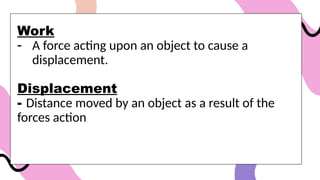
Work
- A force acting upon an object to cause a
displacement.
Displacement
- Distance moved by an object as a result of the
forces action
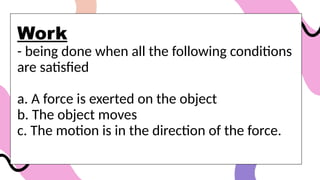
Work
- being done when all the following conditions
are satisfied
a. A force is exerted on the object
b. The object moves
c. The motion is in the direction of the force.
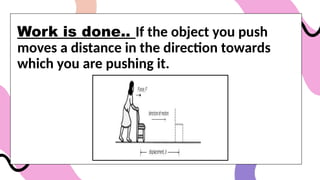
Work is done.. If the object you push
moves a distance in the direction towards
which you are pushing it.
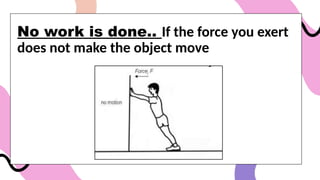
No work is done.. If the force you exert
does not make the object move
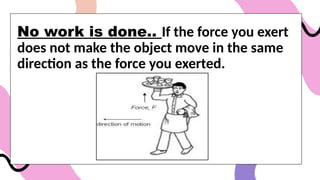
No work is done.. If the force you exert
does not make the object move in the same
direction as the force you exerted.
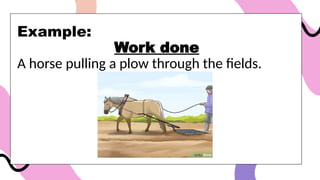
Example:
Work done
A horse pulling a plow through the fields.
Example:
Work done
A father pushing a grocery cart down the aisle
of a grocery store.
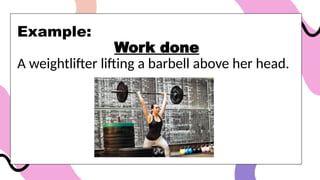
Example:
Work done
A weightlifter lifting a barbell above her head.
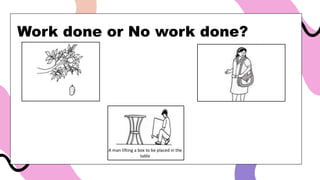
Work done or No work done?
CALCULATING
WORK
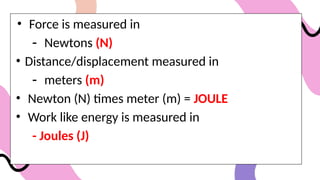
• Force is measured in
- Newtons (N)
• Distance/displacement measured in
- meters (m)
• Newton (N) times meter (m) = JOULE
• Work like energy is measured in
- Joules (J)
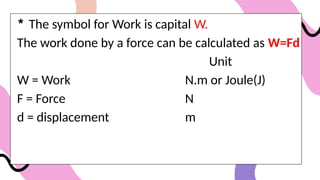
* The symbol for Work is capital W.
The work done by a force can be calculated as W=Fd
Unit
W = Work N.m or Joule(J)
F = Force N
d = displacement m
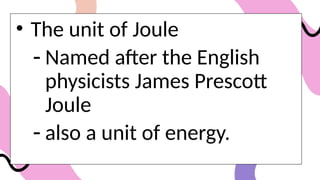
• The unit of Joule
- Named after the English
physicists James Prescott
Joule
- also a unit of energy.
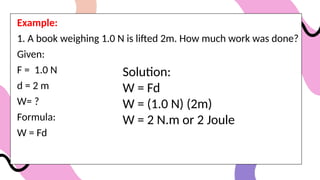
Example:
1. A book weighing 1.0 N is lifted 2m. How much work was done?
Given:
F = 1.0 N
d = 2 m
W= ?
Formula:
W = Fd
Solution:
W = Fd
W = (1.0 N) (2m)
W = 2 N.m or 2 Joule
Example:
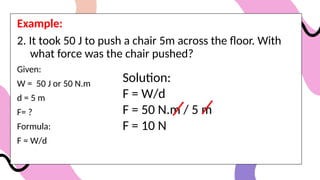
2. It took 50 J to push a chair 5m across the floor. With
what force was the chair pushed?
Given:
W = 50 J or 50 N.m
d = 5 m
F= ?
Formula:
F = W/d
Solution:
F = W/d
F = 50 N.m / 5 m
F = 10 N
Example:
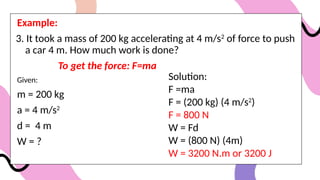
3. It took a mass of 200 kg accelerating at 4 m/s2
of force to push
a car 4 m. How much work is done?
To get the force: F=ma
Given:
m = 200 kg
a = 4 m/s2
d = 4 m
W = ?
Solution:
F =ma
F = (200 kg) (4 m/s2
)
F = 800 N
W = Fd
W = (800 N) (4m)
W = 3200 N.m or 3200 J
Let us check
your
understanding!
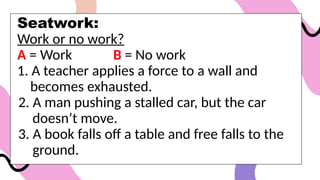
Seatwork:
Work or no work?
A = Work B = No work
1. A teacher applies a force to a wall and
becomes exhausted.
2. A man pushing a stalled car, but the car
doesn’t move.
3. A book falls off a table and free falls to the
ground.
Seatwork:
Work or no work?
A = Work B = No work
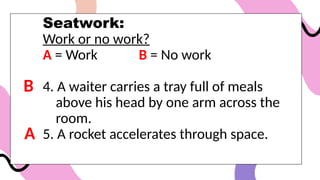
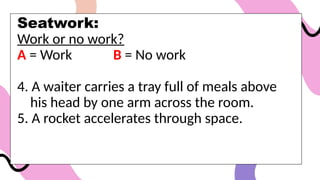
4. A waiter carries a tray full of meals above
his head by one arm across the room.
5. A rocket accelerates through space.
Seatwork:
Work or no work?
A = Work B = No work
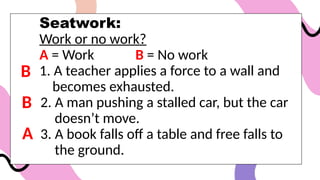
1. A teacher applies a force to a wall and
becomes exhausted.
2. A man pushing a stalled car, but the car
doesn’t move.
3. A book falls off a table and free falls to
the ground.
B
B
A
Seatwork:
Work or no work?
A = Work B = No work
4. A waiter carries a tray full of meals
above his head by one arm across the
room.
5. A rocket accelerates through space.
B
A
5. Science grade lesson 8  about  work.pptx

5. Science grade lesson 8 about work.pptx

  • 1.
    Our Father Who artin heaven, Hollowed be Thy name, Thy kingdom come, Thy will be done On earth as it is in heaven. Give us this day our daily bread and forgive us our trespasses as we forgive those who trespass against us, and lead us not into temptation but deliver us from evil. Amen Opening Prayer
  • 3.
  • 4.
  • 5.
    MOST ESSENTIAL LEARNING COMPETENCY •Identifyand explain the factors that affect potential and kinetic energy. •(S8FE-Ic-20)
  • 6.
    Objectives: •1.Define work scientifically •2.Identifysituations in which work is done and in which no work is done.
  • 7.
  • 8.
    Work - A forceacting upon an object to cause a displacement. Displacement - Distance moved by an object as a result of the forces action
  • 9.
    Work - being donewhen all the following conditions are satisfied a. A force is exerted on the object b. The object moves c. The motion is in the direction of the force.
  • 10.
    Work is done..If the object you push moves a distance in the direction towards which you are pushing it.
  • 11.
    No work isdone.. If the force you exert does not make the object move
  • 12.
    No work isdone.. If the force you exert does not make the object move in the same direction as the force you exerted.
  • 13.
    Example: Work done A horsepulling a plow through the fields.
  • 14.
    Example: Work done A fatherpushing a grocery cart down the aisle of a grocery store.
  • 15.
    Example: Work done A weightlifterlifting a barbell above her head.
  • 17.
    Work done orNo work done?
  • 18.
  • 19.
    • Force ismeasured in - Newtons (N) • Distance/displacement measured in - meters (m) • Newton (N) times meter (m) = JOULE • Work like energy is measured in - Joules (J)
  • 20.
    * The symbolfor Work is capital W. The work done by a force can be calculated as W=Fd Unit W = Work N.m or Joule(J) F = Force N d = displacement m
  • 21.
    • The unitof Joule - Named after the English physicists James Prescott Joule - also a unit of energy.
  • 22.
    Example: 1. A bookweighing 1.0 N is lifted 2m. How much work was done? Given: F = 1.0 N d = 2 m W= ? Formula: W = Fd Solution: W = Fd W = (1.0 N) (2m) W = 2 N.m or 2 Joule
  • 23.
    Example: 2. It took50 J to push a chair 5m across the floor. With what force was the chair pushed? Given: W = 50 J or 50 N.m d = 5 m F= ? Formula: F = W/d Solution: F = W/d F = 50 N.m / 5 m F = 10 N
  • 24.
    Example: 3. It tooka mass of 200 kg accelerating at 4 m/s2 of force to push a car 4 m. How much work is done? To get the force: F=ma Given: m = 200 kg a = 4 m/s2 d = 4 m W = ? Solution: F =ma F = (200 kg) (4 m/s2 ) F = 800 N W = Fd W = (800 N) (4m) W = 3200 N.m or 3200 J
  • 26.
  • 27.
    Seatwork: Work or nowork? A = Work B = No work 1. A teacher applies a force to a wall and becomes exhausted. 2. A man pushing a stalled car, but the car doesn’t move. 3. A book falls off a table and free falls to the ground.
  • 28.
    Seatwork: Work or nowork? A = Work B = No work 4. A waiter carries a tray full of meals above his head by one arm across the room. 5. A rocket accelerates through space.
  • 29.
    Seatwork: Work or nowork? A = Work B = No work 1. A teacher applies a force to a wall and becomes exhausted. 2. A man pushing a stalled car, but the car doesn’t move. 3. A book falls off a table and free falls to the ground. B B A
  • 30.
    Seatwork: Work or nowork? A = Work B = No work 4. A waiter carries a tray full of meals above his head by one arm across the room. 5. A rocket accelerates through space. B A

Editor's Notes

  • #19 Two factors affecting work are force and distance/displacement