Reflective Writing for
Postgraduates
• Explain what reflective writing is
• Evaluate examples of reflective writing
• Synthesise your experiences and
theory to write reflectively
Rhian Wyn-Williams
Skills@ljmu.ac.uk
Reflect on your reflections….
Think back to your previous reflective assignments.
What went well and what aspect of your reflective
writing do you want to improve?
Note this down.
What does good reflective
writing look like?
• You have extracts from previous
students’ reflections.
• Which one is better? A or B?
• Based on your evaluation of them, what
do you think good reflective writing
looks like? Write your comments in the
chat box.
So, what is academic reflection?
Think about the
literature, policy and
professional
frameworks from your
subject area
For example,
think about how
you are working
on your
placement or in
your
employment. You
may need to
think about your
experiences in
university too.
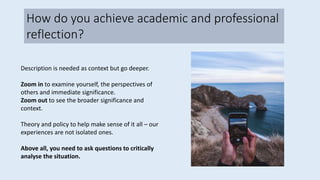
Description is needed as context but go deeper.
Zoom in to examine yourself, the perspectives of
others and immediate significance.
Zoom out to see the broader significance and
context.
Theory and policy to help make sense of it all – our
experiences are not isolated ones.
Above all, you need to ask questions to critically
analyse the situation.
How do you achieve academic and professional
reflection?
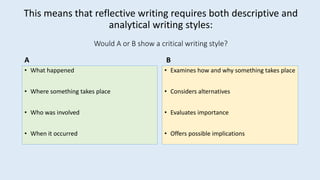
This means that reflective writing requires both descriptive and
analytical writing styles:
Would A or B show a critical writing style?
A
• What happened
• Where something takes place
• Who was involved
• When it occurred
B
• Examines how and why something takes place
• Considers alternatives
• Evaluates importance
• Offers possible implications
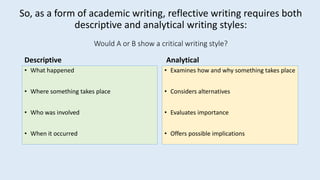
So, as a form of academic writing, reflective writing requires both
descriptive and analytical writing styles:
Would A or B show a critical writing style?
Descriptive
• What happened
• Where something takes place
• Who was involved
• When it occurred
Analytical
• Examines how and why something takes place
• Considers alternatives
• Evaluates importance
• Offers possible implications
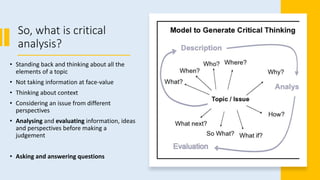
So, what is critical
analysis?
• Standing back and thinking about all the
elements of a topic
• Not taking information at face-value
• Thinking about context
• Considering an issue from different
perspectives
• Analysing and evaluating information, ideas
and perspectives before making a
judgement
• Asking and answering questions
Analyse your
experience/incident
Interrogate yourself – keep pushing! Imagine
you have someone with you asking more and
more questions.
• What happened?
• Why did this happen?
• How did/do they feel about the incident? Why?
• What and how can you learn from theory and practice about your
experience?
• What is its significance?​ Why?
• How valuable was the experience?​ Why? How will you use it?
• What exactly did/would they do differently next time?
Use a reflective
model
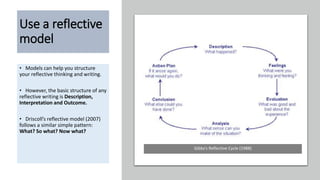
• Models can help you structure
your reflective thinking and writing.
• However, the basic structure of any
reflective writing is Description,
Interpretation and Outcome.
• Driscoll’s reflective model (2007)
follows a similar simple pattern:
What? So what? Now what?
Gibbs’s Reflective Cycle (1988)
Cooperation between group members was at risk because of
this perception of unfairness. Social interdependence theory
recognises a type of group interaction called ‘positive
interdependence’, meaning cooperation (Johnson & Johnson,
1993, cited by Maughan & Webb, 2001), and many studies have
demonstrated that “cooperative learning experiences
encourage higher achievement” (Maughan & Webb, 2001).
Ultimately, our group achieved a successful outcome, but to
improve the process, we perhaps needed a chairperson to help
encourage cooperation when tasks were being shared out. In
future group work, on the course and at work, I would probably
suggest this.
Specific tasks were shared out amongst members of my team.
Initially, however, the tasks were not seen as equally difficult by
all team members.
For each section:
A =
Description
B =
Interpretation
C =
Outcome
Description, Interpretation, Outcome: which section is which?
Specific tasks were shared out amongst members of my
team. Initially, however, the tasks were not seen as equally
difficult by all team members. Cooperation between group
members was at risk because of this perception of
unfairness. Social interdependence theory recognises a
type of group interaction called ‘positive interdependence’,
meaning cooperation (Johnson & Johnson, 1993, cited by
Maughan & Webb, 2001), and many studies have
demonstrated that “cooperative learning experiences
encourage higher achievement” (Maughan & Webb, 2001).
Ultimately, our group achieved a successful outcome, but
to improve the process, we perhaps needed a chairperson
to help encourage cooperation when tasks were being
shared out. In future group work, on the course and at
work, I would probably suggest this.
Description
Interpretation
Outcome
Features of the language of
reflective writing:
• First person-when expressing personal experiences,
observations or opinions.
• Third person-when referring to theory or other
writers, write in the third person. Refer to other
writers by name.
• Actions (verbs)-usually those of feeling and thinking,
e.g. feeling, felt, considered, experienced, wondered,
remembered, discovered, learned.
• Hedging- using words like ‘may’, ‘perhaps’ or ‘might’
help demonstrate that you are aware that you are
considering different perspectives, experiences,
lenses, and that critical analysis does not make
something 100% certain.
Reflect on your
reflections….
Go back to you what has gone well and
what you would like to improve.
What will you now do to make that
improvement?
Note this down as a reminder for when
you are next writing a piece of reflection.
Next steps: postgraduate webinars to come
Next week:
Editing and Proofreading
Dissertations: Question Time
Academic Writing: case studies
Week starting 6th April:
Editing and Proofreading
Dissertations: Question Time
Look out for further webinars to be
announced.

Pg reflective writing webinar

  • 1.
    Reflective Writing for Postgraduates •Explain what reflective writing is • Evaluate examples of reflective writing • Synthesise your experiences and theory to write reflectively Rhian Wyn-Williams Skills@ljmu.ac.uk
  • 2.
    Reflect on yourreflections…. Think back to your previous reflective assignments. What went well and what aspect of your reflective writing do you want to improve? Note this down.
  • 3.
    What does goodreflective writing look like? • You have extracts from previous students’ reflections. • Which one is better? A or B? • Based on your evaluation of them, what do you think good reflective writing looks like? Write your comments in the chat box.
  • 4.
    So, what isacademic reflection? Think about the literature, policy and professional frameworks from your subject area For example, think about how you are working on your placement or in your employment. You may need to think about your experiences in university too.
  • 5.
    Description is neededas context but go deeper. Zoom in to examine yourself, the perspectives of others and immediate significance. Zoom out to see the broader significance and context. Theory and policy to help make sense of it all – our experiences are not isolated ones. Above all, you need to ask questions to critically analyse the situation. How do you achieve academic and professional reflection?
  • 6.
    This means thatreflective writing requires both descriptive and analytical writing styles: Would A or B show a critical writing style? A • What happened • Where something takes place • Who was involved • When it occurred B • Examines how and why something takes place • Considers alternatives • Evaluates importance • Offers possible implications
  • 7.
    So, as aform of academic writing, reflective writing requires both descriptive and analytical writing styles: Would A or B show a critical writing style? Descriptive • What happened • Where something takes place • Who was involved • When it occurred Analytical • Examines how and why something takes place • Considers alternatives • Evaluates importance • Offers possible implications
  • 8.
    So, what iscritical analysis? • Standing back and thinking about all the elements of a topic • Not taking information at face-value • Thinking about context • Considering an issue from different perspectives • Analysing and evaluating information, ideas and perspectives before making a judgement • Asking and answering questions
  • 9.
    Analyse your experience/incident Interrogate yourself– keep pushing! Imagine you have someone with you asking more and more questions. • What happened? • Why did this happen? • How did/do they feel about the incident? Why? • What and how can you learn from theory and practice about your experience? • What is its significance?​ Why? • How valuable was the experience?​ Why? How will you use it? • What exactly did/would they do differently next time?
  • 10.
    Use a reflective model •Models can help you structure your reflective thinking and writing. • However, the basic structure of any reflective writing is Description, Interpretation and Outcome. • Driscoll’s reflective model (2007) follows a similar simple pattern: What? So what? Now what? Gibbs’s Reflective Cycle (1988)
  • 11.
    Cooperation between groupmembers was at risk because of this perception of unfairness. Social interdependence theory recognises a type of group interaction called ‘positive interdependence’, meaning cooperation (Johnson & Johnson, 1993, cited by Maughan & Webb, 2001), and many studies have demonstrated that “cooperative learning experiences encourage higher achievement” (Maughan & Webb, 2001). Ultimately, our group achieved a successful outcome, but to improve the process, we perhaps needed a chairperson to help encourage cooperation when tasks were being shared out. In future group work, on the course and at work, I would probably suggest this. Specific tasks were shared out amongst members of my team. Initially, however, the tasks were not seen as equally difficult by all team members. For each section: A = Description B = Interpretation C = Outcome Description, Interpretation, Outcome: which section is which?
  • 12.
    Specific tasks wereshared out amongst members of my team. Initially, however, the tasks were not seen as equally difficult by all team members. Cooperation between group members was at risk because of this perception of unfairness. Social interdependence theory recognises a type of group interaction called ‘positive interdependence’, meaning cooperation (Johnson & Johnson, 1993, cited by Maughan & Webb, 2001), and many studies have demonstrated that “cooperative learning experiences encourage higher achievement” (Maughan & Webb, 2001). Ultimately, our group achieved a successful outcome, but to improve the process, we perhaps needed a chairperson to help encourage cooperation when tasks were being shared out. In future group work, on the course and at work, I would probably suggest this. Description Interpretation Outcome
  • 13.
    Features of thelanguage of reflective writing: • First person-when expressing personal experiences, observations or opinions. • Third person-when referring to theory or other writers, write in the third person. Refer to other writers by name. • Actions (verbs)-usually those of feeling and thinking, e.g. feeling, felt, considered, experienced, wondered, remembered, discovered, learned. • Hedging- using words like ‘may’, ‘perhaps’ or ‘might’ help demonstrate that you are aware that you are considering different perspectives, experiences, lenses, and that critical analysis does not make something 100% certain.
  • 14.
    Reflect on your reflections…. Goback to you what has gone well and what you would like to improve. What will you now do to make that improvement? Note this down as a reminder for when you are next writing a piece of reflection.
  • 15.
    Next steps: postgraduatewebinars to come Next week: Editing and Proofreading Dissertations: Question Time Academic Writing: case studies Week starting 6th April: Editing and Proofreading Dissertations: Question Time Look out for further webinars to be announced.

Editor's Notes

  • #3 Need at 15 minutes. This works as substantial activity to assess their learning as they will all (hopefully) be saying something about what they will take away and use in their own assignments, as well as a plenary through the reviewing of them (either by circulating the room and then summarising the key feedback points to the whole group or by reading them out, depending on the size of the group – would also work, if time, as a peer review activity). The quotations they have been given are: Reflection is “… consideration of the larger context, the meaning, and the implications of an experience or action” (Branch & Paranjape, 2002, p. 1185)   “Student responses often differ markedly form what teachers have expected on their basis of their own feelings in the classroom” (Brookfield, 1995, pp. 95-96)   “Once the situation has been analysed, you can plan for a response or a strategy2 (Tripp, 1993, p. 72)   “Reflection lies somewhere around the notion of learning and thinking. We reflect in order to learn.” (Moon, 2004, p.12) I also tell them here that they could even make some references to literature/policy up if they don’t remember any off the top of their heads and they want to say something not directly related to reflection using the quotations given to them– it’s really to show that they know where and how to integrate the literature.
  • #4 10 minutes in total, including Q and A/discussion as feedback – get them to clearly and precisely identify the features of good reflective writing.
  • #5 Use to reinforce their comment and to explain a little further how the refection is where the experience and the theory collide – how they won’t working/learning in a vacuum but in this broader context.
  • #6 Emphasise that academic and professional reflection is not the same as just reflecting. This can be done as a whole group Q and Abut they need to develop their initial comments by focusing more on exactly how the sample pieces are demonstrating these features (what bigger context exactly is being shown and how)– get some focus on critical analysis (how are they showing it?) – this will lead into a What is Critical Analysis discussion – could ask each student to define it as a way of checking current levels of knowledge/understanding/application.
  • #7 Reiterate here that reflective writing needs both of these styles but it is the critical that really enables true reflection, which leads into the next slide
  • #8 Reiterate here that reflective writing needs both of these styles but it is the critical that really enables true reflection, which leads into the next slide
  • #9 Hopefully just a check list after the previous discussion. It is worth going through these and asking them for examples of each using what they have studied so far on their course
  • #10 10 minutes. Explain how this works as learner cell –– it’s not a discussion but question and answer – can only ask questions/answer them taking it in turn. Encourage them to challenge in their questions: keep asking why, how etc until ‘satisfied’. Could relate their questions back also to the questions to trigger critical analysis already discussed. Get each pair to share what they have learnt about their partners ‘incident’ and what their partner has learnt from it.. Open up to how far this has deepened their reflections. Were they able to refer to any literature/policy? Leads into next slide
  • #11 Highlight the variety with some examples (Brookfield, Johnson and Johnson, Tripp….which are the most suitable for the subject) but they all share the DIO basis
  • #14 Ask them to go back and identify any of these features in the sample paragraphs they have just used - open it up to for 5 minutes or so