MANAGEMENT
INFORMATION
SYSTEM
DIPANTI JOSHI
• Satyam Pandey
• Hiral Shah
• Riya Raval
• Pooja Shukla
• Janki Pandya
• Jay shah
Group members.
PROCTER & GEMBLE
HISTORY
Their father in law called a meeting and
persuaded his son in laws become business
partners. On the 31st of October the Procter &
Gamble company was created.
They began by supplying the Union army
with soap and candles
P&G AT Glance
• Parent company - Procter & Gamble (P&G)
• Founded in - 1837
• Category - Consumer Products(FMCG)
• Tagline - Touching Lives, improving Life
• Brands Portfolio - Moreover 300 brands worldwide
• USP - Business experience over 170 years &
spread
over 180 countries
OPRATIONS & PRODUCTS
• Beauty segment
• Grooming segment
• Health Care segment
• Snacks & Pet Care segment
• Fabric care & home care segment
• Baby care & family home care segment
GLOBAL PRESENCE
• ASIA : CHINA, JAPAN, KOREA, HONG CONG, INDIA, etc.
• NORTH AMERICA
• WESTERN EUROPE
• LATIN AMERICA
• AUSTRALIA
THE 10 PILLARS OF P&G (GLOBALLY)
• Arial
• Downy
• Head & shoulders
• Joy
• Olay
• Pampers
• Pantene
• Safeguard
• Tide
• Whisper
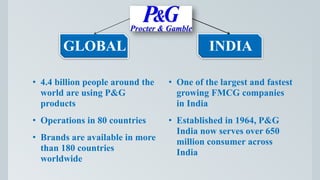
GLOBAL
• 4.4 billion people around the
world are using P&G
products
• Operations in 80 countries
• Brands are available in more
than 180 countries
worldwide
INDIA
• One of the largest and fastest
growing FMCG companies
in India
• Established in 1964, P&G
India now serves over 650
million consumer across
India
CURRENT STRATEGIES
• Consumers will pay a premium price for products the offer
improvements over either private label products or the brands
they have bought for years.
• Product innovation must be regular with visible improvements
year constantly.
• Products innovation must be designed to constantly “up scale”
consumer preference.
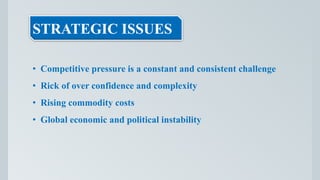
STRATEGIC ISSUES
• Competitive pressure is a constant and consistent challenge
• Rick of over confidence and complexity
• Rising commodity costs
• Global economic and political instability
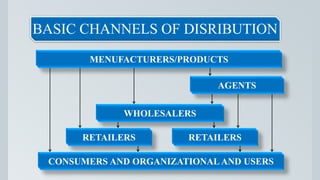
BASIC CHANNELS OF DISRIBUTION
MENUFACTURERS/PRODUCTS
AGENTS
RETAILERS
WHOLESALERS
CONSUMERS AND ORGANIZATIONAL AND USERS
RETAILERS
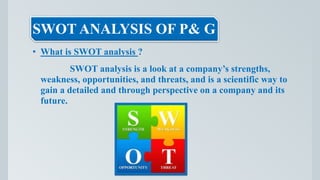
SWOT ANALYSIS OF P& G
• What is SWOT analysis ?
SWOT analysis is a look at a company’s strengths,
weakness, opportunities, and threats, and is a scientific way to
gain a detailed and through perspective on a company and its
future.
• COMPONENTS OF SWOT ANALYSIS
INTERNAL – strengths & weakness of a firm
EXTERNAL – opportunities & threats of a firm
• IMPORTANCE
SWOT analysis helps to make business plan &
strategies for future
STRENGTHS
• The company is valued at $191.47 billion on the market
• P&G has over 300 brands globally which are available in over
180 countries
• It has around 25 brands have annual sales over a billion dollars
• Over 125000 people are employed in P&G globally
• Many of P&G products are considered non cyclical
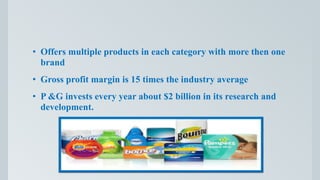
• Offers multiple products in each category with more then one
brand
• Gross profit margin is 15 times the industry average
• P &G invests every year about $2 billion in its research and
development.
WEAKNESS
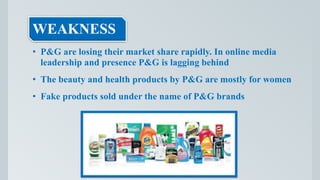
• P&G are losing their market share rapidly. In online media
leadership and presence P&G is lagging behind
• The beauty and health products by P&G are mostly for women
• Fake products sold under the name of P&G brands
OPPORTUNITIONS
• Tap rural markets and increase penetration in urban areas
• The exponential growth of the middle class in emerging
markets such china and India
• An opportunity for P&G is health and beauty products for
man.
• The online social networks and internet marketing techniques
is also an opportunity for P&G
• Going green/eco friendly
THREATS
• There is cut throat competition in the market.
• In the market many substitutes are available for P&G
products at cheaper prices.
• The private label growth is also a serious threat to the P&G
market value due to recession, the consumer spending has
decreased globally.
• Raw materials are increasing cost to the company is increasing
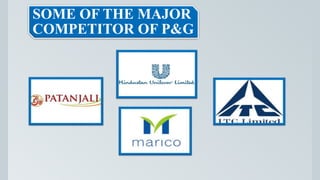
SOME OF THE MAJOR
COMPETITOR OF P&G
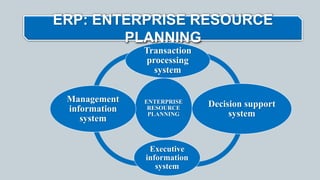
ERP: ENTERPRISE RESOURCE
PLANNING
ENTERPRISE
RESOURCE
PLANNING
Transaction
processing
system
Decision support
system
Executive
information
system
Management
information
system
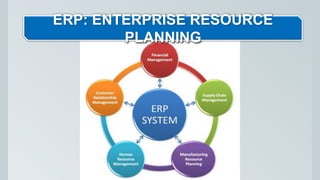
ERP: ENTERPRISE RESOURCE
PLANNING
FUTURE PLANS OF P&G
• P&G tie up with Wal-Mart and KROGES in the U.S. It is a
win win deal.
• P&G plans for a panels in Germany beauty plan.
FUTURE PLANS OF P&G
ONLINE MARKETING
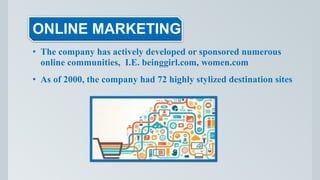
• The company has actively developed or sponsored numerous
online communities, I.E. beinggirl.com, women.com
• As of 2000, the company had 72 highly stylized destination sites
P&G
CONCLUSION
• As we know this market is known as FMCG market so there
are many competitor in this time in this market so P&G wants
to focus on middle class segment for increasing their sales as
wall as there market share.
• Some products like Gillett's is made by the company to target
the high segment of market.
• In India HUL is biggest competitor of P&G.
P & g

P & g

  • 1.
  • 2.
    • Satyam Pandey •Hiral Shah • Riya Raval • Pooja Shukla • Janki Pandya • Jay shah Group members.
  • 3.
  • 4.
    HISTORY Their father inlaw called a meeting and persuaded his son in laws become business partners. On the 31st of October the Procter & Gamble company was created. They began by supplying the Union army with soap and candles
  • 5.
    P&G AT Glance •Parent company - Procter & Gamble (P&G) • Founded in - 1837 • Category - Consumer Products(FMCG) • Tagline - Touching Lives, improving Life • Brands Portfolio - Moreover 300 brands worldwide • USP - Business experience over 170 years & spread over 180 countries
  • 7.
    OPRATIONS & PRODUCTS •Beauty segment • Grooming segment • Health Care segment • Snacks & Pet Care segment • Fabric care & home care segment • Baby care & family home care segment
  • 8.
    GLOBAL PRESENCE • ASIA: CHINA, JAPAN, KOREA, HONG CONG, INDIA, etc. • NORTH AMERICA • WESTERN EUROPE • LATIN AMERICA • AUSTRALIA
  • 9.
    THE 10 PILLARSOF P&G (GLOBALLY) • Arial • Downy • Head & shoulders • Joy • Olay • Pampers • Pantene • Safeguard • Tide • Whisper
  • 12.
    GLOBAL • 4.4 billionpeople around the world are using P&G products • Operations in 80 countries • Brands are available in more than 180 countries worldwide INDIA • One of the largest and fastest growing FMCG companies in India • Established in 1964, P&G India now serves over 650 million consumer across India
  • 13.
    CURRENT STRATEGIES • Consumerswill pay a premium price for products the offer improvements over either private label products or the brands they have bought for years. • Product innovation must be regular with visible improvements year constantly. • Products innovation must be designed to constantly “up scale” consumer preference.
  • 14.
    STRATEGIC ISSUES • Competitivepressure is a constant and consistent challenge • Rick of over confidence and complexity • Rising commodity costs • Global economic and political instability
  • 15.
    BASIC CHANNELS OFDISRIBUTION MENUFACTURERS/PRODUCTS AGENTS RETAILERS WHOLESALERS CONSUMERS AND ORGANIZATIONAL AND USERS RETAILERS
  • 16.
    SWOT ANALYSIS OFP& G • What is SWOT analysis ? SWOT analysis is a look at a company’s strengths, weakness, opportunities, and threats, and is a scientific way to gain a detailed and through perspective on a company and its future.
  • 17.
    • COMPONENTS OFSWOT ANALYSIS INTERNAL – strengths & weakness of a firm EXTERNAL – opportunities & threats of a firm • IMPORTANCE SWOT analysis helps to make business plan & strategies for future
  • 18.
    STRENGTHS • The companyis valued at $191.47 billion on the market • P&G has over 300 brands globally which are available in over 180 countries • It has around 25 brands have annual sales over a billion dollars • Over 125000 people are employed in P&G globally • Many of P&G products are considered non cyclical
  • 19.
    • Offers multipleproducts in each category with more then one brand • Gross profit margin is 15 times the industry average • P &G invests every year about $2 billion in its research and development.
  • 20.
    WEAKNESS • P&G arelosing their market share rapidly. In online media leadership and presence P&G is lagging behind • The beauty and health products by P&G are mostly for women • Fake products sold under the name of P&G brands
  • 21.
    OPPORTUNITIONS • Tap ruralmarkets and increase penetration in urban areas • The exponential growth of the middle class in emerging markets such china and India • An opportunity for P&G is health and beauty products for man. • The online social networks and internet marketing techniques is also an opportunity for P&G • Going green/eco friendly
  • 22.
    THREATS • There iscut throat competition in the market. • In the market many substitutes are available for P&G products at cheaper prices. • The private label growth is also a serious threat to the P&G market value due to recession, the consumer spending has decreased globally. • Raw materials are increasing cost to the company is increasing
  • 23.
    SOME OF THEMAJOR COMPETITOR OF P&G
  • 24.
    ERP: ENTERPRISE RESOURCE PLANNING ENTERPRISE RESOURCE PLANNING Transaction processing system Decisionsupport system Executive information system Management information system
  • 25.
  • 26.
    FUTURE PLANS OFP&G • P&G tie up with Wal-Mart and KROGES in the U.S. It is a win win deal. • P&G plans for a panels in Germany beauty plan.
  • 27.
  • 28.
    ONLINE MARKETING • Thecompany has actively developed or sponsored numerous online communities, I.E. beinggirl.com, women.com • As of 2000, the company had 72 highly stylized destination sites
  • 29.
  • 30.
    CONCLUSION • As weknow this market is known as FMCG market so there are many competitor in this time in this market so P&G wants to focus on middle class segment for increasing their sales as wall as there market share. • Some products like Gillett's is made by the company to target the high segment of market. • In India HUL is biggest competitor of P&G.